Feeds:
Posts
Comments

Posts Tagged ‘Occoquan Bay National Wildlife Refuge’

I often see vultures circling overhead when I am walking along the trails at Occoquan Bay National Wildlife Refuge. Although I have gotten used to their presence, I find them to be slightly spooky and I try to make sure I don’t stand still for too long a period, lest the vultures think that I am carrion.

Most of the vultures that I see are Turkey Vultures (Cathartes aura), like the one in the first photo. Occasionally, though, I also see Black Vultures (Coragyps atratus). How do I tell them apart? As you can see in the second photos, Turkey Vultures have red heads, while Black Vultures have black heads. In addition, the pattern of the light feathers on the underside of the wings of the two vultures is different. Black Vulture have patches of light feathers near the tips of the wings and Turkey Vultures have light feathers along almost the entire length of the trailing edges of the underside of their wings.

Turkey Vulture

vultures

© Michael Q. Powell. All rights reserved.

Read Full Post »

I had a lot of trouble trying to track this energetic Downy Woodpecker (Picoides pubescens) as it moved about among the branches of a tree last Friday at Occoquan Bay National Wildlife Refuge. It paused for a moment and I was able to capture this image in which it looks like the little woodpecker is posing for me and smiling.

Downy Woodpeckers are the smallest woodpeckers in my area—about six inches in length (15 cm)—and are the ones that I see most often. I am always struck by the high energy level and industriousness of these little birds that seem to be foraging all of the time.

Downy Woodpecker

© Michael Q. Powell. All rights reserved.


Read Full Post »

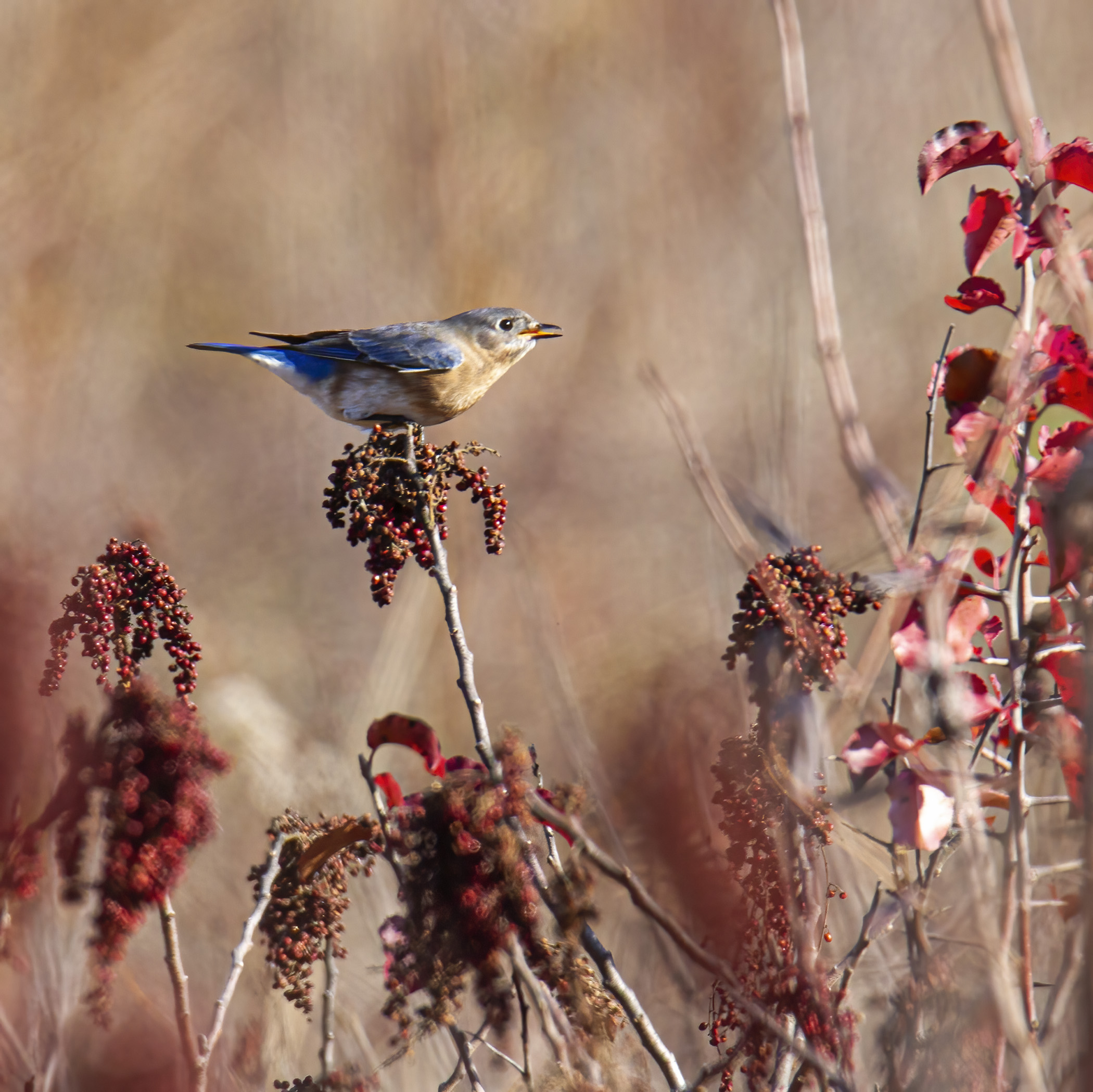
When there is an abundance of berries, how does a bird decide which one to eat first? I thought that a bird would select the one that was closest to it. However, when I watched an Eastern Bluebird (Sialia sialis) last Friday in a patch of sumac at Occoquan Bay National Wildlife Refuge, I realized that it had a different criterion for selecting berries.

I captured this little sequence of photos that showed a bluebird reaching down and carefully selecting a single berry that met its unstated criteria. After holding the berry in its beak momentarily, the bluebird swallowed the berry and, judging from the final berry, seemed to enjoy its flavor before choosing another one.

I am absolutely delighted to see bluebirds at this time of the year, when the number of birds has been steadily decreasing. These little birds, along with Northern Cardinals, add a burst of color during the long, gray days of the winter months.

bluebird

Bluebird

Bluebird

© Michael Q. Powell. All rights reserved.
Read Full Post »

I generally have trouble identifying trees, but one that I can often pick out is an American Sweetgum tree (Liquidambar styraciflua), thanks to its distinctive spiky balls. At certain times of the year the ground in various part of Occoquan Bay National Wildlife Refuge is carpeted with the spiky seedpods, making walking a bit uncomfortable.

Last Friday I watched a Carolina Chickadee as it extracted seeds from some of the spiky sweetgum balls still hanging from the tree branches. The chickadee would hang from its claws from one of the balls and thrust its beak into the center of the ball. Sometimes the long stem of the ball would sway a bit, but I never saw one give way—either the stem is really strong or the chickadee is really light (or both).

The chickadee was high in the tree, but I managed to capture this cool shot of the little bird in action.


Carolina Chickadee

© Michael Q. Powell. All rights reserved.


Read Full Post »

During the winter months it is not uncommon for me to see large flocks of European Starlings (Sturnus vulgaris). When the lighting is poor, they appear to be entirely black in color. When the sun is shining brightly, however, I am sometimes able to see the speckles in their feathers and a shiny iridescence that often looks greenish or pinkish in color.

This starling was part of a flock that I spotted on Friday at Occoquan Bay National Wildlife Refuge. The birds were foraging high in the trees and most of them flew away as I approached. This one hung around for a bit longer than the others, allowing me to capture these shots that highlight markings pretty well.

According to the Cornell Lab of Ornithology, “All the European Starlings in North America descended from 100 birds set loose in New York’s Central Park in the early 1890s. The birds were intentionally released by a group who wanted America to have all the birds that Shakespeare ever mentioned. It took several tries, but eventually the population took off. Today, more than 200 million European Starlings range from Alaska to Mexico, and many people consider them pests.”

Another fun fact that I learned on the Cornell Lab of Ornithology website relates to the feathers of this cool-looking bird. “Starlings turn from spotted and white to glossy and dark each year without shedding their feathers. The new feathers they grow in fall have bold white tips – that’s what gives them their spots. By spring, these tips have worn away, and the rest of the feather is dark and iridescent brown. It’s an unusual changing act that scientists term “wear molt.””

European Starling

European Starling

© Michael Q. Powell. All rights reserved.

Read Full Post »

It had been over a week since I last went out with my camera, so I was thrilled yesterday to walk the trails at Occoquan Bay National Wildlife Refuge. One of the first places where I usually look for activity is the large eagle nest shown in the second photo. It may be a little early for the eagles to begin nesting, but an eagle couple is often in the surrounding area at this time of the year.

I scanned the trees in the immediate area, but came up empty-handed. As I continued down the trail, however, I spotted the bright white head of a Bald Eagle (Haliaeetus leucocephalus). As I maneuvered about, trying to get a clear shot, I suddenly realized that there were two eagles partially hidden in the trees. I don’t know for sure if the eagles were a couple, for they seemed to be perched far apart for a couple—maybe the pandemic has caused the eagles to practice social distancing.

I was happy to be able to capture an image that shows both of the eagles pretty well. As I have said many times before, any day when I am able to photograph eagles is a good day.

Bald Eagles


eagle nest

© Michael Q. Powell. All rights reserved.

Read Full Post »

I hear hawks crying out more often than I see them. Quite often when I do manage to spot one, it is soaring high in the sky and my photos show only the underside of the hawk.

Last week, however, I managed to capture this image of a hawk as it flew by at treetop level at Occoquan Bay National Wildlife Refuge. I think that the bird is a Red-tailed Hawk (Buteo jamaicensis), but I must confess that I sometimes have trouble distinguishing between Red-tailed Hawks and Red-shouldered Hawks.

It almost looks like I was at eye level with the hawk when I took this photo, but I can confirm that my feet were firmly planted on the ground at that moment. I love the way that I was able to capture both wings in good positions as the hawk was flying and the determined, intensely-focused look on its face.

hawk

© Michael Q. Powell. All rights reserved.

Read Full Post »

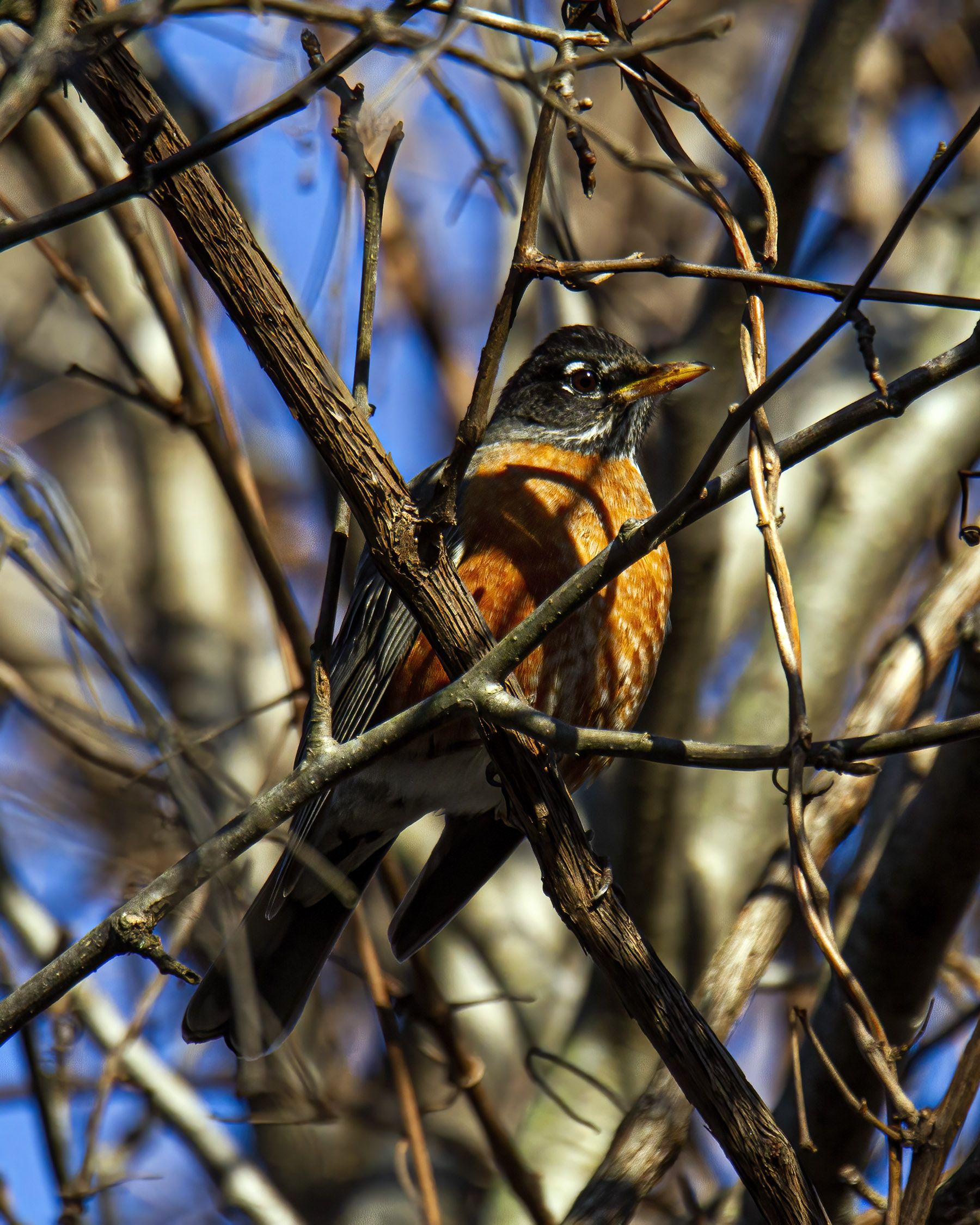
I really liked the way that the light was falling on the face of this Great Blue Heron (Ardea herodias), so I zoomed in close to capture this portrait-like headshot of the handsome heron last week at Occoquan Bay National Wildlife Refuge.

Great Blue Heron

© Michael Q. Powell. All rights reserved.
Read Full Post »

This Cedar Waxwing (Bombycilla cedrorum) had turned its head away from the light when I spotted it last week at Occoquan Bay National Wildlife Refuge, but I love the way that the light coming from the side illuminated the pale yellow color on its belly. I really like the rakish masks and crests of Cedar Waxwings. Normally the tips of their tails are bright yellow in color, but the tail of this one seemed to have a reddish-orange coloration.

Cedar Waxwing

© Michael Q. Powell. All rights reserved.


Read Full Post »

I first became aware of the presence of this Great Blue Heron (Ardea herodias) last week when I caught sight of it lifting off into the air from a small stream at Occoquan Bay National Wildlife Refuge. I swung my camera around quickly and captured a few in-flight shots of the large bird.

Normally I would not post photos of a bird flying away from me, which are derisively referred to as “butt shots” by many photographers. In this case, however, I was quite taken by the way that the dangling feet of the heron stand out in the photos. The heron was flying only a short distance and did not bother to lift its legs. In the second photo, the heron was preparing to land on the large branch that was protruding from the vegetation.

Great Blue Heron

Great Blue Heron

© Michael Q. Powell. All rights reserved.

Read Full Post »

It was really cool on Monday to see a Bald Eagle (Haliaeetus leucocephalus) working on a new nest at Occoquan Bay National Wildlife Refuge while the other member of the couple kept watch from a nearby tree. I suspect that this is the same nest that another frequent visitor to the refuge recently photographed. It is not yet clear if this will be a replacement for one of the nests used in the past or will be an additional one.

In the past I have seen active eagle nests in only two locations in the past. One of them is very large, but seems to be getting a bit precarious. The other is quite small and prior to last year’s nesting season seemed to have partially collapsed. Eagles were successful in the large nest this past season with at least one eaglet, but I don’t know for sure of there was an eaglet in the smaller nest.

In case you are curious, the new nesting site is almost equidistant from the two existing sites. It is a long way from any of the trails from which I can take photos and I suspect it will be tough to monitor when the leaves return to the trees in the spring.

eagle nest

© Michael Q. Powell. All rights reserved.

Read Full Post »

Despite our recent frigid weather, some Autumn Meadowhawk dragonflies (Sympetrum vicinum) are still with us, like this handsome male that I spotted on Monday at Occoquan Bay National Wildlife Refuge. Autumn Meadowhawks are invariably the last dragonflies of the season in my area. They are more tolerant of the cold than most other dragonflies and seem to be able capable of withstanding frosts and freezes if not prolonged or severe.

It is a real challenge to find and photograph Autumn Meadowhawks, because they are small—about 1.3 inches (33 mm)—and they tend to perch among the fallen leaves, where they blend in well with their surroundings. One additional challenge for me was the fact that I was shooting them at the 600mm end of my Tamron 150-600mm zoom lens. At that focal length, the minimum focusing distance for the lens is about 8.8 feet (270 cm), which means that I have to be a pretty good ways away from my tiny subject.

I hope to see these little red dragonflies into early December, assuming that the weather does not stay cool for too long a period and we do not have an extended period of cloudy weather—on cool days I tend to find Autumn Meadowhawks in areas where there is direct sunlight.

Autumn Meadowhawk

Autumn Meadowhawk

© Michael Q. Powell. All rights reserved.

Read Full Post »

I love to take photographs of large powerful raptors, like the Bald Eagle and the Red-tailed Hawk that I featured recently in blog postings. However, I am equally happy to capture images of the small birds that I often hear, but have trouble spotting. This past Monday I spotted these little birds as I wandered about at Occoquan Bay National Wildlife Refuge. None of the shots are particularly spectacular, but I find that there is incredible beauty in the details of these little birds.
I can’t help but be reminded of some of the words of a hymn that we occasionally sing at church called “All Things Bright and Beautiful” that was written by Cecil Frances Alexander.
“All things bright and beautiful,
All creatures great and small,
All things wise and wonderful:
The Lord God made them all.
Each little flower that opens,
Each little bird that sings,
He made their glowing colors,
He made their tiny wings.”
You may be familiar with some of these birds, but in case you need a reminder, they are an Eastern Bluebird (Sialia sialis); a Golden-crowned Kinglet (Regulus satrapa); a Yellow-rumped Warbler (Setophaga coronata); and a Carolina Chickadee (Poecile carolinensis).
Eastern Bluebird
Golden-crowned Kinglet
Yellow-rumped Warbler
Carolina Chickadee
© Michael Q. Powell. All rights reserved.

Read Full Post »

Most woodpeckers are black and white in color with occasional pops of red. The Northern Flicker (Colaptes auratus), however, has an amazing assortment of colors and patterns, like this handsome one that I spotted on Monday at Occoquan Bay National Wildlife Refuge. The flicker spent most of its time on the back side of the tree, but I waited patiently and eventually it popped out for a moment into the light and I was able to capture this image.

In the United States, today is Thanksgiving Day, a day set aside for giving thanks for all of the blessings in our lives. I am truly blessed in so many ways. As I get older, I am growing increasingly conscious of the fact that every single day is blessing in and of itself—tomorrow is not guaranteed.

Rejoice always, pray without ceasing, in everything give thanks.” Happy Thanksgiving.

Northern Flicker

© Michael Q. Powell. All rights reserved.


Read Full Post »

Red-tailed Hawks (Buteo jamaicensis) are the most common hawks in North America, but I rarely see one. Most of the hawks that I photograph in my home area of Northern Virginia are Red-shouldered Hawks.

I was delighted on Monday when I spotted a perched hawk through the vegetation at Occoquan Bay National Wildlife Refuge. The hawk was perched in a small tree just above eye level. I had to work to find a visual tunnel that let me get a relatively unobstructed view of the beautiful hawk, as you can see in the first photo.

Before long, the hawk detected my presence and took to the air. I reacted quickly and was able to capture some shots of the bird as it flew away. I really like the way that the second and third shots show the markings on the underside of the hawk that I think is a juvenile.

Red-tailed Hawk

Red-tailed Hawk

Red-tailed Hawk

© Michael Q. Powell. All rights reserved.


Read Full Post »

What a difference a month makes. When I last visited Occoquan Bay National Wildlife Refuge, it was still relatively warm and many of the leaves were still on the trees. Butterflies were relatively abundant and there were lots of other insects, including dragonflies.

Yesterday, it was cold and breezy, with temperatures in the mid 40’s (7 degrees C). Virtually all of the leaves were stripped from the trees and there were very few insects. Already I have pulled out my thermal underwear and insulated boots. It feels like winter is almost here.

One of the advantages of the naked trees was that I was able to spot some larger birds from a greater distance, like these Bald Eagles (Haliaeetus leucocephalus) that I photographed at different locations in the refuge. The eagle in the first photo was part of a pair that I had spotted. As I moved closer, one of them who had been looking at me flew away. The other one had its back to me and I tried to creep closer to it to get a better shot. Somehow the eagle detected my presence and looked back at me over its shoulder and I managed to capture its look of disapproval.

In the second shot, the eagle was pretty far away, but it was perched in the open, so I was able to frame my shot reasonably well. As you can see, the sun was shining brightly, though it did not provide much warmth, and the skies were blue.

The eagle in the final photo was perched in a sweetgum tree and I like the way that the spiky balls of the tree provice some color and texture to the image. Like the eagle in the first photo, this eagle was also looking over its shoulder at me. This eagle’s look appeared to be more coy and curious than annoyed.

Later in the day I spotted an eagle working on what appears to be a new nest. As we move closer to nesting season, I will try to keep track of the activity at the nesting sites that appear to be in use. In the past, eagle couples have used two different sites and I am not sure if this new nest will be a replacement for the older ones or will be a new addition.

Bald Eagle

Bald Eagle

Bald Eagle

© Michael Q. Powell. All rights reserved.

Read Full Post »

I suspect that the species is gone for the season by now, but here are a couple of shots of a female Blue-faced Meadowhawk dragonfly (Sympetrum ambiguum) that I spotted at Occoquan Bay National Wildlife Refuge on 21 October 2022, before my trip to Texas. Many of the females are tan in color, like the one in these shots, which makes them hard to spot among the fallen leaves.  Some female Blue-faced Meadowhawks, however, are male-like in color, i.e. they are red, and are sometimes referred to as andromorphs.

Since my return from Texas, we have had cold temperatures that have often dipped below the freezing level. This week I will be out looking for some late season dragonflies. In the past I have sometimes seen Autumn Meadowhawks in November and occasionally even in December. It is quite possible, though, that I have seen my final dragonflies of the season and will switch to photographing birds most of the time.

Blue-faced Meadowhawk

Blue-faced Meadowhawk

© Michael Q. Powell. All rights reserved.

Read Full Post »

I have arrived safely in Bastrop, Texas (just outside of Austin) for a family wedding after a long drive from Virginia that turned out to be 1560 miles (2510 km).

I don’t have any new photos to post, but thought I would feature an image of a female Autumn Meadowhawk dragonfly (Sympetrum vicinum) that I photographed a little over a week ago. I spotted this beautiful dragonfly at Occoquan Bay National Wildlife Refuge and was delighted to capture the shadow that the little dragonfly was casting on a colorful fallen leaf.

Thanks to all of you who responded to my recent request to subscribe to the YouTube channel of young UK-based wildlife photographer Toby Wood. He has now surpassed the required level of one thousand subscribers and his channel is now presumably eligible for monetization on YouTube.

Autumn Meadowhawk

© Michael Q. Powell. All rights reserved.

Read Full Post »

I have been pretty lucky recently in capturing images of birds in settings that include colorful fall foliage. On Tuesday I photographed a Yellow-rumped Warbler (Steophaga coronata) perched in a tree in full of persimmons at Occoquan Bay National Wildlife Refuge. I am not sure if the warbler was interested in the persimmons or if it was more interested in the poison ivy berries that you can see in the upper left portion of the image.

I do not know much about persimmons and can’t tell if the ones in the photo are ripe. I have been told that persimmons can be very tasty when ripe, but are very bitter when not yet ripe. To the best of my recollection I have never tasted one, but I know that the raccoons in another local park love to feed on these fruits.

Yellow-rumped Warbler

© Michael Q. Powell. All rights reserved.

Read Full Post »

I saw lots of Eastern Cottontail Rabbits (Sylvilagus floridanus) on Tuesday at Occoquan Bay National Wildlife Refuge. Usually I see the rabbits during the early and late hours of the day, but these ones were active at midday. There is something really gentle about these creatures that really calms and soothes me.

In the first photo, one of the rabbit lifted its head to check me out and stared right at me. Deciding that I was not a threat, it returned to contentedly nibbling on the grass. I love the way that the rabbit’s ears look like mini-antlers, making it look like a cross between a rabbit and a deer.

In the second image, I captured a view of two rabbits contentedly chewing on the grass in an area adjacent to the parking lot. Perhaps they were used to the presence of people or perhaps they were less alert because they were eating. Whatever the reason, I was able to get my shots without disturbing them. The two rabbits were too far apart to get them both in focus, so I chose to focus on the nearest one and like the effect that I achieved.

Eastern Cottontail Rabbit

Eastern Cottontail Rabbits

© Michael Q. Powell. All rights reserved.


Read Full Post »

I was amazed on Tuesday when I saw a Great Blue Heron (Ardea herodias) snag a really large fish in the shallow waters off of Occoquan Bay National Wildlife Refuge. The heron carefully made its way to a secluded area of the shore where it was hidden from view to enjoy its big catch. It might have been a bit of a struggle for the heron to swallow a fish that large, but I have seen Great Blue Herons swallow fish almost that big in the past.

I had been observing the heron for quite a while and had seen it catch numerous tiny fish as it waded about in the shallow water. Gradually the heron moved to slightly deeper water and continued to look for fish. All of the sudden the heron extended its neck and plunged its head forcefully into the water, extending its wings as it did so. The third image shows how committed the heron was as it submerged its entire upper body.

Once it had grabbed the fish underwater, the heron flapped its mighty wings, as you can see in the final photo, to generate enough force to pull the large fish out of the water. The first image shows the moment when the fish first came out of the water. The second image shows the heron as it slowly and gingerly walked to the shore—it apparently did not want to take the chance of losing its catch.

Tuesday was overcast and cool and up to that point in the day I had not had much success in finding subjects to photograph—this encounter priduced the catch of the day for me and probably for the heron too.

Great Blue Heron

Great Blue Heron

Great Blue Heron

Great Blue Heron

© Michael Q. Powell. All rights reserved.

Read Full Post »

I thought that the ospreys (Pandion haliaetus) in our area had already headed south, so I was pleasantly surprised to spot one last Friday at Occoquan Bay National Wildlife Refuge and was thrilled to be able to capture this image as it zoomed by me. During the summer there are multiple pairs of mating ospreys throughout the refuge and the ospreys are vocal and visible, but it had been at least a month since I had last seen an osprey.

Osprey

© Michael Q. Powell. All rights reserved.


Read Full Post »

I haven’t seen an American Goldfinch (Spinus tristis) for quite some time, so I was happy when I spotted this one last Friday at Occoquan Bay National Wildlife Refuge. The vegetation was mostly dried-out, but the goldfinch had no problem finding lots of little seeds. I love the way that the dull colors of the goldfinch were a match for those of the seed heads that surrounded the little bird.

American Goldfinch

© Michael Q. Powell. All rights reserved.

Read Full Post »

As we move to colder temperatures, I am taking fewer photos of insects and more of birds, like this cool-looking House Finch that I spotted last Wednesday at Occoquan Bay National Wildlife Refuge. From a distance, I though that this perched bird might be a sparrow, judging from its basic coloration. When I got a little closer, I could see the conical-shaped bill and reddish tinge on the bird’s head and breast, so I immediately was able to tell that it was definitely not a sparrow.

At first glance, the two photos may look identical, but if you look closely, you’ll see that the bird’s head is in a different position in each image. Although the second image is a better profile shot, the birds’s face is in the shadows. In the first image, the bird had turned its head a little bit and the light was shining more directly on its face and produced a nice catchlight in its eye.

When I am taking photos of birds, I usually shoot in short bursts, because even perched birds around a lot and each movement may result in a different expression and pose.

House Finch

House Finch

© Michael Q. Powell. All rights reserved.

Read Full Post »

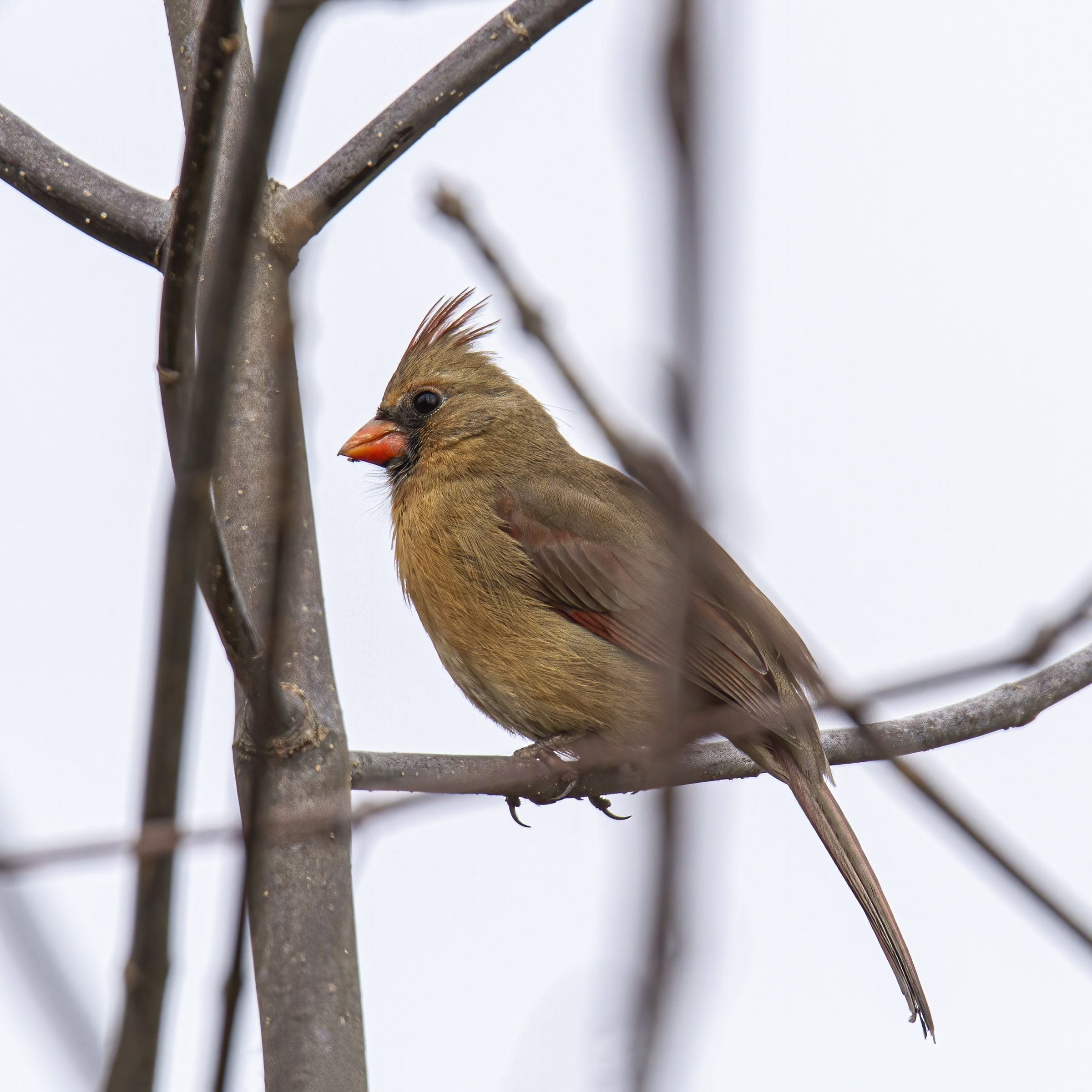
Last Friday at Occoquan Bay National Wildlife Refuge I captured this fun little image of a Yellow-rumped Warbler (Setophaga coronata) in mid-air as it hopped to a new position on a tree with colorful fall foliage. I am pretty sure that the warbler was stationary when I clicked off a short burst of shots and luck played a big role in me being able to capture this moment. Yellow-rumped Warbler

© Michael Q. Powell. All rights reserved.
Read Full Post »

As I was walking along on one of the trails at Occoquan Bay National Wildlife Refuge last Friday, I noticed a large spider coming in my direction at a pretty good clip. I gave the spider plenty of space, but managed to capture this image of what I believe is a Wolf Spider with my long telephoto lens.

Wolf spiders belong to the family Lycosidae and are among the most common spider species found around the world. According to an article entitled “Wolf Spider: Friend or Foe?” wolf spiders “are keen hunters that chase or pounce on prey like wolves rather than spin a web and wait for a meal. Unlike wolves hunting as packs, wolf spiders generally live and hunt alone. Hunting occurs both day and night.”

wolf spider

© Michael Q. Powell. All rights reserved.

Read Full Post »

Autumn Meadowhawk dragonflies (Sympetrum vicinum) love to perch on the ground and at this time of the year the ground is covered with fallen leaves in many places. Most of those leaves are brown, which makes for pretty good shots, but I am always hoping that an Autumn Meadowhawk will choose to perch on a more colorful red or yellow leaf. Last Wednesday at Occoquan Bay National Wildlife Refuge, I was fortunate when one of these colorful little dragonflies landed on a yellow leaf and I captured the first image.

Although the second and third images feature brown leaves, I love the textures and shapes of those leaves. I also like the way that the drabness of the leaves helps the bright red of the dragonfly’s body really stand out.

At this time of the year, most of my photographic subjects are likely to be birds, so I tend to walk around with my Tamron 150-600mm telephoto zoom lens on my camera. Although a long telephoto lens my not be my first choice for photographing such a small subject—an Autumn Meadowhawk is about 1.3 inches (33 mm) in length—I can get pretty good results if I am really careful in steadying the lens and paying attention to the focus point. All three of these images, for example, were shot with the lens fully extended to 600mm.

Autumn Meadowhawk

Autumn Meadowhawk

Autumn Meadowhawk

© Michael Q. Powell. All rights reserved.


Read Full Post »

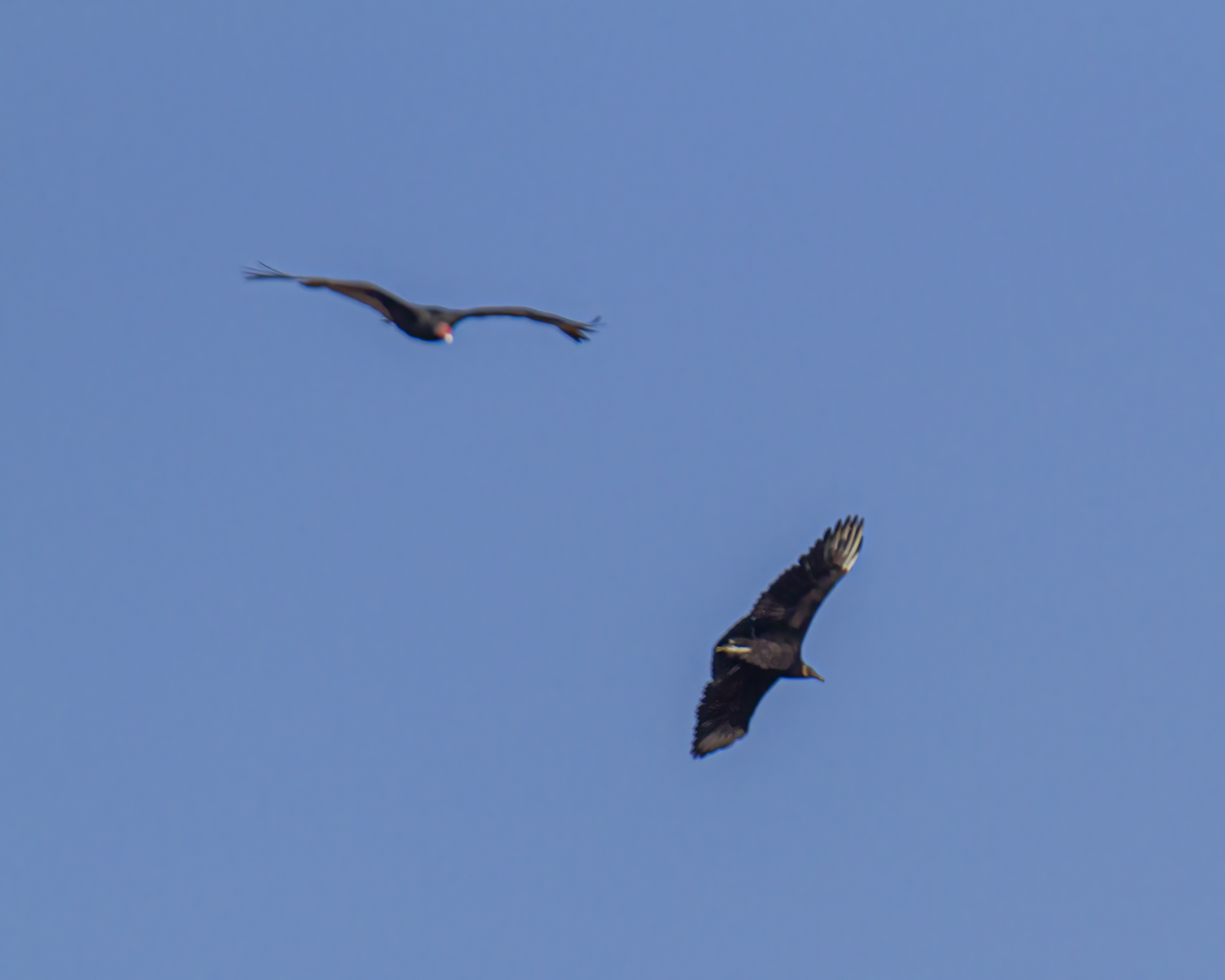
I almost never get an unobstructed view of a warbler. Most of the time I see them flitting about in the foliage, making it difficult to get a clear shot of one. If I am lucky, I manage to capture an image, like the final one, when the warbler pokes its head out of the brush for a moment.

Last Wednesday at Occoquan Bay National Wildlife Refuge, I was shocked and delighted when I was able to take a series of unobstructed shots of a Yellow-rumped Warbler (Setophaga coronata) as it was feeding on some poison ivy berries. The first three images shows some moments from that encounter.

As I look at these four images, I am strangely drawn most to the final one. Despite the clutter of the branches in that shot, the warbler stand out—the branches serve as a kind of frame for the central subject. Now I really do like the way that the first two images capture the action of the bird and the way the third shot provides the best view of the perching warbler, but someone the environmental shot appeals to me most this morning as I am composing this posting. What do you think?

Yellow-rumped Warbler

Yellow-rumped Warbler

Yellow-rumped Warbler

Yellow-rumped Warbler

© Michael Q. Powell. All rights reserved.
Read Full Post »

I chased this orange butterfly for quite some time on Wednesday at Occoquan Bay National Wildlife Refuge and was delighted when it chose to land on top of a fallen leaf. The warm oranges and browns of the butterfly are a wonderful match for the autumn season and the fallen down leaves that now litter the landscape.

I could not immediately identify the butterfly, but when I got home I was able to determine that it is a Variegated Fritillary butterfly (Euptoieta claudia). My car windshield was covered with frost yesterday morning—autumn is definitely here and I suspect that my insect sightings will be decreasing sharply soon.

Variegated Fritillary

© Michael Q. Powell. All rights reserved.


Read Full Post »

I couldn’t get very close to this Belted Kingfisher (Megaceryle alcyon) at Occoquan Bay National Wildlife Refuge last week, but I was happy to get a few long-distance shots before it flew away. Kingfishers are incredibly skittish and often my first indication of the presence of one is when I see or hear it flying away from me.

Generally I prefer to photograph birds that are perched on natural objects, but in this case I really like the geometric shape of the wooden structure that was sticking out of the water. Considering that I took these shots from a long way off, I was happy to be able to capture some of the grain of the wood and the bolt that held the boards to the post. I think this might have been part of a former duck blind, though it is hard to know for sure where it came from.

I am hoping to see this kingfisher again and perhaps will manage to get some closer shots the next time. Like most wildlife photographers, I am always thinking of my next shots, confident that I can capture better images on future outings.

Belted Kingfisher


Belted Kingfisher

© Michael Q. Powell. All rights reserved.

Read Full Post »

I was concentrating so intently on photographing the large eagle nest at Occoquan Bay National Wildlife Refuge last Wednesday that I almost missed the Bald Eagle (Haliaeetus leucocephalus) that was sitting in the nest. This nest is really deep and during nesting season it is hard to tell if one or more of the eagles are inside of it. The nesting season ended quite some time ago, so I definitely did not expect to see the nest occupied at this time of the year.

The second shot is the one that I was intending to capture. I liked the way that the red leaves were creeping up the side of the trees holding the nest and that was what I was I was photographing. If you look really carefully, you can just see a bit of the yellow beak of the eagle stick out from behind the leftmost tree, but I did not notice it at the time I took the shot.

After I had taken a few shots, I continued on the trail a half dozen steps, seeking to photograph the nest from a different angle. It was only then that I spotted a bit of bright white that turned out to be the eagle’s head. The eagle was hidden really well, but appeared have positioned itself so as to be able to keep an eye on what was happening around it.

I captured a series of images, but the eagle’s head was blocked by the nest and/or the leaves in most of them. Fortunately, the eagle was moving its head from side to side and eventually I managed to capture a shot in which we can see the eagle’s eye pretty clearly.

Quite often in my wildlife photography, I detect the subject only because of its movement, but in this case, the subject was stationary and it was the difference in color of the eagle’s head that allowed me to spot it. As you can probably guess, my eyes are moving constantly when I am out with my camera, searching high and low, near and far, and left to right for potential subjects to photograph.

eagle nest

eagle nest

© Michael Q. Powell. All rights reserved.


Read Full Post »

« Newer Posts - Older Posts »