Feeds:
Posts
Comments

Posts Tagged ‘Occoquan Bay National Wildlife Refuge’

I was ecstatic to spot this bright yellow Prothonotary Warbler (Protonotaria citrea) on Tuesday at Occoquan Bay National Wildlife Refuge. It can be a little frustrating at time of the year when warblers are migrating through our area, because there are leaves on the trees that conceal the little birds—I often end up hearing more warblers than seeing them.

The warbler was perched on this clump of vegetation at the end of a branch and was reaching down into the cluster of leaves. At first I thought that the item in the warbler’s bill was an insect, but now I wonder if it might be a seed. Although Prothonotary Warblers like to eat all kinds of insects, they will also eat fruits and seeds.

I am by nature a curious person and don’t recall encountering the word “prothonotary” in any other context. What is a prothonotary? According to the Cornell Lab of Ornithology, “The Prothonotary Warbler got its name from the bright yellow robes worn by papal clerks, known as prothonotaries, in the Roman Catholic church.” A prothonotary is also the chief clerk in certain courts of law, including in the state of Pennsylvania.

Prothonotary Warbler

© Michael Q. Powell. All rights reserved.

Read Full Post »

On Tuesday I hiked to the farthest Bald Eagle (Haliaeetus leucocephalus) nest at Occoquan Bay National Wildlife Refuge, hoping to determine if there were any eaglets in the nest. During most of the year you can walk past this nest as part of a big loop, but the road is now blocked to protect the eagles, so you have to double back along the trail (a distance of almost two miles (3.2 km) to return to the parking lot.

This eagle nest is in a sycamore tree. Several years ago, one of the limbs gave way and during the off-season almost half of the nest slid to the ground. The eagles have done some repairs each year, but the nest is still relatively small. At this time of the year, there is a good deal of new foliage, so it is a bit difficult to see what is going on in the nest.

When I arrived at the nest, I noticed that one of the adults was sitting completely upright, which was a good sign. When the eagles are incubating the eggs, the tend to hunker down in the nest, with only their heads visible.

As I watched and waited, the adult eagle flew to some higher branches in the tree. My flow of adrenaline and sense of anticipation increased as I waited to see if an eaglet would appear. I was double delighted when two little heads popped up. The eaglet on the left seemed to be a bit bigger than its sibling and was probably the older of the two. In the second image, the bigger eaglet is looking upwards toward the branch where the adult was perched.

I was a long way off when I took these photos with my telephoto zoom lens, so they are not super quality images, but they provide proof that there are at least two little eaglets in this nest. As I noted in an earlier post, there is one eaglet in another nest on the refuge. The third active eagle nest is so large and high up in the trees that it is not yet possible to tell if there are any eagle babies in it—any eaglets will probably have to grow stronger and larger before the climb up to the the edge of that nest.

Bald Eagle

Bald Eagle

Bald Eagle babies

© Michael Q. Powell. All rights reserved.

Read Full Post »

On Tuesday I spotted this female Common Green Darner (Anax junius) dragonfly at Occoquan Bay National Wildlife Refuge, the first darner that I have been able to photograph this season. Like most darners, Common Green Darners are relatively large dragonflies—about 3 inches (76 mm) in length—that spend a lot of time patrolling in the air. In fact, Common Green Darners are one of a handful of dragonflies that migrate, so that the earliest ones that we see in spring are likely to have migrated from more southern locations before local Common Green Darners have emerged.

When I first spotted this dragonfly, she was patrolling over a field of tall vegetation. I watched her fly back and forth for quite a while. When she decided to take a break, I was lucky to see where she landed.

As you can see in the photo, Common Green Darners normally hang vertically. In this case the dragonfly perched relatively close to the ground, so it was a bit of a challenge to frame the shot, particularly because I was shooting with my long telephoto zoom lens. I am quite pleased, though, with the resulting image that shows off a lot of the details of this species, including the distinctive black and blue “bullseye” in from of the dragonfly’s large compound eyes.

Common Green Darner

© Michael Q. Powell. All rights reserved.

Read Full Post »

I was delighted yesterday to photograph an eaglet in one of the Bald Eagle (Haliaeetus leucocephalus) nests at Occoquan Bay National Wildlife Refuge. Last week, several photographers posted photos in Facebook of the baby eagle, so I knew for sure that there was at least one in the nest. I have been keeping a close eye on this nest, a small one that was used by ospreys last year, and knew that it would have trouble comfortably accommodating an adult eagle and a growing eaglet.

When I first arrived at the barrier that closes the trail, I could see through the foliage that an eagle was sitting upright in the nest, but I could not see an eaglet. I watched and waited and the eagle eventually flew away. A short time later, another eagle flew in and landed on a tree branch above the nest rather than in the nest. As the eagle approached the nest, a little head popped up and I was able to capture the first image.

The eagle in the tree kept watch over the curious little eaglet and I never did see the adult sit in the tree. After a while, the eaglet disappeared from sight—it was probably time for its afternoon nap.

When I departed the area to check on another eagle nest, the adult was still on duty in the tree. I passed by this nest one last time and noted that an eagle was now sitting in the nest. It may be that one of the parents is small enough to fit into the nest and the other one is simply too large. As the baby grows, I suspect that both parents will be forced out of the nest. I would not see the eaglet until the adult lifted its wing and I was able to capture the final image.

As you can probably see from the blotches of green in the photos, I did not have an unobstructed view of the nest. I am hoping that the leaves on the trees do not fully block my view in the upcoming weeks.

Bald Eagle

Bald Eagle

Bald Eagle

© Michael Q. Powell. All rights reserved.


Read Full Post »

When it comes to photographs, do you prefer “pretty pictures” or “action shots?” If I were to judge from “likes” on social media platforms, “pretty pictures” are more popular, although I am often most proud of my “actions shots.” One of the coolest things about photography, of course, is that there is a wide latitude for individual styles and preferences and neither the viewer nor the photographer has to be forced into making false choices.

On Monday I took a couple of photos of small birds during a visit to Occoquan Bay National Wildlife Refuge. At this time of the year I am thrilled when I am able to spot the small birds that are often hidden by the increasingly dense foliage.

The bird in the first photo is an incredibly cute Carolina Wren (Thryothorus ludovicianus). Carolina Wrens frequently poke about in the undergrowth and I was delighted when this one chose instead to perch on a photogenic branch in the open.  The result was this pretty portrait of the little wren that looks almost like it was taken in a studio environment.

The bird in the second photo is a White-throated Sparrow (Zonotrichia albicollis). It was not perched in the open and it was not stationary. The little sparrow was bobbing and moving as it attempted to grab some of the tender shoots growing on the tree. I was happy when I managed to get a shot in which the bird has one of the shoots in its mouth. The background in this image is cluttered and part of the bird’s body is hidden by a branch. However, I like the moment that I captured and the way that the image provides a sense of the bird’s environment.

When I am photographing wildlife, I am unconsciously making a series of creative choices in the way that I frame an image and the camera settings that I use, all of which affect the look and feel of the resulting images. Sometimes of those images will be “artsy” and others will be “documentary”—I love both styles of photography.

Carolina Wren

White-throated Sparrow

© Michael Q. Powell. All rights reserved.

Read Full Post »

On Monday I was thrilled to photograph my first dragonfly of the year at Occoquan Bay National Wildlife Refuge, the location that I visit most frequently with my camera. The first prize goes to an immature male Blue Corporal dragonfly (Ladona deplanata)—males turn blue as they mature, but initially they have the same coloration as the females. Blue Corporals of both genders have two light-colored stripes on the front of their thoraxes, the traditional rank military insignia for corporals.

Later in the day I spotted a female Blue Corporal perched on some dry leaves, as shown in the second photo. Can you spot the differences between the dragonflies in the first and second photos? The male abdomen tends to be a bit thinner than the abdomen of the female. However, the biggest difference is in the terminal appendages, i.e. the specific parts at the very tip of their abdomens (their “tails”).

The following day I returned to the refuge and spotted another Blue Corporal perched in some vegetation—I think it is another immature male. Most of the time Blue Corporals like to perch on the ground, but this one looked like it had only recently emerged and may have been waiting for its wings to harden.

When dragonflies undergo their metamorphosis from water-dwelling nymphs to aerial acrobats, their wings are initially very clear and fragile and the creatures are very vulnerable, so I was careful not to disturb the dragonfly when I took a few photos. If you are interested to learn more, check out a 2016 blog posting  Metamorphosis of a dragonfly in which I documented the entire transformation process of a Common Sandragon dragonfly in a series of 15 photos. At the end of that series you will be able to see why I characterized the wings of a newly-emerged dragonfly as “fragile.”

Blue Corporal

Blue Corporal

Blue Corporal

© Michael Q. Powell. All rights reserved.

Read Full Post »

Yesterday was a beautiful spring day and I was delighted to capture this image of a Zebra Swallowtail (Eurytides marcellus), one of my favorite butterflies, at Occoquan Bay National Wildlife Refuge. I chased after this hyperactive butterfly and luckily was close enough to get a shot when it landed for a split second. I love the touches of red and blue on this mostly monochromatic butterfly and its distinctive long “tails.”

As I was doing a little research on this butterfly, I discovered that the Zebra Swallowtail has two seasonal forms, one occurring in the spring and the other in the summer. According to Wikipedia, the spring forms are smaller, more white, and have short, black tails with white tips. As you can see from the first photo below, yesterday’s Zebra Swallowtail was a spring form butterfly.

Summer forms of the Zebra Swallowtail are larger, have broader black stripes, and longer, black tails with white edges. For the sake of comparison, I reprised a photo from a 6 September 2021 blog posting. The butterfly in the second photo, a summer form butterfly, indeed looks darker than the one in the first photo and there are noticeable differences in the shape and coloration of the tails.

Zebra Swallowtail

Zebra Swallowtail

© Michael Q. Powell. All rights reserved.

Read Full Post »

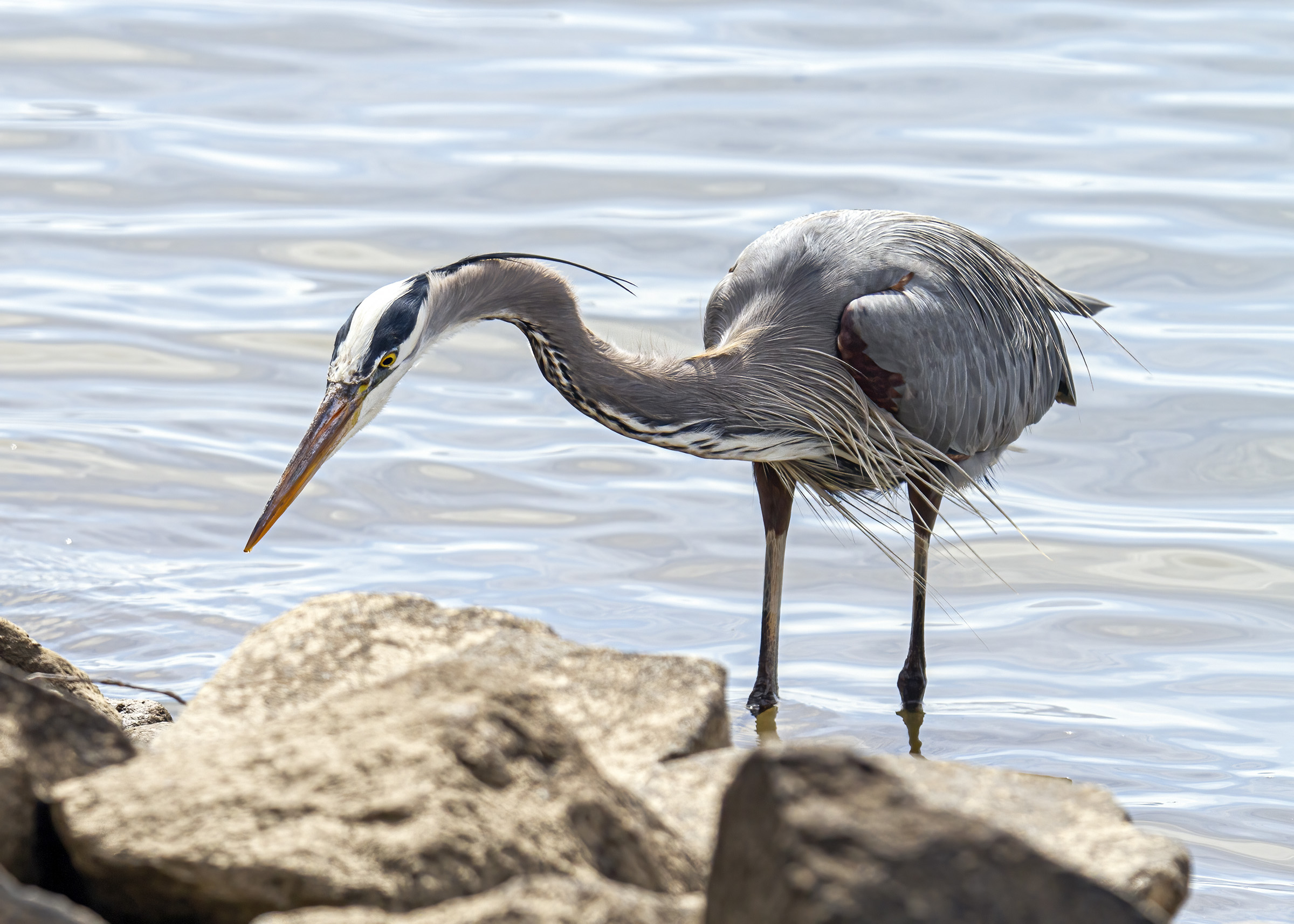
When I first spotted this Great Blue Heron (Ardea herodias) at Occoquan Bay National Wildlife Refuge, I immediately noticed how spiky its feathers looked—they were sticking out in all directions. When I was growing up (and had hair), there were times when I had some unruly strands of hair that were equally uncontrollable. I would sometimes resort to a little bit of Brylcreem to slick down my hair—to this day I remember one of the marketing slogans for this product, “Brylcreem—a little dab will do ya!” When I was really little, my Mom would sometimes use a little saliva on her fingers to control my wayward hairs—it worked.

The heron was intently focused on an area with rocks and slowly moved closer to it, gradually lowering its head. I waited and waited and eventually the heron struck. I did not see the actual strike, because the heron’s head was hidden by the rocks at that moment. I was excited to see what the heron had caught. As the heron lifted its head, I was shocked to see a tiny fish in its bill. Though the fish was only an appetizer at best, the heron carefully maneuvered it into position and swallowed it.

When I left the heron, it had returned to fishing, dreaming perhaps of its next catch, which would hopefully be bigger than this one.

Great Blue Heron

Great Blue Heron

Great Blue Heron

Great Blue Heron

Great Blue Heron

© Michael Q. Powell. All rights reserved.


Read Full Post »

At this time of the year I am drawn to any insects that I see flying about and I have found myself chasing after even small flies. There’s usually a period of readjustment as I switch from searching for subjects that are far away to looking for tiny subjects that are often only an arm’s length away from me. Most of the time I have to rely upon movement to spot these insects—only occasionally am I able to spot a perched insect.

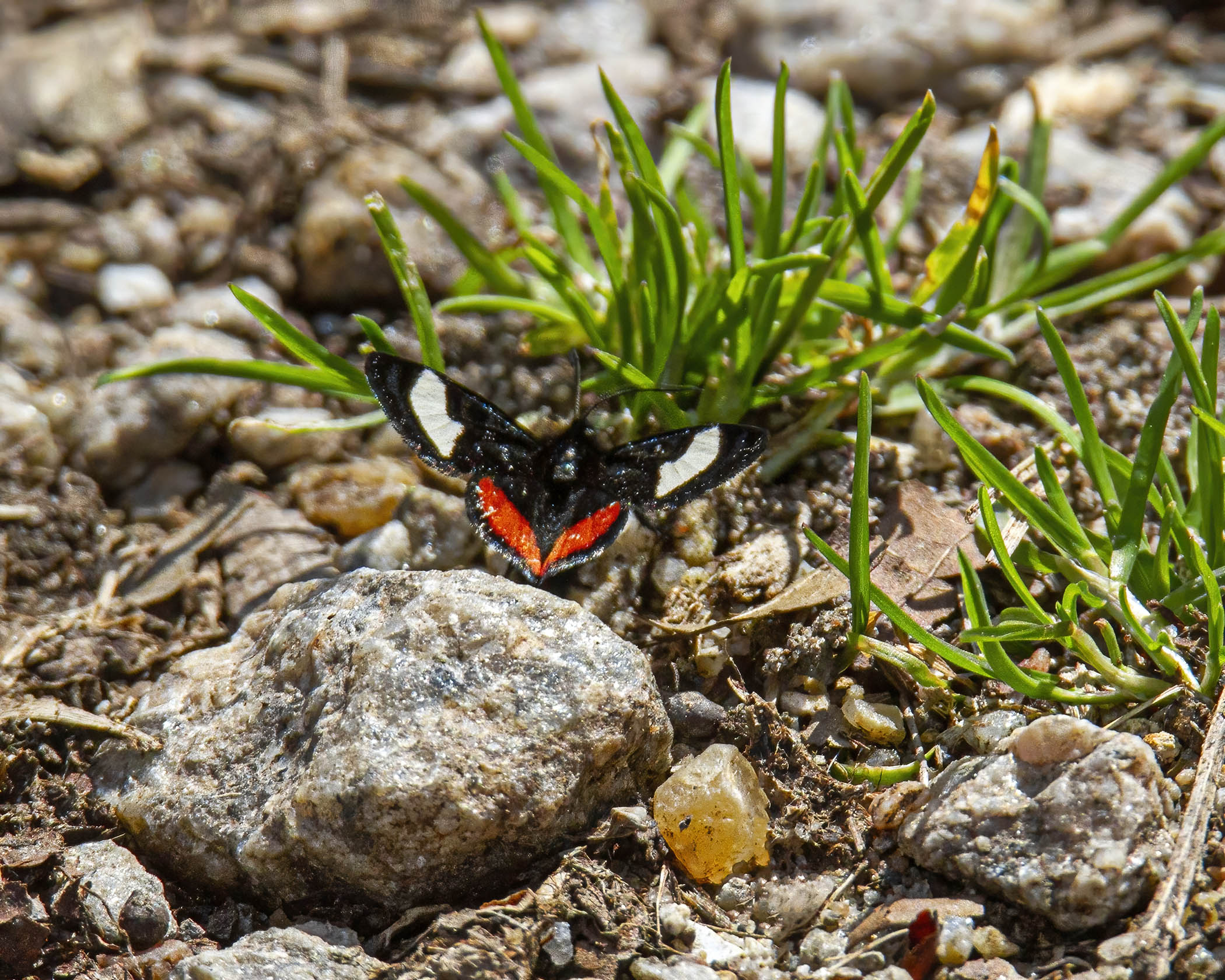
As I noted in yesterday’s blog posting, I finally spotted my first two butterflies of the spring. I thought I had spotted a third butterfly last Wednesday at Occoquan Bay National Wildlife Refuge when this colorful little insect flew in front of me. I am pretty familiar with the butterflies in my area, but did not recognize this one.

After doing some research, I have concluded that this is probably a Grapevine Epimenis Moth (Psychomorpha epimenis). According to the Missouri Department of Conservation, “The grapevine epimenis flies during daytime and would seem too colorful to be a moth, but a moth it is. A member of the noctuid family, its many drab, grayish relatives include dagger, owlet, armyworm, cutworm, and earworm moths.”

Grapevine Epimenis Moth

© Michael Q. Powell. All rights reserved.

Read Full Post »

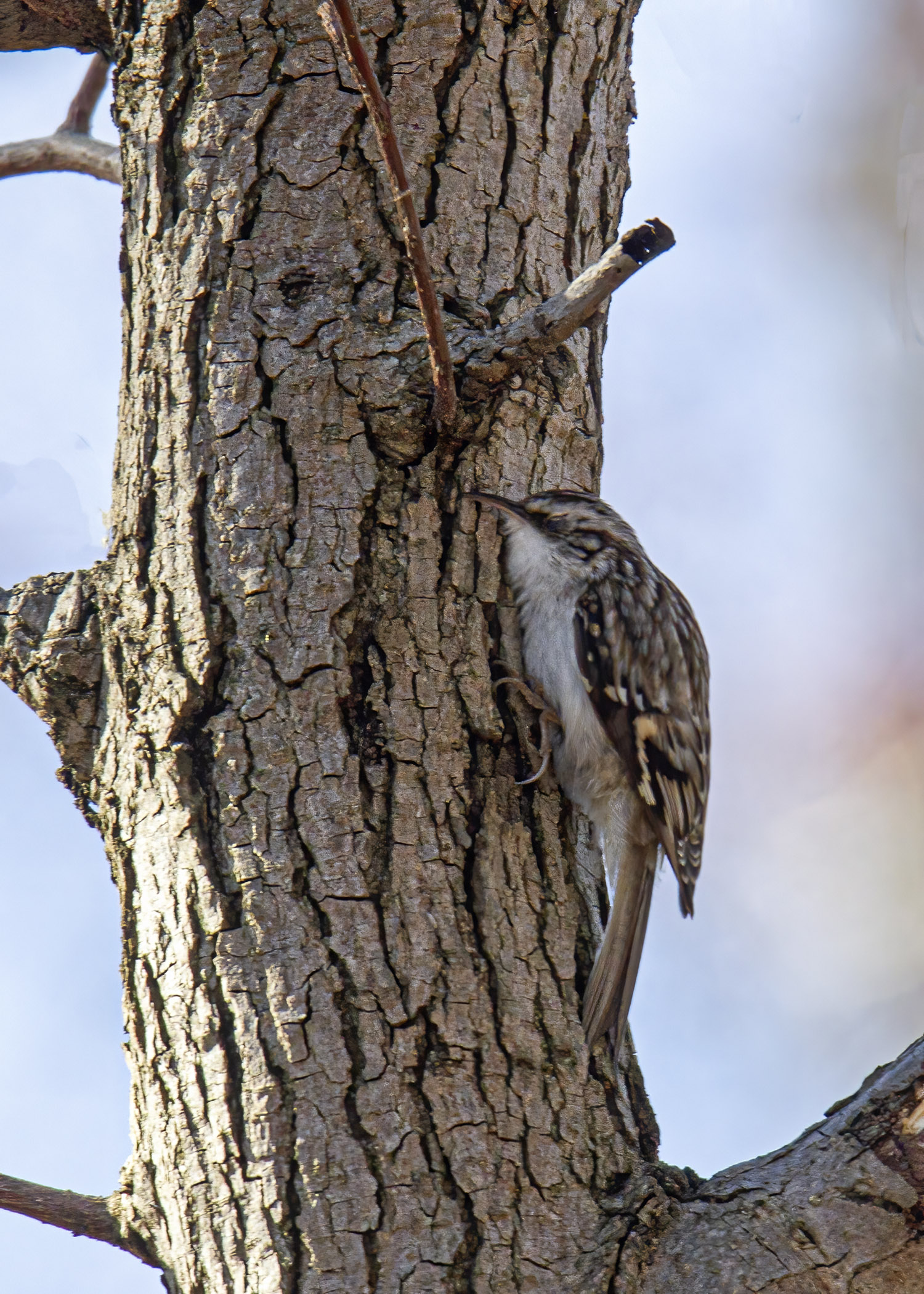
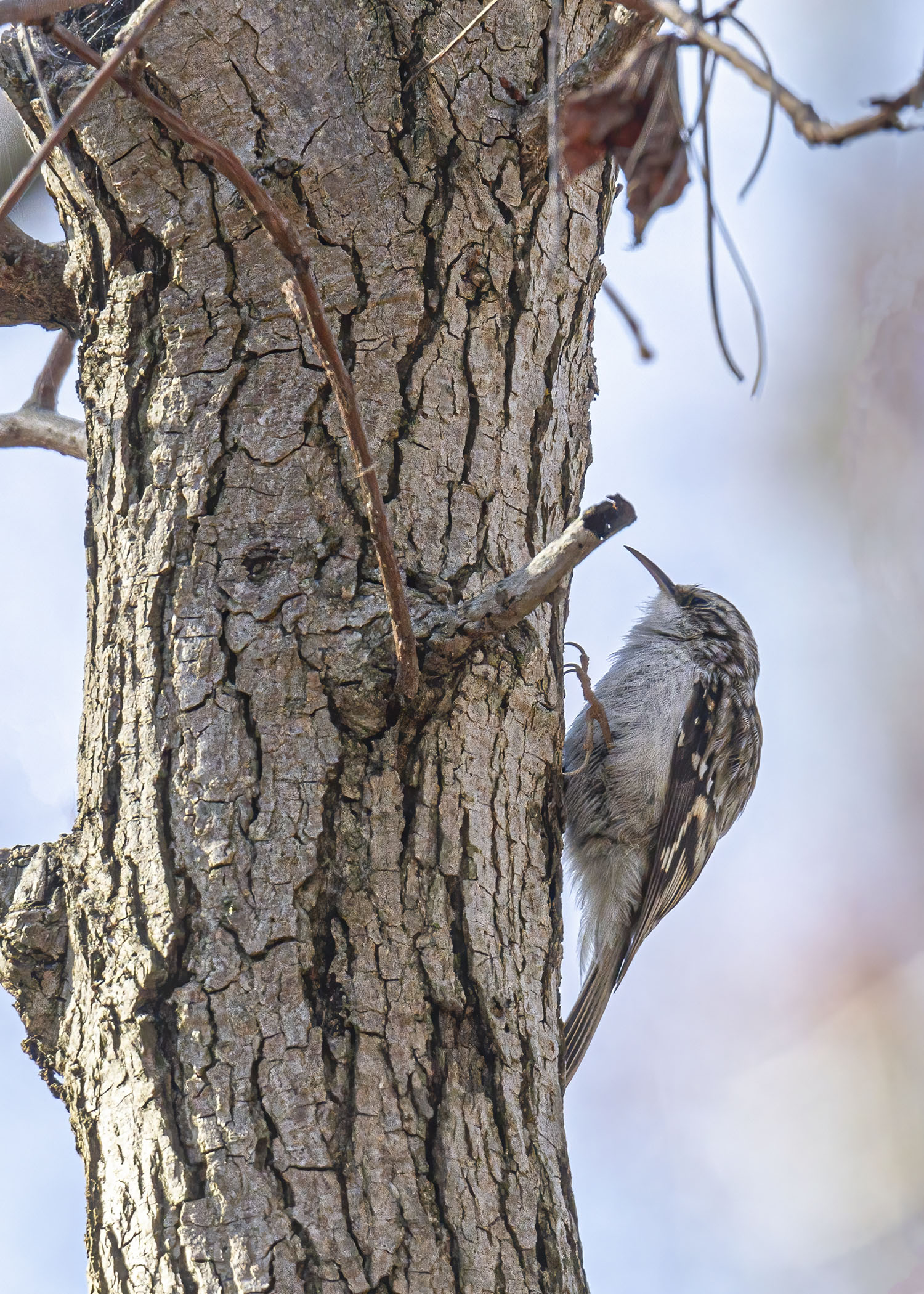
Brown Creepers (Certhia americana) are unusual-looking birds. They are relatively small songbirds (about 5 inches (13 cm) in length) that have long, curved claws and a sharp, curved bill. Their mottled bodies cause them to blend in really well with the bark of the trees on which they are usually found. Even when I manage to spot one, they tend to be in motion all of the time as they spiral their way up the trunk of the tree, making them tough to photograph.

Last week at Occoquan Bay National Wildlife Refuge I was thrilled to capture some shots of a Brown Creeper. I was particularly happy that the images show the bird’s distinctive bill and claws. In the middle photo, you can see how the creeper uses its curved bill to poke about in the crevices as it searches for insects, sometimes bracing itself with its stiff tail.

Brown Creeper

Brown Creeper

Brown Creeper

© Michael Q. Powell. All rights reserved.

Read Full Post »

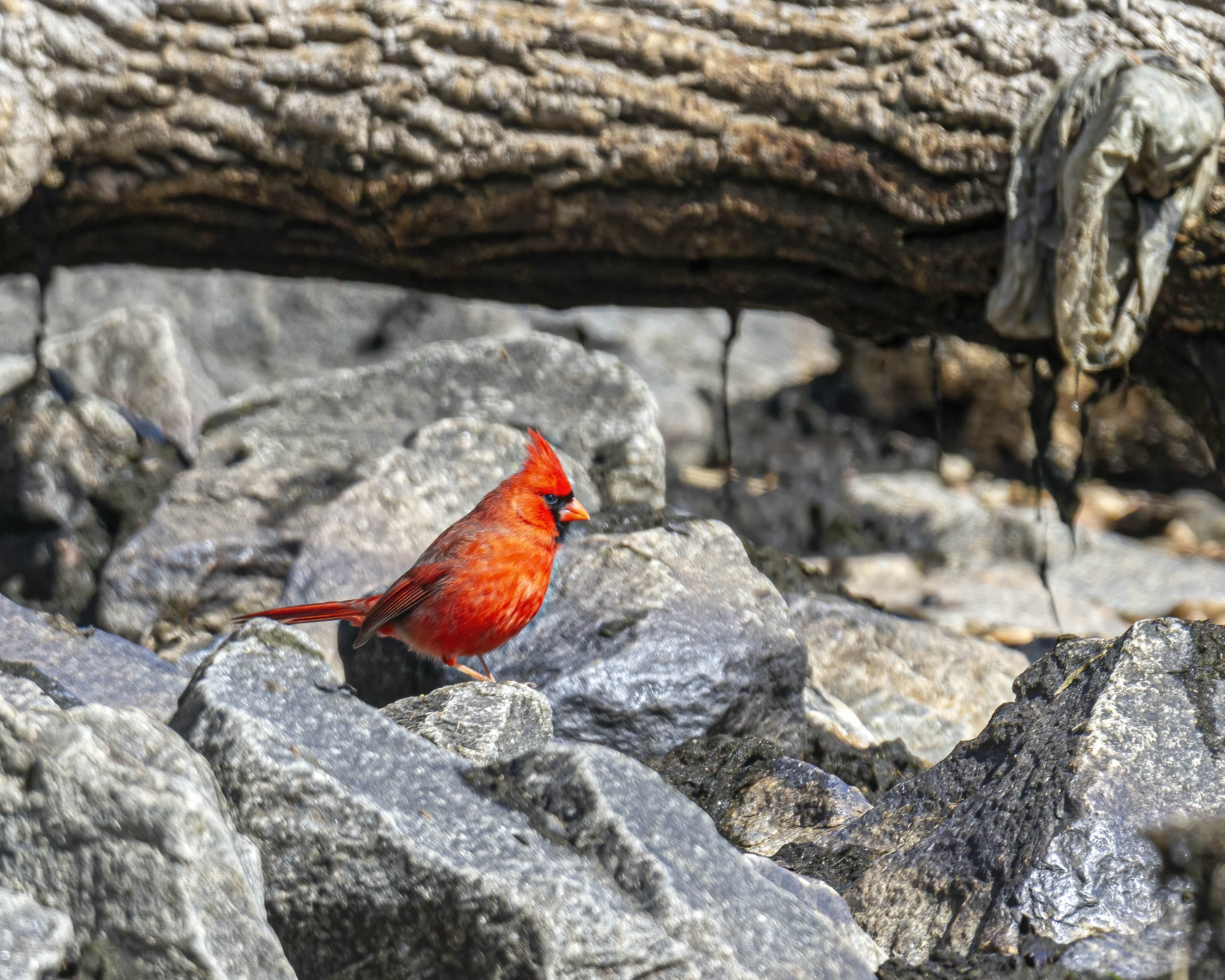
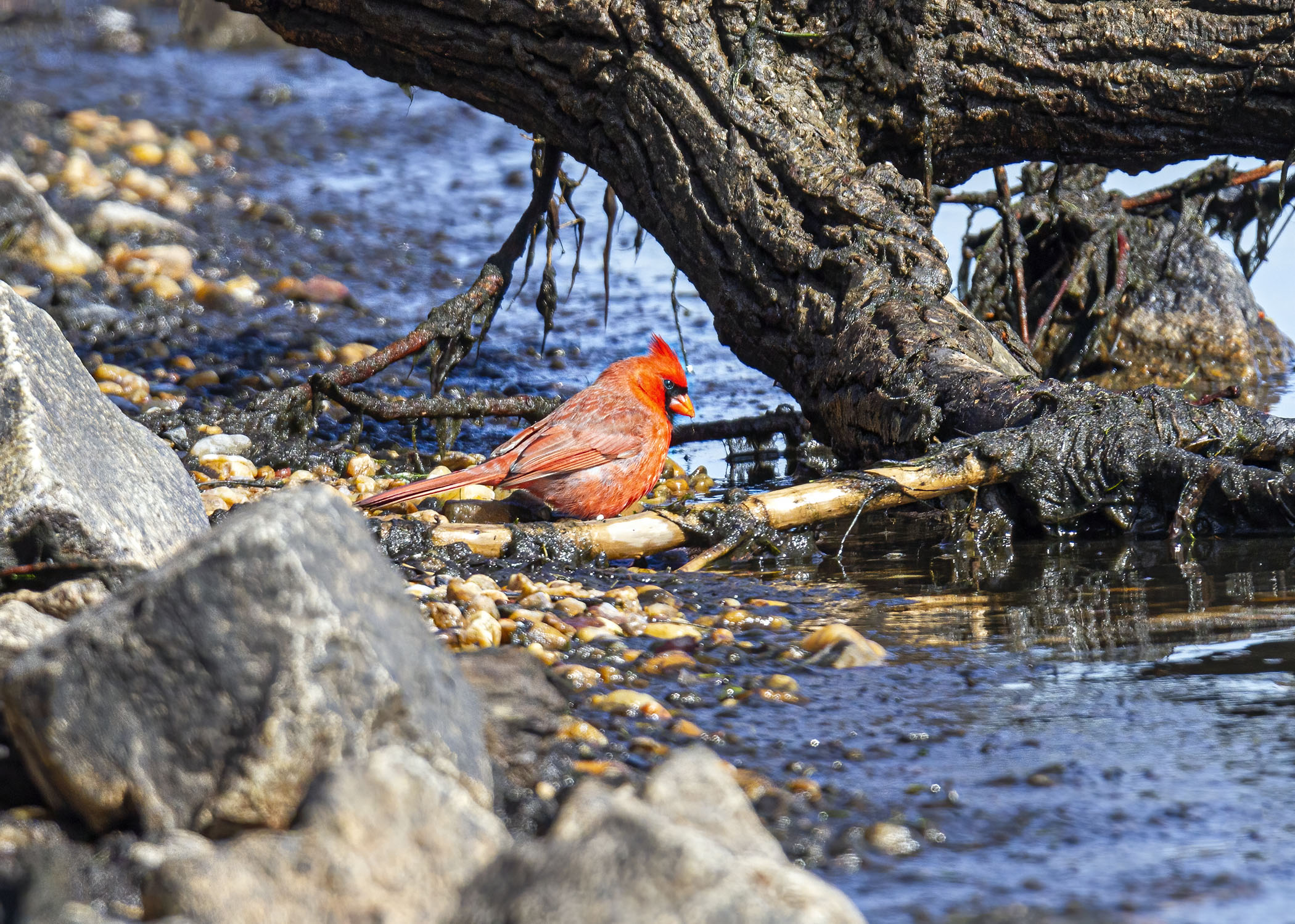
It is always fun to photograph familiar subjects in an unexpected environment. This past week I spotted a male Northern Cardinal (Cardinalis cardinalis) amidst the rocks and other debris at the edge of the water at Occoquan Bay National Wildlife Refuge rather than in the vegetation where I normally see cardinals.

I was delighted to be able to capture a series of images as the cardinal moved about on the rocks and eventually made his way to the water. He dipped his head to take a drink, but his face was completely hidden from view, so I was not able to capture that moment.

On the whole, though, I really like the balance I was able to achieve in showing both the primary subject and the environment in which I found him—the brightness of the cardinal’s red body definitely helped him to stand out from the somewhat cluttered background and foreground despite the fact that he filled only a small part of the frame.

Northern Cardinal

Northern Cardinal

Northern Cardinal

Northern Cardinal

© Michael Q. Powell. All rights reserved.

Read Full Post »

Most of the nests of Ospreys(Pandion haliaetus) that I have seen in the past were in trees, but sometimes ospreys build their nests in readily manmade structures. On Tuesday I spotted an osprey couple that appeared to have taken over a nest on a channel marker in the waters off of Occoquan Bay National Wildlife Refuge.

In past years I have seen osprey activity at this same channel marker, but do not know for sure if ospreys were successful in hatching eggs there. The nest takes up only half of the space on the marker and there looks to be enough room to accommodate a second osprey couple. However, I doubt that the current occupants would tolerate the presence of neighbors that close, so it seems unlikely that I will see side-by-side nests in the future.

osprey nest

© Michael Q. Powell. All rights reserved.

Read Full Post »

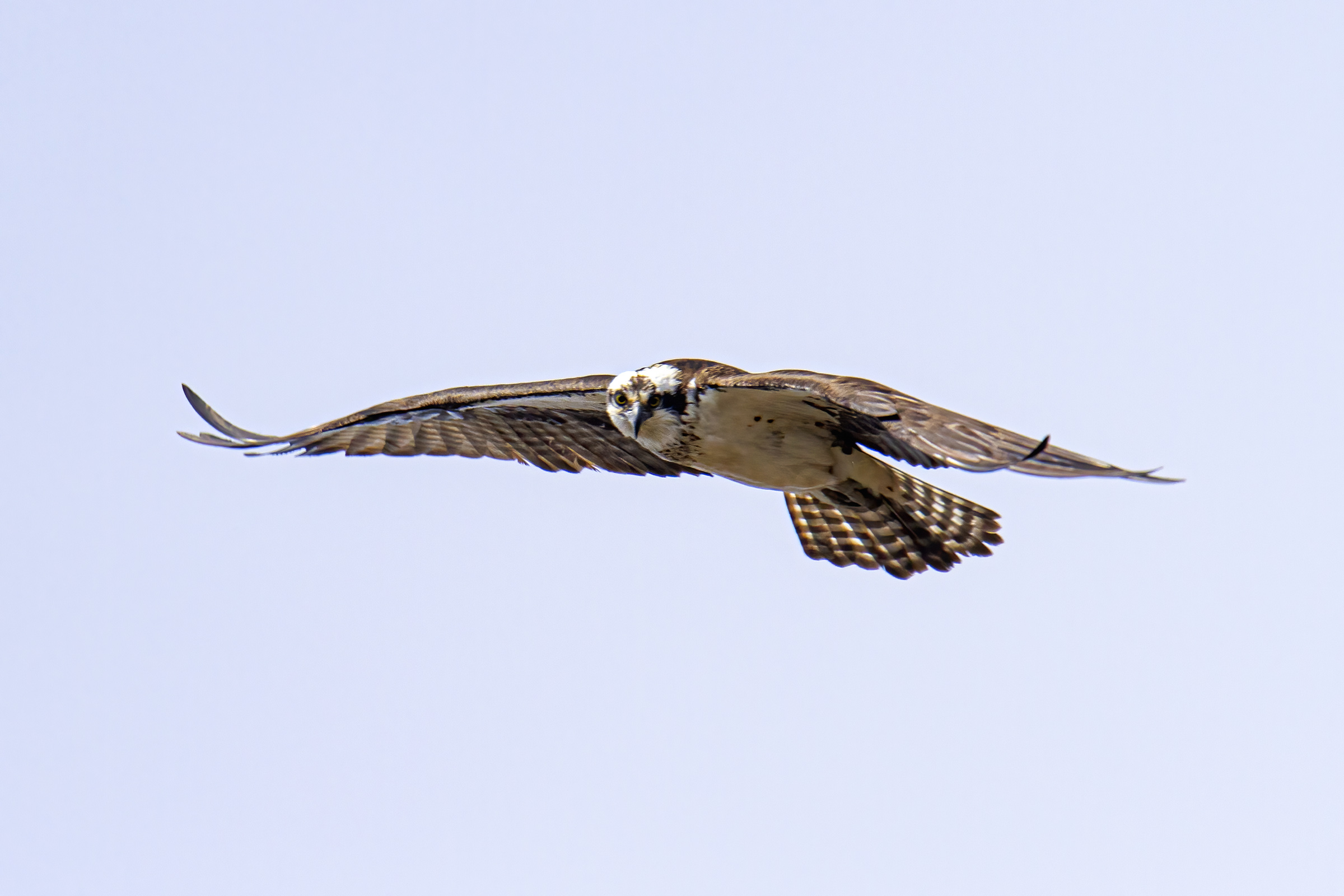
Like many other local photographers, I am thrilled that Ospreys (Pandion haliaetus) have returned to our area—they spend the colder months in warmer locations. On Tuesday, I captured several shots of one of the ospreys as it soared above me at Occoquan Bay National Wildlife Refuge.

Ospreys hover in the air a bit, so it is a bit easier to get shots of them flying than it is with eagles and hawks. However, it is still a challenge to get shots that have good wing and head positions. I was happy that the osprey was flying towards me in both of these images and its eyes are somewhat visible.

More osprey are sure to arrive soon and I am sure that I will get some better (and closer) shots in the upcoming months. I am content with these shots that that document the fact that the ospreys have returned, yet another sign of the arrival of spring.

Osprey

osprey

© Michael Q. Powell. All rights reserved.


Read Full Post »

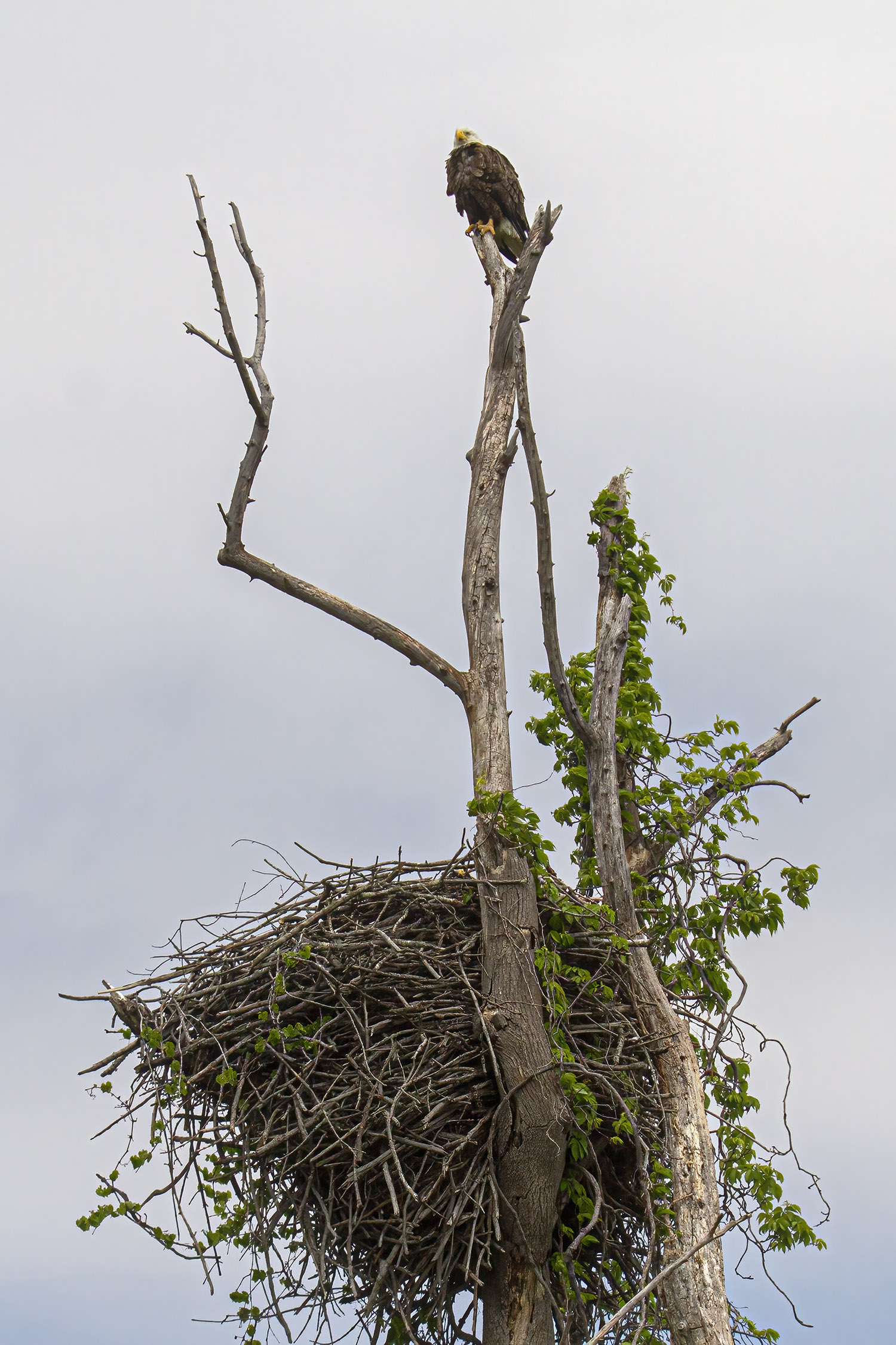
I am not sure what was going on Tuesday in the waters off of Occoquan Bay National Wildlife Refuge, but two Bald Eagles (Haliaeetus leucocephalus) were perched on a structure and an aggressive Osprey(Pandion haliaetus) kept dive-bombing them repeatedly. The osprey would fly by right above them and each time the eagles would rear up with their talons extended as they screamed at the osprey. I took the shot below from a long way away, but it gives you a sense of the action.

Several of my friends on Facebook suggested that this might have been a territorial dispute. Others posited that the eagles had stolen a fish from the osprey and the osprey was angry about it. Another friend provided a link to a fascinating article at Natural Habitat Adventures entitled “Eagles and Ospreys: When Birds of Prey Clash.” According to the article, eagles will sometimes steal osprey chicks and ospreys may attack eagles while they are eating. It is too early for there to be chicks—ospreys have only recently returned to our area—but it is certainly possible that this was a food fight.

eagles and osprey

© Michael Q. Powell. All rights reserved.
Read Full Post »

When a Bald Eagle (Haliaeetus leucocephalus) looks directly at me, it feels really intense—there is a sense of ferocity and power in its glaring eyes. Normally I do not like eye-t0-eye photos of birds, because that direct angle causes their bills to look really strange. In this photo, though, I really like the way that the eagle’s beak looks and the way that the color of its beak matches the color of its feet.  The sharpness of the beak also mirrors the sharpness of the eagle’s prominent talons.

I try to get as many different kinds of photos of eagle as I can, and this image has a different “feel” than most of my other images. There is a minimalism and starkness that really appeal to me and a very, but effective composition.

I really feel blessed that I get to see bald eagles so often when I visit Occoquan Bay National Wildlife Refuge, where I take most of the eagle shots that are featured in my blog postings.


Bald Eagle

© Michael Q. Powell. All rights reserved.

Read Full Post »

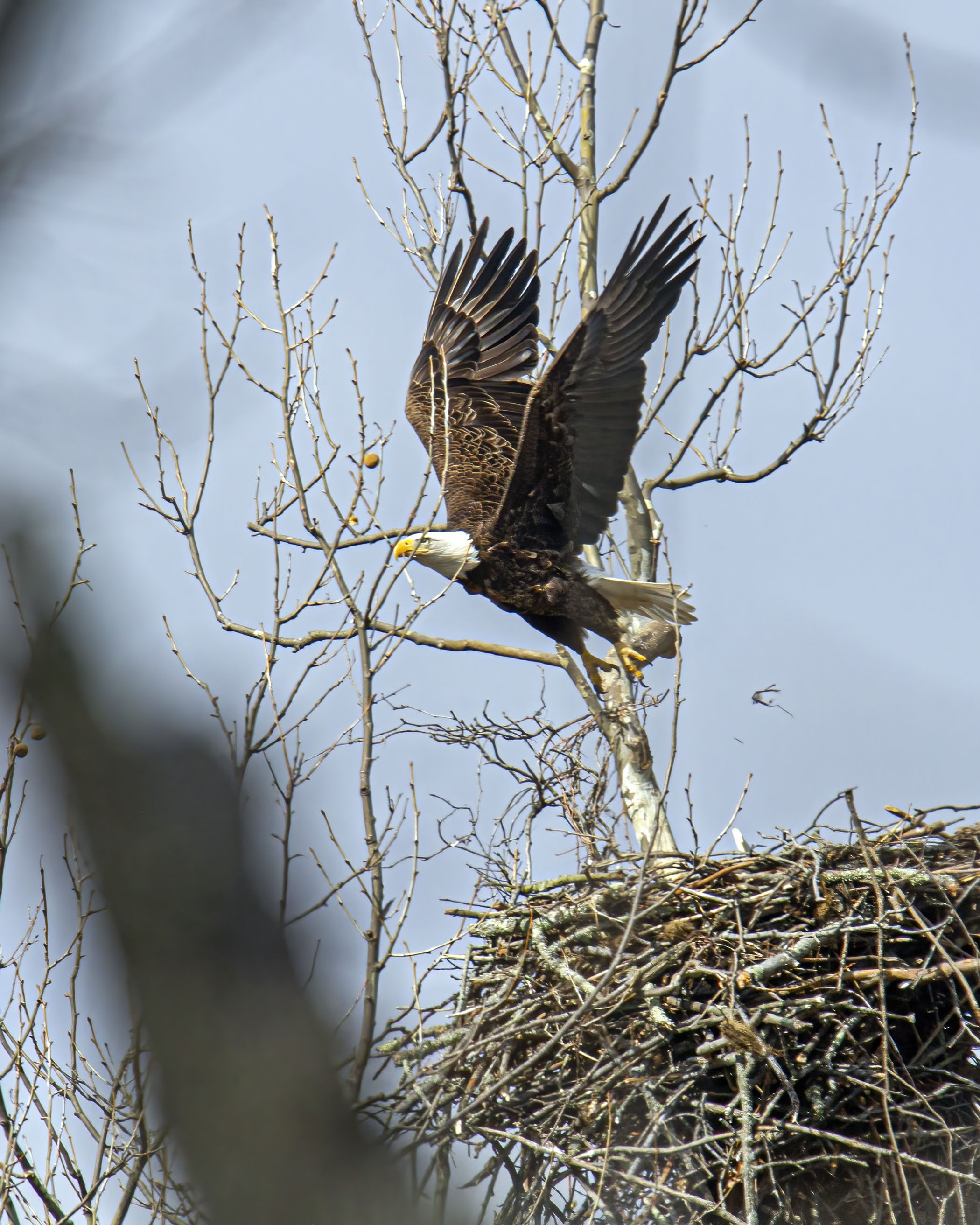
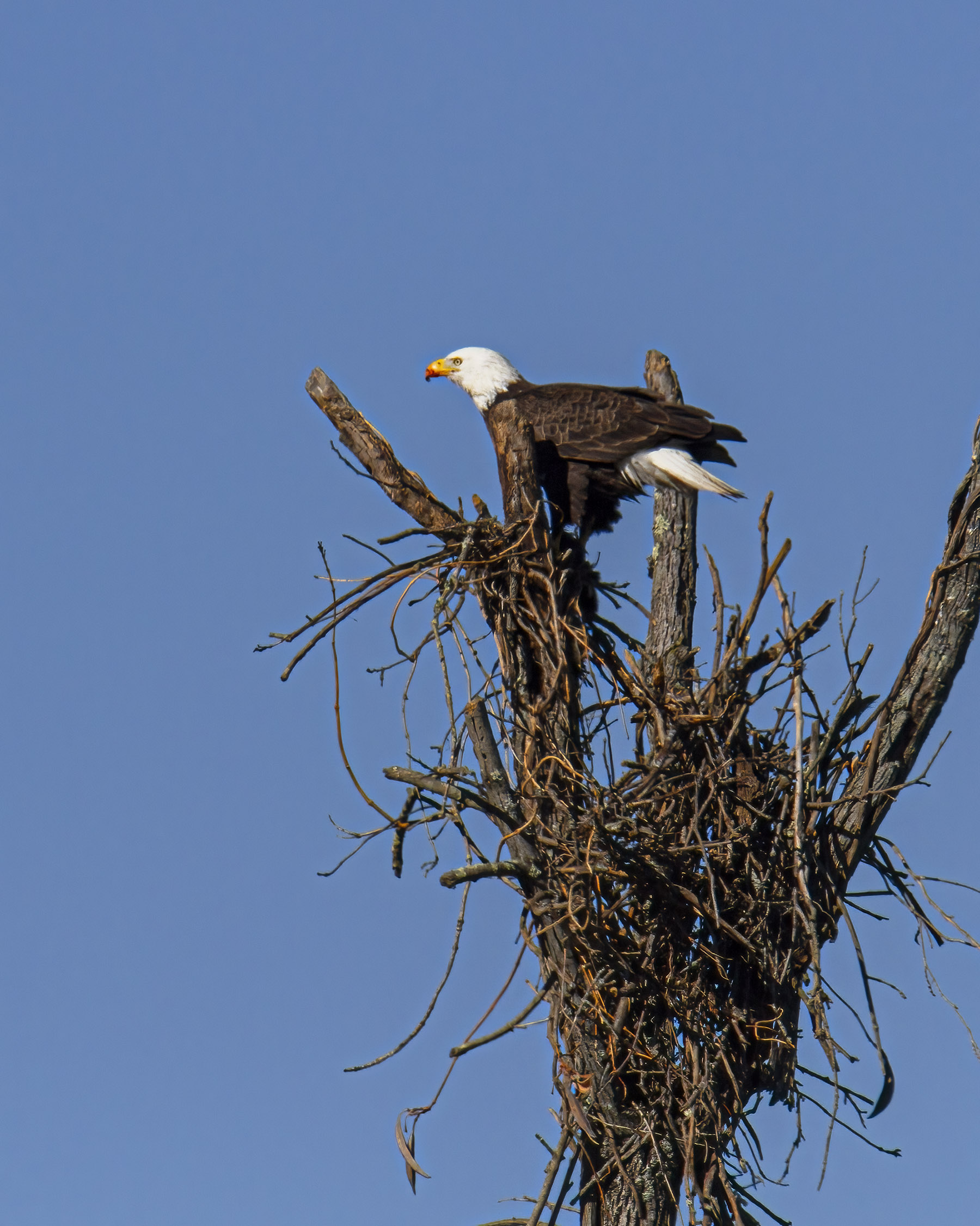
Most of the time I am an opportunistic photographer—I wander about and react to the the things that I see. During the nesting season of Bald Eagles (Haliaeetus leucocephalus), however, I will hangout at spots where I can observe the eagle nests.

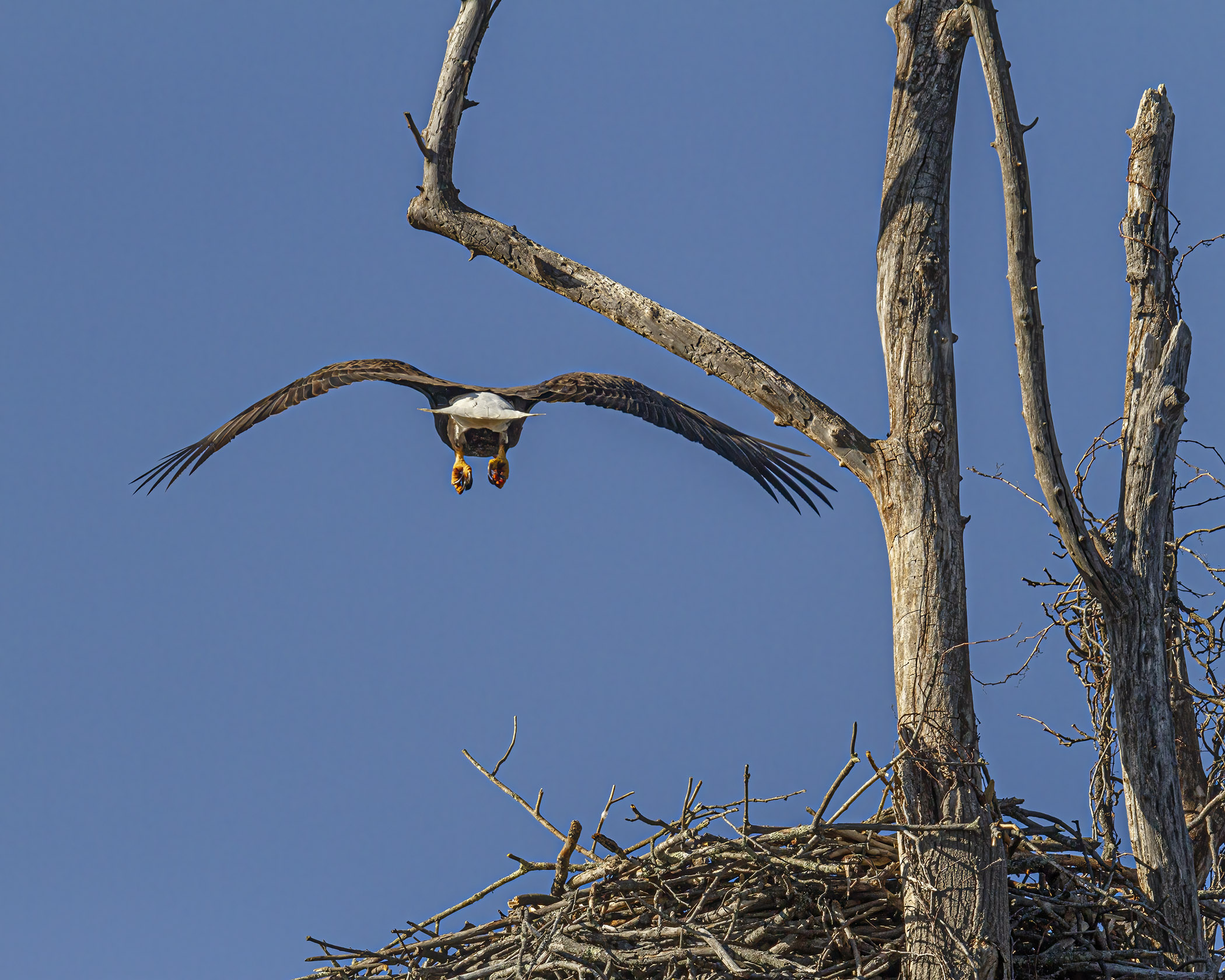
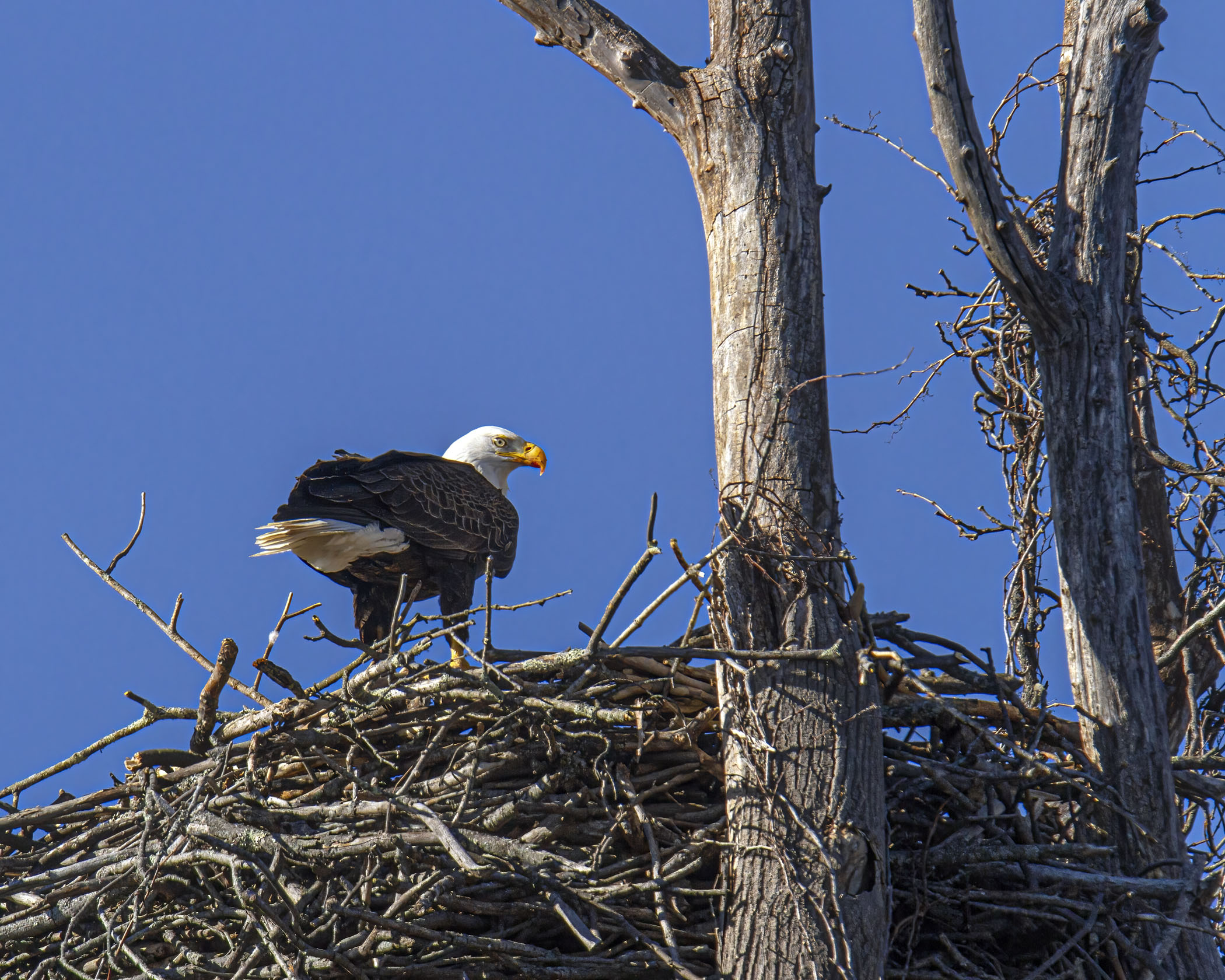
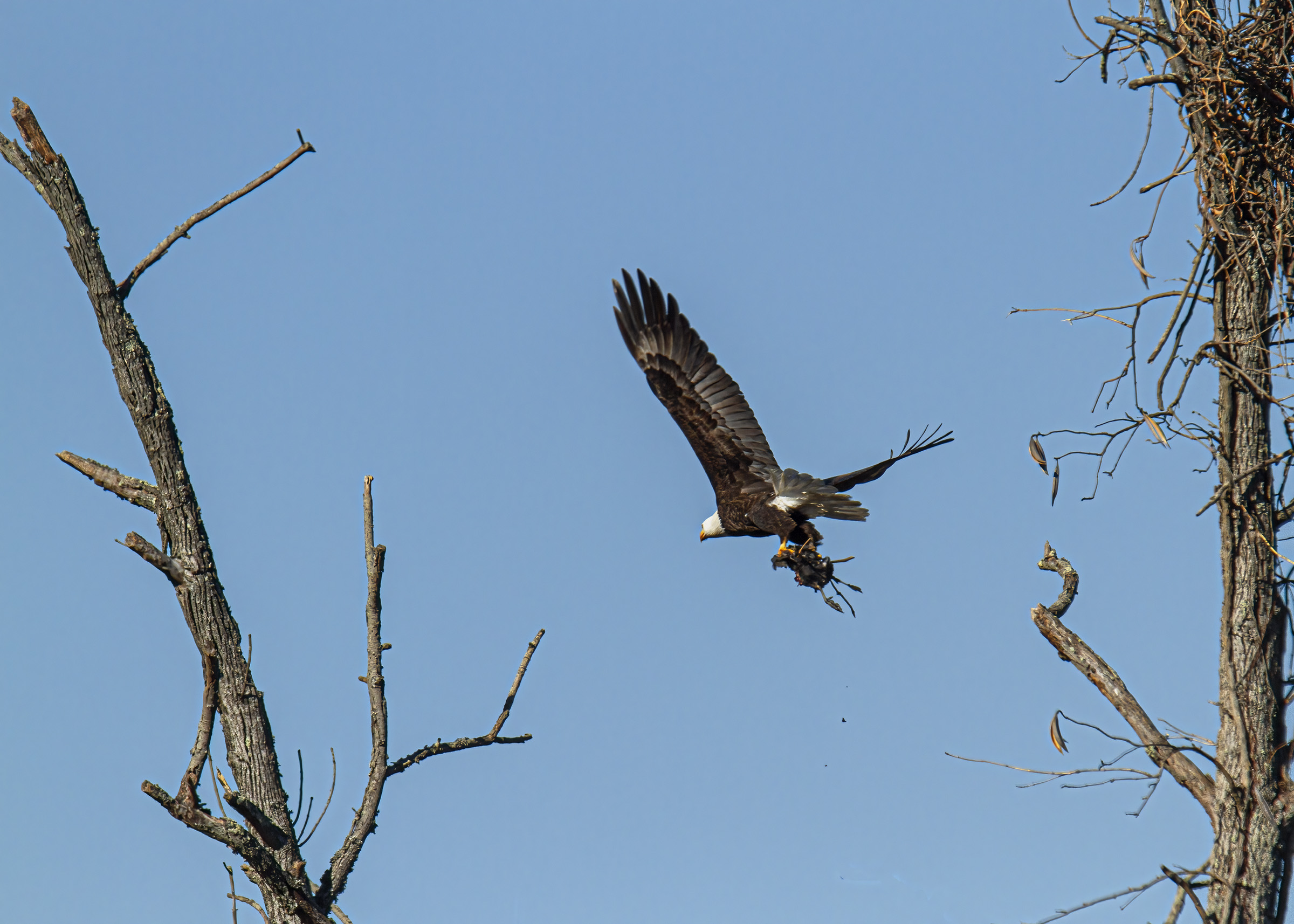
The members of an eagle couple take turns sitting on the eggs, and I love to try to capture the changing of the guard, i.e. when one eagle switches off with the other one. Earlier this month, I observed such an exchange at one of the nests that I watch at Occoquan Bay National Wildlife Refuge.

The first photo shows the departing eagle. If you look closely behind the eagle, you will see some small twigs in the air that were dislodge during the takeoff. I had to look through a lot of vegetation to get a clear view of the nest and the dark smudges in the photo are branches that were partially blocking my vision—fortunately those branches were on the periphery of my composition.

The second photo shows the arriving eagle. The nest is so small that I don’t think it could hold both eagles at the same times, particularly when there are fragile eggs present.

Bald Eagle

Bald Eagle

© Michael Q. Powell. All rights reserved.
Read Full Post »

It’s almost time for birds to be migrating northward through our area, some of which will remain with us throughout the warmer months. Many birders look forward to this time when warblers appear each year. For me, though, it is always a challenge, because leaves appear at about the same time, making it tough to spot the new birds.

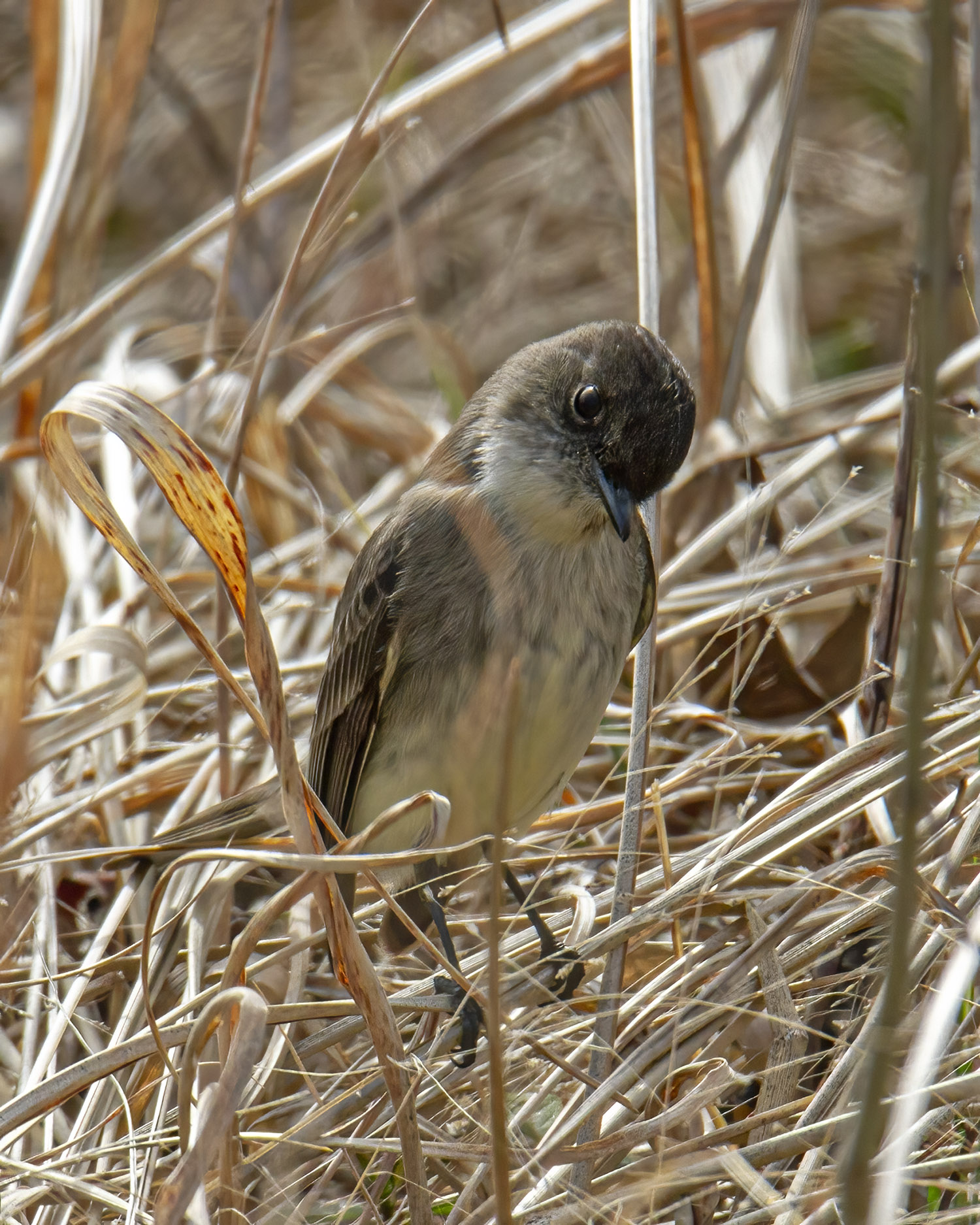
Earlier this month I was happy to get a few shots of an Eastern Phoebe (Sayornis phoebe), one of the earliest migrating species. The phoebe was initially foraging on the ground and then flew up into a tree. It is interesting to compare the two photos and see what a difference the background makes in the “feel” of the photos.

Eastern Phoebe

Eastern Phoebe

© Michael Q. Powell. All rights reserved.
Read Full Post »

A Turkey Vulture (Cathartes aura) turned its head to check me out as I walked by it during a recent visit to Occoquan Bay National Wildlife Refuge. However, the vulture did not move from its perch, suggesting to me that there was something dead nearby that had attracted the vulture’s attention.

I couldn’t help but think of a joke about a vulture that a friend told me last year—A vulture boards an airplane carrying two dead raccoons. The flight attendant looks at him and says, “I’m sorry, sir, only one carrion allowed per passenger.” Sorry—I have a somewhat warped sense of humor and love puns and wordplay.

Turkey Vulture

Turkey Vulture

© Michael Q. Powell. All rights reserved.

Read Full Post »

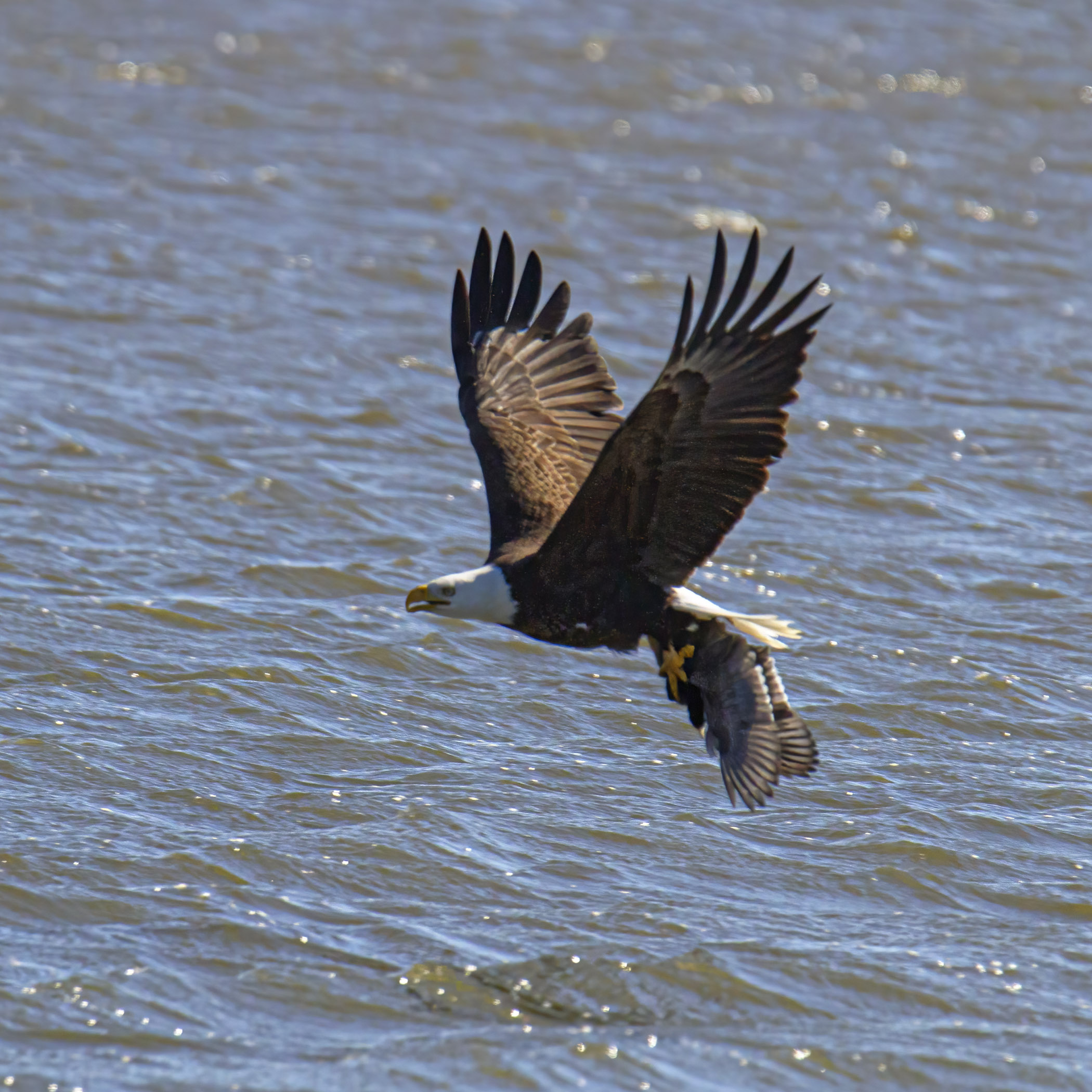
Bald Eagles (Haliaeetus leucocephalus) have impressive wing spans, approximately 80.3 inches (204 cm), according to the Cornell Lab of Ornithology. I was thrilled last week to capture some images of an eagle with its wings fully extended as it flew over me at Occoquan Bay National Wildlife Refuge.

The afternoon sunlight was pretty strong, which caused a shadow on the side of the eagle’s face, but I was happy that I was able to keep the visible eye in pretty sharp focus—you may want to click on the images to get a better look at the eagle’s eyes.

bald eagle

bald eagle

© Michael Q. Powell. All rights reserved.

Read Full Post »

Last Wednesday I watched as this Bald Eagle (Haliaeetus leucocephalus) approached its nest to take the place of its mate, who had flown away a moment earlier. It would have been cooler if the eagle had been coming towards me when it landed, but I like the way that I was able to capture the wing, tail, and talon positions in the first two photos. In the final photo, the eagle had successfully landed at the large nest—the eagle’s head was initially in the shadows, so I was happy when it glanced over its shoulder in my direction and the sunlight hit its eye.

Bald Eagle

Bald Eagle

Bald Eagle

© Michael Q. Powell. All rights reserved.


Read Full Post »

Whenever I see a Bald Eagle (Haliaeetus leucocephalus) in the air, I will try to track it through the lens of my camera. This past Wednesday I was tracking an eagle that was a long way from me at Occoquan Bay National Wildlife Refuge. The eagle was flying quite low, so I figured he was fishing.

I snapped the first photo shortly after the eagle dropped down to the water and grabbed what I thought was a fish. As you can see in the photo, the birds in the immediate area were quite agitated with the eagle flying just above them. When I examined the image on my computer, I realized that the eagle’s prey was probably an American Coot (Fulica americana), not a fish.

The eagle flew low over the water, probably to avoiding alerting any other eagles of its catch. As the eagle flew by me, I was able to capture the second and third images that clearly show the wings of the bird in the eagle’s talons.

The eagle landed in a small tree not far from the shore and proceed to feast on its freshly-caught meal. The bird was wedged in a crook in the tree that helped to steady the prey as the eagle dug into it. If you look closely at the eagle’s beak in the fourth photo, you can see bright red blood from the bird.

When the eagle had partially consumed its meal, it flew to another tree. In the final photo you can see the dangling feet of the prey. Unlike ducks that have webbed feet, coots have lobed feet with long toes and you can see some of those toes in the last image. If you would like to get a closer look at a coot’s feet, check out my December 2014 blog post entitled “Coot feet.”

Bald Eagle and Coot

Bald Eagle and Coot

Bald Eagle and Coot

Bald Eagle and Coot

Bald Eagle and Coot

© Michael Q. Powell. All rights reserved.

Read Full Post »

I was tracking a Carolina Chickadee (Poecile carolinensis) foraging high in a tree at Occoquan Bay National Wildlife Refuge on Wednesday and instinctively pressed the camera shutter when it took off, allowing me to capture this cool image of the tiny bird. I love the fully outstretched wings, which appear to be translucent, and the long skinny legs that were just being released from the branch when I took the shot.

Carolina Chickadee

© Michael Q. Powell. All rights reserved.


Read Full Post »

When Bald Eagles (Haliaeetus leucocephalus) are born, they have brown heads, brown eyes, and a black beak. It takes about five years for them to develop the characteristic white head, pale eyes, and yellow beak that we associate with adult bald eagles. Certain changes take place each year and it is possible to estimate the age of immature bald eagle on the basis of its appearance.

I believe that the eagle depicted in the two two photos is about 3 1/2 years old. There is still a good deal of mottling in the feathers on its chest and some brown patches on its mostly white head. If you would like more detailed information about the developmental stages of bald eagles, I highly recommend an article by Avian Report entitled “Juvenile & Immature Bald Eagles.”

I do not see eagles of this age very often at Occoquan Bay National Wildlife Refuge, where I took these photos last week. Most of the eagles that I see are adults or are a year or two younger than this one. From what I have read, eagles reach mating age at about the same time that they get their white heads and tails, so I doubt that this eagle has already found a mate—in human terms, I guess the eagle might be characterized as a teenager.

Bald Eagle

Bald Eagle

© Michael Q. Powell. All rights reserved.


Read Full Post »

Some birds blend in so well with their surroundings that it is hard to spot them. That is definitely not the case with the male Northern Cardinal (Cardinalis cardinalis), whose bright red feathers announce his presence in even the most cluttered environment.

Last week at Occoquan Bay National Wildlife Refuge, I spotted this cardinal as he flew across the trail on which I was walking. Normally cardinals bury themselves in dense vegetation at ground level and it is tough to get a clear view of them. On this occasion, the cardinal perched on a fallen branch and briefly posed for me.

The first two images show off the cardinal’s beautiful red feathers really well, but the final photo is probably my favorite of the three. I love the way that the cardinal cocked his head to the side as he looked right at me—my dog used to look at me sometimes in the same pose with a similar mixture of puzzlement, curiosity, and amusement.

Northern Cardinal

Northern Cardinal

Northern Cardinal

© Michael Q. Powell. All rights reserved.


Read Full Post »

It is hard to tell exactly when eggs are present in the nests of Bald Eagles (Haliaeetus leucocephalus). However, when I see an eagle hunkered down, it’s a pretty safe assumption that it is helping to incubate the eggs.

Last week, an eagle was sitting in one of the nests that I monitor at Occoquan Bay National Wildlife Refuge. As I watched, it took off, and I captured some shots of the eagle flying away that I featured in a blog posting  entitled “Eagles in flight.”

A short time later, another eagle flew to the nest and the photos below show the arrival of that eagle and its subsequent actions. The eagle carefully examined the nest, made a few adjustments, and eventually settled in for its shift of sitting on the eggs.

Bald Eagle

Bald Eagle

Bald Eagle

Bald Eagle

© Michael Q. Powell. All rights reserved.

Read Full Post »

I was delighted to capture some images of a female Northern Cardinal (Cardinalis cardinalis) last Wednesday at Occoquan Bay National Wildlife Refuge. Although the cardinal was a bit scruffy in appearance, I found her to be quite attractive—I have always like the muted tones of the female cardinal, which does not stand out as much as her bright red male counterpart.

As you can see from the two photos, the cardinal was perched in a flowering tree, yet another sign that spring has almost arrived in Northern Virginia. I am not very good in identifying trees, but one of my Facebook friends suggested that it is a maple tree.

If you look closely at the final photo, you will see that the female cardinal was consuming some of the tiny seeds and/or flowers of the maple tree. I encourage you to click on that photo to get a closer look at the cardinal’s feeding activity.

UPDATE: One of my readers, Alan of New Hampshire Garden Solutions, noted that the flowers on this tree are male flowers of the American Elm Tree. Thanks for the help in correctly identifying the tree.


Northern Cardinal

Northern Cardinal

© Michael Q. Powell. All rights reserved.

Read Full Post »

I spotted this Bald Eagle (Haliaeetus leucocephalus) couple on Wednesday as they perched closely together in a dead tree at Occoquan Bay National Wildlife Refuge. At this time of the year most eagle couples are nesting and one eagle is in the nest at all times.  It therefore felt a little strange to see this couple together in the open.

The two eagles were looking at a small pile of sticks in a nearby tree that looked almost like the start of a nest. The tree, though, looked far too small to support the weight of an eagle nest.

There is a bit of mystery and uncertainty about what is going on in this photo, an effect that was heightened by the overcast skie, which gave the image a monochromatic look.

Bald Eagle

© Michael Q. Powell. All rights reserved.

Read Full Post »

This tiny Golden-crowned Kinglet (Regulus satrapa) seemed pretty excited on Wednesday at the appearance of tender young buds on the trees at Occoquan Bay National Wildlife Refuge. The kinglet has probably had to subsist on a diet of dried-up seeds during the winter, so the buds are undoubtedly a welcome treat.

Golden-crowned Kinglets are energetic and acrobatic and I really enjoyed watching this one feeding, who sometimes seemed to defy gravity. The images reflect only some of the varied poses of the kinglet—in most of my other shots the kinglet had its head down or was looking away.

I particularly like the pose in the final shot in which the kinglet is hanging horizontally and looking right at me. One of my Facebook friends thought that I was lying down and looking upward when I took that shot, but I can assure you that I was standing upright at that moment.

Golden-crowned Kinglet

Golden-crowned Kinglet

Golden-crowned Kinglet

© Michael Q. Powell. All rights reserved.

Read Full Post »

Yesterday I observed the “changing of the guard” at one of the Bald Eagle (Haliaeetus leucocephalus) nests at Occoquan Bay National Wildlife Refuge. I was watching the nest and could see the white head of the eagle as it sat in the nest, when suddenly the eagle stood up and took off a few moments later. A short time later, the second eagle landed at the nest to take over nesting responsibilities.

I had a tricky time trying to track the departing eagle, because it flew among the trees initially. The three photos below show different wing positions that I was able to capture during the eagle’s flight. In the final photo, the eagle seems to be glancing in my direction. I thought I was pretty well-hidden by the vegetation, but an eagle’s vision is so sharp that it is quite possible that it could see me clearly.

Bald Eagle

Bald Eagle

Bald Eagle

© Michael Q. Powell. All rights reserved.
 

Read Full Post »

I love to try to fill the frame with my primary subject by using a telephoto zoom lens or a macro lens. Getting as close to my subject as possible helps me to capture an incredible amount of detail in some of my photos.

Sometimes, though, it is not possible or even desirable to zoom in on a subject, because I might then lose a sense of its context and environment, i.e. “the big picture.”  Last week I caught sight of a pair of Eastern Bluebirds (Sialia sialis) in the woods while I was wandering the trails at Occoquan Bay National Wildlife Refuge. They were pretty far away and the light was far from ideal, but I decided to try to take some shots anyways.

The first photo shows a female bluebird. When I started to work on the photo, the first thing I noticed was that the eye was nicely in focus, one of my normal goals when capturing images of living creatures. The second thing that really delighted me was the red buds that were sprinkled about in the background—many of the trees are now starting to sprout buds and blossoms.

The second photo shows the male bluebird. He was in the shadows, so his eye is not very visible. However, the blue color of his plumage was very prominent and stood out against a very neutral background. In this image, I tried to take advantage of the natural framing of the tree trunks and branches to draw attention to the bluebird.

Some of my fellow photographers like to shoot only when conditions are ideal, but I am willing to take a photo of almost anything that captures my attention. The resulting photos may not be amazing, but they can be quite pleasing, as was the case with these two images of distant bluebirds.

Eastern Bluebird

Eastern Bluebird

© Michael Q. Powell. All rights reserved.

Read Full Post »

As I was exploring a small pond last week at Occoquan Bay National Wildlife Refuge, I spotted a male Ring-necked Duck (Aythya collaris). Other than a few mallards at the other end of the pond, the Ring-necked Duck was all alone at the pond. I captured this image as the Ring-necked Duck swam up to a weathered mallard decoy and appeared to be trying to interact with it.

After a few moments without response from the mallard, the Ring-necked Duck slowly swam away, looking elsewhere for companionship. Perhaps he will have more luck with the turtles that were sunning themselves on the shore of the pond.

Ring-necked Duck

© Michael Q. Powell. All rights reserved.


Read Full Post »

« Newer Posts - Older Posts »