Feeds:
Posts
Comments

Posts Tagged ‘Occoquan Bay National Wildlife Refuge’

It is always cool to capture an image with multiple birds of the same species, especially when they are at different stages of development. This past Monday at Occoquan Bay National Wildlife Refuge I spotted two Bald Eagles (Haliaeetus leucocephalus) perched next to each other in some distant trees.

The larger eagle on the left was clearly an adult, with a white head and yellow beak. This eagle had its head raised and was calling out loudly. In similar circumstances in the past, it appeared to me that one member of a couple was calling out to its mate. I am not at all sure if that was the case this time.

The eagle on the right is quite a bit smaller than the adult. I cannot see all of its markings, but I would guess that it is about two to three years old—it takes almost five years for a bald eagle to mature.

Was this younger eagle related to the adult? Perhaps it was a parent-child relationship. For some reason I imagined a teenager that had left home to live on its own and then decided that it wanted or needed to move back in with its parents.


Bald Eagle

© Michael Q. Powell. All rights reserved.

Read Full Post »

Can turtles smile? It is probably physiologically impossible for a turtle to smile, but this Eastern Painted Turtle (Chrysemys picta picta) seemed to be doing its best as it posed for me Monday at Occoquan Bay National Wildlife Refuge. Some of our nights are still dipping below the freezing level, but the days seem to be getting progressively warmer.

Most of the turtles are probably still spending the majority of their time in the mud at the bottom of the ponds, but a few adventurous ones have started to come to the surface to bask in the warmth of the sun on sunny days.

Eastern Painted Turtle

© Michael Q. Powell. All rights reserved.

Read Full Post »

As I was walking along a trail on Monday at Occoquan Bay National Wildlife Refuge, I happened to glance to my left  and was shocked to see that I was almost face-to-face with a Wild Turkey (Meleagris gallopavo). This turkey, along with several of his friends, was foraging in the underbrush and apparently had not heard me approaching. I immediately stopped in my tracks, fearful of scaring the turkeys away and contemplate my next steps.

Should I try to move into another position for a better shot? Should I zoom out and try capture the turkey’s entire body that was mostly hidden in the vegetation? The clock was ticking and I knew that the turkeys would soon sense my presence.

I had a pretty clear view of the turkey’s head from where I was standing, so I decided to go for a portrait close-up portrait shot. I carefully focused on the turkey’s eye and was happy to be able to capture quite a bit of detail in a profile shot when the turkey turned his head to the side.

In a funny way I felt almost like I was looking a mirror, because the turkey had a lot of wrinkles and hairs sprouting out of various parts of his head, features that have become increasingly noticeable for me as I have gotten older. When I was younger, I don’t think I realized how much hair would eventually be growing out of my nose and ears.

After I had grabbed a few shots, I move on quietly down the trail and the turkeys continued their foraging .

Wild Turkey

© Michael Q. Powell. All rights reserved.

Read Full Post »

The tide was going out on Monday when I spotted a Great Blue Heron (Ardea herodias) in the shallow waters off of Occoquan Bay National Wildlife Refuge. The heron was walking slowly, stopping periodically as it scanned the water, patiently searching for prey. I decided to stop, wait, and watch the heron.

I know from long experience that herons are very patient—it is hard to remain constantly alert for extended periods of time, hoping to anticipate the moment when the heron will strike.

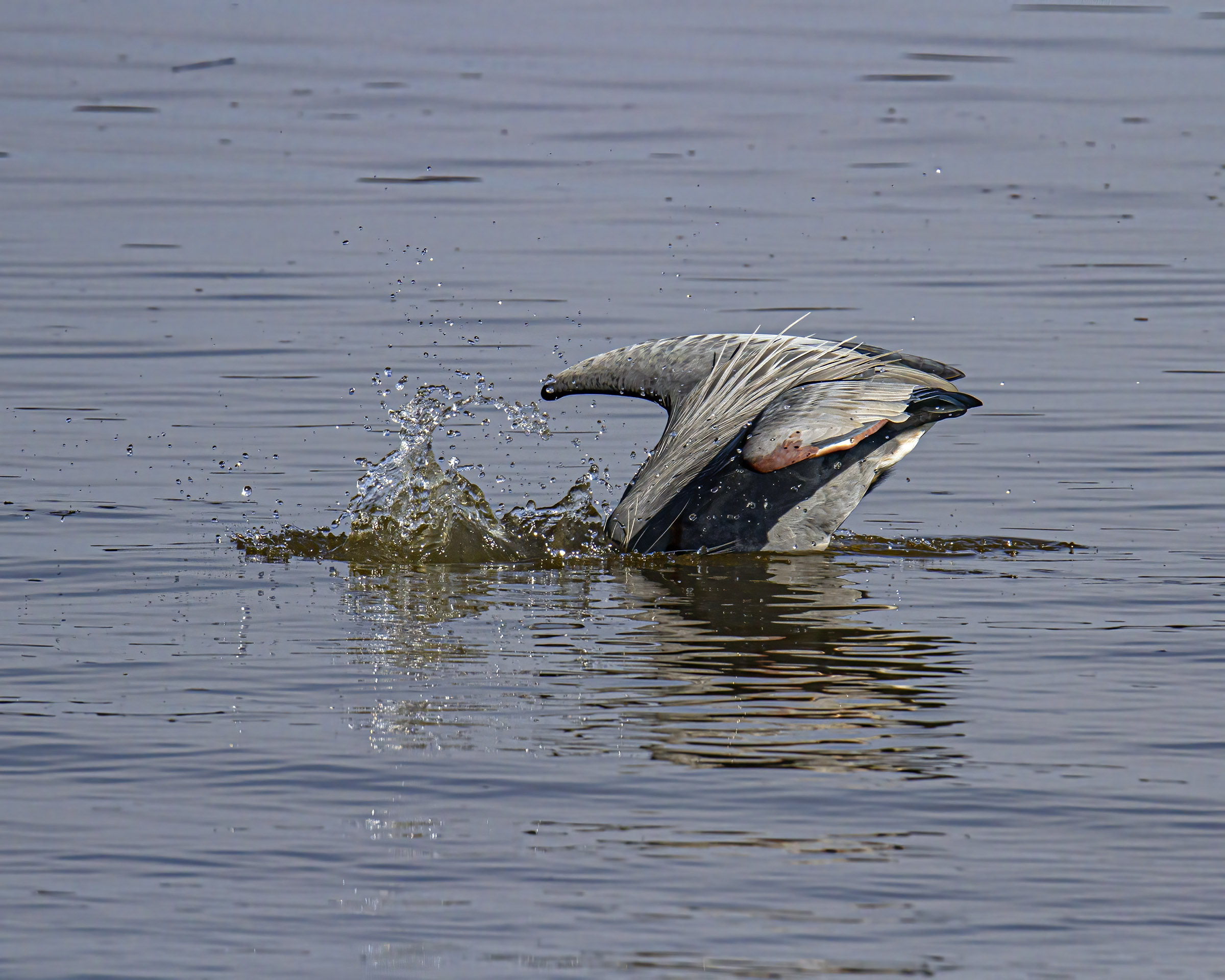
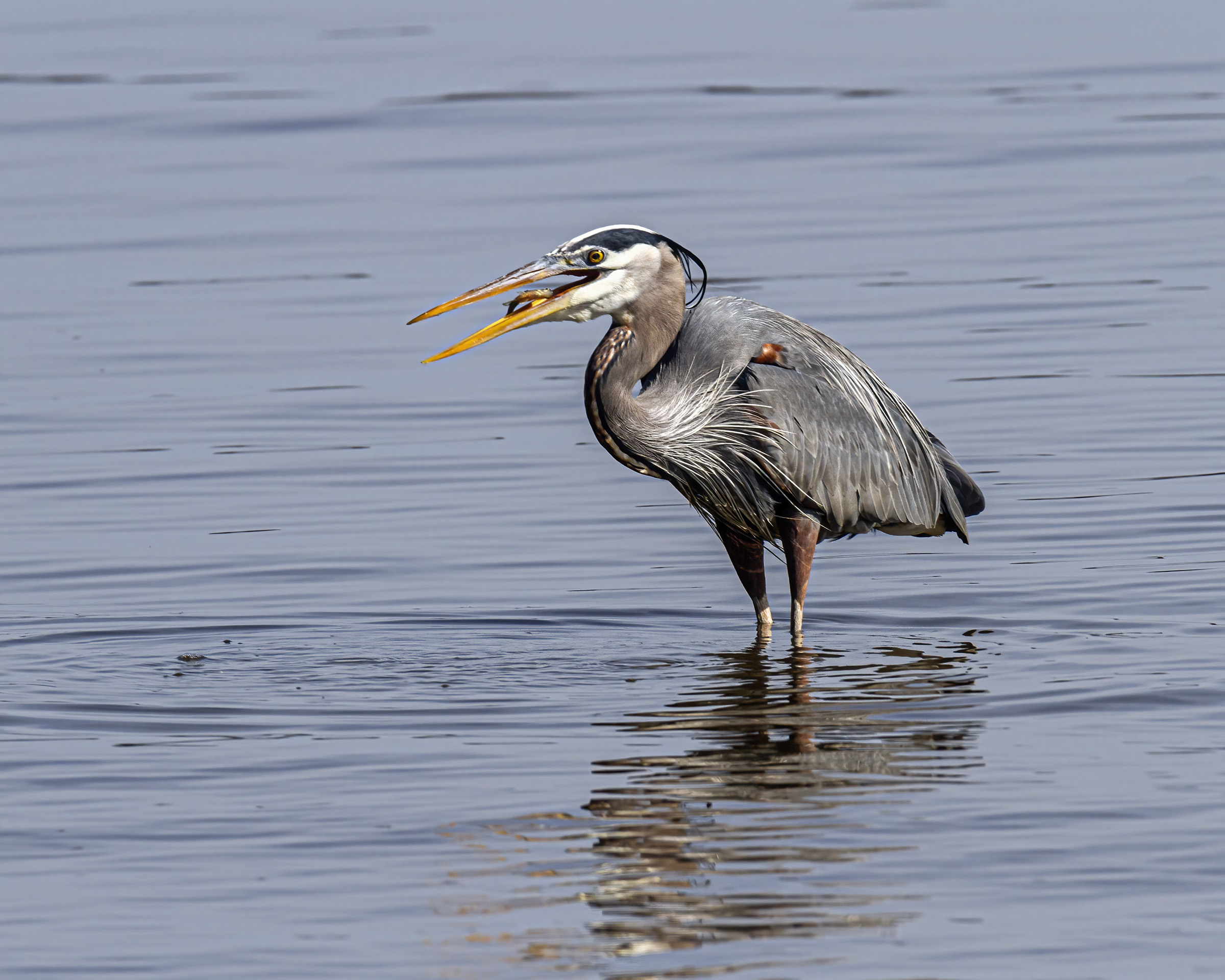
On this occasion, I was able to capture some of the action when the heron plunged its head into the water. Time seemed to slow down as I waited to see what, if anything, the heron had caught. As you can see in the first photo, the heron’s catch was a modestly-sized fish. The heron flipped its head to the side to reposition the fish—herons swallow fish headfirst in a single gulp. The final photo shows the fish’s final repositioning in the heron’s long bill. A split second later the heron tilted it bill upward and the fish disappeared from sight.

As I looked a these three photos, I was struck by the way that the heron’s long head feathers moved around as it twisted and turned its head. That little detailo revived distant memories of the 1970’s when I had long hair—I remember flipping my head from time to time to keep the hair out of my eyes.

Great Blue Heron

Great Blue Heron

Great Blue Heron

© Michael Q. Powell. All rights reserved.


Read Full Post »

Yesterday was a beautiful day, with blue skies and temperatures soaring above 60 degrees (16 degrees C). I visited Occoquan Bay National Wildlife Refuge and was thrilled to have multiple sightings of Bald Eagles (Haliaeetus leucocephalus).

One eagle seemed particularly vigilant, keeping careful watch over the entire area. Initially the eagle was mostly hidden from view by the heavy vegetation, but eventually I found a visual tunnel that gave me a mostly unobstructed view of the majestic eagle.

Photographing bald eagles can be quite challenging—the extreme contrast between the bright white heads and the dark bodies means that I have to choose the exposure for the image carefully to avoid blowing out the highlights in the head or losing the details of the body in the shadows.

Bald Eagle

© Michael Q. Powell. All rights reserved.

Read Full Post »

The last few days I have been really busy and have not had a chance to get out very much with my camera to capture new images. I went over the shots from my visit to Occoquan Bay National Wildlife Refuge and decided to post some more shots of the subadult Bald Eagle (Haliaeetus leucocephalus) that I photographed as it flew about, twisting and turning in the air above my head.

Previously I posted a shot of the eagle with outstretched wings (the 20 February posting was called Eagle Gyration). Today’s posting shows the same eagle in a number of other positions. I am always intrigued by the way that birds use their wings and tails in combination to move in the desired direction. Eagles make flying seem so effortless.Bald Eagle

Bald Eagle

Bald Eagle

© Michael Q. Powell. All rights reserved.

Read Full Post »

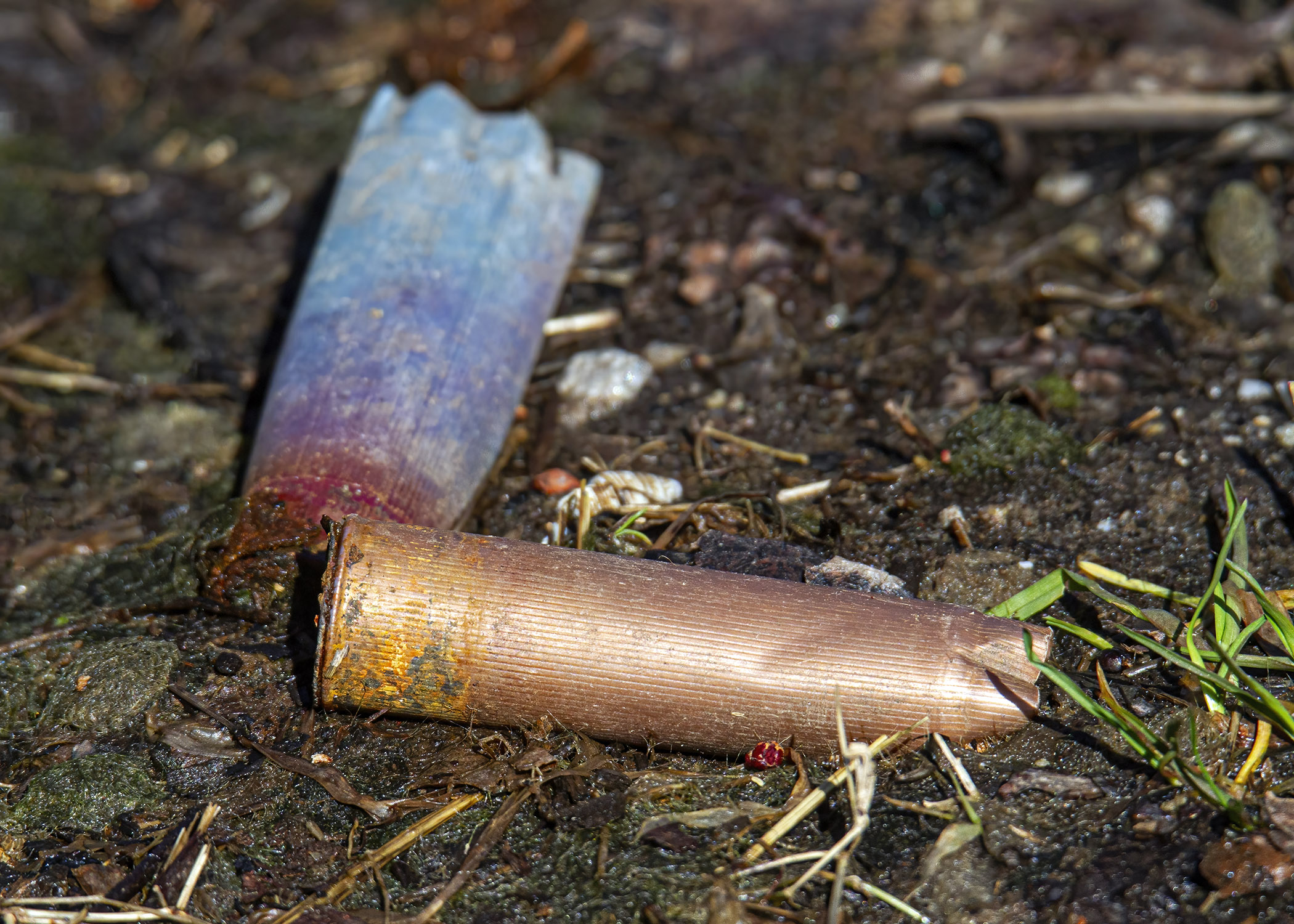
The waterside trails at Occoquan Bay National Wildlife Refuge are often flooded by tidal surges and littered with debris when the waters recede. Some of the debris, like driftwood, snail shells, and clumps of vegetation is natural, but much of it is manmade.

During a recent visit to the refuge, I was shocked to spot a different kind of shel than I am used to seeing—there were multiple used shotgun shells at one location. In some earlier postings I have noted that there are multiple duck blinds in the waters off of the wildlife refuge and during certain seasons I have seen and heard duck hunters using these blinds.

I assume that these shells floated in or were carried in by the tide from one of those duck blinds. (Do used shotgun shells float?) Hunting is definitely not permitted on the grounds of the refuge, with the exception of several days a year when the refuge is closed and deer hunting, which is part of the “deer management program,” is permitted. I am not a hunter, but recognize that there is an overabundance of white-tailed deer in our area that poses a threat to both humans on the roads and to the deer themselves, who may struggle to find food.

I tried to capture these images of the shell as artfully as possible, but the juxtaposition of the natural and manmade elements in the photos is nonetheless jarring for me, considering what the shells were designed to do.

shotgun shells

shotgun shells

© Michael Q. Powell. All rights reserved.


Read Full Post »

How good is your balance? This morning I was reading an article in AARP magazine about measuring your fitness level and one of the tests was a one-legged balance test. I tested myself and was able to hold the pose for only a few seconds. Yikes!

A Great Blue Heron (Ardea herodias) that I spotted on Monday at Occoquan Bay National Wildlife Refuge would have aced the test. The heron seemed to be perfectly stable as it relaxed in an open area adjacent to a small pond while standing on a single leg. It was a cold morning and I suspect that the heron’s other leg was tucked under its feathers to conserve body heat.

As I get older, I have become more conscious of the need for balance in all areas of my life. When I worked for the federal government a lot of lip service was given to the importance of “work-life balance,” but the sad reality was that few of my co-workers achieved that sense of balance—most of us, myself included, tended to be workaholics. Retirement has provided me a lot more freedom to use my time in a way that attempts to balance my physical, mental, spiritual, relational, and creative needs. It’s a constant juggling act, but I’m working on it.

In the meantime, I think I would do well to emulate the Great Blue Heron and practice my one-legged pose some more.

Great Blue Heron

© Michael Q. Powell. All rights reserved.


Read Full Post »

When I watched a Bald Eagle (Haliaeetus leucocephalus) fly into a nest on Monday at Occoquan Bay National Wildlife Refuge, I was not sure if it was occupied. We have reached the time of the year when the eagles at this refuge begin to sit on their eggs, but I did not know if the process had begun at this small nest that was used for the first time last year. As you can see in the first photo, the nest is only about as wide as the eagle’s outstretched wings.

After the eagle had landed and settled down, the body of a second eagle appeared from within the nest. I never did get a good look at the second eagle, because it kept its head down as it made some adjustments in the nest while the newly arrived eagle waited patiently to take over nest responsibilities.

One eagle flew away and the remaining one sank lower from view as it spread its body to cover the eggs. The nest is quite shallow, though, so I could still see the top of the eagle’s head most of the time. Occasionally the eagle would raise its head a little and I was able to capture a few shots like the final one here in which the eagle was looking up into the sky, wondering perhaps when its mate would return to the nest.

Bald Eagle

Bald Eagle

Bald Eagle

© Michael Q. Powell. All rights reserved.

Read Full Post »

I raised my camera to my eye when I spotted a Carolina Chickadee (Poecile carolinensis) extracting seeds from spiky Sweet Gum balls on Monday at Occoquan Bay National Wildlife Refuge. As I pressed the shutter release, the chickadee took off and I captured this fun photo of the departing little bird.

I really like the way the head is tilted upward and how the tiny claws are still extended. Most of all, though, I love the way that I was able to capture the feather details in the extended wing.

Sometimes it is better to be lucky than good—this was definitely not the shot that I thought I was taking.

Carolina Chickadee

© Michael Q. Powell. All rights reserved.


Read Full Post »

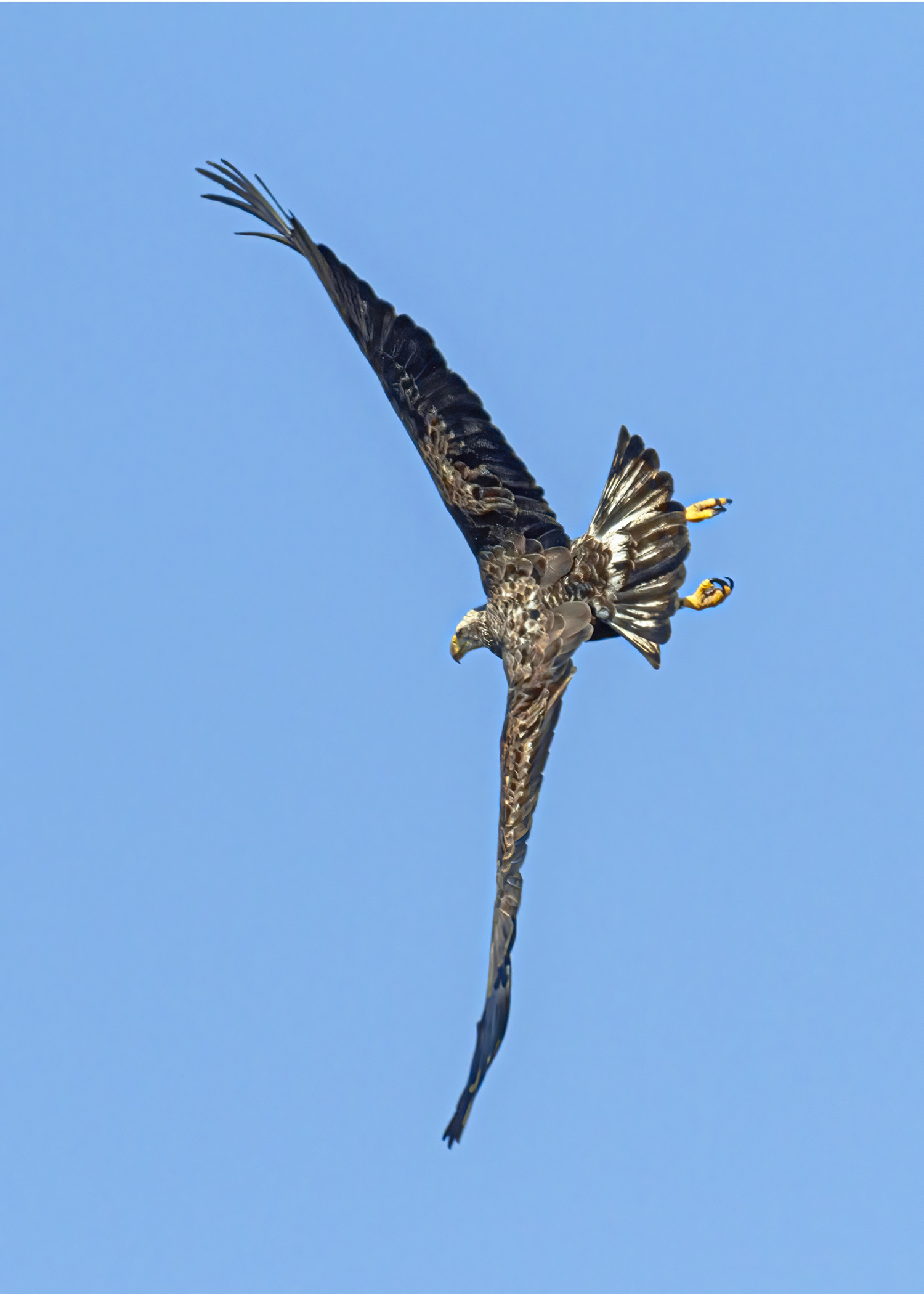
It takes about five years for a Bald Eagle (Haliaeetus leucocephalus) to develop into adulthood and acquire the bright white heads and tails that we generally associate with this species. When they are young, the eagles have dark feathers and beaks and during the intermediate years their feathers have a mottled appearance.

Yesterday I watched a subadult eagle flying about in the skies over Occoquan Bay National Wildlife Refuge. Judging from its coloration, I’d guess that it was about three to four years old.

The eagle put on quite an aerial show for me, twisting and turning in an amazing display of aerial prowess. I was particularly impressed by the way that the eagle would stretch wide its wings and flare its tail as it changed directions, as you can see in the photo below.

When an eagle or any other raptor is moving about like that, it is quite a challenge to track it and keep it within the frame. Suffice it to say, I have quite a few shots in which the eagle is partially cut off at the edge of the frame or occasionally is completely absent from the photo.

Bald Eagle

© Michael Q. Powell. All rights reserved.

Read Full Post »

Most of the time when I see a male Red-bellied Woodpecker (Melanerpes carolinus), its head is buried in the shadows or is turned away from me as he feverishly pecks away at a tree. Last Wednesday at Occoquan Bay National Wildlife Refuge, however, I spotted a Red-bellied Woodpecker in the open at a distant tree and he accommodated me by presenting his head in profile, allowing me to capture this image.

I really like the way that you can see his striking red cap so well in this photo, as well as the beautiful black and white markings on his back.

Red-bellied Woodpecker

© Michael Q. Powell. All rights reserved.

Read Full Post »

I see and hear crows quite often when I am walking about at Occoquan Bay National Wildlife Refuge. Frequently there are large, noisy flocks of them moving about as a group. In my area, there are two types of similar-looking crows—the American Crow (Corvus brachyrhynchos) and the Fish Crow (Corvus ossifragus)—and I reluctantly admit that I have not yet learned to tell them apart.

This past Wednesday, which happened to be Valentine’s Day, I spotted a single crow all by itself atop a broken-off tree. Apparently it had not been able to get a date for the special day or perhaps, like me, it preferred spending some peaceful moments alone.

I was happy to be able to capture some details of the crow’s eye in this shot. Quite often the eye blends it with the dark feathers and looks like a black, featureless hole.

Have a wonderful weekend.

crow

© Michael Q. Powell. All rights reserved.

Read Full Post »

Have you ever tried to sneak up on a Bald Eagle (Haliaeetus leucocephalus)? Given the eagles’ superior eyesight and quicker reactions, they almost always detects me before I can get within camera range and often my first indication of an eagle’s presence is when I see it flying away from me.

As many of you know, there are several eagle nests at Occoquan Bay National Wildlife Refuge and this is the time of the year when eagles begin nesting in them. The roads are blocked in the area surrounding one of the nests, so it is hard to get a good look at it. The largest nest, though, is set way back in the trees, but is visible from one of the main trails, which remains open.

During a visit to the refuge on Wednesday (Valentine’s Day), I noticed through the trees that both members of an eagle couple were perched atop the nest. Male eagles are often smaller than the females, so I think that the eagle to the left in the first photo is a male. I was still a long way from the nest when I captured that first photo, but experience has taught me that it is best to capture a “record” shot, before trying to get closer for a better one.

I continued down the trail in the direction of the eagle nest doing my best to walk near the high vegetation at the edge of the trail that blocked the eagle from seeing me and, alas, prevented me from seeing the eagle.

I know where the spots are where there is an open view of the nest and I prepared myself as I approached the best one. As I stepped partially into the open and raised my camera, one of the eagles took off and I captured the second shot below. As I was trying to track that eagle in the air, the second one took off too and I watched as they both flew away over the waters of the bay.

Before long, the eagles should be sitting on one or more eggs in the nest. The nest is quite deep and high up that it is almost impossible to tell if there is an eagle in the nest when they are incubating the eggs. The members of the couple rotate the responsibility for sitting on the eggs and I have been lucky on a couple of occasions to see the “changing of the guards.” Perhaps I will have that same good fortune this year.

Bald Eagle

Bald Eagle

© Michael Q. Powell. All rights reserved.

Read Full Post »

Yesterday I traveled to Occoquan Bay National Wildlife Refuge, my favorite local place for wildlife photography, for the first time in over a week. Things were kind of slow and most of the birds that I spotted, primarily scaups, ruddy ducks, and buffleheads, were out of range in the deep water. There was a good bit of sunshine, though, that lifted my spirits and helped to compensate for the scarcity of subjects.

As I walked along the trails, I heard this Downy Woodpecker (Picoides pubescens) before I was able to spot him. He was hammering away on a branch and had his head lowered and mostly to the side. I kept my camera trained on him and eventually he raised his head and I was able to capture this image of him that I really like. The shot provides a good look at the large claw on his foot that helps him grip the branch and it also shows how he uses his tail to give him additional leverage.

Downy Woodpecker

© Michael Q. Powell. All rights reserved.


Read Full Post »

At this time of the year male Hooded Merganser ducks (Lophodytes cucullatus) do all that they can to attract the attention of potential mates. They may go through elaborate displays or simply chase after the females, as the two males in this photo appeared to be doing. It is often hard to read the body language of birds, but both females seemed to be sending the clear message that they were not interested (or were playing hard to get).

It struck me that many human males go through similar gyrations in their efforts to attract the attention of females of the species, particularly on this day, when thoughts turn to romantic love.

Happy Valentine’s Day!

Hooded Mergansers

© Michael Q. Powell. All rights reserved.

Read Full Post »

No matter what the conditions or location, I can usually count on seeing sparrows foraging in the underbrush. I spotted this handsome White-throated Sparrow (Zonotrichia albicollis) during a recent visit to Occoquan Bay National Wildlife Refuge. I really like the way that I was able to capture his intense focus as he surveyed a spot right in front of him for a tasty tidbit.

White-throated Sparrow

© Michael Q. Powell. All rights reserved.

Read Full Post »

The waters off of Occoquan Bay National Wildlife Refuge are affected by the tidal surges of the Potomac River. As a result, trails that run parallel to the water are sometimes inundated with water, which leaves behind driftwood and other debris when the waters recede.

Last Thursday one of my favorite trails was still flooded and an abandoned chair caught my attention. The broken plastic lawn chair was sitting upright in the shallow water, partially covered in vines. What was it doing there? Where did it come from?

I focus on wildlife and nature subjects most of the time, but will photograph almost anything else that attracts my eye. In this case, the chair seemed to be telling a story of sorts, having an almost metaphorical significance. The image has an almost abstract feel to it and I love the ripples and reflections in the water and the contrast in the shapes and textures of the natural elements in the photo versus those of the manmade chair.

Yes, I know that this is kind of a quirky image, but I like it and decided it was worth sharing.

chair

© Michael Q. Powell. All rights reserved.

Read Full Post »

When I spotted this Song Sparrow (Melospiza melodia) last Thursday poking about in a mass of floating vegetation in a small pond last Thursday at Occoquan Bay National Wildlife Refuge, I decided that I wanted to get a shot of it. That proved to be quite a challenge. The bird kept its head down and was blocked by the vegetation most of the time.

I kept waiting and shooting in vain and worried that the sparrow would eventually fly away and leave me empty-handed. Finally the bird starting moving toward one end of the vegetation and was almost in the open. I got ready and when the sparrow limited its head momentarily, I was able to capture the kind of image that I had imagined at the start.

I like the way that the sparrow is framed by the vegetation and the water that is visible throughout the image. I am not sure what it had in its mouth, but the sparrow had apparently found some kind of tasty tidbit. The partial reflection of the bird in the water was an added bonus.

It is not rare for me to imagine shots when I am out with my camera and it is really cool when I manage to bring those imagined shots to life.

Song Sparrow

© Michael Q. Powell. All rights reserved.

Read Full Post »

Red-bellied Woodpeckers(Melanerpes carolinus) are one of the most common woodpeckers in my area. I catch glimpses of them often as the move about in the trees, but I rarely manage to get a clean shot of one. I remember when I was first began to photograph birds and was super excited to spot the bright red heads of these woodpeckers. I mistakenly assumed that they would be called Red-headed woodpeckers, but I was wrong—Red-headed Woodpeckers are completely different species.

I was always a bit confused by the name of this species, because I never managed to see the woodpecker’s “red belly.” In the second photo below, you can see an orangish tinge in the lower abdomen area that I guess may qualify as a “red belly,” but that is a bit of a stretch.

Red-bellied Woodpeckers spend a lot of time probing beneath the bark of trees for insects. If you look closely at the first photo, you can see the woodpecker at work with its bill. According to the Cornell Lab of Ornithology, “A Red-bellied Woodpecker can stick out its tongue nearly 2 inches past the end of its beak. The tip is barbed and the bird’s spit is sticky, making it easier to snatch prey from deep crevices. Males have longer, wider-tipped tongues than females, possibly allowing a breeding pair to forage in slightly different places on their territory and maximize their use of available food.” Wow!

Things are warming up a bit and it was delightful to walk about in the sunshine at Occoquan Bay National Wildlife Refuge last Thursday. I decided to leave my heavy coat in the car and wore just a hooded sweatshirt with a long-sleeved thermal shirt underneath. Spring is coming, but I suspect that we will have a bit more winter weather before then—here in Northern Virginia February often has the most severe weather of the winter.

Red-bellied Woodpecker

Red-bellied Woodpecker

© Michael Q. Powell. All rights reserved.

Read Full Post »

Photography does not have to be complicated. Sometimes all it takes is a well-executed image of a common subject in a simple composition.

If I were working as a portrait photographer for humans, I could choose an appropriate backdrop and set up studio lighting. I could instruct subjects on poses and position them carefully, shooting a variety of poses so that I would have multiple shots from which to choose the best ones. If I did not like a particular expression in a shot, I could reshoot the portrait until both the client and I were happy.

Life is much different for a wildlife photographer. I have to work with the available light and environment. Subjects are often skittish and uncooperative. I often have only a single chance to get a shot and may not get a second chance.

I feel blessed when things work out and I am able to capture simple portraits, like this one of a male Northern Cardinal (Cardinalis cardinalis) that I photographed last Thursday at Occoquan Bay National Wildlife Refuge. I took multiple shots of this cardinal when I spotted his bright red feathers, but in almost every one of them, the cardinal was looking away. Finally, the cardinal looked toward me for a brief moment and I was able to get the shot.

It is certainly not a perfect shot, but it is a pleasing little portrait of this handsome bird and I am happy that I was able to capture the moment. For me, photography is primarily about capturing and sharing the beauty that surrounds us, a beauty that too often we ignore, because it is uncomplicated and unspectacular. As the old Shaker folk song reminds us, “Tis a gift to be simple.”

Northern Cardinal

© Michael Q. Powell. All rights reserved.

Read Full Post »

Bald Eagles (Haliaeetus leucocephalus) at Occoquan Bay National Wildlife Refuge are increasingly spending time in and around existing eagle nests. It probably won’t be long before eggs are laid and the eagles begin to sit on the eggs.

On Thursday I spotted an eagle perched high in a nest while its mate kept watch from a nearby tree, as you can see in the final photo. This eagle nest is huge and is by far the largest one at the wildlife refuge. The nest has been used for many years and each year the eagles seem to add another layer to it. It was very easy to spot this eagle, because its bright white head was sticking prominently out of the nest.

When the eagles begin incubating the eggs, however, they hunker down in the deep nest and it is usually impossible to know for certain when they are present. During that period of time I will sometimes watch and wait, hoping to be there for the “changing of the guard,” when one member of the couple takes over duties from the other, but I have been lucky enough to be there only a few times when that happened. Otherwise I have to wait for the eaglets to get big enough to poke their little heads out of the top edge of the nest.

On another part of the refuge, barriers have now gone up to protect the nesting eagles at that location. That nest is adjacent to one of the trails, whereas the large nest pictured here is far enough away from the trail that the authorities do not seem to think that the eagles require additional protection.

Bald Eagle

Bald Eagle

Bald Eagle

Bald Eagle

© Michael Q. Powell. All rights reserved.


Read Full Post »

Great Blue Herons (Ardea herodias) often stand still for extended periods of time when fishing. I consider myself to be quite patient, but most of the time a heron’s patience exceeds my own and I will move on before he has made a strike to catch a fish.

Sometimes, though, herons will walk slowly through the water, carefully lifting their large feet to create minimum disturbance in the water. That was the case last week at Occoquan Bay National Wildlife Refuge, where I spotted a heron slowing making its way through the shallow water—the waters in the Potomac River area are influenced by the tides and it was near low tide when I was observing the heron.

I captured this fun little image just as the tips of the heron’s visible foot cleated the water. If you look closely, you will notice that he claws on the heron’s visible foot were just touching the water. (I love to play with words, so you could say that the heron was “just scratching the surface.” Sorry.)

The angle at which I took the shot caused the heron’s two legs to blend together, so that it looks almost like there are two legs coming out of a single knee. The reflections further confuse the viewer, because it is not clear where the legs end (especially the back leg) and where the reflections begin. The net result, I think, is a positive one, prompting the view to linger longer on the image in an effort to resolve the visual confusion—many viewers scroll through photos really quickly and it is a real plus when something about an image causes them to pause for a moment and examine it more closely.

Great Blue Heron

© Michael Q. Powell. All rights reserved.

Read Full Post »

At various times throughout the winter, I can see rafts of migratory ducks in the waters off of Occoquan Bay National Wildlife Refuge. Most of the time there are Buffleheads, Ruddy Ducks, and Hooded Mergansers, but sometimes these familiar friends are joined by members of other species.

Last week I spotted some Scaups, medium-sized diving ducks that tend to hang out in the deeper waters far from the shore. There are two different kinds of Scaups—Greater and Lesser—that are almost identical in appearance and I honestly have trouble telling them apart. According to the Cornell Lab of Ornithology, there are “only slight differences in head shape: the Greater Scaup has a rounded head, the Lesser Scaup a peaked head.”

One of the female scaups ventured within range of my telephoto lens and I was able to capture this image. To me, her head looks rounded, so I am guessing that she is a Female Greater Scaup (Aythya marila). I love her distinctive white patches near her bill and her stunning yellow eyes.

Greater Scaup

© Michael Q. Powell. All rights reserved.


Read Full Post »

I never get tired of photographing Bald Eagles (Haliaeetus leucocephalus)—it always feels special to catch sight of one of these majestic birds. In Northern Virginia, where I live, we are blessed to have a relative abundance of Bald Eagles and I see one or more of them quite regularly. Getting a good shot of one, though, is a bit of a challenge, because the eagles’ eyesight and reaction times are vastly superior to my own. A lot of the time my first indication of the presence of an eagle is when I see it flying away from me.

This past Tuesday I spotted a Bald Eagle perched on a broken-of branch of what appeared to be a small, dead tree at Occoquan Bay National Wildlife Refuge. There was some vegetation between the two of us that hopefully hid me from view. Initially my view of the eagle was partially blocked, but by bending and twisting myself, I managed to find a clear visual tunnel.

When I captured the first shot, the “regal” one, the eagle appeared to be surveying its surroundings from on high, like a royal sovereign. A few seconds late, the eagle seemed to have become aware of my presence and stared directly at me. It is hard to interpret the facial expressions of an eagle, but “fierce” is a descriptive word that often comes to mind.

Although it might have been a little curious about me, the eagle seemed mostly unhappy that I was there. I can imagine the regal eagle thinking, “We are not amused.”

Be sure to click on the second image to get a closer look at the eagle’s face. How do you interpret that expression?

Bald Eagle

Bald Eagle


© Michael Q. Powell. All rights reserved.

Read Full Post »

Have the rules changed or have I simply changed? When I first starting getting into wildlife and nature photography, one of the basic “rules” that I learned was I should try to fill the frame with my primary subject. I acquired longer lenses and worked to become more stealthy so I could get closer and closer to my subjects. My “ideal” shot was a sharp “portrait” image with a soft creamy background.

I still like those kind of images, but I began to realize that I was removing the birds and bugs from their environments. I am now pushing myself to try to include more of the relationship between the subject and its surroundings and ideally the interaction between the two. What that means is that I am growing increasingly comfortable with images in which the primary subject takes up only a small portion of the frame.

In the first image, for example, I could have easily cropped this shot of Song Sparrow (Melospiza melodia) much more tightly to draw the viewers’ eyes to the bird’s feather details. Instead, I limited the cropping in order to show all of the dried vegetation hanging from the branch on which the sparrow was perched.

In the second image, the Great Blue Heron (Ardea herodias) was quite far away. In the past, I might not have taken the shot, because I knew I would not be able to capture a detailed view of the heron. In this case, I instantly knew that I wanted to capture the mood of the moment by showing the heron in its environment. I was happy to be able to convey a sense of the peacefulness of the moments that I shared with this beautiful heron, a time for reflection both literally and figuratively.

Rules and guidelines are undoubtedly helpful for beginners, because they establish a general framework for understanding what makes a “good” photograph. Over time and after spending countless hours with my camera and my computer, I have learned that “good” is a relative term and that “beauty” is often subjective. Most importantly, however, I have developed a greater sense of what types of photos I personally like and become more skilled in creating these kinds of images.

Nothing is static, though, and I know that my tastes and preferences and those of my readers are likely to change over time. Artists of all types are prone to introspection and are more likely than most other people to explore their inner landscape for inspiration and understanding. Whatever output those artists create is often the result of the interplay between their inner world and the outer world—the “environment” really matters in understanding the context of a work.

Song Sparrow

Great Blue Heron

© Michael Q. Powell. All rights reserved.


Read Full Post »
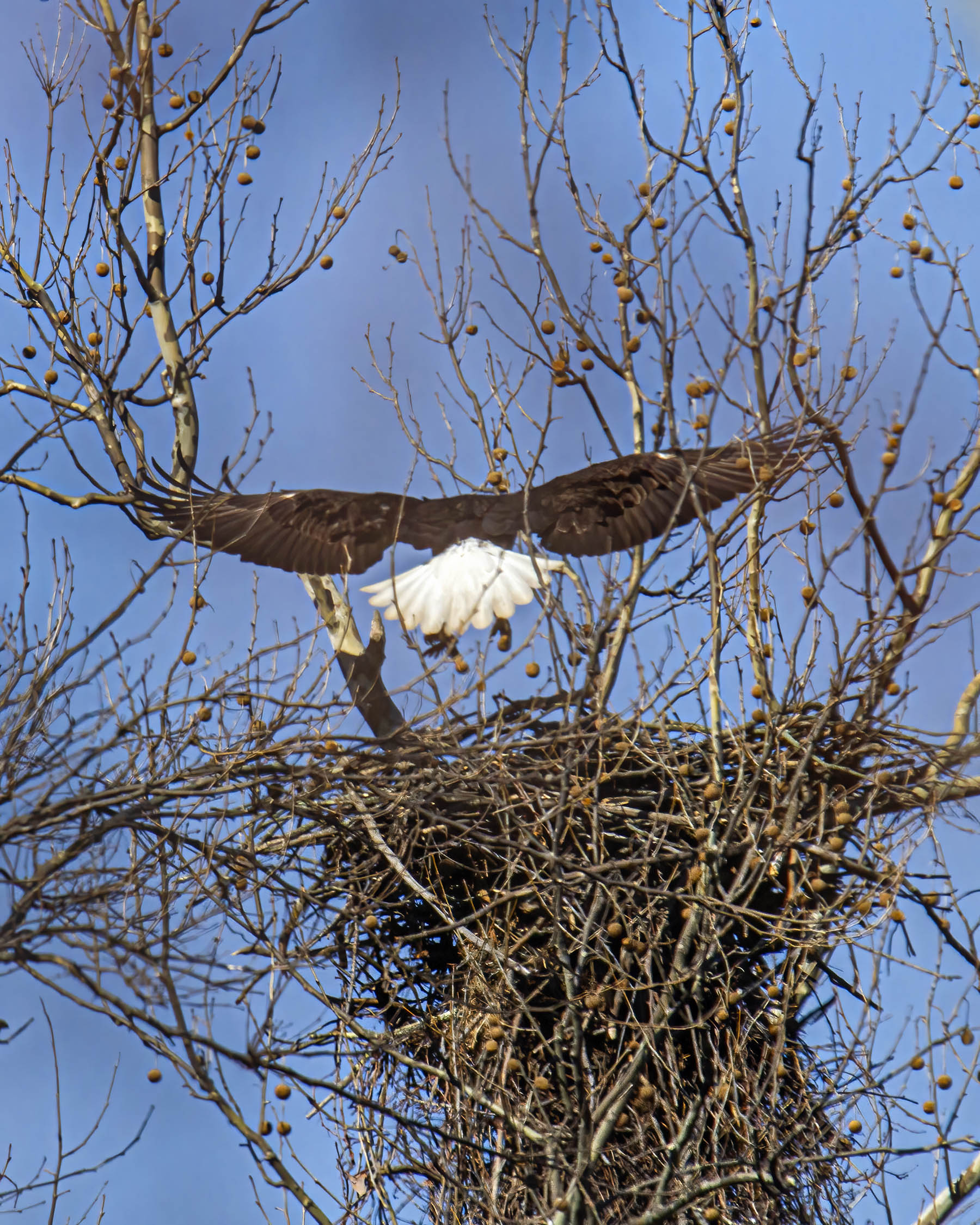
It won’t be long before the Bald Eagles (Haliaeetus leucocephalus) begin to incubate their eggs at one of several nests of which I am aware at Occoquan Bay National Wildlife Refuge. The smallest nest was used for the first time last year and I was curious to see if the eagles would return to it. I was therefore quite happy to spot an eagle on Tuesday perched in that nest in what looks to be a sycamore tree. Usually eagles sit much lower in the nest when there are eggs present, so I suspect that this eagle was checking out the nest, possible as a prelude to renovating or enlarging it.

I was a pretty good distance away from the eagle and was partially hidden by vegetation and trying to be stealthy, but the eagle detected my presence. I captured the second image right after the eagle flew out of the nest. I managed to get only a single decent shot, because the eagle descended and was immediately hidden by the abundant branches—if the eagle had flown upwards I might have had a better chance of getting several clear shots.

Last year the authorities at the refuge eventually blocked the trail on which I was traveling to keep the eagles from being disturbed during the nesting season. I would not surprised to find the trail blocked the next time I visit the refuge. During the period of time before the trees begin to leaf out, I may still be able to keep track of the nest, albeit from a slightly greater distance from it.

Bald Eagle

Bald Eagle

© Michael Q. Powell. All rights reserved.

Read Full Post »

Despite my best efforts, I could not get this White-throated Sparrow (Zonotrichia albicollis) to smile for me during a mini-portrait session on Tuesday at Occoquan Bay National Wildlife Refuge. The sparrow seemed to think that a serious look was more appropriate for his LinkedIn profile photo.

Birds were much more active on Twitter before its name was changed to X, but now are searching for new social media fora. Are postings on X still called “tweets?”

White-throated Sparrow

© Michael Q. Powell. All rights reserved.


Read Full Post »

When it comes to posting photos, where do you you draw the line? Do you carefully curate your images and post only the ones that make you look good as a photographer? Do you worry about your “image” and reputation? I remember someone telling me once that the true sign of professionals is that they present only their absolute best work to the public.

I am proud to say that I am not a professional by that definition and I post photos that I find interesting, cool, or quirky, irrespective of the supposed quality of the images. I do not really care all that much about my personal image and have never had a goal of attracting a large audience of “followers.” I post images that appeal to me in some way and hope that some viewers will have a similar reaction

My photos (and my blog) are a reflection of the way that I see the world and my simple objective is to use my images and words to share my perspectives with others, i.e. to help them to see the world through my eyes. For me, the natural world is full of endless wonder and unlimited beauty, a place to explore and channel my curiosity and creativity.

I have gone off on a bit of a tangent in this posting, but I woke up this morning in an introspective mood and wanted to share some of what is going on in my head at this moment. The three images below are ones that I have taken over the past two weeks at Occoquan Bay National Wildlife Refuge and are a bit more “artsy” than my usual images, which tend to be more detailed and close-up.

The first image shows a pair of Hooded Merganser ducks (Lophodytes cucullatus) flying away from me over the water. I really like their shadowy reflections and the parallel lines of the water. The second photo shows a Pied-billed Grebe (Podilymbus podiceps). Although I captured the details of the bird pretty well, it is the rippled reflection that really grabbed my attention.

The final photo is a minimalist environmental portrait of a Belted Kingfisher (Megaceryle alcyon). Silhouettes work best when the shape of the subject make it immediately recognizable, which I think is the case here. I like the way that the angular protrusions of the branch match those of the bird. The image is mostly black and white, but I really like the way that you can see a bit of the blue sky peeking through in the upper right corner of the frame.

So what do you think? Would you have thought to capture these images? Would you have been willing to share them with others? Where do you draw the line?

Hooded Mergansers

Pied-billed Grebe

Belted Kingfisher

© Michael Q. Powell. All rights reserved.

Read Full Post »
I observed Song Sparrows (Melospiza melodia) foraging for food on the ground at multiple locations last Thursday at Occoquan Bay National Wildlife Refuge. Most of the time they would fly away as I approached, but occasionally one of them would choose a new snow-covered perch that was still within range of my long telephoto zoom lens.

The two photos below are mostly monochromatic, composed primarily of various shades of brown and white. The warmth of the browns helps to warm up the photos a little, despite the abundance of snow. I think the photos would have felt cooler and more stark if I had converted them to black and white.

Song Sparrow

Song Sparrow

© Michael Q. Powell. All rights reserved.


Read Full Post »

Most of the woodpeckers in my area have black and white feathers in varying patterns, but the Northern Flicker (Colaptes auratus) is a notable and colorful exception to that general rule. I spotted this male Northern Flicker—only males have the black “mustache”—last Thursday perched high in a dead tree at Occoquan Bay National Wildlife Refuge.

The sky was clouded over when I captured this image, so I chose to overexpose the shot to reveal the amazing colors and patterns of the flicker’s feathers. These camera settings caused the background to be almost totally blown out and the resulting white background makes this look like it was shot in a studio.

Like most of the birds that I photographed in our recent frigid weather, the flicker had fluffed its feathers in an effort to retain heat. If you look closely at the image, you may notice that the feathers cover most of the flicker’s feet, with only the tips of the toes visible.

Northern Flicker

© Michael Q. Powell. All rights reserved.

Read Full Post »

« Newer Posts - Older Posts »