Feeds:
Posts
Comments

Posts Tagged ‘Kingstowne VA’

Hooded Mergansers (Lophodytes cucullatus) are strange-looking ducks—no other ducks that I see regularly look like them. The shape and proportions of their heads and bills are so unusual and cartoonish that they look like they were created at Disney Studios.

Most of the time when I see Hooded Mergansers, they are in small groups, but last week I spotted only a solitary male during a short visit to a suburban pond not far from where I live. The “Hoodie” seemed to be content to swim around alone, not interacting with the other ducks on the pond and not spending any noticeable time fishing—Hooded Mergansers dive for fish, crayfish, and other food, seizing it in their thin, serrated bills.

The weather was cold, gray, and windy on the day I captured these images, conditions that are quite typical during the winter here. Weather forecasters predict that today will be mostly sunny, so I hope to have a chance to get out in nature with my camera and exercise both my body and my soul. As Vincent Van Gogh once wrote in a letter to his brother Theo, ““Always continue walking a lot and loving nature, for that’s the real way to learn to understand art better and better.”


Hooded Merganser

Hooded Merganser

© Michael Q. Powell. All rights reserved.

Read Full Post »

One of the most distinctive ducks that migrates into my area for the winter is the Hooded Merganser (Lophodytes cucullatus). The male has a curious-looking head that is black and the white and the female has an orange-brown hairstyle that literally sticks out.

Sometimes Hooded Mergansers arrive in groups and I have seen some recent photos by local photographers of males competing for the attention of the females. In this case, cover, I spotted only one couple at the small suburban pond not far from where I live. The ducks dozed a bit and occasionally preened their feathers, so there was not a whole lot of action to capture. I was content to capture a few “record” images and hope I will have some more chances to see these little diving ducks in the upcoming months.

Hooded Merganser

Hooded Merganser

Hooded Merganser

© Michael Q. Powell. All rights reserved.

Read Full Post »

Ruddy Ducks (Oxyura jamaicensis) “feed most actively at night, so you’ll often see Ruddy Ducks sleeping during the day, head tucked under a wing and tail cocked up,” according to the Cornell Lab of Ornithology. I spotted a small group of them, including the sleeping male Ruddy Duck in the first photo, on Tuesday at a small suburban pond in Kingstowne, a community only a couple of miles from where I live.

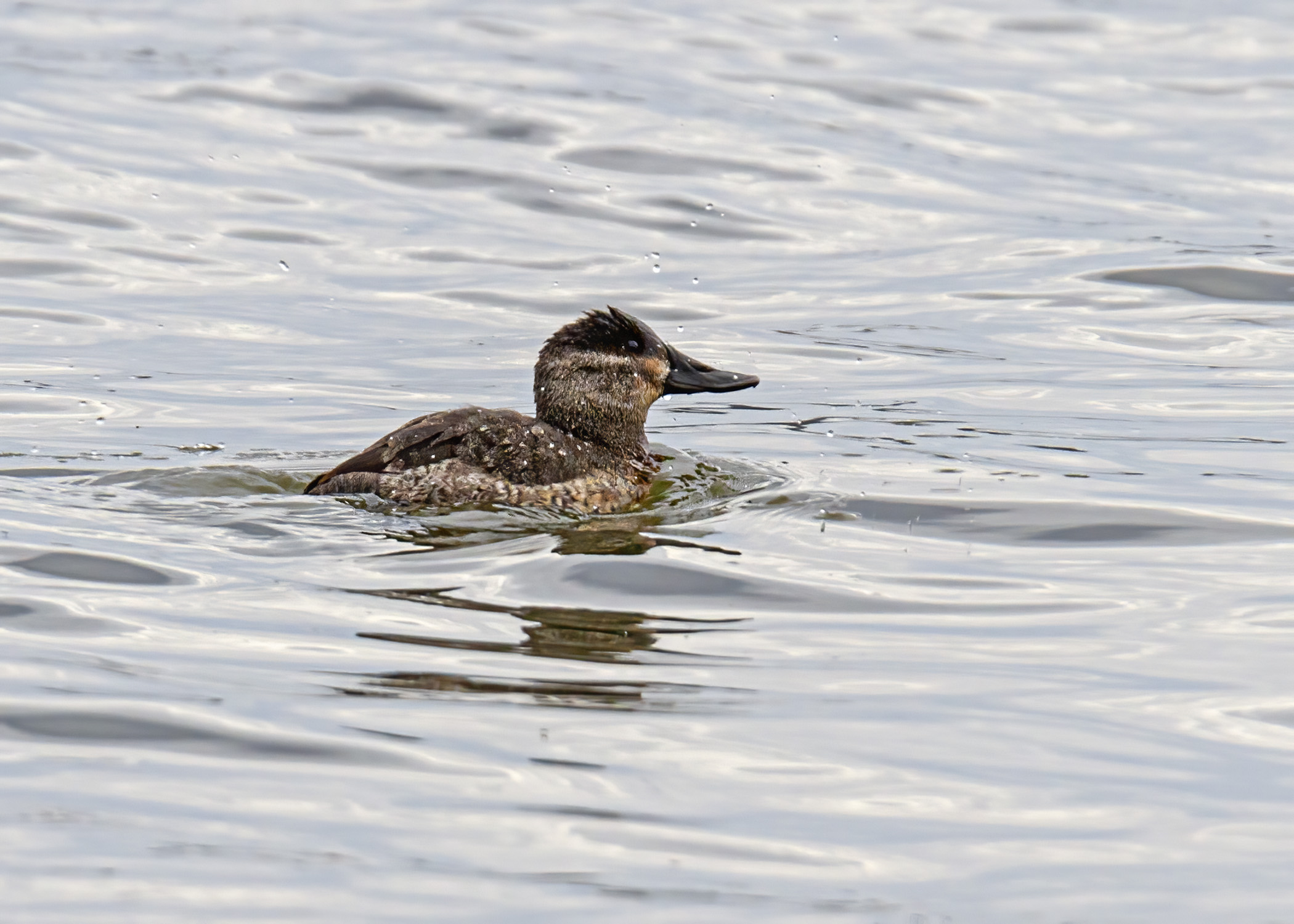
Earlier this month I spotted a much larger flock of Ruddy Ducks in the waters off of Occoquan Bay National Wildlife Refuge. As you can see in the second photo, many of the ducks were sleeping. The ducks were quite a distance from shore, but the bright white cheek patches on some of the males made them easy to identify. Eventually one of the ducks swam a bit closer and I captured the final image—judging from its coloration, this appears to be either a female or an immature male.

I read on-line that the breeding colors of the male are spectacular, with a sky-blue bill, shining white cheek patch, and gleaming chestnut body, but I have never seen Ruddy Ducks during breeding season. As I read further in the entry for the species on the Cornell Lab of Ornithology website, I could not help but chuckle:

“The bright colors and odd behavior of male Ruddy Ducks drew attention from early naturalists, though they didn’t pull any punches. One 1926 account states, “Its intimate habits, its stupidity, its curious nesting customs and ludicrous courtship performance place it in a niche by itself…. Everything about this bird is interesting to the naturalist, but almost nothing about it is interesting to the sportsman.” ”

UPDATE: A sharp-eyed Facebook friend noted that the position of the duck in the first photo is a bit more upright than it would be if he were sleeping and suggested the duck was in the process of grooming.

Ruddy Duck

Ruddy Ducks

Ruddy Duck

© Michael Q. Powell. All rights reserved.

Read Full Post »

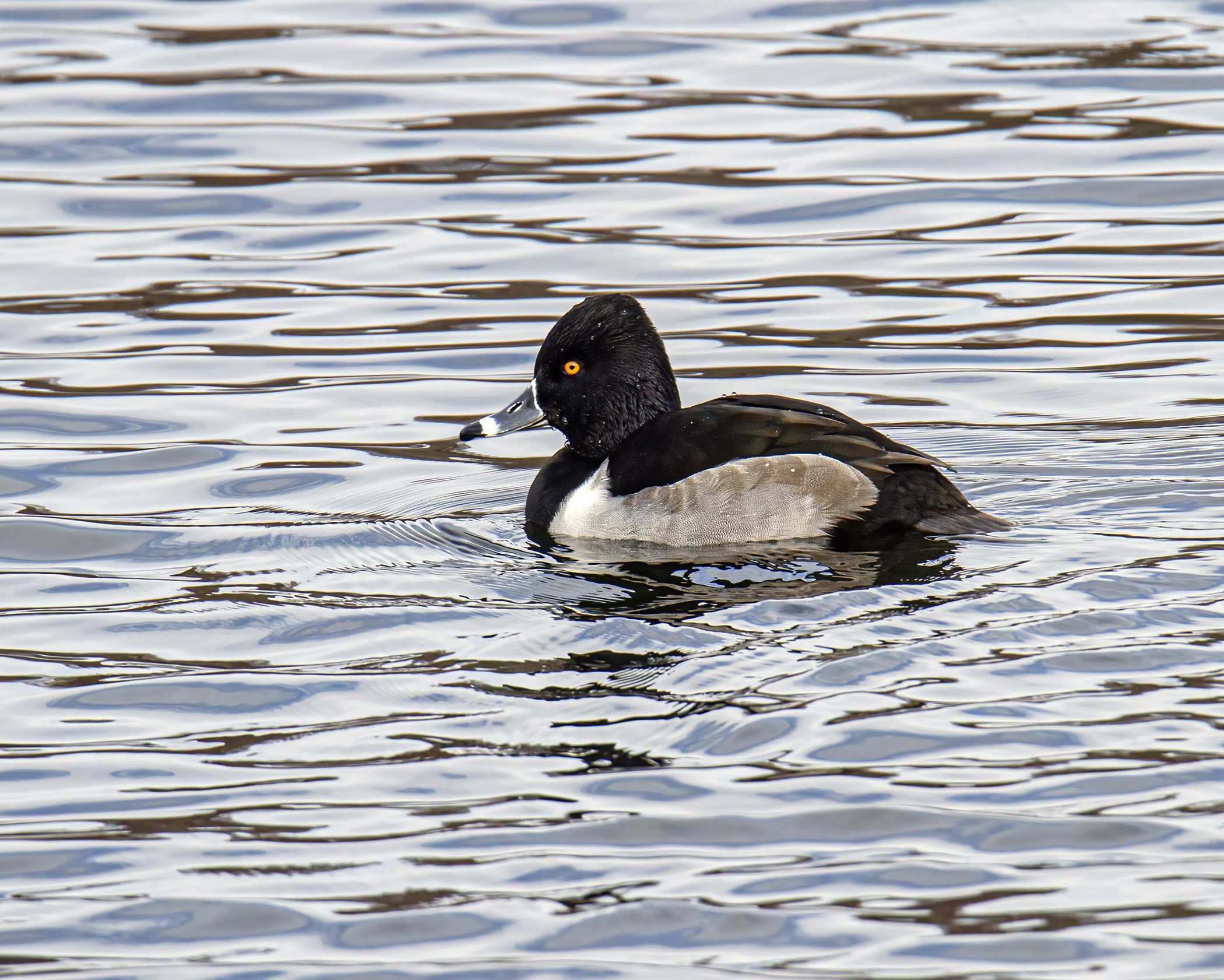
Yesterday I made a quick trip to a local suburban water retention pond, where several migratory bird species overwinter with us. I was shocked to see that no Canada Geese were there, but did spot two Double-Crested Cormorants, a few Ruddy Ducks, and several pairs of Ring-necked ducks (Aythya collaris). All of these are diving birds, so they mostly hung out near in the deeper waters at the center of the pond.

I spent a good amount of time watching one Ring-necked Duck repeatedly dive into the water and would try to guess when and where he would resurface. Male Ring-necked Ducks have a distinctive appearance, with yellow eyes, a striped bill, and a strangely pointed head.

Clouds would drift across the sun from time, causing patterns on the surface of the water to shift and change. I really got caught up in these reflections and these three photos give you a sense of the swirl of colors and patterns that provided an amazing backdrop for these cool-little ducks.

Ring-necked Duck

Ring-necked Duck

Ring-necked Duck

© Michael Q. Powell. All rights reserved.

Read Full Post »

Do you imagine a photo in your mind and then try to create it? Most of the time I am an opportunistic wildlife photographer—I react to the situations in which I find myself and try to make the best possible photo to capture the subject, the action, or the mood. Sometimes, though, I look at a spot and think, “Wouldn’t it be great if my subject moved into that light or onto that photogenic perch?”

On Wednesday I watched a lone Double-crested Cormorant (Phalacrocorax auritus) as it repeatedly dove into the water in a small suburban pond not far from my townhouse. Generally I encounter cormorants at larger bodies of water, but I know that this manmade pond is deep and is suited to birds that dive for food—some species of migratory diving ducks, for example, overwinter there.

The cormorant would spend quite a while underwater and I never knew where it would pop up next. I kept hoping it would surface in an area where the reflections of the fall foliage were especially colorful and eventually it did. The cormorant was quite far away, but I captured the kind of imagine that I had imagined, with colorful rippled patterns on the surface of the water as the cormorant swam into the frame. I encourage you to click on the imagine to see the details of the first image.

The second image was one of my earlier attempts. The cormorant surfaced closer to me than in the first shot, but the surface of the water was not as colorful as I wanted. However, the shot provides a really good look at the striking aquamarine eyes of this beautiful bird. Wow! Those eyes never fail to startle and delight me.

It is a fun challenge to try to incorporate the fall foliage into my photos and I have had an unusual amount of good luck in doing so this past week with a variety of subjects. I am starting to see more and more leaves on the ground, so I know that this period is transitory. Carpe diem!

Double-crested Cormorant

Double-crested Cormorant

© Michael Q. Powell. All rights reserved


Read Full Post »

Bright colors are starting to emerge in the landscape as we move deeper into spring, a welcome sight after the long gray days of winter. I was delighted to see some equally bright colors in the feathers of several small birds that I photographed last Saturday in the vegetation surrounding a small suburban pond in Northern Virginia.

The first bird appears to be a female Yellow-rumped Warbler (Setophaga coronata). Normally I am not a big fan of a head-on shot of a bird, but in this case I really like the way that the photo shows both of the bird’s yellow patches on its breast (there is also a yellow patch on the warbler’s rump).

The bird in the second photo is a male House Finch (Haemorhous mexicanus). I was struck by the intensity of the red on the finch’s upper body, which reminded me of the color of a male cardinal.

In the coming months, warblers will be migrating northward through my area. Each year it is a real challenge for me to get shots of these colorful little birds, because they appear just as the trees begin to cover themselves with leaves—I often can hear warblers behind the leafy foliage without being able to see them.

yellow-rumped warbler

house finch

© Michael Q. Powell. All rights reserved.

Read Full Post »

On Saturday I encountered several female House Sparrows (Passer domesticus) with clumps of vegetation in their mouths and suspect that they are beginning to construct nests. According to the Cornell Lab of Ornithology, “House Sparrow prefers to nest in manmade structures such as eaves or walls of buildings, street lights, and nest boxes instead of in natural nest sites such as holes in trees.”

I know that some people resent the invasive presence of House Sparrows, which were introduced in the United States from Europe in 1851, because they sometimes displace native species. Personally I find them to be as interesting to observe and photograph as any other birds.

Perspective makes a difference—as a photographer I focus my attention on different aspects of my subjects than others may do. For, example,  I know that farmers and gardeners will view some vegetation and insects as pests, while I may find them to be beautiful subjects. It is definitely a cliché, but there is also truth in the old saying that “beauty is in the eye of the beholder.”


House Sparrow

House Sparrow

© Michael Q. Powell. All rights reserved.
 

Read Full Post »

Does the proverbial early bird always get the worm? I’m not sure if that is necessarily the case. I photographed this American Robin (Turdus migratorius) just before noon on Saturday. Perhaps this robin likes to sleep in late during the weekend. Whatever the case, I was delighted to capture this image of the robin snagging a juicy worm for its meal, which might have been brunch for a late-rising bird.

American Robin

© Michael Q. Powell. All rights reserved.
Read Full Post »

When the light is coming from the right direction and a Double-crested Cormorant (Phalacrocorax auritus) is fairly close, you can catch a glimpse of the bird’s stunning turquoise eyes. Yesterday I was fortunate to spot a cormorant perched on a concrete bar that sticks out of a retention pond in a nearby neighborhood. The cormorant was fairly close to the shore, which meant that I was able to capture some detailed images of the striking bird.

The first image is a simply a crop of the second image that really highlights the cormorant’s eyes. The orange skin on its face really makes those eyes “pop.” The cormorant twisted its body from side to side, stretching its long neck, before finally slipping into the water, as you can see in the final photo. This is the view that I am most accustomed to during my wildlife adventures, though normally the cormorant is a lot farther away from me.

These photos are proof that it is not always necessary to travel to a wildlife refuge to see wildlife—this pond is only about a mile (1.6 km) or so from my suburban townhouse.

Double-crested Cormorant

Double-crested Cormorant

Double-crested Cormorant

Double-crested Cormorant

© Michael Q. Powell. All rights reserved.

Read Full Post »

It is a cool, rainy morning here as I sit here, trying to think about what I want to say as I begin the new year. I planned on watching the ball fall at Times Square at midnight, but dozed off on the sofa and missed the moment—I guess that is a sign that I am getting old.

I am feeling pensive right now as I think about the year that has just concluded and wonder what the new year will hold for me. I decided to share some photos that I took last week at the little pond that I featured yesterday. I was utterly fascinated by the reflections of some of the trees at the edge of the pond and the textures that appeared in the ripples on the surface of the water.

Normally I have much more of an identifiable main subject when I am taking a photo, but in those moments I was mesmerized, feeling a little bit like I was looking at a Monet painting. Sometimes I get into an “artsy” trance of sorts and I have no idea how long I stood there with my camera pointing down at the water on the opposite shore.

A few people passed by, but fortunately did not pose the sometimes annoying question that I am frequently asked about what I was photographing. I often have to bite my tongue and not reply with the words resounding in my head—”I was trying to photograph a bird that you spooked with your noisy arrival.” In this case, there was no live subject to scare away, but it would have destroyed my meditative concentration.

I have to admit that I am a little selfish when it comes to sharing my wildlife experience in person with others—I prefer to enjoy the beauty of nature in solitude. I often avoid locations that have abundant wildlife, if I know there will be crowds of photographers. As I like to tell my friends, I was avoiding people long before it became popular during this pandemic.

I will probably do some kind of more organized retrospective look at the postings of this past year in the next few days. For today, though, I wanted to share some musings and reflections.

Best wishes to all of you for a happy and healthy New Year.


ripples

ripples

ripples

© Michael Q. Powell. All rights reserved.

Read Full Post »

Early in the winter, several species of water birds migrate to a water-retention pond in a nearby community called Kingstowne and they generally remain there until spring. The water in the center of the pond is quite deep  and the species that like to dive for their food (versus those that “dabble” on the surface of the water) spend most of their time there.

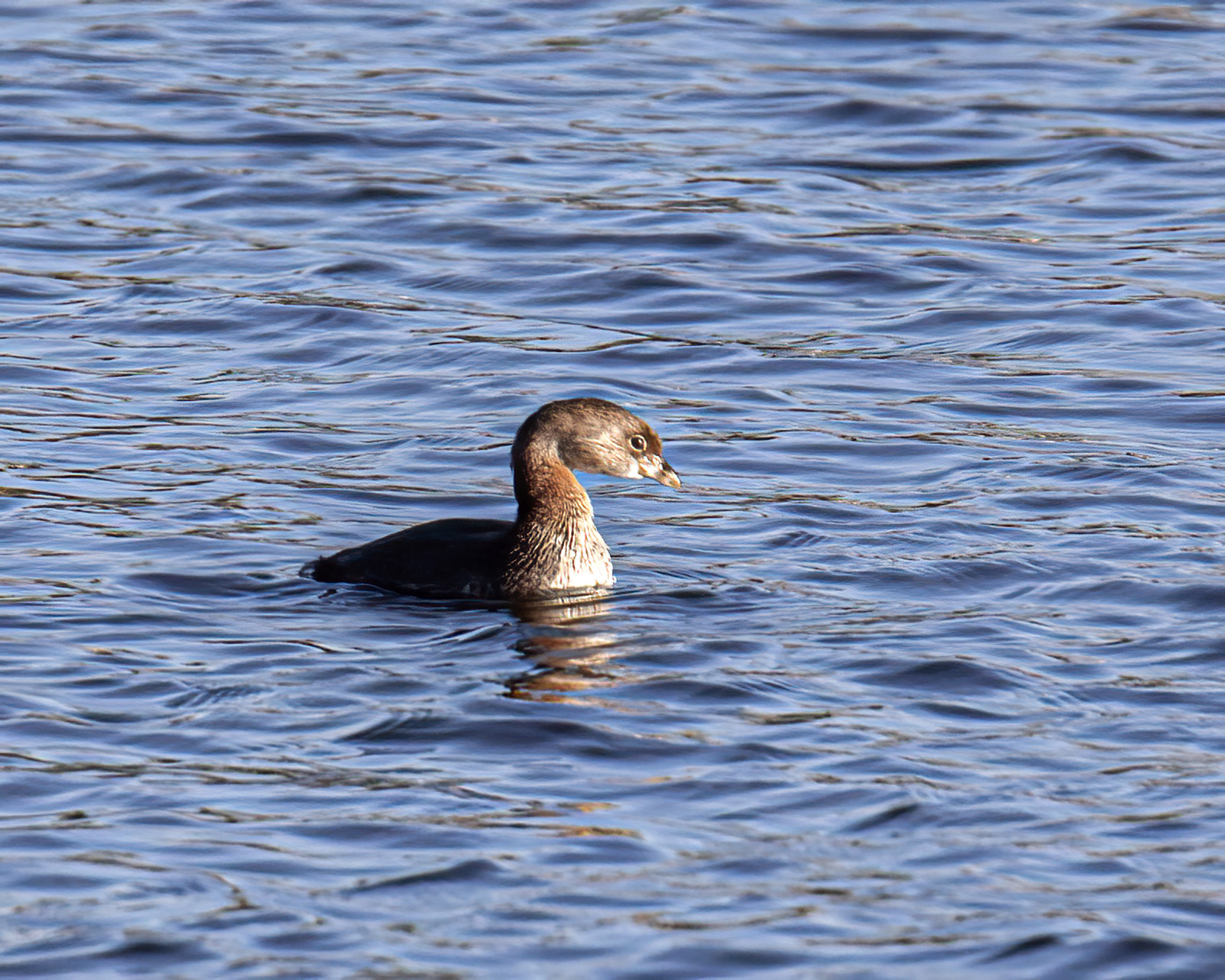
Last Sunday I managed to capture a few long distance shots of the newest visitors, including a Ring-necked Duck (Aythya collaris) and a Pied-billed Grebe (Podilymbus podiceps). A quick visual comparison of the two species shows how remarkably different they are in appearance.

Ring-necked Ducks have beautiful markings and striking yellow eyes, but their overall shape is fairly typical for a duck. Pied-billed Grebes, on the other hand, has such distorted proportions with overly large heads, short bills, and chunky bodies, that they always looks cartoonish to me. You can’t see it in the photo, but Pied-billed Grebes also have lobed feet, rather than the webbed feet of most ducks.

This pond is only a mile or so from where I live, so it is a really convenient location when I want just a short outing with my camera. It is adjacent to a shopping center, so it is not exactly like going out into the wilds, but it serves as a kind of oasis for me, a place where I can drink in the beauty of nature and restore my inner balance.


Ring-necked Duck

Pied-billed Grebe

© Michael Q. Powell. All rights reserved.

Read Full Post »

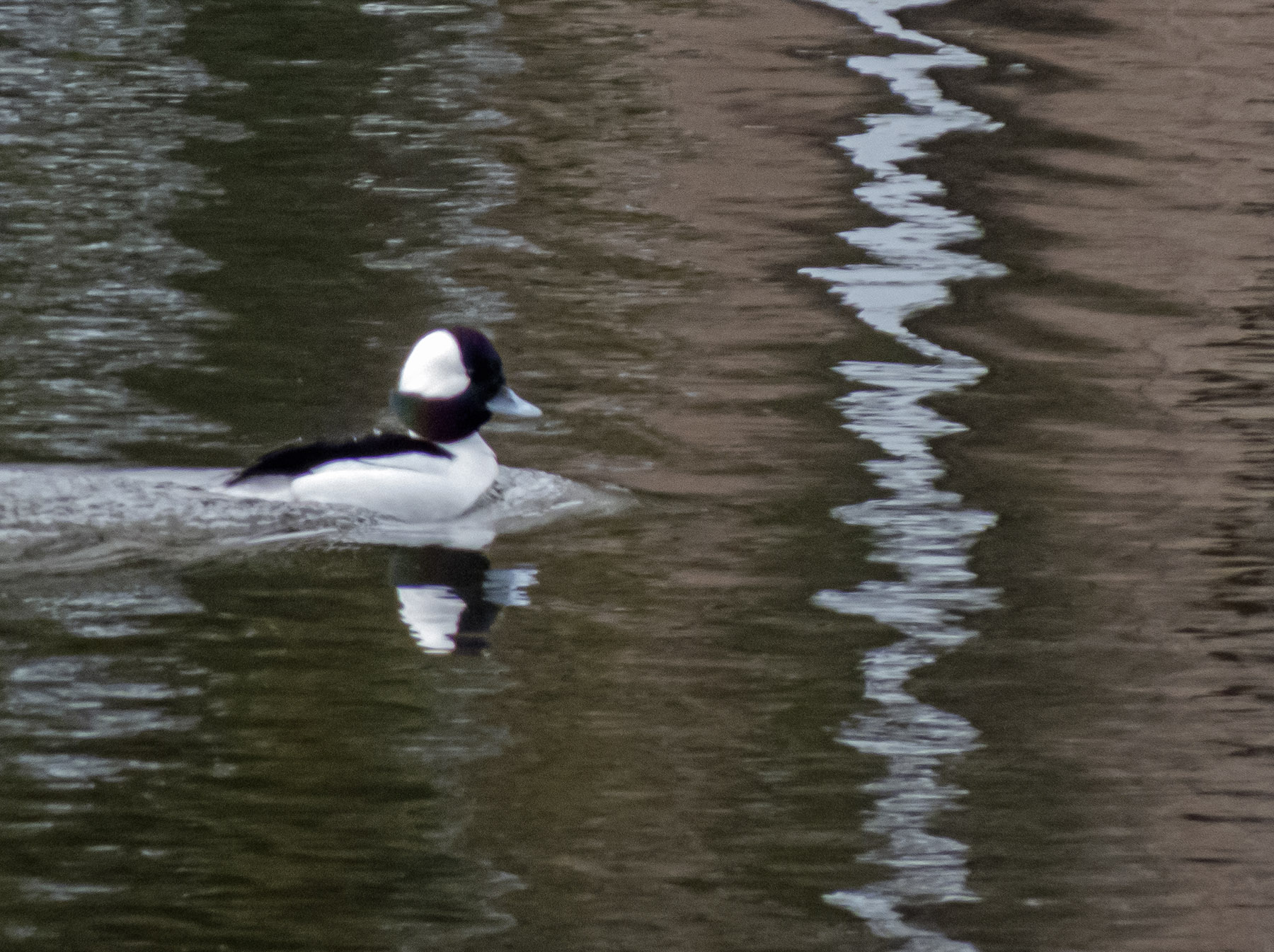
Male Bufflehead ducks (Bucephala albeola) are really easy to identify even from a distance because of the distinctive bonnet-like white patch on their heads. The rest of their heads normally appears to be a solid darkish color, but if the light is coming from the right direction, a very striking purple-green iridescence is revealed.

Yesterday I spotted a couple of male buffleheads at a small suburban pond near where I live. Most of the time the buffleheads stayed in the deep water, as most diving ducks like to do, but occasionally one of them would pop up momentarily a bit closer to the shore. I was thrilled that I managed to capture the beautiful head coloration in a couple of my images, which surprised and delighted me because the day was mostly cloudy and sunlight was mostly lacking.

Bufflehead

Bufflehead

© Michael Q. Powell. All rights reserved.

Read Full Post »

A common bird in a simple setting—that is all of the prompting that I need to capture an image. Nature photography for does not require exotic subjects or locations.

This past Saturday I spotted this Northern Mockingbird (Mimus polyglottos) perched in a young tree. The position did not look very comfortable, so I suspected the bird would not stay in it for long. I focused quickly and was really happy with the result—a nice little portrait with a very limited palette of subdued colors.

Northern Mockingbird

© Michael Q. Powell. All rights reserved.


Read Full Post »

Although we had only about an inch of snow last week, it has hung around on cars and in shady areas. Despite the continuing cold and overcast weather, I decided yesterday that I needed to get outdoors with my camera. I had several places in mind, but my plans were thwarted when I ran into a traffic jam on the interstate. I took the first exit and decided to visit instead a small suburban pond not far from where I live.

Several species of ducks overwinter at this pond and I spotted Hooded Mergansers and Ring-necked Ducks in the center of the pond, out of range of my telephoto zoom lens. As I continued circling the pond on a walking trail, I was thrilled to spot several Double-crested Cormorants (Phalacrocorax auritus) standing in the shallow water not far from the shore. Some bushes separated me from the cormorants, so I had to bend and twist a bit to get a clear shot, but I managed to capture this image of one of them before they turned their backs to me and swam away.

The bright orange color of the cormorants’ bills always captures my attention, but it is the beauty of their brilliantly blue eyes that keeps me transfixed. Wow! Be sure to double-click on the photo to get a closer look at that amazing blue color.

As it turned out, I did not need to travel far to find beauty—figuratively speaking it was in my back yard. It would be cool to have an actual pond in my back yard, but it would have to be a tiny one and my townhouse homeowners’ association would certainly complain about it.

Double-crested Cormorant

© Michael Q. Powell. All rights reserved.

Read Full Post »

As I was walking around a small suburban pond recently, some movement in the underbrush caught my eye. Several small House Sparrows (Passer domesticus) were splashing about in the shallow water of a tiny rivulet that ran into the pond. I managed to capture this whimsical little portrait of one of the bathing sparrows, whose glance suggested to me that my presence was not exactly welcomed.

House Sparrow

© Michael Q. Powell. All rights reserved.


Read Full Post »

Although the daytime temperatures keep dropping, turtles still come out to bask on sunny days. I spotted this beautiful turtle, which I believe is a Red-eared Slider (Trachemys scripta elegans), last Friday at the same suburban pond where I saw the Ring-necked Ducks and Canada Geese that I featured in previous postings. The subject and composition of this image are fairly ordinary, but the beautiful interplay of the light and shadows help to make the image stand out.

Red-eared Slider

© Michael Q. Powell. All rights reserved.

Read Full Post »

Thanks to Tchaikovsky, swans seem to have cornered the market for bird ballet, so some local Canada Geese (Branta canadensis) decided to organize themselves for synchronized yoga competitions instead. At a recent practice that I observed at a small suburban pond, they were having some issues in coordinating their left single-legged pose—one of them had trouble remembering which leg was the left one. What a silly goose. 🙂

Canada Goose

© Michael Q. Powell. All rights reserved.

Read Full Post »

As the weather gets colder, ducks and geese begin to arrive at a small suburban pond not far from where I live. Most of these birds will overwinter with us, though some others may just be passing through our area. It is still a bit early for most species, but I was delighted on Friday to spot a small group of Ring-necked ducks (Aythya collaris). Even from a distance it is easy to identify this species with its prominent yellow eyes, distinctive bill, and pointed head.

The ducks drifted about in the deeper water, never coming very close to the shore, so I was not able to capture any close-up images this time. I’m sure, however, that I will be back to this pond multiple times this winter to check on the ducks, so you may see these colorful characters again in the coming months.

Ring-necked ducks

Ring-necked ducks

© Michael Q. Powell. All rights reserved.

Read Full Post »

Pied-billed Grebes (Podilymbus podiceps) are rather strange looking birds. Their heads are unusually large and blocky, their bills are short and thick, and they have virtually no tails. The Cornell Lab of Ornithology website describes them with these words, “The Latin genus name for “grebe” means “feet at the buttocks”—an apt descriptor for these birds, whose feet are indeed located near their rear ends. This body plan, a common feature of many diving birds, helps grebes propel themselves through water. Lobed (not webbed) toes further assist with swimming. Pied-billed Grebes pay for their aquatic prowess on land, where they walk awkwardly.”

Most of the times when I see a Pied-billed Grebe it is either disappearing from sight as it dives for food or it is swimming away from me. I captured this shot last week as the grebe was in fact swimming away, but paused for a moment and looked to the side. Yes, this is the notorious “butt shot” that we photographers try to avoid, but I like the way that you can see some of the details of the birds eye and the water beaded up on its back and decided to post it anyways.

Pied-billed Grebe

© Michael Q. Powell. All rights reserved

Read Full Post »

From a distance, male Bufflehead ducks (Bucephala albeola) generally look like they are black and white.  Last Friday, however, the lighting was coming from a good direction and revealed some of the beautiful green and purple iridescent feathers on this bird’s head. The second image shows a Bufflehead couple and shows the dramatic difference in appearance between the male and female of this species.

Bufflehead

Buffleheads

© Michael Q. Powell. All rights reserved.

Read Full Post »

This past Friday I spotted a Dark-eyed Junco (Junco hyemalis), one of the birds that is present in my area only during the winter months. According to the Cornell Lab of Ornithology there is a huge range of geographic variation in the Dark-eyed Junco, with five variants of the bird considered separate species until the 1980s.

The bird in the photo below is a “slate-colored junco,” the only type that I have ever seen. Variants found in other parts of the United States, however, may have white wings, pink sides, red backs, gray heads, or a dark hood. Yikes—bird identification is hard enough under normal circumstances, but with that much variation, it seems almost impossible.

Dark-eyed Junco

© Michael Q. Powell. All rights reserved.

Read Full Post »

Can birds smile? With rigid bills, it is probably anatomically impossible for birds to smile in the same way that humans do.

Sometimes, though, a bird will look at me in such a friendly, inquisitive way that it is easy for me to imagine that it is smiling at me. That was the case recently with this female Bufflehead duck (Bucephala albeola) that had cocked her head to the side and looked right at me.

I generally try to approach my subjects as slowly and stealthily as I can so that they will not perceive me as threatening. Of course, most wildlife subjects have much more highly developed senses than I do and they usually catch me in the act. Sometimes they will flee, but if I am lucky, they will simply smile at me.

bufflehead

© Michael Q. Powell. All rights reserved.


Read Full Post »

Some bird species are very territorial and will chase off intruders, while others are content to peacefully coexist with members of other species. Canada Geese (Branta canadensis) are definitely in the latter category—they barely reacted when this Ring-necked Duck (Aythya collaris) passed through the middle of their flock, weaving his way in and around the much larger birds.

I love to capture images with multiple species in a single frame. In this case, I am curious why the duck chose to swim through the geese rather than going around them. Was he courageous and bold? Was he stubborn and determined?

How will you face the upcoming new year? Here’s hoping that, like this little duck, you will be able to move confidently forward towards your goals, mindful of the obstacles that face you, but unbowed by them.


Ring-necked Duck


© Michael Q. Powell. All rights reserved.


Read Full Post »

Recently I mentioned that I had spotted a pair of Bald Eagles (Haliaeetus leucocephalus) at a nearby “suburban pond” and realized that readers may have differing ideas of what such an environment looks like. The pond is man-made and serves as a storm water retention pond. A gentleman who lives nearby told me that it is 35 feet deep (1066 cm) at its deepest point. There is a path that goes around the pond, which is bounded by a complex of townhouses on one side, by roads on two sides, and by a wooded area on the final side.

Last week I captured a series of images of an eagle swooping down and pulling what I think was a small fish from that pond. I was a long way off and the focus is not as sharp as I would have liked it, but I think the photos show pretty clearly how close the pond is to a road. You can see some vehicles, traffic signs, and even the signals for a crosswalk. I really like the fact that I can see a pretty good variety of wild creatures in this pond. Initially I thought that there were only ducks and geese there, but I have also seen Great Blue Herons and Double-crested Cormorants, and now even Bald Eagles.

Perhaps you have a similar small body of water where you live. I encourage you to check it out and you may surprised to find a lot of wildlife living there.

Balg Eagle

Bald Eagle

Bald Eagle

© Michael Q. Powell. All rights reserved.


Read Full Post »

Even when they are dozing, ducks seem to be keeping an eye on me, including a male Ring-necked Duck (Aythya collaris), a male Hooded Merganser (Lophodytes cucullatus), and a male Ruddy Duck, all of which I spotted this past week floating on a local pond.


Ring-necked Duck

Hooded Merganser

Ruddy Duck

© Michael Q. Powell. All rights reserved.


Read Full Post »

Sometimes I don’t have to worry about getting my ducks in a row—they do it themselves for me. I was really struck by the beauty and grace of these ducks as I watched them glide across the water earlier this week. Mallards (Anas platyrhynchos) are the most common ducks where I live and most folks here take them for granted, barely giving them a passing glance.

I think that there is something special about rediscovering the beauty in the familiar—all that it usually requires is slowing down, putting aside distractions, and focusing on the moment with all of your senses. You will find that there is beauty surrounding you all of the time.

Mallard ducks

© Michael Q. Powell. All rights reserved.


Read Full Post »

As I was observing ducks and gulls earlier this week on a small suburban pond, most of them suddenly took the air. Instinctively I looked up, suspecting that there was a hawk or eagle overhead, and sure enough I spotted a Bald Eagle (Haliaeetus leucocephalus).

I extended my telephoto zoom lens and tried to focus on the moving bird and was a bit surprised when a second eagle flashed across the frame—it was a pair of Bald Eagles. The eagles made several passes over the pond and I was happy to be able to capture these shots, including a couple of images with both of the eagles in the same frame.

This is the first time that I have seen Bald Eagles at this location, but hopefully will not be the last time.

Bald Eagle

Bald Eagle

Bald Eagle

© Michael Q. Powell. All rights reserved.
Read Full Post »

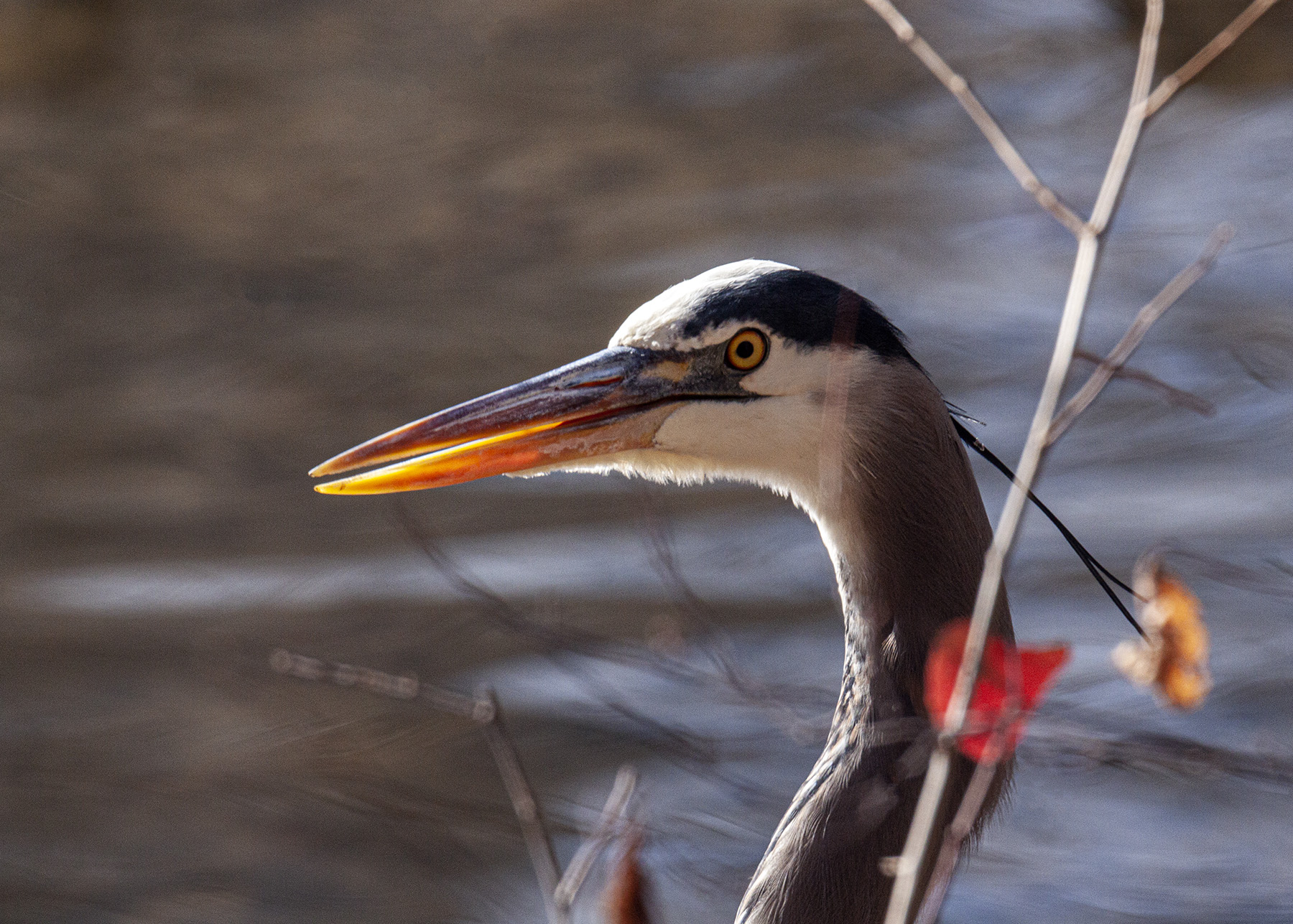
Merry Christmas to family and friends who are celebrating Christmas today and Happy Holidays to all of you scattered throughout the world. Even this Great Blue Heron (Ardea herodias) seemed to want to join me in singing earlier this week.

“And heaven and nature sing,” as the chorus to “Joy to the World” tells us, as all creatures join with the landscape to “repeat the sounding joy.”

Great Blue Heron

© Michael Q. Powell. All rights reserved.

Read Full Post »

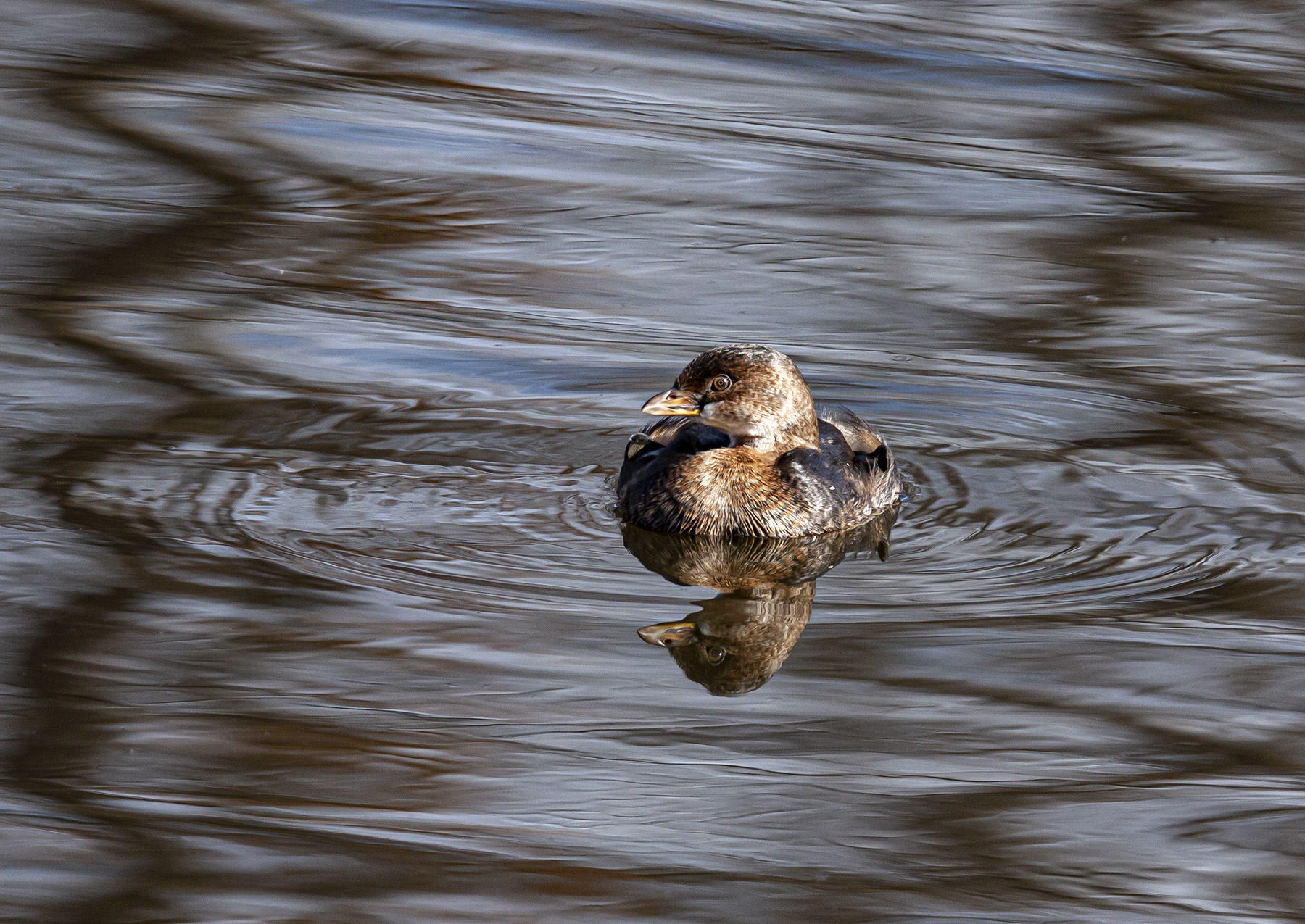
Pied-billed Grebes (Podilymbus podiceps) are small and often stay in deep waters, but I managed to capture these shots of one yesterday at a suburban pond not far from where I live. If you click on the photos, you can see the grebe’s beautiful eye coloration and the pattern on its bill.

As I was walking along the pond, I initially spotted the little grebe while it was napping. It had drifted a little closer to shore than normally, so I was pretty excited to have a chance to get some shots of this elusive bird. However, the grebe’s head was in the shadows, so I watched and waited, marveling at the patterns in the water.

I captured the second shot below shortly after the grebe started stirring and looked to one side. As it started to swim away, the lighting was almost perfect and I captured the first shot below, a wonderful little side portrait of this Pied-billed Grebe.

Pied-billed Grebe

Pied-billed Grebe

© Michael Q. Powell. All rights reserved.

Read Full Post »

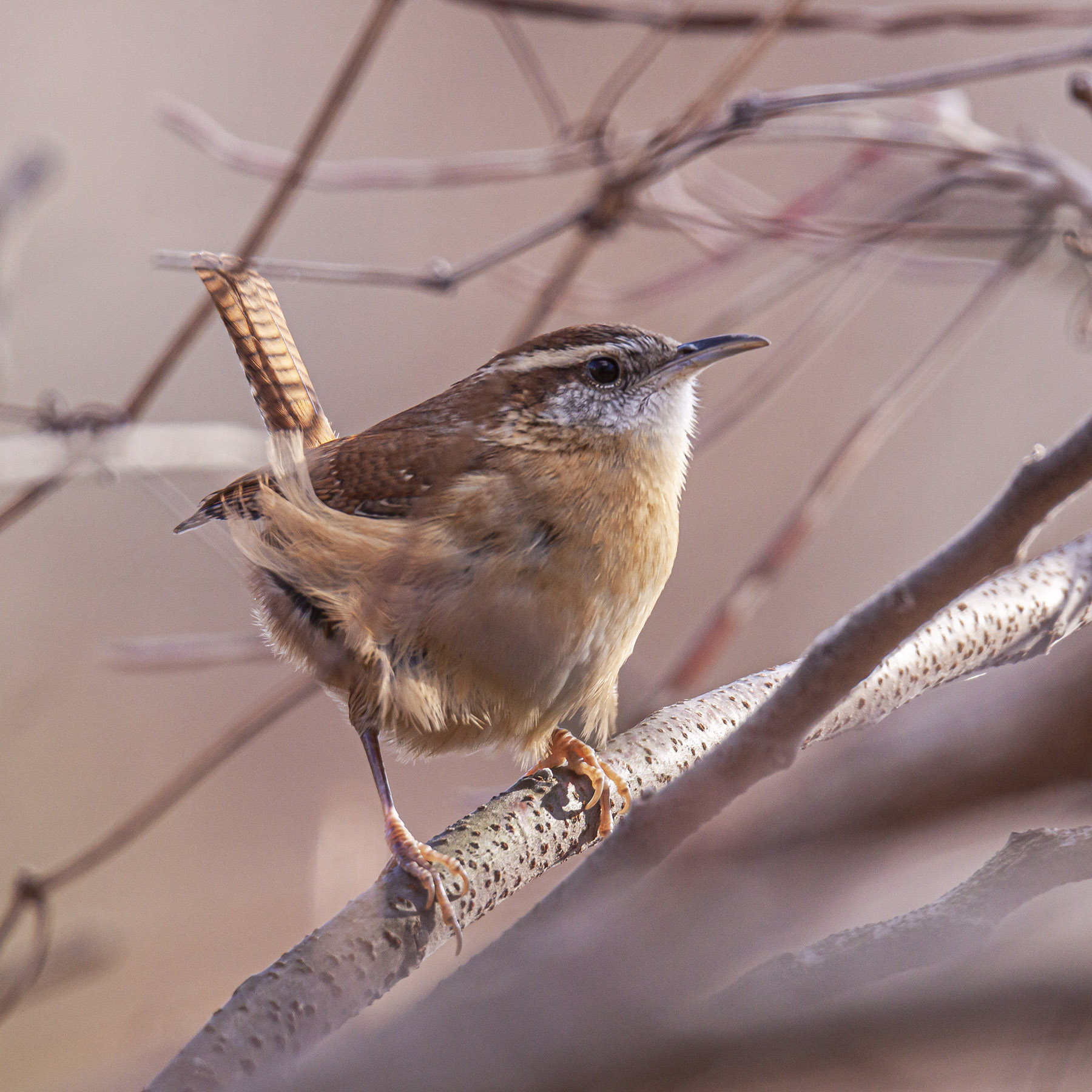
Carolina Wrens (Thryothorus ludovicianus) are usually active very close to the ground in the undergrowth. I was therefore quite surprised when one recently flew into a tree at almost eye level as I sought to track a different bird. The minimum focusing distance for my telephoto lens is almost 9 feet (270 cm) and although this little bird seemed to be really close, it was apparently a little beyond that distance.

I managed to quickly focus on the wren and capture this shot before it flew away. It is always cool when I am able to be at eye level with a bird, because I think that it tends to show the personality of a bird more than a shot from a lower or higher angle.


Carolina Wren

© Michael Q. Powell. All rights reserved.

Read Full Post »

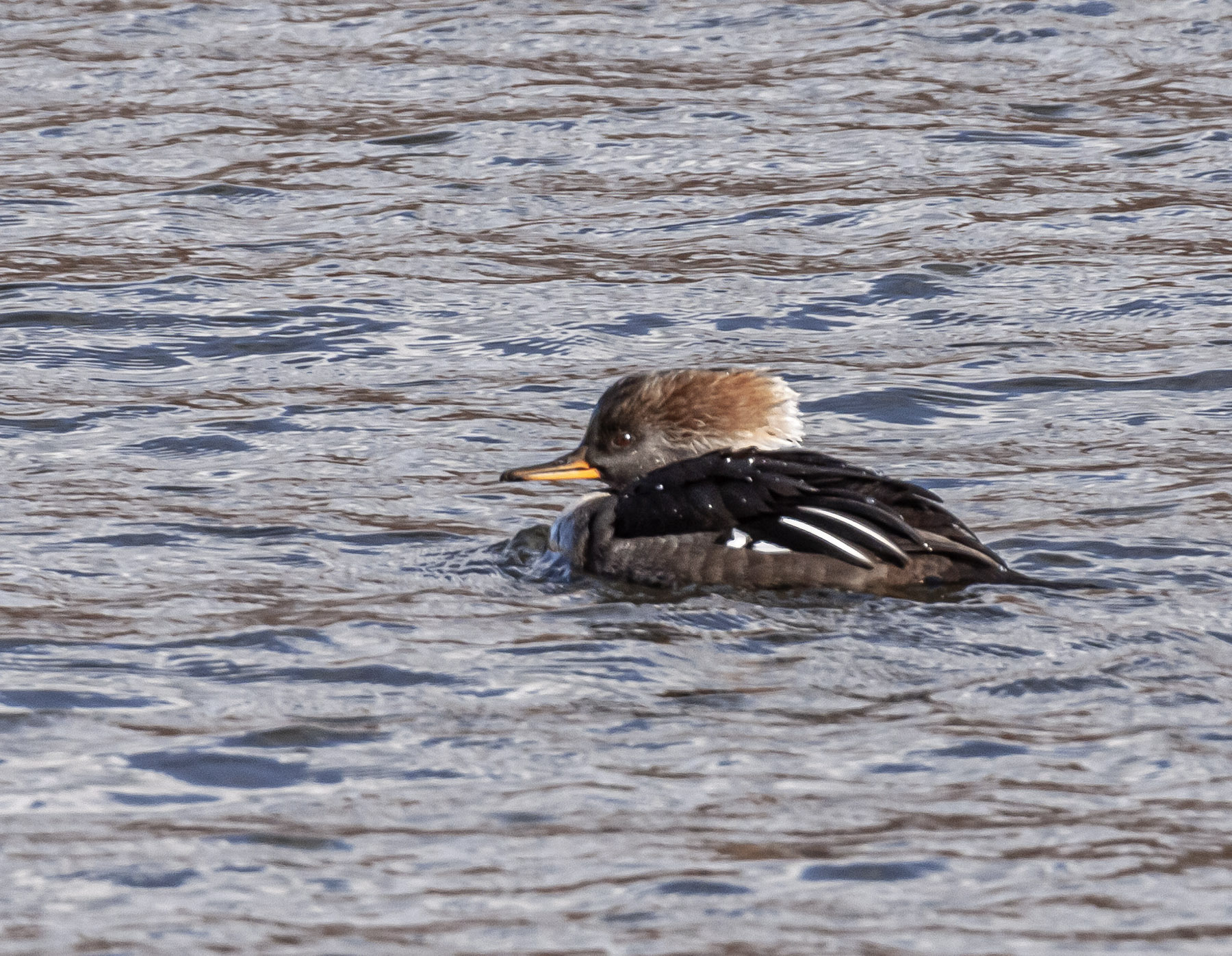
I love the “hairstyles” of the female Hooded Merganser (Lophodytes cucullatus).  Sometimes the “hair” is circular, like an Afro of the 1960’s, sometimes it is more flattened, and occasionally it has a pointed peak.

Earlier in December I tried to photograph an elusive female Hooded Merganser. She never came close to shore and seemed to always be twisting and turning. Eventually I was able to capture some shots from a distance. As you look at the images, you will undoubtedly notice how the texture and color of the water and the lighting changed as I moved to different parts of the pond.  For me, those variations add interest to shots that might look more humdrum with a more uniform background.

Hooded Merganser

Hooded Merganser


Hooded Merganser

© Michael Q. Powell. All rights reserved.

Read Full Post »

Older Posts »