Feeds:
Posts
Comments

Posts Tagged ‘Huntley Meadows Park’

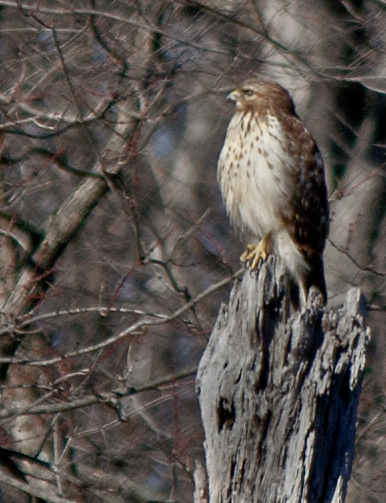
This past weekend I was fortunate enough to see a few hawks. I am still having trouble identifying the different types of hawks, especially when they are immature, as I think this hawk might be.

I spotted this one perched on the top of a old broken-off tree overlooking one of the fields of the marsh and was able to creep close enough to get a clear shot (although nor close enough to get an image that didn’t require significant cropping). For me, there is something regal about the hawk’s position, as though he is a monarch surveying his domain.

I have a few more shots of a hawk in a tree that I probably will post later, but wanted to share this one first.

stump_blog

© Michael Q. Powell. All rights reserved

Read Full Post »

After a week away from home in a far-off city, it was great for me to get back to nature. Somehow my senses seemed to be heightened yesterday as I took in the sights, sounds, and smells of the little marshland park that has become a second home for me.

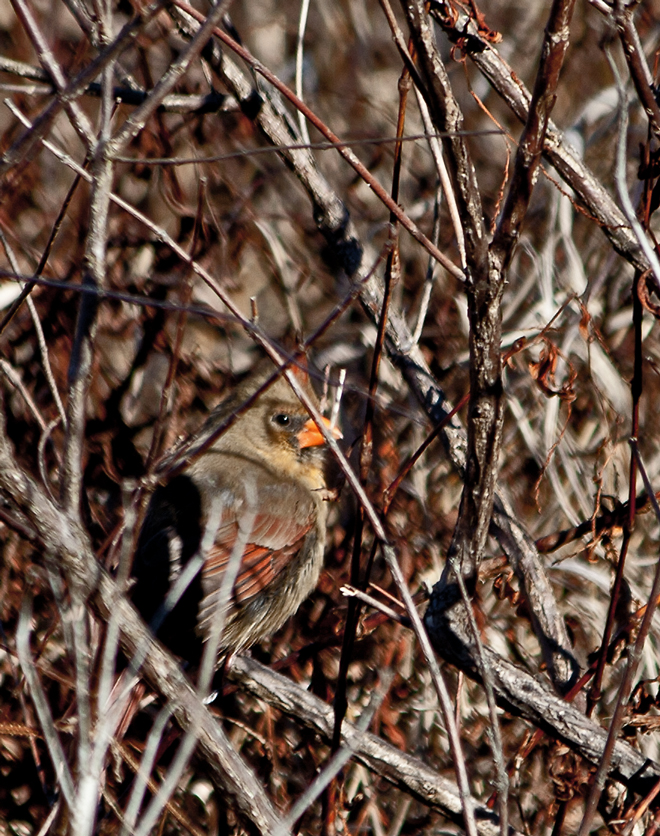
Even so, I almost missed this female Northern Cardinal, whose muted tones provided almost perfect camouflage for her in the vine-filled underbrush. A slight amount of movement and the bright orange color of her bill, however, were enough to permit me to see her despite all of the visual obstructions.

I realize that most people don’t get excited about photographing such ordinary subjects, but there was something comfortable and reassuring about returning to the familiar, like putting on a pair of my favorite jeans.

almost_blog

© Michael Q. Powell. All rights reserved

Read Full Post »

Yesterday I encountered this big bird in a tree and I’m pretty sure that it is a hawk, probably a Red-shouldered Hawk (Buteo lineatus). I was a happy that he was perched relatively low in the tree, so that I could get a relatively normal perspective view of his head and body. His coloration doesn’t match exactly any of the photo identification keys I looked at, so I am not one hundred percent sure of the identification. The photo is a bit soft and grainy, because of the distance and lighting, but I like that fact that I was able to get a relatively unobstructed view of this beautiful bird.

Hawk in a tree

Hawk in a tree

© Michael Q. Powell. All rights reserved

Read Full Post »

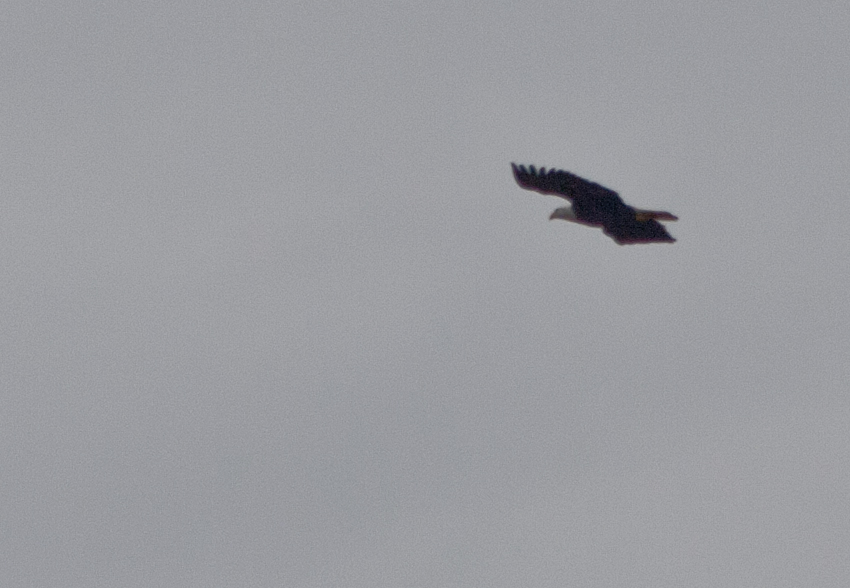
Yesterday I was observing ducks, geese, and gulls in one of the ponds at my local marshland, when suddenly they all took to the air. It seemed to me that something had spooked them and I quickly scanned the ground area and the water and found nothing. When I turned my eyes to the sky, however, I discovered a relatively large bird flying  across my field of vision in the distance

The day was dark and gray and rain clouds covered the sky, so the lighting was not very good. The poor lighting and the fact that the bird was so far away made it tough for me to lock on the focus of the camera, so I was able to snap off only a couple of shots before the bird disappeared completely in the distance.

The flight of the bird did not look like that of the vultures that I have photographed, so I thought that perhaps I had photographed a hawk, though it was hard to know for sure from the image on the little LCD screen of my camera. When I viewed the images on my computer, I was thrilled to discover that I had finally photographed a Bald Eagle (Haliaeetus leucocephalus). Maybe it’s because of the symbolism attached with the bald eagle—all I know is that I felt really happy with my discovery.

These two images are not really that clear and I hope to get better ones in the future. In many ways, I am continuing what I recognize as a pattern in my shooting. The first time I capture a new subject, I am so excited that I will share the image, irrespective of its quality. The second time, the quality of the image normally increases dramatically.

eagle2_blogeagle1_blog

© Michael Q. Powell. All rights reserved

Read Full Post »

Nowadays when I see a little brown bird, my first thought is that it’s probably some kind of sparrow. In this case, however, the beak seemed to be too long to be a sparrow, so I had to so some research. I’m pretty sure this pretty little bird is a Carolina Wren (Thryothorus ludovicianus). In addition to the beak, I was able to use the white eye stripe and uplifted tail as identification features.

In addition to the internet, I now have my first hardcopy identification guide, Peterson Field Guide to Birds of North America, a thank-you gift from friends for catsitting. I suspect that this may turn out to be the first of a series of guides that I’ll end up acquiring.

Carolina Wren

Carolina Wren

© Michael Q. Powell. All rights reserved

Read Full Post »

One thing that I have learned since I started watching birds is that birds seem to enjoy the company of other species of birds. In the past, for example, I might have assumed that a flock of birds was made up of a single species—now I know better. As a result, I’ve started to pay more attention to the individual birds in a group and determine if there are some that look “different.”

That was the case last weekend, when I was looking at a group of mallard ducks from a pretty good distance. One of them had a streak of bright white, which seemed unusual for a mallard. Clueless to what kind he might be, I took some photos, following my usual practice of “shoot first and ask questions later.” Returning home and doing a little research, I discovered that my mystery duck is a male Northern Pintail Duck (Anas acuta), a new species to me.

My first photo permits you to compare him with a mallard and it’s pretty obvious why he stood out. I like the way that he hold his long white neck upright in almost a military posture.

The second shot was my attempt to capture him in flight when he took off. My view was obscured a bit as I shot from a distance and the focus was not great, but I at least managed to catch him in flight. This is the kind of shot I aspire to shoot, so you’re getting to see my practice shots as I try to master the techniques of capturing photos of birds in flight.

pintail_blogpintail2_blog

© Michael Q. Powell. All rights reserved

Read Full Post »

It is not well known that geese are jealous of their water fowl colleagues, the swans, for all of the attention they get in numerous productions of Swan Lake. Geese consider themselves equally adept at dancing and have picked up regional folk dancing during their long migratory travels through numerous territories. In this photo, a goose is practicing a variation of a traditional fan dance (and it turns out that geese, unlike humans, don’t need any props for the fan dance).

dance_blog

© Michael Q. Powell. All rights reserved

Read Full Post »

On rare occasions I can anticipate a photo opportunity as a series of actions seems to heading towards an inevitable conclusion. That was the case this past weekend.

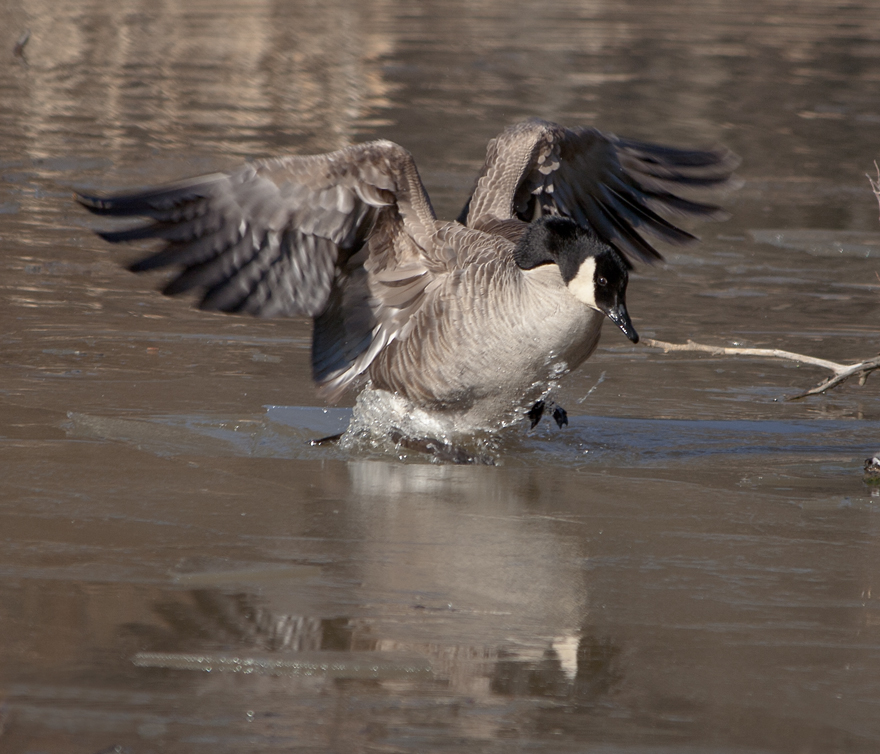
The weather here has warmed up and the layer of ice on the ponds has started to melt a bit. I watched as a mixed group of Canada Geese and Mallard Ducks started walking across the iced-over beaver pond.

A duck walked past a branch sticking out from the ice and I thought I detected some water, suggesting to me that they were walking on thin ice. A goose (in the second photo) looked down at the ice and made a mental calculation that it was safe to cross. His calculations proved to be wrong as he broke through the ice and started to sink into the water. I caught his initial reaction in the third photo. I especially like the startled look in his eyes.

Without further delay, he flapped his wings and was able to lift himself out of the water. The photo I took of that moment is the first one shown on this blog posting and is my favorite. I am happy that I was able to capture a lot of the the details of the wings and of the ice. You can see, for example, the sheets of ice that have broken off on either side of the goose. I also like the sense of action in the position of the goose, a moment frozen in time (sorry about the obvious pun).

I always feel a little strange when I post a series of action shots in non-sequential order, but I worry that folks won’t stay around to see the dramatic conclusion if all they see is the first shot (which is not that exciting, but is an important part of the story). That is why I led with the conclusion, thereby giving away the end of the story. Maybe I need to employ the kind of techniques used in television, “Stay tuned as this goose rescues himself from the frozen waters of the pond…”

Breaking the ice

Breaking the ice

Testing the ice

Testing the ice

Starting to go under

Starting to go under

© Michael Q. Powell. All rights reserved

Read Full Post »

We had some sunny weather this past weekend and temperatures soared to the upper 40’s (about 8-9 degrees C). As I was walking through my local marshland park, I heard an approaching loud noise, and before I knew it the sky was full of blackbirds. I turned my camera skyward and snapped off a few shot.

From the photos, I can’t identify all of the types of birds, but there seems to be a mixture of Red-winged Blackbirds and grackles and maybe a few others. What I find most fascinating, though, is the variety of wing positions, sizes, and shapes that you can see. Unlike the geese that I see flying in beautiful V-shaped formations, these blackbirds seem to be utterly lacking in organization as they move from place to place.

blackbirds_blog

© Michael Q. Powell. All rights reserved

Read Full Post »

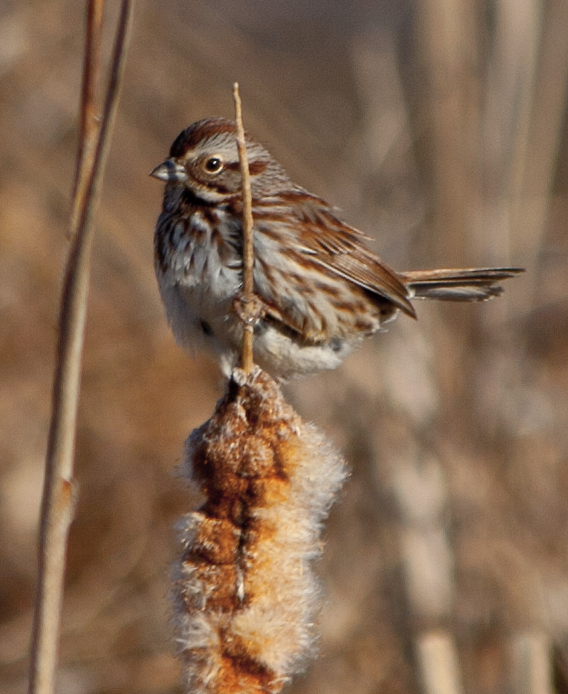
Last month I featured a photo of an American Tree Sparrow (Spizella arborea), a species that is among the most visible and active during the cold, gray days of winter. I should probably caveat my statement about the sparrows being visible, because they are usually only partially visible as they root around in the tangled undergrowth and move quickly from place to place.

Occasionally I manage to get a somewhat clear shot of the American Tree Sparrow and I decided to share a couple of them this morning. The first one shows the sparrow in what I consider his most “natural” environment, mostly surrounded by vines and branches. I like the way he just poked out his head, permitting me to get a clear profile shot. The second image shows a sparrow at the top of cattail, a place where I rarely see them, which made it a little easier to get a clear shot.

Although I may not show photos of some of these smaller birds as often as I post photos of ducks, geese, and herons, I am attempting to photograph them almost every time that I am out shooting. I enjoy the challenge, even if my success rate is relatively low.

sparrow_blogsparrow2_blog

© Michael Q. Powell. All rights reserved

Read Full Post »

Birders, I’m finding out, are an excitable breed. Sometimes they travel in flocks and sometimes alone. You can often identify them by their binoculars and spotting scopes and sometimes their cameras with enormous camouflaged lenses. They have special apps on their smartphones and frequently can be observed with their heads buried in one of the numerous identification guides they may be carrying.

I encountered a very excited member of this species as I passed by the bird feeders at my local marshland park this past weekend. He had his camera—with a large lens and flash—set up on a tripod pointed at the feeder.  Crouching in the shadows with a remote release in his hand, he was obviously waiting for something.

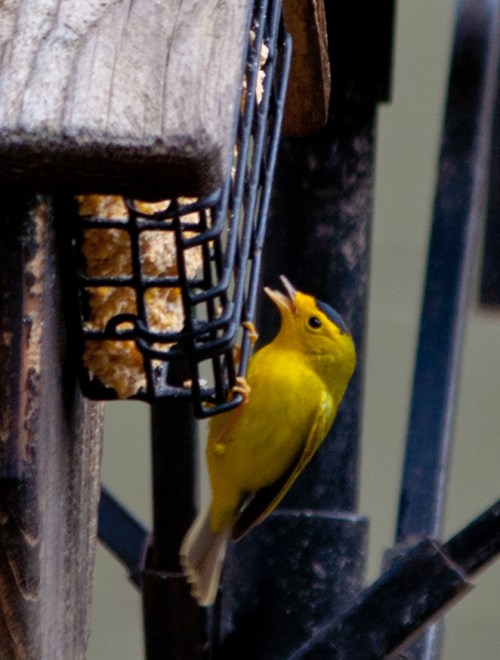
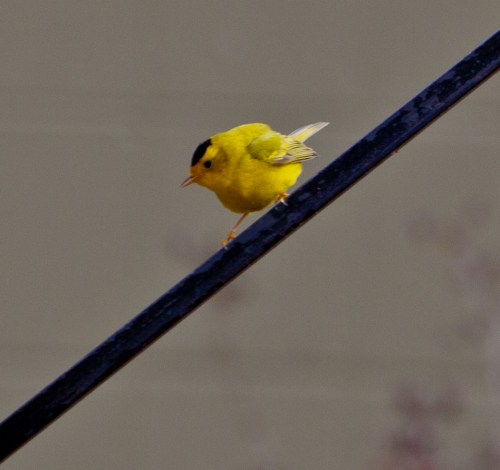
Before I could pose the obvious question, he asked me in a whisper if I also was there to photograph the Wilson’s Warbler. He must have mistaken me for one of his own kind, probably because I had a camera with a telephoto lens around my neck. I got the impression that this bird was rarely seen here and that word had circulated in birding circles of this find. Suddenly he snapped a few photos and went rushing off into the underbrush, saying that a fellow birders had alerted him that the bird had also been seen near one of the benches in the park. His closing words to me were that the warbler had been timed as coming back to the feeder every four to five minutes.

Caught up in the excitement, I waited near the feeder with my camera. The only problem was that I did not have a clue what a Wilson’s Warbler looked like. How was I going to photograph it if I couldn’t identify it? An assortment of Downy Woodpeckers and nuthatches arrived and departed at the feeder and I was beginning to despair that I would see this elusive bird, when all of the sudden I saw a flash of bright yellow. It was a small yellow bird, a welcome sight on a gray late December day, and over the course of the next fifteen minutes or so I attempted to take his picture.

When I arrived home, looked at my photographs on my computer, and did a little research, I realized that I had photographed a Wilson’s Warbler (Wilsonia pusilla or Cardellina pusilla). Judging from the range maps on the Cornell Lab of Ornithology website, Virginia is on the migratory path for these birds, which breed in the northern and western parts of North American and winter in the tropics.

I am not used to photographing birds at a feeder, but managed to get a few interesting shots of the Wilson’s Warbler. To avoid scaring off the bird, I was at a pretty good distance from the feeder,  so I had to crop the images quite a bit. I am quite content, though, that I have managed to capture some of the essence of this happy little bird.
Wilson's Warbler Walking

Wilson’s Warbler Walking

Wilson's Warbler Hovering

Wilson’s Warbler Hovering

Wilson's Warbler Feeding

Wilson’s Warbler Feeding

© Michael Q. Powell. All rights reserved

Read Full Post »
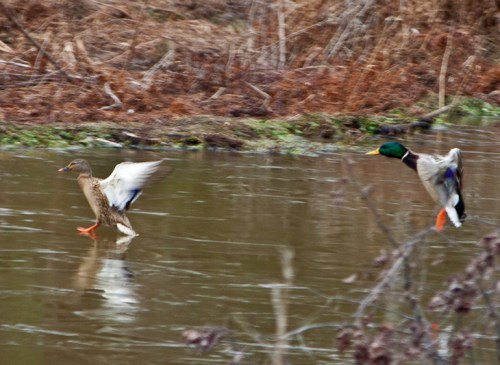
This past weekend there was a thin layer of ice on many of the little ponds at my local marshland park. I thought the ice would deter the migrating ducks and geese from stopping in, but I was wrong. Perhaps they just needed a break from flying.

It seemed unusual enough that I took some photos of the ducks walking on the frozen water. The first two images are pretty straightforward, but I tried to be a little creative in framing the third image, as a female duck contemplates the vast expanse of the ice in front of her.

I even tried to capture a duck landing on the ice in the last photo. A female duck is making a soft landing as her male companion prepares to come in right behind her. It’s not really sharp, but it gives you the idea. I had previously thought that the ducks would aim to land in the water that had not yet frozen, but obviously the ducks know what they are doing.

I never know what I will find when I venture out into nature—it’s one of the reasons that I keep returning to the same places, in hopefeil expectation of new surprises.

cold_duck1_blogduckwalk_blogice_duck_blogice_landing_blog

© Michael Q. Powell. All rights reserved

Read Full Post »
The new year has started. Like these Canada Geese, we have taken off and are continuing our journeys. Who knows where we will stop along the way? The wind and other obstacles may cause us to make unexpected stops or detours—things will undoubtedly not go according to our plans or maybe not even our desires. Best wishes and prayers for all of you on your own adventures this year, that you remain safe and healthy, joyful and at peace.

newyear

Click on the photo for a higher resolution view

© Michael Q. Powell. All rights reserved

Read Full Post »

We have had temperatures below freezing most nights recently and many of the ponds at my local marshland are now covered with a thin sheet of ice. I was a little shocked today to see that ducks and geese continue to fly in and out of the pond, in some cases landing on the ice itself (some of the birds find areas that are not frozen over in which to land).

I am working on a number of photos showing these migrating birds on ice, but I thought I’d share this initial image. The goose to the left seemed to be sounding the alarm, signalling the others that it was time to fly away. As you can see from his open mouth, he was honking loudly and was flapping his wings. If you focus your attention on his feet, it looks like he may be slipping on the ice as a result of his vigorous actions. The two geese in the background appear to be ignoring him and all of his noise, although they may have joined him when he took off a few seconds later.

alarm

© Michael Q. Powell. All rights reserved

Read Full Post »

Do you ever play with the white balance of a photo in post-processing? I never realized before that a simple change to the white balance can fundamentally change the feel of some images.

I am currently using Photoshop Elements and the white balance slider is something that I haven’t experimented with much when processing my RAW images. Normally my camera is set to automatic white balance, so I don’t worry too much about the temperature of the light being wrong. I was thinking a lot about light, however, when looking at an image of reflected moonlight that I shot last week. I shot it at ISO100, f20, and 20 seconds. According to my computer, the image as shot had a color temperature of 3950 Kelvin. Wondering what would happen I changed the temperature to something different, I moved the temperature to the shade setting of 7500 K.

Transformed moonlight

Transformed moonlight

Suddenly my cool, moon-lit scene looks like a warm sunset. To give you an idea of the initial image, I went back to the RAW file and changed the color temperature to its original setting.  The image is not exactly as it came out of the camera, because I made some other changes in Camera RAW, but you can see the big difference.

The second image is closer to what my eye saw, but in many ways I like the transformed image more. My unofficial resolution for the coming year may be to learn more about processing my photos (and there seems to be an awful lot to learn).

Moonlight

Moonlight

© Michael Q. Powell. All rights reserved

Read Full Post »
This past weekend I spent some more time watching migrating geese and and attempting to photograph them in flight. Often the geese flew in large formations, though sometimes they would arrive and depart in pairs. As I looked overt my photos, though, my favorite photos of the day feature geese trios.

I love shots like these in which it’s fun to compare the positions of the different birds, and the degree to which they are synchronizing or varying their body positions and wing movements. Each of these photos seems to form a mini-progression within itself, as though they were made up of multiple exposures of a single bird.

goose triogoose trio 2

© Michael Q. Powell. All rights reserved

Read Full Post »

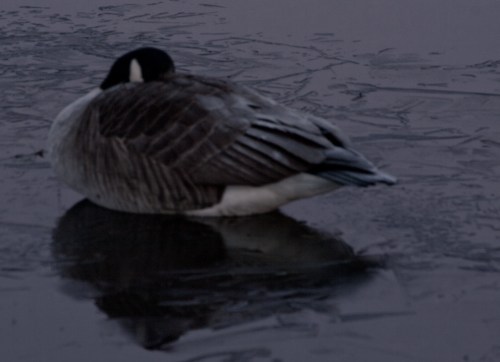
This past Friday I was up before the dawn to try to photograph the almost-full moon and already posted some photos of the moonlight reflected in the water and of the sunrise. As I was making my way along the boardwalk in the marsh, I saw that geese were asleep in the fields. With my camera on a tripod, I took some photos. This was shot at ISO100, f11, and a 25 second exposure. I like the fact that the moonlight was strong enough to cause a reflection in the water and illuminated what looks to be a thin sheet of ice on the water.

Goose asleep in the moonlight

Goose asleep in the moonlight

© Michael Q. Powell. All rights reserved

Read Full Post »

Another squirrel photo? In the past few months I have posted a number of photos of Eastern Gray Squirrels (Sciurus carolinensis). yet I  continue to attempt to photograph them whenever I can. Each time, the light is different, the environment is different, and the squirrel is different.

I really like the colors in this photo, the shades of brown and red, especially the way the brown-red surrounding the squirrel’s eyes is repeated in the exposed wood of the branch. I also like the unique characteristics of this squirrel, his cute pose and his little notched ear.

Another squirrel? I’m sure that squirrels will be featured again in my blog. In my suburban lifestyle, many days they may be my only link to nature.

Squirrel in tree

© Michael Q. Powell. All rights reserved

Read Full Post »

In many ways this is a companion piece to my last posting that showed early-morning moonlight reflected in my local marsh. Less than an hour after I took that shot yesterday morning. the sun began to rise. As I looked to the east, I watched in wonder as the skies behind the trees were transformed into a beautiful mixture of pink, orange, and purple. Eventually the sun rose high enough to bring light into my world and I tried to capture the rays of the sun just starting to pierce the darkness.

Colorful skies as the sun rises

Colorful skies as the sun rises

Rays of sunshine penetrate the darkness

Rays of sunshine pierce the darkness

© Michael Q. Powell. All rights reserved

Read Full Post »

Last night I saw a beautiful almost-full moon as I was driving home from work, so I got up early this morning with hopes of seeing the moon setting before sunrise.

The moon was bright in the cold pre-dawn sky.  Although it was partially obscured by clouds, the moon illuminated my way along the darkened path to the boardwalk of my local marsh. There were geese sleeping in the fields just off the boardwalk and I attempted to photograph them (I’ll post a photo or two of them later). I tried photographing the moon itself, but the overcast sky prevented me from getting any details of the moon, which looks like a blob of light in all of my photos. I had somewhat greater success in taking photos of the moonlight reflecting off the water. I had my camera on a tripod for extra stability, but focusing in the dark was difficult and I couldn’t see the dials of the camera, so my settings were not always right.

Here is my favorite image that shows a pathway of reflected light from the moon. The subject that I photographed is pretty mundane, but I really like the overall atmosphere of the photo.

Moonlight

Moonlight in the marsh

© Michael Q. Powell. All rights reserved

Read Full Post »

I haven’t been out shooting in nature for almost a week, so I ventured out into my marshland park early this morning. I have not yet had a chance to go through all of my shots, but I knew I really liked this one as soon as I took it and did a quick review on the LCD of my camera.

I found myself in a good position when several Canada Geese (Branta canadensis) were coming in for a water landing and was able to track them and get a good focus. The buffer of my camera fills up pretty fast, so I didn’t want to start shooting too early. Just before they hit the water, I snapped off a few exposures and managed to get this shot in which one of the geese has landed and created a splash.  A goose in the foreground is landing in the midst of the splashing water. My shutter speed (1/320 sec) was fast enough to freeze most of the motion, with the exception of a slightly blurred wing. I like the blurry wing and thing it helps give the sense of motion, as do the droplets of water.

I have been trying to shoot a scene like this for quite some time and think that this is my best result to date. (I recommend clicking on the image to get a higher resolution view.)

Splashdown

Splashdown

© Michael Q. Powell. All rights reserved

Read Full Post »

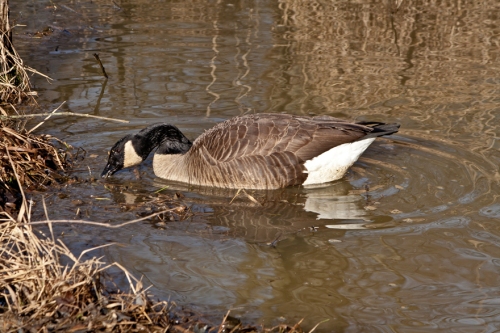
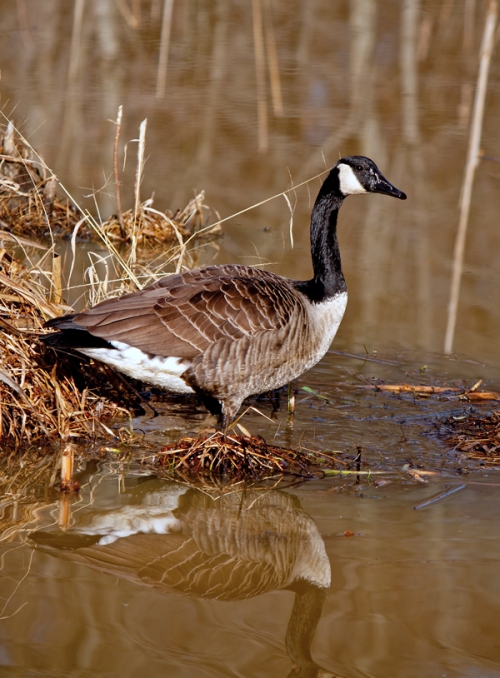
As of last week, Canada Geese continued to populate the pond and fields of my local marshland pond in great numbers. Many were engaged in foraging for food, but some look like they have been assigned sentinel duty. The photos are pretty self-explanatory—I’ll let them speak for themselves and make this posting short.

Goose in waterSentinel goosegoose_grass_blog

© Michael Q. Powell. All rights reserved

Read Full Post »
Deep inside a bush with red berries, a male Northern Cardinal was almost camouflaged, most of his body a dusty red that blended in with his surroundings. His head, though, was a bright red, a defiant red that refused to be hidden. For me, it’s like the true meaning of Christmas, that is often camouflaged with bright lights and tinsel. My simple prayer today is one that we sang at a Christmas Eve service last night, Dona nobis pacem (Grant us peace). Peace to all this Christmas day and in the coming new year.Hidden cardinal

© Michael Q. Powell. All rights reserved

Read Full Post »

I keep trying to photograph geese and  ducks taking off and landing, using a variety of techniques. Normally I will try to catch the birds in flight, though sometimes I have trouble getting my lens to acquire focus quickly enough. I stumbled onto a panning technique when I tried to photograph geese landing in the early morning. This weekend I experimented using both techniques.

I took this first shot when several geese took off without warning almost directly in front of me. I didn’t intend to cut off the goose to the left, but I like the effect of him entering into the frame. In this image, the action is completely frozen.

Geese takeoff

Geese takeoff

The second image is an example of the panning technique. The geese are not quite in as sharp focus as I would have liked, but you can see some details. I like the way that the background is blurred and provides a sense of motion. This panning was much more deliberate than the photos that I posted previously with motion blur.

Geese liftoff

Geese liftoff

It’s so much fun experimenting with different techniques—photography is still new enough to me that I often feel like a little kid on a voyage of discovery.

© Michael Q. Powell. All rights reserved

Read Full Post »

Do your find yourself shooting the same subjects over and over, hoping that you will find the perfect combination of lighting, pose, and background? That is certainly the case for me when it comes to photographing birds. It is both frustrating and challenging to realize that the only variables over which I have any control are me and my trusty camera. I can try to creep closer to birds or adjust the exposure and composition, but luck and perseverance are the overwhelmingly dominant factors in achieving success, however you choose to definite it.

Walking along a path at my local marshland park this past Friday, I heard the now-familiar tap-tap of a woodpecker. I looked up and saw a male Downy Woodpecker (Picoides pubescens) at work in the upper branches of a tree. Instantly I knew I had a chance for a pretty good shot, because the lighting was good, the view was uncluttered,  and the sky was blue in the background. The woodpecker was persistent as he moved along the branch and so was I, snapping away with my head bent back at an uncomfortable angle.

Downy Woodpecker portrait

How did I do? Well, you can judge for yourself, but I think that this is about as close to perfection as I can achieve with my current skills and equipment. The elements fell into place and I managed to take an image with which I am pretty happy, a nice portrait of a Downy Woodpecker.

© Michael Q. Powell. All rights reserved

Read Full Post »
Yesterday I spent some time watching geese and ducks at the marsh. I thought that the numbers would drop as the weather gets cold, but there actually seem to be more than there were in November, especially the geese. Once again I have been trying to take in-flight shots of these migratory birds, especially when they are taking off and landing.

I like the contrast in this photo between the impassive female Mallard Duck (Anas platyrhynchos), who seems only mildly curious about the activity taking place right in front of her, and the two Canada Geese (Branta canadensis), who are making big splashes and generating waves as they land. They look like they could be a synchronized swimming pair, though I think in that sport you lose points if you make big splashes. In the background you can see some of the fields of cattails at the marsh, as well as some additional geese in the distance foraging in the fields and in the water.

Impassive observer

© Michael Q. Powell. All rights reserved

Read Full Post »

The subject of this photo, a male Mallard duck, is very common. He’s not doing anything strange or unusual. The environment, the beaver pond at my local marsh, is not particularly exotic.

Somehow, though, I feel a sense of comfort and peace in the very ordinariness of this simple composition and in its soothing color palette. In the midst of the hustle and bustle of this holiday season, it’s good to slow down and regain some inner peace (even if it’s necessary at other times to paddle hard beneath the surface).

In the words of a song that I heard yesterday on the radio, “Let there be peace on earth, and let it begin with me.”

mallard

© Michael Q. Powell. All rights reserved

Read Full Post »

Have you ever looked at your photos and realized that you captured two very different species in similar poses?

When I was reviewing my photos from this morning, I realized that a White-breasted Nuthatch (Sitta carolinensis) and an Eastern Gray Squirrel (Sciurus carolinensis) had each assumed the same pose as I photographed them. Strangely enough, they happened to be on the same tree at slightly different times.

I like how the lightness of the background matches the coloration of the bird. It wasn’t that long ago that I saw my first nuthatch, and I continue to be amazed by their acrobatic behavior and incredible flexibility. Imagine trying to hold yourself in a position like this!

White-breasted Nuthatch

White-breasted Nuthatch

The squirrel seems to be hyper-focused and intense, scanning his surroundings and ready to move at the sign of any danger. There are only a limited number of colors in this photo and I like it so much that I considered posting it separately with a title of Study in Gray and Brown.

Eastern Gray Squirrel

Eastern Gray Squirrel

The poses of the two wild creatures are similar, but their individual characteristics and the different color palettes of the two photos give each of the two images a distinctive feel.

© Michael Q. Powell. All rights reserved

Read Full Post »

A couple of weeks ago I finally got some relatively clear shots of the North American Beavers (Castor canadensis) at my local marshland and showed you one image in a posting called Beaver at dusk—the sequel. A brief overseas trip and other distractions have kept me from posting additional photos (as I promised to do in the original blog entry), but I finally have worked up a couple more photos.

The first image shows a shaggy, dark-haired beaver in profile. It was late afternoon, about an hour before sunset, and this beaver and the lighter-colored one that you can see in the background had emerged from their lodge and seemed to be grooming themselves and each other. Judging from the crying sounds that I have heard coming from inside the lodge, I suspect that there is a younger beaver in there too.

Shaggy beaver

Shaggy beaver

The second images shows the two beavers interacting. It looks like the lighter-colored one is giving the other beaver a massage, but I wasn’t close enough to determine for sure what they were doing. Could it be love or is he merely loosening up for a night of heavy lifting?

Beaver masseuse

Beaver masseuse

© Michael Q. Powell. All rights reserved

Read Full Post »
It’s almost Christmas. Decorations are visible everywhere and all the radio stations are playing non-stop Christmas music. As I am driving to work, I am reminded of (and sometimes burst into singing) the lyrics of Silver Bells, which include the line, “Strings of street lights, even stoplights, blink a bright red and green, as the shoppers rush home with their treasures.”

Even in nature I am reminded of Christmas. Despite the title of this blog posting, this bird is not called a “Santa bird,” but I enjoy making up names of the creatures that I photograph. Usually I do so when I don’t know their real names, but in this case I know that the bird is a White-throated Sparrow (Zonotrichia albicollis).

His prominent white “beard” and his round belly, though, remind me of Santa Claus, and I can’t help but smile. I recall some of the words of the famous poem ‘Twas the Night Before Christmas, “He had a broad face and a little round belly, that shook when he laughed, like a bowl full of jelly. He was chubby and plump, a right jolly old elf, and I laughed when I saw him, in spite of myself.”

Soon it will be Christmas day.

Santa bird

Santa bird

© Michael Q. Powell. All rights reserved

Read Full Post »

A couple of days ago I featured a photo of Canada Geese coming in for an early morning water landing in a posting I called Photo Finish. So many people made positive comments about the photo that it prompted me to take another look at the other photos from that morning. I played around with one of them and decided to post the result.

The overall effect in this image is similar to the previous photo, but in this one you can see some reflections in the water. Tonally, it has more brown in it.  It’s a bit muddy in appearance, but it still conveys the sense of motion of the geese in flight and the panning stripped away all of the excess details in the background. I recommend that you click on the image to get a higher resolution view.

Coming in for a landing

Coming in for a landing

© Michael Q. Powell. All rights reserved

Read Full Post »

« Newer Posts - Older Posts »