Feeds:
Posts
Comments

Posts Tagged ‘Huntley Meadows Park’

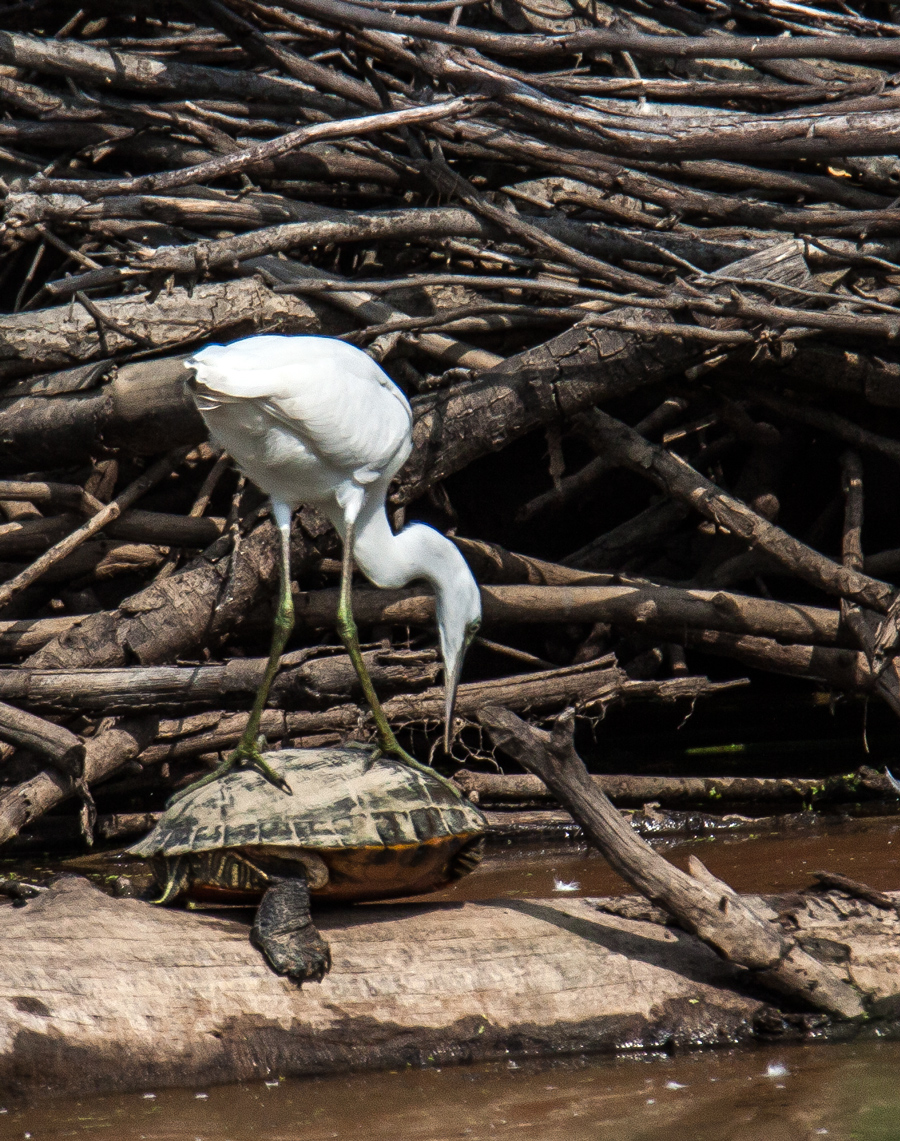
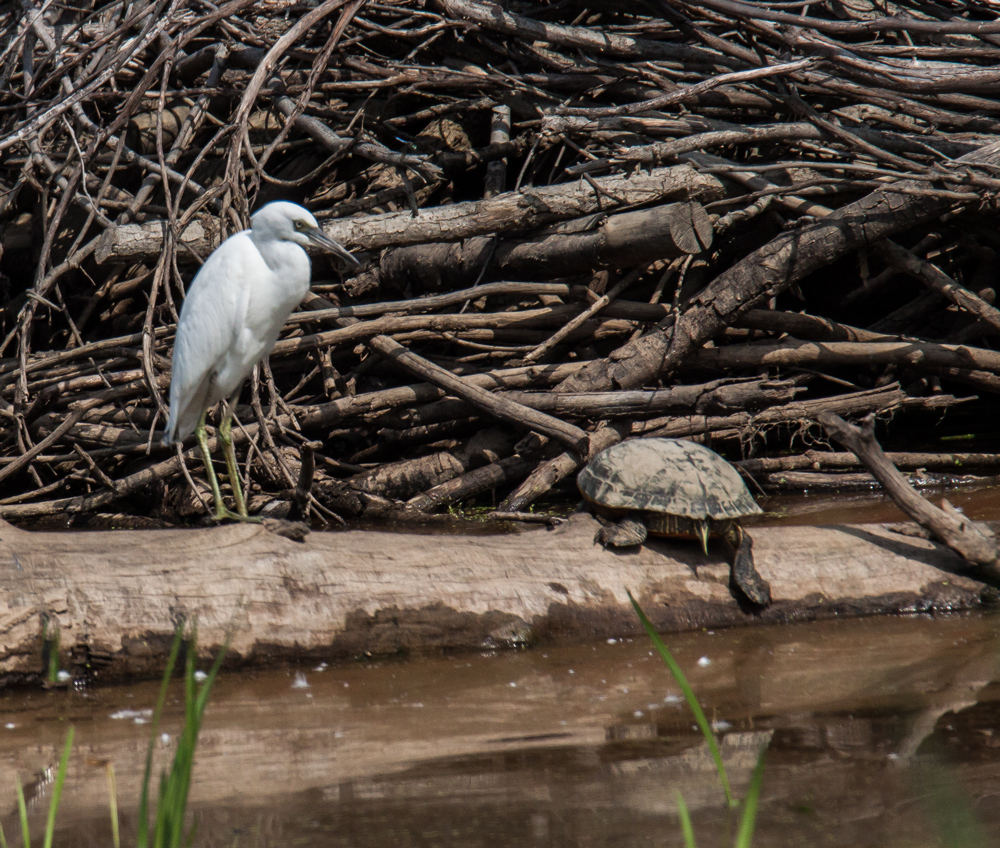
As I watched through my telephoto lens last Friday, one of the juvenile Little Blue Herons (Egretta caerulea) at Huntley Meadows Park became increasingly curious about the turtle with whom it was sharing a log. The heron moved closer and closer and finally jumped on top of the turtle. I was shocked to see the heron then put its face mere inches from that of the turtle.

This past month, a group of four or more juvenile Little Blue Herons has taken up residence at my local marshland park. When I first saw them, I assumed they were Great Egrets, because of the bright white coloration. However, the bills are a different color than those of the egrets. I am hoping that the Little Blue Herons hang around long enough for us to see them change into the blue color for which they are named.

I managed to take a series of shots of the encounter between the heron and the turtle. I initially thought it was a snapping turtle, but one of the folks who saw a photo I posted on Facebook thinks it might be a slider of some sort, a Red-eared Slider (Trachemys scripta elegans), I would guess after taking a closer look at the second image.

Little Blue Heron

Initially the heron eyed the turtle from a distance.

Little Blue Heron

Then he decided to get a closer look.

Little Blue Heron

Feeling bold, he placed one foot on the turtle…

Little Blue Heron

…and jumped on top of the turtle.

Little Blue Heron

His curiosity still not yet satisfied, the heron leaned in for a face-to-face encounter. (Note that the turtle has retracted one of its front legs.)

© Michael Q. Powell. All rights reserved.

Read Full Post »

Chasing after beautiful butterflies on a sunny summer day—it doesn’t get much better than that. I don’t know plants very well, but this appears to be some kind of thistle. I photographed this Eastern Tiger Swallowtail (Papilio glaucus) last Saturday at Huntley Meadows Park in Alexandria, Virginia.

Eastern Tiger Swallowtail

© Michael Q. Powell. All rights reserved.

Read Full Post »

The blooming Swamp Rose Mallows (Hibiscus moscheutos) at Huntley Meadows Park helped provide a beautiful backdrop for this Great Blue Heron (Ardea herodias) that I spotted there last Saturday.

Great Blue Heron

© Michael Q. Powell. All rights reserved.

Read Full Post »

How do you capture the details of a pure white bird as it flies in an out of the light? That was my challenge this past weekend when I tried to photograph Great Egrets (Ardea alba) at my local marshland park.

Many of my past shots of egrets have been unsuccessful, usually because they are overexposed and the highlights and details are blown out. I’ve tried using exposure compensation with only minimum success.

This time, I remembered to switch to spot metering and had greater success. Sure, the backgrounds are a bit underexposed, but I think that the darkness helps the highlight the beauty of the egret.

Great Egrets seem a little awkward when in the water, but when they take to the air, it’s like watching a ballet.

Great Egret

Great Egret

Great Egret

© Michael Q. Powell. All rights reserved.

Read Full Post »

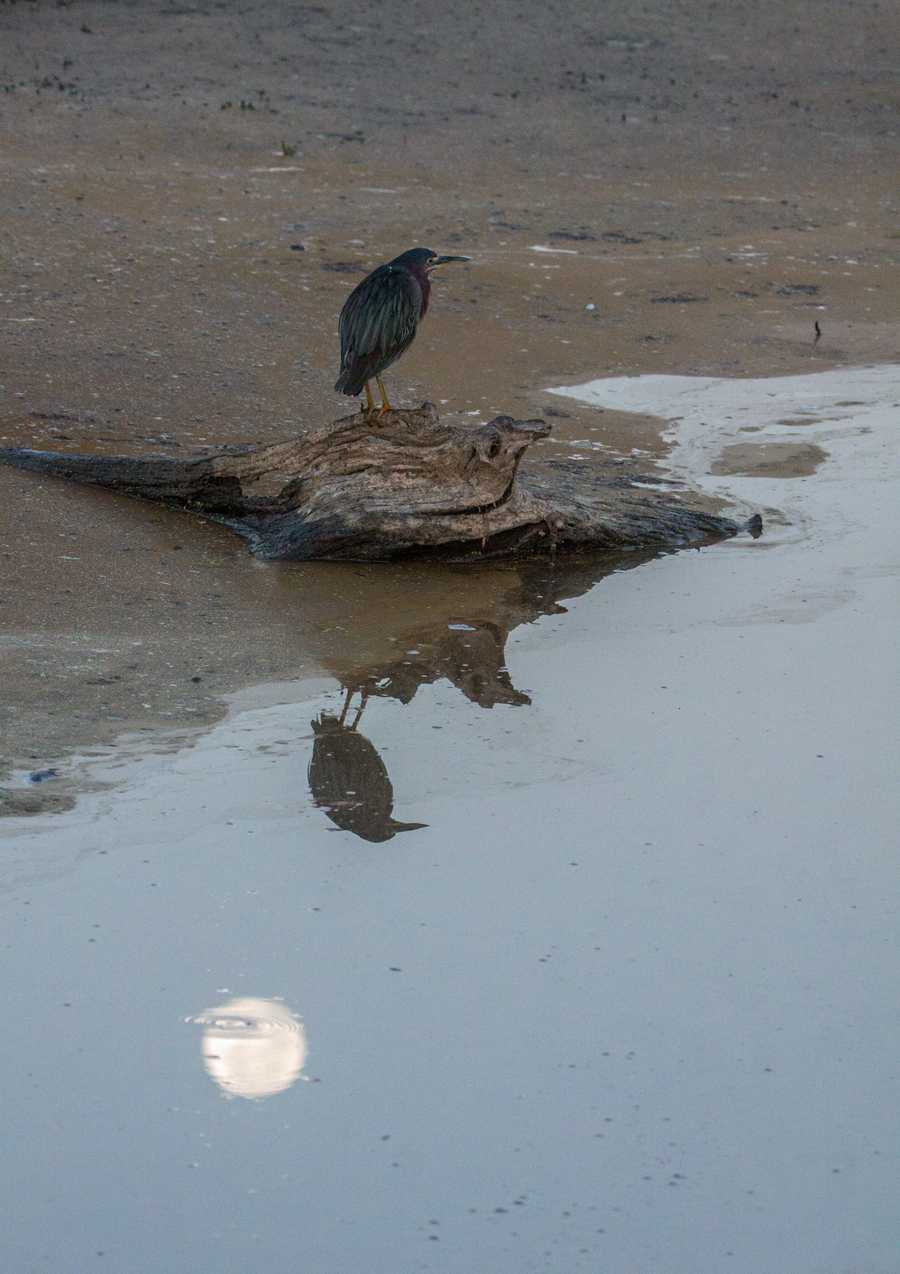
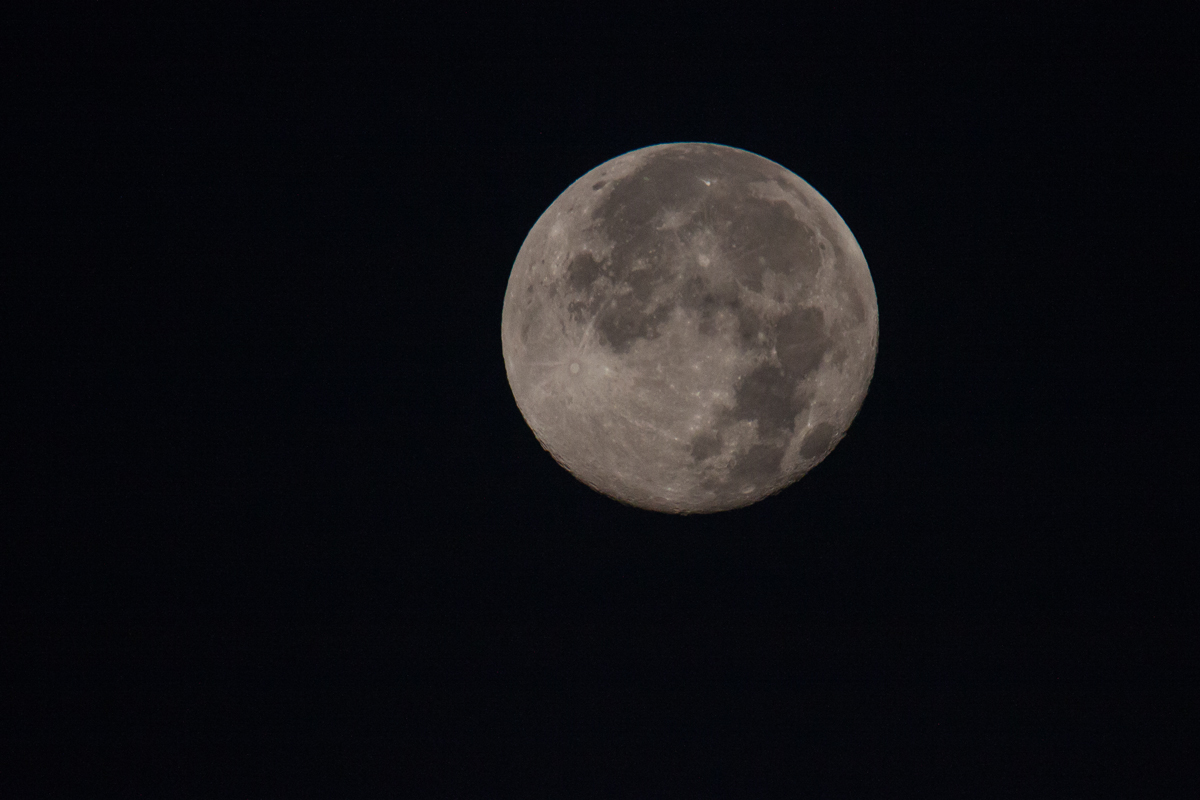
The full moon was bright and beautiful early yesterday morning, when I arrived at Huntley Meadows Park as the sun was just beginning to rise.

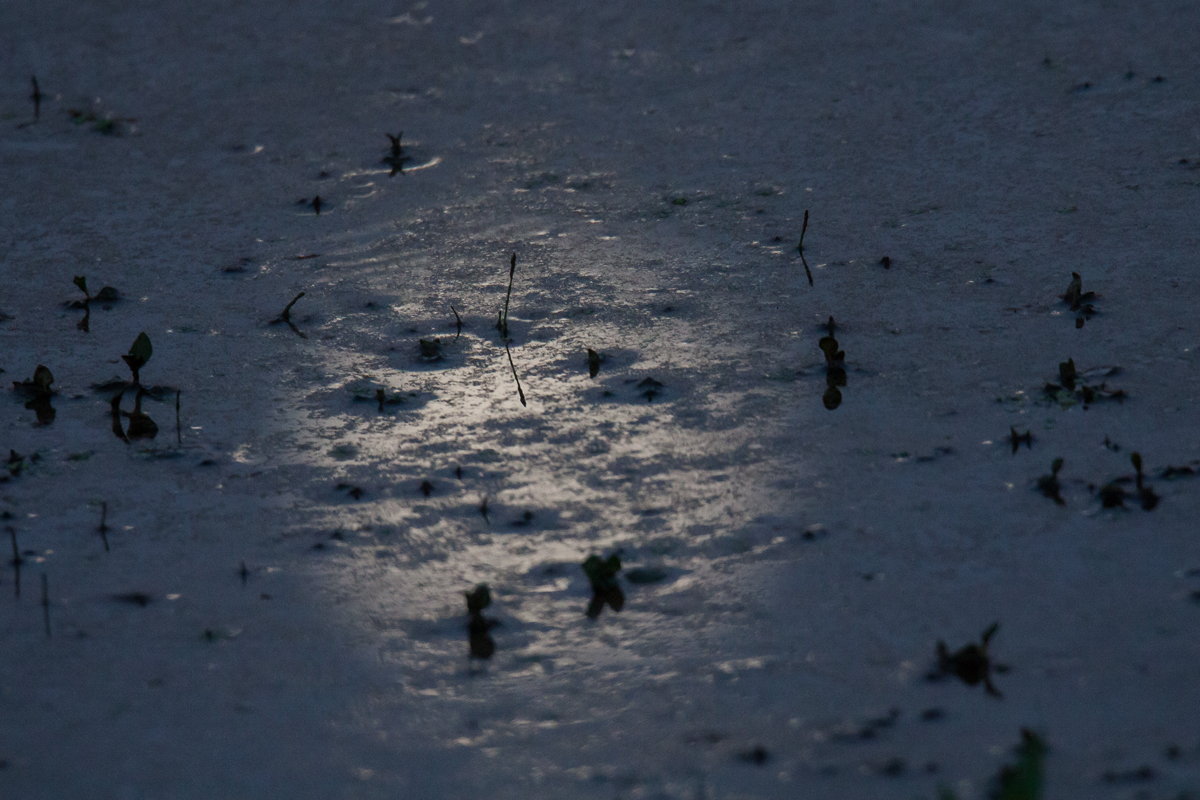
I struggled a little, trying to figure out the best way to capture the moon. Should I show the moon against the black night sky? Should I show merely its reflection? Should I show it as an element of a larger composition?

Here are some of my attempts to show the full moon in the predawn light at my local marsh.

Green Heron

Green Heron in the moonlight

Full moon in the night sky

Full moon in the night sky

reflections of a full moon

Reflections of a full moon

full moon

Moon over the marsh


© Michael Q. Powell. All rights reserved.

Read Full Post »

Recently Green Herons (Butorides virescens) have been more numerous than in the past at my local marshland park. Most of the time these little herons are obscured by the vegetation at the water’s edge or by the branches of the trees in which they like to roost.

Early one morning last week, however, I watched one of them stalking potential prey from a log in an open area. The little heron seemed focused, but relaxed. From time to time the Green Heron would become more alert and rigid and he would stare more intently at the water.

On this occasion, they were all false alarms and I didn’t see him catch anything for breakfast. Eventually he seemed to give up and flew off, presumably to a better location for catching something to eat.

Green Heron

Green Heron

Green Heron

© Michael Q. Powell. All rights reserved


Read Full Post »

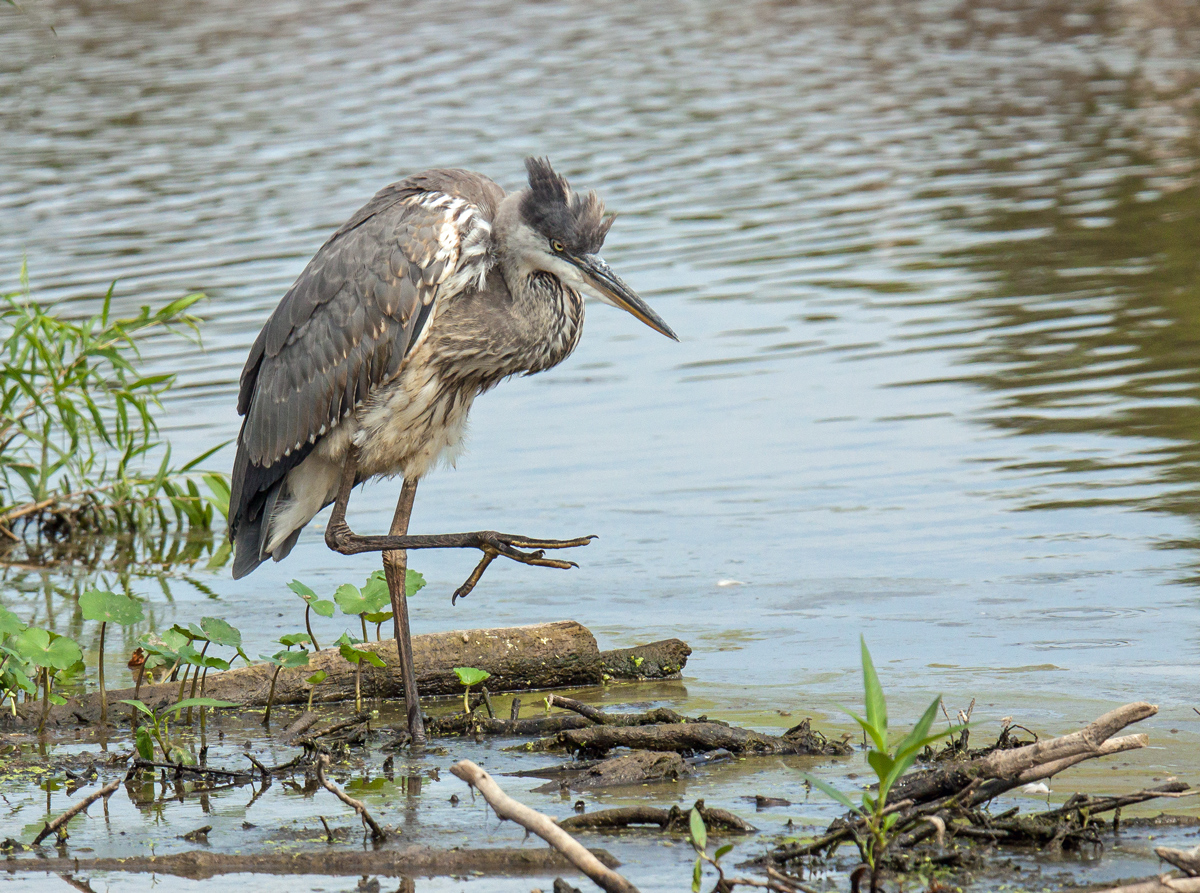
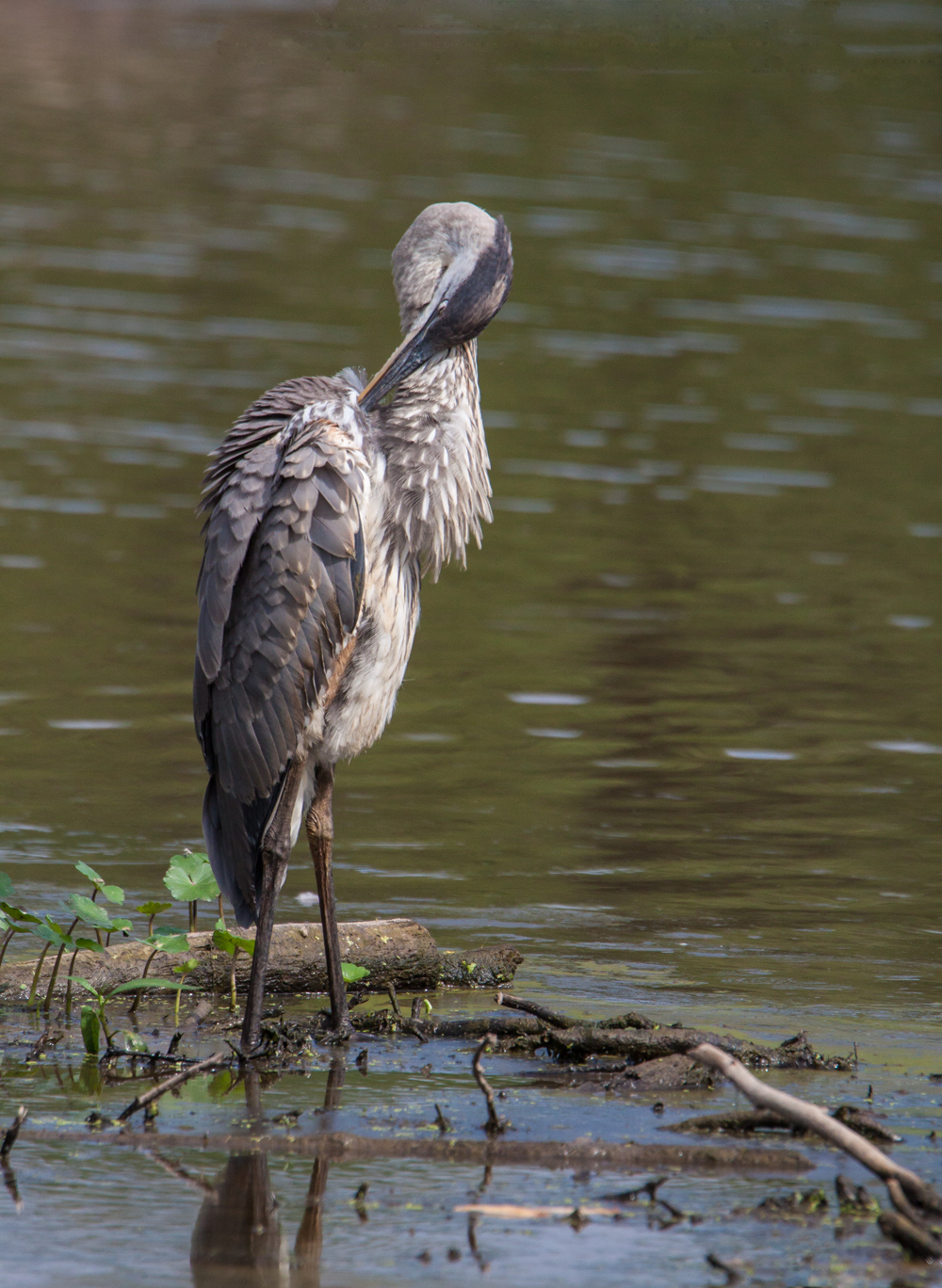
I never tire of watching Great Blue Herons (Ardea herodias) and catching them in fun and unusual poses.

Great Blue Heron

Great Blue Heron

Great Blue Heron


© Michael Q. Powell. All rights reserved


Read Full Post »

On Monday I came across this really cool-looking moth while walking through the woods at Huntley Meadows Park in Alexandria, Virginia. The moth’s distinctive pattern reminds me of the shields used in the Middle Ages by the knights during the Crusades, which is why I want to call it the Crusader moth.

Officially, this is a Clymene Moth (Haploa clymene), a moth of the Tiger Moth family that is found in the eastern part of North America.

As I was doing research, I learned that 18-26 July is National Moth Week.

Go wild!

Clymene moth

Clymene moth

© Michael Q. Powell. All rights reserved

Read Full Post »

It’s fun to watch the Great Egrets (Ardea alba) at Huntley Meadows Park, the local marsh where I take most of my wildlife photos. Unlike the Great Blue Herons (Ardea herodias), who will remain motionless for a long time, the egrets like to move.

Great Egret

Great Egret

This egret’s moves in the initial two images somehow brought to mind the song “Walk Like an Egyptian” by the Bangles. In case you don’t recall that catchy tune or are too young to have heard it, here’s a link to a YouTube video of the song.

I was quite amazed at the variety of moves in the egret’s repertoire and the expressive way that it was able to use its neck, sometimes tucking it in and sometimes fully extending it. Here are a few more shots from the egret’s performance.

Great Egret

Great Egret

Great Egret

I think with a little more practice the egret will be ready for “Dancing With the Stars” or “So You Think You Can Dance.”

© Michael Q. Powell. All rights reserved

Read Full Post »

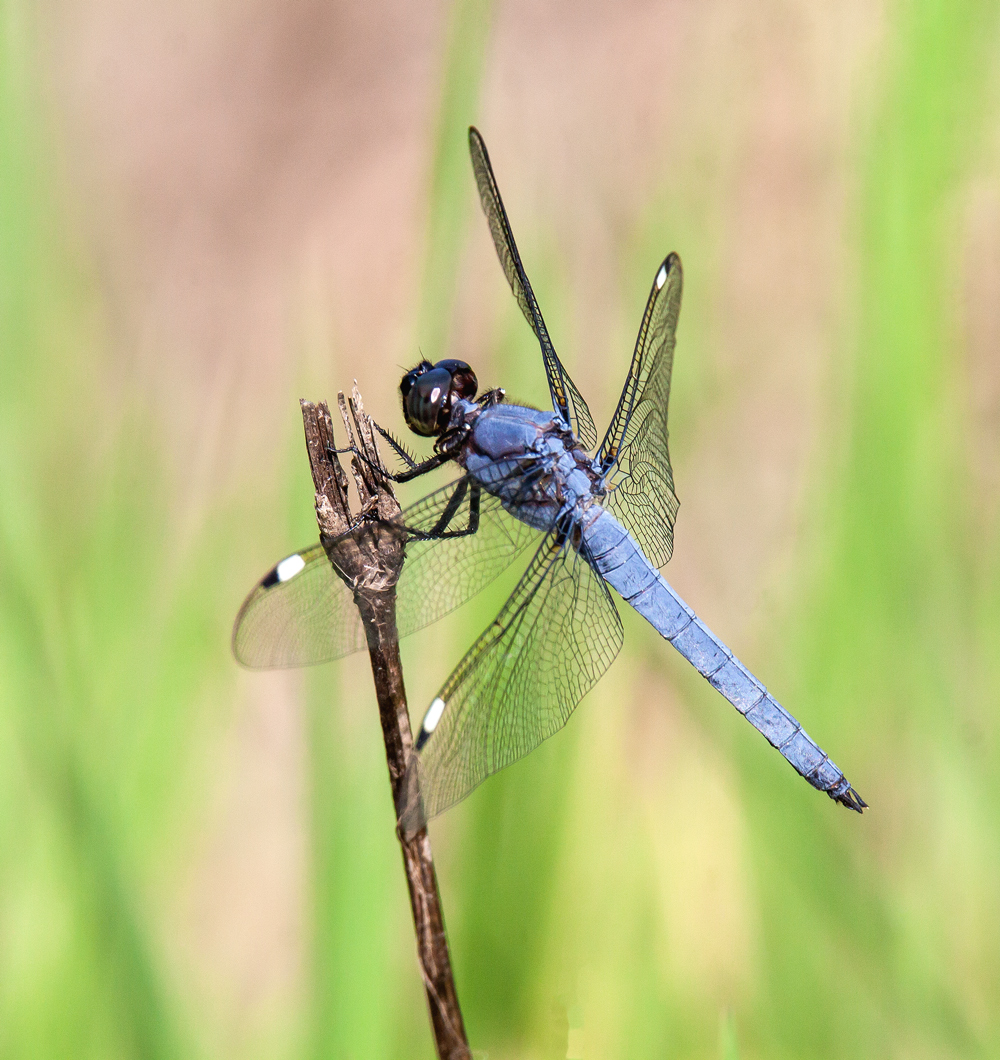
In vain I have searched this month for Common Sanddragon dragonflies at the places where I spotted them earlier this season. My good friend and fellow photographer and blogger, Walter Sanford, captured some beautiful shots of the last ones that we spotted. Be sure to check out the other wonderful photos and fascinating information in his blog.

waltersanford's avatarwalter sanford's photoblog

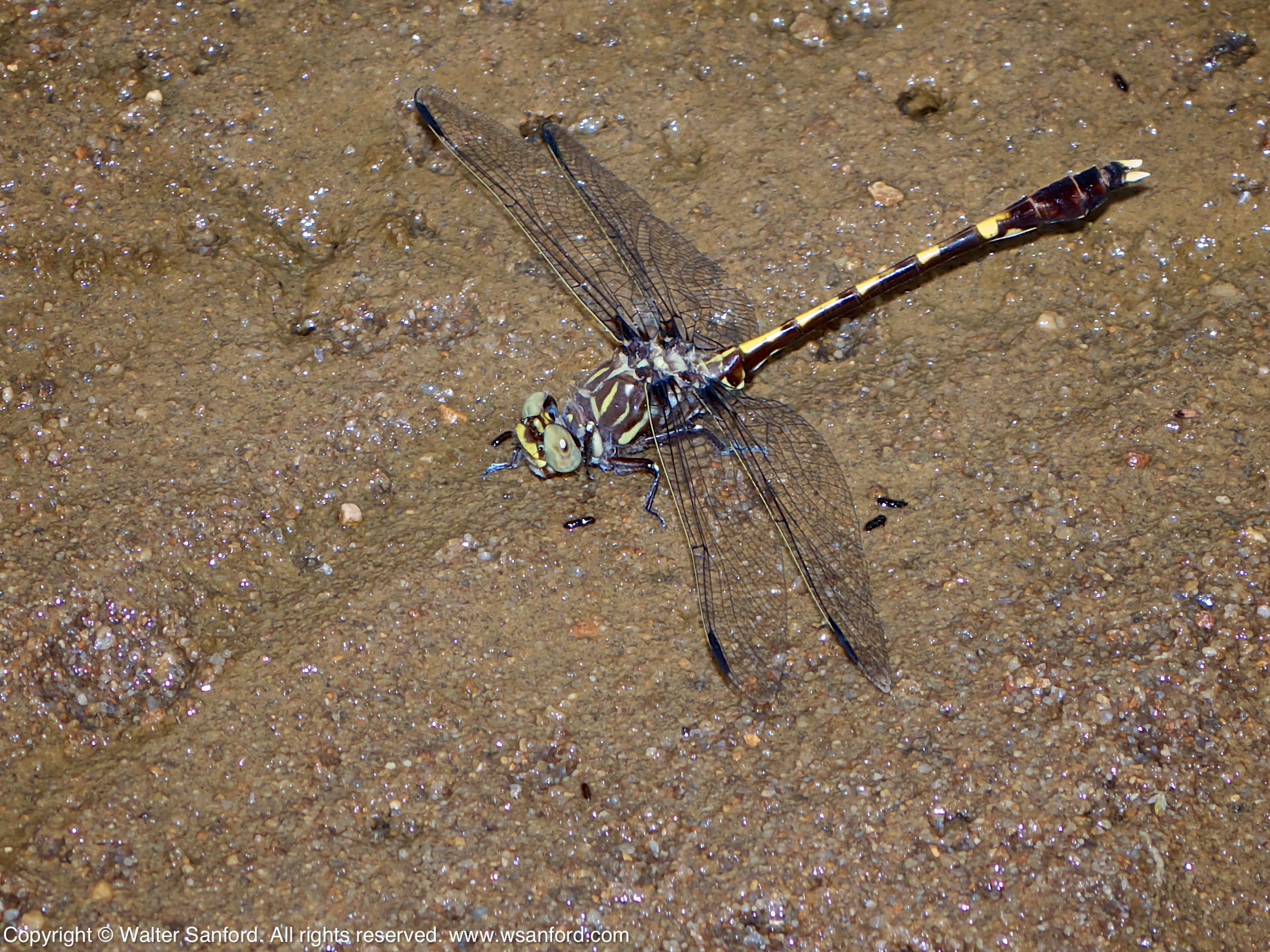
Common Sanddragon (Progomphus obscurus) is a member of the Clubtail Family of dragonflies that is spotted during June and July in mid-Atlantic United States like Virginia. Common Sanddragons are habitat specialists that prefer sandy woodland streams, so don’t look for them in wetland areas like the hemi-marsh at Huntley Meadows Park.

This post features two male Common Sanddragon dragonflies, as indicated by their terminal appendages. As fate would have it, they are the last Sanddragons spotted during Summer 2015.

The water level was near the top of the stream banks after near record-setting rainfall for the month of June. (Notice the discoloration of the vegetation from siltation during a recent flood.)

A Common Sanddragon dragonfly (Progomphus obscurus) spotted at Dogue Creek, Huntley Meadows Park, Fairfax County, Virginia USA. This individual is a male. 29 JUN 2015 | Huntley Meadows Park | Common Sanddragon (male)

The conditions for hunting Sanddragons were less than ideal. Male Common Sanddragons prefer perching on a sandy beach, facing the water; there weren’t any beaches, so Sanddragons were…

View original post 178 more words

Read Full Post »

Sunrise yesterday was at 5:59 and I managed to get this shot of a beautiful little fawn in the cattails at 6:05, when there was just barely enough light for my camera to focus.

Summer weather in the Washington D.C. area is often miserable—hot and humid—and I decided to visit my local marshland park really early to avoid some of the oppressive heat. When I left my house in the pre-dawn darkness, however, it was already 80 degrees (27 degrees C) on a day that was forecast to reach 96 degrees (35 degrees C).

I could hear a lot of movement in the marsh as I made my way along the board walk and occasionally would catch a glimpse of some activity as it grew progressively lighter. I encountered another photographer and he was the one who spotted the fawn and pointed it out to me—I am pretty sure that I would not have seen it without his help.

We didn’t see any adult White-tailed deer (Odocoileus virginianus) with the fawn, but their presence could easily have been hidden by the thick stand of cattails. I had time to snap off only a few photos before the fawn slowly turned his back on us and slowly faded into the background.

What a wonderful way to start my day.

fawn

© Michael Q. Powell. All rights reserved

Read Full Post »

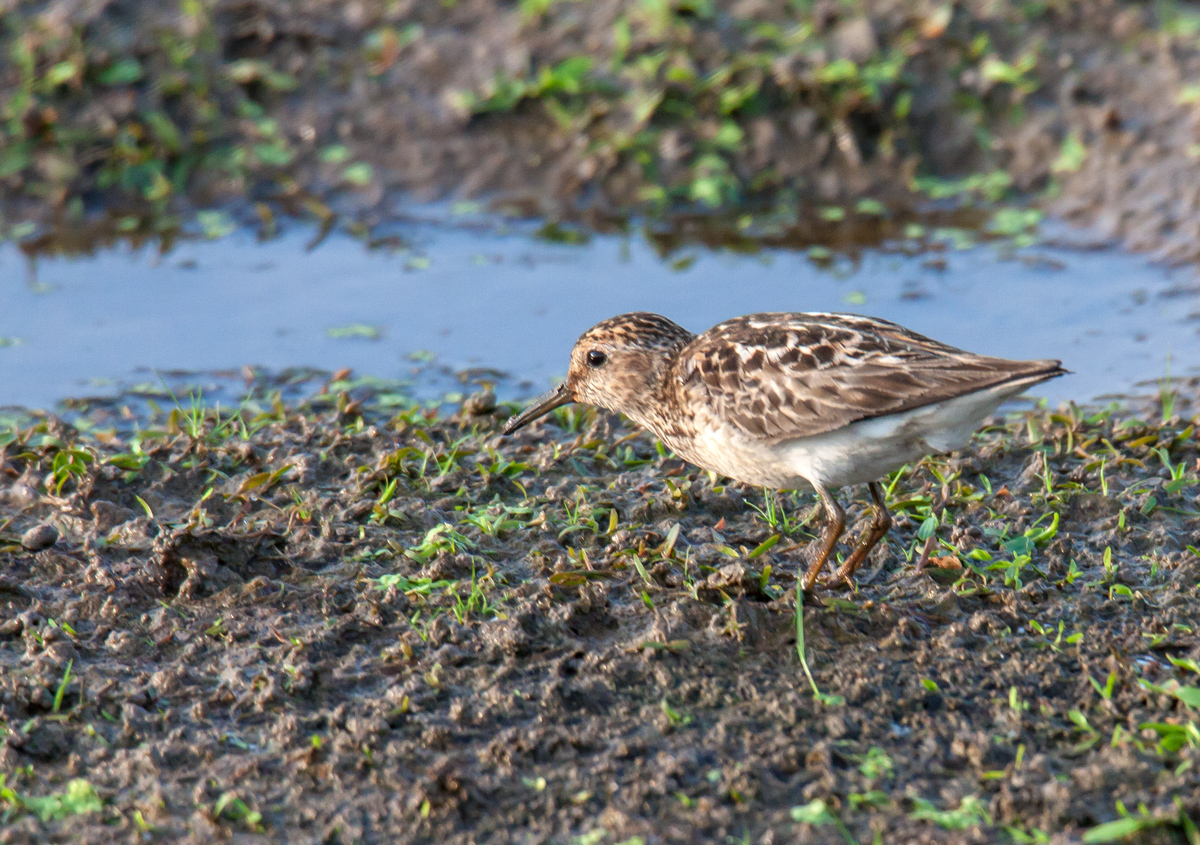
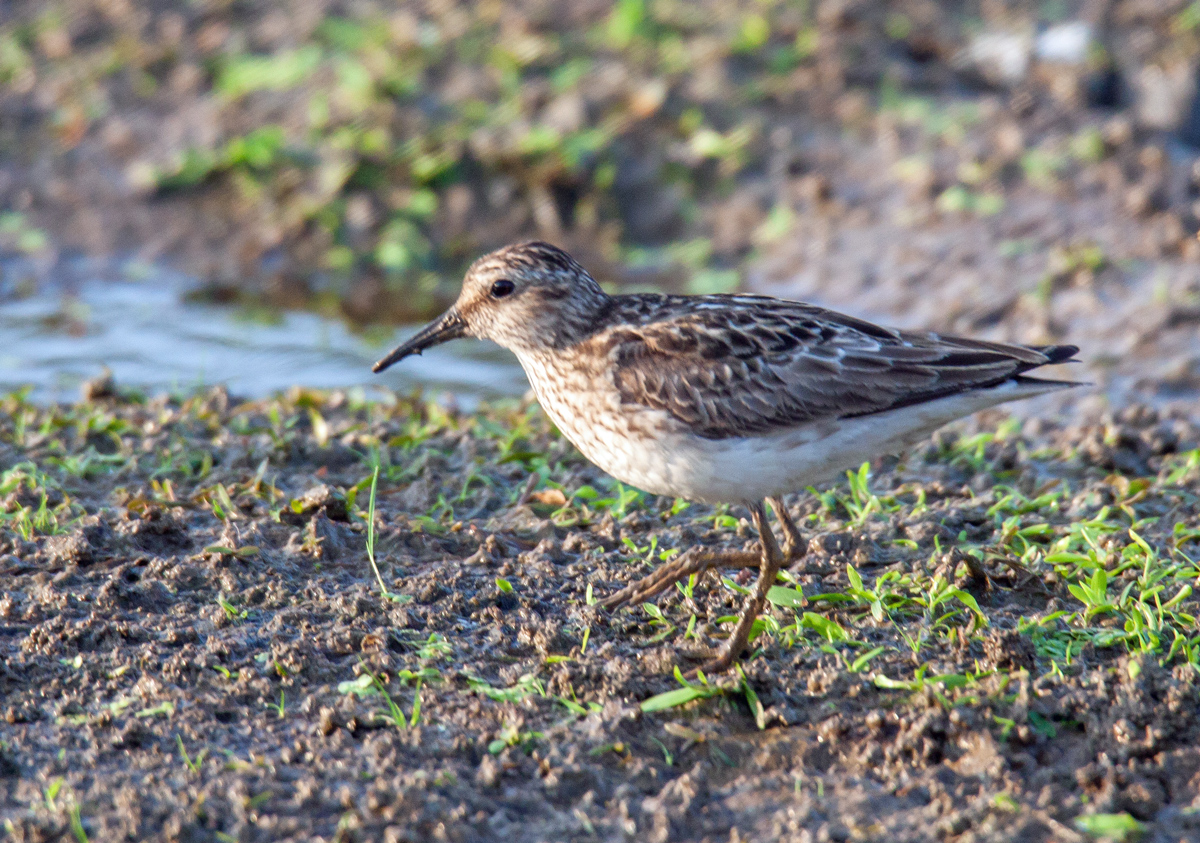
I can’t help but wonder if Least Sandpipers (Calidris minutilla) suffer from an inferiority complex, surrounded as they are by “Great” Blue Herons and “Great” Egrets.

Early Saturday morning, I spotted a small flock of these tiny birds at my local marsh in an area where the water levels were really low, revealing a muddy area with shallow pools of water that seemed perfect for these little wading birds. According to the Cornell Lab of Ornithology website, the Least Sandpiper is the smallest shorebird in the world, weighing in at about one ounce (28 grams) and measuring five to six inches long (13-15 cm).

I suspect that these Least Sandpipers are in the process of migration, probably eventually heading further south. At this time of the year we start to see all kinds of unusual birds that make brief stops at my local marshland on their way to more distant destinations.

Least Sandpiper

Least Sandpiper

Least Sandpiper

© Michael Q. Powell. All rights reserved

Read Full Post »

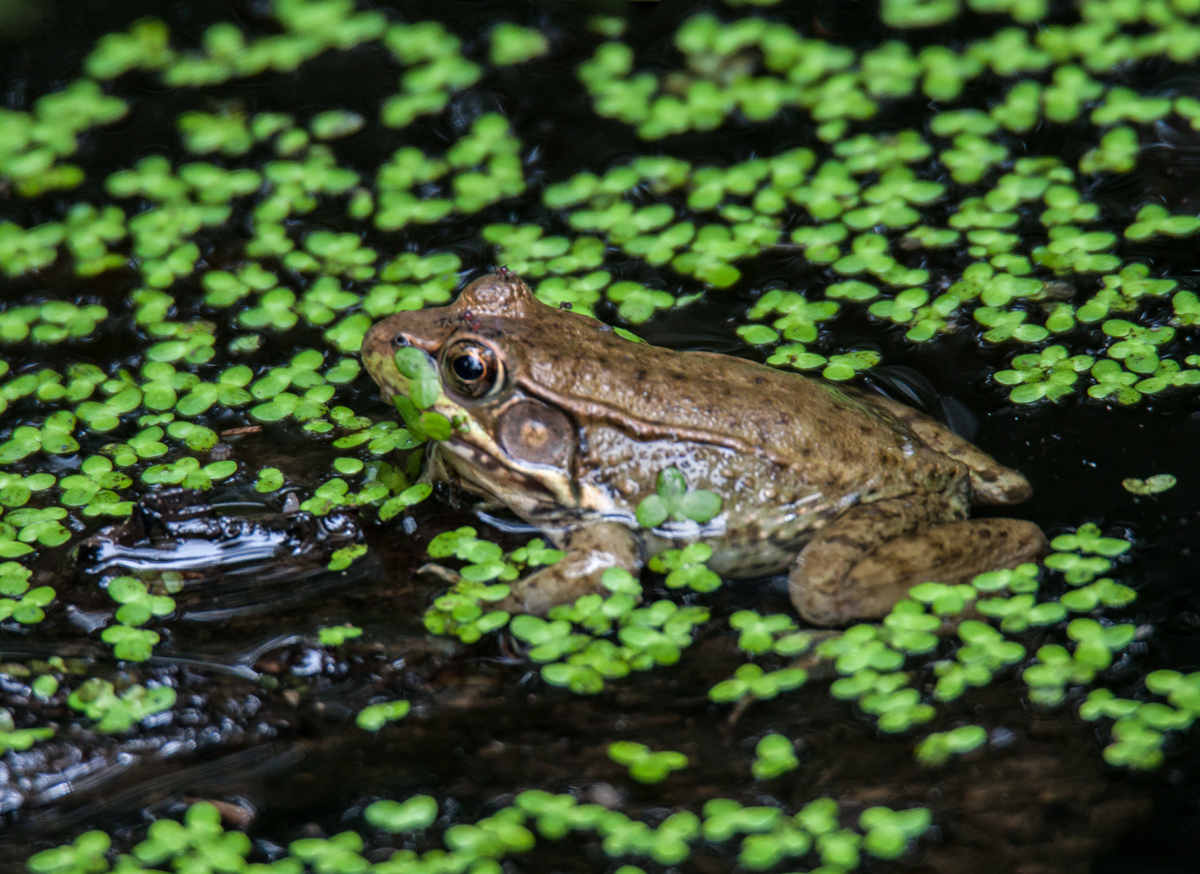
When a friend pointed toward a small pond and said he saw a bronze frog, I thought he was talking about a metal figurine. I had never even heard of bronze frogs and certainly had not seen one before.

Bronze Frogs (Rana clamitans clamitans) are a subspecies of the Green Frog (Rana clamitans) and I must confess that I really can’t tell them apart from the other subspecies, the Northern Green Frog (Rana clamitans melanota), because there is a significant amount of color variation.

Identification aside, I really like the way that this frog is surrounded by and partially covered with duckweed as he tries to stay cool on a hot day in July.

bronze frog

© Michael Q. Powell. All rights reserved

Read Full Post »

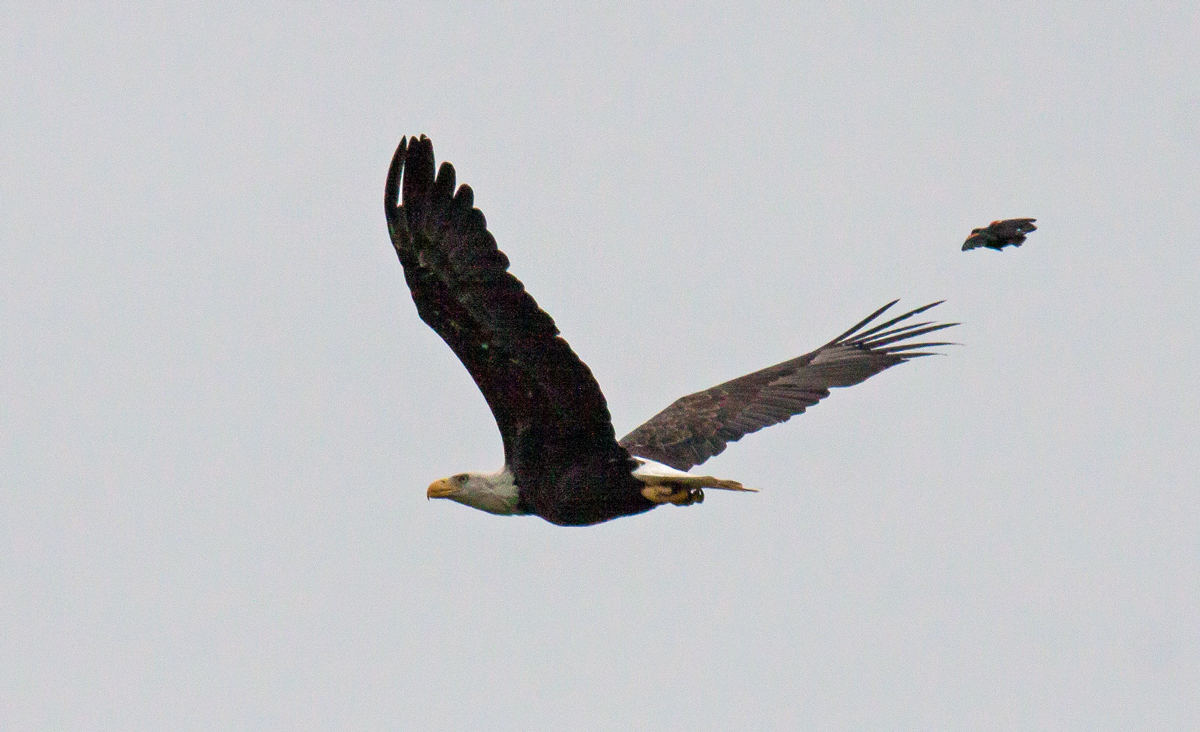
The Red-winged Blackbird (Agelaius phoeniceus) was either really brave or really foolish chasing a Bald Eagle (Haliaeetus leucocephalus) across the sky early yesterday morning at Huntley Meadows Park in Alexandria, Virginia.

Bald Eagle chase

I did manage to get a few other shots (below) in which the eagle’s wings are in more photogenic positions, but the blackbird is farther away from the eagle in each of them.

Bald Eagle chase

Bald Eagle chase

© Michael Q. Powell. All rights reserved

Read Full Post »

What do adventurous young grasshoppers do for fun? Hopping may be ok for the average grasshopper, but this little guy prefers the adrenaline rush he feels when he scales the sheer face of a rocky cliff with no ropes or other climbing gear.

grasshopper

The truth is a little less exciting than my fiction. The angle was not as steep as it looks in the shot and the “rock” is actually a rotten log.

I still choose to believe that grasshoppers like a little adventure in their lives. Who knows what they do when we are not watching?

© Michael Q. Powell. All rights reserved

Read Full Post »

Do you find yourself shooting the same subjects over and over? I often take repeated pictures of familiar subjects, knowing that the weather, the lighting conditions, the environment, and the subject’s pose will be different each time.  Although I try to control the exposure, the framing, and the angle of view, I am sometimes pleasantly surprised at the results.

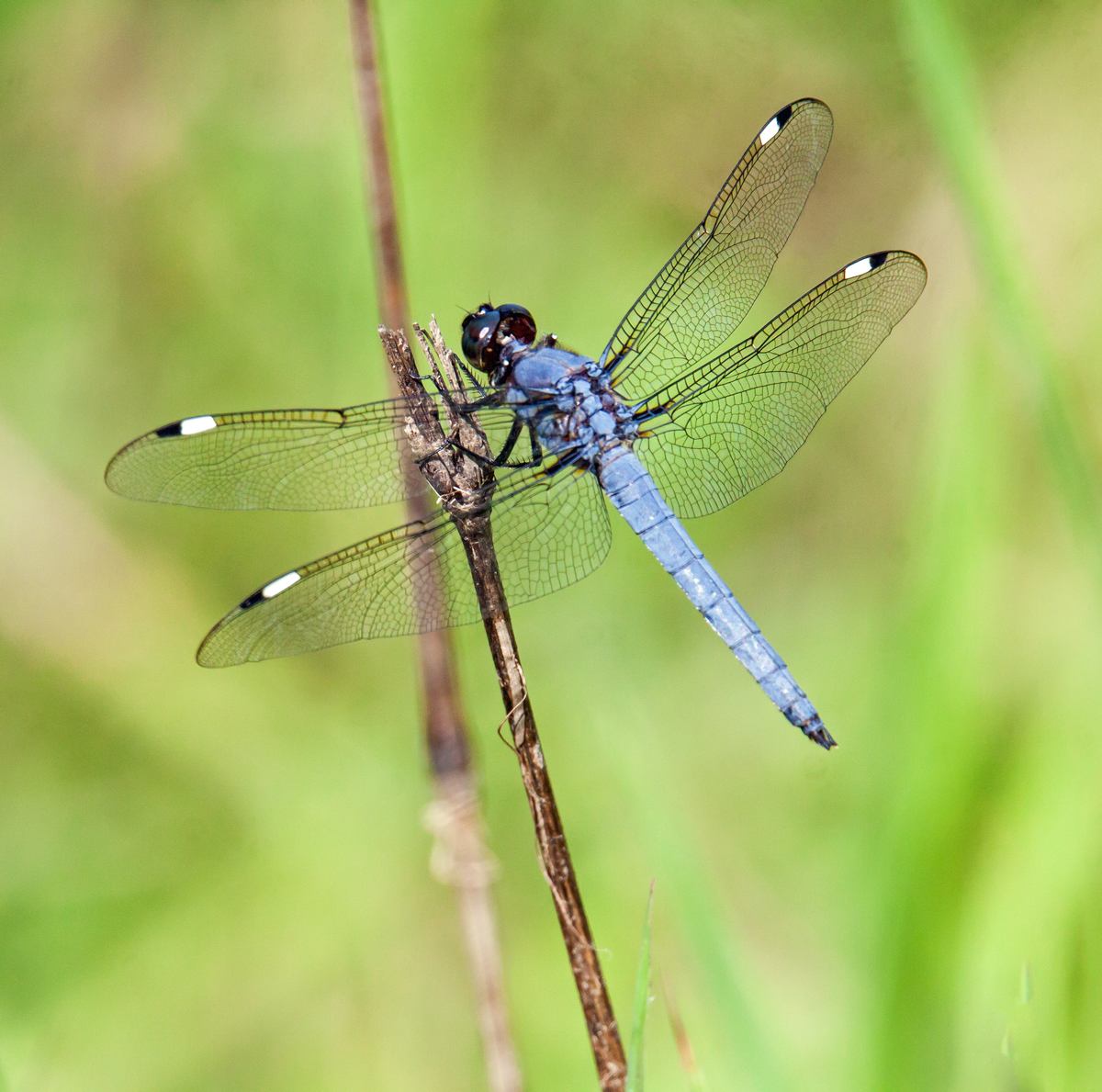
I don’t see Spangled Skimmer dragonflies (Libellula cyanea) very often, so I was happy to spot this beautiful male last week. The markings on the wings are so distinctive that it is pretty easy to identify a member of this species when I do come upon one. (The second shot gives a really good view of those markings.)

I like the way that the background turned out in these shots and I have captured pretty detailed images of a Spangled Skimmer. I am confident, though, that I will be snapping away again if I stumble across another one. Who knows what kind of a photo I might be able to capture the next time?

Spangled Skimmer

Spangled Skimmer

© Michael Q. Powell. All rights reserved

Read Full Post »

When damselflies are connected in the tandem mating position, they are large enough to be noticed, especially when they fly right by me, as was the case this past Friday. They were pretty skittish, but I managed to get a couple of relatively clear shots.

My identification task was greatly eased by the fact that these were not one of the multiple blue species that inhabit my local marshland park—there was only a little blue on the tip of the male’s abdomen. Imagine my shock when I learned that these damselflies are Blue-tipped Dancers (Argia tibialis). In my experience, names generally are not that helpful when it comes to identification, but this is an obvious exception.

Sharp-eyed readers may notice that these damselflies look a bit like the one currently featured in the banner of my blog. That damselfly is a Violet Dancer, a subspecies of the Variable Dancer species (Argia fumipennis). Apparently damselflies do a lot of dancing!

If you are interested in seeing some photos and descriptions of the bluet family of damselflies at our local park, check out this recent posting by fellow blogger and photographer Walter Sanford entitled Blue for Bluets.

Blue-tipped Dancer

Blue-tipped Dancer

© Michael Q. Powell. All rights reserved


Read Full Post »

This young male Halloween Pennant dragonfly (Celithemis eponina) let me get close enough to use my macro lens to good effect, but an intermittent light breeze caused him to sway back and forth, greatly increasing the challenge of getting sharp shots.

Halloween Pennants are spectacular dragonflies with their two-toned eyes and patterned wings. They almost always choose to perch at the very tip of flimsy branches and blades of grass and often do look like pennant blowing in the wind.

I included a shot of the entire body of this dragonfly to give you a full appreciation of its wildly wonderful wings.

Halloween Pennant

Halloween Pennant

Halloween Pennant


© Michael Q. Powell. All rights reserved

Read Full Post »

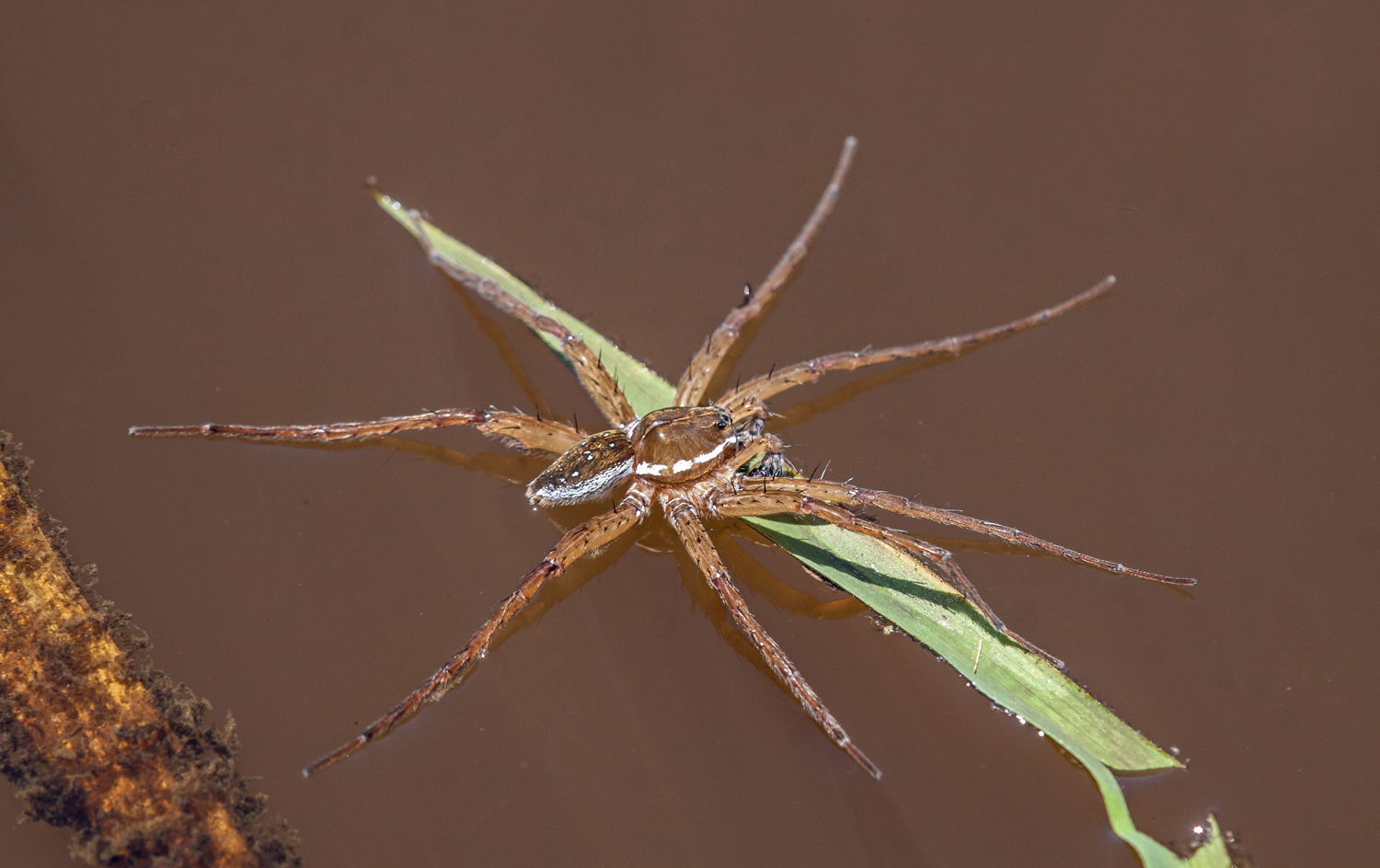
Some movement in the muddy water right below my feet caught my attention yesterday as I was standing at the edge of a small stream at Huntley Meadows Park observing a dragonfly. A Six-spotted Fishing spider (Dolomedes triton) was walking on the water with its legs fully extended.

The other times that I seen one of these fishing spiders, they always had a few legs hanging onto the shore, but this one was moving across the surface of the water pretty quickly, perhaps chasing a potential prey. Unfortunately, overhanging vegetation prevented me from tracking the spider’s movement, so I don’t know if the hunt was successful.

Six-spotted Fishing spider

© Michael Q. Powell. All rights reserved


Read Full Post »

Like most guys, I have trouble remembering anniversaries, so it is a good thing that WordPress sent me a reminder that three years ago today I started my blog. I still recall my feelings of doubt and uncertainty when my mentor and muse Cindy Dyer sat me down in front of a computer and told me that I was starting a blog. We had just finished reviewing and editing some shots that I had taken earlier in the day at Kenilworth Park and Aquatic Gardens. Cindy helped me through the mechanics of setting up the blog and shortly thereafter I made my first posting, Blue Dasher dragonfly.

Once I started, I couldn’t stop. I grew to look forward to writing the postings and taking photos to feature. As of right now, I’ve made 1638 postings and had 78743 views—that’s a lot of words and a lot of photos.

I was struck from the outset by the sense of community and mutual support that exists in the blogging world and there is a small group of fellow photographers with whom I feel a particular affinity, including Sue, Gary, Leanne, Ed, Lyle, Emily, Allen, and Chris. The amount of encouragement that I receive from them and countless others is overwhelming. Closer to home, Cindy continues to be a constant source of inspiration and instruction and Walter and I help to push each other as we explore remote areas of our favorite marshland park.

When I started this blog, I didn’t really think of myself as a photographer. I was taking a lot of photos and knew that I was improving, but there was a kind of psychological barrier that kept me from thinking in those terms. Now, I can confidently say that I am a photographer.

My journey into photography has been full of highlights, but two moments from 2014 really stand out. In November, I witnessed the rescue of a bald eagle at my local marsh and my photos and links to my blog posting were featured on the websites of several Washington D.C. media outlets, resulting in a total of 3344 views of my posting Rescue of an injured Bald Eagle. A short time before that incident, I was really honored when I was featured in an Introductions post by noted Australian photographer Leanne Cole.

If you have read this far, you may be wondering about my reference to “cannibals” in the title of this posting. What do cannibals have to do with my blog? Well, if I set aside the abnormally high number of views of my eagle rescue post, for the longest time my most popular post was one with the innocuous title of Fuzzy white caterpillar. There is not a whole lot special about the prose or the photos, but it has had 489 views to date.

Earlier this week the caterpillar was passed in the stats by my post Red-footed Cannibalfly, with 492 views to date—the cannibals have taken over the lead. As a guy, I feel happier that a more macho sounding insect is now leading the field of “normal” posts. As far as I can tell, the post’s popularity is a function of the search engines. The post was not particularly popular when it first appeared and has only 36 likes. Now, though, it even shows up on the first page of Google results if you type in “Red-footed Cannibalfly.”

So what’s ahead? I hope to be able to keep improving my writing and my photography. I have certain aspirational shots in my mind of different subjects or different locations.

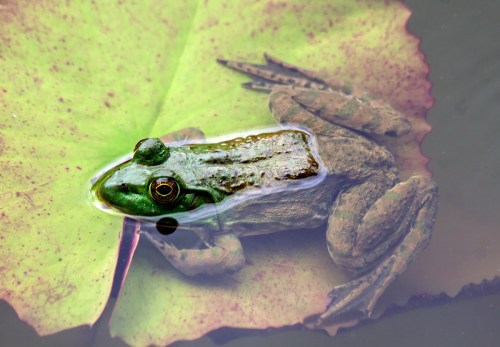
Yesterday, when I was taking photos of water lilies with Cindy Dyer, I mentioned that I had always imagined taking a shot a frog on a lily pad, but had never even seen a frog perching on one. A short time later, Cindy excitedly pointed out a partially submerged frog on a lily pad and I managed to snap a couple of shots before he dove into the water. (Check out Cindy’s blog posting to see her beautiful shot of this frog.) Dreams do come true.

Thanks again to all my readers and supporters, whose encouragement has helped motivate and sustain me this past three years. I look forward to sharing my journey with my fellow travelers.
 

Frog on a lily pad

© Michael Q. Powell. All rights reserved

Read Full Post »
Everyone knows that Monarch butterflies love milkweed, but if you move in closer to the plants, you’ll discover a world of fascinating little creatures, like this Red Milkweed Beetle (Tetraopes tetrophthalmus) that I spotted this past weekend at Huntley Meadows Park in Alexandria, Virginia.

Almost three years ago I did a posting in which I acknowledged that I had become obsessed with shooting Red Milkweed Beetles. This weekend I realized that that my initial fascination with my colorful little friends has not diminished much over time when I saw this beetle in a small stand of swamp milkweed. I’m not sure if it is the long antennae or the bold pattern or the bright color that attracts me most—I just know that I love seeing them in all of their developmental forms (they go through several interesting instars as they grow).

The next time you see some milkweed, stop for a moment, examine it closely, and prepare to enter a fascinating little world as the scent of the flowers envelops you.


Red Milkweed Beetle

© Michael Q. Powell. All rights reserved


Read Full Post »

As an American, I feel a special affinity for the Bald Eagle (Haliaeetus leucocephalus), our national bird and one of our most visible national symbols. Eight months ago, I was privileged to witness the rescue of an injured bald eagle at my local marshland park and captured some of the best photos that I have ever taken.

This photo, which appeared originally on 4 November last year, seems particularly appropriate today, reminding that our liberty requires constant vigilance and that brave men and women across the globe are on duty today safeguarding that freedom.

If you would like to see additional photos or learn more of the eagle rescue, check out my earlier posting. That posting has been my most popular one ever, thanks in part to the fact that several media outlets used my photos in their on-line coverage and provided links to my blog. Unfortunately, this story ended tragically and the eagle’s injuries turned out to be so severe that this majestic bird was euthanized.

Bald Eagle

© Michael Q. Powell. All rights reserved.

Read Full Post »

With patches of red, white, and blue, this Red Admiral butterfly (Vanessa atalanta) that I spotted earlier this week seems to be perfectly attired to celebrate Independence Day today here in the United States.

Happy Fourth of July!

Red Admiral

© Michael Q. Powell. All rights reserved.

Read Full Post »

A few years ago I probably would have misidentified this butterfly as a Monarch because of its coloration. Now, however, I can tell immediately that it is a Viceroy butterfly (Limenitis archippus), because there is a black stripe across the hindwings that the Monarch lacks.

I spotted this beautiful little butterfly this past Monday as I was searching for dragonflies and other creatures in a remote area of Huntley Meadows Park, the marshland area where I take many of my photos. A significant number of the areas that I like to visit are at least partially flooded. The month of June that we just ended turned was the second most rainy June on record for the region (and the rain has continued into July).

As I take more and more photos, I keep learning more and more about my subjects as I try to figure out what I have shot. What amazes me is that I manage to retain some of that information and can use it to identify a subject, as I did in this case. It’s not that easy most of the time (at least for me).

Viceroy butterfly

© Michael Q. Powell. All rights reserved.

Read Full Post »

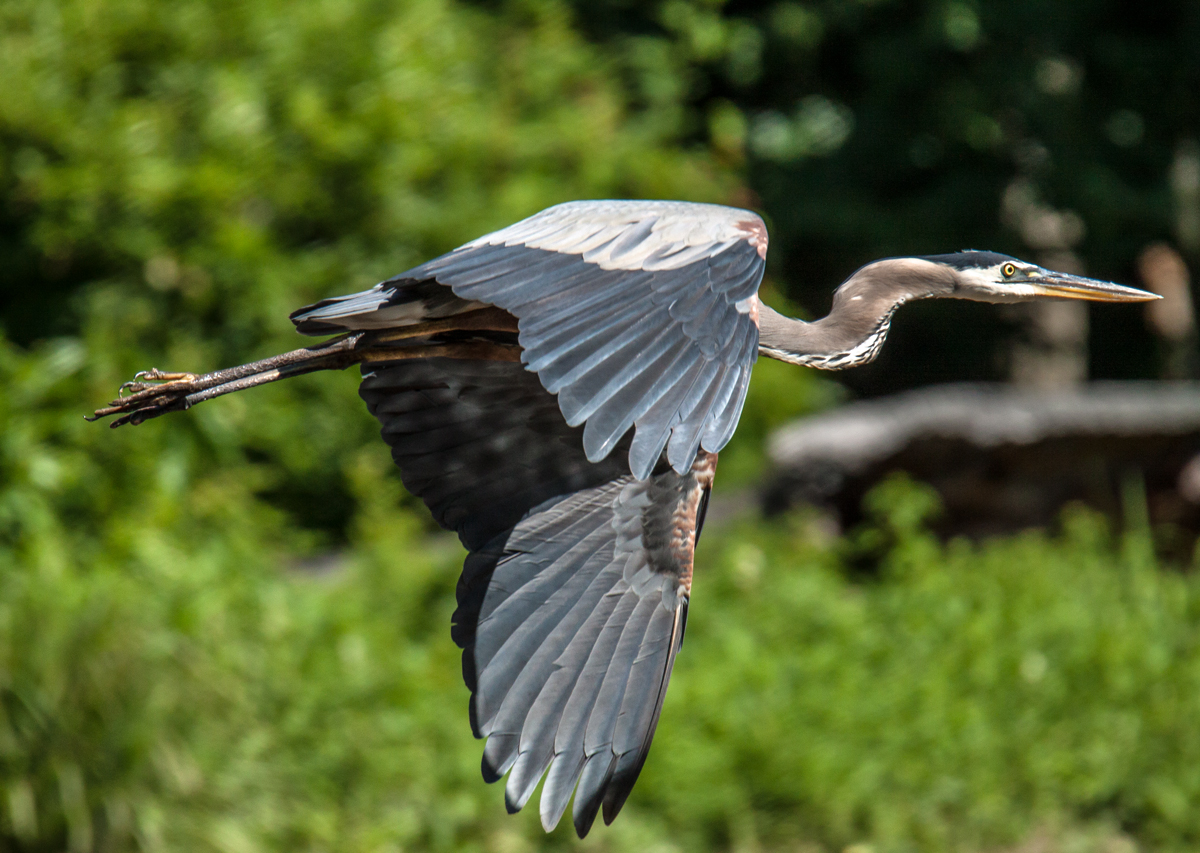
I was concentrating so intently on tracking this Great Blue Heron (Ardea herodias) in flight on Monday that I didn’t realize he was so close to me that I actually should have zoomed out a bit—the heron barely fit within the viewfinder.

Fill the frame with your subject? I can’t remember the last time that I was able to do so with a bird as the subject.

Great Blue Heron

© Michael Q. Powell. All rights reserved.

Read Full Post »

Instinctively I try to get as close to a subject as possible, often ignoring the “big picture.” One recently early morning, however, there was a substantial amount of water between me and the Belted Kingfisher (Megaceryle alcyon) that I spotted on a fallen tree and there was no way I was getting closer.

I concentrated on focusing, thinking I would probably have to crop a lot, and on composition. Almost despite myself, I ended up with an image that I really like, an image in which the kingfisher is only one element of an early morning landscape.

There is definitely a benefit sometimes in not getting closer to the subject.

Belted Kingfisher

Michael Q. Powell. All rights reserved.

Read Full Post »

It rained all day yesterday and today I felt the need for a burst of color, so I worked up a shot that I took in early May of a male Southern Spreadwing damselfly (Lestes australis). Somehow this beautiful little damselfly fell to the back of the queue during a period of time when I was taking so many photos that I barely had time to review and sort them all.

Three things really strike me about this damselfly. It is much biggest than most of the damselflies; it perches with its wings spread wide, unlike most damselflies; and, most importantly for me, it has very striking turquoise eyes that draw me right in.

Special thanks to my friend, Walter Sanford, who located the damselfly and worked with others to establish that this was a Southern Spreadwing and not the visually similar Sweetflag Spreadwing. Walter said that he was so familiar with this particular damselfly that he nicknamed him “Arty,” because of his propensity for perching in front of photogenic backgrounds.

Southern Spreadwing damselfly

Michael Q. Powell. All rights reserved.

Read Full Post »

I probably watched too many horror movies as a child, because I couldn’t help but think of Count Dracula when I first saw the posture of this male Red-winged Blackbird (Agelaius phoeniceus) at my local marshland park. The blackbird seemed to have assumed the traditional bat-like Dracula pose and appeared to be getting ready to swoop in and suck my blood. Involuntarily, my neck began to twitch a little.

Fortunately, the blackbird flew off in another direction and, at least for now, I have not been turned into a vampire.

Red-winged Blackbird

Michael Q. Powell. All rights reserved.

Read Full Post »

This spring I have been spending more and more time in remote areas of my marshland park and have had the opportunity to see dragonflies in earlier stages of development than in previous years. I was thrilled recently to spot a newly emerged male Common Sanddragon (Progomphus obscurus) and managed to get some shots of it with my macro lens.

Fellow dragonfly enthusiast Walter Sanford did a posting yesterday with some wonderful shots of adult male Common Sanddragon dragonflies and you can refer to that posting if you want to see what a mature male looks like.

When you look at this very young dragonfly, in a stage called “teneral,” a few things stand out. The colors of its eyes and its body are very pale and the wings are really clear. As the dragonfly is exposed to the air and to the sunlight, its colors become more pronounced and its wings more solid.

Many of you know that dragonflies spend most of their lives underwater as nymphs going through a series of transformations. Only in the later stage of their lives do they shed their exoskeletons one last time and become the aerial acrobats that we are used to seeing.

I’ve always wanted to see this transformation taking place, but have not yet had the chance to do so. When I was sharing this images with a friend, though, he pointed out something which I had missed—the dragonfly is perched on its cast-off skin. In the final photo, you can see that the dragonfly is now more than twice as long as when he first emerged, with a significantly lengthened abdomen. In the two close-up shots, it looks like the dragonfly’s front legs are astride the head of the exoskeleton and I think you can actually see the two eyes.

I am in awe when I think of the incredible metamorphosis that has just taken place and find this dragonfly, like all newborns, to be amazingly beautiful and precious.

Common Sanddragon

Common Sanddragon

Common Sanddragon

Michael Q. Powell. All rights reserved.

Read Full Post »

Here are some wonderful shots of one of my favorite dragonflies, the Common Sanddragon, by my fellow photographer, blogger, and dragonfly enthusiast Walter Sanford.

waltersanford's avatarwalter sanford's photoblog

On the one-year anniversary for Mike Powell’s discovery of a new species of dragonfly at Huntley Meadows Park, I revisited the same location where Mike found the first Common Sanddragon dragonfly (Progomphus obscurus) at the park.

On an overcast, rainy day I was pleasantly surprised to see several male Common Sanddragons and a single female. A few photos of the males are featured in this post; a photo of the female will be published in a follow-up post.

A Common Sanddragon dragonfly (Progomphus obscurus) spotted at Huntley Meadows Park, Fairfax County, Virginia USA. This individual is a male. 17 JUN 2015 | Huntley Meadows Park | Common Sanddragon (male)

A Common Sanddragon dragonfly (Progomphus obscurus) spotted at Huntley Meadows Park, Fairfax County, Virginia USA. This individual is a male. 17 JUN 2015 | Huntley Meadows Park | Common Sanddragon (male)

A Common Sanddragon dragonfly (Progomphus obscurus) spotted at Huntley Meadows Park, Fairfax County, Virginia USA. This individual is a male. 17 JUN 2015 | Huntley Meadows Park | Common Sanddragon (male)

Copyright © 2015 Walter Sanford. All rights reserved.

View original post

Read Full Post »

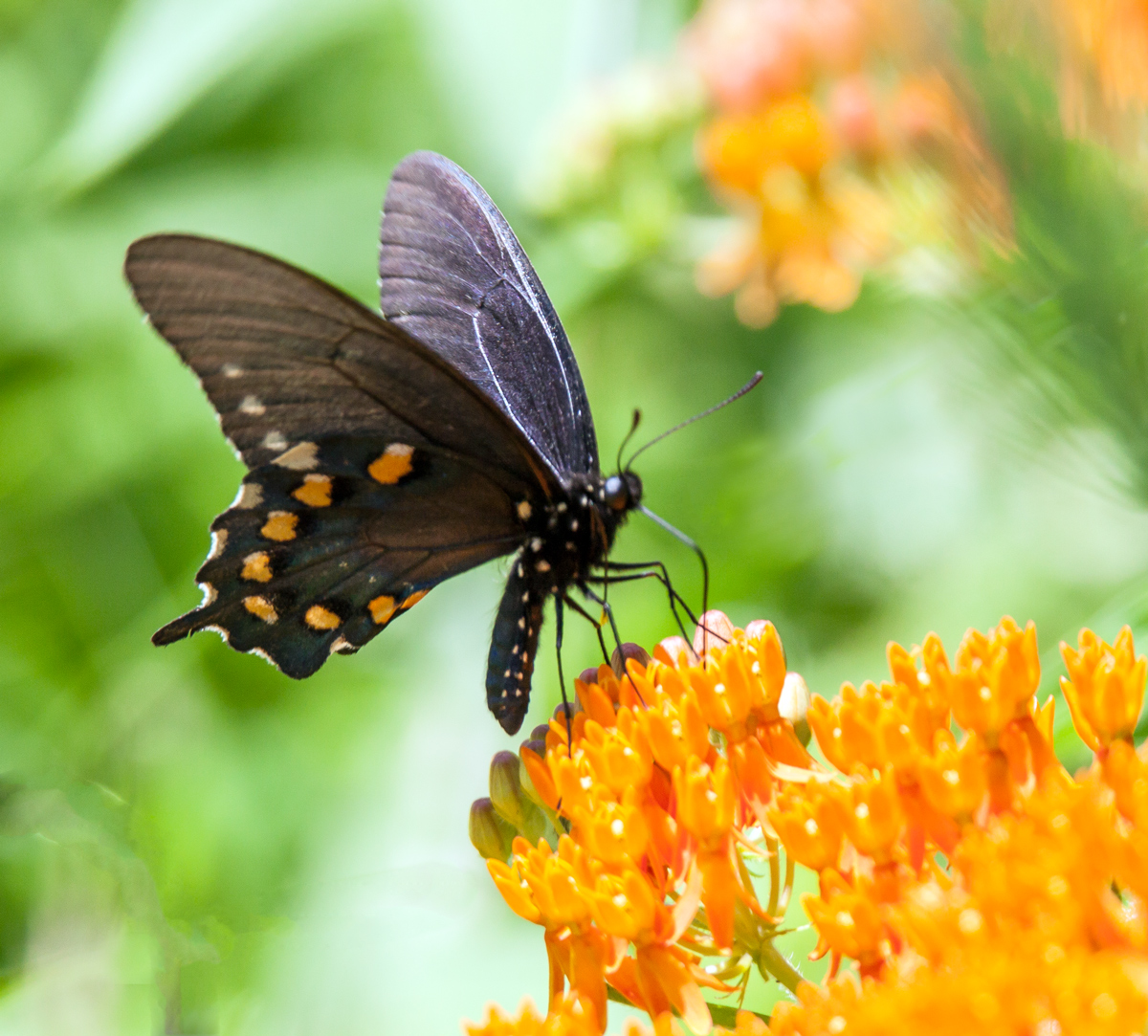
This past weekend I spotted a black swallowtail fluttering about some bright orange flowers, never stopping for more than a split second. Could I get a shot before it flew away?

Well, I managed to get some shots and then came the tough part—figuring out which black-colored swallowtail I had captured. How hard can that be? For a casual observer like me, there were at least three candidates that immediately came to mind—the black version of the Eastern Tiger Swallowtail, the Spicebush Swallowtail, and the Pipevine Swallowtail. I recalled that one of the key indicators is the pattern of the orange spots, but I couldn’t remember which one had which pattern.

After some quick research, I’ve concluded this is probably a Pipevine Swallowtail butterfly (Battus philenor). I was also really taken by the orange plant and think it might be butterfly weed (Asclepias tuberosa), a type of milkweed that, as its name suggests, attracts butterflies.

Pipevine swallowtail

Michael Q. Powell. All rights reserved.

Read Full Post »
« Newer Posts - Older Posts »