Yesterday I wrote of a male Eastern Pondhawk dragonfly (Erythemis simplicicollis) transitioning to adulthood, but I realized this morning that not all viewers know what an adult male pondhawk looks like.
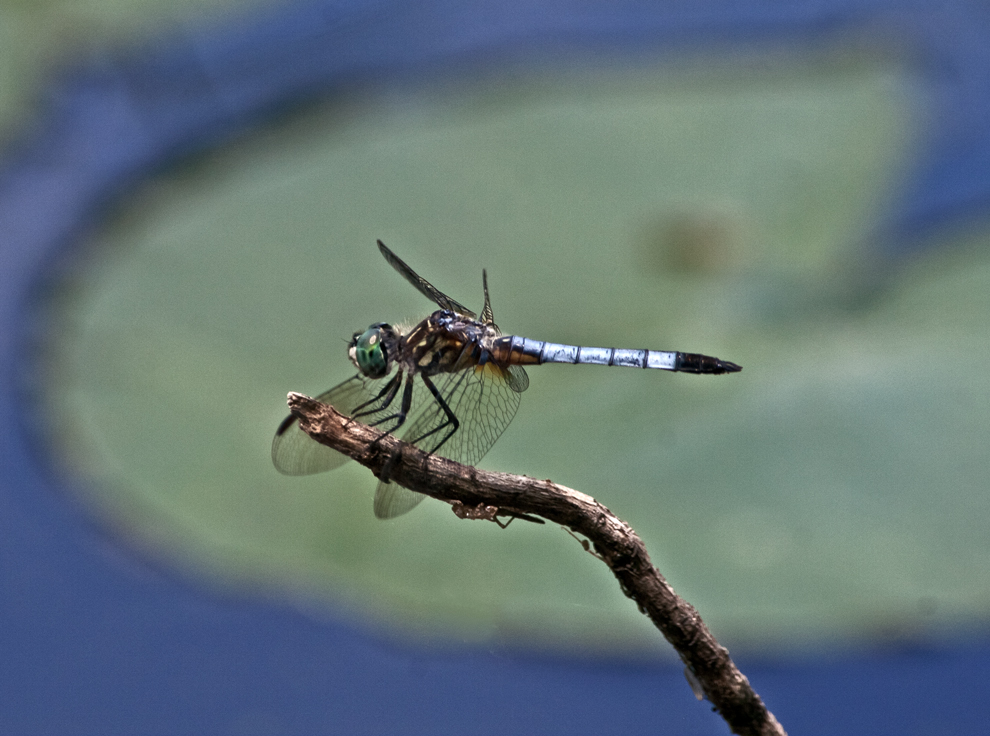
This first shot shows an adult male Eastern Pondhawk perched above a big mass of algae, duckweed, and other “stuff” at a small pond at a local garden. Originally I was frustrated when the dragonfly flew into this mess and did not perch above the cleaner water of the pond. I wasn’t sure if I could get a clear shot with all of the clutter, but was pleasantly surprised with the result. I actually like the bubbles in the foreground and the texture and visual interest that it adds to the shot.

I took the second shot in a totally different environment, at the edge of a field. It shows the bright green coloration of the Eastern Pondhawk female (and young males). My local dragonfly expert, Walter Sanford, keeps reminding me that one of the keys to differentiating the genders is the terminal appendages and I think this one is a female.
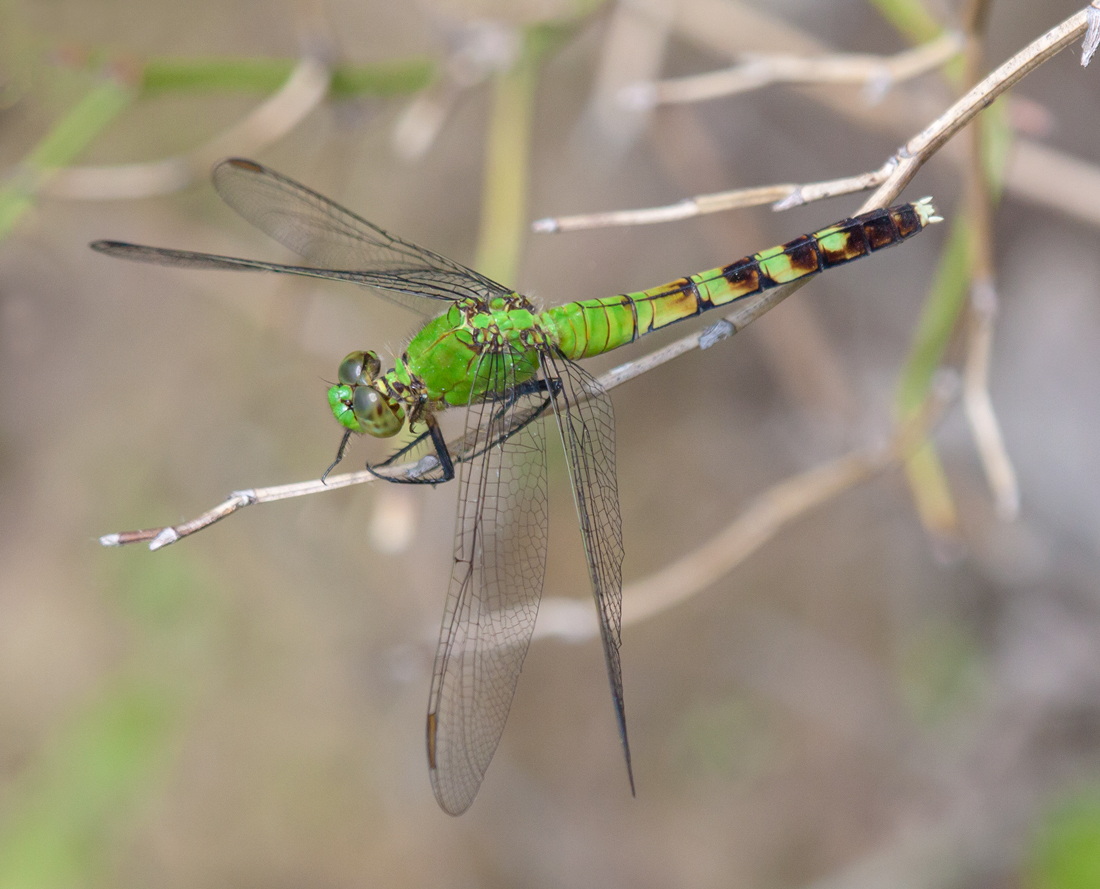 When you take the blue from the top photo and the green from the bottom one, you get the color combination of yesterday’s posting. As for me, I find the colors to be exceptionally beautifully individually as well as in combination.
© Michael Q. Powell. All rights reserved.
















 Mike Powell
I believe I can fly
Posted in commentary, Dragonflies, Insects, Inspiration, Macro Photography, Nature, Photography, tagged Alexandria VA, Canon 100mm macro lens, Canon Rebel XT, damselfly, emerging, green spring gardens, larva on July 2, 2013| 6 Comments »
This photo leaves me a little confused, because the larval shell to which this damselfly is clinging seems too big for its body and looks more like it belonged to a dragonfly.
There are plenty of places on the internet where you can read about the life cycle of dragonflies and damselflies, but the short version is that they spend most of their lives in the water as nymphs. There they go through a series of larval stages in which they shed their skin that has grown too tight. Just before they molt for the final time, they climb out of the water and, once the skin dries, the damselflies emerge. They then have to rest for a little while as their wings unfurl and their legs get stronger. Only then can they fly away.
This pretty little damselfly seems to be in the resting phase on a little rock ledge at the edge of a pond at a local garden. I wanted to try to get a bit closer, but the embankment where the ledge was located was steep and muddy and I would have had to be standing in the water to get a better angle.
I like the photo a lot and find it to be weirdly fascinating. The landscape is simple and rugged, with some texture in the foreground. The moulted shell still seems lifelike and seems to be looking at us with a slightly tilted head. The damselfly itself has the only color in the image and attracts the viewers’ eyes. There is a kind of tension in the damselfly’s pose, as it hangs on with all of its strength, waiting until the moment when it can fly away.
Imagine what it would be like waiting, waiting for the moment when you take to the air for the first time, leaving behind forever your old life in the water.
© Michael Q. Powell. All rights reserved
Share this:
Read Full Post »