Feeds:
Posts
Comments

Posts Tagged ‘Erythemis simplicicollis’

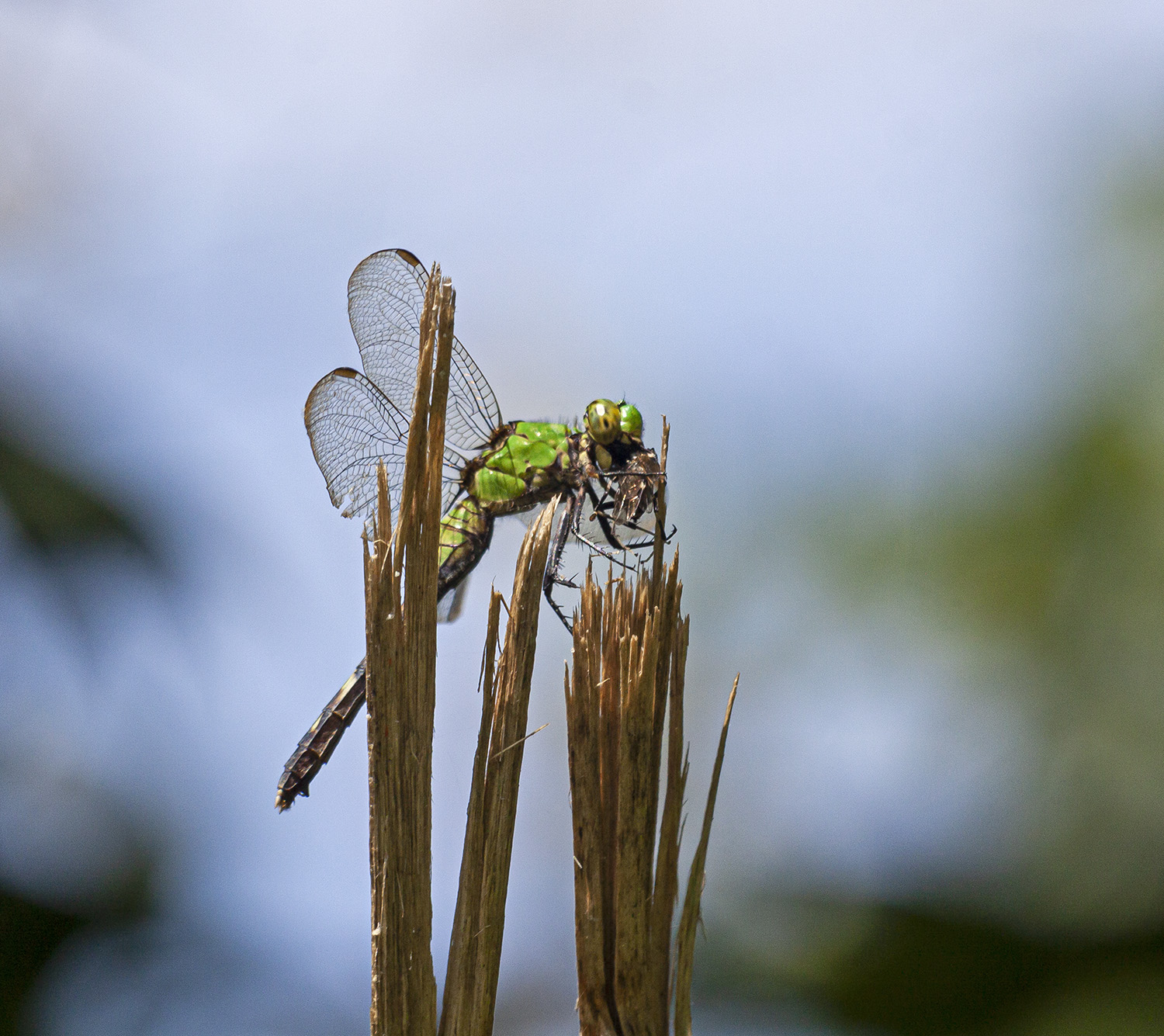
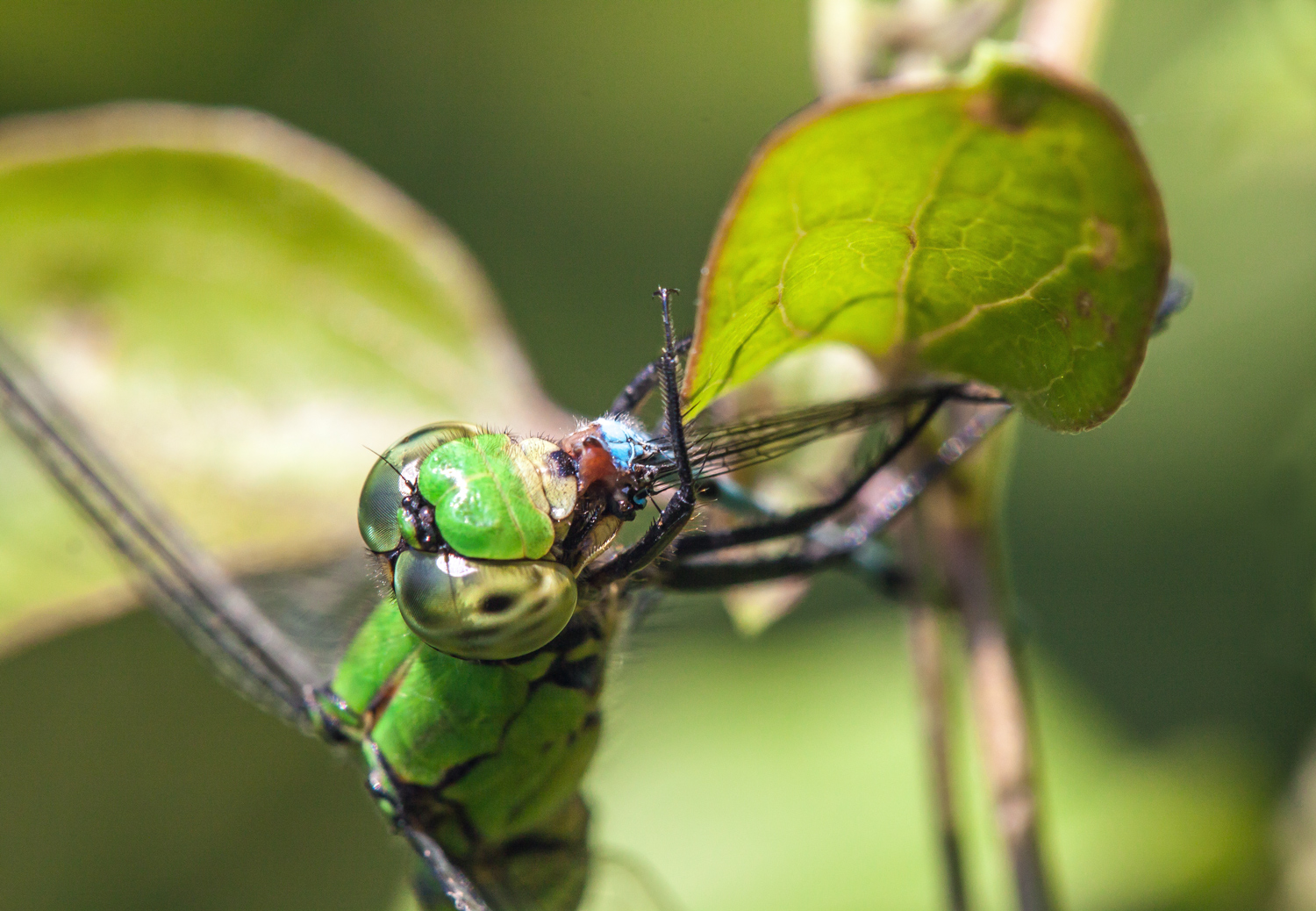
There are only a few remaining dragonflies as we move deeper into the autumn season. I was therefore delighted to spot this female Eastern Pondhawk dragonfly (Erythemis simplicicollis) during a recent visit to Occoquan Bay National Wildlife Refuge. Eastern Pondhawks appear in early May and generally hang around until the end of October.

The females of this species are quite distinctive in their appearance, with their brilliant green color and striped abdomens, so they are relatively easy to identify. Immature males, however, have the same coloration when young, so I usually check the terminal appendages before making a call on the gender of an Eastern Pondhawk.

Eastern Pondhawk

© Michael Q. Powell. All rights reserved.


Read Full Post »

How do you handle the heat? For those of us who live in the Northern Hemisphere, the last few months have seen a series of unrelenting hot days. High temperatures have frequently been in the 90’s (33 degrees C) and have occasionally pushed past 100 degrees (38 degrees C).

Despite the heat, I ventured out yesterday with my camera during the middle of the day and visited Huntley Meadows Park, a local wetlands area. Wildlife activity seemed quite low—many of the creatures seemed to be sheltering out of sight in the shade. I did manage to spot this female Eastern Pondhawk dragonfly (Erythemis simplicicollis) that was perilously perched on a flimsy bit of vegetation. I don’t know for sure if she was taking a siesta or was simply chilling, but somehow her actions seemed make a bit more sense for dealing with the heat than those of this intrepid photographer.

Perhaps the old saying is true—”Mad dogs and Englishmen go out in the midday sun.” Technically I am not English, so what does that make me?

Eastern Pondhawk

© Michael Q. Powell. All rights reserved.

Read Full Post »

My mind sometimes works in mysterious ways. Often when I see a bright green female Eastern Pondhawk dragonfly (Erythemis simplicicollis), like the one in this image that I captured during a visit to Occoquan Bay National Wildlife Refuge, I can’t help but think of Kermit the Frog. Why?

Kermit the Frog has always been my favorite Muppets character. I have distinct memories of Kermit singing one of his signature songs, “It’s not easy being green” in which he laments his green coloration, expressing his concern that green “blends in with so many ordinary things” and wishing to be some other color.

“It’s not that easy being green;
Having to spend each day the color of the leaves.
When I think it could be nicer being red, or yellow or gold-
or something much more colorful like that.

It’s not easy being green.
It seems you blend in with so many other ordinary things.
And people tend to pass you over ’cause you’re not standing out like flashy sparkles in the water-
or stars in the sky.”

Have you ever felt that way, wishing you could stand out more from the crowd, uncomfortable in your own skin? I know that I have sometimes felt that way.

In the end, though, Kermit recalls positive associations with the color green, and concludes by accepting and embracing his color.

“But green’s the color of Spring.
And green can be cool and friendly-like.
And green can be big like an ocean, or important like a mountain, or tall like a tree.

When green is all there is to be
It could make you wonder why

But, why wonder? Why wonder?
I’m green and it’ll do fine
It’s beautiful, and I think it’s what I want to be.”

Life’s too short to worry and complain about all the things that we are not, to constantly compare ourselves with others, to become green with envy. It is so much more rewarding when you can boldly embrace who you are and ignore the views of the naysayers on the sidelines.

Eastern Pondhawk

© Michael Q. Powell. All rights reserved.

Read Full Post »

Last Saturday I spotted this stunning female Eastern Pondhawk dragonfly (Erythemis simplicicollis) during a visit to Occoquan Bay National Wildlife Refuge. The thorn-like projection near the tip of the abdomen that helps her to lay eggs made it immediately obvious that this was a female. The bright green coloration, distinctive black bands on her abdomen, and her green face make it almost impossible to misidentify this species.

As I was checking my blog yesterday, I came across a notice from WordPress informing me that I had started my blog 13 years ago. Wow! It’s hard to believe that I have kept this blog going for that long. According to the statistics from WordPress I have had 524,468 views of 5,417 posts since I began posting.

It is a bit of a cliché but it is absolutely true that I could not have done this without all of the support, suggestions, and encouragement. Thank you to all of you. I remember my modest expectations when I started the blog, looking simply for a place to post my wildlife and nature photographs. Over time this blog has become a kind of diary in which I have been able to express a lot of what I think and feel as I experience the beauty of the natural world. I have come to enjoy expressing myself as much in my written words as I have in my photos, reflecting on many different aspects of my life, including religion, poetry, and various artistic pursuits.

I remember deciding on the subheading for the blog some 13 years ago, calling it “My journey through photography.” Though the path has often been meandering and full of detours and distractions, that journey still continues. Once again, I thank all of you who have chosen to walk alongside me and to experience the world in part as I see it.

Female Eastern Pondhawk

© Michael Q. Powell. All rights reserved.

Read Full Post »

With most dragonfly species, the male is usually the one with the most distinctive coloration and females are often nondescript in appearance. That is definitely not the case with the Eastern Pondhawk dragonfly (Erythemis simplicicollis), where the female is bright green and has distinctive black bands on her abdomen. She also has a green face that makes it almost impossible to misidentify this species.

Immature males of this species have a similar coloration to that of the female, but they are gradually transformed into a duller shade of blue and finally a powdery bluish-gray. The terminal appendages of the male are different from those of the female and additionally the ovipositor of the female, the egg-laying organ, is frequently visible below the tip of her abdomen, as you can see in this photo that I took last week at Occoquan Bay National Wildlife Refuge.

Eastern Pondhawks are quite common in my area, though this year I have not seen as many as in previous years. Although other dragonflies are equally fierce predators as the Eastern Pondhawk, the majority of the times that I have seen a dragonfly with prey, particularly other dragonflies or damselflies, it has been an Eastern Pondhawk.

Eastern Pondhawk

© Michael Q. Powell. All rights reserved.

Read Full Post »

When male Eastern Pondhawk dragonflies (Erythemis simplicicollis) are very young, they have green bodies with dark banding on the abdomen, just like their female counterparts. Over time male Eastern Pondhawks are gradually transformed into a duller shade of blue and finally a powdery bluish-grey.

From an aesthetic point of view, my favorite stage of development is when they are young males and their thoraxes are a beautiful shade of green that contrasts wonderfully with their blue abdomens. Eastern Pondhawks of both genders have cool-looking green faces that help to distinguish them immediately from other dragonfly species.

I spotted this Eastern Pondhawk during a recent visit to Jackson Miles Abbott Wetland Refuge, a small refuge that belongs to a nearby military installation. It is not a contiguous part of that installation, however, and is open to the public. The composition of this shot is quite simple, but I like the way that the Y-shape of the forked branch helps to divide up the frame and lead the viewer’s eyes to the main subject.

Eastern Pondhawk

© Michael Q. Powell. All rights reserved.

Read Full Post »

This female Eastern Pondhawk dragonfly (Erythemis simplicicollis) blended in so well with the vegetation that I almost missed seeing her yesterday at Occoquan Bay National Wildlife Refuge. Eastern Pondhawks are one of the most commonly seen dragonflies in my area during the summer, but this is the first one that I have seen so far this year.

I love the beautiful emerald color of female Eastern Pondhawks (as well as immature males of the species). They are not particularly large as dragonflies go, but they are very fierce predators. Several times each season I stumble upon Eastern Pondhawks gnawing on damselflies or other dragonflies that they have caught. Yikes!

Eastern Pondhawk

© Michael Q. Powell. All rights reserved.


Read Full Post »

In many of my blog postings, I concentrate on a single species of dragonflies, but today I want to celebrate the diversity of species that I have been seeing during the month of September. Despite my warnings in some earlier postings about the decreasing numbers of dragonflies, I continue to see a variety of species—Northern Virginia, where I live, is blessed to have an abundance of different dragonflies and damselflies.

The first photo shows a female Eastern Amberwing (Perithemis tenera), the smallest dragonfly in our area.  Males of this species hang out at ponds, but the females, which do not have amber wings like the males, are usually found in vegetation some distance from the water.

The second image shows a male Calico Pennant (Celithemis elisa), a beautifully colored dragonfly with distinctive patterns on its wings. The third image shows a mature female Needham’s Skimmer (Libellula needhami). Her wings show some damage and her color has fades, but she is still beautiful and the golden strands on the front edges of her wings were sparkling in the sunlight when I captured this image.

The fourth image shows a female Eastern Pondhawk (Erythemis simplicicollis), one of the most common dragonfly species in my area. I love the brilliant emerald color of the females (and immature males) of this species and the black markings on the abdomen.

The dragonfly in the last photo was the toughest one for me to identify. It had flown up into a tree and I was looking into the sun when I captured the image. However, I am pretty sure that it is a female Great Blue Skimmer (Libellula vibrans).

All of these dragonflies belong to the Skimmer family, the largest dragonfly family that includes the species most likely to be seen by a casual dragonfly watcher. The other families, which are generally harder to find, include Clubtails, Cruisers, Darners, Emeralds, Petaltails, and Spiketails. If I remember correctly, I have managed this season to photograph at least one dragonfly in all seven of these dragonfly families.

Eastern Amberwing

Calico Pennant

Needham's Skimmer

Eastern Pondhawk

Great Blue Skimmer

© Michael Q. Powell. All rights reserved.


Read Full Post »

Female Eastern Pondhawk dragonflies (Erythemis simplicicollis) are quite easy to spot when they are out in the open—they are bright emerald green in color and have distinctive black stripes on their abdomens. When they land in a grassy area, however, they virtually disappear from sight, thanks to their almost perfect camouflage.

During a recent visit to Jackson Miles Abbott Wetland Refuge, I spotted this Eastern Pondhawk while it was flying and watch it land on this fallen branch. If I had not seen the dragonfly land and it had remained still on its perch, I doubt that I would have detected its presence.

Eastern Pondhawk

© Michael Q. Powell. All rights reserved.

Read Full Post »

I love the look of male Eastern Pondhawk dragonflies (Erythemis simplicicollis) when they are transitioning to adults. When they are juvenile, male Easter Pondhawks have emerald green thoraxes and black striped abdomen, like their female counterparts. Gradually the body coloration shifts to blue as they mature. I really like their appearance when, as was the case with these pondhawks that I photographed last week at Occoquan Regional Park, their bodies have beautiful shades of both green and blue.

In the second and third photos, you get a glimpse of the pondhawk’s beautiful eyes that are also a combination of blue and green. Although you can’t see it very well in these photos, Eastern Pondhawks of both genders have bright green faces, which helps to distinguish the male Eastern Pondhawks from a number of other dragonfly species that have blue bodies.

Eastern Pondhawk

Eastern Pondhawk

Eastern Pondhawk

© Michael Q. Powell. All rights reserved


Read Full Post »

I was delighted on Wednesday to spot my first Eastern Pondhawk (Erythemis simplicicollis) dragonflies of the season while I was exploring the trails at Occoquan Regional Park. As we progress into summer, this species will become quite abundant, but it is always a joy to spot these little beauties.

Females, like the ones in these photos, are bright green in color and have a banded abdomen. I did not see any males that day, but they start out with coloration similar to that of the females and then gradually transition to having a blue abdomen and a blue and green thorax. Both genders have green faces, which, along with their coloration, make them easy to identify.

I love the way that the green spring foliage matches the colors of an Eastern Pondhawk and provides a beautiful backdrop for them, as you can see in these photos.

I will be away in the mountains this weekend on a church retreat, so will probably not be posting for the next few days. I will have my camera with me, though, so you may see a few photos from my adventures there in upcoming blog postings.

Eastern Pondhawk

Eastern Pondhawk

© Michael Q. Powell. All rights reserved.


Read Full Post »
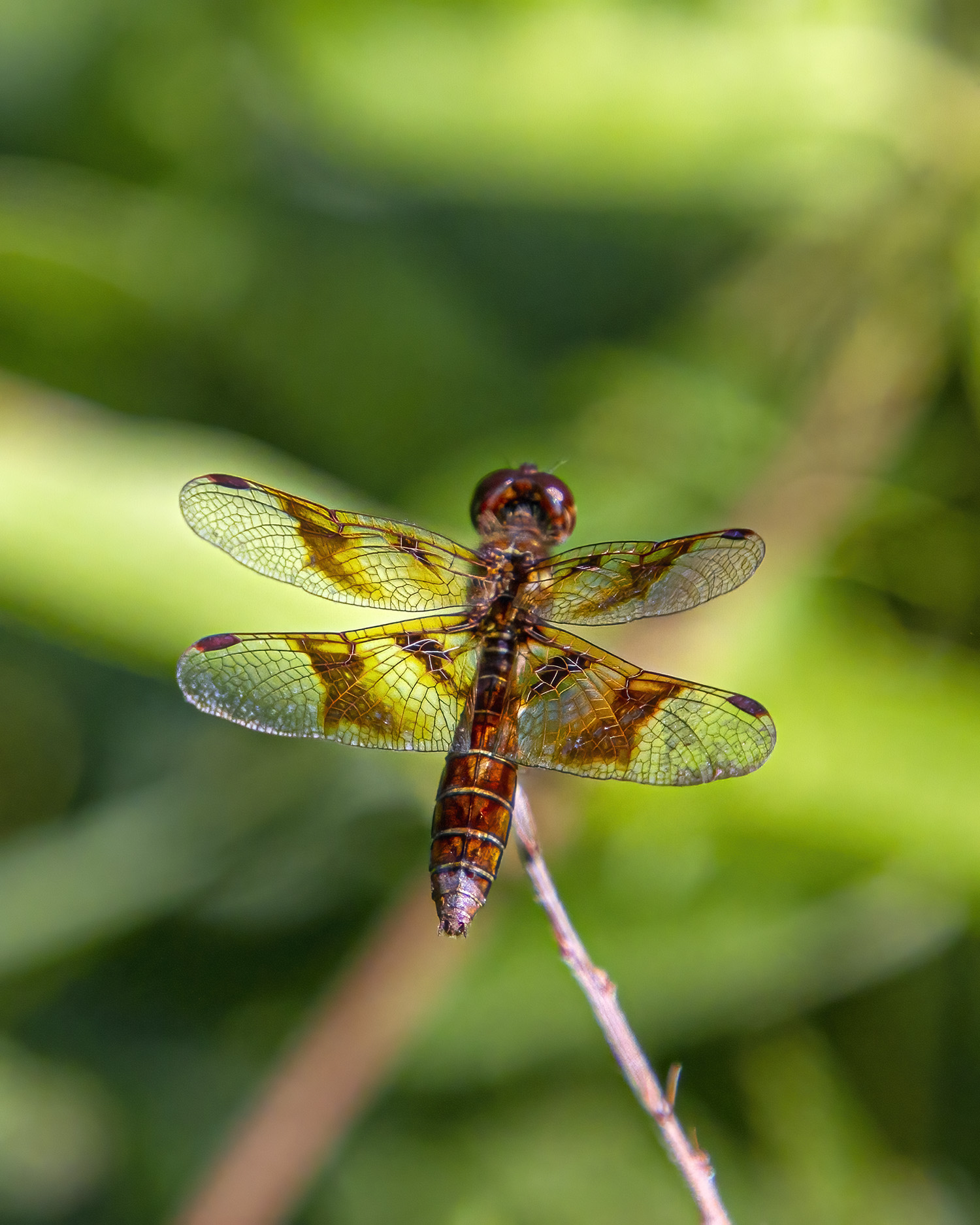
It is a simple law of nature that all creatures have to eat and many of my subjects are carnivores. The question of whether a creature is predator or prey is often a relative one—today’s predator can easily become tomorrow’s prey.

I try not to get emotionally involved when I witness one creature feeding on another, but that is not always possible. For me it is somewhat jarring when I see one dragonfly eating another—it feels like cannibalism.

For some reason, most such encounters that I have witnessed have involved Eastern Pondhawk dragonflies (Erythemis simplicicollis). This species is not at that large or powerful, but seems particularly fierce. Some other dragonflies catch their prey and eat while they are flying, their version of “fast food,” so that may be why I don’t see dragonflies consuming other dragonflies very often.

In the first photo, a female Eastern Pondhawk was feasting on a male Calico Pennant dragonfly (Celithemis elisa) that it had just caught. As you can see, the dragonfly holds its prey in its long legs and begins by eating the head.

In the second photo, taken at a different location, another female Eastern Pondhawk was munching on an unidentifiable damselfly. Readers sometimes ask me about the differences between dragonflies and damselflies and this photo gives you a general idea of the relative size and shape of their bodies.

According to a fascinating posting called “What do Dragonflies Eat?” on The Infinite Spider website, “All adult dragonflies are insectivores, which means they eat insects they catch with their spiny hairy legs.  The insects are then held in a basket-like device while flying. They particularly delight in mosquitoes (30-100+ per day per dragonfly!) as well as other pesky flight bugs  such as flies, butterflies, bees, and even other dragonflies.”

Check out the posting that I referenced in the previous paragraph, if you dare, for details about how dragonflies actually eat. Here is a sneak preview, “The main thing to notice is that they have jaws that work side to side and that are shaped like wicked meat hooks, mandibles that go up and down and maxillae that act like a lower lip and hold food.” Yikes!

Eastern Pondhawk


Eastern Pondhawk

© Michael Q. Powell. All rights reserved.


Read Full Post »
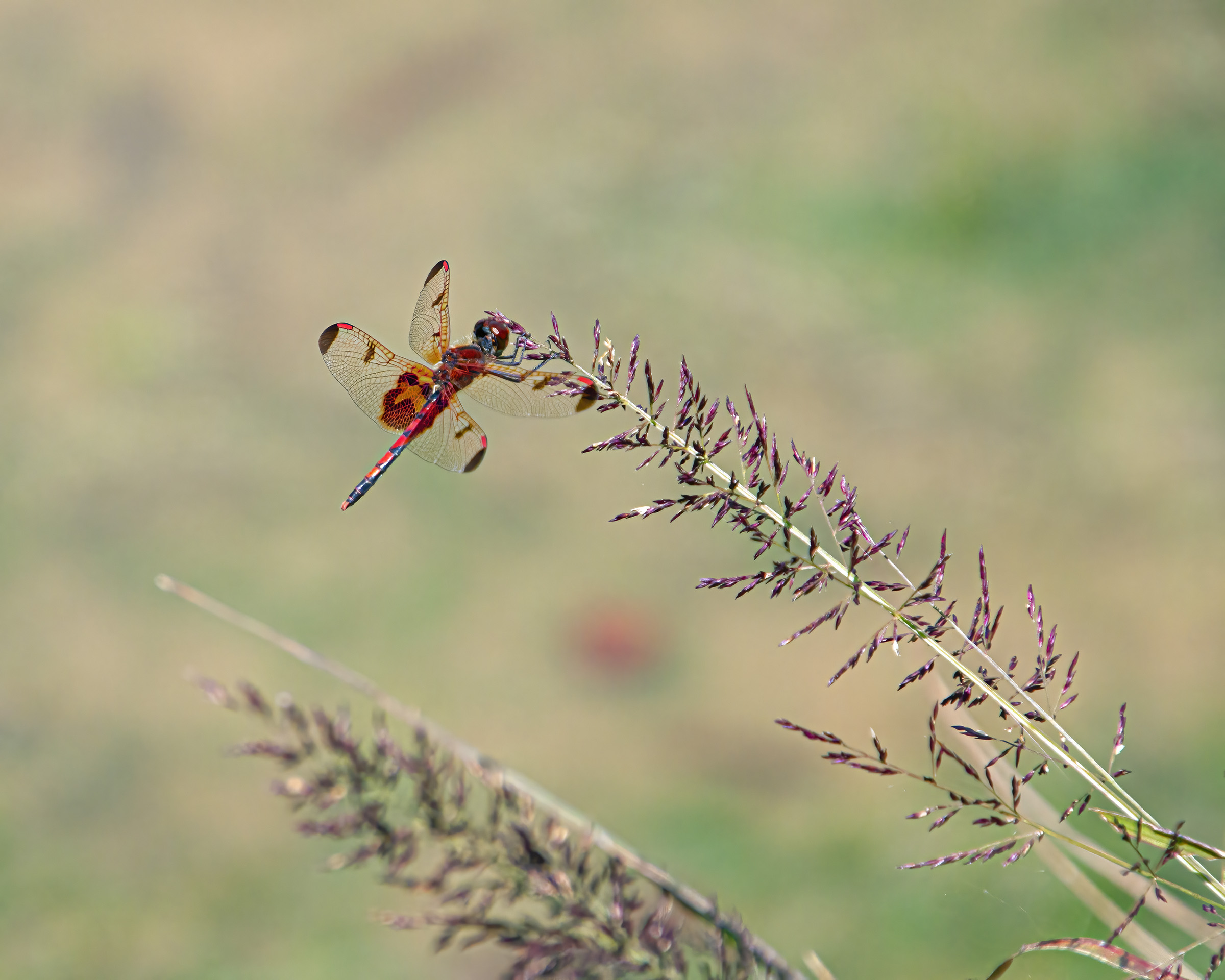
Although Eastern Pondhawks (Erythemis simplicicollis) are among the most common dragonflies in my area, I never fail to be startled by the brilliant emerald green color of the females and immature males. Their matching green faces and the striped pattern on their abdomen makes for a stylishly stunning look.

In many ways, however, I am even more drawn to the less flashy, two-toned look of the transitional males as shown in the second image. Males start out with the same look as the females, but eventually transition to become entirely blue, though they retain their green faces and eyes. I love the way the blue gradually fades into green during the intermediate phase of a male Eastern Pondhawk.

So what about you? Are you drawn more to the colors of the dragonfly in the first photo or the one in the second photo? If I am truthful in answering my own question, I’d have to say that my personal preference varies, depending on a number of factors including my mood and the weather.

Eastern Pondhawk

Eastern Pondhawk

© Michael Q. Powell. All rights reserved.


Read Full Post »
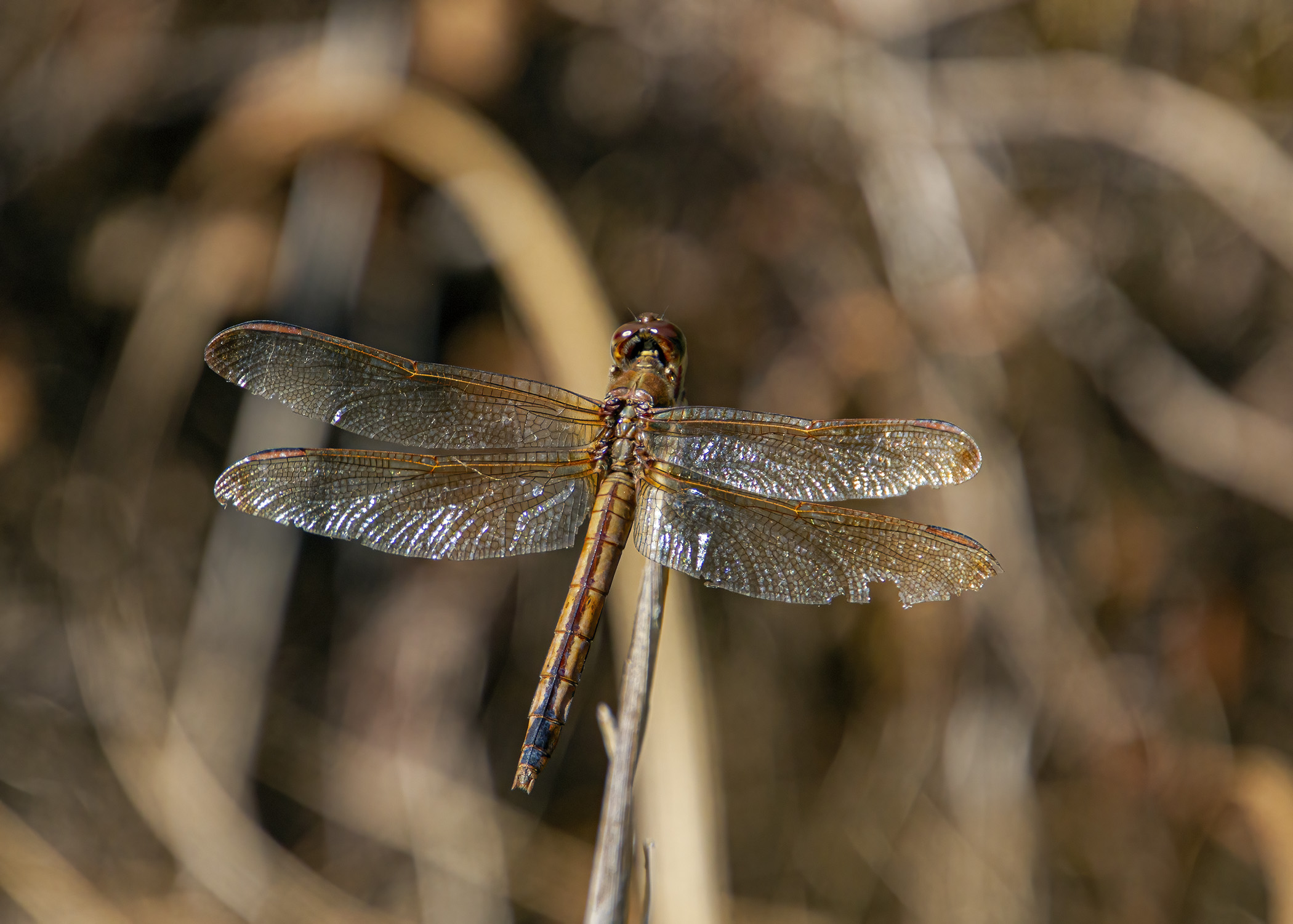
I am still on the lookout for summer dragonfly stragglers and survivors. There are certain dragonfly species that I expect to see during the autumn, but there are also a few particularly hard individuals from the summer species that are managing to hang on. Over the past week and a half I have spotted one Great Blue Skimmer (Libellula vibrans), one Eastern Pondhawk (Erythemis simplicicollis), and one Blue Dasher (Pachydiplax longipennis), as shown in the photos below.

It is interesting to note that all three of these dragonflies appear to be females. I wonder if female dragonflies tend to outlive their male counterparts, as is the case with humans.

I went looking for dragonflies today, after several frosty nights, and did not see a single dragonfly. The daytime temperature was only about 52 degrees (11 degrees C), which is a bit cold for dragonfly activity. Temperatures are forecast to rise to 68 degrees (20 degrees C) early next week and I anticipate that I will see a few dragonflies then.


Great Blue Skimmer

Eastern Pondhawk

Blue Dasher

© Michael Q. Powell. All rights reserved.

Read Full Post »
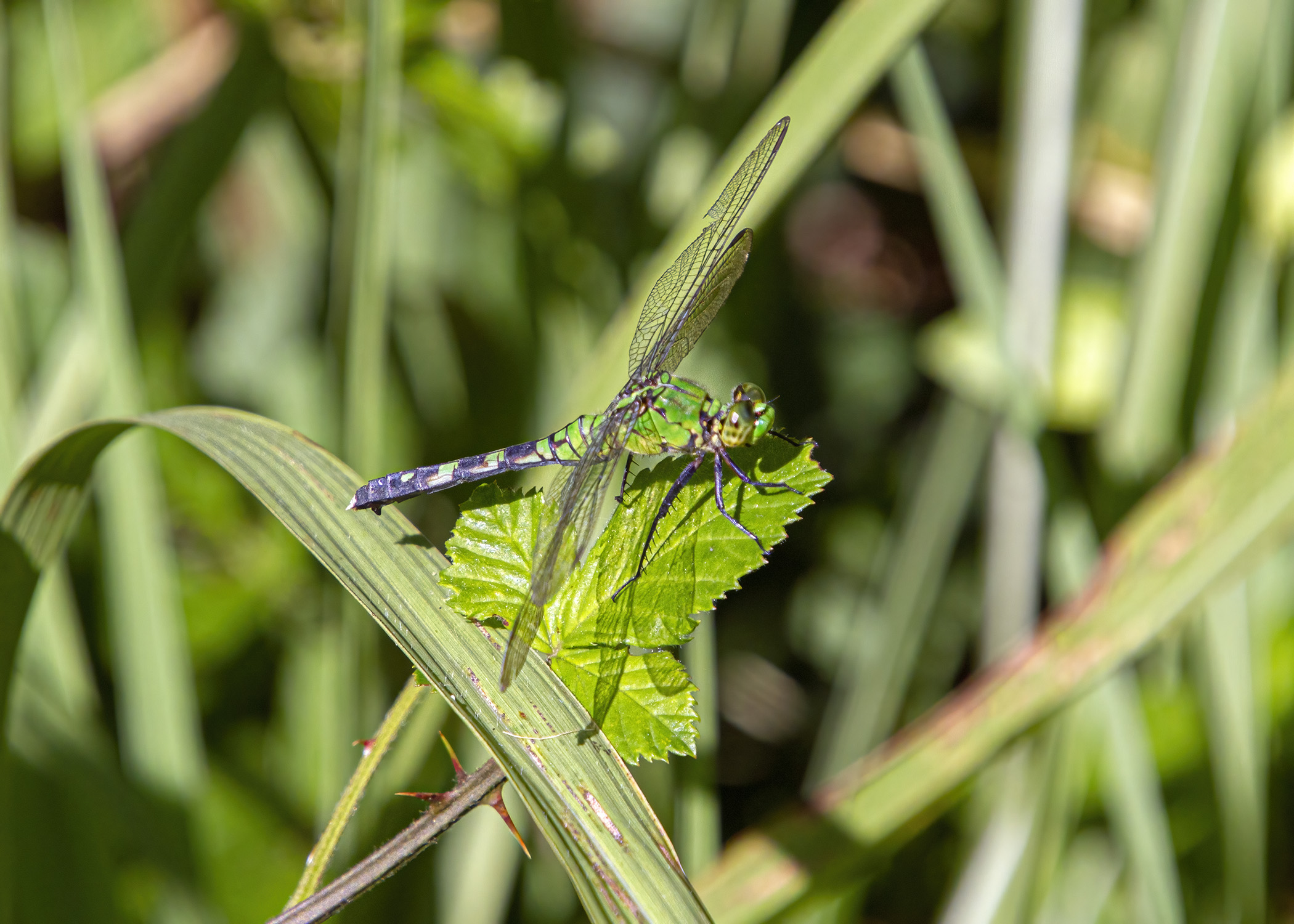
When the urge to take photos strikes me, I am undeterred by drizzle or intermittent light rain, though heavier rain and gusty winds tend to keep me at home. Of course, weather is unpredictable and I have gotten drenched in downpours a number of times. I carry an array of plastic bags and coverings to protect my gear, which is usually my number one priority.

Last Friday, it was raining off and on and I decided to visit Jackson Miles Abbott Wetland Refuge to see if any creatures were stirring. Not surprisingly, dragonflies were at the top of my list, though I doubted that any of them would be flying in the rain. I was therefore pleasantly surprised when I spotted this male Eastern Pondhawk dragonfly (Erythemis simplicicollis). I watched him land on a droplet-laden plant and managed to capture the first image below.

As I continued to walk around the small pond, I noticed a Black and Yellow Garden Orbweaver (Argiope aurantia) in its web, patiently waiting for a passing prey to be snagged. I thought the long brown object just below the spider might be a caterpillar or some other insect, but it turned out to be only a small twig.

There were a lot of flowers in bloom and my eyes were attracted to a cluster of small purple asters. The colors seemed really saturated and I liked the way that the droplets of water stood out on the petals.

So, I was able to capture a few photos to share, despite the rain. About the only thing that the images have in common is that they all include raindrops, which I believe add an additional element of interest to what otherwise might have been rather ordinary shots.

Eastern Pondhawk

Argiope aurantia spider

asters

© Michael Q. Powell. All rights reserved.

Read Full Post »
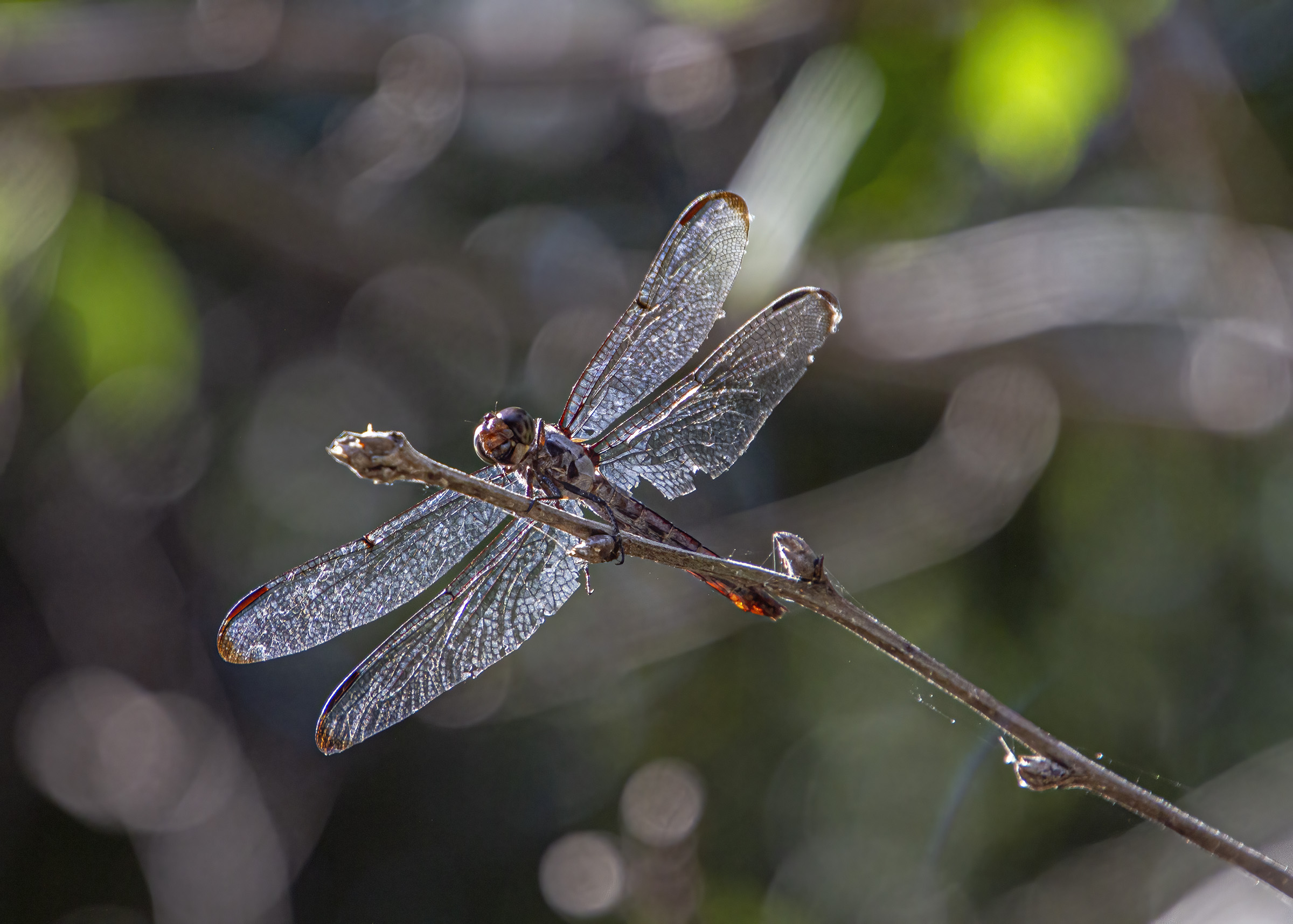
Dragonflies are really fierce predators and will eat almost any insect that they can catch. Some dragonfly species will consume mosquitoes or other small insects while in flight, while others will hunt larger larger insect prey and, if successful, will perch at ground-level in order to enjoy a more leisurely meal.

Although they are not all that big in size, Eastern Pondhawks (Erythemis simplicicollis) are the species that I most often encounter with a large victim, often another dragonfly or a damselfly. I spotted this female Eastern Pondhawk last Wednesday at Occoquan Bay National Wildlife Refuge as she was feasting on a hapless Big Bluet damselfly (Enallagma durum).

I apologize if the image is too gruesome for some viewers, but I have grown accustomed to the “circle of life” in nature and recognize that all creatures have to eat. As for today’s predator, the Eastern Pondhawk, she could easily become tomorrow’s prey and be captured by a bird or a larger dragonfly.

Eastern Pondhawk

© Michael Q. Powell. All rights reserved.

Read Full Post »

Although it can be exciting to photograph uncommon dragonflies, I equally enjoy capturing images of the species that I see quite regularly, like these female Eastern Pondhawks (Erythemis simplicicollis) that I spotted during several trips last week to Occoquan Bay National Wildlife Refuge. Both the males and females of this species have beautiful emerald green faces and I especially like the look of the females (and immature males) with their green thoraxes and distinctively striped abdomens.

Whenever I see female Eastern Pondhawks like these a snippet of a song from my youth comes to mind that spoke of “the greens of summers.” You have to be of a certain age to remember Simon and Garfunkel singing the Paul Simon song “Kodachrome” that had a memorable chorus—you also have to pretty old to have actually used Kodachrome slide film. (If you have not heard the song, I encourage you to click on this link to a YouTube video from The Concert in Central Park in September 1981.)

“Kodachrome
They give us those nice bright colors
They give us the greens of summers
Makes you think all the world’s a sunny day
I got a Nikon camera
I love to take a photograph
So Mama don’t take my Kodachrome away.”

Eastern Pondhawk

Eastern Pondhawk

Eastern Pondhawk

© Michael Q. Powell. All rights reserved.

Read Full Post »
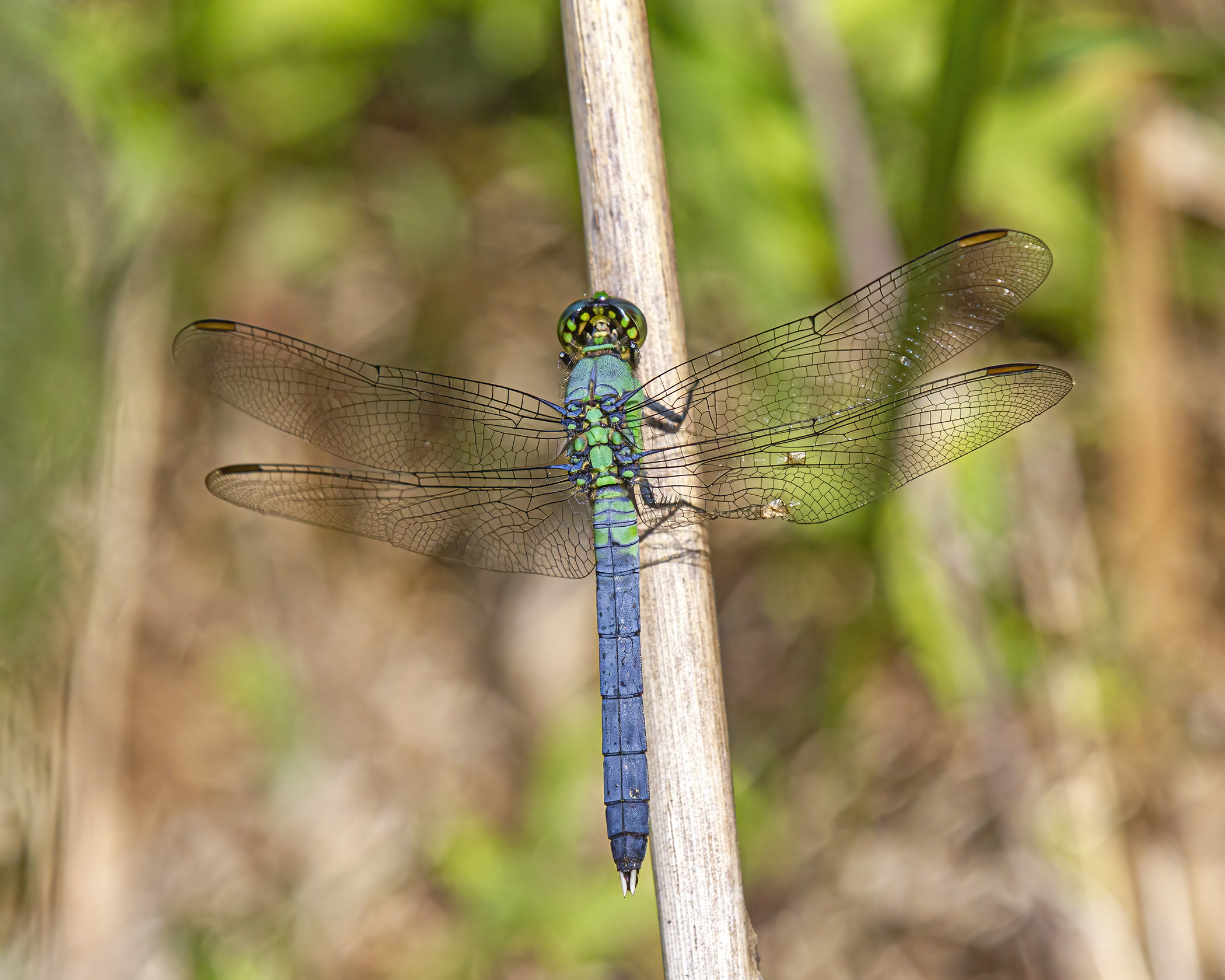
The ponds and marshes are alive with the sight of flying dragonflies. As the summer weather has grown increasingly hot and humid, the number of dragonflies has increased —we are probably nearing the peak of dragonfly activity.

One of the species that I encounter most frequently is the Eastern Pondhawk (Erythemis simplicicollis). When male Eastern Pondhawks are immature, they sport the emerald  coloration and striped abdomens of their female siblings, but as they get older they turn into a beautiful shade of blue that is a perfect complement to their bright green faces and bluish-green eyes.

I spotted these two adult male Eastern Pondhawks last Saturday during a visit to Occoquan Regional Park. Unlike some species that always perch in the same way, Eastern Pondhawks will perch in a variety of different ways almost anywhere. I selected these two photos today because I like the way that they show off the coloration of these handsome dragonflies.

Eastern Pondhawk


Eastern Pondhawk

© Michael Q. Powell. All rights reserved.


Read Full Post »

I love the cool tones of this image of a male Eastern Pondhawk dragonfly (Erythemis simplicicollis) that I photographed last week at Occoquan Regional Park—the green of the vegetation seemed a perfect complement to the colors of this handsome dragonfly. In most dragonfly species the male stands out more than the female, but with the Eastern Pondhawk, it is the female who is more often in the spotlight with her emerald green thorax and the black striped abdomen, as some of you may recall from my posting last week entitled First Eastern Pondhawk of 2021.

A male Eastern Pondhawk starts out with the same bright green coloration as the female, but over the course of his adult life the green is gradually transformed into a duller shade of blue and finally a powdery bluish-grey. A number of other dragonflies have a similar shade of blue on their bodies, but it is fairly easy to identify male Eastern Pondhawks because they, like the females, have bright green faces and their terminal appendages at the tip of their abdomens (the “tail”) are white in color.

Eastern Pondhawk

© Michael Q. Powell. All rights reserved.

Read Full Post »

One corner of the pond at Ben Brenman Park was covered with so much duckweed on Sunday that it look almost solid, like a floating carpet of green lentils. As I was scanning the surface of the water for frogs, which sometimes hang out in duckweed, I spotted a  dragonfly buzzing low over the water. When it finally landed, I captured this image of what turned out to be a male Eastern Pondhawk dragonfly (Erythemis simplicicollis).

This image really appeals to me for artistic reasons. I like the different colored branches that cut across the frame; I like the texture provided by the duckweed in the background; and I like the color and the angled pose of the dragonfly, and its wonderful shadow as an added bonus.

I am drawn in by the image’s simple composition, as is frequently the case with my favorite photographs. Photography, I’ve found, is often most effective when it is reduced to its most basic elements, as I tried to do in this image of a dragonfly and duckweed.

Eastern Pondhawk

© Michael Q. Powell. All rights reserved.

Read Full Post »

Dragonflies are carnivorous—they feed on other live insects. Most of their diet consists of gnats, mosquitoes, and other small insects, but they also prey upon bees, butterflies, damselflies, and even on other dragonflies.

When I first spotted this male Eastern Pondhawk dragonfly (Erythemis simplicicollis) on Saturday at Jackson Miles Abbott Wetland Refuge, it had just perched on a stalk of vegetation. As I moved a little closer, the dragonfly changed its position, looking almost like it was trying to hide behind the stalk. What I did not realize at the time was that the dragonfly had just snagged a damselfly and was preparing to eat his lunch. Obviously he did not want to share it with me.

Almost all of the times that I have seen dragonflies with prey, they been Eastern Pondhawks, which seem to be particularly fierce predators. Some dragonflies eat their prey in mid-air and I never see them do so. It may also be the case that some other dragonflies fly up into the trees and consume their prey out of sight, while the Eastern Pondhawk is content to eat in public.

It is often difficult to judge the relative size of dragonflies and damselflies. This images lets you see how much smaller and thinner damselflies are than dragonflies. An Eastern Pondhawk is about 1.7 inches (43 mm) in length and the unidentified damselfly looks to a bit over an inch (25 mm) in length.

Eastern Pondhawk

© Michael Q. Powell. All rights reserved.

Read Full Post »

We are in a period of transition. All around I see the signs of autumn, but summer has not completely loosed its grasp. Last week I spotted this female Eastern Pondhawk dragonfly (Erythemis simplicicollis) at Occoquan Bay National Wildlife Refuge. Eastern Pondhawks are among our most common dragonflies—they are still with us, but their numbers are clearly dwindling.

In this image I really like the juxtaposition of the dragonfly’s bright summer coloration with the more muted autumn colors of the fallen leaves, a visual representation of this time of transition.

Eastern Pondhawk

© Michael Q. Powell. All rights reserved.

Read Full Post »

Dragonflies are remarkably uncooperative—I can rarely get them to perch in places where the light is good and the background is photogenic.  I love photographing butterflies in patches of colorful flowers, for example, and have often thought that it would be cool to shoot a dragonfly in a similar environment. Alas, dragonflies don’t seem to be attracted by nectar and pollen. I have repeatedly been frustrated by dragonflies that zoom past flowers and refuse to stop.

This past Wednesday, though, an emerald green female Eastern Pondhawk dragonfly (Erythemis simplicicollis) that I had been chasing surprisingly set herself down in a patch of bright yellow flowers. Moving as stealthily as I could with a racing heart, I managed to get close enough to the dragonfly to capture this image before she flew away.

When I am walking about with my camera, I try to be ready for the unexpected and on this occasion my persistence and quick reaction paid off.

Eastern Pondhawk

© Michael Q. Powell. All rights reserved.

Read Full Post »

Eastern Pondhawk dragonflies (Erythemis simplicicollis) are voracious predators and I spotted this female pondhawk munching on another insect this past Tuesday at Occoquan Bay National Wildlife Refuge. At this time of the year the vegetation has grown high in many of the locations that I visit and I am now seeing more dragonflies perching at eye level or even higher. This heightened perspective allows me to get some cool, uncluttered backgrounds, like the one in this image that reminds me of a watercolor painting.

Eastern Pondhawk

© Michael Q. Powell. All rights reserved.

Read Full Post »

Normally a dragonfly’s abdomen is straight. Occasionally, though, I encounter one with an abdomen that has a noticeable curve, like this male Eastern Pondhawk dragonfly (Erythemis simplicicollis) that I spotted yesterday at Jackson Miles Abbott Wetland Refuge. (For those of you not familiar with dragonfly anatomy, the upper portion of the body is the thorax and the lower two-thirds is the abdomen.)

I suspect that the curvature was the result of a problem that occurred when the dragonfly was first emerging. It does not seem to have any effect on his ability to fly or to catch prey, but it might pose a problem when he attempts to mate.

Eastern Pondhawk

© Michael Q. Powell. All rights reserved.

Read Full Post »

Frequent viewers of this blog have probably noticed that I am doing a little series of postings featuring common dragonflies that at first glance might look similar. Today’s “star” is a mature male Eastern Pondhawk (Erythemis simplicicollis). Like several other dragonflies in recent postings, the Eastern Pondhawk has a primarily blue body, but several characteristics make it possible to distinguish this species from others.

Both the male and female Eastern Pondhawks have green faces and the male has distinctive white terminal appendages, i.e. those little protrusions at the end of the abdomen (the “tail). Dragonfly specialists spend a lot of time focusing on those appendages, because immature males often have the same coloration as females. In this case, an immature male Eastern Pondhawk would be green with black bands on the abdomen. For the sake of comparison, I am including a photo I took on the same day of a female Eastern Pondhawk. If you compare the tips of the “tails” of the male and the female, you should be able to see the anatomical differences between the genders.

Although it doesn’t help in identifying them, I can’t help but note that Eastern Pondhawks are voracious predators. I think that I have captured more photos of Eastern Pondhawks feeding on other insects that of any other species. When I captured this image last week, I had no idea that the dragonfly was devouring a damselfly. If you click on the image to enlarge it and look just to the left of the dragonfly’s head, you will notice a set of small wings. As you look more closely, you can see the damselfly’s body hanging vertically just below the dragonfly’s head. Yikes!

Eastern Pondhawk

Eastern Ponndhawk


© Michael Q. Powell. All rights reserved.

Read Full Post »

Although we are well into October, some of my beloved dragonflies are still hanging on at Occoquan Bay National Wildlife Refuge. Here are some dragonfly shots from the past 10 days of (1) a male Blue-faced Meadowhawk (Sympetrum ambiguum); (2) a female Eastern Pondhawk (Erythemis simplicicollis) with a hoverfly in her mouth; and (3) a female Autumn Meadowhawk (Sympetrum vicinum).

I hadn’t really noticed before I aggregated this shots that all three of the dragonflies were perching on leaves. During the summer months, a significant number of the dragonflies that I photograph are perched higher on stalks of vegetation or on branches. In addition to these smaller dragonflies,

I have also recently spotted Common Green Darners, Wandering Gliders, and Black Saddlebags patrolling over the fields. Unfortunately, none of them paused long enough for me to get shots of them. All three of those species are migratory species and they may have been fueling up for a long journey ahead.

Blue-faced Meadowhawk

Eastern Pondhawk

Autumn Meadowhawk

© Michael Q. Powell. All rights reserved.

Read Full Post »

Have you ever gotten into a staring contest with a dragonfly? Dragonfly eyes can have an almost hypnotic effect on you when you look directly into them..

I went eye-to-eye with this Eastern Pondhawk dragonfly (Erythemis simplicicollis) on Monday at Occoquan Bay National Wildlife Refuge. She was the one to break eye contact first as she cocked her head, smiled at me, and decided the contest was over.

Eastern Pondhawk

Eastern Pondhawk

© Michael Q. Powell. All rights reserved

Read Full Post »

This image is a little gruesome, but here is a close-up look at an Eastern Pondhawk dragonfly (Erythemis simplicicollis) as it consumed a damselfly that it had captured this past Monday at Occoquan Bay National Wildlife Refuge in Northern Virginia. The second image shows a different Eastern Pondhawk with a different damselfly—the pondhawks seemed to have a particularly voracious appetite that day.

Eastern Pondhawk

Eastern Pondhawk

© Michael Q. Powell. All rights reserved.


Read Full Post »

I was simultaneously fascinated and horrified yesterday at Occoquan Bay National Wildlife Refuge as I watched this Eastern Pondhawk dragonfly (Erythemis simplicicollis) gnaw on the head of a colorful Calico Pennant dragonfly (Celithemis elisa) that it had captured. I know that dragonflies eat other insects, but in my mind I tend to think of them consuming mosquitoes and other such smaller insects. Some of them, however, apparently prefer larger prey, including other dragonflies.

Eastern Pondhawk versus Calico Pennant

© Michael Q. Powell. All rights reserved.

Read Full Post »

I couldn’t help but notice Friday at Occoquan Bay National Wildlife Refuge how closely the green on the body of this Eastern Pondhawk dragonfly (Erythemis simplicicollis) matched the color of the vegetation on which it chose to perch. It won’t be long before pondhawks are all around us, but it was still nice to spot my first one of the season.

Eastern Pondhawk

© Michael Q. Powell. All rights reserved.

Read Full Post »

Older Posts »