Feeds:
Posts
Comments

Posts Tagged ‘Canon 70-300mm telephoto zoom lens’

This past weekend I traveled with some friends to photograph a large grove of ginkgo trees at the Blandy Experimental Farm of the State Arboretum of Virginia in Boyce, VA. It was a beautiful day, with bright blue skies, and I took some shots that I will probably include in a more extended post, but I wanted to give you a sneak preview of the really-cooling looking leaves of the ginkgo (Ginkgo biloba) tree, a tree that dates back at least 270 million years, judging from ginkgo leaf fossils that have been uncovered.

GInkgo Vertical blog

© Michael Q. Powell. All rights reserved.

Read Full Post »

“How many legs does a horse have if you call the tail a leg? Four. Calling a tail a leg doesn’t make it a leg.”

My apologizes to Abraham Lincoln for changing the animal from a dog to a horse in a famous quote attributed to him, but that was what came to mind when I first brought up this image of a horse that appeared to have five legs. The tail is so long that it just about touches the ground and it seems to be almost as rigid as the legs.

Of course, as some of you know, I am a product of the suburbs, so I am happy that I can identify this animal as a horse. Earlier in the day I saw two bulls with horns, but when I took a closer look, one of them seemed to have udders. When we stopped to photograph a farmhouse on the drive home, I could identify sheep and cattle, then suddenly a group of emus came running onto the scene accompanied by a llama (or maybe it was an alpaca).

Is it any wonder I find identifying domestic animals confusing?

Five Legged Horse blog

© Michael Q. Powell. All rights reserved.

Read Full Post »

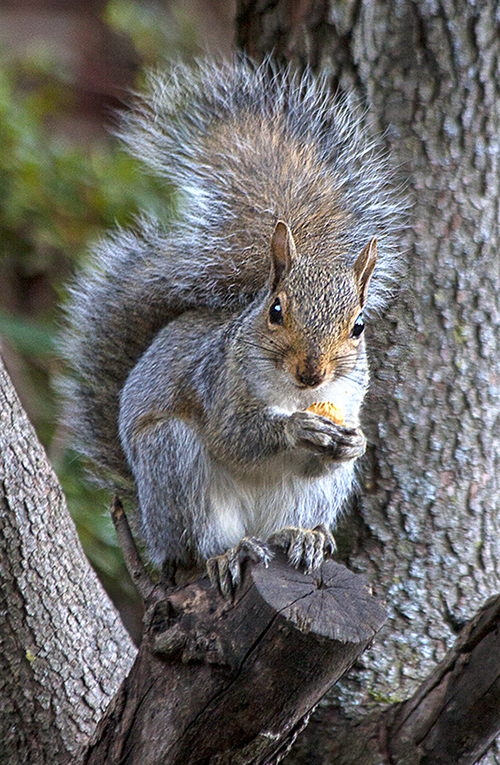
The squirrels in my neighborhood are very busy now as they scurry about getting ready for winter. This particular Eastern Gray Squirrel (Sciurus carolinensis) paused several times to enjoy a leisurely snack. Rather than devour the treat on the ground, he would leap up onto this posing stand and delicately nibble away. He almost seemed to be aware that I was photographing him and periodically would change his pose to give me a different look.

I guess that I lucked into photographing a squirrel with modeling experience (and great hair).

Squirrel Nut blogSquirrel Nut 2 blog

© Michael Q. Powell. All rights reserved.

Read Full Post »

Despite the frost that we’ve had the last few mornings, the gorgeous Morning Glory flowers of my neighbors continue to flourish. I photographed one of the flowers yesterday afternoon—does that make it an afternoon glory?

When you look at the photo it looks like I used flash, which caused the background to go black. However, if you look carefully at the way the light falls, with some of it coming from the back, you realize I would have had to use an elaborate multi-light setup to get this kind of lighting. I took this shot in the early afternoon, with the light mostly coming from the side and back of the flower.

My fellow photographer and blogger CIndy Dyer says that the shadow in the bottom area of the white part of the flower looks like a photographer (possibly with a bald head) with a camera and long telephoto lens and she initially thought I had somehow managed to get a reflection of myself onto the flower. We may have spent too many hours yesterday out in the sun with our cameras!

Glory Photographer blog

© Michael Q. Powell. All rights reserved.

Read Full Post »

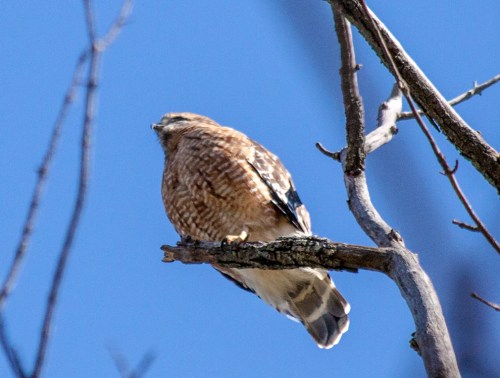
Yesterday as I was walking on Roosevelt Island, a National Park in the Potomac River,  I heard a hawk screaming loudly and realized it was pretty close to where it was.

I walked slowly and quietly toward the source of the sound and spotted this hawk almost directly above me in the trees. There were a lot of branches in the way and I had to search to find a visual tunnel to try to get an unobstructed shot of the hawk. The angle was a steep one and gave me a view of the underside of a hawk that I had never had before. In fact, I think that you can see the roof of his open mouth in the first shot.

hawk_screaming1_blog

The hawk stopped screaming for a little while and I got a shot of him with his mouth closed. It may just be the distortion caused by the steep view angle, but it seems to me that he has an awfully small beak.
hawk_screaming2_blog

I am having a little trouble identifying this hawk. At first I thought it might be a Red-Shouldered Hawk, but now I am not certain, because it doesn’t quite match any of the photos that I see on-line.  I’d appreciate any help from more experienced bird watchers in figuring out which species I photographed.

After a too short period on this branch, the bird flew off this perch and disappeared from view. I’ll be keeping my eyes out for hawks and hopefully it will be easier to spot them when the leaves fall off of the trees.

© Michael Q. Powell. All rights reserved.

Read Full Post »

Migrating birds are starting to arrive in my area, including a few Ring-necked ducks (Aythya collaris) that I observed last week in a man-made pond in a nearby suburban housing area. The water in my local marsh tends to be too shallow for these diving ducks, but this pond seems to suit them pretty well.

The ducks tend to stay near the center of the pond, which makes them a little challenging to photograph. These shots were taken from a distance, but they let you see some of the beautiful details of the male Ring-necked duck, including the pattern on his bill and his beautiful golden eyes.

If I have the good luck that I had last year, I look forward to seeing and photographing another half-dozen species of ducks in the coming months.

ring-necked_duck2_blog

ring-necked_duck1_blog

© Michael Q. Powell. All rights reserved.

Read Full Post »

Although I have been seeing a lot of cardinals recently, most of them seem very skittish and fly off as I approach. This Northern Cardinal (Cardinalis cardinalis) flew away a short distance and observed me from a tree where he was almost surrounded by the foliage.

With that bright red coloration, though, it’s a little hard to conceal yourself entirely.

cardinal_foliage_blog

© Michael Q. Powell. All rights reserved.

Read Full Post »
Have you ever watched a coot swim? When I first spotted this American Coot (Fulica americana) earlier this week at my local marsh, I thought it might be a duck. Once it started swimming, I could tell immediately that it was a coot.

Coots have a really clumsy way of swimming. They thrust their necks forward and then back, as if to generate momentum to propel themselves forward. The two photos show two different positions that the coot assumes while swimming. The Cornell Lab of Ornithology that coots, unlike ducks, don’t have webbed feet, but instead each one of the coot’s long toes has broad lobes of skin that help it kick through the water. In fact, they are closer relatives to Sandhill Cranes than to Mallards.

This coot was by itself and may be migrating through this area or may become a resident here for the winter. I was happy that I saw the coot in a relatively open area of the marsh. A short time later, the coot swam into the cattails and disappeared from sight.

Given the popular use of the term “coot,” I wonder if I am old enough to qualify as an American coot too.

coot_swimming2_blogcoot_swimming1_blog

© Michael Q. Powell. All rights reserved.

Read Full Post »

When I first saw this bird, I knew that it was a sparrow, but couldn’t identify it. I was baffled when I went to my Peterson Field Guide to Birds of North America, because I couldn’t find the sparrow. I went back and forth through the 14 pages covering sparrows, examining carefully the text and illustrations, but none of the species looked like this bird.

I was beginning to doubt my identification skills, so I kept looking through the field guide, desperately hoping to find the bird. On the very last page of the section of the guide with information on bird species, just before all of the range maps, I stumbled across a small section called Old World Sparrows and found the bird—it’s a House Sparrow (Passer domesticus).

Apparently Old World sparrows are non-native (as their name suggests) and are of a different family from all of the other sparrows that I have observed. The Cornell Lab of Ornithology website indicates that House Sparrows were introduced from Europe in 1851 and that they are common in places with houses, because the birds seem to prefer to nest in manmade structures, like the eaves of buildings, more than natural nesting sites. I took these photos at a little manmade lake that is partially surrounded by houses, rather than at the marsh where I do a lot of my shooting, which may explain why I have never noticed this type of sparrow before.

little_bird1_blog

© Michael Q. Powell. All rights reserved.

Read Full Post »

Perched on the end of a railing at the marsh, this sparrow seems lost in thought as it surveys the surrounding area.

Most of the time I try to get as close to my subject as possible, either with a telephoto or macro lens, but in this case I liked this image the moment that I pulled it up on my computer screen. I struggled to find words to explain why I like this particular shot, but the lines, the colors, and lighting somehow combined in a way that I find interesting and pleasing.

sparrow_light_blog

© Michael Q. Powell. All rights reserved.

Read Full Post »

Deep in the cattails, this Northern Water snake (Nerodia sipedon) seemed to have taken refuge from the rising waters of the marsh after several days of heavy rainfall. The snake’s body looked a little thicker around the middle, causing me to wonder if it had eaten recently and was in the kind of food coma that I experience after a really big meal.

snake_bush_blog

© Michael Q. Powell. All rights reserved.

Read Full Post »

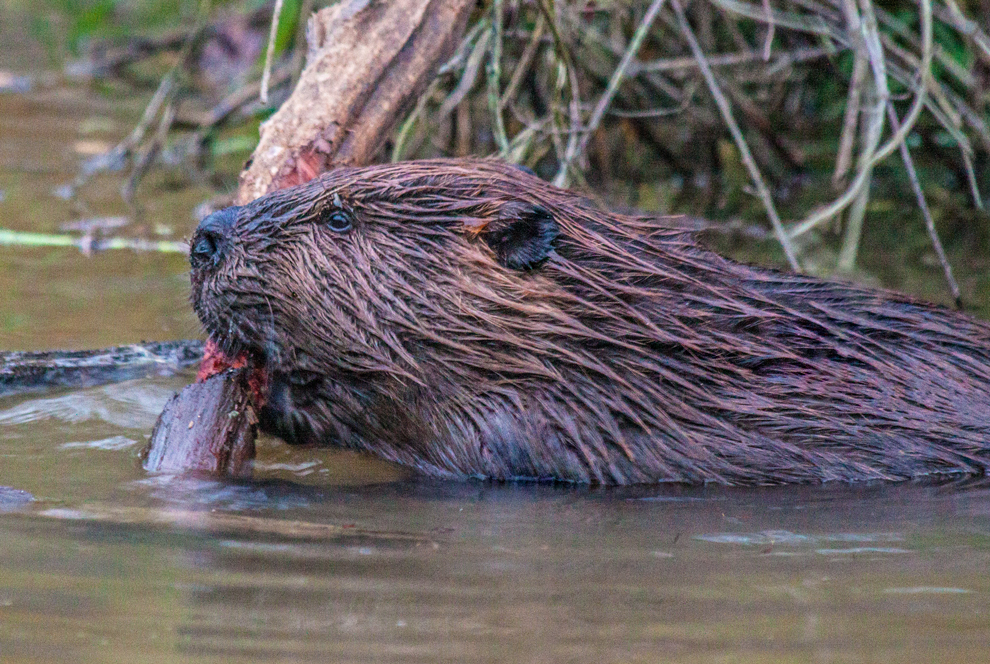
Whenever I am at my local marsh near sundown, I like to hang around near the beaver lodge to see if I can spot the beavers. Often I can hear them gnawing on branches, but rarely do I get an unobstructed view of one of them.

This past weekend, though, I managed to be at the right spot at the right time and got this shot of a North American Beaver (Castor canadensis). It seemed smaller than the other one I saw that evening, so I wonder if this is a young one.

The light was fading as I took these shots and I had to push my ISO past 1000. Even so, the shutter speed was below 1/30 second, so I was happy that my camera was already on my tripod. I was kneeling on the boardwalk as I took these shots and was afraid that other people would approach and scare the beaver away. I was really happy when an approaching family with several small children saw what I was doing and sat down on the boardwalk and quietly watched the beaver in action.

beaver_chewing2_blogbeaver_chewing1_blog

© Michael Q. Powell. All rights reserved.

Read Full Post »

As I walked along the boardwalk yesterday at Huntley Meadows Park, fellow photographer Christy Turner pointed out this Southern Leopard frog (Lithobates sphenocephalus) in the bushes and I managed to get a shot of the cool-looking frog.

These frogs are pretty common and I think I hear them often, but I hadn’t seen one in months. We have had a lot of rain this past week and this frog may have decided to chill out in the underbrush rather than remain in the now deep water in this part of the marsh. It was an interesting challenge to try to find an uncluttered visual pathway to get this shot—I crouched and leaned as I focused on the frog, conscious of the fact that I could end up in the bushes with the frog if I were not careful.

Things turned out pretty well, and I avoided falling in the water at that moment, though my feet got soaked later in the afternoon when I ventured too close to a flooded-out section of the boardwalk.

frog_leopard1_blog

© Michael Q. Powell. All rights reserved

Read Full Post »
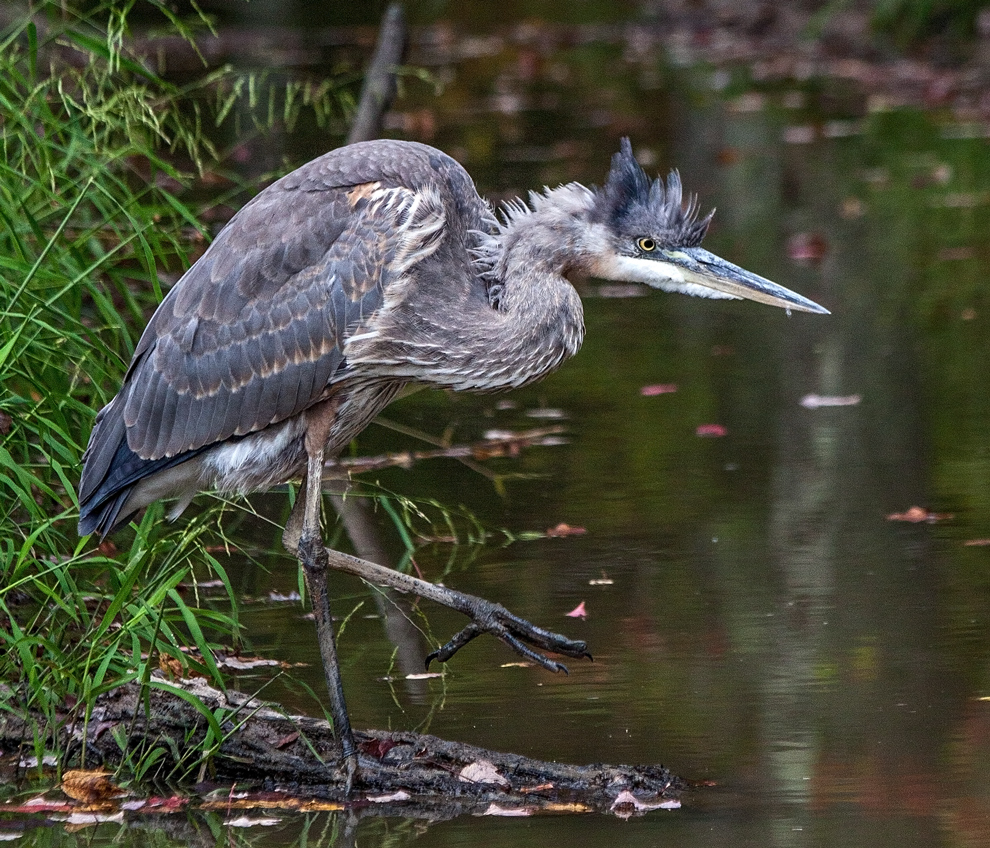
A blue heron with attitude? The pose, facial expression, and hair style of this Great Blue Heron (Ardea herodias) at Huntley Meadows Park, my local marsh, remind me of a punk rocker. Do you think he has tattoos and body piercings too?

heron_punkrocker_blog

© Michael Q. Powell. All rights reserved

Read Full Post »
This week we are caught in a weather system with constant gray skies and rain, so I need a splash of color to lift my spirits, like this immature male Common Yellowthroat (Geothlypis trichas) that was hiding in the lower levels of the cattails last week.

The little yellow bird was in almost constant motion and was often obscured by the stems of the underbrush, but I did manage to get a few relatively unobstructed shots when the bird poked its head into an open area. As is often the case, I also managed to get a shot as the bird flew away. Normally that means that the bird is partially out of the frame, but this time the bird flew almost straight down and I got a fun little final image.

yellow_brush_blogyellow_brush2_blogyellow_brush3_blog

© Michael Q. Powell. All rights reserved

Read Full Post »

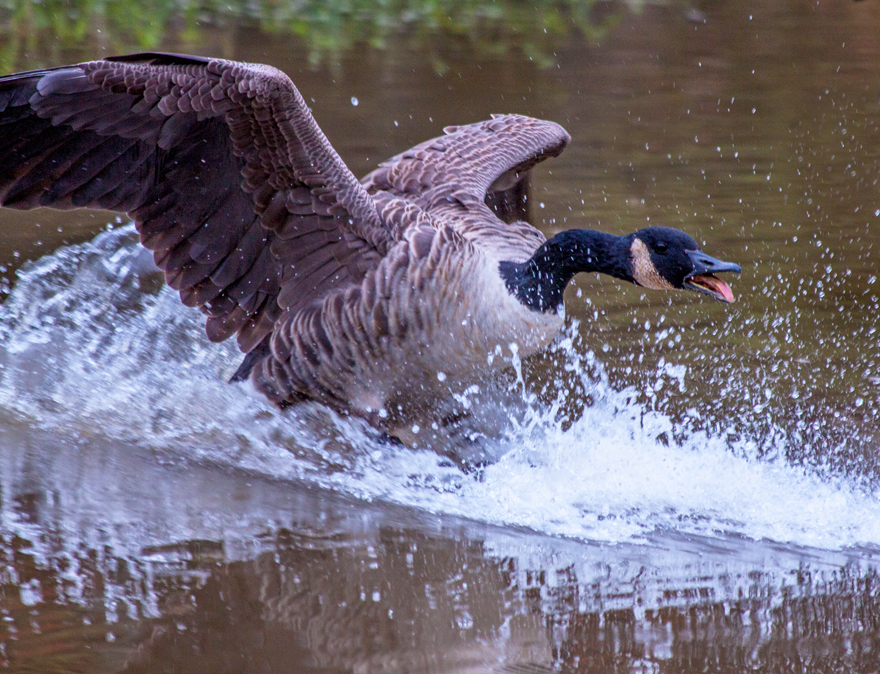
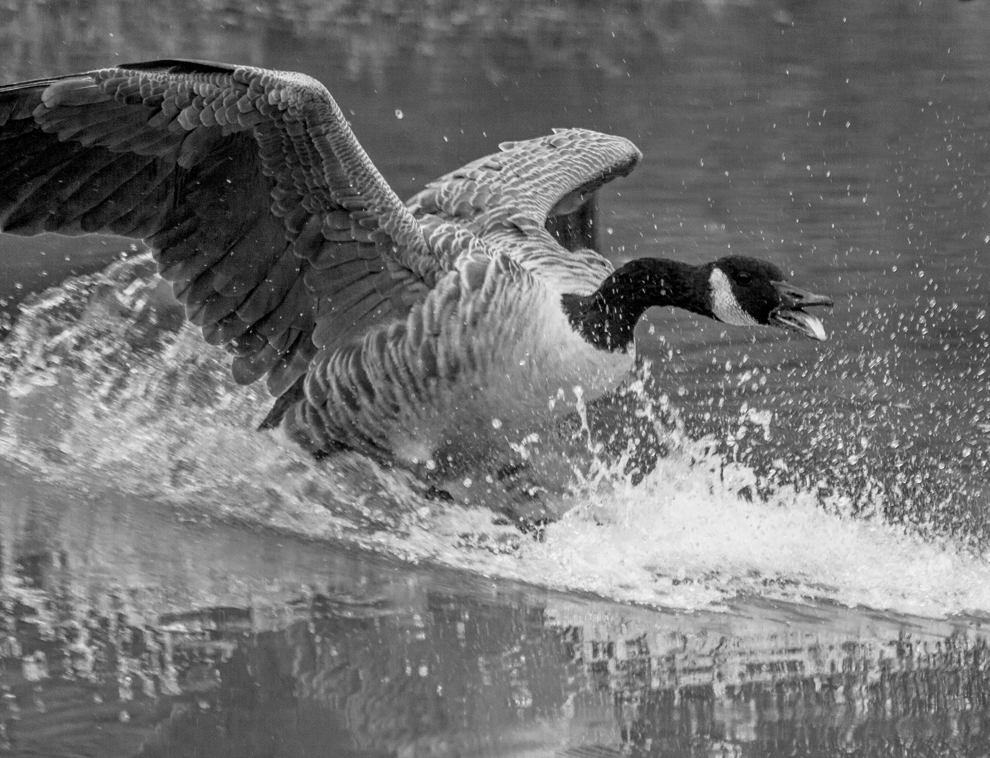
One of the first waves of migrating Canada geese (Branta canadensis) loudly announced its arrival and landed right in front of me in the beaver pond of my local marsh yesterday.

Last year we seemed to have geese arriving and departing so frequently that I felt like I was at a major geese transit airport. I kept expecting to hear departure announcements on a loudspeaker.

Several areas of the marsh had dried up in the last few months, because of a lack of rain, and I had been fearful that the migrating birds would not stop over. The rain storms this week have partially filled those areas, so my concerns have been partially assuaged.

When I looked at this photo, it seemed like it was mostly black and white already (except for the pink tongue), so I played around a little and converted it to black-and-white. For me, the second version really draws my eye to the texture of the feathers, but I can’t decide whether I like it more than the color version.

What do you think about the black-and-white version?

goose_arrrival1_bloggoose_arrrival1a_blog

© Michael Q. Powell. All rights reserved

Read Full Post »
I watched the sun go down yesterday evening at my local marsh and was initially disappointed as the sun dropped lower and lower on the horizon without any real displays of color. Eventually, though, my patience was rewarded, when for a few minutes  the sky turned a beautiful shade of red.

sunset_sky_blog

© Michael Q. Powell. All rights reserved

Read Full Post »

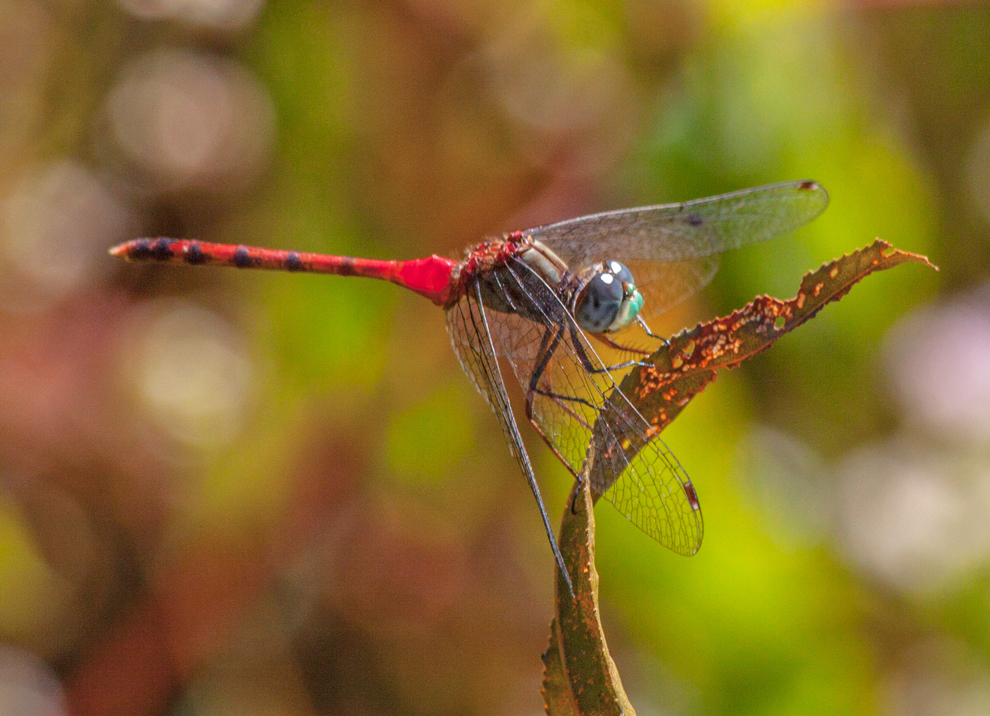
I don’t expect to see new species of dragonflies at this time of the year, but one of my fellow photographers, Walter Sanford, has been stalking the Blue-faced Meadowhawk (Sympetrum ambiguum) almost daily and I joined him for a few hours one late September day and got this shot.

I learned quickly that these dragonflies are hard to spot, despite their conspicuous coloration. They seem to like to remain perched down low in the vegetation and wait for their prey, rather than fly around when they are hunting.

I love the combination of colors on the Blue-faced Meadowhawk and I was happy to get a decent shot that shows its blue face. If you want to see more shots of this beautiful dragonfly, check out Walter’s blog posting from yesterday.

I am now in search of the Autumn Meadowhawk, the last dragonfly that I observed last fall. Normally they should be here already, but none of my fellow dragonfly followers has observed any of them yeat.

blue-faced1_blog

© Michael Q. Powell. All rights reserved

Read Full Post »

In the shallow water of the marsh, this Northern Water snake (Nerodia sipedon) patiently waits for its unwary prey, probably a frog. At one point its body began to vibrate violently and I thought it was getting ready to strike, but it turned out to be a false alarm. In the end, the snake turned out to be more patient than I was and I left without observing the snake capture its next meal.

snake_water_blog

Click on the photo to see a higher resolution view of the snake.

© Michael Q. Powell. All rights reserved


Read Full Post »
In the faint light and fog of the pre-dawn hour, I watched the shadowy forms of a small group of deer move slowly across an open area at my local marsh, heading for the treeline. My attempts to photograph them while they were moving were not successful. Once they reached the edge of the trees, however, this male White-tailed deer (Odocoileus virginianus) stopped for a moment and looked back at me. A moment later, he was gone.

deer3_blog

© Michael Q. Powell. All rights reserved

Read Full Post »

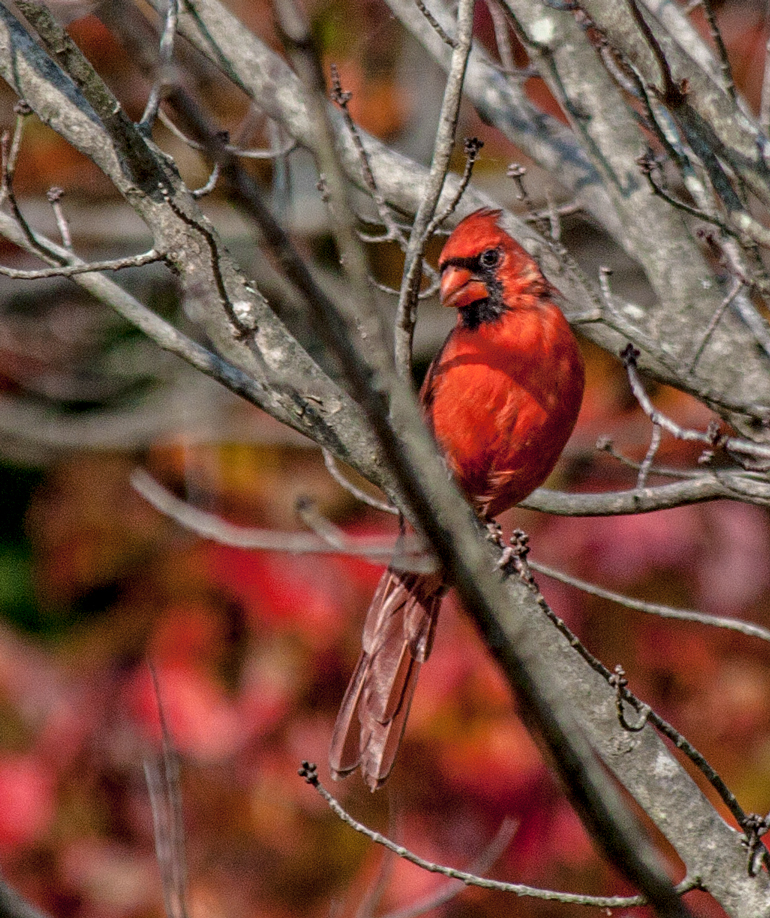
I love to photograph cardinals throughout the year, but I was really excited when I saw this male Northern Cardinal (Cardinalis cardinalis) land on a tree with colorful fall foliage in the background. There were a lot of branches, but I somehow managed to get a facial shot with an interesting expression.

The cardinal seemed to be staring at me, silently criticizing my behavior. It reminded me of the expression that parents sometimes adopt when they want to publicly communicate their displeasure to their offspring without uttering a single word.

cardinal_autumn_blog

© Michael Q. Powell. All rights reserved

Read Full Post »
I featured this Slender Spreadwing damselfly (Lestes rectangularis) in an earlier posting in a series of action shots, but thought this more formal portrait deserved a posting of its own.

As I stalked this beautiful little dragonfly, it moved to a number of different perches and it is interesting to see how the background shifted in terms of color palette and clutteredness (I think I may have just created a new word). In the gymnastics shots of this damselfly, the background was bright and colorful and a little busy, whereas the background here is darker and a bit more moody, with just a hint of colors. Be sure to click on the image to see a higher resolution view of this little damselfly that was probably less than 2 inches ( 50 mm) long.

Those of you who like to observe damselflies know that this species is an exception to the general rule that damselflies, unlike dragonflies, hold their wing close into and parallel to their bodies when at rest. My fellow photographer and blogger, Walter Sanford, an expert on dragonflies, was the one who first spotted this damselfly and you should check out his blog for lots of wonderful wildlife photos, including a recent image of a perched Wandering Glider dragonfly, a species that never seems to land.damsel_spread_blog

© Michael Q. Powell. All rights reserved

Read Full Post »
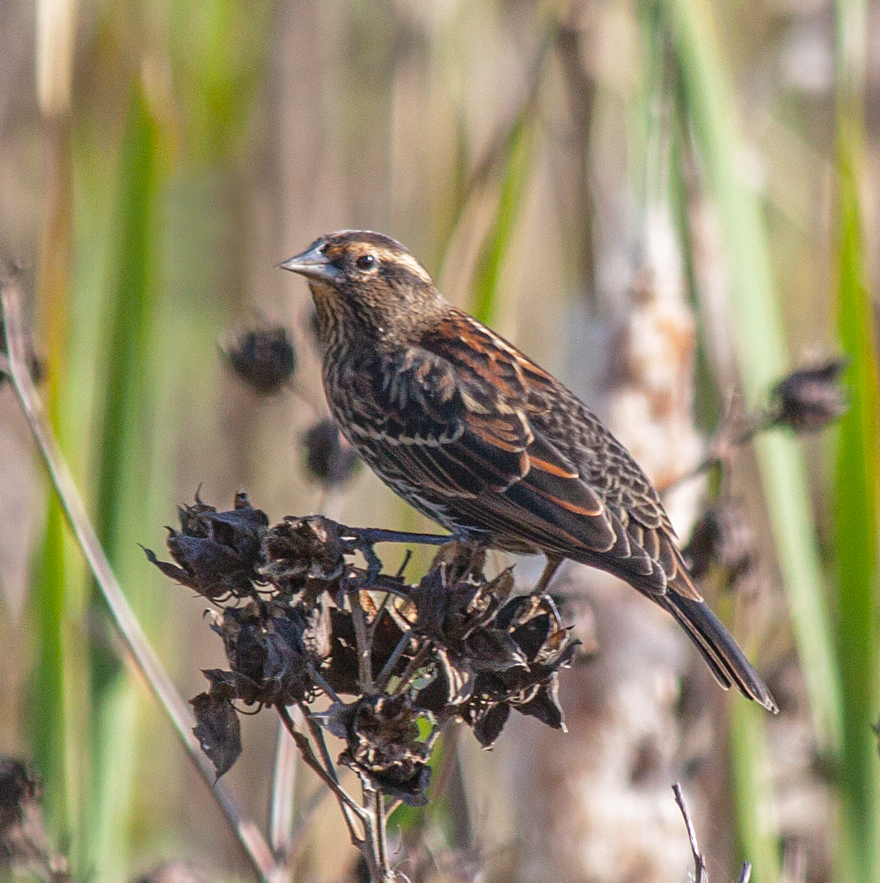
I remember well my confusion the first time that someone identified a bird like this one as a female Red-winged Blackbird (Agelaius phoeniceus). “How can it be a Red-winged Blackbird, when it’s not black and doesn’t have red wings?” I naively asked.

I have learned a lot since that moment and have resigned myself to the reality that the names of birds and insects are often not descriptive (or apply only to one gender of the species).

Female Red-winged Blackbirds seem to forage for food in the underbrush most of the time and I have found it to be harder to get a good shot of females than the males, which seem to like to perch and pose prominently on the cattails. This female lifted her head for a brief moment, permitting me to get this shot, and then quickly returned to work.

blackbird_female_blog

© Michael Q. Powell. All rights reserved

Read Full Post »

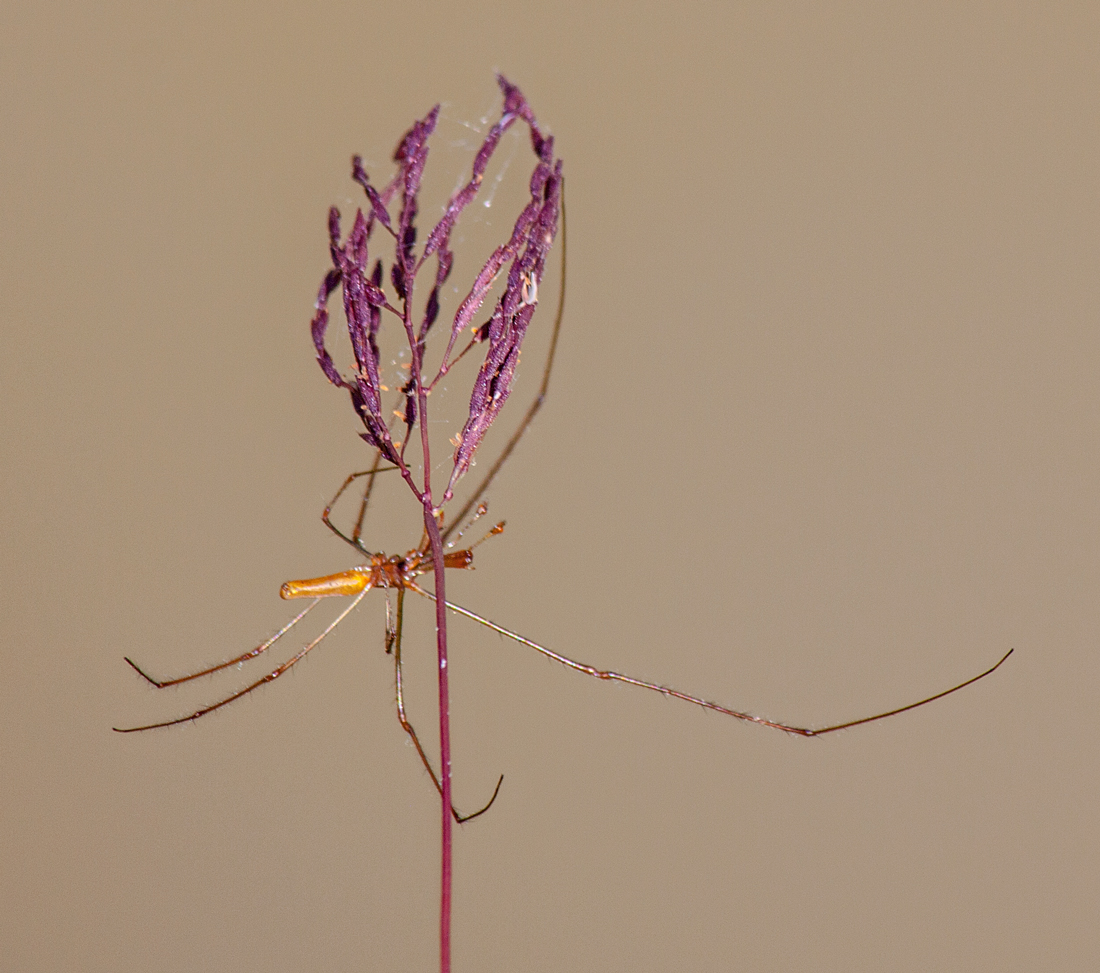
This long-jawed spider is not really camouflaged, of course, but it positioned itself in such an artistic way that its elongated body and legs seem to be an extension of the plant, especially from a distance. The plant was growing at the edge of a small pond at my local marsh and the brown background color is the water of the pond.

spider_purple_blog

Click on the image to get a higher resolution view of it.

© Michael Q. Powell. All rights reserved

Read Full Post »

Out of the corner of my eye, I detected some movement and, glancing upward, caught sight of this Great White Egret (Ardea alba) flying almost directly overhead. Normally I see egrets in flight only when I spook them and prompt them to fly away from me.

The early morning light helped to illuminate the underside of this gorgeous bird, which is usually in the shadows, revealing some of the details of the feathers. It is always tricky for me to get the proper exposure with these very white birds and I was happy that I managed to avoid blowing out too many of the highlights.

As I recall, I was pointing the camera almost straight up for these shots and that provides an unusual perspective. In the second shot, for example, it almost looks like the egret is imitating a fighter jet and is flight straight up into the air.

egret_overhead1_blog egret_overhead2_blog

© Michael Q. Powell. All rights reserved

Read Full Post »

There seemed to be a lot of small birds in the trees this past weekend, mostly hidden in the foliage. I did manage to get a shot of this pretty little bird, which I think is a Red-eyed Vireo (Vireo olivaceus). The eye does not look as bright red as in some of the images that I see on-line of this bird, but most of the other characteristics seem to match pretty well.

We seem to be moving into the prime season for birds and my bird identification guide (I was given a Peterson Field Guide to Birds of North America by a dear friend) now has a prominent spot on my desk. Unlike some of the birders that I encounter, I don’t carry around a field guide when I am shooting—I don’t like to have my head buried in a book and potentially miss some action shots.

vireo_blog

© Michael Q. Powell. All rights reserved

Read Full Post »

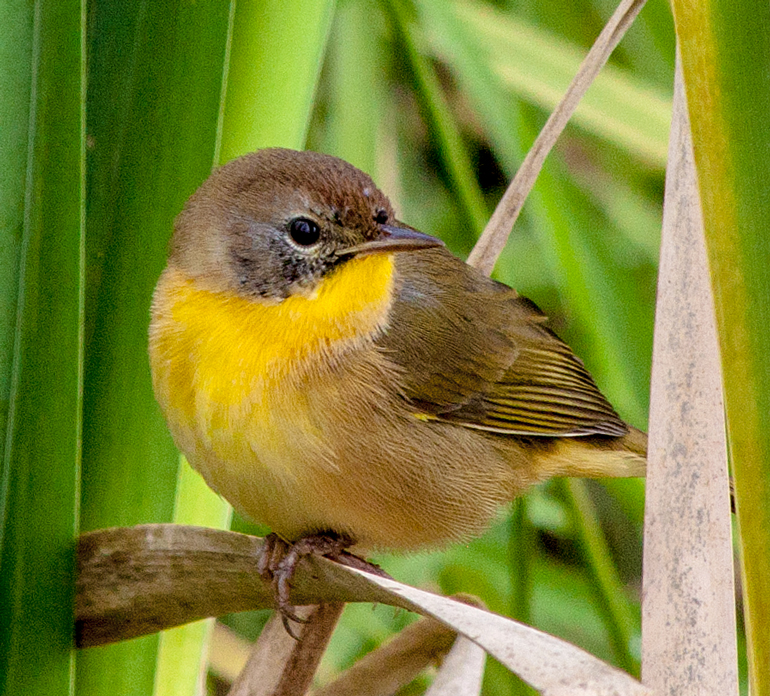
Glancing into the cattails, I caught sight of a flash of color and then gradually a bright yellow bird came into view. The tail was partially concealed by the cattails, accentuating the bird’s circular body shape (and everyone knows that the camera adds pounds to subjects).

I have done some internet searches and concluded that this is probably an immature male Common Yellowthroat (Geothlypis trichas). Adult male Yellowthroats are really easy to identify, because they have a prominent black mask. Like many bird species, however, young male Yellowthroats look a lot like the females, but gradually develop the mask. It looks to me that this bird may have the first traces of such a mask.

The lighting and camera settings combined to produce images that I really like, with colors that are beautifully saturated. I need to figure out how to replicate this look.

yellowbird_blogyellowbird2_blog

© Michael Q. Powell. All rights reserved

Read Full Post »
When a scope-toting birder told me that there was a cuckoo in a tree in the distance, I had not idea what to look for. My parents had a German cuckoo clock when I was growing up and somehow I thought the cuckoo would look like the little bird that popped out of the clock each hour.

I could see the white breast of the bird, so I pointed my telephoto lens at the tree and focused as well as I could. I had to crop quite a bit, but the bird I photographed is definitely identifiable as a Yellow-billed Cuckoo (Coccyzus americanus). What shocked me the most was the length of the bird’s tail. According to my birding guide, this cuckoo is about 12 inches (30 cm) in length.

According to the Cornell Lab of Ornithology, these birds like to eat large quantities of hairy caterpillars. Those readers who follow my blog know well that there have been lots of hairy caterpillars recently at my local marsh, so it makes a lot of sense that these birds would be present.

The background in the image is cluttered, but I like the bright colors of the autumn leaves, so I am not bothered by it, particularly because they do not conceal very much of the cuckoo.

cuckoo_blog

© Michael Q. Powell. All rights reserved

Read Full Post »

The early morning light from the side illuminated the bright fall leaves and the equally bright red male Northern Cardinal at my local marsh this past weekend.

cardinal_fall_blog

© Michael Q. Powell. All rights reserved

Read Full Post »

A familiar subject can look quite different when viewed from an unusual angle. It’s a lesson that every photographer is taught early on, but I need constant reminders to vary my approach.

I took this shot of a Viceroy butterfly (Limenitis archippus) yesterday while lying on the ground and pointing my telephoto lens up toward the sky. The perspective caused the shape of the wings to be different and permitted me to see the butterfly’s legs in a way that was completely new.

Not all such experiments are successful, of course, but I think that this one worked out pretty well.

looking_up_blog

Click on the photo to see a higher resolution view.

© Michael Q. Powell. All rights reserved

Read Full Post »

Yesterday I noticed several small flocks of blackbirds swooping in and out of the cattails at my local marsh and suspect that they are migrating birds. The marshland park seems to be favorite stopping-off spot for all kinds of birds as they move south.

I managed to get his shot of one of a male Red-winged Blackbird (Agelaius phoeniceus) in a rather typical pose on a cattail stalk. Unlike in the spring, when males seem to spend a lot of time calling out to potential, the blackbirds yesterday seemed to be much more focused on foraging for food.

blackbird_fall_blog

© Michael Q. Powell. All rights reserved

Read Full Post »

« Newer Posts - Older Posts »