Feeds:
Posts
Comments

Posts Tagged ‘Canon 70-300mm telephoto zoom lens’

How often have you been told (or read) that you need to fill the frame with your primary subject? If you photograph wildlife as I do, you know that it is rare that you have the opportunity to “fill the frame,” especially when your subject is moving.

I was a little shocked when I first looked at this image of a Canada Goose (Branta canadensis)—not only had I filled the frame, but I had managed to compose it pretty well. Yes, this is an uncropped image of a flying goose. I was awfully lucky to get this shot and I know that several of the images in the burst I took featured cutoff bodies or heads.

Now if I could just get a raptor to fly by this closely…

goose_fill_frame_blog

© Michael Q. Powell. All rights reserved.

Read Full Post »

No matter how bad the weather is, sparrows seem to be omnipresent at this time of the year. I can hear them as they move about in search of food, but they often choose to bury themselves deep in the bushes and undergrowth.

This White-throated Sparrow (Zonotrichia albicollis) was snacking on some kind of berries and I managed to catch him mid-bite when he lifted his head slightly. The branches and leaves give you an idea of the challenge involved in getting an unobstructed  shot. I am happy that I was able to get the head (and eye) in focus and the pose is an interesting one, because it caught the sparrow as it was doing something—static portraits are nice, but for me it’s even nicer to capture motion and activity.

berry_blog

© Michael Q. Powell. All rights reserved.

Read Full Post »

Orchestral conductors tend to be flamboyant characters and that is exactly what came to mind when I first say this image  of a female Mallard Duck (Anas platyrhynchos) with fully outstretched wings. She seems to be conducting an unseen duck orchestra creating what some might call music and other would characterize as a quackonophy.

dancing_duck_blog

© Michael Q. Powell. All rights reserved.

Read Full Post »

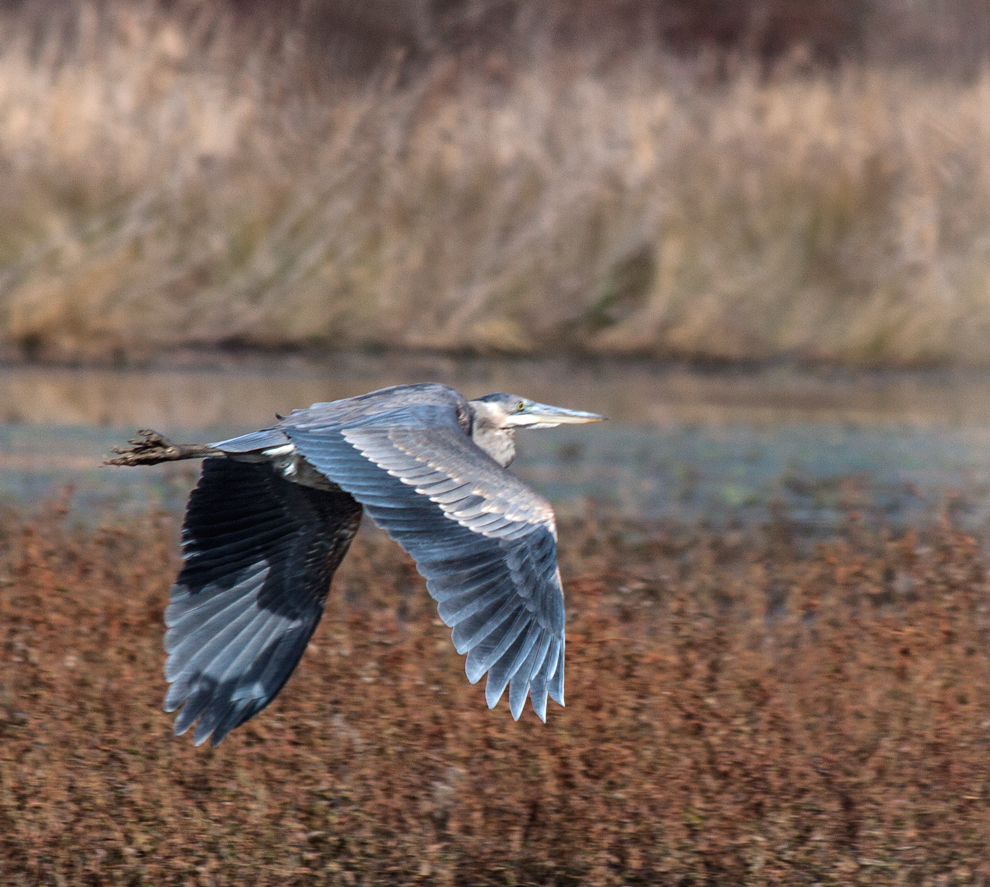
I was moving forward slowly in the underbrush, trying to get closer to some ducks, when out of the corner of my eye I detected some motion. It was a Great Blue Heron (Ardea herodias) flying low over the waters of the marshland pond.

I didn’t have time to check the settings on my camera, but the heron’s slow speed in flight did allow me to get off a few shots. This was one of the few times that I have been able to capture a bird in flying parallel to the ground at eye level and I really like this perspective.

heron_marsh2_blogheron_marsh_blog

© Michael Q. Powell. All rights reserved.

Read Full Post »

Now that most of the leaves are gone from the trees, one of the Red-shouldered Hawks (Buteo lineatus) seems to have returned to a favorite perch at my local marsh. The good news is that I know where the perch is, but the bad news is that there is a large field of cattails in mud and water between my best observation spot and the tall tree in which the hawk is perched.

The branch is parallel to the ground and seems to provide the hawk a comfortable observation post from which to survey the surroundings and look for prey. Apparently it is so comfortable that the hawk can stay in that one spot for a long period of time. I had my camera on a tripod for the first shot and I waited and waited for the hawk to fly.

A fellow Canon photographer came by and we started taking about menu settings and I took the camera off the tripod in order to check the menus. As I was thumbing through the menus, my friend suddenly blurted out that my hawk had taken off. I turned back in the direction of the hawk and was able to snap off a couple of quick shots of the hawk in flight.

The shots highlight some of the beautiful colors and patterns of the hawk’s wings and so I have chosen to include them in this posting. As one of my fellow bloggers Lyle Krahn has noted, any day that you see a hawk is a good day. Be sure to check out his blog for some awesome shots of hawks (and lots of other wildlife), including this recent posting, in which you are asked to make a difficult choice between two hawk photos for an imaginary calendar.

hawk_flying3_bloghawk_flying_bloghawk_flying2_blog

© Michael Q. Powell. All rights reserved.

Read Full Post »

He was partially hidden by the branches, but I was happy—I had finally gotten a clear view and a recognizable photograph of a Pileated Woodpecker (Dryocopus pileatus).

I have long hoped to spot a Pileated Woodpecker. I have seen evidence of their handiwork (or is it more appropriately “beakwork”) several time and heard the loud sound of these large woodpeckers at work, but I had not been able to find one. This past Monday, while I was attempting to photograph dragonflies, I heard the sound of a woodpecker in a nearby patch of woods and went to investigate. I was surprised to see a Pileated Woodpecker, because the soft tap-tap was not what I expected from this species.

My shot is really just a record shot, but the first time that I see a new bird, insect, or animal, I am invariably content to get any kind of shot. I know I can do a lot better, if I can just find a cooperative Pileated Woodpecker.

pileated_blog

© Michael Q. Powell. All rights reserved.

Read Full Post »

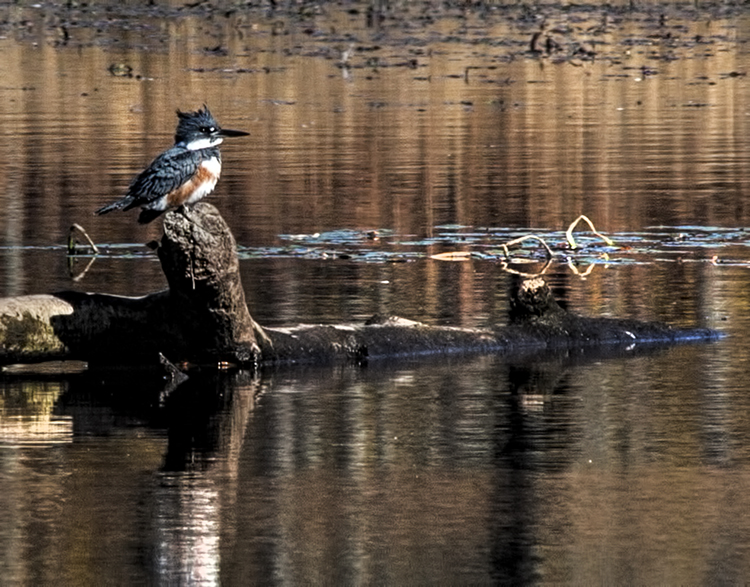
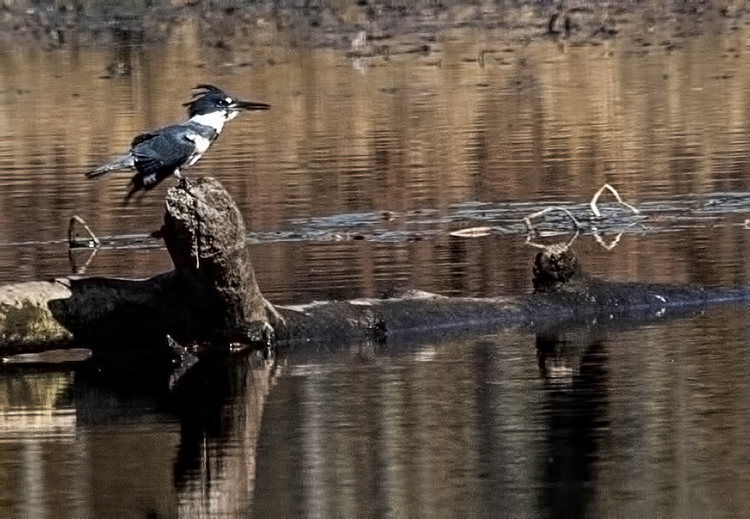
I was looking across the water of a small pond at my local marsh, enjoying the beautiful early morning reflections, when a bright white flash zoomed across my field of view and stopped in the middle of the water.

Initially I had no clue about what it might be, but when I looked through my telephoto lens, I could see that it was a female Belted Kingfisher (Megaceryle alcyon). I had never before seen a kingfisher perched so low to the water and it was pretty obvious that she was not fishing. As I watched from a distance, she went through what I assume is her morning routine, as she twisted and turned and fluffed up her feathers.

Before long, the kingfisher flew off to a higher perch in a more distant tree, where I suspect she busied herself with the task of catching some fish for her breakfast.

IMG_2587 crop webIMG_2519 Cropped web

© Michael Q. Powell. All rights reserved.

Read Full Post »

Sometimes you don’t have to make a choice between two options—you can have them both.

In this morning’s blog posting, I posed the question, “When it comes to images of birds in flight, do you prefer the sky as the background or some element of the earth?” and I received quite a few responses, with a greater number having a preference, in general, for background or contextual elements rather than a plain blue sky.

Sometimes I manage to get an image that incorporates the best of both worlds. This image, for example, has one Canada Goose against a leafy background, one against the sky, and one in between.

Who says you have to choose? (In the interest of full disclosure, I intentionally set up the question as a false dichotomy in order to stimulate thinking. For me, the best answer to the question I posed, which called on you to make a sweeping overgeneralization, was the person who responded quite simply with the words, “It depends.”)

geese_flying_cropped_blog

© Michael Q. Powell. All rights reserved.

Read Full Post »

When it comes to images of birds in flight, do you prefer the sky as the background or some element of the earth? Here are two photographs of Canada Geese (Branta canadensis) that I took this past Monday that illustrate my question.

Canada Geese are some of my favorite subjects as I try to improve my skills in photographing flying birds—they are relatively big, flight slowly (especially when taking off and landing), and, perhaps most importantly, there are a lot of them.

In some ways, it’s a little easier to track a bird in the sky, since there is nothing else to grab the camera’s focus (if you can lock in the focus quickly enough). However, the light is a lot more variable, particularly when a bird is circling, so proper exposure is a challenge and shadows are a sad reality. I was happy that I was able to time the second shot so that the light illuminated most of the underside of the goose. Some photographers, though, seem to look down at photos of birds in the sky and prefer more environmental shots.

I had to act quickly to get the shot of the goose with the trees in the background, when some geese took off and flew by me at almost eye level. The trees were far enough away that they blurred out and the head of the goose is mostly in focus. Depth of field is always an issue for me in shots like this—you can actually see the depth of field in the amount of the extended wings that is in focus.

So there you have it, two different shots of a goose in flight. Does the background play a role in your assessment of which one you prefer?

goose_flying_11Nov_blog

goose_flying2_11Nov_blog

© Michael Q. Powell. All rights reserved.

Read Full Post »

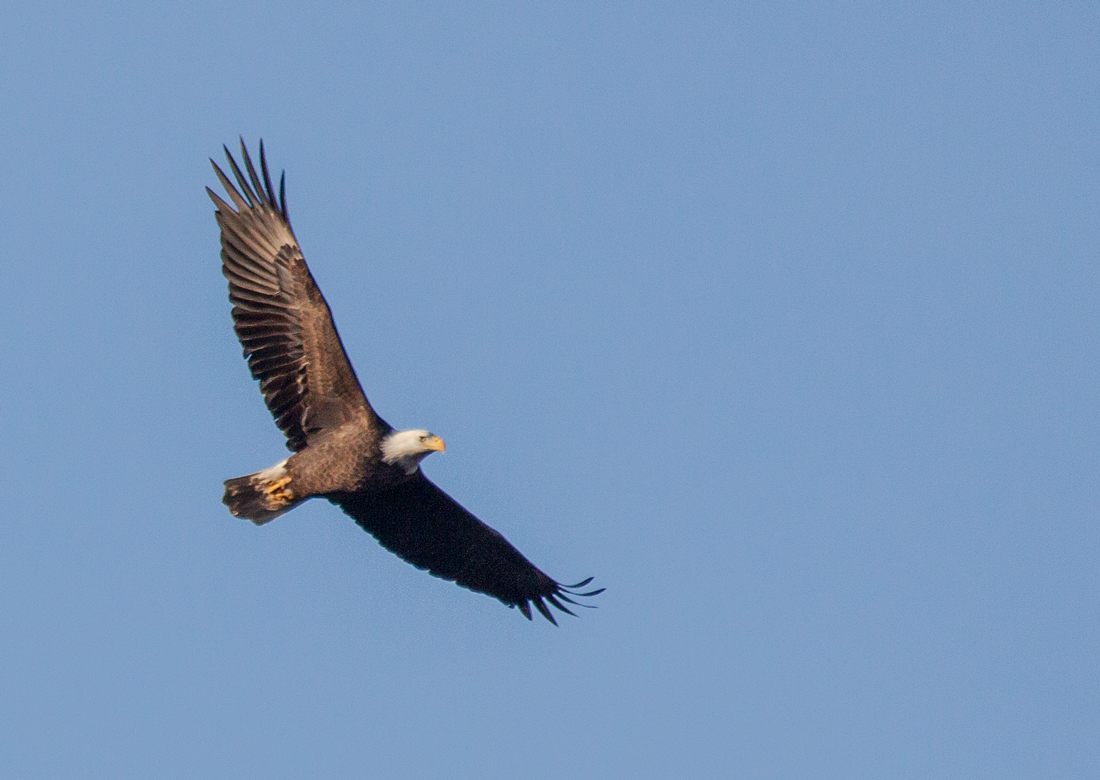
On a day devoted in the United States to the brave men and women who are serving and have served in out armed forces, it seemed appropriate that I was able to get some shots of a Bald Eagle (Haliaeetus leucocephalus), our national bird.

For a short time early yesterday morning, this eagle circled over me at my local marsh park and then flew off to a distant tree, where its white head was still visible, but was out of range of my camera.

I’m still working on my techniques for photographing birds in flight and this eagle reminded me of the importance of light in trying to get a decent shot. As the bird circled and changed its wing positions, various parts of the body would come in an out of the light and in about half of my shots, the eagle’s head is in the shadows. When the eagle’s head was in the light, however, the brilliant white color often caused the details to blow out.

The final reminder of this experience is a familiar one for anyone who has attempted to photograph birds—I need a longer telephoto lens.

eagle3_11Nov_blogeagle2_11Nov_blogeagle_11Nov_blog

© Michael Q. Powell. All rights reserved.

Read Full Post »

As I was going through some of my bird photos, I realized that a majority of them feature the male of the species. The males tend to be more loud and flashy, so I guess it’s not surprising that they draw my attention much of the time. The female often has a more delicate beauty and coloration, as is the case with this female Ring-necked duck (Aythya collaris) that I photographed recently.

I added an image of a male Ring-necked duck that I photographed the same day to allow you to make your own comparison and judgments. It may be a cliché, but it is nonetheless true that beauty is in the eye of the beholder.

ring-necked_female_blogring-necked_male_blog

© Michael Q. Powell. All rights reserved.

Read Full Post »

Do you still look at the clouds and see shapes as you did when you were a child? Sometimes the shadows and light and my imagination combine and cause me to see new things, like the leaves in this ginkgo tree that remind me of a flock of bright yellow butterflies.

Ginkgo trees are endlessly fascinating for me. Check out my earlier posting to see additional photos of my journey to a ginkgo grove a few weeks ago, including some close-up shots of ginkgo leaves and the fleshy seeds produced by the female ginkgo trees.

ginkgo_butterflies_blog

© Michael Q. Powell. All rights reserved.

Read Full Post »

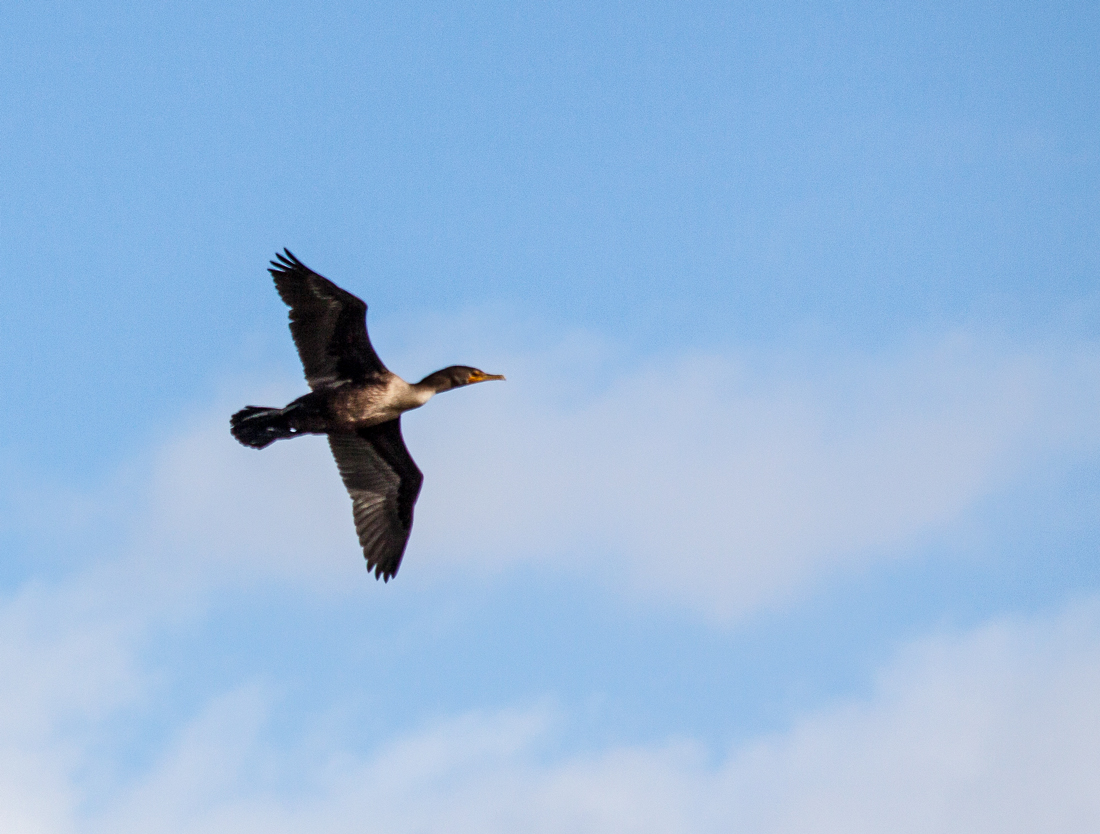
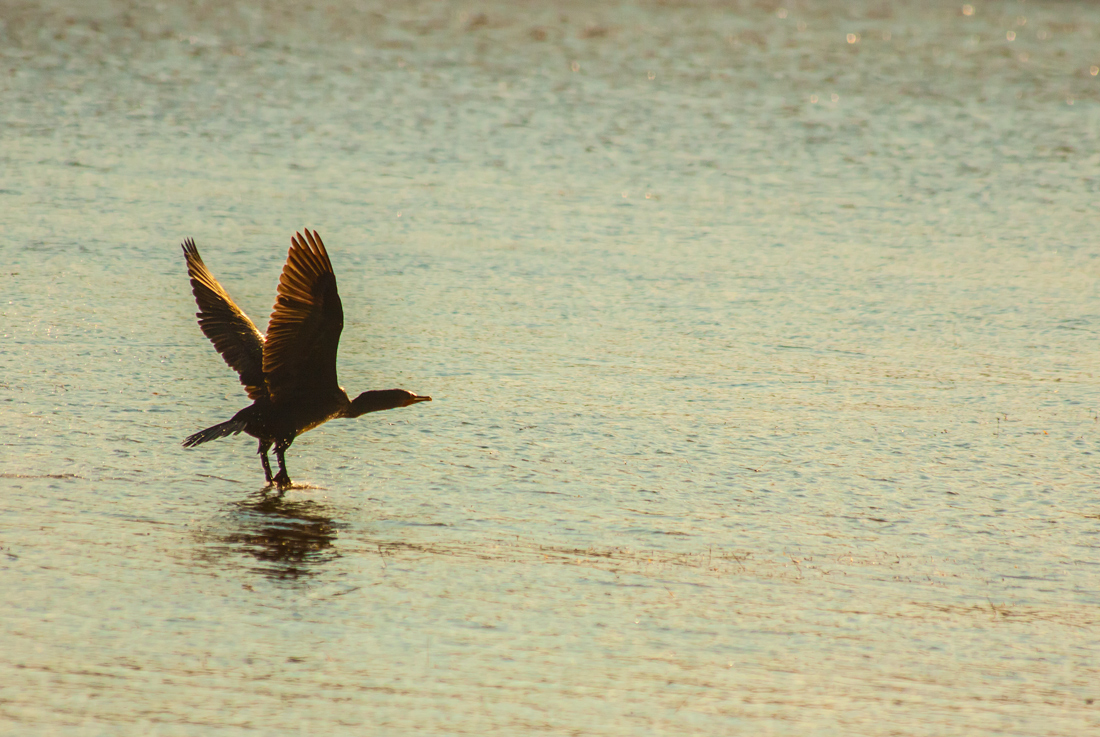
Two weeks ago I didn’t even realize that we had Double-crested Cormorants (Phalacrocorax auritus) in this area and now I can find quite a number of them on the Potomac River. It’s a little difficult to tell from the range maps in my bird guide if the cormorants are migrating through this area of if they may choose to winter here.

The more I observe these birds, the stranger they appear. The Cornell Lab of Ornithology described them this way—”The gangly Double-crested Cormorant is a prehistoric-looking, matte-black fishing bird with yellow-orange facial skin. Though they look like a combination of a goose and a loon, they are relatives of frigatebirds and boobies and are a common sight around fresh and salt water across North America.”

I am still working on getting some shots of the cormorants in the water, but as a start, here are a couple of images of a cormorant in the air. I took the first one before I knew that it was a cormorant—I have a habit of trying to capture anything in flight that is remotely in range. The second one shows a cormorant as he is taking off from the water after some bounding steps across the surface as he gained speed. The location of the light caused much of the cormorant’s body to be in the shadows, but did illuminate the details of some of its feathers.

cormorant_flying1_blogcormorant_liftoff_blog

© Michael Q. Powell. All rights reserved.

Read Full Post »

The wind was kicking up yesterday on the Potomac River, making it difficult for the ducks there, like this Ruddy Duck (Oxyura jamaicensis). I watched as the small ducks got drenched repeatedly as they sought to ride the waves.

At least it wasn’t raining and the temperatures have not yet dropped below the freezing levels, even at night.

ruddy_waves_blog

© Michael Q. Powell. All rights reserved.

Read Full Post »

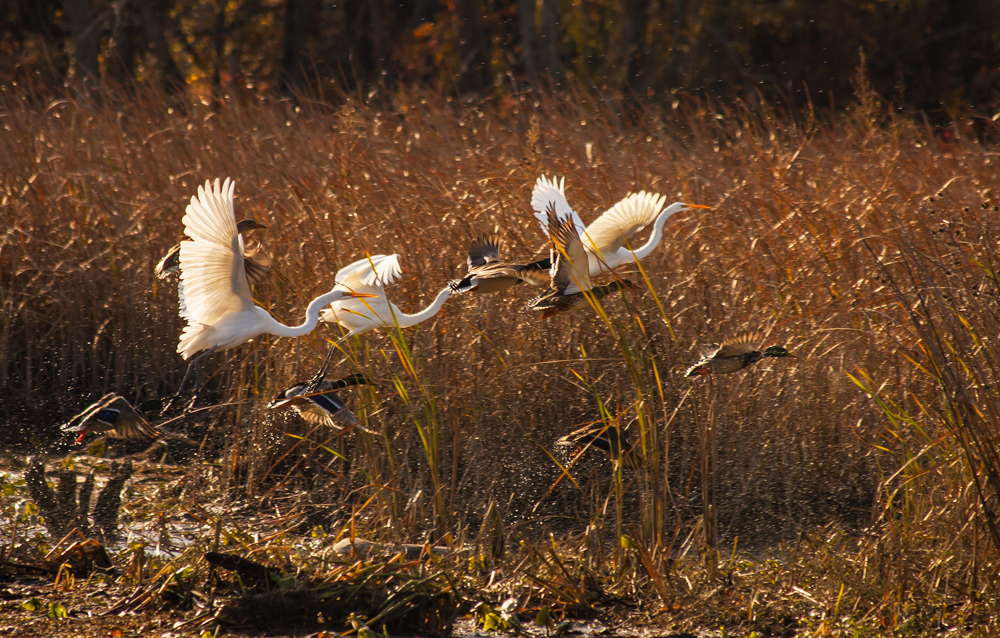
I was watching some Great White Egrets (Ardea alba) yesterday at Dyke Marsh Wildlife Preserve, a freshwater tidal wetland on the Potomac River, when something startled the birds.

The egrets and some mallard ducks took off from the water en masse in a great explosion of water. I captured some of that noise and confusion in the second photo. The photo I chose to feature shows the birds a short after the take off as they start to lift off a little and fly over a meadow-like area with tall golden grass. The light was especially beautiful on the wings of the egrets, which happily I managed to capture without blowing out the highlights as sometimes I do with these very white birds.

Click on the photos to see some of the beautiful details of the birds in greater resolution.

takeoff_group1_blog takeoff_group2_blog

© Michael Q. Powell. All rights reserved.

Read Full Post »

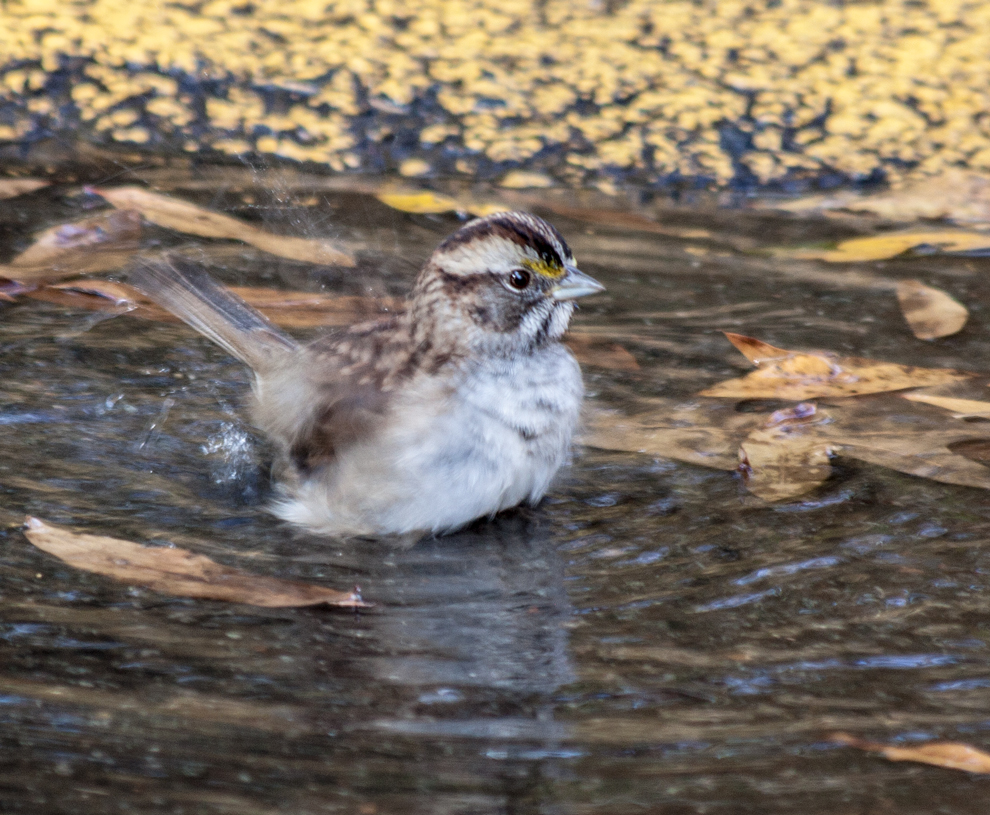
Did you enjoy playing in puddles when you were a child? I remember a childhood of rubber boots and yellow slickers and days when my pant legs would be drenched from walking through puddles. Even now, I’ll occasionally kick my feet through a puddle of water and then glance quickly all around, hoping that nobody has seen me give in to my child-like impulses.

When I spotted this White-throated sparrow (Zonotrichia albicollis) in a shallow puddle, I thought he was merely getting a drink of water. However, he stuck his head in the water, splashed around, and seemed to be having a good time. Perhaps he was taking a bath, or maybe he was simply enjoying himself in the cool waters. (In case you are curious about the background, the puddle had formed in a low area adjacent to a speed bump at the entrance to the parking area of my local marsh park—the yellow you can see is the safety paint of the speed bump itself.)

Initially, I was unsure that this sparrow was a White-throated, because the white patch was not really obvious and the eye stripes were not as well defined as in previous photos that I have posted of this species. The yellow coloration above the lore (the area between the eye and the bill) makes it pretty likely that this is a White-throated sparrow, though it may be the brown and tan striped variant, rather than the black and white one that I featured in a posting earlier this week.

I don’t know about you, but I feel inspired to find a puddle to play in today. Have a wonderful Friday.

Sparrow_puddle_cropped_blog

© Michael Q. Powell. All rights reserved.

Read Full Post »

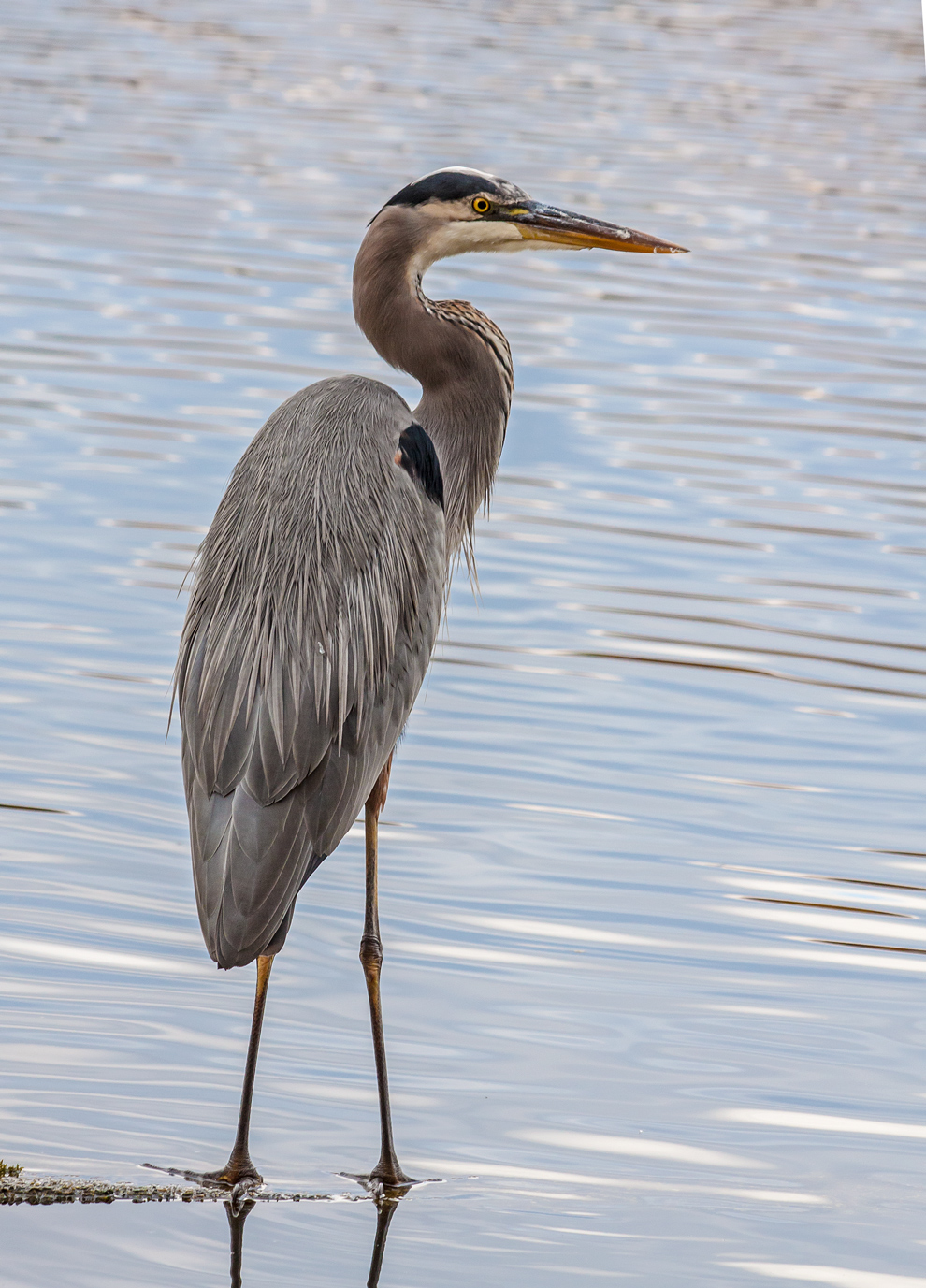
I felt like this Great Blue Heron (Ardea herodias) was modeling for me when it climbed out of the water onto a narrow slab of concrete and struck a pose. It was unusual for me to see a stationary heron out of the water—usually when I see them out of the water, they are flying. The blue waters make it look like I shot this in some exotic, tropical location, but I took this photo only a mile or so from where I live, at a small suburban pond surrounded by townhouses on one side and a well-travelled road on the other side.

heron_out_of_waterblog

© Michael Q. Powell. All rights reserved.

Read Full Post »

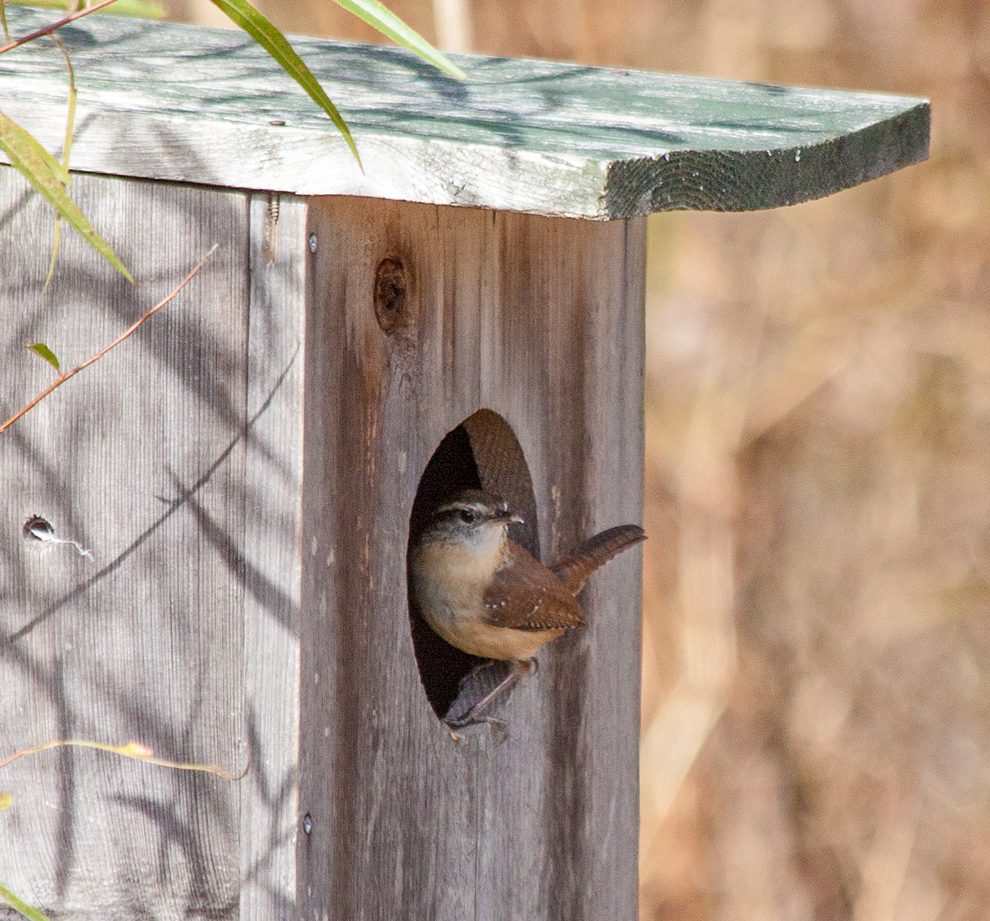
Why was this wren perching on the nesting box just prior to entering it? It’s not nesting season, is it? Was it seeking shelter on a cool, windy day? Were there insects inside to eat?

As I noted yesterday, bird activity was low on Monday—we didn’t even have any Canada geese or ducks passing through. I initially noticed this small bird, which I think is a Carolina Wren (Thryothorus ludovicianus), when it was checking out the underside of this nesting box. The box itself is pretty big and was placed there, I believe, for ducks to use. Eventually the wren perched on the edge of the entrance and peered inside and then looked all around before going inside.

wren_box_blog

© Michael Q. Powell. All rights reserved.

Read Full Post »

It was cold and overcast yesterday and there were not many birds visible, with the notable exception of sparrows. Sparrows were as active as ever, though most of the time I could only hear them and not see them. They seem to like to rot about in the underbrush most of the time.

I was really happy when this White-throated sparrow (Zonotrichia albicollis) popped up for a moment and I was able to get this image. I love the facial pattern and colors of this bird, which seems to have a goatee much like my own. (My goatee started out with salt-and-pepper color, but increasingly has become mostly salt).

When researching this bird, I learned that there is another version (morph) of this bird that has brown and tan head stripes, instead of black and white. I will have to look even more closely at my photos of the White-throated sparrow, which has become more common the past few weeks, and see if I have managed to capture any images of the tan-striped variant.

sparrow_white_throat_crop_blog

© Michael Q. Powell. All rights reserved.

Read Full Post »

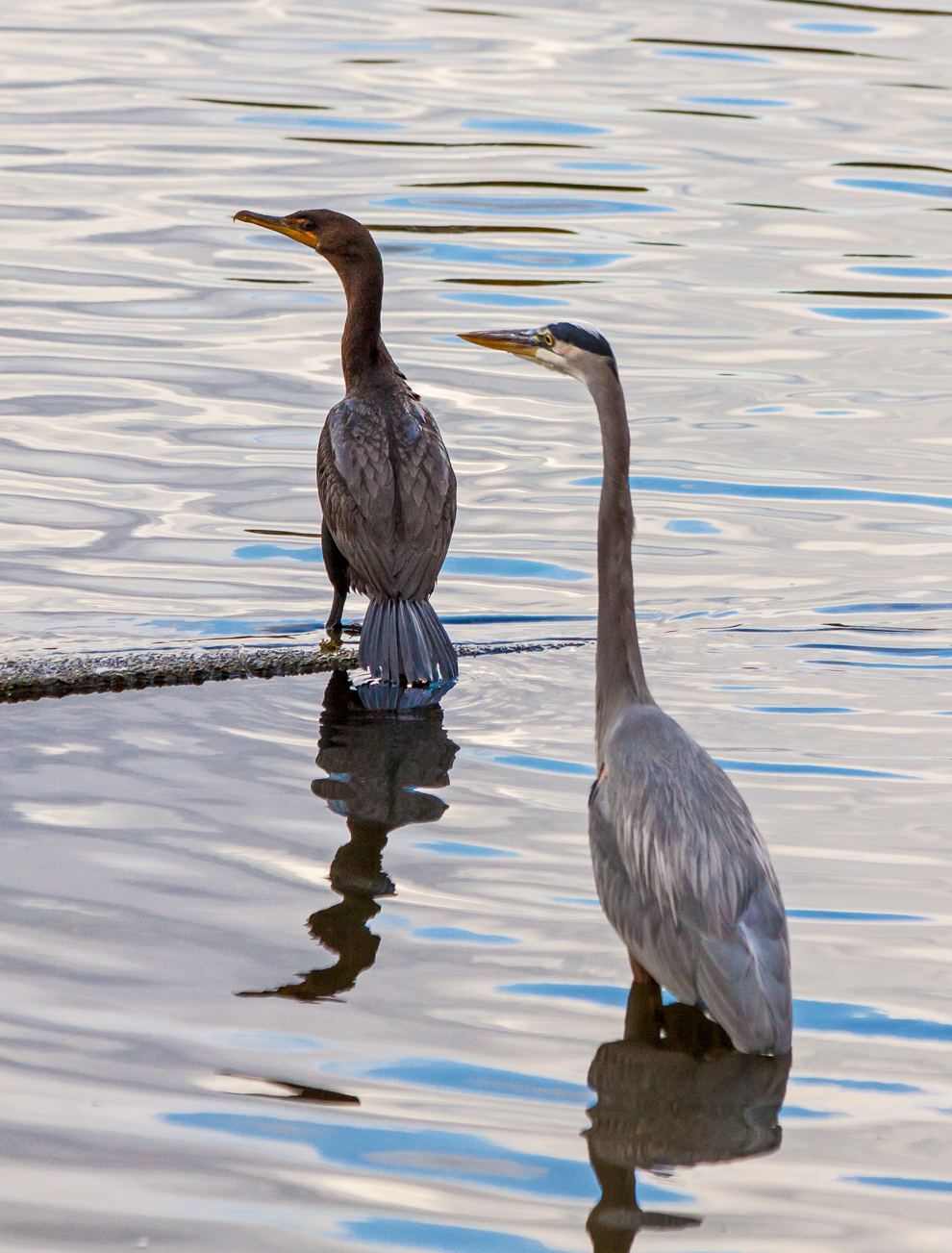
Who knew that the man-made pond in a nearby suburban neighborhood would be a favorite spot for juvenile birds to hang out together?  That’s what it looked like when I spotted an immature Double-crested Cormorant (Phalacrocorax auritus) and an immature Great Blue Heron (Ardea herodias) together, both with their heads turned in profile, probably checking out some cute little female goose.

Actually, I couldn’t immediately identify the cormorant, though it was obvious that it was neither a duck or a goose. The way that it swam with its long neck extended and its bill pointed in the air, however, was distinctive enough to make it easy to find in my identification guide.

I like the way that these two birds posed for me, with the cormorant perched on a narrow concrete slab to compensate for the heron’s greater height and the synchronized head positions. I have seen this young heron hanging around the pond before (it’s the same heron that I featured in the Crouching heron posting this morning), but I don’t think that I have seen a cormorant there before. Usually there are only geese and occasionally some ducks, like the small flock of Ring-necked ducks that are there right now.

cormorant_heron_blog

© Michael Q. Powell. All rights reserved.

Read Full Post »

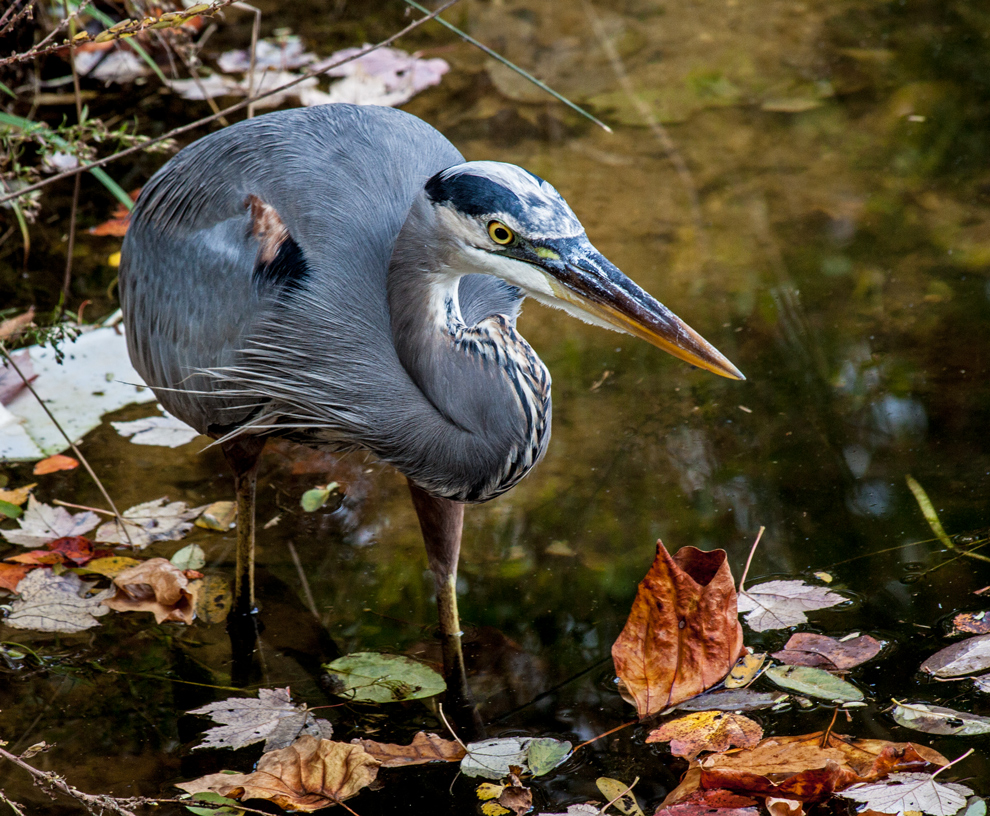
Saturday, I went out with fellow photographer Cindy Dyer to take photographs of the fall foliage and we stopped at a little suburban pond, where I managed to get this close-up shot of a Great Blue Heron (Ardea herodias) crouching at the edge of the water. If you want to see some awesome shots of the fall colors in Northern Virginia, check out Cindy’s blog—she was quicker than I was in posting her shots.

I was able to get this downward-looking angle for the image because I was on a small bridge that is part of a walking path around the pond. The heron was focused on trying to catch prey, though he didn’t seem to be having too much success. Judging from its relatively small size and inexperience fishing, I suspect that this might be a juvenile heron.

I took a number of other shots of the heron that I will probably post, including an encounter with what I think is a juvenile cormorant. Stay tuned.

heron_crouching_blog

© Michael Q. Powell. All rights reserved.

Read Full Post »

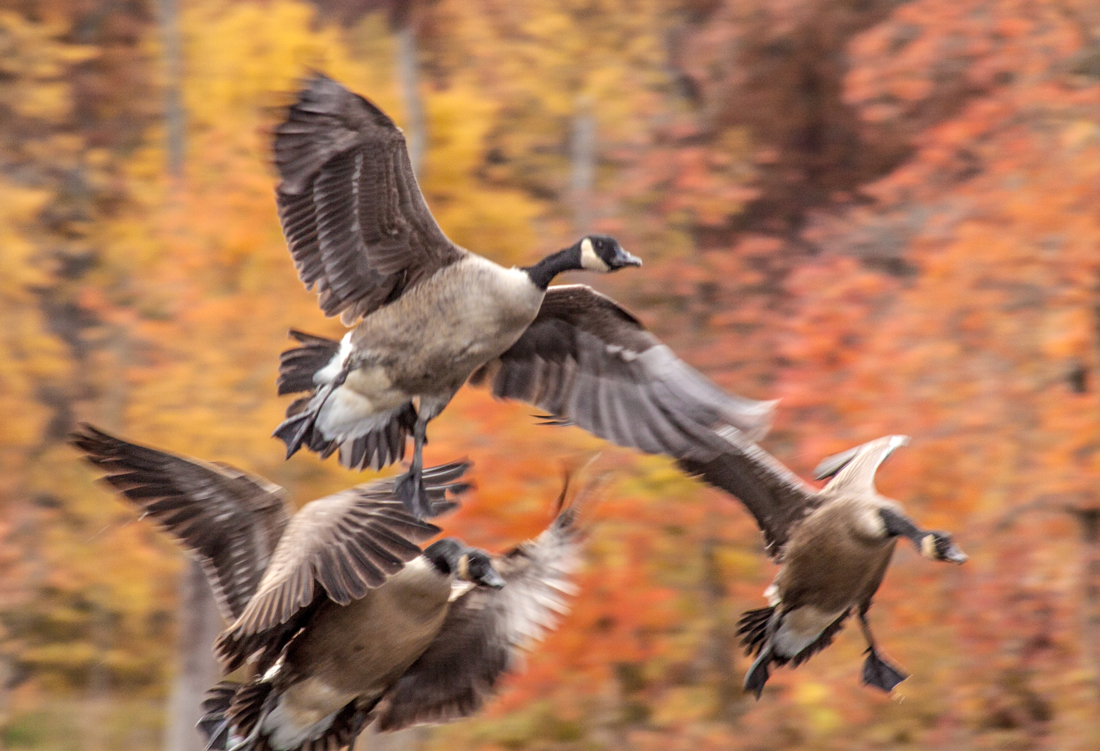
Standing at the end of a small pond, I heard the sounds of an approaching flock of Canada Geese (Branta canadensis). I looked all around as I prepared to track them and couldn’t help noticing areas of beautiful autumn foliage.

Wouldn’t it be cool  if I could capture the geese landing with the colorful leaves as a background? I put that idea in the back of my mind, remembering that it was going to be tough enough to capture decent shots of the geese without worrying about the background.

It’s a noisy crazy couple of moments when the geese come in for a landing—they come in waves and there is so much activity that it’s hard to figure out what to focus on. Usually, as I did here, I will try to concentrate on a single bird as it approaches and to keep it in focus.

I captured this image at the moment when the geese were slowing down just prior to entry into the water. My main subject is in a pretty good focus and the other geese are in interesting positions. I was surprised that I was able to get the orange background—it had been a hope, but certainly not an expectation. The result is an image that I really like, an image that combines two of the iconic elements of the autumn.

geese_landing_fall_blog

© Michael Q. Powell. All rights reserved.

Read Full Post »

If you germinated 600 seeds from a single ginkgo tree, how many would grow up to be male trees and how many female? Some of you may have come up with an answer already, but I am still struggling with the question. Can trees really have a gender? Apparently ginkgo trees, like holly, persimmon, and some others have a gender. Who knew?

In 1929, Dr. Orlando White at the Blandy Experimental Grove of the State Arboretum of Virginia in Boyce, Virginia decided to do an experiment and hypothesized that the sex ratio would be 1:1. Dr. White’s intellectual curiosity resulted in the Blandy Ginkgo Grove that I visited last weekend, one of the largest collections of gingkos outside of the tree’s native China. You can learn more fascinating information about ginkgos and about this grove by downloading this brochure, my source for the historical information about the grove.

I was struck by the beauty of the ginkgo leaves. Fossils of these leaves date back to 270 million years ago, meaning this plant was around with the dinosaurs. A ginkgo, which means “silver apricot” in Chinese, doesn’t form fruits, but has fleshy seeds about the size and appearance of a small apricot, seeds that you can see in some of my photos. I should warn you, though, that ginkgo seeds do not smell as nice as apricots—they smell like a cross between vomit and dog excrement.

I am including a variety of shots to give you an idea of the beauty of the ginkgo, ranging from a view of part of the entire grove down to an image of a single leaf.  I have never used the gallery feature with WordPress, but decided to put the photos I selected for this posting into a gallery and see how it works out. Let me know if you have any thoughts about whether you like this approach, vice using single photos.

© Michael Q. Powell. All rights reserved.

Read Full Post »

Most of the time when I try to photograph ducks in flight, I end up with shadows and muted colors. Last weekend, though, the light was right and I was able to capture a small group of mallards (Anas platyrhynchos) in full color. They were pretty far away, but I like the formation that I was able to capture. There are four males and one female, and one of the males is a straggler who seems to have trouble keeping up with the group.

straggler_blog

Click on the photo to see it in higher resolution.

© Michael Q. Powell. All rights reserved.

Read Full Post »

Last year it seemed like I saw Downy Woodpeckers everywhere, but this year I have sighted only a few of them. I took this shot of a female Downy Woodpecker (Picoides pubescens) in mid-October during a visit to Theodore Roosevelt Island, a nature preserve in the Potomac River opposite the District of Columbia.

woodpecker_downy_blog

© Michael Q. Powell. All rights reserved.

Read Full Post »

On Halloween night, it somehow feels appropriate to post this photograph of a spider web that I took earlier this month. Some people find spider webs (and spiders) to be creepy, but I find them to be fascinating.  I look at spider webs as a form of beautiful natural art, filled with wonderful geometric shapes and designs and always marvel at the ability of spiders to weave them.

web_halloween_blog

© Michael Q. Powell. All rights reserved.

Read Full Post »
If you are a heron, how do you get  a fish down your throat and into your stomach after you have caught it? Some animals and birds of prey might tear off a bite-size piece of the fish using claws or talons. Herons don’t have that option. They have to somehow maneuver their catch within their bills until they are in a position to swallow it whole, all the time at risk of dropping their catch back into the water and losing it.

I enjoy watching Great Blue Herons (Ardea herodias) fish. They seem to be extremely focused, but patient as they wait for the optimal moment for a strike. This past weekend, I observed this heron in the waters of the Potomac River, just south of the city of Alexandria, Virginia. I watched and waited with my camera focused and ready until the heron struck and pulled a modest fish out of the water.

The heron made several adjustments to the fish’s position by making small movements with his head until it was in the ready position shown in the second photo. He them gave a little flip of his head, launching the fish into the air, and opened his mouth wider, as you can see in the first image. In a split-second the fish was gone and the heron was swallowing.

Every time I see a heron fishing, I am hoping that I will see him pull a really big fish out of the water, as I have seen in photos on other blogs.  So far I have seen the herons catch only small fish and an occasional crayfish or frog, but I hope to be ready when a heron catches a “big one,” so that I won’t have to be the one who tells stories of “the one that got away.”

heron_fish2_blog

heron_fish1_blog© Michael Q. Powell. All rights reserved.

Read Full Post »

The first time I saw a bird that looked like this, I thought it was a sparrow of some sort. When I saw this one, last week, I knew immediately that it was a female Red-winged Blackbird (Agelaius phoeniceus).

I have learned a lot about birds and photography this past year.  Along the way I also have learned more about myself as I seek to express myself in my words and in my images.

red-winged_female_blog

© Michael Q. Powell. All rights reserved.

Read Full Post »

I haven’t seen many migrating ducks yet at my local marsh, so I traveled to the Potomac River this weekend, because I had heard from a birder that there were numerous ducks there. There were lots of Mallards, some Northern Shovelers (I think), and this cool-looking duck with a distinctive white patch on its cheek that I could not identify initially. After I returned home, it didn’t take long to figure out that this as a Ruddy Duck (Oxyura jamaicensis), a species that I had never seen before.

ruddy_duck1_blog

© Michael Q. Powell. All rights reserved.

Read Full Post »

My eyes caught a flash of bright blue yesterday as I was walking through Huntley Meadows Park, my local marsh, and I pointed my telephoto lens at the tree in the distance.

As I composed this shot, I was initially a little confused by what I saw. The reddish-brown color of the breast and the fact that there were some blue feathers made me think that it was an Eastern Bluebird (Sialia sialis), but the bird’s body didn’t seem blue enough. After doing a little research when I got home, I realized that most of the bluebirds that I had seen previously must have been adult males—as is the case with many other birds, the female Eastern Bluebird is more subdued in color than the male.

I didn’t have a lot of time to frame this shot, so I was happy that I managed to center the bird on the dark spot in the background and to surround it with some colorful fall foliage. All of the orange color in the image really helps the blue on the wing to pop, which is not too surprising since, if I remember color theory correctly, orange and blue are complementary colors.

bluebird_autumn_blog

© Michael Q. Powell. All rights reserved.

Read Full Post »

Red-roofed barns, silos, and rolled bays of hay may seem ordinary if you live in the country, but they were exotic enough to cause a group of city-dwelling photographers to pull off to the side of the road this past weekend to photograph them.

Never having lived or worked on a farm, I have a romanticized vision of life on a farm, of living close to nature. There is something almost idyllic for me in a setting like the one in the first photo.

As for rolled bales of hay, I don’t quite understand them. A lot of the cowboy movies that I grew up with featured muscular cowboys tossing around bales of hay that looked nothing like the ones in the second and third photos. These bales look like giant Shredded Wheat biscuits that would require a huge bowl and lots of milk to soften up enough to swallow. I remember from my childhood the scratchy sensation in my throat when I was in a hurry and swallowed my Shredded Wheat cereal before it had absorbed the milk.

Red Barn blogBales x 3 blogWheaties blog

© Michael Q. Powell. All rights reserved.

Read Full Post »

« Newer Posts - Older Posts »