Feeds:
Posts
Comments

Posts Tagged ‘Canon 55-250mm zoom lens’

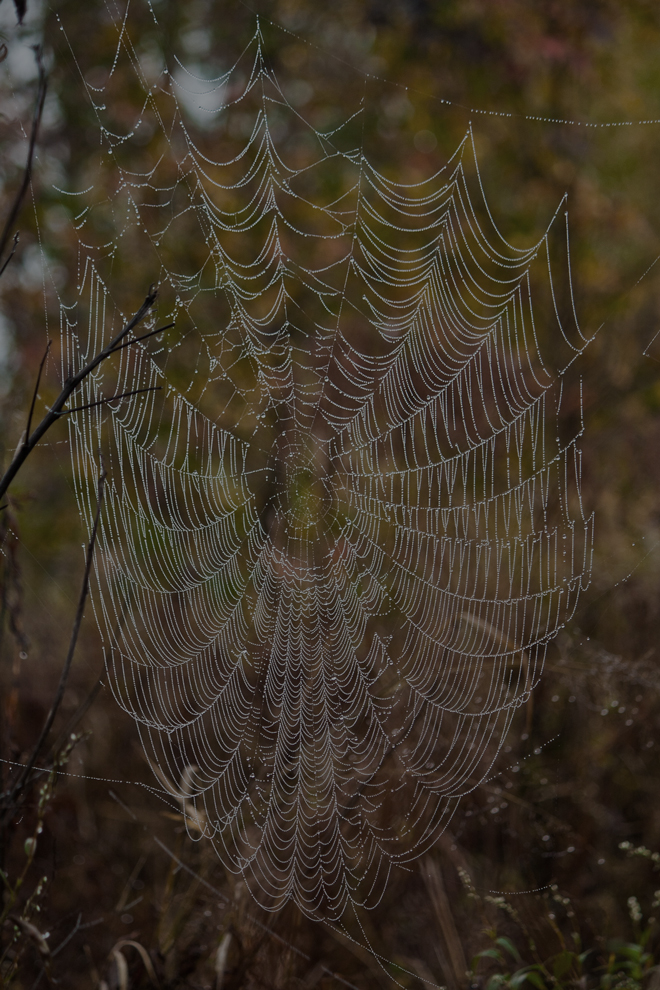
A few days I posted a photo of a giant spider web (which one blogger said looked to be big enough to catch a dog) processed in a couple of different ways. I received lots of helpful comments about adjustments that I made or didn’t make. With those comments in mind, I worked on this photo of a different web that I photographed earlier in October. It’s not quite as big as the previous one, but is in better condition and the spider is still present. The web was suspended between two cattails and I had enough room to set up my tripod on the boardwalk that runs through the marsh, so hopefully my shot is pretty clear (although I confess that manual focusing is still a challenge for me). I may work on some more variations of this photo, but here is my initial effort.

So what do you think of this spider web (click on it to see a higher resolution view)?

Almost giant spider web with spider

© Michael Q. Powell. All rights reserved.

Read Full Post »

This image of a male red-winged blackbird is not spectacular or anything, but I like it just the same. I’m happy to see some of the texture of the feathers and some of the details of the eye. I’m content with the way the background turned out. Some days those small victories are reason enough for me to celebrate (and to post a photo).

© Michael Q. Powell. All rights reserved.

Read Full Post »

I was going over some photos from earlier this month and came across these photos of a Monarch butterfly. I remember how excited I was when I shot them and decided to share a few of them. Early in the summer I took lots of photos of swallowtails, but I longed to photograph a Monarch butterfly. The first few that I saw flew away before I could raise my camera. Eventually, I managed to get some decent shots, but my pulse still quickens whenever I see a Monarch. Other insects may be cool or interesting or unusual, but for me there is nothing that really matches the beauty and elegance of a Monarch butterfly.

© Michael Q. Powell. All rights reserved.

Read Full Post »

The water level in the area of the marsh where I photographed herons and egrets earlier this summer is so low that it is now just a big puddle. Therefore, I was surprised early one morning this past weekend to see a Great Blue Heron (Ardea herodias) wading in the water. The light was not very bright, but the surface of the water had a really beautiful reflection of the orange of the fall foliage. The heron was a pretty good distance away and I was on a boardwalk, so my options were limited for framing my shots. Here are a couple of my favorite shots of the heron, surrounded by the reflection of the fall colors.

Great Blue Heron in the fall at Huntley Meadows Park

Fall reflection of a Great Blue Heron

© Michael Q. Powell. All rights reserved.

Read Full Post »

In the autumn, rural areas in New England are often invaded by hordes of city dwellers anxious to see the spectacular fall foliage. Locals frequently refer (often derisively) to these outsiders as “leaf peepers.” Still, it’s hard to ignore the beauty of the changing leaves, and the Northern Cardinal in this photo appears to have paused for a moment to admire the scenery. Apparently birds can be leaf peepers too.

Northern Cardinal checks out the fall foliage

© Michael Q. Powell. All rights reserved.

Read Full Post »

I was really happy when I came across this large dew-covered spider web early one morning this past weekend. I am not sure exactly how big it was, but I think it was probably about 18-24 inches across, with an amazing number of rows, especially at the bottom part that is fully intact.

I processed the same photo in two ways to get different looks. In the first photo, I desaturated most of the color to try to draw attention to the strands of the web (and you should click on the photo to get a somewhat higher resolution view of the web). In the second photo, I tried to punch up the colors a bit by increasing the vibrance and saturation settings.

Which one do you think works best?

Spider web (mostly desaturated)

Spider web (increased vibrance)

© Michael Q. Powell. All rights reserved.

Read Full Post »

Out of the corner of my eye, I noticed something fly past me and land on a nearby leaf. At first I thought it was a big dragonfly (my peripheral vision is not that great), but closer examination revealed that it was a praying mantis.

Earlier in the summer I spotted my first praying mantis “in the wild,” but it moved away as I was getting my camera ready—I was hoping to avoid the same fate this time around. As I tried to frame a shot, I realized that praying mantises are not easy to shoot. Their bodies are so long and skinny that it’s hard to fit them into a photo, especially when there is heavy vegetation that prevents an unobstructed view. I finally managed to find a narrow visual pathway through the branches that resulted in this shot.

It almost looks like the praying mantis is impatiently posing for me, with its tilted head and inquisitive facial expression. The eyes are wonderful too—they seem to be expressive. The orange tones of the leaves in both the foreground and the background help to give this portrait of a praying mantis an autumnal feel.

Praying mantis in the fall

© Michael Q. Powell. All rights reserved.

Read Full Post »

I am going through a bird phase, it seems, as I continue on my journey into photography. Perhaps it’s a seasonal thing, as flowers and insects seem to be in shorter and shorter supply, or perhaps it’s a kind of evolution in an unknown direction. Whatever the case, I find my lenses pointed more and more frequently at birds.

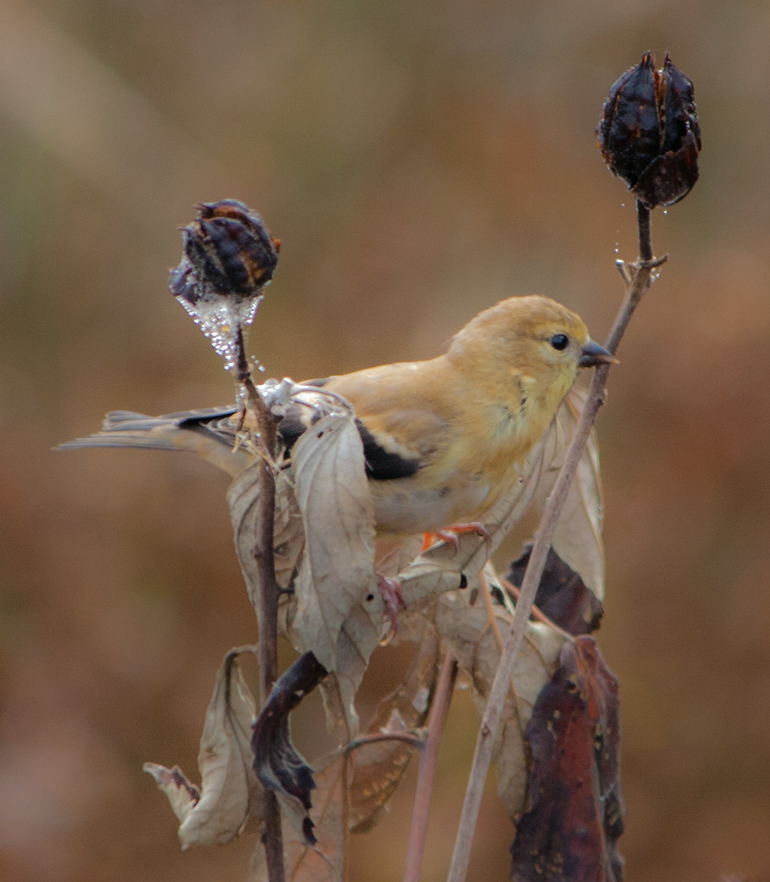
Here are a few shorts of an American Goldfinch that I took in the early morning, when the dew was still clinging to the strands of spider web silk on the plants. The sunlight was not yet strong and was coming from the side.

When I pulled up the RAW files to make a few adjustments, I was faced with the dilemma of the yellow coloration of the bird. In I changed some settings, the yellow became “dirtier,” but you can see more details. That’s what I did in the first photo. I can’t decide if the contrast is too much, but it seemed to me that the bird’s more severe facial expression lent itself to this treatment. On the other hand, if I changed settings differently, the yellow became a little brighter, but the image got a little softer. That’s what I did in the second and third photos. Again, I was guided a bit by the bird’s expressions.

Do you think that one of the two approaches worked better? I’ve come to realize that there is no magical recipe, no secret formula that will guarantee me great shots. That’s why it’s fun for me to try out different approaches and see what happens.

© Michael Q. Powell. All rights reserved.

Read Full Post »

Throughout much of the summer I posted photos Black and Yellow Garden Orbweaver spiders (Argiope aurantia). Having not spotted one in several weeks,  that they were gone until next year. I was happy to be wrong, however, and photographed one yesterday. I was even more delighted that the background colors work well for autumn and for Halloween (and nothing says Halloween more than a creepy spider).

Autumn spider

© Michael Q. Powell. All rights reserved.

Read Full Post »

As I have worked to improve my skills in photographing birds, I have had the most success with red-winged blackbirds (Agelaius phoeniceus). Why? First of all, the red-winged blackbird is a lot bigger than most of the birds that I try to photograph. Secondly, the blackbirds like to perch on cattails, which are closer than the trees in the areas in which I shoot. Finally, the blackbirds seem a bit more tolerant of my relative proximity (unlike some other birds that fly away at the slightest movement long before I get in camera range).

Here are three shots of male red-winged blackbirds from yesterday that I like. The first one shows some details of the feathers, which for this bird are not solid black. This may be a not-quite-nature male blackbird (immature males have wings with buff or orange edges and have yellow on their shoulders, according to the Cornell Lab of Ornithology).

Red-winged blackbird with feather details

The next two photos show the same bird in slightly different positions. The first one looks almost like the bird was posing for me for a profile shot. The last one gives us a peek inside a blackbird’s mouth as he begins to call out—it seems that male blackbirds always need to get in the last word.

Red-winged blackbird profile

Red-winged blackbird with open mouth

© Michael Q. Powell. All rights reserved.

Read Full Post »

I was out with my camera early this morning, when the ground fog still hung over the cattails in the marsh. The red-winged blackbirds were active and I managed to get this shot. It’s almost a silhouette, yet it retains some surface detail. I love the bird’s open mouth as he utters a loud cry. The elements all seem to work together to create an atmosphere of early morning mystery.

Early morning blackbird

© Michael Q. Powell. All rights reserved.

Read Full Post »

I often see turtles lined up on branches in the water, basking in the sun. Usually they are arranged as neatly as cars in a parking lot, though occasionally I see them in haphazard patterns or so close to each other that they are touching (I see that in parking lots too, actually). Nonetheless, I really like the configuration of the turtles in this photo, who all appear to be red-eared slider turtles (Trachemys scripta elegans). I find the different positions of the heads and bodies to be interesting and the facial expressions particularly fascinating.

My favorite element, though, is the little turtle near the bottom of the photo, who is mostly in the shade, but has managed to extend his neck to catch a bit of the sun. Do you prefer a different turtle?

Turtles in the sun

© Michael Q. Powell. All rights reserved.

Read Full Post »

Does Halloween have an official insect mascot? Maybe we need an election, since it seems to be season for campaigning.

When I first saw this photo of a Cattail caterpillar (Simyra insularis) that I took a week ago, I was struck by the fact that its black and orange colors seemed perfectly appropriate for Halloween. (In a previous posting about this species, it was the pattern of the caterpillar that was its most notable feature.)

Does anyone else have a viable candidate? If so, post your photos and let’s make this a race!

Vote for me to be the official insect mascot for Halloween

© Michael Q. Powell. All rights reserved.

Read Full Post »

I think that just about everybody can correctly identify this bird as a male Northern Cardinal (Cardinalis cardinalis), the mascot of the St. Louis Cardinals. His flashy red color makes him very easy to spot, even when he is in heavy vegetation. The background and foreground of this image are pretty cluttered, but I love the way that it captures the cardinal as he is feeding, with seeds visible on his beak.

Northern Cardinal feeding on seeds

© Michael Q. Powell. All rights reserved.

Read Full Post »

The tree is ablaze with vibrant fall colors and in the middle of it sits a dull black bird, a Common Grackle (Quiscalus quiscula), whose only touch of color is his yellow eyes. The juxtaposition of the contrasting elements, I believe, makes the image more interesting than either of them would have been separately.

Common Grackle in a tree

© Michael Q. Powell. All rights reserved.

Read Full Post »

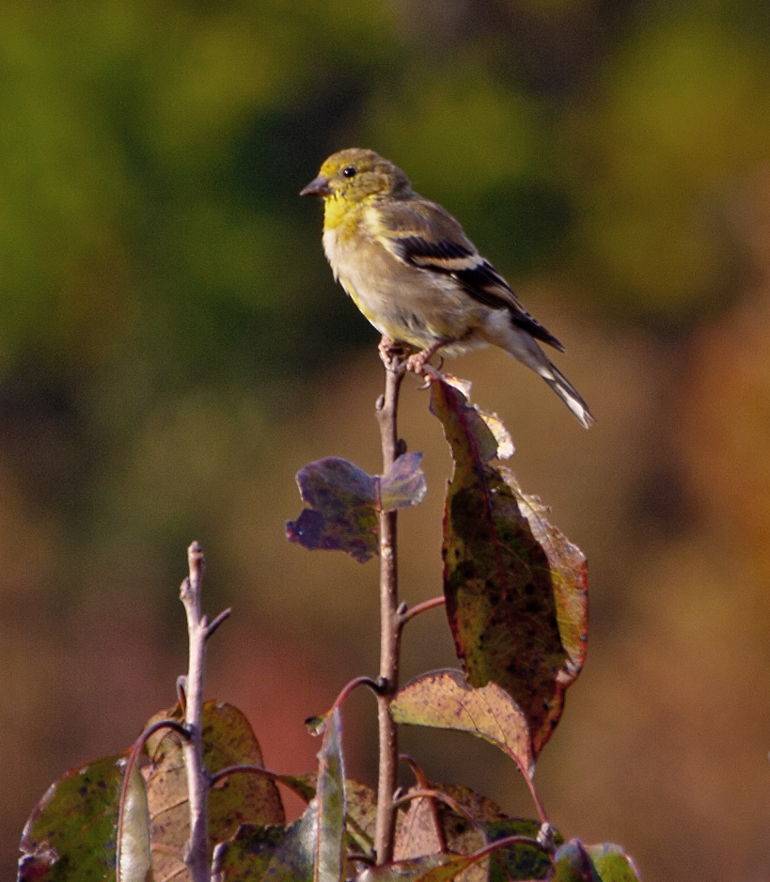
I am getting a little better at bird identification and can identify the birds in these photos as probably American Goldfinches (Spinus tristis). However, just went I thought I could differentiate between a male and a female, I found out that non-breeding males look a lot like females. Wow! This is getting more complicated. Here’s some of my favorite goldfinch shots from this past weekend, when there seemed to be quite a few goldfinchs feeding on the bushes at Huntley Meadows Park in Alexandria, Virginia.

American Goldfinch looking back at me

American Goldfinch in a tree

American Goldfinch perched at the top

American Goldfinch feeding

© Michael Q. Powell. All rights reserved.

Read Full Post »

As the weather has cooled off, there have been fewer and fewer dragonflies buzzing around in the marsh area. Occasionally I see a Common Whitetail dragonfly, but that has been pretty much it. This past weekend, however, I encountered some new, colorful dragonflies that I am pretty sure are Autumn Meadowhawk dragonflies (Sympetrum vicinum).

It was relatively early in the morning when some fellow photographers pointed out an orange-colored dragonfly perched on some leaves. According to their information, the dragonfly was unlikely to move until the temperature rose to about 70 degrees. I wasn’t so sure about their calculations and so I hastened to take some shots with my 55-250mm zoom lens. Here is an overall shot to give you an idea what an Autumn Meadhawk looks like (the sun was a bright and I couldn’t shield it so there are some unfortunate hot spots).

Autumn Meadowhawk dragonfly

Once I had a record shot, I became a bit bolder and decided to try my 100mm macro lens. The major problem I had was that the dragonfly was about a foot below me and about two feet away from me (I was on a raised boardwalk), so holding the lens steady was a problem. I did get a couple of close-up shots, like this one. I am always amazed when you can see the little hairs on a dragonfly’s “face.”

Close-up shot of Autumn Meadowhawk dragonfly

There were still some harsh shadows and hotspots, so I decided to use my collapsible diffuser to soften the light. Unfortunately, the dragonfly must have thought I was a predator, because it flew away as soon as I cast a shadow on it with the diffuser. Later that day, however, I encountered the Autumn Meadowhawks several times, but they refused to perch on plants, preferring to land on the boardwalk. Feeling a little frustrated, I took some shots of them on the boardwalk and ended up with the following image that I like, even if it’s not exactly a “natural” environment.
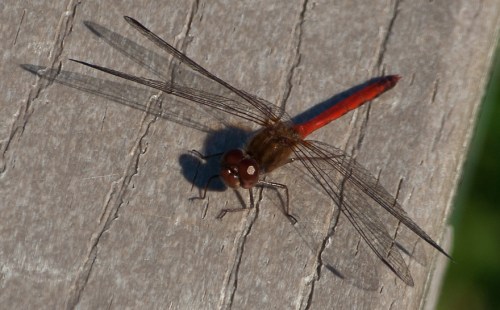
Autumn Meadowhawk dragonfly on the boardwalk

I am not sure how long these dragonflies will hang around, but it is nice seeing some new species as the seasons change, an unexpected bonus for me this past weekend.

© Michael Q. Powell. All rights reserved.

.

Read Full Post »

It’s the middle of October and grasshoppers are still hopping, though it seems that there are fewer of them than a month ago. This grasshopper was willing to stay still long enough to pose for this informal portrait. The sunlight was coming from the side and the back, helping to illuminate the underside of the grasshopper that is usually in the shadows and there is a nice glow to the grasshopper. I like the effect.

Illuminated fall grasshopper

© Michael Q. Powell. All rights reserved.

Read Full Post »

This weekend I learned some new things about woodpeckers. I always thought that woodpeckers were found exclusively in the trees. Isn’t it logical that woodpeckers need wood to peck? (It reminds me of the response attributed to Willie Sutton on why he robbed banks—”Because that’s where the money is.”) Well, I saw a woodpecker pecking at the stalks of cattails and other similar vegetation that clearly were not made of solid wood.

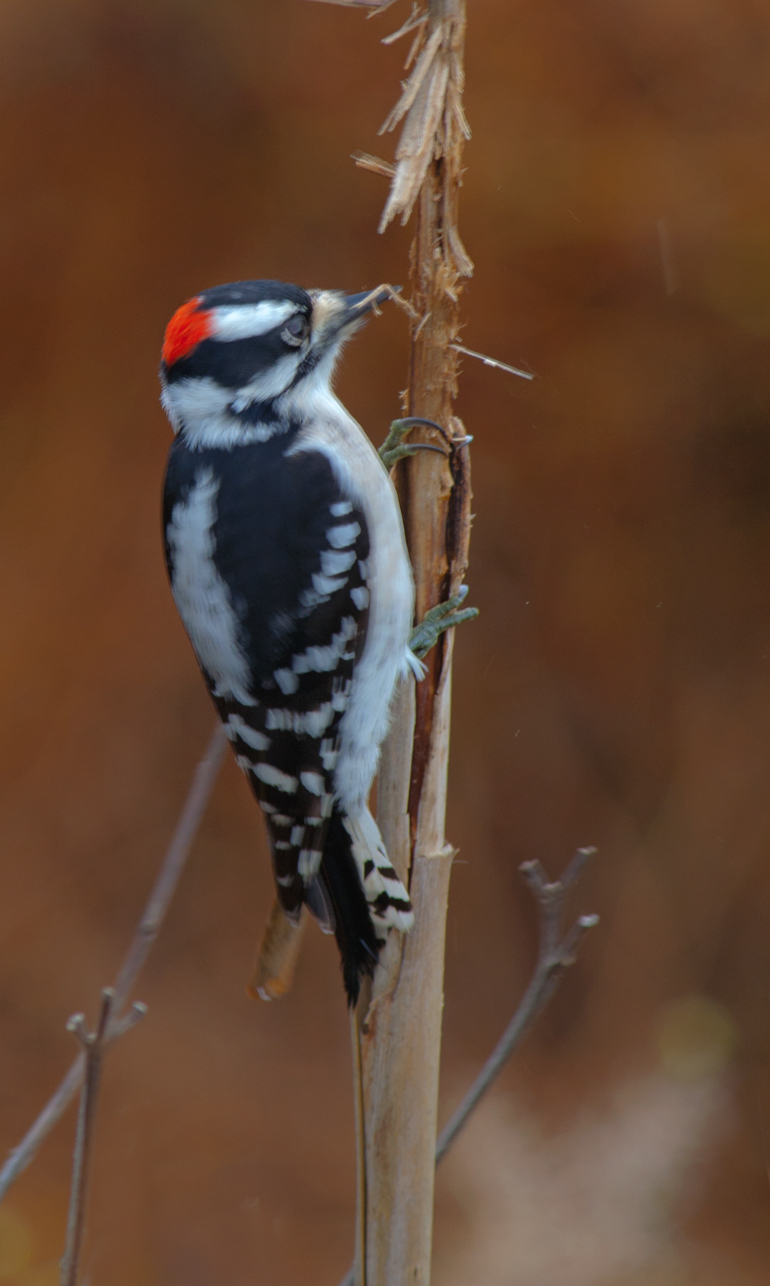
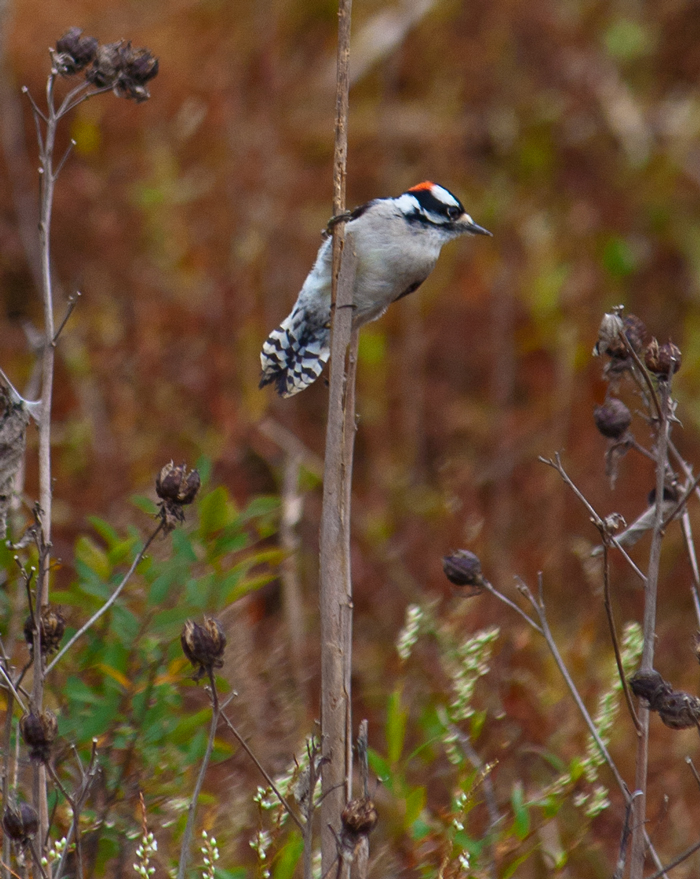
Secondly I learned that the woodpecker that had a big red spot on the back of his head was not a Red-Headed Woodpecker. Fortunately, it was not too hard to determine that the little woodpecker that I saw and photographed was a male Downy Woodpecker (Picoides pubescens). He was very active climbing up and down the stalks of a whole series of plants in the middle of a marsh and was a lot of fun to watch.

Here are a couple of photos of that beautiful bird. I am not sure that I did full justice to the blazing red color on his head that initially attracted my attention or to the wonderful black and white pattern of his feathers. I hope that I have another chance soon to see more woodpeckers and learn even more new things about them.

Male Downy Woodpecker in the field

Downy Woodpecker looks to the side

© Michael Q. Powell. All rights reserved.

Read Full Post »

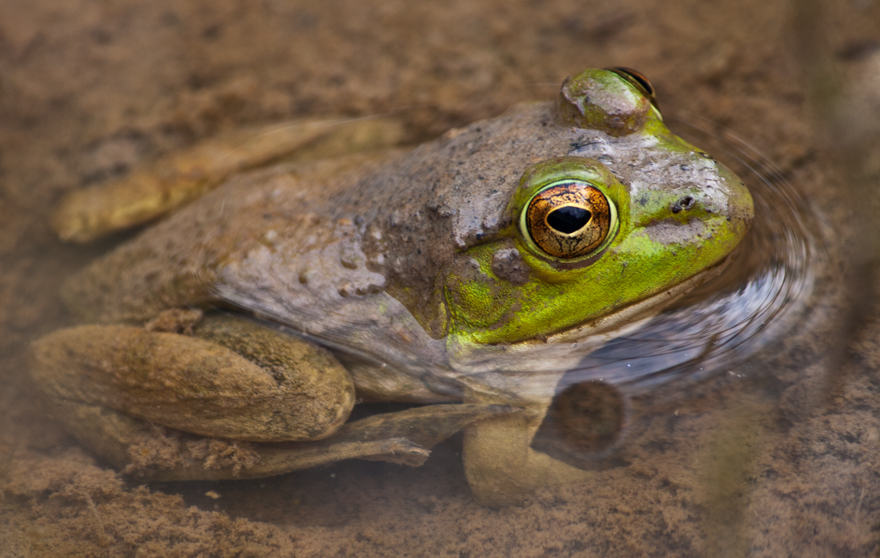
I have a confession to make—I really like to photograph little green frogs. Maybe it’s the influence of Kermit the Frog on my perceptions, but, whatever the reason, there seems to be something whimsical about frogs. Like this little frog that I photographed yesterday, they appear to have a perpetual half-smile, as though they find this world to be unceasingly amusing.

It brings to mind one of my favorite movies scenes, the opening sequence of The Muppet Movie, in which the camera gradually zooms in on Kermit, sitting on a log in the swamp and playing the banjo. The words of the song he is singing express the kind of eternal optimism to which I aspire, “Someday we’ll find it, the Rainbow Connection, the lovers, the dreamers and me.” (Here’s a link to the video of that scene on YouTube—I highly recommend that you take a couple of moments to relax with it, especially if you’ve never seen it before.) With all of the cares of everyday life, it’s hard to be a dreamer, it’s tough to see hope in rainbows, it’s not easy to see whimsey in frogs. It’s my hope, though, that we all can maintain (or rediscover) that child-like optimism about our world.

Fall frog

© Michael Q. Powell. All rights reserved.

Read Full Post »

It was just after 5:00 in the afternoon and storm clouds were gathering for rain showers that eventually came. I headed back to my car and just as I reached the parking lot I looked up. Beautiful late-afternoon light was shining on the tops of the trees with dark clouds in the background and I snapped a few shots. I decided to fight my temptation to tweak the image (for fear of messing up what I had) and didn’t crop at all.I did just a little sharpening and a slight increase in saturation. I don’t know if the image adequately (and accurately) captured the wonderful light, but it gives you an idea of what the scene looked like to me.

Stormy light

© Michael Q. Powell. All rights reserved.

Read Full Post »

Have you ever woken up on a fall morning and noticed the dewy grass and bushes littered with spider webs? I don’t mean the beautiful geometric-patterned webs of the orb-weaving spiders, but webs that appear to be nothing more than loosely woven sheets of spider silk. Normally I don’t give them a second glance, but one morning this weekend I stopped and looked at one of them more closely.

Close-up of web in the grass

I discovered a beautiful little world, filled with tiny beads of water, captured by the threads of the web. I think the spider is a grass spider of the genus Agelenopsis. Wikipedia notes that the webs of grass spiders are not sticky, but the spiders makes up for that by being able to run really quickly.

Here is a view of an entire web through a telephoto lens. I was on a walkway several feet above ground-level when I took the shots, so I was not able to get actual close-up shots. The photo is not a very good one, but it gives you an idea of how nondescript the web looked at first glance.

Web in the grass

© Michael Q. Powell. All rights reserved.

Read Full Post »
Early morning sunlight illuminates the cattails (and the webs in between them) in the marsh at Huntley Meadows Park in Alexandria, VA. Low hanging mist/fog that morning added a special beauty and mystery to the quietness of that fall morning.

(click on photo to see a higher resolution view)

© Michael Q. Powell. All rights reserved.

Read Full Post »

I arrived early at the marsh on a cool fall morning. The dew was heavy on the vegetation and the warmth of the rising sun was creating a fog-like list that hung over the field of cattails. Looking toward the west, I could see trees in the distance that were starting to show their glorious fall foliage and there was a soft illumination from the sun (as shown in the first photo). Looking in another direction, I could see darker shadows of the tress and a heavier mist (as shown in the second photo). You can see some golden light in the upper branches of the tree.

I am not sure that I was able to capture completely the inner peace I felt as I watched interplay of the light and the water on the cattails in the foreground and on the trees in the background. For a few moments, nothing else seemed to matter as I was caught up in the beauty of nature.

Morning mist and fall foliage

Morning mist and shadows

© Michael Q. Powell. All rights reserved.

Read Full Post »

The large yellow-and-black spiders (Argiope aurantia) that I have observed throughout the summer seem to have disappeared. I was hoping to see the egg sacs that they produce in the fall, but I guess I’ll have to wait until next year.

However, there must be spiders still around, because early yesterday morning there were quite a few dew-covered spider webs. Last month I did a couple of postings about webs at the same location at Huntley Meadows Park (see Amazing Spider Webs and More Spider Art), but I am so fascinated by the individuality of the webs that I thought I’d post one from yesterday (and I think there might be a few more shots coming). I do not know how the spiders figure out the designs of the webs, but it seems that there is creativity involved in fitting a web into a specific spot, even if there is a “standard” pattern for different varieties of spiders.

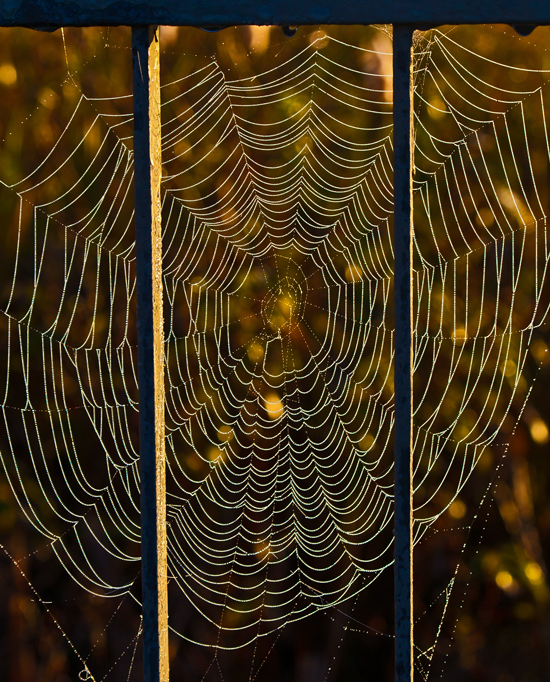
This web was located behind the railing of a little bridge that crosses part of the marsh land and joins two sections of a boardwalk. I was shooting into the sun that was still very low in the sky. The sunlight reflecting on one side of the railing suggests that I was not facing directly east. but was angled a little. Behind the web is a field of cattails, though you can’t really see any details.

Spider webs are like snowflakes for me (and it won’t be too long before we see them again). At first they all may seem to be the same, but when you take the time to look more closely at them, you realize each is unique. People are like that too.

Early morning spider web

© Michael Q. Powell. All rights reserved.

Read Full Post »

There was a lot of bird activity early yesterday morning as I walked through the cattail-filled marshy area of Huntley Meadows Park in Alexandria, Virginia. Many of the birds were in groups, it seemed, including large flocks of noisy black birds that several  of my fellow bloggers have helped me identify as grackles.

Most of the birds seemed to be be passing through and perched high in trees or landed too far away for me to capture them individually with my modest telephoto zoom. (Another photographer I saw had a massive 600mm telephoto lens with a 1.4x teleconverter attached and seemed to have greater success.)

However, I was able to take this photo of bird on a cattail stalk and amazingly I can identify it—it’s a male Red-winged Blackbird (Agelaius phoeniceus).  I realize that the Red-winged Blackbird is probably one of the easiest birds to identify (along with the robin, bluejay, and cardinal), but I have had so many problems recently identifying the birds in my photos that it is satisfying to be able get one right.

There were flocks of birders present too, equipped with telescopes and binoculars, and some of them were almost as loud as the grackles. I heard lots of interesting debates, like whether a large bird soaring in the distance was a red-shouldered hawk or a redtail hawk (and I had no idea previously that there was a bird called a Coopers hawk). Most of the bird people were so intense that I didn’t dare to attempt to engage them in conversation.  One gentlemen, however, talked with me at length, periodically referring to a tattered guide that he had with him (it was a Peterson’s guide to birds east of the Rockies and he recommended it for a beginner like me). I think that I may have to break down and buy a little guide like that to start to learn more about birds.

For now, I’m happy that I can identify a Red-winged Blackbird most of the time, especially a male one!

Red-winged Blackbird on a cattail

© Michael Q. Powell. All rights reserved.

Read Full Post »

As I was walking through the marsh land early this morning, a flock of very loud black birds flew overhead. I was surprised at how many there were and how noisy they were. I think they may be some kind of blackbird and that they are in the process of migrating. I managed to snap a few photos of some of the birds as they were flying. It is fun to look at all of the different body positions of the individual birds when I took the shots.

I especially like this first photo. It looks to me like the bird who is lagging behind is calling out to the other birds, requesting that they slow the pace a bit so that he does not fall behind. The birds look almost cartoonish and the photo just makes me smile.

“Please slow down.”

The second photo shows an even greater number of different positions. You may want to click on the photo for a higher resolution view so that you can appreciate the uniqueness of the individual birds.

Unsynchronized flying

© Michael Q. Powell. All rights reserved.

Read Full Post »

A little over a week ago I posted a photo of a brown pelican at the National Zoo in Washington, D.C. that was full of vivid colors in the pelican and in the reflections of light on the water. Today, I want to show the same pelican in a different way. I changed the angle of the camera and captured a background that was more somber and simple.  In post-processing I desaturated the colors a bit to place the emphasis on the textures of the feathers, the branch on which the pelican is perched, and the rock in the right hand corner. I toyed with the idea of going completely to black and white, but decided I liked the hint of a color in the beak and part of the pelican’s head, as well as on the branches. The overall look is more somber and perhaps a bit more formal.

I haven’t made my mind up yet whether I like this presentation of the brown pelican more than the previous one, but it certainly was fun experimenting with various settings in Photoshop Elements with the intent of making the colors less bright (usually I am moving in the opposite direction).

Somber brown pelican at the National Zoo

© Michael Q. Powell. All rights reserved.

Read Full Post »
Reflections often look much better than the original objects that are being reflected. The water (and the objects in the water, like the rocks in this photo) can distort the “reality” and add a different tonality and texture to the reflection. As I was walking along the edge of the water, I was happy to finally find a patch of foliage with the fall colors of my childhood, but the beauty was marred by the utility poles and traffic signs of my suburban area. The reflection seems to have cleansed the image of those blemishes and shows a purer, more beautiful view, a view closer to what my heart was seeing.

Fall reflection

© Michael Q. Powell. All rights reserved.

Read Full Post »
When it comes to photographing birds, it doesn’t take much to make me happy. If I can get a clear shot of a bird with a relatively uncluttered background, that constitutes a good photograph for me.  By that low standard, this image that I took a week ago is a successful one. My bird identification skills are still so weak that I won’t even hazard a guess at what kind of bird it is, but I like this modest image of this little bird.

Little bird feeding in the wild

© Michael Q. Powell. All rights reserved.

Read Full Post »
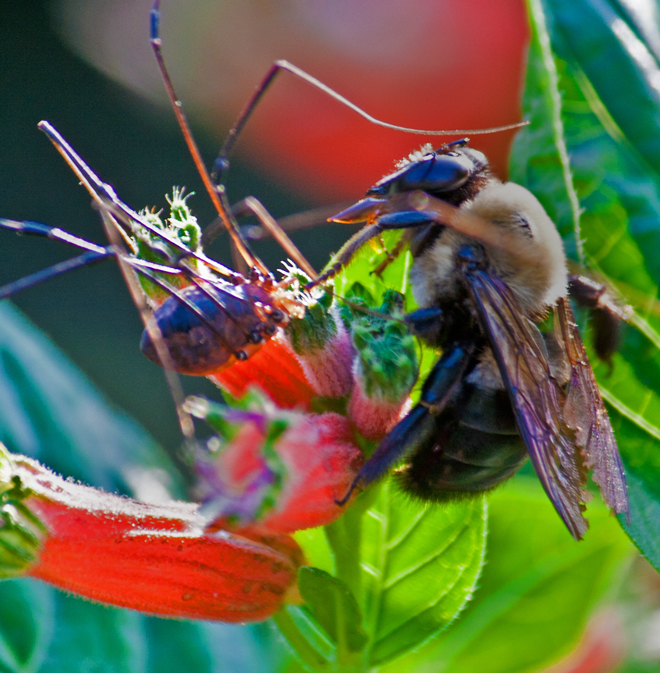
I am always fascinated whenever I happen to capture two different insects in a single image, especially when they appear to be interacting. A bee flew onto a flowering plant and appears to be having a conversation with a daddy longlegs (aka harvestman) that was already there. Does one of them look at the other as a potential prey? Are they sharing information? Is one asking the other out on a date?

Can you hear me now?

Insect interaction

© Michael Q. Powell. All rights reserved.

Read Full Post »

« Newer Posts - Older Posts »