Feeds:
Posts
Comments

Posts Tagged ‘Canon 50D’

One of the coolest turtles in our area is the Eastern Box Turtle (Terrapene carolina carolina), also known as the Woodland Box Turtle. Unlike many turtles, this one spends most of its time on land rather than in the water. I spotted this beauty, which is probably a male,  last weekend at Occoquan Bay National Wildlife Refuge as it was slowly making its way across a trail—males generally have red eyes and the females have brown eyes.

As I was doing a little research, I discovered that the Eastern Box Turtle is the official state reptile of North Carolina and Tennessee. Who even knew that states had official reptiles? According to an article in ncpedia.org, the General Assembly of 1979 designated the Eastern Box Turtle as the official State Reptile for North Carolina. Given that this was agreed in a legislative body, debates were held about the relative merits of this reptile versus other potential candidates.

I couldn’t help but laugh as I read the words of the preamble to the legislative bill that cited a variety of reasons why the box turtle was selected:

“Whereas, the turtle is a most useful creature who serves to control harmful and
pestiferous insects, and acts as one of nature’s clean-up crew, helping to preserve
the purity and beauty of our waters; and

Whereas, the turtle is derided by some who have missed the finer things of life,
but in some species has provided food that is a gourmet’s delight; and

Whereas, the turtle, which at a superficial glance appears to be a mundane and
uninteresting creature, is actually a most fascinating creature, ranging from
species well adapted to modern conditions to species which have existed
virtually unchanged since prehistoric times; and

Whereas, the turtle watches undisturbed as countless generations of faster hares
run by to quick oblivion, and is thus a model of patience for mankind, and a
symbol of this State’s unrelenting pursuit of great and lofty goals; and

Whereas, the woodlands, marshes, and inland and coastal waters of North
Carolina are the abode of many species of turtles; Now, therefore. . .”

As an interesting sidenote, Virginia, the state in which I live, has twice considered adopting this turtle as the state’s official reptile, but rejected the legislative proposals in 1999 and 2009. A posting on nbcwashington.com reported that during discussions in 2009, one delegate asked why Virginia would make an official emblem of an animal that retreats into its shell when frightened and dies by the thousands crawling across roads and counterproposed that the rattlesnake be chosen. The fatal blow, according to the posting, might have been the disclosure that the Latin name for the Eastern Box Turtle—Terrapene carolina carolina—implied too close a relation to a Virginia regional rival.

Eastern Box Turtle

© Michael Q. Powell. All rights reserved.

Read Full Post »

As I turned the corner of a trail at Occoquan Bay National Wildlife Refuge on Monday, I spotted a large bird perched high in a tree. It didn’t immediately fly away, so I figured it wasn’t an eagle. Zooming in, I realized I was wrong—it was a Bald Eagle (Haliaeetus leucocephalus) facing in the opposite direction.

I got lots of photos of the back of the eagle’s head, but decided that I wouldn’t share any of them. I knew that eventually the eagle would turn its head and tried to get ready. I snapped off a few photos, including the first one below, when the eagle turned its head and surveyed the area.

I don’t know if it was the noise of the shutter or if it detected motion, but the eagle spotted me and I was able to capture the second shot as it was preparing to take flight. I was thrilled, because this was the closest encounter that I had had with a bald eagle in a long time.

I continued down the trail and a short while later made a turn onto another trail. As I glanced to my left, I saw a perched eagle. I don’t know if it was the same one that I had just observed, but I managed to snap off a few more shots, including the third shot below. I like the way that I was able to capture a bit of the feel of autumn with the red leaves.

Bald Eagle

Bald Eagle

Bald Eagle

© Michael Q. Powell. All rights reserved.

Read Full Post »

When I spotted this bird on Monday at Occoquan Bay National Wildlife Refuge, it was facing away from me and I couldn’t immediately identify it. It had fluffed up its feathers and appeared to be basking in the sunlight.

When it finally turned its head slightly, I caught a glimpse of its red eyes and realized that it was probably an Eastern Towhee (Pipilo erythrophthalmus). All of the other times that I have seen towhees in the past, they have been foraging in the cluttered undergrowth, so it was a real treat to see one more or less in the open. As a bonus, the light coming from the left helped to illuminate some of the details of the bird’s beautiful feathers and the bird’s pose is quite different from that of a typical perched bird .

Eastern Towhee

© Michael Q. Powell. All rights reserved.

Read Full Post »

When I heard loud singing coming from the top of a tree, I glanced up and saw a shape that reminded me of a mockingbird. Looking more closely, I realized that the colors looked more like those of a female Red-winged Blackbird, but the shape of the body and behavior were not those of a blackbird. Although I was pretty far away, I noticed that the bird had startlingly light-colored eyes. What was this bird?

Thanks to its physical characteristics, it was not hard to locate this bird in my identification book when I got home—it is a Brown Thrasher (Toxostoma rufum).  According to the Cornell Lab of Ornithology, “Brown Thrashers are exuberant singers, with one of the largest repertoires of any North American songbird.” The same article notes that some early naturalists thought that the Brown Thrasher’s musical abilities are underappreciated, as compared with the mockingbird, which has received greater acclaim. “Brown Thrasher”  somehow sounds to me like it should be associated more with a heavy metal band than with this pretty bird. Maybe this bird needs a better marketing strategy and a public relations campaign.

The sky was heavily overcast the day I took these shots. Normally I don’t like the look of the washed-out skies, but in this case I really like the effect. One of my Facebook viewers commented that it made the photo that I posted (the first one below) look like an Audubon print.

Brown Thrasher

Brown Thrasher

Brown Thrasher

© Michael Q. Powell. All rights reserved.

Read Full Post »

Recently at Occoquan Bay National Wildlife Refuge, the only views I have gotten of Bald Eagles (Haliaeetus leucocephalus) have been of them flying away from me. Yesterday I got lucky and caught a glimpse through the foliage of one sitting in a distant tree in what appears to be a nest. Earlier this year, several roads in the refuge were closed after two eaglets were born. I don’t know if this was the nesting site, but suspect it might have been.

I was a long way away, but had a small visual tunnel through the trees that gave me a mostly unobstructed view of the eagle. I tried to move slowly, although I figured that the eagle was unaware of my presence. Apparently I underestimated the sharpness of the eagle’s vision, because it took off from the nest not long after I began shooting.

As I have said in the past, however, any day that I am able to see and photograph a Bald Eagle is a wonderful day.

Bald Eagle

Bald Eagle

Bald Eagle

© Michael Q. Powell. All rights reserved.

Read Full Post »

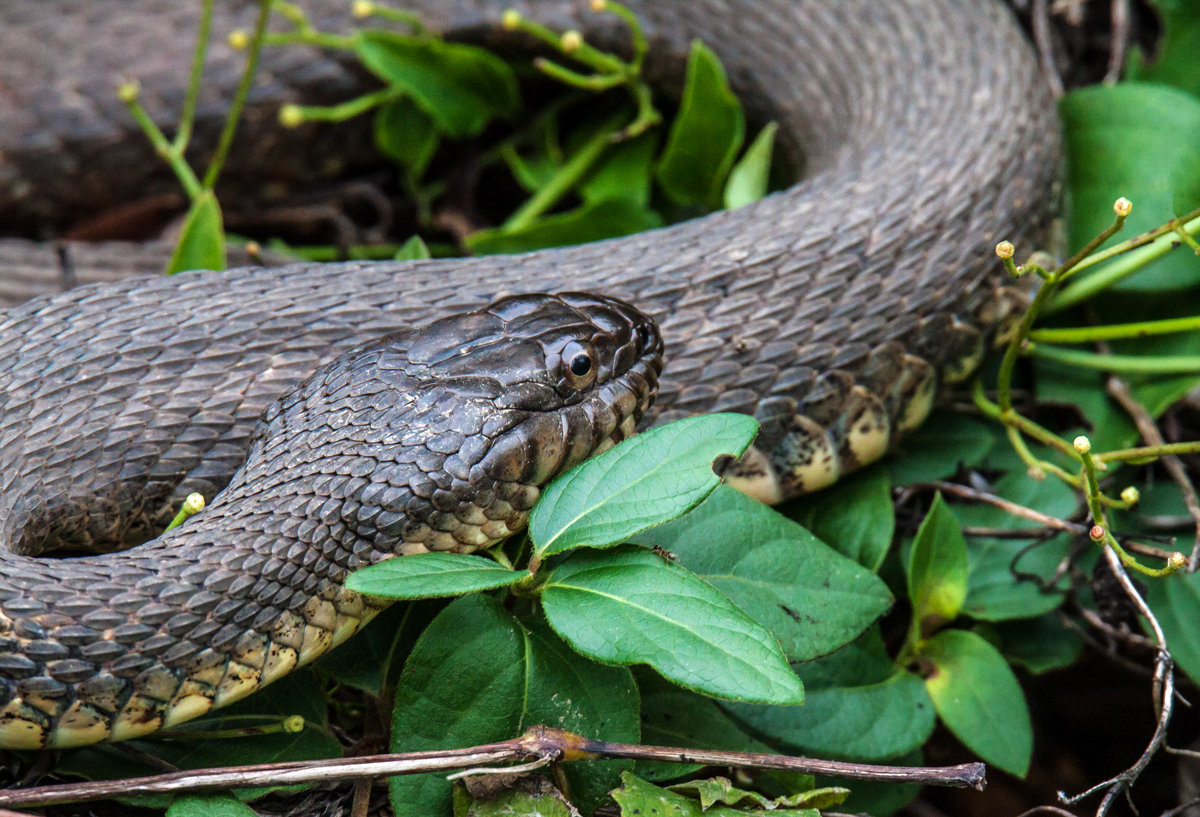
I spent much of my time Friday at Occoquan Bay National Wildlife Refuge scanning the trees for birds. On one of the rare moments when I was looking down, I ended up looking into the eyes of what appears to be a Northern Watersnake (Nerodia sipedon).

Although it may look like I was dangerously close to this snake, I took these shots with my Tamron 150-600mm lens, which has a minimum focusing distance of almost 9 feet (274 cm). Northern Watersnakes are not poisonous, but I have been told that their bites can be very painful and that the snakes inject an anti-coagulant when they bite, so wounds tend to bleed profusely.

I particularly like the way that I was able to capture some of the details of the snake, including its scales and its head. If you look closely, you can even see a miniature landscape in the eyes of the snake.

UPDATE: One of the viewers on my Facebook page commented that this looks more like an Eastern Ratsnake (Pantherophis alleghaniensis) than a Northern Watersnake. I am hoping to get some clarification on the species of this snake and would welcome the views of any readers with expertise in this area.

Northern Watersnake

Northern Watersnake

Northern Watersnake

© Michael Q. Powell. All rights reserved.


Read Full Post »

It was cool, wet, and a little breezy yesterday, not exactly a perfect day for photography, but I made a trip anyways to Occoquan Bay National Wildlife Refuge.  My persistence was rewarded when I was able to capture some images of several cute little Yellow-rumped Warblers (Setophaga coronata).

When it comes to warblers, I generally have two big problems. Warblers seem to like to perch in the center of clusters of branches and it is often virtually impossible to get unobstructed shots of them. Even if I am able to get a clear shot, I am faced with the equally daunting challenge of identifying the bird. There appear to be a large number of warblers with similar patterns and colors and there are innumerable variations based on season, age, gender, and region.

I was pretty confident that the birds in these images were Yellow-rumped Warblers, but for reassurance I checked with some experts on a Facebook birding forum. One of them humorously noted that this bird is often informally referred to as “Butterbutt.”

Yellow-rumped Warbler

Yellow-rumped Warbler

Yellow-rumped Warbler

© Michael Q. Powell. All rights reserved.


Read Full Post »

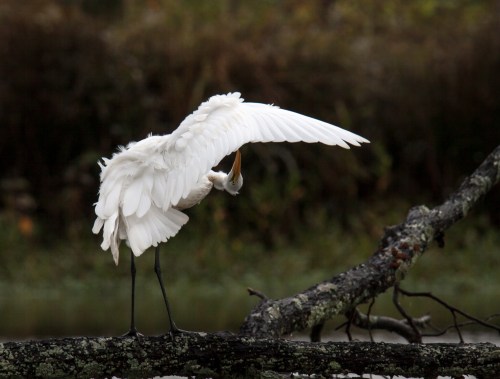
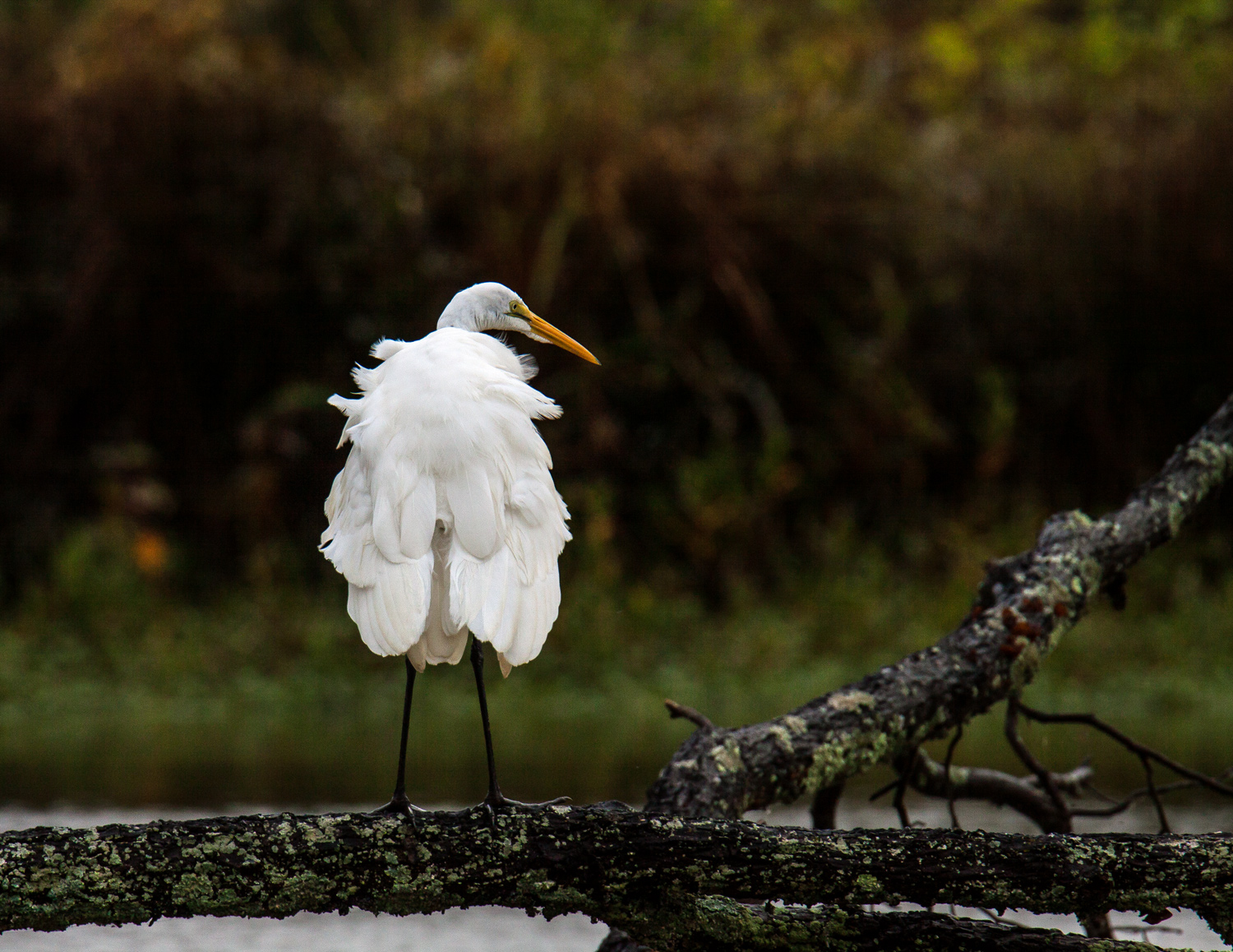
This Great Egret (Ardea alba) showed great balance and flexibility as it meticulously preened its feathers on Monday at Huntley Meadows Park. I would definitely need to see a chiropractor if I tried to imitate the position in the first image, assuming I did not completely fall over.

Great Egrets are relatively common in this park during the warmer months of the year, though they will soon depart for the winter. The Great Blue Herons, however, stay with us throughout the entire winter. I enjoy watching these large wading birds, never knowing when I will catch them in an unusual position or exhibiting an unusual behavior. The first shot is my clear favorite, because of the unusual body position, but I have included a couple of additional shots to show you various moments during the preening process.


Great Egret

Great Egret

Great Egret

© Michael Q. Powell. All rights reserved.

Read Full Post »


Read Full Post »

The heavy clouds and intermittent rain on Monday morning at Huntley Meadows Park limited the light and muted the colors, but in my eyes the beauty of this Eastern Bluebird (Sialia sialis) was in no way diminished.

The bluebird perched in a marshy area with lots of trees, so it was tough for me to get a clear shot. I was happy to find at last a gap between two lichen-covered trees that let me capture this image. A blue sky would have been nice, but I had to settle for the almost pure white sky that you see in the shot.

Eastern Bluebird

© Michael Q. Powell. All rights reserved.


Read Full Post »

It was dark and overcast yesterday morning at Huntley Meadows Park and became more eerie when a Turkey Vulture (Cathartes aura) started to circle lower and lower around me. Eventually it landed on the broken tip of a nearby tree.

After closing its wings initially, the vulture suddenly opened them wide and left them open for an extended period of time, perhaps to let them dry—it had been raining earlier in the morning. The wing position reminded me of the Double-crested Cormorants that I occasionally see with wings extended to dry them after an underwater dive.

Turkey Vulture

Turkey Vulture

Turkey Vulture

© Michael Q. Powell. All rights reserved.

Read Full Post »

Do you ever get so obsessed with a single species that you return over and over again to the same location, seeking another glimpse (and hopefully more photos) of that species? Generally I describe myself as an “0pportunistic” shooter—I like to walk around and photograph whatever I happen to see—and only rarely do I have specific goals for a photo shoot.

My normal approach changed this past month as I became somewhat obsessed with the Fine-lined Emerald dragonfly (Somatochlora filosa). My good friend and local dragonfly expert Walter Sanford encouraged me to seek out this rare species, which has been seen at only a single location, Occoquan Bay National Wildlife Refuge, in our area. I started spending most of my free time at this wildlife refuge, rather than at Huntley Meadows Park, my most frequent shooting location.

Mostly on my own, though occasionally shooting with Walter, I learned more and about this species, including its preferred perches and patrolling techniques. Over time, I learned to recognize Fine-lined Emeralds as they flew towards me at knee-level with their shiny green eyes glinting in the sunlight and spent endless hours chasing after them. Eventually I acquired a collection of shots of them perching and even managed to capture an image of one in flight and some shots of a couple mating.

I was painfully aware that, as the old saying indicates, all good things must come to an end. The excellent website Dragonflies of Northern Virginia showed the record late date for this species of 4 October in our area, so last Friday, 6 October, I went out to shoot with high hopes, but low expectations. I was thrilled to have multiple sightings of Fine-lined Emeralds during the day and the images below are among my favorites of the day.

We have now entered into a period of rain in our area and I fear that I may have seen my final Fine-lined Emerald dragonfly for the year. I am a bit stubborn and unusually persistent, though, so I may make a trip again on Friday, my next free day for shooting, hoping against the odds to see my Fine-lined friends one more time.

Fine-lined Emerald

Fine-lined Emerald

Fine-lined Emerald

© Michael Q. Powell. All rights reserved.

Read Full Post »

Some movement in the leaves of a tree at Occoquan Bay National Wildlife Refuge caught my eye on Friday afternoon. I thought it might be a squirrel, but it turned out to be a pretty large praying mantis. There is entire order of mantises (Mantodea) that includes over 2400 species, according to Wikipedia, so I hope that you can forgive me for not identifying the specific species of this praying mantis.

I love how well its shape and color help it to blend in with its surroundings—if it hadn’t moved, I am pretty sure that I would never have noticed it.

praying mantis

© Michael Q. Powell. All rights reserved.

Read Full Post »

A small flock of wild turkeys yesterday at Occoquan Bay National Wildlife Refuge moved off of the trail and into the woods as I approached. Peering through the vegetation a few seconds later, I was able to catch a glimpse of one of them that may have though it was well hidden.

It would be hard for me to say that Wild Turkeys (Meleagris gallopavo) are beautiful, but they sure do have a distinctive look.

wild turkey

© Michael Q. Powell. All rights reserved.
Read Full Post »

Autumn seems to be the season for migration—it’s hard to miss the flocks of honking geese that fill the skies and mysterious warblers taunt me with their songs from hidden haunts behind the foliage as they rest before continuing their journeys. Did you know that some species of dragonflies are also migratory?

Most of the migratory species unsurprisingly spend a lot of time in the air. They are visible as they pass through our area, but are tough to photograph. This past weekend I manage to get shots of two of the migratory species at Occoquan Bay National Wildlife Refuge. The first one is a Wandering Glider (Pantala flavescens) and the second is a Black Saddlebags (Tramea lacerata). What really stands out to me is the perfect condition of their wings, in contrast to the wings of the remaining resident dragonflies that are often tattered and torn this late in the season.

Wandering Glider

Black Saddlebags

© Michael Q. Powell. All rights reserved.

Read Full Post »

As October begins, I renew my search for red dragonflies. Autumn is quite naturally the season when Autumn Meadowhawks (Sympetrum vicinum) appear along with their more gaudily-colored brethren, the Blue-faced Meadowhawks (Sympetrum ambiguum). Both of these species have bright red bodies that should be easy to spot, but they like to perch low to the ground and sometimes even on fallen leaves, so you really have to pay attention.

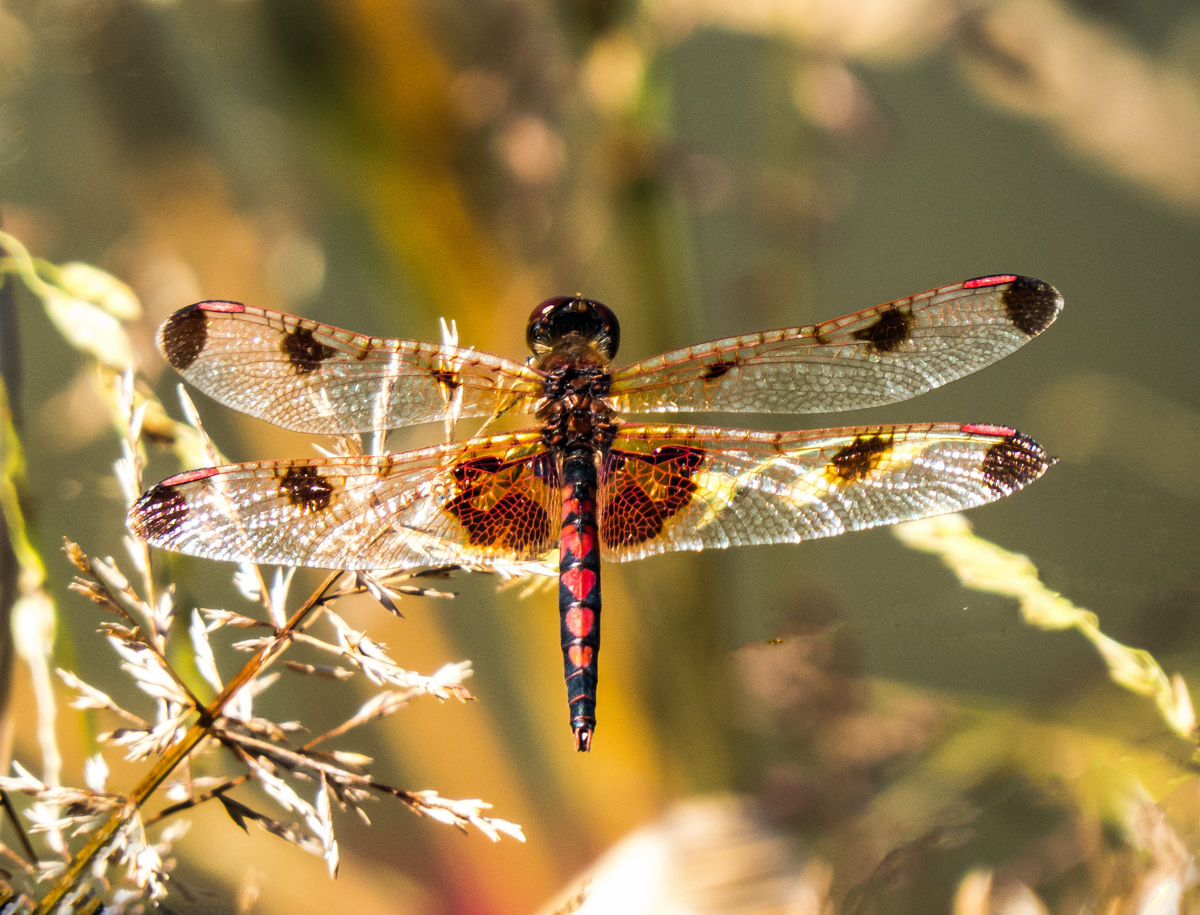
I was a bit shocked on Monday to see some other small red dragonflies—at least three male Calico Pennant dragonflies (Celithemis elisa) were active at a small pond at Occoquan Bay National Wildlife Refuge. Calico Pennants are generally a summer species and I have featured them a couple of times earlier this year in this blog. According to the Dragonflies of Northern Virginia website, their peak flight time is June to July and their late date is 23 September (I saw the one below on 2 October).

There are still other active dragonflies, but over time their numbers will continue to drop. Autumn Meadowhawks, though, usually stay with us into December and, if I remember correctly, occasionally even into January. I’ll be continuing my October hunt for red dragonflies into November and beyond.

Calico Pennant

Calico Pennant on 2 October at Occoquan Bay National Wildlife Refuge


Blue-faced Meadowhawk

Blue-faced Meadowhawk at Occoquan Bay National Wildlife Refuge


Autumn Meadowhawk

Autumn Meadowhawk at Occoquan Bay National Wildlife Refuge

© Michael Q. Powell. All rights reserved.

Read Full Post »

As we move inexorably deeper into autumn, more and more flowers and leaves are fading and falling. Many of the familiar dragonflies of the summer also are disappearing. I was heartened yesterday at Occoquan Bay National Wildlife Refuge to spot this Fine-lined Emerald dragonfly (Somatochlora filosa), a survivor that is tattered and torn, but is still flying in October.

I mentioned in a recent blog posting that I am experimenting with carrying two cameras with me when I go out shooting. The first photo was shot with my Canon SX50, a super-zoom camera and the second was taken with my Canon 50D DSLR. The depth of field is so shallow with the DSLR, normally shooting close to the 600mm end of my zoom lens, that it seems more ideal for shots like the second image where the subject is flatter. The SX50 gives me more depth of field and I love the way that it allowed me to capture the background as circles of color.

Fine-lined Emerald

Fine-lined Emerald

© Michael Q. Powell. All rights reserved.

Read Full Post »

The early morning light was soft and beautiful, allowing me to capture these images of a young Turkey Vulture (Cathartes aura) on Saturday at Occoquan Bay National Wildlife Refuge. I am not sure I have ever seen a vulture look so handsome (and maybe even a little cute in the second photo).

Turkey Vulture

Turkey Vulture

© Michael Q. Powell. All rights reserved.
Read Full Post »

As I looked down one of the trails yesterday morning at Occoquan Bay National Wildlife Refuge, I spotted a group of large birds sprawled across the entire width of the trail. Having seen Wild Turkeys (Meleagris gallopavo) a couple of times at this refuge, I correctly identified them, but I couldn’t figure out what they were doing. I later learned from the website of the National Wild Turkey Federation that wild turkeys use dust baths as part of their preening and plumage maintenance.

wild turkey

I tried to be stealthy and moved quietly forward, but the trail was wide and clear and the turkeys became aware of my presence. The flock slowly moved away— several of the turkeys flapped their wings to get a little additional momentum. I was uncertain if wild turkeys can fly and was surprised to learn from one internet source that wild turkeys can fly swiftly, with a maximum speed of 55 miles per hour (88 kph) and can run up to 25 mph (40 kph).

wild turkey

After a brief period of frantic movement, the birds settled down and began to forage. They seemed a little confused and looked around in different directions. When I got a bit closer, they eventually decided to move into the woods and did so in a rather leisurely fashion.

wild turkey

I could not tell for certain, but it looked to me that this flock of turkeys was made up of females and juveniles—I did not see any of the turkeys that look like the stereotypical male turkeys that are featured in the run-up to Thanksgiving. I will be alert for any sign of those males during future trips to this wildlife refuge.

© Michael Q. Powell. All rights reserved.

Read Full Post »

I am becoming convinced that dragonflies are rulebreakers. Yesterday I noted that dragonflies do not always follow the rules and can sometimes be found in habitats where they are not supposed to be. Apparently they also do not know how to follow a calendar and can sometimes be found earlier or later than the rules and records indicate they will be present.

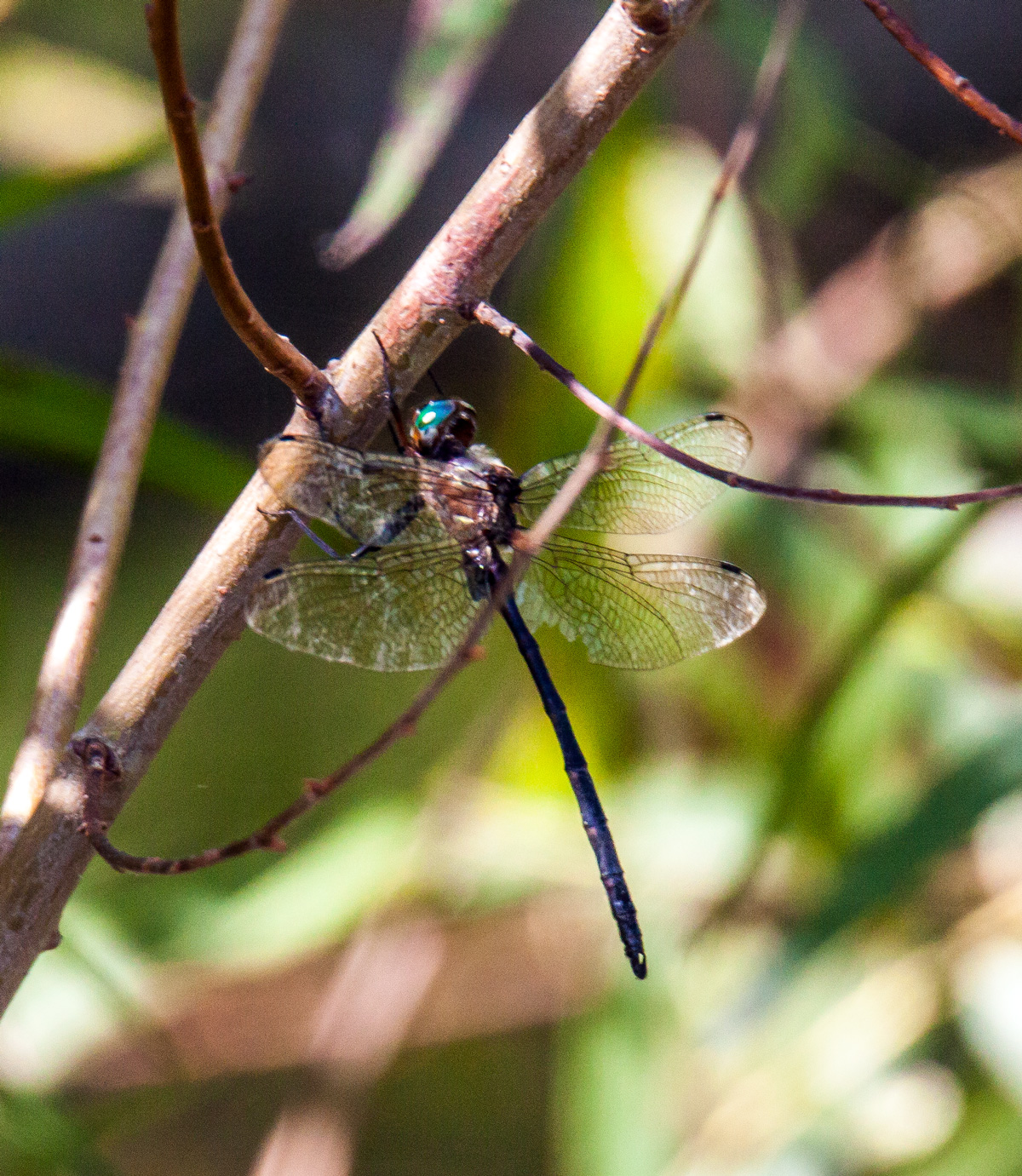
This past Monday I was back at Occoquan Bay National Wildlife Refuge, searching again for the rare Fine-lined Emerald dragonflies that I had seen there previously. When I saw a dragonfly with bright green eyes perch in a distant tree, I naturally assumed that it was a Fine-lined Emerald. It is getting to be late in the dragonfly season, so many other species are no longer present. The dragonfly never got any closer, so I had to be content with my long-distance shots.

When I pulled up the images on my computer, something didn’t look quite right. The shape of the body seemed a little different from the Fine-lined Emeralds that I had seen previously and the tips of the abdomen (the “terminal appendages”) also looked different. I consulted with some dragonfly experts and they identified the dragonfly to me as a Mocha Emerald dragonfly (Somatochlora linearis). I have seen this species before, but in a totally different environment and much earlier in the year, so I had mentally removed it from consideration.

Now I don’t feel too bad about missing the identification, because the two species are part of the same genus Somatochlora, also known as Striped Emeralds. The website Dragonflies of Northern Virginia indicates that the flight records for the Mocha Emerald are from 16 June to 16 September—I guess that window can now be extended a little.

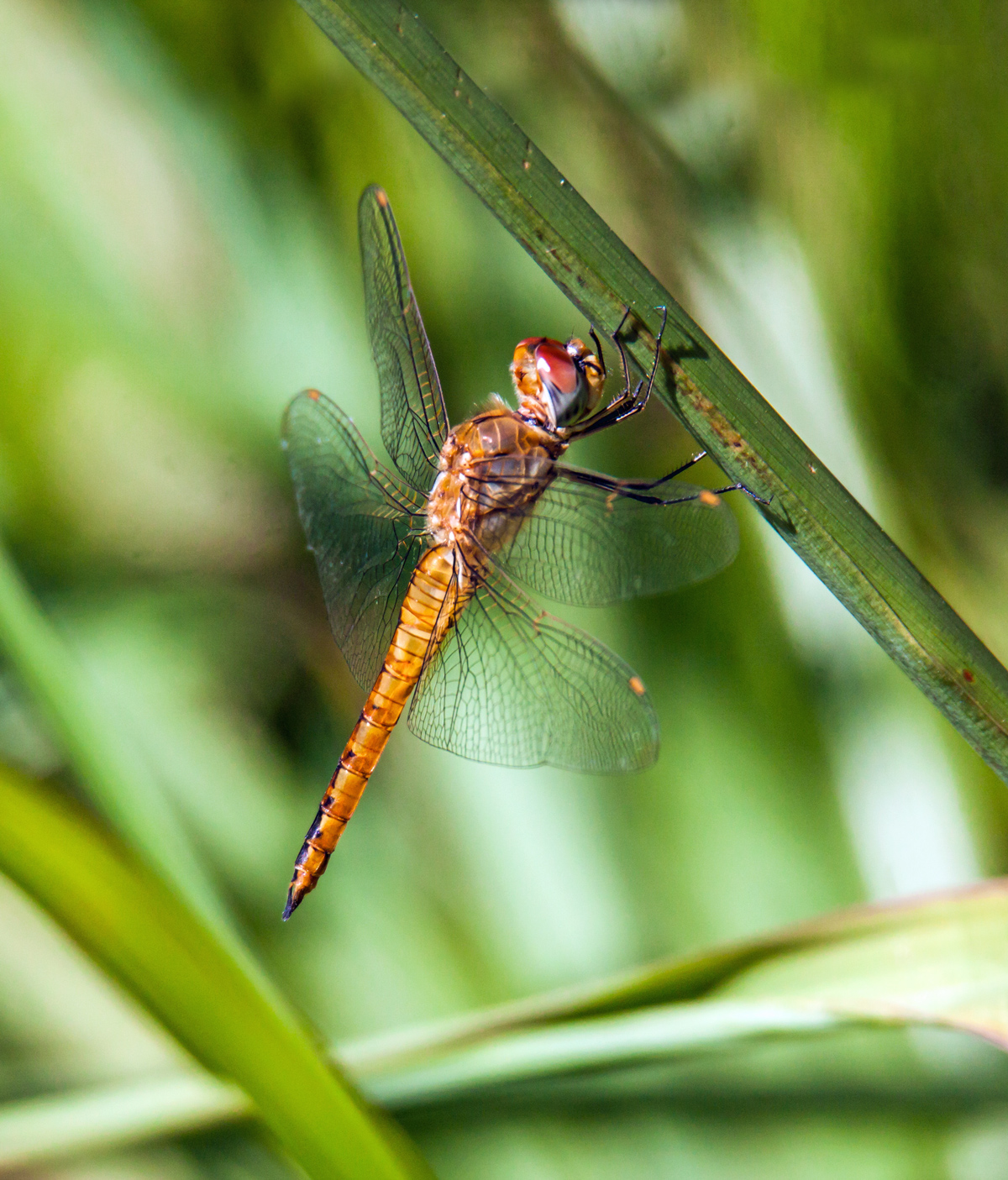
I am including two photos of the Mocha Emerald that may look almost identical, but were shot with two very different cameras. The settings for the cameras were almost the same with an aperture of f/7.1 and a shutter speed of around 1/400 of a second and both were handheld. The first shot was with my Canon 50D DSLR and Tamron 150-600mm lens. Taking into account the crop factor of the camera, the field of view was equivalent to 960mm. The second shot was with my Canon SX50 with a field of view that was equivalent to 1200mm.

The DSLR was a lot heavier and a lot more expensive, but produced a more out-of-focus background. The Canon SX50 was cheaper, lighter, and brought me in closer to the subject. It’s clear to me that equipment did not make a huge difference in this case and that there are advantages and disadvantages to each system. I am increasingly drawn to the idea of carrying both with me for the moment and continuing to experiment with them.

The other big lesson that I continue to learn is to expect the unexpected. As I am discovering, subjects may pop up in places and at times when you least expect them.

Mocha Emerald

Mocha Emerald

© Michael Q. Powell. All rights reserved.
Read Full Post »

For the last couple of weeks I have been chasing male Fine-lined Emerald dragonflies (Somatochlora filosa) around Occoquan Bay National Wildlife Refuge in Northern Virginia in a series of patrolling and perching encounters. One day this past weekend a couple flew by me in wheel position, i.e. they were locked together in a mating position and were still able to fly. I was able to get a few shots of them when they landed nearby. Eventually they changed positions and hung together in tandem. Unfortunately I lost sight of them for a second and I didn’t see them actually fly away

Readers of this blog have seen multiple shots of mating dragonflies, but this was a really special encounter for me. Why? This species of dragonflies is pretty rare, both locally and nationally. As Kevin Munroe described it on his wonderful Dragonflies of Northern Virginia website, “One of Northern Virginia’s most rare dragonflies, possibly our rarest, this species is seldom seen and little known throughout its range, from New Jersey to Florida, and west to Kentucky and Texas. Most field guides describe its breeding habitat as “unknown”.” It is reassuring to see this species breeding in our area, so there is a chance I will see them again next year and in the future.

In the section of his website dealing with the Fine-lined Emerald, Kevin included a photo from 2012 of a pair of these dragonflies mating with a caption that indicated it was “the only record of this species breeding in N VA.” I don’t know if others have captured images of mating Fine-lined Emeralds more recently, but it is cool to realize that I am part of a really small group of folks who have documented this behavior.

Early this week I went back to the same area, hoping to find another mating pair, but was unsuccessful. I’d like to be able to learn how and where the females lay their eggs. I was told by one dragonfly expert on a Facebook forum that egg-laying behavior for this species has been observed and documented only once. I tend to think of myself as more of an artist than a scientist. I am, however, motivated by an almost overwhelming sense of curiosity that pushes me outdoors more and more frequently with my camera, striving and hoping to capture more interesting subjects and situations that I can share with others. Who knows, maybe I will be able to find out where female Fine-lined Emeralds hang out and deposit their eggs.

Fine-lined Emerald

Fine-lined Emerald dragonflies in wheel position


Fine-lined Emerald

Fine-lined Emerald dragonflies in tandem position

© Michael Q. Powell. All rights reserved.

Read Full Post »

For several years I have been on a quest, seeking to find a dragonhunter. No, I have not been playing a medieval role-playing game—I have been searching in vain for one of the monsters of the dragonfly world, the Dragonhunter (Hagenius brevistylus)As its name suggests, this fierce predator feeds on other insects, including darner and other clubtail dragonflies, sometimes ambushing them from above, according to Wikipedia.

As I was walking yesterday along one of the trails at Occoquan Bay National Wildlife Refuge, I was certainly not expecting to see a dragonhunter. Most of the time they perch in trees overhanging streams and wait for a prey to fly by. So when I saw a dragonfly perch vertically on the stem of a plant, I assumed that it was a Fine-lined Emerald or possibly a Russet-tipped Clubtail, species that I had previously encountered near this location.

When I zoomed in, I noticed that the coloration was different, but thought perhaps that it was a merely female of one of these two species. When I reviewed a couple of shots on the back of the camera and saw the bright yellow stripes on the thorax, I knew that I had captured images of a different species. I wasn’t sure what it was, but local dragonfly expert and fellow blogger Walter Sanford identified it for me as a male Dragonhunter.

This experience reminded me of one of the lessons that Walter has taught me over the years—it pays to be alert at all times, because dragonflies don’t always follow the “rules” when it comes to habitats and can sometimes be found in locations where you would never expect to find them.

dragonhunter

dragonhunter

© Michael Q. Powell. All rights reserved.

Read Full Post »

The red leaves surrounding this Common Yellowthroat (Geothlypis trichas) that I spotted in a distant tree recently at Jackson Miles Abbot Wetland Refuge serve as a reminder that the autumn has begun. Leaves are starting to fall from many of the trees and some of them are starting to change colors, though the colors never seen so bright and vibrant as the trees in my native New England.

Initially I was not going to post this photo, because I was not able to get a detailed shot of the bird, but the more I look at the image, the more I like the environmental surroundings of the beautiful little bird.

Common Yellowthroat

© Michael Q. Powell. All rights reserved.

Read Full Post »

Black Saddlebags dragonflies (Tramea lacerata) spend most of their time flying, so it was a rare treat to spot this beautiful female perching recently at Occoquan Bay National Wildlife Refuge. In the second image you can see the distinctive blotches on the dragonfly’s wings that make it look like it is wearing saddlebags, but the first image is my overwhelming favorite—the unique pose, the delicate coloration of the eyes, and the “artsy” overall feel of the first shot produce an emotional reaction in me than the more clinical second shot.

Do you prefer one image more than the other?


Black Saddlebags

Black Saddlebags

© Michael Q. Powell. All rights reserved.

Read Full Post »

As soon as I saw the flash of yellow, I knew that these little birds were almost certainly warblers and not sparrows. When it comes to most warbler species, that’s the full extent of my identification skills. Most years when the warblers come through our area in the spring and in the fall, I can hear the warblers in the trees, but I rarely see them.

I initially thought that the bird in the first shot was a Yellow-rumped Warbler, but it turns out that my knowledge of bird anatomy is lacking. The area that is yellow on this bird is the undertail area and not the rump, which is more on the top. So what are these birds? A helpful birder in a Facebook forum identified them to me as Palm Warblers. (Setophaga palmarum).

With a little luck, I’ll get some more shots of warblers in the coming weeks and will undoubtedly have to rely on others to assist me in identifying them, though I need no help in appreciating their beauty.

Palm Warbler

Palm Warbler

Palm Warbler

© Michael Q. Powell. All rights reserved.

Read Full Post »

I never know what I will see when I go out with my camera. This morning at Occoquan Bay National Wildlife Refuge I spotted a small flock of Wild Turkeys (Meleagris gallopavo). They disappeared into the brush as soon as they became aware of my presence, but I did manage to capture a few images. I pretty sure that the turkey in both of these shots is a female.

Wild Turkey

Wild Turkey

© Michael Q. Powell. All rights reserved.

Read Full Post »

Peering through the vegetation at Occoquan Bay National Wildlife Refuge this past Monday, I spotted several large birds at the edge of the water. I thought they might be eagles or ospreys, but they turned out to be Black Vultures (Coragyps atratus) that appeared to be foraging as the tide was going out.

Black Vulture

Black Vulture

Black Vulture

© Michael Q. Powell. All rights reserved.

Read Full Post »

As I was loading camera gear into my car on Monday at Occoquan Bay National Wildlife Refuge, I noticed that I had a tiny hitchhiker—a crab spider that looked ready to embrace me with open arms. After photographing the cute little spider, I released it into a grassy area, where it seemed more likely to catch something to eat than on the roof of the car.

I do not have much experience with crab spiders, but think this one might be a Goldenrod Crab Spider (Misumena vatia). As always, I would welcome a correction or confirmation if you are knowledgeable about spiders.

crab spider

© Michael Q. Powell. All rights reserved.

Read Full Post »

Different dragonfly species rest in varying positions. Some of them hang vertically, but most of them perch at somewhat of an acute angle. Last week when I spotted this male Swift Setwing dragonfly (Dythemis velox), I was struck by the degree to which its rigid position reminded me of the diagrams of a right angle in my geometry textbook when I was a schoolboy—the dragonfly and the plant stem seemed to form an almost perfect 90 degree angle. One unusual thing about Swift Setwing dragonfly is the way that it holds its wings forward when perched and not straight out as most dragonflies do. Perhaps it helps to counterbalance the effects of gravity and helps it hold its abdomen so high for so long.

Swift Setwing

© Michael Q. Powell. All rights reserved.

Read Full Post »

For quite some time I chased after a male Fine-lined Emerald dragonfly (Somatochlora filosa) one morning last week at Occoquan Bay National Wildlife Refuge, but it seemingly had endless energy and would not stop to perch. Unwilling to give up, I decided to try to shoot him in mid-air as he patrolled a section of a trail.

As you might suspect, it is pretty challenging to shoot dragonflies in mid-air. If you have a high-end camera with a really good focusing system and a fast, responsive lens, you might be able to use auto focus, assuming you  are able to track the dragonfly in your camera’s viewfinder. I was using my somewhat older Canon 50D DSLR, a camera that was made starting in 2008, and my Tamron 150-600mm zoom lens, which is sometimes slow in acquiring focus, so I was focusing manually. In this situation, I was helped a little by the fact that the dragonfly would hover a bit from time to time, although usually he would do so while facing away from me.

Patience and persistence paid off and I was pretty excited when I was able to capture this shot.

Fine-lined Emerald

© Michael Q. Powell. All rights reserved.

Read Full Post »

It seems a little late in the season for Calico Pennant dragonflies (Celithemis elisa) to be mating, but I nevertheless spotted this couple in action this past Saturday at Occoquan Bay National Wildlife Refuge in Woodbridge, Virginia. In case you are curious, the male is the red one near the top of the image that is clasping the female by its head. I like the way that the soft background and simple composition draw our eyes to the shapes, colors, and patterns of the dragonflies, rendering the subject in a beautifully abstract way.

calico pennant dragonflies

© Michael Q. Powell. All rights reserved.
Read Full Post »

« Newer Posts - Older Posts »