Feeds:
Posts
Comments

Posts Tagged ‘Canon 50D’

When you check out spider webs really carefully, you can often discover really cool-looking tiny spiders, like this Arrowhead Orb Weaver spider (Verrucosa arenata) that I spotted yesterday at Occoquan Bay National Wildlife Refuge. If you look really closely in between its uppermost legs, you can see some of its multiple eyes looking straight at you. Information on BugGuide.net indicates that this spider is unusual because it rests in the web with its head up, not head down like most other Orb Weavers.

It’s hard to get a sense of scale when you look at this image, but I’d estimate that this little spider was less than an inch in length (25 mm). It was hanging in the air in its web at the edge of a trail when I first spotted it. I was able to move in pretty close with my macro lens—unlike many other spiders, it did not scurry away to the edge of the web. Sharpness is always an issue when shooting at at close range, but my monopod helped to steady me enough to get a relatively sharp image.

You may not like spiders, but you have to admit that this is a cool-looking spider.

Arrowhead Orb Weaver

© Michael Q. Powell. All rights reserved

Read Full Post »

Dragonflies have amazing compound eyes that wrap around their heads. With up to 30,000 facets (ommatidia, to be technical), dragonflies have incredible vision and can even see colors beyond human visual capabilities, like UV light. For an easy to read discussion about dragonfly eyes, i.e. not overly scientific, check out this posting by “grrl Scientist” that was posted on scienceblogs.com.

I captured this close-up image of a Great Blue Skimmer dragonfly (Libellula vibrans) yesterday at Occoquan Bay National Wildlife Refuge. At least once a season, I manage to get a shot like this when a cooperative dragonfly lets me get close. I captured the image below with my trusty Tamron 180mm macro lens on my Canon 50D DSLR. This lens, which has a longer focal length than most macro lenses, gives me some stand-off distance so I can get a macro shot like this without actually being on top of the subject. The only downside to the lens is that it has no built-in image stabilization, so I have to pay extra attention to remaining steady when shooting with it—I generally use a monopod to help reduce camera shake and I think it helped for this image.

The image is framed just as I saw it in my viewfinder. Most of the time I end up cropping my images as part of my normal post-processing, but in this case it looked pretty good without any cropping whatsoever.

Great Blue Skimmer

© Michael Q. Powell. All rights reserved

Read Full Post »

Sometimes when I have my camera in my hands, my attention is drawn to the amazing shapes, colors, and pattern of the natural world—I don’t need a specific animate subject to shoot. Here are a few of my more abstract shots from Monday at Occoquan Bay National Wildlife Refuge.

Even though I may not have had a main subject, in the traditional sense,I wouldn’t say that I was photographing nothing—au contraire, I was photographing everything.

ferns

grass

lily pads

© Michael Q. Powell. All rights reserved

Read Full Post »

I just love the colors of this Red Admiral butterfly (Vanessa atalanta) that I photographed on Monday at Occoquan Bay National Wildlife Refuge. I mean, really, how can you not like an insect that sports the red, white, and blue?

You don’t have to be American to like those three colors—it seems like there are an awful lot of countries that use them in various shades and patterns in their national flags.

Red Admiral

© Michael Q. Powell. All rights reserved

Read Full Post »

I was thrilled to capture some shot of a Spicebush Swallowtail butterfly (Papilio troilus) this past weekend at Green Spring Gardens as it fed on a lantana flower. I am so used to more muted colors when I am shooting in the “wild” that the brightness of these flowers seem almost unnatural.

If you look closely at the butterfly’s legs in the first image, you will see that one of them is blurred. Obviously the butterfly was moving about and my camera’s shutter speed was too slow to stop the motion. In many cases I would be disappointed with that lack of sharpness, but I find that it acceptable here, because it doesn’t really distract the viewer’s eyes.

There are a number of dark-colored swallowtails in our area, but the Spicebush Swallowtail is the only one with a blue swoosh on its wings in the middle of a row of orange spots.

Spicebush Swallowtail

Spicebush Swallowtail

© Michael Q. Powell. All rights reserved.

Read Full Post »

Imagine an insect so powerful that it is reportedly able to take down a hummingbird. Then give it the macabre monniker of Red-footed Cannibalfly (Promachus rufipes). If I were an insect, I would be really worried. Actually I don’t think that I would want to allow one to bite me, because a cannibalfly stabs its prey with its proboscis and injects saliva that help to liquify the prey’s insides. Then the cannibalfly sucks out the liquid through its proboscis.

I don’t know why exactly, but the last week or so I have seen a lot of Red-footed Cannibalflies during my trips to Occoquan Bay National Wildlife Refuge. Here are a few of my recent shots. The first one reminded one of my Facebook viewers of The Lorax, a Dr. Seuss character with a big mustache. Maybe this insect needs to overhaul its public image so that it is viewed as being less threatening. One possible first step might be to change its name to the Bee Panther, a nickname that is sometimes used for this species.

On a side note, each of the last four years, including this year, a 2013 posting entitled simply Red-footed Cannibalfly has been my most viewed posting. If I calculated correctly, the posting has been viewed almost 2400 times, including 293 times in 2018.

Why is that posting so popular? Apparently a lot of people do Google searches for “red-footed cannibalfly” and stumble onto my blog posting. I’m proud of a number of my postings and the images that I have captured, but I must confess that I don’t consider that 2013 posting as one of my best.

It’s a little scary to think that I may be inextricably linked in some people’s minds with Red-footed Cannibalflies. Yikes!

Red-footed Cannibalfly

Red-footed Cannibalfly

Red-footed Cannibalfly

© Michael Q. Powell. All rights reserved.

Read Full Post »

There were lots of flowers in bloom yesterday at Green Spring Gardens, a historic county-run garden not far from where I live. One of my favorites was the Zowie Zinnia and a Monarch butterfly (Danaus plexippus) seemed to like it a lot too.

I was at the garden with my dear friend and photography mentor, Cindy Dyer, and her husband. We were all taking a break at one point and I told Cindy that I was going to return to a patch of Zowie Zinnias to see if I could get a shot of a butterfly landing on one. We both recalled a photo that she took in 2010 (check out her blog posting) when an Easter Tiger Swallowtail butterfly appeared out of nowhere and landed on one of the two Zowie Zinnias that she was focusing on with her camera on a tripod.

Imagine her surprise when a couple of minutes later I returned with this photo. She grabbed her camera and went to the patch of zinnia, but, alas, the butterflies were not as cooperative for her as they had been for me.

Monarch butterfly and Zowie Zinnia

© Michael Q. Powell. All rights reserved.

Read Full Post »

Many of us are old enough to remember when wall phones had long coiled cords that usually ended up stretched out and elongated. That’s exactly what I was thinking of when I spotted these coiled tendrils of some kind of flower yesterday when I was exploring Occoquan Bay National Wildlife Refuge.

I wasn’t sure how to capture them in an image and tried a couple of different approaches. The image below was my favorite. It is kind of a natural abstract image, but I included the flower in the corner of it to give the image a sense of context.

Those who read my postings regularly know that this is not the usual kind of photo that I post—sometimes it is fun to venture outside of my normal box.

coil

© Michael Q. Powell. All rights reserved.

Read Full Post »

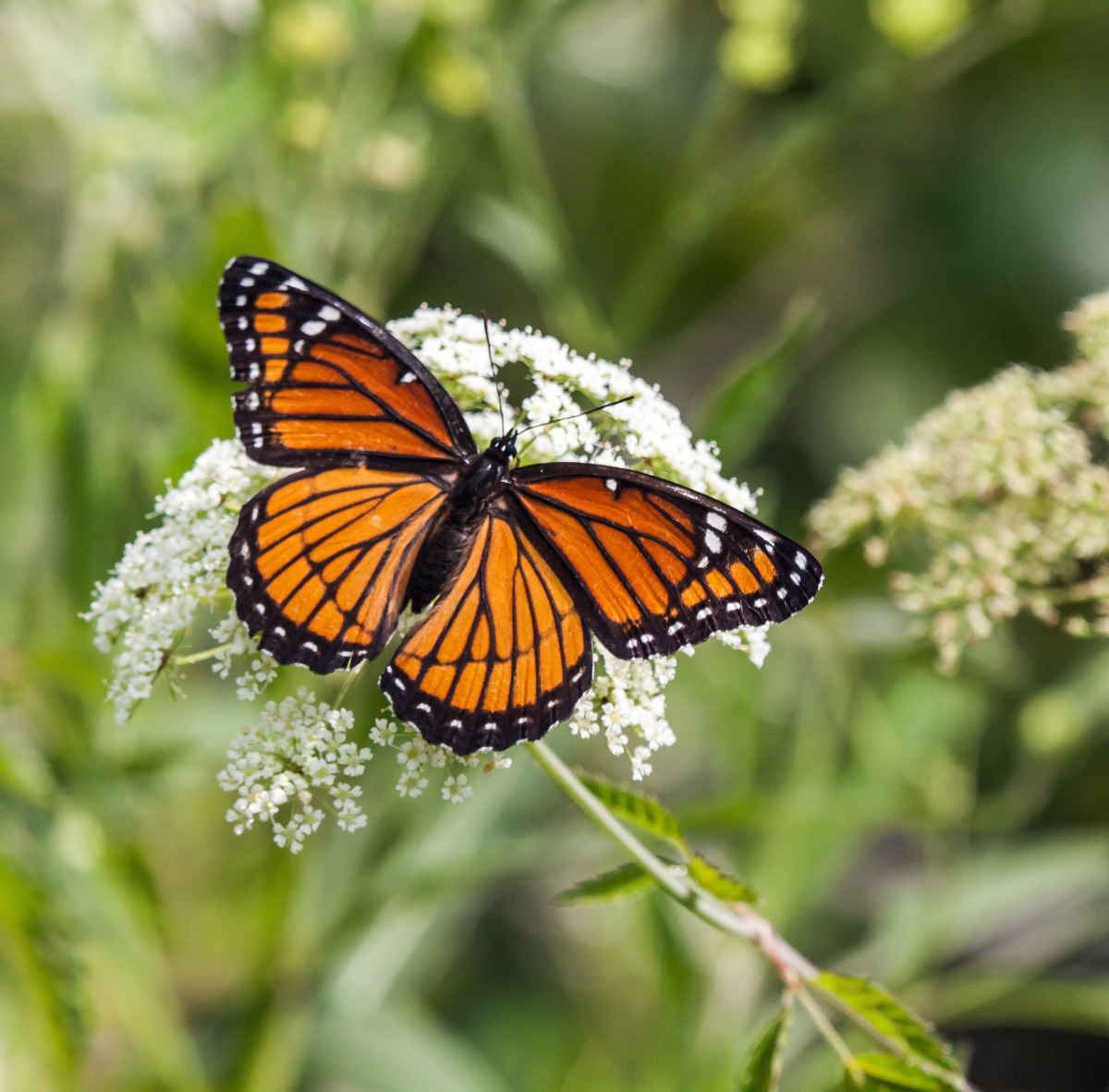
I suppose that I should call this a royal posting for it features both a viceroy and a queen. Of course, here in the USA we don’t have a monarchy, but that doesn’t keep us from having Viceroy butterflies (Limenitis archippus) and Queen Anne’s Lace (Daucus carota). I spotted this royal pair on Monday at Occoquan Bay National Wildlife Refuge where the Viceroy repeated probed the clusters of Queen Anne’s Lace.

You probably have noticed that the coloration of the Viceroy butterfly matches that of the Monarch butterfly. One of the easiest ways to tell them apart is the black line across the hind wings which is present with Viceroys but not with Monarchs.

Viceroy butterfly

Viceroy butterfly

© Michael Q. Powell. All rights reserved.

Read Full Post »

I can’t identify this flower and I am not certain what kind of skipper butterfly this is, but the two of them sure did combine well in this image that I captured this past weekend at Meadowlark Botanical Gardens. (I’m leaning towards this being a Peck’s Skipper (Polites peckius), but there are so many different kinds of skippers that it’s hard to be sure.)

In many ways this is the kind of image that I aspire to capture. The subject is active, engaged in probing the flower with its extended proboscis, rather than in a static pose. Of equal importance, the image has an artistic feel, a kind of beauty in its composition and colors. There are so many uncontrollable elements in nature that there is no way to guarantee results like this, but it is sure is nice when it happens.

UPDATE: Helpful folks on Facebook and readers of this blog have helped to identify the butterfly as a Zabulon Skipper (Poanes zabulon) and the flower as an Obedient Plant (Physostegia virginiana). Thanks, Drew and Molly.

skipper and flower

© Michael Q. Powell. All rights reserved.


Read Full Post »

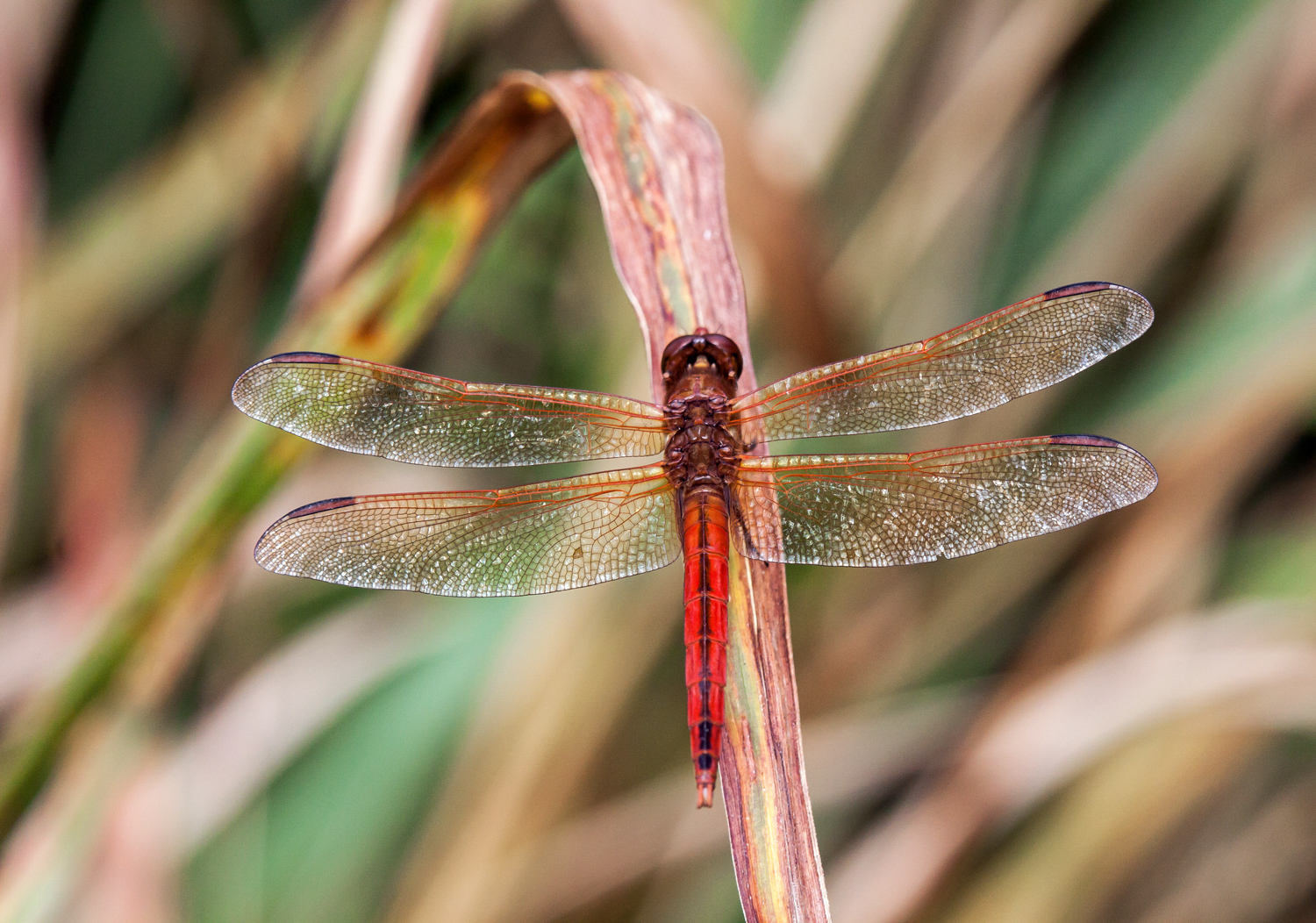
I love the stunning red-orange coloration of a male Needham’s Skimmer dragonfly (Libellula needhami), especially when the sunlight dances across its gold-tinged wings, as it did on Monday morning at Occoquan Bay National Wildlife Refuge.

Generally I prefer an uncluttered background for my subjects, but in this case I think the soft patterns of the grasses in the background enhance the image more than would have been the case with a uniform single color.

Needham's Skimmer

© Michael Q. Powell. All rights reserved.


Read Full Post »

Normally I aim for extreme realism when taking photos. Sometimes, however, I like to try an “artsy” approach, like in this image of a flower (a zinnia, I believe) from this past weekend at Meadlowlark Botanical Gardens.

In this case, I deliberately tried to distort perceptions and make it look like the grass and the sky had switched places. In reality, the blue is not from the sky, but is a gravel path.

I like to try to vary the angle at which I am shooting and the results can often be fun and different. I never know when I will find myself sprawled on the ground or standing in the mud, so I tend to wear clothes that are rugged and often ragged.

zinnia

© Michael Q. Powell. All rights reserved.

Read Full Post »

I am always excited to see Monarch butterflies (Danaus plexippus). Over the years there have been numerous reports of this species becoming endangered, primarily because of the loss of habitat. Some years, I have spotted only a few Monarch during an entire summer. This year I have been fortunate enough to see them at several of the locations that I frequent.

I spotted this spectacular Monarch butterfly yesterday while visiting Meadowlark Botanical Gardens in nearby Vienna, Virginia with some fellow photographers. Each of us has a different style of shooting and preferred subjects and we usually shoot separately. It is always a lot of fun when we reassemble after shooting and share our photos and experiences with each other over dinner at a restaurant.

Monarch butterfly

© Michael Q. Powell. All rights reserved.

Read Full Post »

What is your favorite dragonfly? Most people would have trouble answering a question like that. If they do happen to notice dragonflies, they generally have not looked closely enough at them to identify species—at best they might be able to say something like, “I like the big green ones that I see flying overhead” or “I like the little blue ones that perch on the reeds.”

Most of you know that I somewhat obsessed with dragonflies (and those who know me well might question my use of the qualifier “somewhat” in the first half of the sentence). I love the beauty and aerial agility of these flying insects and I spend endless hours searching for them for months on end.

How do I choose a favorite dragonfly? It’s kind of like asking a parent to choose a favorite child. There are different things that I like about different dragonfly species.

If I were asked the question directly, I would probably say that the Blue-faced Meadowhawk (Sympetrum ambiguum) is my favorite dragonfly. I absolutely love the striking combination of the turquoise blue eyes and the striking red body. Blue-faced Meadowhawks are also special to me for a personal reason—I was awarded second place in a local photo contest several years ago for a macro shot of a Blue-faced Meadowhawk. (Here is a link to the 2015 posting Second place in a local photo competition that shows that prize-winning entry and tells some of the back story of the image.)

Yesterday at Occoquan Bay National Wildlife Refuge I photographed my first Blue-faced Meadowhawk of the season, a handsome male with bright coloration. Even if you are not a big fan of dragonflies, I hope that you can agree this little dragonfly is strikingly beautiful—welcome to my world.


Blue-faced Meadowhawk

© Michael Q. Powell. All rights reserved.


Read Full Post »

Recently I spotted this small orange and brown butterfly while I was roaming the trails at Occoquan Bay National Wildlife Refuge. I initially thought it was a Pearl Crescent butterfly, a familiar species, and posted a photo on Facebook. One of my friends there, however, pointed out that my little butterfly was actually a Silvery Checkerspot butterfly (Chlosyne nycteis), a new species for me.

The composition in my image is pretty simple, but I really like the way that it turned out, with the soft contours of the butterfly juxtaposed with the linear veins of the leaf and the sharp contrast between the dominant green and orange tones. The shadows are a real bonus, adding additional interest to the photo.

Silvery Checkerspot

© Michael Q. Powell. All rights reserved.

Read Full Post »

This image is a little gruesome, but here is a close-up look at an Eastern Pondhawk dragonfly (Erythemis simplicicollis) as it consumed a damselfly that it had captured this past Monday at Occoquan Bay National Wildlife Refuge in Northern Virginia. The second image shows a different Eastern Pondhawk with a different damselfly—the pondhawks seemed to have a particularly voracious appetite that day.

Eastern Pondhawk

Eastern Pondhawk

© Michael Q. Powell. All rights reserved.


Read Full Post »

I spotted this beautiful butterfly this past weekend at Jackson Miles Abbott Wetland Refuge. I am pretty sure that it is a Question Mark butterfly (Polygonia interrogationis), judging from the pattern of its wing spots.

While I may not be absolutely certain that it is a Question Mark butterfly, its beauty is unquestionable.

Question Mark butterfly

© Michael Q. Powell. All rights reserved.

Read Full Post »

I was simultaneously fascinated and horrified yesterday at Occoquan Bay National Wildlife Refuge as I watched this Eastern Pondhawk dragonfly (Erythemis simplicicollis) gnaw on the head of a colorful Calico Pennant dragonfly (Celithemis elisa) that it had captured. I know that dragonflies eat other insects, but in my mind I tend to think of them consuming mosquitoes and other such smaller insects. Some of them, however, apparently prefer larger prey, including other dragonflies.

Eastern Pondhawk versus Calico Pennant

© Michael Q. Powell. All rights reserved.

Read Full Post »

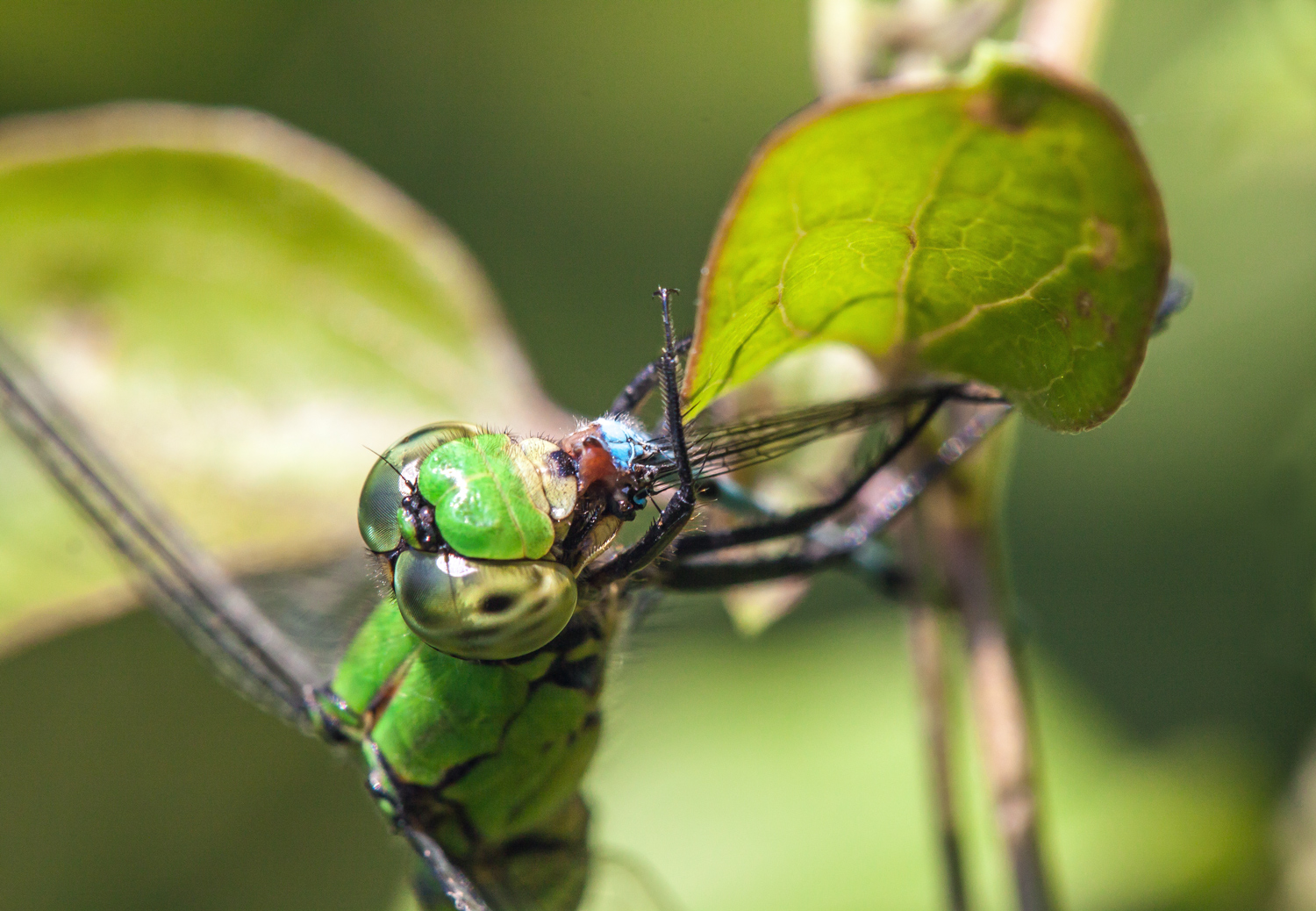
Normally when I see a Common Green Darner dragonfly (Anax junius) it is patrolling in the air and it is mostly a greenish blur. This past Friday, however, I was fortunate enough to spot one on the ground, nestled low in the vegetation at Occoquan Bay National Wildlife Refuge. At this closer distance I was able to marvel at all of the wonderful colors of this beautiful dragonfly.

Be sure to click on the images to see the details of this dragonfly at higher resolution.  Did you notice the blue color near the tip of its “nose?”

Common Green Darner

Common Green Darner

© Michael Q. Powell. All rights reserved.


Read Full Post »

This Prince Baskettail dragonfly (Epitheca princeps) almost looks like it was flying at an airplane’s cruising altitude and was looking down at a landscape with rivers, mountains, and lakes. I spotted this dragonfly last weekend at Occoquan Bay National Wildlife Refuge and spent quite a while trying to get a shot of it in flight.

The dragonfly, however, never ventured close enough to shore for me to get a detailed shot of it. I was a little disappointed until I opened up the image on my computer and discovered that I had managed to capture a wonderful, fanciful background. Sometimes I try to document the reality that I see and other times it seems like it is just my imagination running away with me.

Prince Baskettail

© Michael Q. Powell. All rights reserved.

Read Full Post »

When you closely at flowers, you discover all kinds of cool insects, like this Ailanthus Webworm Moth (Atteva aurea) that I spotted yesterday at Occoquan Bay National Wildlife Refuge. My eyes were drawn to the colorful pattern on the body of this insect, which I initially assumed was some kind of beetle. Because of the distinctiveness of the pattern, it was not hard to identify it after a Google search, but I was a bit surprised to learn that it is a moth, not a beetle.

I thought that this was my first time spotting this moth, but a search of my blog shows that I saw one in 2016 and did a posting entitled Not a Beetle. Although my memory may not be perfect, apparently my reaction was almost identical both times.

Ailanthus Webworm moth

© Michael Q. Powell. All rights reserved.

Read Full Post »

Most folks are familiar with the comic book hero the Green Hornet, but have you ever seen a green bee? I don’t see them very often, so I was pretty excited to spot this one in some flowers last weekend at Occoquan Bay National Wildlife Refuge. I think this kind of bee is generally known as a metallic green sweat bee and is of the genus Agapostemon.

green bee

© Michael Q. Powell. All rights reserved.

Read Full Post »

Sometimes the dragonfly is the predator and sometimes it is the prey—it appears to be primarily a matter of circumstances and timing. This male Common Whitetail dragonfly (Plathemis lydia) met his demise this past Friday at Occoquan Bay National Wildlife Refuge.

I am not sure how exactly the spider managed to snag the dragonfly, but I assume the dragonfly flew into the spider’s web, which was high in the air, spanning a gap between some tall trees. Interesting enough, I was only able to see a few strands of the web, so I wonder if this action took place at the extreme edge of the web.

common whitetail dragonfly

© Michael Q. Powell. All rights reserved.


Read Full Post »

I spotted this beautiful female Eastern Ringtail dragonfly (Erpetogomphus designatus) last week along the Potomac River while exploring Great Falls Park. Unlike some of the dragonflies that I have photographed recently that perched at the very tips of tall stems, this species likes to perch in vegetation relatively low to the ground. As a result, the background in this image is a little more cluttered than I prefer.

If you double click on the image, you will see the image in greater detail, including its marvelous multi-colored eyes and the wonderful colors and patterns on its body.

Eastern Ringtail

© Michael Q. Powell. All rights reserved.

Read Full Post »

I love photographing the nondescript butterflies that are so common that they fly by virtually unnoticed, like this beautiful little sulphur butterfly that I spotted last week at Occoquan Bay National Wildlife Refuge. I believe it is an Orange Sulphur butterfly (Colias eurytheme), though it is often hard to distinguish that species from the Clouded Sulphur (Colias philodice), so I am a little uncertain of the identification.

What I am certain of, however, is the delicate beauty of this butterfly and I am happy that I was able to capture some of that beauty in this image. As I gaze at this photo, I am reminded of the moment when I took it, a moment when I was enveloped by a sense of deep tranquility as the gorgeous sunlight illuminated the wings of the butterfly. Quite often when I am pursuing a subject, I can feel my heart racing a little as adrenaline kicks in.  This was one of the rare circumstances when I had the opposite physical reaction.

It is hard to describe in words what I was feeling, though it was definitely cool to experience. I hope that some of you will get a sense of that tranquility from this image. Iam becoming more and more convinced of the value of taking life a little more slowly, of opening myself up to experiencing the beauty that surrounds us every day.

sulphur butterfly

© Michael Q. Powell. All rights reserved.

Read Full Post »

Eastern Amberwings (Perithemis tenera) are the smallest dragonflies in our area. You can often find males buzzing around at the water’s edge, but females are harder to spot because they hang out in vegetation away from the water. I was thrilled therefore to see a beautiful female this past Friday at Occoquan Bay National Wildlife Refuge in some beautiful morning sunlight.

I decided to give a male Eastern Amberwing dragonfly equal billing in this post, because I really like the way that the shadows and the reflections make it look like he has an elongated body and extra sets of wings.

Eastern Amberwing

Eastern Amberwing

© Michael Q. Powell. All rights reserved.

Read Full Post »

In a moment of calm amidst the storms this past Monday, I captured this shot of a beautiful little Cabbage White butterfly (Pieris rapae) in the garden of my neighbor and fellow photographer Cindy Dyer. The shot is a little grainy, because there was not a great deal of light, but somehow the image fills me with an overwhelming sense of serenity.

Cabbage White

© Michael Q. Powell. All rights reserved.

Read Full Post »

I love the dark, slate-blue tones of the male Slaty Skimmer (Libellula incesta), one of the most common dragonflies in our area.  The beauty of this handsome Slaty Skimmer was further enhanced by the colorful backdrop that I managed to capture this past Friday at Occoquan Bay National Wildlife Refuge.

It is hard to come up with a composition that is more basic—beauty can often be found in simplicity.

Slaty Skimmer

© Michael Q. Powell. All rights reserved.

Read Full Post »

Many of my photographer friends have been posting photos of hummingbirds and I felt a little left out. I didn’t see any yesterday, but did spot several Snowberry Clearwing moths (Hemaris diffinis) at Occoquan Bay National Wildlife Refuge. This species, along with other clearwing moths, is sometimes called a “hummingbird moth” because of its appearance and behavior, which reminds some folks of a hummingbird.

Most of the times in the past that I have seen a hummingbird clearwing moth, it has been a “cousin” of this species, the very similar Hemaris thysbe. That species, however, has more red on its body and has lighter colored legs, according to the butterfliesandmoths.org website.

As you might suspect, these moths are in almost constant motion.  Its is quite a challenge, therefore, to track them and keep them in focus as they dart among the flowering plants.

As I was tracking one, a second one flew in and seemed intent on dislodging the first one. I reflexively I pressed the shutter button and was a little shocked to see that I managed to capture them both in a single frame. It’s cool that they both had their long proboscises curled up at the moment I took the shot.

Snowberry Clearwing Moth

Snowberry Clearwing moth

Snowberry Clearwing moth

© Michael Q. Powell. All rights reserved.

Read Full Post »

Yesterday as I was exploring Riverbend Park in Great Falls, Virginia, I encountered several damselflies that were new to me. When you spend as much time as I do  searching for insects to photograph, you develop a sense of what is “normal” and I am able to decide almost immediately whether a subject is a familiar one or not. Those of you who know my work are aware that familiarity with a subject is not a criterion for photographing it—I am just as likely to take a shot of a common subject as a rare one.

As I looked though my reference books and material on line, I was able to determine that I had captured images of both the male and the female American Rubyspot damselfly (Hetaerina americana). One of the experts in a Facebook dragonfly forum pointed out the dragonfly in the first photo below is an immature male, which helps to explain why the red spot for which the species is named is not yet prominent.

I won’t go into the details of damselfly anatomy, but if you compare the dragonflies in the two photos, you can see some of the gender differences that often help in identification. The very tip of the abdomen, the part of the body that many folks refer to as the “tail,” is quite different for the male and the female. There is also some color differentiation. Alas, these are general rules that don’t apply in all cases, so I am often confounded when trying to identify the species of a given subject.

It is really cool that I continue to encounter new species. Part of the reason for that, I suspect, is that I am exploring some new locations. More importantly, though, my observational skills have improved dramatically over time and I am seeing things that I might not have noticed several years ago.

American Rubyspot

American Rubyspot

© Michael Q. Powell. All rights reserved.

Read Full Post »

From time to time I will try to capture images of dragonflies in flight. Even under the best of circumstances it is a tough challenge for dragonflies are small, fast, and agile. Occasionally they will hover briefly, though most of the time it seems they choose to do so only when they are a long way away from me.

This past Monday I visited Jackson Miles Abbott Wetland Refuge and was surprised at the number of Swift Setwing dragonflies (Dythemis velox) that I observed there. As far as I know, this is the only location in our area where this species can be found. Swift Setwings are primarily a southern species, but seem to be migrating slowing northward.

Swift Setwings are  pretty small, about 1-6 to 2 inches long (42 to 50 mm), and the males, the only ones that I generally see, tend to perch at the edge of the water in overhanging vegetation. On this particular day, the dragonflies seemed to be particularly skittish, flying off as soon as I approached them. That was what prompted me to try to photograph them in flight. My Tamron 180mm macro is notoriously slow in focusing and tends to hunt a lot, so I switched to manual focusing. I made a lot of attempts and managed to get a few photos that were relatively in focus like the second image below.

While I was tracking one Swift Setwing in my viewfinder, a second one flew in and the two hooked up in mid-air in a mating position. They held the position for only a brief moment before disengaging and flying away in separate directions. I will spare you the anatomical details, but, as you can see in the first photo, dragonflies are quite acrobatic and flexible when mating.

So if you want a real photographic challenge, go out and see if you can capture some images of dragonflies in flight. It’s a fun challenge for me, even when I am not successful. If others see you doing so, it will reinforce the notion that wildlife photographers are a bit crazy, a perception that is accurate in many cases.

Swift Setwing

Swift Setwing

© Michael Q. Powell. All rights reserved.


Read Full Post »

« Newer Posts - Older Posts »