Feeds:
Posts
Comments

Posts Tagged ‘Alexandria VA’

I waited for the sunset yesterday at my local marshland park and was treated to some cool effects as the last rays of the sun made their way through the trees onto the icy pond, creating some beautiful reflections.

My eye is really attuned to this effect because of a recent series of images by Stephen Pitt in his blog “Le temps d’un Soupir…” that show early morning rays of sun illuminating the forest floor. Check out his most recent posting by clicking on the name of his blog.

pre_sunset1_blog

© Michael Q. Powell. All rights reserved

Read Full Post »

Have sparrows become my favorite bird? This winter, I’ve spent more time with them than with any other birds and I’ve featured them repeatedly in my blog postings. I tend to be more at ease with the familiar and the comfortable, rather than the exotic and extreme. and sparrows fit well into my world, like this Song Sparrow (Melospiza melodia) in the snow.

Photographing these small birds is a challenge, though, because it is unusually tough to isolate them from their often cluttered background and they are in constant motion. I like the way that I was able to capture this sparrow, with the small patch of exposed grass amidst the snow. The light was pretty strong and blew out a few details in the chest feathers, but if cast an interesting shadow.

Perhaps sparrows are not my favorite birds, but we are good friends who spend a lot of time together.

sparrow_shadow_blog

© Michael Q. Powell. All rights reserved

Read Full Post »

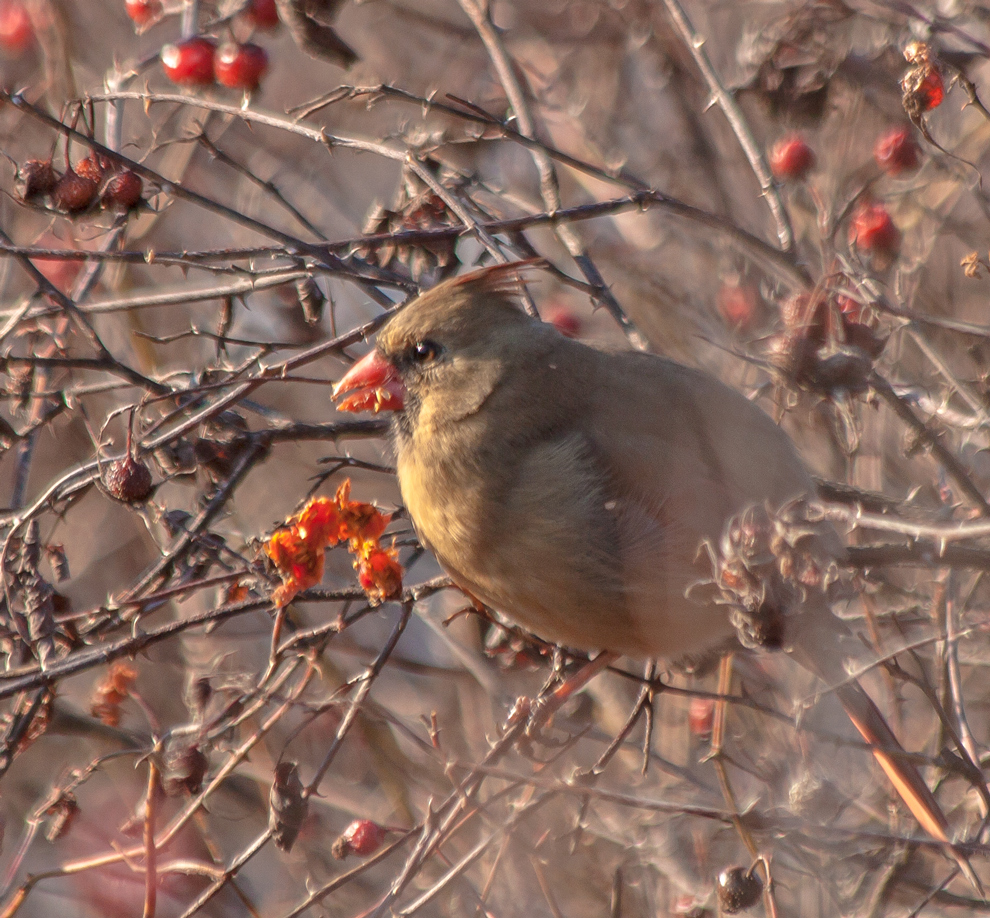
If berries/fruits are still around on a bush in February, I have to believe that they are not a bird’s favorite food. If you are hungry, enough, I guess you make do with what is there, as this female Northern Cardinal (Cardinalis cardinalis) was doing yesterday when I took this photo.

I am not certain, but I think that the red berries may be rose hips and the cardinal was trying to get to the seeds in the center, as the evidence on her bill suggests.  Although I have heard that rose hips are a great source of Vitamin C, I doubt that they provide much nourishment to the birds.

I really like the way that this female cardinal almost disappears into the background in this image—the colors of her body and her bill are almost a perfect match for her surroundings.

cardinal_feb_blog

© Michael Q. Powell. All rights reserved

Read Full Post »

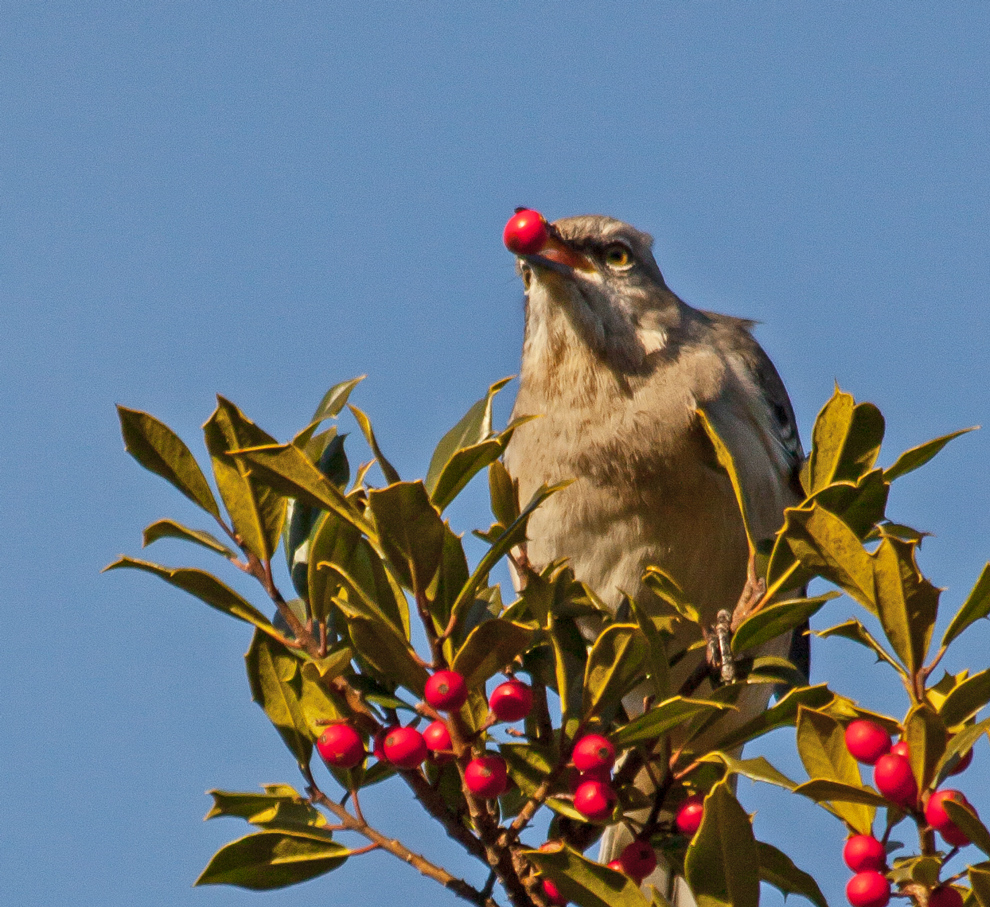
Mockingbirds always strike me as bold and defiant, often perching in the highest point of a tree or bush and singing loudly, heedless of the weather.  On a recent sunny day, a rarity for us, I spent quite some time observing this Northern Mockingbird (Mimus polyglottos).

Most of the time, the mockingbird seemed to be just soaking up the warmth of the sun, but occasionally the bird would reach down and grab and swallow a bright red berry so quickly that it seemed to be inhaling the berry. In this shot, I managed to capture the berry before it disappeared.

mocking_winter_blog

© Michael Q. Powell. All rights reserved

Read Full Post »

A Turkey Vulture (Cathartes aura) will never look as fierce as a hawk or an eagle and I am pretty sure that “Eye of the Vulture” won’t ever be a featured song in a Rocky movie, but there is still something disconcerting when a vulture circles close overhead, staring down in your direction.

In most of my previous shots of a Turkey Vulture, the eyes have not been visible, but on a recent sunny day, the light was good enough and the vulture came close enough for me to see the eyes, which look a little creepy. Click on the photo to see a higher resolution view of this big bird, with an impressive wingspan.

vulture_look_blog

© Michael Q. Powell. All rights reserved

Read Full Post »

Winter landscapes often have a stark, black-and-white look that I really enjoy, like this shot I took last week of part of the boardwalk at Huntley Meadows Park, the local marshland park where I take a lot of my wildlife images.

It was late afternoon when I took this shot, and the sun cast a golden light on part of the surface of the boardwalk (which is made of a synthetic material) and created beautiful shadows beneath it. I really like the contrast between the straight lines and geometric shape of the boardwalk and the wild, irregular shapes of the natural environment.

I often forget to look for the “big picture” in my zeal to get in closer and closer to my subject, but in this case I am happy that I took the effort to pull back and take in my surroundings.

landscape_blog

© Michael Q. Powell. All rights reserved

Read Full Post »

When I was a college student in the 1970’s a cheap sparkling wine known as “Cold Duck” was really popular (along with Zapple, Annie Greensprings, and Boone’s Farm). Do they still produce those wines?

The title of this posting, however, refers to a bird that I observed on the ice this past weekend, not to a retro beverage.

I was struck by the contrast between the vivid colors of the male mallard duck (Anas platyrhynchos) and the drab gray and white of the frozen pond. The duck seemed to be getting into a yoga-like pose, with one foot flat on the ice and the pointed toe of the other foot providing additional stability. Wait a minute, do ducks have toes?

I also couldn’t help but notice that ducks look a lot more graceful when swimming or flying—walking looks like it would be awkward for a duck. I suspect that no composer will every produce a ballet entitled “Duck Pond,” which would scarcely provide any competition for “Swan Lake.”

In the first few days of February, our temperatures have soared over the freezing mark, but there has been little melting on the surface of the pond and I did not detect any quacks in the ice.

duck_walk_crop_blog

© Michael Q. Powell. All rights reserved

Read Full Post »

This past weekend, I was filled with an inexplicable urge to take some flower photos. With the exception of some clumps of snowdrops, nothing was blooming outdoors, so I slipped into the small glass-enclosed greenhouse at my local county-run garden to capture images of some of the tropical flowers there.

I was alone with the plants for an extended period of time and was able to set up my tripod and use my macro lens, which has been gathering dust the last few months. My eyes have grown accustomed to looking for birds in the distance and it was an interesting challenge to get them to focus on the smaller details of stationary objects.

I am not sure of the names of the flowers that I photographed (with the exception of the second one, which is a kind of Lady’s Slipper orchid), but my senses were satisfied temporarily with the sight and smells of these beautiful flowers.

I can’t wait for spring, when I’ll have the chance to to see more flowers (and the accompanying insects) outdoors.

pink_blogslipper_blogstars_blog

© Michael Q. Powell. All rights reserved

Read Full Post »

It’s a little too early for most flowers to be blooming, although I did find flowering snowdrops yesterday at Green Spring Gardens, a local county-run historic garden. I like the way that the white of the flower shines in the shadows, a reminder that the brightness of spring will eventually come.

snowdrop_feb_blog

© Michael Q. Powell. All rights reserved

Read Full Post »

At dusk yesterday as I was preparing to leave Huntley Meadows Park, my local marshland park, I stumbled upon this muskrat enjoying its dinner. The sun was setting, but it provided just enough warm light for me to capture some images of this elusive little animal.

Muskrats (Ondatra zibethicus) generally are skittish and the most common view that I get of them is when they are swimming away from me. I was fortunate that this muskrat was concentrating on feeding, so its guard might have been down a little, and I was able to approach it without startling it.

I was snapping away in an effort to take advantage of the disappearing light and my moment of solitude with the muskrat, when my camera alerted me that my memory card was full. I backed away slowly and surprisingly was able to change memory cards and resume shooting.

Suddenly I started to feel vibrations in the boardwalk on which I was kneeling and I realized that I was not alone. I tried to concentrate as much as I could, knowing that my time was limited as I felt and heard the approach of a young family with both a stroller and a toddler. The noise and movement was too much for the muskrat and after a bit of hesitation, it scrambled under the ice and swam away.

I haven’t yet downloaded and looked through all of my shots, but wanted to share an initial image. I really like that the last rays of sunlight were able illuminate the muskrat’s fur and add a little catch light in the eyes. (As you can probably tell, the light was coming from camera right and shining right on the muskrat.)  Stay tuned, as I am sure that I will post at least a few more photos of my encounter with this little muskrat.

muskrat1_jan_blog

© Michael Q. Powell. All rights reserved

Read Full Post »

Another photo of a chickadee? Chickadees are so common that they fade into the background to the point where we no longer notice them. Nobody would travel a great distance to see a Carolina Chickadee (Poecile carolinens) like this one and there were no throngs of curious spectators to ask me what I was photographing.

What was the attraction for me? One of my fellow bloggers, Mr. K.A. Brace, a thoughtful and insightful poet who writes in a blog called The Mirror Obscura, posted a poem today entitled “The Brilliance” that really resonated with me. In the poem, he spoke of the “brilliance of the ordinary.” I encourage you to check out this poem and other wonderful poems—one of the cool features of most of the blog postings is that they feature an audio clip of the poet reading the featured poem.

“The brilliance of the ordinary”—I love that combination of words. Children (and pets) approach life with boundless curiosity and endless fascination with the most mundane, ordinary aspects of our everyday world. I want to regain more of that childlike sense of wonder.

chickadee_winter_blog

© Michael Q. Powell. All rights reserved

Read Full Post »

Although I rarely see them, the animals in the woods at my local marsh were out and about after our recent snowstorm and their tracks made fascinating patterns in the fresh snow. What animals made the tracks and what were they doing?

I took these photos in a remote area of my local marshland park, near what I believe to be an active beaver lodge, the location at which I have previously spotted a fox, an otter, and a raccoon.

I suspect that there are resources on the internet that would help me identify these tracks, but for the moment I am content with the reminder that I am a visitor in the home of these unseen woodland creatures.

tracks3_blogtracks2_blogtracks1_blog

© Michael Q. Powell. All rights reserved

Read Full Post »
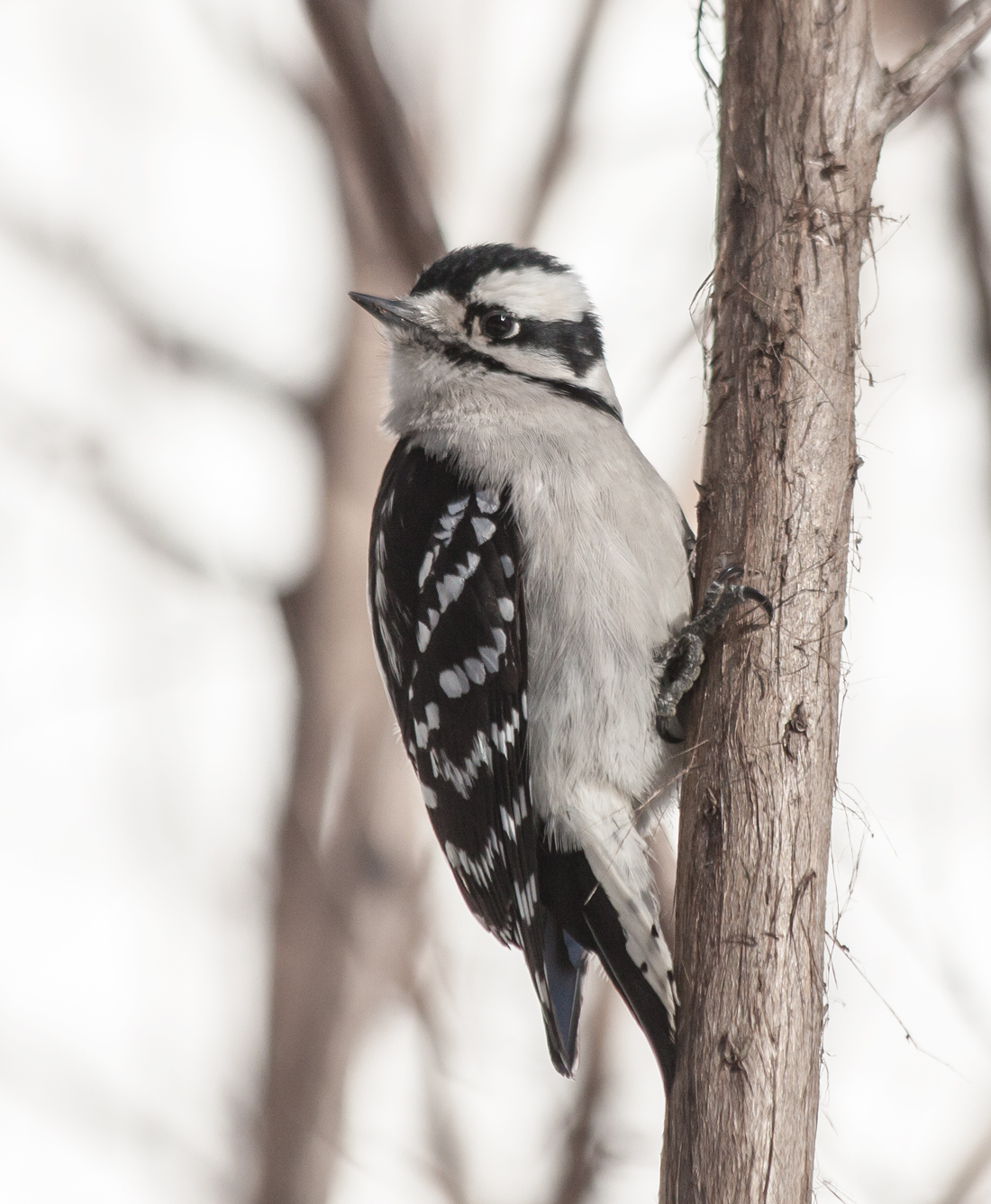
I love to watch energetic little Downy Woodpeckers (Picoides pubescens) at work, like this one that I observed last week in my own neighborhood.

Most of the time these little powerhouses are in constant motion or are obscured by branches, so it’s difficult to get a clear shot of them. This one, however, was in a location where I could get an unobstructed photograph and the woodpecker even cooperated by lifting its head for a moment (though it did appear to be a little irritated at the interruption).

As soon as I was done with the brief photo shoot, the woodpecker went back to work, pounding away at the wood in search of some tasty morsels of food.

downy_neighbor_blog

© Michael Q. Powell. All rights reserved

Read Full Post »
When you see a white, rounded object in a bird’s nest, your minds tends to assume that it is an egg. Of course, when it is the middle of the winter and the temperature is well below the freezing point, you know that it can’t be an egg (unless it’s from a snowbird, but I think they have already migrated south to the beaches of Florida).

I came across this little nest as I was making my way through the thorny vines at the edge of one of the ponds at my local marshland park. I still have trouble identifying many birds and I haven’t the slightest clue about what kind of bird would use a nest like this.

Still, this nest caught my eye as a kind of visual reminder that spring will arrive in just a few months, full of the promise of new life.

nest_blog

© Michael Q. Powell. All rights reserved

Read Full Post »

I finally made it out to my local marsh this past weekend to check out the wildlife activity following our recent snowstorm and protracted period of cold weather. The boardwalks are still mostly slippery and covered with packed snow and almost all of the water in the ponds is frozen solid, which means that most of the geese and ducks have relocated. The cold spell is forecast to continue this week, so I don’t expect to see the water fowl returning any time soon.

The sparrows seemed even more active than normal, though, in constant motion as they moved from one set of vegetation to another. Often it seemed that they chose to hop from place to place, rather than fly, and I caught this Song Sparrow (Melospiza melodia) in mid-hop. (It looked like they would extend their wings a bit when they would hop down from a higher point on a plant to a lower spot).

sparrow_hopping_blog

© Michael Q. Powell. All rights reserved

Read Full Post »

Another unexpected bird that I sighted during a recent walk around my neighborhood was this American Goldfinch (Spinus tristis). I don’t think that I have seen one before during the winter—during the spring and the summer the goldfinch’s bright yellow plumage makes it easier to spot one.

I guess I need to pay more attention to the birds of the neighborhood, for it appears that more of them overwinter than I originally thought. What else is out there, waiting to be seen and photographed?

goldfinch1_blog

© Michael Q. Powell. All rights reserved

Read Full Post »

I didn’t think that there were many birds in my suburban neighborhood at this time of the year, so I was pleasantly surprised to see a number of different species during a post-snowstorm walk, including this White-breasted Nuthatch (Sitta carolinensis). For most of hte time that I was observing it, the nuthatch was in the typical head-down position, but it finally turned its head to the side and I got this shot.

nuthatch1_blog

© Michael Q. Powell. All rights reserved

Read Full Post »

How do you convey a sense of the winter season? Do you take wide-angle shots of snow-covered mountain peaks? Do you show vast fields or forests or frozen ponds, all blanketed in white?

I didn’t really have a plan when I set out for a walk in my neighborhood after a recent storm that dumped over six inches of snow (about 15 cm) on us. The sun was shining and the snow was beautiful, though it was windy and cold. I walked for a while, taking in this uncommon view of the common scenery (we don’t get snow very often in Northern Virginia), when I caught sight of some motion out of the corner of my eye—an oak leaf was dancing across the surface of the powdery snow.

When the leaf came to rest, I hurried toward it, wanting to capture the simple beauty of this winter still life that conveyed to me a sense of the winter season.

leaf_snow_blog

© Michael Q. Powell. All rights reserved

Read Full Post »

Despite the frigid cold and snow, the squirrels in my neighborhood are out and active (and looking surprisingly cute).

squirrel_snow_blog

© Michael Q. Powell. All rights reserved

Read Full Post »

Little kids get pretty excited about snow, but it’s hard to match the enthusiasm of a puppy as she propels herself face-first into the freshly fallen snow.

These shots show Freckles, a year-old Cocker Spaniel, a few seconds after she dove into the snow in my backyard. The yard had areas of sunshine and shadows and the snow appears white when Freckles was in the sun, as in the first image. The snow took on a bluish cast  however, when the snow in the background was in the shadows. I liked the effect and cropped the second image to make the background more uniform, causing it to look a bit like a formal studio shot.

freckles_snow1_blogfreckles_snow2

© Michael Q. Powell. All rights reserved

Read Full Post »

Northern Cardinals (Cardinalis cardinalis) are one of my favorite birds, in part because they stay with us throughout the winter. The bright red color of the male cardinal never fails to lift my spirits, even on a dreary, rainy day in mid-December, when I took this photo. The feathers on the bird’s body seem to be more subdued than usual, but the spiky red feathers on the cardinal’s head give it plenty of color as well as attitude.

We are covered in snow, thanks to yesterday’s daylong snowstorm, and I would love to get some shots of a cardinal in the snow. The bitterly cold temperatures (it’s 9 degrees F (minus 13 C) and windy right now), gusty winds, and treacherous road conditions, however, may limit my photo opportunities for the next few days.

cardinal_rainy_blog

© Michael Q. Powell. All rights reserved

Read Full Post »

Yesterday when the sun was shining and the temperature soared to the high 50’s (15 degrees C), I was blissfully ignorant that snow was headed our way. Like this Eastern Painted Turtle (Chrysemys picta picta) that I observed at my local marsh, I wanted only to bask in the warmth of the sun.

Today in the Washington D.C. area, the federal government and most of the schools are closed and we are all hunkered down as we await the arrival of what is forecast to be the biggest snowstorm we’ve had in a few years, as much as eight inches (20cm).

During the summer, I often see a whole row of turtles on this particular log, but yesterday this was the only turtle that had bee roused from its slumbering state by the surprisingly warm, sunny weather. The mud on its shell suggests that this turtle did not swim around a lot, but made a beeline for this log after rose to the surface.

I suspect that this turtle is already back in the mud at the bottom of the pond today, comfortably dreaming of spring, when it will reemerge into the sun.

turtle_jan_blog

Click on the photo to see a higher resolution view of the turtle.

© Michael Q. Powell. All rights reserved

Read Full Post »

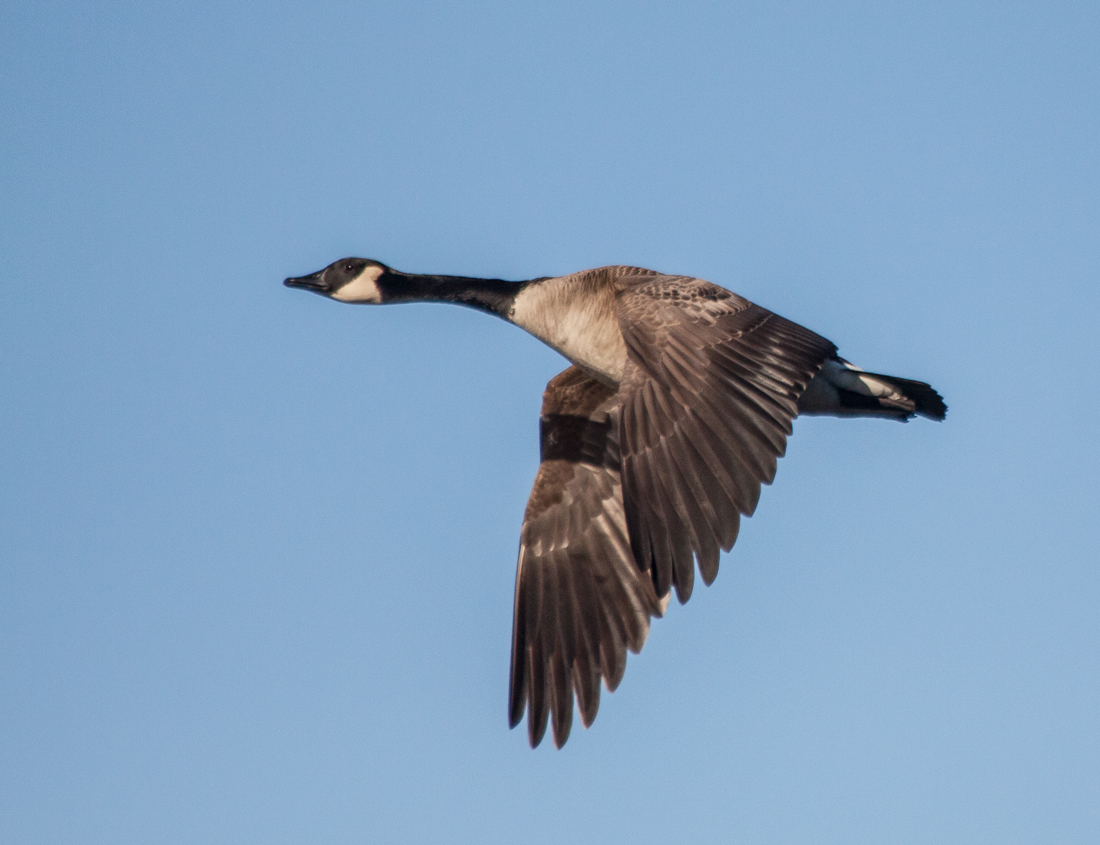
So many factors have to work together perfectly to get good shots of a bird in flight—the lighting has to be right, the exposure needs to be correct, the shutter speed needs to be fast enough to stop the motion, and, most critically perhaps, the camera has to focus properly on the moving subject. Of course, it helps also to be able to capture the wings in an interesting position and to have a background that is not distracting.

I have been working on taking photos of birds in flight, especially Canada Geese, but it has been rare for me to get all (or even most) of the variables to fall into place at the same time. However, in late December I took a series of shots of a Canada Goose (Branta canadensis) that turned out really well. The background was the sky, which some folks don’t find to be very interesting, but at least the goose was not obscured by branches. Click on the photos to see them in higher resolution—I was thrilled that I even managed to get a catchlight in the visible eye.

The challenge for me will be to repeat this success with smaller birds that fly faster and less predictably.

goose_flight1_blog goose_flight2_blog goose_flight3_blog

© Michael Q. Powell. All rights reserved

Read Full Post »

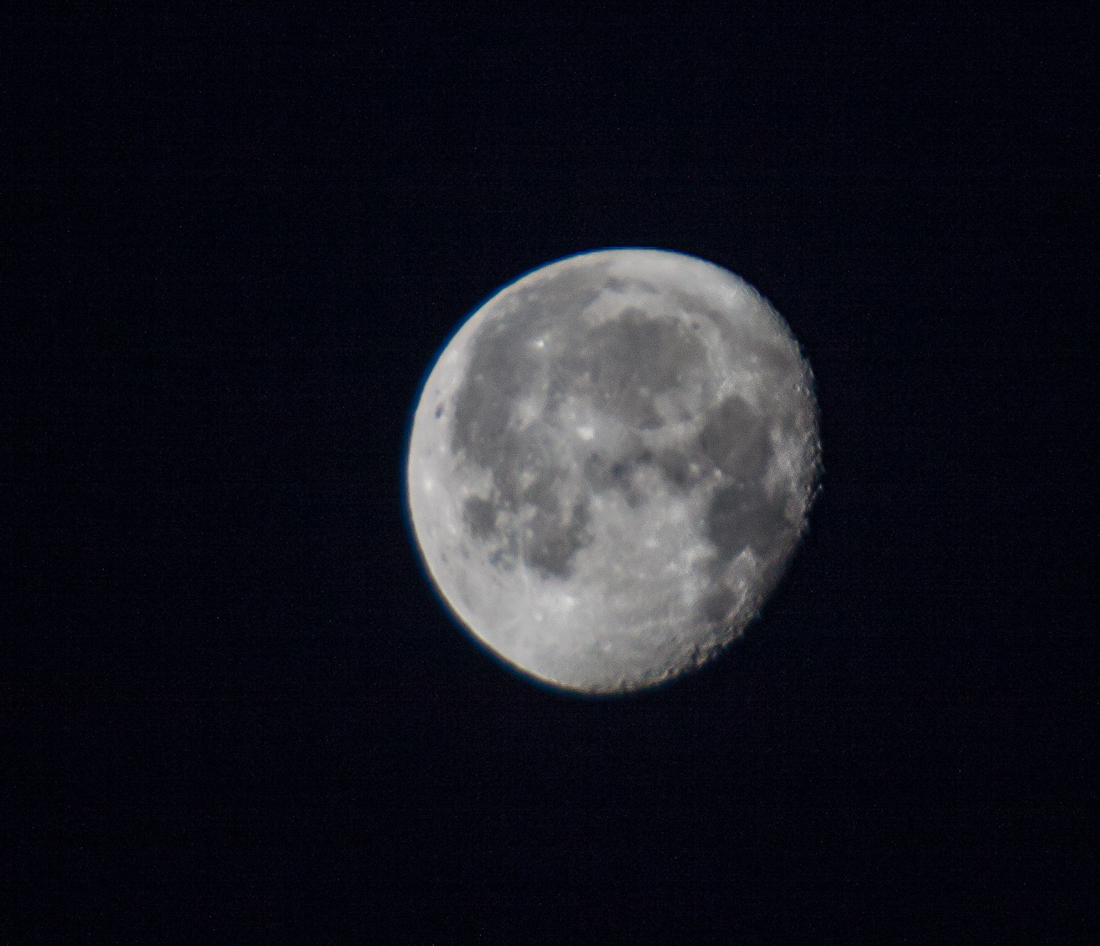
The moon looked amazing at 7:00 this morning when I went out to get my newspaper from my front steps. It was still dark and in the opposite direction, the sun was just beginning to rise. I rushed back into the house, put some socks on my sandaled feet, and ran outside with my camera to get some shots.

I used the longest lens that I have, a Sigma 135-400mm lens, and leaned it against the roof of a parked car to stabilize it.  I was surprised at the detail that I managed to capture of the craters near the dark side of the moon. (I think the full moon was a few nights ago.) Click on the photo to see it in higher resolution.

moon_19Jan_blog

© Michael Q. Powell. All rights reserved

Read Full Post »

It’s nice to be back home from my recent overseas trip and to have the chance to go out in the wild for some photos. Urban shooting is ok, but somehow I feel more comfortable chasing after wildlife.

Yesterday I spotted this Pileated Woodpecker (Dryocopus pileatus) high in the trees at Huntley Meadows Park, the local marsh that is my favorite spot for wildlife shooting. I’ve been trying for quite a while to get some good shots of this spectacular woodpecker and they are getting better, though they are not quite there yet.

These two shots are part of a series that I took as the woodpecker moved its head from side to side as well as up and down, chiseling out a hole in the tree. I was amazed to see how far back the woodpecker pulled its head before each stroke and the powerful force with which it struck—it was enough to give me a headache.

I’m still hoping that I will find a Pileated Woodpecker a bit lower in a tree (or working on a fallen log) in a location that will permit me to get some better shots, but I am content that I was able to get these shots when I caught sight of this woodpecker yesterday.

pileated2_jan_blogpileated1_jan_blog

© Michael Q. Powell. All rights reserved

Read Full Post »

Most birds seem to seek shelter when it is raining (and most people too), but this male Red-winged Blackbird (and this photographer) were an exception to that rule in late December.

blackbird_rain_blog

© Michael Q. Powell. All rights reserved

Read Full Post »
It concerns me that this young Great Blue Heron (Ardea herodias) at my local marsh may be too tolerant of people and desensitized to the reality of genuine predators that could do it harm. I worry too about its ability to catch enough food to survive, especially if this is the same young heron that I observed during the fall striking in vain at leaves in the water.

On a cold, wet day this past week, the heron was hunkered down on a log not far from the boardwalk. Other than a few movements of its head as it watched me, the heron didn’t budge a bit as I snapped away and even stayed in place when a noisy group of people walked by us.

When I see this little heron, I try to get a few pictures and then move on, thankful for the photo opportunity, but not wanting to reinforce its comfort level with the presence of people.

heron1_jan_blog

© Michael Q. Powell. All rights reserved

Read Full Post »

Yesterday’s cloudy, rainy, foggy day made it a little tough to take photos, but I like the effect it had on the landscape, creating almost monochromatic scenes of different shades of gray. This is an unfamiliar style of shooting for me, so I played around a bit, trying to capture both a wide view of the marsh, and some close-views of isolated areas.

The snow here is gone now, but the ice is still hanging on.

harsh3_blogharsh1_blogharsh2_blog

© Michael Q. Powell. All rights reserved

Read Full Post »

I’m not sure if and when we will see more snow in Northern Virginia this winter, so I am posting a couple of shots as an homage to the departed snow.

As you can tell, I was looking up a lot when I walked through my neighborhood and captured somewhat similar images of the snow that had accumulated on a pine tree and an oak tree.

pinecones_blog

leaves_blog

© Michael Q. Powell. All rights reserved

Read Full Post »

Winter is the time of the year when I am finally able to photograph some of the small birds that are with us all year, but are hidden in the leafy branches and undergrowth during the other seasons, like this Carolina Chickadee (Poecile carolinensis). Generally I see these little birds at the feeders at the Visitor Center at my local marshland park, so I was really happy when this chickadee posed for me in a more natural setting.

chickadee2_little_blog

© Michael Q. Powell. All rights reserved

Read Full Post »

On New Year’s Day, as I was hiking with a fellow photographer to one of my favorite spots at the local marsh, she spotted this skull, flipped upside down on a mossy log. Had it been placed on the log by a fellow hiker or had it been abandoned there by another animal?

Judging from the length of the one remaining tooth, it looks like this is a skull of a North American Beaver (Castor canadensis). There is no way for me to tell how this animal died, but the tooth marks around the eye socket suggest that something has been gnawing on the skull.

We both took some photographs of the skull and then hurried along, hoping to see a live beaver at its lodge. We  saw the lodge, but, alas, did not see a living beaver that day.

skull1_blogskull2_blog

© Michael Q. Powell. All rights reserved

Read Full Post »

« Newer Posts - Older Posts »