Feeds:
Posts
Comments

Posts Tagged ‘Alexandria VA’

I don’t often see dragonflies in a garden, but spotted this female Eastern Amberwing dragonfly (Perithemis tenera) amidst the flowers earlier this week at Green Spring Gardens. There were lots of male Eastern Amberwings buzzing around the small ponds in another location at the gardens in hopeful expectation of finding a mate.

I have the impression that female dragonflies like to hang out in a different area from the males and then make an appearance at a time of their own choosing.

Eastern Amberwing

© Michael Q. Powell. All rights reserved.

Read Full Post »

Hot, humid summer days may be a little tough on us, but butterflies seem to love them. I captured this shot of a spectacular Eastern Tiger Swallowtail (Papilio glaucus) this past weekend at Huntley Meadows Park as it sipped nectar from what I think is Joe-Pye weed (g. Eutrochium). (I am a bit uncertain about the plant identification and wonder if it might instead be a kind of milkweed, but “Joe Pye” rhymes with butterfly and sounds cooler, so I’ll go with that as a possible identification.)

Unlike many butterflies that I see at this time of the year whose wings are tattered and torn, this butterfly seemed to be in perfect condition. The sun was shining brightly when I took these shots and I was really afraid of blowing out the highlights of this lightly-c0lored butterfly. I switched the metering on my camera to spot metering and was able to get a good exposure of the butterfly and the background went really dark, adding a bit of drama to the images.

Eastern Tiger Swallowtail

Eastern Tiger Swallowtail

Eastern Tiger Swallowtail

© Michael Q. Powell. All rights reserved.

Read Full Post »

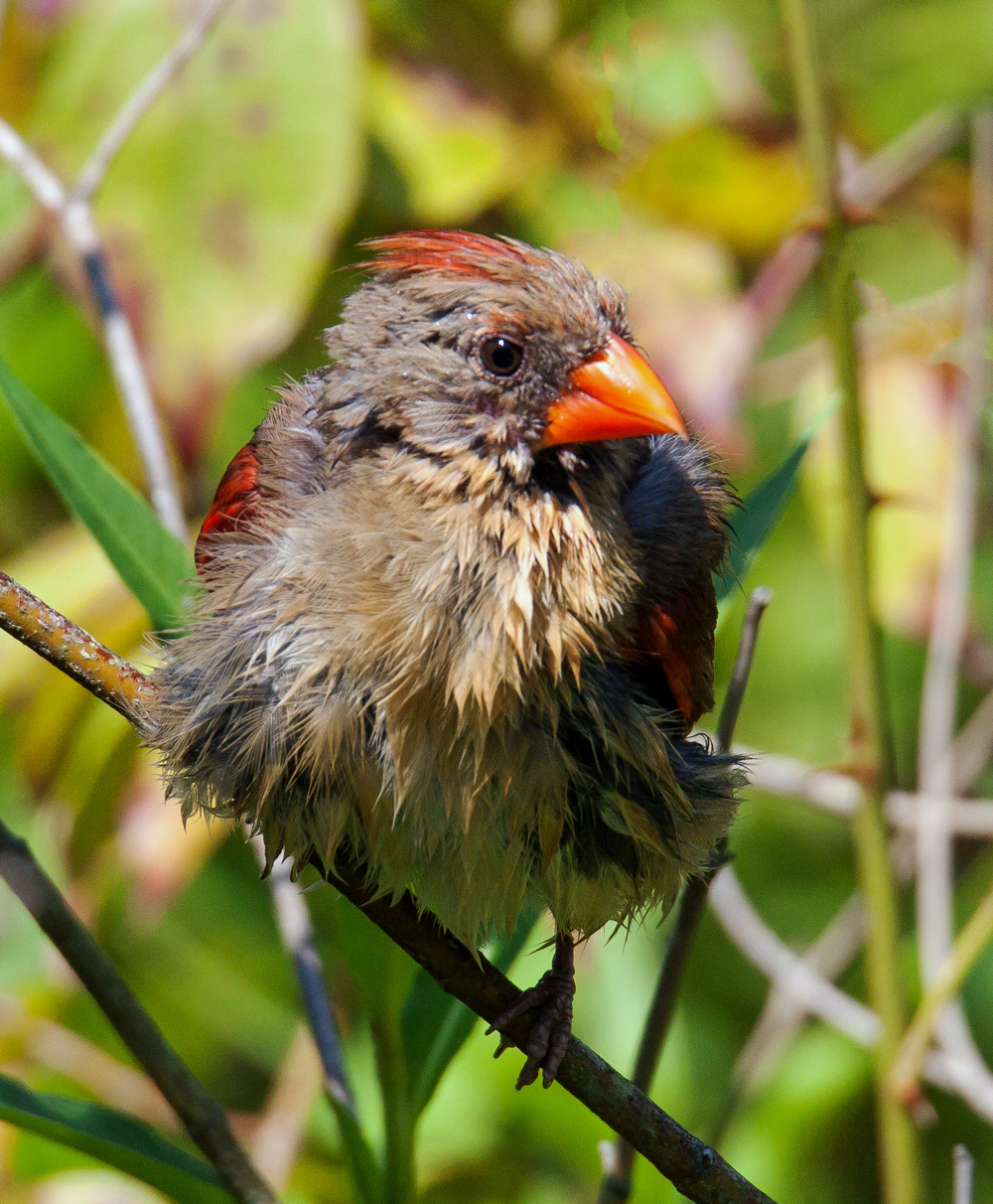
A Northern Cardinal (Cardinalis cardinalis) that I spotted on Saturday at Huntley Meadows Park seemed to be in an awkward feather phase that gave him an almost clown-like appearance.

I suspect that the cardinal feels as self-conscious as the average human male going through puberty.

Northern Cardinal


© Michael Q. Powell. All rights reserved.

Read Full Post »

A Great Egret (Ardea alba) and a Great Blue Heron (Ardea herodias) started goofing around yesterday at Huntley Meadows Park when I was trying to take their photo together—I think they are great friends. They looked like they were posing for a selfie.

I cropped the image to a square to make it easier for them to post to their Instagram pages.

great friends


© Michael Q. Powell. All rights reserved.

Read Full Post »

Eastern Tiger Swallowtail butterflies (Papilio glaucus) were really busy on the buttonbushes (Cephalanthus occidentalis) at Huntley Meadows Park recently, including what looks to be a dark morph female. Females of this species are dimorphic—there are both yellow morphs and dark morphs—but males are only yellow.

If you look closely at the second image you’ll see that I managed to capture a “bonus bug.” a bee that is also feeding on the buttonbush. My photography mentor likes to use the term “bonus bug” to refer to insects  in our photos whose presence was unknown at the time the photos were taken.

Eastern Tiger Swallowtail

Eastern Tiger Swallowtail

© Michael Q. Powell. All rights reserved.

Read Full Post »

Butterflies were really active this past Monday at Huntley Meadows Park, especially around the buttonbushes (Cephalanthus occidentalis). A dark swallowtail butterfly caught my eye and my mind raced to remember how to distinguish among the various dark swallowtails. Fortunately I had enough presence of mind to capture some images, knowing I could search different resources when I got home.

I’m pretty confident that the butterfly in question is a Pipevine Swallowtail (Battus philenor). One of its distinguishing characteristics is a single row of orange spots in the shape of a C. As I was searching the internet, I came across a wonderful posting by Louisana Naturalist that has side-by-side photos of four different dark swallowtails —the Black Swallowtail, the dark morph of the female Eastern Tiger Swallowtail, the Spicebush Swallowtail, and the Pipevine Swallowtail.

As I was trying to get a shot of this butterfly, which was in constant motion, another insect decided to photobomb us. I think it is a bee and I am including a photo of the photobombing insect just for fun.

Pipevine Swallowtail

Pipevine Swallowtail

© Michael Q. Powell. All rights reserved.

Read Full Post »

How do birds manage to survive the unbearable heat of summer? Monday, on a day when temperatures soared to 100 degrees (38 degrees C), I spotted this Northern Cardinal (Cardinalis cardinalis) at Huntley Meadows Park. It was sitting in the shade and looked like it had fluffed up its feathers or was drying off after a dip in the pond in an effort to stay cool.

I was the crazy one standing in the sun.

Northern Cardinal

Northern Cardinal

© Michael Q. Powell. All rights reserved.

Read Full Post »

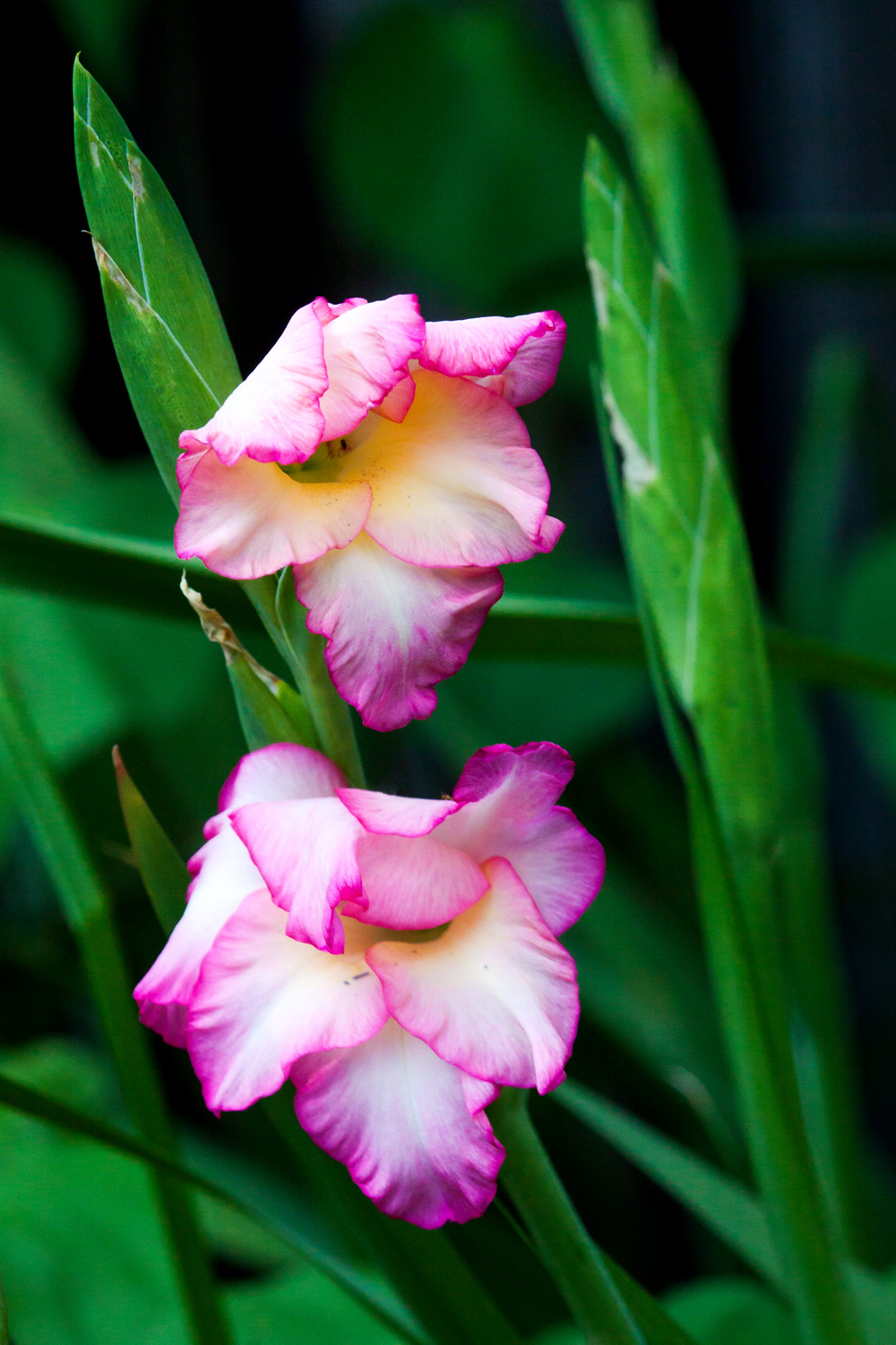
When the temperature is 96 degrees outside (about 36 degrees C), it’s hard to have the energy to go far with my camera. Fortunately, my neighbor, fellow photographer Cindy Dyer, has an awesome garden. I was glad to be able to capture this shot of some gladiolas that were blooming there this past weekend.

Thanks, Cindy.

gladiolas

© Michael Q. Powell. All rights reserved.

Read Full Post »

Blue Dasher dragonflies (Pachydiplax longipennis) have become for me one of the signs of summer in the area in which I live. When the weather turns hot and humid, they can often be seen flying lazily over the marshes and ponds, perching frequently on vegetation growing out of the water.

On a recent trip to Green Spring Gardens, I captured some images perched male Blue Dasher dragonflies. In the first shot, the dragonfly was perched on the edge of a lotus leaf. I really like the curves and softness of the leaves, which contrast with the details of the dragonfly. I think too that the shadow cast on the lower leaf adds some additional visual interest to the  image.

The second image features a Blue Dasher in the obelisk pose. It is generally believed that some dragonflies assume this pose to dissipate heat by reducing the amount of their bodies that is exposed to direct sunlight. I was shooting partially into the sun, which forced me to overexpose the image a bit and accounts for the lighter background. However, the surface of the water was covered with a lot of duckweed and was not uniform in color. As a result, the background ended ended up with some ugly gray patches that I seemed to be impossible for me to remove.

Blue Dasher

Blue Dasher

© Michael Q. Powell. All rights reserved.

Read Full Post »

This weekend when I visited Green Spring Gardens I was shocked to see that not a single lotus flower was blooming, given that so many were blooming recently at nearby Kenilworth Park and Aquatic Gardens. As I looked in vain for a flower, I somehow became fascinated with the shapes of the leaves of the lotus plants and their interplay with the light and captured these almost abstract images.

These images are definitely different from the ones that I normally post, but I thought I would share them to show you what unexpectedly caught my eye that day.

lotus leaf


lotus leaf

© Michael Q. Powell. All rights reserved.

Read Full Post »

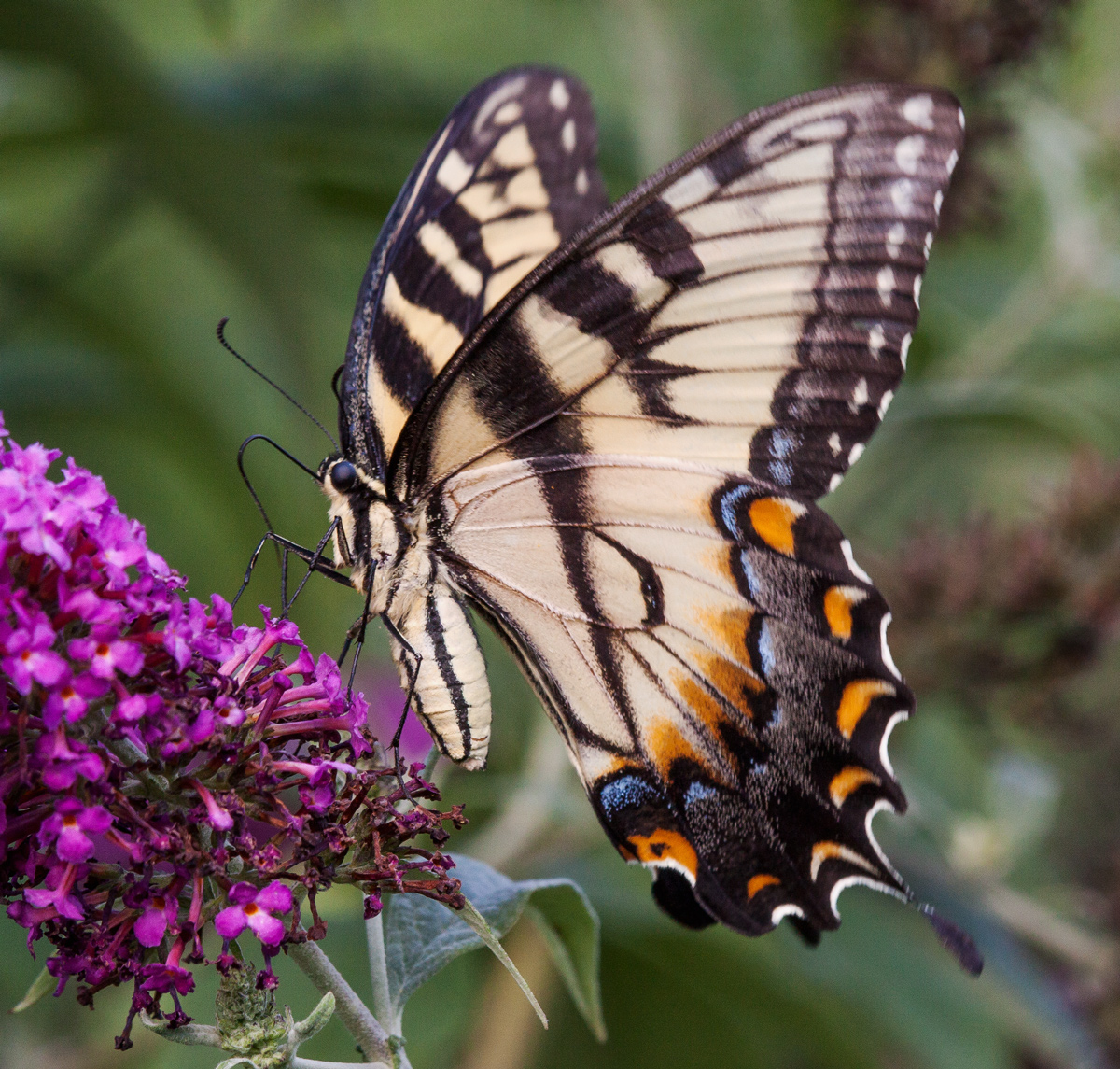
Some folks are really into chasing imaginary creatures with their cellphones. I prefer to chase living creatures with my camera and captured this image of a beautiful Eastern Tiger Swallowtail butterfly (Papilio glaucus) yesterday as it was feeding at Green Spring Gardens, a county-run historic garden in Northern Virginia.

The butterfly gave me multiple opportunities to get shots as it flew around a small area of the gardens, but it rarely gave me an obstructed view. Often it was partially buried in the flowers or turned away from me at an angle. When I took this shot, the butterfly had opened its wings and offered me a rare look at its body as well as its amazingly long proboscis.

Eastern Tiger Swallowtail

© Michael Q. Powell. All rights reserved.


Read Full Post »

I absolutely love the vibrant colors of the daylilies in the garden of my neighbor, Cindy Dyer. Cindy is best known for her photos of flowers that have appeared multiple times on U.S. postage stamps, but she photographs a wide variety of subjects. On a more personal level, she has served as my photography mentor over the past four years and has been a constant source of encouragement and inspiration for me.

As I was capturing some images of the daylilies, I thought back to one of my earliest lessons with Cindy in which she reassured me that I didn’t have to capture the entire flower when I photographed it. That simple insight helped me realize that I was doing something more than simply documenting reality—I was creating my own version of reality through a series of artistic and technical choices.

I learned a powerful and liberating lesson that day that has continued to shape the way I approach most of my photography.

daylily

© Michael Q. Powell. All rights reserved.

Read Full Post »

Do your remember what it was like to be young and in love? You and your beloved couldn’t beat to be separated—you were always together, always close, always touching, like these two Shasta Daisies growing in the garden of my neighbor and fellow photographer Cindy Dyer.

As I was looking for information about the Shasta Daisy, I came across this fascinating information on the history on the flower at lutherburbank.org:

“2001 marked the 100th anniversary of Luther Burbank’s introduction of the Shasta daisy, one of America’s most beloved garden flowers. Burbank spent 17 years developing this quadruple hybrid which he named after Mt. Shasta. Others have continued Burbank’s work and many new varieties of the Shasta daisy have been introduced since Burbank completed his work more than 100 years ago.”

Shasta Daisy

© Michael Q. Powell. All rights reserved.

Read Full Post »

What do you want to be when you grow up? I wonder if these ducklings were dreaming of growing to be as big as a Great Blue Heron (Ardea herodias) when they swam toward its reflection yesterday at Huntley Meadows Park.

growing up

© Michael Q. Powell. All rights reserved.

Read Full Post »

Yesterday I spotted this spectacular female Swamp Darner dragonfly (Epiaeschna heros) at Huntley Meadows Park. At almost 3 1/2 inches long (90 mm), Swamp Darners are one of the largest dragonflies in our area.

It was a rare treat for me to capture shots of one perching—usually I see them only in flight. Like most darners, Swamp Darners hand vertically from vegetation, often low to the ground. I was fortunate to see this beautiful dragonfly fly to the perch and it remained there long enough for me to maneuver into position for a clear shot with my long zoom lens. I actually had to pull back from the maximum 600mm focal length of the lens in order to be able to fit the dragonfly’s entire body in the frame.

If you want to get a higher-resolution look at some of the wonderful details of this dragonfly, including the amazing colors of its eyes, be sure to click on the image.

Swamp Darner

© Michael Q. Powell. All rights reserved.

Read Full Post »

I love the colorful patterns on the wings of a Halloween Pennant dragonfly (Celithemis eponina), but rarely have the chance to see one. Therefore, I was pretty excited when I spotted one from a distance last week at Huntley Meadows Park, my favorite marshland location for nature photography.

I moved a little closer to get some initial shots with my Tamron 150-600mm lens fully extended. Generally I use my long zoom for birds more often than for dragonflies.  In this case, however, the lens turned out to be a better choice than my macro lens, because the dragonfly flew away when I took a couple of steps toward it and I never saw it again.

Most of the Halloween Pennant dragonflies that I have observed in the past have had wings that were more amber-colored than those of this individual, but the wing pattern is so distinctive that I am pretty sure about my identification. In addition to the wonderful wings, I was really struck by the length and two-toned color of this dragonfly’s legs.

Halloween Pennant

© Michael Q. Powell. All rights reserved.

Read Full Post »

How far do you usually travel when you want to take some photos? I capture a lot of my wildlife/nature images in my local area, but generally I get into my car and travel at least a few miles before I begin shooting.

Sometimes, though, I feel the urge to shoot, but don’t really want to travel far. In those moments I will usually walk over to the townhouse of my neighbor, fellow photographer Cindy Dyer, who always seems to have an assortment of photogenic flowers in bloom.

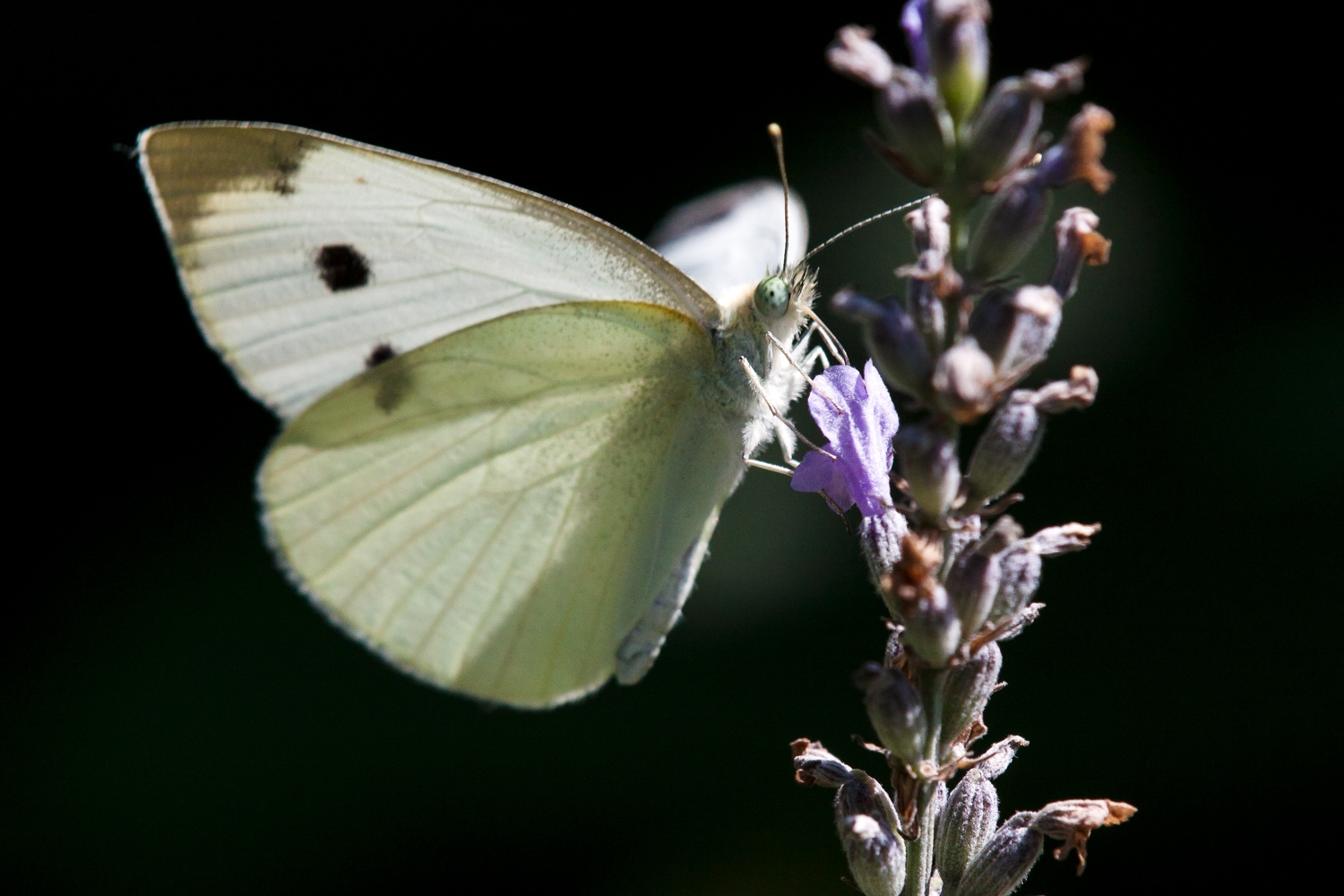
Last week I chased a Cabbage White butterfly (Pieris rapae) that I spotted fluttering about the flowers in garden. It passed by the globe thistles and the cone flowers and finally perched for a moment on a lavender plant. The sun was shining brightly, which I knew would create problems in getting a proper exposure of the dazzling white wings of the butterfly. I switched my metering to spot metering and the wings retained their details, but the background became really dark, creating a dramatic lighting effect that I really like. As always, I was thrilled to be able to see the beautiful green eye of this common butterfly that is often ignored or simply taken for granted.

Cabbage White

© Michael Q. Powell. All rights reserved.

Read Full Post »

Ebony Jewelwing damselflies (Calopteryx maculata) like to hide in the shadows, but they really do sparkle like jewels when the light hits them right.

I spotted the beautiful female damselfly in the first photo this past weekend at Huntley Meadows Park—only females have white spots on their wings. I really like the way that the tones of the background complement the colors of the damselfly.

Ebony Jewelwing

I captured this shot of a male Ebony Jewelwing damselfly only a few minutes later. The lighting was brighter and the stance seems almost confrontational, which gives this image a totally different feel from that of the female.

Ebony Jewelwing

I’ll leave it to others to make broader inferences about the mysteries of the fairer gender versus the in-your-face directness of the average male.

© Michael Q. Powell. All rights reserved.

Read Full Post »

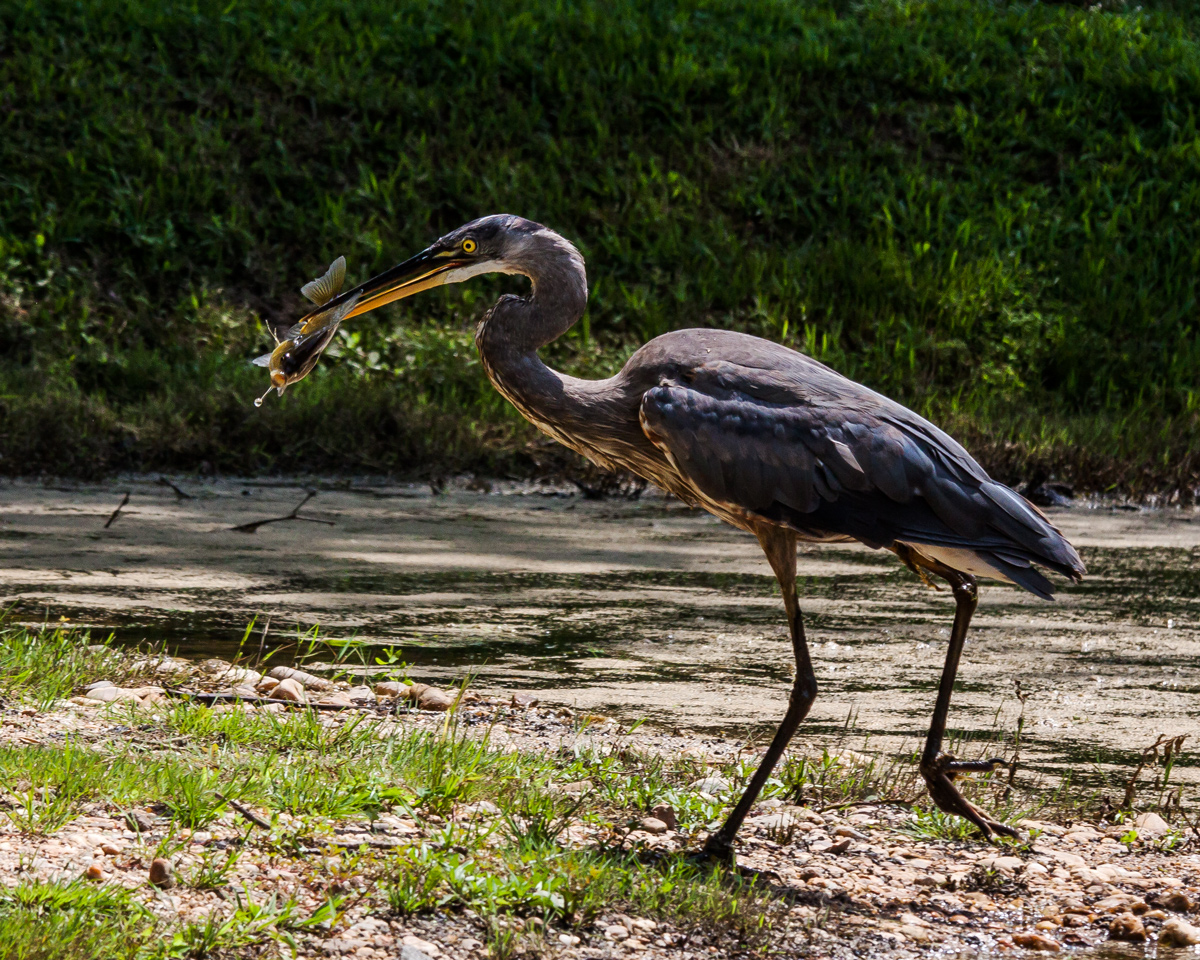
How many large fish can there possibly be in the tiny man-made pond at Green Spring Gardens? That was my initial thought when I stumbled upon a Great Blue Heron (Ardea herodias) intently focused on the water at one end of the pond. I crept as close as I could, acutely aware that I had a non-zooming macro lens on my camera, and watched and waited.

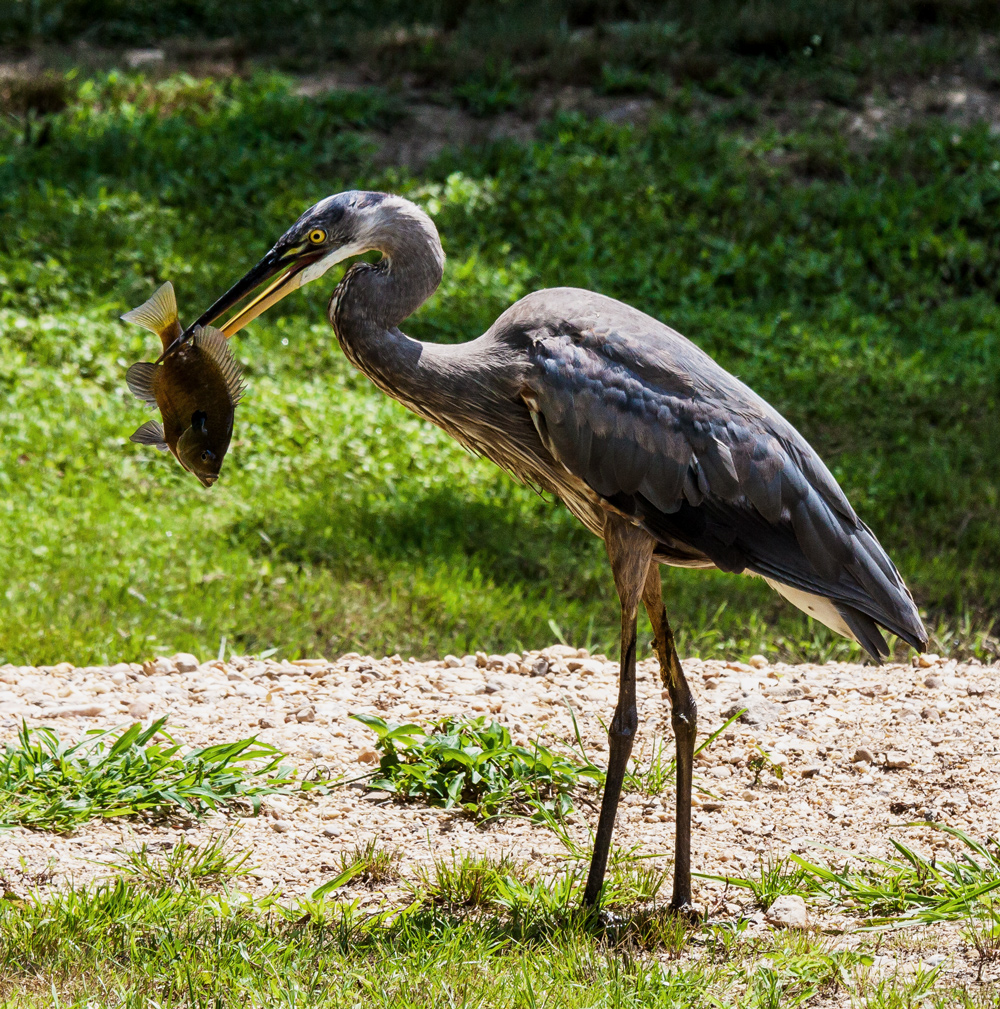
I was somewhat surprised when the heron finally made a strike and was amazed when it pulled out a large fish. Almost immediately, the heron headed for dry land, probably fearing that it might drop the fish into the water. Playing it safe proved to be a good choice for the heron subsequently did drop the fish onto the ground. I am not sure if it was an accidental drop or if it was an intentional maneuver to grab the fish, but the heron had no trouble retrieving the fish.

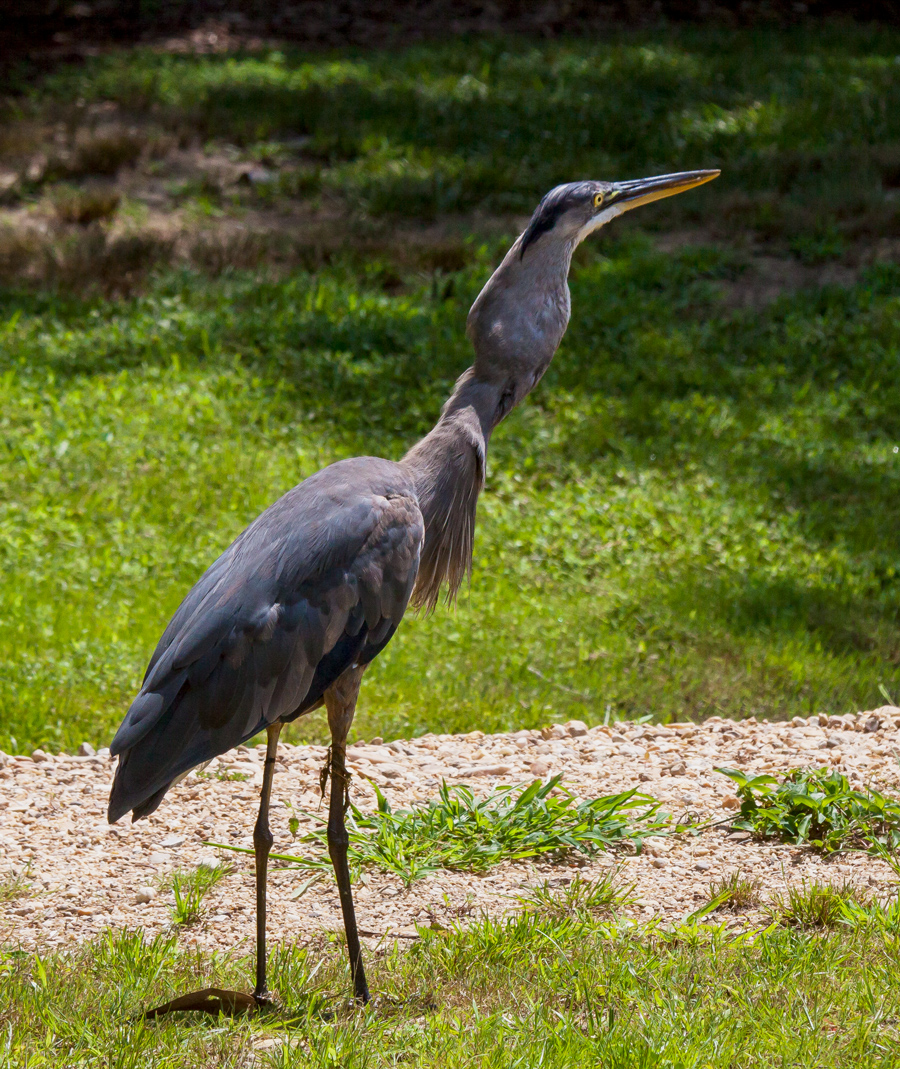
It took a little while for the heron to position the fish, but once the fish was in place, the heron swallowed the fish in a single gulp. The heron then stretched out its neck and I could almost watch as the fish made its way down the neck and into the heron’s stomach.

Great Blue Heron

Pulling the fish out of the water

Great Blue Heron

Heading for dry land

Great Blue Heron

Initial positioning

Great Blue Heron

Dropped fish

Great Blue Heron

The end is near

Great Blue Heron

Trying to swallow

© Michael Q. Powell. All rights reserved.


Read Full Post »

Early yesterday morning, an immature Little Blue Heron (Egretta caerulea) flew up to the top of a nearby tree as I slowly approached it on the boardwalk at Huntley Meadows Park. From its elevated perch, the beautiful little bird seemed to be surveying the landscape, contemplating the start of a new day.

At this time of the year there are quite a few large white wading birds at my favorite marshland park. I think that most of them are Great Egrets (Ardea alba), but the coloration and shape of the bill of the bird in this photo suggest to me that this is a Little Blue Heron. When Little Blue Herons are mature, they are a dark grayish blue and would never be mistaken for Great Egrets, but when they are young, the feathers of a Little Blue Heron are all white.

Little Blue Heron

© Michael Q. Powell. All rights reserved.

Read Full Post »

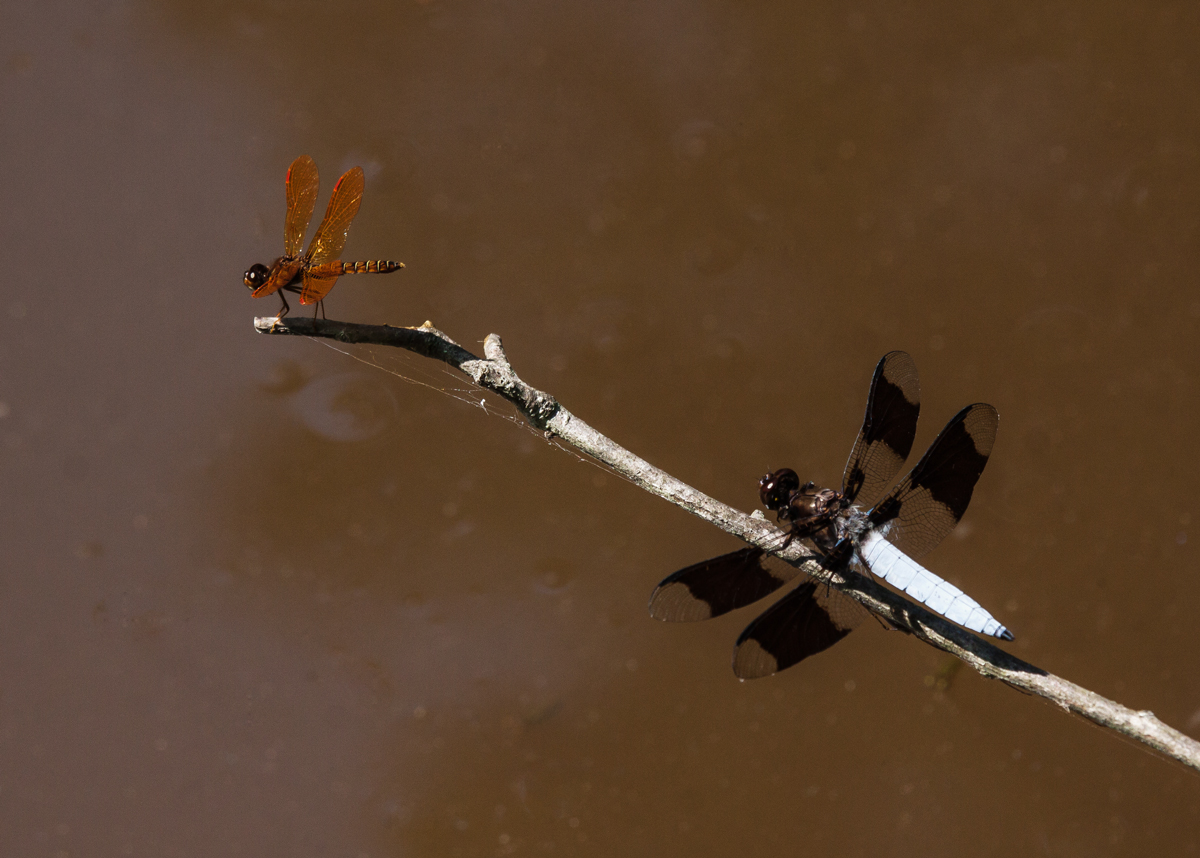
Despite their differences in size and appearance, the Eastern Amberwing (Perithemis tenera) and the Common Whitetail (Plathemis lydia) dragonflies were able to co-exist peacefully and both were able to enjoy the same perch this morning at Huntley Meadows Park.

Why is it so hard for us to do the same?

coexist1_8Jul_blog

© Michael Q. Powell. All rights reserved.

Read Full Post »

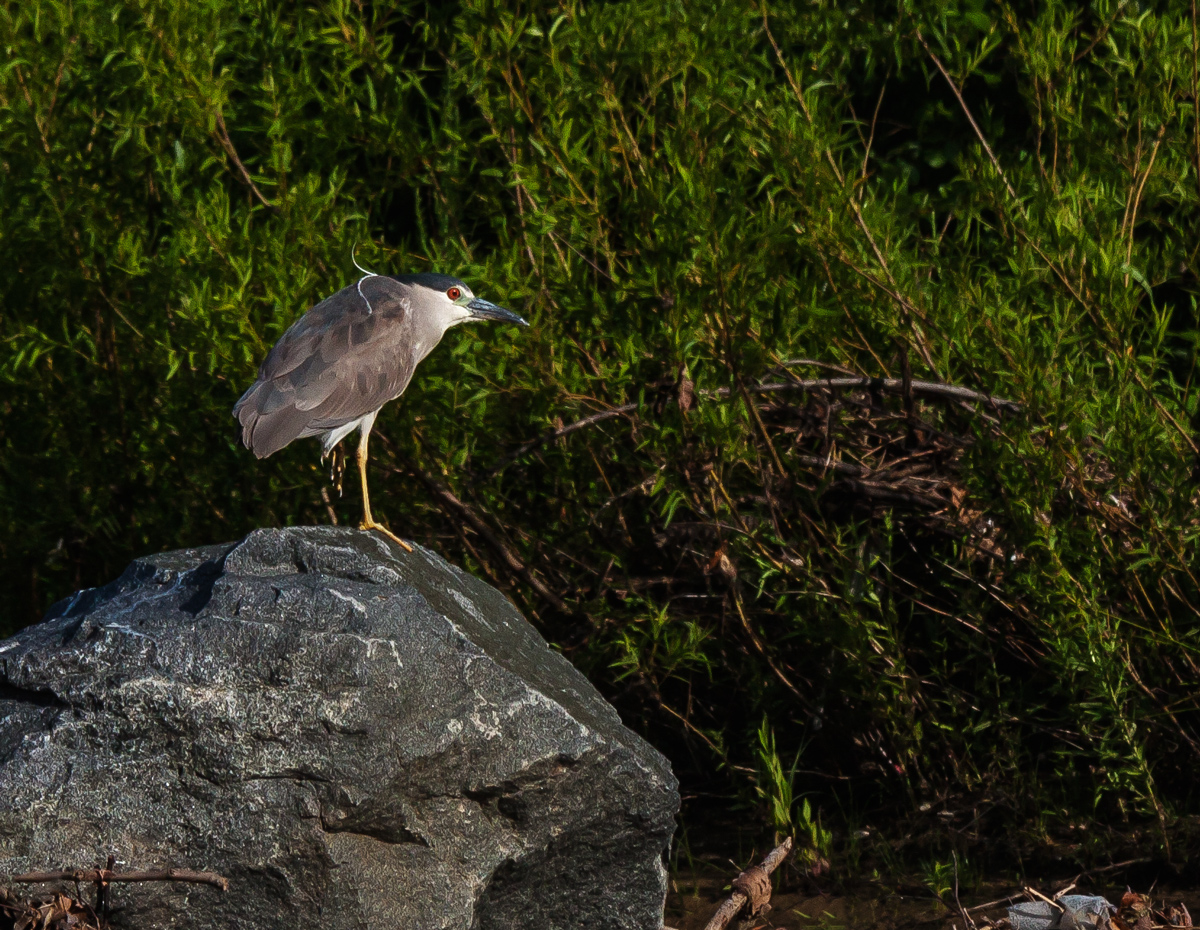
How much of the environment do you show when your primary subject is a bird? Normally I try to fill as much of the frame as possible with the bird through a combination of zooming and cropping.

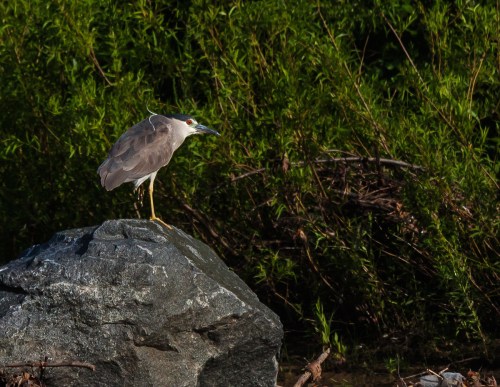
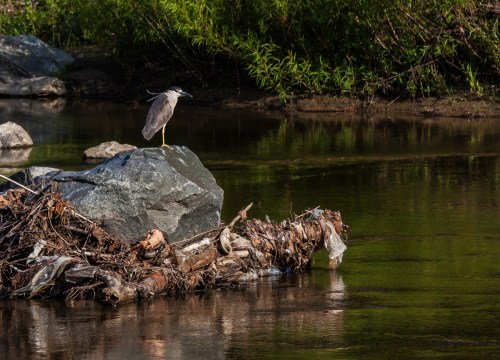
Yesterday as I walking along Cameron Run, a suburban waterway that feeds into the Potomac River, I spooked a Great Blue Heron when I took a few steps in its direction. A smaller bird was also spooked and it flew to a rock in the middle of the stream. I was thrilled when I realized that it was a Black-crowned Night Heron (Nycticorax nycticorax), a bird species that I don’t see very often.

It would have been easier to get a shot if I had been carrying my long zoom lens, but instead I had my 180mm macro lens on my camera. Fearful that the bird would take flight again, I took some initial shots and then slowly moved forward. As I climbed over large rocks toward the water’s edge, I’d stop and take a few more shots. After I reached the water, I decided to change lenses and put on the 70-300mm lens that was in my camera bag and, of course, the night heron flew off as I was changing lenses.

When I was at the closest point, I was able to capture an image that, with a lot of cropping, shows some of the beautiful details of the heron, including its startlingly red eyes, but as I looked over my images, that was not my favorite one. My eyes kept returning to the landscape shot. in which the heron is only one element of a beautiful composition of rocks and water.

What do you think? I’m posting three different shots of the night heron with varying amounts of background context, so you can see how the scene changed as I zoomed with my feet (and cropped in post processing).

Black-crowned Night Heron

Black-crowned Night Heron

Black-crowned Night Heron

© Michael Q. Powell. All rights reserved.

Read Full Post »
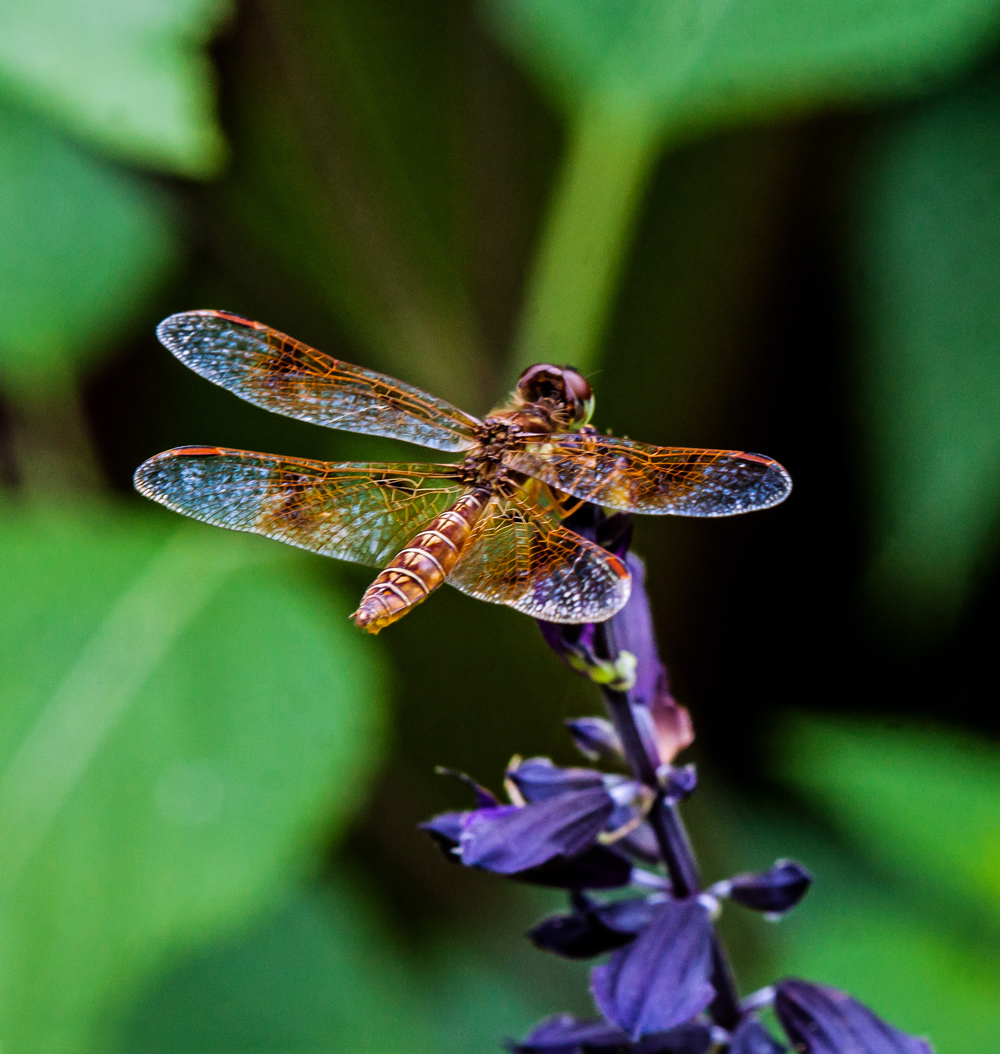
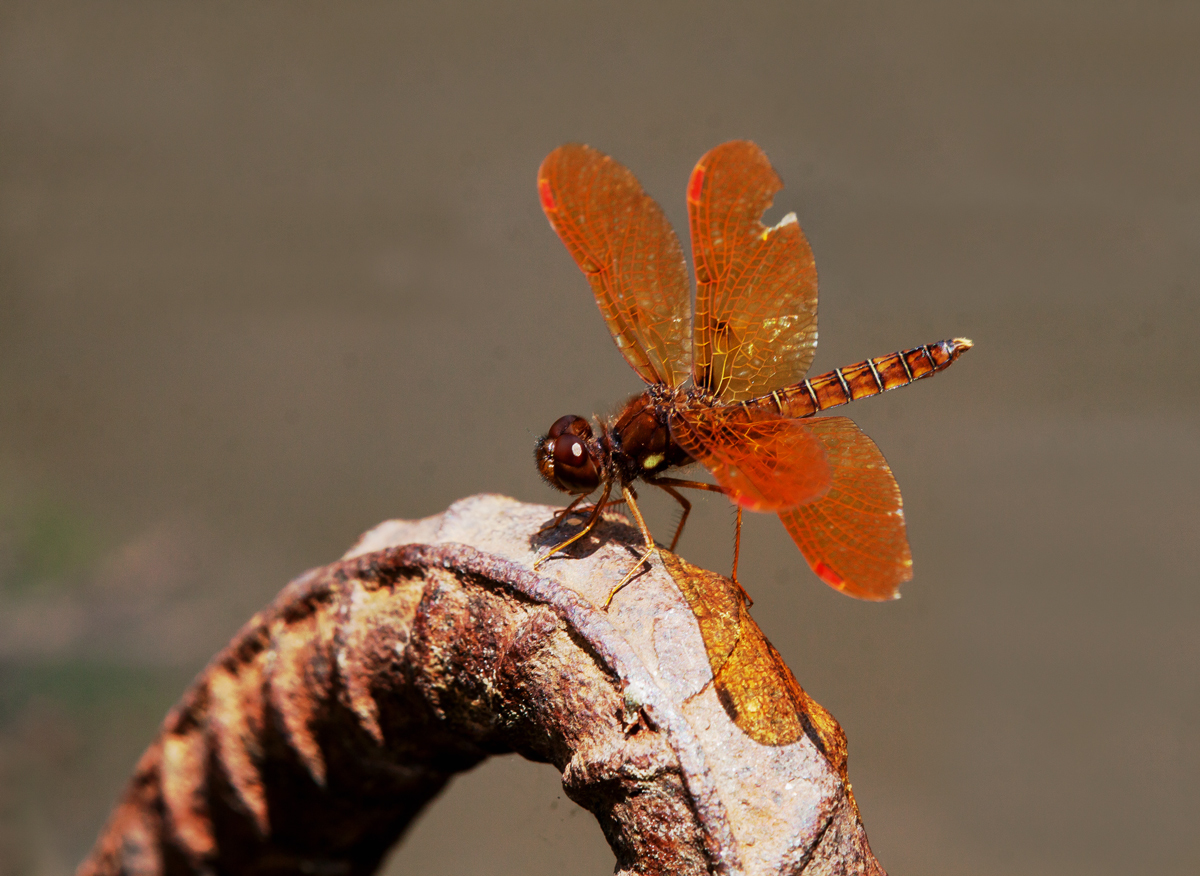
Normally I like to photograph dragonflies in their natural environment, but when an Eastern Amberwing dragonfly (Perithemis tenera) chose to perch on a curved piece of rebar recently, the juxtaposition of the natural and man-made elements seemed to create a sense of harmony rather than one of dissonance.

I took this photo at a small man-made pond at Green Spring Gardens in Alexandria, Virginia. Later in the summer I hope to see water lilies and lotus blossoms at the pond, but it is mostly devoid of vegetation right now, which many be why the dragonfly chose this unusual perch.

I have no idea why this piece of reinforcing steel is sticking out of the water, but its reddish-brown color and curved shape made it a good match for this tiny dragonfly.

Eastern Amberwing

© Michael Q. Powell. All rights reserved.

Read Full Post »

“I’m the king of the world.” This Red Milkweed Beetle (Tetraopes tetrophthalmus) is not exactly Leonardo DiCaprio, but it assumed his Titanic pose after it climbed to the tip of a milkweed plant this past weekend at Green Spring Gardens in Alexandria, Virginia.

I have been fascinated by Red Milkweed Beetles since I first encountered them several years ago when I first started getting into macro photography. They are bright and colorful and relatively easy to find—whenever I spot a milkweed plant I immediately begin to search for these little red bugs.

There is something almost cartoonish about the appearance of the Red Milkweed Beetle, as though an artist started with the shape of a horse’s head, added the horns of a longhorn bull, and then made it a really bold color to make it stand out.

For a fleeting moment, this little beetle is the king of the world.

Red Milkweed Beetle

© Michael Q. Powell. All rights reserved.

Read Full Post »

As I was looking over a whole range of the colorful flowers yesterday at Green Spring Gardens, I gradually realized that I was drawn most to those with simple shapes and relatively subdued colors, like the modest spiderwort (g. Tradescantia). There is a real beauty in its simplicity.

The bees seemed to like the spiderworts too, including one that I photographed with overfilled pollen sacs.

spiderwort

spiderwort

© Michael Q. Powell. All rights reserved.

Read Full Post »

For a change of pace I decided today to visit Green Spring Gardens, a historical county-run garden that always has lots of beautiful flowers. Some purple poppies were among my favorites. Several of them were in bloom, surrounded by a large number of seed pods. A honey bee and I were attracted to the same flower at the same time—the bee ignored me and busily went about its work.

Purple Poppy

© Michael Q. Powell. All rights reserved.

Read Full Post »
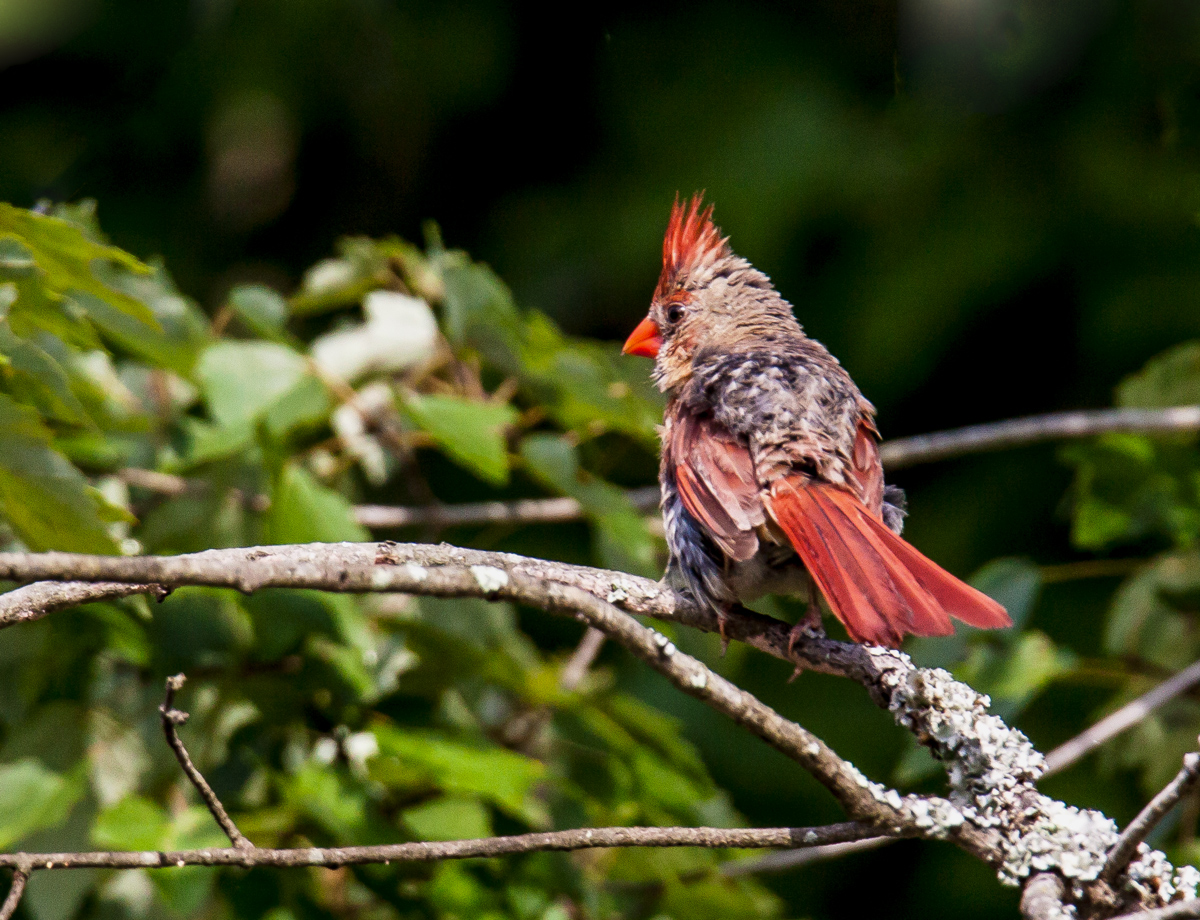
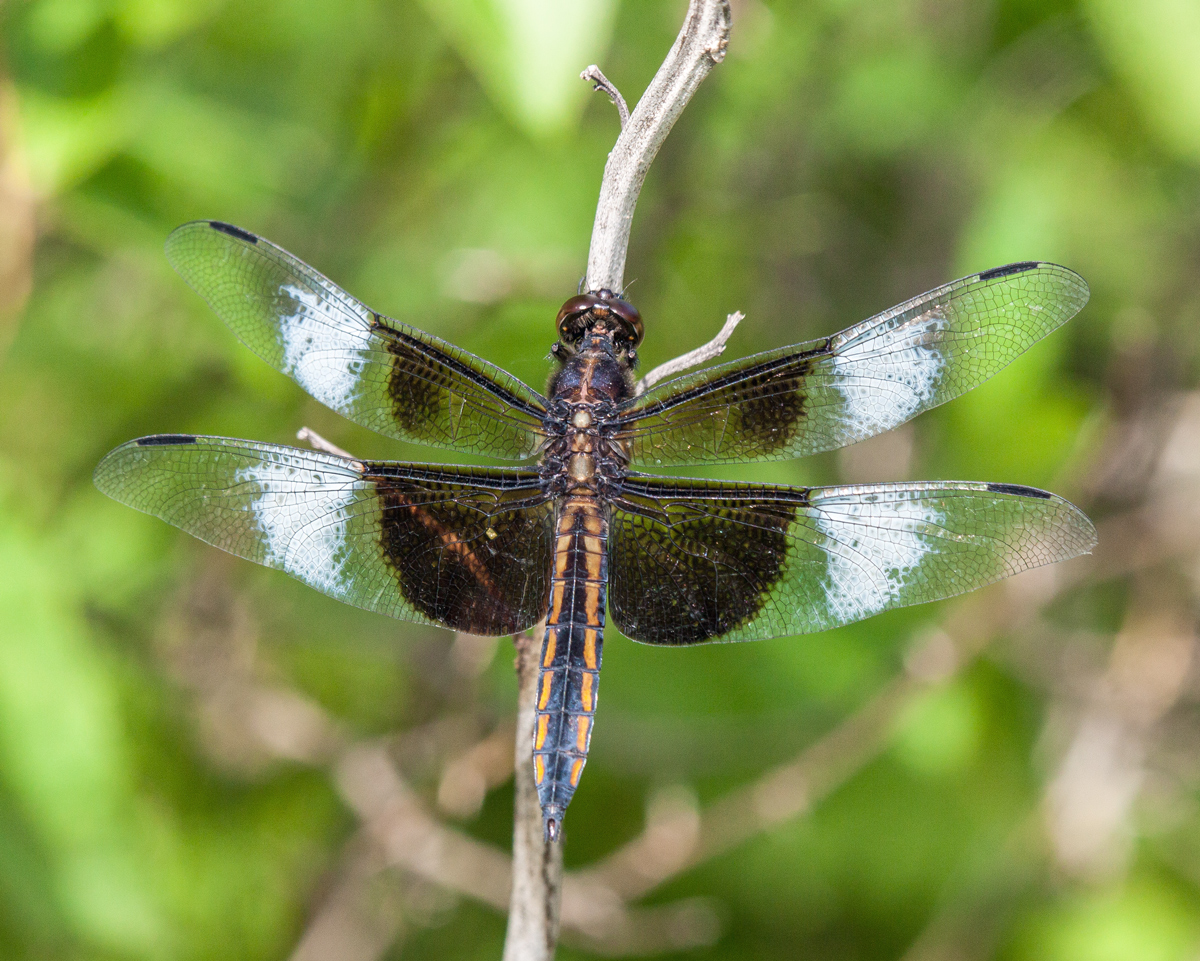
What is a Widow Skimmer? It sounds like a con artist who preys on rich older women, but it actually is a beautifully patterned dragonfly, like this juvenile male that I spotted recently at Huntley Meadows Park.
Why is it called a “widow?” According to bugguide.net, the species name of the Widow Skimmer (Libellula luctuosa) “means sorrowful or mournful, perhaps because the wings of both male and female seem to be draped in mourning crepe.” Only the male has white patches on its wings, so it’spretty easy to identify the dragonfly in the image as a male. Adult males have blue bodies and juvenile males and females have yellow and brown bodies.
Sometimes I wish that the identification of dragonfly species were this easy all of the time, but real life is generally much more complicated.
Widow Skimmer
© Michael Q. Powell. All rights reserved.

Read Full Post »

Purple Milkweed (Asclepias purpurascens) is in bloom in multiple locations at Huntley Meadows Park and the butterflies are loving it, including this Silver-spotted Skipper (Epargyreus clarus) that I spotted this past Monday.
Generally I have trouble identifying little skipper butterflies and Wikipedia notes that there are more than 3500 species of skippers worldwide.  The Silver-spotted Skipper, though, is pretty easy to identify, given its distinctive colors and markings.
There are several species of milkweed in my favorite marshland park and I have noticed more Purple Milkweed this year than in the past. This is really good news, because Purple Milkweed is considered to S2 (“imperiled”) in the Commonwealth of Virginia, according to the 2016 plant list of the Virginia Department of Conservation and Recreation.
Silver-spotted Skipper

© Michael Q. Powell. All rights reserved.

Read Full Post »
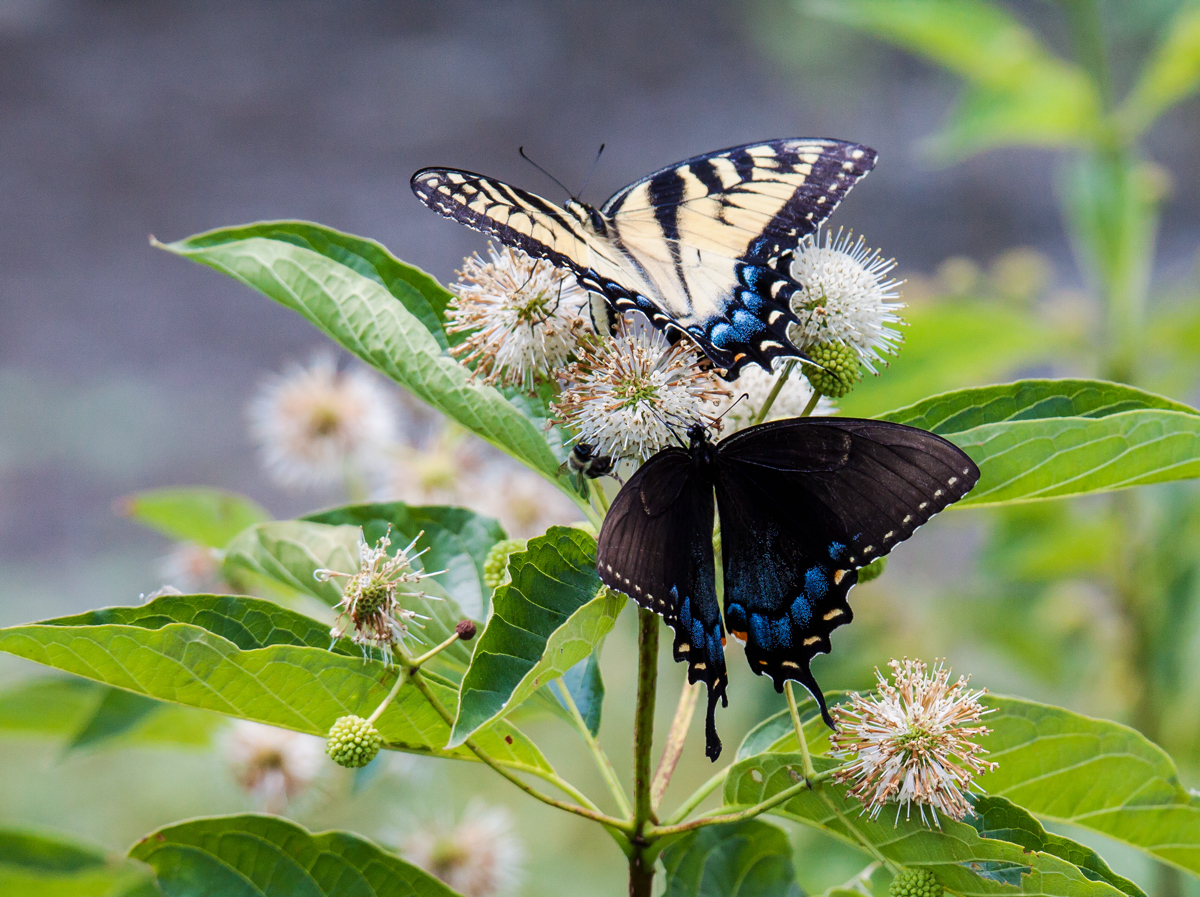
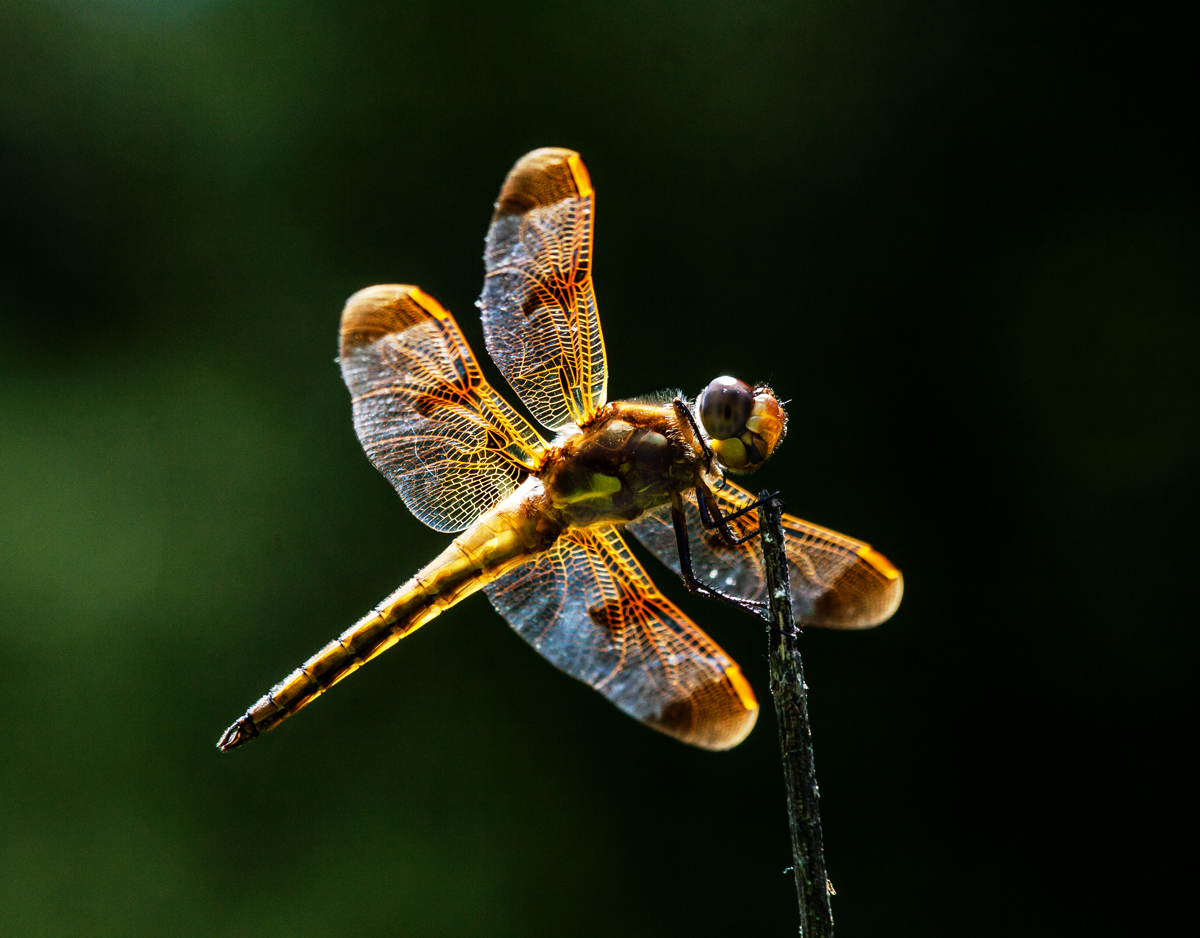
The sunlight shining through from behind helped to highlight the beautiful colors and patterns of this Painted Skimmer dragonfly (Libellula semifasciata) at Huntley Meadows Park this past Monday. Although I usually try to get more even lighting in my shots, I really like the way that this directional lighting has created areas of brightness and shadow, which seems to add a bit of drama to the image.

Painted Skimmer
© Michael Q. Powell. All rights reserved.

Read Full Post »
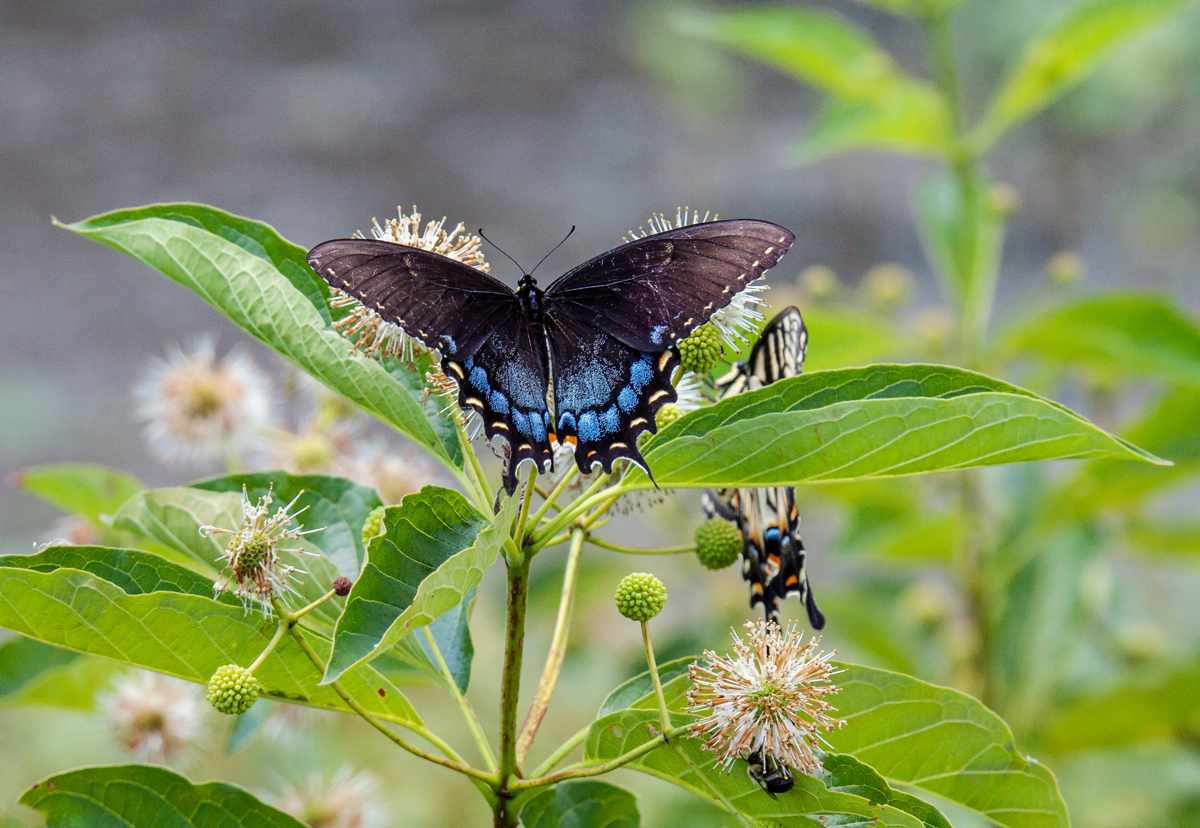
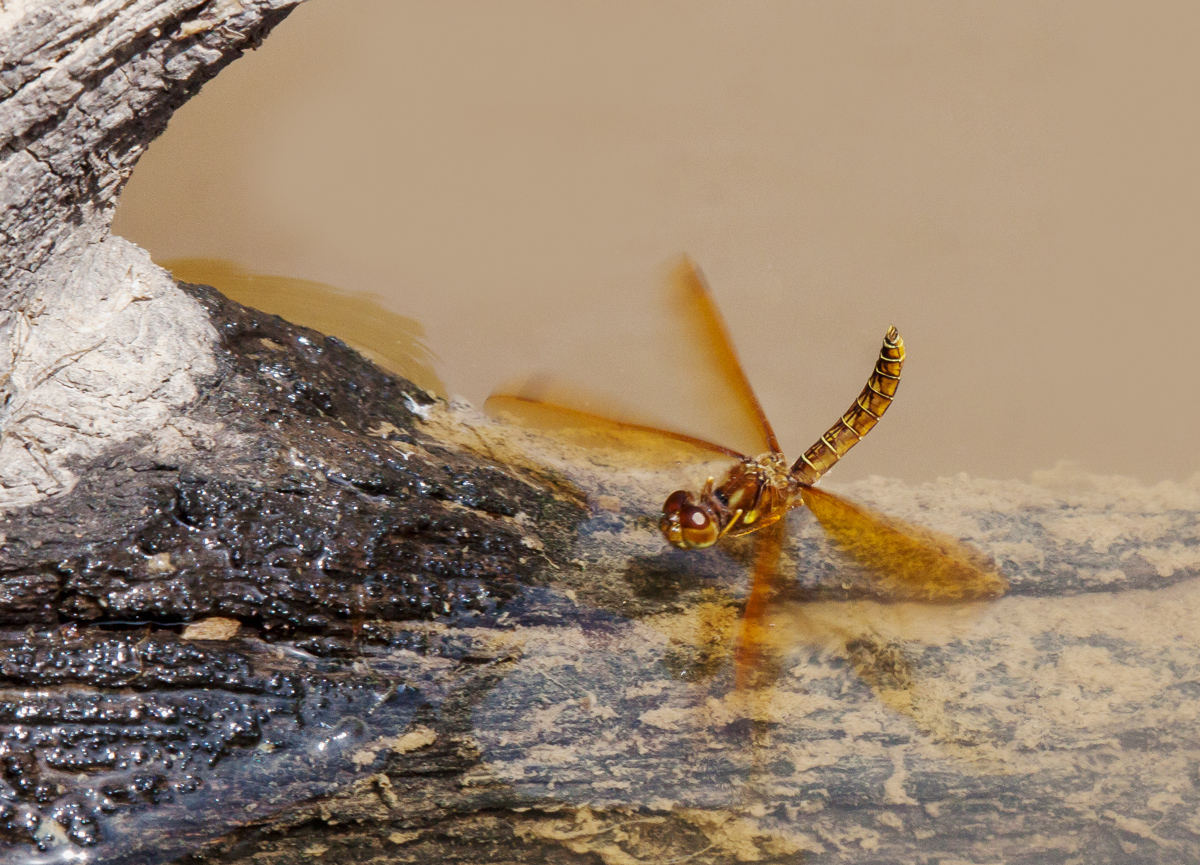
When I first spotted a tiny Eastern Amberwing dragonfly (Perithemis tenera) flying low over the water and flexing yesterday at Huntley Meadows Park, I assumed that it was a female depositing eggs into the water. As I continued to watch (and try to get shots) a couple of things became clear—it was a male, not a female, and he was pointing his abdomen up into the air, not down into the water. What was he doing?

Apparently this is courting behavior and he was trying to impress a lady that he had spotted. There is a fascinating description of this process in a blog posting by the University of Wisconsin Milwaukee Field station that I highly recommend. Here is an extract from that posting.

“A male flies low over the water, patrolling a territory about 20 feet wide of choice egg-laying turf (weedy aquatic sites) and defending it vigorously – darting out at intruders and displaying with those spectacular wings. When a female approaches, he follows and courts her, swaying back and forth, abdomen raised. If she’s agreeable, she follows him home. He hovers over his territory while she evaluates it, and if she likes it, she gets him along with it.”

As the third photo shows, his courting behavior was successful. After they mated, she deposited the eggs into the water and he returned to his perch, ready to chase off rivals and attract more female dragonflies. (In case you are not familiar with this dragonfly species, the Eastern Amberwing is one of the smallest dragonflies in the United States, with a body length of just under one inch (25 mm).

Eastern Amberwing


Eastern Amberwing

Eastern Amberwing

Eastern Amberwing

© Michael Q. Powell. All rights reserved.

Read Full Post »

Females are a real mystery to me, especially when it comes to dragonflies. At this time of the year I see a lot of different dragonflies and I have featured a number of the colorful males over the past few weeks. They are relatively easy to identify when they are mature—immature males, however, often have the same coloration as females.

The challenge with females, particularly a number of the members of the Skimmer family, is that they all look pretty much the same.  This past Friday I photographed this beautiful female dragonfly and I love the two-toned coloration of her eyes. After consulting with my local dragonfly expert Walter Sanford, I have concluded that she is probably a Great Blue Skimmer (Libellula vibrans), though she doesn’t have a spot of blue on her

Great Blue Skimmer

© Michael Q. Powell. All rights reserved.

Read Full Post »
« Newer Posts - Older Posts »