October 19, 2018 by Mike Powell
When the lighting is perfect, the blue and orange colors of an Eastern Bluebird (Sialia sialis) are incredibly saturated and beautiful. Alas, lighting conditions were far from ideal when I spotted three bluebirds earlier this week at Occoquan Bay National Wildlife Refuge and the bluebirds were elusive.
I was able to capture some images that give at least a hint of the beauty of the bluebirds, a species that I am always happy to see.


© Michael Q. Powell. All rights reserved.
Posted in Autumn, Birds, Nature, Photography, wildlife | Tagged bluebird, Canon 50D, Eastern Bluebird, Occoquan Bay National Wildlife Refuge, Sialia sialis, Tamron 150-600mm, Woodbridge VA | 6 Comments »
October 18, 2018 by Mike Powell
When I spotted this turtle from a distance earlier this week at Occoquan Bay National Wildlife Refuge, it was so elevated that I thought it was standing on a log or a rock. It was only when I zoomed in on this Eastern Painted Turtle (Chrysemys picta picta) that I realized that it was standing on the back of another turtle. Yikes!
You have to be pretty old—probably about my age—if you remember the song whose name I used as the title for this blog posting. No, it was not sung by The Turtles.

© Michael Q. Powell. All rights reserved.
Posted in Nature, Photography, Reptiles, wildlife | Tagged Canon 50D, Chrysemys picta picta, Eastern Painted Turtle, I'm not your steppin' stone, Monkees, Occoquan Bay National Wildlife Refuge, painted turtle, Tamron 150-600mm, Woodbridge VA | 12 Comments »
October 18, 2018 by Mike Powell
I spotted this little family of Double-crested Cormorants (Phalacrocorax auritus) in the waters off of Occoquan Bay National Wildlife Refuge this past Monday. The adult seemed bothered by something and initIally cried out before finally taking off, leaving the younger cormorants temporarily by themselves.
I am not actually completely certain that this is a family unit, but I think it is a pretty safe assumption when I look at the way that the smaller ones are paying attention to the larger cormorant. It also appears to me that the the adult was potentially reacting to a perceived threat and flew off as a way of protecting the younger ones.


© Michael Q. Powell. All rights reserved.
Posted in Autumn, Birds, Nature, Photography, wildlife | Tagged Canon 50D, cormorant, Double-crested Cormorant, family of cormorants, Occoquan Bay National Wildlife Refuge, Phalacrocorax auritus, Tamron 150-600mm, Woodbridge VA | 5 Comments »
October 17, 2018 by Mike Powell
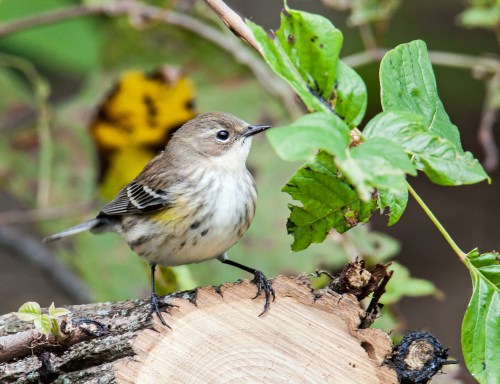
At this time of the year Yellow-rumped Warblers (Setophaga coronata) are probably the most numerous warblers in our area. You can often seem them in constant motion flitting about high in the trees. They rarely stay still for more than a moment and it is unusual to get a clear view of the entire body of one.
I have spent a lot of time this week patiently tracking these little birds at several locations at Occoquan Bay National Wildlife Refuge and managed to get a few shots that I really like. The first image shows a Yellow-rumped Warbler perched at ground level on the trunk of a tree that had fallen across the road and had been cut up and moved to the side. I particularly like that it shows the tiny feet of this bird that is about 5 inches in length (13 cm). The little yellow streaks just under the wings help to identify this as a Yellow-rumped Warbler.
The second image, possibly my favorite, shows the yellow patch on the bird’s rump that is responsible for its name. The intense focus of the warbler as it looks upward help to give this image a dynamic element that is absent in many images of perched birds.
The final image has a studio-like feel to it, because the sky was completely overcast and turned white as I was processing the image. I had tracked the bird when it entered into the vegetation and managed to get this shot when it finally popped up at the top of the tree and stretched its neck to look around.


© Michael Q. Powell. All rights reserved.
Posted in Autumn, Birds, Nature, Photography, wildlife | Tagged Canon 50D, Occoquan Bay National Wildlife Refuge, Setophaga coronata, Tamron 150-600mm, warbler, Woodbridge VA, Yellow-rumped Warbler | 8 Comments »
October 16, 2018 by Mike Powell
I have seen Great Blue Herons (Ardea herodias) catch fish so big that I was sure that they would not be able to swallow them, but I don’t think I have ever seen one catch fish as small as the ones this heron was pulling out of the water yesterday at Occoquan Bay National Wildlife Refuge.
The Great Blue Heron was standing on the shore rather than in deeper water. As I watched, the heron periodically would catch and swallow one of these tiny fish and then return to scanning the water. It struck me that it would need to catch a lot of these little fish to make a satisfying meal.

© Michael Q. Powell. All rights reserved.
Posted in Autumn, Birds, Fish, Nature, Photography, wildlife | Tagged Ardea herodias, blue heron, Canon 50D, Great Blue Heron, heron, Occoquan Bay National Wildlife Refuge, Tamron 150-600mm, Woodbridge VA | 14 Comments »
October 15, 2018 by Mike Powell
In the autumn, various species of warblers fly through our area as they migrate south and I spent a large amount of time this past Friday trying to get shots of what I believe were mostly Palm Warblers (Setophaga palmarum). Warblers in general are tough for me to identify, even in the spring when the colors and patterns on the birds are bright and distinctive. At this time of the year, however, all of the colors and patterns are muted and many species look really similar to me.
Palm Warblers are a little easier to spot than most warblers to identify, because they often can be found pecking away on the ground rather than in trees, as you can see in the second shot. Although I usually strive to get unobstructed shots of my subject, the first image is my clear favorite of the three in this posting. The branch in the foreground that partially blocks the bird helps in the composition, I think, and reinforces the sense of the elusiveness and caution of this little warbler.


© Michael Q. Powell. All rights reserved.
Posted in Autumn, Birds, Nature, Photography, wildlife | Tagged Canon 50D, Occoquan Bay National Wildlife Refuge, Palm Warbler, Setophaga palmarum, Tamron 150-600mm, warbler, Woodbridge VA | 6 Comments »
October 14, 2018 by Mike Powell
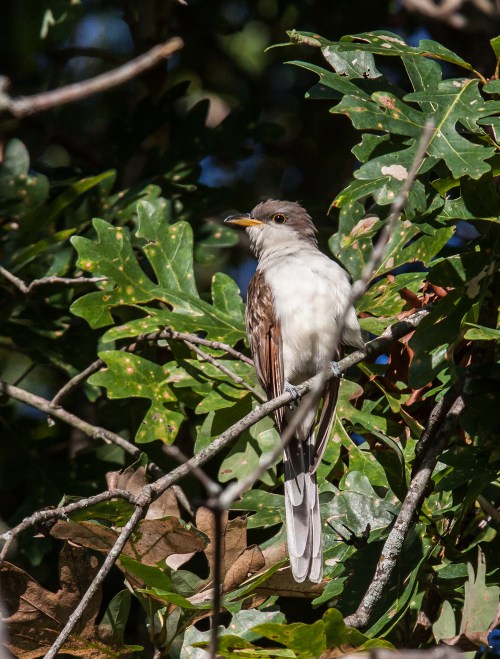
I am always shocked by the length of the tails of Yellow-billed Cuckoos (Coccyzus americanus), like this one that I spotted on Friday morning at Occoquan Bay National Wildlife Refuge. It is pretty rare for me to get an almost unobstructed view of a cuckoo—usually they either fly away as I approach or are hidden in the foliage.
In the second shot, the cuckoo had shifted its body and the the new perspective has the effect of making the tail look a bit shorter and the body a bit chunkier.

© Michael Q. Powell. All rights reserved.
Posted in Autumn, Birds, Nature, Photography, wildlife | Tagged Canon 50D, Coccyzus americanus, cuckoo, Occoquan Bay National Wildlife Refuge, Tamron 150-600mm, Woodbridge VA, Yellow-billed Cuckoo | 9 Comments »
October 13, 2018 by Mike Powell
I was startled on Friday when exploring Occoquan Bay National Wildlife Refuge to hear a loud roaring noise overhead. I looked up and saw a large group of vintage aircraft flying in formation. Even though I zoomed out as far as I could with my 150-600mm lens, I could not fit all of the aircraft within the frame until they were flying away.
According to a press release from the Culpeper Air Fest, in an operation known as the Potomac Flight, a group of World War II aircraft on Friday, 12 October did a flyover down the Potomac River from Culpeper Regional Airport over the Pentagon and Arlington National Cemetery to honor Disabled American Veterans as a tribute to the services and sacrifices veterans have made for our freedom. Those of us who live in the Washington DC area know that the airspace over the capital region is tightly controlled and I can only imagine all of the bureaucratic impediments that had to be overcome to make this overflight possible.
I am not very good at identifying vintage aircraft, but the press release cited above indicated the overflight would include T-6 Texans and a C-47 aircraft.


© Michael Q. Powell. All rights reserved.
Posted in aircraft, Autumn, Patriotism, Photography | Tagged aircraft, Canon 50D, Culpeper Air Fest, Occoquan Bay National Wildlife Refuge, Potomac Flight, Potomac Flight 2018, Tamron 150-600mm, vintage aircraft, Woodbridge VA, World War II | 5 Comments »
October 13, 2018 by Mike Powell
I was really struck by the contrast in color and texture between this cluster of large milkweed bugs (Oncopeltus fasciatus) and the milkweed on which they were perched at Occoquan Bay National Wildlife Refuge during a visit earlier this week.
The color combination seems appropriate for a Christmas card, though the subject matter would be considered untraditional, to say the least, and might not be met with enthusiasm by all recipients.

© Michael Q. Powell. All rights reserved.
Posted in Autumn, Christmas, Insects, Macro Photography, Nature, Photography, wildlife | Tagged Canon 50D, large milkweed bugs, milkweed, milkweed bug, Occoquan Bay National Wildlife Refuge, Oncopeltus fasciatus, Tamron 180mm, Woodbridge VA | 4 Comments »
October 12, 2018 by Mike Powell
It seems like we are at a time in the year when the number of birds has increased. I can hear them everywhere when I walk along the wooded trails of Occoquan Bay National Wildlife Refuge. The problem, though, is that most the leaves are still on the trees, so I am having huge problems spotting the birds and if I can’t see them, I can’t photograph them.
Earlier this week, I heard the familiar knocking sound of a woodpecker at work. I could see some movement in a tree amidst the foliage. I tracked the movement until suddenly the woodpecker popped into the open for a brief moment as it reached the top of the dead tree. I was able to capture this one shot of what appears to be a male Downy Woodpecker (Picoides pubescens)—only males have the red patch of feathers on the back of their heads. (The Hairy Woodpecker is similar in appearance to the Downy Woodpecker, but is larger and has a longer bill—the angle of this shot makes it tough for me to be absolutely certain of my identification.)
Downy Woodpeckers are the smallest woodpeckers in Northern America, but what they lack in size, they seem to make up in energy. They always seem to be super energetic and industrious and are one of the birds that I am able to spot throughout most the entire year.

© Michael Q. Powell. All rights reserved.
Posted in Autumn, Birds, Nature, Photography, wildlife | Tagged Canon SX50, Downy Woodpecker, Dryobates pubescens, Occoquan Bay National Wildlife Refuge, Picoides pubescens, Woodbridge VA | 7 Comments »
October 11, 2018 by Mike Powell
I love Wood Ducks (Aix sponsa), but haven’t seen any for quite some time. I was therefore really happy when I spotted this pair swimming in the distance in a creek at Occoquan Bay National Wildlife Refuge earlier this week.
The male Wood Duck, as shown in the first image, is one of the most colorful and distinctively patterned birds in our area—there is no other bird that looks even vaguely similar. The duck stopped swimming for just a moment and I was able to capture this shot of him getting a drink of water.
The female Wood Duck shown in the second image is not quite as colorful as her male counterpart, but has an equally distinctive look with her windswept “hair” and prominent white eye ring.


© Michael Q. Powell. All rights reserved.
Posted in Autumn, Nature, Photography, wildlife | Tagged Aix sponsa, Canon SX50, female wood duck, male wood duck, Occoquan Bay National Wildlife Refuge, wood duck, Woodbridge VA | 8 Comments »
October 10, 2018 by Mike Powell
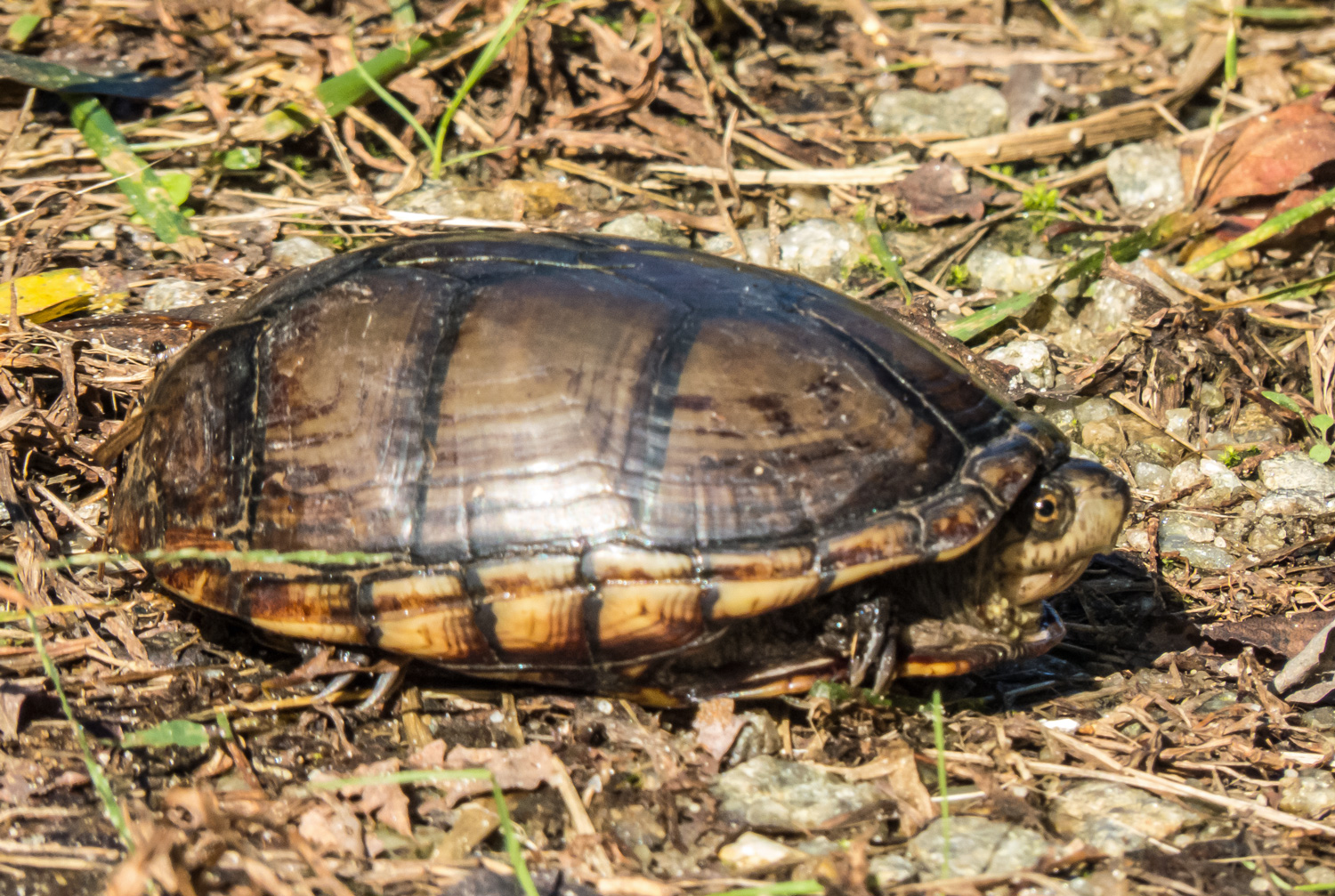
As I was exploring Occoquan Bay National Wildlife Refuge earlier this week, I stumbled upon this cute little Southeastern Mud Turtle (Kinosternon subrubrum subrubrum). It looks like the little turtle had attempted to withdraw its head into its shell, but it does not quite fit.
I’ve only spotted this species of turtle, also known an Eastern Mud Turtle, a few times, so I decided to do a little research. Among other things, I learned on the website of the Virginia Herpetological Society that Southeastern Mud Turtles are ominvores, eating, among other things, insects, crustaceans, mollusks, amphibians, carrion, and aquatic vegetation.
Here are a few more fun facts about these turtles from the same website: “Southeastern Mud Turtles are bottom walkers, spending most of their active time in water on the bottom. A substantial but unknown portion of their annual activity period is terrestrial. They seldom bask. Southeastern mud turtles are pugnacious when caught and many will try to bite, causing a minor wound from the curved beak.”
I am glad that I felt no desire to pick up the turtle.

© Michael Q. Powell. All rights reserved.
.
Posted in Autumn, Nature, Photography, turtle, wildlife | Tagged Canon SX50, Eastern Mud Turtle, Kinosternon subrubrum, Kinosternon subrubrum subrubrum, Occoquan Bay National Wildlife Refuge, Southeastern Mud Turtle, Woodbridge VA | 5 Comments »
October 9, 2018 by Mike Powell
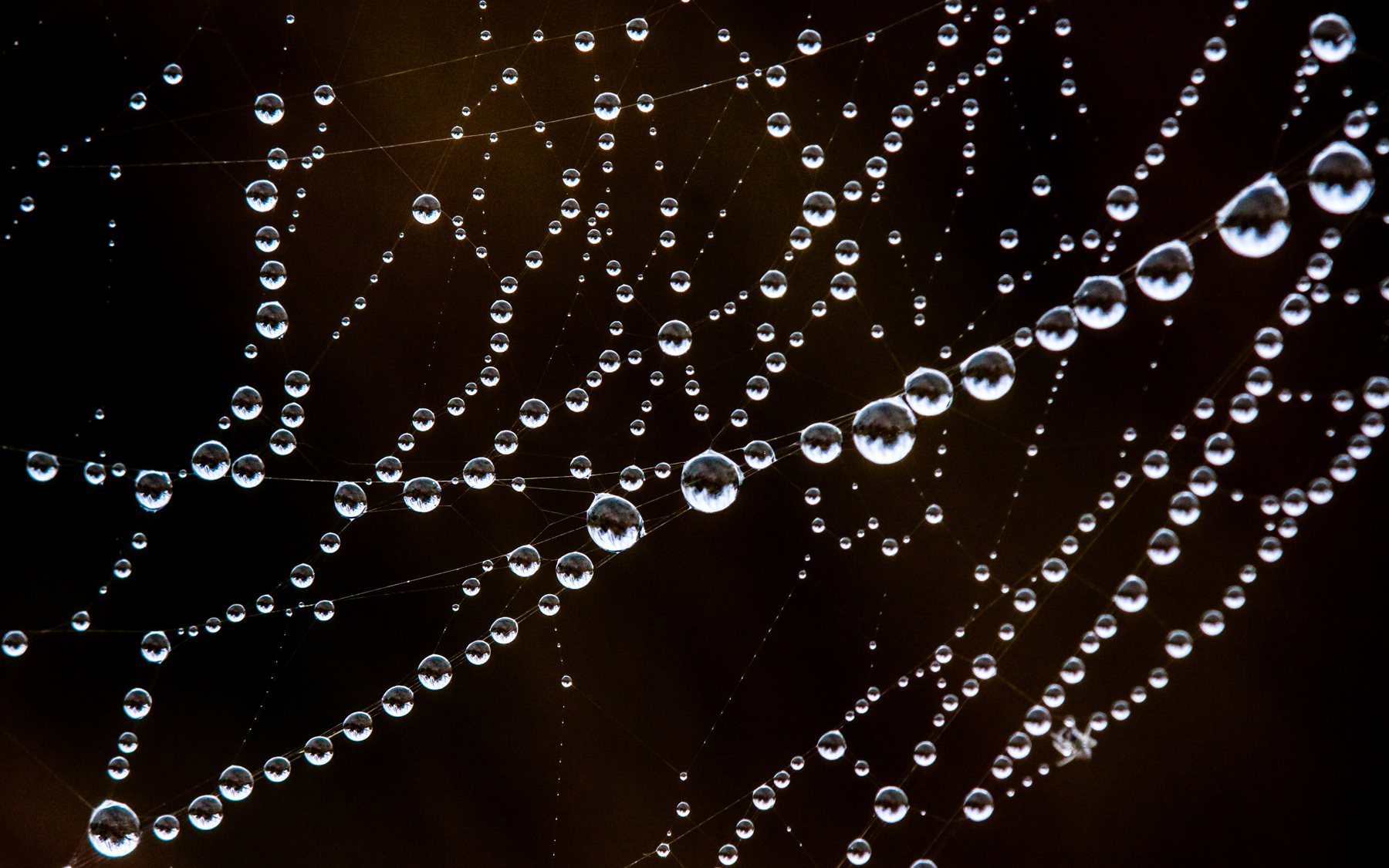
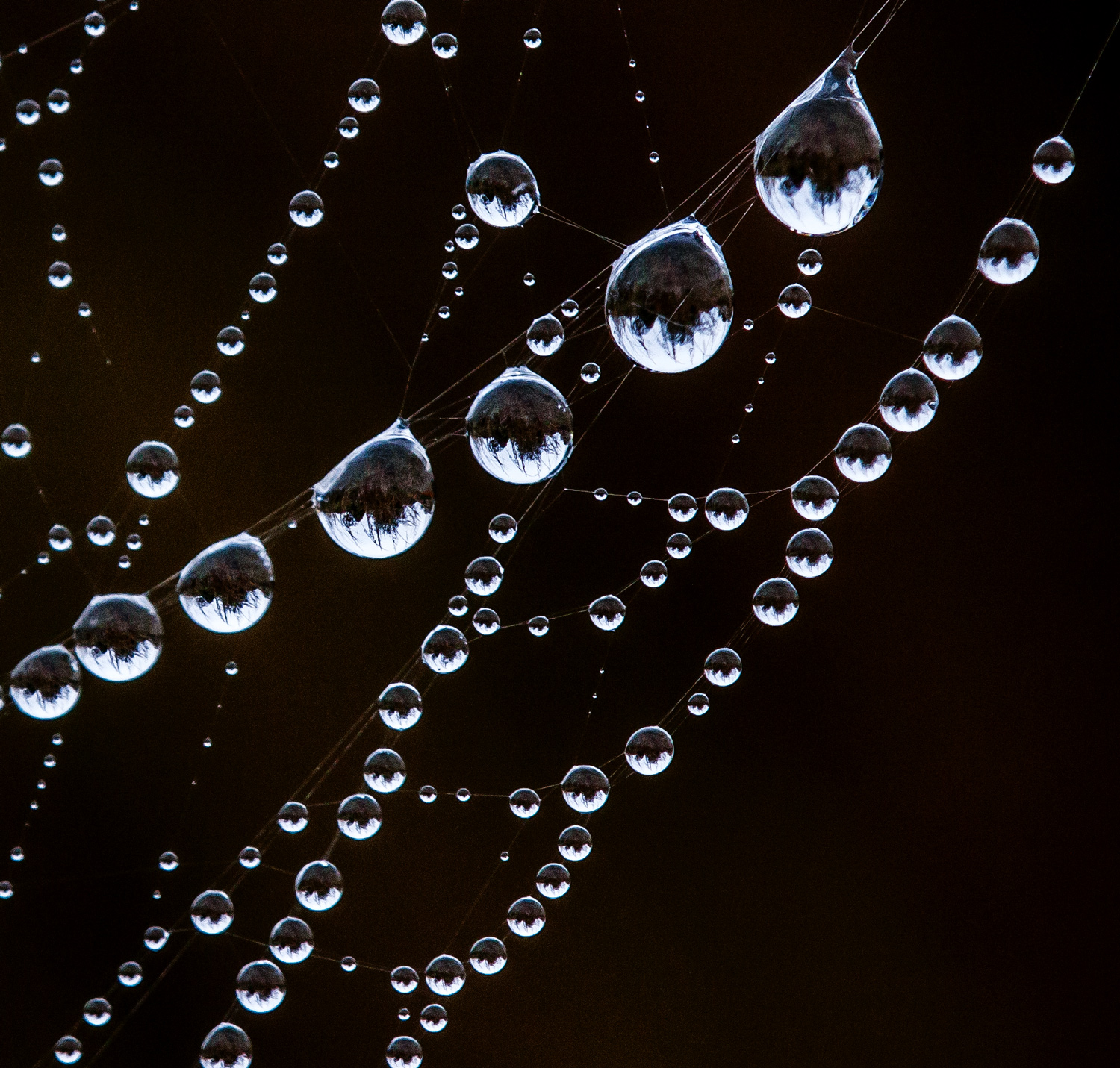
The spiderweb was tattered and the spider was absent, but the globular drops of dew gave the scene a magical feel as the early morning light turned them into transparent pearls. As I looked more closely, I saw there was a miniature upside down version of the landscape in many of the drops.
For the ease of the viewer, I flipped a cropped version of part of the scene 180 degrees in the first photo below to give a better sense of the “landscapes” that are shown right side up. The second image shows a wider view of the strings of glistening drops. The final image is the same as the first one, but rotated back to its original orientation, so that the normal rules of gravity apply and the dew drops are hanging down from the silken strands of the spider web.


© Michael Q. Powell. All rights reserved.
Posted in abstract, Art, Landscape, Nature, Photography, spiders | Tagged Canon 50D, dew, landscape, Occoquan Bay National Wildlife Refuge, pearls, spider web, Tamron 180mm, transparent pearls, Woodbridge VA | 15 Comments »
October 8, 2018 by Mike Powell
When this Spotted Orbweaver spider (Neoscona crucifera) spotted me last week at Jackson Miles Abbott Wetland Refuge, it scurried along the silken threads of its web to the relative safety of the plant to which one end of the web was attached.
There is something that really appeals to me about this image. Maybe it’s the way that the colors of the spider match those of the plant or how the shapes of the stems are similar to those of the spider’s legs. Perhaps it is the contrast between the sharpness of a few elements in the image and the dreamy, almost ghost-like background.
Most of the time I strive for super-realistic images and try to draw a viewer’s attention to the details. When I am in an artsy, creative mood, though, I am content to capture an impression of the subject, leaving the details to the imagination of others.

© Michael Q. Powell. All rights reserved.
Posted in Arachnids, Macro Photography, Nature, Photography, spiders, wildlife | Tagged Canon 50D, Fort Belvoir VA, Jackson Miles Abbott Wetland Refuge, Neoscona crucifera, Spotted Orbweaver, Spotted Orbweaver spider, Tamron 180mm | 3 Comments »
October 7, 2018 by Mike Powell
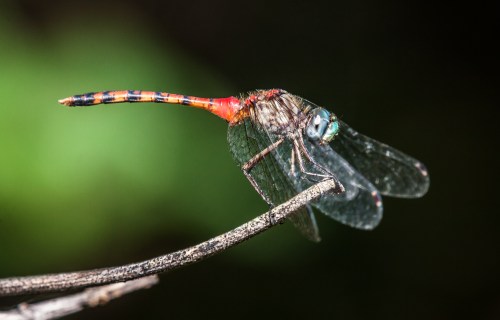
Each fall I look forward to the reappearance of the Blue-faced Meadhowhawk dragonflies (Sympetrum ambiguum). No matter how many times I see them, I never fail to be amazed at the wonderful combination of bright colors on these little beauties.
Quite often Blue-faced Meadowhawks perch in the crowded undergrowth, where the background is cluttered. I was quite happy recently to capture a few images in which the dragonfly perched a little higher, which allowed me to isolate it from the background and ensure that the viewer’s attention is focused on the primary subject.

© Michael Q. Powell. All rights reserved.
Posted in Dragonflies, dragonfly, Insects, Nature, Photography, wildlife | Tagged Blue-faced Meadowhawk, Blue-faced Meadowhawk dragonfly, Canon 50D, Occoquan Bay National Wildlife Refuge, Sympetrum ambiguum, Tamron 180mm, Woodbridge VA | 2 Comments »
October 6, 2018 by Mike Powell
Shining brightly from behind the leaves, the sun revealed their autumnal beauty.
This is completely different from my “normal” photography, but when I stumbled upon this blaze of color while exploring Occoquan Bay National Wildlife Refuge, I couldn’t help but try to capture a sense of the moment.

© Michael Q. Powell. All rights reserved.
Posted in Autumn, Nature, Photography | Tagged autumn colors, autumn foliage, Canon 50D, Occoquan Bay National Wildlife Refuge, Tamron 180mm, Woodbridge VA | 12 Comments »
October 6, 2018 by Mike Powell
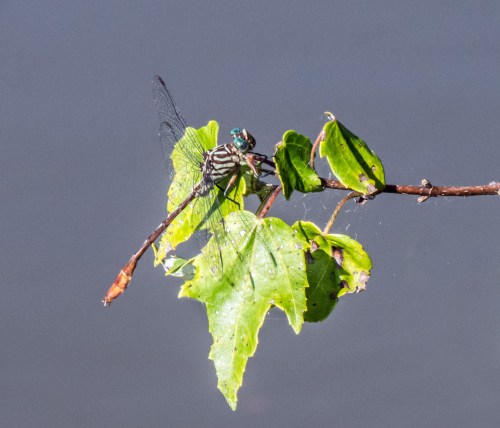
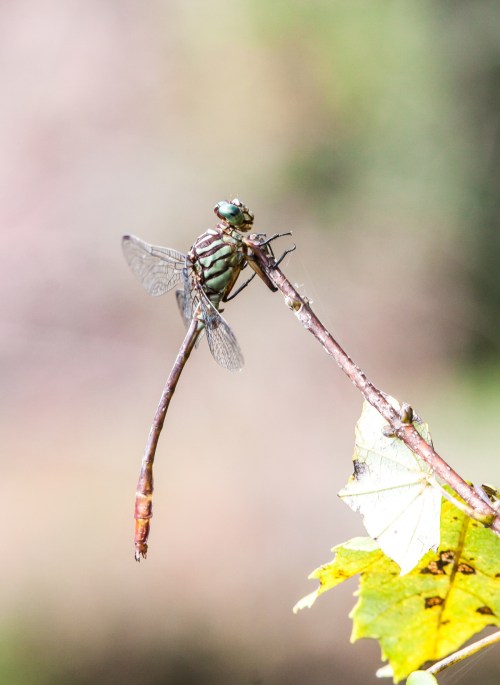
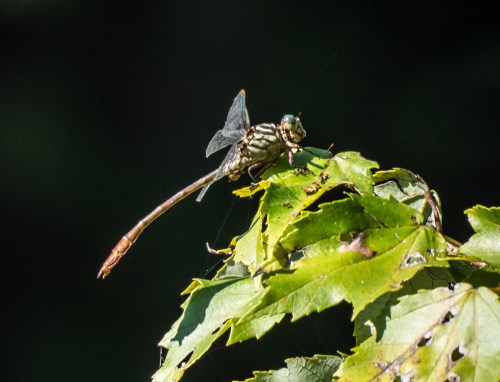
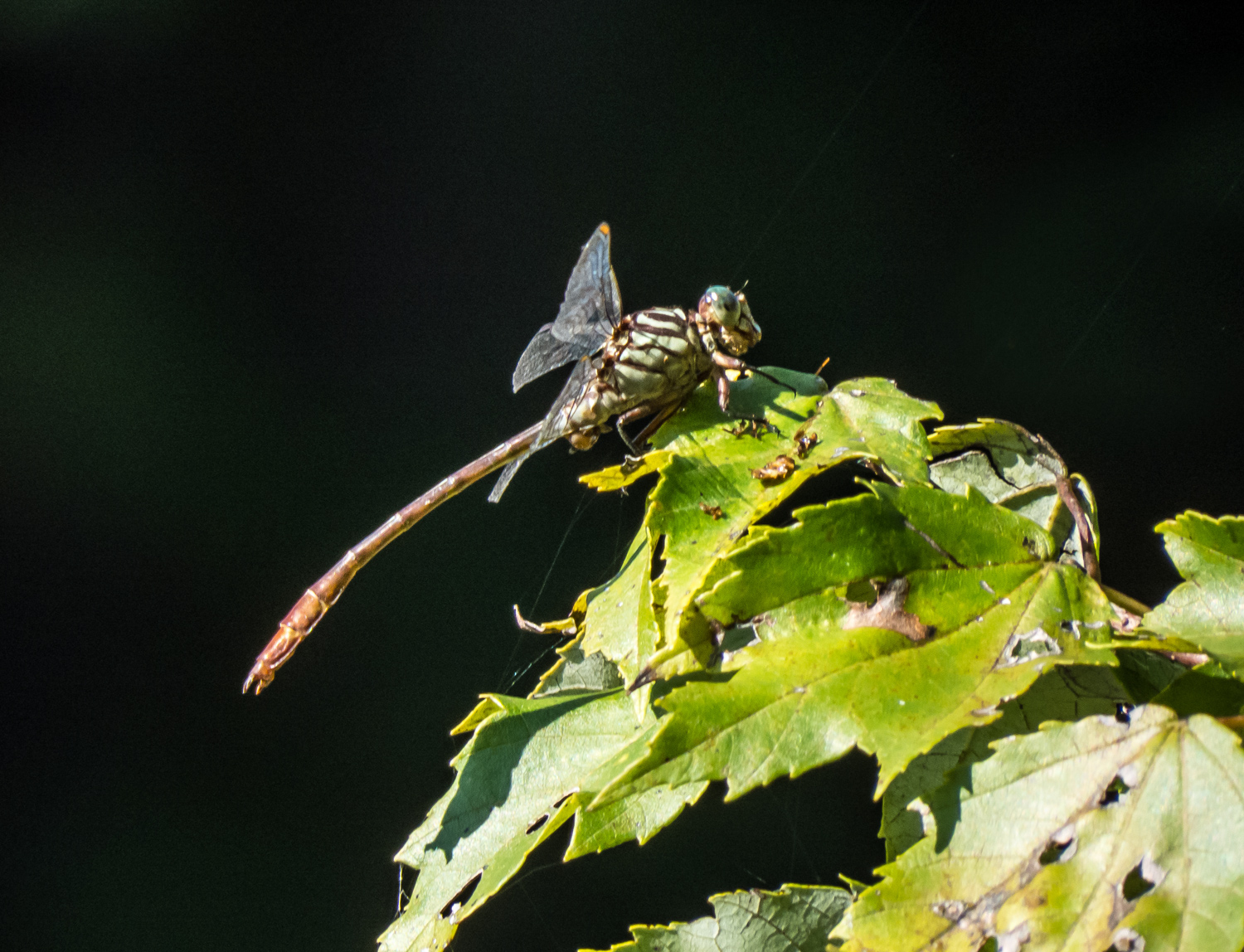
Although we are well into autumn, there are still dragonflies around, including some stunning Russet-tipped Clubtail dragonflies (Stylurus plagiatus) that I spotted earlier this week at Jackson Miles Abbott Wetland Refuge. As you can see from the photos Russet-tipped Clubtails like to perch on somewhat exposed leaves, which makes them a bit easier to spot than some species of dragonflies, though they are not common in my experience
I was able to capture images of Russet-tipped Clubtails (there were at least two individuals that I saw, both males) on several leafy perches in a tree overhanging a pond. My angle of view and the direction of the light gave each of these images a very different feel, primarily because of the way that the background was captured.
Depended on my mood, any one of these three images can be my favorite. Is there one that particularly appeals to you?
© Michael Q. Powell. All rights reserved.
Posted in Autumn, Dragonflies, dragonfly, Insects, Nature, Photography, wildlife | Tagged Canon 50D, Canon SX50, Fort Belvoir VA, Jackson Miles Abbott Wetland Refuge, Russet-tipped Clubtail, Russet-tipped Clubtail dragonfly, Stylurus plagiatus, Tamron 180mm | 9 Comments »
October 5, 2018 by Mike Powell
I spotted this little Ruddy Duck (Oxyura jamaicensis) all by itself on Wednesday morning at the far end of Painted Turtle Pond at Occoquan Bay National Wildlife Refuge. He must have been feeling a little lonely, however, and tried to strike up a conversation with the mallard decoy that is a permanent feature at this pond. The mallard remained silent.
I was trying to capture a shot of the Ruddy Duck by itself, as in the second image, but I like the eye contact in the first image so much that I decided to make it my lead photo for the posting. The shot simply makes me smile.
Have a wonderful Friday.


© Michael Q. Powell. All rights reserved.
Posted in Autumn, Birds, Humor, Nature, Photography, wildlife | Tagged Canon SX50, Occoquan Bay National Wildlife Refuge, Oxyura jamaicensis, Ruddy Duck, Woodbridge VA | 7 Comments »
October 5, 2018 by Mike Powell
Autumn is a prime season for migration. It is almost impossible to ignore the sounds of the Canada Geese as they pass overhead and thousands of other birds pass by unheard, heading south to warmer locations.
Some dragonflies migrate too and at this time of the year it is not unusual to see some of them patrolling high in the air. A good number of dragonflies spend a lot of time perching, and they tend to be easiest to photograph. Other dragonflies, like the species that migrate, spend most of their time in flight. Their stamina is amazing and your patience has to be equally amazing if you try to wait for them to land to photograph them. The alternative is to try to photograph them in flight.
Yesterday I spotted a couple of Wandering Gliders (Pantala flavescens) flying patrols over a small pond at Occoquan Bay National Wildlife Refuge. Wandering Gliders are the most widespread dragonflies on the planet and have an almost worldwide distribution.
I watched the Wandering Gliders for a while to see if I could figure out the patterns that they were flying. Gradually I realized that they often would pass by a certain part of the shore and hover a little and that became my target zone. With my Canon SX50 superzoom camera in hand, I visually tracked the dragonflies in the air and attempted to photograph them. Mostly I was unsuccessful, but I did get a few decent shots.
In the first shot below, the sharpest that I was able to manage, the Wandering Glider was flying above eye level, so the beautiful blue sky served as a backdrop. In the second image, the dragonfly was flying below eye level and the ripples in the water create a beautiful pattern in the background. When I consider the two images, I am torn between two competing impulses—technically the first shot is superior, but artistically the second shot appeals to me more. Fortunately, I don’t have to choose one over the other and can post both of them.


© Michael Q. Powell. All rights reserved.
Posted in Autumn, Dragonflies, dragonfly, Nature, Photography, wildlife | Tagged Canon SX50, Occoquan Bay National Wildlife Refuge, Pantala flavescens, Wandering Glider, Wandering Glider dragonfly, Woodbridge VA | 4 Comments »
October 4, 2018 by Mike Powell
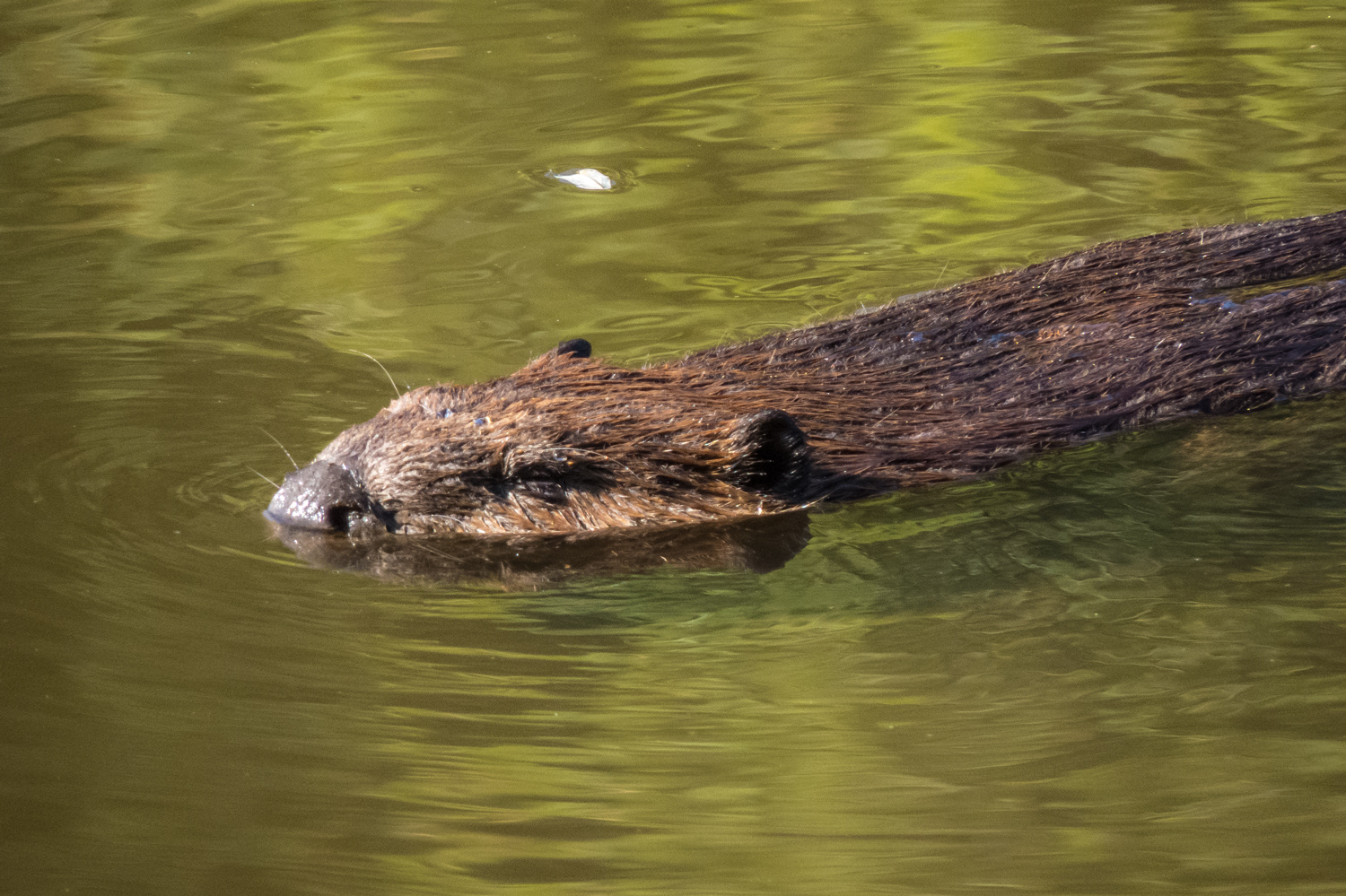
Beavers are nocturnal creatures and consequently the best times to see them generally are at dawn and at dusk. Dragonflies, on the other hand, mostly like bright sunlight and they are often most visible during the hottest part of the day.
When I was walking around the small pond at Jackson Miles Abbott Wetland Refuge yesterday morning around 10:00, therefore, I was expecting to see dragonflies. Imagine my shock when some motion in the water caught my eye and I spotted a North American Beaver (Castor canadensis) lazily swimming by parallel to the shore on which I was standing.
The light on the water was amazing and gave it a golden glow, as you can see in the first image. The beaver made a gentle u-turn and I was able to capture the ripples and the wake it created in the second image. The beaver was then swimming toward the light and that is why you can see some of the details of the eye in that second image.
I then decided to switch from my DSLR with my 180mm macro lens that I used for the first two shots to my Canon SX50 superzoom camera. The third image is framed just as it came out of the camera with no cropping and it lets you see some of the texture of the beaver’s fur and the little hairs that stick out of its face. I also love the way the patterns of the water look in this image.
This little incident was a reminder to be eternally vigilant. Wild creatures don’t always follow the rules and may turn up in unexpected places at unanticipated times.


© Michael Q. Powell. All rights reserved.
Posted in animals, beaver, Nature, Photography, wildlife | Tagged beaver, Canon 50D, Canon SX50, Castor canadensis, Fort Belvoir VA, Jackson Miles Abbott Wetland Refuge, North American Beaver, swimming beaver, Tamron 180mm | 12 Comments »
October 3, 2018 by Mike Powell
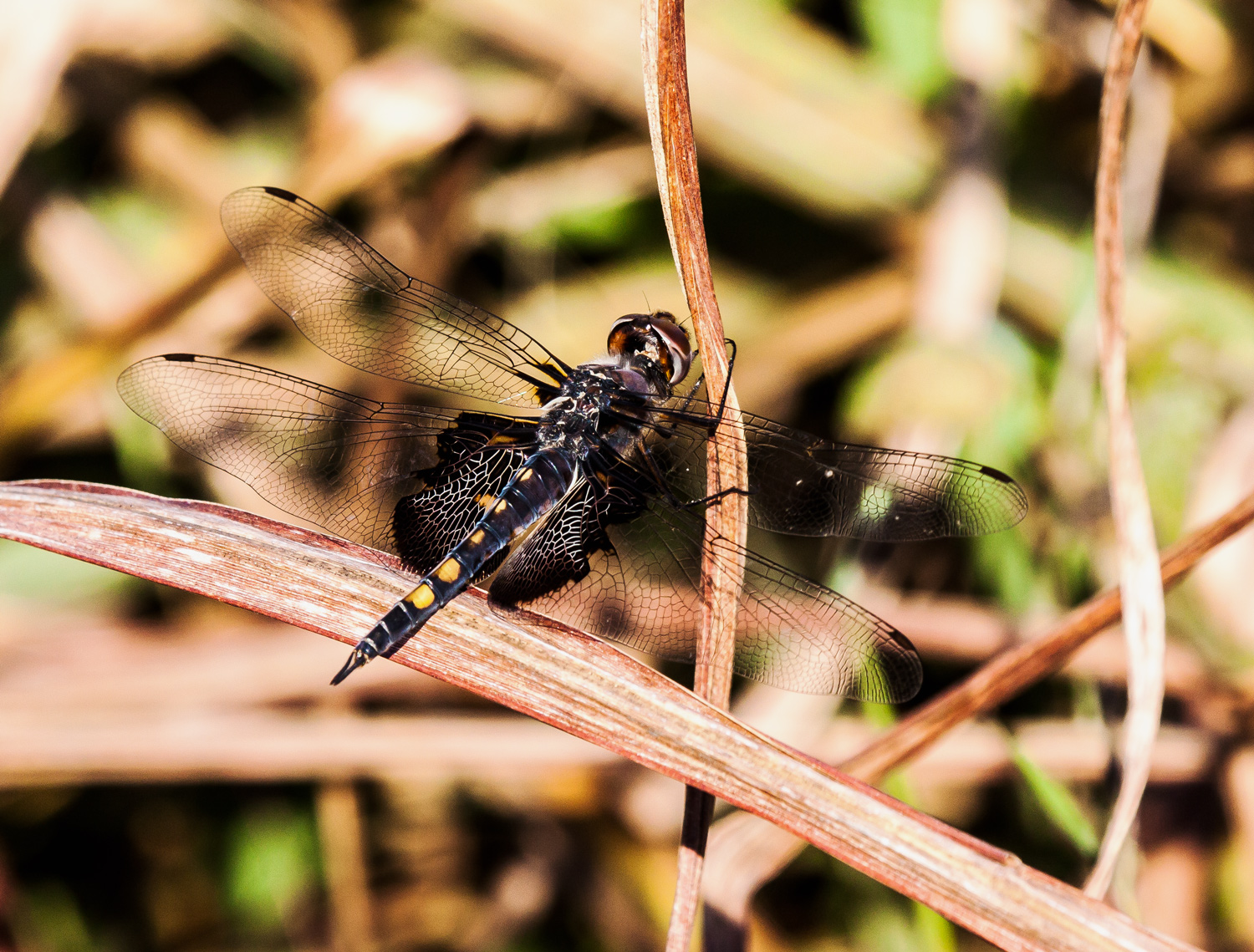
I don’t know if this is a local dragonfly or was merely stopping by while migrating south, but I was happy when this Black Saddlebags dragonfly (Tramea lacerata) stopped circling a field and perched for a moment earlier this week at Occoquan Bay National Wildlife Refuge.
This species of dragonfly is one of several migratory species and in the early autumn I tend to see more Black Saddlebags dragonflies than at any other time of the year. As you might have guessed, the dark blotches on the wings caused some scientist to imagine that they looked like saddlebags. In some cases, I scratch my head when I learn the name of a species, but in this case the name seems to fit and doesn’t require too big a stretch of the the imagination.

© Michael Q. Powell. All rights reserved.
Posted in Autumn, Dragonflies, dragonfly, Insects, Nature, Photography, wildlife | Tagged Black Saddlebags, Black Saddlebags dragonfly, Canon 50D, Occoquan Bay National Wildlife Refuge, Tamron 180mm, Tramea lacerata, Woodbridge VA | 2 Comments »
October 2, 2018 by Mike Powell
I love to photograph bees and realize that I have not featured one for quite some time. I captured this image of one as it perched on some pickerelweed this past weekend at Ben Brenman Park in Alexandria, VA.
In many ways, this image is as much about the flowering plant as it is about the bee. It speaks to me of the interaction between those two main subjects.
For me, photographing nature is about balancing the depiction of the small details, as I often do, with the “bigger” picture—the framing of this shot helps to give the viewer a better sense of the environment than if I had done an extreme close-up shot of the bee itself.

© Michael Q. Powell. All rights reserved.
Posted in Autumn, Bees, Flowers, Insects, Nature, Photography | Tagged Alexandria VA, bee, Ben Brenman Park, Canon 50D, pickerel weed, pickerelweed, Tamron 180mm | 5 Comments »
October 1, 2018 by Mike Powell
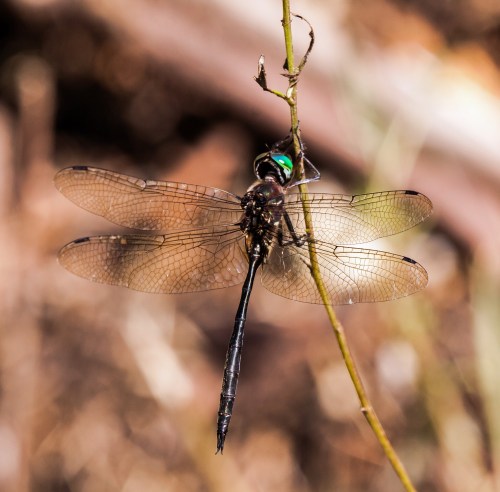
Despite seeing several Fine-lined Emerald dragonflies (Somatochlora filosa) last Friday at Occoquan Bay National Wildlife Refuge, only this one was cooperative enough to land for a moment and allow me to get some shots.
Previously I posted some photos I took of Fine-lined Emeralds in flight. I had chased and chased these elusive dragonflies, but they never seemed to stop flying. I was beginning to think that I would not get a shot of one perched when suddenly one that I was tracking dropped down into the vegetation. I approached very cautiously and spotted it clinging vertically to a narrow stem.
My heart was racing as I switched to manual focusing—the profile of the perched dragonfly was so slim that I didn’t think my auto-focus would lock on my subject. I took a couple of shots and then inched forward a little. This is part of an eternal struggle for a wildlife photographer, deciding how close you can get to a subject without disturbing it.
I was pretty happy with this image, because I was able to capture a lot of details of this cool-looking species. I recommend clicking on the image to see a higher resolution view of the dragonfly’s spectacular emerald eyes, beautiful body markings, and wonderful wings.
© Michael Q. Powell. All rights reserved.
Posted in Autumn, Dragonflies, dragonfly, Insects, Nature, Photography, wildlife | Tagged Canon 50D, Fine-lined Emerald, Fine-lined Emerald dragonfly, Occoquan Bay National Wildlife Refuge, Somatochlora filosa, Tamron 180mm, Woodbridge VA | 10 Comments »
September 30, 2018 by Mike Powell
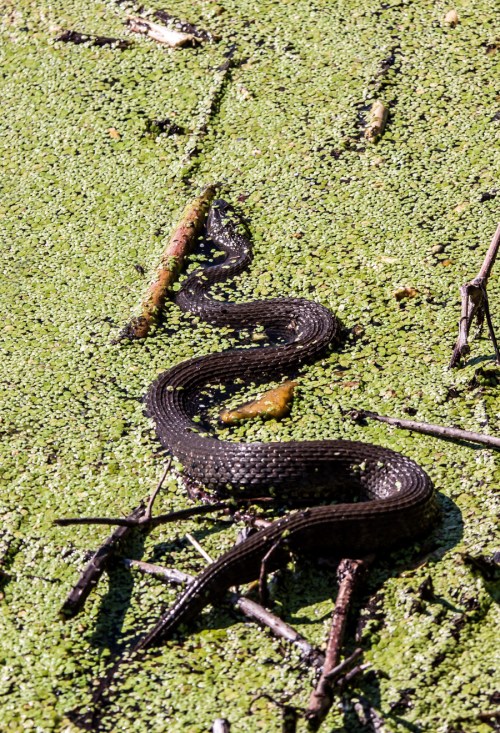
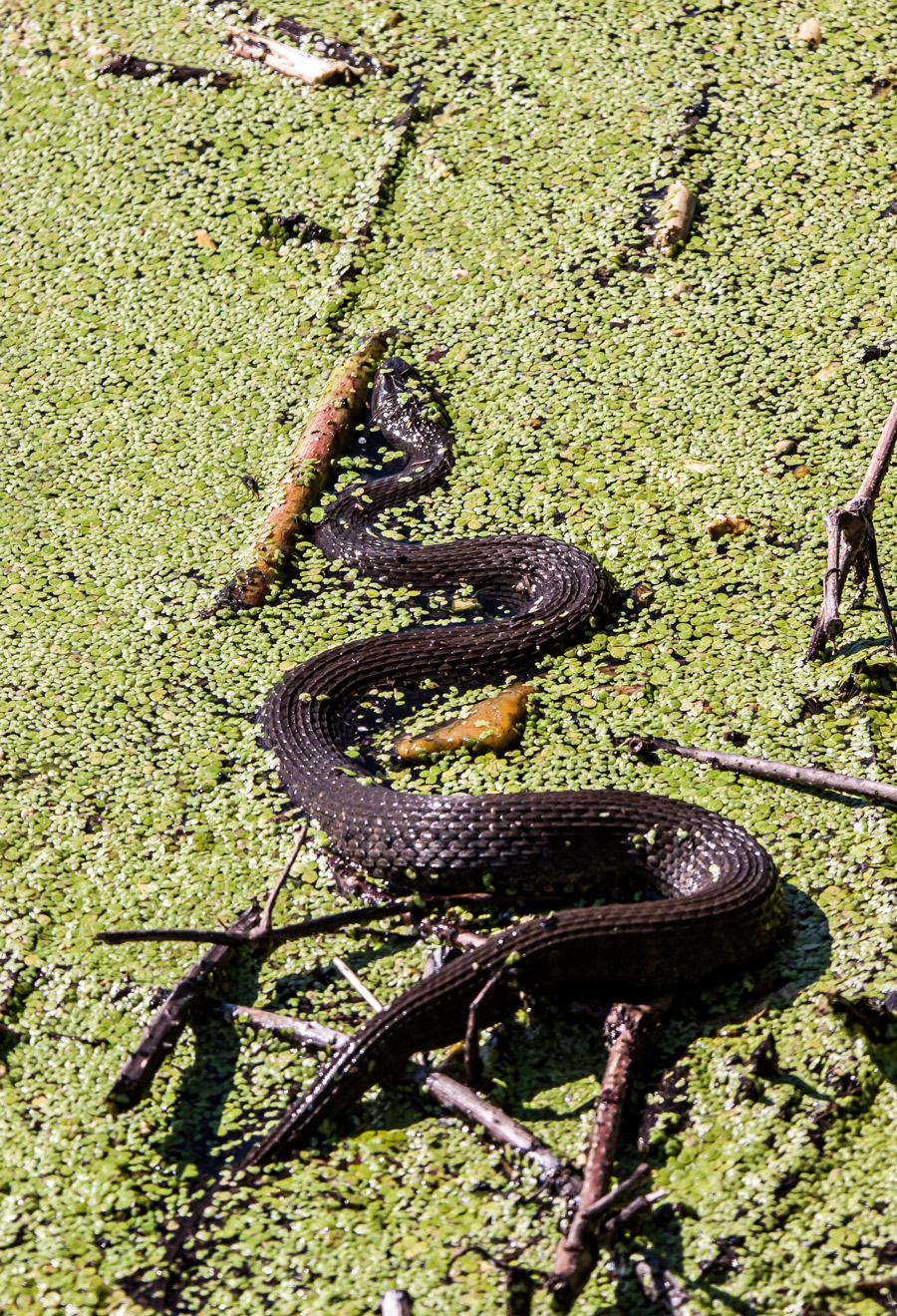
Semi-submerged in the duckweed in the shallow water, this snake patiently awaited an unseen prey yesterday at the pond at Ben Brenman Park, a small suburban park not far from where I live in Alexandria, Virginia. I did not get a really good look at the snake, which dove into the water shortly after I took this shot, but I think it might be a Northern Water Snake (Nerodia sipedon).
In many ways I was more interested in the sinuous curves of the snake’s body than in the identification of the snake’s species. There is an abstract beauty in the colors and the shapes in this image that appeals to me, though I know that some of my viewers are so creeped out by the main subject that they will find it hard to see any beauty whatsoever in the image.
© Michael Q. Powell. All rights reserved.
Posted in Nature, Photography, Reptiles, wildlife | Tagged Alexandria VA, Ben Brenman Park, Canon 50D, Nerodia sipedon, Northern Water Snake, Tamron 180mm | 10 Comments »
September 30, 2018 by Mike Powell
Orange and brown seem to be the perfect color combination for the autumn and this Question Mark butterfly (Polygonia interrogationis) was suitably celebrating the season this past Friday at Occoquan Bay National Wildlife Refuge.

© Michael Q. Powell. All rights reserved.
Posted in Art, Autumn, Butterflies, Insects, Nature, Photography, wildlife | Tagged autumn colors, Canon 50D, Occoquan Bay National Wildlife Refuge, Polygonia interrogationis, question mark, Question Mark butterfly, Tamron 180mm, Woodbridge VA | 5 Comments »
September 29, 2018 by Mike Powell
Orange is one of the colors that I tend to associate with autumn. Some leaves are already turning orange and pumpkin decorations and displays have started to appear on my neighbors’ doorsteps.
As I was exploring Occoquan Bay National Wildlife Refuge yesterday morning, my eyes detected some motion in the nearby grass. I leaned forward and was delighted to see this tiny damselfly decked out in the colors of Halloween—orange and black. I had no idea what species it was, but fortunately I have a really good guide for damselflies and was able to identify it as an immature female Eastern Forktail damselfly (Ischnura verticalis).
Although there are already lots of symbols for autumn, I think this tiny damselfly could be added to the list.

© Michael Q. Powell. All rights reserved.
Posted in Autumn, damselfly, dragonfly, Insects, Macro Photography, Nature, Photography, wildlife | Tagged Canon 50D, Eastern Forktail, Eastern Forktail damselfly, Ischnura verticalis, Occoquan Bay National Wildlife Refuge, Tamron 180mm, Woodbridge VA | 4 Comments »
September 29, 2018 by Mike Powell
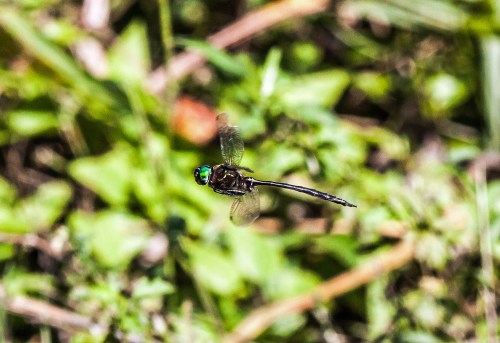
I was thrilled yesterday to see that there are still Fine-lined Emerald dragonflies (Somatochlora filosa) at Occoquan Bay National Wildlife Refuge. I was afraid that all of the recent rain had washed them away.
This particular dragonfly species is pretty uncommon, but the wildlife refuge that has become my go-to place for photography is one of the few local spots where they can be found. I think its peak period in our area is September-October, judging from my experience last year, so I was anxious to see them some more before they disappeared for the year.
It is easy to see a Fine-lined Emerald dragonfly when it is patrolling, because it often flies at knee to shoulder height. It is a whole different problem, though, to get a shot of one, because they spend most of their time in the air rather than perching. I spent quite a bit of time yesterday chasing after these dragonflies, hoping in vain to be able to catch the moment when one decided to take a break.
Finally I decided to change my approach and see if I could capture a shot of one as it flew by me. I know that it can be done, because last year I captured an in-flight image using my 150-600mm zoom lens. The lens that I had on my camera, however, was my 180mm macro lens, which meant that I had to get pretty close to the dragonfly rather than zooming in. That particular lens is slow to focus, so I decided to focus manually, which can be tricky with a moving subject. One of the downsides of the lens is it has no built-in image stabilization, so I decided to keep the camera affixed to my monopod for the sake of stability.
It took some time, but eventually I was able to capture a few shots of flying Fine-lined Emeralds that were relatively in focus, aided by the fact that these dragonflies hover a little from time to time.
I particularly like the first image because it shows both the emerald eyes and the fine lines near the tip of the abdomen that are responsible for the name of the species. It was also cool that the angle of view was unusual, given that I was looking down at the dragonfly as I took the shot. I also like the touch of brownish-orange from the out-of-focus leaves that gives the image an autumn feel.
The second shot gives a more “normal” view of a Fine-lined Emerald dragonfly as it flew by. I was happy to be able to separate it somewhat from the leafy backdrop by carefully focusing on the dragonfly. This is one of those situations when the auto-focusing system of the camera would have been challenged—the subject was pretty small in the viewfinder and the auto-focus probably would have tried to lock on the background.

© Michael Q. Powell. All rights reserved.
Posted in Autumn, Dragonflies, dragonfly, Nature, Photography, Winter | Tagged Canon 50D, Fine-lined Emerald, Fine-lined Emerald dragonfly, fine-lined emerald in flight, Occoquan Bay National Wildlife Refuge, Somatochlora filosa, Tamron 180mm, Woodbridge VA | 8 Comments »
September 28, 2018 by Mike Powell
I suspect that all of the Monarch butterflies (Danaus plexippus) will soon be leaving our area for warmer places, so I am really trying to enjoy each and every encounter with one. I spotted this beauty feeding on some kind of thistle plant thispast weekend at Occoquan Bay National Wildlife Refuge.

© Michael Q. Powell. All rights reserved.
Posted in Butterflies, Flowers, Insects, Nature, Photography, wildlife | Tagged Canon 50D, Danaus plexippus, Monarch, monarch butterfly, Occoquan Bay National Wildlife Refuge, Tamron 180mm, thistle, Woodbridge VA | 9 Comments »
September 27, 2018 by Mike Powell
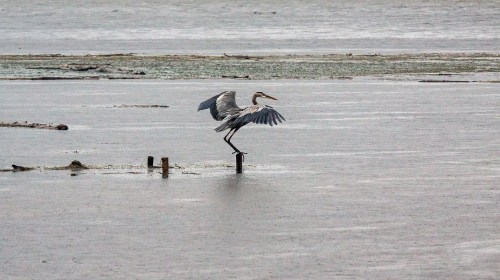
The muted tones of this Great Blue Heron (Ardea herodias) seemed to be a perfect match for the gray water and skies this past weekend at Occoquan Bay National Wildlife Refuge. The heron almost seemed to be playing hopscotch as it made its way along a series of posts and then extended its wings for balance when it reached the final post.
If you closely at the water you can see a lot of floating debris, caused by runoff and tidal surges from recent heavy rains—we have had well over double the normal amount of rainfall during the month of September.
© Michael Q. Powell. All rights reserved.
Posted in Birds, Nature, Photography, wildlife | Tagged Ardea herodias, Canon 50D, Great Blue Heron, heron hopscotch, hopscotch, Occoquan Bay National Wildlife Refuge, Tamron 180mm, Woodbridge VA | 5 Comments »
September 26, 2018 by Mike Powell
Now that fall has officially arrived, I look forward to seeing more Autumn Meadowhawk dragonflies (Sympetrum vicinum), like this stunning female that I spotted last Friday at Occoquan Bay National Wildlife Refuge. Adult males of this dragonfly species are bright red in color, but females can be either tan or red. The “spike” near the end of the abdomen makes it easy. though, to identify this one as a female.
In Northern Virginia, where I live, the Autumn Meadowhawk tends to be the latest surviving dragonflies—I have spotted them in mid-December and others have seen them in early January.

© Michael Q. Powell. All rights reserved
Posted in Autumn, Dragonflies, dragonfly, Insects, Nature, Photography, wildlife | Tagged Autumn Meadowhawk, Autumn Meadowhawk dragonfly, Canon 50D, female Autumn Meadowhawk, Occoquan Bay National Wildlife Refuge, Sympetrum vicinum, Tamron 180mm, Woodbridge VA | 4 Comments »
September 25, 2018 by Mike Powell
Sometimes I don’t have to venture far to capture images. I took this shot recently of a flower growing out of one of the hosta plants in my front yard as the rain was falling.
Simple colors and shapes and the sparkle of raindrops—photography doesn’t always have to be complicated. The challenge is to slow down, to really see the world around us, and to recognize its inherent beauty.

© Michael Q. Powell. All rights reserved
Posted in Flowers, Gardening, Macro Photography, Nature, Photography | Tagged Alexandria VA, Canon 50D, flower in the rain, Hosta, raindrops, Tamron 180mm | 4 Comments »
« Newer Posts - Older Posts »













 Mike Powell