February 17, 2020 by Mike Powell
I went searching through my archives yesterday for a photo from March 2016 that I wanted to have printed. I won’t dwell on my storage practices, but suffice it to say that I am not very well organized. The image in question, one of my all-time favorite shots, shows a Red-winged Blackbird (Agelaius phoeniceus) whose breath was visible in the cold morning air. I have posted the image a few times and have had some really positive response, but somehow I had never gotten around to having it printed.
I had forgotten that I had captured multiple shots that day and as I was going through them yesterday I came across the first shot below that I have never posted. I love the way that the image shows how the blackbird puts his whole body into producing his “visible song”—I remember my choir leaders instructing us on the importance of breathing from the diaphragm for better sound projection.
The second and third shots give you a better view of the bird’s breath as it was being expelled. I was playing around with image formats and decided to do a square crop that I think works pretty well with these images. One of the photo companies has a sale today on canvas prints and I may one or more of these shots printed to see how they look. A friend has also suggested that I consider having a metal print made of one of them.
The temperature, humidity, and lighting all have be perfect to be able to see this phenomenon shown here. I have not been lucky enough to see it again since that day almost four years ago, though others have taken similar shots at the same location in recent years.
If you are curious to read my blog posting about the initial encounter, check out my 8 March 2016 blog posting entitled “Visible Song.”


© Michael Q. Powell. All rights reserved.
Posted in Art, Birds, Nature, Photography, wildlife, Winter | Tagged Agelaius phoeniceus, Alexandria VA, Canon 50D, Huntley Meadows Park, male Red-winged Blackbird, red-winged blackbird, Tamron 150-600mm, visible song | 29 Comments »
February 16, 2020 by Mike Powell
Last Wednesday I spotted this little sparrow at Occoquan Bay National Wildlife Refuge. I thought it was a Song Sparrow (Melospiza melodia), but decided to check with some birding experts on Facebook who were able to confirm my initial suspicions. It did take me a little while longer to get a response than usual, however, because my proposed identification was correct. I tend to get quicker responses when I am wrong—folks will often jump in really quickly to correct me.
Although Song Sparrows are one of the most common sparrow species where I live, I love trying to get shots of them whenever I can. In this case, I was happy with the simple composition and minimalist color palette that I was able to capture in this image—all of the different shades of brown give the image a harmonious feel that I find pleasing.

© Michael Q. Powell. All rights reserved.
Posted in Birds, Nature, Photography, wildlife, Winter | Tagged Canon 50D, Melospiza melodia, Occoquan Bay National Wildlife Refuge, song sparrow, sparrow, Tamron 150-600mm, Woodbridge VA | 10 Comments »
February 15, 2020 by Mike Powell
Most of the time I try to take detailed shots of the birds that I photograph, but somethings that simply is not possible. This past week at Occoquan Bay National Wildlife Refuge, the ducks all stayed in the deep water, far from the shore on which I was standing. As I gazed to my right and to my left searching for closer ducks, I became increasingly fascinated by the bare branches of the trees overhanging the water.
Even though I was shooting with a long telephoto lens, I decided to try to capture the landscape that was drawing me in. If you look closely at the two images below, you will see that I have included some distant ducks, but clearly they were not the focus of the photos. A wider lens might have capture the environment better, but would have risked drawing the viewers’ eyes away from the tree shapes. I don’t take landscape-style photos very often, but sometimes that is what the situation seems to call for and/or permits.


© Michael Q. Powell. All rights reserved.
Posted in Birds, Landscape, Nature, Photography, Winter | Tagged Canon 50D, distant ducks, ducks, Occoquan Bay National Wildlife Refuge, Tamron 150-600mm, Woodbridge VA | 7 Comments »
February 14, 2020 by Mike Powell
How do Bald Eagles (Haliaeetus leucocephalus) show affection? I am not sure exactly what these two eagles were doing when I spotted them on Tuesday at Occoquan Bay National Wildlife Refuge. Were they singing to each other? Maybe they doing some version of eagle French kissing? Whatever the case, the eagles definitely seemed to be enjoying spending the time close together, beak-to-beak, showing love in their own ways.
Happy Valentine’s Day as you show love in your own way. Although this holiday traditionally is focused on couples, I think that singles like me should also celebrate love today—I love flowers and am planning to get some later today. It is more than ok to love yourself, so go ahead and treat yourself today—you are worth it.

© Michael Q. Powell. All rights reserved.
Posted in Birds, Nature, Photography, wildlife, Winter | Tagged Bald Eagle, Bald Eagle couple, Canon 50D, eagle affection, Haliaeetus leucocephalus, Occoquan Bay National Wildlife Refuge, Tamron 150-600mm, Woodbridge VA | 21 Comments »
February 13, 2020 by Mike Powell
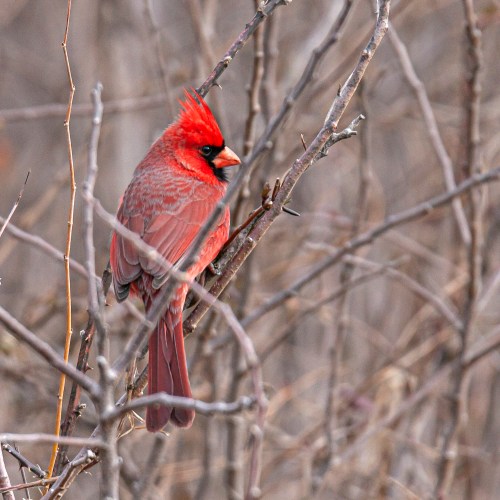
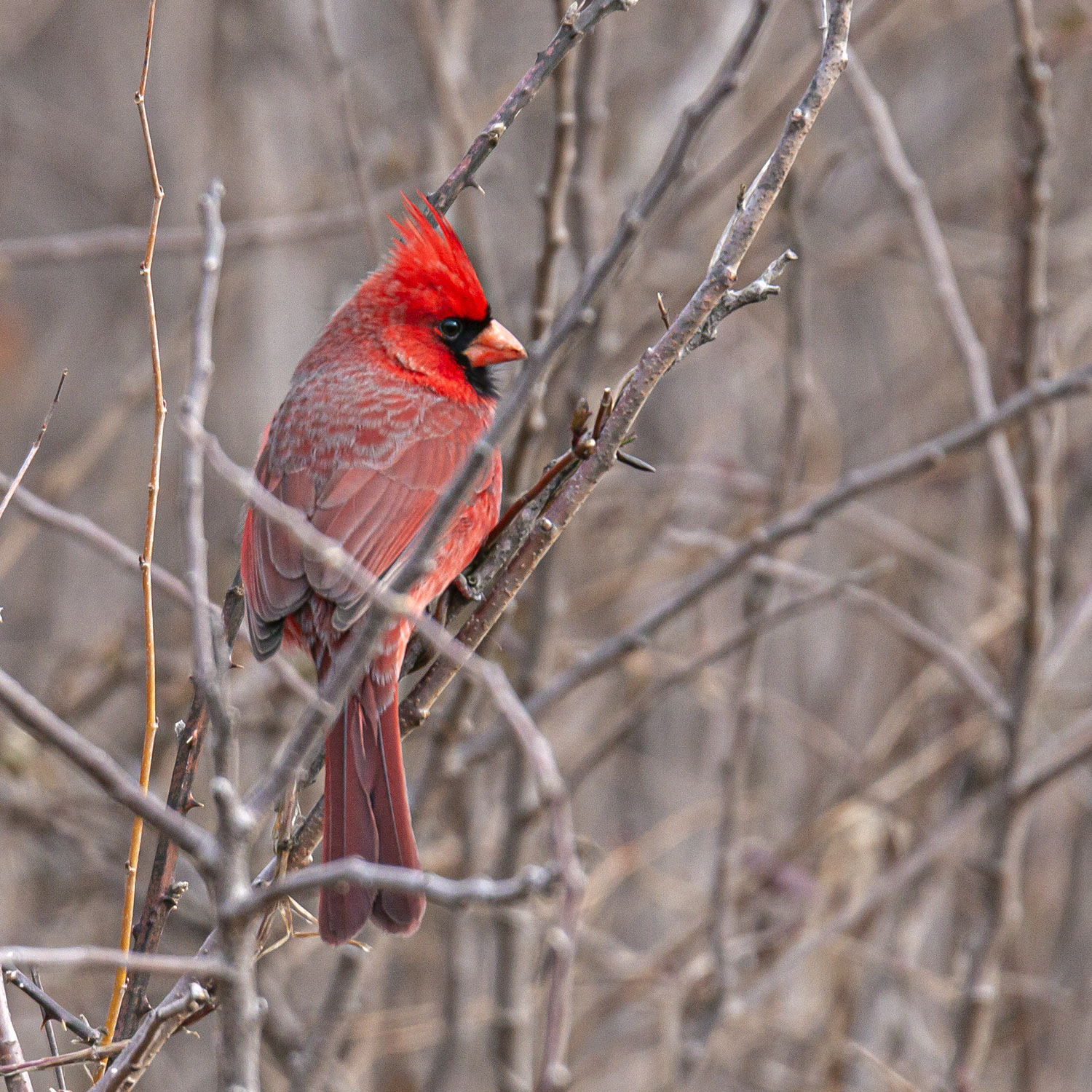
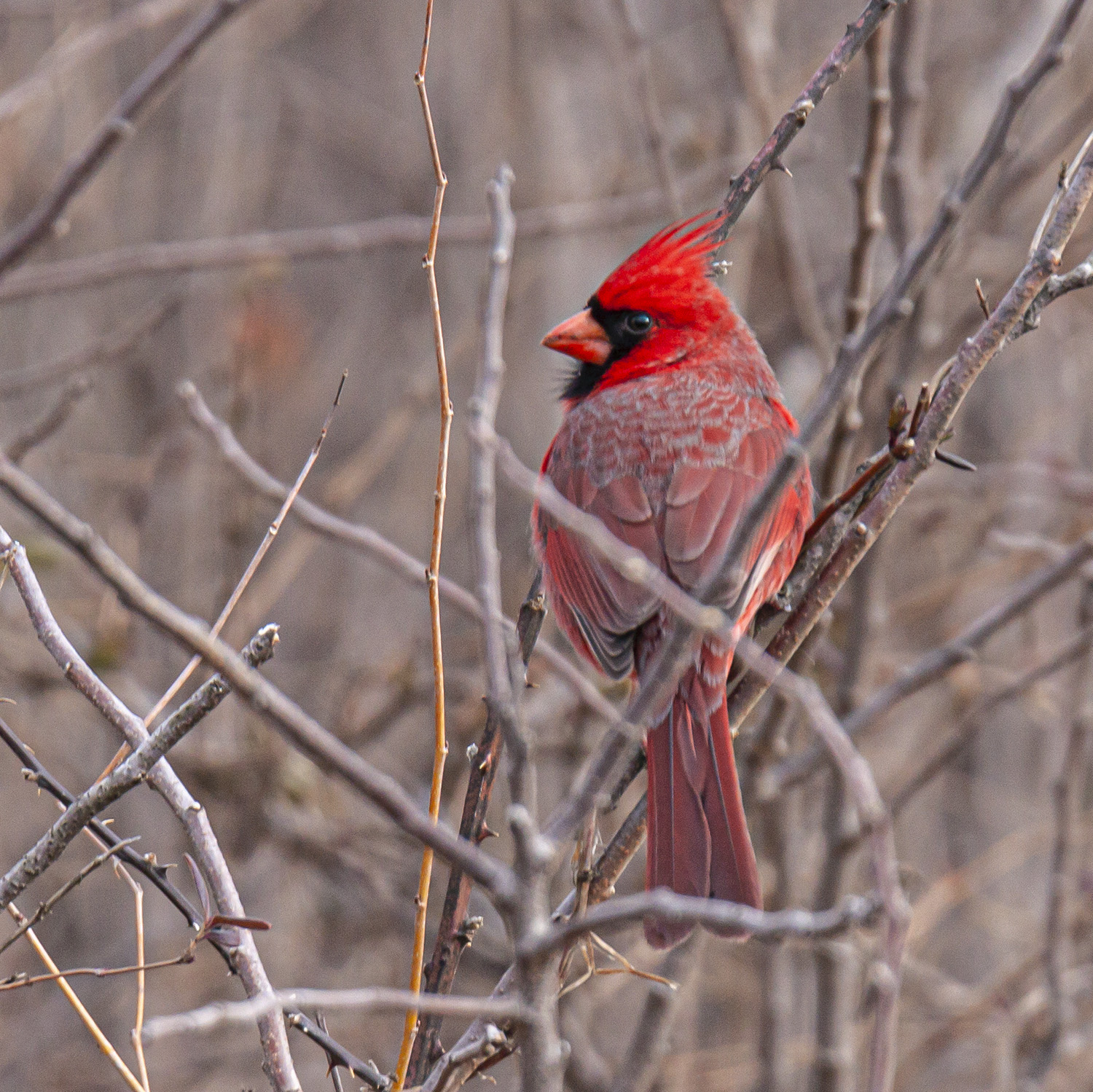
Do male Northern Cardinals (Cardinalis cardinalis) know that they are bright red in color? When I spooked one of them yesterday morning at Occoquan Bay National Wildlife Refuge, he flew to a nearby field and perched in the midst of a mass of vegetation.
Did he think that he was hidden from me? Obviously he was not—his red coloration makes it almost impossible for him to blend in. I couldn’t help but think of a quotation that is attributed to Dr. Seuss, “Why fit in when you were born to stand out?” That’s probably a good question for all of us—as you can probably guess, I am somewhat of a non-conformist.

© Michael Q. Powell. All rights reserved.
Posted in Birds, Nature, Photography, wildlife, Winter | Tagged Canon 50D, Cardinalis cardinalis, male Northern Cardinal, Northern cardinal, Occoquan Bay National Wildlife Refuge, Tamron 150-600mm, Woodbridge VA | 17 Comments »
February 12, 2020 by Mike Powell
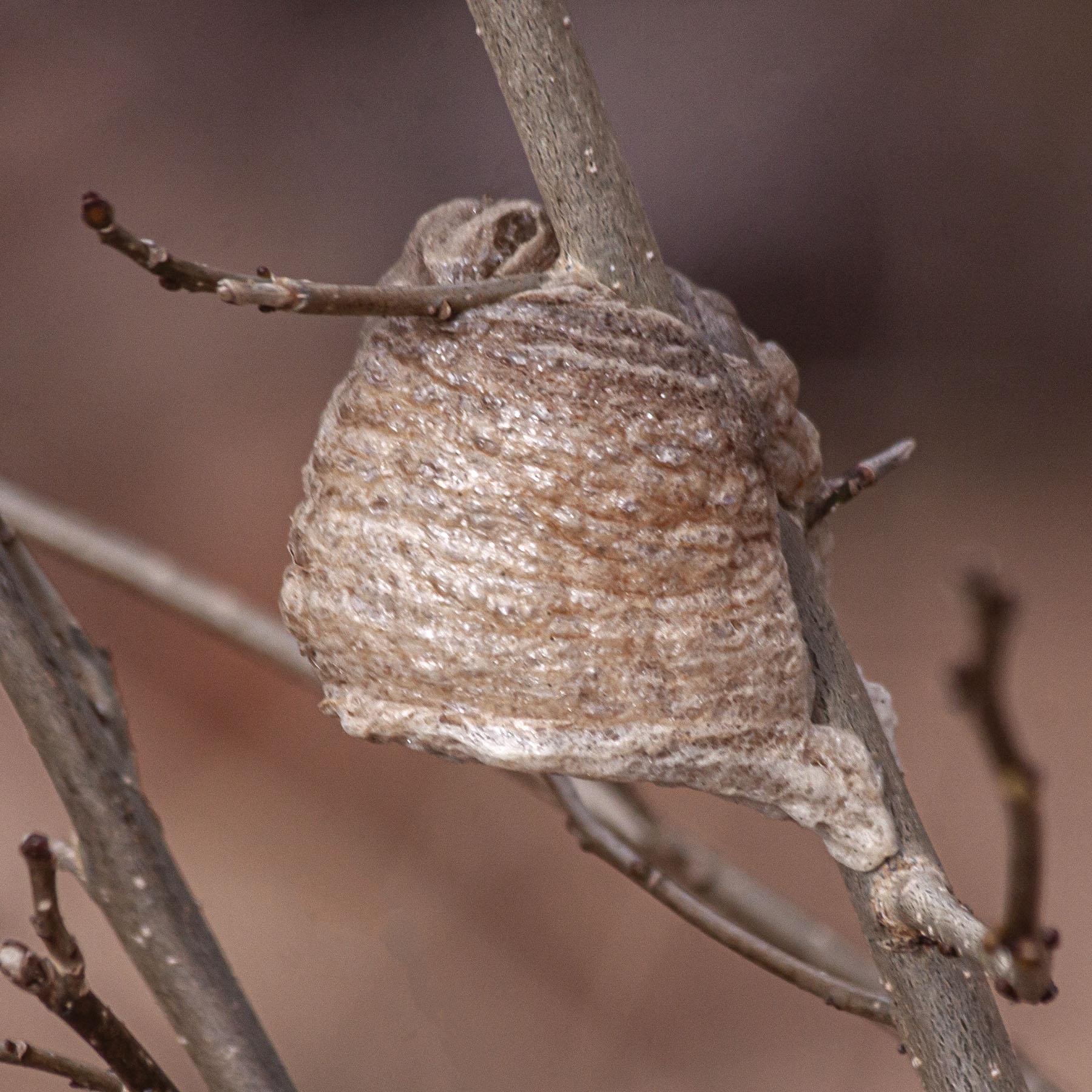
As I was exploring Occoquan Regional Park last week with fellow dragonfly enthusiast Walter Sanford, he pointed out a foamy-looking mass attached to the branches of a bush and asked me if I knew what it was. My first thought was that it was some sort of cocoon, but I had never seen one that looked like this. Walter informed me that it was an ootheca and when I continued to look at him with a blank stare, he explained that an ootheca is an egg case for a praying mantis, in this case most likely a Chinese mantis (Tenodera sinensis sinensis).
I did a little research on-line and learned more about oothecae in an article on the Thoughtco.com website.
“Soon after mating, a female praying mantis deposits a mass of eggs on a twig or other suitable structure. She may lay just a few dozen eggs or as many as 400 at one time. Using special accessory glands on her abdomen, the mother mantis then covers her eggs with a frothy substance, which hardens quickly to a consistency similar to polystyrene. This egg case is called an ootheca.”
Several articles warned readers against collecting one of these egg masses. Apparently indoor heat may cause the tiny mantises inside to think it is spring and you may suddenly find yourself with 400 new additions to your household.


© Michael Q. Powell. All rights reserved.
Posted in Insects, Nature, Photography | Tagged Canon 50D, Canon 70-300mm, Chinese mantis, Lorton VA, mantis egg case, Occoquan Regional Park, ootheca, Tenodera sinensis sinensis | 12 Comments »
February 11, 2020 by Mike Powell
Deer hunting is conducted from early September to late February in many of the county-run parks where I take photographs. Our area is over-populated with White-tailed Deer (Odocoileus virginianus) and hunting is one element of a comprehensive deer management program. I am personally not a hunter, but I understand the need to try to keep the population in check to limit the likelihood of collisions with cars or of deer dying from starvation during the winter months.
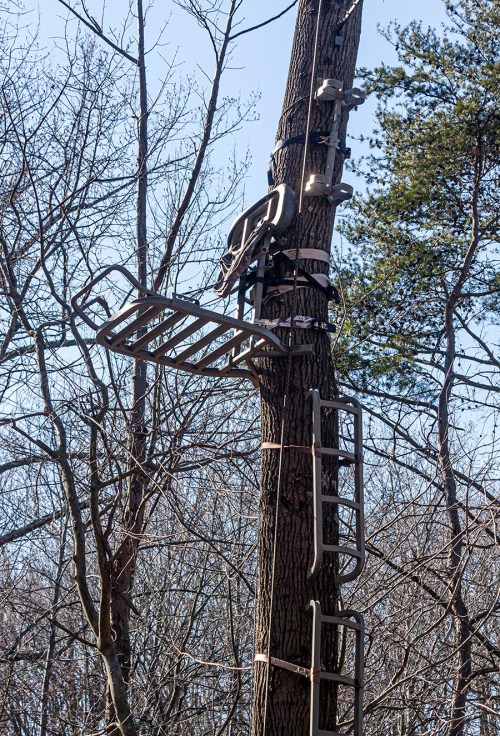
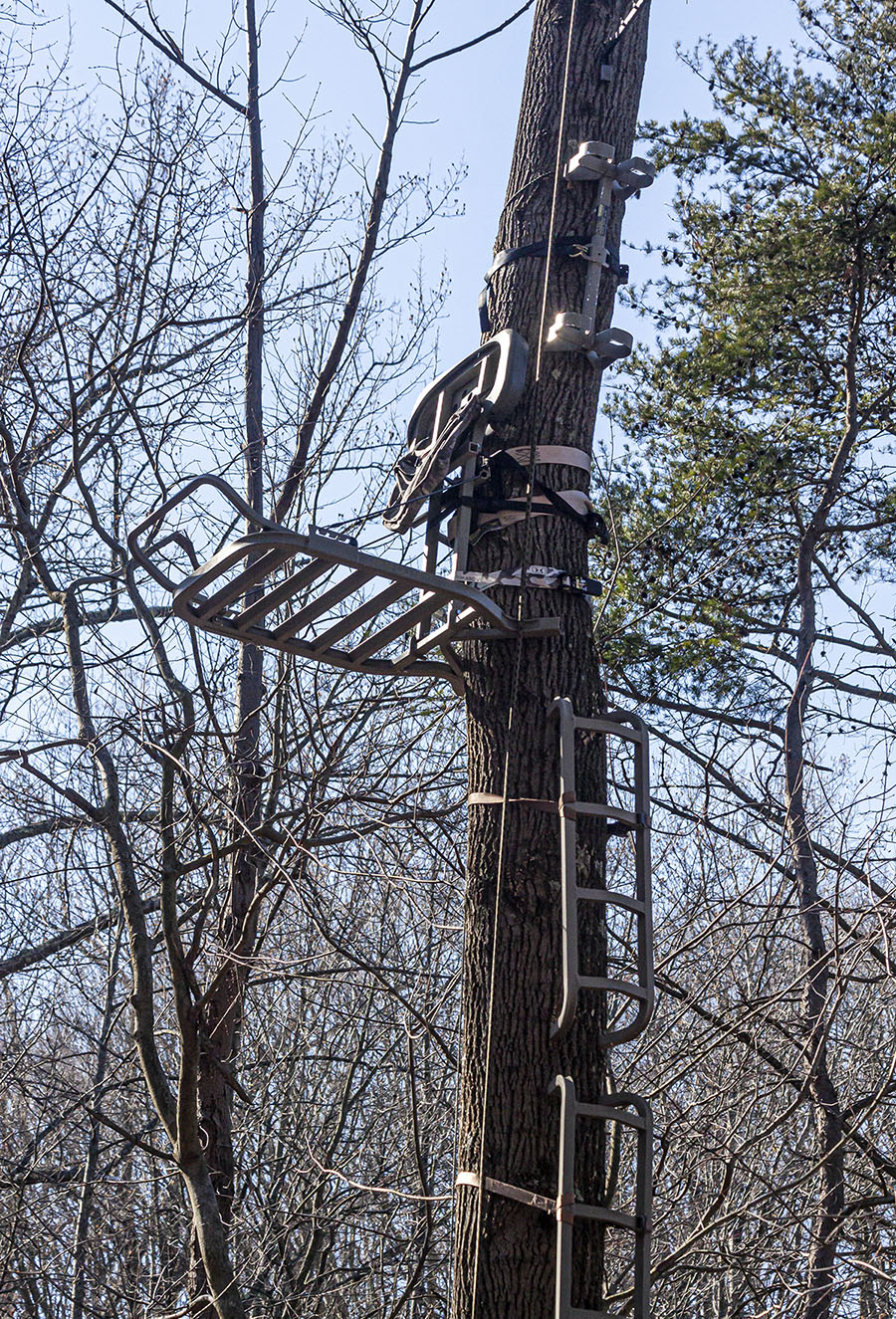
No areas of these parks are closed during this hunting season, which might sound dangerous, but there are strict requirements that the hunters must follow. Most notably they have to be trained and certified archers and must shoot from tree stands. Most people never see the tree stands because they are in remote areas of the parks, but those are precisely the areas that I like to visit.
During recent trips to Occoquan Regional Park, I spotted the tree stand shown in the first photo below. No archers were sitting in the stand, though in the past I have spotted occupied tree stands a couple of times. The second image shows one of several trail cameras that I have seen at this park this year. The cameras that I have spotted in the past were more primitive—they recorded to a memory card that had to be retrieved and reviewed. The markings on the camera shown indicated that it could transmit on a cell phone signal. The manufacturer’s website notes that images can be sent in real-time or transmitted in a batch at periodic intervals during the day.
How does all of this affect me? I am not deterred from visiting these locations, but I am extra alert and cautious when I know there are tree stands nearby. I also make sure that I smile whenever I spot a trail camera—I never know when someone is watching me.

© Michael Q. Powell. All rights reserved.
Posted in animals, Nature, Photography, wildlife, Winter | Tagged Canon 50D, Canon 70-300mm, deer hunting, deer management, Lorton VA, Occoquan Regional Park, Odocoileus virginianus, white-tailed deer | 4 Comments »
February 10, 2020 by Mike Powell
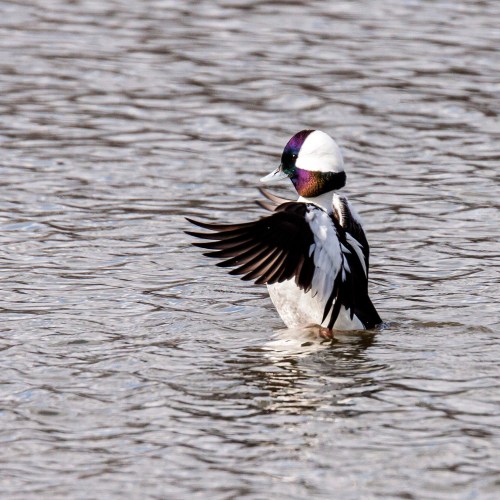
I was thrilled Saturday when the sunlight illuminated the beautiful colors of this male Bufflehead duck (Bucephala albeola) as he was drying his wing feathers at the pond at Ben Brenman Park in Alexandria, Virginia. In the past I had gotten glimpses of the brilliant purple and green colors on the head of a bufflehead, but this is the first time that I have been able to capture them so well.
In most of my previous shots of a male bufflehead, those colors all blend together into a nondescript dark color. I was definitely helped by the way that the way the bufflehead had lifted himself partially out of the water in order to flap his wings, giving me a clearer view of its head..
© Michael Q. Powell. All rights reserved.
Posted in Birds, Nature, Photography, wildlife, Winter | Tagged Alexandria VA, Ben Brenman Park, Bucephala albeola, bufflehead, bufflehead duck, Canon 50D, male bufflehead, Tamron 150-600mm | 21 Comments »
February 9, 2020 by Mike Powell
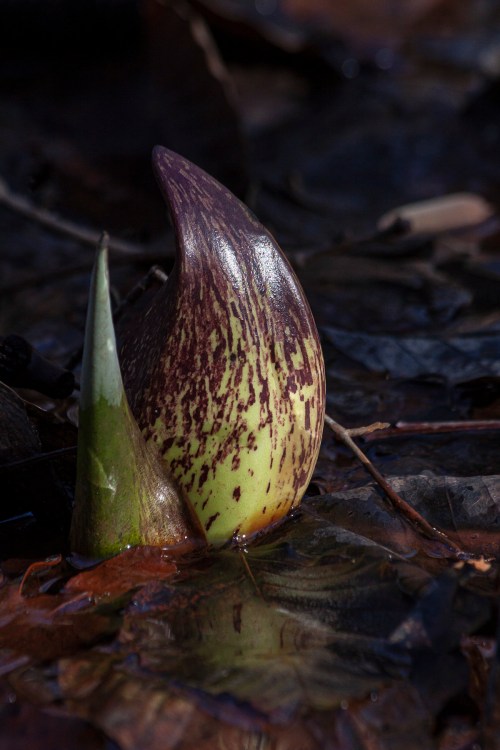
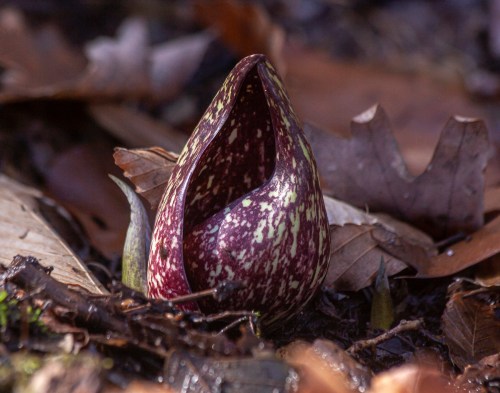
The past few weeks I have been searching for patches of skunk cabbage (Symplocarpus foetidus). What exactly is skunk cabbage? The Gardening Know How website describes the plant in these words, “Skunk cabbage is a perennial wildflower that grows in swampy, wet areas of forest lands. This unusual plant sprouts very early in the spring, and has an odd chemistry that creates its own heat, often melting the snow around itself as it first sprouts in the spring.” In case you are curious, the plant gets its name from the fact that its leaves gives off a smell of skunk or rotting meat when they are crushed or bruised—I can’t personally vouch for that fact, but am willing to accept it at face-value.
So why am I looking for this curious plant that has already begun to sprout in my area? Several types of dragonflies, including the Arrowhead Spiketail dragonfly (Cordulegaster obliqua) that I featured last week, and the Gray Petaltail dragonfly (Tachopteryx thoreyi) can be found in the kind of forest seeps where skunk cabbage grows. The purpose of my recent trips to several parks has been to conduct advance reconnaissance of locations to explore when dragonfly season finally arrives.
For more information about skunk cabbage and how dragonflies are associated with this plant, check out this recent posting by Walter Sanford, my friend and fellow dragonfly enthusiast, with whom I have conducted some of these scouting expeditions.

© Michael Q. Powell. All rights reserved.
Posted in Flowers, Nature, Photography, Winter | Tagged Arrowhead Spiketail, Canon 50D, Canon 70-300mm, Cordulegaster obliqua, Gray Petaltail, Lorton VA, Occoquan Regional Park, Prince William Forest Park, skunk cabbage, Symplocarpus foetidus, Tachopteryx thoreyi, Triangle VA | 10 Comments »
February 8, 2020 by Mike Powell
White-throated Sparrows (Zonotrichia albicollis) are with us throughout the winter and I will usually attempt to photograph them during my winter forays into the wild. I tend to think of White-throated Sparrows as the “dandies” of the sparrow world—they have the same general coloration as other sparrows, but have a distinctive appearance with their white chin beards and bright yellow eyestripes. It is a real bonus when the lighting is good and the perch is photogenic, as was the case last week at Occoquan Bay National Wildlife Refuge.

© Michael Q. Powell. All rights reserved.
Posted in Birds, Nature, Photography, wildlife, Winter | Tagged Canon 50D, Occoquan Bay National Wildlife Refuge, Tamron 150-600mm, white-throated sparrow, Woodbridge VA, Zonotrichia albicollis | 9 Comments »
February 7, 2020 by Mike Powell
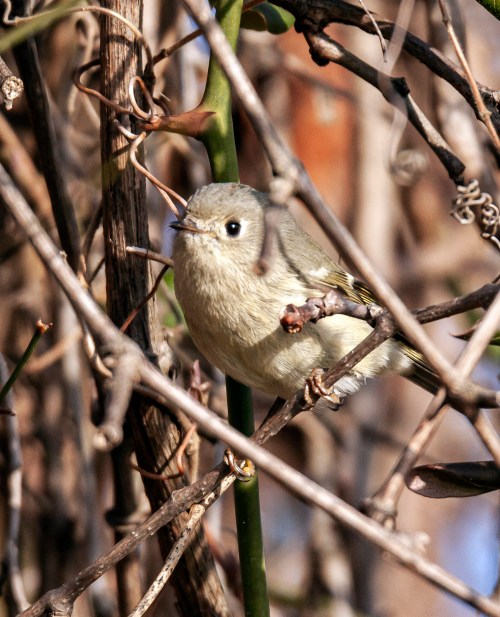
Kinglets are tiny birds, about 4 inches (10 cm) in length, and always seem to be in constant motion in heavily vegetated areas. As a result, they tend to be really hard to photograph. Last week at Occoquan Bay National Refuge I was thrilled to be able to capture images of both kinglet species in our area—the Golden-crowned Kinglet (Regulus satrapa) and the Ruby-crowned Kinglet (Regulus calendula).
It is not hard to guess that the bird in the first shot is a Golden-crowned Kinglet. I was never able to get close to the kinglet, but it did give me a clear view of its beauty when it perched momentarily on a small branch. The Ruby-crowned Kinglet in the second image has a more typical pose, surrounded by vines and branches. I shot over a dozen images of this little bird and this is the only one in which its head is up and visible.

© Michael Q. Powell. All rights reserved.
Posted in Birds, Nature, Photography, wildlife, Winter | Tagged Canon 50D, Golden-crowned Kinglet, kinglet, Occoquan Bay National Wildlife Refuge, Regulus calendula, Regulus satrapa, ruby-crowned kinglet, Tamron 150-600mm, Woodbridge VA | 14 Comments »
February 6, 2020 by Mike Powell
It is not yet dragonfly season, so I have no new photos of these amazing aerial acrobats. However, when I was searching for some other photos yesterday, I came across these images that I had worked up last May and had never posted. I sometimes get so focused on getting new photos that I forget about the older ones, which is why I usually try to do postings as soon as I can after a sighting.
Arrowhead Spiketails (Cordulegaster obliqua) are pretty uncommon in my area, but I was familiar with their appearance because I had seen one only a few days earlier when exploring a different location with fellow blogger and dragonfly enthusiast Walter Sanford (for more information on the earlier sighting, see my May 27, 2019 posting Female Arrowhead Spiketail dragonfly)
I spotted this dragonfly in the air as I was walking along a trail at Occoquan Regional Park and watched it land on some nearby vegetation. As I approached, it was easy for me to see the distinctive arrowhead pattern of the abdomen for which this species is named. Like other spiketails, Arrowhead Spiketails perch by hanging vertically or at an angle. This particular dragonfly, which happens to be a male, was quite cooperative and let me get close enough to get the portrait-style shot that you see as the second image below.
It will be at least two months before some of the early dragonfly species start to appear in our area. Unlike many summer species that are habitat generalists and are numerous for months on end, spring dragonfly species tend to be found in small numbers in very specific habitats for a limited period of time. Hopefully this posting—a flashback to last May—is a preview of coming attractions.


© Michael Q. Powell. All rights reserved.
Posted in Dragonflies, dragonfly, Insects, Nature, Photography, wildlife | Tagged Arrowhead Spiketail, Arrowhead Spiketail dragonfly, Canon 50D, Cordulegaster obliqua, Lorton VA, male Arrowhead Spiketail, Occoquan Regional Park, Tamron 180mm | 17 Comments »
February 5, 2020 by Mike Powell
With the weather so warm recently in my area, it is hard to remember that the puddles were iced over last Thursday when I captured this early morning shot of one of them at Occoquan Bay National Wildlife Refuge.
Winter in my area has been exceptionally mild—we have had almost no snow and only occasional periods of below-freezing temperatures. I have always been fascinated by the abstract patterns that form as water freezes, but this was the first time this season that I was able to capture a shot like this.
I am even more in awe of the amazing photos that I occasionally come across of individual snowflakes—capturing a shot like that is on my list of aspirational goals in photography.

© Michael Q. Powell. All rights reserved
Posted in abstract, Art, Nature, Photography, Winter | Tagged abstract ice pattern, Canon 50D, ice, Occoquan Bay National Wildlife Refuge, Tamron 150-600mm, Woodbridge VA | 11 Comments »
February 4, 2020 by Mike Powell
I didn’t realize that this Bald Eagle (Haliaeetus leucocephalus) was eating its breakfast when I inadvertently spooked it last Thursday morning at Occoquan Bay National Wildlife Refuge. There was no way the eagle was going to leave the fish behind, however, so it decided to take its fish “to go” when it took to the air.
When I first looked at this image, I was not sure if I liked it—it is pretty obvious that I was shooting through some branches and parts of the eagle are blurred out by them. When I examined the shot more closely, though, the positioning of the fish in the eagle’s mouth and the awesome details of the talons and tail made me decide that it was worth posting.

© Michael Q. Powell. All rights reserved
Posted in Birds, Nature, Photography, wildlife, Winter | Tagged Bald Eagle, birds in flight, Canon 50D, Haliaeetus leucocephalus, Occoquan Bay National Wildlife Refuge, Tamron 150-600mm, Woodbridge VA | 16 Comments »
February 3, 2020 by Mike Powell
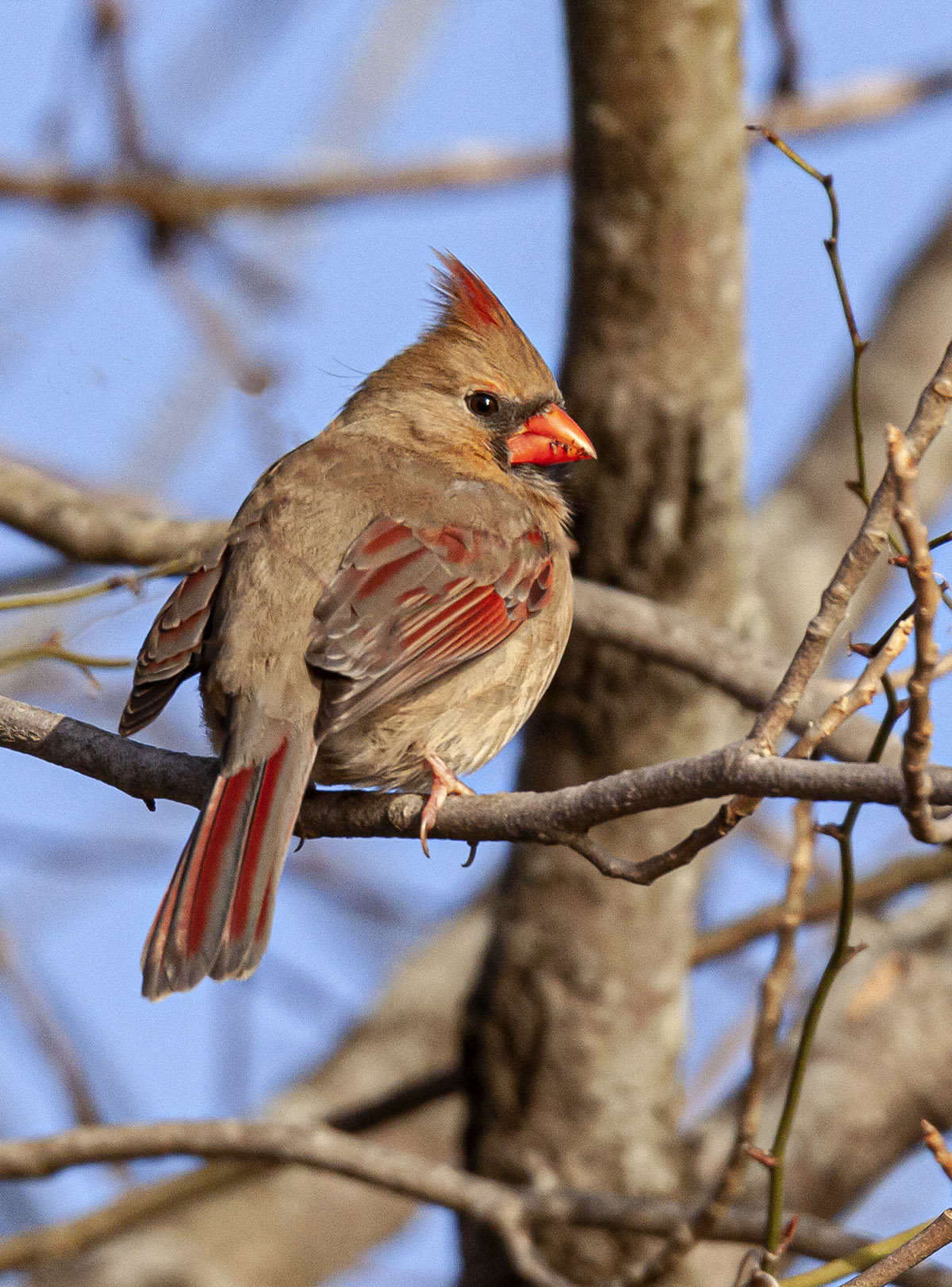
All female Northern Cardinals (Cardinalis cardinalis) have traces of red feathers, but this one that I spotted last week at Occoquan Bay National Wildlife Refuge seemed to have bolder markings than most. Before I took her portrait, I could help noticing that she had seed remnants on her bill. I also can be a bit of a messy eater at times, so I am reluctant to allow anyone to photograph me while I am eating.

© Michael Q. Powell. All rights reserved
Posted in Birds, Nature, Photography, wildlife, Winter | Tagged Canon 50D, Cardinalis cardinalis, female Northern Cardinal, Northern cardinal, Occoquan Bay National Wildlife Refuge, Tamron 150-600mm, Woodbridge VA | 11 Comments »
February 2, 2020 by Mike Powell
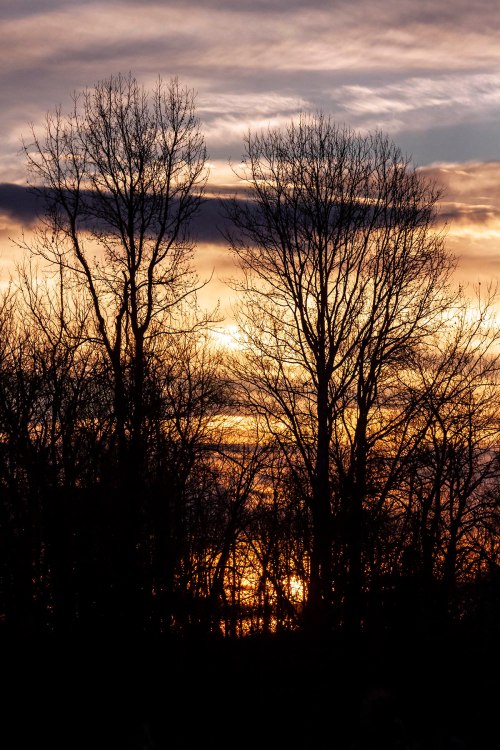
Even though I arrived at Occoquan Bay National Wildlife Refuge last Thursday morning as the electric gate was opening at 7 o’clock, I was a little too late to photograph the the sun rising over the water. However, I did manage to capture some shots of the early morning color through the trees.
It is always tough for me to take landscape-type shots, especially when there is not an obvious subject. In this case, I was content to capture the colors and the patterns in images that feel almost abstract to me.


© Michael Q. Powell. All rights reserved
Posted in Landscape, Nature, Photography, Winter | Tagged Canon 50D, Occoquan Bay National Wildlife Refuge, sunrise, Tamron 150-600mm, winter sunrise, Woodbridge VA | 7 Comments »
February 1, 2020 by Mike Powell
At this time of the year pops of bright color are especially welcome, so I was thrilled on Thursday to see some Eastern Bluebirds (Sialia sialis) in a sumac patch at Occoquan Bay National Wildlife Refuge. Sometimes when I see bluebirds their colors seem muted, but the blue color of these birds was dazzling, especially for the males in the first two shots. I think the bluebird in the final shot is a female, judging from its coloration.
As always, you can see more detail if you click on the images, which I especially recommend for the first image, because you will see that the bluebird has a tiny sumac berry in its bill.


© Michael Q. Powell. All rights reserved
Posted in Art | Tagged bluebird, Canon 50D, Eastern Bluebird, Occoquan Bay National Wildlife Refuge, Sialia sialis, sumac, Tamron 150-600mm, Woodbridge VA | 23 Comments »
January 31, 2020 by Mike Powell
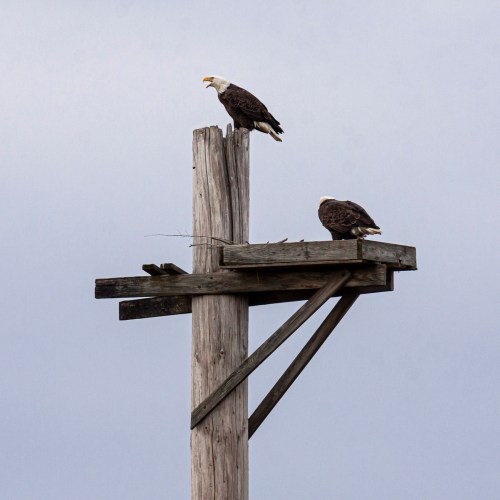
Why do eagles scream? Most of the times when I hear a Bald Eagle (Haliaeetus leucocephalus) screaming, the eagle is by itself and appears to be signaling its location to its mate. This past Monday, though, I spotted a Bald Eagle couple perched together on an osprey nesting site not far from their nesting location. The eagles seem to enjoy hanging out at this location that gives them a clear view of the tree in which the nest is located.
I am posting this little sequence of photos out of order, because the first image best tells a story, although it is not completely clear what that story is. The female eagle, the larger of the two, is on the lower level and seems to be screaming at her mate who is perched higher on the pole. A moment earlier they were both on the lower level and both eagles appeared to be calm, as you can see in the second image. Then the male hopped to the higher level and the female began to scream.
In the final shot, the female has turned away and the male is now screaming. Was he responding to his mate or was he screaming at something else? I guess you can connect the dots of this story in any way that you like.
As I was doing a little research on screaming eagles I came across a fascinating National Public Radio (NPR) article entitled “Bald Eagle: A Mighty Symbol, With A Not-So-Mighty Voice.” The article posits that most people have an incorrect idea of what an eagle scream sounds like and blames Hollywood. According to bird expert Connie Stanger, “Unfortunately for the bald eagle, it has like a little cackling type of a laugh that’s not really very impressive for the bird” and in most movies the sound of the eagle is actually dubbed by a Red-tailed Hawk. (I imagine a hawk in a sound booth with headphones dubbing over the eagle’s calls.)
If you click on the link above and then click the button on the website called “57 Second Listen,” you can hear a short clip of the NPR broadcast that includes both the call of the eagle and that of the Red-tailed Hawk. As for the question in the posting’s title, I personally like to think that it was a conversation, but acknowledge the distinct possibility that they were individually responding to a commonly-perceived threat. I think that my interpretation allows for more creative possibilities as I try to imagine the domestic conversations of a Bald Eagle couple. 🙂


© Michael Q. Powell. All rights reserved
Posted in Birds, Nature, Photography, wildlife, Winter | Tagged Bald Eagle, Bald Eagle couple, Canon 50D, Haliaeetus leucocephalus, Occoquan Bay National Wildlife Refuge, screaming eagle, Tamron 150-600mm, Woodbridge VA | 20 Comments »
January 30, 2020 by Mike Powell
Pied-billed Grebes (Podilymbus podiceps) are rather strange looking birds. Their heads are unusually large and blocky, their bills are short and thick, and they have virtually no tails. The Cornell Lab of Ornithology website describes them with these words, “The Latin genus name for “grebe” means “feet at the buttocks”—an apt descriptor for these birds, whose feet are indeed located near their rear ends. This body plan, a common feature of many diving birds, helps grebes propel themselves through water. Lobed (not webbed) toes further assist with swimming. Pied-billed Grebes pay for their aquatic prowess on land, where they walk awkwardly.”
Most of the times when I see a Pied-billed Grebe it is either disappearing from sight as it dives for food or it is swimming away from me. I captured this shot last week as the grebe was in fact swimming away, but paused for a moment and looked to the side. Yes, this is the notorious “butt shot” that we photographers try to avoid, but I like the way that you can see some of the details of the birds eye and the water beaded up on its back and decided to post it anyways.

© Michael Q. Powell. All rights reserved
Posted in Birds, Nature, Photography, wildlife, Winter | Tagged Canon SX50, Grebe, Kingstowne VA, Pied-billed Grebe, Podilymbus podiceps | 5 Comments »
January 29, 2020 by Mike Powell
From a distance, I could see that a Bald Eagle (Haliaeetus leucocephalus) was in the nest on Monday morning at Occoquan Bay National Wildlife Refuge. As I have noted in the past, the tree with the nest is right beside one of the trails at the refuge. Normally I approach the nest from the same direction and an eagle can see me from a pretty good distance away because the trail runs through an open field.
This time, however, I was walking from the opposite direction and the tree trunk blocked my view of the eagle as I got closer, which meant that it probably kept the eagle from spotting me. The first shot shows my initial look at the eagle once it came into view as I approached from the right. At this point, I think the eagle was unaware of my presence and I tried to remain as stealthy as I could.
I moved forward a bit more and continued to observe the eagle, completely in awe its beauty and majesty. My peaceful reverie was broken when I head the sounds of people approaching. Perhaps they were speaking at a normal conversational level, but it sure sounded loud to me. In the second shot, the eagle was looking in the direction of the noise. Had it heard the others? In the final shot, the eagle seemed to be looking right at me, having finally become aware of the fact that I was there.
The eagle did not take off immediately, but a short while later it flew off to a nearby osprey nesting platform. Later in the day I observed two eagles on the platform, which seems to be a favorite perching spot for the eagle couple.
It won’t be long before the refuge closes the trail from which I was taking the photos. I am wishing the best for the eagle couple as they move into nesting season. Last year there was one eaglet in this nest, I believe, and the year before there were two.


© Michael Q. Powell. All rights reserved
Posted in Birds, Nature, Photography, wildlife, Winter | Tagged Bald Eagle, bald eagle nest, Canon 50D, Haliaeetus leucocephalus, Occoquan Bay National Wildlife Refuge, Tamron 150-600mm, Woodbridge VA | 14 Comments »
January 28, 2020 by Mike Powell
Do you feel like you are progressing in photography? Have your skills improved as you have bought newer and more expensive gear? How do you know?
Periodically a notice pops up in my Facebook timeline reminding me of a posting that I made on that date in a previous year. I post at least one photo daily and I have no idea how the Facebook algorithm decides when to present me with a memory and, if so, which one to use.
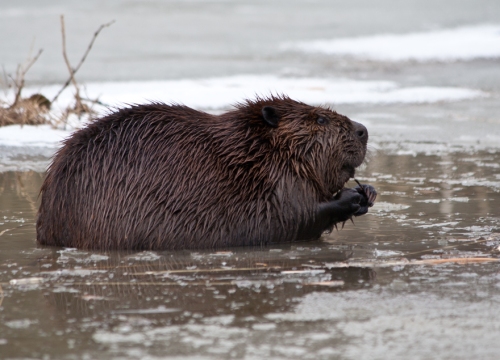
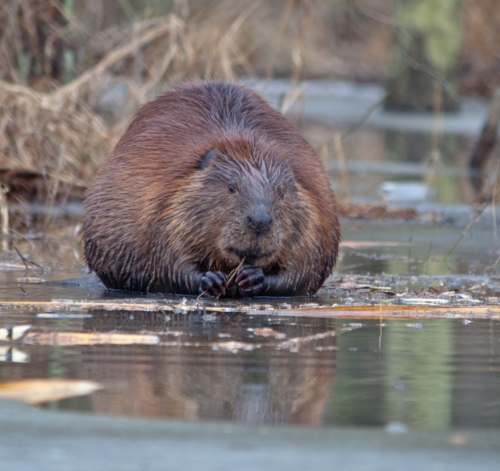
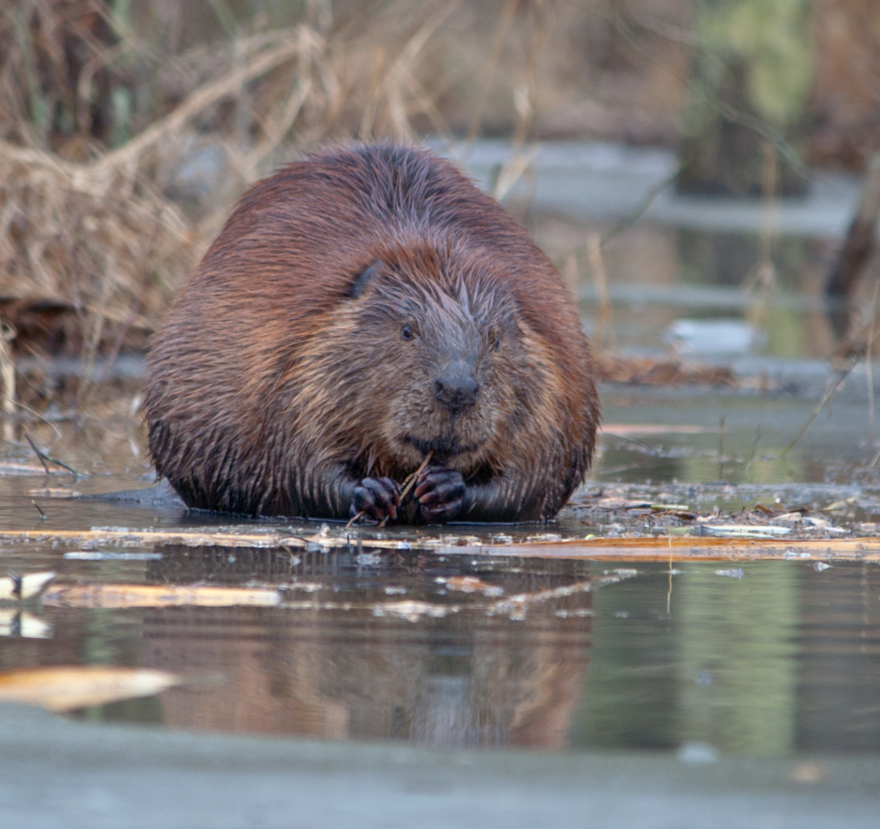
This morning, Facebook reminded me of the image below of a North American Beaver (Castor canadensis) that I posted seven years ago. Wow—seven years ago is in the distant past, only six months or so after I had started to get more serious about my photography. At that time I was shooting with a Canon Rebel XT, an entry-level 8.0 megapixel DSLR, and my “long” lens was a 55-250mm zoom lens.
It is almost a cliché for photographers to state that gear does not matter, but I think that this image demonstrates that there is a truth in that cliché. I have more experience now and better gear, but I would be hard for me to take a better shot today. Nothing is more important than being there, as all wildlife photographers know well. The informal motto of the Postal Service seems to apply to us as well— “Neither snow nor rain nor heat nor gloom of night stays these couriers from the swift completion of their appointed rounds.”
Click on this link if you would like to see the original posting from 2013 (and judge for yourself if my style of posting has changed). For fun, I added a second beaver photo that I posted the following day, January 29, 2013—here’s a link to the original posting.
I don’t know about you, but I rarely take the opportunity to look back at my older images. Perhaps I should do some more often.
© Michael Q. Powell. All rights reserved
Posted in animals, Nature, Photography, Portraits, wildlife, Winter | Tagged Alexandria VA, beaver, canon 55-250mm, Canon Rebel XT, Castor canadensis, flashback, Huntley Meadows Park, North American Beaver | 8 Comments »
January 28, 2020 by Mike Powell
Yesterday at Occoquan Bay National Wildlife Refuge I captured some images of a Turkey Vulture (Cathartes aura), providing a pretext for me to repeat a joke I recently came across—A vulture boards a plane carrying two dead raccoons. The flight attendant says, “I am sorry, sir, but we only allow each passenger one carrion.” I confess that I am addicted to bad jokes, especially puns and word plays, and I have been dying to photograph a vulture ever since I read that joke.
I initially spotted the vulture while it was flying and captured several shots, shown below, as it was landing in a tree. Generally I prefer action shots like those ones and I do like the dynamic quality of those poses. In this case, however, I really like the formal, portrait-like pose the vulture assumed as I was taking the first shot below. Somehow, at least in my mind, it lends a kind of dignity and beauty to this bird that most people do not see because they cannot get past the fact that vultures feed on carrion.


© Michael Q. Powell. All rights reserved.
Posted in Birds, Humor, Nature, wildlife, Winter | Tagged Canon 50D, carrion, Occoquan Bay National Wildlife Refuge, Tamron 150-600mm, turkey vulture, turkey vulture portrait, vulture, Woodbridge VA | 15 Comments »
January 27, 2020 by Mike Powell
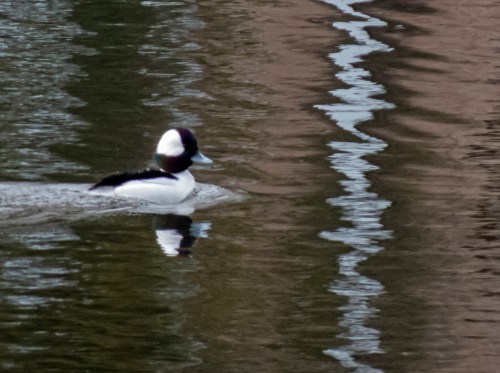
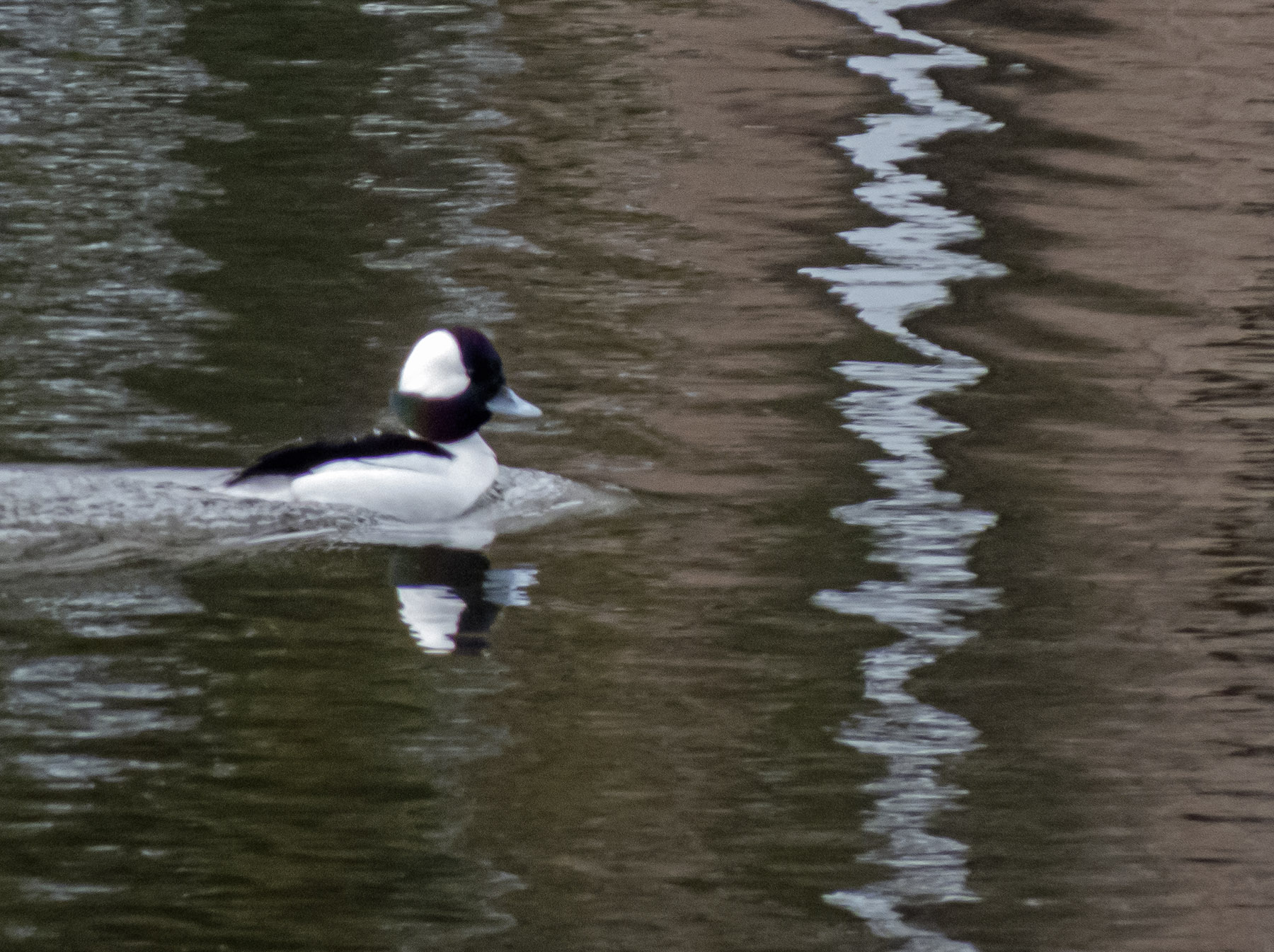
From a distance, male Bufflehead ducks (Bucephala albeola) generally look like they are black and white. Last Friday, however, the lighting was coming from a good direction and revealed some of the beautiful green and purple iridescent feathers on this bird’s head. The second image shows a Bufflehead couple and shows the dramatic difference in appearance between the male and female of this species.

© Michael Q. Powell. All rights reserved.
Posted in Birds, Nature, Photography, wildlife, Winter | Tagged Bucephala albeola, bufflehead, bufflehead duck, Canon SX50, Kingstowne VA | 9 Comments »
January 26, 2020 by Mike Powell
This past Friday I spotted a Dark-eyed Junco (Junco hyemalis), one of the birds that is present in my area only during the winter months. According to the Cornell Lab of Ornithology there is a huge range of geographic variation in the Dark-eyed Junco, with five variants of the bird considered separate species until the 1980s.
The bird in the photo below is a “slate-colored junco,” the only type that I have ever seen. Variants found in other parts of the United States, however, may have white wings, pink sides, red backs, gray heads, or a dark hood. Yikes—bird identification is hard enough under normal circumstances, but with that much variation, it seems almost impossible.

© Michael Q. Powell. All rights reserved.
Posted in Birds, Nature, Photography, wildlife, Winter | Tagged Canon SX50, Dark-eyed Junco, junco, Junco hyemalis, Kingstowne VA | 7 Comments »
January 25, 2020 by Mike Powell
I spotted this Bald Eagle last week at Occoquan Bay National Wildlife Refuge. The eagle was initially mostly hidden by branches, but I managed to get a clear shot of its head when it leaned forward and started to take off.
This month I have been particularly fortunate in finding eagles and in getting some pretty good shots of them. It is almost time for them to be nesting and before long portions of the refuge will be closed to keep the eagles from being disturbed. In the mean time I continue to walk the trails, trying to stay alert as I scan the trees and the skies for the possible presence of one of these majestic birds.

© Michael Q. Powell. All rights reserved.
Posted in Birds, Nature, Photography, wildlife, Winter | Tagged Bald Eagle, bald eagle takeoff, Canon 50D, Haliaeetus leucocephalus, Occoquan Bay National Wildlife Refuge, Tamron 150-600mm, Woodbridge VA | 5 Comments »
January 24, 2020 by Mike Powell
The lighting was so beautiful last week when I spotted this White-throated Sparrow (Zonotrichia albicollis) that I did not mind that there was a branch partially blocking my view of the bird. I especially love the way that the lighting highlights the bright yellow markings in the area between the eye and the bill known technically as the lores.

© Michael Q. Powell. All rights reserved.
Posted in Birds, Nature, Photography, wildlife, Winter | Tagged Canon 50D, Occoquan Bay National Wildlife Refuge, sparrow, Tamron 150-600mm, white-throated sparrow, Woodbridge VA, Zonotrichia albicollis | 16 Comments »
January 23, 2020 by Mike Powell
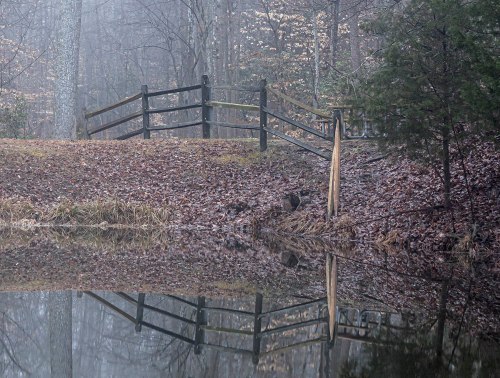
When I am photographing wildlife, I have to make decision about composition really quickly. I generally have only a few options to capture the subject and then I try to work with what I have gotten when I do post-processing. With a landscape, though, I have the chance to think more deliberately about composition while taking the shot and not merely afterwards.
Last week when I arrived early in the morning at Prince William Forest Park, fog was hanging over a small pond. As I walked around it, I decided to try to capture the scene in several different ways. In my first attempt, I placed the fence in the lower portion of the image to emphasize the height of the trees. In the second shot, I placed the fence in the upper portion of the image to focus more attention on the reflection. In the final shot I switched to landscape mode and included more of the tree to the right.
Which one works best? None of these shots will win a prize, but for me the first one does the best job of capturing what I was seeing and feeling at the moment. I think it is a valuable exercise, though, for me to explore a number of possibilities when taking a shot, because it allows me to think of creative possibilities as I change perspectives rather than adopt a “one and done” mentality.


© Michael Q. Powell. All rights reserved.
Posted in Landscape, Nature, Photography | Tagged Canon 50D, Canon 70-300mm, composition, foggy morning, Prince William Forest Park, Triangle VA | 18 Comments »
January 22, 2020 by Mike Powell
Most of the times when I see Wild Turkeys (Meleagris gallopavo) at Occoquan Bay National Wildlife Refuge, they are foraging in the open along one of the trails. As I approach, they usually disappear deep into the vegetation.
At this time of the year, though, I can see a lot farther into the woods than when there are leaves on the trees. Occasionally now I can get a glimpse of the turkeys moving about in the distance. I was happy to capture these head shots last week of one of the local turkeys as it popped in and out of view.


© Michael Q. Powell. All rights reserved.
Posted in Birds, Nature, Photography, wildlife, Winter | Tagged Canon 50D, Meleagris gallopavo, Occoquan Bay National Wildlife Refuge, Tamron 150-600mm, turkey, Wild Turkey, Woodbridge VA | 11 Comments »
January 21, 2020 by Mike Powell
Last Thursday I went for a hike in Prince William Forest Park in Triangle, Virginia. According to Wikipedia, the park is the largest protected natural area in the Washington D.C. metropolitan area at over 16,000 acres (65 square kilometers) and has over 37 miles (60 km) of hiking trails.
One of my favorite trails runs along Quantico Creek, a swiftly moving creek that flows through a large part of the eastern portion of the park. The trail, which runs roughly parallel to the creek, is hilly in places and the creek is sometimes not visible, but I can always hear the therapeutic sound of the flowing water.
The first two photos show waterfalls just below a dammed section of the creek—there is a small pond/lake just upstream. The smaller waterfall in the second photo is just to the right of the one shown in the first photo.
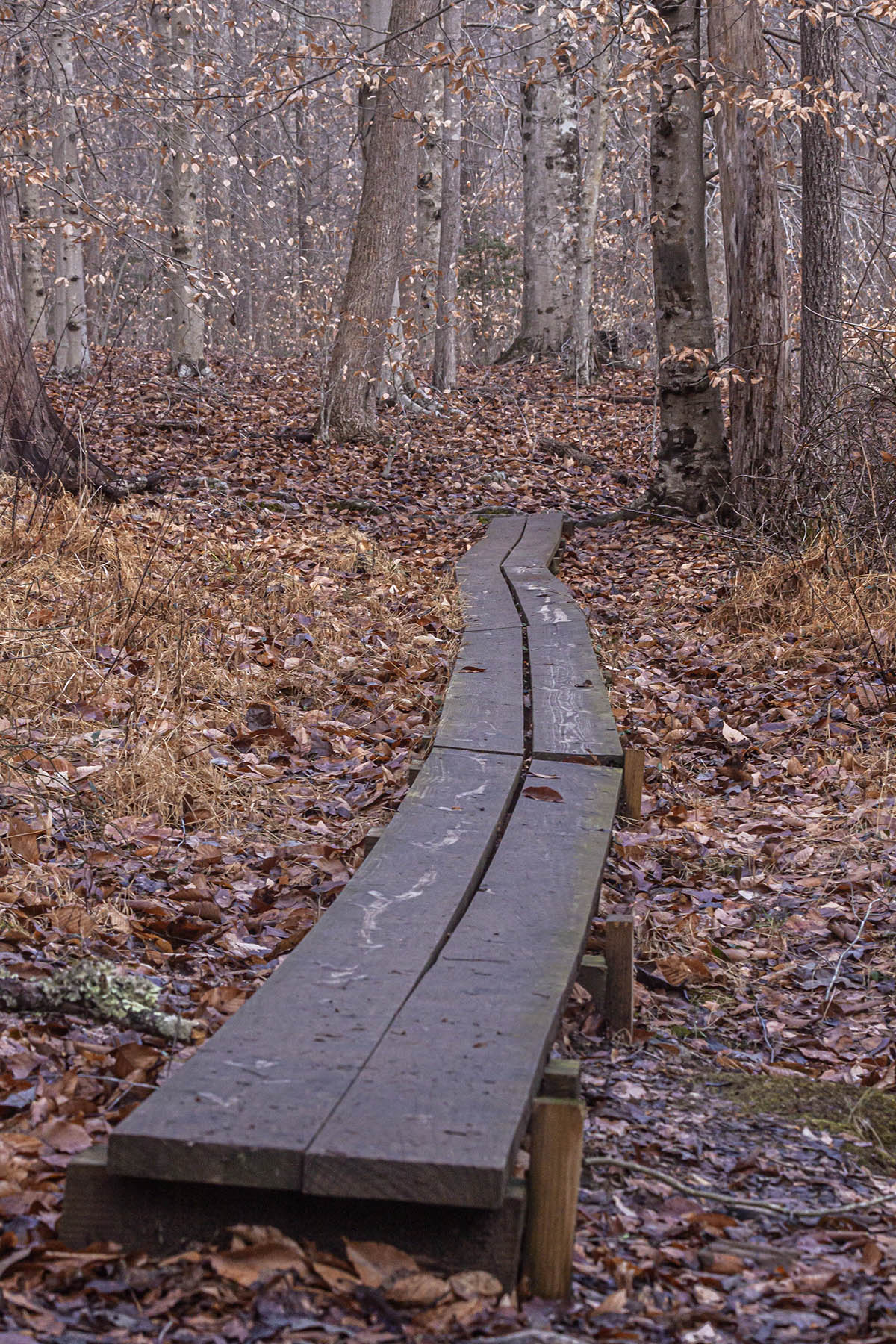
Parts of most of the trails, including the creekside one, were covered with wet fallen leaves, but occasionally I would come across narrow bridges that helped me cross marshy areas with relatively dry feet, like the one in the final photo.
I did not see much wildlife during my hike, but that was ok—the solitary walk in the forest was its own reward.


© Michael Q. Powell. All rights reserved.
Posted in Landscape, Nature, Photography, Winter | Tagged Canon 50D, Canon 70-300mm, creek, Prince William Forest Park, Quantico Creek, Triangle VA, two-board bridge, waterfall | 7 Comments »
January 20, 2020 by Mike Powell
It was gray and overcast early last Monday at Occoquan Bay National Wildlife Refuge when I captured this shot of a small flock of Bufflehead ducks (Bucephala albeola) flying away from me. Normally “butt shots” are undesirable, but in this case I like the almost abstract patterns of the birds’ wings and their reflections in the water.
Although this looks like I converted the image to black and white, this is more or less what it looked like color-wise straight out of the camera. No matter how I played with saturation, I could not bring out any colors in the shot. I think, though, that the monochromatic look of the final image is a pretty good match for the mood of that moment.

© Michael Q. Powell. All rights reserved.
Posted in abstract, Birds, Nature, Photography, wildlife, Winter | Tagged Bucephala albeola, bufflehead, bufflehead duck, Canon 50D, Occoquan Bay National Wildlife Refuge, Tamron 150-600mm, Woodbridge VA | 6 Comments »
January 19, 2020 by Mike Powell
Ever since I was a kid, I have always enjoyed the game “one of these things is not like the others.” Can you spot the juvenile Snow Goose (Anser caerulescens) in this photo of geese that I observed last Thursday at Occoquan Regional Park?
Generally the only geese that I ever see in my area are Canada Geese (Branta canadensis). They are so numerous that many people consider them to be a nuisance. I have learned from experience that birds intermingle when floating on the water, so I was carefully scanning the flock of Canada Geese when I spotted this anomaly. At first I thought it might be some kind of duck, because it seemed so much smaller than the other birds. After some research and assistance from more experienced birdwatchers, however, I have determined that it is a Snow Goose, a species that I have never photographed before.
The song “One of these things is not like the others” used to pop up regularly on the Sesame Street television program with all kinds of different items. When I looked on YouTube, I came across a delightful video with the song that features with food items and a mitten and dates back to 1969. Click on this link to watch the short video that concludes with the provocative question, “Did you ever try eating a mitten?”

© Michael Q. Powell. All rights reserved.
Posted in Birds, Nature, Photography, wildlife, Winter | Tagged Anser caerulescens, Canon 50D, juvenile Snow Goose, Lorton VA, Occoquan Regional Park, Snow Goose, Tamron 150-600mm | 6 Comments »
« Newer Posts - Older Posts »













 Mike Powell