May 26, 2020 by Mike Powell
Last Tuesday I spotted these rather scruffy-looking non-breeding male Indigo Buntings (Passerina cyanea) at Occoquan Bay National Wildlife Refuge. One viewer in a birding forum on Facebook commented, “He won’t get a date looking like that.”
I sort of expected all male Indigo Buntings to have a color that rivals or surpasses that of a male Eastern Bluebird—I had never before encountered the mottled coloration of a non-breeding male. For the sake of comparison, I have included as a final photograph an image that I captured in August 2017 of a breeding male Indigo Bunting on a sunflower. Click this link if you would like to see the final photo in the context of the original posting in which it was one of the featured images.


© Michael Q. Powell. All rights reserved.
Posted in Birds, Nature, Photography, spring, wildlife | Tagged Canon 50D, Indigo Bunting, non-breeding male Indigo Bunting, Occoquan Bay National Wildlife Refuge, Passerina cyanea, Tamron 150-600mm, Woodbridge VA | 13 Comments »
May 25, 2020 by Mike Powell
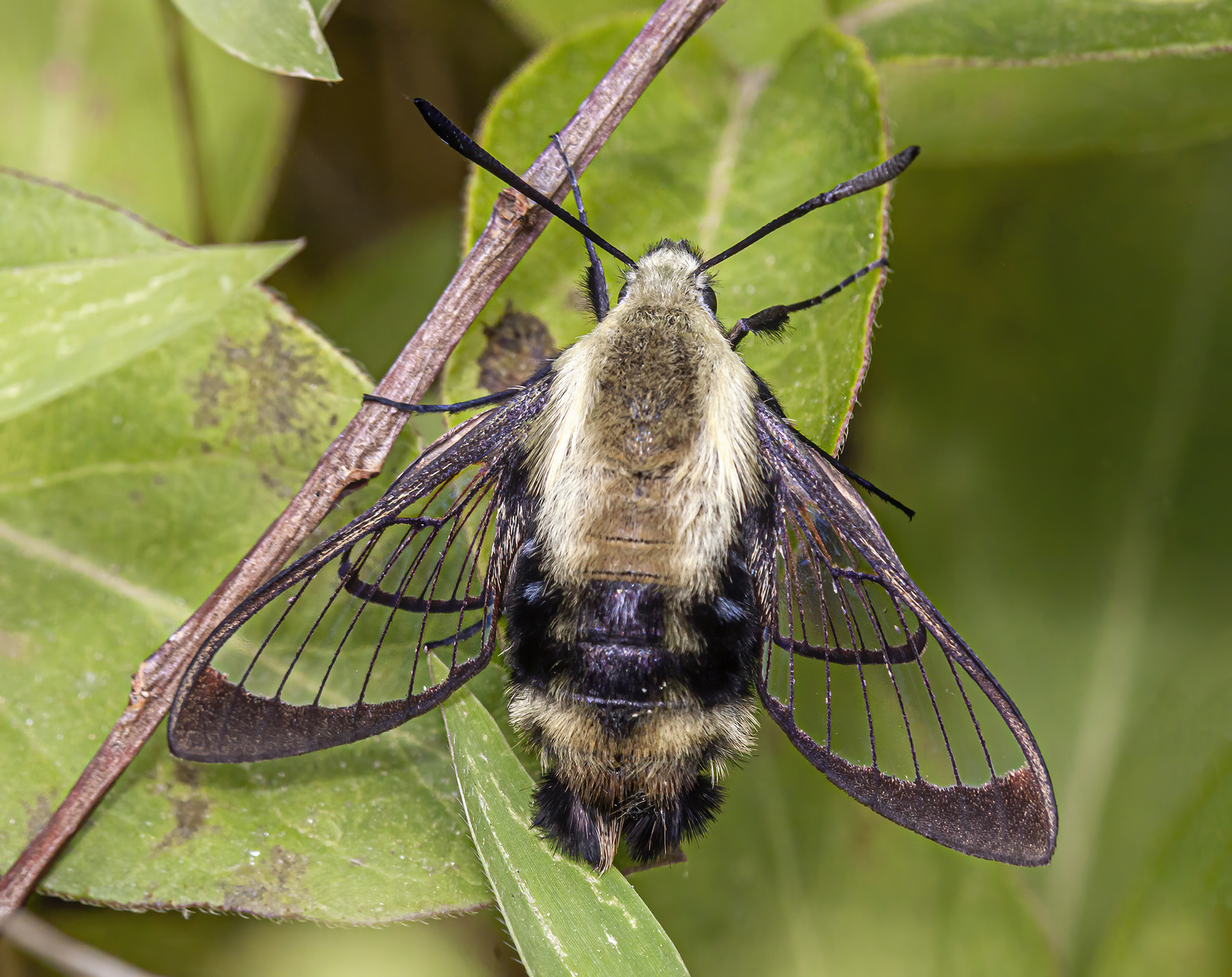
When I first spotted this insect last Thursday at Occoquan Regional Park, it looked like a large bumblebee. I tracked it visually as it buzzed about and when it landed, I could see from its distinctive wings that it was definitely not a bee. In our area we have two species of clear wing moths that are similar in appearance and behavior, the Snowberry Clearwing Moth (Hemaris diffinis) and the Hummingbird Clearwing Moth (Hemaris thysbe). Identification guides warn that both species are variable in color, which complicates identification, but the Hummingbird Clearwing Moth has light-colored legs, so I am pretty confident that this one is a Snowberry Clearwing Moth.
Most of the time when I see clearwing moths they are beating their wings rapidly and hovering in the air as they collect nectar from a variety of flowers, which causes some people to think they are hummingbirds. I do not know why this one was perched in the low vegetation—perhaps it was taking a break—but its static position allowed me to get a detailed look at its wings and the rest of its body.

© Michael Q. Powell. All rights reserved.
Posted in Insects, Macro Photography, Nature, Photography, spring, wildlife | Tagged Canon 50D, clearwing moth, Hemaris diffinis, Lorton VA, Occoquan Regional Park, Snowberry Clearwing Moth, Tamron 180mm | 10 Comments »
May 24, 2020 by Mike Powell
Generally when I spot a Black Saddlebags dragonfly (Tramea lacerata), it is flying. The distinctive dark blotches, which some scientist decided look like saddlebags, are visible even when the dragonfly is in the air. Some dragonflies spend most of their time perching, while others spend most of their time flying—the Black Saddlebags is in the latter category. I was therefore quite excited when I saw this one land in the low vegetation last Thursday at Occoquan Regional Park.
When a subject is this close to the ground, the background is almost inevitably going to be cluttered. In an effort to soften the potential distraction, I opened up the aperture to f/6.3 and tried to shoot almost directly down on the subject. I like the resulting image that has most of the dragonfly in sharp focus and most of the background a bit blurry.

© Michael Q. Powell. All rights reserved.
Posted in Dragonflies, dragonfly, Insects, Nature, Photography, spring, wildlife | Tagged Black Saddlebags, Black Saddlebags dragonfly, Canon 50D, Lorton VA, Occoquan Regional Park, Tamron 180mm, Tramea lacerata | 15 Comments »
May 23, 2020 by Mike Powell
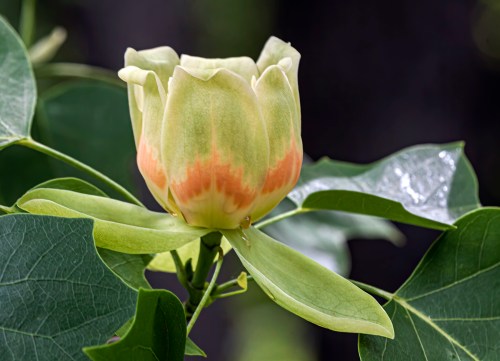
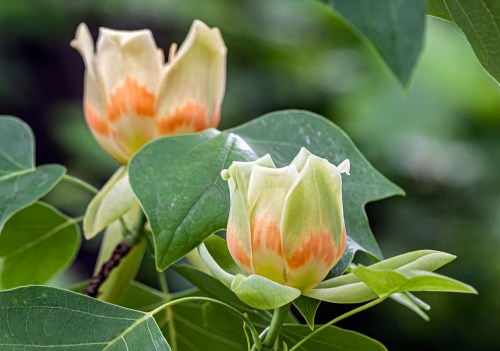
I was thrilled on Thursday when I spotted this flowering Tulip tree (Liriodendron tulipifera) at Occoquan Regional Park. Tulip trees, also known as tulip poplars or yellow poplars, don’t start flowering until they are older, up to 15 years old, and grow fast and really tall—the current tallest tulip tree on record has reached 191.9 feet (58 meters). Individual tulip trees have been known to live for up to 500 years, according to Wikipedia.
I had seen flowers like this one on the ground repeatedly while hiking in the woods this spring and never could figure out where they came from. Most of the time, the flowers are found high in the tree, out of sight. In this case, I was fortunate that the flower was still attached to the tree and was only slightly above eye level.
Here are a few shots of the tulip tree flowers—they definitely remind me of tulips, although they are in no way related, but instead are related to magnolia trees. The final shot shows a flower that had fallen and gives you a look at the distinctively shaped leaf of the tulip tree.

© Michael Q. Powell. All rights reserved.
Posted in Flowers, Nature, Photography, spring | Tagged Canon 50D, Liriodendron tulipifera, Lorton VA, Occoquan Regional Park, Tamron 180mm, Tulip Poplar, tulip tree, yellow poplar | 20 Comments »
May 22, 2020 by Mike Powell
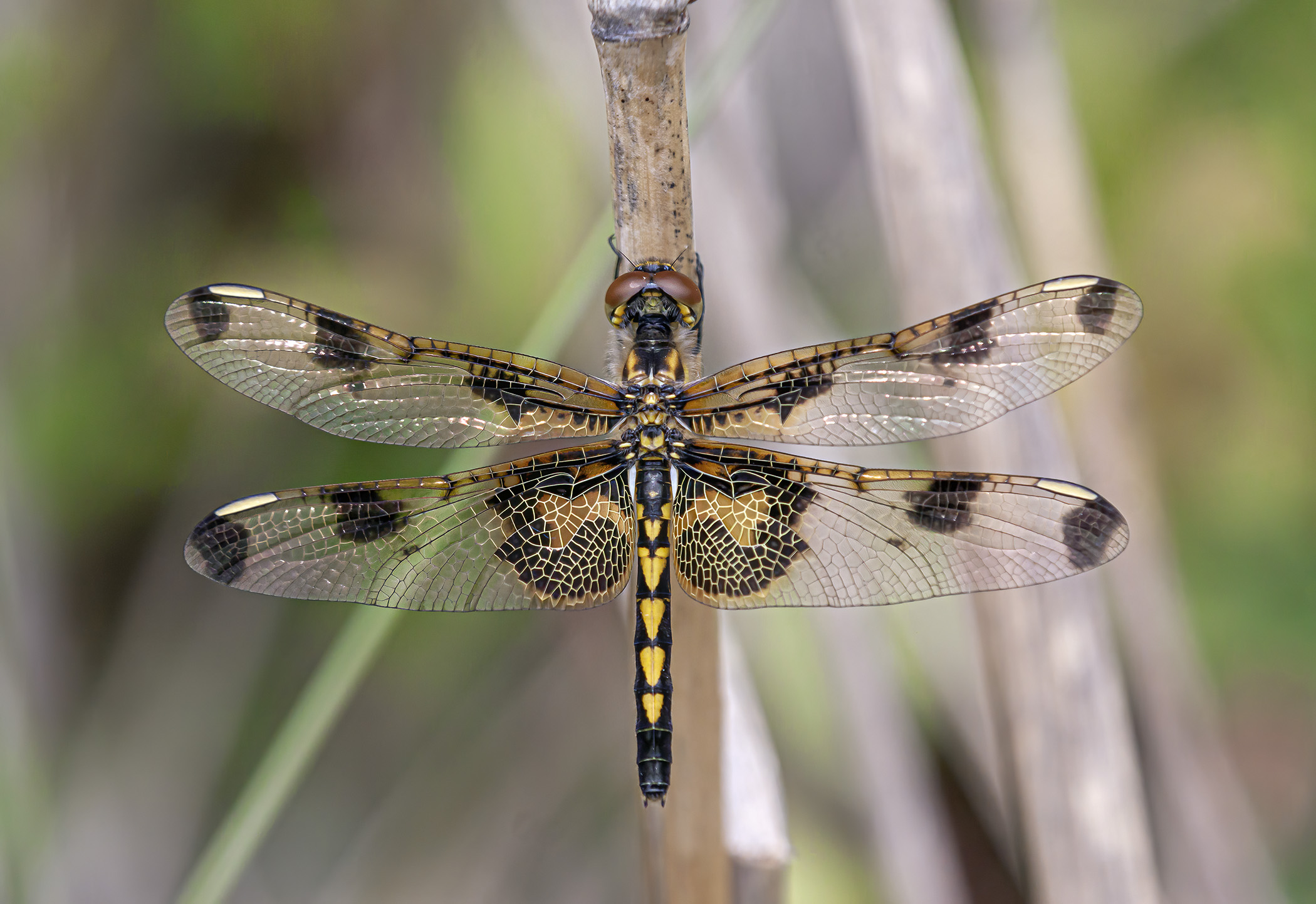
On Tuesday I spotted this beautiful female Calico Pennant dragonfly (Celithemis elisa) during a visit to Occoquan Bay National Wildlife Refuge. I always love to see the wonderfully patterned wings of this dragonfly species and the first shot provides a good view of the wing details, especially if you click on the image to enlarge it.
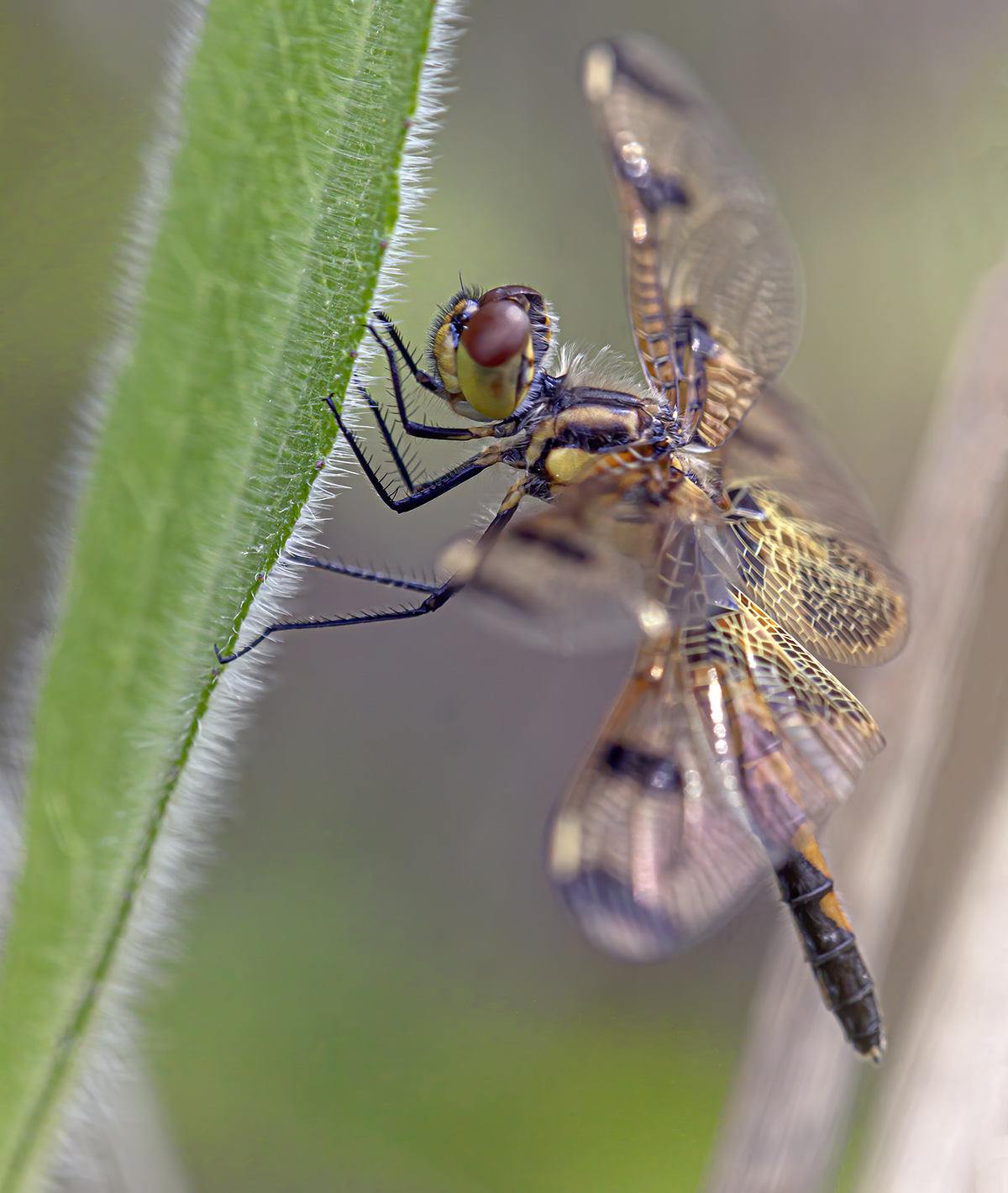
In the second image, I focused primarily on the dragonfly’s head and body and the wings are mostly out of focus. I love the way that you can see the dragonfly’s tiny feet and the tenuous grasp they have on the fuzzy plant stem from which the dragonfly is hanging.


© Michael Q. Powell. All rights reserved.
Posted in Dragonflies, dragonfly, Insects, Macro Photography, Nature, Photography, spring, wildlife | Tagged Calico Pennant, Calico Pennant dragonfly, Canon 50D, Celithemis elisa, female Calico Pennnant, Occoquan Bay National Wildlife Refuge, Tamron 180mm, Woodbridge VA | 20 Comments »
May 21, 2020 by Mike Powell
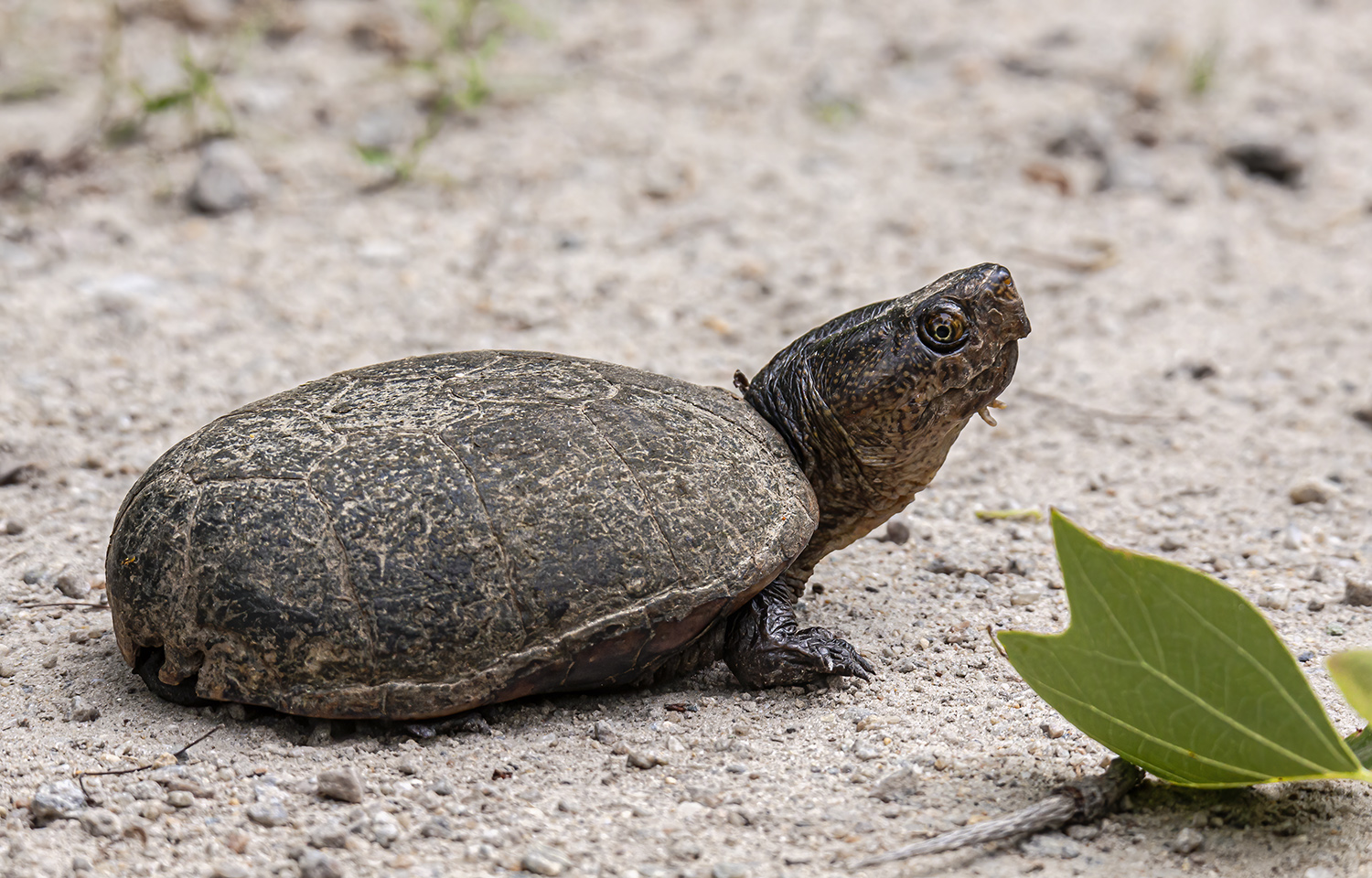
No matter how many times that I see an Eastern Mud Turtle (Kinosternon subrubrum), I am always shocked by the disproportionately large size of its head. When I spotted this one on Tuesday at Occoquan Bay National Wildlife Refuge, I remember wondering if it was physically possible for the turtle to withdraw its head into its shell. The turtle was standing in the middle of a wide trail, apparently in the process of crossing the trail. Although the mud turtle seemed to be fully aware of my presence, it appeared to be totally unfazed and merely gave me a sidewards glance as it waited for me to pass.
Given the circumstances in which we now live, I think we all could use some of the patience and imperturbability of this little creature.

© Michael Q. Powell. All rights reserved.
Posted in Nature, Photography, Reptiles, spring, turtle, wildlife | Tagged Canon 50D, Eastern Mud Turtle, Kinosternon subrubrum, Kinosternon subrubrum subrubrum, mud turtle, Occoquan Bay National Wildlife Refuge, Southeastern Mud Turtle, Tamron 150-600mm, Woodbridge VA | 11 Comments »
May 20, 2020 by Mike Powell
The Bald Eagles (Haliaeetus leucocephalus) at a prominent nesting site at Occoquan Bay National Wildlife Refuge were late this year in nesting and I feared that they might not have any babies. I was therefore thrilled yesterday to discover that there is now an eaglet in the nest when I returned to that part of the refuge for the first time in a couple of months.
Authorities at the refuge set up barriers to keep the nesting eagles from being disturbed, so I had to observe the nest from a long way off. When I first arrived at the barrier yesterday, I could not tell if there were any eaglets. However, I noted that one of the parent eagles was perched on a limb above and to the right of the nest. In the past, I learned that when eaglets start to grow, there is no longer any room for a parent in the nest, so having one parent keeping guard near the nest was a positive sign.
I waited and waited and eventually the other parent eagle flew in and perched on a limb above and to the left of the nest. I was peering though my fully-extended telephoto zoom lens and noticed a dark shape pop up in the middle of the nest shortly after the second parent arrived. When I looked at my shots afterwards, I confirmed that there was an eaglet in the nest.
In the first shot, it looks like the eaglet was calling to its parent, although I did not hear a sound, or maybe was indicating it was hungry. I pulled back my zoom lens to its widest setting for the second shot, in which you can see both eagle parents and the eaglet in the nest in the center (you may want to click on the image to see more details).
I think that there is only one eaglet this year, though I can’t be absolutely certain. In past years there have been either one of two eaglets in this nest. Now that I know that there is a new little eaglet, I will probably try to return to the site to monitor its progress over the upcoming weeks and months.


© Michael Q. Powell. All rights reserved.
Posted in Birds, Nature, Photography, spring, wildlife | Tagged Bald Eagle, Bald Eagle baby, Canon 50D, eaglet, Haliaeetus leucocephalus, Occoquan Bay National Wildlife Refuge, Tamron 150-600mm, Woodbridge VA | 14 Comments »
May 19, 2020 by Mike Powell
I wasn’t sure if Uhler’s Sundragon dragonflies (Helocordulia uhleri) would still be around when I set out exploring in Prince William County earlier this month. This species of dragonfly is one of the first to appear in the spring and generally is flying for only a month or so. I had spotted several females on the third of April—see my posting Female Uhler’s Sundragons for details and photos—so I knew that the clock was ticking.
I scoured all of the locations where I had seen them in the past and was about to give up hope when some movement low in the vegetation caught my eye. I was excited to see that it was a Uhler’s Sundragon, my target species. As I tried to control my racing heart and slow down my breathing, I maneuvered into position and was able to capture this image of a handsome male Uhler’s Sundragon. As it turned out, this dragonfly was the only one of its species that I would see that day and I have not seen one since. In this case, though, one was more than enough.

© Michael Q. Powell. All rights reserved.
Posted in Dragonflies, dragonfly, Insects, Macro Photography, Nature, Photography, spring, wildlife | Tagged Canon 50D, Helocordulia uhleri, Prince William County VA, Tamron 180mm, Uhler's Sundragon, Uhler's Sundragon dragonfly | 5 Comments »
May 18, 2020 by Mike Powell
When I posted a photograph last week of a skink with a bright blue tail, I noted that a skink can shed its tail if a predator grabs onto it. I never suspected that two days later I would encounter a skink with a missing tail. When I first spotted it, I was so drawn to the detailed scallop pattern on its body that I did not even notice its really short tail. (Click on the image to get a closer view of that wonderful texture.) The coloration suggests to me that this is a Broad-headed Skink (Plestiodon laticeps), not the more common Five-lined Skink that I featured last week.
I was also drawn to the orange coloration of the head. According to the Virginia Herpetological website, the head in male Broad-headed Skinks becomes bright orange and enlarged in the temporal region during the spring mating season. Perhaps the skink lost its tail during a fight with a rival—the website cited above notes that adult males are particularly aggressive to other males during the mating season.
In case you need a reminder about how long a skink’s tail should be, check out the posting from last week Young skink in May. Some of you may have read my bad joke about skinks in the comment section of that posting, but it seems so appropriate that I can’t help but repeat it here. “Do you know what skinks do when they lose their tails? They go to a retail store.” Sorry. 🙂

© Michael Q. Powell. All rights reserved.
Posted in Nature, Photography, Reptiles, spring, wildlife | Tagged Broad-headed Skink, Canon 50D, Plestiodon laticeps, Prince William County VA, skink, Tamron 180mm | 15 Comments »
May 17, 2020 by Mike Powell
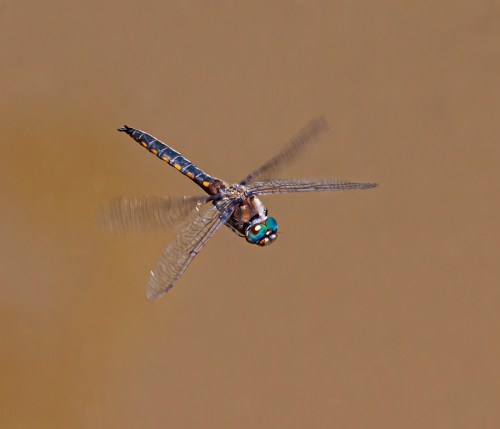
On Friday, temperatures in my area soared to 84 degrees (29 degrees C), which I thought might trigger the emergence of new dragonflies. However, when I arrived at Jackson Miles Abbott Wetland Refuge, a nearby park with a small pond, the only dragonflies that I could find were a half-dozen Common Baskettail dragonflies (Epitheca cynosura) patrolling over various parts of the pond.
I walked around the perimeter of the pond multiple times, searching in vain in the undergrowth and in the vegetation at water’s edge. Periodically I stopped and attempted to photograph the dragonflies in flight. Their flight paths were somewhat predictable, which gave me hope, but the dragonflies varied their distances from the shore and changed their altitude unexpectedly.
Here are a few of my favorite shots from the photo excursion. As a frame of reference, Common Baskettail dragonflies are about 1.6 inches (41 mm) in length, so I think you can appreciate the challenge of photographing one on the fly.


© Michael Q. Powell. All rights reserved.
Posted in Dragonflies, dragonfly, Insects, Nature, Photography, spring, wildlife | Tagged Canon 50D, Common Baskettail, Common Baskettail dragonfly, Fort Belvoir VA, Jackson Miles Abbott Wetland Refuge, Tamron 180mm | 26 Comments »
May 16, 2020 by Mike Powell
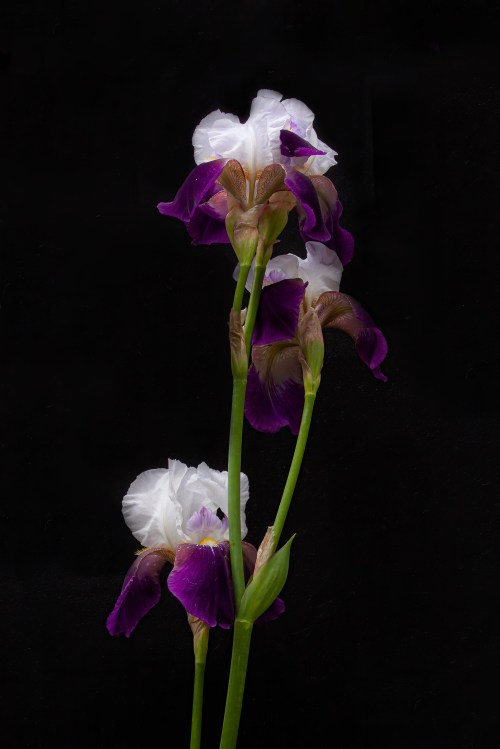
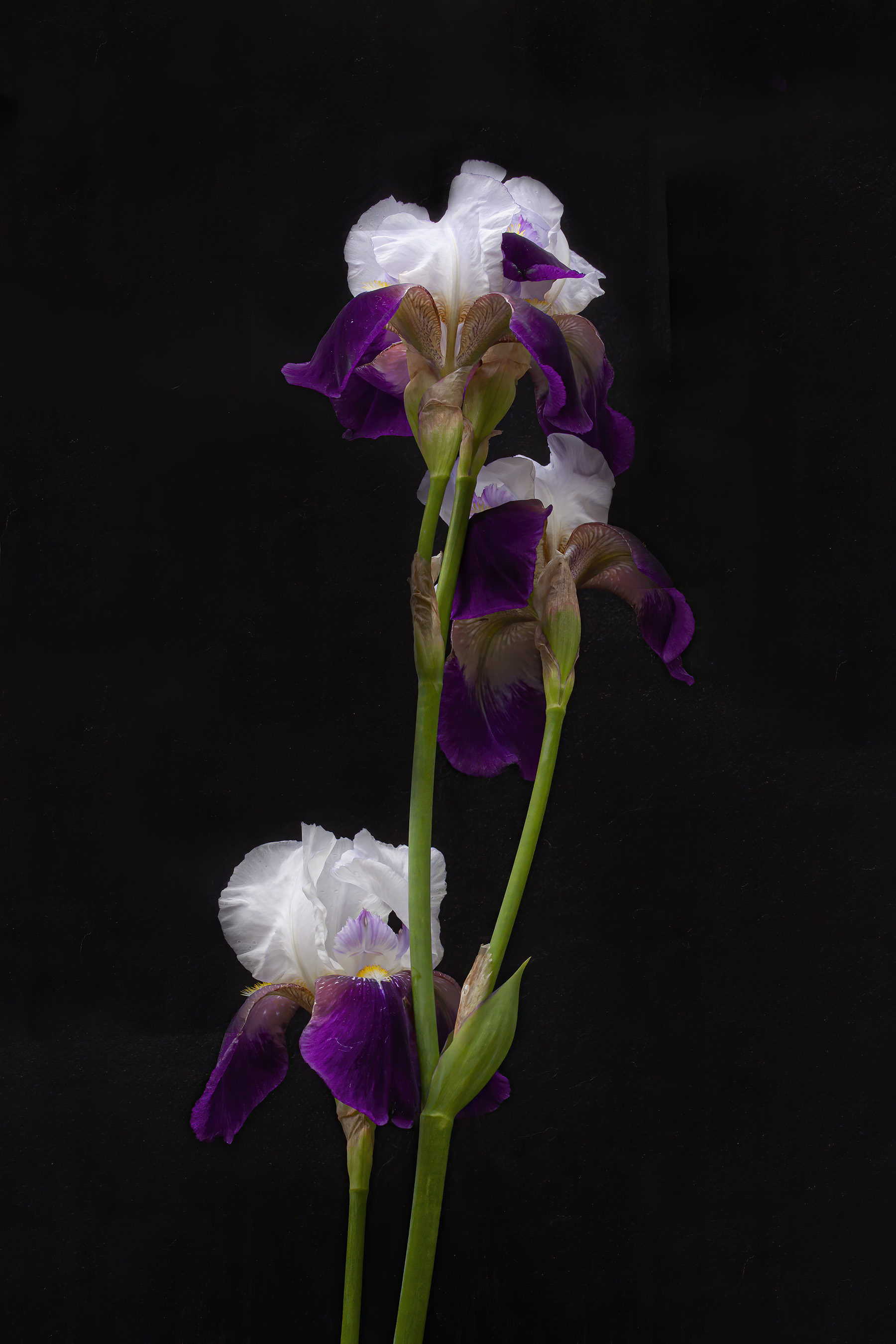
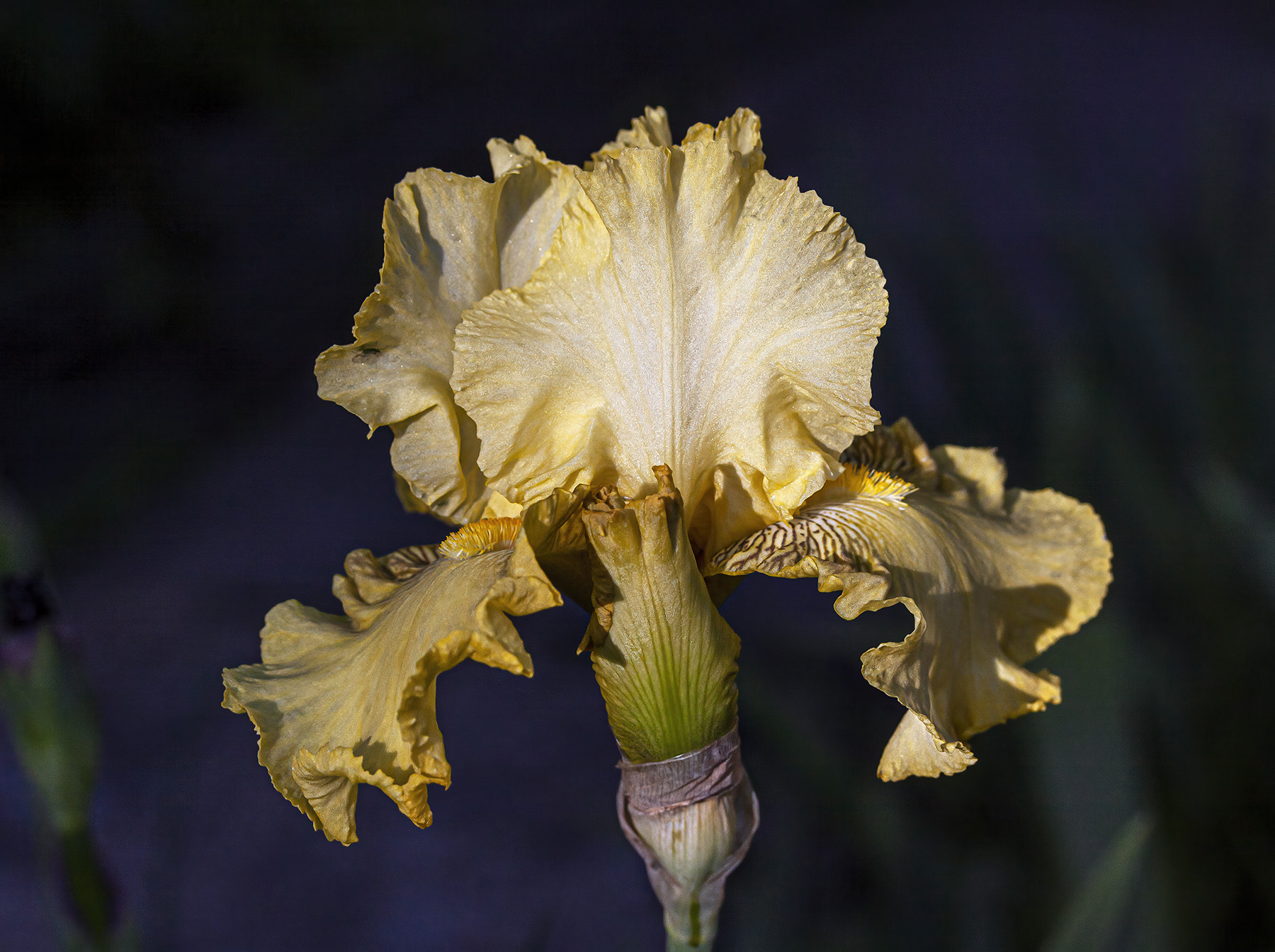
A week ago I did a posting called Studio-like irises that featured photos of bearded irises shot against a background of a white foamcore board. This week on Thursday my photography mentor Cindy Dyer and I photographed some more of the irises in her garden, this time against a black background. Cindy had obtained some black velvet-like material with an adhesive backing that she affixed to the back of the white foamcore board. Normally this material is used for jewelry displays, but it worked perfectly to highlight the forms and colors of these beautiful flowers.
Here are a few selected shots from our little photoshoot. Although we had a consistent background, we were moving in and out of the sunlight and shadows and I had to constantly change mycamera settings—we even had a few raindrops fall on us while we were taking photos. Cindy and her husband have three cats and when I opened up my images in Photoshop I learned that velvet serves as a magnet for cat hair.
If you like the look of these shots, you should check out the posting that Cindy did on her blog that features seven fabulous photos, including several colorful iris species not shown below.


© Michael Q. Powell. All rights reserved.
Posted in Art, Flowers, Gardening, Nature, Photography, spring | Tagged Alexandria VA, Bearded Iris, black background, Canon 50D, Canon 60mm, Cindy Dyer, iris, outdoor studio | 18 Comments »
May 15, 2020 by Mike Powell
Many beetles are dark-colored and go about their business in the underbrush, unseen by human eyes. Six-spotted Tiger Beetles (Cicindela sexguttata), on the other hand, are hard to miss—their metallic-green bodies sparkle as they perch in the middle of the sun-lit forest trails on which I have been hiking in recent weeks.
The beetle’s common name refer to the six small white spots on the beetle’s metallic-green elytra (the beetle’s hardened wing cases), although the number of spots is somewhat variable—I think I count eight spots on this individual. As I was doing a bit of research, I stumbled upon the fact that elytra is the plural form of elytron—I think that I have almost always seen the word used in the plural form and the spell-check highlights elytron as an unknown word.
It is often hard to get a shot of one of these beetles, because they are skittish and often fly away as I bend down to photograph them. For this photo, I was fortunate that the beetle chose to perch on a trunk of a tree at eye-level and no contortions were therefore required on my part.

© Michael Q. Powell. All rights reserved.
Posted in Insects, Macro Photography, Nature, Photography, spring, wildlife | Tagged Canon 50D, Cicindela sexguttata, Prince William County VA, Six-spotted Tiger Beetle, Tamron 180mm | 13 Comments »
May 14, 2020 by Mike Powell
I often feel a bit overwhelmed when I visit a public garden—there are so many flowers all around vying for my attention. I am rarely attracted to large clusters of flowers, but instead tend to gravitate toward individual flowers that I can photograph up close with my macro lens.
Here are three of the flowers that I photographed during a recent photographic foray to nearby Green Spring Gardens with my friend Cindy Dyer. The first is a spiderwort (g. Tradescantia), a flower that I love for its simple geometric shape. I am not sure if the plant in the second photo, some species of allium, counts as a flower, but I love the way that the partially open “bud” reveals the complex structure inside. The final flower is a simple viola that I spotted amidst a bed of green ground cover—like pansies, violas always make me smile.


© Michael Q. Powell. All rights reserved.
Posted in Flowers, Gardening, Macro Photography, Nature, Photography, spring | Tagged Alexandria VA, allium, Canon 50D, g. Tradescantia, green spring gardens, spiderwort, Tamron 180mm, viola | 21 Comments »
May 13, 2020 by Mike Powell
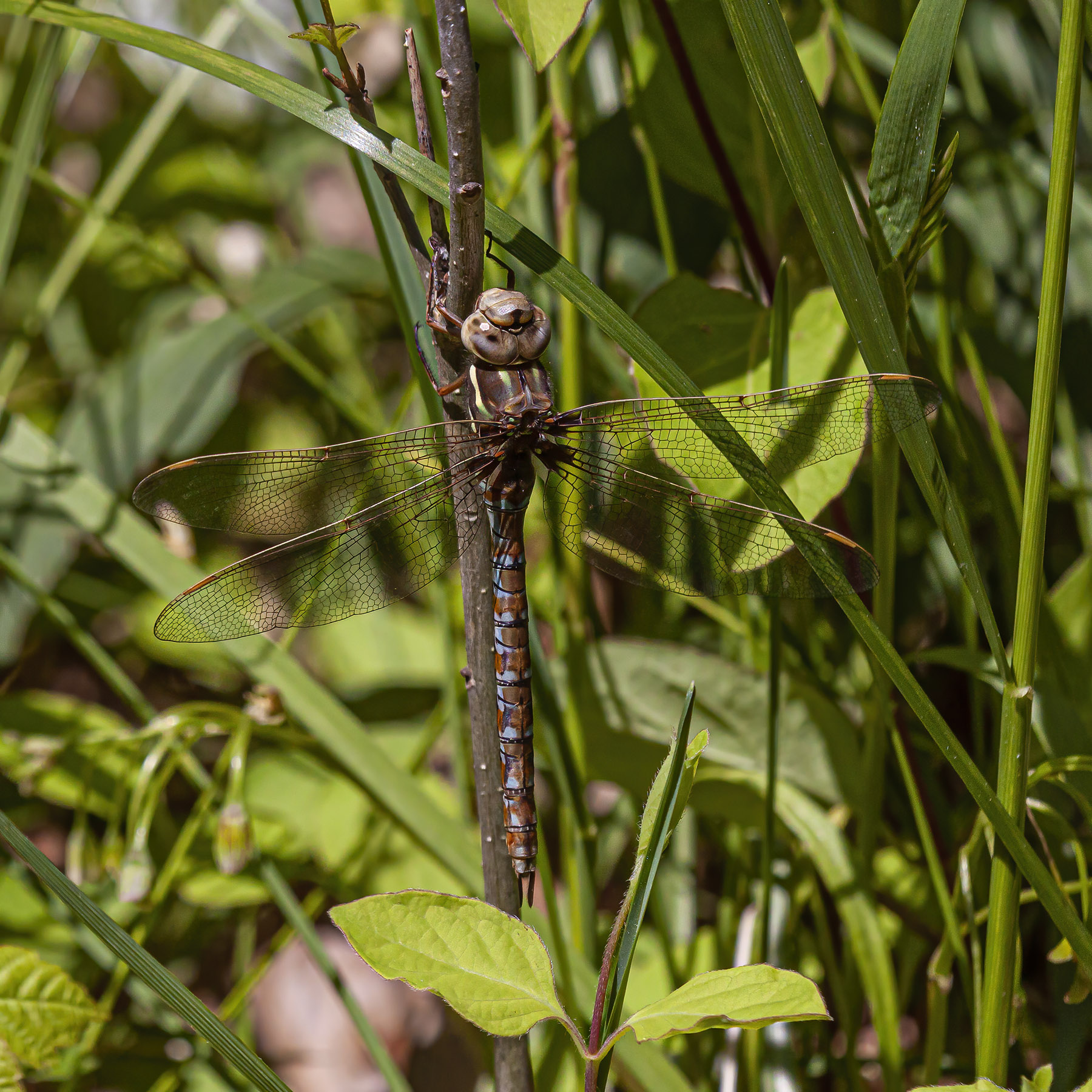
During a recent dragonfly hunting trip with my friend and fellow dragonfly enthusiast Walter Sanford, I was thrilled when we stumbled upon several Springtime Darner dragonflies (Basiaeschna janata). As their name suggests, they are in flight early in the dragonfly season and are gone well before many of the summer dragonfly species arrive.
I first spotted one flying low over the vegetation in an overgrown field. It dropped down into the vegetation, but I was fortunately to be able to find where it was perched. As you can see in the first photo, Springtime Darners perch vertically, making it hard to see them amid all of the nearby stalks and stems. The female in the first photo was relatively cooperative and I was able to position myself well enough to have most of her body in focus. I encourage you to click on the image to see all of the wonderful details and colors of this beautiful dragonfly.
Although we had several more encounters with Springtimes Darners, all of those individuals were very skittish and it was tough to get any good shots. I included the second shot below because it shows really well the body of a male Springtime Darner, although the head is a bit out of focus because of the way he was perched.
Walter also did a blog posting on our encounter with these beautiful dragonflies. Be sure to check it out at this link and you will find more information about this dragonfly species and his photos and “take” on our dragonfly adventure.


© Michael Q. Powell. All rights reserved.
Posted in Dragonflies, dragonfly, Insects, Nature, Photography, spring, wildlife | Tagged Basiaeschna janata, Canon 50D, Fairfax County Virginia, Springtime Darner, Springtime Darner dragonfly, Tamron 180mm, Walter Sanford | 10 Comments »
May 12, 2020 by Mike Powell
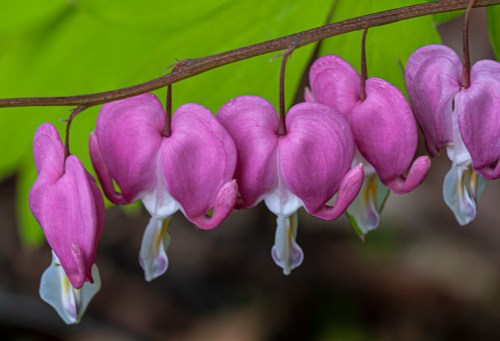
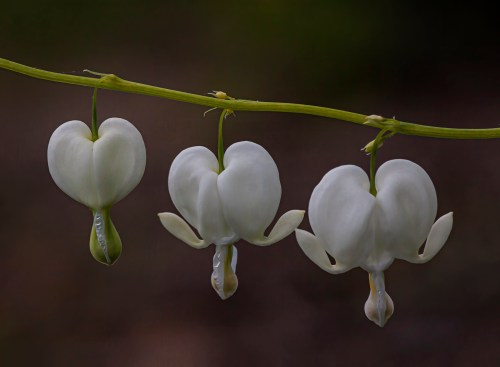
I spotted these beautiful Bleeding Heart flowers (Lamprocapnos spectabilis) during a brief trip to Green Spring Gardens last Tuesday with my friend Cindy Dyer. The colors of the pink ones are stunning, especially against the lime-green leaves in the background. However, I was particularly struck by the white ones, a variant that was new to me.

© Michael Q. Powell. All rights reserved.
Posted in Flowers, Gardening, Nature, Photography, spring | Tagged Alexandria VA, Asian bleeding-heart, Bleeding Hearts, Canon 50D, green spring gardens, Lamprocapnos spectabilis, Tamron 180mm, white Bleeding Hearts | 8 Comments »
May 11, 2020 by Mike Powell
I really love the look of young Common Five-lined Skinks (Plestiodon fasciatus), when their tails are bright blue, like this one that I spotted last Thursday while exploring in Prince William County. The blue color gradually fades as the skinks mature and as a result it becomes a bit harder to spot the adults in the wild.
We do not have very many lizards where I live, so I am always happy to see one of these skinks. They are generally about 5 to 8.5 inches in length (13 to 21 cm), including their tails, and tend to be very skittish. I have read that a skink can shed its tail if a predator grabs onto it and then regenerate somewhat imperfectly the lost portion of the tail, but I have never knowingly seen a skink with a regrown tail.

© Michael Q. Powell. All rights reserved.
Posted in Nature, Photography, Reptiles, spring, wildlife | Tagged Canon 50D, Common Five-Lined Skink, Plestiodon fasciatus, Prince William County VA, skink, Tamron 180mm | 17 Comments »
May 10, 2020 by Mike Powell
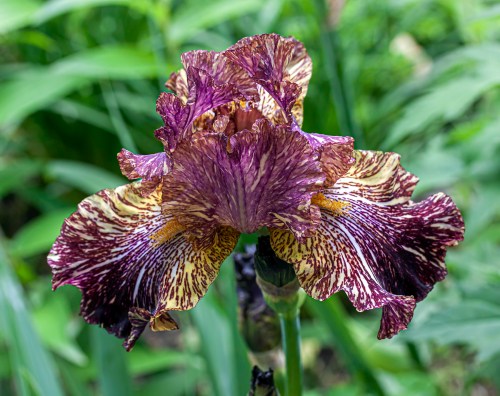
Although I have grown to know most of the irises in the garden of my friend and neighbor Cindy Dyer, I don’t know their individual names. One iris that recently started blooming is so unusual and outrageous in appearance that I suspected that it was a special hybrid. I was bemused to learn that it is called the ‘Bewilderbeast’ bearded iris.
I love the way that Claire Austin described this striking hybrid iris on the Heritage Irises website, “This flower is a psychedelic mixture of colours, including maroon, mauve, and cream. These colours sit in rivers across the white background. The standards are muted in tone, and the thin beards are dark yellow.”
I tried photographing the iris with a natural background, which I prefer, and also with a piece of foamcore board. Do you prefer one image over the other?

© Michael Q. Powell. All rights reserved.
Posted in Flowers, Gardening, Nature, Photography, spring | Tagged Alexandria VA, Bearded Iris, Bewilderbeast, Bewilderbeast iris, Canon 50D, Canon 60mm, Cindy Dyer, iris, Runnymeade | 27 Comments »
May 10, 2020 by Mike Powell
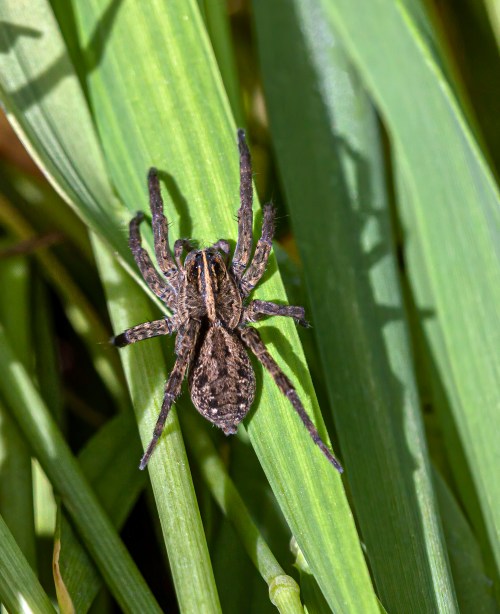
It was probably my imagination, but the Wolf Spiders (Tigrosa georgicola) that I spotted last weekend while exploring in Fairfax County seemed huge. In the first image, the shadow makes the spider look even larger and gives it a somewhat menacing appearance. I am not sure why the spider in the second shot was out in the open, but its exposed condition allowed me to examine it closely—even relatively large spiders spark my curiosity.

© Michael Q. Powell. All rights reserved.
Posted in Arachnids, Nature, Photography, spiders, spring, wildlife | Tagged Canon 50D, Fairfax County Virginia, Tamron 180mm, Tigrosa georgicola, wolf spider | 9 Comments »
May 9, 2020 by Mike Powell
Columbines are one of my favorite spring flowers and I was excited to have the chance to capture images of some different varieties during a short visit to Green Spring Gardens, a county-run historical garden, this past Tuesday with my friend and photography mentor Cindy Dyer. When I started working with Cindy almost eight years ago, flowers were often our target subjects and this garden was our favorite location to photograph them.


© Michael Q. Powell. All rights reserved.
Posted in Art, Flowers, Gardening, Nature, Photography, spring | Tagged Alexandria VA, Canon 50D, columbine, columbines, Fairfax County, green spring gardens, Tamron 180mm | 12 Comments »
May 9, 2020 by Mike Powell
On Thursday I was excited to spot these two Stream Cruiser dragonflies (Didymops transversa), one female and one male, in a sunny area adjacent to a creek that I was exploring in Prince William County, Virginia. Authorities have closed the park that I was visiting to vehicular traffic, so I had to hike in to reach my target area, which took over an hour and a half each way.
It was the end of a long and tiring day and I had already begun the trek back to my car. By 4:00 in the afternoon, much of the trail along the creek was in the shade. Periodically, though, I would pass patches of sunlit vegetation and I stopped to explore them, knowing that many dragonflies like to bask in the sunlight. I was searching one such spot when my eyes detected a dragonfly in flight. I was able to track the dragonfly in the air and to see it land. The male Stream Cruiser (shown in the second photo below) perched at an odd angle on some low-hanging vegetation, but I managed to get a shot of it before it took off again.
I decided to stay in that spot and wait and after a while another dragonfly flew by, landing this time much higher in the vegetation. Initially I thought that it might be the same dragonfly that I had already photographed, but when I got closer, I could see that the second one (shown in the first photo below) was a female. The female Stream Cruiser chose to perch about chest-high, so I was able to get a much better angle for this shot than for the first one and compose the image more carefully.
This experience is a good reminder for me to stay alert at all times when I have my camera in my hands until I am actually back to my car. I had not even been thinking of Stream Cruisers, a species that I have seen only a couple of times previously, when I decided to make this trip. However, I was ready when this opportunity unexpectedly presented itself to me.
I cringe a little sometimes when well-meaning folks see my photos and say, “You are so lucky.” Yes, I have more than my share of good fortune, but it often takes hours and hours of effort for a decisive moment to arrive and even then I have to be quick enough and skillful enough to get a shot. Rather than going to the trouble to explain all of that, though, I will usually nod my head and agree that I was lucky to get my shots.


© Michael Q. Powell. All rights reserved.
Posted in Dragonflies, dragonfly, Insects, Nature, Photography, wildlife | Tagged Canon 50D, Didymops transversa, Prince William County VA, Stream Cruiser, Stream Cruiser dragonfly, Tamron 180mm | 18 Comments »
May 8, 2020 by Mike Powell
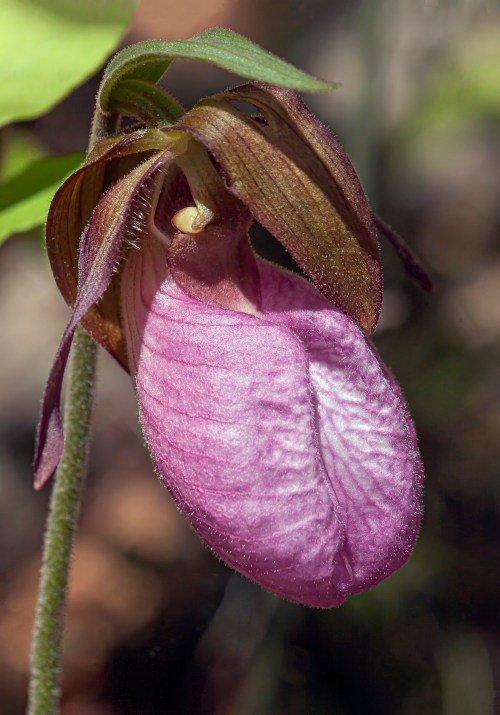
I was really excited yesterday to spot some Pink Lady’s Slippers (Cypripedium acaule), a type of wild orchid, while exploring in Prince William County, Virginia. I was hunting for dragonflies adjacent to a hiking trail when two young ladies with a large dog came walking in my direction. I moved further back into the vegetation to increase our distance. One of the young ladies, noticing my camera, asked me if I was interested in photographing some “rare kind of orchids” and gave me some rather general directions for a place a couple of miles down the trail.
I have been to orchid shows before, so I had a general idea that the hikers were talking about lady’s slippers when they described the flowers, but I did not really know what they looked like in the wild. So I set off down the trail and eventually found three small clusters of Pink Lady’s Slippers. The midday sunlight was harsh, but I managed to find some angles from which the light was mostly diffused. I included the final shot to give you an idea of what the whole flower looks like when it is growing.
After doing some research, I learned that the Pink Lady’s Slippers, also known as “moccasin flowers,” are actually not “rare.” This flower is found in many places in the eastern third of the United States and in all Canadian provinces except for British Columbia. Whether the lady’s slipper is rare or not, I was happy to have the chance to see and photograph this fascinating flower, which somehow reminds me of a human heart.


© Michael Q. Powell. All rights reserved.
Posted in Art, Flowers, Nature, Photography, spring | Tagged Canon 50D, Cypripedium acaule, Pink Lady's Slipper, Prince William County VA, Tamron 180mm | 18 Comments »
May 7, 2020 by Mike Powell
You do not need to be in a studio to get a studio portrait look—all you need to do is to hold a piece of white cardboard or foamcore board behind the blooming flowers, such as these beautiful bearded irises in the garden of my friend Cindy Dyer. Cindy was gracious enough to hold the board for me and I returned the favor a few minutes later. Several viewers on my Facebook page commented that the style of these shots reminded them of botanical prints.
One of the challenges of shooting outdoors for shots like this was trying to get even lighting. I tweaked my settings in post-processing a bit to make the background as white as I dared, but did not go to the trouble of making the flowers perfect and removing any slight shadows or color casts from the background.


© Michael Q. Powell. All rights reserved.
Posted in Art | Tagged Alexandria VA, Bearded Iris, Canon 50D, Canon 60mm, Cindy Dyer, iris, Runnymeade | 26 Comments »
May 6, 2020 by Mike Powell
How close can you get to a dragonfly when trying to photograph it? As with most things in life, the vexing answer is that “it depends.” In my experience, some dragonfly species tend to be more skittish than others and will fly away for good at the first indication of your presence. Other species will fly away, but return to the same perch a short time later. Occasionally I will encounter a dragonfly that remains in place and permits me to get as close as I want, although I still have to pay close attention to where I place my feet, so that I do not disturb its perch, and to the location of the sun, so that I do not cast my shadow on the dragonfly.
Last Saturday I went hunting for dragonflies with my friend and fellow dragonfly enthusiast Walter Sanford at a remote location in Fairfax County, Virginia, the county in which we live. Under normal circumstances, we probably would have made multiple excursions together by this time of the year, but this was our first trip of the season.
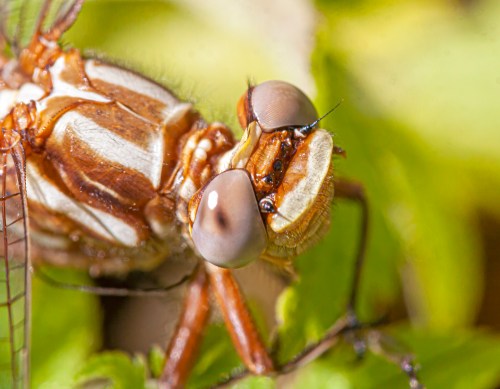
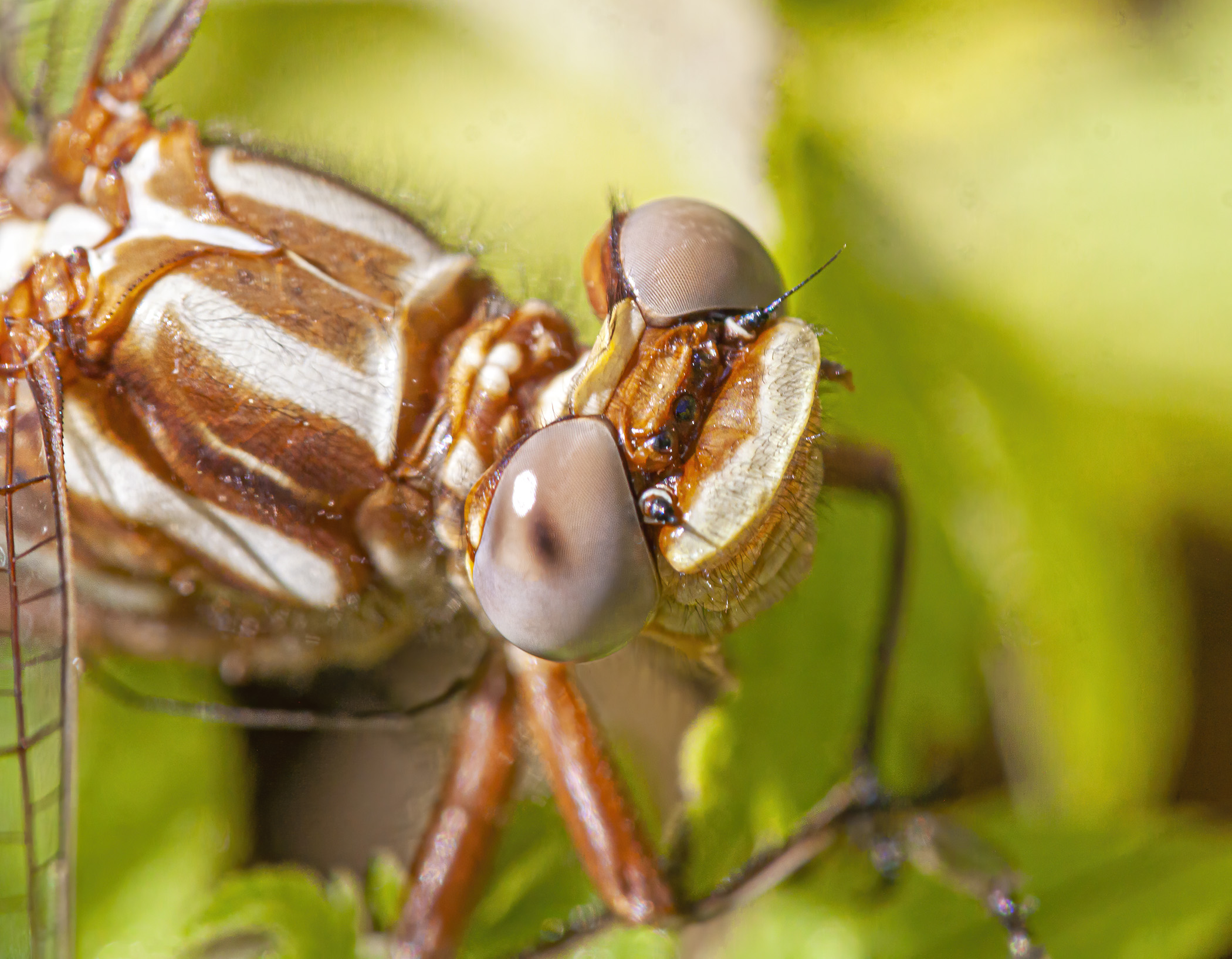
The first dragonfly that we encountered was a female Ashy Clubtail dragonfly (Phanogomphus lividus) and she proved to be remarkably cooperative. Why? I think that the dragonfly was a little distracted because she was in the process of consuming a cranefly. In some of my photos I could see remnants of the legs, wings, and other body parts of the victim.
The three photos show in inverse chronological order how I started out photographing the entire body of the dragonfly and them moved in closer and closer. Each of shows some pretty remarkable details of the dragonfly’s anatomy and it is definitely worth clicking on them to get a better look. For example, the third photo shows the beautiful coloration of the body; the second shot shows the spines on the legs and the hook-like tips of the feet; and the first image draws your attention to the dragonfly’s amazing compound eyes.
I took all of the photos below handheld with my Canon 50D DSLR and Tamron 180mm macro lens. My partner in this adventure used totally different gear and his approach to capturing images was definitely not the same as mine. In the past Walter and I have done companion postings on our respective blogs when we have taken photos together and we decided to continue the tradition.
Walter and I have different backgrounds, writing styles, and shooting styles and it has always been fascinating to contrast our “takes.” Even though we were shooting the same subject under the same conditions, I can almost guarantee that the images we post will be quite different. Be sure to check out Walter’s blog at waltersanford.wordpress.com for all kinds of wonderful postings, mostly about dragonflies.
I will include a link to his posting on our encounter with this Ashy Clubtail dragonfly after I publish this posting—I have not yet seen how he described our adventures.
UPDATE: Here, as promised, is a link to Walter’s posting about our encounter with this female Ashy Clubtail dragonfly.


© Michael Q. Powell. All rights reserved.
Posted in Dragonflies, dragonfly, Insects, Macro Photography, Nature, Photography, spring, wildlife | Tagged Ashy Clubtail, Ashy Clubtail dragonfly, Canon 50D, Fairfax County Virginia, Phanogomphus lividus, Tamron 180mm, Walter Sanford | 16 Comments »
May 5, 2020 by Mike Powell
At this time of the year there are still so few dragonflies around that I will try to photograph almost every single one that I see. Sometimes that involves photographing them when they are flying, as I showed in a posting earlier today. At other times, I am forced to shoot them when they are a long way away, as was this case with the male Common Whitetail dragonfly (Plathemis lydia) in the photo below.
I had already made one loop around Occoquan Bay National Wildlife Refuge looking primarily for insects and decided to switch to my telephoto zoom lens and focus on looking for birds during a second loop. When I was walking past a small pond, however, I spotted the dragonfly flying over the water. I could tell that it was a Common Whitetail, a species that perches fairly often, so I decided to see if it would land.
Eventually the dragonfly perched atop some thick vegetation not far from the water’s edge. Unfortunately the area between the two of us was marshy and there was no way that I could get any closer. Even with the lens cranked out to its longest length (600mm), the dragonfly filled only a small portion of the frame.
I decided to try to treat the shot like a landscape and include the water of the pond in the background and the curling stem on which the dragonfly was perched in the foreground. I am pretty happy with the way the shot turned out, a kind of environmental portrait of the Common Whitetail dragonfly.

© Michael Q. Powell. All rights reserved.
Posted in Dragonflies, dragonfly, Insects, Landscape, Nature, Photography, spring | Tagged Canon 50D, Common Whitetail, Common Whitetail dragonfly, Occoquan Bay National Wildlife Refuge, Plathemis lydia, Tamron 150-600mm, Woodbridge VA | 5 Comments »
May 5, 2020 by Mike Powell
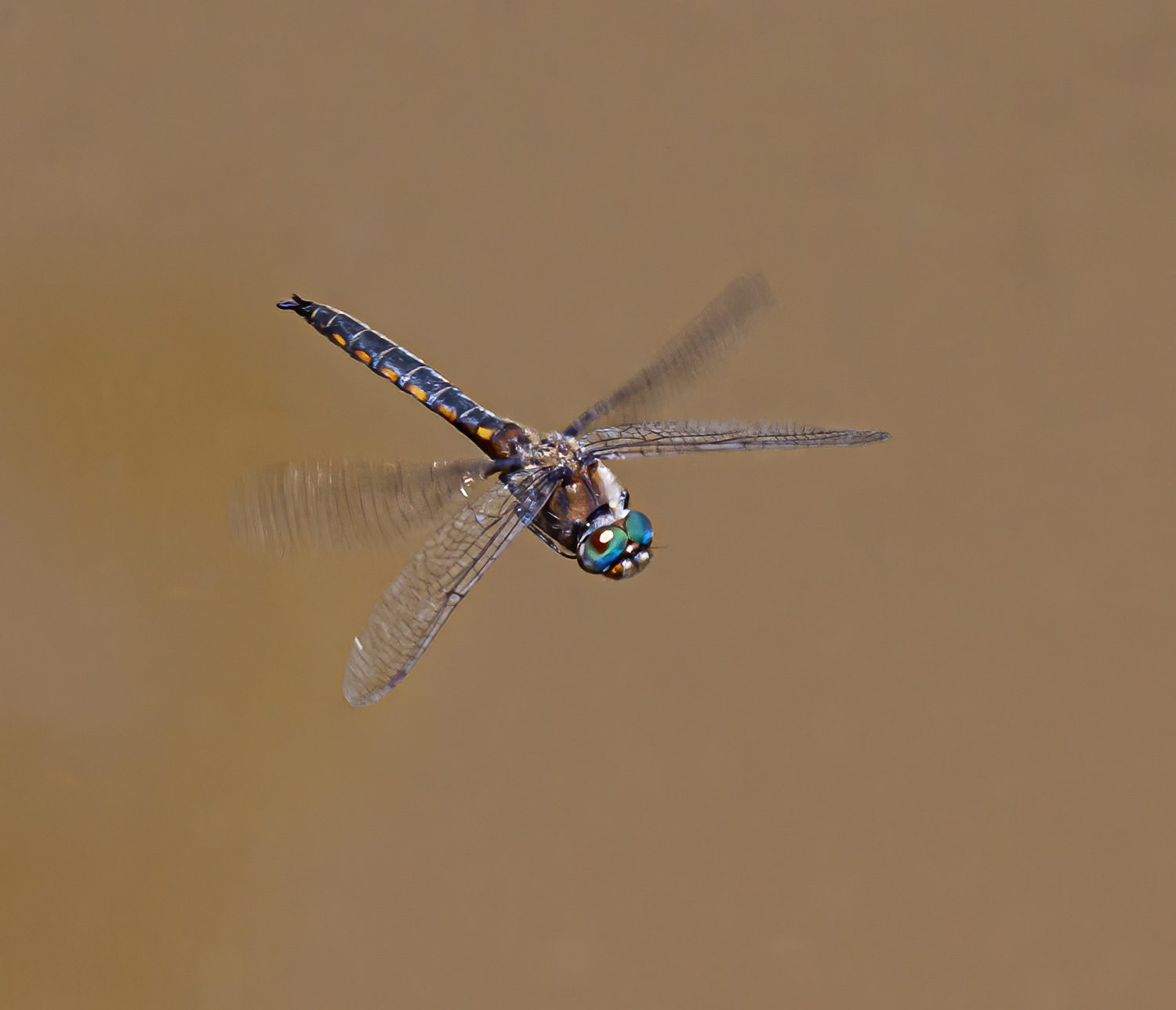
Do you like to challenge yourself? I like to try to photograph moving subjects. It is not easy, even when it is a large bird like a Great Blue Heron (Ardea herodias), but it is even more difficult when it is a small dragonfly, like this Common Baskettail (Epitheca cynosura) that I photographed last Wednesday at Ococoquan Bay National Wildlife Refuge.
The dragonfly was patrolling over a small pond and at certain moments would hover for a split second before continuing. It took quite a few attempts, but eventually I was able to capture this image, which is cropped from a much larger image that came out of my camera.
Different photographers use different techniques to capture shots of flying dragonflies. I personally use my 180mm macro lens and focus manually, because the autofocus on the lens is notoriously slow and has trouble achieving focus with such a small subject. Every year I try this same challenge, often multiple times, so with a little luck and a lot of patience and persistence, I hope to be able to do more postings of dragonflies in flight in the upcoming months.

© Michael Q. Powell. All rights reserved.
Posted in Dragonflies, dragonfly, Nature, Photography, spring | Tagged Canon 50D, Common Baskettail, Common Baskettail dragonfly, dragonfly in flight, Epitheca cynosura, Occoquan Bay National Wildlife Refuge, Tamron 180mm, Woodbridge VA | 9 Comments »
May 4, 2020 by Mike Powell
Yesterday my friend and photography mentor Cindy Dyer and I were photographing flowers in different parts of her garden when she excitedly called out to me that she had spotted a ladybug inside one of the irises. I rushed over and spotted a tiny Multi-colored Asian Lady Beetle (Harmonia axyridis) feverishly crawling around inside of a beautiful yellow bearded iris.
I had a mental picture of composing an image in which the viewer would looking from the outside into the interior of the flower. That meant that I could not get too close to the ladybug. It also meant that the ladybug had to cooperate by crawling into the right part of the frame. I watched and waited and eventually was able to capture the kind of artsy image that I had imagined.

© Michael Q. Powell. All rights reserved.
Posted in Bugs, Flowers, Insects, Macro Photography, Nature, Photography, spring | Tagged Bearded Iris, Canon 50D, Canon 60mm, Cindy Dyer, Harmonia axyridis, iris, ladybird, ladybug, Multicolored Asian Lady Beetle | 14 Comments »
May 4, 2020 by Mike Powell
I tend to think of pollen as yellow, but it comes in other colors too. This past weekend I captured this shot of a bee covered in bright red pollen from the Purple Deadnettle flowers (Lamium purpureum) on which it was feeding. Earlier this spring I did a posting with a somewhat similar shot, but misidentified the plant as the closely-related Henbit (Lamium amplexicaule).
Purple Deadnettle is in the mint family and seems to be everywhere at this time of year. I was in a fairly remote area when I took this shot, but I have seen large patches of it in gardens, where it is considered to be a weed. According to an article entitled “Foraging for Purple Dead Nettle: an edible backyard weed,” the plant is not only a wild edible green, but a highly nutritious superfood. The leaves are edible, with the purple tops being even a little sweet. It can also be used in combination with other “weeds” like chickweed and dandelion greens to make pesto and can also be added to soups, salads, or blended into smoothies.
But wait, there is more. Purple Dead Nettle also has purported medicinal benefits. It is known in the herbal world as being astringent, diuretic, diaphoretic and purgative. It’s also anti-inflammatory, anti-bacterial, and anti-fungal and can be used to make salve, poultices, and teas.
As an interesting aside, in Great Britain this plant is apparently known as Red Deadnettle. Why is there a difference in names? I do not know why, but it is not all that surprising considering the number of different words the British use for common objects and the different spellings for common words.

© Michael Q. Powell. All rights reserved.
Posted in Bees, Flowers, Gardening, Macro Photography, Nature, Photography, spring | Tagged bee, Canon 50D, Fairfax County Virginia, Lamium purpureum, Purple Deadnettle, red pollen, Tamron 180mm | 21 Comments »
May 3, 2020 by Mike Powell
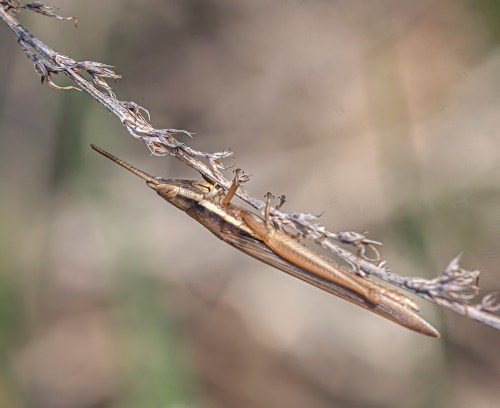
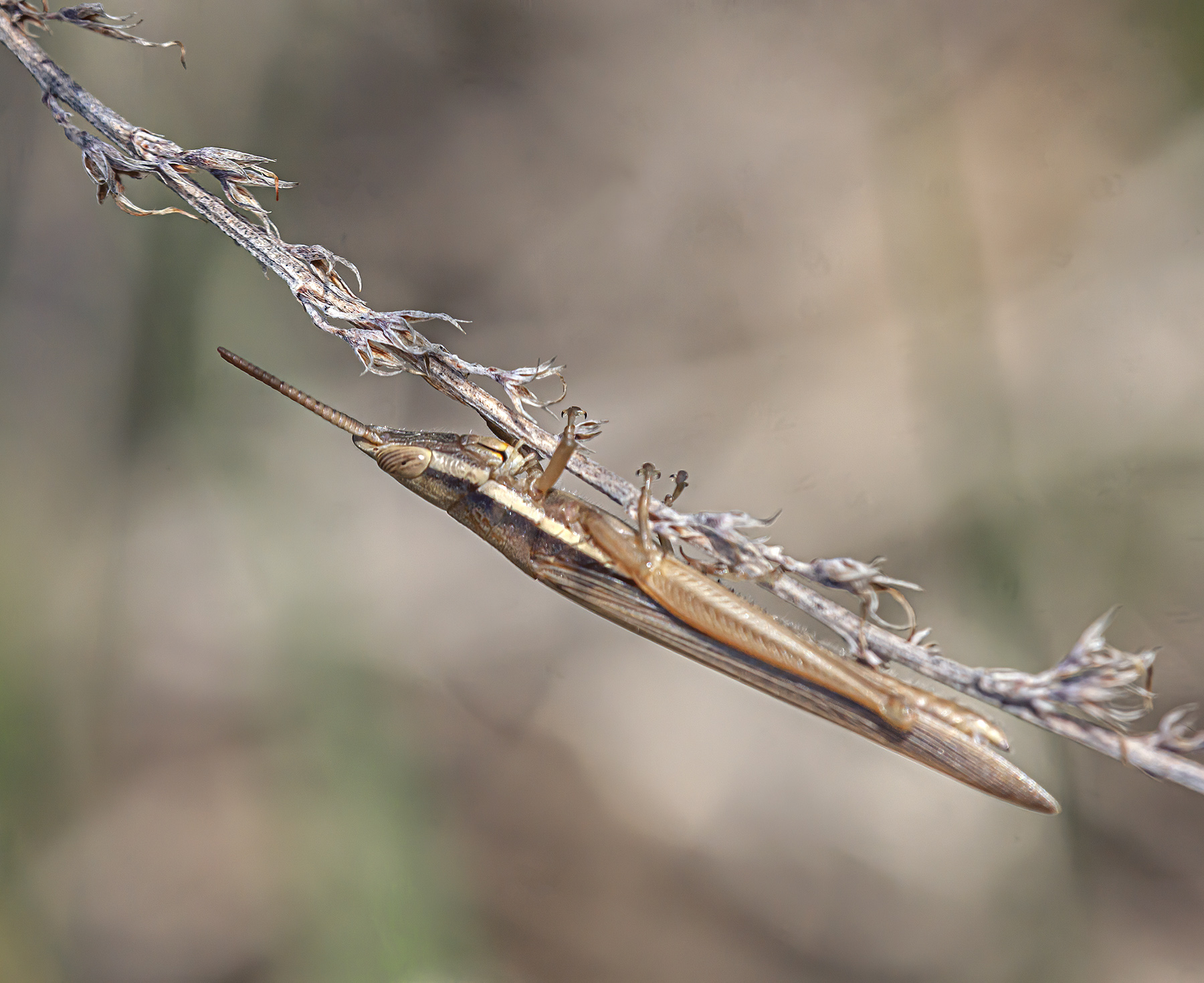
Have you ever stopped to look closely at grasshoppers? They come in all shapes, sizes, and colors. I spotted this elongated one with fluted, unicorn-like antennae this past week at Occoquan Bay National Wildlife Refuge. I knew that I had seen one like this before, but could not recall its name. After some research, I rediscovered that it is the colorfully-named Cattail Toothpick Grasshopper (Leptysma marginicollis).
If you try chasing grasshoppers, you will discover that they often stay in place after the first hop, giving you a chance to examine them for a moment before they hop away.
So whether you are in your backyard or in a park, be sure to check out the grasshoppers. You might be surprised by what you discover.
© Michael Q. Powell. All rights reserved.
Posted in Insects, Macro Photography, Nature, Photography, spring, wildlife | Tagged Canon 50D, Cattail Toothpick Grasshopper, Leptysma marginicollis, Occoquan Bay National Wildlife Refuge, Tamron 180mm, Woodbridge VA | 24 Comments »
May 3, 2020 by Mike Powell
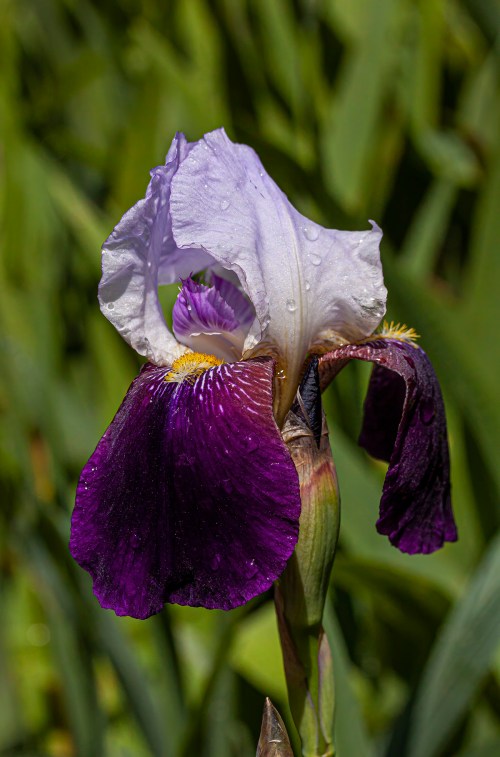
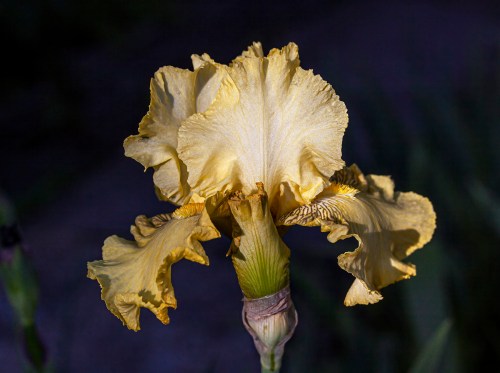
A short while ago I did a posting of iris buds that offered a preview of coming attractions. Today I wanted to give you a quick look at some of the attractions that have already arrived. I like the yellow bearded irises that have started blooming in numbers, but I have to admit that I have really fallen in love with the violet one that is shown in the first photo below. It is the only one of its color that has opened so far, but there are several dozen more that should be appearing in the next week or two. I can hardly wait.

© Michael Q. Powell. All rights reserved.
Posted in Flowers, Gardening, Nature, Photography, spring | Tagged Alexandria VA, Bearded Iris, Canon 50D, Canon 60mm, Cindy Dyer, iris, Runnymeade | 9 Comments »
May 2, 2020 by Mike Powell
One of the earliest dragonflies to emerge in the spring in our area is the Blue Corporal (Ladona deplanata). Adult males are bluish in color and both the male and the female have two white stripes on their thoraxes in an area that you might think of as their shoulders. In the military of the United States, the rank insignia for corporals is two stripes, which accounts for that portion of the common name for the species.
The dragonfly in the first photo is a female Blue Corporal. She will remain that tan color for her entire life. If you look closely at the very tip of her abdomen (the “tail”) and compare it with the same area of the dragonfly in the second image, you can probably see some physiological differences. This is often the best way to tell the gender of a dragonfly.
The dragonfly in the second photo is a newly emerged male Blue Corporal, a stage known as teneral. During this stage, the wings are very clear and shiny and are very fragile. As the male matures, he will gradually turn bluish in color. His corporal stripes may turn light blue and eventually fade away.
You probably noted that the male Blue Corporal is perched flat on the ground—this is the most frequent perching position for this species. I was a little surprised that the female in the first photo was perching vertically a few inches above the ground, but I am not complaining, because it gave me a better chance to get a photo of her wings.
It is still a bit early in the season for dragonflies, so I was really happy to spot these two on Wednesday at Occoquan Bay National Wildlife Refuge. The refuge is still open and there were a number of other cars in the parking lot when I arrived. All of the other visitors, though, seemed to be either birding or walking in other areas of the refuge, leaving me the chance to muck about at the edge of a small pond all by myself, safely distanced from human contact.


© Michael Q. Powell. All rights reserved.
Posted in Dragonflies, dragonfly, Insects, Macro Photography, Nature, Photography, spring | Tagged Blue Corporal, Blue Corporal dragonfly, Canon 50D, Ladona deplanata, Occoquan Bay National Wildlife Refuge, Tamron 180mm, Woodbridge VA | 12 Comments »
May 1, 2020 by Mike Powell
I am not sure what kind of insect this male Eastern Bluebird (Sialia sialis) had caught, but he seemed pretty proud of himself yesterday at Occoquan Bay National Wildlife Refuge. When I first spotted him, the bluebird was perched on the roof of a nesting box. I suspect that there may be a female and possibly babies inside the nesting box and the male was serving as a deliveryman.
As I moved slightly to try to get a better angle, the bluebird flew to a nearby tree, still holding the worm/caterpillar in its mouth. I quickly realized that he did not like me being around , so I took a quick shot of him in the tree and left him in peace to complete his delivery.


© Michael Q. Powell. All rights reserved.
Posted in Birds, Nature, Photography, spring, wildlife | Tagged bluebird, Canon 50D, Eastern Bluebird, Occoquan Bay National Wildlife Refuge, Sialia sialis, Tamron 150-600mm, Woodbridge VA | 12 Comments »
« Newer Posts - Older Posts »

















 Mike Powell