March 21, 2013 by Mike Powell
I have often wondered if birds actually used the nesting boxes scattered throughout my local marshland park and yesterday I got a definitive response when I saw two female Hooded Merganser ducks separately go into one of the boxes.
As I was looking across the beaver pond, one of my favorite spots for taking photos, a Hooded Merganser (Lophodytes cucullatus) couple flew by and landed in the water. They were out of the reach of my lens at that moment, but a fellow photographer alerted me to the fact that the couple had been using a nesting box that was somewhat closer to where I was standing.
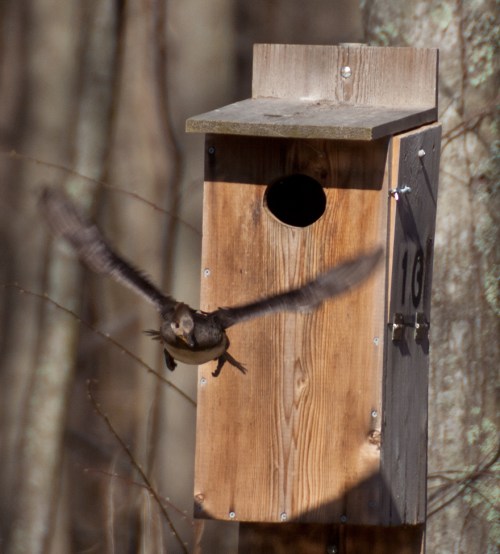
I set up my tripod and trained my 135-400 telephoto lens on the nesting box and waited. Eventually the couple swam behind a cattail patch and came into view near the box. Without warning, the female lifted off and flew straight into the box. It happened so fast that I was not able to get off a shot. A short while later, the male took off.
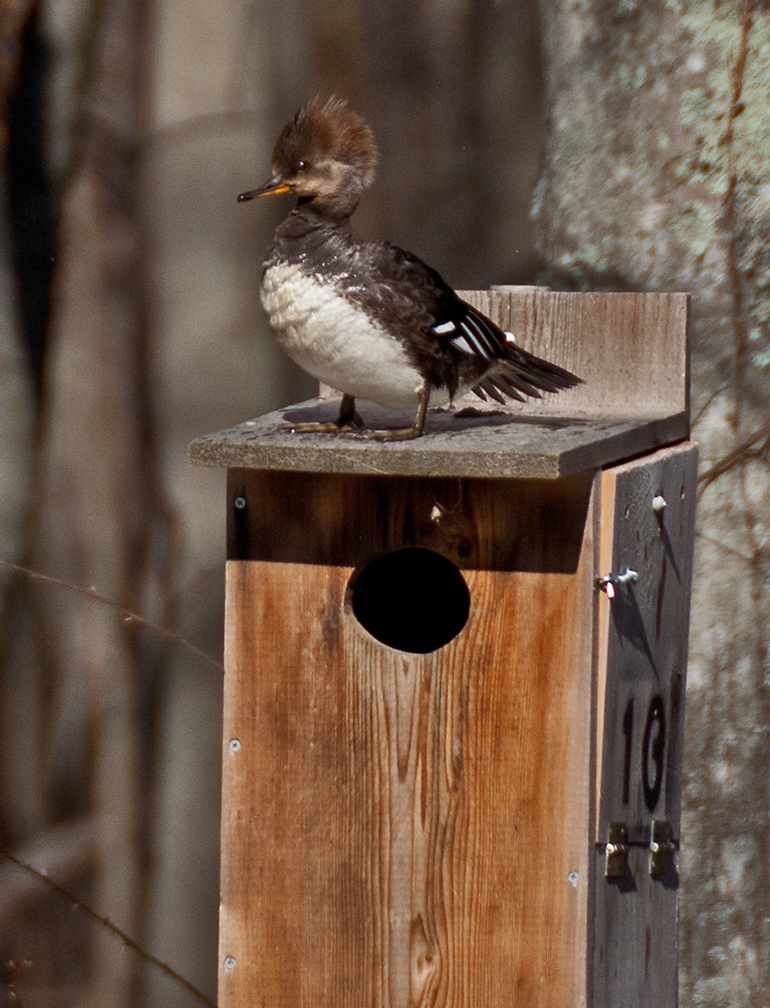
I continued to wait, confident that the female would eventually have to emerge through the hole in the nesting box. As I was watching and waiting, a bird landed on the roof of the nesting box, as you can see in the second photo. I did not immediately realize that it was another female Hooded Merganser, but I had the presence of mind to take some shots.
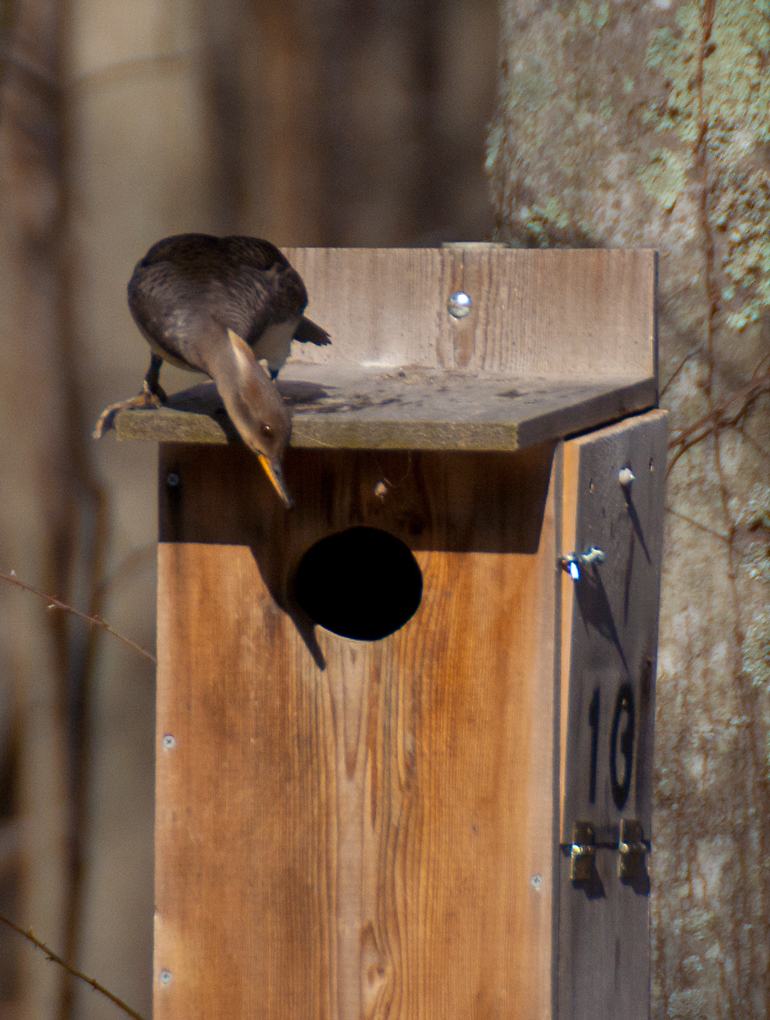
She seemed uncertain about whether or not she should go into the box and tried to peer into it, as you see in the first photo. Satisfying herself that everything was ok, she flew into the box, which by now was getting a little crowded. My photos of the entry were completely blurry.
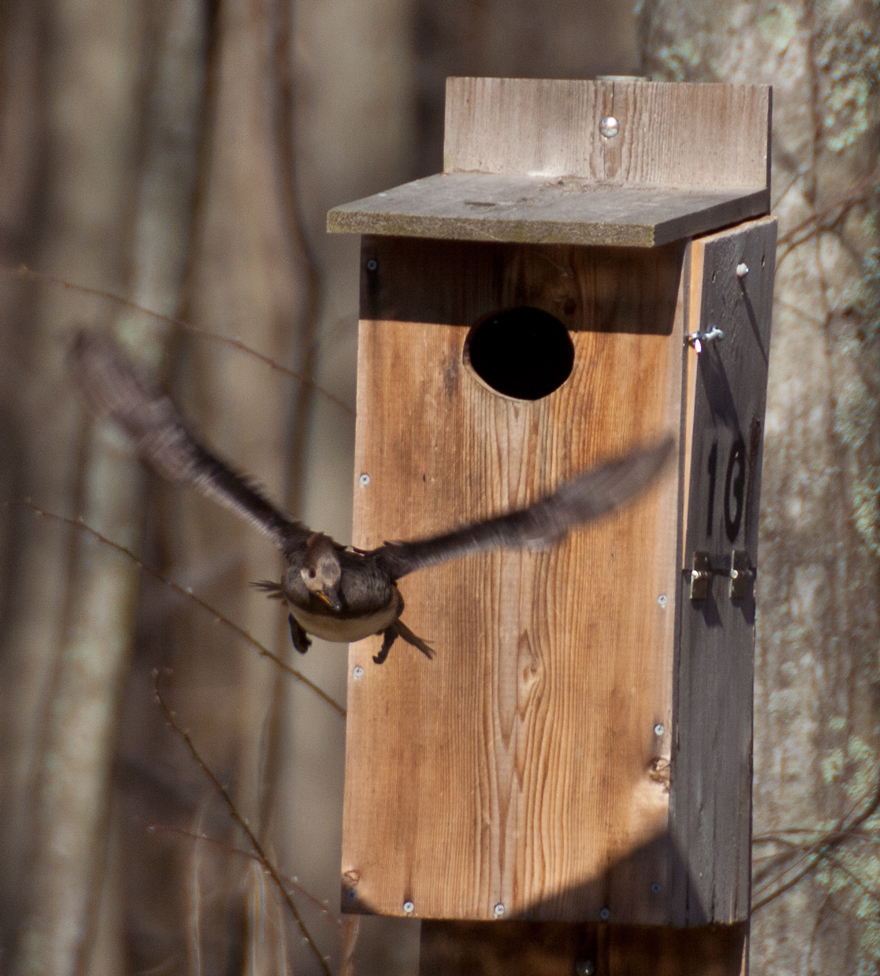
I waited some more and eventually one of the females flew out and I managed to get the third shot. I was hoping that she would linger with her head sticking out of the box before she started flying, but that didn’t happen. I waited for about 45 minutes longer for the second female to exit the box and finally my patience gave out.
The incubation period for the eggs that the female presumably is laying in the box is about a month, so I will keep returning to this location, and with a little luck will be able to see some ducklings.


Michael Q. Powell. All rights reserved
Posted in Birds, Nature, Photography, Winter | Tagged Canon Rebel XT, ducks, Hooded Merganser, Hooded Merganser ducks, Huntley Meadows Park, Lophodytes cucullatus, nesting box, Sigma 135-400mm telephoto zoom lens | 5 Comments »
March 20, 2013 by Mike Powell
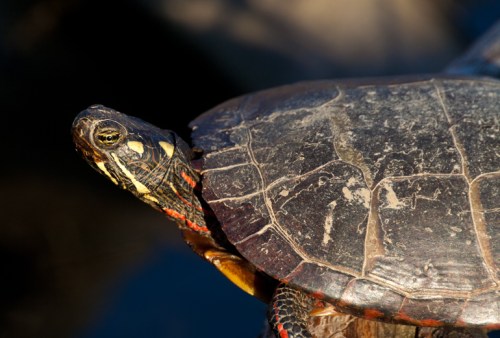
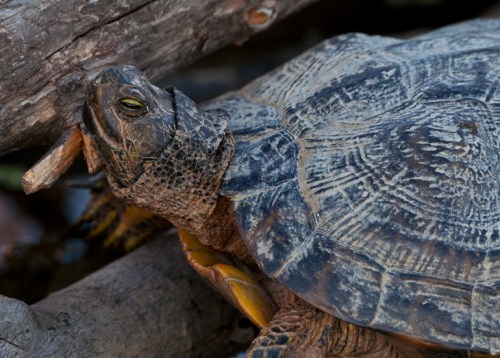
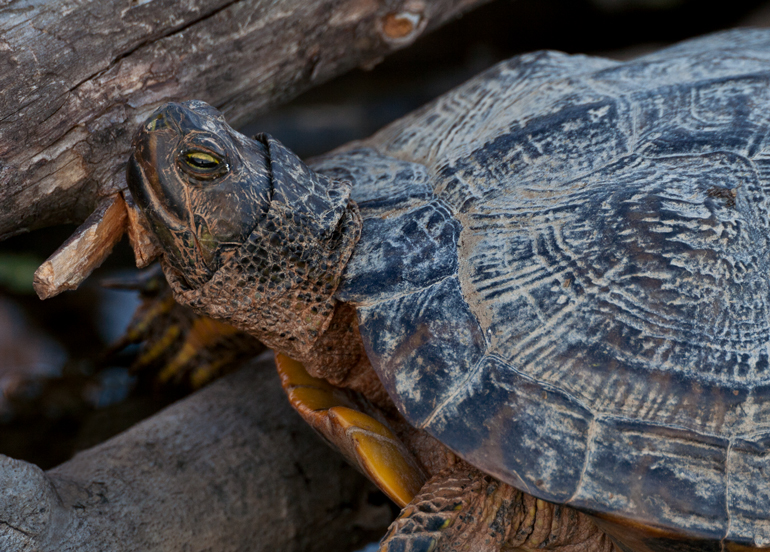
Yesterday I decided to take some close-up shots of some of the turtles sunning themselves at my local marsh.
I am pretty sure that the first one is a painted turtle, but I am not sure if the turtle in the second photo is a different species. I was intrigued by the contrast between the clean, bright colors of the first turtle and the muddy, muted colors of the second one. The turtles were pretty cooperative and let me get close enough to fill the frame of my camera.
It’s not quite warm enough for humans to be sunbathing, but now that spring is officially here, it won’t be long.
Michael Q. Powell. All rights reserved
Posted in Nature, Photography, Portraits, Reptiles, wildlife | Tagged Canon Rebel XT, close-up, Huntley Meadows Park, Sigma 135-400mm telephoto zoom lens, turtle | 11 Comments »
March 20, 2013 by Mike Powell
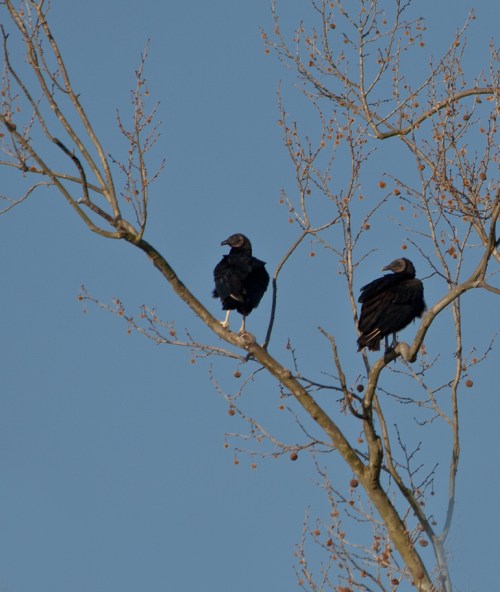
I was really struck by the unusual poses of these Black Vultures (Coragyps atratus) that I encountered while walking along the canal path in Augusta, GA. The only other time that I saw Black Vultures in a tree, they were roosting and looked large and menacing.
These two vultures look like they have adopted a hawk’s approach to hunting by perching on a tree and waiting, rather than by circling endlessly in the skies as other vultures do.
© Michael Q. Powell. All rights reserved
Posted in Birds, Nature, Photography, wildlife | Tagged Augusta Canal, Augusta GA, Black Vulture, Canon 55-250mm zoom lens, Canon Rebel XT, Coragyps atratus | 4 Comments »
March 19, 2013 by Mike Powell
Walking along the Augusta Canal for a final time yesterday morning before returning home, I encountered this spider, hanging in the air from a concrete supports of an overpass, and took shots of him without a flash and with one. After being starved for insects over the winter (photographically speaking), I was thrilled to have a chance to photograph one.
I probably should have taken out my macro lens, which I had with me in my bag, but opted instead to shoot with the 55-250mm zoom lens that was on my camera. It was still relatively early in the morning and the the spider was mostly in the shade, so lights was an issue. I upped the ISO to 800, but still needed an exposure of 1/8 of a second at f/9. Fortunately I had my tripod with me, so I used that to get a relatively sharp shot. I shot with the zoom at 250mm and used manual focus.
The first image was with natural light and the second one was taken using the camera’s built-in flash. The light coming from behind the spider in the first shot helps to illuminate the spider’s legs, which look almost translucent. The flash in the second photo reveals some additional details of the spider, although it did add some reflections, because I did not have a diffuser for the flash.
Which one do you prefer?


© Michael Q. Powell. All rights reserved
Posted in Bugs, Insects, Macro Photography, Travel | Tagged Augusta Canal, Augusta GA, Canon 55-250mm zoom lens, Canon Rebel XT, flash, spider | 10 Comments »
March 18, 2013 by Mike Powell
As I was walking on a low boardwalk yesterday at the Phinizy Swamp Nature Park in Augusta, GA, I spotted this Six-spotted Fishing spider (Dolomedes triton) at the edge of the water on a leaf. These spiders wait for prey with several of their legs in the water and capture other invertebrates, tadpoles, and sometimes even small fish, according to Wikipedia, when they feel the vibrations in the water.
It will probably be several months before I begin to see insects in Northern Virginia, but my brief trip to Georgia has given me a foretaste of things to come.

© Michael Q. Powell. All rights reserved
Posted in Bugs, Insects, Macro Photography, Nature, Photography, wildlife | Tagged Dolomedes triton, fishing spider, Six-spotted Fishing Spider, spider | 4 Comments »
March 17, 2013 by Mike Powell
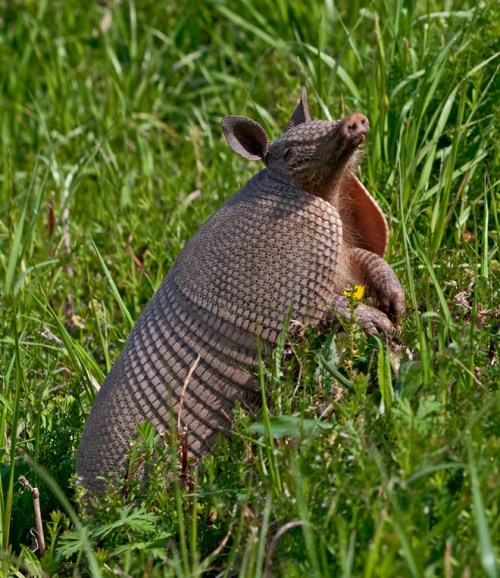
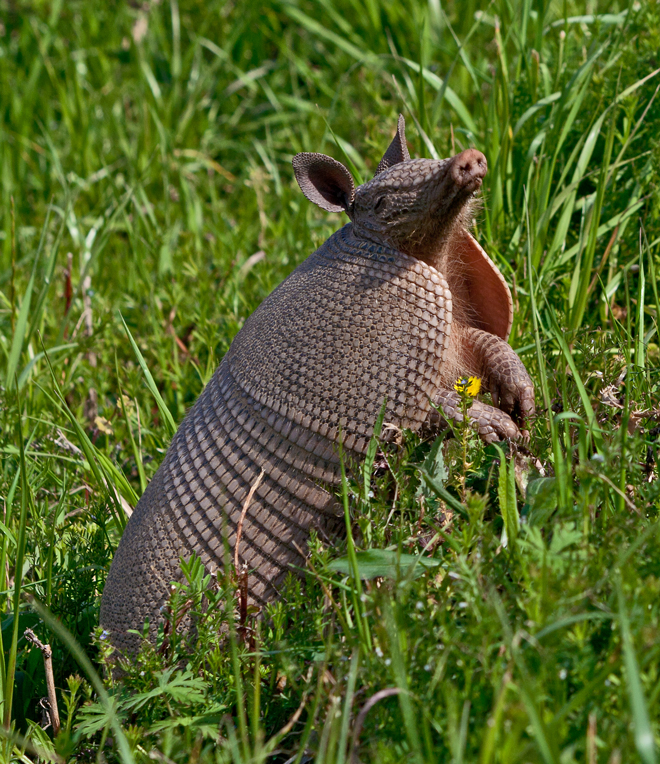
Today I visited the Phinizy Swamp Nature Park in Augusta, GA, hoping that I might see an alligator. Although I did not spot an alligator, I did encounter this Nine-banded Armadillo (Dasypus novemcinctus) in the Park. (You can actually count the nine bands).
Initially the armadillo was rooting about in the grass and he startled me a bit when he stood up. I was close to ground level and was looking through my telephoto lens, which made the movement seem a little threatening.
I was surprised to see an armadillo in Georgia—I tend to associate them with places like Texas and Oklahoma—but apparently their range is expanding. Information on the internet suggests that armadillos are mostly nocturnal and come out around dusk. I have no idea why this one chose to be out in the middle of the day.
I may post some other photos of the armadillo, but I thought that this pose was unusual enough to justify posting an image immediately.
© Michael Q. Powell. All rights reserved
Posted in animals, Nature, Photography, Travel, wildlife | Tagged armadillo, Augusta GA, Canon 55-250mm zoom lens, Canon Rebel XT, Dasypus novemcinctus, Nine-banded Armadillo, Phinizy Swamp Nature Park | 23 Comments »
March 17, 2013 by Mike Powell
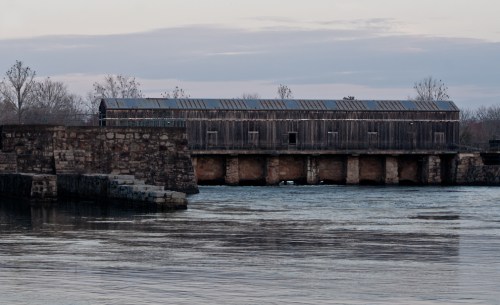
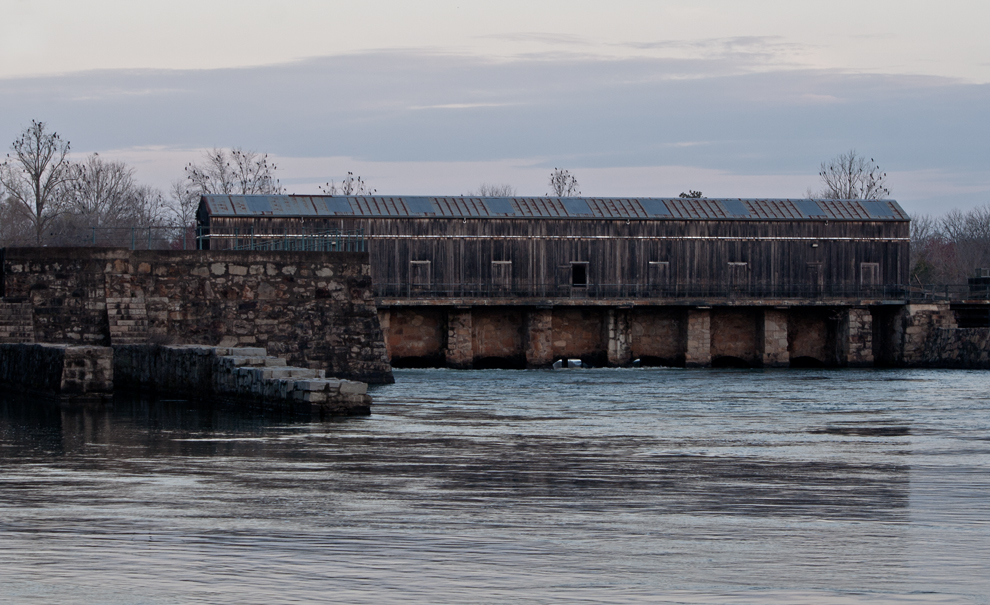
Savannah Rapids is the starting point of the Augusta Canal, which was built in 1845 as a source of power, water and transportation for Augusta, Georgia. The Canal was designated a National Heritage Area by Congress in 1996 and now serves primarily as a recreational area. (Click on this link for more details on the history of the canal, which served an important role for the Confederacy during the Civil War.)
On a beautiful morning, I walked along the raised tow path for several miles, with the canal on one side and the Savannah River on the other. The trees were starting to bud and even to flower and even to flower on a day that got up to 75 degrees (24 degrees C). Spanish moss was growing on many of the trees, giving them a look that seemed exotic to me.
Here are a few photos I took of the structures associated with managing the flow of the water in the canal. I love the weathered wood and stone and the interplay of light and shadows and reflections.


© Michael Q. Powell. All rights reserved
Posted in Architecture, Landscape, Photography, Travel | Tagged Augusta Canal, Augusta GA, Canon 55-250mm zoom lens, Canon Rebel XT, locks, Savannah Rapids, Savannah RIver | 3 Comments »
March 16, 2013 by Mike Powell
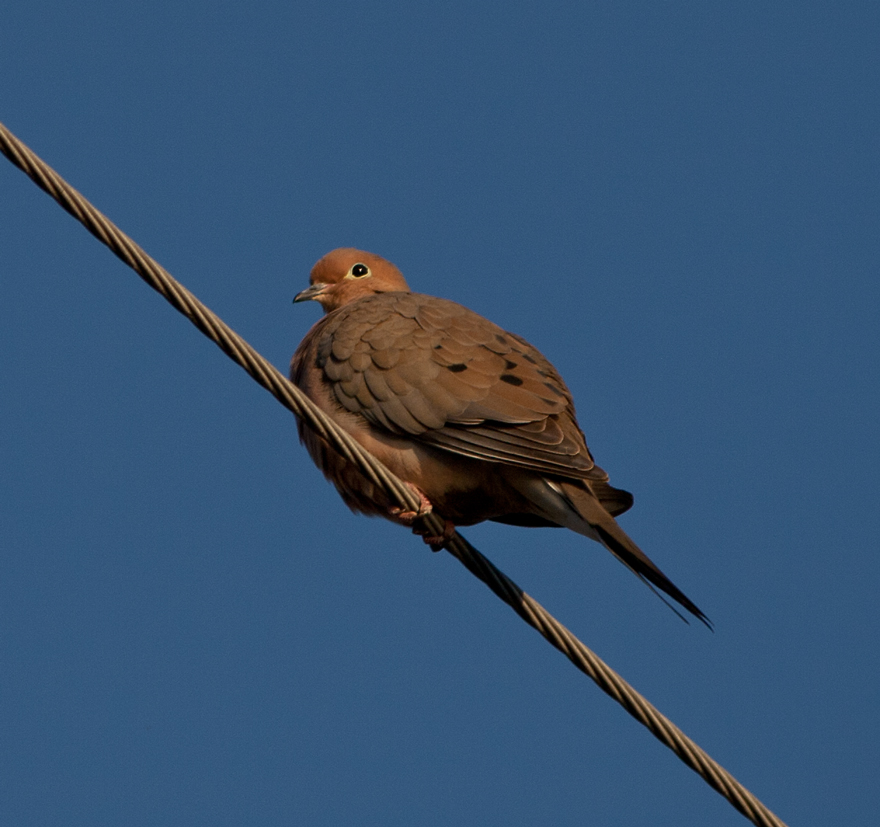
This morning I went out exploring a bit in Augusta, GA, where I am attending a family wedding, and came across this Mourning Dove (Zenaida macroura). The morning rays helped to highlight the beautiful details of its feathers, so I can live with the fact that the wire on which the dove is perched is not exactly a natural setting.
 © Michael Q. Powell. All rights reserved
Posted in Birds, Nature, Photography | Tagged Augusta GA, Canon 55-250mm zoom lens, canon rebel, dove, mourning dove, Zenaida macroura | 3 Comments »
March 16, 2013 by Mike Powell
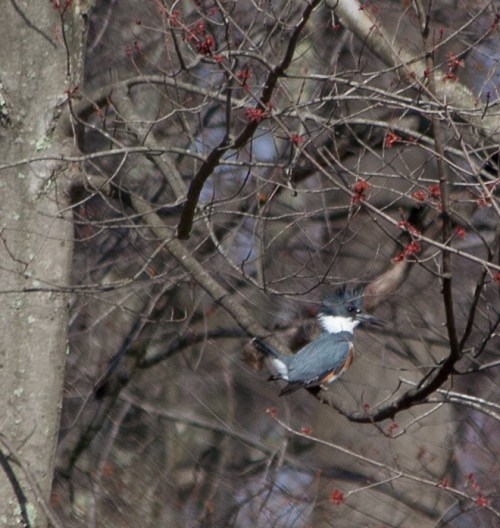
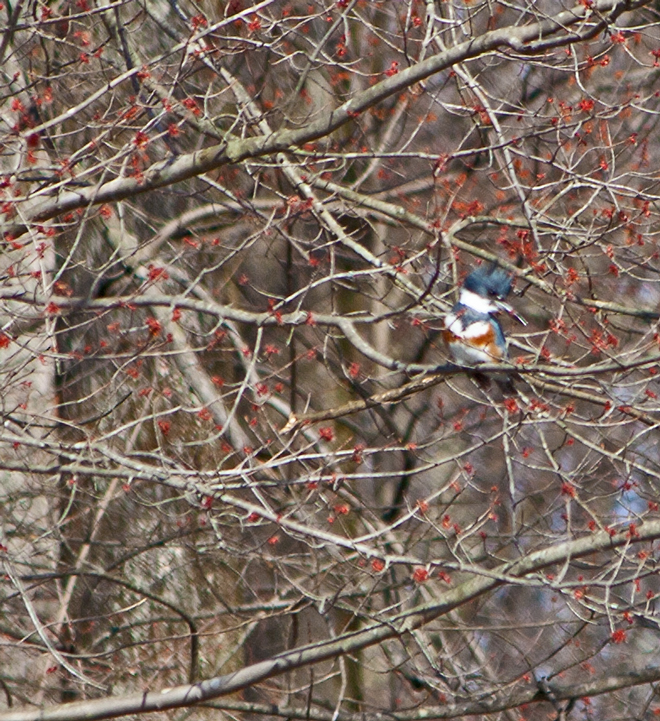
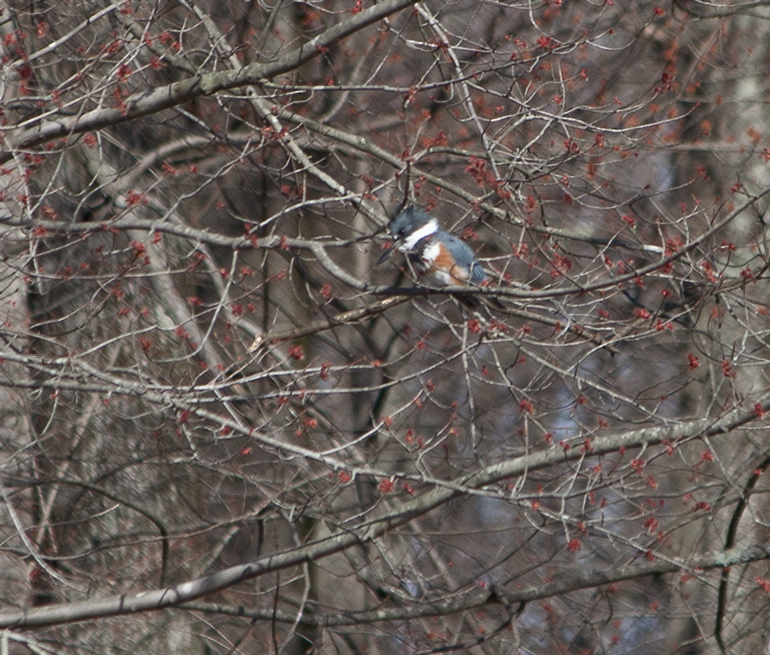
As I was standing next to the beaver lodge at my local marsh, I heard the unmistakable call of a Belted Kingfisher (Megaceryle alcyon), a sound I had never heard before at that location. After you have heard its sound, described by the Cornell Lab of Ornithology as a “strident, mechanical rattle,” you can’t help but remember it.
I was a bit surprised to see a kingfisher at that location, because kingfishers usually prefer clear waters, so they can see their prey. The water in the beaver pond is somewhat muddy, but perhaps it is teeming with new life.
I watched for a while as the female Belted Kingfisher (females have orange chest stripe and males don’t) changed positions several times in the tree, perhaps hoping to get a better view of the water. Eventually she dove into the water, but I was unable to tell if she was successful in catching something before she flew away.
The kingfisher was across the pond from me, so the photos are not perfectly sharp, but they do show some of the different positions of this fascinating bird as she gazed intently at the water.


© Michael Q. Powell. All rights reserved
Posted in Birds, Nature, Photography, wildlife | Tagged Belted Kingfisher, Canon 55-250mm zoom lens, Canon Rebel XT, Huntley Meadows Park, kingfisher, Megaceryle alcyon | 2 Comments »
March 15, 2013 by Mike Powell
Most of the turtles that I have seen on recent sunny days have climbed out of the water entirely to bask in the sun, but this Eastern Painted Turtle (Chrysemys picta picta) seems to have taken a more tentative approach.
Although he seems poised for a quick reentry into the water, he seemed undisturbed when I approached him to take this photo. The angle of the photo provides a view of the turtle’s torso that I rarely see, and as you can probably tell, I got down pretty low to get the shot.
I was surprised by the amount of red on his body and the length of his claws. When I saw the claws, I decided not to go for an extreme close-up shot. I can only imagine the newspaper headline, “Wildlife photographer mauled by killer turtle.”

© Michael Q. Powell. All rights reserved
Posted in Nature, Photography, Portraits, Reptiles | Tagged Canon 55-250mm zoom lens, Canon Rebel XT, Chrysemys picta picta, Eastern Painted Turtle, Huntley Meadows Park, painted turtle, turtle | 4 Comments »
March 14, 2013 by Mike Powell
I remember my parents telling me when I was young that robins are a sign of the imminent arrival of spring and that association remains strong in my mind to this day.
I am now seeing increasingly large numbers of robins and other birds. Flowers are starting to pop up all over, crocuses, daffodils, and others. The air is alive with a sense of joyous expectation, of new growth.
Whenever I see a robin, I instinctively pause and look around for more signs of spring. Life gets so busy that it is useful for me to have reminders that push me outside of the cares of my daily life and cause me to take a closer look at the beauty of nature.

© Michael Q. Powell. All rights reserved
Posted in Birds, Nature, Photography, Portraits | Tagged American robin, Canon 55-250mm zoom lens, Canon Rebel XT, green s, robin, Turdus migratorius | 7 Comments »
March 14, 2013 by Mike Powell
Have you ever watched a frog as he was croaking?
Apparently he closes his mouth and nostrils, squeezes his lungs, and his vocal sacs expand, looking a lot like a bubblegum bubble.
Southern Leopard Frogs (Lithobates sphenocephalus) have a vocal sac on either side of their head, although some other frogs have only a single sac under their chin,
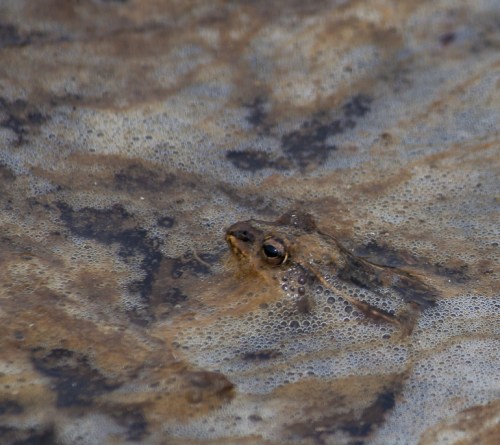
Here’s a shot I took on Monday of one as he was croaking. You can see the vocal sac bubble pretty wellif you look closely at the side of the head nearest the camera.

I am including this additional frog photo, because I really like the way that the bubbles surround his head.
© Michael Q. Powell. All rights reserved
Posted in Amphibians, Nature, Photography, wildlife | Tagged Canon 55-250mm zoom lens, Canon Rebel XT, croaking, frog, Huntley Meadows Park, leopard frog, Lithobates sphenocephalus, Southern Leopard frog | 2 Comments »
March 13, 2013 by Mike Powell
Can cardinals smile?
This past weekend, I was observing a male Northern Cardinal (Cardinalis cardinalis) in the underbrush. He was busily pecking away, probably searching for something to eat.
All of the sudden he stopped what he was doing. Cocking his head to the side a little, he turned in my direction and smiled, or at least it seemed that way to me. The glint in his eye enhanced the effect, as though he was amused by my antics.
Smiling cardinals? I choose to believe in them.

© Michael Q. Powell. All rights reserved
Posted in Birds, Humor, Nature, Photography | Tagged Canon 55-250mm zoom lens, Canon Rebel XT, cardinal, Cardinalis cardinalis, Huntley Meadows Park, Northern cardinal | 4 Comments »
March 12, 2013 by Mike Powell
Yesterday I was out again in the marsh, hoping to photograph frogs as they were croaking. Of course, the first problem was finding them. I could hear them throughout the marsh, but many of them were hidden from view in the cattails or far out in the water.
Eventually I was able to locate a few frogs that were within the range of my camera and I am still going through those images. What I was looking to capture was the vocal sacs that expand like little bubbles when they make the croaking sound. I am still not sure if I captured that phenomenon well enough, but plan to post some images later.
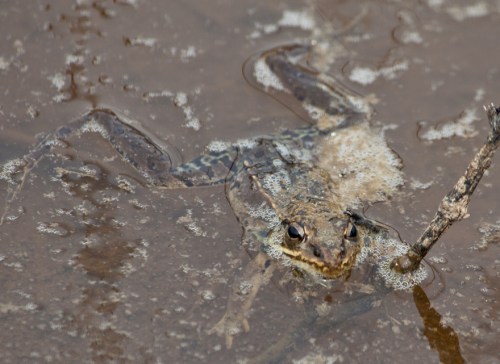
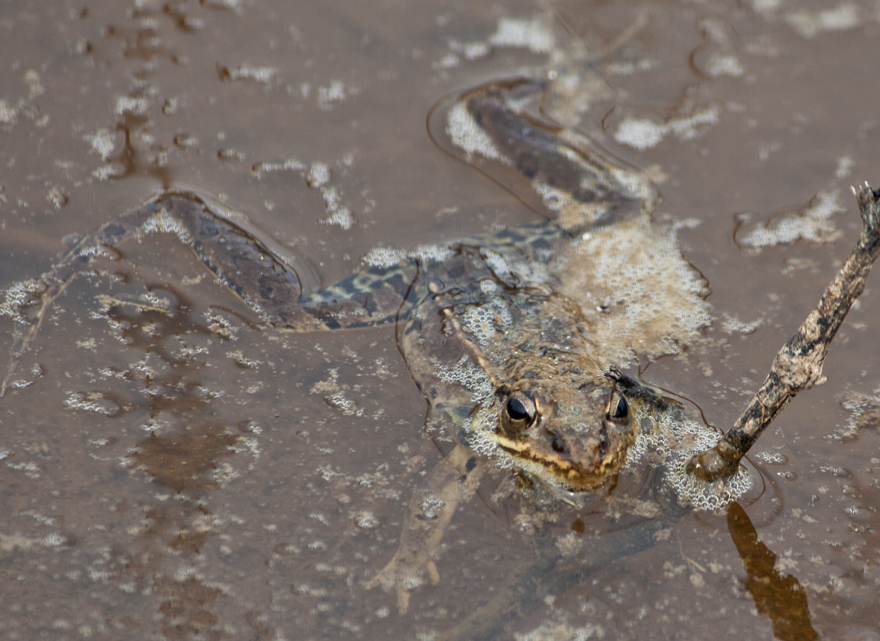
One of the frogs that I spotted, a Southern Leopard Frog (Lithobates sphenocephalus), was apparently unaware of my presence and began swimming slowly in my direction. He seemed to be trying to keep his head above the water and doing a version of what I used to call the “dog paddle”—I may start calling it the “frog paddle” from now on.
This photo shows the swimming frog in mid-stroke, surrounded by lots of bubbles. I am not sure if he is responsible for the bubbles, but they add a nice touch to the photo.
I’m pretty sure that I will be off again soon in search of frogs, snakes, and turtles as me move into spring. Stay tuned, there’s more to come.
© Michael Q. Powell. All rights reserved
Posted in Amphibians, Nature, Photography, wildlife | Tagged Canon 55-250mm zoom lens, Canon Rebel XT, frog, Huntley Meadows Park, l, leopard frog, Lithobates sphenocephalus, Southern Leopard frog, swimming frog | 2 Comments »
March 12, 2013 by Mike Powell
It’s a little ironic that I took these photos of a Ring-necked Duck (Aythya collaris), some of my best duck photos, in a man-made pond in my neighborhood, rather than in a more natural setting. I have never seen any Ring-necked Ducks at my marshland park—perhaps the water is not deep enough for these diving ducks—but found them in a very suburban setting.
The light was bright on the day when I watched some of these ducks diving and resurfacing every couple of minutes. The glare was pretty intense on some of my initial photos and I didn’t like the way they turned out.
However, there is a walking trail all of the way around the pond, so I went off in search of a better lighting situation. When I reached an area of open shade, I encountered this duck near the shore. Unlike his fellow ducks, he seemed to be relaxing and was remarkably cooperative in letting me take his portrait.
If you are like most people, you may wonder why this duck is not called a ring-billed duck, because there doesn’t seem to be any ring around his neck. According to the Cornell Lab of Ornithology, the bird’s name refers to the hard-to-see chestnut collar on its black neck, which apparently jumped out to the nineteenth century biologists that described the species using dead specimens.


© Michael Q. Powell. All rights reserved
Posted in Birds, Nature, Photography, Portraits, wildlife | Tagged Aythya collaris, Canon 55-250mm zoom lens, Canon Rebel XT, duck, Kingstowne, Ring-necked duck | 5 Comments »
March 11, 2013 by Mike Powell
Do you ever take shots that you really like, despite technical flaws, because one aspect of the photo came out really cool?
That was the case with this photo of a robin from this past weekend. It was in the middle of the day and the light was pretty harsh, coming in through the leaves almost directly in front of me. As you can see from the robin’s shoulders, the light bleached out most of the color. However, the light also illuminated the robin’s bill, actually shining through it in a really cool way. I also like the way the background turned out.
I am always willing to look for subjects in all directions, and not just for ones in optimal light. You never know when the light will reward you in unexpected ways.

© Michael Q. Powell. All rights reserved
Posted in Birds, Nature, Photography, wildlife | Tagged American robin, Canon 55-250mm zoom lens, Canon Rebel XT, Huntley Meadows Park, robin | 3 Comments »
March 11, 2013 by Mike Powell
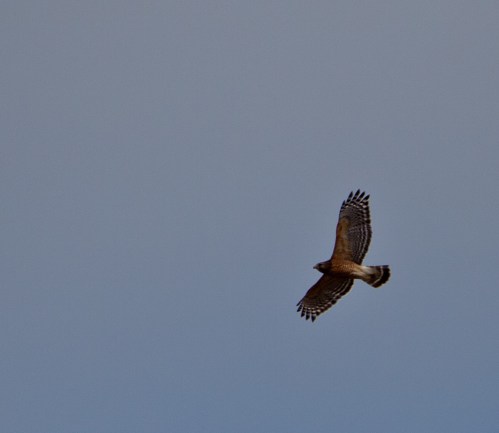
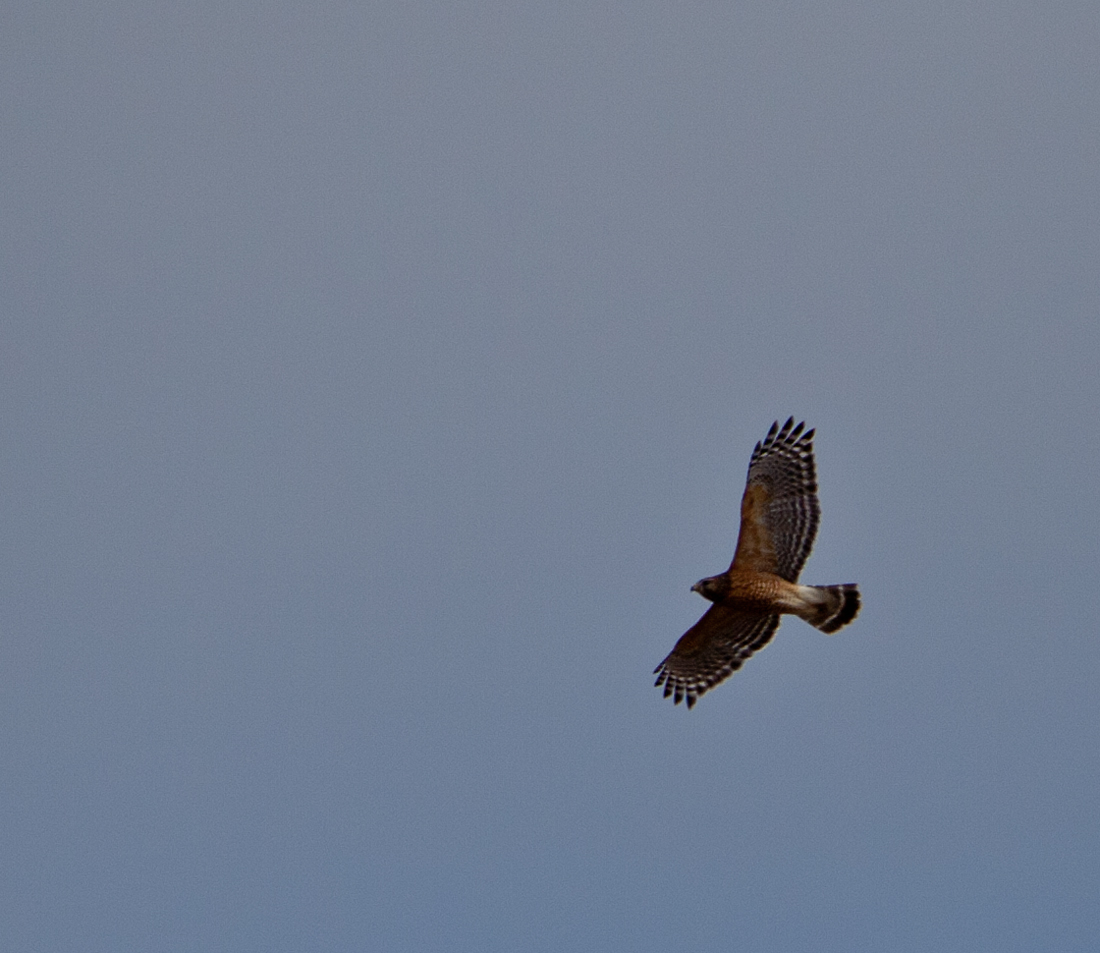
I’m starting to see hawks—primarily Red-shouldered Hawks (Buteo lineatus) with some regularity, but really good shots of these powerful birds have proven to be elusive so far.
I am happy that I am beginning to capture images of the hawks while they are flying, but virtually all of the time they are flying away from me and not toward me, so the hawks do not fill up much of the frame.
Perhaps when the weather is warmer, there will be more prey for the hawks, thereby giving me more chances to get good shots. At a minimum, I’ll have more hours of daylight in which to make my attempts.

© Michael Q. Powell. All rights reserved
Posted in Birds, Nature, Photography, wildlife | Tagged birds in flight, Buteo lineatus, Canon 55-250mm zoom lens, Canon Rebel XT, hawk, Huntley Meadows Park, Red-Shouldered Hawk | 4 Comments »
March 10, 2013 by Mike Powell
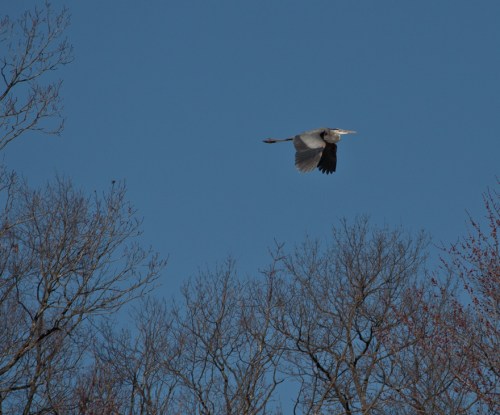
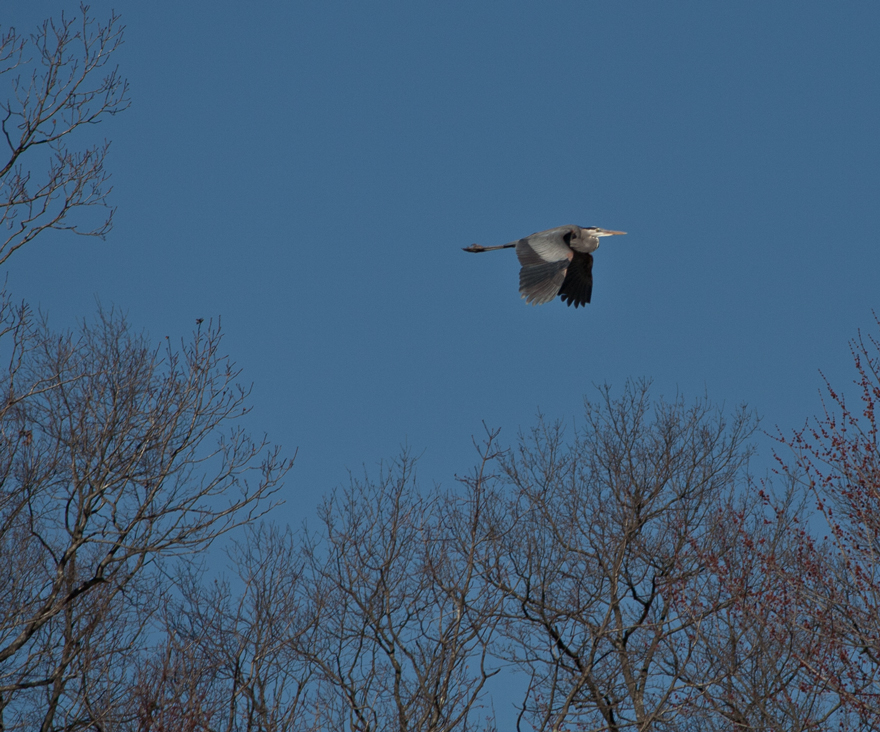
I was staring intently at some ducks in a secluded area of the marsh, when suddenly my eyes caught sight of movement in one of the trees overlooking the pond. The next think I knew a Great Blue Heron (Ardea herodias), who had apparently been perched on the tree, was flying through the air.
This is the best of the shots that I was able to take. Most of the times that I have attempted a similar shot in the past, the white in the face has been totally blown out. I still need to work on getting a better exposure, but feel like I am making progress. Now if I can just find a cooperative heron.
© Michael Q. Powell. All rights reserved
Posted in Birds, Nature, Photography, wildlife | Tagged Ardea herodias, birds in flight, Canon 55-250mm zoom lens, Canon Rebel XT, Great Blue Heron, heron, Huntley Meadows Park | 6 Comments »
March 10, 2013 by Mike Powell
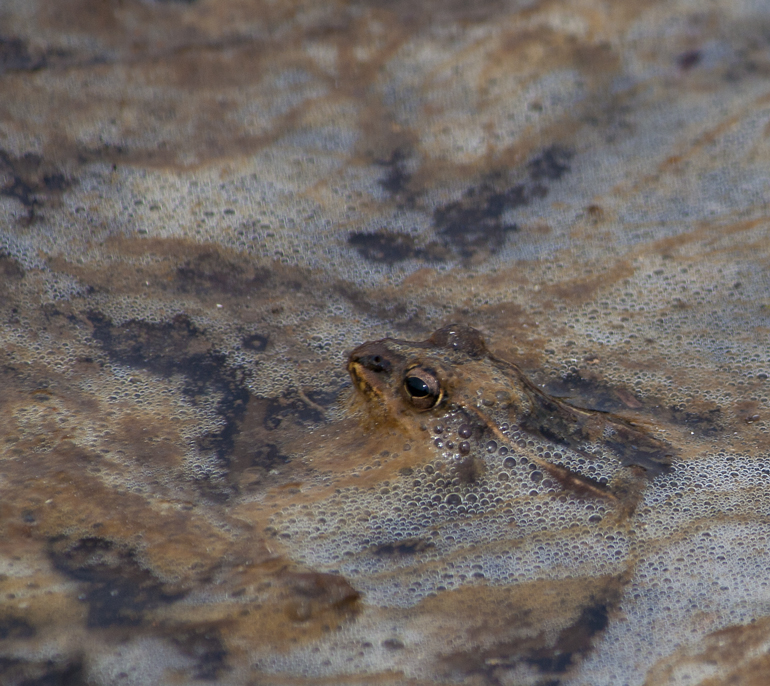
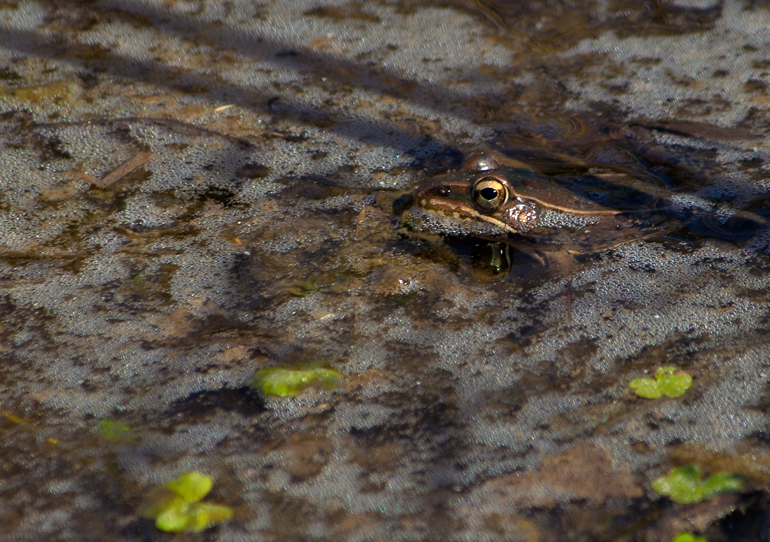
Yesterday, the marsh was alive with the sound of music, frog music. Entire areas of the marshland seemed to resound with waves of sounds, some it high-pitched and some of it lower in range. The warm weather, in the low 60’s (16 degrees C), seemed to have roused the frogs from their sleep and they were in the mood to sing.
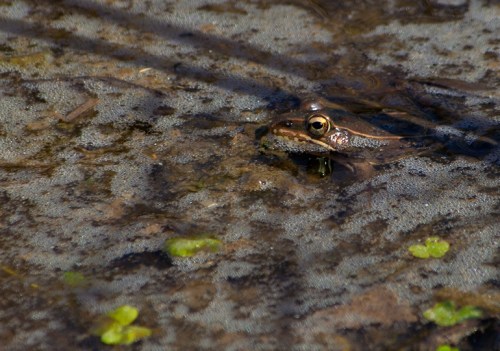
Although I could identify the general areas of the frog activity, it proved to be very difficult to spot the frogs themselves. My eyes scanned and rescanned the shallow waters near the cattails until at last I spotted a frog.
I think this frog is a Southern Leopard Frog (Lithobates sphenocephalus), but I am not entirely sure of my identification. You can see from the photo how effectively he is camouflaged.
Frogs and turtles are starting to be active, can the dragonflies be far behind?
© Michael Q. Powell. All rights reserved
Posted in Amphibians, Nature, Photography, wildlife | Tagged Canon 55-250mm zoom lens, Canon Rebel XT, frog, Huntley Meadows Park, Lithobates sphenocephalus, Southern Leopard frog | 7 Comments »
March 9, 2013 by Mike Powell
After endless gray winter days, the beauty of a sunny day seemed magnified and the vivid colors of this mallard duck looked even brighter. I love the shade of blue of the feathers that show through when the ducks are in flight, especially when they are taking off and landing.

© Michael Q. Powell. All rights reserved
Posted in Birds, Nature, Photography, wildlife | Tagged birds in flight, Canon 55-250mm zoom lens, Canon Rebel XT, duck, Huntley Meadows Park, mallard | 9 Comments »
March 9, 2013 by Mike Powell
At the edge of a cattail patch, this male Downy Woodpecker (Picoides pubescens) was pecking away at the branches of a small tree, moving upward until he had reached the tip of the branch. For a short moment, he took a break from his work and turned his head to the side, which let me take a nice profile shot.
Perhaps he was searching for the next plant to peck, maybe the cattail in the distance.

© Michael Q. Powell. All rights reserved
Posted in Birds, Nature, Photography, wildlife | Tagged Canon 55-250mm zoom lens, Canon Rebel XT, cattails, Downy Woodpecker, Huntley Meadows Park, Picoides pubescens | 3 Comments »
March 8, 2013 by Mike Powell
On a cool and windy day, this bright scarlet male Northern Cardinal looks like he chose to wrap himself in an old-fashioned cloak for protection from the elements.
I really was struck today by the sharp distinction between the coloration of the head and the rest of the body of this cardinal.
Do cardinals change colors in the spring?

© Michael Q. Powell. All rights reserved
Posted in Birds, Nature, Photography | Tagged Canon 55-250mm zoom lens, Canon Rebel XT, cardinal, Cardinalis cardinalis, cloak, Huntley Meadows Park, Northern cardinal | 11 Comments »
March 8, 2013 by Mike Powell
Do you aspire to photograph extraordinary subjects in exotic locations or are you content to shoot ordinary subjects in nearby locales?
This past winter (well, it’s almost past), I have really enjoyed photographing birds. At times, I have longed to be able to capture awe-inspiring images of hawks and eagles, of ospreys and owls and have thought about the travel and equipment that might be required to do so. Does that make me an adrenaline junkie, always searching for more, someone who requires increasing amounts of excitement to be content?
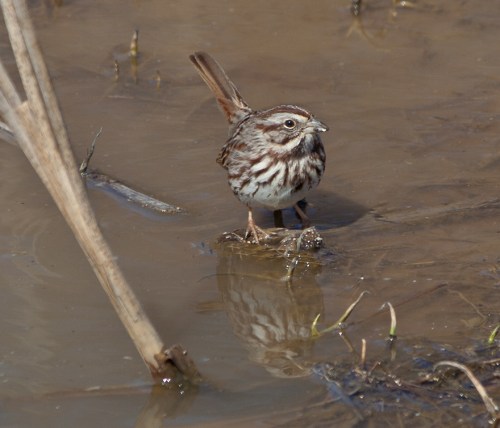
For the moment at least, I know that the answer is “no.” My pulse still quickens when I see a robin or a cardinal. I will take shot after shot of geese and ducks flying and landing. I am willing to kneel in the mud to try to get yet another shot of a sparrow. Here is one such shot of a Song Sparrow (Melospiza melodia) from earlier this week that I really like.
I am content with the ordinary and strive to capture and display its beauty. Cristian Mihai, a wonderful, easy-t0-read blogger, wrote a posting yesterday on beauty, entitled Beauty will save the world that I really recommend. It caused me to think more deeply about my photography, about my goals and motivations. What is is about beauty that prompts a desire to respond, to share it with others?
I started this posting with a false dichotomy, with alternatives that are not mutually exclusive to stimulate thought, the kind of inner examination that I have been conducting. There is no simple answer—sometimes it is sufficient to simply think about the question.
© Michael Q. Powell. All rights reserved
Posted in Birds, commentary, Nature, Photography | Tagged beauty, Canon 55-250mm zoom lens, Canon Rebel XT, Huntley Meadows Park, Melospiza melodia, ordinary, song sparrow | 4 Comments »
March 7, 2013 by Mike Powell
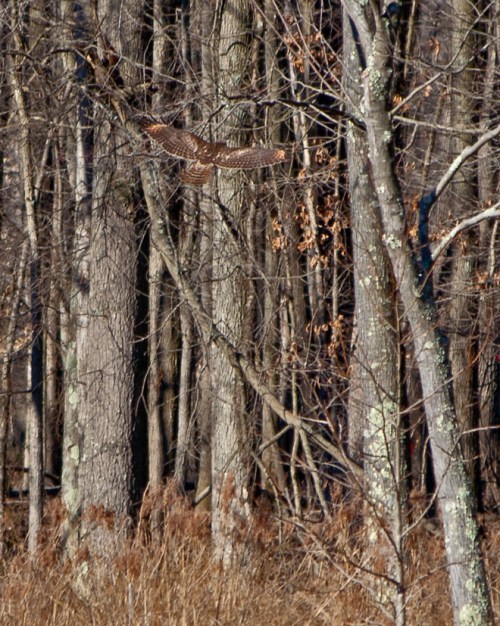
I stood and waited, camera at the ready, as I stared at a hawk in a tree overlooking a field, hoping that he would fly toward me when he spotted a prey.
I waited and waited and finally he took off from the branch. Unfortunately, he flew up in the air and away from me, rather than down and toward me. I tried to track him and snapped off a couple of photos.
I managed to capture him with his wings fully extended as he headed into the woods and was struck by the degree to which he blends in with his surroundings.
I am sure that I will soon find myself in a similar situation, watching and waiting—it’s the fate of those of us who choose to photograph wildlife.
© Michael Q. Powell. All rights reserved
Posted in Birds, Landscape, Nature, Photography | Tagged Canon 55-250mm zoom lens, Canon Rebel XT, hawk, Huntley Meadows Park | 6 Comments »
March 6, 2013 by Mike Powell
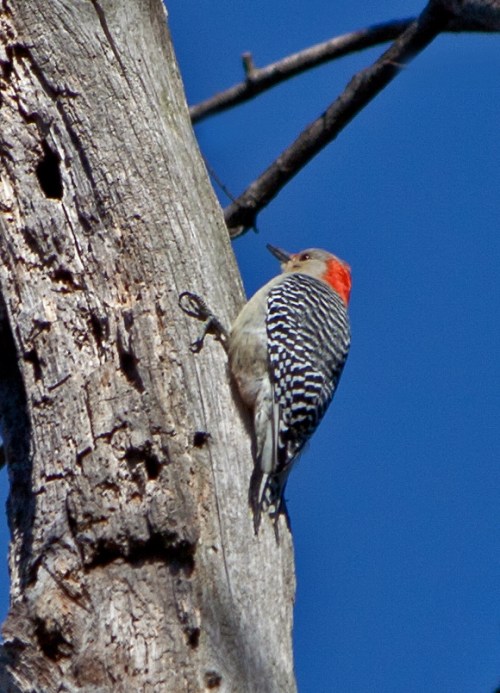
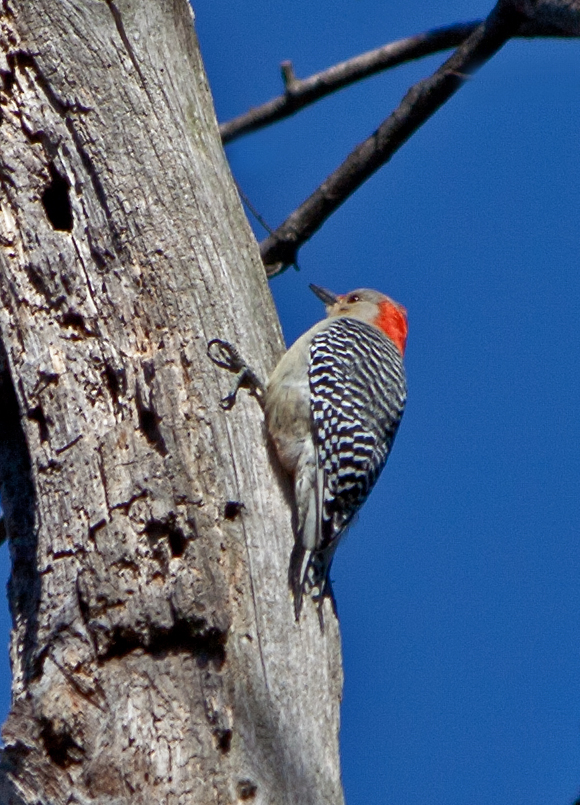
Walking through the woods on Monday, I heard the sound of a woodpecker and was pleasantly surprised to see that it was a Red-bellied Woodpecker (Melanerpes carolinus).
Most of the woodpeckers that I see are Downy Woodpeckers, which are cute in their own way, but I had been longing to see some of the bigger woodpeckers. Although the woodpecker was fairly high in the tree, I was happy that I managed to get some recognizable shots in different poses.


I stopped in the visitor center as I was leaving the park and happened to glance through the window at the bird feeders. The birds at the feeders tend to be fairly small, including nuthatches, chickadees and tufted titmice. Imagine my surprise when a big woodpecker showed up at the suet feeder—it was another Red-Bellied Woodpecker.
Although I was indoors, I decided to take a few shots of the woodpecker. I think I ended up with a pretty cool image, in which the shadow of the wire cage imparted a striped pattern to the bird’s bill. When you first look at the image, you may not even realize that the stripes are added.
Now that I have photographed a medium-sized woodpecker, I will be in search of a Pileated Woodpecker—the superstar of woodpeckers.
 © Michael Q. Powell. All rights reserved
Posted in Birds, Nature, Photography, wildlife | Tagged Canon 55-250mm zoom lens, Canon Rebel XT, Huntley Meadows Park, Melanerpes carolinus, Red-bellied Woodpecker, woodpecker | 16 Comments »
March 6, 2013 by Mike Powell
A flock of robins was really active in my neighborhood this morning, busily pecking the ground as the freezing rain gradually turned into snow. This American Robin (Turdus migratorius) didn’t even have time to clean up before I took his portrait.

Click on the photo to see a higher-resolution view
© Michael Q. Powell. All rights reserved
Posted in Birds, Nature, Photography, Portraits | Tagged American robin, Canon 55-250mm zoom lens, Canon Rebel XT, robin, snow, Turdus migratorius | 2 Comments »
March 6, 2013 by Mike Powell
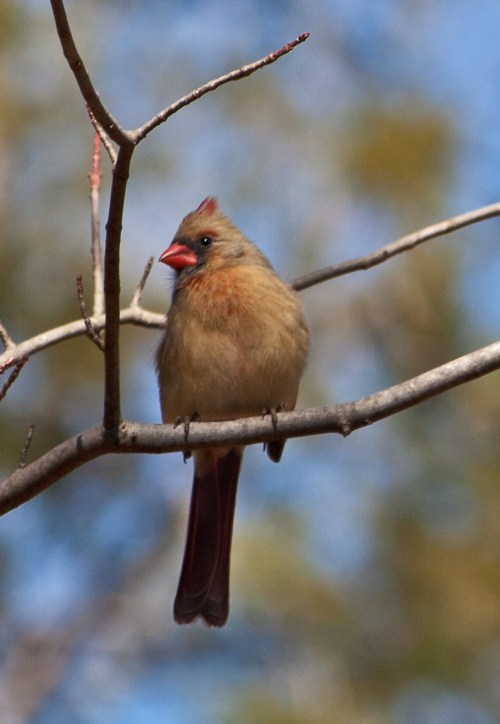
The sky was a spectacular shade of blue on Monday, providing a beautiful backdrop to this shot of a female Northern Cardinal (Cardinalis cardinalis).
I’ve posted quite a number of photos of cardinals, primarily of male cardinals, but one of my fellow bloggers commented that you can never have too many photos of these beautiful birds.
I agree.
© Michael Q. Powell. All rights reserved
Posted in Birds, Nature, Photography | Tagged Canon 55-250mm zoom lens, Canon Rebel XT, cardinal, Cardinalis cardinalis, Huntley Meadows Park, Northern cardinal | 5 Comments »
March 5, 2013 by Mike Powell
This past weekend, I made another trip to the orchid exhibit at Lewis Ginter Botanical Gardens in Richmond, VA, in part to hone my macro-shooting skills that have atrophied during the winter months.
I have grown accustomed to photographing birds and small mammals at the far end of my telephoto range in situations in which I don’t have much time for decision-making. If I am lucky, I am able to quickly check the direction of the light and adjust my camera’s settings, but sometimes there is insufficient time for even those rudimentary checks.
When I am shooting with my macro lens, my camera is usually attached to my tripod and, if I remember to do so, I have time to think about the exposure, the settings, and the angle before the shot. More importantly, I can look at the results and take a second shot. Birds and animals rarely give me a second chance.
Here are shots of a couple of the orchids that at the exhibition. I don’t know the names of the orchids, but one of my Facebook friends told me that the red one is from the Cymbidium genus. As I was working on the images, I noticed that I photographed both of them from almost the same angle. Perhaps I liked that angle, but most likely I was desperately trying to get an uncluttered background and this view allowed me to minimize distractions.
I can tell I need to retrain my eyes a bit to look at the tiny details as I prepare for the insect and flower season. Baseball is not the only activity that requires spring training.


© Michael Q. Powell. All rights reserved
Posted in commentary, Flowers, Gardening, Macro Photography, Photography | Tagged Canon 100mm macro lens, Canon Rebel XT, Cymbidium, Lewis Ginter Botanical Garden, Richmond VA | 6 Comments »
March 4, 2013 by Mike Powell
I am not absolutely sure what this muskrat (Ondatra zibethicus) was doing when I took these photos yesterday, but it look to me like he was grooming himself.
I really like the way that you can see his two little front paws in the first photo—he almost looks like he is praying. In the second photo, it appears that he is rubbing something onto his cheek. Was he putting on make-up because he knew that I was photographing him?
I don’t know the beauty secrets of muskrats, but maybe rubbing cattails on your face helps to reduce wrinkles.


© Michael Q. Powell. All rights reserved
Posted in animals, Humor, Nature, Photography, wildlife | Tagged Canon 55-250mm zoom lens, Canon Rebel XT, Huntley Meadows Park, muskrat, Ondatra zibethicus | 1 Comment »
March 4, 2013 by Mike Powell
Yesterday was the first time that I was able to get some shots of a muskrat (Ondatra zibethicus) out of the water, eating and grooming.
The muskrat was at the edge of a patch of cattails that grow in the middle of the beaver pond at my local marshland park and I actually heard his feeding sounds before I was able to see him. He was a pretty good distance away, but the late afternoon sun illuminated the scene from the left and provided enough light for me to focus the camera.
I am going through the other shots that I was able to snap off before he slid into the water, but thought I’d share this image of the muskrat chewing on what looks to be a cattail stalk. I like the way in which the cattails help to frame the image, rather than block the view, which is usually the case.
I went to the marsh yesterday with the hope of getting some photos of the beavers, which did not make an appearance while I was there, but I ended up with something a bit better—one of the serendipitous joys of photographing wildlife.

© Michael Q. Powell. All rights reserved
Posted in animals, Nature, Photography, wildlife | Tagged Canon 55-250mm zoom lens, Canon Rebel XT, Huntley Meadows Park, marsh, muskrat, Ondatra zibethicus | 6 Comments »
March 3, 2013 by Mike Powell
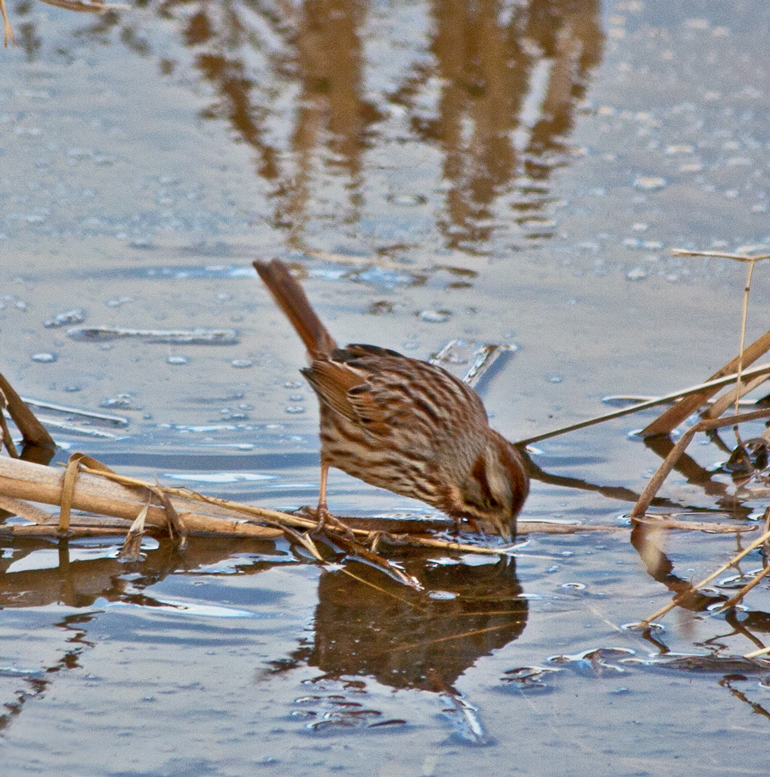
Although it is enjoyable and challenging to try to photograph large, colorful birds, I often find myself returning to photographing smaller, more ordinary birds. It’s a different kind of challenge capturing images of these little birds, who seem to be in constant motion.
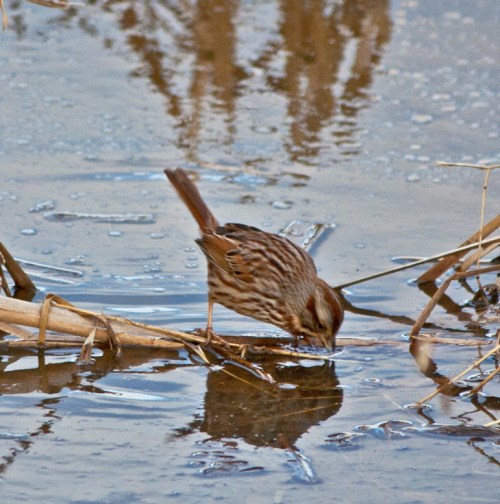
This afternoon I was able to photograph this Song Sparrow (Melospiza melodia) when he stopped for a moment to get a drink of water.
© Michael Q. Powell. All rights reserved
Posted in Birds, Nature, Photography | Tagged Canon 55-250mm zoom lens, Canon Rebel XT, Huntley Meadows Park, Melospiza melodia, song sparrow, sparrow | 6 Comments »
« Newer Posts - Older Posts »















 Mike Powell
Shooting the ordinary well
March 8, 2013 by Mike Powell
Do you aspire to photograph extraordinary subjects in exotic locations or are you content to shoot ordinary subjects in nearby locales?
This past winter (well, it’s almost past), I have really enjoyed photographing birds. At times, I have longed to be able to capture awe-inspiring images of hawks and eagles, of ospreys and owls and have thought about the travel and equipment that might be required to do so. Does that make me an adrenaline junkie, always searching for more, someone who requires increasing amounts of excitement to be content?
For the moment at least, I know that the answer is “no.” My pulse still quickens when I see a robin or a cardinal. I will take shot after shot of geese and ducks flying and landing. I am willing to kneel in the mud to try to get yet another shot of a sparrow. Here is one such shot of a Song Sparrow (Melospiza melodia) from earlier this week that I really like.
I am content with the ordinary and strive to capture and display its beauty. Cristian Mihai, a wonderful, easy-t0-read blogger, wrote a posting yesterday on beauty, entitled Beauty will save the world that I really recommend. It caused me to think more deeply about my photography, about my goals and motivations. What is is about beauty that prompts a desire to respond, to share it with others?
I started this posting with a false dichotomy, with alternatives that are not mutually exclusive to stimulate thought, the kind of inner examination that I have been conducting. There is no simple answer—sometimes it is sufficient to simply think about the question.
© Michael Q. Powell. All rights reserved
Share this:
Posted in Birds, commentary, Nature, Photography | Tagged beauty, Canon 55-250mm zoom lens, Canon Rebel XT, Huntley Meadows Park, Melospiza melodia, ordinary, song sparrow | 4 Comments »