October 23, 2013 by Mike Powell
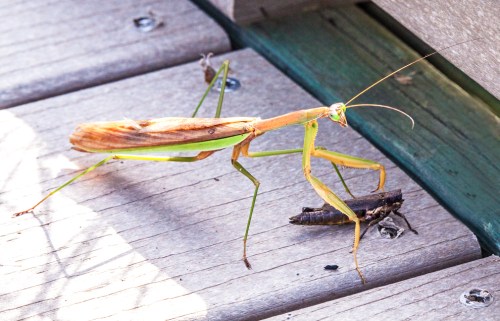
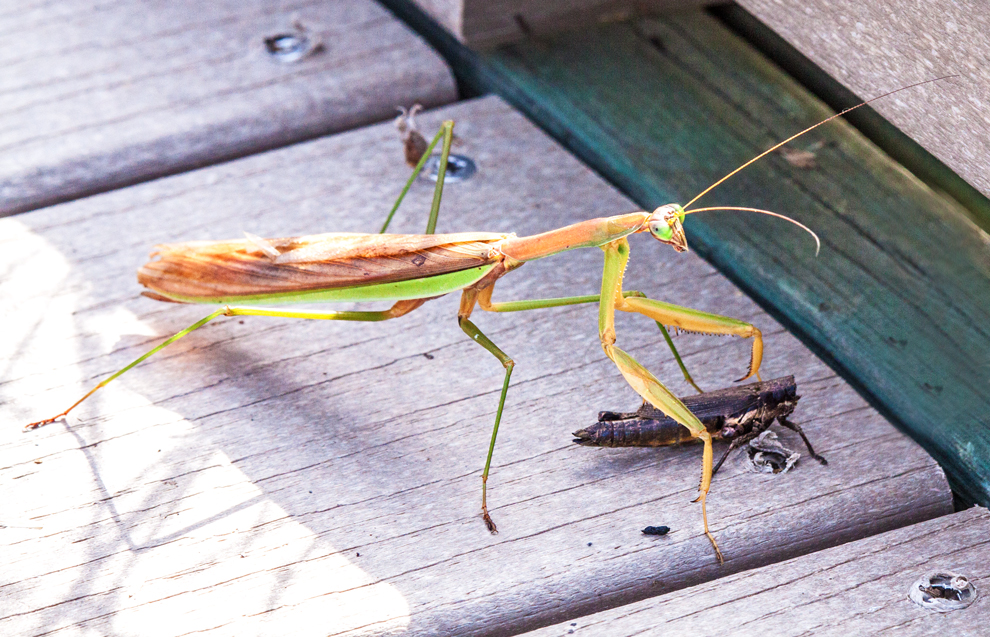
When this praying mantis began to straddle a hapless grasshopper, I wasn’t sure what was going to happen, but suspect that the grasshopper may have been the one that began to pray.
Was the mantis looking at the grasshopper as a potential mate or a potential meal? With praying mantises, the question of mate or meal is a little complicated, because some females reportedly bite off the heads of the males after mating.
As it turned out, the praying mantis ignored the grasshopper and simply climbed over him and the grasshopper’s prayer undoubtedly turned into one of giving thanks.
© Michael Q. Powell. All rights reserved.
Posted in Humor, Insects, Macro Photography, Nature, Photography, wildlife | Tagged Alexandria VA, Canon 50D, grasshopper, Huntley Meadows Park, praying mantis, Tamron 180mm macro lens | 10 Comments »
October 22, 2013 by Mike Powell
When this bright red male Autumn Meadowhawk dragonfly landed briefly on my fellow photographer’s white sneaker yesterday, it suddenly struck me that we might have hit on a potential fall fashion fad. Why not accessorize plain shoes with colorful dragonflies in seasonal colors? We could start with the Autumn Meadowhawk for fall and perhaps move on to the Common Whitetail as the snow begins to fall. Spring could bring on the Green Darner and summer could feature the Blue Dasher.
Of course, we couldn’t use real dragonflies, but they could serve as models for pin-on or clip-on dragonflies. Size-wise, it looks like this Autumn Meadowhawk is about the right size.
Now that I have a marketing idea, all I need is investors.

© Michael Q. Powell. All rights reserved.
Posted in Dragonflies, Humor, Macro Photography, Nature, Photography | Tagged Alexandria VA, Autumn Meadowhawk dragonfly, Canon 50D, dragonfly, Huntley Meadows Park, Sympetrum vicinum, Tamron 180mm macro lens | 7 Comments »
October 22, 2013 by Mike Powell
There is something a little wistful about searching for the last dragonfly of the year. Most of the familiar dragonflies from the summer have disappeared and it looks like the sole remaining dragonfly in our area is the Autumn Meadowhawk dragonfly (Sympetrum vicinum).
Yesterday I spent some time trying to photograph this dragonfly along with fellow photographer and blogger Walter Sanford, who has an amazing collection of photographs of dragonflies on his blog site, including a world-class series on the Blue-faced Meadowhawk. I was willing to try to capture photos of any dragonfly that I could spot, but Walter noted that he had taken enough photos of the male Autumn Meadowhawk and was really interested in photographing females or, even better, mating pairs.
The mating pairs tended to elude him most of the day, until suddenly a pair in the “wheel” position circled around us and landed on his bare calf—talk about unprotected sex. There was no way that he could twist himself around to get a good photo, but I manage to get this shot of the two dragonflies in action.
Temperatures are supposed to continue to drop this week, so there is always a chance that these will be the last dragonflies that I see this year, though I will be out searching for them for weeks to come before I bid my final adieu to them.

© Michael Q. Powell. All rights reserved.
Posted in Dragonflies, Humor, Insects, Macro Photography, Nature, Photography, wildlife | Tagged Alexandria VA, Autumn Meadowhawk dragonfly, Canon 50D, dragonflies, Huntley Meadows Park, mating dragonflies, Sympetrum vicinum, Tamron 180mm macro lens | 14 Comments »
October 21, 2013 by Mike Powell
As the outside temperatures continue to drop, I am seeing fewer and fewer spiders. This is one of my favorite recent shots of what I think is a barn spider. I really like the way that the spots in the background mirror the spots on the spider’s abdomen.
I think that this may be a Neoscona crucifera spider, though it may be an Araneus cavaticus spider. Strangely enough, both of them are sometimes known as barn spiders.

© Michael Q. Powell. All rights reserved.
Posted in Arachnids, Macro Photography, Nature, Photography, Portraits, wildlife | Tagged Alexandria VA, Araneus cavaticus, barn spider, Canon 50D, Huntley Meadows Park, Neoscona crucifera, spider, spots, Tamron 180mm macro lens | 3 Comments »
October 21, 2013 by Mike Powell
Perhaps the old adage that “opposites attract” applies to grasshoppers too. When I photographed this intimate moment on a leaf, I couldn’t figure out for sure what was going on.
Perhaps the grasshopper was attracted by the bright colors of the Handsome Meadow Katydid and was trying to start a conversation. Maybe this was a blind date set up by some well-intentioned friends. Is it possible they matched on a lot of points in the insect version of Match.com?
I have photographed grasshoppers and katydids separately, but this is the first time I have them both in a single image. It is fascinating to be able to compare the bodies of the two species and note the differences in the eyes, the legs, and many other parts.
The striking colors of the Handsome Meadow Katydid have always drawn my attention, but I am left with one question to ponder. Do grasshoppers even see in color or only in shades of gray?

© Michael Q. Powell. All rights reserved.
Posted in Humor, Insects, Macro Photography, Nature, Photography | Tagged Alexandria VA, Canon 50D, encounter, grasshopper, Handsome Meadow Katydid, Huntley Meadows Park, katydid, Tamron 180mm macro lens | 5 Comments »
October 20, 2013 by Mike Powell
Although I have been seeing a lot of cardinals recently, most of them seem very skittish and fly off as I approach. This Northern Cardinal (Cardinalis cardinalis) flew away a short distance and observed me from a tree where he was almost surrounded by the foliage.
With that bright red coloration, though, it’s a little hard to conceal yourself entirely.

© Michael Q. Powell. All rights reserved.
Posted in Art, Birds, Nature, Photography, wildlife | Tagged Alexandria VA, Canon 50D, Canon 70-300mm telephoto zoom lens, cardinal, Cardinalis cardinalis, Huntley Meadows Park, Northern cardinal | 7 Comments »
October 19, 2013 by Mike Powell
Freckles is a year-old female Cocker Spaniel who is staying with me overnight while her owner is out of town. Freckles is usually very active, but she managed to sit still for a minute while I took some photos of her.
I used my 50mm lens for this shot (a lens that I should use more often) and I tried to get as close to eye-level as I could. I shot it at f/2.2, which blurred out the beige carpet of my dining room, though I did have to clone out a couple of objects in the background.
I am happy that I was able to capture some of Freckles’ beautiful coloration and I am sure that most viewers will agree that she is a very photogenic model.
 © Michael Q. Powell. All rights reserved.
Posted in animals, Dog, Photography, Portraits | Tagged Canon 50D, Canon 50mm lens, Cocker Spaniel, dog, Freckles | 5 Comments »
October 19, 2013 by Mike Powell
I am not really sure what these spiders were doing, but it looked to me like they were engaged in a game that I played as a child called “King of the Hill.” The objective of the game was to climb to the top first and then to repel the efforts of the others trying to unseat you and take your place.
The two spiders seemed to be racing to the top of this plant’s stalk in the first photo and the second image shows that the one on the left was the winner. Somehow that second image reminds me of the iconic shot of King Kong on the Empire State Building, clutching the spire of the building.
It was a challenge trying to track moving subjects like this with a macro lens and my need for a higher shutter speed caused me to sacrifice some depth of field. I do like the simple, uncluttered composition that I was able to achieve and the fact that I was able to capture these little spiders in action.

 © Michael Q. Powell. All rights reserved.
Posted in Arachnids, Art, Macro Photography, Nature, Photography, wildlife | Tagged Alexandria VA, Canon 50D, Huntley Meadows Park, spider games, spiders, Tamron 180mm macro lens | 11 Comments »
October 18, 2013 by Mike Powell
Have you ever watched a coot swim? When I first spotted this American Coot (Fulica americana) earlier this week at my local marsh, I thought it might be a duck. Once it started swimming, I could tell immediately that it was a coot.
Coots have a really clumsy way of swimming. They thrust their necks forward and then back, as if to generate momentum to propel themselves forward. The two photos show two different positions that the coot assumes while swimming. The Cornell Lab of Ornithology that coots, unlike ducks, don’t have webbed feet, but instead each one of the coot’s long toes has broad lobes of skin that help it kick through the water. In fact, they are closer relatives to Sandhill Cranes than to Mallards.
This coot was by itself and may be migrating through this area or may become a resident here for the winter. I was happy that I saw the coot in a relatively open area of the marsh. A short time later, the coot swam into the cattails and disappeared from sight.
Given the popular use of the term “coot,” I wonder if I am old enough to qualify as an American coot too.


© Michael Q. Powell. All rights reserved.
Posted in Art, Birds, Humor, Nature, Photography, Portraits, wildlife | Tagged Alexandria VA, American Coot, Canon 50D, Canon 70-300mm telephoto zoom lens, coot, Fulica americana, Huntley Meadows Park | 8 Comments »
October 17, 2013 by Mike Powell
When I first saw this bird, I knew that it was a sparrow, but couldn’t identify it. I was baffled when I went to my Peterson Field Guide to Birds of North America, because I couldn’t find the sparrow. I went back and forth through the 14 pages covering sparrows, examining carefully the text and illustrations, but none of the species looked like this bird.
I was beginning to doubt my identification skills, so I kept looking through the field guide, desperately hoping to find the bird. On the very last page of the section of the guide with information on bird species, just before all of the range maps, I stumbled across a small section called Old World Sparrows and found the bird—it’s a House Sparrow (Passer domesticus).
Apparently Old World sparrows are non-native (as their name suggests) and are of a different family from all of the other sparrows that I have observed. The Cornell Lab of Ornithology website indicates that House Sparrows were introduced from Europe in 1851 and that they are common in places with houses, because the birds seem to prefer to nest in manmade structures, like the eaves of buildings, more than natural nesting sites. I took these photos at a little manmade lake that is partially surrounded by houses, rather than at the marsh where I do a lot of my shooting, which may explain why I have never noticed this type of sparrow before.

© Michael Q. Powell. All rights reserved.
Posted in Birds, Flowers, Gardening, Nature, Photography, Portraits, wildlife | Tagged Alexandria VA, Canon 50D, Canon 70-300mm telephoto zoom lens, House Sparrow, Kingstowne, Old World Sparrow, Passer domesticus, sparrow | 14 Comments »
October 16, 2013 by Mike Powell
Here’s another shot of one of the numerous spiders that I observed yesterday at my local marsh, which I have not yet been able to identify.
This one was pretty big and seemed to be putting out a lot of silk, one strand at a time. If you look closely, you can spot numerous eyes and a cool orange racing stripe down the middle of its face. I took this shot from a low angle so that I could capture the spider with the sky as the partial backdrop.
© Michael Q. Powell. All rights reserved.
Posted in Arachnids, Macro Photography, Nature, Photography, wildlife | Tagged Alexandria VA, Canon 50D, Huntley Meadows Park, spider, Tamron 180mm macro lens, web | 4 Comments »
October 16, 2013 by Mike Powell
Perched on the end of a railing at the marsh, this sparrow seems lost in thought as it surveys the surrounding area.
Most of the time I try to get as close to my subject as possible, either with a telephoto or macro lens, but in this case I liked this image the moment that I pulled it up on my computer screen. I struggled to find words to explain why I like this particular shot, but the lines, the colors, and lighting somehow combined in a way that I find interesting and pleasing.

© Michael Q. Powell. All rights reserved.
Posted in Birds, Landscape, Nature, Photography, wildlife | Tagged Alexandria VA, Canon 50D, Canon 70-300mm telephoto zoom lens, Huntley Meadows Park, song sparrow, sparrow | 1 Comment »
October 15, 2013 by Mike Powell
There seemed to be spiders everywhere at the marsh today. When I arrived in the morning, there were webs all over the place, though not the kind that orbweavers make—plants were simply covered with web-like material. Later in the day I saw all kinds of spiders scurrying along the boardwalk and even flying through the air in a process known as ballooning.
I saw a lot of one of my favorite type of spiders, the jumping spider. I am still downloading my images from today, but here is an advance preview, an image of a jumping spider that had crawled onto part of the railing of the boardwalk. I love the details of the spider, especially the eyes, and even the peeling paint of the railing.

© Michael Q. Powell. All rights reserved.
Posted in Arachnids, Macro Photography, Nature, Photography, wildlife | Tagged Alexandria VA, Canon 50D, Huntley Meadows Park, jumping spider, spider, Tamron 180mm macro lens | 10 Comments »
October 15, 2013 by Mike Powell
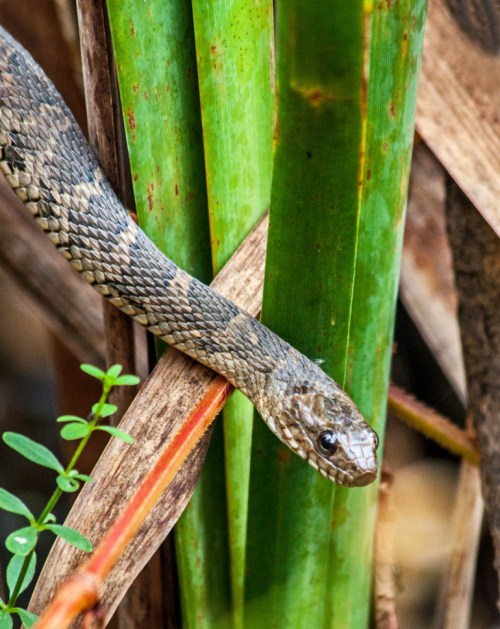
Deep in the cattails, this Northern Water snake (Nerodia sipedon) seemed to have taken refuge from the rising waters of the marsh after several days of heavy rainfall. The snake’s body looked a little thicker around the middle, causing me to wonder if it had eaten recently and was in the kind of food coma that I experience after a really big meal.
© Michael Q. Powell. All rights reserved.
Posted in Nature, Photography, Portraits, Reptiles, wildlife | Tagged Alexandria VA, Canon 50D, Canon 70-300mm telephoto zoom lens, Huntley Meadows Park, Nerodia sipedon, Northern Water Snake, snake | 4 Comments »
October 14, 2013 by Mike Powell
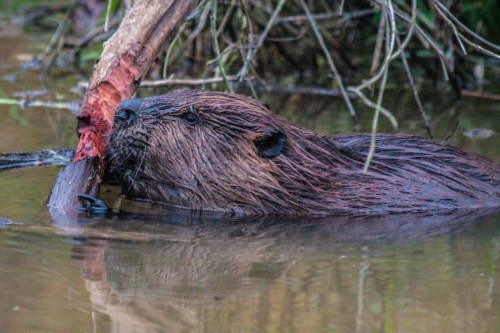
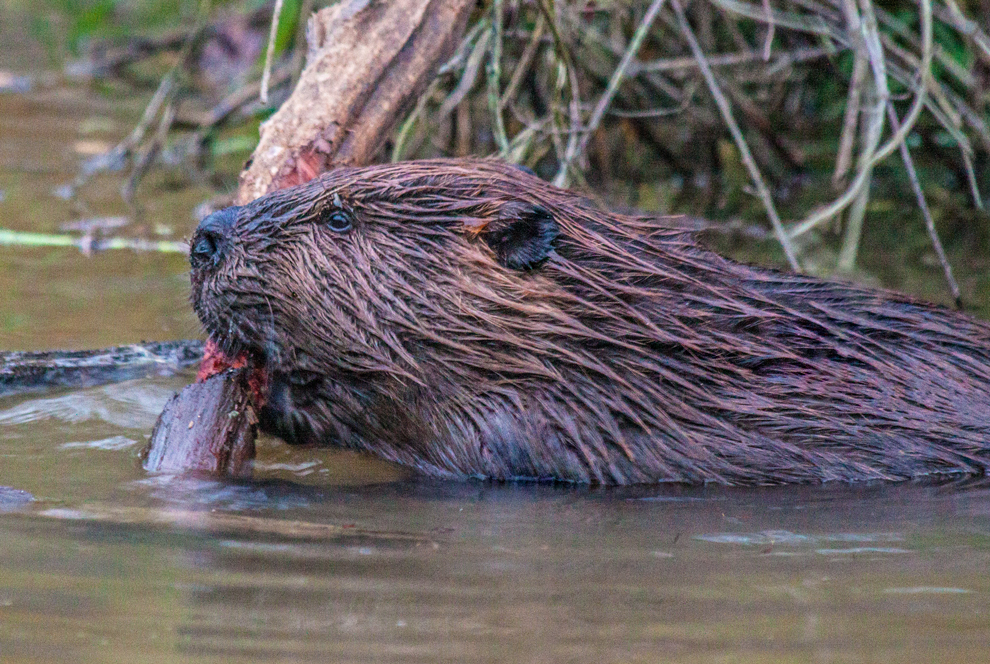
Whenever I am at my local marsh near sundown, I like to hang around near the beaver lodge to see if I can spot the beavers. Often I can hear them gnawing on branches, but rarely do I get an unobstructed view of one of them.
This past weekend, though, I managed to be at the right spot at the right time and got this shot of a North American Beaver (Castor canadensis). It seemed smaller than the other one I saw that evening, so I wonder if this is a young one.
The light was fading as I took these shots and I had to push my ISO past 1000. Even so, the shutter speed was below 1/30 second, so I was happy that my camera was already on my tripod. I was kneeling on the boardwalk as I took these shots and was afraid that other people would approach and scare the beaver away. I was really happy when an approaching family with several small children saw what I was doing and sat down on the boardwalk and quietly watched the beaver in action.

© Michael Q. Powell. All rights reserved.
Posted in animals, Nature, Photography, wildlife | Tagged Alexandria VA, beaver, Canon 50D, Canon 70-300mm telephoto zoom lens, Castor canadensis, gnawing, hungry, hungry beaver, Huntley Meadows Park, North American Beaver | 10 Comments »
October 13, 2013 by Mike Powell
Like most people who live in the the Washington, D.C. area, I don’t visit monuments much unless there are visitors. One of my fellow photographers invited me to photograph the Capitol on Friday evening to satisfy the wishes of a visiting photographer.
We were quite a sight as we set up umbrellas and tripods in the rain which fell progressively harder and harder. My favorite shot is the first one, which shows the reflection of the Capitol in one of the wet, slippery stairs leading up to it. I tried a number of long exposures, varying from about 15 to 30 seconds to get this look.
The second one is a more traditional view, but I think that the lighting was pretty cool at that time of the evening.


© Michael Q. Powell. All rights reserved
Posted in Architecture, Art, Photography, Travel | Tagged Canon 50D, Canon 55-250mm zoom lens, Capitol, night photography, Washington DC | 8 Comments »
October 13, 2013 by Mike Powell
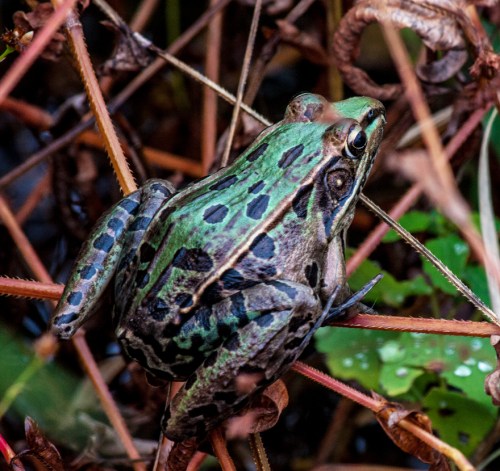
As I walked along the boardwalk yesterday at Huntley Meadows Park, fellow photographer Christy Turner pointed out this Southern Leopard frog (Lithobates sphenocephalus) in the bushes and I managed to get a shot of the cool-looking frog.
These frogs are pretty common and I think I hear them often, but I hadn’t seen one in months. We have had a lot of rain this past week and this frog may have decided to chill out in the underbrush rather than remain in the now deep water in this part of the marsh. It was an interesting challenge to try to find an uncluttered visual pathway to get this shot—I crouched and leaned as I focused on the frog, conscious of the fact that I could end up in the bushes with the frog if I were not careful.
Things turned out pretty well, and I avoided falling in the water at that moment, though my feet got soaked later in the afternoon when I ventured too close to a flooded-out section of the boardwalk.
© Michael Q. Powell. All rights reserved
Posted in Amphibians, Nature, Photography, wildlife | Tagged Alexandria VA, Canon 50D, Canon 70-300mm telephoto zoom lens, frog, Huntley Meadows Park, Lithobates sphenocephalus, Southern Leopard frog | 5 Comments »
October 12, 2013 by Mike Powell
A blue heron with attitude? The pose, facial expression, and hair style of this Great Blue Heron (Ardea herodias) at Huntley Meadows Park, my local marsh, remind me of a punk rocker. Do you think he has tattoos and body piercings too?

© Michael Q. Powell. All rights reserved
Posted in Art, Birds, Humor, Music, Nature, Photography, Portraits, wildlife | Tagged Alexandria VA, Ardea herodias, blue heron, Canon 50D, Canon 70-300mm telephoto zoom lens, Great Blue Heron, heron, Huntley Meadows Park, punk rock, punk rocker | 13 Comments »
October 11, 2013 by Mike Powell
This week we are caught in a weather system with constant gray skies and rain, so I need a splash of color to lift my spirits, like this immature male Common Yellowthroat (Geothlypis trichas) that was hiding in the lower levels of the cattails last week.
The little yellow bird was in almost constant motion and was often obscured by the stems of the underbrush, but I did manage to get a few relatively unobstructed shots when the bird poked its head into an open area. As is often the case, I also managed to get a shot as the bird flew away. Normally that means that the bird is partially out of the frame, but this time the bird flew almost straight down and I got a fun little final image.


© Michael Q. Powell. All rights reserved
Posted in Art, Birds, Nature, Photography, wildlife | Tagged Alexandria VA, Canon 50D, Canon 70-300mm telephoto zoom lens, Common Yellowthroat, Geothlypis trichas, Huntley Meadows Park, yellowthroat | 9 Comments »
October 10, 2013 by Mike Powell
Sometimes I don’t want to freeze motion entirely in the way that I did in a photo of a Canada Goose landing in the water that I posted earlier today.
Here is another shot of a Canada Goose in which I panned the camera, helping to blur the background, and the slower shutter speed left a certain amount of motion blur in the wings, helping to enhance the impression of speed. My camera was in aperture-priority mode and the shutter speed dropped when the goose that I was tracking flew against the darker background of the trees.
I really like the overall feel of the image, the sense that the goose is straining to slow down as it prepares for landing, but is still moving forward at a fast speed. Is the image “tack sharp?” No, it’s not, but I am happy that it is not—it’s a creative choice. Check out a recent posting entitled “Chasing the tack sharp mirage” by Lyle Krahn, one of my favorite photographers, for a provocative discussion about this topic.

© Michael Q. Powell. All rights reserved
Posted in Art, Birds, Nature, Photography, Portraits, wildlife | Tagged Alexandria VA, bird in flight, Branta canadensis, Canada Goose, Canon 50D, canon 70-300mm telephoto zoom, goose, Huntley Meadows Park, motion blur, panning | 4 Comments »
October 10, 2013 by Mike Powell
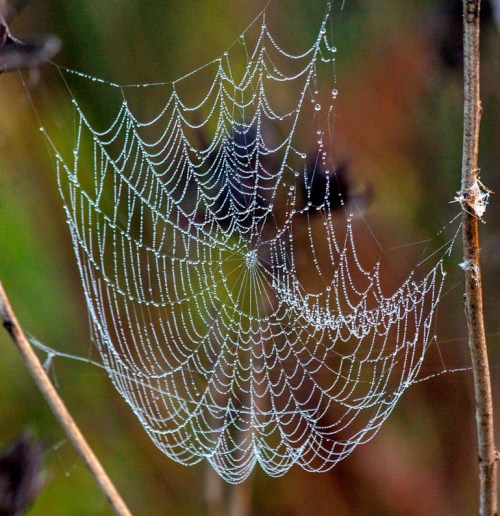
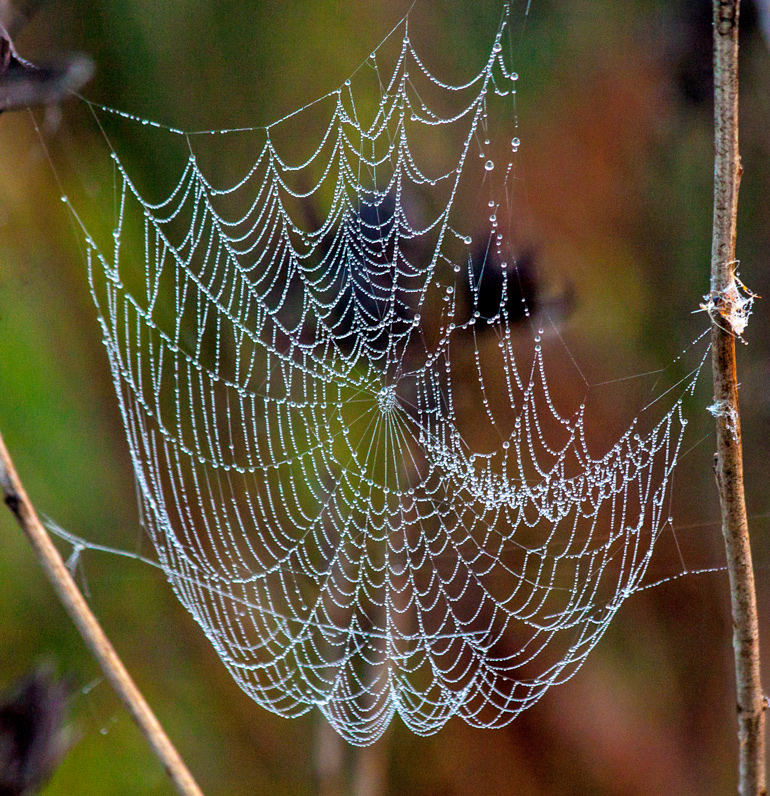
I haven’t seen many big spiders this fall, but I did come across this spiderless web early one morning recently. The morning was damp and foggy and the droplets of water on the web made it easier to spot in the cattails of the marsh. Using manual focusing, which is still a challenge for me with my DSLR, I was able to capture this image of the web. If you click on the image, you can see the beads of water that look like tiny strands of transparent pearls.
© Michael Q. Powell. All rights reserved
Posted in Arachnids, Art, Macro Photography, Nature, Photography | Tagged Alexandria VA, autumn, Canon 50D, canon 70-300mm telephoto zoom, Huntley Meadows Park, spider web, spiderweb | 2 Comments »
October 10, 2013 by Mike Powell
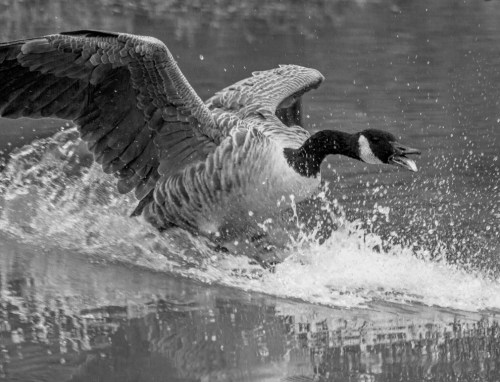
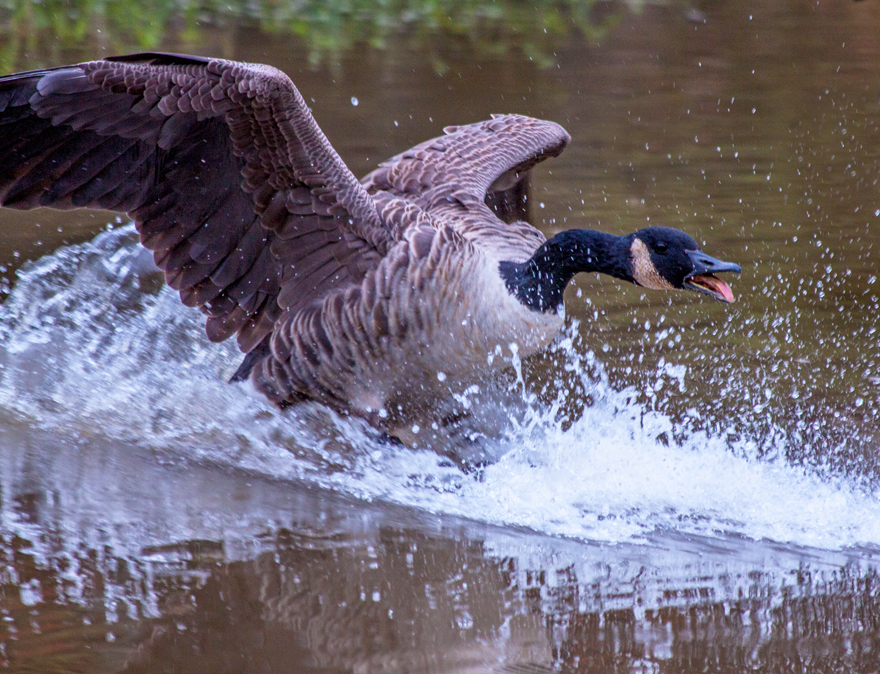
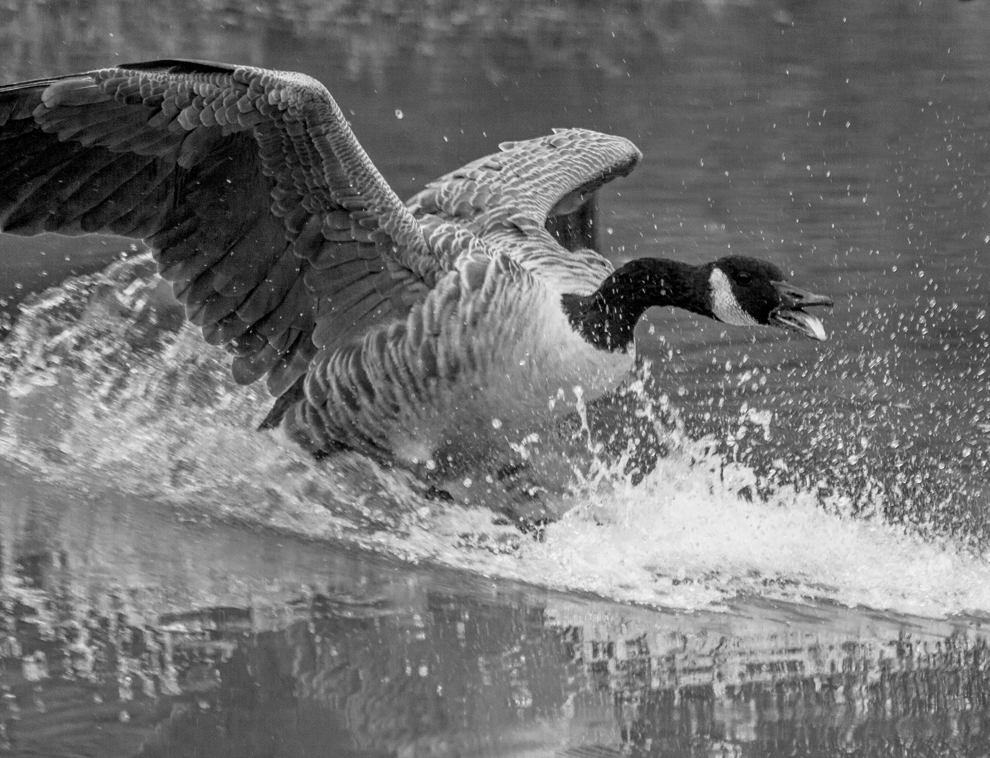
One of the first waves of migrating Canada geese (Branta canadensis) loudly announced its arrival and landed right in front of me in the beaver pond of my local marsh yesterday.
Last year we seemed to have geese arriving and departing so frequently that I felt like I was at a major geese transit airport. I kept expecting to hear departure announcements on a loudspeaker.
Several areas of the marsh had dried up in the last few months, because of a lack of rain, and I had been fearful that the migrating birds would not stop over. The rain storms this week have partially filled those areas, so my concerns have been partially assuaged.
When I looked at this photo, it seemed like it was mostly black and white already (except for the pink tongue), so I played around a little and converted it to black-and-white. For me, the second version really draws my eye to the texture of the feathers, but I can’t decide whether I like it more than the color version.
What do you think about the black-and-white version?

© Michael Q. Powell. All rights reserved
Posted in Art, Birds, Humor, Nature, Photography, wildlife | Tagged Alexandria VA, Branta canadensis, Canada Geese, Canada Goose, Canon 50D, Canon 70-300mm telephoto zoom lens, goose, Huntley Meadows Park, water landing | 13 Comments »
October 9, 2013 by Mike Powell
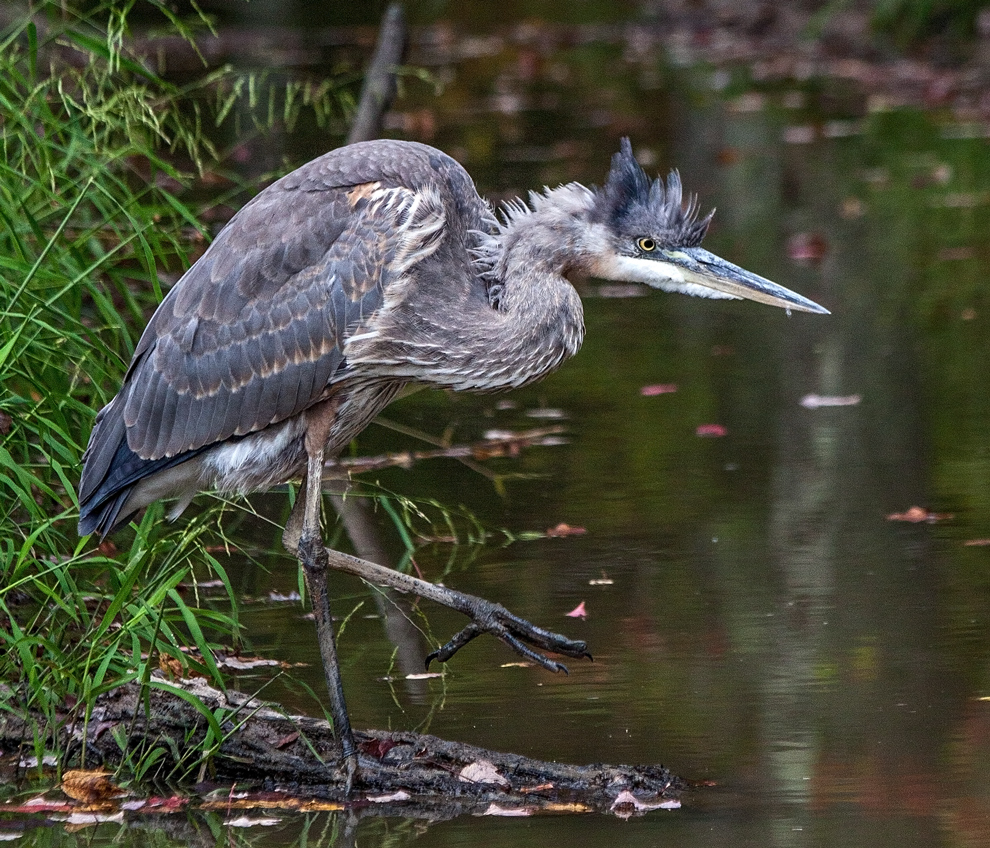
This Great Blue Heron, which I think was a juvenile, was clearly not experienced at hunting for food. Unlike his more patient elders, he seemed unable to stay in one spot for more than a few minutes and his success rate when he made a strike was not very high. He was persistent, however, and I kept hoping that he would pull a frog or some other tasty morsel out of the waters of the beaver pond.
I readied myself as he prepared for another strike and fired away as he triumphantly pulled his catch out of the water. The photo confirmed my initial impression—the big catch was just a leaf that had been floating on the surface of the water.
With more practice, this heron’s fishing skills are sure to improve or it is going to be a long, cold autumn and winter for him.

© Michael Q. Powell. All rights reserved
Posted in Art, Birds, Humor, Nature, Photography, Winter | Tagged Alexandria VA, Ardea herodias, blue heron, Canon 50D, canon 70-300mm telephoto zoom, fishing, Great Blue Heron, Huntley Meadows Park, inexperienced | 9 Comments »
October 9, 2013 by Mike Powell
I watched the sun go down yesterday evening at my local marsh and was initially disappointed as the sun dropped lower and lower on the horizon without any real displays of color. Eventually, though, my patience was rewarded, when for a few minutes the sky turned a beautiful shade of red.

© Michael Q. Powell. All rights reserved
Posted in Landscape, Nature, Photography | Tagged Alexandria VA, Canon 50D, Canon 70-300mm telephoto zoom lens, Huntley Meadows Park, red sky, sunset | 6 Comments »
October 8, 2013 by Mike Powell
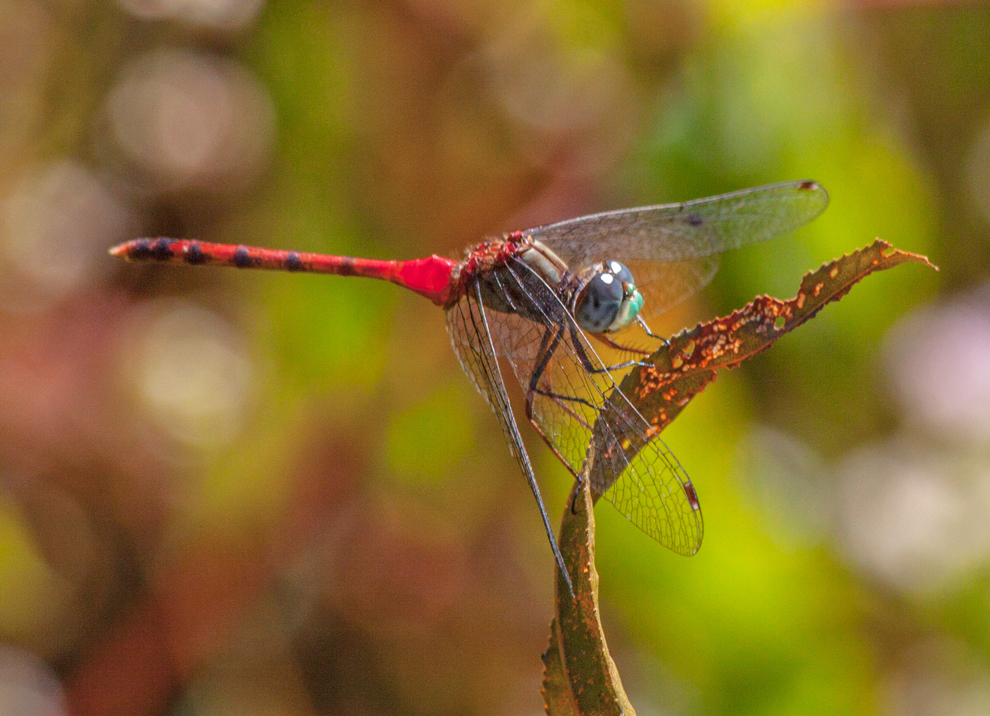
I don’t expect to see new species of dragonflies at this time of the year, but one of my fellow photographers, Walter Sanford, has been stalking the Blue-faced Meadowhawk (Sympetrum ambiguum) almost daily and I joined him for a few hours one late September day and got this shot.
I learned quickly that these dragonflies are hard to spot, despite their conspicuous coloration. They seem to like to remain perched down low in the vegetation and wait for their prey, rather than fly around when they are hunting.
I love the combination of colors on the Blue-faced Meadowhawk and I was happy to get a decent shot that shows its blue face. If you want to see more shots of this beautiful dragonfly, check out Walter’s blog posting from yesterday.
I am now in search of the Autumn Meadowhawk, the last dragonfly that I observed last fall. Normally they should be here already, but none of my fellow dragonfly followers has observed any of them yeat.

© Michael Q. Powell. All rights reserved
Posted in Art, Dragonflies, Insects, Macro Photography, Nature, Photography, Portraits, wildlife | Tagged Alexandria VA, Blue-faced Meadowhawk, Blue-faced Meadowhawk dragonfly, Canon 50D, Canon 70-300mm telephoto zoom lens, Huntley Meadows Park, Sympetrum ambiguum | 9 Comments »
October 7, 2013 by Mike Powell
In the shallow water of the marsh, this Northern Water snake (Nerodia sipedon) patiently waits for its unwary prey, probably a frog. At one point its body began to vibrate violently and I thought it was getting ready to strike, but it turned out to be a false alarm. In the end, the snake turned out to be more patient than I was and I left without observing the snake capture its next meal.

Click on the photo to see a higher resolution view of the snake.
© Michael Q. Powell. All rights reserved
Posted in Nature, Photography, Portraits, Reptiles, wildlife | Tagged Canon 50D, Canon 70-300mm telephoto zoom lens, Huntley Meadows Park, Nerodia sipedon, Northern Water Snake, snake, water snake | 5 Comments »
October 7, 2013 by Mike Powell
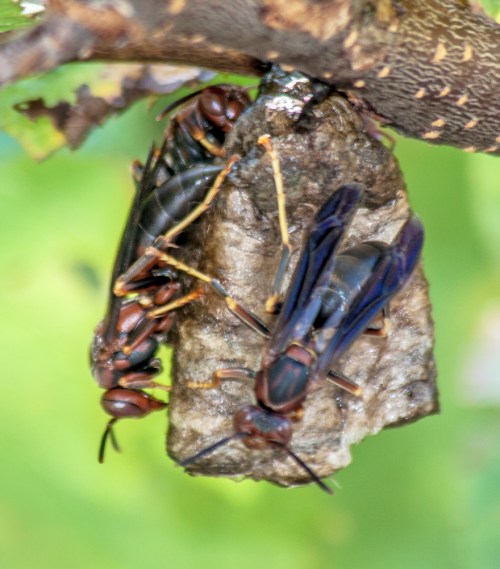
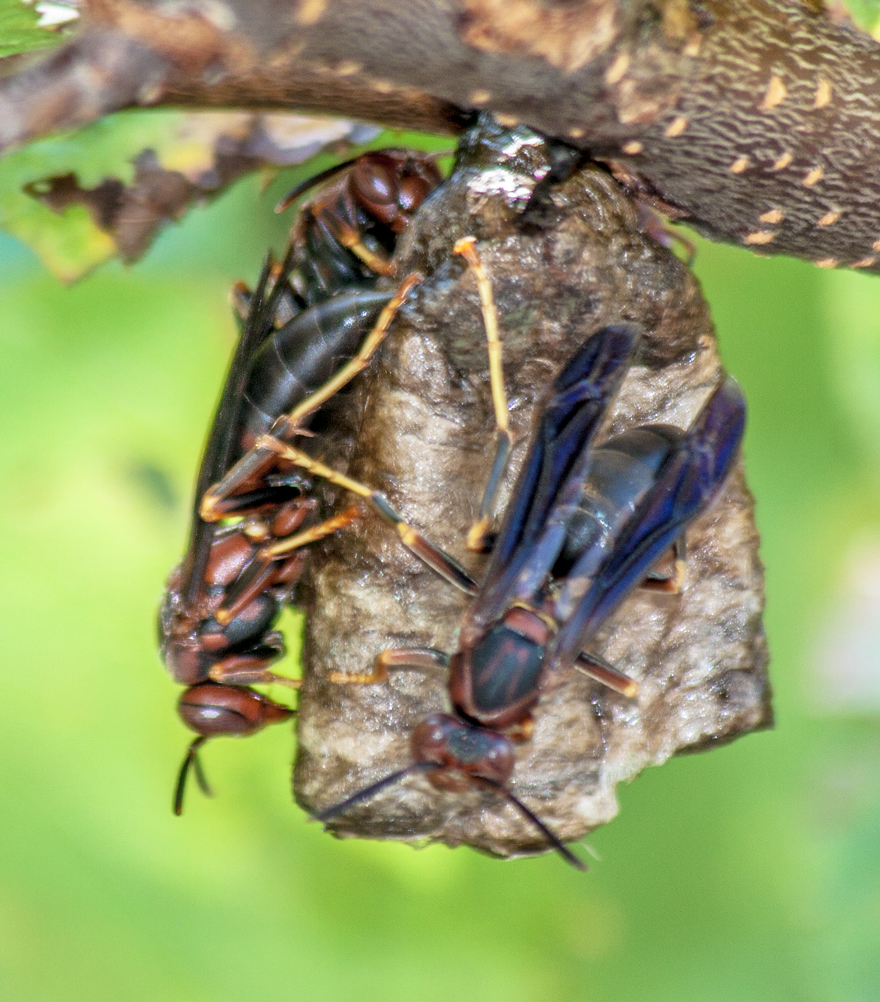
” Do you want to get some shots of a wasp nest?” I was at a loss for words when a fellow photographer excitedly posed that question to me this past weekend. I had visions of an enormous cluster of very large and angry insects and I hesitated for a long moment before finally agreeing.
What had I gotten myself into? It turns out that my fears were greatly exaggerated and the nest was a very modest one, not much bigger than the wasps themselves. My fellow photographer had been told that they are paper wasps and it looks to me like they may be brown paper wasps, judging from some of the photos that I have seen on-line.
I am hoping that the nest doesn’t get too big, because it is near a path that I regularly use. There were not a lot of wasps present yet, but they looked pretty fierce and I kept my distance and used my telephoto zoom at the far end of its range.
© Michael Q. Powell. All rights reserved
Posted in Insects, Macro Photography, Nature, Photography | 3 Comments »
October 7, 2013 by Mike Powell
In the faint light and fog of the pre-dawn hour, I watched the shadowy forms of a small group of deer move slowly across an open area at my local marsh, heading for the treeline. My attempts to photograph them while they were moving were not successful. Once they reached the edge of the trees, however, this male White-tailed deer (Odocoileus virginianus) stopped for a moment and looked back at me. A moment later, he was gone.

© Michael Q. Powell. All rights reserved
Posted in animals, Nature, Photography, wildlife | Tagged Alexandria VA, Canon 50D, Canon 70-300mm telephoto zoom lens, dawn, deer, Huntley Meadows Park, Odocoileus virginianus, white-tailed deer | 10 Comments »
October 6, 2013 by Mike Powell
I arrived at the marsh before dawn, hoping to photograph a beautiful sunrise. I stumbled around in the fog and the dark as it gradually got lighter and captured this shot of a flock of blackbirds flying over a field of cattails. If you click on the photo, you can get a better look at all of the different flying positions of the blackbirds.
As it turned out, there were virtually no colors in the sky as the sun rose. I’m sure that I will be back again soon for another attempt.

© Michael Q. Powell. All rights reserved
Posted in Art, Birds, Nature, Photography, wildlife | Tagged Alexandria VA, blackbirds, Canon 50D, canon 70-300mm telephoto zoom, foggy, Huntley Meadows Park, pre-dawn, Red-winged Blackbirds | 4 Comments »
October 6, 2013 by Mike Powell
Most of the tree frogs that I have seen until now have been lime green, but the one that I saw on Friday was a much darker shade of green. I am pretty sure, though, that he is a Green Treefrog (Hyla cinerea) and he was in a very familiar pose, comfortably napping during the heat of the day.
He was a pretty good distance away, perched on a small tree (or maybe a bush) in the partial shade, but luck was with me, because the sunlight was shining on him. I had a telephoto lens on my camera and managed to get a pretty good shot without scaring him away.
I left the frog thinking that he probably had the right approach—a nap sounded like a good idea.

© Michael Q. Powell. All rights reserved
Posted in Amphibians, Art, Humor, Nature, Photography, Portraits, wildlife | Tagged American Green Treefrog, Green Treefrog, Hyla cinerea, tree frog | 12 Comments »
October 5, 2013 by Mike Powell
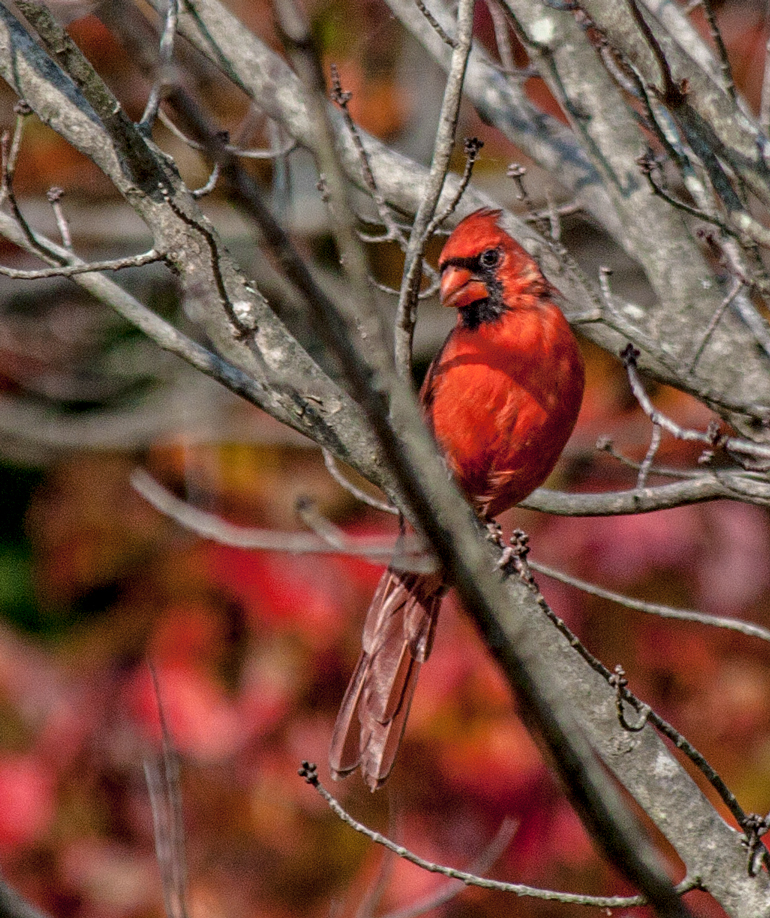
I love to photograph cardinals throughout the year, but I was really excited when I saw this male Northern Cardinal (Cardinalis cardinalis) land on a tree with colorful fall foliage in the background. There were a lot of branches, but I somehow managed to get a facial shot with an interesting expression.
The cardinal seemed to be staring at me, silently criticizing my behavior. It reminded me of the expression that parents sometimes adopt when they want to publicly communicate their displeasure to their offspring without uttering a single word.

© Michael Q. Powell. All rights reserved
Posted in Art, Birds, Humor, Nature, Photography, Portraits, wildlife | Tagged Alexandria VA, autumn, Canon 50D, Canon 70-300mm telephoto zoom lens, cardinal, Cardinalis cardinalis, Huntley Meadows Park, Northern cardinal | 7 Comments »
« Newer Posts - Older Posts »











 Mike Powell