Feeds:
Posts
Comments

Archive for the ‘Winter’ Category

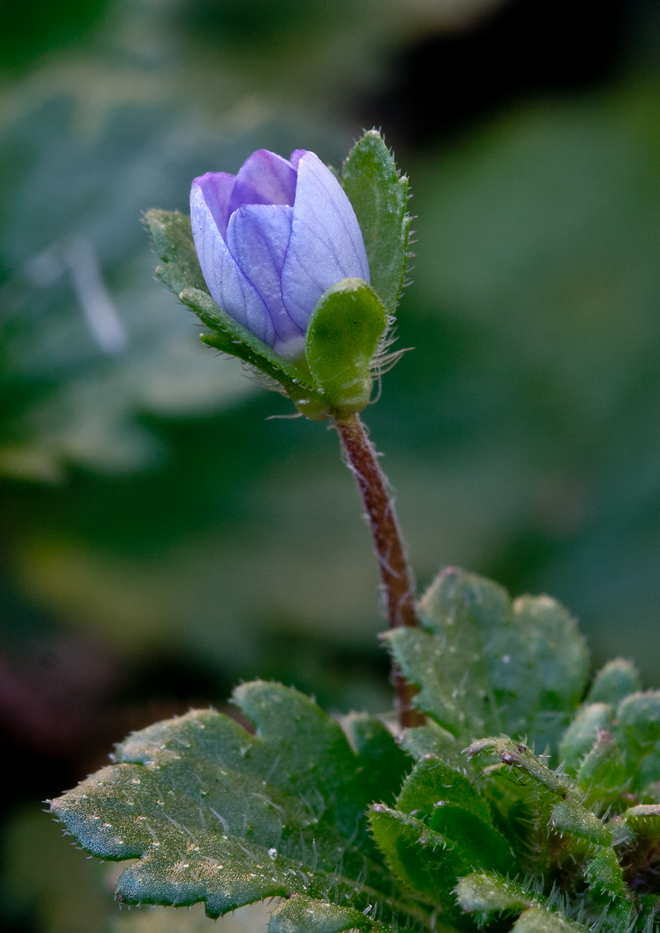
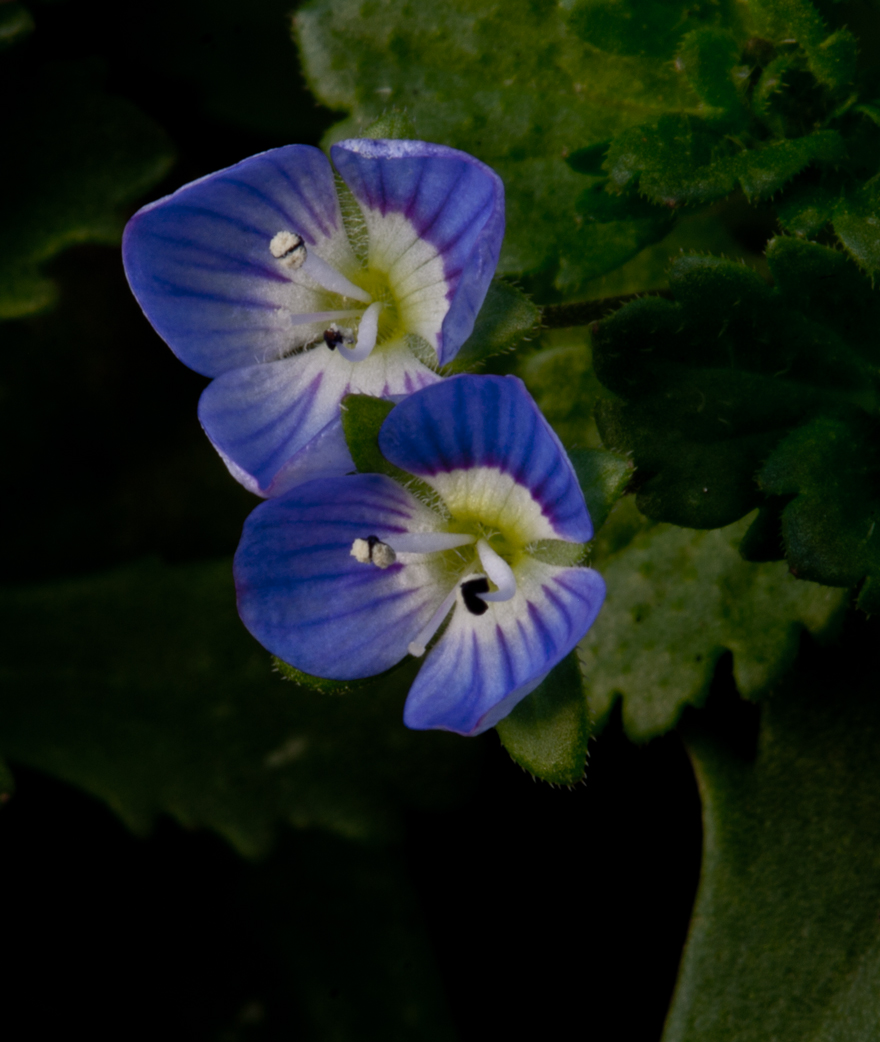
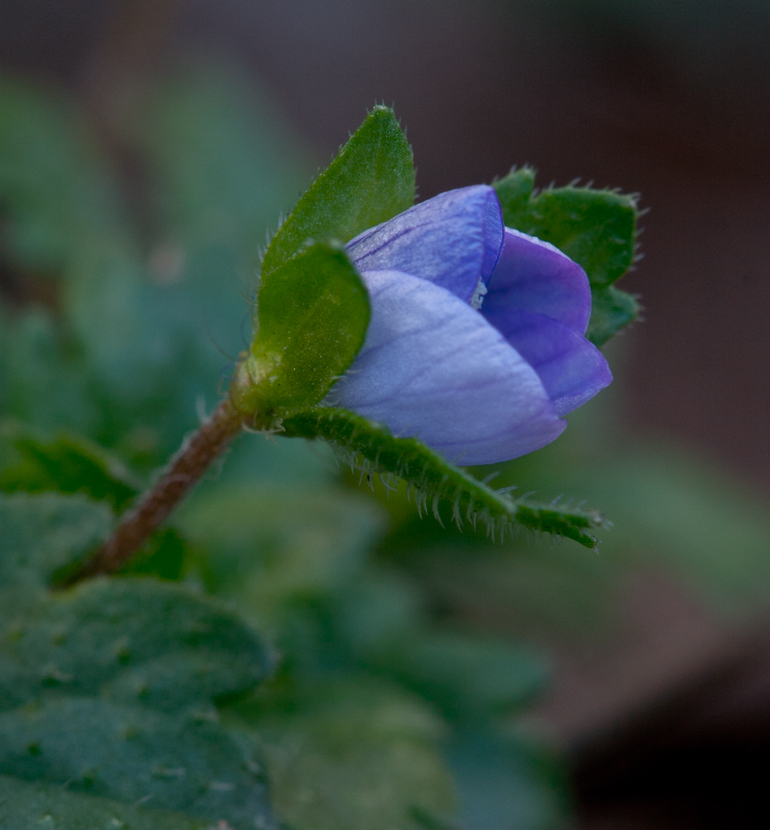
We have had a strange winter here in Northern Virginia, with some unseasonably warm days. Today, for example, it was over 50 degrees (10 degrees Celsius). As a result, some flowers may be starting to bloom earlier than normal. My neighbor and photography mentor Cindy Dyer has a wonderful garden and I noticed today that she has a whole lot of little blue flowers that are in the process of blooming.

I can’t identify what kind of flowers they are, but they are really pretty. I put my macro lens on my camera, put the camera on a tripod, and attempted to use the techniques that Cindy taught me for photographing flowers. I shot the first photo with an aperture setting of f20 in an attempt to capture the details of the flowers. The second and third images were shot at about f9, which let me blur the background a little. I like the way in which the buds look like little roses.

Temperatures are supposed to drop way below freezing during this coming week and I hope these little flowers are hardy enough to endure the cold.

flowers1_blogflowers2_blogflowers3_blog

© Michael Q. Powell. All rights reserved

Read Full Post »

On my final night in Brussels for this trip, I made one last walk through the city. Despite the frigid cold, there were still a lot of pedestrians stopping in the Grand-Place to take photos or to visit one of the numerous bars and restaurants in the area. Some of the previous times that I was in Brussels, the buildings in the square were illuminated, but the were pretty dark this time.

I balanced my camera on my stocking hat to stabilize it for this first photo, which you can probably guess was a pretty long exposure. I like the way the different lights in the scene turned out differently, with varying strengths and colors.

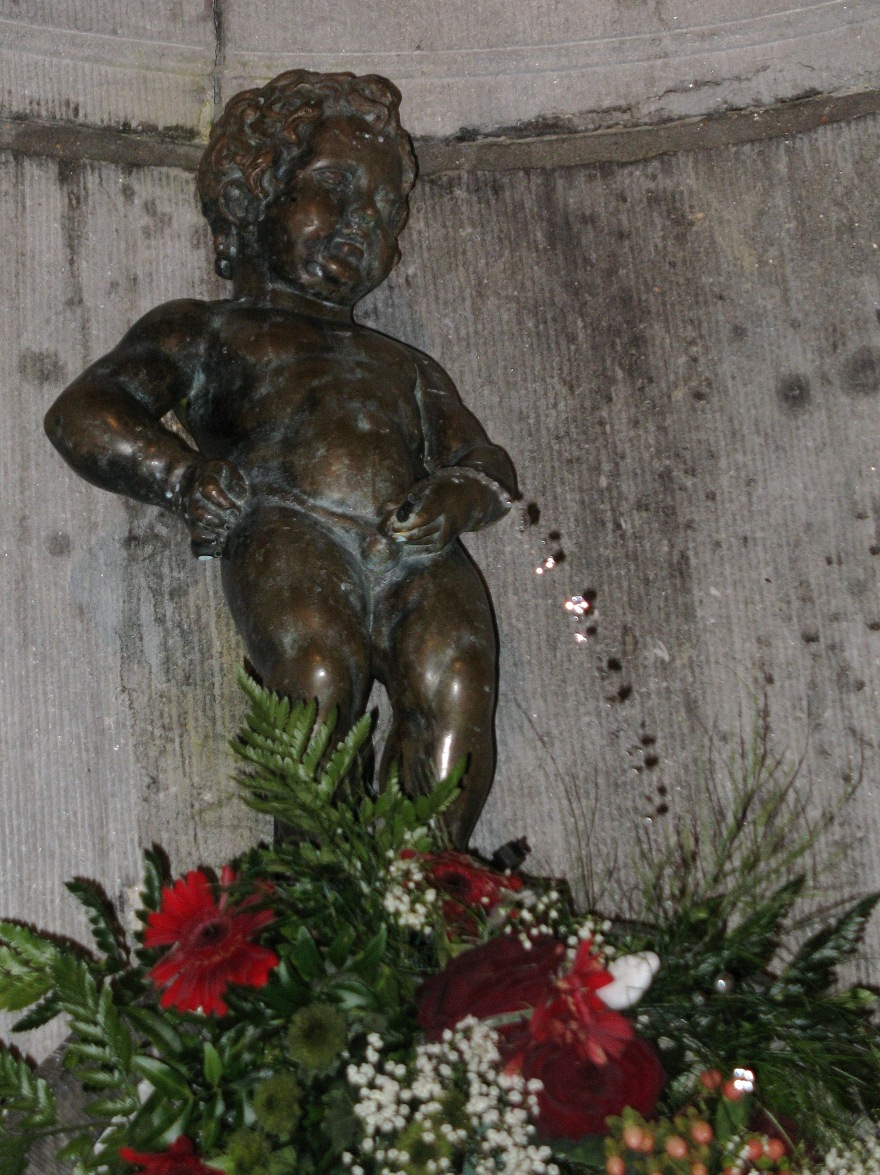
The second photo is one of Mannekin Pis, a statue of a little boy that is one of the symbols of Brussels. Sure, it’s a touristy thing place to visit and the statue certainly doesn’t rate high in terms of art. However, I usually try to stop by and see him, because sometimes he is wearing one different outfits for different occasions.

Tomorrow I’ll be home and will probably return to posting mostly nature shots in my blog.  It’s been an interesting experience the last few days trying to orient myself to photographing different things in a completely different environment.

night_blogmannekin

© Michael Q. Powell. All rights reserved

Read Full Post »

Walking around in Brussels, I came upon this stone statue with a smile that simply drew me in. There is a kind of mischievous glint in the eye that matches the smile.

I hope that you’ll smile too when you see him.

statue

© Michael Q. Powell. All rights reserved

Read Full Post »

Brussels is still blanketed with a light coating of snow. The outdoor areas of the restaurants on the Grand-Place, the old city square, are deserted, but they continue to be surrounded by flowerboxes full of hardy flowers, like this little pansy. My eyes were drawn to this splash of color in a sea of grayness.

The little point-and-shoot Canon that I have with me has a limited zoom range, but it does have a macro mode that lets me get pretty close to my subject. I have tried to capture simultaneously the colors of the flower and the sense of winter. I did find the ice to be particularly difficult to render in a realistic way, probably because of its reflectiveness.

pansy1pansy2

© Michael Q. Powell. All rights reserved

Read Full Post »

What do you do when you wake up early in the morning in a hotel in a foreign country and have the desire to take some photos? If the weather were a bit nicer, I might have gone for a walk in the city, but it was bitter cold last night and snow has fallen, so instead I took a few shots looking out my window.

My room overlooks one of the entrances to the Central Train Station in Brussels and there are interesting lights and colors. The fresh snow is already covered in footprints, although not many pedestrians were yet visible when I took my photos. I particularly liked one sidewalk area that goes off to the side of the station and the two shots I’m posting show pedestrians walking in this area. The photos have kind of an urban vibe that is new to me. I’m starting to understand a bit what attracts some photographers to taking photos in the city.

Who are these people? Why are they up and about at a time when most others are still sleeping? I’ll never know their stories, but I have captured their images on this frigid Brussels morning.

Early morning pedestrian in Brussels

Early morning pedestrian in Brussels

Brussels pedestrians

Brussels pedestrians

© Michael Q. Powell. All rights reserved

Read Full Post »

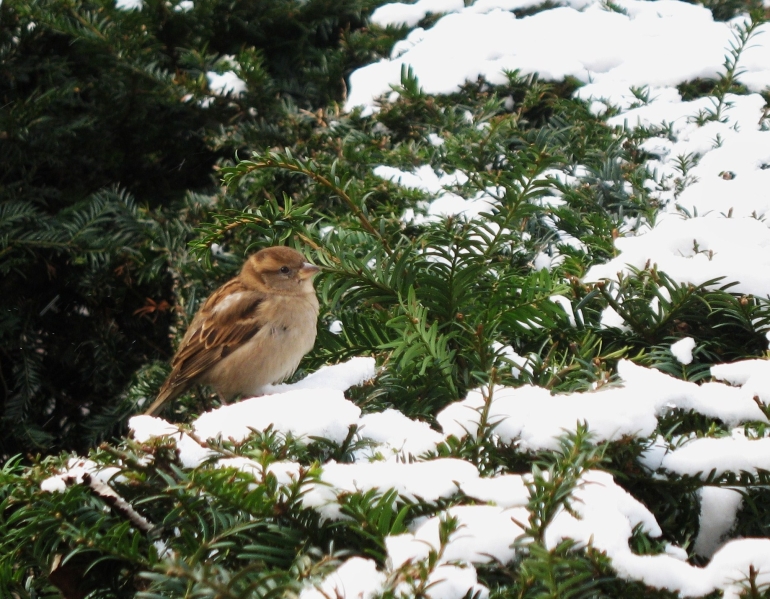
I have been photographing so many birds recently that one of my first thoughts upon arrival in Brussels yesterday was to look for birds. I did manage to get a few shots of some sparrows in a small park near the Central Train Station, the neighborhood in which my hotel is located. However, I quickly realized that the 4X zoom of my little Canon A620 is a limiting factor in getting close enough for a decent shot. I also know that at 7.1 megapixxels, I can’t afford to dramatically crop the photos.

I’m happy with these two images. I captured the first sparrow on a snowy evergreen bush. Snow may not be special to many, but my part of the USA has seen only a very small amount of snow this year. The second sparrow is perched on the railing surrounding the plants and is looking into them. I think he was singing so much that the bottom part of his beak is blurred.

I haven’t yet been able to identify these sparrows, but I wonder if they are different from the ones that I typically see in suburban Virginia.

Sparrow in Brussels

Sparrow in Brussels

Sparrow on a fence

Sparrow on a fence

© Michael Q. Powell. All rights reserved

Read Full Post »

It was almost 60 degrees (15 degrees C) when I left home, but it was well below freezing when I arrived in Brussels this morning. Although I usually try to stay awake when I first arrive, it was so dark and gray that I decided to take a nap first. Eventually the sun came out and I went for a little walk in the city center, though the cold and wind drained the power quickly from the batteries of my point-and-shoot camera and made it a little uncomfortable.

Last fall when I was here, I posted some photos of the main square of the city, the Grand-Place. The light was so beautiful today that I decided to post another shot of one of the buildings on that square, the city hall building. The perspective lines are distorted, but I think you can see how beautiful the building is. I am also including a photo of the bell tower of one of the churches here. It is considerably less ornate than the buildings on the Grand-Place, but I find it equally captivating.

City Hall in Brussels

City Hall in Brussels

IMG_1828

© Michael Q. Powell. All rights reserved

Read Full Post »

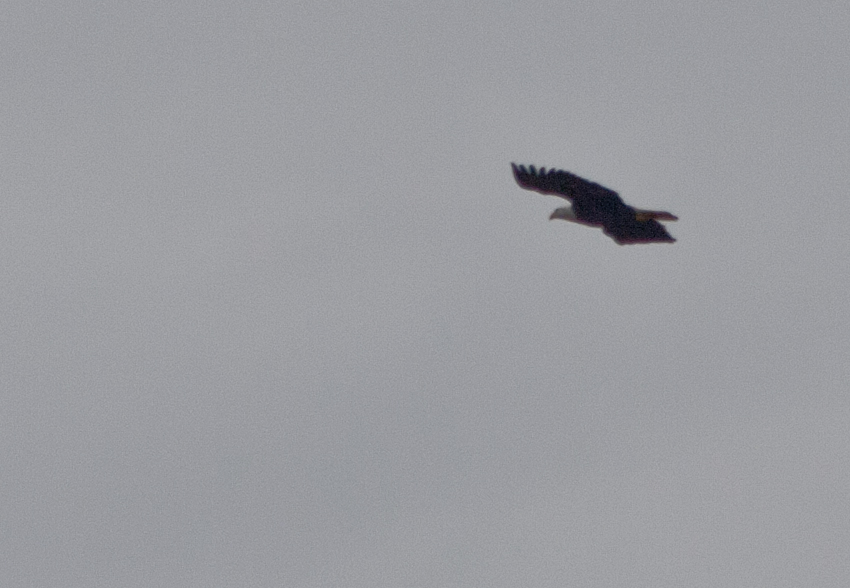
Yesterday I was observing ducks, geese, and gulls in one of the ponds at my local marshland, when suddenly they all took to the air. It seemed to me that something had spooked them and I quickly scanned the ground area and the water and found nothing. When I turned my eyes to the sky, however, I discovered a relatively large bird flying  across my field of vision in the distance

The day was dark and gray and rain clouds covered the sky, so the lighting was not very good. The poor lighting and the fact that the bird was so far away made it tough for me to lock on the focus of the camera, so I was able to snap off only a couple of shots before the bird disappeared completely in the distance.

The flight of the bird did not look like that of the vultures that I have photographed, so I thought that perhaps I had photographed a hawk, though it was hard to know for sure from the image on the little LCD screen of my camera. When I viewed the images on my computer, I was thrilled to discover that I had finally photographed a Bald Eagle (Haliaeetus leucocephalus). Maybe it’s because of the symbolism attached with the bald eagle—all I know is that I felt really happy with my discovery.

These two images are not really that clear and I hope to get better ones in the future. In many ways, I am continuing what I recognize as a pattern in my shooting. The first time I capture a new subject, I am so excited that I will share the image, irrespective of its quality. The second time, the quality of the image normally increases dramatically.

eagle2_blogeagle1_blog

© Michael Q. Powell. All rights reserved

Read Full Post »

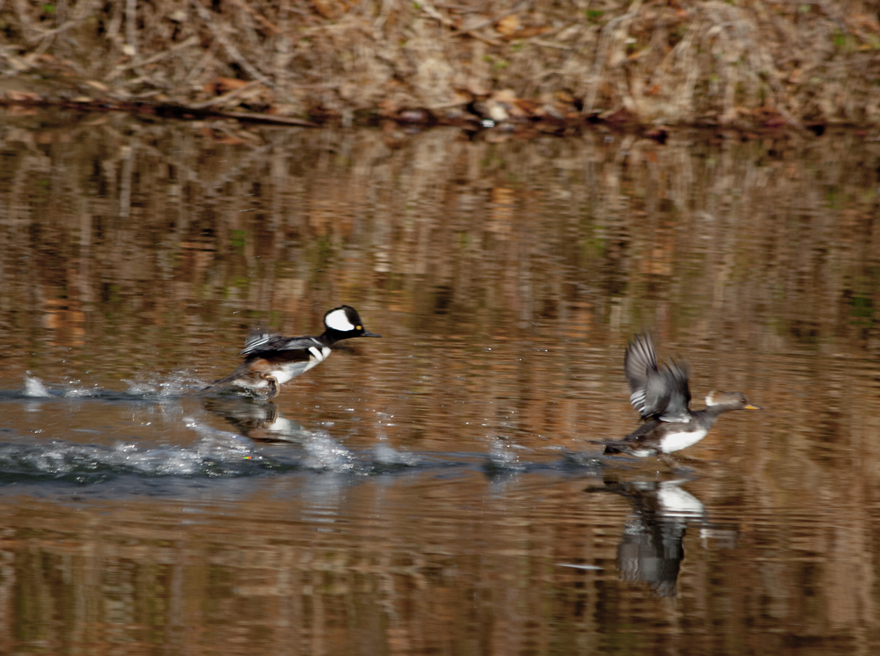
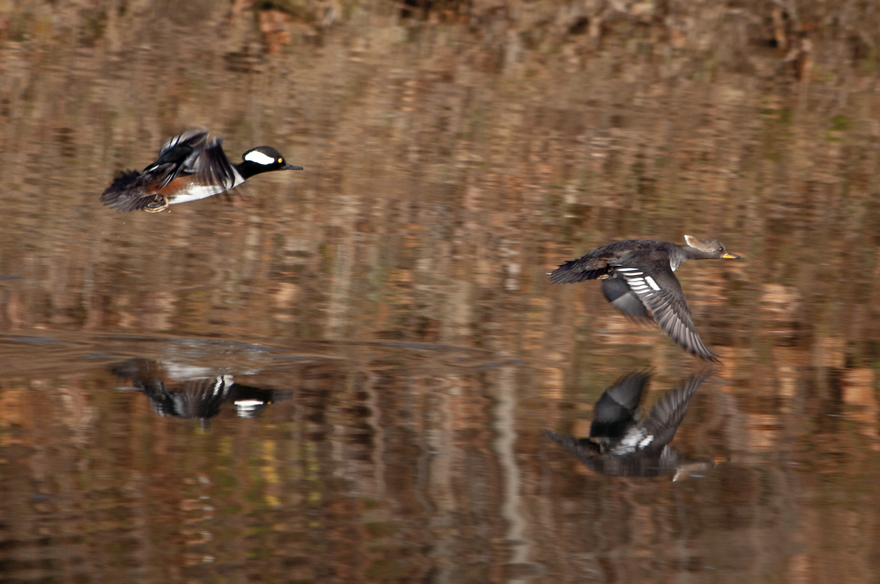
I stumbled upon a pair of Hooded Merganser ducks (Lophodytes cucullatus) at Lake Cook, a tiny urban lake, shortly after I photographed a Belted Kingfisher this past weekend. As soon I spotted them, they also became aware of my presence and immediately took evasive action. In most cases in the past, that has meant that they started swimming away. This time they seemed to have decided that more decisive action was needed and they immediately took off.

Fortunately my camera was already in my hands and the settings were about the right ones for the situation. When I started photographing birds, one of the more experienced birders whom I met recommended keeping the camera set for burst mode and that’s where I keep it most of the time now. Occasionally that means I shoot off a few extra exposures unintentionally when my trigger finger is a little heavy, but sometimes it lets me get an exposure I might not have gotten otherwise. Now, let me be clear that my almost ancient Canon Rebel XT is not a professional DSLR, so burst mode means about three frames a second, which worked out this time.

I fired off a half-dozen frames as the two ducks, a male and a female, took off from the water and I am pretty pleased with the results. It looks like the ducks get a running start on the water before they take to the air. The photo of the male duck that I featured at the start is the second one in the chronological sequence, but I thought it was the most interesting in showing the little water “explosions” as the ducks skipped across the surface. The rest are pretty much self-explanatory. I especially like the way that the heads flatten out into more aerodynamic shapes as the ducks start flying and the reflections are pretty nice. A couple of the shots are cropped to show only the male duck, because his position happened to bemore interesting than that of the female in the image (no discrimination intended).

Takeoff2_blogTakeoff1_blogtakeoff3_blog Takeoff4_blog

© Michael Q. Powell. All rights reserved

Read Full Post »

On rare occasions I can anticipate a photo opportunity as a series of actions seems to heading towards an inevitable conclusion. That was the case this past weekend.

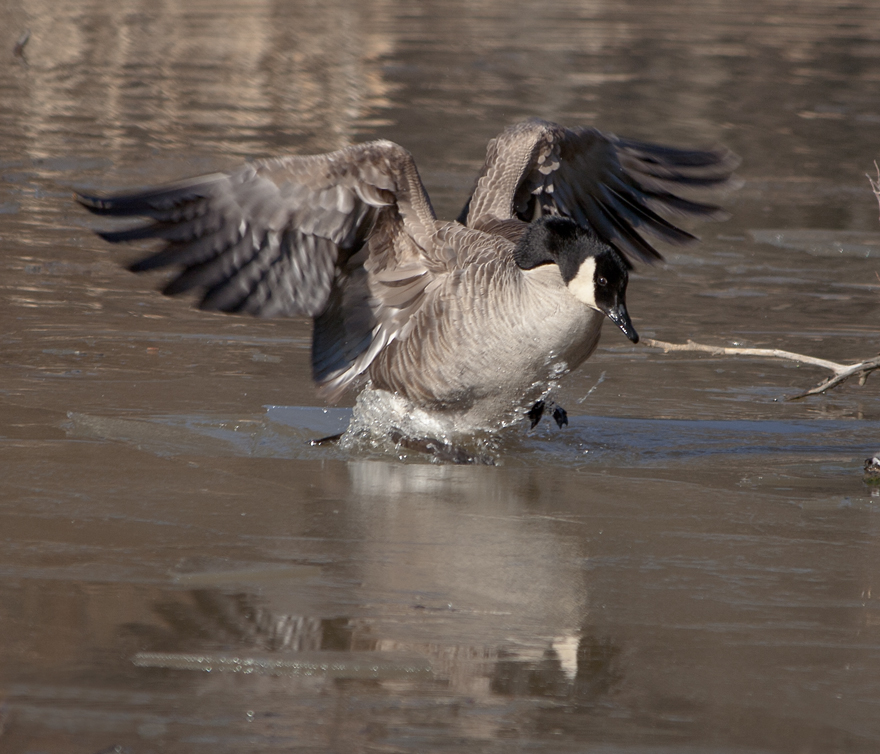
The weather here has warmed up and the layer of ice on the ponds has started to melt a bit. I watched as a mixed group of Canada Geese and Mallard Ducks started walking across the iced-over beaver pond.

A duck walked past a branch sticking out from the ice and I thought I detected some water, suggesting to me that they were walking on thin ice. A goose (in the second photo) looked down at the ice and made a mental calculation that it was safe to cross. His calculations proved to be wrong as he broke through the ice and started to sink into the water. I caught his initial reaction in the third photo. I especially like the startled look in his eyes.

Without further delay, he flapped his wings and was able to lift himself out of the water. The photo I took of that moment is the first one shown on this blog posting and is my favorite. I am happy that I was able to capture a lot of the the details of the wings and of the ice. You can see, for example, the sheets of ice that have broken off on either side of the goose. I also like the sense of action in the position of the goose, a moment frozen in time (sorry about the obvious pun).

I always feel a little strange when I post a series of action shots in non-sequential order, but I worry that folks won’t stay around to see the dramatic conclusion if all they see is the first shot (which is not that exciting, but is an important part of the story). That is why I led with the conclusion, thereby giving away the end of the story. Maybe I need to employ the kind of techniques used in television, “Stay tuned as this goose rescues himself from the frozen waters of the pond…”

Breaking the ice

Breaking the ice

Testing the ice

Testing the ice

Starting to go under

Starting to go under

© Michael Q. Powell. All rights reserved

Read Full Post »

On an overcast day last week, I came across this Northern mockingbird (Mimus polyglottos), silhouetted against an almost white sky. As I was focusing on him, he hopped to a slightly higher branch. He didn’t flap his wings at all, and I managed to catch him in mid-air.

hopping_blog

The image was underexposed and as I played with it to bring back some of the details, I realized it was already almost black and white. It was not a far stretch to desaturate the photo and play around in black and white. In fact, it was so much fun that I decided to work on a second photo of the same mockingbird.

mocking2_blog

I think I need to work on my techniques a little more, but I like the initial results of my dabbling in black and white.

© Michael Q. Powell. All rights reserved

Read Full Post »

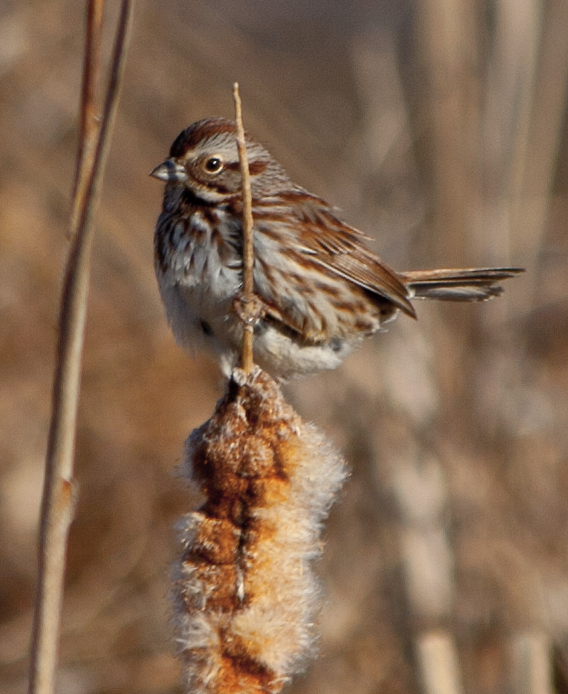
Last month I featured a photo of an American Tree Sparrow (Spizella arborea), a species that is among the most visible and active during the cold, gray days of winter. I should probably caveat my statement about the sparrows being visible, because they are usually only partially visible as they root around in the tangled undergrowth and move quickly from place to place.

Occasionally I manage to get a somewhat clear shot of the American Tree Sparrow and I decided to share a couple of them this morning. The first one shows the sparrow in what I consider his most “natural” environment, mostly surrounded by vines and branches. I like the way he just poked out his head, permitting me to get a clear profile shot. The second image shows a sparrow at the top of cattail, a place where I rarely see them, which made it a little easier to get a clear shot.

Although I may not show photos of some of these smaller birds as often as I post photos of ducks, geese, and herons, I am attempting to photograph them almost every time that I am out shooting. I enjoy the challenge, even if my success rate is relatively low.

sparrow_blogsparrow2_blog

© Michael Q. Powell. All rights reserved

Read Full Post »

Birders, I’m finding out, are an excitable breed. Sometimes they travel in flocks and sometimes alone. You can often identify them by their binoculars and spotting scopes and sometimes their cameras with enormous camouflaged lenses. They have special apps on their smartphones and frequently can be observed with their heads buried in one of the numerous identification guides they may be carrying.

I encountered a very excited member of this species as I passed by the bird feeders at my local marshland park this past weekend. He had his camera—with a large lens and flash—set up on a tripod pointed at the feeder.  Crouching in the shadows with a remote release in his hand, he was obviously waiting for something.

Before I could pose the obvious question, he asked me in a whisper if I also was there to photograph the Wilson’s Warbler. He must have mistaken me for one of his own kind, probably because I had a camera with a telephoto lens around my neck. I got the impression that this bird was rarely seen here and that word had circulated in birding circles of this find. Suddenly he snapped a few photos and went rushing off into the underbrush, saying that a fellow birders had alerted him that the bird had also been seen near one of the benches in the park. His closing words to me were that the warbler had been timed as coming back to the feeder every four to five minutes.

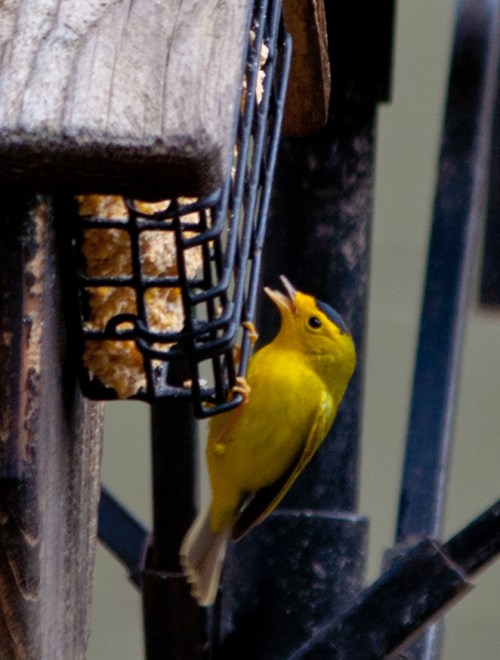
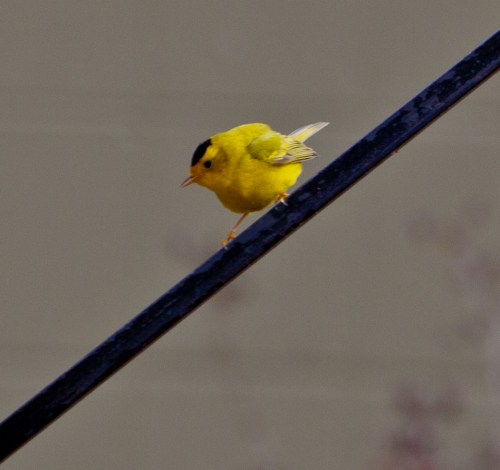
Caught up in the excitement, I waited near the feeder with my camera. The only problem was that I did not have a clue what a Wilson’s Warbler looked like. How was I going to photograph it if I couldn’t identify it? An assortment of Downy Woodpeckers and nuthatches arrived and departed at the feeder and I was beginning to despair that I would see this elusive bird, when all of the sudden I saw a flash of bright yellow. It was a small yellow bird, a welcome sight on a gray late December day, and over the course of the next fifteen minutes or so I attempted to take his picture.

When I arrived home, looked at my photographs on my computer, and did a little research, I realized that I had photographed a Wilson’s Warbler (Wilsonia pusilla or Cardellina pusilla). Judging from the range maps on the Cornell Lab of Ornithology website, Virginia is on the migratory path for these birds, which breed in the northern and western parts of North American and winter in the tropics.

I am not used to photographing birds at a feeder, but managed to get a few interesting shots of the Wilson’s Warbler. To avoid scaring off the bird, I was at a pretty good distance from the feeder,  so I had to crop the images quite a bit. I am quite content, though, that I have managed to capture some of the essence of this happy little bird.
Wilson's Warbler Walking

Wilson’s Warbler Walking

Wilson's Warbler Hovering

Wilson’s Warbler Hovering

Wilson's Warbler Feeding

Wilson’s Warbler Feeding

© Michael Q. Powell. All rights reserved

Read Full Post »
This past weekend there was a thin layer of ice on many of the little ponds at my local marshland park. I thought the ice would deter the migrating ducks and geese from stopping in, but I was wrong. Perhaps they just needed a break from flying.

It seemed unusual enough that I took some photos of the ducks walking on the frozen water. The first two images are pretty straightforward, but I tried to be a little creative in framing the third image, as a female duck contemplates the vast expanse of the ice in front of her.

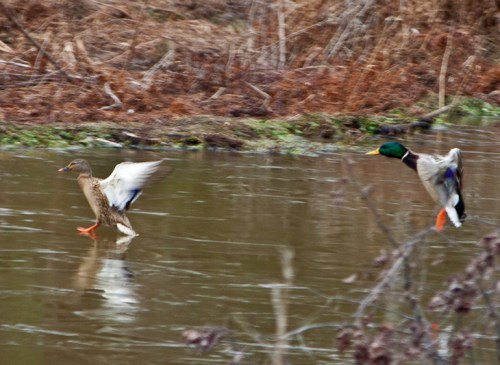
I even tried to capture a duck landing on the ice in the last photo. A female duck is making a soft landing as her male companion prepares to come in right behind her. It’s not really sharp, but it gives you the idea. I had previously thought that the ducks would aim to land in the water that had not yet frozen, but obviously the ducks know what they are doing.

I never know what I will find when I venture out into nature—it’s one of the reasons that I keep returning to the same places, in hopefeil expectation of new surprises.

cold_duck1_blogduckwalk_blogice_duck_blogice_landing_blog

© Michael Q. Powell. All rights reserved

Read Full Post »
« Newer Posts