Feeds:
Posts
Comments

Archive for the ‘wildlife’ Category

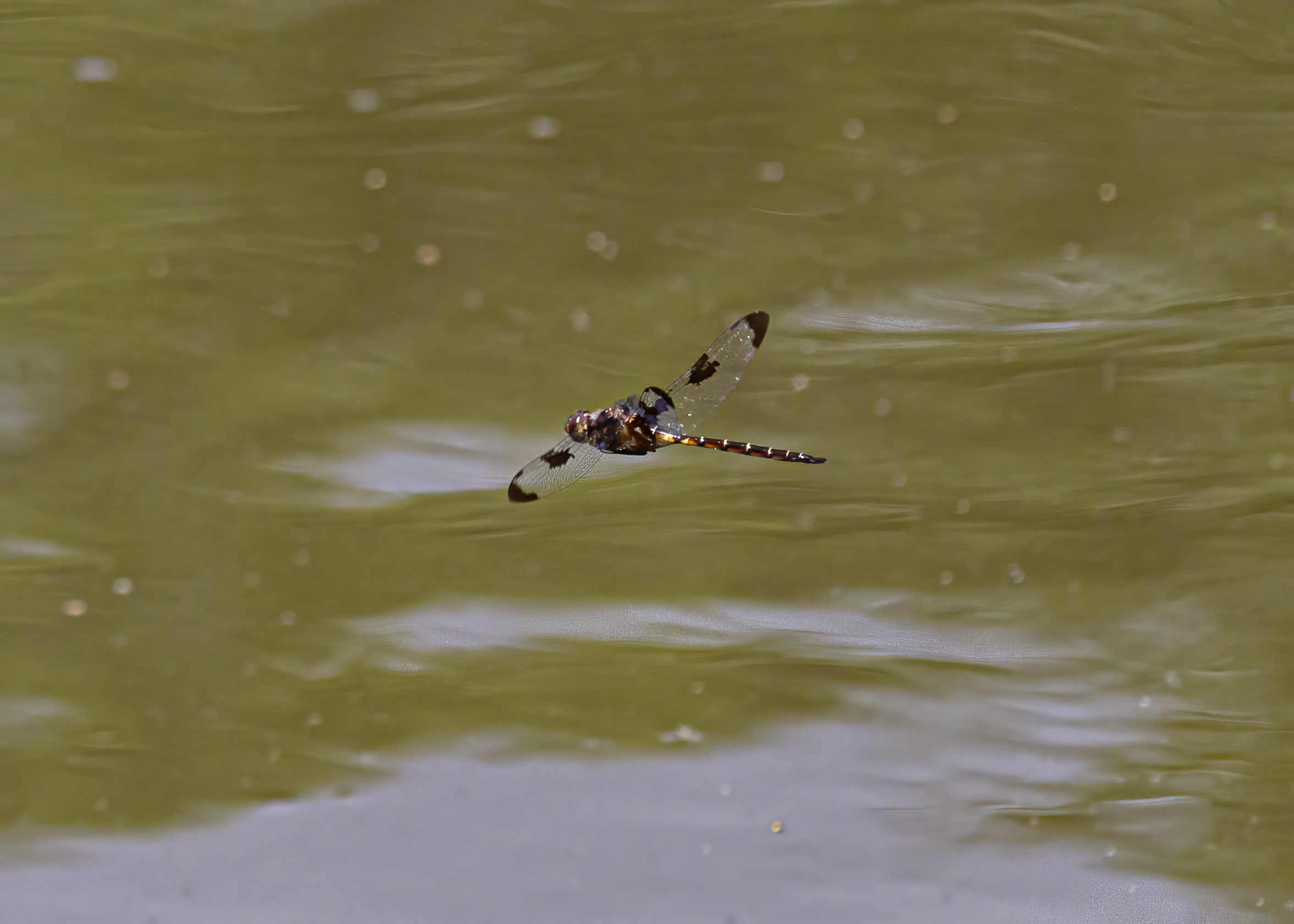
On Monday I was thrilled to spot this Prince Baskettail dragonfly (Epitheca cynosura) flying patrols over the small pond at Jackson Miles Abbott Wetland Refuge. Previously I had spotted Common Baskettails doing the same thing at this location—see my recent posting Common Baskettails in flight—but they seem to have been supplanted by the Prince Baskettails. How do you tell them apart? Although they are both part of the Emerald family, only Prince Baskettails have patterned wings, as you can see in these photos.

I really like the description of this species on the Dragonflies of Northern Virginia website:

“This sleek, elegant dragonfly could in fact be called King Baskettail, as it is the largest member of the Emerald family. There are seven families of dragonflies in the US–Emeralds are known for their glowing green eyes (hence the family name), and their endless, acrobatic flight. Like other members of this family, Prince Baskettails rarely land and can spend many hours in ceaseless flight. Look for this powerful flier making long, repeated, low patrols over open water habitats such as lakes, ponds, canals, and sluggish river sections.”

As a result of the repeated patrols, I was able to track the dragonfly as it flew by me and capture these images. The dragonfly did not get really close to the bank on which I was standing, so my autofocus would not detect my subject and I had to resort to focusing manually. I am pretty happy with the results and I encourage you to click on the images to see the beautiful markings on the body of this Prince Baskettail dragonfly.

Prince Baskettail

Prince Baskettail

Prince Baskettail

© Michael Q. Powell. All rights reserved.

Read Full Post »

Although Blue Dashers (Pachydiplax longipennis) are among the most common dragonflies in my area during the summer, they are very special to me. I remember visiting a photography show by my dear friend Cindy Dyer in 2012, I believe, and marveling at the photos that she had taken of Blue Dasher dragonflies. I decided that I wanted to be able to take photos like hers of these beautiful creatures.

I went out on numerous occasions and she taught me a lot about both the creative and technical sides of photography. She also served as a muse to me, encouraging me and gently pushing me along my path. She had a well-established blog and decided that I needed one too, so on 7 July 2012, she sat me down I created my blog. My first blog posting on the same day was entitled Blue Dasher dragonfly and it featured a male Blue Dasher dragonfly in the obelisk position, similar to the pose of the dragonfly in the final photo in today’s post. That’s one of the main reasons why Blue Dashers are so special to me.

I spotted these Blue Dashers, all of which are males, on Monday during a brief visit to Jackson Miles Abbott Wetland Refuge. Each of the three photos represents a different approach I used in attempting to capture the”feel” of my encounters with these dragonflies. The first image shows the details of colors and patterns of the body quite well. The second image gives you a sense of their environment. The final photo focuses on the obelisk pose that is believed to be a form of thermoregulation—by raising its abdomen the dragonfly reduces its exposure to the direct sunlight on hot days.

Some days I will post only a single photo, but most often I enjoy posting a small set of photos that complement each other and provide different perspectives on the living creatures that I love to photograph. Beauty is everywhere.


Blue Dasher

Blue Dasher

Blue Dasher

© Michael Q. Powell. All rights reserved.

Read Full Post »

How many views does one of my blog posts need to get for me to consider it “successful” or “popular?” On a good day, my blog receives about 100 views, of which 60 may be related to that day’s post. If a post receives over a 100 views over time, I’ll consider it to be one of my top posts.

However, WordPress has a mind of its own, and the most-viewed postings, in my view, are not necessarily the best-written ones or the ones with my best photos. Some of the posts continue to receive views years after they were written thanks to searches on Google and other search engines. Even then, some subjects seem to go in and out of popularity on the search engines as a result of ever-changing algorithms.

For many years, my most popular blog posting was one from 4 November 2014 entitled Rescue of an Injured Bald Eagle that documented the rescue of the eagle by an a county animal control officer at my local marshland park. I was lucky enough to be present during the rescue operation and my photos (including a link to my blog posting) were picked up by several on-line news organizations in the Washington D.C. area. As a result, that posting has had 3,475 views to date, including 3,290 views during the initial month of the posting.

Bald Eagle rescue

This month, another blog posting has taken over the lead from the posting of the eagle rescue. My new top post is now a 9 May 2016 blog posting called Blue-eyed Garter Snake. Although this posting had only 70 views during its initial month, it now has had 3,512 views, including 438 views in 2023.

garter snake

Another posting may soon overtake the eagle rescue posting. The 3 August 2013 posting entitled Fuzzy White Caterpillar currently has had a total of 3,442, only 72 of which came during its initial month. Neither the writing or the photos in that posting are all that great, but I suspect that the title is so generic that it comes up often in Google searches.

fuzzy white caterpillar

One final contender for the top post is a 31 August 2013 posting entitled Red-footed Cannibalfly. This posting has had 3,169 views, of which 61 came in its initial month. For five years in a row it had over 350 annual views and appeared on the first page of Google results. Something changed, however, and it has fallen in the Google rankings since 2018, though it still appears as the fifth entry in a Bing search of “Red-footed Cannibalfly.”

red-footed cannibalfly

To be perfectly honest, I do not really care that much about views. I use this blog as a means to express myself creatively in my writing and in my photos. I am grateful for the modest success that I have enjoyed and even more thankful for the community of supportive people who have encouraged and supported me over the years.

I made my first posting on 7 July 2012, so I will soon be celebrating an anniversary. According to WordPress, my postings have had 403,801 views to date and I am thankful for each and every one of them and for all of you.

© Michael Q. Powell. All rights reserved.


Read Full Post »

During a recent visit to Jackson Miles Abbott Wetland Refuge I was delighted to spot a female Eastern Amberwing dragonfly (Perithemis tenera) as she was depositing her eggs in the vegetation in a small pond. Initially she would hover for a moment, as you can see in the first image, and then dip the tip of her abdomen straight downwards to release some eggs, as shown in the second image. The dragonfly repeated this process multiple times at this spot before moving on to other spots.

I have observed this process multiple times, but have rarely been able to photograph it. Eastern Amberwings are the smallest dragonflies in my area and are only about an inch (25 mm) in length, so they are a challenge to photograph. Fortunately when the female is ovipositing, she hovers a bit, which gives me time to focus on her. Sharp-eyed viewers may have noticed that the wings of this dragonfly have patterns, but are not amber in color—only male Eastern Amberwings have amber wings.

Eastern Amberwing

Eastern Amberwing

© Michael Q. Powell. All rights reserved.


Read Full Post »

Whenever I see a dragonfly in flight when I am traipsing about with my camera, I can’t help but stop and try to get a photograph of the dragonfly in the air. My success rate in not high, but sometimes I am able to capture a good image as the dragonfly zooms by me.

In mid-June I spotted a Common Baskettail dragonfly (Epitheca cynosura) as it flew back and forth over the pond at Jackson Miles Wetland Refuge. During one of its passes I managed to freeze its motion in this shot. I like the way that you can see all four wings and also the distinctive markings on its body. The bluish-green eyes really “pop” and if you look really closely, you can see the that the dragonfly folds its legs under its thorax (the torso part of its body) while it is flying.

I returned yesterday from my five-day trip up to Massachusetts and Maine to deal with a family emergency. Hopefully I will be able to get out this week and capture some new images. It’s hard to believe that it is already July.

Common Baskettail

© Michael Q. Powell. All rights reserved.

Read Full Post »

I just wanted to alert readers who may be used to me publishing a blog posting almost every day that I will be absent from this space for the rest of this week. A family emergency requires me to travel to Massachusetts and Maine and I will not have access to the internet for most of this time.

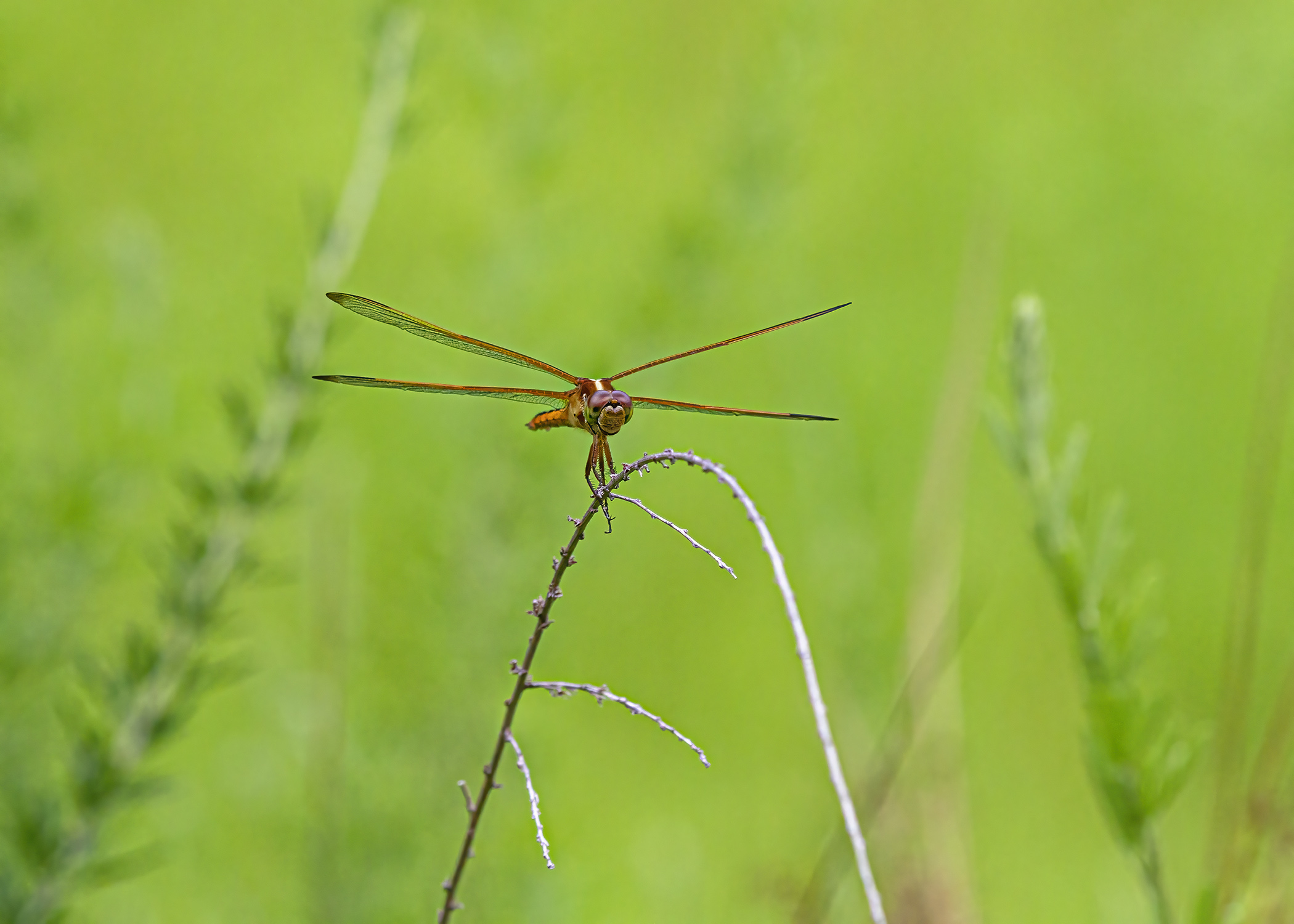
I decided though to leave you with a shot of a dragonfly facing away. While I was exploring Occoquan Regional Park earlier this month, I managed to get only a single angled view of this dragonfly before it flew away, but it was enough to confirm that it was my first Carolina Saddlebags dragonfly (Tramea carolina) of the season. Despite the odd angle, I was able to capture the patches on the hind wings that are thought to resemble “saddlebags” and its distinctive red color, so identification was not a problem.

I really like the colors and patterns of this shot, which has more of an “artsy” feel rather than a “scientific” one. Normally eye contact is desirable with a subject, but I look at that “rule” as more of a suggestion than a requirement.

Carolina Saddlebags

© Michael Q. Powell. All rights reserved.


Read Full Post »

Dragonflies and damselflies have rather limited lifespans after they emerge from the water and are transformed from aquatic nymphs into aerial acrobats. One of their biological imperatives is to perpetuate their species, so it is not unusual to see mating activity during this time of the year that is primetime for dragonflies and damselflies.

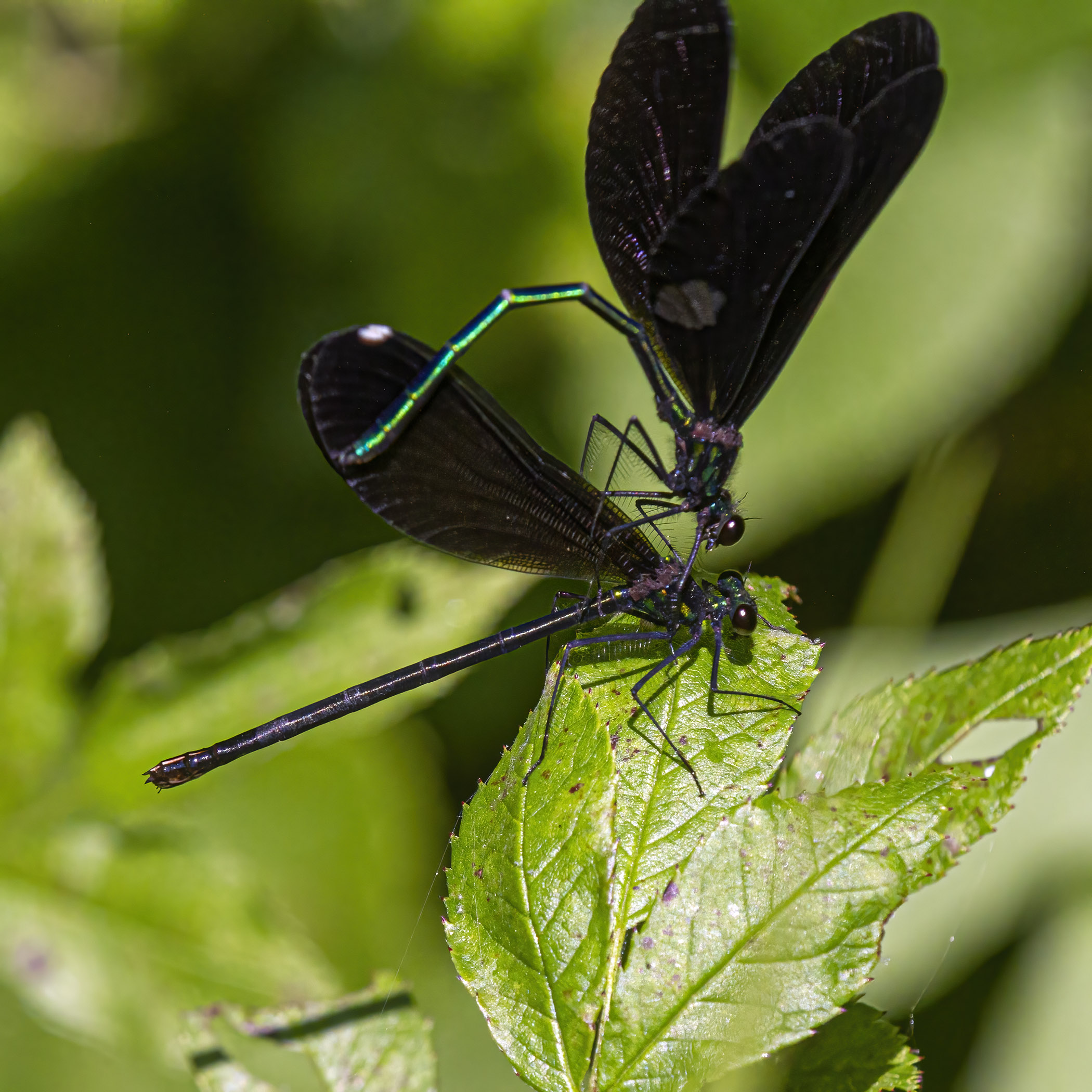
On a trip earlier this month to Occoquan Regional Park, I spotted this pair of Ebony Jewelwing damselflies (Calopteryx maculata) in their distinctive sidewards-heart mating position. I am really happy with this image because I was able to use my shooting angle and camera settings to keep the bodies of both damselflies in focus and achieve a blurry background that allows a viewer to focus on the damselflies without any visual distractions.

In case you are curious, the damselfly to the left is the female and the one with the shiny green body is the male. You can tell the genders from the mating position and from the little white patch on the wings that is present on female Ebony Jewelwings and not on the completely dark wings of the males


Ebony Jewelwing

© Michael Q. Powell. All rights reserved.
Read Full Post »

This handsome Common Green Darner dragonfly (Anax junius) does not have all of the colors of the rainbow, but it does have many of them and I love its mix of vibrant colors. The dragonfly was perched vertically really low in the vegetation when I spotted it during a recent to Occoquan Regional Park. I ended up sprawled almost flat on the ground to get this shot—my position would have made for an amusing photo, but fortunately no one else was around to capture that moment.

Mature male Common Green Darners have bright blue abdomens. The reddish pink color of this dragonfly’s abdomen suggest to me that it is an immature male. Early and late in the season, the abdomens of male Common Green Darners may appear purple. Common Green Darners have dark-colored platelets in their blood that rise to the surface when it is cold, darkening their abdomen color and attracting more sun. On bright, hot days, those dark platelets sink, and the abdomen turns bright blue again, now reflecting light.

Common Green Darner

© Michael Q. Powell. All rights reserved.

Read Full Post »

Last week I managed to capture a series of images of a hook-up between two Ebony Jewelwing damselflies (Calopteryx maculata). Initially I was focused on a female that was perched on a leaf, but then noticed a male who was circling around her. According to Wikipedia, “Calopteryx males will hover in front of a female with alternating fast and slow wingbeats; if she is receptive she will remain perched, otherwise she will fly off.” This female remained in place, so the male moved in, as you can see in the first three photos.

During mating, the male uses claspers at the tip of his abdomen to grasp the female behind her head tightly enough to resist the attempts by other males to dislodge him, a position sometimes called “tandem.” The male then flexes his abdomen to encourage the female to loop her abdomen round to interlock with him, forming the “wheel’ position,” the sidewards-heart position shown in the final photo.

I suppose that I could leave the description here, but the process that was taking place was so weird and fascinating that I thought I should explain what is going on. In order to keep from getting too graphic, I will borrow some language from Wikipedia.

“Mating in damselflies, as in dragonflies, is a complex, precisely choreographed process involving both indirect insemination and delayed fertilization….When he (the male) is ready to mate, he transfers a packet of sperm from his primary genital opening on segment 9, near the end of his abdomen, to his secondary genitalia on segments 2–3, near the base of his abdomen. The male then grasps the female by the head with the claspers at the end of his abdomen; the structure of the claspers varies between species, and may help to prevent interspecific mating… The female then curls her abdomen downwards and forwards under her body to pick up the sperm from the male’s secondary genitalia, while the male uses his “tail” claspers to grip the female behind the head: this distinctive posture is called the “heart” or “wheel.”

Wow! I think I will leave it at that. Suffice it to say that the process is complicated and the participants have to be incredibly flexible.

Ebony Jewelwing

Ebony Jewelwing

Ebony Jewelwing

Ebony Jewelwing

Ebony Jewelwing

Ebony Jewelwing

© Michael Q. Powell. All rights reserved.

Read Full Post »

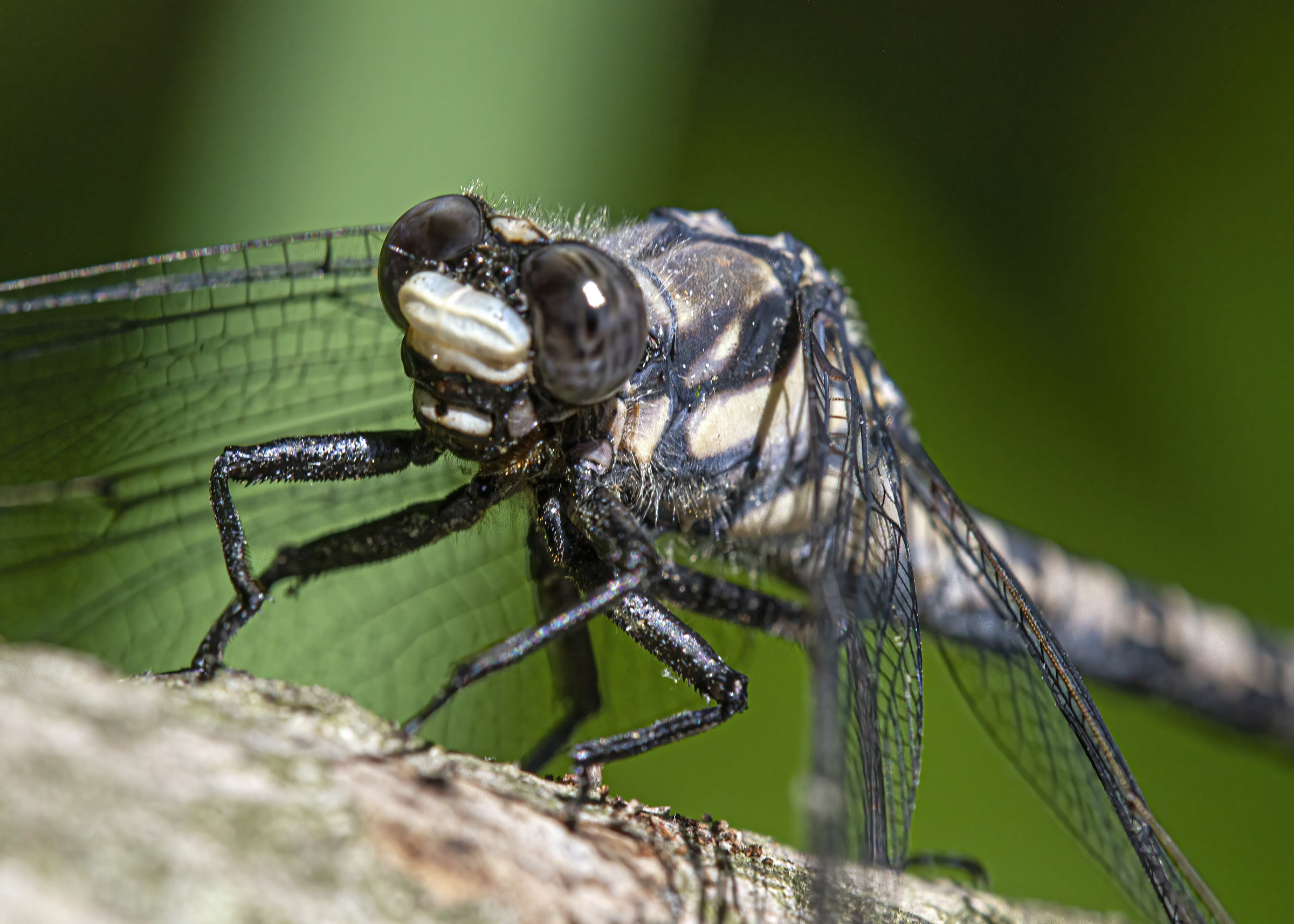
This Gray Petaltail dragonfly (Tachopteryx thoreyi) was quite cooperative and let me take a close-up portrait last week as I was exploring a small pond in Fairfax County, Virginia. Gray Petaltails are known to be quite friendly and inquisitive and I have had one perch on me on multiple occasions. During one such encounter in 2019, fellow dragonfly enthusiast Walter Sanford snapped a couple of photos of one perched on me when I was wearing a gray sweatshirt that must have made me look like a tree to the dragonfly. If you want to see the photos, check out Walter’s blog post entitled “You look like a tree to me.

Most of the time I am not able to approach a dragonfly from this angle to get a close-up shot. Dragonflies have incredible vision and I am certain that this one could see me coming. However, he apparently did not see me as a threat and stayed in place while I took several shots. As you can see, the depth of field was incredibly shallow for this shot—only a small portion of the dragonfly’s body was in focus—but I was able to keep the striking gray eyes in focus and capture a lot of details that highlight their beauty.

Gray Petaltail

© Michael Q. Powell. All rights reserved.

Read Full Post »

There were lots of Slaty Skimmers (Libellula incesta) flying about on Tuesday at the small pond at Jackson Miles Abbott Wetland Refuge, but none of them were cooperative in perching within range. They seemed to content to buzz around over the lily pads and land occasionally in vegetation overhanging the water—I was willing to lean a little to get closer to the dragonflies, but did not want to risk falling into the water.

Slaty Skimmers are one of our most common summer dragonfly species and they find themselves at home in almost any habitat. The mature males are really easy to identify because of their dark bodies and eyes. Immature males and females are a lot harder to distinguish from a number of other species in the skimmer family, like the Great Blue Skimmer and the Bar-winged Skimmer.

Slaty Skimmer

Slaty Skimmer

© Michael Q. Powell. All rights reserved.


Read Full Post »

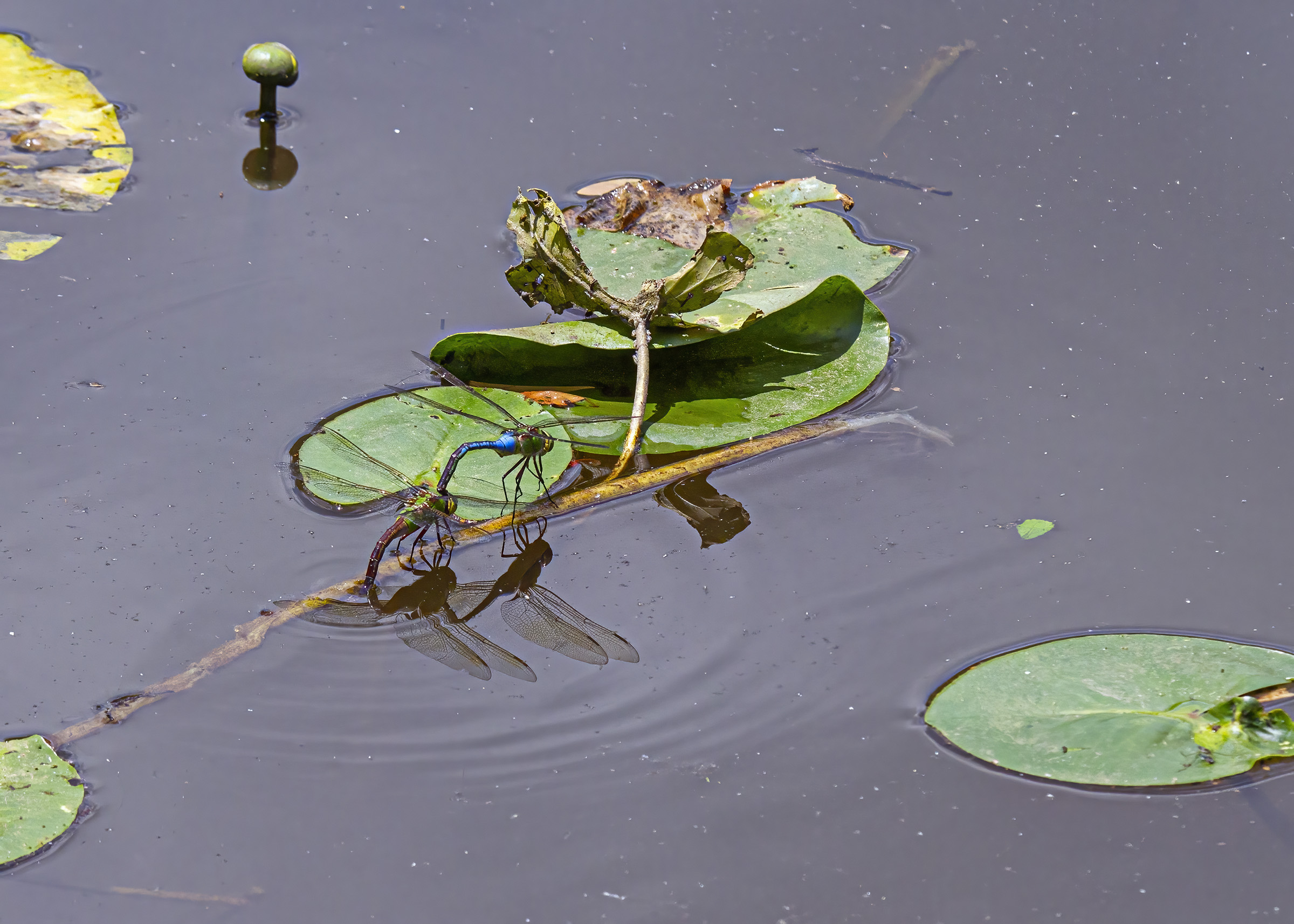
I spotted a female Common Green Darner dragonfly (Anax junius) as she was ovipositing while her male partner held onto her last Saturday at the edge of the small pond at Jackson Miles Abbott Wetland Refuge. Common Green Darners are large dragonflies—about 3 inches (76 mm) in length—so it was relatively easy to track the pair as they moved about placing eggs in various patches of vegetation in the water.

After mating takes place, the males of some species of dragonflies disappear.  In other species, the male stays nearby, guarding the female and fending off other males that might remove the initial suitor’s sperm and replace it with their own.  Some species, like this Common Green Darner, remain attached to the female in a position known as “tandem.” while egg-laying takes place.  The female Common Green Darner submerges her abdomen and lays her eggs in or on the aquatic vegetation, as you can see in these images. If you look really closely at the first image, you can see what I believe is the dragonfly’s curved ovipositor that she uses to make a little slit into the vegetation in which to place the eggs.

According to an article on Animal Diversity Web, there are two different lifecycles for Common Green Darners, one for the dragonflies that have migrated northward and one for the resident population. “Migratory adults mate and oviposit in June. Unlike resident populations, nymphal development for migrant offspring takes only 3 to 5 months, and they do not overwinter. They emerge as tenerals typically around late-August and September. They often begin their migration as tenerals, feeding along the way and developing into adults.” The timing of the activity that I observed suggests that these could be migrant Common Green Darners.

“For residents in the north, the adults mate and oviposit in late July to August. The resulting offspring hatch and develop to mid-instars and then overwinter when temperatures drop. Total nymphal development time can take 11 to 12 months for residents, as the nymphs finish development when temperatures warm in the spring and then emerge as adults in the following June and July.”

I highly recommend the article that I referenced, which has lots more fascinating information about this colorful dragonfly species.

Common Green Darner

Common Green Darner

Common Green Darner

Common Green Darner

© Michael Q. Powell. All rights reserved


Read Full Post »

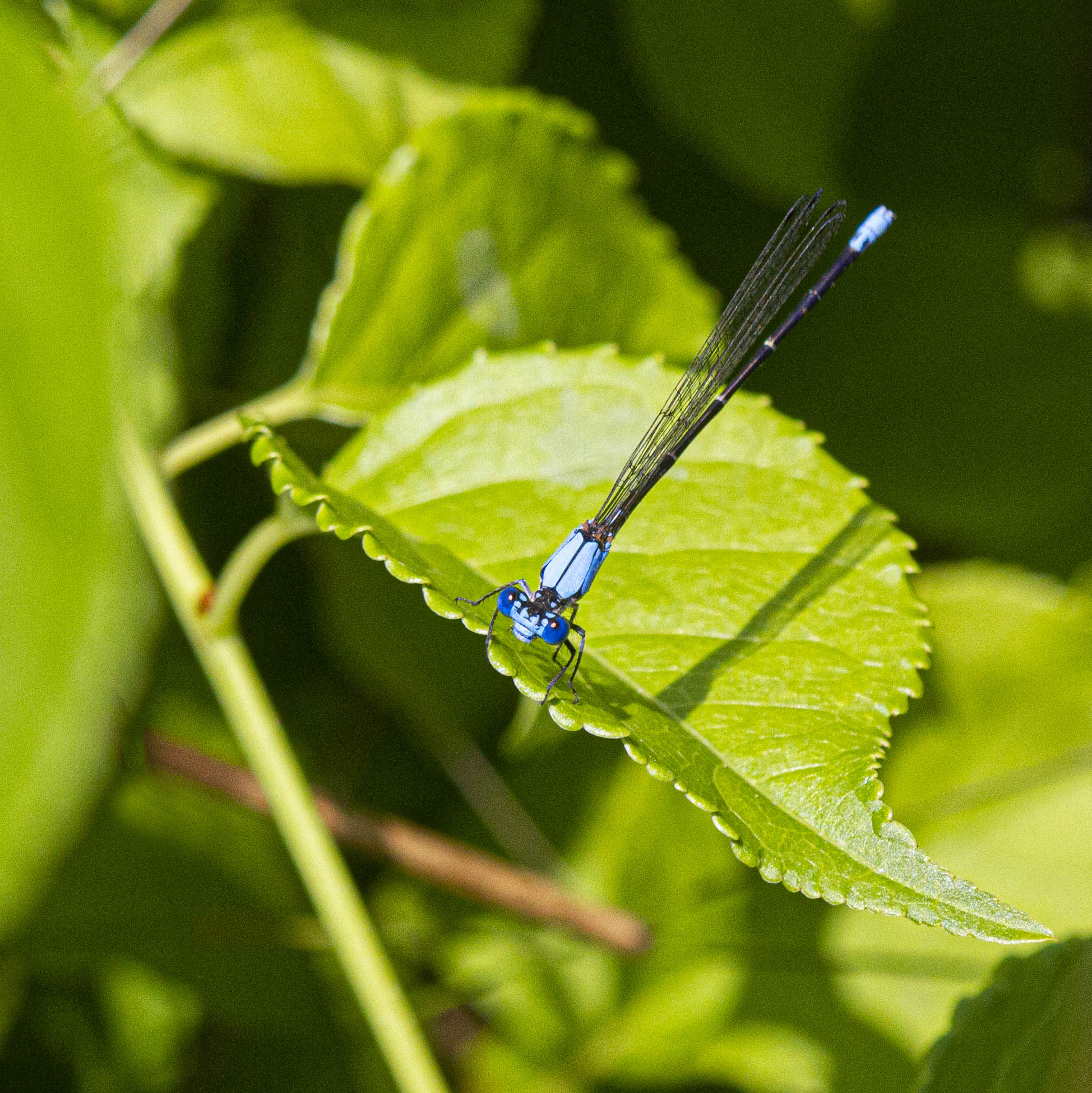
Many damselflies have distinctive shoulder stripes, but the thoraxes of Blue-fronted Dancers (Argia apicalis) are almost completely blue and have only hairline black stripes. Last Saturday I was delighted to spot some Blue-fronted Dancers at the small pond at Jackson Miles Abbott Wetland Refuge, my first sighting of this species this season. Although the blue thorax made them easy to identify, what really struck me were their brilliant blue eyes, a feature that I had never noticed before. Wow!

I was able to photograph these damselflies on various locations as I repeatedly circled the pond. Periodically I would glance out at the water, where several families of Canada Geese were swimming around with their almost grown goslings. In the final photo, you can see one of the feathers from the geese, a quirky and almost whimsical addition to my photo of the Blue-fronted Dancer—I really like that image.

Blue-fronted Dancer

Blue-fronted Dancer

Blue-fronted Dancer

© Michael Q. Powell. All rights reserved

Read Full Post »

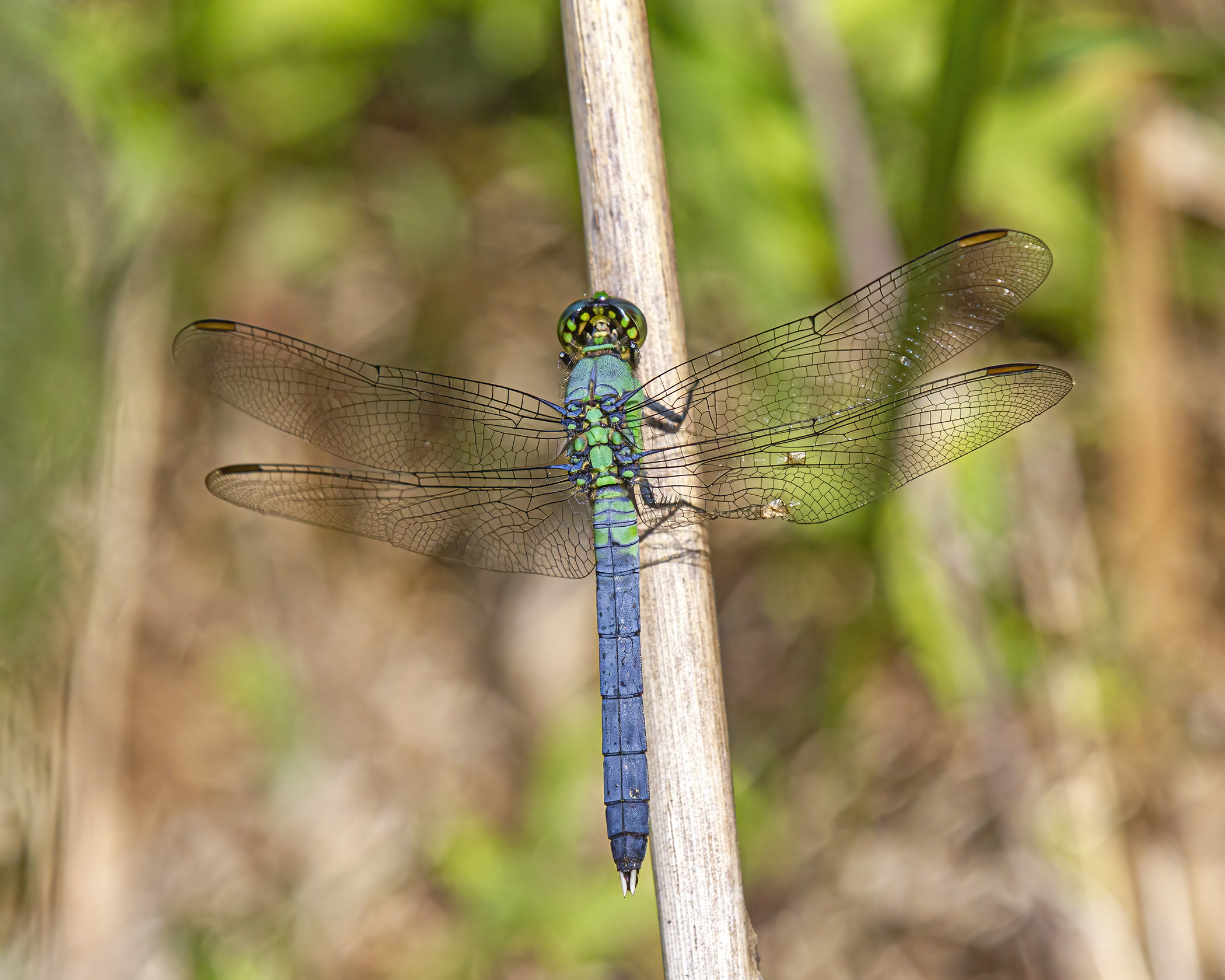
I love the look of male Eastern Pondhawk dragonflies (Erythemis simplicicollis) when they are transitioning to adults. When they are juvenile, male Easter Pondhawks have emerald green thoraxes and black striped abdomen, like their female counterparts. Gradually the body coloration shifts to blue as they mature. I really like their appearance when, as was the case with these pondhawks that I photographed last week at Occoquan Regional Park, their bodies have beautiful shades of both green and blue.

In the second and third photos, you get a glimpse of the pondhawk’s beautiful eyes that are also a combination of blue and green. Although you can’t see it very well in these photos, Eastern Pondhawks of both genders have bright green faces, which helps to distinguish the male Eastern Pondhawks from a number of other dragonfly species that have blue bodies.

Eastern Pondhawk

Eastern Pondhawk

Eastern Pondhawk

© Michael Q. Powell. All rights reserved


Read Full Post »

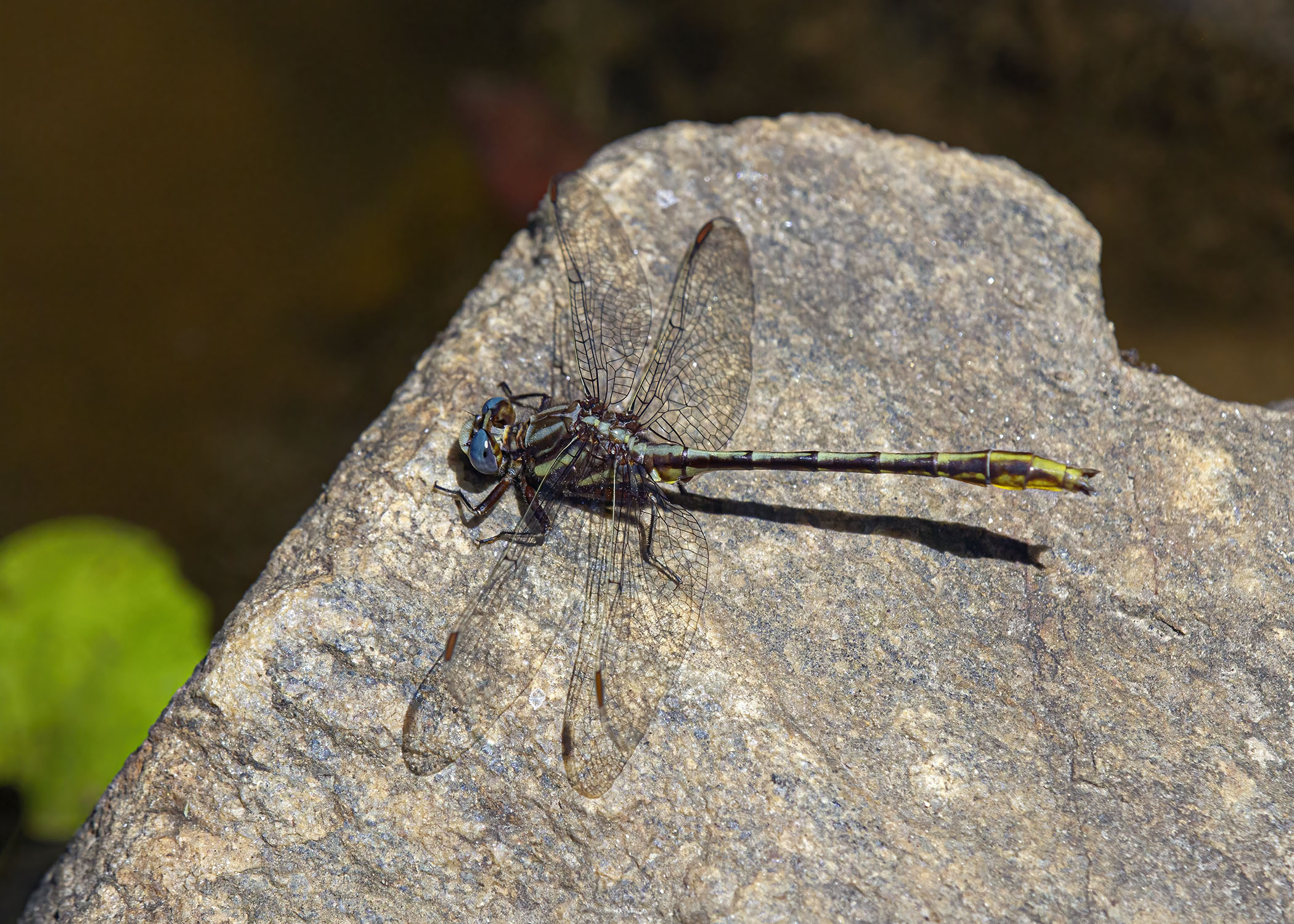
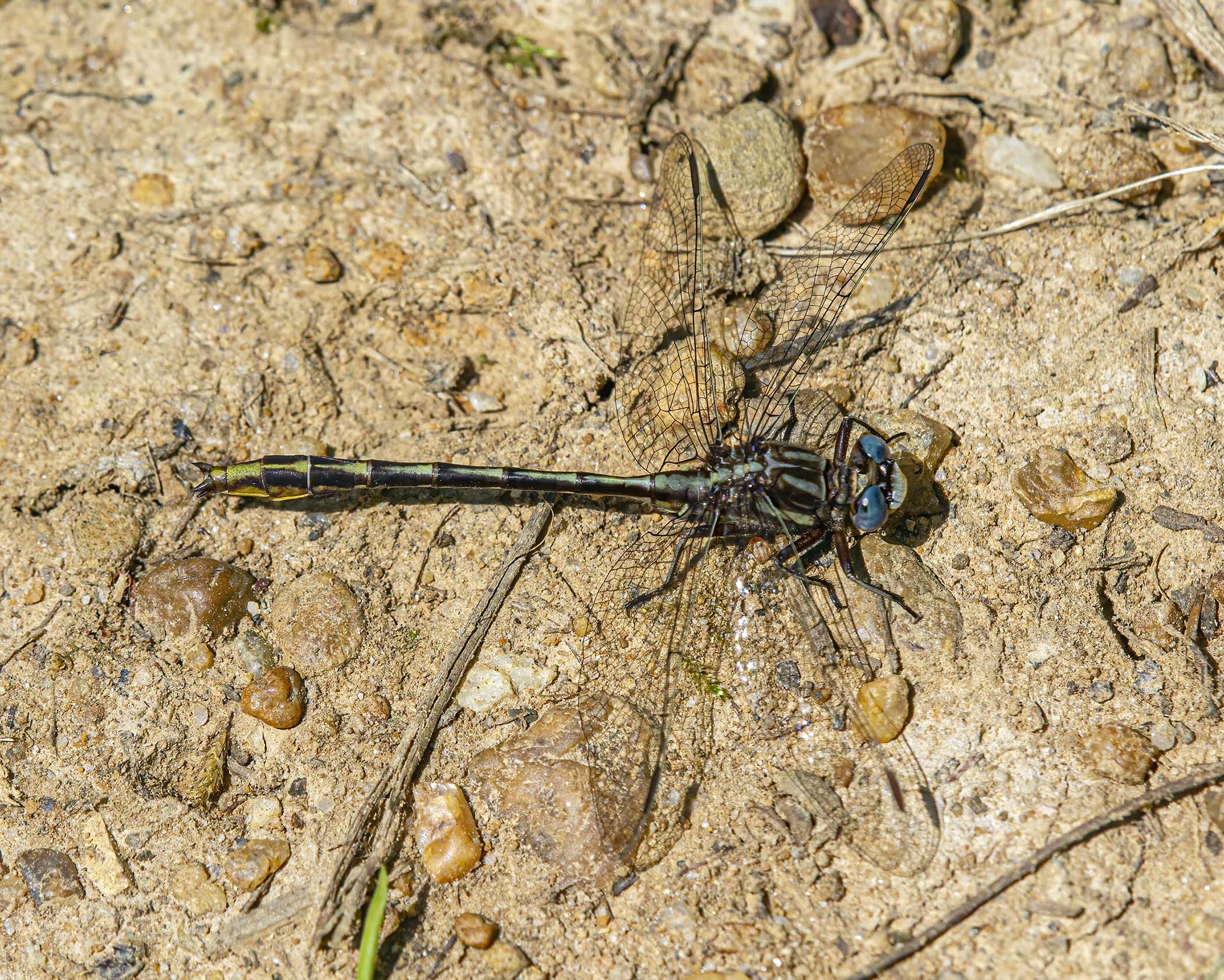
I was thrilled to spot at least one male Sable Clubtail dragonfly (Stenogomphurus rogersi) last Saturday while I was exploring a small stream in Fairfax County, Virginia. I visited that section of the stream several times during the day and had multiple sightings of a Sable Clubtail, but I am not sure if there was more than one of this species or if I was seeing the same individual each time.

As you can see from these two photos, Sable Clubtails like to perch low in vegetation just above the level of the water of the stream. As a result I had to crouch really low to be able to capture these images. The lighting was brighter for the first photo and you can see many of the details of the markings on the dragonfly, but I really like the cool shadow in the second image, which has a more “artsy” feel.

Sable Clubtails are rarein our area. Fellow dragonfly enthusiast Walter Sanford did extensive research and rediscovered this species in 2018 and I have been fortunate to see a Sable Clubtail at this stream in most years since then. If you are interested in the backstory of Walter’s efforts, check out his June 2018 blog posting entitled Off-season homework pays dividends.

Sable Clubtail

Sable Clubtail

© Michael Q. Powell. All rights reserved


Read Full Post »

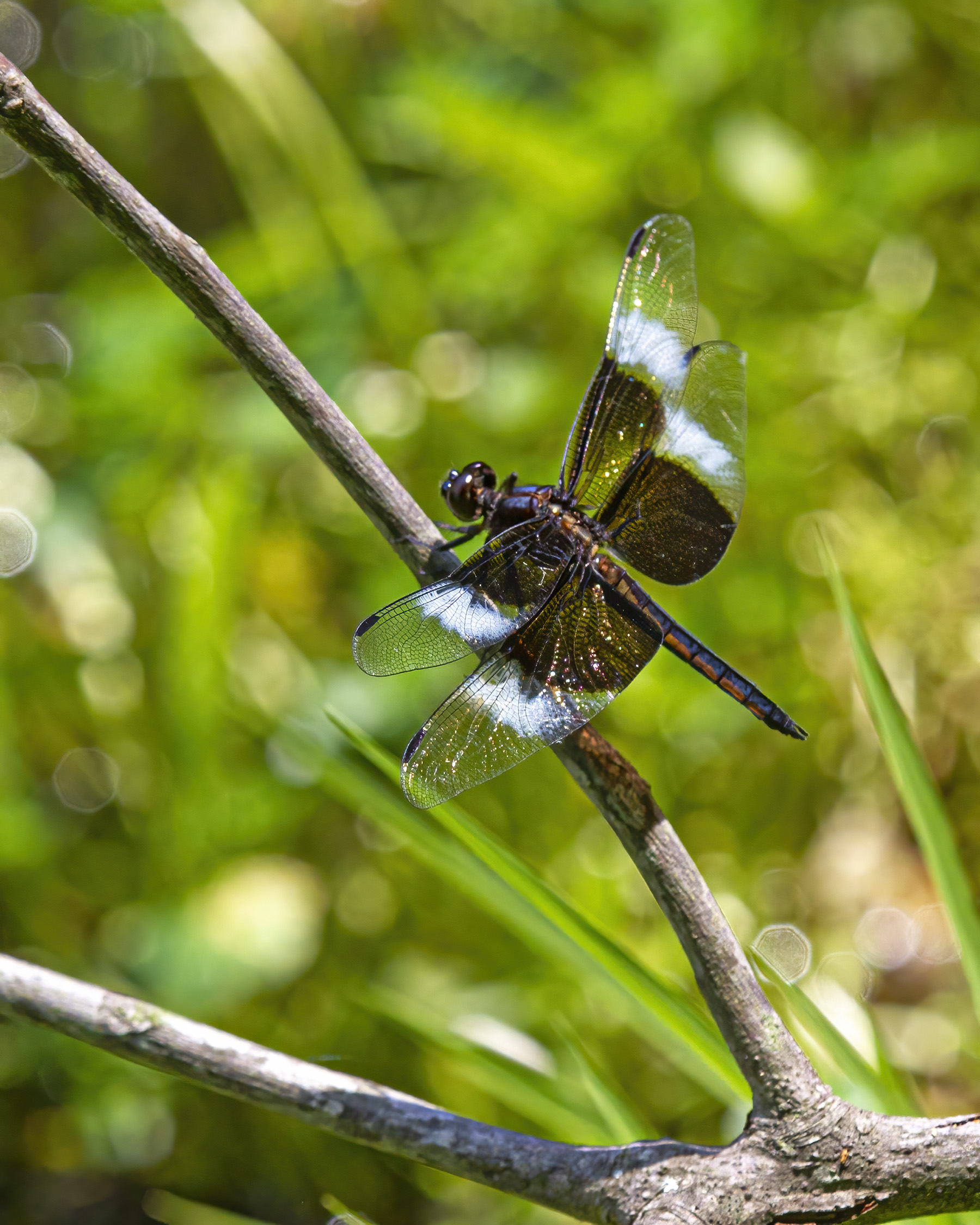
Many summer dragonfly species are now emerging on the scene, like this immature male Widow Skimmer dragonfly (Libellula luctuosa) that I spotted last Tuesday at Occoquan Regional Park in Lorton, Virginia.

Anecdotally, someone thought that these dragonflies appeared to be draped in mourning crepe and that is the source of the “widow” in the name of the species. The Loudon Wildlife Conservancy website states that “This dragonfly got the “widow” name because, unlike most other dragonfly species where the male stays near the female after she lays the eggs, the male in this pair leaves her after the eggs have been laid.” Either explanation is plausible, though I have seen more references to the first explanation than the second one.

I was quite fortunate that the dragonfly chose a high perch that allowed me to separate it from the rest of the background. Quite a few of the dragonflies that I have photographed recently have perched on the ground or in dense vegetation and the backgrounds in those photos have been quite cluttered.

Widow Skimmer

Widow Skimmer

© Michael Q. Powell. All rights reserved

Read Full Post »

I was a bit surprised at the way that this Eastern Ratsnake (Pantherophis alleghaniensis) had poked its head up high to peer above the vegetation on 6 June at Occoquan Regional Park. It felt like one of the snake charmers that I used to see in movies when I was growing up, although as I recall those snakes tended to be cobras. For the record, I was not playing a flute nor was I trying to hypnotize the snake.

The snake seemed to be alert and inquisitive as it scanned its surroundings. Perhaps it was looking for potential prey. As you may be able to tell, I tried to get down as low as I could to take this photo. I tried to be as stealthy as I could and he snake did not move—it was either unaware of my presence or did not view me as a threat. When I departed, it was still in the same spot with its head and “neck” elevated.

Eastern Ratsnake

© Michael Q. Powell. All rights reserved.


Read Full Post »

Usually I see Gray Petaltail dragonflies (Tachopteryx thoreyi) perched vertically on tree trunks, but this one perched horizontally on a fallen branch and stared at me after landing momentarily on my shoulder on Tuesday at Occoquan Regional Park in Lorton, Virginia.

I really like to get eye-to-eye contact with dragonflies—somehow it makes the encounter more personal and intimate. One of the consequences of shooting from this angle, though, is that much of the body of the dragonfly will be out of focus. I am ok with that and in fact it tends to pull the viewer’s eyes towards those bits that are in focus, particularly the dragonfly’s wonderful compound eyes.  Gray Petaltail

© Michael Q. Powell. All rights reserved.


Read Full Post »

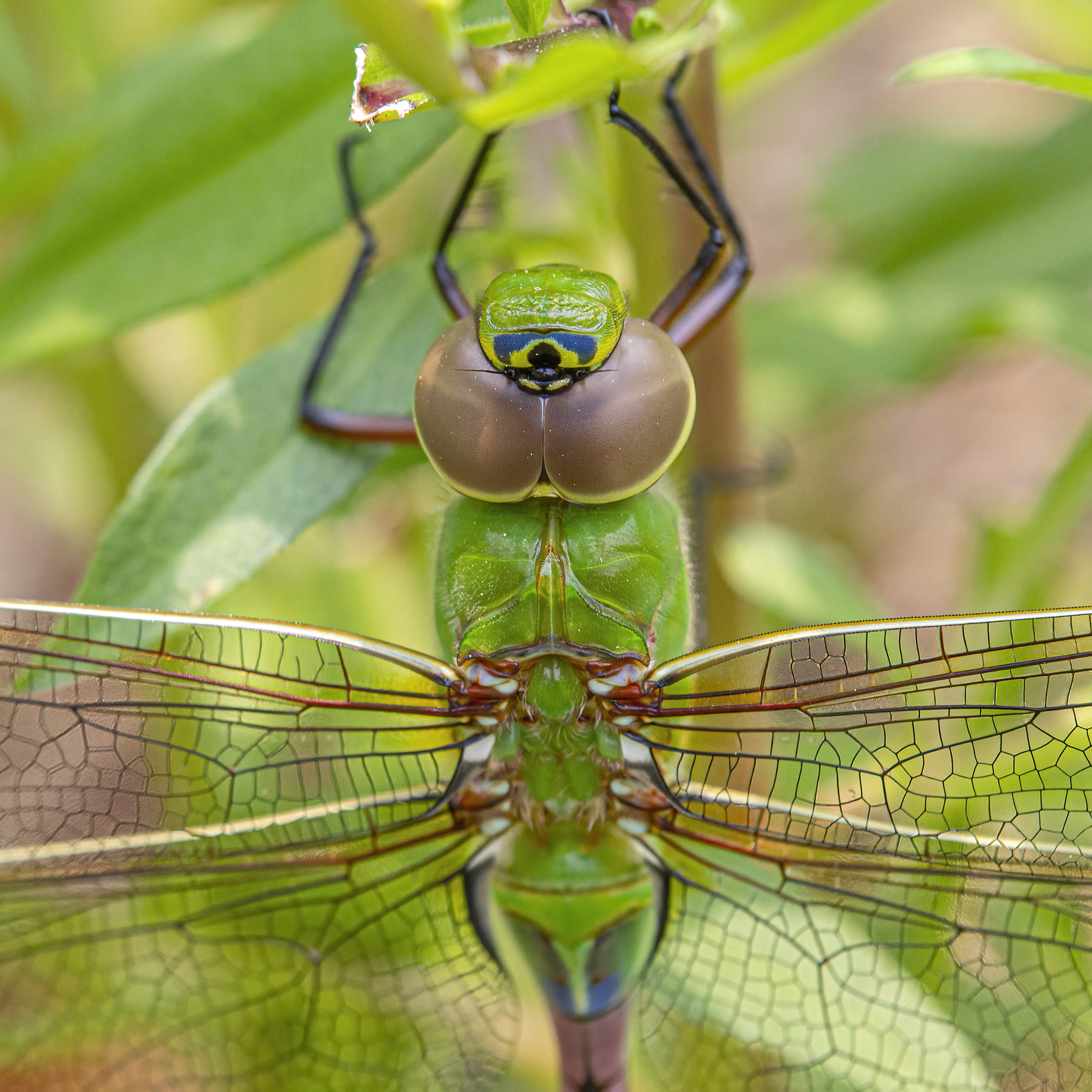
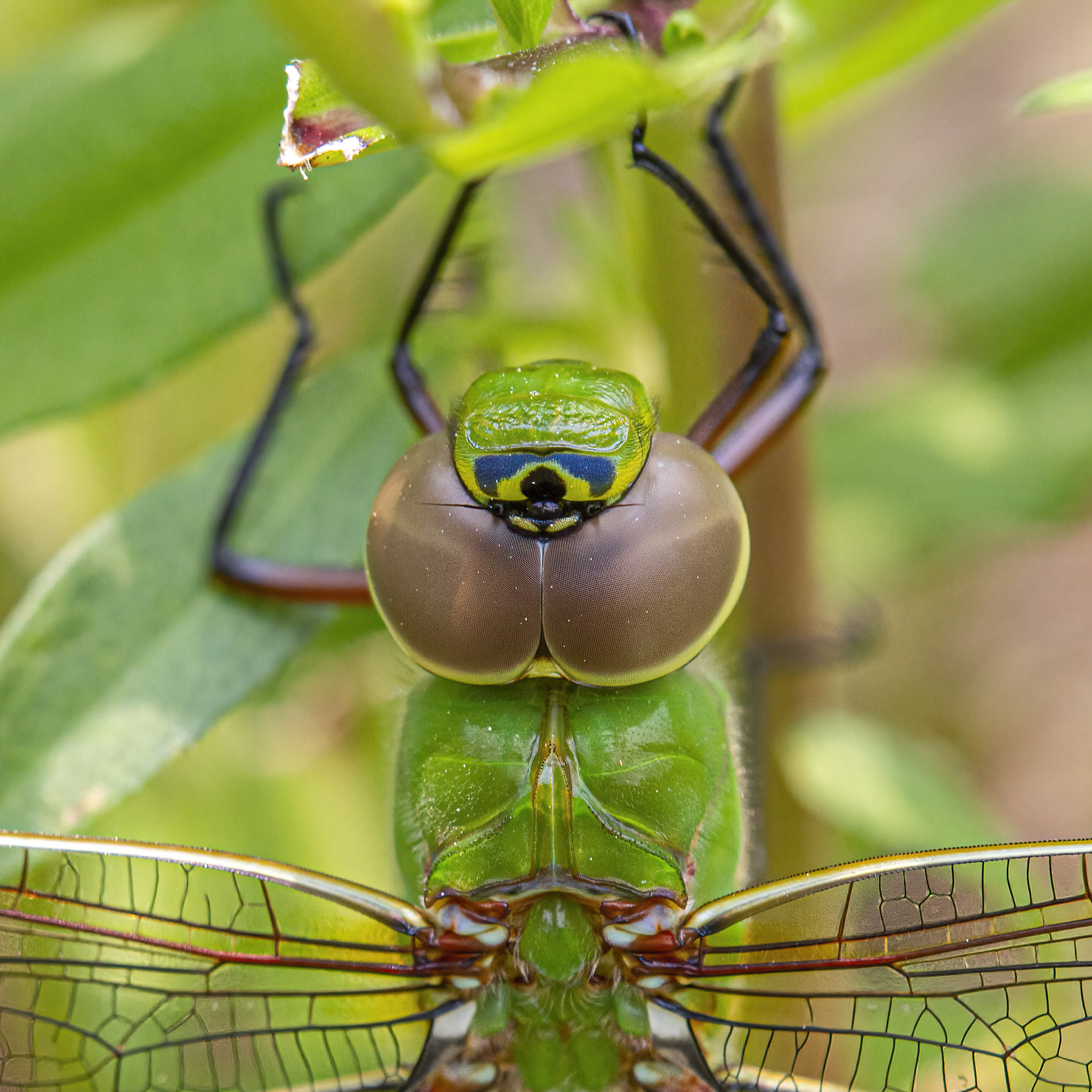
I am used to seeing Common Green Darner (Anax junius) dragonflies flying overhead, but on Tuesday I had the relatively rare chance to see one up close at Occoquan Regional Park. The Common Green Darner is a large, colorful dragonfly that is known for its long distance migratory flights. According to Wikipedia, “By attaching micro-radio transmitters to Common Green Darners, researchers have found them to be capable of migrating up to 140 kilometers in a day, though they typically cover less distance per day. ” Wow!

I spotted this dragonfly when I saw it fly to a perch in the vegetation just inches above the ground. I slowly made my way towards the vertically-perched Common Green Darner and surprisingly it did not move. I am not certain, but I had the impression that the dragonfly had newly emerged and was resting as its body parts dried out.

My 180mm macro lens gives you the impression that I was right on top of the dragonfly, but I was actually quite a bit farther away than it seems. After I took a few shots and moved away, the Common Green Darner remained in place. In fact, when I passed by the same area about twenty minutes later, it was still perched there.

I was thrilled by the amount of detail that I was able to capture. You can easily see the distinctive “bullseye” marking, for example, on the “face” of the dragonfly. The second image is a closer crop of the first image and it helps you to see some of the ommatidia, the thousands of faceted optical units that make up the dragonfly’s amazing compound eyes. You may want to click on the image to make it larger on your screen.

According to an on-line article called Dragonfly’s Eyes, “Dragonflies have very large eyes and have very good vision. Vision dominates their behaviour, including predation and looking for mates. The compound eye is made up of ommatidia which is a visual unit consisting of a lens system and a group of light sensitive cells. A large dragonfly may have up to 30,000 ommatidia in each compound eye. Each ommatidium collects one visual information, together form a mosaic image in the dragonfly’s brain. It is believed that the insects’ compound eyes are not as high resolution as vertebrate eyes. However, the dragonfly’s visual system is extremely sensitive to movement and it points in almost all direction and gives the 360 degree visual field.”

Common Green Darner

Common Green Darner

© Michael Q. Powell. All rights reserved.

Read Full Post »

Last week I was delighted to spot several Aurora Damsel (Chromagrion conditum) damselflies as I was exploring a pond in Prince William County. I had seem some Aurora Damsels earlier in the spring, when they were newly emerged, but had not yet seen any mature adults.

According to the damselfly guide that I use for reference, Damselflies of the Northeast by Ed Lam, the genus Chromagrion “consists of a single species, the Aurora Damsel, a blue and black damselfly with bright yellow on the side of the thorax. It lacks eyespots and shoulder stripes and often perches with its wings slightly spread, unlike most members of its family” of Pond Damsels (Coenagrionidae).

As I have learned from photographing insects and birds, I rarely can capture all of the distinguishing features of a species in a single photograph. In the first photo, you can see the slightly-spread wings, the distinctive markings on the abdomen and thorax, and the lack of eye spots.  You cannot, however, see the bright yellow markings on the thorax. I like to think of these kinds of shots as “scientific,” because the entire body of the damselfly is in almost perfect focus.

I personally tend to be a little more fond of shots like the second image. The damselfly seems to be posing for me with its head slightly cocked and the background and the perch are creative parts of the image. The eyes of the damselfly are in focus, but most of the rest of its body is at least a little blurry. I like to think of this type of shots as “artistic.”

Most of my photography is a mixture of  the “scientific” and the “artistic” approaches. Sometimes the approach is dictated by the circumstance, e.g. when I have to react instantaneously, and sometimes the approach is a consequence of the creative choices that I have made in my camera settings or in composition or angle of view. The cool thing about photography is that it easily accommodates a wide range of approaches and I can be as geeky or artsy as I want to be at ay given moment.

Aurora damsel

Aurora Damsel

© Michael Q. Powell. All rights reserved.

Read Full Post »

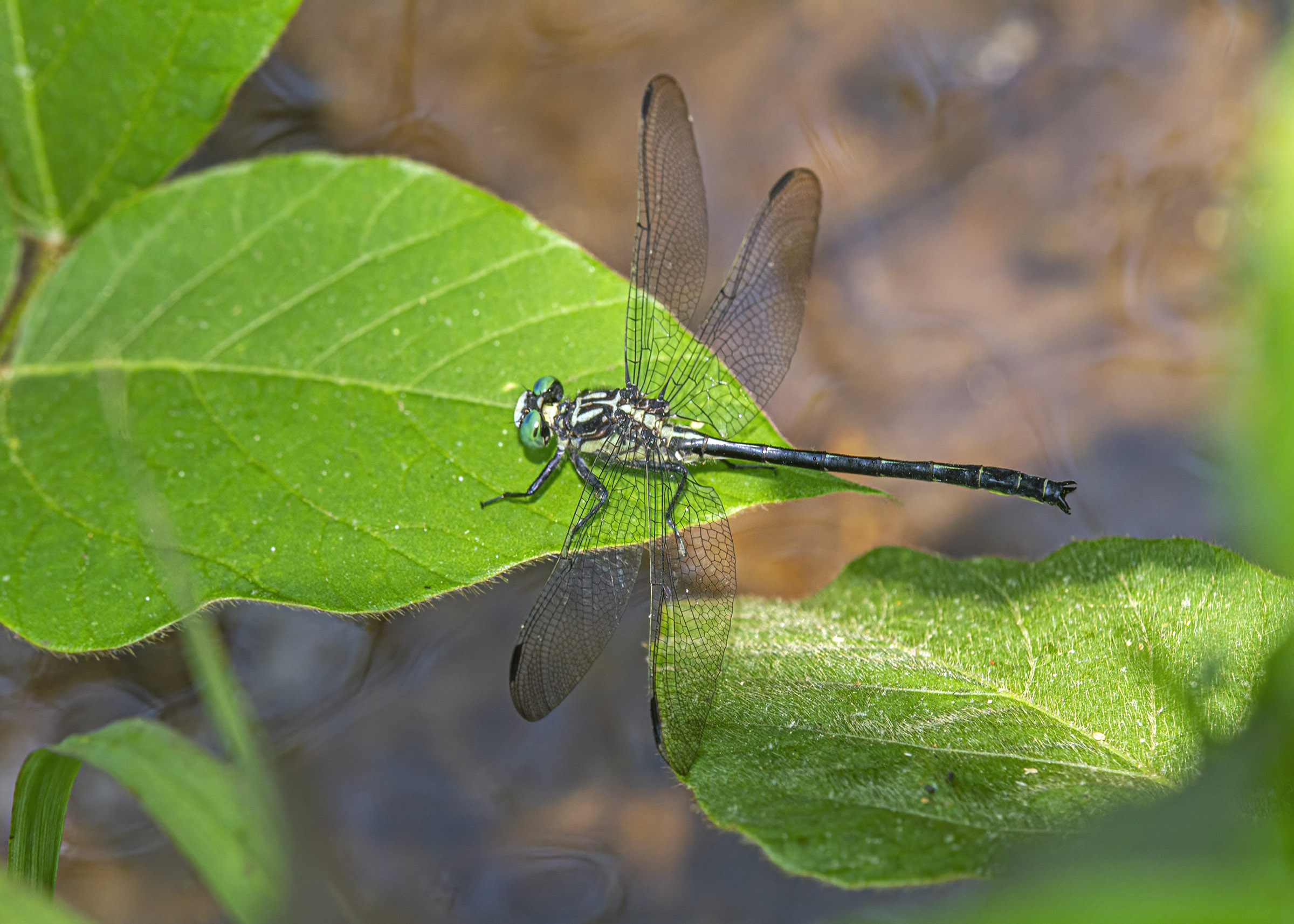
I was delighted to spot several handsome Lancet Clubtail dragonflies (Phanogomphus exilis) during a recent visit to Jackson Miles Abbott Wetland Refuge, my first sightings of this species this season. As you can see from these two photos, Lancet Clubtails like to perch flat on the ground and I spotted both of these near the edge of the pond.

I love the bright blue eyes of Lancet Clubtails and the yellow flange near the tip of the abdomen, a feature that helps to distinguish Lancet Clubtails from the visually-similar Ashy Clubtails. Some members of the Clubtail family have large and obvious “clubtails,” but the one on the male Lancet Clubtails is relatively small—you have to look at the proper angle to see it well. I like the way that the shadow in the first photo makes it easy to see the enlarged area near the end of abdomen that constitutes the “clubtail.”

Lancet Clubtail

Lancet Clubtail

© Michael Q. Powell. All rights reserved.

Read Full Post »

Can you spot the dragonfly in the first photo? Let me give you a clue—the large dragonfly is in the center of the image. Can you see it now?

Some dragonflies are easy to see, because of their bright colors or the way that they perch in the open on prominent stalks of vegetation. Others are a bit harder to see, because they perch on the ground or in dense vegetation (or they fly continuously and rarely seem to land).

The Gray Petaltail dragonfly (Tachopteryx thoreyi) is a bit of an anomaly—it perches in the open, but is still very hard to spot. Why? Its gray and black coloration is an almost perfect match for the rough bark of the trees on which it usually perches vertically. In the past I have watched a Gray Petaltail fly to a tree and perch and had trouble seeing it, even though I knew exactly where it was.

Last Wednesday I spotted my first Gray Petaltail of the season as I was exploring a small pond in Prince William County, Virginia. I had seen this dragonfly species at this location several times to the past, so I was carefully scanning the trunks of trees on which they sunlight was shining directly—Gray Petaltails seem to prefer direct sunlight, especially earlier in the day.

I often have to rely on movement to see dragonflies that are so well camouflage, but amazingly I spotted the dragonfly in the first photo while it was still perched. I cropped the image and made a few tweaks to make it a little more visible for you, but it was so tough to spot that I had to creep closer and look from a different angle to make sure that my eyes were not playing tricks on me.

For the second and third shots, I moved around the tree in an effort to better isolate the dragonfly from the tree. I think that approach worked especially well in the final photo in which the dragonfly had raised its wings a bit. Suddenly the Gray Petaltail was much more visible. I chose my angle carefully to try to get a bit of the sky in the photo—I was shooting at an upward angle—and I really like the way that the background came out in the final image.

Gray Petaltail

Gray Petaltail

Gray Petaltail

© Michael Q. Powell. All rights reserved.
Read Full Post »

Some people get creeped out by spiders, but many of them are quite beautiful, like this tiny Orchard Orbweaver spider (Leucauge venusta) that I spotted on Wednesday in Prince William County. The sun was shining brightly on the shiny body of the spider, so I underexposed the image intentionally, which is why it looks so dark in the photo—the background was green in real life. I was also leaning my lens against a branch for stability, since even the slightest movement at such close range can blur an image.

Orchard Orbweavers are really common where I live, but I suspect that most people do not look closely enough at them to see their beautiful colors. According to the LSU AgCenter, “Orchard spiders are .13 to .3 inches (3.5 to 7.5 mm) in length, with females typically larger than males.” I believe that the aforementioned measurements are for the body alone and do not include the legs.

In addition to capturing some of the beautiful colors of the Orchard Orbweaver, I was thrilled to capture a look at the web of the spider. These webs are much smaller and compact than the webs of some of the larger orbweaver spiders in our area, which is a good thing, because many of these webs seem to be built across paths and I often run into them face-first.

Orchard Orbweaver

© Michael Q. Powell. All rights reserved.


Read Full Post »

Our recent warm weather has brought out all kinds of creatures, including Northern Water Snakes (Nerodia sipedon). On Wednesday I spotted my first Northern Water Snake of the day as I was sitting on a rock, taking a break alongside a stream. When I spotted it, the snake was swimming vigorously downstream and the first photo captured some of the sinuous movement of the snake’s body. I lost sight of the snake as it approached a series of cascades and was not able to see how the snake handled them

Later that same day I spotted another snake at a small pond. This Northern Water Snake had hidden its body in the debris at the edge of the pond, with just its head visible above the water. This snake was alert and seemed to be in a hunting mode, so I kept my distance and watched the snake carefully as I took the second shot below. Although I know that Northern Water Snakes are not venomous, I remember reading that their bites are painful and that their saliva contains an anticoagulant that causes bites to bleed profusely.

Northern Water Snake

Northern Water Snake

© Michael Q. Powell. All rights reserved.

Read Full Post »

Several Common Baskettail dragonflies (Epitheca cynosura) were patrolling over the pond at Jackson Miles Abbott Wetland Refuge last Thursday and I spent a lot of time trying to capture images of one of them as they zoomed by me. I made attempts with both my 180mm macro lens and my 18-400mm zoom lens, sometimes using focusing manually and sometimes using auto focus. Needless to say, there is also a lot of luck involved in getting a somewhat sharp photo of a dragonfly in flight

I spent a lot of time trying to track the dragonflies. They didn’t exactly fly in a pattern, but they seemed to have a territory that they were patrolling, so they came by me at irregular intervals. In the first two shots below, I was able to get a bit of the habitat in the photo, but most of the time I was focusing solely on the dragonfly and there is nothing in the background but the somewhat muddy water of the pond.

I was happy that I was able to get some shots from a number of different angles. In some of the shots, the dragonfly was flying by me, but in other cases I manage to capture images in which the dragonfly was flying towards me or away from me. The angle was often dependent on the speed with which I was able to acquire my target in the viewfinder of my camera and successfully track it as I tried to focus on it—hand-t0-eye coordination is critical.

I used to think that it was impossible to get shots like these. It has gotten a little easier over time as I have gained experience, but it still is pretty hard. No matter how skilled I get, patience and persistence are still the most critical factors in this type of photography.

Common Baskettail

Common Baskettail

Common Baskettail

Common Baskettail

© Michael Q. Powell. All rights reserved.

Read Full Post »

Some of you may have noticed that the banner photo for this blog shows a beautiful purple damselfly, one of my favorite insects. The intense purple is really striking and is not a color that I seen very often when I am looking for wildlife to photograph. The official species name for the damselfly is Variable Dancer (Argia fumipennis), though I prefer to use the colorful and descriptive name of its most common subspecies, the Violet Dancer (Argia fumipennis violacea).

Last Thursday I was delighted to spot numerous Violet Dancers in the vegetation along the edge of a small pond at Jackson Miles Abbott Wetland Refuge.  I even managed to photograph one on the trail surrounding the pond, as you can see in the first photo in which the damselfly is perched on a small stone. For the other two shots, I was much farther away from the damselfly. These damselflies like to perch on vegetation that overhangs the water, so I shot from a distance to avoid slipping into the pond, which has happened on occasion in the past.

Violet Dancer

Violet Dancer

Violet Dancer

© Michael Q. Powell. All rights reserved.

Read Full Post »

This little damselfly is called an Orange Bluet (Enallagma signatum). Yes, the name is confusing and seems to be a bit of an oxymoron. Most bluets have various patterns of blue and black on their bodies, but surprisingly there are also bluets that are patterned predominantly in red, orange, yellow, green or black. The male Orange Bluet adopted a seemingly confrontational pose and stared right at me as I prepared to photograph him last Thursday at Jackson Miles Abbott Wetland Refuge—maybe he felt the need to defend his territory.

I would have liked to have captured an eye-to-eye shot, but was afraid of scaring away the damselfly if I bent down closer to it, so took the shot from a downward angle. Although a substantial part of the Orange Bluet’s body is out of focus in this image, I think the shot worked out ok, owing largely to the fact that the damselfly’s eyes were in focus. The curve of the stalk on which it was perched was a nice bonus and added some visual interest to the shot.

Orange Bluet

© Michael Q. Powell. All rights reserved.

Read Full Post »

Last Thursday I was delighted to spot some Slender Bluet (Enallagma traviatum) damselflies at the small pond at Jackson Miles Abbott Wetland Refuge, my first sighting of this species this year. Although this species is quite small—about 1.2 inches (31 mm) in length—I managed to get a shot of a Slender Bluet in flight, as well as several shots of Slender Bluets perched in the vegetation at the edge of the pond.

Many of the summer species of dragonflies and damselflies have now reappeared and I will be focusing a lot of my attention in the upcoming months on highlighting the beauty of these amazing aerial acrobats.

Slender Bluet

Slender Bluet

Slender Bluet

© Michael Q. Powell. All rights reserved.

Read Full Post »

In the United States, today is Memorial Day, a federal holiday. For some people this day marks the unofficial beginning of summer, but for me, as someone who served for twenty years in the U.S Army, this day has a deeper meaning, a day to reflect on the lives of the brave men and women who died in the defense of this nation. Yesterday, Facebook reminded me of a posting I made on Memorial Day 2018, and I decided to share it again today in this blog posting.

“I was prompted this morning to read again the challenges to us in the Gettysburg Address, which seem so appropriate today as we remember the sacrifices of so many brave men and women. “It is for us the living, rather, to be dedicated here to the unfinished work which they who fought here have thus far so nobly advanced. It is rather for us to be here dedicated to the great task remaining before us—that from these honored dead we take increased devotion to that cause for which they gave the last full measure of devotion—that we here highly resolve that these dead shall not have died in vain—that this nation, under God, shall have a new birth of freedom—and that government of the people, by the people, for the people, shall not perish from the earth.” ”

For those of you who might be curious, the photo below is from a November 2014 blog posting entitled “Rescue of an injured Bald Eagle” that documented the capture of an injured eagle by an officer of the Fairfax County Animal Control Services at my local marshland park. Some of the photos from that posting were reprised in Washington D.C. media outlets and the posting has been my all-time most popular posting with 3472 views.

Bald Eagle

© Michael Q. Powell. All rights reserved.


Read Full Post »

I did not get a close enough look at it to identify its species, but a teneral damselfly decided to momentarily hitch a ride on my pant leg last Wednesday at Green Spring Gardens in Alexandria, VA. A teneral damselfly is one that has only recent emerged and is therefore pale and does not yet have its full adult coloration.

It turns out that a 180mm macro lens is less than optimal for a selflie, even of my leg—I could not get far enough away to include the whole damselfly in the frame. The only other alternative is for me to become a lot more flexible, which at my age does not seem very likely.

teneral damselfly

© Michael Q. Powell. All rights reserved.


Read Full Post »

There are lots of different species of skipper butterflies in my area and it is hard for me to tell them apart. I spotted this beautiful little butterfly last Wednesday at Green Spring Gardens, just a few miles from where I live. I think that it is a Zabulon Skipper (Poanes zabulon), although it might possibly be the similar-looking Peck’s butterfly. I’d like to say that there is a scientific reason why I chose Zabulon over Peck’s, but it really is because I think that Zabulon is the cooler name of the two—I love the exotic sound of the word “Zabulon.”

I tried to get down to eye-level with the butterfly when I photographed it so that the background would fall away into a pleasant green blur and was largely successful. I like too that I was able to capture some of the green striations in the leaf on which the butterfly is perched and those little lines help to lead the viewer’s eyes to the butterfly.

Zabulon Skipper

© Michael Q. Powell. All rights reserved.


Read Full Post »

« Newer Posts - Older Posts »