Feeds:
Posts
Comments

Archive for the ‘wildlife’ Category

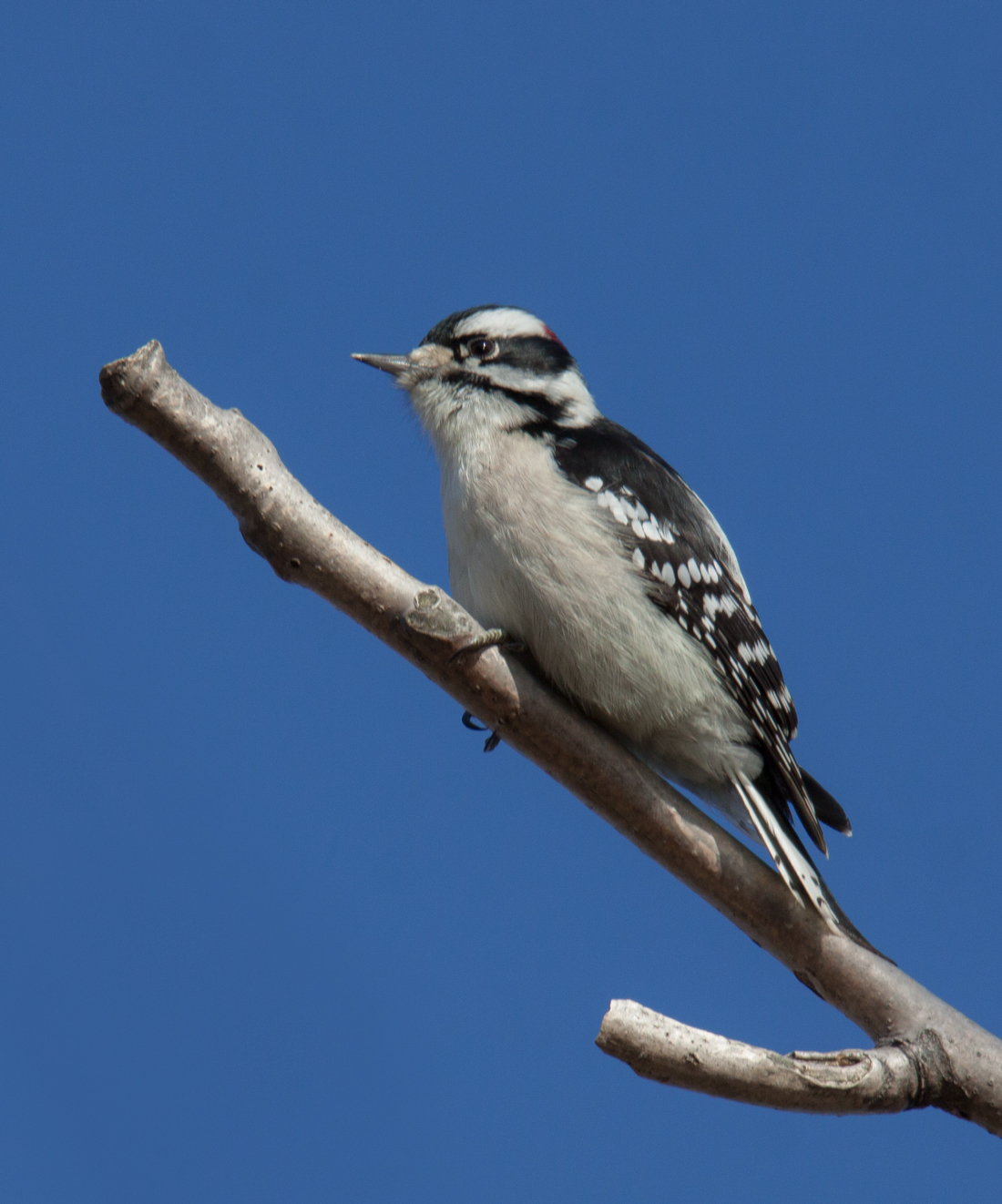
Yesterday I spotted a male Downy Woodpecker (Picoides pubescens) on an exposed branch in a tree across a small field of cattails. In the past, I would not have even attempted to take a shot because of the distance, but I recently bought a Tamron 150-600mm zoom lens and suddenly this little bird was more or less within reach. This was my first day out with my new lens and it was fun testing out its capabilities (and I’ll do a few more postings showing what the lens was able to get in different situations).

Downy Woodpeckers seem to have an amazing amount of energy and are in almost constant motion. As I watched, the little woodpecker pecked his way to the end of the branch and then stopped. He seemed to be confused and stared straight ahead at first,  Unsatisfied, he looked down and then up. Suddenly he lifted off almost straight up and I was fortunate to capture him with his wings extended.

Who knew that Downy Woodpeckers had such an impressive wingspan?

Downy Woodpecker

Liftoff

Downy Woodpecker

Looking ahead

Downy Woodpecker

Looking down

Downy Woodpecker

Looking up

© Michael Q. Powell. All rights reserved.


Read Full Post »

I recently experienced a sharp increase in the number of views of my blog and went from 628 to 4723 views in a single week.  One of my posts has had an amazing 3235 views to date. What happened? Have I learned a secret to boosting my viewer statistics?

As you might have guessed from the photos that I have reprised below, the post in question is my 4 November posting Rescue of an Injured Bald Eagle. Within my WordPress world, the post was reasonably successful and sixty viewers “liked” it, but that’s not enough to account for the boost.

The most important key to getting more viewers, I think, is finding viewers from outside of WordPress. I sometimes cross-post on Facebook account and in a few Facebook groups to which I belong and will get some additional views, but generally only a few.

I’ve looked back at all that transpired and here is the “formula” that led to my “success.” First, take photos of an event that is newsworthy, has broad appeal, and preferably has police involvement. The police departments, it seems, are always looking for good news stories, and I sent copies of my photos to the officer who made the rescue. The Fairfax County Police Department posted my photos (with attribution) on their blog on 5 November and included a link to my blog posting. This got the ball rolling, it seems.

The next step is to enlist the aid of the mass media in publicizing your blog and keep them updated. I suspect that news outlets troll the police sites for stories and suddenly I started receiving requests from reporters to use the photos in the on-line versions of their television or radio stations—I don’t think the photos appeared in print. I gave approval each time that I was asked, but requested attribution by name and, if possible, a link back to my blog.

The local Fox station and the local NBC station were the most cooperative and did articles that used my photos, excerpts from the text of my blog, and included links to my blog. The Fox article brought in more than 750 viewers and the NBC article brought in over 100 viewers. WTOP, a local news radio station, was similarly cooperative. I made sure to keep these reporters in the loop when I first received information that the eagle was euthanized and all they did updates on the story.

What about the others? Several news outlets, most notably The Washington Post, used my photos with attribution, though they did not request permission or link back to my blog in any way. It was really cool to see the Post use one of my photos in articles on 5 November and 6 November, but it had no effect on my blog statistics. The local ABC station WJLA also gave attribution when they used my photo in an article. I ran across a couple of instances in which my photos were used and they were attributed to “a park visitor” or to the police department.

I came across the photos, with attribution, in several local community news sites and in a couple of other Fox site as well. The euthanization decision was carried by the Associated Press, but, alas, they did not use a photo.

I think I understand better now how I had such an increase in viewers, but I realize that the experience is not easily replicable and the results were short-lived. After the temporary spike in views, I have returned to more normal levels. I enjoyed the brief moment in the spotlight and learned a lot about how stories enter into the news cycle, but I am content to return to my smaller world of walking the trails, in search of new photographic adventure.


Bald Eagle rescue

Bald Eagle rescue

© Michael Q. Powell. All rights reserved.


Read Full Post »
I’ve been in denial about the change of seasons. Two weeks ago it was warm and I was still photographing insects.  The sub-freezing temperatures the last couple of days have been a reminder to me that it’s time to put my macro lenses on the shelf and reach for my telephoto lenses.

Walking through my local marshland park this past Monday, I couldn’t help but notice that the ducks are starting to arrive. During the fall and winter, the park hosts a variety of different ducks (along with quite a few Canada Geese). Some of them are there for a brief stay and then continue their journeys to more distant destinations. Others remain for an extended period of time.

Among the early birds are these Northern Shovelers (Anas clypeata), whose distinctively-shaped bills and colorful bodies make them hard to miss. They were paddling across the largest pond in the park, past a brush pile, when I captured this image. I didn’t notice it when I took the shot, but I really like the way that you can see some Canada Geese swimming in the distance.Northern Shoveler

© Michael Q. Powell. All rights reserved.

Read Full Post »

The weather recently has turned cold and heavily overcast with intermittent rain. The chill in the air reminds me that winter is coming and apparently the beavers at my local marshland park have been receiving the same signals.

One of my favorite places in the park is a small beaver pond in a remote area of the park. It is peaceful and quiet and there are some fallen logs on which I like to sit and just watch and listen.

As the summer progressed I grew increasingly uncertain about the inhabitants. Were they still there or had they moved? It looked like the dam that held in the water had been neglected and parts of it were deteriorating.

I am sill not certain that they are still in the lodge that you see in the second photo, but in the area surrounding that lodge, I’ve come across incontrovertible evidence that beavers have been busy—several dozen small and medium trees that have been removed and the toothmarks look fresh.

I’ll be keeping my eyes open for additional signs that the lodge is occupied or that another one is being built nearby as I return to this spot.

dam3_blogdam1_blogdam2_blog

© Michael Q. Powell. All rights reserved.

Read Full Post »

We all like to believe in happy endings, but unlike fairy tales, real life does not always turn out that way. I was saddened this afternoon to learn that the female Bald Eagle (Haliaeetus leucocephalus) that was rescued on Monday at Huntley Meadows Park had to be euthanized.

The dislocation of her elbow was chronic and so severe that eventual release was not a possibility.  The doctors at The Wildlife Center of Virginia determined that humane euthanasia was the best treatment.

I was happy that the work of the Fairfax County Animal Control Services officer that I chronicled in an earlier posting were featured today in the on-line editions of local media, including the Washington Post, WJLA (ABC television), WTOP radio, and Inside NOVA. The sad ending in no way diminishes my respect and thanks to Officer Kathy Prucnal for her extraordinary efforts to rescue the injured eagle.

This photo that I took during the rescue is how I want to remember the female Bald Eagle, appearing strong and alert.

RIP, beautiful eagle.

Bald Eagle

© Michael Q. Powell. All rights reserved.

Read Full Post »

I received an update from the Animal Control Officer who rescued the Bald Eagle (Haliaeetus leucocephalus) featured in yesterday’s posting and the prognosis looks positive.

The eagle had a low heart rate, according to the attending veterinarian, likely from pesticide poisoning, and they treated it with atropine. The eagle, an 8 pound (3.6 kg) female, also had a dislocated joint in one wing, which is treatable as well. It is likely they will be able to release her after some rehabilitation at a specialized facility in southern VA, which I assume is The Wildlife Center of Virginia in Waynesboro, Virginia.

I took the first photo when the eagle was trying to swim away while being rescued. The image is not quite as sharp as the photos from yesterday, but I just love the reflection of the eagle in the water as it struggles to swim. This was in a wooded area of Huntley Meadows Park, my favorite venue for photography, that is now flooded as part of a wetland restoration project. The second photo shows the eagle as it was when I first came upon it, perched on a pile of brush, unable to fly away.

Bald Eagle

Bald Eagle

© Michael Q. Powell. All rights reserved.

Read Full Post »

Would you be willing to chase an injured adult Bald Eagle (Haliaeetus leucocephalus) with nothing more than a blanket in your hands? Yesterday, I was privileged to observe a very brave officer of the Fairfax County Animal Control Services capture an injured eagle at my local marshland park.

The eagle was perched on a brush pile in a flooded forest area of the marsh. From time to time it would hop to a new position, but did not seem able to fly away. Several parkgoers had alerted the park authorities of the situation and I came upon the situation shortly before the animal control officer arrived.

When the officer began to chase it, the eagle hopped away and then tried to swim away, stopping for a moment to look in my direction from behind a tree. Eventually, when an unidentified parkgoer helped to block a potential exit route for the eagle, the officer was able to capture the eagle.

As the officer was carrying the eagle, wrapped up in a blanket, to a small vehicle, I circled around on the path as fast as I could, hoping to get a closer look at the eagle. The officer was accommodating and briefly unwrapped the blanket and I got an amazing close-up look at this majestic bird. She was also willing to pose for me and I took a photo that I sent to her to help her remember her amazing actions.

I managed to get a final look at the eagle after it had been transferred to the animal control vehicle. The officer unwrapped the eagle so that the man who had assisted in the rescue could get a look at it. The eagle seemed to have settled down a bit and appeared to be resting comfortably. It was impossible to determine the cause and the extent of the eagle’s injuries, but the officer assured me that the county has excellent rehabilitation facilities for injured raptors. If I am able to get progress reports on the eagle’s recovery, I’ll be sure to keep you all informed.

Bald Eagle

Bald EagleBald Eagle rescueBald Eagle rescueBald Eagle rescue

© Michael Q. Powell. All rights reserved.

Read Full Post »

Even from a distance it’s hard to miss the bright lapis blue eyes of a male Great Spreadwing damselfly (Archilestes grandis). Unlike many damselflies, which are tiny, this species, as its name suggests, is a big damselfly, about 2 to 2 1/2 inches in length (50-62mm). According to Bugguide.net, though, the bright yellow”racing” stripe, which occurs on both males and females, is the most easily seen distinguishing identification feature for this species.

I had never even heard of this beauty until the 11th of October, when fellow dragonfly hunter Walter Sanford blogged about his discovery of one at Huntley Meadows Park on the 9th of October. I had no idea if this was the only member of the species at the park or how long it would hang around and didn’t hold much hope of seeing one of these damselflies myself.

I was shocked and pleased on the 20th of October when I spotted Walter and this damselfly. Walter graciously ceded to me the prime spot for taking a close-up shot. A week later I returned to the same location and the Great Spreadwing was gone.

In past years I didn’t pay much attention to the timing and location of various dragonflies and damselflies—they were either present or they weren’t. This summer and fall, however, I’ve been learning how important the specific habitat and the time of year are for certain species and the window of opportunity to observe them opens and closes pretty quickly.

Consequently, I consider myself very fortunate that I was able to capture this little portrait of the Great Spreadwing damselfly.


Great Spreadwing

© Michael Q. Powell. All rights reserved.

Read Full Post »

Many of the other dragonflies are gone for the season, but the Autumn Meadowhawks (Sympetrum vicinum) will be around for quite some time, possibly even into December. Autumn Meadowhawks like to perch on the ground much of the time, but yesterday I was happy to capture one in what I consider to be its natural environment, perched among the colorful leaves of the autumn foliage.

Autumn Meadowhawk

© Michael Q. Powell. All rights reserved.

Read Full Post »

This re-posting is a bit of shameless self-promotion, but it is hard to describe how honored and thrilled I feel to be featured by Leanne Cole in a blog posting today. Leanne, who lives and works in Australia, is a wonderful photographer who spends a lot of time as a kind of photographic evangelist, sharing her passion for the art and practice of photography. She is constantly encouraging and teaching others, yet somehow seems to find time to explore new areas of her own photography, ranging from photographing the stars at night to investigating the close-up world of macro photography. Be sure to check out her incredible blog.

Read Full Post »

Do you ever shoot the same subject at the same time with another photographer and compare the results afterwards? It is fascinating to see how the choice of equipment, individual shooting styles, and angle of view affect the results.

Recently I was walking at Huntley Meadows Park, the local marshland park where I take a lot of my nature photos, with fellow blogger and photographer Walter Sanford when he spotted a mating pair of Blue-faced Meadowhawk dragonflies (Sympetrum ambiguum). Eventually they landed on the ground and Walter and I took up our shooting positions. He was seated on his Coleman folding camp stool facing the sun and I was crouching (and eventually sprawling flat on the ground) on the other side of the mating dragonflies, trying desperately not to cast a shadow on the action.

The dragonflies were surprisingly tolerant of us or were so caught up in the moment that they were oblivious to the outside world. We ended up shooting quite a few images during a lengthy session and couldn’t help but note the remarkable endurance of this couple. 

I started out in a position where I could capture both members of the couple (as you can see in the second photo), but then I started inching forward in an effort to see how close I could get to them, focusing my camera and my attention on the female. When I took the first photo below, I was pretty close to the minimum focusing distance of my Tamron 180mm macro lens, which is 1.54 feet (47cm). In case anyone is curious about the settings for that image, I was at ISO 400, f/13, and 1/20 of a second and used my pop-up flash.

There is no way that I can handhold this lens at 1/20 of a second, in part because it has no built-in image stabilization). It’s virtually impossible to use a tripod that close to the ground. So what I have started doing is using my camera bag as a kind of giant beanbag and resting my camera on the bag.

Walter took some shots of me in action and kindly agreed to let me use one of the resulting photos in this posting. He also circled in red the mating dragonflies to give you a better idea of how small our subjects were. In case you are wondering what the black object is that is underneath me, it’s my tripod bag—my photography mentor Cindy Dyer has influenced me to carry a tripod at almost all times.

In a final fashion note, I would like to point out that this is not the way that I usually wear a baseball cap. I turned the cap around in order to look through the viewfinder at this low angle. You will never catch me with my hat like that in public and I shudder every time I see a teenager with his hat tilted to the side or on backwards.


Blue-faced MeadowhaekBlue-faced MeadowhawkP1270731_Aperture-BFX_psda

© Michael Q. Powell. All rights reserved.

Read Full Post »

A female Belted Kingfisher (Megaceryle alcyon) lives at a small lake not far from where I live and periodically I try to photograph, but she continues to remain elusive.

Generally I try to photograph the kingfisher at one of her normal perches in a grove of trees across a narrow portion of the lake from where I am standing. It’s tough to isolate her against the backdrop of the trees, especially at this time of the year when the leaves are still on the trees, and often I only catch sight of her when she starts to fly.

Most of the shots in this posting are my attempts to capture her in flight. I am getting better at tracking the bird in the air and keeping her in focus, but it’s not easy to do as she flies in and out of the shadows and against varying backgrounds and she is somewhat hidden in these shots.

This past weekend, I decided to try to approach the grove of trees from the other side of the lake, where there is often a group of fishermen. I was fortunate that I was alone and I was able to make it relatively close to the grove of trees.  I was surprised to see that the kingfisher was on a low perch rather than high in the trees where I usually find her and I managed to squeeze off a few shots before she flew away. The first shot in this posting was from this new shooting position.

I plan to try this new approach again in the future and with a bit of luck, I may finally be able to get the kind of shot of this bird that I have been visualizing in my mind.


Belted Kingfisher

Belted KingfisherBelted KingfisherBelted Kingfisher

© Michael Q. Powell. All rights reserved.

Read Full Post »
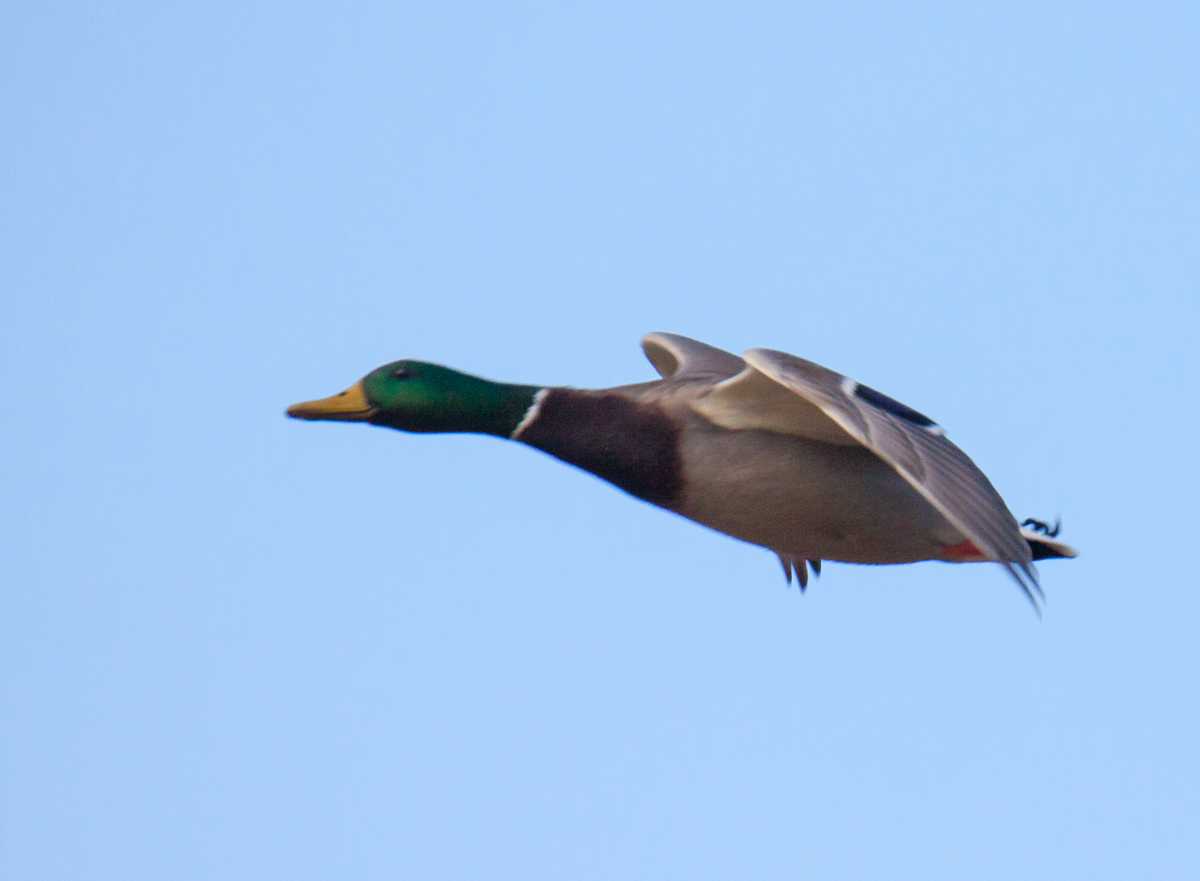
As I slowly made my way through the tall grass on the lake shore, my eyes were focused on the low-hanging branches where I had seen a Belted Kingfisher earlier in the day. Suddenly the water exploded at my feet.

I was startled and so was the Double-crested Cormorant (Phalacrocorax auritus) that scrambled into action and started moving across the surface of the water. The cormorant had apparently been resting or feeding at the water’s edge and had not heard me approach. It was interesting to see the cormorant move—it rose up a bit and seemed to walk across the water and then settled back into the water once it was a good distance away from me.

The action happened so quickly and in an unexpected location that I initially had trouble framing my shots. This is my favorite of the ones in which I managed to get the entire cormorant in the frame. I especially like the details that you can see on the wings. As I was working on the image, it was interesting to note that there are almost no colors in the shot, except for the bird’s bill. When I adjusted the hue and saturation, for example, almost nothing changed.

Double-crested Cormorant

© Michael Q. Powell. All rights reserved.

Read Full Post »

This past Friday I spotted one of my favorite spiders, the Bold Jumping Spider (Phidippus audax), in the reeds adjacent to the boardwalk at Huntley Meadows Park. The spider was pretty active and jumped a couple of times, but I managed to get a shot that highlights its multiple eyes and colorful “fangs.”

“Here’s looking at you, kid.”


Bold Jumping Spider

© Michael Q. Powell. All rights reserved.

Read Full Post »

It has often been said that the eyes are the windows to the soul. I’m not sure what I can say about the soul of this Northern Watersnake (Nerodia sipedon), but I recently had a chance to take a long, close look into one of its eyes.

As I was walking in my local marshland park last week, one of my fellow photographers pointed out the snake to me in the low vegetation. Most of the time that I see this species, it is in the water, where it is almost impossible for me to get a close-up shot. The snake started to move several times as I got closer and closer to it, but then it would stop, thinking perhaps that it would be invisible if it remained motionless.

Most of the time, my view to the snake was obscured by the vegetation, so I waited and tried to anticipate where it would move next, hoping that it would move to a more open area. Finally, I was able to get a relatively clear shot of its eye in a head-and-shoulders portrait, though, of course, snakes don’t really have shoulders.

Northern Watersnake

© Michael Q. Powell. All rights reserved.

Read Full Post »

Earlier this month, I was really happy to spot this Northern Rough Greensnake (Opheodrys aestivus) on the boardwalk at Huntley Meadows Park, my local marshland park. These snakes spend most of the time in the trees and in heavy brush, so I rarely get to see one, despite their very distinctive color and overall appearance. The Virginia Herpetological Society claims that this is a docile species that will not bite, but just to be safe, I took the close-up shot from a good distance away, shooting at 300mm on my telephoto zoom lens.

Generally I like to photograph my wildlife subjects in a natural environment and the “wood” on this boardwalk isn’t even natural—it’s some kind of synthetic material. In this case, however, the neutral color of the background helps to focus viewers’ attention on the colors and textures and shape of the snake. In the final two images, in particular, I really like the contrast between the sinuous curves of the snake’s body and the hard, straight lines of the man-made objects.

Rough GreensnakeRough GreensnakeRough Greensnake

© Michael Q. Powell. All rights reserved.

Read Full Post »

It’s migration time for Common Green Darner dragonflies (Anax junius) and last week one of my fellow photographers, Walter Sanford, reported a small swarm of Green Darners at my local marshland park.

I was walking in an entirely different area of the park from Walter and was surprised to see Green Darners, which are easily recognized thanks to their coloration and distinctive bullseye on their heads, flying up from the ground as I approached them. Rather than fly off into the distance, which is most often the case when I happen to disturb a dragonfly, these dragonflies moved only a short distance and came to rest again on the ground.

I don’t yet have the ability to interpret the movements of dragonflies, but it seemed to me that these Green Darners were conserving energy, as though they were resting in the midst of a long journey. I tried to be as quiet and stealthy as I could and moved closer and closer to one Green Darner perched near some green moss that was almost a perfect match for the color of the forward portion of her body. Judging from her overall coloration, I think this is probably a female.

My subject was amazingly cooperative and I was able to get shots of this beautiful dragonfly from a number of different angles. Although I normally try to have backgrounds that are must less cluttered than those in these images, I don’t find them to be too distracting here and they do help to show how well this colorful dragonfly blended in with her environment.

Common Green DarnerCommon Green DarnerCommon Green DarnerCommon Green Darner

© Michael Q. Powell. All rights reserved.

Read Full Post »

The more I watch spiders, the more I am fascinated by them. I used to think that spiders extruded only a single kind of silk, but I have learned that many spiders have multiple spinneret glands that are used for producing different kinds of silk.

One of the most amazing kinds of silk is known as aciniform silk, according to Wikipedia, which is used to wrap up and immobilize prey. This silk looks like a long gauze bandage as it is extruded by the spider.

Last month, I watched as a large Black and Yellow Garden Orbweaver spider(Argiope aurantia) wrapped up a recently captured bee. I was amazed at how quickly it accomplished the mission, spinning the prey as it wound multiple layers of silk around it. Here are a couple of shot I took that show the spinnerets in action.

I loved the reaction of one of my friend to the first photo. He imagined the bee protesting being wrapped in bandages saying, “Hey, you’re not my doctor!”

Argiope aurantiaArgiope aurantia

© Michael Q. Powell. All rights reserved.

Read Full Post »

One of the main reasons why I love having a macro lens is that it that it lets me capture photos like this extreme close-up image of a male Eastern Pondhawk dragonfly (Erythemis simplicicollis) that I took yesterday at Green Spring Gardens, a historical, county-run garden in Alexandria, Virginia.

I have always been fascinated by the multi-faceted compound eyes of dragonflies and the blue-green eyes of the Eastern Pondhawk are particularly stunning. When I first caught sight of this dragonfly, he was sunning himself on a rock near the edge of a small pond. I kept low to the ground and approached him slowly. He didn’t fly away and seemed more curious about my presence than afraid.

For these shots, I rested the lens hood of the camera on the edge of the rock ledge to get this low, eye-to-eye perspective. This technique served to steady my camera, so I was able to capture a good deal of detail of the dragonfly’s face. In the initial photo, for example,which is a cropped version of the second image, you can see that the dragonfly has stubble on his chin. The third shot is a cropped version of the last photo, again to show greater detail and to draw the attention of viewers more directly to the eyes.

Do you think the shots are more effective when cropped or do you prefer the larger perspective images?

Eastern Pondhawk

Eastern Pondhawk

Eastern Pondhawk


pondhawk1_closeupb

© Michael Q. Powell. All rights reserved.


Read Full Post »

Many dragonflies species have disappeared by now as we move deeper into autumn, but some especially beautiful ones have taken their place, like these male Blue-faced Meadowhawks (Sympetrum ambiguum) that I photographed yesterday at my local marshland park.

According to the Dragonflies of Northern Virginia website, this species peaks in September to October and is the rarest and hardest to find meadowhawk in our area. I was walking through a meadow at the park with one of my fellow photographers when she spotted the Blue-faced Meadowhawk in the second photo perched on a log. At that moment, I happened to have a 70-300mm telephoto lens on my camera and I was happy  to be able to get a shot that shows the spectacular colors of this dragonfly. Little did I know that I would have an even better opportunity a few minutes later.

As we continued into an area with thigh-high growth, my friend stopped for a moment and said she had spotted a spreadwing damselfly. I looked in the direction that she was pointing and didn’t see the damselfly, but I did spot another Blue-faced Meadowhawk perched atop one of the plants.

In a whispered voice, I asked my friend to freeze and I quickly changed lenses to my 180mm macro lens. Amazingly, the dragonfly stayed in place and I was able to get a number of shots, including the first one below. Given that these dragonflies are less than two inches in size (50mm), I am thrilled with the results. There is something almost magical about the combination of red, blue, and turquoise on this dragonfly.


Blue-faced Meadowhawk Blue-faced Meadowhawk.

© Michael Q. Powell. All rights reserved.

Read Full Post »

This morning I spotted a Bald Eagle (Haliaeetus leucocephalus) in a tree a my local marshland park, not far from where I had previously seen one. Once again, the eagle reacted more quickly than I did and took off before I was completely ready. This time, however, I was able to more quickly track the flying eagle and got a better shot than last time. I’m still not fully satisfied with the sharpness of this image, but I continue to believe that any day that I see an eagle is a great day.

Bald Eagle at Huntely Meadows Park

© Michael Q. Powell. All rights reserved.


Read Full Post »

I’ve seen lots of Great Egrets (Ardea alba) over the past couple of years, but until recently I had never seen a juvenile one and had no idea that they were so small compared to the adults.

I caught this little interaction between what I assume is a mother and a young egret at Cameron Run, a tributary of the Potomac River in Alexandria, Virginia. The birds were standing on one of a number of concrete slabs that cross the entire width of the stream, presumably to slow down the flow of the water.

UPDATE: A number of more experienced birders have weighed in and pointed out that the smaller egret is not a juvenile Great Egret as I thought, but is instead a Snowy Egret (Egretta thula), a species that I had never seen before. As a result, the scenario below that I imagined is no longer valid—I’ll have to think a bit more about what herons of two different species might have been discussing.

The mother seemed to be giving instructions to the young one to stay put while she flies off to fish a short distance away.

Great Egret and baby

Mom gets a bit excited as she warns the little one to stay put

Great Egret adult and juvenile

The little one finally agrees

The mother eventually is reassured and takes off for the rocky edge of the water, hoping for a quick catch, so that she can feed the hungry youngster.

Great Egret adult and juvenile

Flying away for a little while

Great Egret in flight

Searching for the perfect spot for fishing

The young egret is left all alone to wait for the return of his Mom, hopefully with a tasty snack.

Great Egret adult and juvenile

Waiting for Mom

© Michael Q. Powell. All rights reserved.


Read Full Post »

Do you photograph some subjects over and over again, hoping to get better (or at least different) images? I never grow tired of observing herons and egrets at my local marshland park. Most of the time, they (and I) are standing still, waiting for a brief moment of action, generally when they are fishing or when they take off into the air. These birds look gangly and awkward when on the ground or in the water, but when they are flying, it’s like watching an aerial ballet.

I took this shot last Friday as a Great Egret (Ardea alba) was just taking off from the muddy waters of one of the small ponds at the park. I was thrilled to be able to capture both a shadow and reflection of the graceful bird. Although I often have trouble getting a good exposure and frequently blow out the highlights, in this case I as able to capture some of the details of the wing feathers.

The egrets will be migrating out of this area soon, but I will continue to have the herons to keep me occupied in the upcoming months (and I’ll be trying to get more shots like this one).

Great Egret

© Michael Q. Powell. All rights reserved.

Read Full Post »

It won’t be long before most of the dragonflies are gone for the season, so I am really enjoying them while they are still around. A little over a week ago, I was able to capture images of some male Twelve-spotted Skimmer dragonflies (Libellula pulchella), a species that I had not seen previously this summer.

Twelve-spotted Skimmer

In the first shot, the dragonfly seems to be eating something that is bright red in color. I can’t tell for sure, but when I zoom in, it looks like it might be a ladybug. Whatever the case, I am happy that I was able to frame the shot to be able to get some of the yellow meadow flowers into the background.

In the other shots, I worked to get the wings into focus by shooting on a plane horizontal to their position. The dragonflies were reasonably cooperative and I am pretty happy with the resulting images.

12spot1_blog 12spot2_blog 12spot3_blog

© Michael Q. Powell. All rights reserved.

Read Full Post »
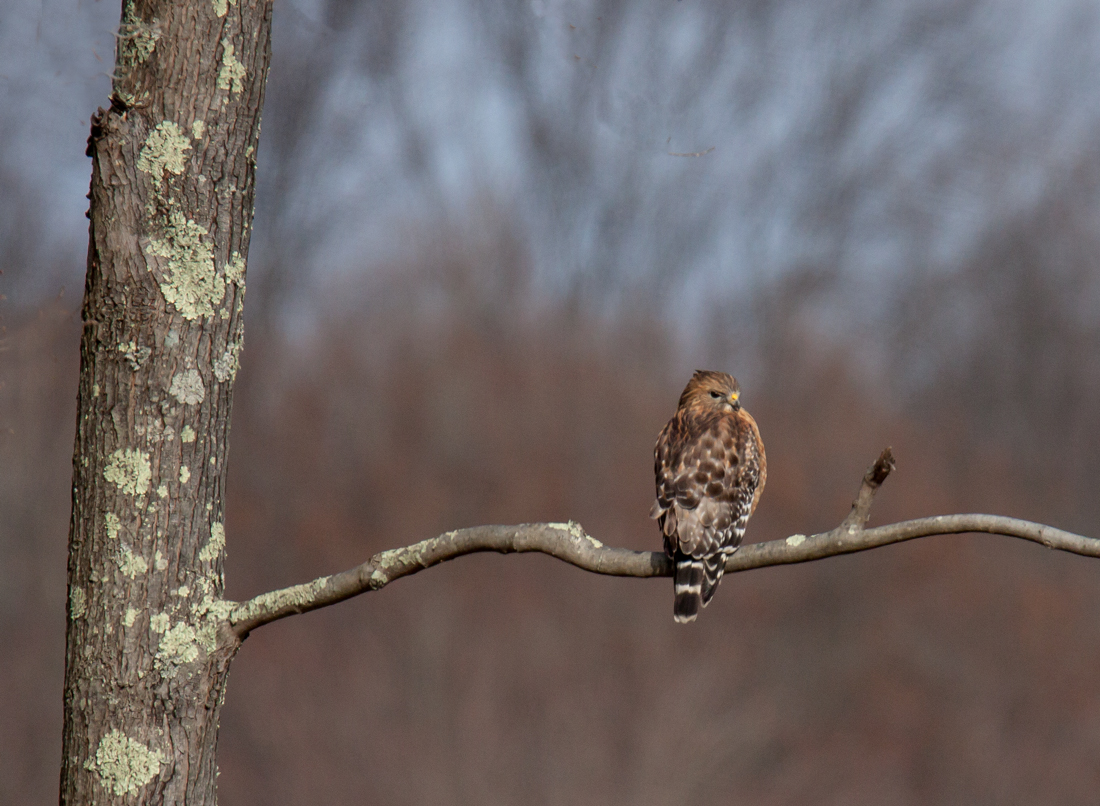
What do dragonflies eat for lunch? I stumbled upon this dragonfly earlier in September as it was beginning to enjoy a freshly caught insect. Judging from the long legs and wings of the prey, it looks like the dragonfly is munching on a crane fly.

The dragonfly was so focused on eating that it let me get pretty close without flying away and I was able to take a number of shots from different angles and with different settings. I defer to others on identification of the dragonfly species. I initially thought it was a Great Blue Skimmer, but the eye color seems wrong.

lunch3_bloglunch2_bloglunch1_blog

© Michael Q. Powell. All rights reserved.

Read Full Post »

It’s autumn now and my thoughts (and my camera) are starting to focus more on birds than insects. This past weekend, I returned to a location where I had previous seen a female Belted Kingfisher (Megaceryle alcyon).  The kingfisher would perch on the limbs of some trees overlooking a small trout-stocked pond called Lake Cook, which is really more like a small pond, and periodically make a foray across the surface of the water and grab a fish.

I realized this time that I had a problem—there are so many leaves still on the trees that I couldn’t spot the kingfisher when I heard its very distinctive, rattling call. I could get a general idea of its location, but couldn’t see the kingfisher until it was already in flight, which mean I had to react really quickly to acquire and track it, hoping that I would be able to focus on it.

As it turns out, hope is not really an effective photographic technique and not surprisingly I ended up with a lot of blurry, improperly exposed images, in part because the kingfisher was flying in an out of the shadows. I was pleased, though, that I was able to capture a few decent images of the kingfisher in flight. I was shooting from across the pond from where the kingfisher was perched, so the shots are not close-ups of the bird, but are more like environmental action shots. Maybe I need a longer lens!

Belted KingfisherBelted KiingfisherBelted KingfisherBelted Kingfisher

© Michael Q. Powell. All rights reserved.

Read Full Post »
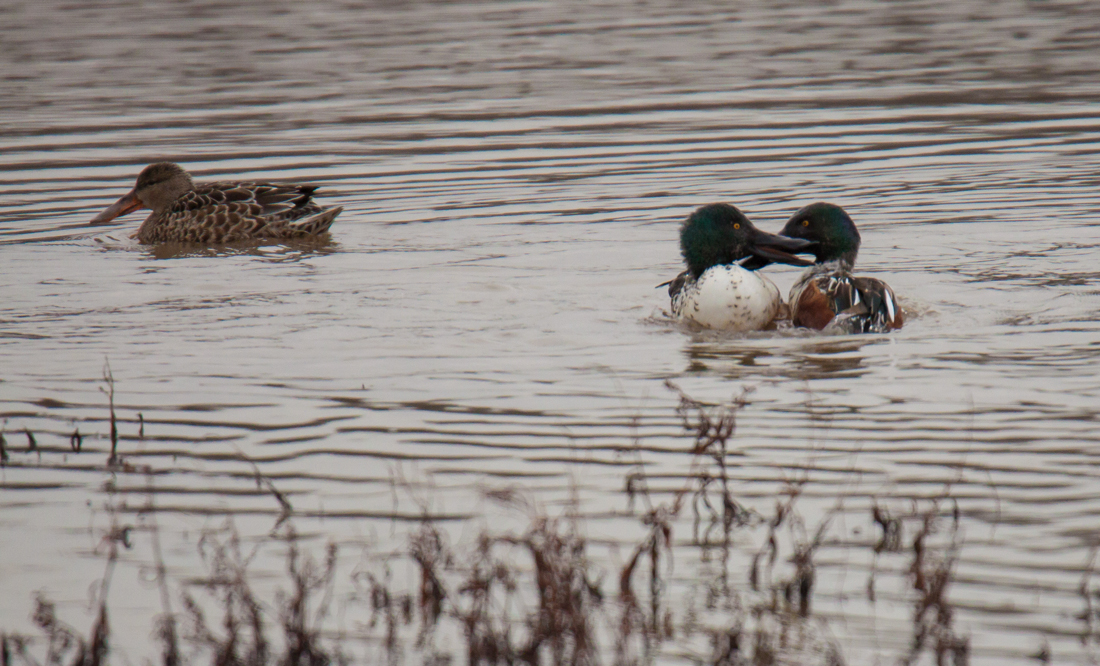
Can you react faster than an eagle can? Yesterday, I was getting ready to step out of the brush that surrounds one of the ponds at my local marsh, when I spotted a large dark shape in a dead tree that overlooks the water. I suspected that it might be a Bald Eagle (Haliaeetus leucocephalus), since I had seen eagles perched on this tree a couple of times in the past.

As I stepped forward and was starting to bring my camera to my eye, a juvenile Bald Eagle took off. The eagle flew upwards so quickly that I had trouble finding it and keeping it in my viewfinder, as you can see in my first shot. I got a few more shots as I tracked the eagle’s flight, but in most of them, the eagle’s head is obscured by its outstretched wings. Just before the eagle flew behind the trees in the distance, I got a reasonably clear shot, the second image below.

What did I learn? If an eagle spots me at the same time that I spot him, his reaction times are going to be quicker than mine. Someone I’m going to have to figure out a way to be more stealthy and more ready the next time I find myself in a situation like this. That will be my challenge this autumn as I start to take more shots of birds as the insect population gradually decreases.

eagle1_blog_sepeagle2_blog_sep© Michael Q. Powell. All rights reserved.

Read Full Post »

Sometimes when the Great Egrets (Ardea alba) are moving from one place to another at Huntley Meadows Park, my local marshland park, they fly really low, almost like they are in stealth mode and are trying to avoid being picked up on the radar.

Great Egret

Great EgretGreat Egret

© Michael Q. Powell. All rights reserved.

Read Full Post »

One of my fellow photographers, Walter Sanford, pointed at the water and exclaimed, “Spider!” A spider in the water? Yes, fishing spiders don’t make a web and instead hunt by sensing the vibrations on the surface of the water.

There are numerous species of fishing spiders, but I think this may be a Six-spotted Fishing Spider (Dolomedes triton). Yes, I realize there are more than six white spots on its back—apparently the name refers to six dark spots on the underside of the spider, a part of the spider that I have never seen.

Six-spotted Fishing Spider

© Michael Q. Powell. All rights reserved.


Read Full Post »

I love to photograph insects with cool or unusual names, like this caterpillar known as the Smeared Dagger Moth Caterpillar (Acronicta oblinita). Who makes up these crazy names? Freddy Krueger? Jason? Someone obviously had been been watching too many slasher or horror films.

The first time that I photographed this caterpillar, I called it the Pittsburgh Steelers caterpillar, because its colors matched those of the Steelers’ uniforms. I even proposed that the Steelers adopt the caterpillar as a mascot, but the idea didn’t catch on—a fuzzy caterpillar probably doesn’t match the Steelers macho image anyways.

Now that I have captured the Smeared Dagger, I’m searching for one of my previous subjects, the Twice-stabbed Stink Bug (Cosmopepla lintneriana). Yes, that’s a real insect. You can’t just make this stuff up, or maybe you can.

Smeared Dagger Moth caterpillar

© Michael Q. Powell. All rights reserved.

Read Full Post »

When you photograph something really cool, do you return to the same location with the hope of finding your subject again? In late August, I spotted a Mocha Emerald dragonfly (Somatochlora linearis) for the first time and was really excited, but I wanted to get some better shots.

Over the course of this summer, I have learned that some dragonflies are very habitat-specific—you can only find them in places where the water or vegetation have certain characteristics. So I returned on the 5th of September and followed the same shallow stream and was thrilled to find another Mocha Emerald. Initially I caught sight of the dragonfly in flight and wasn’t sure that it was a Mocha Emerald until it landed. Only them could I see the really narrow abdomen and unusual terminal appendage that are characteristic of this species.

Getting a shot was a bit of a technical challenge. The area was heavily shaded, but there was some light coming in from directly behind the dragonfly, creating a silhouette. I cranked up the ISO to 1250 and underexposed a bit and got the second image below after a bit of post processing. I decided to use my pop-up flash to try to balance the light coming from the back and got the first image, my favorite one.

However, I really wanted to get more of the wings into the photo and I started to circle around the perched dragonfly. Unfortunately, one foot slid into the water of the shallow stream and I composed the third shot with one foot in the water and one on the bank, not exactly an optimal shooting position.

When I tried to continue my movement to frame the dragonfly from a different angle, it flew away. I suspect that the Mocha Emeralds are now gone from the season, but I may return one last time to that location to see if there are any stragglers. I might get lucky again.

Mocha Emeraldmocha_2_blogmocha_3._blog

© Michael Q. Powell. All rights reserved.

Read Full Post »

« Newer Posts - Older Posts »