Feeds:
Posts
Comments

Archive for the ‘Travel’ Category

Last night, my final night in Vienna this trip, I had a chance to walk by Stephansdom (St. Stephen’s Cathedral), an incredible building in the center of the city.

The beauty of Vienna is magnified at this time of the year by wonderful decorations and lights everywhere.

Stephansdom

© Michael Q. Powell. All rights reserved.

Read Full Post »

My short trip to Vienna, Austria is rapidly coming to a close and I want to leave you with this image of the entrance to the outdoor Christmas market at the Rathaus (City Hall), the tall building in the background.

My busy work schedule and the rainy weather this year have conspired against me and kept me from getting new photos. I decided to reprise a photo from a similar posting that I did in 2016. I did have a chance earlier in the week to visit this Christmas market and, as always, it was amazingly beautiful, despite the bustling crowds and often commercialized decorations and merchandise.

Best wishes to all for a “Frohe Weihnachten,” German for “Merry Christmas.”

Christmas 2018

© Michael Q. Powell. All rights reserved.

Read Full Post »

Sometimes the most mundane scenes capture my eye and prompt me to photograph them. On Monday morning, I looked out of my hotel window and was captivated by the way that the early sunlight was falling on the dome of a building in the distance. As I started exploring the scene I saw lots of wonderful details, a wonderful juxtaposition of elements of the old and the new, of historical buildings and new construction.

This is not my normal style of photography, but I thought it would be fun to share with you a couple of images that give you a sense of the feel of that early morning in Vienna, Austria. I had hoped to take some additional photos of the city, but the last couple of days have been cold, wet, and windy. With a little luck I will be able to take a few photos of the Christmas markets to share with you before I depart this beautiful old city.

Vienna Austria

Vienna Austria

© Michael Q. Powell. All rights reserved.


Read Full Post »

Whenever I am traveling for work I try to find some local wildlife to photograph. I am currently in Vienna, Austria and yesterday morning I went for a short walk in the Stadtpark, a park in central Vienna that is not far from my hotel. In the small pond there I found mostly mallard ducks (Anas platyrhynchos), a species with which I am quite familiar.  One duck, however, really stood out because it had such unusual markings.

I focused my attention and my camera on this particular duck. Its shape looked to be similar to that of normal mallards and I wonder if this might be some kind of hybrid. I suppose that it could be another species altogether, though it did not look like any of the species in the photographic list I found on-line of the birds of Austria.

Whatever the case, this bird struck me as being a bit of an odd duck.

duck in Vienna

duck in Vienna

© Michael Q. Powell. All rights reserved.

Read Full Post »

I am back now in the USA, but thought I’d post one last image from my recent trip to Brussels. I spotted this young Common Moorhen (Gallinula chloropus) swimming around in the small pond at the botanical garden. There were several other moorhens, but they all stayed in the reeds and I was not able to get a good shot of them. I really like the spiky feathers of young moorhens. When they become adults, their feathers appear to be much smoother in appearance.

Common Moorhen

© Michael Q. Powell. All rights reserved

Read Full Post »

Later today I will board an airplane and fly across the Atlantic Ocean with the assistance of a significant amount of sophisticated machinery. I can’t help but marvel at the way that dragonflies and damselflies, by contrast, maneuver through the air so skillfully and effortlessly. Wouldn’t it be cool to be able to fly like that?

This past weekend I spent a good amount of time in one of my favorite photographic pursuits—trying to capture images of a dragonfly in flight. When I am traveling I usually don’t have my best camera gear with me and opt instead to use a Canon SX50, a superzoom point-and-shoot camera. It gives me a lot of reach, but is sometimes slow to focus and has a low frame rate. What that means is that I have to be even more careful than usual, because I can’t capture a lot of shots in an extended burst.

Mostly I was trying to photograph Migrant Hawker dragonflies (Aeshna mixta) at the botanical garden in Brussels. The good news is that Migrant Hawkers are relatively large in size and will sometimes hover a bit over the water. That increases slightly my chances of getting a shot, though many of my attempts resulted in cut-off or out-of-focus shots of the dragonflies.

This was probably my best shot of the session. I like the way that I captured a pretty clear view of the body, including the legs that are tucked in during the flight and managed to get the eyes in relatively sharp focus. One of my Facebook friends commented that it would make a handsome piece of jewelry made with gold, turquoise and onyx—I totally agree with her.

Migrant Hawker


© Michael Q. Powell. All rights reserved

Read Full Post »

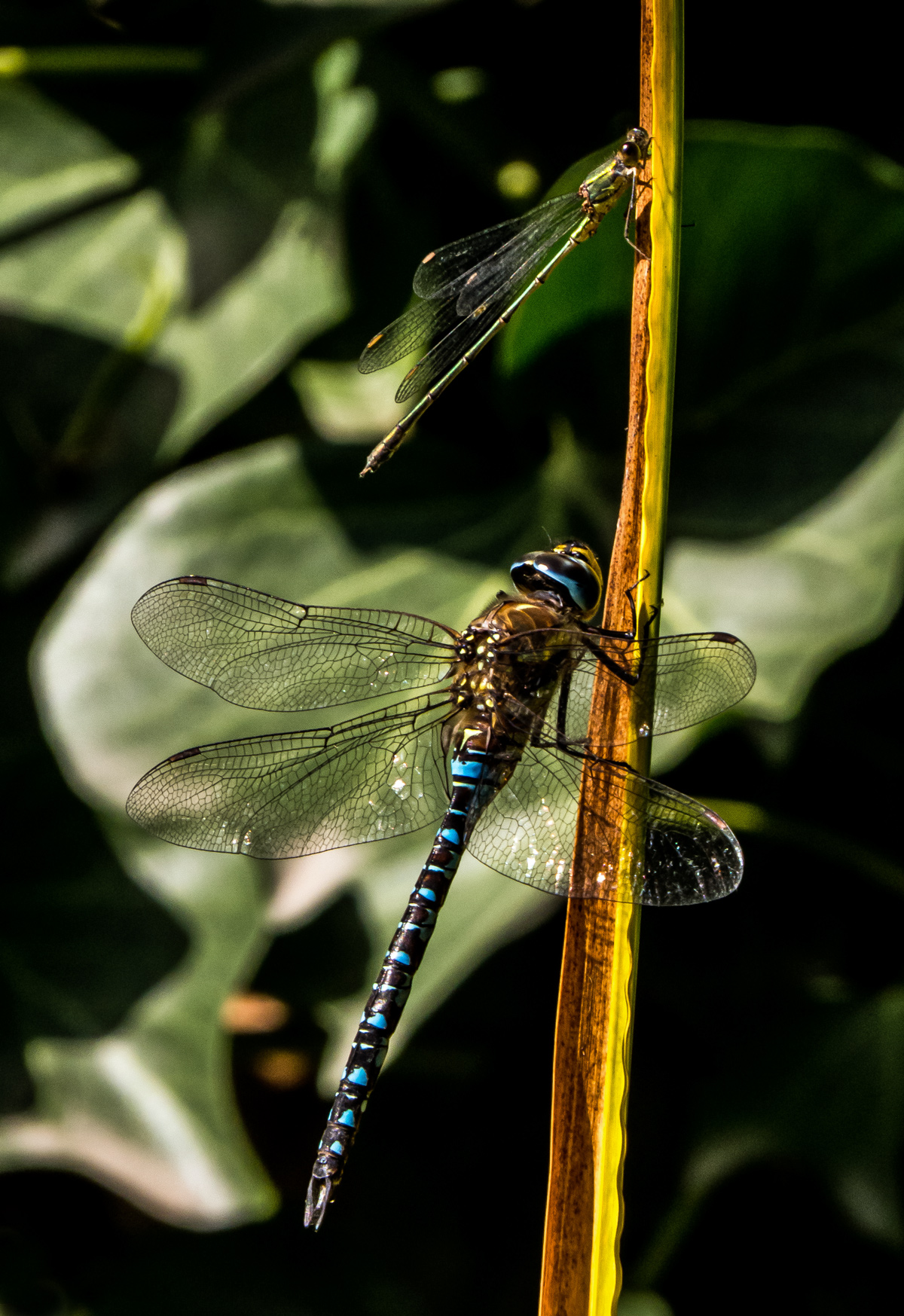
I can’t help but wonder what was going through the minds of these two insects as they perched on the same stalk of vegetation this past weekend at the botanical garden in Brussels, Belgium. Their postures suggest to me a heightened sense of alertness and a kind of wariness. The much smaller damselfly at the top seems to be cautiously looking down over its shoulder at the Migrant Hawker (Aeshna mixta), who appears to be focusing his attention upward. Was it a sign of curiosity or one of hunger? There was never any sign of direct aggression, but I note that the damselfly was the first one to take off and the dragonfly did not pursue it.

For those of you who are not as hooked on dragonflies as I am, this image shows pretty clearly some of the differences in the body shape and eye positions of a damselfly versus a dragonfly. It is important, though, to keep in mind the amazing diversity within the community of dragonflies and damselflies in terms of color, size, and behavior—these are some of the reasons why I am drawn to them as subjects for my photography.

friend or foe

© Michael Q. Powell. All rights reserved

Read Full Post »

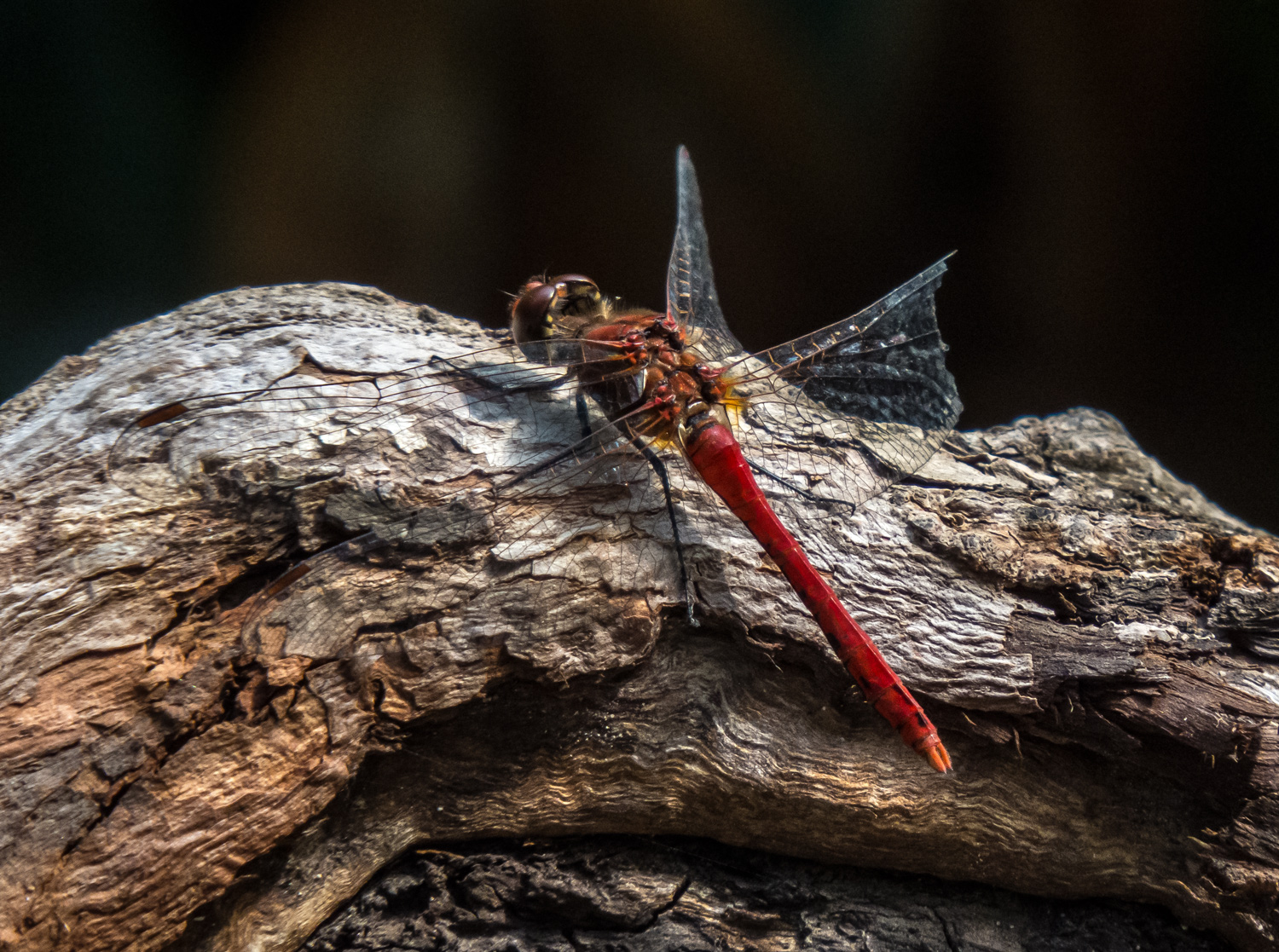
Its colors are not quite as ostentatious as those of the Migrant Hawker dragonfly that I featured yesterday, but the bright red bodies of what I believe are Common Darter dragonflies (Sympetrum striolatum) made them equally hard to miss at the botanical garden in Brussels, Belgium. The colors of these beautiful little dragonflies remind me of those of the Autumn Meadowhawk (Sympetrum vicinum), a species that I see quite often in my home area of Northern Virginia and the shared Latin genus name of Sympetrum indicates their relationship.

I was able to photograph male Common Darters perched in several different spots and I particularly like the way that the fiery red of their bodies contrasts with the cooler green of the backgrounds.

Common Darter

Common Darter

Common Darter

© Michael Q. Powell. All rights reserved


Read Full Post »

Last year when visiting Brussels, Belgium in early September, I was excited to discover dragonflies at the botanical garden in the center of the city. I headed back to the same location on Sunday right after checking into my hotel to see if I could find some dragonflies there this year.

As soon as I arrived at the small pond at the botanical garden, I was thrilled to see a number of large, colorful dragonflies flying about. Although they spent most of their time flying patrols over the water, occasionally one of the dragonflies would perch on the vegetation at water’s edge, which allowed me to capture some images of them.

I absolutely love the beautiful colors and patterns of these dragonflies, which I believe are Migrant Hawker dragonflies (Aeshna mixta). I am definitely not an expert on European dragonflies, however, and there are a number of other hawker species that are somewhat similar in appearance. In North America, there are dragonflies of this same Aeshna genus, which are usually referred to as mosaic darners, but I don’t think that this particular species can be found on the other side of the Atlantic.

Migrant Hawker

Migrant Hawker

Migrant Hawker

© Michael Q. Powell. All rights reserved


Read Full Post »

As I was working on a post earlier today about an unusually colored damselfly, the Citrine Forktail damselfly, I realized that I had not posted any photos of the beautifully colored ones that I saw during my trip to Brussels earlier this month. They were not yellow in color, but instead were a bright red. The first ones that I saw were a couple in the tandem position that is used for mating and also, for some species, when depositing eggs. A few days later I spotted a singleton damselfly perched on some vegetation.

I don’t think that I have seen any red damselflies in Northern Virginia, so I had to do some research. What I discovered is that these damselflies have the very unexciting name of Large Red Damselflies (Pyrrhosoma nymphula). The name seems to fit, but it strikes me that the scientist must have been tired or was otherwise feeling uncreative when he came named the species. This particular species is mainly a European one with some populations in Northern Africa and Western Asia, according to Wikipedia, so I am not at all likely to spot one on my frequent photowalks here.

Large Red Damselfly

Large Red Damselfly

© Michael Q. Powell. All rights reserved.

Read Full Post »

So many dragonflies…so little time. Although I have returned from my recent trip to Brussels, Belgium, I still have photos to share of dragonflies that I saw while I was there. I guess that I consider the species that I observed to be “exotic” and special because they were new to me, though many of them are probably quite common in Brussels.

The dragonfly species that I am featuring today is the Black-tailed Skimmer (Orthetrum cancellatum). When I first spotted these dragonflies at the  étang Tenreuken (Tenreuken Pond). I was struck by their resemblance to the Blue Dasher (Pachydiplax longipennis), a very common dragonfly where I live. The Blue Dasher is particularly special to me because it was the subject of my very first blog posting in July 2012. (For reference purposes, this will be posting number 2740.)

As I watched the Black-tailed Skimmers, I noticed some differences compared to the Blue Dashers. The bodies of the Black-tailed Skimmers appeared to be larger and broader; their eyes seemed greener; and they seemed to spend more time perching flat on the ground rather than on the tips of vegetation.

I thought about posting only the first image, my favorite, because it has a kind of artistic appeal to me. I like the low angle that I chose and the vegetation growing in the foreground out of what appears to be a rock, but is actually the deteriorated wood of a piling at the edge of the water. Ultimately I decided to share some additional shots that give you a more complete view of this beautiful “new” dragonfly species.

UPDATE: A sharp-eyed viewer from the United Kingdom noted that the dragonfly in the second photo appears to be a different species than the ones in the other photos. I did some additional checking and agree with him that it is probably a male Scarce Chaser (Libellula fulva), not a Black-tailed Skimmer. Thanks for the help, blhphotoblog, and others should check out his wonderful blog Butterflies to Dragsters for some wonderful photos.

Black-tailed Skimmer

Black-tailed Skimmer

Black-tailed Skimmer

© Michael Q. Powell. All rights reserved.


Read Full Post »

Many dragonflies are colored with muted shades of green and brown and blend in well with their environments. Some, though, are more boldly colored and are hard to miss when they are present.

That is definitely the case for this Scarlet Darter dragonfly (Crocothemis erythraea) that I spotted last week at the Rouge-Cloître Park in Brussels, Belgium. I first noticed the bright red color of this dragonfly when it zoomed across my line of sight and I was thrilled later in the day when one accommodated me by landing on the ground not far from where I was standing.

Scarlet Darter

Scarlet Darter

© Michael Q. Powell. All rights reserved.

Read Full Post »

When this bird spread its wings and left them open last week at a small pond in Brussels, I instantly knew it was a cormorant. Cormorants have to frequently dry out their wings, because their feathers are not completely waterproof like some other water birds. It sounds like that would be a problem, but it actually is an advantage for them. Their waterlogged feathers help them to dive deeper, kind of like a weight belt that a deep-sea diver might wear.

It turns out that this is a Great Cormorant (Phalacrocorax carbo), a larger and somewhat darker cousin of the Double-crested Cormorants that live in our area.

Great Cormorant

Great Cormorant

© Michael Q. Powell. All rights reserved.

Read Full Post »

Although I saw Eurasian Coots (Fulica atra) a few times when I was in Brussels, Belgium this week, I was especially thrilled to spot this juvenile coot interacting with one of its parents. The color pattern on the juvenile is quite different from the adult’s, but the shape of their bills definitely shows that they are both coots.

Eurasian Coots are similar in appearance to the American Coots (Fulica americana) that I am used to seeing, though it appears to me that the white frontal shield on the “forehead” of the coot seems more prominent on the Eurasian species.

As I was thinking about the word “coot,” I realized that most people use the word only in the expression “old coot.” It made me wonder why coots are associated with a somewhat disparaging term for older men. According to an article in the Hartford Courant newspaper, “If you’ve ever seen a coot — an ungainly marsh bird that bobs its head like a hen as it swims or walks — you can see why “coot” came to denote, by the 1700’s, “a harmless, simple person,” as in “an old coot.””

I love when I have the chance to photograph the interaction between two species or two members of the same species. In this case, the eye contact and body positions tell a story that scarcely requires words.

Eurasian Coot

© Michael Q. Powell. All rights reserved.


Read Full Post »

It’s amazing how many different species of dragonflies I have been able to spot and photograph during my brief stay here in Brussels, Belgium. One new species for me is the Four-spotted Chaser (Libellula quadrimaculata)—there were quite a few members of this species active at a pond in the Rouge-Cloître park. Unlike some of the species that I have seen here, this species is also found in North America, where it is known as the “Four-spotted Skimmer.”

This species is so popular that,  according to one website, it won a contest in 1995 to become the state insect of the state of Alaska. That may sound a bit strange to some readers, but personally I am happy that it beat out competitors that included the mosquito. (I have heard stories that mosquitoes in Alaska are large and aggressive and possibly are even larger than dragonflies, though that may be a slight exaggeration.)

Four-spotted Chaser

Four-spotted Chaser

© Michael Q. Powell. All rights reserved.


Read Full Post »

One of the most exciting things that I have observed during this brief trip to Brussels has been a family of Mute Swans (Cygnus olor) swimming in a small pond at the Rouge-Cloître park. I have seen swans a few times before in the wild, but I had never seen baby swans. As you might expect, they are really cute. Both of the parents seemed to be very attentive to the little ones and stayed close to them at all times. The baby swans, technically known as cygnets, seemed to be very curious and energetic and interacted a lot with each other as they explored the world.

Swan babies

Swan babies

Swan babies

© Michael Q. Powell. All rights reserved.

Read Full Post »

At several locations during this visit to Brussels, I have spotted large blue-and-green dragonflies flying patrols back and forth over the water. They reminded me a lot of the Common Green Darner dragonflies (Anax junius) that I see fairly often in my home area of Northern Virginia. I suspected correctly that Common Green Darners are a North American species and that the dragonflies that I was observing were European “cousins.”

It was not hard to establish that these are Emperor dragonflies (Anax imperator), a species that is also referred to as “Blue Emperor.” Because of their size and the fact that their territory seemed to be pretty small, it was easy to track the Blue Emperor dragonflies visually when they were flying. I had to wait a long time, however, for them to perch and then move quickly to get a shot when they did so. Their rest breaks frequently lasted only a few seconds and then they would begin to fly again.

I really like the blue and green color combination and the way that these colors coexist in both the bodies and in the eyes of these beautiful dragonflies.

Emperor dragonfly

Emperor dragonfly

© Michael Q. Powell. All rights reserved.

Read Full Post »

As I was exploring the Rouge-Cloître (Red Cloister) Park in Brussels, Belgium last weekend, I could hear some excited peeping coming from a heavily-vegetated area at the edge of a pond. Peering through the reeds, I could just make out the dark shapes and brightly-colored beaks of a pair of adult Common Moorhens (Gallinula chloropus).

As I kept watching I began to see several smaller shapes and realized there were baby chicks with the parents—there were at least three chicks and possibly more. The chicks and the parents remained mostly out of sight, but occasionally I got a partial glimpse of one of them through the vegetation as they moved about and managed to snap off a few shots.

I am also including a shot of an adult moorhen that I spotted earlier in the day at another park, in case you are not familiar with this bird species. In the photo you can’t help but notice that Common Moorhens have large feet that lack the webbing that we are used to seeing in ducks.

Common Moorhen

Common Moorhen

Common Moorhen

© Michael Q. Powell. All rights reserved.


Read Full Post »

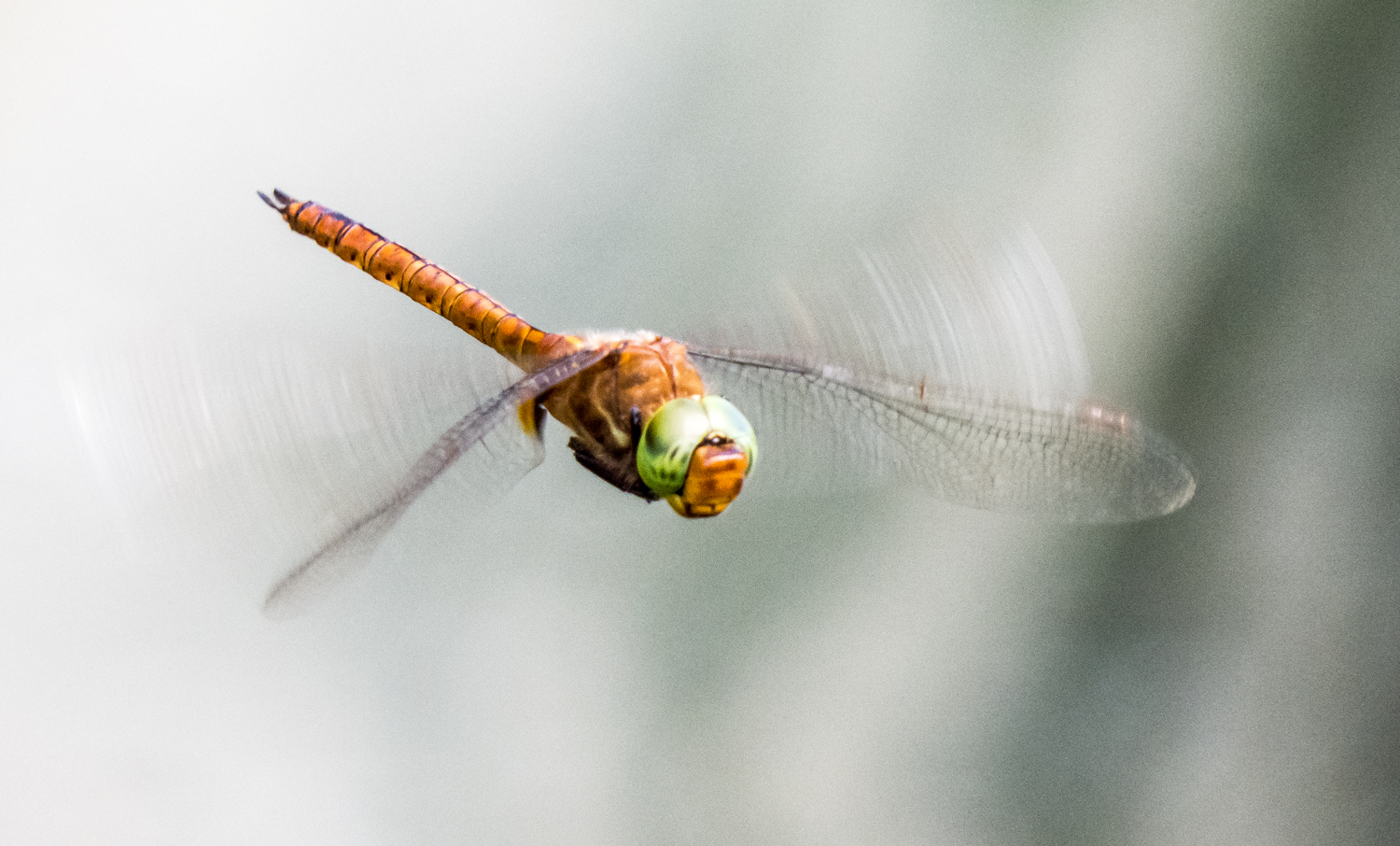
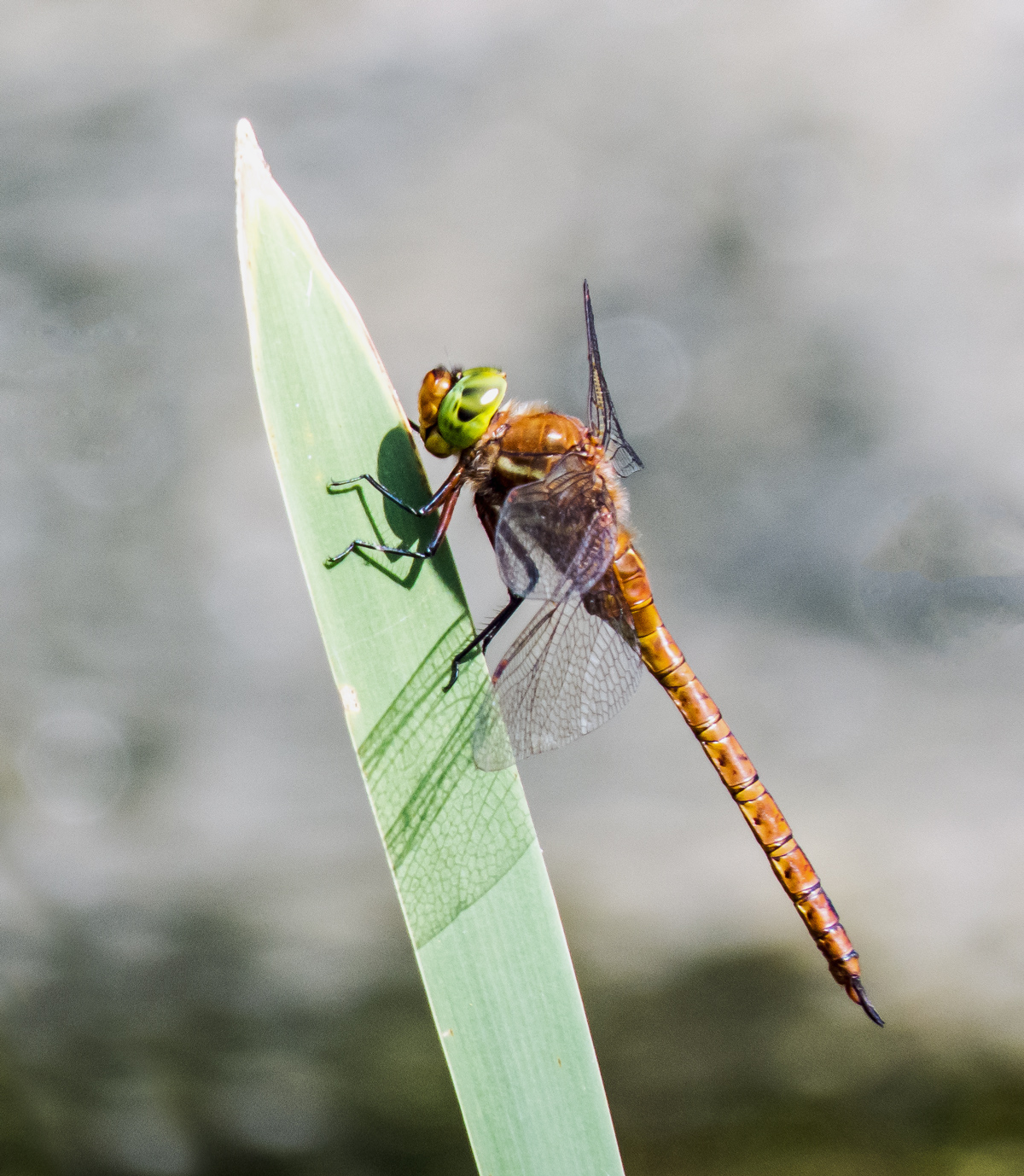
During this past weekend here in Brussels, I managed to find some really cool dragonflies, like this Green-eyed Hawker (Anaciaeschna isoceles or Aeshna isoceles) that I spotted at a pond in the Rouge-Cloître (Red Cloister) Park. This rather large dragonfly, also known as a Norfolk Hawker, is really striking as it flies, with a combination of colors that I have never seen before on a dragonfly.

With a bit of persistence and a lot of luck, I managed to capture an in-flight shot of a Green-eyed Hawker, but mostly I waited and waited for one to land. It was a little frustrating when one of them would land in a location that was too far away or in a location that did not afford me a clear shot, but eventually I was able to capture some images of a perching Green-eyed Hawker.

I was happy to capture the last photo that shows the yellow triangle on the upper part of the abdomen that is responsible for the “isoceles” portion of the Latin name of the species.

Green-eyed Hawker

Green-eyed Hawker

Green-eyed Hawker

© Michael Q. Powell. All rights reserved.

Read Full Post »
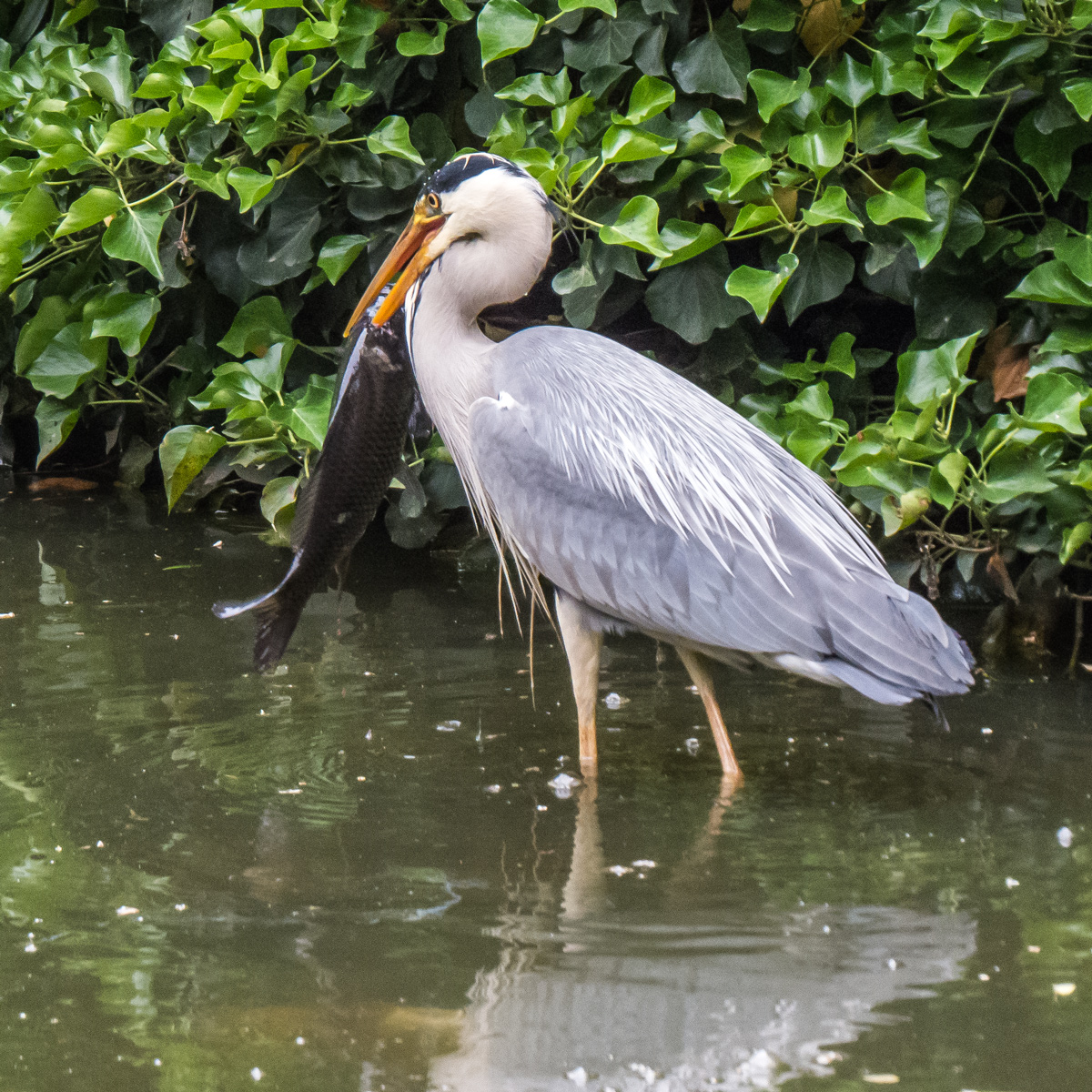
Grey Herons (Ardea cinerea), like this one that I observed at the Botanical Garden here in Brussels, look and act a lot like the familiar Great Blue Heron (Ardea herodias) of North America, but are a little smaller and slightly different colored. Shortly after it caught this big fish, the heron let it go or it somehow managed to escape—maybe they have a catch-and-release policy at this location.

Grey Heron

Grey Heron

Grey Heron

© Michael Q. Powell. All rights reserved.

Read Full Post »

Egyptian Geese (Alopochen aegyptiaca) have a look that is so unusual and distinctive that I can now recognize them almost instantaneously. I am fortunate to have the chance to travel to Brussels, Belgium a couple of times a year for work and one of my favorite places to visit here is the botanical gardens of Brussels. There is a small pond at the botanical gardens that always has an assortment of birds, and I was delighted to spot this beautiful Egyptian Goose swimming in the pond yesterday, my day of arrival in this historic city. I have seen an Egyptian Goose at this location a couple of times in the past, but the lack of surprise did not diminish at all my excitement at seeing this exotic species.

As their name suggests, Egyptian Geese are native to the Nile River area and sub-Saharan Africa, but there are now established breeding populations in parts of Europe and even in the United States. According to information in Wikipedia, Egyptian geese were considered sacred by the ancient Egyptians, and appeared in much of their artwork. They have been raised for food and extensively bred in parts of Africa since they were domesticated by the ancient Egyptians, although I suspect that they are viewed in Europe as primarily an ornamental bird.

Egyptian Goose

© Michael Q. Powell. All rights reserved.


Read Full Post »

I will be heading home soon after my brief stay in Vienna, Austria and thought I would post a few last wildlife photos that I took here. These images help reinforce to me the notion that there is always something interesting in nature to photograph, no matter where I happen to be.

The first image is an unidentified species of frog that I encountered at the edge of a pond while wandering about the Donau-Auen National Park. It reminds me of the Southern Leopard Frog that I often see at home in Northern Virginia.

frog in VIenna

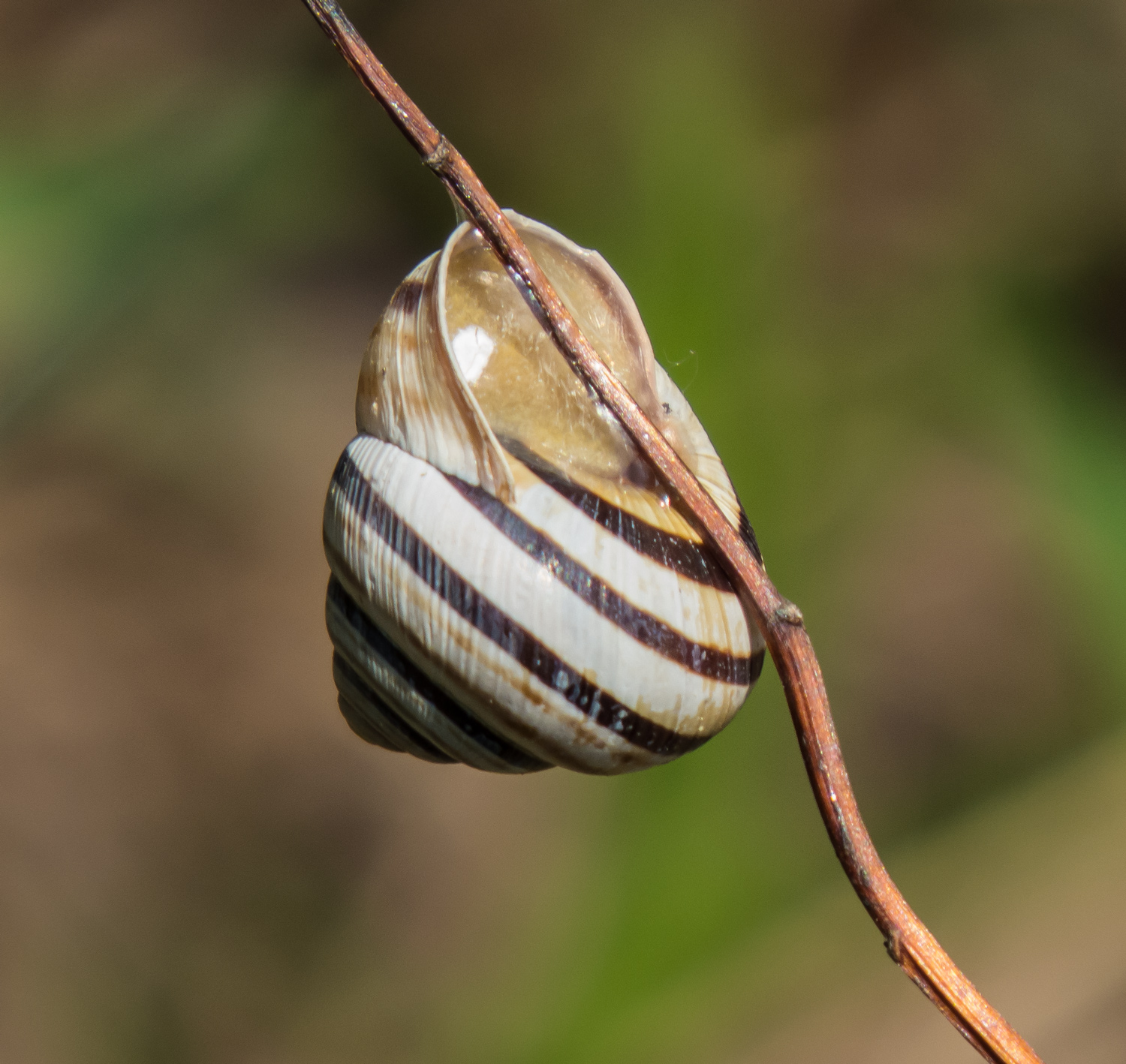
The second image appears to be a Viennese Banded Snail (Cepaea vindobonensis) that I also spotted in the National Park.  I thought that it was really cool the way that it had attached itself to the vegetation.

Viennese Banded Snail

The final image shows what I believe to be a Mute Swan (Cygnus olor) that I saw at the Stadtpark (“city park”) not far from the hotel where I am staying. I always find swans to be beautiful and graceful, even when located in an urban environment.

swan in Vienna

© Michael Q. Powell. All rights reserved.

Read Full Post »
Here are a few shots of butterflies that I spotted last weekend during a visit to the Donau-Auen National Park in Vienna, Austria. Unlike the brightly-colored larger butterflies that I sometimes see in gardens, these butterflies were small, rather drab in coloration, and very skittish. They also tended to perch on the ground, which made them a little tougher to photograph. In my experience, woodland butterflies tend to fit this general profile.

I particularly enjoyed chasing one butterfly, which is shown in the first and second images below. The butterfly is a species that I do not see at home and looks quite nondescript when its wings are closed. With the wings open, though, the butterfly reveals its beautiful colors and patterns—it is like a hidden treasure.

The other two butterflies are also quite beautiful, with wonderful muted tones and patterns.


butterfly in Vienna

butterfly in Vienna

butterfly in Vienna

butterfly in Vienna

© Michael Q. Powell. All rights reserved.

Read Full Post »

Dragonflies are amazing. They spend most of their lives as nymphs in the water before they crawl out, discard their exoskeletons, and become beautiful aerial acrobats. I photographed this probable Downy Emerald dragonfly (Cordulia aenea) last weekend at the Donau-Auen National Park in Vienna, Austria.

The object in the upper right in the first image is the discarded exoskeleton, often called an “exuvia,” and further down the vegetation is the dragonfly itself.  The dragonfly appears to have recently emerged from that same exuvia. Note how much longer the dragonfly’s body has grown after emergence. The wings of the dragonfly are not yet fully extended, suggesting that it still is in the process of emergence. If you look closely at the exuvia, you may notice some white stringy looking parts. These are the breathing tubes are part of the respiratory system that helped the dragonfly breathe while still a water-dwelling nymph.

I was standing on a relatively steep incline and the reed-like vegetation was growing out of the water, so it was a challenge to get a good angle to photograph the dragonfly. The second image was taken from a different angle from the first (and I was happy that I was able to keep from sliding into the water).

I proceeded down the trail for a while before looping back and returning to the spot where I had seen the dragonfly. I think the dragonfly in the final image may be the same one as in the first two shots, though obviously the perch is not the same. After dragonflies have emerged, they generally have to wait some time for the wings to harden and for their metamorphosis to be complete.

dragonfly in Vienna

dragonfly in Vienna

dragonfly in Vienna

© Michael Q. Powell. All rights reserved.

Read Full Post »

Damsels in Vienna? Here are a few shots of some beautiful little damselflies that I encountered this past weekend during a visit to the Donau-Auen National Park in Vienna, Austria.

While traveling for work I normally leave at home my Canon DSLR and big lenses and use instead a Canon SX50 point-and-shoot camera with a super zoom lens. There are some compromises and limitations with this type of camera, but I am quite pleased with the results I can achieve using it, including these almost-macro images.

damselfly in Vienna

damselfly in Vienna

damselfly in Vienna

© Michael Q. Powell. All rights reserved.


Read Full Post »

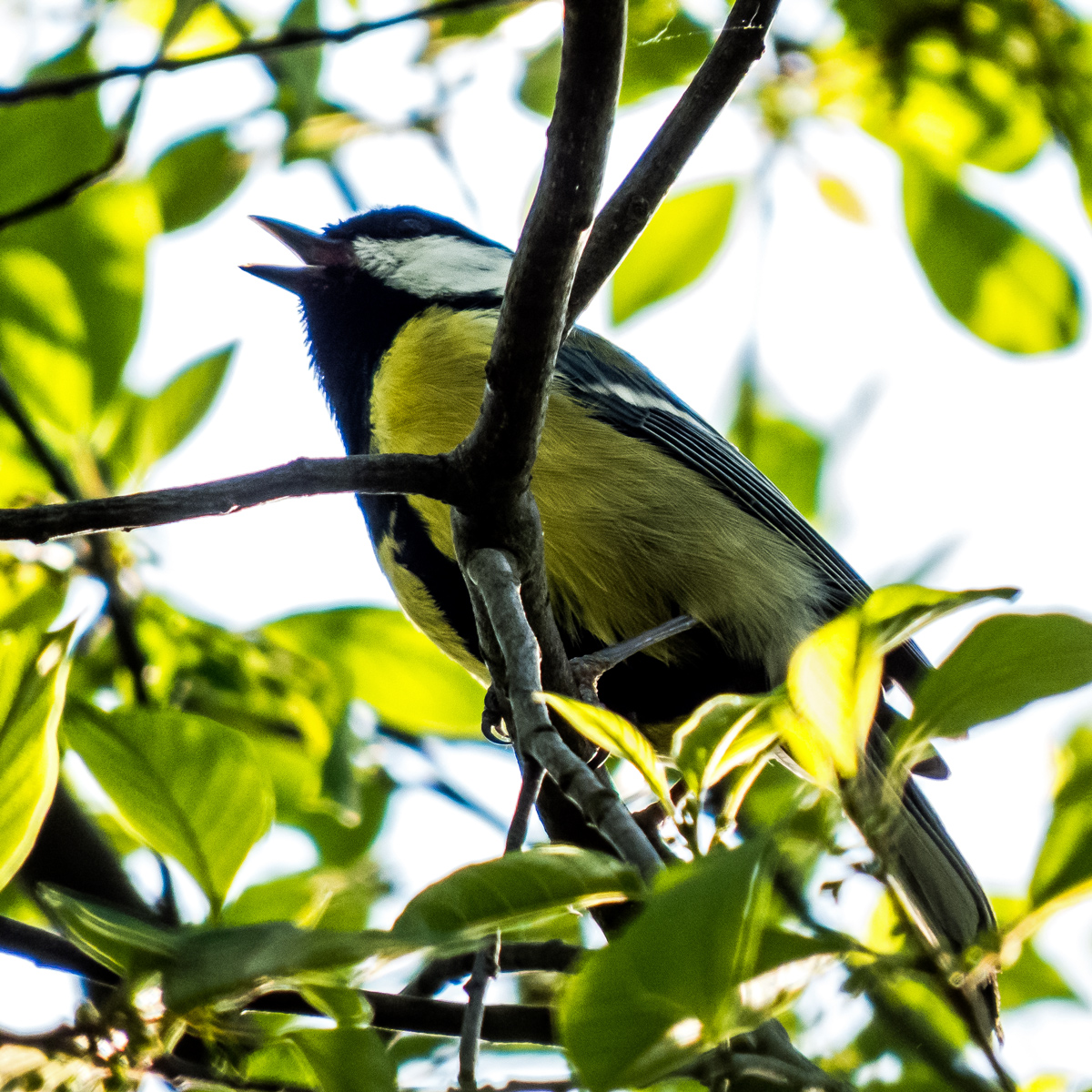
Finding birds is tough when the leaves are on the trees, but I did manage to spot this cool-looking one here in Vienna, Austria while visiting the Donau-Auen National Park. If this bird had remained quiet, there is no way that I would have been able to find it, but fortunately for me it was singing loudly.

I did a quick internet search, but so far I have not yet been able to identify it. I’d welcome identification assistance, particularly from someone with experience with European birds.

UPDATE: Thanks to the assistance of a number of viewers, I have been able to identify this bird as a Great Tit (Parus major), a widespread and common species throughout Europe, the Middle East, Central and Northern Asia, and parts of North Africa.

singing bird in Vienna
© Michael Q. Powell. All rights reserved.

Read Full Post »

I have been to Vienna, Austria often enough in the past 25 years that I have seen most of the big tourist sights. Now, when I have a bit of free time in the city, as I did yesterday, I like to go exploring in the Donau-Auen National Park and seek out wildlife.

I was thrilled when I spotted dragonfly in flight and was able to photograph it after it landed high in a tree. It is not a species with which I am familiar, but fellow bloggere and dragonfly enthusiast Walter Sanford suggested that it is of the Emerald family and I tend to agree with him.

dragonfly in Vienna

© Michael Q. Powell. All rights reserved.

Read Full Post »

No trip to Brussels is complete without a visit to see the statue of the Manneken Pis, the little boy that is one of the symbols of the city. Yesterday he was dressed in a costume that I have not yet been able to identify, but looks Scottish to me.

The little boy has hundreds of different costumes that he wears on special occasions, but the poor fit of this one makes me wonder if it might be an “unofficial” costume that was put on the statue as a prank.

Manneken Pis

© Michael Q. Powell. All rights reserved.


Read Full Post »

On the day of my arrival in Brussels, Belgium for a short business trip, I went for a short walk in the botanical garden, one of my favorite spots to visit in this city. It is within walking distance of my hotel and is one of the few places where I know I can find a taste of nature in the crowed inner city area of Brussels.

Initially I noted only a few mallard ducks and moorhens in the small pond at the botanical garden, but when I looked more closely, I spotted a couple of spectacularly-colored ducks sleeping in a remote corner. I wasn’t sure what they were, but that did not deter me from taking some photos of them. When I went searching on the internet for the species of ducks in Brussels, none of them seemed to match the ones that I had seen. So I switched to searching using more descriptive terms and discovered that the birds were not ducks, but were in fact geese—Egyptian Geese.

As their name suggests, Egyptian Geese (Alopochen aegyptiaca) are native to the Nile River area and sub-Saharan Africa. There are now established breeding populations in parts of Europe and even in the United States.

I took this photo with my Canon SX50, a superzoom point-and-shoot camera that I usually take with me when I travel. As you can see from this image, the camera is capable of capturing a pretty good amount of detail and color.

Egyptian Goose

© Michael Q. Powell. All rights reserved.

Read Full Post »

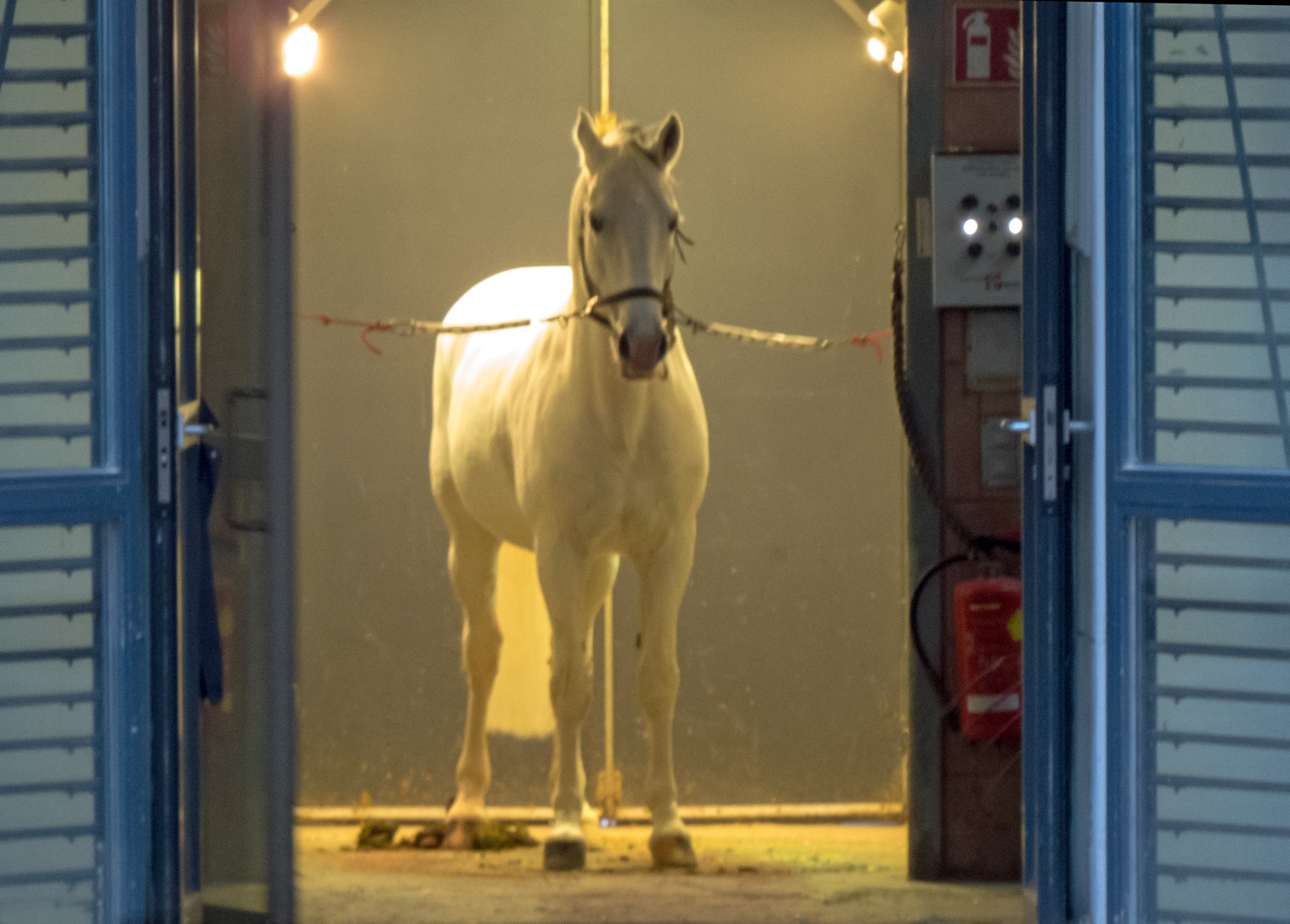
As I was walking to work through the streets of Vienna Friday morning, I passed by the Spanish Riding School in the Hofburg Palace and was thrilled to get a glimpse of some of the world-famous Lippizaner stallions. They were mostly hidden in their stalls, but occasionally one of these beautiful horse would pop its head out or a door would open briefly. I was also able to snap some quick photos as one of the horses was being prepared and was then walked across an open area.

Perhaps someday I will see a performance of the Lippizaners, but for now I am happy to have caught a glimpse of them on my last working day in Vienna for this trip.

Lippizaner

Lippizaner

Lippizaner

Lippizaner

© Michael Q. Powell. All rights reserved.

Read Full Post »

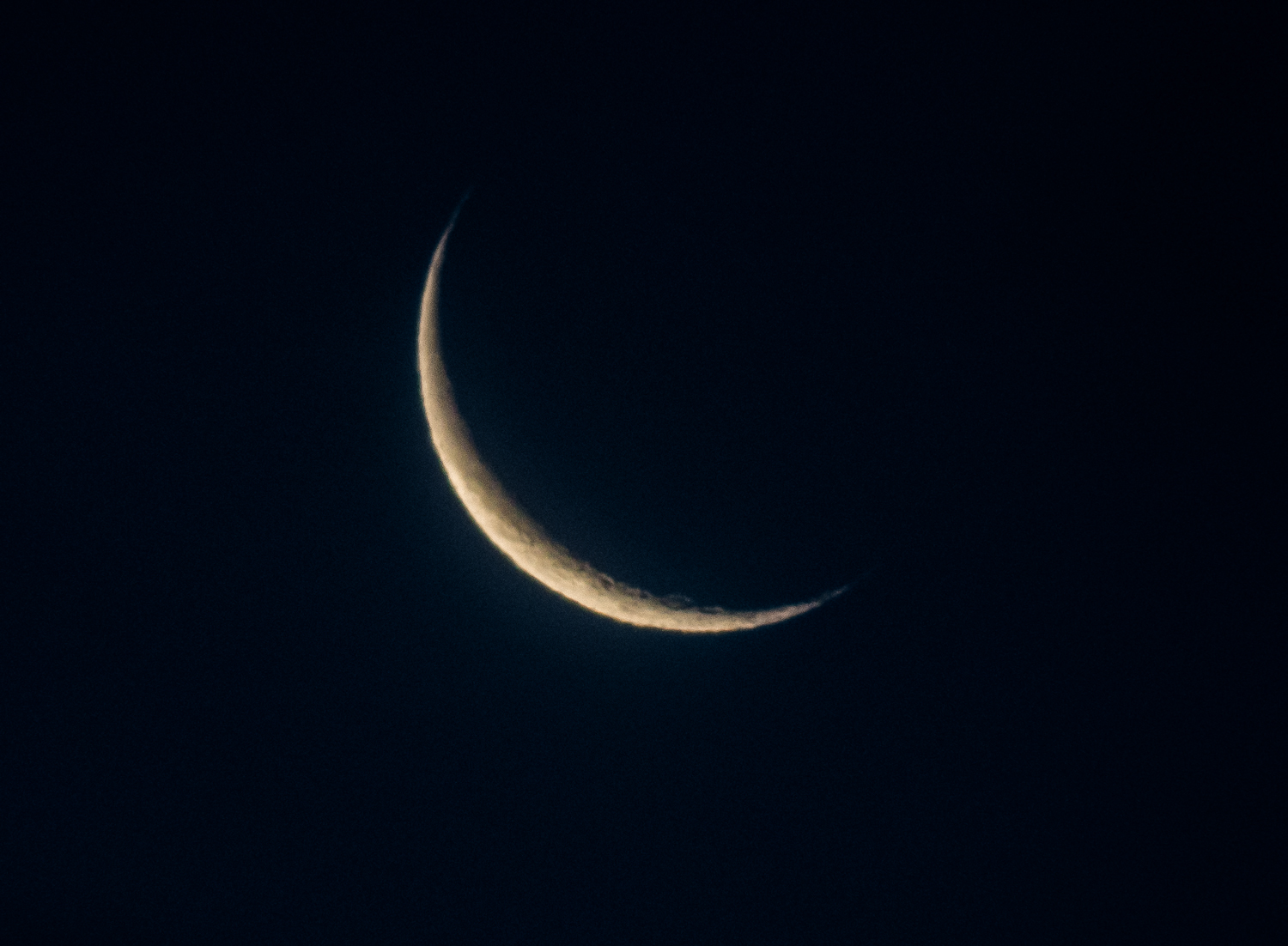
The view from my hotel room in Vienna seems to be mostly of ongoing construction work, but this morning it featured a touch of color as the sun slowly began to rise. A nice highlight was the sliver of a crescent moon still visible in the sky.

Vienna

Vienna

vienna

© Michael Q. Powell. All rights reserved.

Read Full Post »

« Newer Posts - Older Posts »