Feeds:
Posts
Comments

Archive for the ‘Summer’ Category

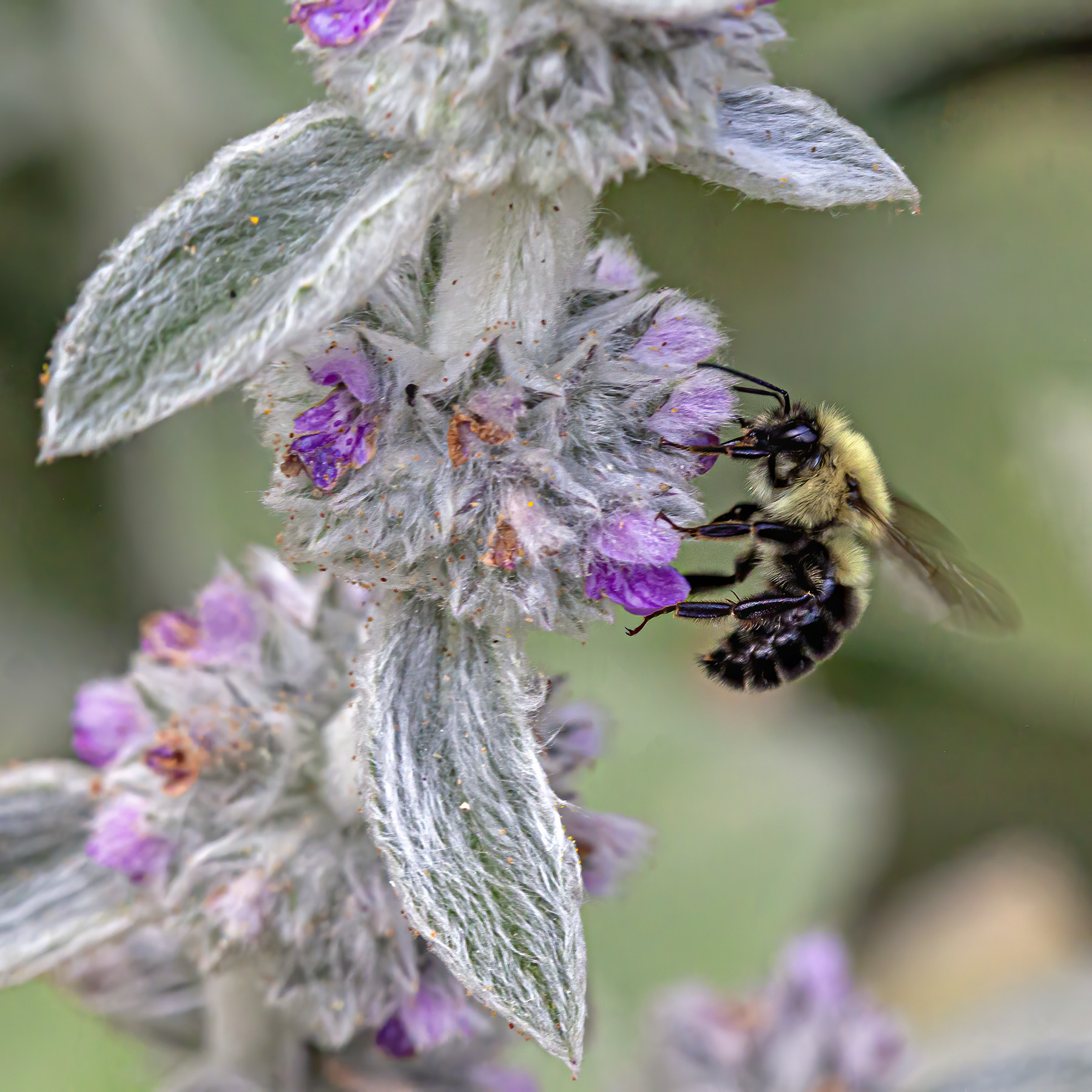
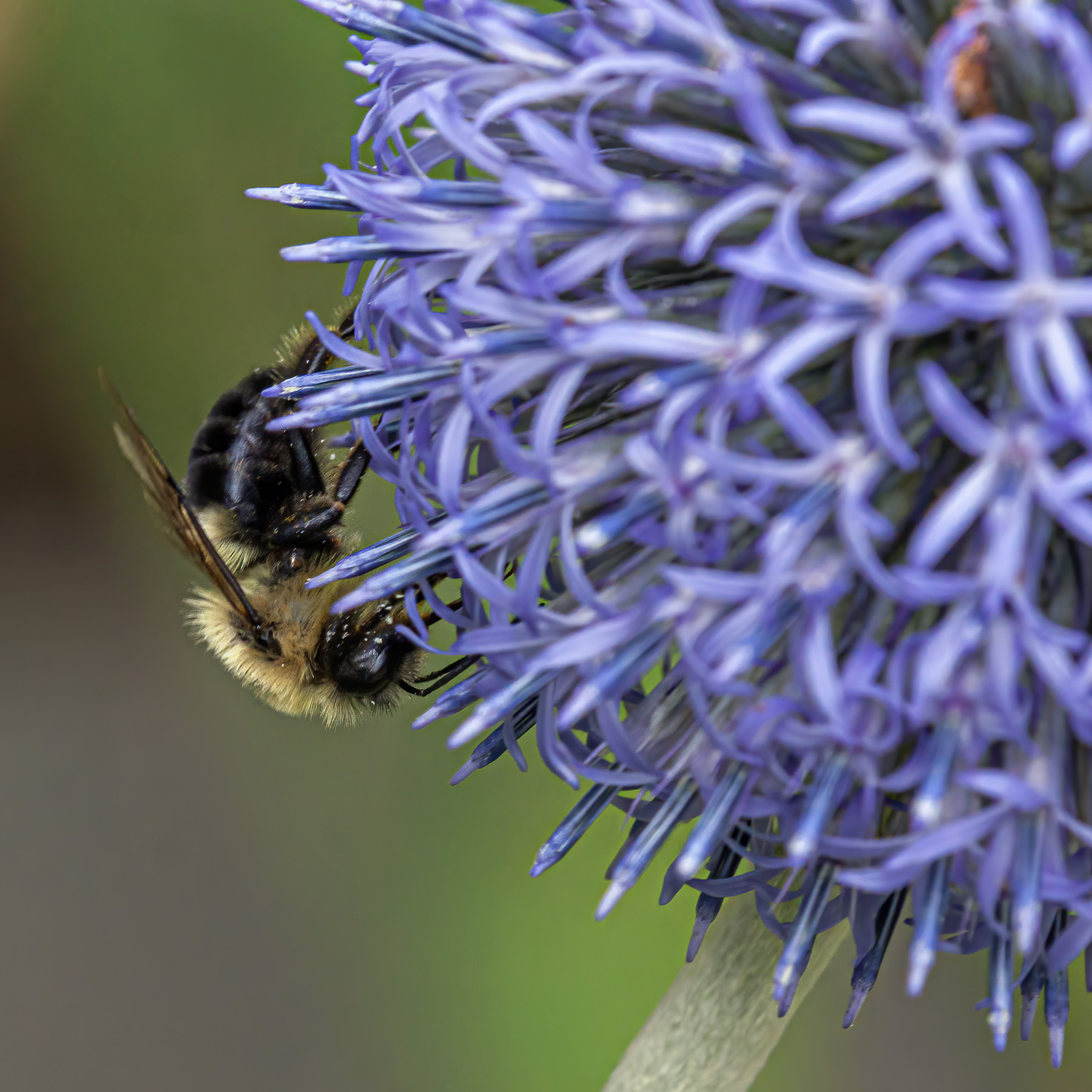
I love bees and spent quite a while on Monday in the garden of my friend and neighbor Cindy Dyer observing them and trying to photograph them. I had no idea that lamb’s ear plants produce flowers, but the bee in the first photo certainly was aware of that fact when I spotted it busily at work. The bee in the second shot decided to try an acrobatic move to gain access to the nectar in the lavender plant that swung wildly each time the bee landed on it. In the final shot, I captured the bee as it was crawling all over a flower of a cool-looking globe thistle plant.

I am not very good at identifying bees, but I think these bees are all Eastern  Carpenter Bees (Xylocopa virginica). Unlike bumblebees that have fuzzy abdomens, carpenter bees have shiny, relatively hairless abdomens.


lamb's ear

lavender

globe thistle

© Michael Q. Powell. All rights reserved.


Read Full Post »

In an ideal world, I would be able to photograph a dragonfly up close and from multiple angles. My close-up shots of a Gray Petaltail dragonfly in yesterday’s posting were the result of almost perfect circumstances. Real life, alas, is rarely that perfect. My entire life, it seems, I have heard the words of the Rolling Stones, reminding me that “You can’t always get what you want, but if you try sometimes, you might find you get what you need.”

Last week I spent almost an entire day with fellow dragonfly enthusiast and blogger Walter Sanford searching for dragonflies in a variety of habitats. It was a long, grueling effort, conducted often in the hot direct sunlight and sometime involving wading through waist-high vegetation. Walter and I have worked together often enough over the years that we have developed some routines. Most of the time we try to stay in sight of each other, so if one of us spooks a dragonfly, the other has a chance of being able to track it to its next perch.

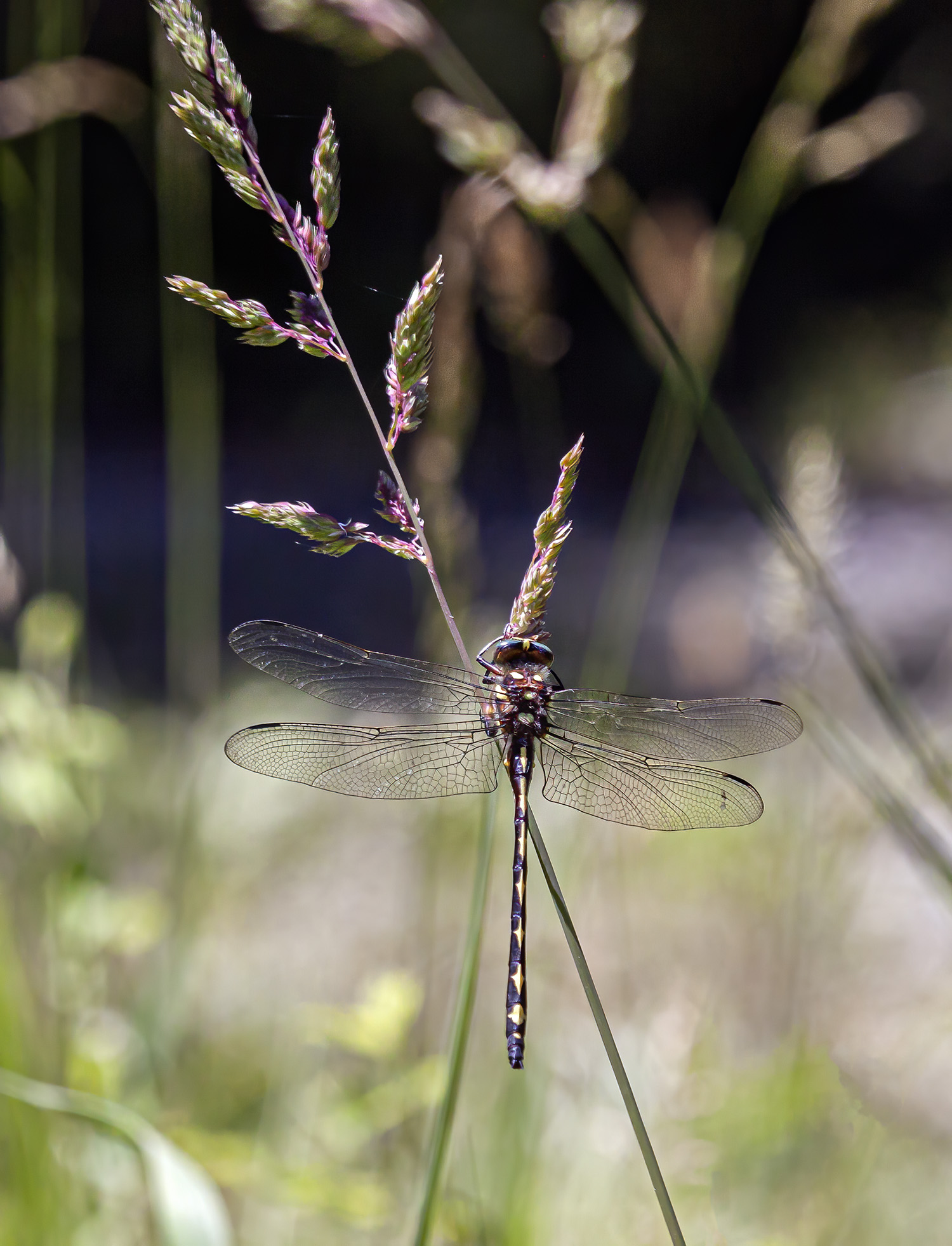
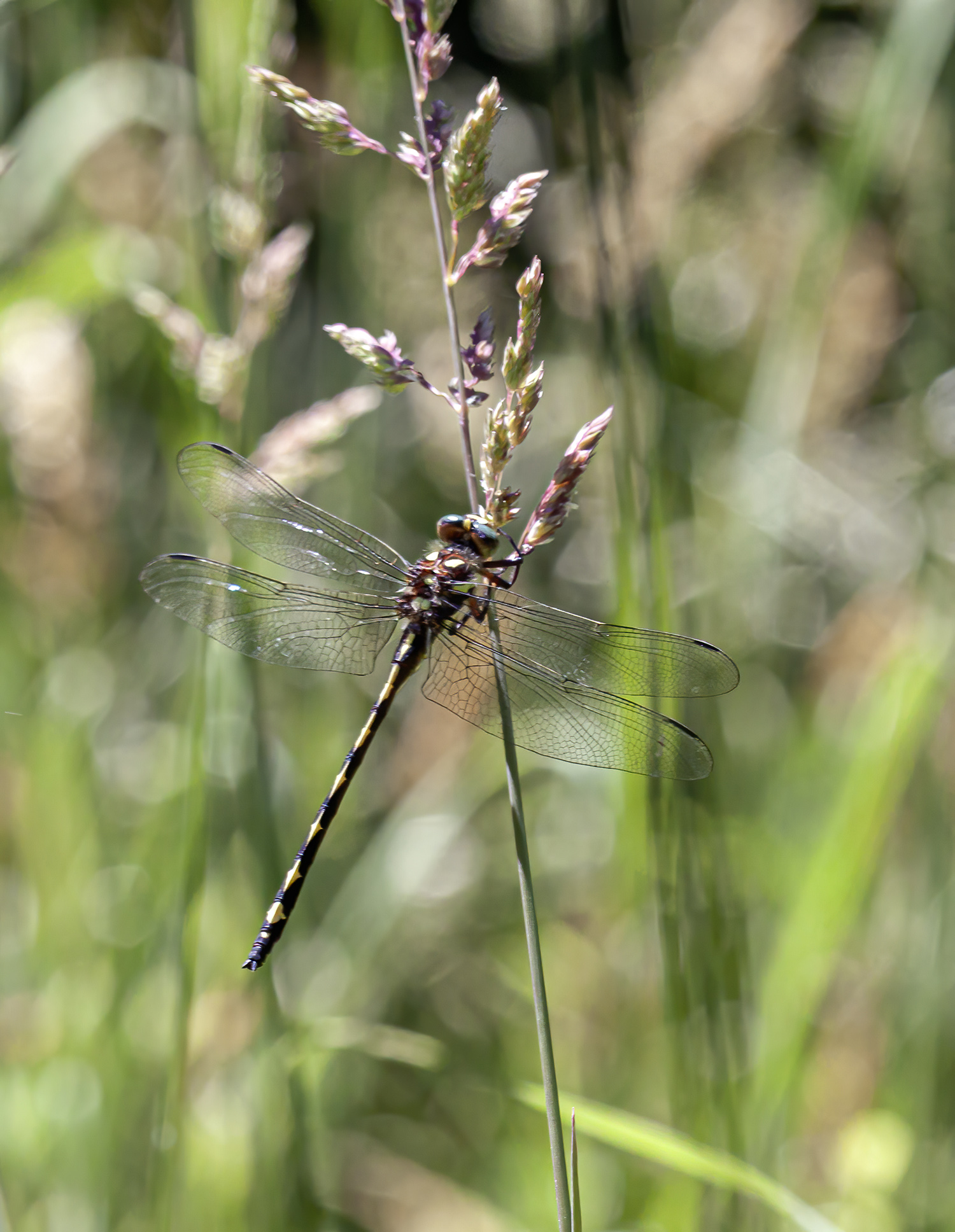
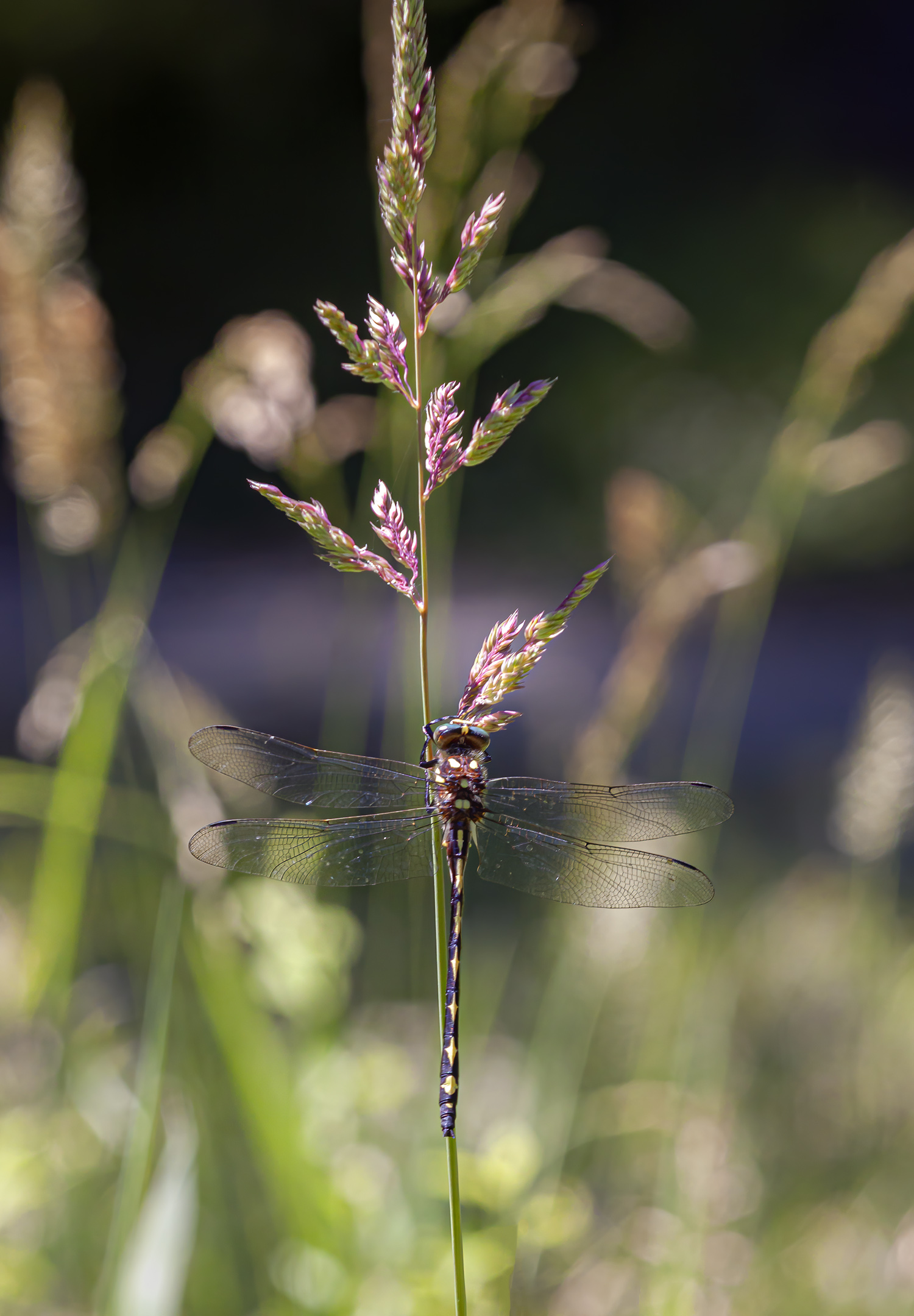
Towards the end of day, we had wandered a little farther apart than usual when I heard Walter tell me emphatically to stop—he had spotted a dragonfly. I was in an awkward position when I stopped and I could barely see the dragonfly through the lens of the camera. It was hanging vertically from a thin stalk of vegetation that was swaying vigorously back and forth in a breeze that had suddenly kicked up. My heart started to beat a bit faster when Walter told me that it looked to be a male Arrowhead Spiketail dragonfly (Cordulegaster obliqua), an uncommon species that I have seen only a few times.

So there I was, frozen in place far from my subject, trying desperately to focus manually on my moving subject that I knew might take off at any moment. I tried to pay attention to the background as I composed my shots, bending my body and flexing my knees to get some minor variations in my angle of view. What you see below are three of those variations. I like the way that they captured the Arrowhead Spiketail in the environment in which we found it—I may not have gotten what I wanted, but perhaps I got what I needed, i.e. I got some decent shots of my subject.

Walter observed this dragonfly from an entirely different angle of view and, as always, approaches things from a different perspective. I encourage you to check out his blog posting today “Arrowhead Spiketail dragonfly (male)” to see his photos and to read about his reactions to seeing this uncommon dragonfly in an environment that was not “according to the book.”

Arrowhead Spiketail

Arrowhead Spiketail

Arrowhead Spiketail

© Michael Q. Powell. All rights reserved.

Read Full Post »

Gray Petaltail dragonflies (Tachopteryx thoreyi) are one of the friendliest and tamest dragonfly species that I have encountered. If you hang around with them often enough, they are almost certain to land on you, particularly if you are wearing gray clothing that somehow reminds them of a tree. It is a little hard not to flinch when one of these relatively large dragonflies (3 inches (75 mm) in length) perches on your head or shoulder.

Gray Petaltails will also let you get pretty close to them when they are perched on trees. Quite frequently, though, they are perched above eye level, so being that close does not allow you to capture close-up images. This past Saturday when I was hunting for dragonflies with my friend Walter Sanford, we spotted a Gray Petaltail perched on a fallen branch that was at knee level. After we had both taken some shots, Walter challenged me to see how close I could get to the dragonfly to capture images with my macro lens.

The first shot shows one of my attempts to get a head-on shot. It is very cool to look another creature straight in the eyes, but it is rare that one will permit you to do so, especially at such close range. It seemed clear to me that the dragonfly was quite aware of my presence, but did not consider me to be a threat.

I took the second shot from the side as I moved even closer to my subject. I was trying my best to capture some of the details of the dragonfly’s eye that was nearest to me and was not concerned that most of the rest of its head was out of focus. If you double-click on the image, you can see some of the ommatidia, the individual optical units that make up a dragonfly’s amazing multi-faceted compound eyes.

If you want to learn more about dragonfly eyes, check out a wonderful article at medium.com entitled  “30,000 Facets Give Dragonflies A Different Perspective: The Big Compound Eye In The Sky“. Scientists, for example, know that the thousands of ommatidia produce a mosaic of “pictures,” but how exactly this visual mosaic is integrated in the insect brain is still not known.

Gray Petaltail

Gray Petaltail

© Michael Q. Powell. All rights reserved.

Read Full Post »

Yesterday I posted a photo of a male Common Whitetail dragonfly that was hovering in the air to fight off rivals and protect the female with which he had mated as she deposited her eggs in the water, a practice know as hover guarding. In some dragonfly species, the male will remain attached to the female throughout the entire process of oviposition, a process known as contact guarding. In other dragonfly species, the female is entirely on her own to deposit the eggs.

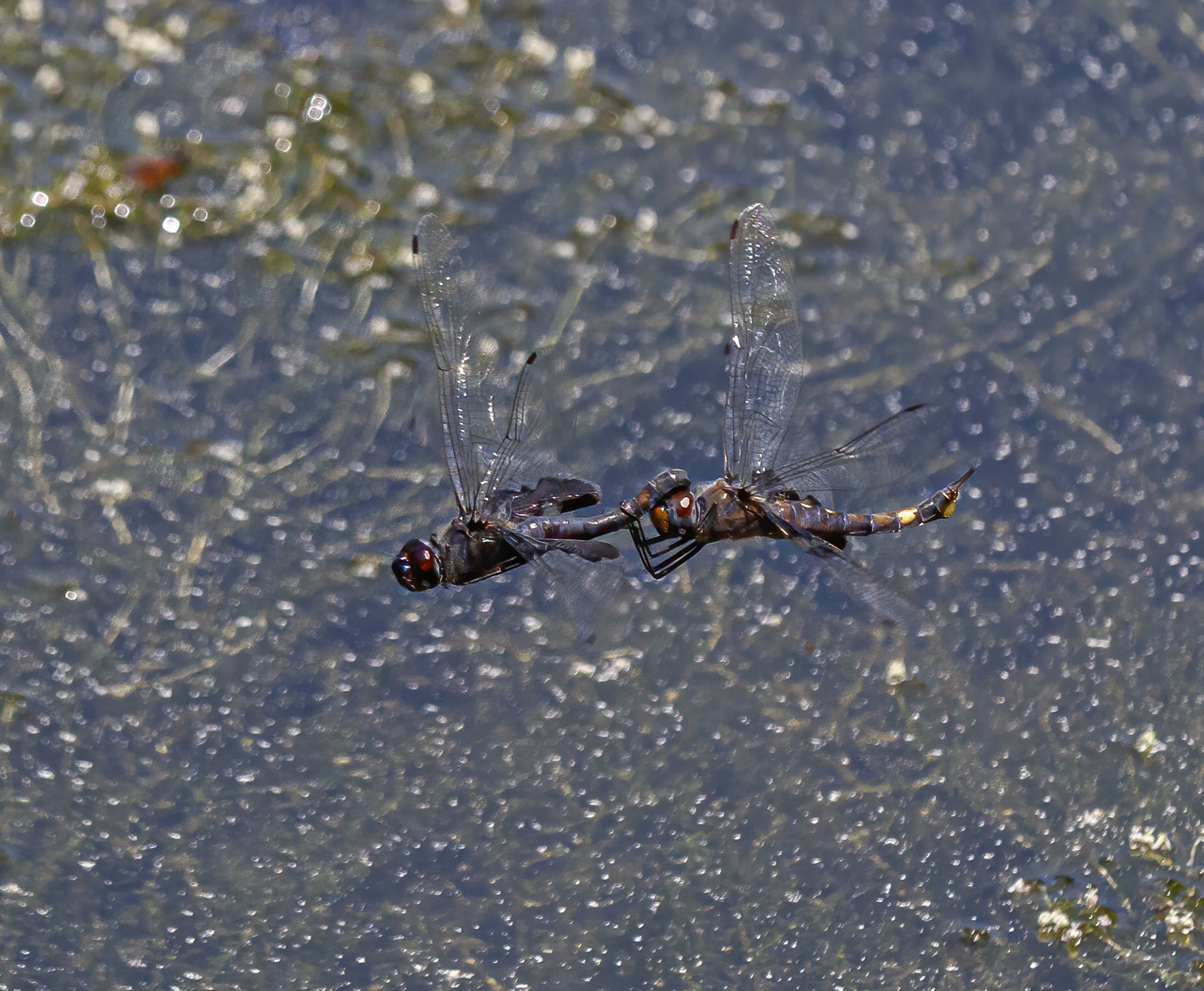
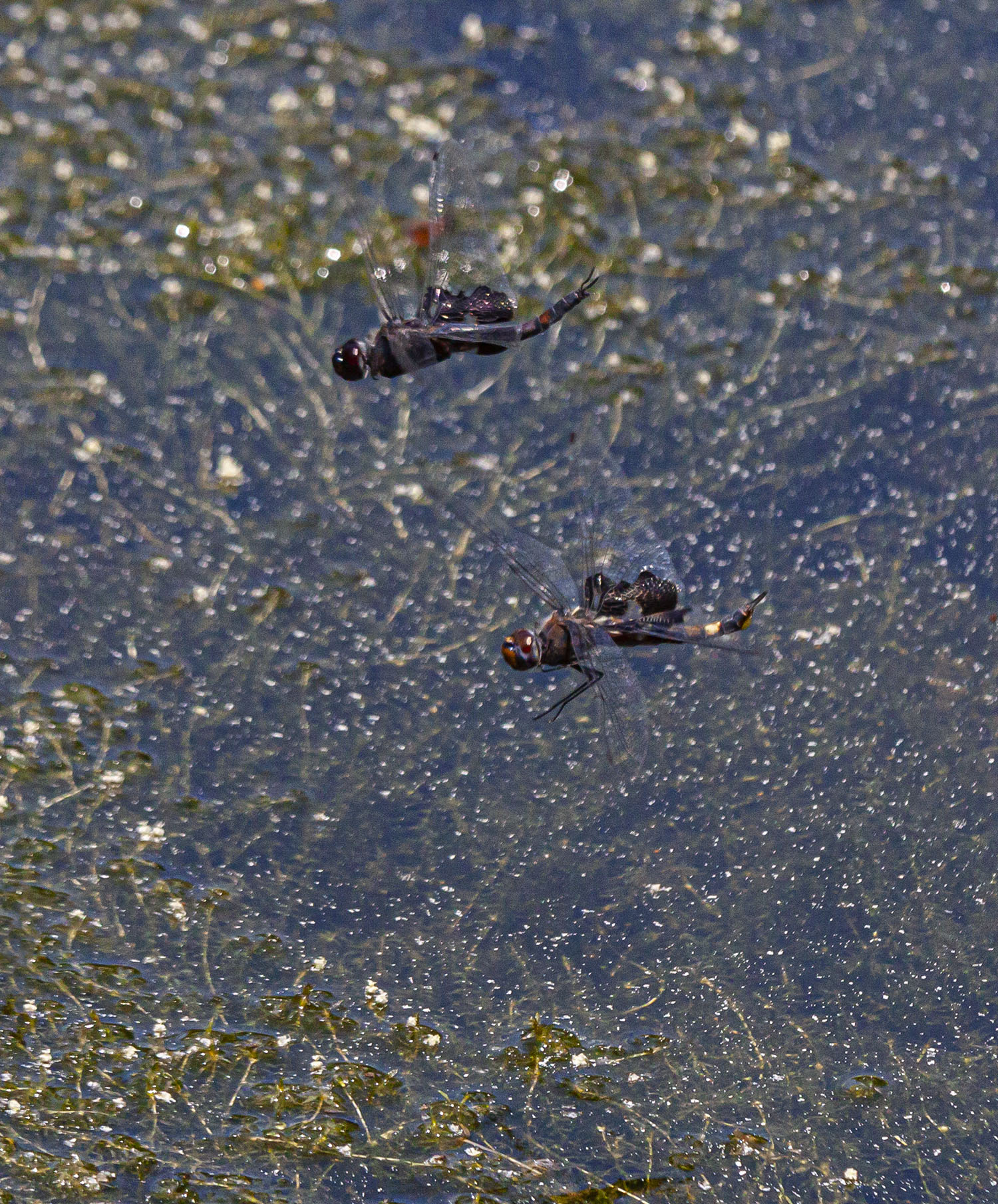
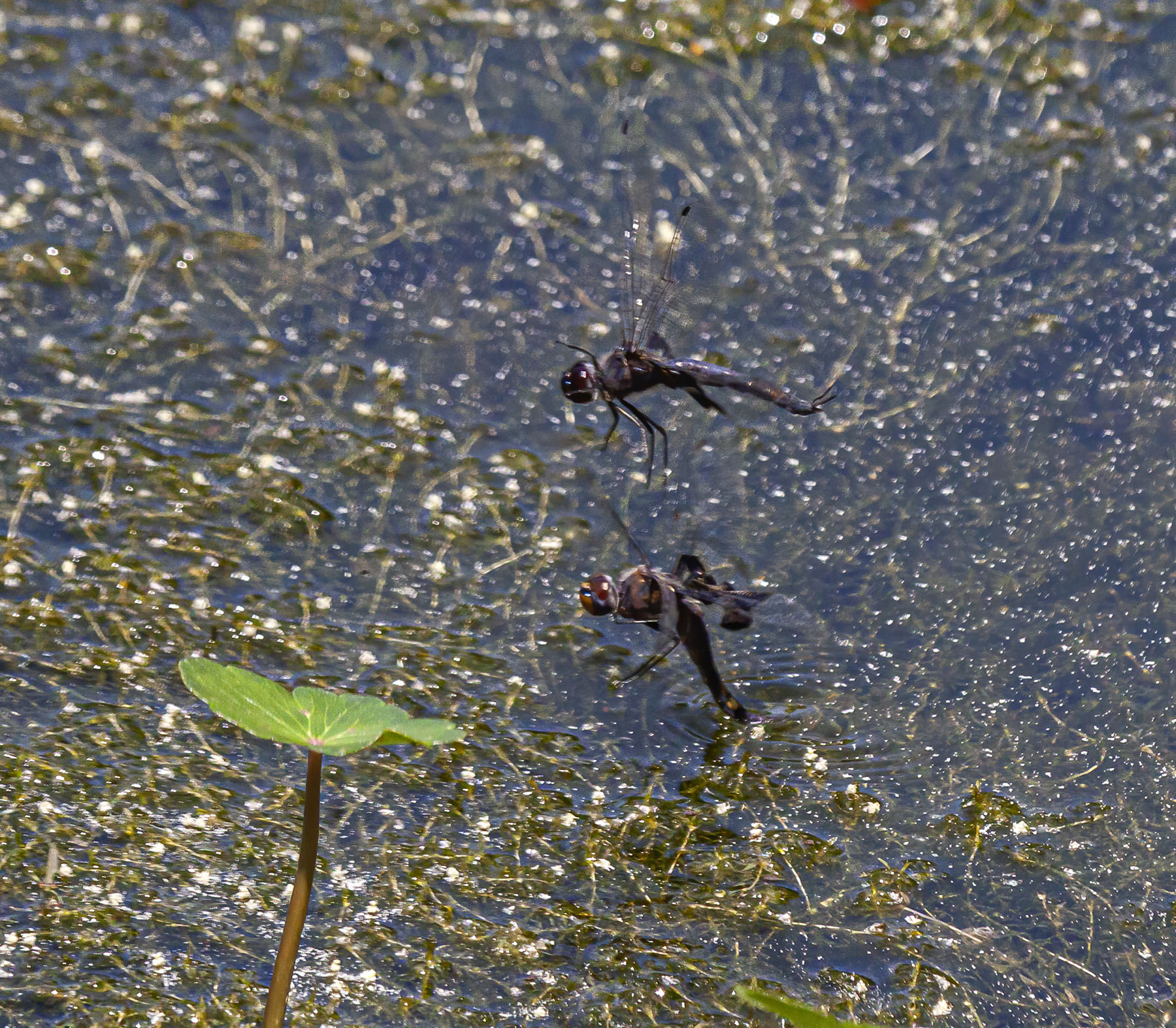
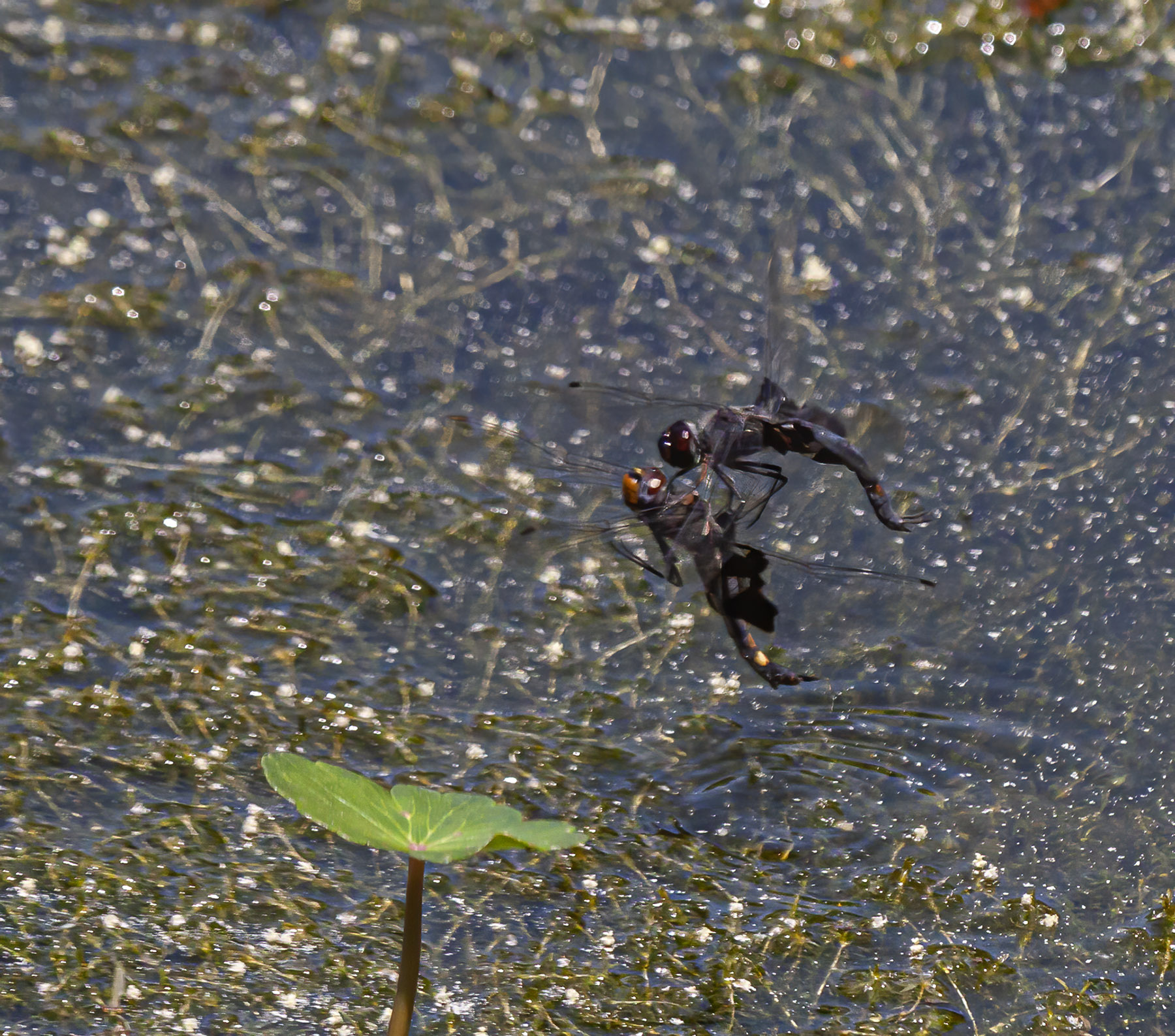
Black Saddlebags dragonflies (Tramea lacerata) use a different technique for guarding that I like to call “release and catch.” After mating is completed, the male and female Black Saddlebags fly together over the water in a tandem position, with the male in the front. At certain moments, for reasons that I cannot determine, the male releases the female and she drops down to the water and taps it to release one or more eggs. As she rises up out of the water, the male catches the female and reattaches the tip of his abdomen to the back of her head. They continue to fly in tandem and repeat this cycle multiple times.

On Saturday I was fortunate to be able to capture this sequence of shots that documents the entire process. Most of the time these dragonflies chose spots that were too far away for me to photograph them, but in this case they flew a bit closer to the edge of the pond where I was standing. As you probably suspect, I had to crop in a good amount to highlight the action for you, given that I was shooting with my trusty 180mm macro lens, which has a more limited reach than the lens that I use when photographing birds.

Black Saddlebags

Black Saddlebags

Black Saddlebags

Black Saddlebags

Black Saddlebags

© Michael Q. Powell. All rights reserved.

Read Full Post »

When you are walking near the edge of the water, it is good to look down from time to time. Sharp-eyed Walter Sanford, a fellow dragonfly fanatic, spotted this Northern Water Snake (Nerodia sipedon) as we were searching for dragonflies in Fairfax County, Virginia last Monday. This is a non-poisonous snake, but I have read that it will bite and the wound may bleed a lot, because its saliva contains a mild anticoagulant.

Three years ago I had an encounter with a similar snake and watched it capture and devour a catfish. If you missed that posting, click on this link and check outSnake captures catfish—if you are like me, you will be fascinated and slightly horrified by the encounter and may avoid wading in the water at the edge of rivers for a time.

Northern Water Snake

© Michael Q. Powell. All rights reserved.

Read Full Post »

What is the most common dragonfly where you live? Over the last few weeks I have noticed more and more dragonflies at the ponds and marshes that I visit, an indication that many of the summer dragonfly species have emerged. Here in Northern Virginia, the most common dragonfly is probably the appropriately named Common Whitetail dragonfly (Plathemis lydia). This species is one of the first to appear in the spring and one of the last to disappear in the fall. They are easy to identify and are such habitat generalists that they can be found almost anywhere.

Many of you know that I will often spend lots of time looking for rare dragonfly species, but I try not to take for granted the more common ones that many people (and photographers) ignore. The first image shows a male Common Whitetail that was hovering for a moment as he kept watch over a female as she deposited eggs in the water.

The second image is a portrait of a male Common Whitetail as he perched on some vegetation overhanging the water. If you look at the angle at which I took the shot, you can probably guess that I was at risk of falling into the water when I took the shot. The final shot is a portrait of a beautiful female Common Whitetail. When they are young, males have a similar coloration on their bodies as the females, but the wing patterns are different. You can also tell the genders apart by looking at the tip of the abdomen (the “tail”) where the terminal appendages are sexually differentiated.

As is often the case for species saddled with the name “common,” Common Whitetail dragonflies are uncommonly beautiful.

Common Whitetail

Common Whitetail

Common Whitetail

© Michael Q. Powell. All rights reserved.

Read Full Post »

The genus Argia, commonly known as dancers, is a large New World group of damselflies. Although the genus name Argia, αργία in Ancient Greek, is translated as “idleness,” dancers are quite active and alert damselflies, according to Wikipedia. Why are they called “dancers?” They are known as dancers “because of the distinctive jerky form of flight they use which contrasts with the straightforward direct flight of bluets, forktails, and other pond damselflies.” I wonder if I am part damselfly, because “distinctive” and “jerky” are definitely adjectives that could be used to describe my attempts at dancing.

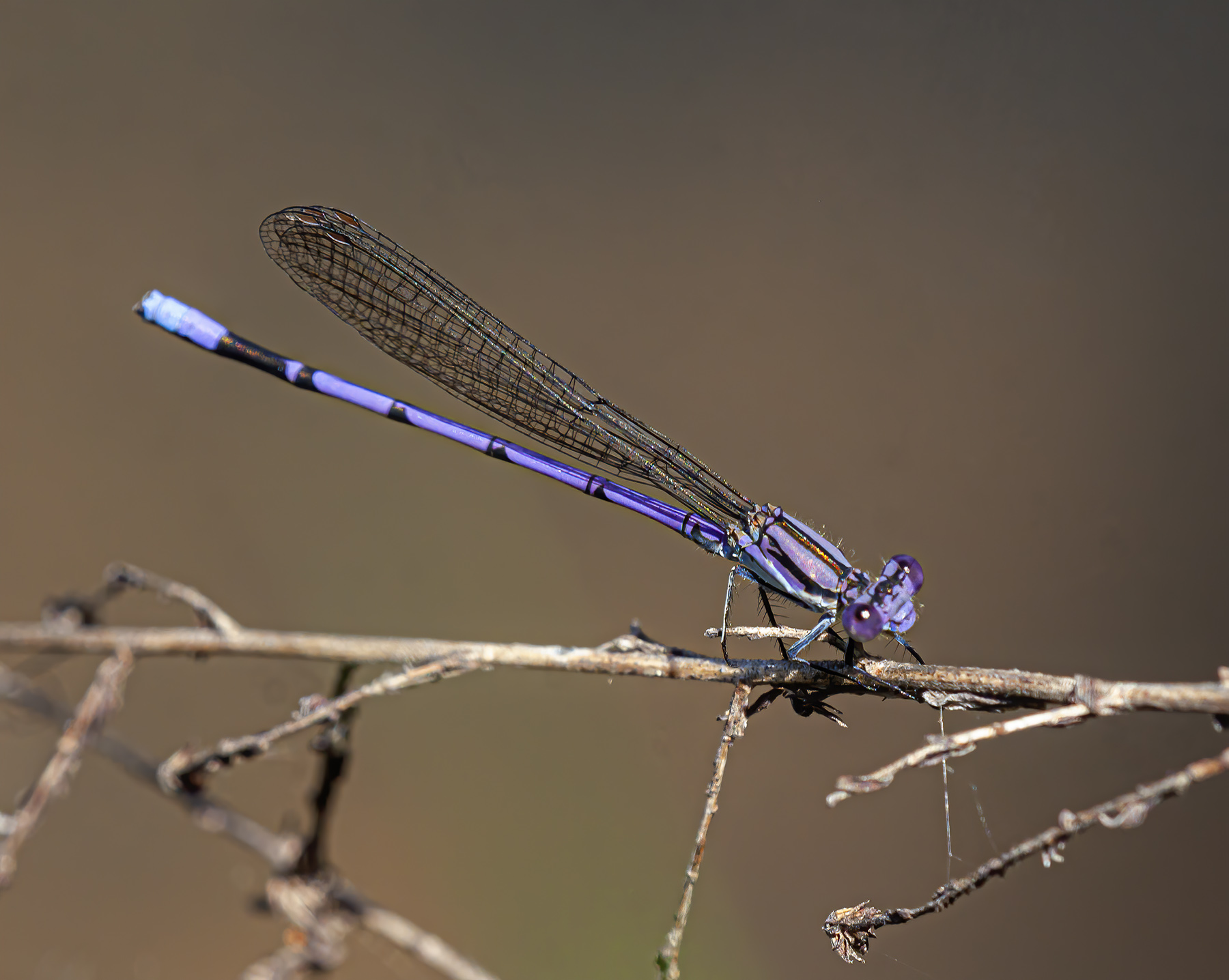
This past week, I have seen three different species of dancers. The first one, the Variable Dancer (Argia fumipennis violacea) has perhaps the most strikingly beautiful color of any of the dragonflies and damselflies that I have seen—I love that shade of violet. Some of my longtime readers may have noted that a photo of a Variable Dancer has been the banner image for this blog for many years.

The damselfly in the second image is a Blue-fronted Dancer (Argia apicalis). The thorax of the males of this species are almost completely blue, with only hairline stripes in the middle of their backs and shoulders.

The final damselfly is a Powdered Dancer (Argia moesta), our only mostly white damselfly. As you can see in the photo, members of this species often like to perch on stones at the edge of the water. I chose to leave this image mostly uncropped, because of the way that it shows the water moving around the stone and the submerged stones on the stream bottom in the background.

All of this talk of dancers brings to mind a country music song that I really like by Lee Ann Womack called “I Hope You Dance.” I am really touched by the basic message of the song—when you get the choice to sit it out or dance, I hope you dance.

Here is the first verse of the song, just in case you have never heard it:

“I hope you never lose your sense of wonder
You get your fill to eat but always keep that hunger
May you never take one single breath for granted
God forbid love ever leave you empty handed
I hope you still feel small when you stand beside the ocean
Whenever one door closes I hope one more opens
Promise me that you’ll give faith a fighting chance
And when you get the choice to sit it out or dance
I hope you dance.”
(I Hope You Dance lyrics © Sony/ATV Music Publishing LLC, Universal Music Publishing Group, Songtrust Ave)

Variable Dancer

Blue-fronted Dancer

Powdered Dancer

© Michael Q. Powell. All rights reserved.


Read Full Post »
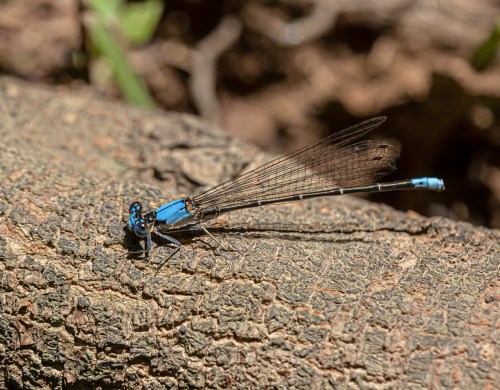
I was really excited to spot this male American Rubyspot damselfly (Hetaerina americana) on Monday while exploring in Fairfax County, Virginia with my good friend and fellow dragonfly enthusiast Walter Sanford. I have seen this species only a few times before, but had no trouble identifying it, thanks to the distinctive “rubyspot” on its wings.

The first image gives you the best view of this gorgeous little damselfly, but the second shot is my favorite. I love to look straight into the eyes of dragonflies and damselflies—they have an almost hypnotic effect on me. Whenever I get the chance, I try to get a close-up shot of the eyes of these acrobatic insects that fascinate and delight me endlessly.

American Rubyspot

American Rubyspot

© Michael Q. Powell. All rights reserved.

Read Full Post »

I usually try to fill the frame as much as possible when I photograph wildlife, but it is equally cool sometimes to take a wider shot that shows the subject’s environment. That was the case with this photo of a Broad-headed Skink (Plestiodon laticeps) that I took last Friday at Occoquan Regional Park. As many of you know, during this time of the year I shoot most often with a macro lens that does not zoom. When I spotted this skink from a distance, I took this shot, suspecting that the skink would scamper away if I got any closer. As soon as I took one more step, the skink disappeared under the tree.

I love the contrast between the bright orange head of the skink and the vibrant green moss on the trunk of the fallen tree. This is probably a male skink, given that the head in males becomes bright orange, as in the photo, during the mating season (spring) but fades and reduces in size in other times of the year.

Broad-headed Skink

© Michael Q. Powell. All rights reserved.


Read Full Post »
It is lily season now in the garden of my neighbor and photography mentor Cindy Dyer. Here are a few photos that I took yesterday morning of some of the lilies blooming in her beautiful garden. It is always reassuring to know that I do not have to travel far to find colorful subjects to photograph—as a photographer and graphic designer, Cindy chooses flowers to plant that she know are photogenic.

lily

lily

lily

© Michael Q. Powell. All rights reserved.

Read Full Post »
Every year I enjoy taking photos of dragonflies perching on a piece of rusted rebar that sticks a few inches out of the water of a small pond at Jackson Miles Abbott Wetland Refuge. I have seen dragonflies of several species use this particular perch, but photographically speaking my favorite is probably a male Eastern Amberwing dragonfly (Perithemis tenera) like the one in this photo from last Friday—the orange-rust colors of the dragonfly and its perch are complementary and soften what might otherwise be a jarring juxtaposition of the natural and man-made worlds.

You can’t see it really well, but there is a spider, probably a long-jawed spider, visible onthe lower portion of the rebar. I don’t know for sure if that spider could capture the dragonfly, but it is a potentially dangerous situation for the dragonfly and in the past I have photographed several dragonflies that had fallen prey to spiders.

Eastern Amberwing

© Michael Q. Powell. All rights reserved.


Read Full Post »
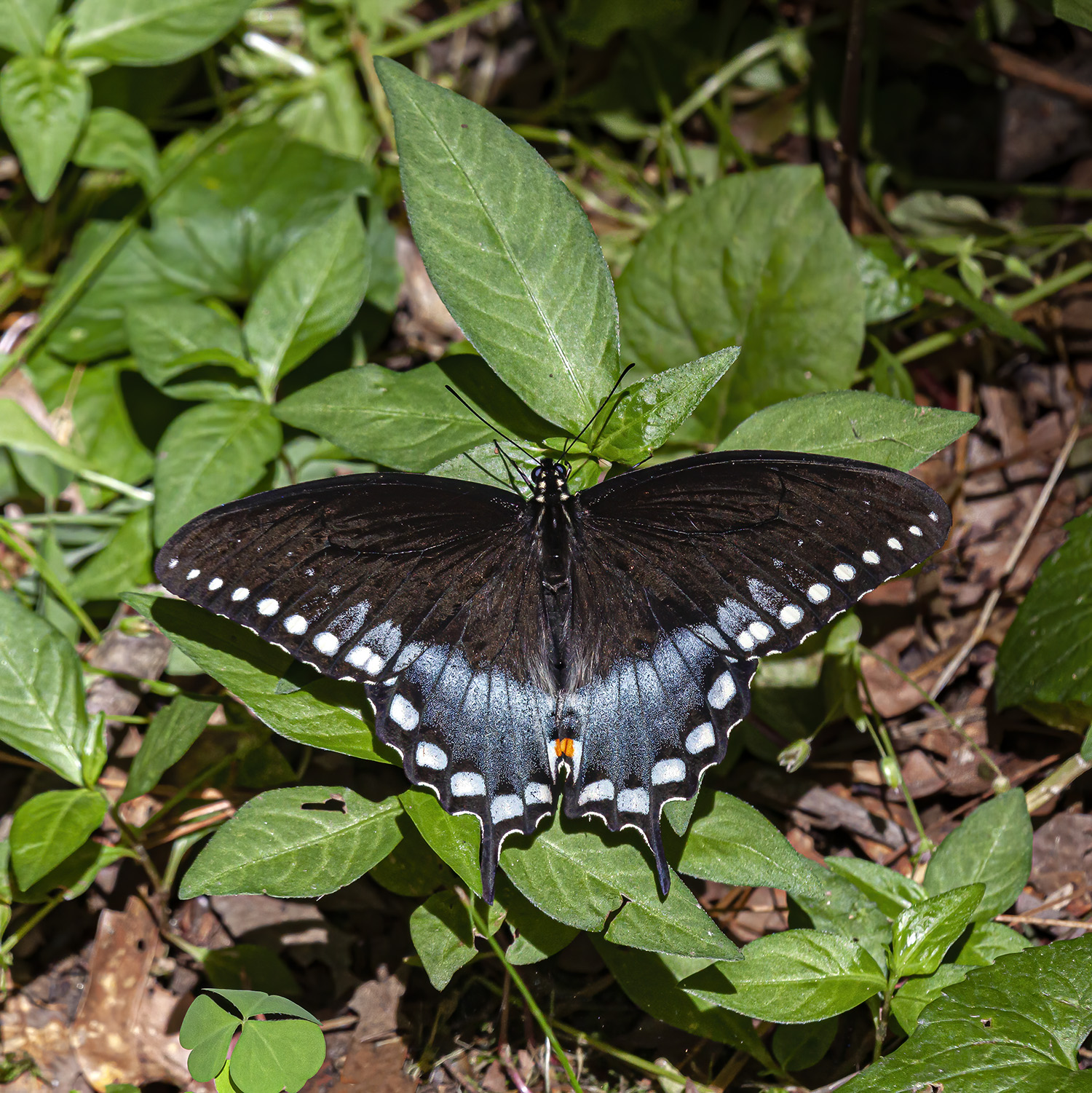
We have a number of different dark swallowtail butterflies in the area in which I live, which can make identification a little tricky. I spotted this beautiful butterfly last Friday at Jackson Miles Abbott Wetland Refuge and believe that it is a Spicebush Swallowtail butterfly (Papilio troilus). The perfect condition of its wings suggest to me that it has emerged quite recently—as we move deeper into summer, I often spot butterflies with tattered wings.

Spicebush Swallowtail

© Michael Q. Powell. All rights reserved.


Read Full Post »
Last week I spotted my first Eastern Amberwing dragonflies (Perithemis tenera) of the season at Jackson Miles Abbott Wetland Refuge. These distinctively colored dragonflies are a frequent sight throughout the summer as they buzz about over the waters of ponds. Eastern Amberwings are small, even by dragonfly standards, with a total length of less than an inch (25 mm) and are considered to be a wasp mimic. According to Wikipedia, “The Eastern Amberwing dragonfly is one of the only types of dragonfly that actively mimics a wasp. The yellow and brown stripes on its abdomen encourage predators to stay away. When perched, they will wiggle their abdomen and wings in a wasp-like fashion to deter other animals from eating it.”

My second and third shots are portraits of perched male Eastern Amberwing dragonflies that were carefully composed and sharp, but my favorite image of the day is the dynamic shot of two dragonflies in flight. It may not be obvious what is going on in the photo, so let me explain. After mating, the female in the upper left corner is getting ready to deposit her eggs in the water, while the male in the lower right corner hovers in the air, ready to keep any rivals from interfering with the process.

Eastern Amberwing

Eastern Amberwing

Eastern Amberwing

© Michael Q. Powell. All rights reserved.

Read Full Post »

I thought it was too late in the season for lotuses, so I was thrilled to see them at Meadowlark Botanical Gardens earlier this week in bloom, as seed pods. and most surprisingly as buds.

I am fascinated by lotuses in all of their stages. I love the three-dimensional quality of the flowers and the way that you can look into the center of them. Lotus seed pods are a little creepy—from certain angles they look like a cluster of eyeballs that follow you around. By contrast, I always feel a sense of calm when I am enjoying the simple beauty of the lotus buds.

lotus

lotus seed pods

lotus buds

© Michael Q. Powell. All rights reserved.


Read Full Post »

With a name that includes the word “bluet,” you might expect that this female Big Bluet damselfly (Enallagma durum) would be blue, but obviously that is not the case here. There is a blue female variant in this species, but this one appears to be the olive variant.  Damselfly identification is difficult under the best of circumstances, because so many of them share the same colors—only the patterns help you distinguish among them. In this case, size helps a bit too, because Big Bluets are in fact larger than many other damselflies.

As I was exploring Occoquan Bay National Wildlife Refuge a few days, I was fortunate that this damselfly chose to perch at almost eye level on a stalk of Eastern Gamagrass, which let me get a clear shot with the sky in the background.  Most of the time damselflies like this perch lower to the ground in areas with denser vegetation.

Big Bluet

© Michael Q. Powell. All rights reserved.


Read Full Post »
I guess that the main subject of this image is the tiny male Eastern Amberwing dragonfly (Perithemis tenera), but I must confess that I was equally drawn to the curving shapes of the branches sticking out of the water during my recent trip to Jackson Miles Abbott Wetland Refuge. Normally I try to fill as much of my frame with my primary subject by using a zoom lens or by moving closer, but in this case I actually moved back in order to be able to capture more of the vegetation.

I really like the way that the warm amber color of the aptly named Eastern Amberwing stands out against the muted tones of the rest of the image. The style of this image is different from most of my shots (assuming that I have an identifiable style), but I enjoy mixing it up from time to time by shooting from different angle or distances.

Eastern Amberwing

© Michael Q. Powell. All rights reserved.

Read Full Post »
The milkweed plants were dirty and dried up, but I knew from past experience that there might be ladybugs crawling around on them. The first two plants that I checked were full of aphids, a favorite food of ladybugs, but I did not see any ladybugs at all. As I approached a third plant, I saw a flash of red and spotted a small ladybug crawling quickly down the stem of the plant. I was not as close as I could have like to have been, but managed to capture some images before the ladybug disappeared from sight.

I like the way that this shot turned out because the reddish-orange of the ladybug really stands out against the blues and greens in the rest of the photos. In case you are curious, the little specks of yellow are aphids. In this case, the aphids were safe, for this ladybug seemed to be in too much of a hurry to stop for a snack.

ladybug

© Michael Q. Powell. All rights reserved.

Read Full Post »
Monarch butterflies (Danaus plexippus) are beautiful in any situation, but when you surround them with red, orange, and yellow flowers, they absolutely explode with color. I was thrilled when I spotted this Monarch during a short visit to Green Spring Gardens this past Saturday morning. The butterfly was initially quite skittish and flew all around before finally settling on what I believe to be some kind of lantana flower. I had to maneuver around to try to get a good shooting position, but the butterfly stayed put for a minute and accommodated me. I was super happy when I managed to include some of the colorful flowers in the background and I just love the way that the colors work so well together.

monarch

© Michael Q. Powell. All rights reserved.

Read Full Post »
I spotted this beautiful American Lady butterfly (Vanessa virginiensis) during a quick visit this past Saturday morning to Green Spring Gardens, a county-run historic garden not far from where I live. A lot of butterflies were active that day, but my eyes were immediately drawn to this American Lady, a species that I do not see very often. I had to chase it a bit before it stopped to feed on this flower, which was so popular that the American Lady had to share it with a much smaller skipper butterfly. The flower was growing near a fenced in area of public plots where people grow vegetables and the fence caused the striped effect in the background.

Although I spend most of my time photographing subjects in the wild, it was nice to visit a more cultivated place that was still ablaze with summer colors. I am quite conscious of the fact that the summer is slowly slipping away.

American Lady

© Michael Q. Powell. All rights reserved.

Read Full Post »

What do you see first when you look at this image? Do you see the beautiful colors, textures, and shapes of the rock that makes up both the foreground and the background? Are you drawn to the lines and somber coloration of the Powdered Dancer damselfly (Argia moesta) and its shadow? Do you focus on the damselfly’s brightly shining gray eye?

I spotted this little damselfly this past week while exploring a creek in Fairfax County with fellow dragonfly enthusiast Walter Sanford. There is a simplicity to this image that I find really appealing. I especially like the limited color palette and the sense of harmony in the way that the colors work together.

What do you think?

Powdered Dancer

© Michael Q. Powell. All rights reserved.


Read Full Post »

Really, an image of a horsefly? That sentence fragment was part of an internal dialogue that I had with myself when considering whether to post this image. I know that most people find flies to be fairly disgusting.  However, I was really taken with the details that I managed to capture when this enormous horsefly—it looked to be about 2 inches (50 mm) in length—perched in front of me earlier this week as I was resting alongside a rocky creek.

The fly’s eyes seem to have multiple colors and its body has several wonderful patterns. It is not all beauty, though, and I find those sharp points protruding from the face to be menacing, an impression enhanced by the enlarged shadow that cast by the fly.

I have to admit that I was fascinated by this giant horsefly and that fascination prompted me to post the photo despite my initial inhibitions. What do you think?

horsefly

© Michael Q. Powell. All rights reserved.

Read Full Post »

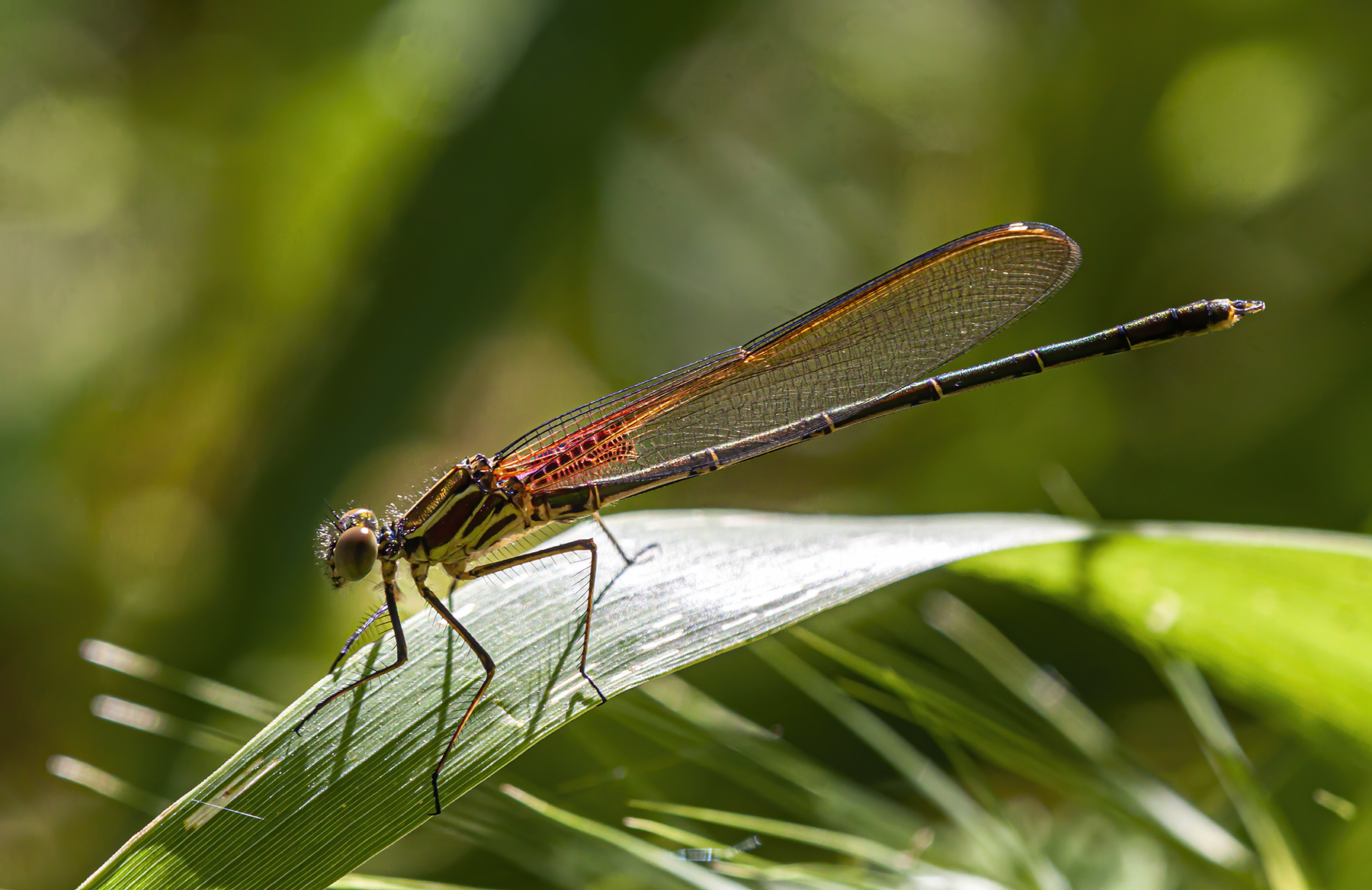
Yesterday I was thrilled to spot this spectacular female American Rubyspot damselfly (Hetaerina americana) while exploring a creek in Fairfax County, Virginia with my good friend and fellow  dragonfly enthusiast Walter Sanford.  This species is found along streams and rivers and this in only the second time that I have ever seen American Rubyspots. The green and brown colors on the thorax (the “chest”) of this damselfly are incredible and I highly recommend you click on the images to get an even better look at the amazing details.

Signs are starting to appear that we are approaching the end of summer. Already I have noted that the number of dragonflies is dropping, though there still seem to be plenty of butterflies. It was therefore particularly gratifying to see this unfamiliar damselfly yesterday. The dragonfly season, though is far from over—there are some autumn dragonfly species that I have not yet seen.  Birds are starting to migrate through this area, so some may appear in this blog soon, but there should still be dragonfly photos for the next few months at least.

American Rubyspot

American Rubyspot

© Michael Q. Powell. All rights reserved.

Read Full Post »

The only other time that I can remember a butterfly perching on me was when I was in an indoor enclosed butterfly garden. This time, though, it was out in the wild and I was a bit shocked when Walter told me that there was a butterfly on my head. Thanks to Walter Sanford, my friend and fellow dragonfly enthusiast, for capturing this encounter. Be sure to check out his blog for lots of wonderful images of dragonflies and other cool creatures.

waltersanford's avatarwalter sanford's photoblog

There’s a butterfly on your hat. A Red-spotted Purple butterfly (Limenitis arthemis astyanax).

16 AUG 2019 | Occoquan Bay NWR | Red-spotted Purple butterfly

This comical butterfly-man union was observed during a photowalk with Michael Powell at Painted Turtle PondOccoquan Bay National Wildlife Refuge, Prince William County, Virginia USA.

16 AUG 2019 | Occoquan Bay NWR | Red-spotted Purple butterfly

The weather was extremely hot and humid. (Notice the Cumulus congestus clouds building in the background.) Both Mike and I were soaked with sweat as soon as we started our photowalk earlier the same day at another site. The butterfly was feeding upon mineral salts on Mike’s “Duck Dynasty” hat.

Copyright © 2019 Walter Sanford. All rights reserved.

View original post

Read Full Post »

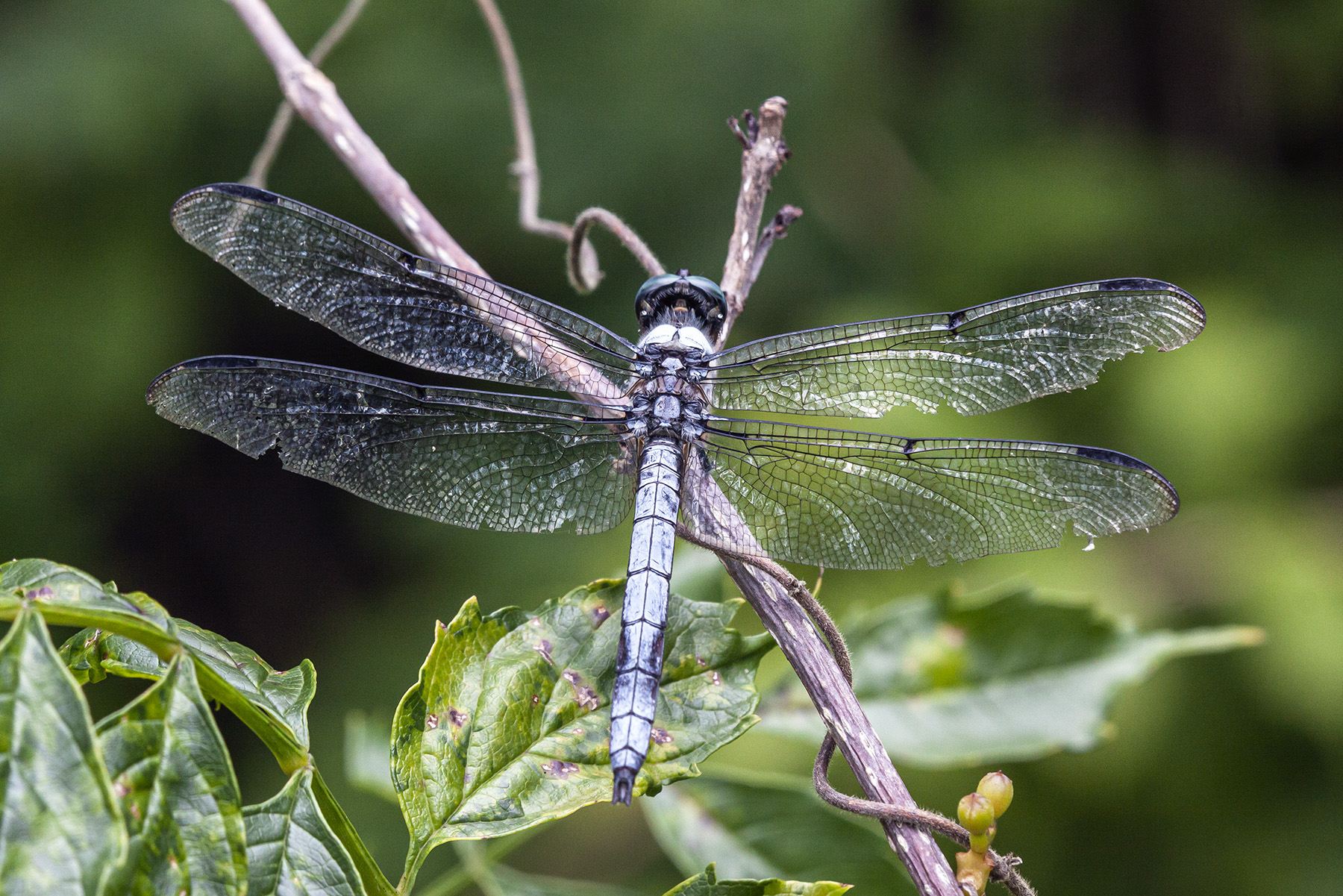
Great Blue Skimmer dragonflies (Libellula vibrans) are really common, but I enjoy photographing them anyways, like this grizzled male that I spotted earlier this week at Jackson Miles Abbott Wetland Refuge. The curling vines of the plant on which this dragonfly chose to perch add some additional visual interest to these photos.

I must confess that ordinary blue dragonflies have a special place in my heart, because my very first blog posting on July 7, 2012 featured a photo of a Blue Dasher, another common species. My photography skills and my knowledge about dragonflies have increased significantly since that time, though I am still quite proud of that initial photo that started me on this long journey into photography.


blue dasher

Blue Dasher

© Michael Q. Powell. All rights reserved.

Read Full Post »

How do spiders decide where to place their webs? Is there some special secret that is passed on from generation to generation about optimal web placement for capturing prey? I know that human fisherman and trappers look for specific conditions and wonder if it is the same with spiders.

Whatever the case, this Black and Yellow Garden Spider (Argiope aurantia) appears to have mastered her trapping skills and looks to have caught both a female Common Whitetail dragonfly (Plathemis lydia) and what I think is some kind of female grasshopper. I am not really sure about the latter victim, but that is what I believe the green-colored object is in the image.

Often I see the webs of this kind of spider in fairly thick vegetation, but this web was hanging in mid-air about six feet high at the edge of a small pond last weekend at Jackson Miles Abbott Wetland Refuge. The murky grayness in the upper right portion of the image is the water of the pond. In the left hand side you can see some of the web strands that tenuously connected the web to some nearby vegetation. This spider would not have one any contests for the beauty of its web, but there is no arguing with its success in capturing prey.

argiope aurantia

© Michael Q. Powell. All rights reserved.

Read Full Post »
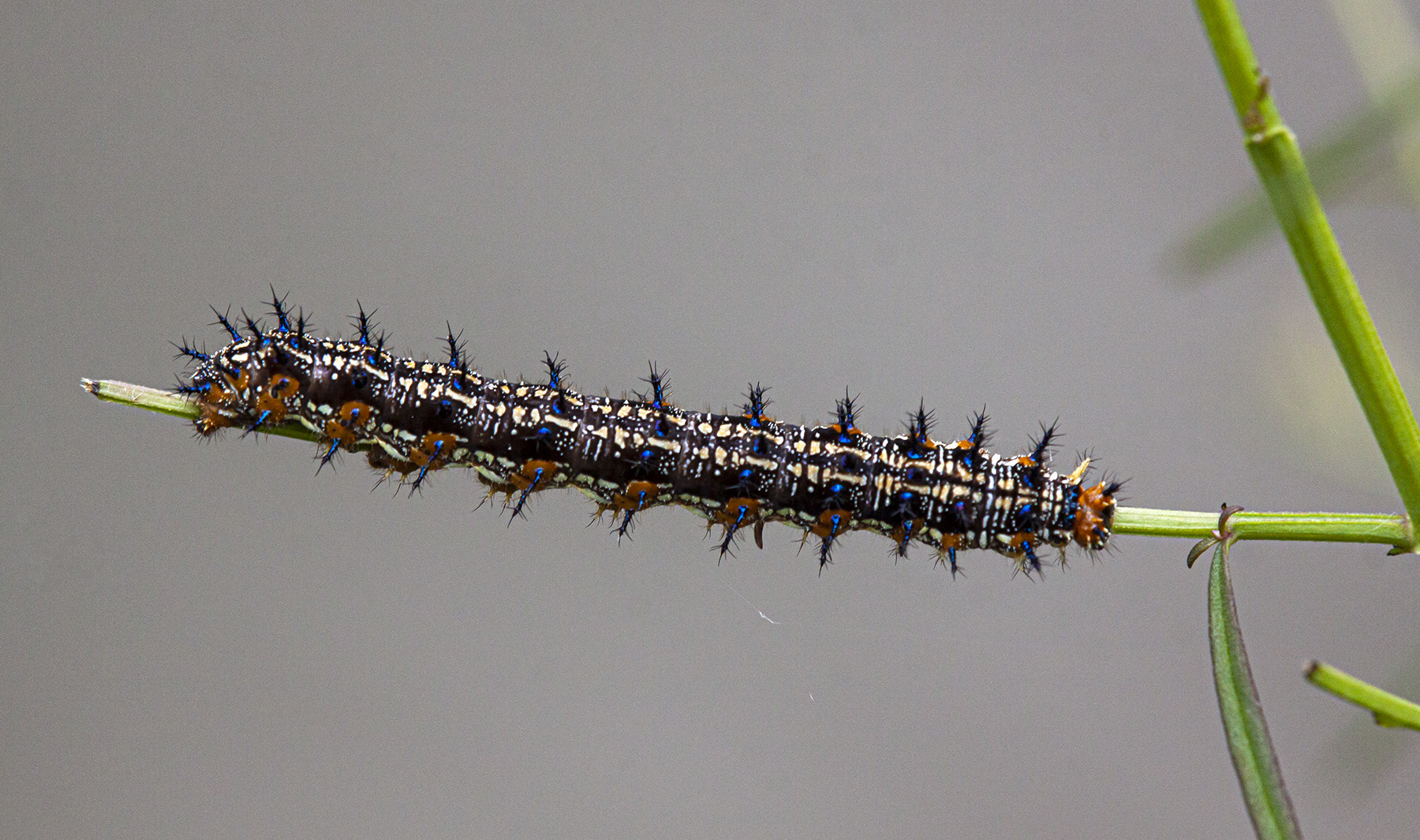
Yesterday I spotted this amazing looking caterpillar alongside a pond at Jackson Miles Abbott Wetland Refuge. I have not yet been able to identify it, but I was really struck by the stunning blue dots and the prickly spikes that run the length of the caterpillar’s body. Often these types of spikes are an indication of a venomous stinging caterpillar, so I kept my distance as I was taking this shot. Click on the image if you want to get a closer look at the wonderful details of the caterpillar.

UPDATE: Several helpful folks have weighed in and have identified this as a Common Buckeye caterpillar (Junonia coenia). Thanks for the help.

caterpillar

© Michael Q. Powell. All rights reserved.

Read Full Post »

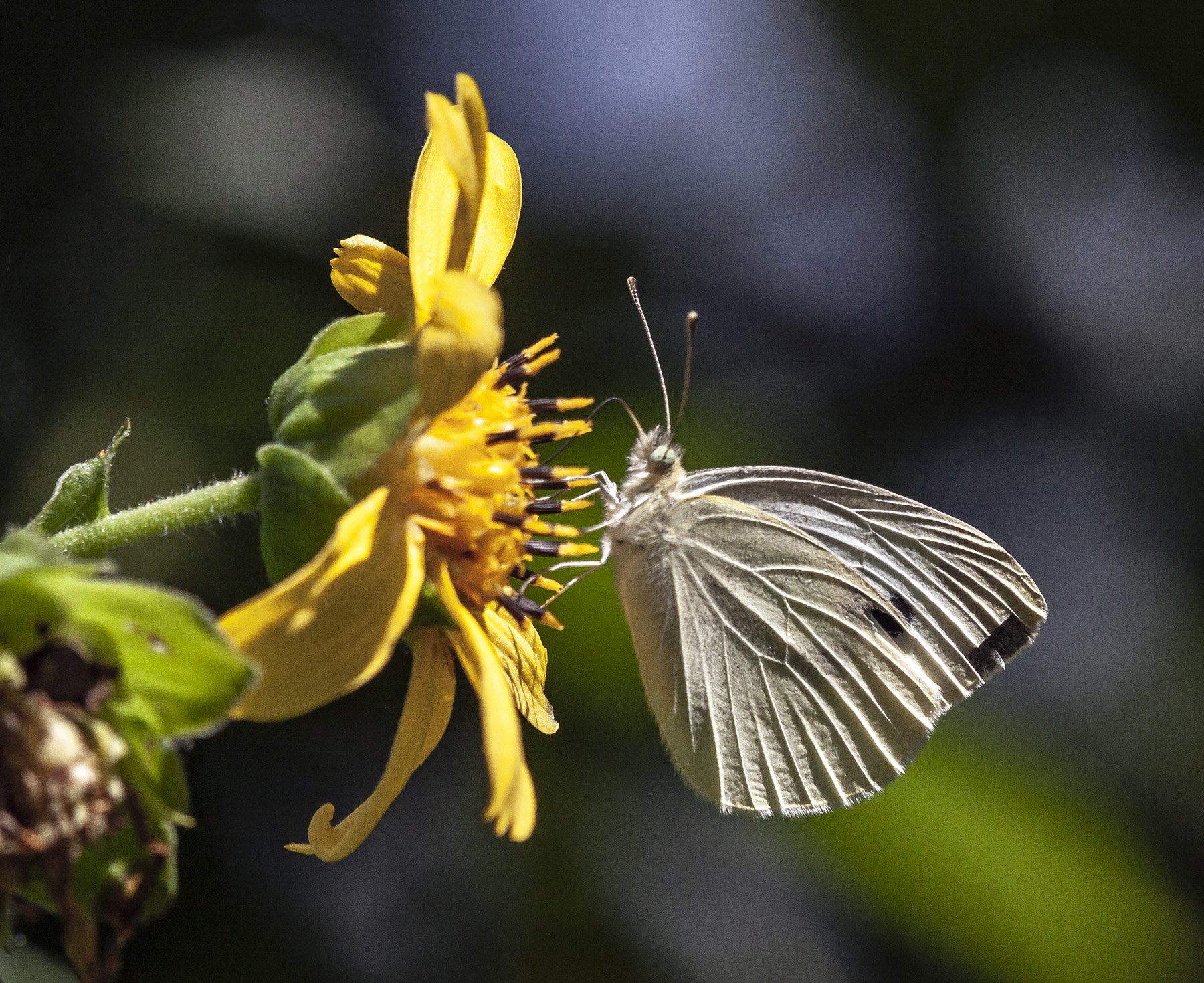
Cabbage White butterflies (Pieris rapae) are small, plain, and common, yet I find a real beauty in their elegant simplicity, especially when I get a view of their speckled green eyes. I spotted this Cabbage White last weekend when I was exploring Occoquan Bay National Wildlife Refuge. As always, my biggest challenge was getting into a shooting position in which the butterfly’s body was on a single plane in order to get most of it in focus—in this case I more or less succeeded in doing so.

Cabbage White

© Michael Q. Powell. All rights reserved.

Read Full Post »

There were quite a few grasshoppers yesterday at Occoquan Bay National Wildlife Refuge and this one cooperated for me by posing momentarily. Initially the grasshopper hung upside down as shown in the first image, but eventually it climbed around on the stalk of vegetation and assumed a more upright pose.

I couldn’t help but notice that the background of the two shots seems really different. I think this was caused by the fact that I shot them from very different angles, even though I remained more or less in the same spot.

grasshopper

grasshopper

© Michael Q. Powell. All rights reserved.

Read Full Post »
Some people see spiders as creepy and others see them as cool. I am definitely in the latter category and was happy to spot this Black and Yellow Garden Spider (Argiope aurantia) during a recent trip to Jackson Miles Abbott Wetland Refuge.

I love the zigzag pattern that is a distinctive characteristic of the webs constructed by this species of spider and was thrilled that I managed to capture the zigzag in this shot. This spider is pretty common and has a lot of different common names including zigzag spider, writing spider, yellow garden spider, and golden garden spider. Zigzag Spiders can get to be pretty big and I have seen them capture large prey including, alas, dragonflies. It is amazing to see how fast the spider is able to wrap up its captured prey in web material. In case you have never witnessed the process, here’s a link to a 2017 posting that shows a spider wrapping up a freshly caught damselfly.

zigzag spider

© Michael Q. Powell. All rights reserved.

Read Full Post »

As many of you know, I love trying to capture images of dragonflies in flight. This Slaty Skimmer dragonfly (Libellula incesta) cooperated by periodically hovering a bit during a recent trip that I made to Jackson Miles Abbott Wetland Refuge. The first two images show you some of the details of the dragonfly’s body, including the way it tucks in its legs when in flight, and the final image gives you a wider view of the environment in which I was shooting.

Slaty Skimmer

slaty skimmer

slaty skimmer

© Michael Q. Powell. All rights reserved.

Read Full Post »

Last Friday I spotted this handsome adult male Calico Pennant dragonfly (Celithemis elisa) while exploring Occoquan Bay National Wildlife Refuge with my friend and fellow dragonfly enthusiast Walter Sanford.  Earlier this month I did a posting entitled Mosaic Wings that featured a photo of an immature male of this same species that had a bright yellow body. This image gives you an idea of how the body color changes to red as the male Calico Pennant dragonfly matures.


Calico Pennant

© Michael Q. Powell. All rights reserved.

Read Full Post »

« Newer Posts - Older Posts »