Feeds:
Posts
Comments

Archive for the ‘spring’ Category

I know that rabbits don’t go south for the winter, but they seemed to disappear in late autumn and I did not see a single one during the winter months. Suddenly this past week, they started reappearing on the trails at Occoquan Bay National Wildlife Refuge.

Yesterday I spotted this cute little Eastern Cottontail (Sylvilagus floridanus) as it gathered up stalks of grass. Initially the rabbit grazed a bit before it started to accumulate a mouthful of the long, dry stalks of grass—perhaps there are little ones that need to be fed.

Eastern Cottontail

© Michael Q. Powell. All rights reserved.

Read Full Post »

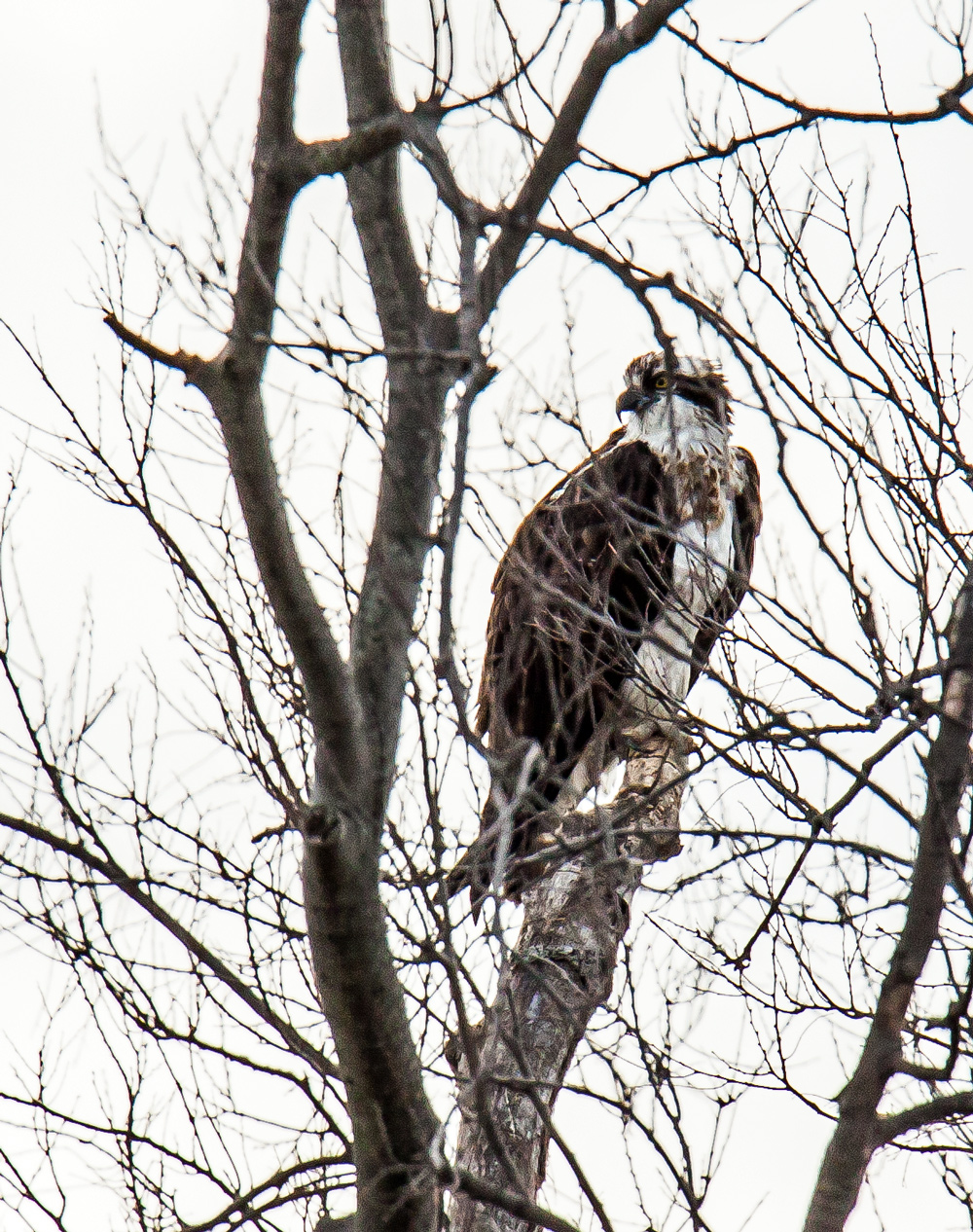
Ospreys leave our area in the fall and spend their winters in warmer locations in Central and South America. Around this time of the year, I keep my eye open for their return and this past Saturday I spotted my first one of the year. The osprey (Pandion haliaetus) was perched in a tree with branches that partially blocked my view. As I tried to maneuver to get a clear shot, the osprey took off, giving me a view of its massive wingspan. As you can see from the two images, it was an overcast day and color is mostly absent. If you look closely, though, you can just get a glimpse of the yellow of the osprey’s eye.

osprey

Osprey

© Michael Q. Powell. All rights reserved.

Read Full Post »

Most colors in nature are so dull and dreary during the winter that it is actually startling to see the bright spring plumage of some birds, like this brilliant blue Eastern Bluebird (Sialia sialis) that I encountered this past Friday. Some of the trees are now putting out buds and blossoms in my area of Northern Virginia and the blurry blotches of color that you see in the background are from one such tree.

Spring is almost here.

Eastern Bluerbird

© Michael Q. Powell. All rights reserved.

Read Full Post »

One of the youngest viewers of my blog is a boy named Benjamin. His grandmother likes to share my photos with him and he especially likes bluebirds. Upon viewing some images of them and seeing their colors, he innocently asked why they aren’t called Orange Bluebirds. Why not indeed? This post is especially for him.

I too love Eastern Bluebirds (Sialia sialis) and am happy anytime I am able to catch a glimpse of their bright colors. Here are a couple of images of bluebirds that I spotted this past Monday at Occoquan Bay National Wildlife Refuge (and there is plenty of orange to be seen).

Eastern Bluebird

Eastern Bluebird

© Michael Q. Powell. All rights reserved.

Read Full Post »

If you talk to your dentist, you’ll certainly be told that cavities are bad, but your perspective might change if you were a bird. I am not sure if this Red-bellied Woodpecker (Melanerpes carolinus) was checking out potential nesting sites yesterday morning at Occoquan Bay National Wildlife Refuge or merely looking for insects, but it sure did give this tree cavity a careful examination.

There was definitely no need to fill this cavity.

Red-bellied Woodpecker

© Michael Q. Powell. All rights reserved.

Read Full Post »

Every spring, Barn Swallows (Hirundo rustica) build a nest on the underside of a raised observation platform at Huntley Meadows Park. It is always  a lot of fun to watch these energetic little dynamos flying about, catching insects in mid-air. Fortunately this one came to rest for a moment on the metal railing of the platform and I was able to capture this image of a colorful Barn Swallow.


Barn Swallow

© Michael Q. Powell. All rights reserved

Read Full Post »

I am so happy that dragonfly season is finally here. There is just something about the beauty, complexity, and acrobatic skills of these amazing insects that never fails to grab my attention and I can easily spend hours watching and photographing them. I spotted this particular dragonfly, a female Spangled Skimmer (Libellula cyanea), last week at Huntley Meadows Park in Alexandria, Virginia.

Spangled Skimmer dragonfly

© Michael Q. Powell. All rights reserved

Read Full Post »

In the early morning light at Huntley Meadows Park last week, I was thrilled to catch a glimpse of an Eastern Kingbird (Tyrannus tyrannus). The colors and lighting were subdued, which helped to draw my attention to the details of the bird’s feathers when I captured these images.

Several other photographers had posted photos of a kingbird on the park’s Facebook page and I was hoping that I would see one when I set out that day. When I first saw this bird from a distance, I thought it might be some kind of swallow. Once I got a little closer, I changed my mind and considered the possibility that it might be an Eastern Phoebe. It was only when I got home and was able to look at my birding book that I realized the white-tipped tail of this bird meant that it was almost certainly an Eastern Kingbird.

I studied Latin for a couple of years in high school (a long time ago) and I am always curious about the origin of the Latin name for different species. This one—Tyrannus tyrannus—really caught my eye.  The Cornell Lab of Ornithology website explained the name in these words. “The scientific name Tyrannus means “tyrant, despot, or king,” referring to the aggression kingbirds exhibit with each other and with other species. When defending their nests they will attack much larger predators like hawks, crows, and squirrels. They have been known to knock unsuspecting Blue Jays out of trees.”

Eastern Kingbird


Eastern Kingbird


Eastern Kingbird

© Michael Q. Powell. All rights reserved

Read Full Post »

It is already June, but today I thought I would post an image of a striking May flower that I photographed late last month. Some of you know that I don’t have my own garden, though I am trying to grow some flowers in my yard this year. I generally have to rely on the garden of one of my neighbors, my photography mentor Cindy Dyer, for beautiful flowers to shoot.

I stopped by her house on the day when her first red day lily opened up. More of them are blooming now, but there is always something special about the first one. I love the rich red color of this particular variety of lily.  When I was growing up in Massachusetts. my Mom had some orange tiger lilies that appeared each year that she especially loved. This lily, of course, is a different color, but somehow it brought back memories of my departed Mom.


lily

© Michael Q. Powell. All rights reserved


Read Full Post »

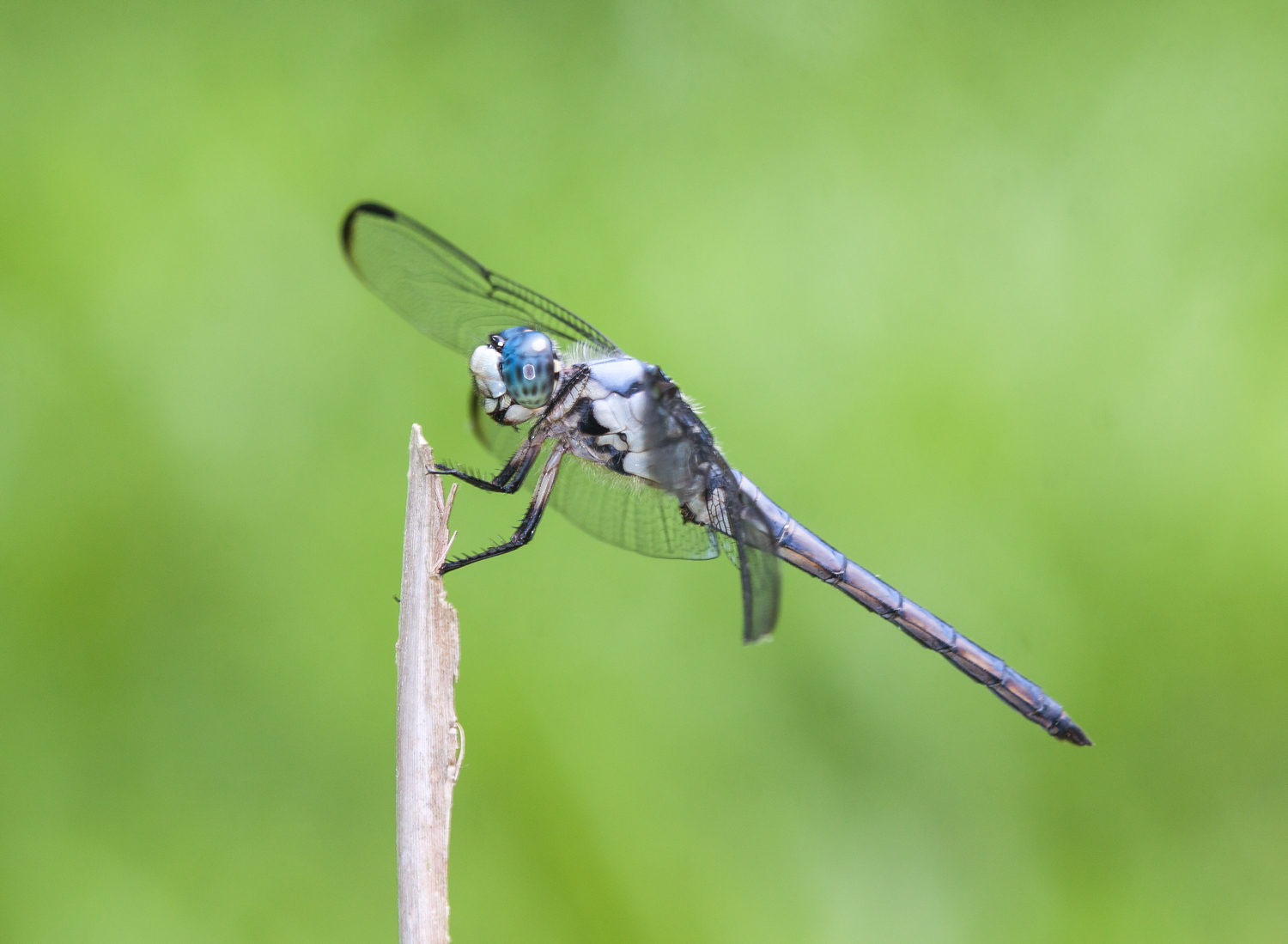
Most folks can readily identify a Great Blue Heron, but would you recognize a Great Blue Skimmer if you encountered one? This dragonfly’s wing pattern is fairly distinctive, but I usually look for its beautiful blue eyes and bright white face. I spotted these male Great Blue Skimmers (Libellula vibrans) on Monday at Huntley Meadows Park in Alexandria, Virginia.

Great Blue Skimmer

Great Blue Skimmer

Great Blue Skimmer

Great Blue Skimmer

© Michael Q. Powell. All rights reserved

Read Full Post »

There were crowds of people at Huntley Meadows Park on Monday, a  holiday in the United States, but I managed to find some moments of serenity and solitude as I contemplated this skipper butterfly perched on a faded iris at the edge of a vernal pool off of the beaten path.

I may be a little selfish, I suppose, but I enjoy nature most when I don’t have to share it with others.


Skipper on iris

© Michael Q. Powell. All rights reserved

Read Full Post »

This Green Heron (Butorides virescens) picked a particularly precarious perch from which to focus on a potential prey this past Monday at Huntley Meadows Park in Alexandria, Virginia.

Green Heron

© Michael Q. Powell. All rights reserved


Read Full Post »

If you go out early in the morning, you have undoubtedly seen flat dew-covered squares of web material scattered all over the ground. Yesterday morning at Huntley Meadows Park, I decided to explore several of them, hoping to find one of the spider-architects. Eventually I was able to find and photograph one of these spiders, which are commonly known as American Grass Spiders (g. Agelenopsis) or funnel weaver spiders.

According to an article on BugGuide.net, “For this family of spiders, the web is a horizontal, sheet-like web with a small funnel-like tube off to a side (or for some species, the middle of the web). This funnel is what the family is named for, and is used by the spider for hunting and protection. The spider will lay in wait in the funnel, and when an insect flies into, or lands on the web, the spider will rush out, very quickly check to see if it is prey, and if it is prey, bite it. The venom is fast-acting on the prey, so once the prey is subdued (within a second or two), the spider will drag the prey back into the funnel (for safety while eating, and to prevent other insects from recognizing the danger that lurks on the web).”

It’s fascinating to think about all the different ways that spiders are able to capture their prey, including all kinds of webs or even without webs, as is the case with jumping spiders and fishing spiders. It makes me happy that spiders are not larger, except perhaps in some Japanese science fiction movies, or we all might be in danger.

funnel weaver spider

© Michael Q. Powell. All rights reserved


Read Full Post »

Wildlife photography forces us to make a lot of choices in a short period of time, because we often encounter our subjects unexpectedly and don’t have the luxury of carefully planning all of our shots. When I stumbled upon this Hooded Merganser family (Lophodytes cucullatus) on Monday at Huntley Meadows Park, for example, I had to make a quick choice. Should I focus on the hyper-vigilant Mom or on her ducklings?

It’s hard to resist cuteness, so I initially focused on the babies. As you can see in the first shot below, the ducklings were relaxed and appeared to be preening and playing, while the Mom in the foreground kept watch. After I had taken a few shots, I switched my attention and my focus to the mother. Her more rigid posture is in sharp contrast to that of her ducklings, who have faded a little into the background in the second shot.

I think that my focusing choices cause each of the images to tell a slightly different story and causes a viewer to react differently. That’s one of the cool things I like about photography—our creative choices can help others to see the world in different ways as we gently guide their attention to what we think is important.

Hooded Merganser family

Hooded Merganser family

© Michael Q. Powell. All rights reserved

Read Full Post »

As I was getting ready to leave Huntley Meadows Park yesterday afternoon, a Wood Duck family (Aix sponsa)  suddenly swam right in front of me from under the boardwalk. Even though I zoomed out, I was unable to capture the entire family with my long telephoto lens.

Here are a couple of shots of the mother and some of her ducklings. They were moving pretty quickly as a group and I didn’t have much time to get some shots before they disappeared into the vegetation.

Wood Duck

Wood Duck

© Michael Q. Powell. All rights reserved


Read Full Post »

The time drew near for our departure and I had pretty much given up hope of getting any good shots of dragonflies during a visit with some friends last Saturday to Lewis Ginter Botanical Garden in Richmond, Virginia. There were several streams and ponds and I would occasionally see dragonflies flying around, but the planted areas of the garden prevented me from getting close to the water and the spots where the dragonflies were perching.

As I was crossing a small bridge that connected the boardwalk to the “shore,” a dragonfly suddenly flew up from the level of the water into a tree and perched on some relatively low-hanging leaves, about eight feet (243 cm) from the ground. I was able to track the dragonfly to its location and approached it slowly and cautiously.

The dragonfly was perching vertically and the first thing I noticed was that its wings were bright and shiny, suggesting that it had only recently emerged. My initial thought was that it was a Unicorn Clubtail (Arigomphus villosipes), because of the distinctive curved tip of the abdomen. When I got home, I looked at photos of Unicorn Clubtails and doubts began to creep into my mind about the identity of this dragonfly, because the colors seemed different from the ones depicted, which were more yellow than green. I posted a photo into a Facebook group and some experts confirmed that my initial instincts had been correct.

I took shots from several different angles, wishing that I was about a foot taller so that I would not have been shooting upwards at an angle. It turned out, though, that there was an advantage to shooting upwards, for I was able to get a pretty good view in the final image of the distinctive yellow “horn” between the dragonfly’s eyes that caused it to be named “unicorn.”

Unicorn Clubtail

Unicorn Clubtail

Unicorn CLubtail

© Michael Q. Powell. All rights reserved

Read Full Post »

In addition to dragonflies, damselflies are now appearing in greater numbers, like this beautiful little Ebony Jewelwing (Calopteryx maculata) that I spotted on Friday at Huntley Meadows Park. Identification is pretty easy, because it is the only dark-winged species in our area. The red eyes suggest that it is newly emerged—the eyes will change to a less demonic color later—and the lack of white markings on the wings indicate it is a male. Click on the image if you want to see some of the details of the damselfly at higher resolution, like the tiny hairs on its legs.

Ebony Jewelwing

© Michael Q. Powell. All rights reserved

Read Full Post »

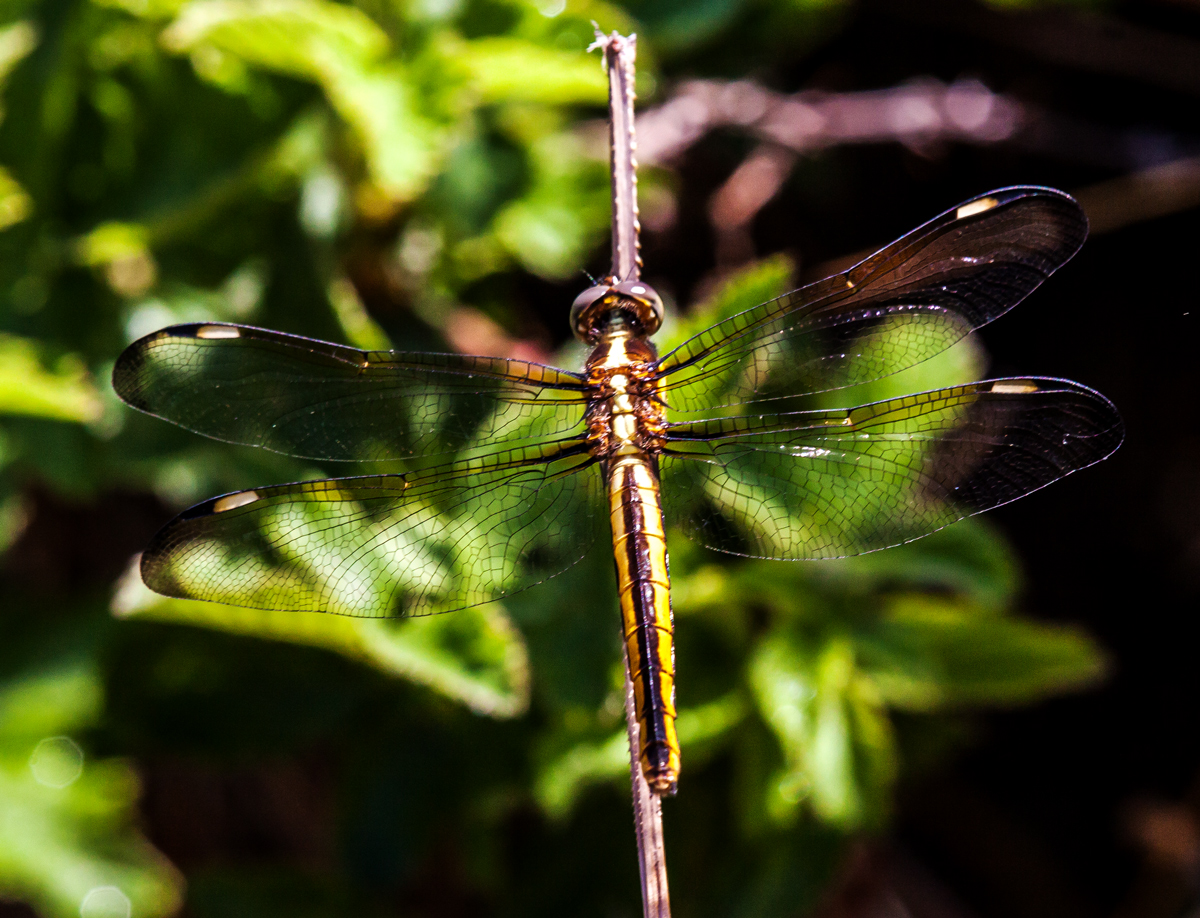
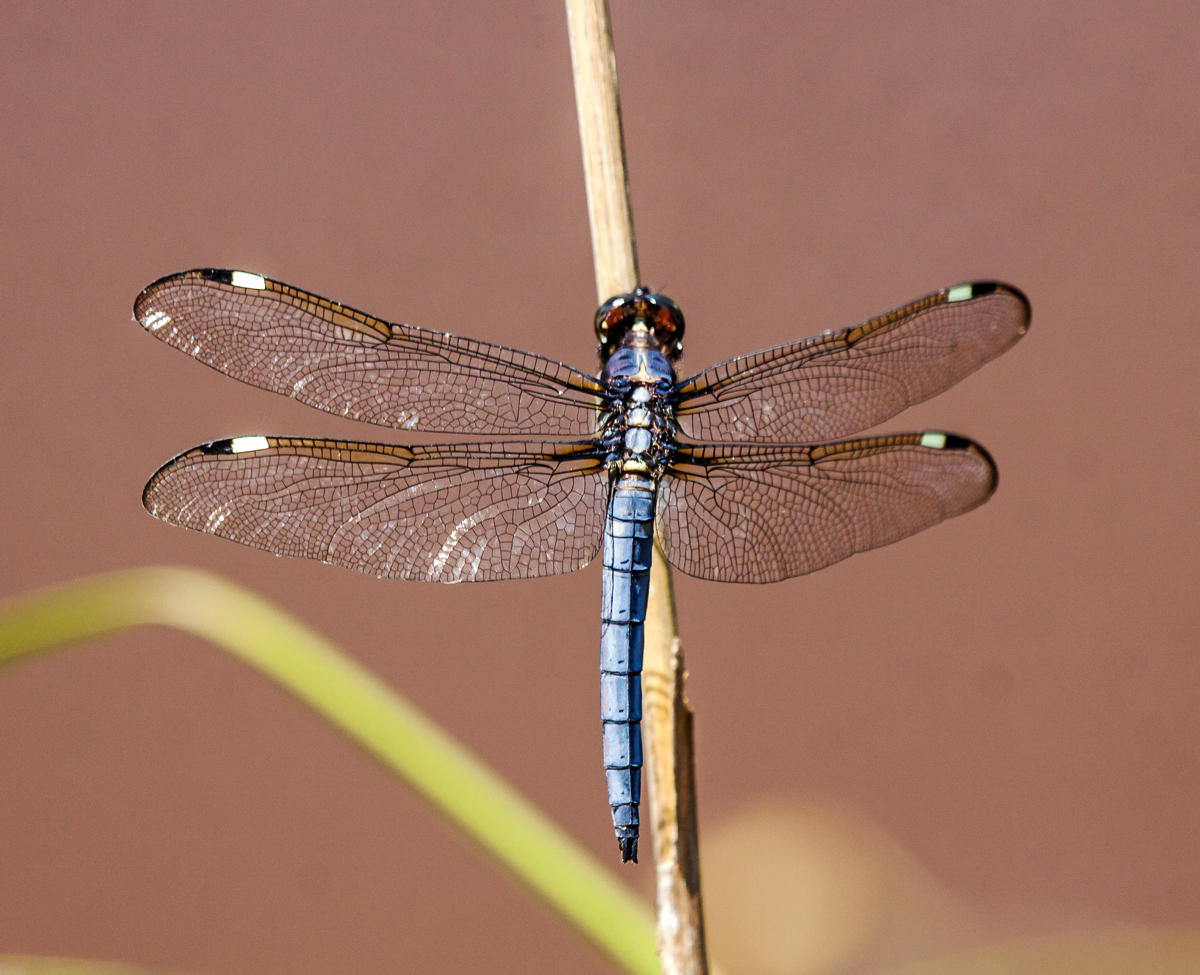
As the weather warms up, more and more dragonflies finally are starting to emerge at Huntley Meadows Park in Alexandria, Virginia. like these Spangled Skimmers (Libellula cyanea) that I spotted yesterday at the park. Spangled Skimmers are pretty easy to identify, because they are the only dragonflies in our area that have the both black and white “stigma” on the front edges of their wings. The adult male is blue, but immature males have the same coloration as the females, so you have to look closely to determine gender.

The first image, for example, shows an immature male, while the second image shows a female. If you examine the extreme tip of the abdomen (what I used to call a “tail”), you can see some differences. You may also note that the terminal appendages match for the first and third images, both of which show males.

If you want to learn more about Spangled Skimmers, check out this page from the Dragonflies of Northern Virginia website. The website is a wonderful resource for anyone interested in dragonflies, not just for folks who live in our area.

Spangled Skimmer

Spangled Skimmer

Spangled Skimmer

© Michael Q. Powell. All rights reserved

Read Full Post »

It was wonderful early this morning to catch a glimpse of one of the Hooded Merganser families (Lophodytes cucullatus) at Huntley Meadows Park. The ducklings appear to be almost grown up now and the survival rate seems to be higher than normal. In the past I have often seen the size of similar families dwindle down to just a couple of ducklings because of the large number of potential predators, most notably snapping turtles. I am amazed that the mother is able to watch over so many babies—the father doesn’t stick around to help raise the offspring.

mama merganser and babies

© Michael Q. Powell. All rights reserved

Read Full Post »

Every spring I seem to have the same problem—I see small brown skipper butterflies and can’t seem to identify them. Wikipedia notes that there are over 3500 species recognized worldwide, so I don’t feel too bad about my poor identification skills. I spotted this particular one during a recent trip to Meadowlark Botanical Gardens in Vienna, Virginia as it was feeding on what looks to be some variety of salvia flower—there are a lot of types of salvia flowers too.

As I looked through internet photos of possible matches for my skipper, I considered that it might be a Peck’s Skipper or possibly a Fiery Skipper, but none of them is a perfect match. I’m hoping that it turns out to be a Zabulon Skipper (Poanes zabulon). Why? More than anything else, I think “Zabulon” is a cool name.

skipper

© Michael Q. Powell. All rights reserved

Read Full Post »

The simple shape and spare palette of spiderwort plants (g. Tradescantia) really appeal to me and I found myself taking innumerable photos of them during a visit with fellow photographer Cindy Dyer to Meadowlark Botanical Gardens in Vienna, Virginia this past weekend. Be sure to check out Cindy’s blog for some awesome colorful images of many of the other flowers that we observed.

My friends all know that I have a warped sense of humor, so it would come as no surprise to them when I confess that I can’t help but think of an abnormal growth on an arachnid every time that I use the word “spiderwort.” As the weather continues to warm up, I’m pretty confident that I will soon be featuring images of spiders, warts and all.

spiderwort

© Michael Q. Powell. All rights reserved

Read Full Post »

Flowers are beautiful, of course, but when it comes to taking photos, I seem to be equally (or more) attracted to insects among the flowers. Yesterday we finally had some sunshine here in Northern Virginia after three soggy days in a row and I made a trip to Green Spring Gardens with my mentor Cindy Dyer to check out the flowers in bloom.

The wind was blowing most of the afternoon, which turned many of the flowers into moving targets, but patience and persistence allowed me to get some shots of some of my favorites, like love-in-a-mist and columbines. I am still going through my images, but I was immediately attracted to this shot of a bee in flight that I captured as it moved from one iris to another.

I remember being a little surprised to see a bee gathering pollen from irises—there seemed to be much candidates nearby, including some large, showy peonies. The bee didn’t spend long in each iris and the long petals of the iris often hid the bee from view. As I was tracking the bee, I somehow managed to maintain focus and captured this whimsical little shot of it in mid-air. My shutter speed of 1/640 sec was not fast enough to freeze the wings, but I really like the blur of the wings, which enhances the sense of motion for me.

bee and iris


© Michael Q. Powell. All rights reserved

Read Full Post »

It has rained almost continuously for several days since my return from a brief overseas trip to Vienna, Austria. After a week spent mostly in the city, I was itching to get out into the wild again. The rain finally let up in middle of this morning, so I went out exploring with my camera at Jackson Miles Abbott Wetland Refuge.

The wetland was really wet and it was cool and cloudy, so not much was stirring, except this little butterfly. I think I disturbed its sleep, for it was motionless with its wings spread wide until I was almost on top of it. Suddenly it took to the air and flew away. I am not sure what type of butterfly this is, but I was so happy to be in my “natural” environment again, that I am content to simply marvel in its delicate beauty.

UPDATE: In a Facebook insect identification group, my pretty little butterfly has been identified as a Crocus Geometer moth (sp. Xanthotype) or possibly a False Crocus Geometer moth.

butterfly

© Michael Q. Powell. All rights reserved

Read Full Post »

I was hoping that I would be in Vienna at the right time of the year to see baby swans, but I guess my trip brought me here a bit too early. At the lake at Donau-Auen National Park, I could see one Mute Swan (Cygnus olor) swimming around and wondered if it was alone. When I walked further around the lake, I spotted what appears to be its mate, partially hidden by the vegetation, sitting on a nest.

Mute Swan

Mute Swan

Mute Swan

Mute Swan

© Michael Q. Powell. All rights reserved

Read Full Post »

As I wandered through the Donau-Auen National Park in Vienna, Austria this past weekend I did not see any large butterflies, but I did spend quite some time chasing several smaller ones.  The butterfly species appear to be somewhat similar to the ones that I see in Northern Virginia, but not identical, as was the case with the damselflies that I featured yesterday.

butterfly in Vienna

butterfly in Vienna

butterfly in Vienna

© Michael Q. Powell. All rights reserved

Read Full Post »
You have to be awfully lucky to capture in-flight images of damselflies, but it helps a little when they are in tandem. I spotted these Southern Spreadwing damselflies (Lestes australis) last week at Huntley Meadows Park. The pair in the foreground were still hooked up after mating and appeared to be heading for the branch that you can see in order to lay eggs there.

It’s cool how you can see another damselfly in the background flying in from another direction. I noticed that some single damselflies, probably rival males, seemed to be trying to interfere with the couples when they were involved in ovipositing, which is why the male stays with the female until he is sure the job is done.

Southern Spreadwing

© Michael Q. Powell. All rights reserved

Read Full Post »

These Southern Spreadwing damselflies (Lestes australis) were engaging in a little May Day mayhem this past Monday at Huntley Meadows Park. If I have this figured out right, the female, the one on the right in this image, is depositing her eggs in the vegetation after successfully mating with the male, who is still holding on to her.

Southern Spreadwing

 © Michael Q. Powell. All rights reserved

Read Full Post »

Male Eastern Pondhawk dragonflies (Erythemis simplicicollis) start out with the same bright green coloration and bold black and white stripes as the female that I featured in a posting earlier this week. Over time the males turn a fairly nondescript blue and are outshone by their female counterparts.

On Monday, I was fortunate to capture this image of a male Eastern Pondhawk in a transitional  stage, with beautiful two-toned shades of green and blue. I was thrilled when it perched on a green plant, which helps to draw the viewer’s eye to the dragonfly in a background of dried-up fallen leaves.

Eastern Pondhawk

© Michael Q. Powell. All rights reserved

Read Full Post »
I celebrated May Day yesterday by searching for dragonflies at Huntley Meadows Park and was rewarded by spotting my first Eastern Pondhawk dragonflies (Erythemis simplicicollis) of the season. This bright green female pondhawk was almost hidden in the fresh vegetation, but she really showed her colors when she perched on the brittle fallen leaves on the forest floor. The muted tones of gray and brown created a wonderful (albeit cluttered) backdrop that really let her beautiful colors and patterns stand out.

Eastern Pondhawk

© Michael Q. Powell. All rights reserved

Read Full Post »

The weather yesterday was hot and sunny—perfect for dragonflies, although a little uncomfortable for me. I decided to search in the vicinity of a vernal pool, one of my favorite spots for dragonflies at Huntley Meadows Park. As I was walking along a small water-filled ditch, a large dragonfly flew up from the water and perched in a tree just a short distance away. I suspected it might be a Swamp Darner (Epiaeschna heros) and it turns out that I was right.

About this time each year, a number of female Swamp Darners descend on this small ditch to lay their eggs. Unlike many other dragonflies, which lay their eggs in the water, Swamp Darners lay their eggs in moist, often rotten logs. Essentially they tunnel into the wood before they lay the eggs.

I spotted the most likely target log and sat on the bank of the ditch to see if the dragonflies would come. It didn’t take long for them to arrive. Sometimes it was just one dragonfly, while at other times there were two or even three of them laying eggs in the same log. I was shooting with a 180mm macro lens, so I could not zoom out to include all of them (and I did not want to move for fear of scaring them away). In one of the photos, you can see two of the Swamp Darners in action and part of the abdomen of a third one in the upper left corner.

I don’t know if it is some biological imperative for species preservation that compels them to deposit these eggs, but the females were putting them everywhere. I was a little shocked when one of them landed on my mud-covered shoes and began to deposit eggs there.

The dragonflies were so focused on depositing their eggs that I was able to lean forward and get a close-up view of the face of one of them. I love dragonfly faces and especially their amazing giant eyes.

Swamp Darner

Swamp Darner

Swamp Darner

Swamp Darner

Swamp Darner

© Michael Q. Powell. All rights reserved

Read Full Post »

As I was exploring Accotink Bay Wildlife Refuge yesterday afternoon, Zebra Swallowtail butterflies (Protographium marcellus) kept fluttering by me. Occasionally one would perch for a moment  within range and I was able to get a few shots.

I really love the coloration and the shape of this beautiful butterfly that I rarely see. Although this butterfly is often associated with pawpaw trees, the ones that I saw perched mostly on the ground and seem to be obtaining either water or minerals.

Zebra Swallowtail

Zebra Swallowtail

Zebra Swallowtail

© Michael Q. Powell. All rights reserved

Read Full Post »

« Newer Posts - Older Posts »