Feeds:
Posts
Comments

Archive for the ‘Portraits’ Category

This large bullfrog was so content in the mud that he did not budge at all when I moved closer to take this shot. Compared to the tiny tree frogs that I have been photographing recently, this frog seemed enormous.

The mud may not be the best backdrop for a photo, but I like the way that the image has become a study in greens and browns, with a golden eye as a accent.

frog_mud_blog

© Michael Q. Powell. All rights reserved.

Read Full Post »

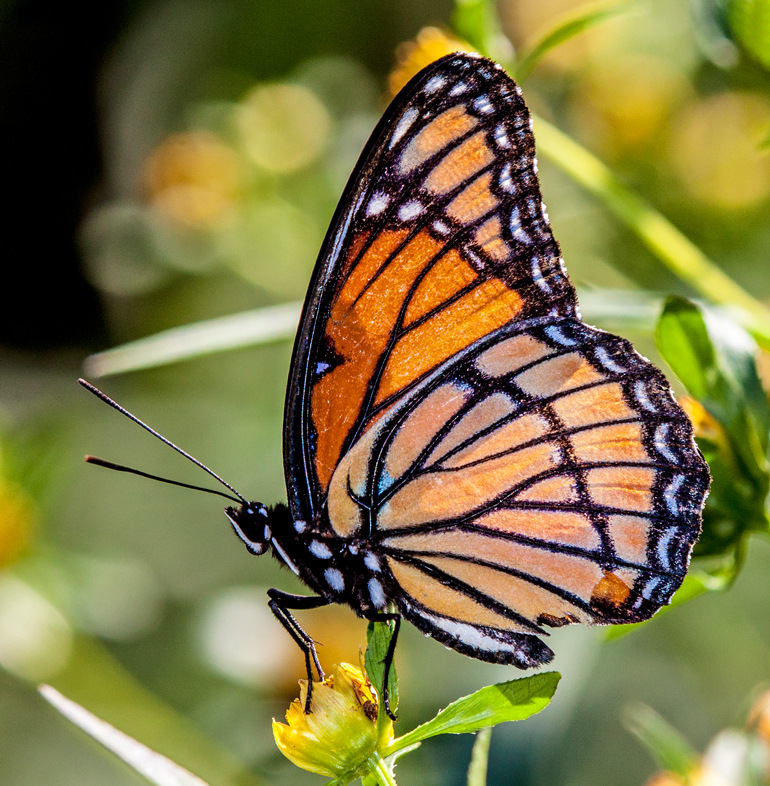
The days are getting cooler and leaves are starting to wither and fall, but there are still signs of the lingering summer, like this beautiful Viceroy butterfly (Limenitis archippus) that I photographed this past weekend. viceroy_bokeh_blog

© Michael Q. Powell. All rights reserved.

Read Full Post »

Imagine how skinny this fuzzy white caterpillar would appear if its fur were “groomed,” like some of the dogs in my neighborhood. There is one fuzzy white dog, in particular, that looks huge, which I think is a Great Pyrenees. I was shocked one day when I saw that dog with closely cropped fur—it looked to be only half of its normal size.

For some reason, this caterpillar’s hair seems to be more tufted than usual, compared to similar caterpillars that I have seen. Maybe the hair is bunched because of the heavy dew or the way that the caterpillar slept. Clearly the caterpillar is having a bad hair day.

Do you think it could get away with wearing a hat to cover the bad hair?

really_fuzzy2_blogreally_fuzzy1_blog

© Michael Q. Powell. All rights reserved.

Read Full Post »

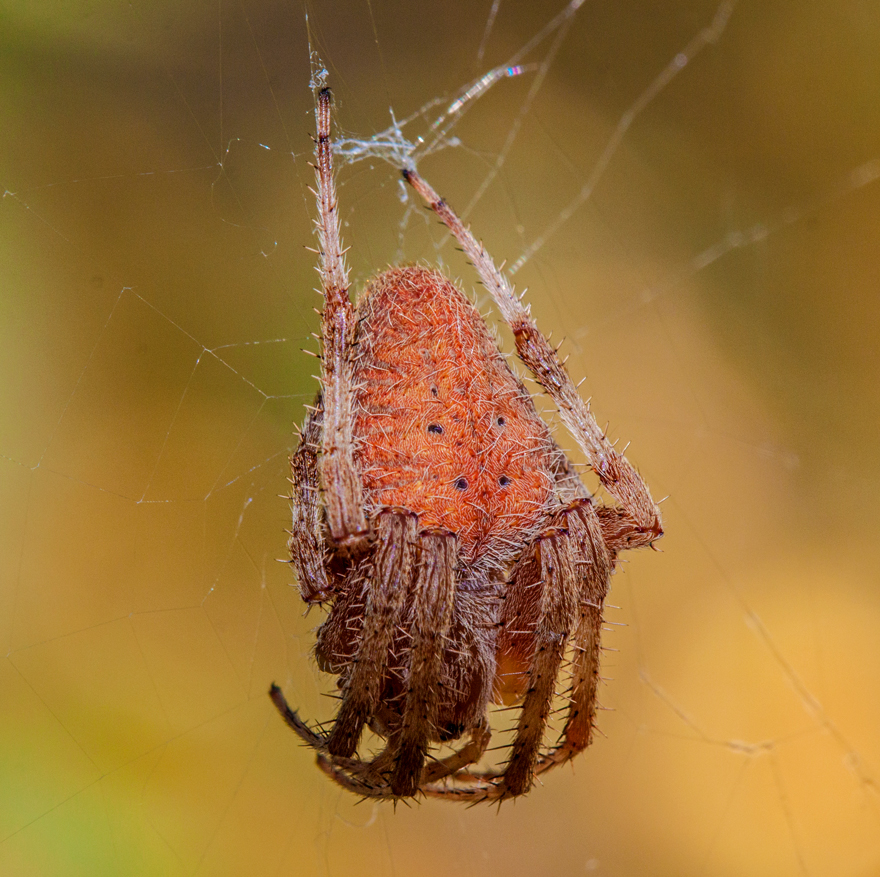
Walking along the boardwalk at my local marsh, I encountered this fairly large, hairy red spider in a web almost at eye level.

It was a little disconcerting to look a spider in the eye (eyes) at such close range, but it did allow me to get a pretty detailed shot at close range against an uncluttered background. I’ve been searching around on the internet, attempting to identify the spider but so far have not had any success. Can anyone identify this cool-looking spider?

orange_spider1_blog

© Michael Q. Powell. All rights reserved.

Read Full Post »

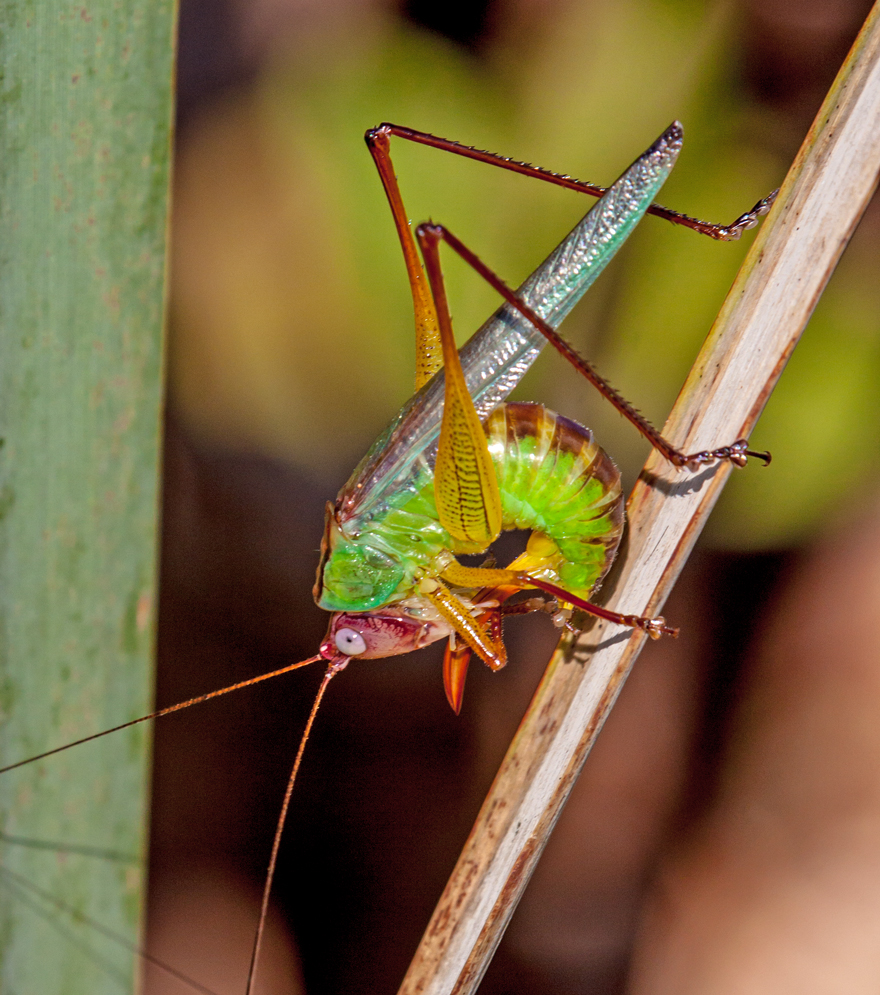
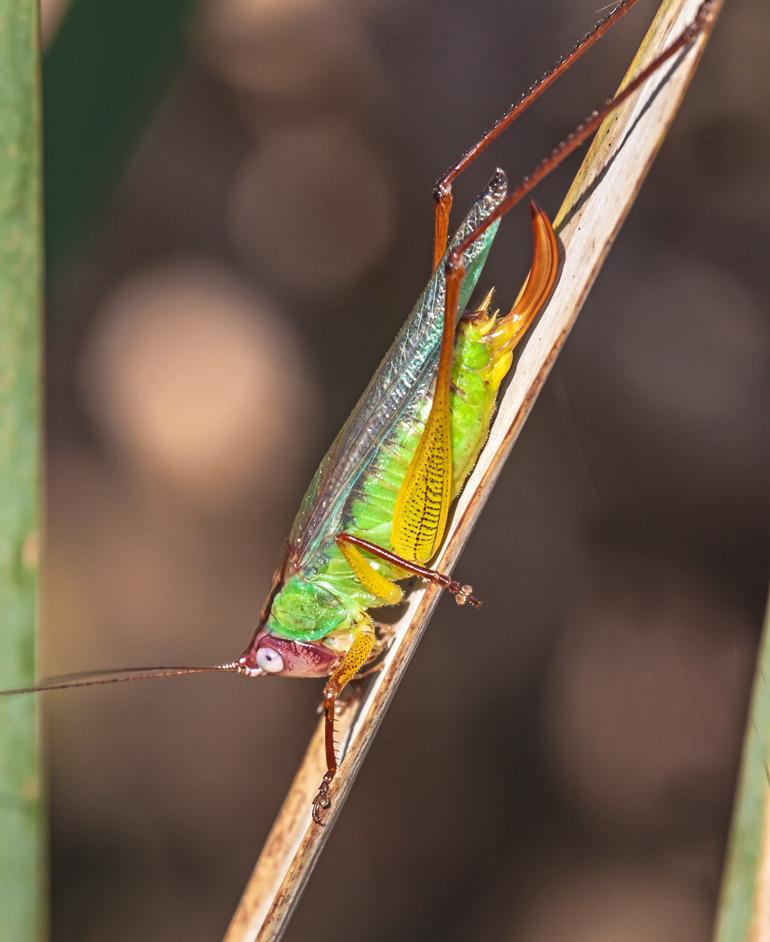
As was watching this Handsome Meadow Katydid (Orchelimum pulchellum) through my viewfinder,  it suddenly arched its body and assumed a position worthy of an world-class gymnast or yoga master. What was it doing?
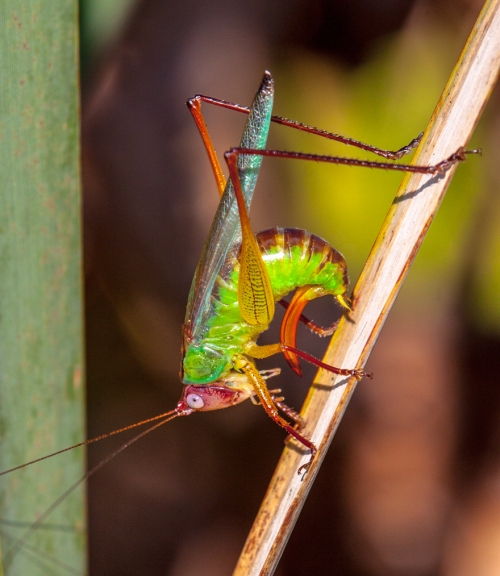
rainbow_gymnastics_blog

My first thought was that the katydid was merely stretching, getting ready for the day’s activities. When you jump around as much as these insects do, you can’t risk a pulled muscle or other injury by not warming up properly.

Over the past year, this rainbow-colored katydid has become my favorite insect, but I confess that I don’t much about their anatomy. Looking over my photos, I realized that I needed to identify the orange-colored body part, a part that I don’t recall observing before, in order to figure out what was going on. What could it possibly be?

rainbow_gymnastics3_blog

Well, it looks like this katydid probably is a female and the orange-colored thing is her ovipositor, the organ used for depositing eggs. So, is she depositing eggs in the photos? I am not sure.

A University of Arkansas website describes the ovipositing for a similar katydid with these words, “An ovipositing female embraces a plant stem with her prothoracic and mesothoracic legs and brings the curved and sword-like ovipositor far forward so its tip can scrape the substrate.” It’s not really helpful when the explanation contains so many words with which I am unfamiliar. I think that I will leave this kind of science to the scientists.

As a photographer, I continue to be amazed by the multi-colored beauty of this fascinating insect and especially by its alluring blue eyes. I know that it’s an illusion, but those eyes often seem to be looking right at me. I’m not sure if this Handsome Meadow Katydid is depositing eggs in these photos, but I am sure that  I like the images a lot, including the final image, which shows the katydid in a more “normal” position following her brief series of gymnastics.

rainbow_gymnastics2_blog

© Michael Q. Powell. All rights reserved.

Read Full Post »

I can’t seem to get enough of these little green tree frogs and continue to try to get photos of them whenever I can.

In this shot, my eyes were drawn textures and colors—in particular, the bumpy texture of the frog’s skin and the contrast between the light olive green of the frog and the darker green of the leaf on which it is sitting.

frog_decay_blog

© Michael Q. Powell. All rights reserved.

Read Full Post »
I always seem to have real problems making positive identification of the smaller, nondescript butterflies, like this little orange skipper butterfly that I photographed recently at my local marshland park.

If I had to go out on a limb, I’d hazard a guess that this is a Delaware Skipper (Anatrytone logan), although with more than 3500 recognized species of skippers, the odds are not in my favor.

tiny_orange_blog

© Michael Q. Powell. All rights reserved.

Read Full Post »

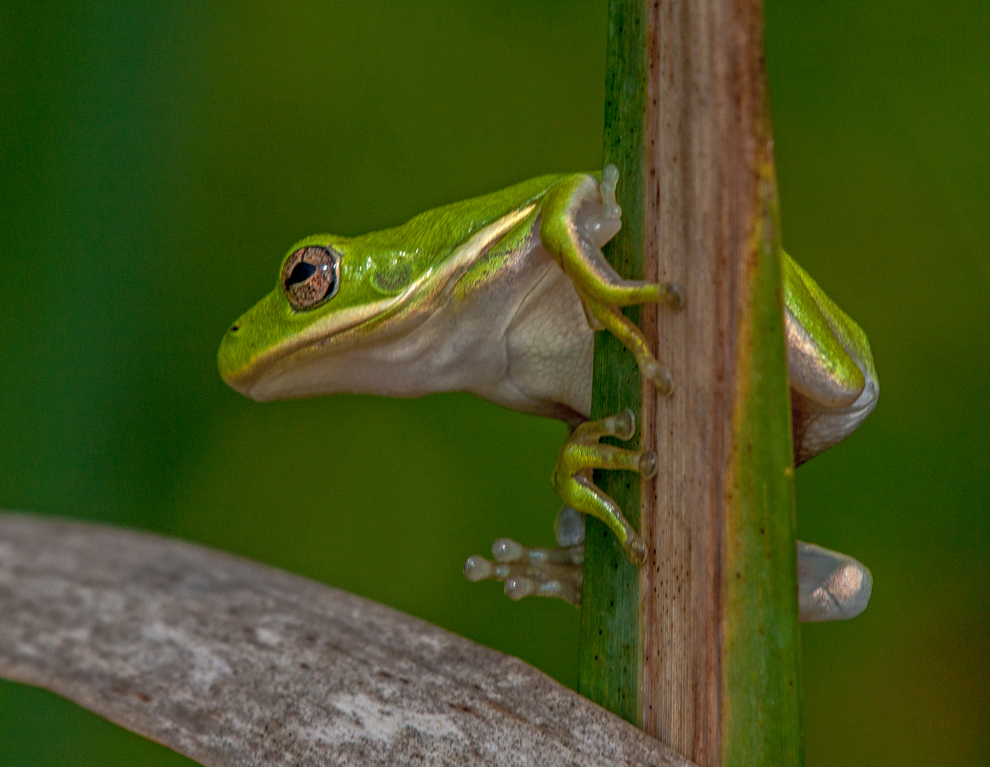
The lighting and the pose add some drama to this almost formal portrait of a Green Treefrog (Hyla cinerea) that I encountered at my local marsh.

Most of the tree frogs that I have seen have been snoozing in the cattails and it’s been tough to get a clear shot, but this one was conveniently perched on a horizontal leaf, giving me pretty good latitude to compose the shot that I wanted. Even the frog was cooperative and stayed put while I made adjustments to the camera in between shots.

I’m really happy with this image and think that the frog too would be content with this portrait.

frog_leaf_blog

© Michael Q. Powell. All rights reserved.

Read Full Post »

I love the mix of colors that resulted when a male Blue Dasher dragonfly (Pachydiplax longipennis) that I was observing chose to perch on a plant with red leaves.red_obelisk_blog

© Michael Q. Powell. All rights reserved.

Read Full Post »
Recently I had the chance to observe a Green Heron (Butorides virescens), one of my favorite birds, as it waded into the water at the edge of a small pond and focused its attention on catching a meal.

It was fascinating to watch the heron’s movements—it moved so with such care and stealth that it almost seemed to be moving in slow motion. At times, the heron would lean forward, as in the first photo, perhaps when a potential prey caught its attention.

The water in the pond was very still and I was happy to capture some nice reflections of the heron. They presented a minor dilemma for me in deciding how to crop the shot. Was it better to crop tighter and emphasize the main subject, as I did in the first shot, or to show the entire reflection, as in the third shot, which is the same image cropped differently? What do you think?

In many ways, the second shot is my favorite one. The heron had started to slowly move away and then turned its head back and opened its mouth a little. That little gesture seemed to give the heron more personality and it looks almost like it is smiling.

green_heron_close2a_bloggreen_heron_close1_bloggreen_heron_close2_blog

Read Full Post »
One of the advantages to living in a relatively southern state is that summer lingers on for a bit longer and flowers continue to bloom. As long as there are flowers blooming, bees continue in their efforts to gather pollen,

I am not sure what flower this is, but it was blooming in the garden of one of my neighbors, Cindy Dyer, a fellow photographer and blogger. She plants her garden with an eye toward plants that will photograph well and when I have a few minutes to spare, I enjoy making a quick trip to her garden to see what is blooming.

When I first spotted it, I had this mental picture of the bee working in the center of the flower, surrounded by a protective little fence.  I tried to frame the shot with that picture in mind and chose an angle that emphasized the “fence.”

Sep_bee_blog

© Michael Q. Powell. All rights reserved

Read Full Post »

I feel lucky whenever I spot a praying mantis, because they are usually so well camouflaged that they are virtually invisible when motionless.

I was a little surprised to see a brown one recently (all the other ones that I have seen have been green), but I can’t help but note that the brown head makes those green compound eye really stand out. I really felt like the praying mantis was looking right at me as I tried to photograph it.

brown_praying_blog

© Michael Q. Powell. All rights reserved

Read Full Post »

This little Green Treefrog (Hyla cinerea) was almost hidden in the cattails, comfortably napping at midday with its legs tucked under its body. It’s nice to know that I am not the only one who enjoys a little afternoon siesta.

sleeping_frog_blog

© Michael Q. Powell. All rights reserved

Read Full Post »

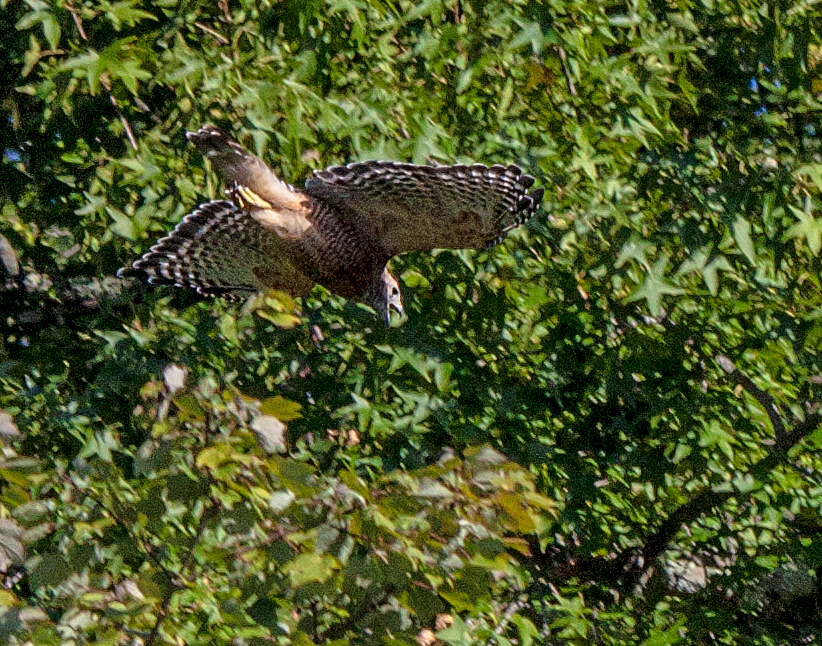
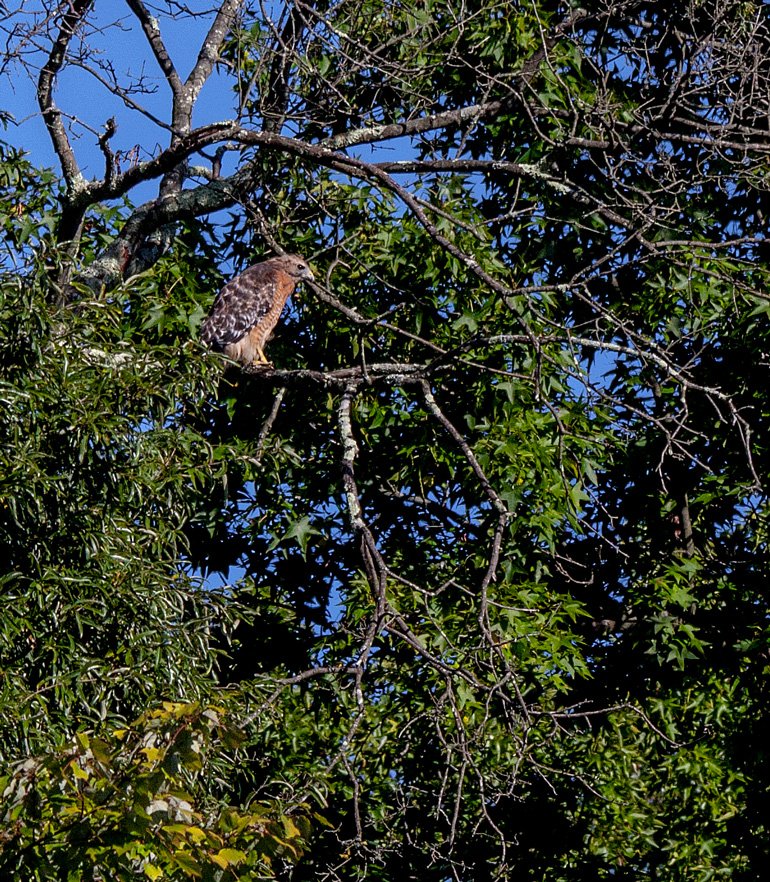
I have not seen any hawks at my local marsh for quite some time, so yesterday I was really happy when I heard the unmistakable sound of screaming Red-shouldered hawks (Buteo lineatus). (Check out the sound file on the Cornell Lab of Ornithology website if you have never heard the cry of these magnificent birds.)

From the sound of the loud screaming, I could tell that the hawks were not far away and eventually I spotted two of them soaring above the trees. After a few minutes, one of them flew silently into view and landed in a tree across the beaver pond from where I was standing. I suspected that he would not remain very long, so I decided to try to get some shots with the lens that I happened to have on my camera at the time, my Tamron 180mm macro lens, rather than take the time to set up my tripod and change to a longer lens.

Before long, I heard the cries of the other hawk and the one that I was watching took to the air and joined in the screaming. I was a little surprise to see that it flew laterally and downward, but I was able to track it pretty well and got the in-flight shot that you see below.

I was pleased to see that the lens was able to capture a pretty good amount of contrast and detail, even in heavily-cropped images like the two that I am posting. I enjoy the challenge of attempting to capture any birds in flight and look forward to more attempts as we move out of insect season, when my macro lens is use most of the time, into bird season, when I switch to a telephoto lens.

screaming3_blogscreaming2_blog

© Michael Q. Powell. All rights reserved

Read Full Post »

Earlier this week I came across this little Jumping spider, patiently waiting for a prey to come by.  I never fail to be amazed by those eyes that seemed to be staring right at me.

Transfixed, I can’t take my eyes off of you, tiny spider, and your eyes seem to follow me. I don’t want to seem paranoid, but when I am with you, I always feel like somebody is watching me.

Somehow I thought I heard the spider humming, “I only have eyes for you,” but it was just my imagination, running away with me.

jumping_marsh2_blog

© Michael Q. Powell. All rights reserved

Read Full Post »
Hoverflies normally are as busy as bees, in constant motion as they move from flower to flower. From time to time, though, I guess that they need to rest. Earlier this week, I captured this image of  a hoverfly relaxing on the dried out leaf of a cattail at my local marshland park.

hoverflyA_blog

© Michael Q. Powell. All rights reserved

Read Full Post »

Unlike most of the tree frogs that I have encountered, this Green Treefrog (Hyla cinerea) was alert and moved about a bit when I tried to take its photo—the others were resting motionless on cattail plants and seemed half-asleep.

The frog initially hid behind the cattail leaf and then tentatively poked its head out, giving me the chance to get this shot. I really like the pose that I was able to capture and the really cool details that you can see of the pads on its toes, which help it to seemingly defy gravity. (Click on the image to see a higher resolution view.)

I too would love to be able to defy gravity.

hanging_on1_blog

© Michael Q. Powell. All rights reserved

Read Full Post »

Small butterflies have a special, delicate beauty all their own, like this Gray Hairstreak butterfly (Strymon melinus) that I photographed in mid-August at Lewis Ginter Botanical Gardens in Richmond, Virginia.

BugGuide states that this is the most common hairstreak in North American, but this is only the second time that I have seen one. Based on my limited observation of American women, I would assert that the blond hairstreak is the most common one, though, as a bald guy, I realize that hair is not my area of expertise.

hairstreak2_bloghairstreak1_blog

© Michael Q. Powell. All rights reserved

Read Full Post »
Who makes up these crazy names? Freddy Krueger? Jason? Believe it or not, this colorful little caterpillar is called a Smeared Dagger Moth caterpillar (Acronicta oblinita). Someone obviously had been been watching too many slasher or horror films.

Fortunately, it has another name—it is also called a smartweed caterpillar.

colorful_blog

© Michael Q. Powell. All rights reserved

Read Full Post »
When it started to rain yesterday, I pulled out my umbrella and kept shooting for a while, permitting me to get this close-up shot of a Great Blue Heron (Ardea herodias).

The heron was stoically enduring the rainfall, as drops of water began to bead up on its shoulders. The wind started to kick up a little too, ruffling some of the feathers on the heron’s chest. I was afraid that my white and green umbrella would spook the heron, but I was able to get pretty close to the heron to get this shot at the far end of my 55-250mm zoom lens. If you click on the photo, you can see these (and other) details in a higher resolution image.

There are many flowers blooming in my local marshland park right now and I really like the little splashes of yellow in the background of this image.

heron_closeup1_blog

© Michael Q. Powell. All rights reserved

Read Full Post »

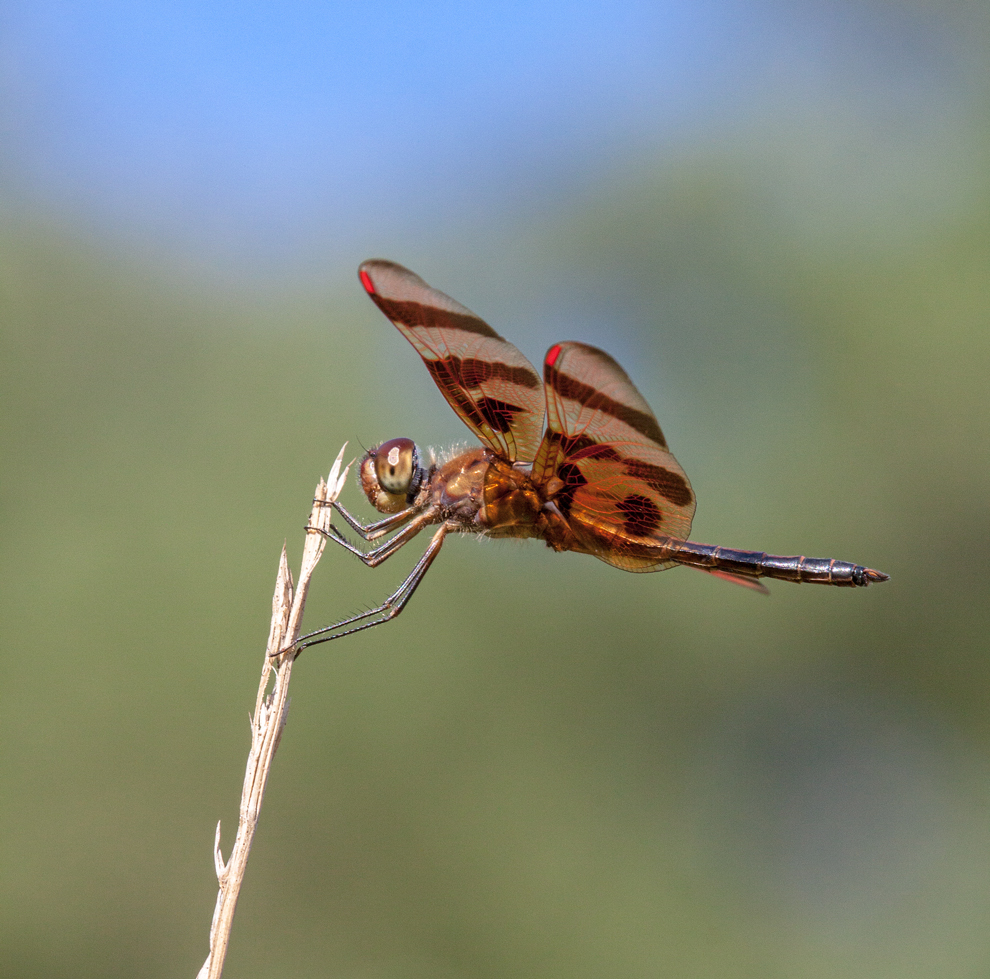
It’s not hard to see where this dragonfly gets its name—the Halloween Pennant (Celithemis eponina)—when it is perched on the very tip of a stalk of grass and is blown about by even the slightest wind.

I took this shot from a very low angle to try to show the sky and I am pretty happy with the way in which I was able to separate the dragonfly from the background.

blowing_blog

© Michael Q. Powell. All rights reserved

Read Full Post »
Growing up in the suburbs of Boston, I was never exposed to muskrats and my first impression of them may well have come from the Captain and Tennille version of the song “Muskrat Love.” So every time I see one now, that song comes into my head and I think of Muskrat Susie and Muskrat Sam doing the jitterbug out in muskrat land.

This past Monday I came upon this little muskrat (Ondatra zibethicus) at my local marsh as I was trying to get some shots of a Green Heron. I was on the boardwalk, maybe 18 inches (about 45 cm) or so above the level of the land and the muskrat was close enough that I was able to get this shot with my 180mm macro lens. Once it became aware of our presence, the muskrat slipped into the water and swam away, perhaps returning to Muskrat Susie.

One interesting note about “Muskrat Love” is that the Captain and Tennille chose to sing that song at the White House in 1976 at a bicentennial dinner that included Queen Elizabeth as a guest, according to Wikipedia. If you have never heard the song (or if you want to relive memories of your childhood), here’s a link to a YouTube version. In the introduction to the song, Toni Tennille describes an impassive Henry Kissinger during the performance at the White House (http://www.youtube.com/watch?v=xBYV_7a0FQs).

muskrat_sam_blog

© Michael Q. Powell. All rights reserved

Read Full Post »
As I noted in an earlier posting today, some of my favorite images are almost minimalist in their approach. This recent image of a male Blue Dasher dragonfly (Pachydiplax longipennis) fits into that category.

Once again, the composition is simple, the color palette is fairly limited, and there is a good amount of negative space. The brown-colored background is the water in one of the areas of my local marshland park.

I like the position of the dragonfly—I think he was trying to cool off on a hot day by raising his abdomen—and the viewer’s eyes are drawn to the dragonfly, because it is the most colorful and the most sharply-focused object in the photo.

This image reminds me a little of a painting in which the artist has arranged the elements to make a pleasing composition. In this case, though, nature did the arranging.

dasher_leaves_blog

© Michael Q. Powell. All rights reserved

Read Full Post »

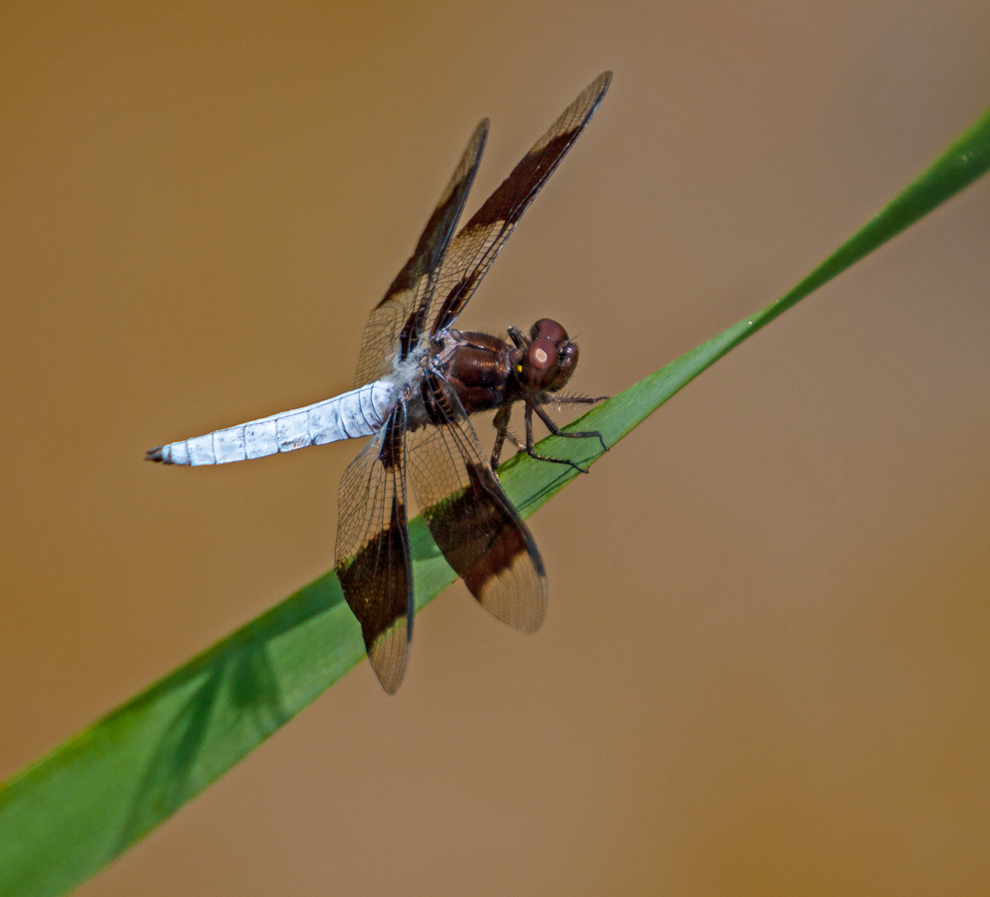
Some of my favorite images are almost minimalist in their approach, like this shot of a male Common Whitetail dragonfly (Plathemis lydia).

The composition is simple, the color palette is limited, and there is a pretty good amount of negative space. The subject is not unique and unusual—its name even indicates that it is “common.”

I managed to capture some of the details of the dragonfly, though, like the “hairs” on the legs (click on the image to see a higher resolution view), though the image is not super sharp. The shadow of the wings on the green leaf adds an additional touch of visual interest to the image.

The photo is not spectacular and showy, but I find a real beauty in its quiet simplicity.

whitetail_A_blog

© Michael Q. Powell. All rights reserved

Read Full Post »
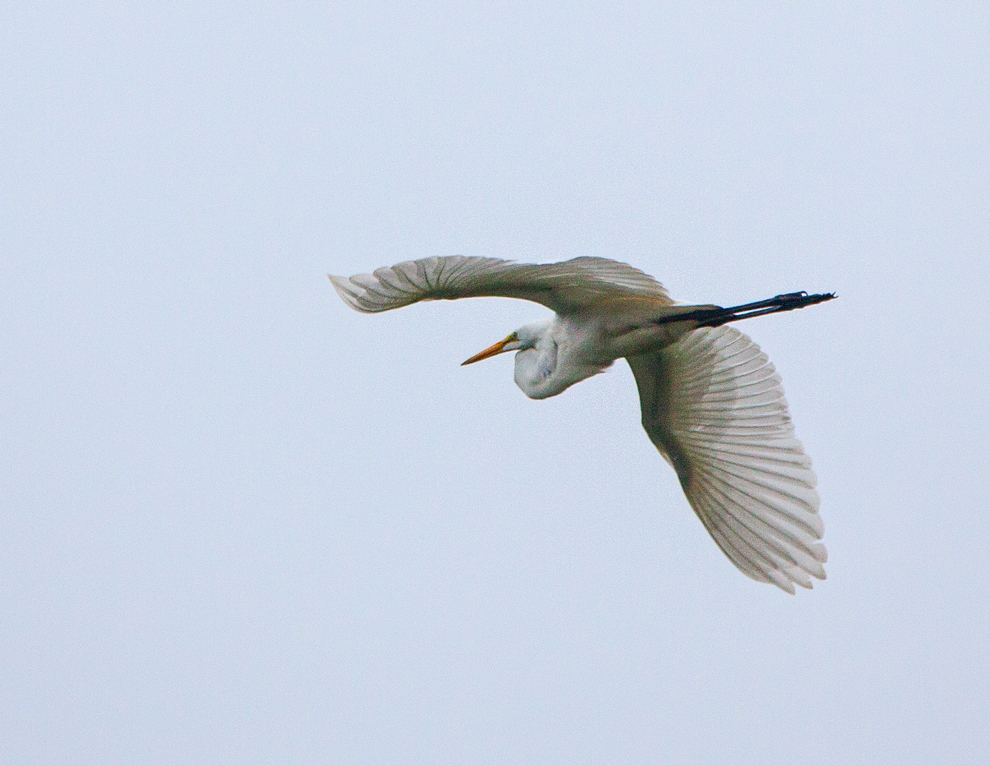
I am in awe of photographers who can capture amazing shots of birds in flight and I continue my quest to improve my own skills. So many things have to come together to get such shots including the timing, location, lighting, and focusing.

Here is one of my most recent efforts, a shot of a Great Egret (Ardea alba) in flight. The focus is a little soft, but I really like the position of the egret that I managed to capture, with a beautiful sweep of the wings.

flying_egret1_blog

© Michael Q. Powell. All rights reserved

Read Full Post »
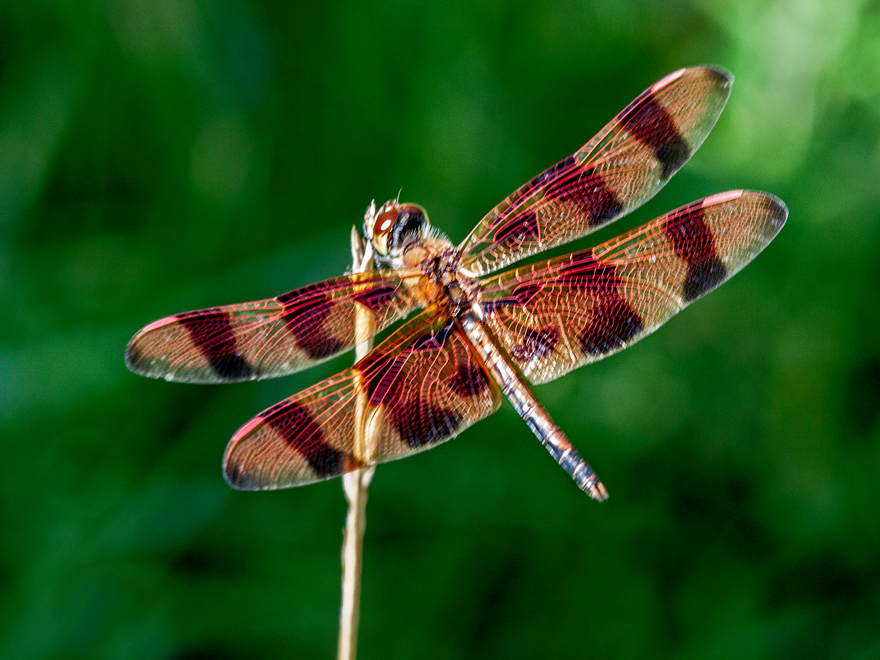
One of the many reasons why I love dragonflies is their amazing wings, which are so delicate and yet so powerful, like those of this male Blue Dasher dragonfly (Pachydiplax longipennis). In this shot, I tried to capture some of the intricate detail of the structure of the wings of the dragonfly. They remind me a bit of the leaded glass windows that I sometimes see in old homes, with each small piece of glass outlined in black.

dragonfly_wings_blog

© Michael Q. Powell. All rights reserved

Read Full Post »

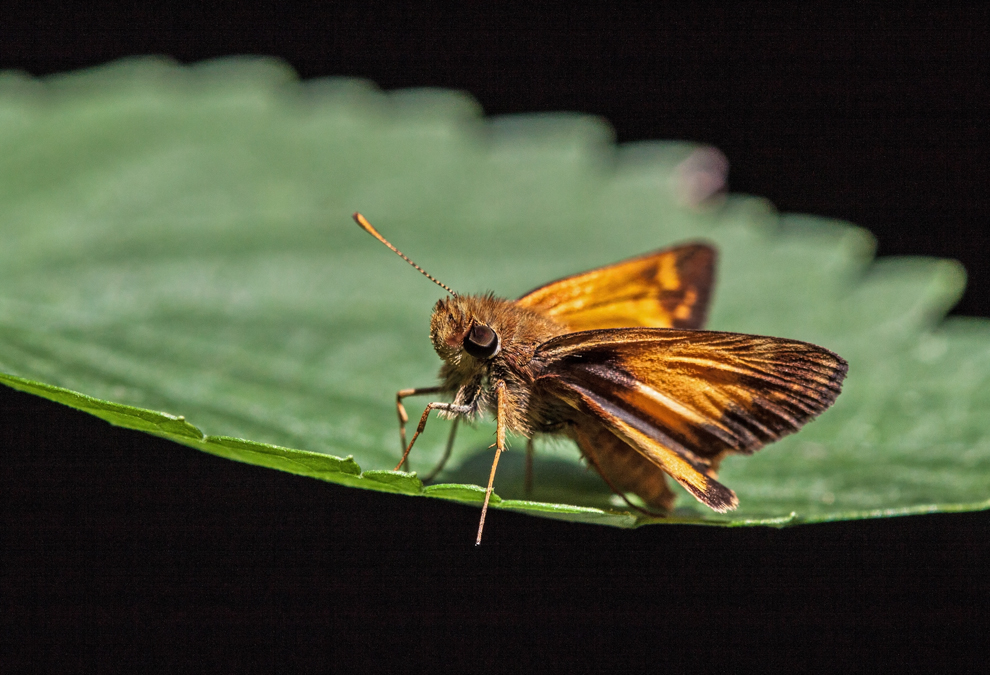
Every now and then I take a photograph and I am not really sure how I achieved the effect in the shot, like this one of a Fiery Skipper butterfly (Hylephila phyleus) on a jagged leaf.

With the exception of a few minor adjustments of the RAW image and a tiny bit of cropping, this looks just like the image I started with. When I first examined the image, I was pretty sure that I had used flash, but the EXIF data indicate that flash was not used. I took the shot handheld at ISO 400, f/6.3, and 1/500 sec. The depth of field was pretty shallow, but I did get the eye pretty much in focus, and I like the way the sharpness falls off so quickly.

I especially like the blurry jagged back edge of the leaf and the sharper near edge. The triangular shape of the wings seems to mirror those jags. Even the butterfly’s pose seems to work well, with the one leg dangling over the edge. If you click on the image, you get a higher resolution view of the photo.

I think that this is a Fiery Skipper, though I confess that I am not very good at identifying these little butterflies. Let me know if you can help in further identifying the butterfly.

skipper_leaf_blog

© Michael Q. Powell. All rights reserved

Read Full Post »

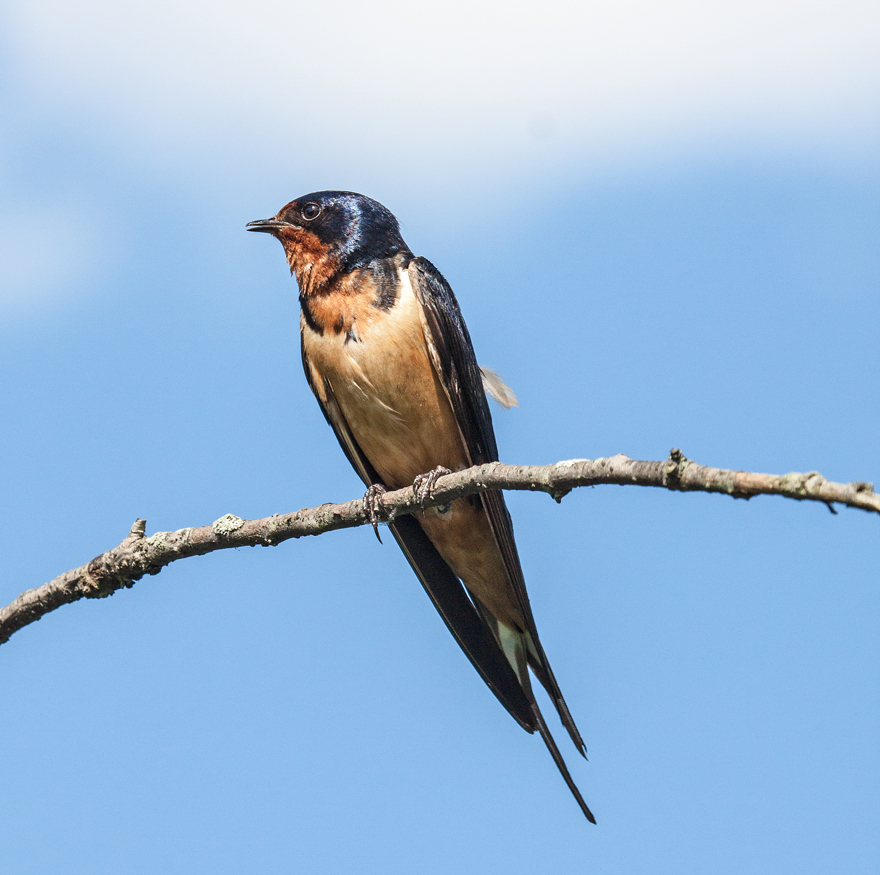
I don’t usually think of photographing birds with a macro lens, but that’s exactly what I did when I encountered this Barn Swallow (Hirundo rustica) perched on a small branch, with a beautiful blue sky in the background.

Of course, I probably should note that the macro lens in question is 180mm in focal length, so it has good telephoto capability—I had just never tried to use it in that way. My experience photographing birds this past winter suggests that this lens does not have enough reach for most birds.  I was really happy, though, with the detail it was able to capture in this situation, when I was standing almost directly below the bird.

Mentally it was an adjustment to be shooting with a prime lens and I had to keep reminding myself that if I wanted to adjust the composition, I had to change my position and move closer or farther away. That’s probably a good thing to remember when I am using a zoom lens, which has a tendency to make me a little lazy.

swallow2_blogswallow1_blog

© Michael Q. Powell. All rights reserved

Read Full Post »

Yesterday I was happy to get some shots of my favorite dragonfly, the Halloween Pennant dragonfly (Celithemis eponina), at Meadowlark Botanical Gardens in Vienna, Virginia.

I don’t see this dragonfly at all at most of the usual places where I take photographs, so I was really excited when I caught sight of a couple of them yesterday. I chased them around for well over an hour and attempted to take a couple of hundred shots using a wide range of camera settings.

Why did I take so many photos? The dragonfly gets the “pennant”  part of its name because it likes to perch on the very tip of a weed stalk and waves in the breeze like a pennant. Yesterday, in fact, was breezy and it was quite an adventure trying to keep the dragonfly in focus, particularly because I was trying to fill the frame with the dragonfly.

The dragonflies that I photographed were reasonably cooperative and I was able to attempt shots from the side, from above, and even from below (fortunately the insects in the grass did not bite very often).

I have not been able to go through the shot to pick the best ones, but thought it would be nice to post one now, especially for those readers who may not be familiar with this beautiful dragonfly. I suspect that I will eventually post at least a couple more images in future postings.

Halloween1_blog

© Michael Q. Powell. All rights reserved

Read Full Post »

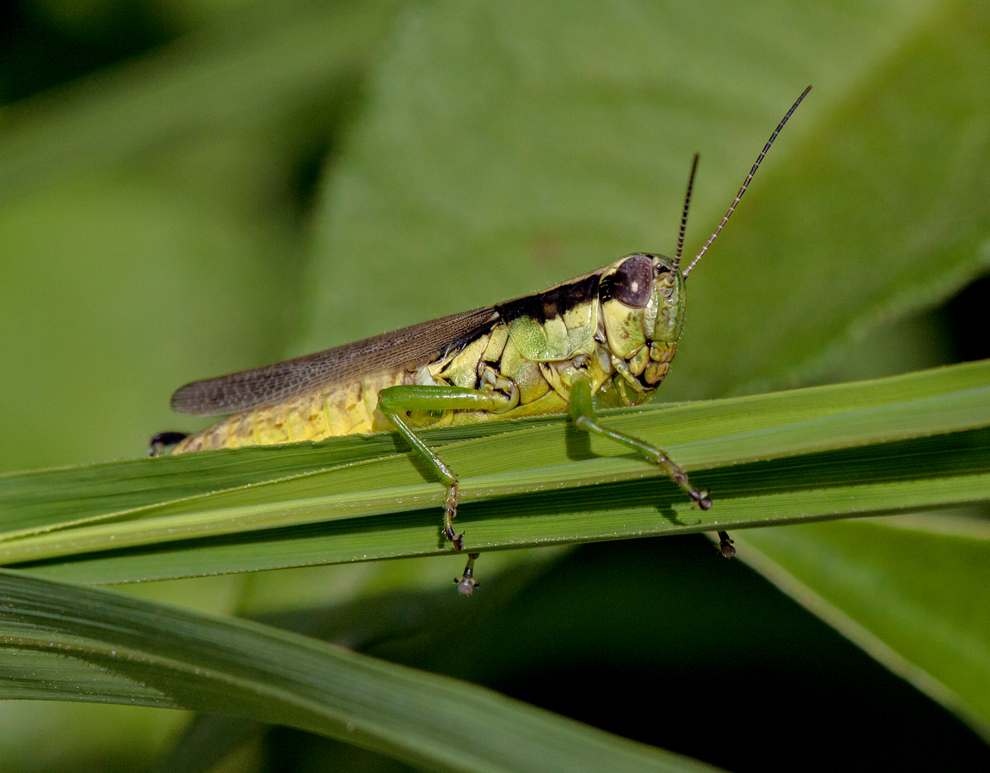
I haven’t seen many grasshoppers this summer, so I was happy to get a few shots of this one before he hopped off the leafy stalk for a new destination. I especially like the details of the eyes and the mouth.

Grasshoppers are special to me, in part because “grasshopper” is the term that my photograph mentor, Cindy Dyer, uses for me, her student. Some of you may be old enough to remember the television series Kung Fu from the 1970’s, in which Master Po, the blind monk, called his young pupil “grasshopper.”

I often wondered why he used that particular word and today I came across an explanation in Wikipedia. Apparently it stemmed from an exchange between the Master Po and the student, Caine, in the pilot episode of the series.  There is a lot of wisdom in that final response.

Master Po: Close your eyes. What do you hear?
Young Caine: I hear the water, I hear the birds.
Po: Do you hear your own heartbeat?
Caine: No.
Po: Do you hear the grasshopper which is at your feet?
Caine: Old man, how is it that you hear these things?
Po: Young man, how is it that you do not?

grasshopper1_blog

© Michael Q. Powell. All rights reserved

Read Full Post »

Praying mantises blend in so well with their surroundings that it is extremely rare for me to see one. This past weekend I spotted one as I was scanning the undergrowth while I was walking along the boardwalk in my local marsh.

The challenge for me was to figure out how to get a good shot of the praying mantis, which was sitting among some green leaves just about level with the boardwalk itself. I first tried shooting from directly above the insect, but I didn’t like the results very much, because I could not seem to make the praying mantis stand out from the background.

The second basic approach that I tried was to shoot at eye level with the insect. This produced some good results, like the second photo below, because I was able to capture a lot of details of the mantis and the shadows add interest to the shot.

I got my favorite image, the first one, when I shot from below the level of the insect, by hanging over the edge of the boardwalk. Framing the shot was a bit tricky because I had to place myself in the middle of the vegetation without disturbing the praying mantis (you should never disturb an insect when it is praying). I also had to shoot from an awkward angle in which it was difficult to steady the camera, so many of my shots were blurry.

Why is the first image my favorite? I like the simplicity of the color palette in the image−mostly green and black—and the pose of the praying mantis staring into the shadows from the edge of the leaf, which has wonderful details. (If you click on the image you can see a higher resolution view, which includes some details of insect’s head.)

praying2_blogpraying1_blog

© Michael Q. Powell. All rights reserved

Read Full Post »

« Newer Posts - Older Posts »