Feeds:
Posts
Comments

Archive for the ‘Photography’ Category

There was only a single water lily in bloom at a pond at Occoquan Bay National Wildlife Refuge last week, but its beauty brightened the entire area and brought a smile to my face. Water lilies are one of the reasons why Claude Monet is one of my favorite painters.

Monet did some 250 oil paintings of water lilies (“Nymphéas” in French), many depicting the garden at his home in Giverny, and they were the main focus of his artistic production during the last thirty years of his like, according to Wikipedia.


water lily

© Michael Q. Powell. All rights reserved.

Read Full Post »

Ebony Jewelwings (Calopteryx maculata) are everywhere in some of the forest streams I like to explore at this time of the year. Still, I love when I can get a good angle on these beautiful damselflies when they are in wheel position and forming a sidewards heart, as was the case with this pair that I spotted last Thursday in Fairfax County.

Yes, as some of you already know, the damselflies are in the process of mating, with the male on the right and the female on the left.


Ebony Jewelwing

© Michael Q. Powell. All rights reserved.


Read Full Post »

When I spotted this strange-looking flower yesterday in the garden of my photography mentor and neighbor Cindy Dyer, I had no idea what it was—she informed me that it was a Peruvian Daffodil (Hymenocallis narcissiflora). This flower, according to information at gardeningknowhow.com, is native to the Andes of Peru and is a member of the daffodil and amaryllis family, Amaryllidaceae.  Its flowers resemble a “spidery” version of these flowers, as you can see in my photos. The elongated, sometimes curved, petals have led to the plant’s alternate common names, “spider lily” and “basket flower.”

Further exploration on the internet led me to wonder if this is actually the hybrid version known as Hymenocallis x festalis, a hybrid of the aforementioned Peruvian Daffodil as the female parent and the Hymenocallis. longipetala, another Peruvian flower, as the male parent, as detailed in an article by the University of Arkansas Division of Agriculture.  Fearing that I would get sucked deeper into the world of plant ancestry, I stopped my research there.

Personally, I think that the name “spider lily” fits best and maybe that that is the name I will use in the future to refer to this crazy-looking flower.


Peruvian Daffodil

Peruvian Daffodil

© Michael Q. Powell. All rights reserved.


Read Full Post »

Skipper butterflies are common and Black-eyed Susans (Rudbeckia hirta) are common too, but what a lovely combination they made when I spotted them together on Friday at Occoquan Bay National Wildlife Refuge.

skipper and susan

© Michael Q. Powell. All rights reserved.

Read Full Post »

Do you believe in unicorns? I am always happy when I manage to spot a Unicorn Clubtail (Arigomphus villosipes), a beautiful dragonfly species in which both sexes have a small hornlike projection between their eyes that gives rise to their common name. I recently spotted the dragonflies in this posting while exploring a small pond in Fairfax County, where I live.

This is the only clubtail species in our area that prefers ponds and marshes over streams and rivers, according to the Dragonflies of Northern Virginia website. It is fairly easy to identify this species, because of the rusty-edged club at the bottom portion of the dragonfly’s abdomen and the very visible bright tip. Male Unicorn Clubtails tend to fly short patrols and perch quite often on low vegetation, so it is not hard for me to spot them if I am in the appropriate environment.  The third photo below shows a male in a typical perching pose.

Female Unicorn Clubtails, on the other hand, are hard to find—I do not know where they hang out, but it seems that they come to the water only when they are ready to mate. The only two times that I have ever seen a female Unicorn Clubtail dragonfly was when when she was ovipositing, like this one in the first two photos that I spotted this past Thursday. I captured these shots as she hovered momentarily in the air, getting ready to tap the water again with the tip of her abdomen to release more eggs.

Chasing unicorns? Yes, that is how I enjoy spending my time in the wild.


Unicorn Clubtail

Unicorn Clubtail

Unicorn Clubtail

© Michael Q. Powell. All rights reserved.

Read Full Post »

I was really happy that I was able to track this Swamp Darner dragonfly (Epiaeschna heros) after it zoomed by me yesterday afternoon at Occoquan Bay National Wildlife Refuge. When I finally caught up to it, the large dragonfly was hanging vertically, high in a tree among the leaves, leisurely munching on its bee lunch in the shade.

Yes, I recognize that bees play an important role as pollinators and highlighted that in yesterday’s posting. Bees, however, also serve as a food source for other creatures higher up on the food chain—they are all part of the circle of life.

Swamp Darners are among the largest dragonflies in our area, about 3.4 inches (86 mm) in length. I really like the description that Kevin Munroe provided of Swamp Darners on the wonderful Dragonflies of Northern Virginia website. “I often tell people on dragonfly walks that if they see a rhino with wings, it’s a swamp darner. Slight exaggeration, perhaps, but they are pretty impressive. June is their month and the best time to see them, as they cruise, slow and purposefully, over shallow, swampy pools, or hunt high over nearby meadows.”


Swamp Darner

© Michael Q. Powell. All rights reserved.


Read Full Post »

It has been a month since I visited the Bald Eagle (Haliaeetus leucocephalus) nest at Occoquan Bay National Wildlife Refuge, where I spotted an eaglet on 19 May and wrote a posting entitled “One little eaglet.” Yesterday I traveled to the refuge to check on the baby eagle and was a little surprised to find that the authorities had removed the barriers that had blocked access to the nesting area, which is adjacent to a trail. Did this mean that the eaglet had fledged and the family had left the nest?

I was happy to discover that the eaglet was still there, has grown considerably in size over the past month, and was sitting tall at one edge of the nest. The leaf coverage has also grown, making it pretty tough to get an unobstructed view of the little eagle. The vegetation also hid the presence of one of the parent eagles that flew away to a nearby grove of trees when I approached.

It is somehow reassuring to see that the cycle of life has continued undisturbed as our lives have been turned upside down by the global pandemic. I celebrate the new life of this young eagle and all of the other creatures who have begun their lives this spring and wish them success as they learn to navigate the challenges of their lives.


Bald Eagle eaglet

© Michael Q. Powell. All rights reserved.

Read Full Post »

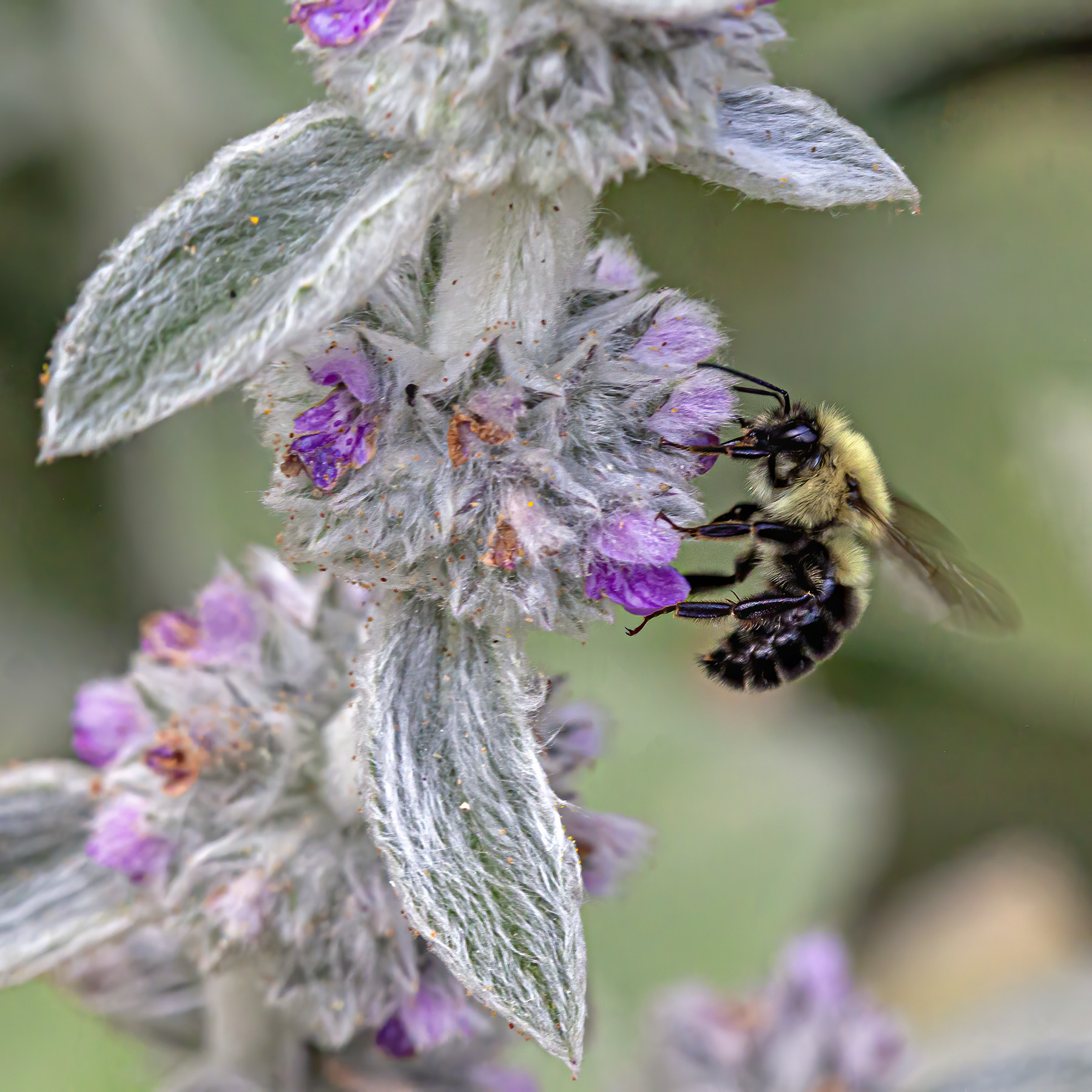
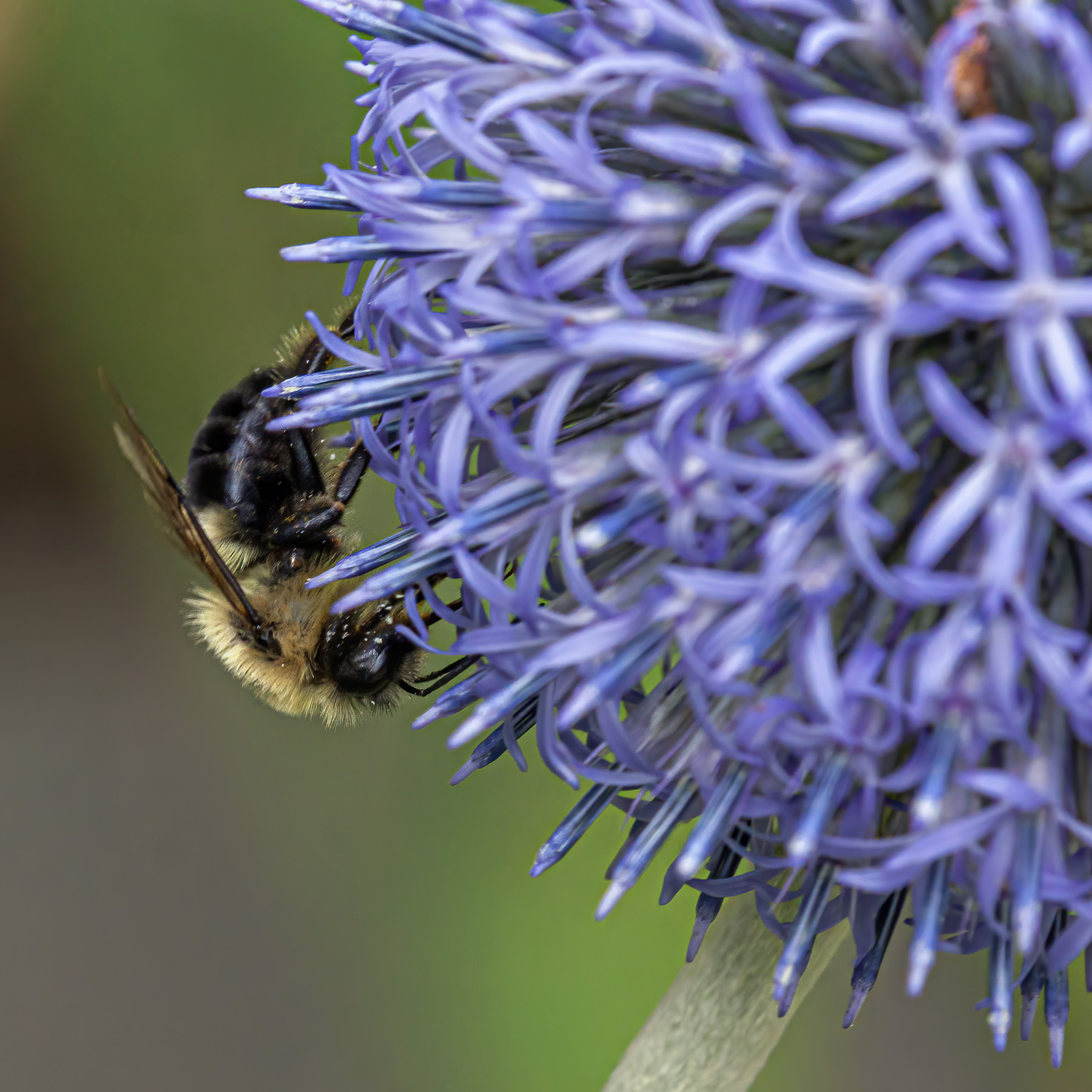
I love bees and spent quite a while on Monday in the garden of my friend and neighbor Cindy Dyer observing them and trying to photograph them. I had no idea that lamb’s ear plants produce flowers, but the bee in the first photo certainly was aware of that fact when I spotted it busily at work. The bee in the second shot decided to try an acrobatic move to gain access to the nectar in the lavender plant that swung wildly each time the bee landed on it. In the final shot, I captured the bee as it was crawling all over a flower of a cool-looking globe thistle plant.

I am not very good at identifying bees, but I think these bees are all Eastern  Carpenter Bees (Xylocopa virginica). Unlike bumblebees that have fuzzy abdomens, carpenter bees have shiny, relatively hairless abdomens.


lamb's ear

lavender

globe thistle

© Michael Q. Powell. All rights reserved.


Read Full Post »

Sometimes I take photographs when I am standing upright, but quite often I am crouching, kneeling, bending, or leaning as I try to compose my images. I occasionally  remark that I am happy that nobody is filming me as I contort my body for the sake of my craft—a kind of photography yoga. Sometimes, though, my friends will take photos of me as I am am taking photos.

Several readers wondered how close I was to the Gray Petaltail dragonfly when I captured some macro images of its eyes that I featured in a posting earlier this week. My friend Walter Sanford, with whom I frequently go on photographic forays for dragonflies, captured the first image below of me in action and graciously agreed to let me use it in this posting. You may need to double-click on the photo to see it, but the Gray Petaltail dragonfly is perched on the left fork of the branch just after the split. The dragonfly was so cooperative that I remained in that crouch for an extended period of time, periodically flexing forward to get a tiny bit closer.

My friend and photography mentor Cindy Dyer has also captured me in action. She recently came across the second photo below, which I think dates back to 2013, and posted it in Facebook. I am not sure what I was looking at so intently through my viewfinder, but it seems likely that I had spotted something more interesting than the Canada Geese right in front of me. As I often do, I was crouching in the brush, with all kinds of vegetation threatening to poke me in the ear and eyes.

When a crouch will not get me low enough, I am often willing to sprawl on the ground, as in the third photo below that was also taken by Cindy Dyer. You may notice that I was carrying a tripod with me in a case on my back. Cindy is a big fan of using a tripod whenever possible for macro shots and I remember well when she told me that one of the keys to success was for me to get as low as possible and spread my legs. I blushed initially until I realized that she was referring to my tripod.

It is probably not mandatory for all photographers, but I have found that it helps to be fit and flexible. One of my personal challenges will be to maintain that level of fitness and energy as I get older, so that I can continue my “style” of photography.

Gray Petaltail

kingstowne pond

shooting position

© Michael Q. Powell. All rights reserved.

Read Full Post »

In an ideal world, I would be able to photograph a dragonfly up close and from multiple angles. My close-up shots of a Gray Petaltail dragonfly in yesterday’s posting were the result of almost perfect circumstances. Real life, alas, is rarely that perfect. My entire life, it seems, I have heard the words of the Rolling Stones, reminding me that “You can’t always get what you want, but if you try sometimes, you might find you get what you need.”

Last week I spent almost an entire day with fellow dragonfly enthusiast and blogger Walter Sanford searching for dragonflies in a variety of habitats. It was a long, grueling effort, conducted often in the hot direct sunlight and sometime involving wading through waist-high vegetation. Walter and I have worked together often enough over the years that we have developed some routines. Most of the time we try to stay in sight of each other, so if one of us spooks a dragonfly, the other has a chance of being able to track it to its next perch.

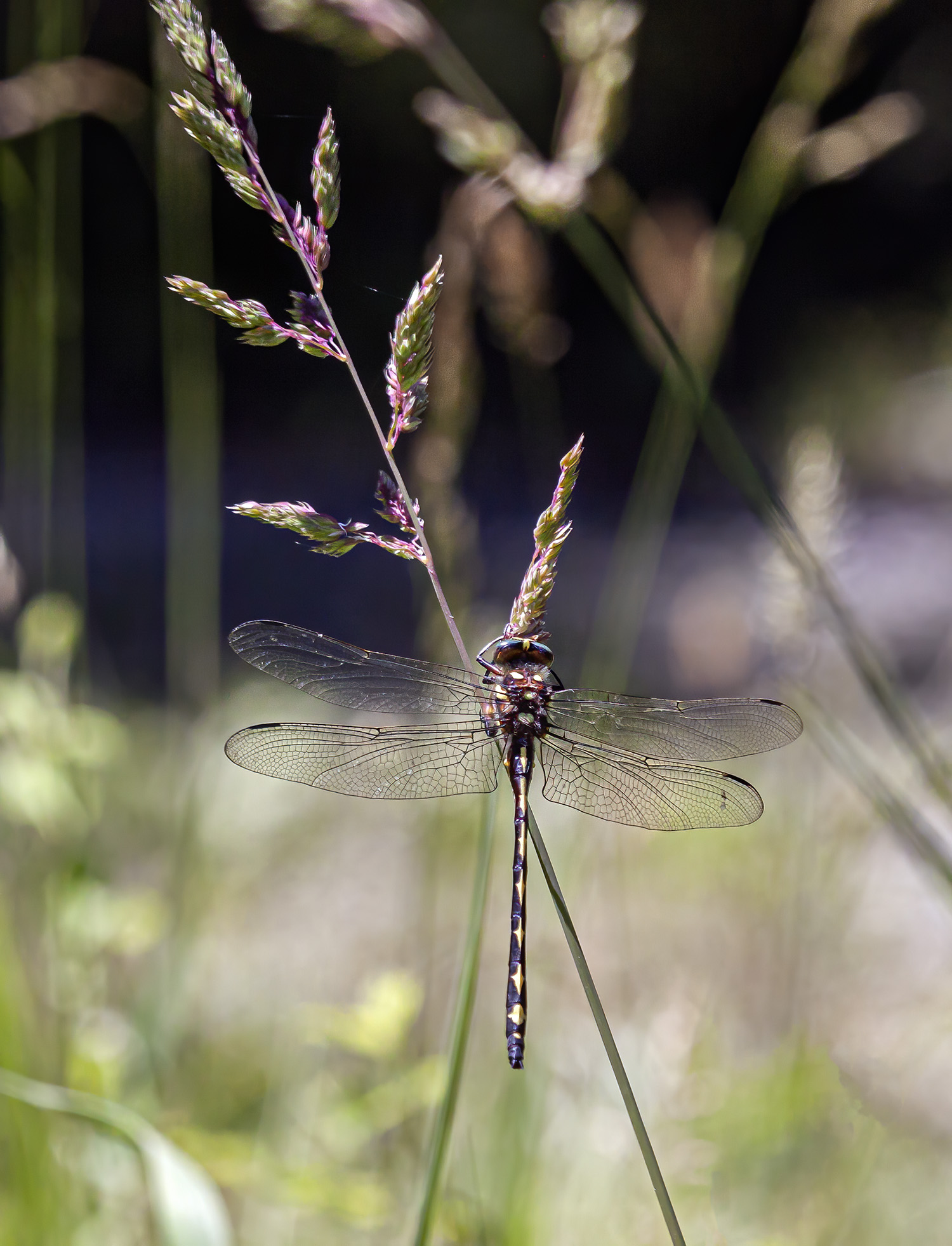
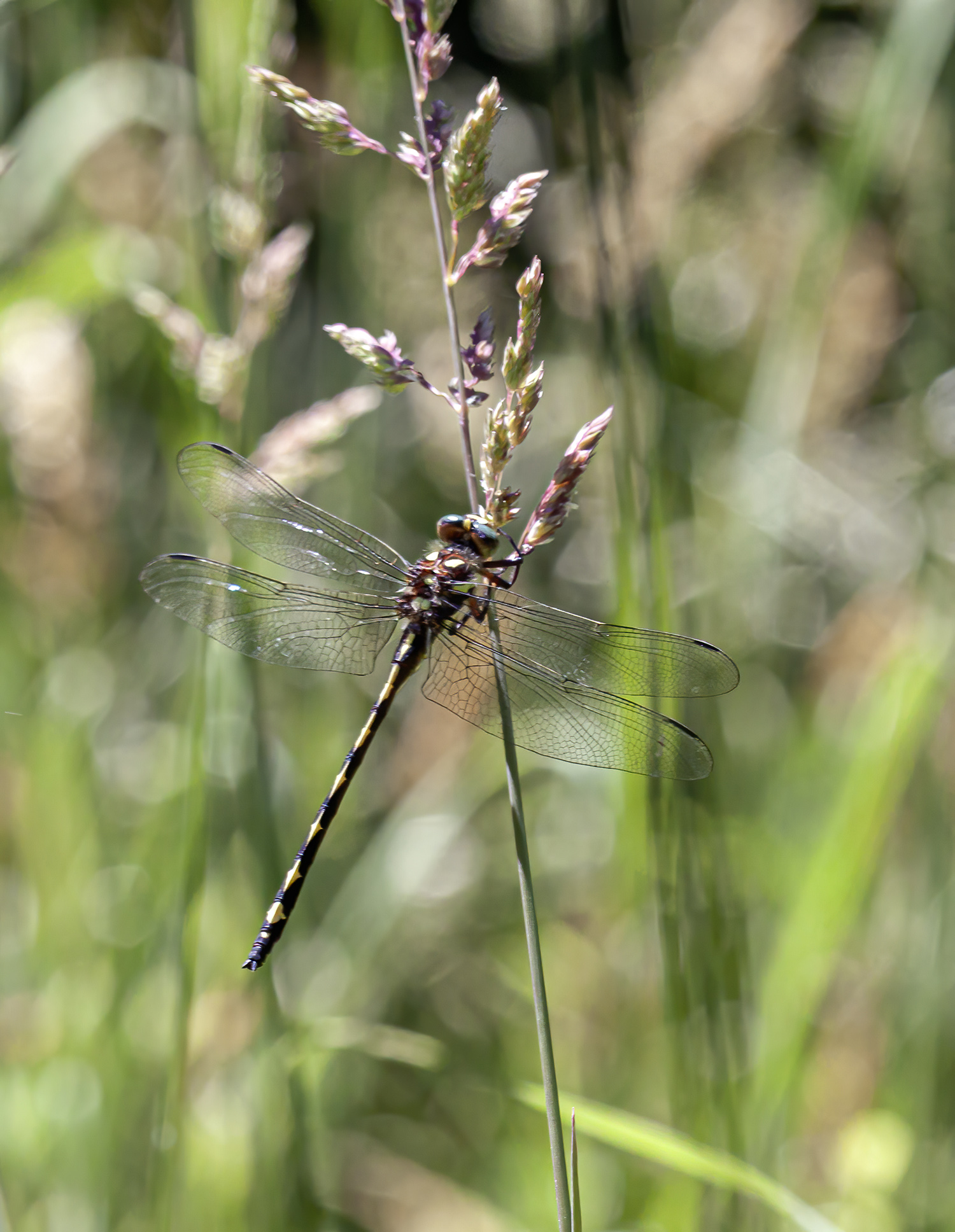
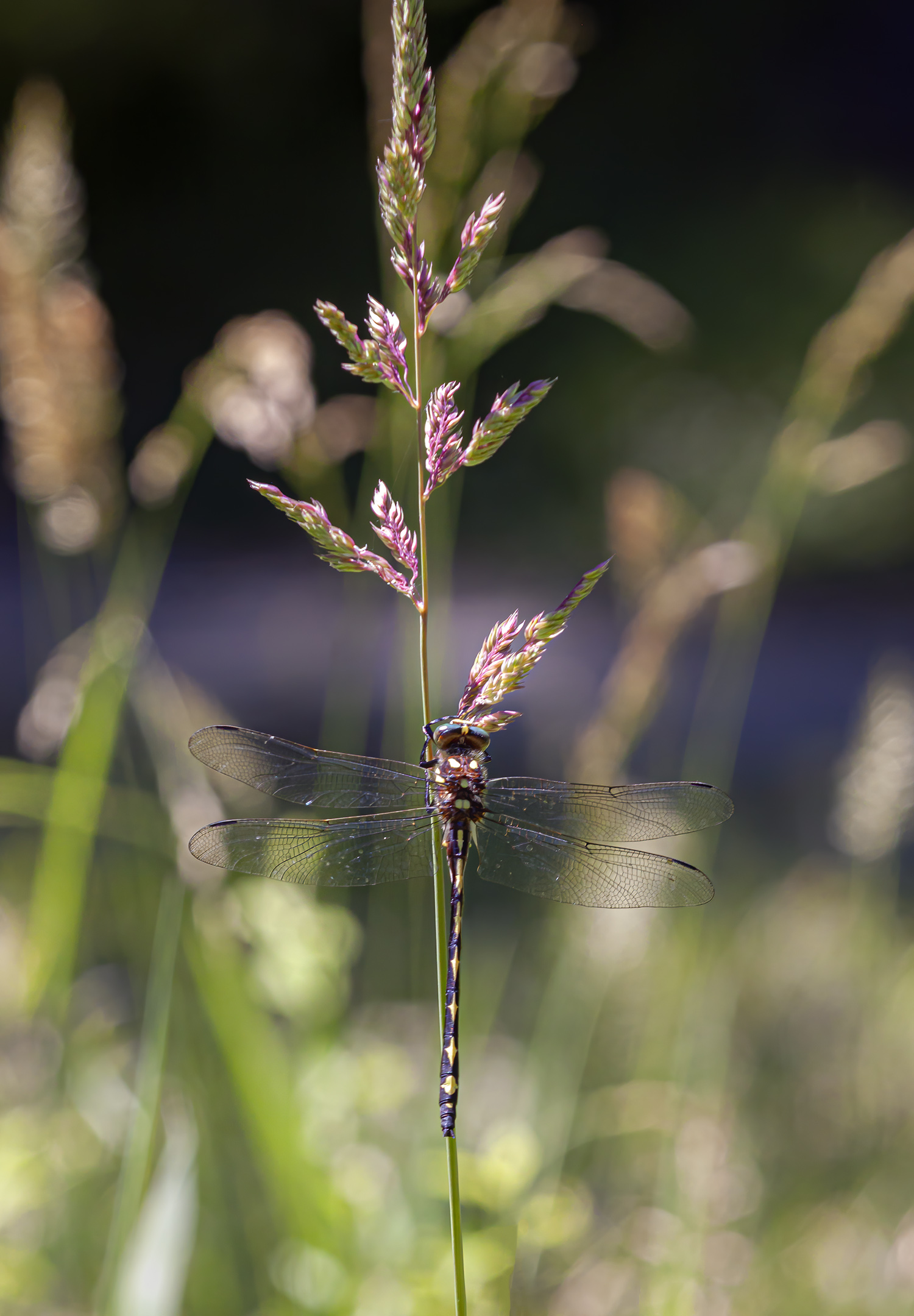
Towards the end of day, we had wandered a little farther apart than usual when I heard Walter tell me emphatically to stop—he had spotted a dragonfly. I was in an awkward position when I stopped and I could barely see the dragonfly through the lens of the camera. It was hanging vertically from a thin stalk of vegetation that was swaying vigorously back and forth in a breeze that had suddenly kicked up. My heart started to beat a bit faster when Walter told me that it looked to be a male Arrowhead Spiketail dragonfly (Cordulegaster obliqua), an uncommon species that I have seen only a few times.

So there I was, frozen in place far from my subject, trying desperately to focus manually on my moving subject that I knew might take off at any moment. I tried to pay attention to the background as I composed my shots, bending my body and flexing my knees to get some minor variations in my angle of view. What you see below are three of those variations. I like the way that they captured the Arrowhead Spiketail in the environment in which we found it—I may not have gotten what I wanted, but perhaps I got what I needed, i.e. I got some decent shots of my subject.

Walter observed this dragonfly from an entirely different angle of view and, as always, approaches things from a different perspective. I encourage you to check out his blog posting today “Arrowhead Spiketail dragonfly (male)” to see his photos and to read about his reactions to seeing this uncommon dragonfly in an environment that was not “according to the book.”

Arrowhead Spiketail

Arrowhead Spiketail

Arrowhead Spiketail

© Michael Q. Powell. All rights reserved.

Read Full Post »

Gray Petaltail dragonflies (Tachopteryx thoreyi) are one of the friendliest and tamest dragonfly species that I have encountered. If you hang around with them often enough, they are almost certain to land on you, particularly if you are wearing gray clothing that somehow reminds them of a tree. It is a little hard not to flinch when one of these relatively large dragonflies (3 inches (75 mm) in length) perches on your head or shoulder.

Gray Petaltails will also let you get pretty close to them when they are perched on trees. Quite frequently, though, they are perched above eye level, so being that close does not allow you to capture close-up images. This past Saturday when I was hunting for dragonflies with my friend Walter Sanford, we spotted a Gray Petaltail perched on a fallen branch that was at knee level. After we had both taken some shots, Walter challenged me to see how close I could get to the dragonfly to capture images with my macro lens.

The first shot shows one of my attempts to get a head-on shot. It is very cool to look another creature straight in the eyes, but it is rare that one will permit you to do so, especially at such close range. It seemed clear to me that the dragonfly was quite aware of my presence, but did not consider me to be a threat.

I took the second shot from the side as I moved even closer to my subject. I was trying my best to capture some of the details of the dragonfly’s eye that was nearest to me and was not concerned that most of the rest of its head was out of focus. If you double-click on the image, you can see some of the ommatidia, the individual optical units that make up a dragonfly’s amazing multi-faceted compound eyes.

If you want to learn more about dragonfly eyes, check out a wonderful article at medium.com entitled  “30,000 Facets Give Dragonflies A Different Perspective: The Big Compound Eye In The Sky“. Scientists, for example, know that the thousands of ommatidia produce a mosaic of “pictures,” but how exactly this visual mosaic is integrated in the insect brain is still not known.

Gray Petaltail

Gray Petaltail

© Michael Q. Powell. All rights reserved.

Read Full Post »

Yesterday I posted a photo of a male Common Whitetail dragonfly that was hovering in the air to fight off rivals and protect the female with which he had mated as she deposited her eggs in the water, a practice know as hover guarding. In some dragonfly species, the male will remain attached to the female throughout the entire process of oviposition, a process known as contact guarding. In other dragonfly species, the female is entirely on her own to deposit the eggs.

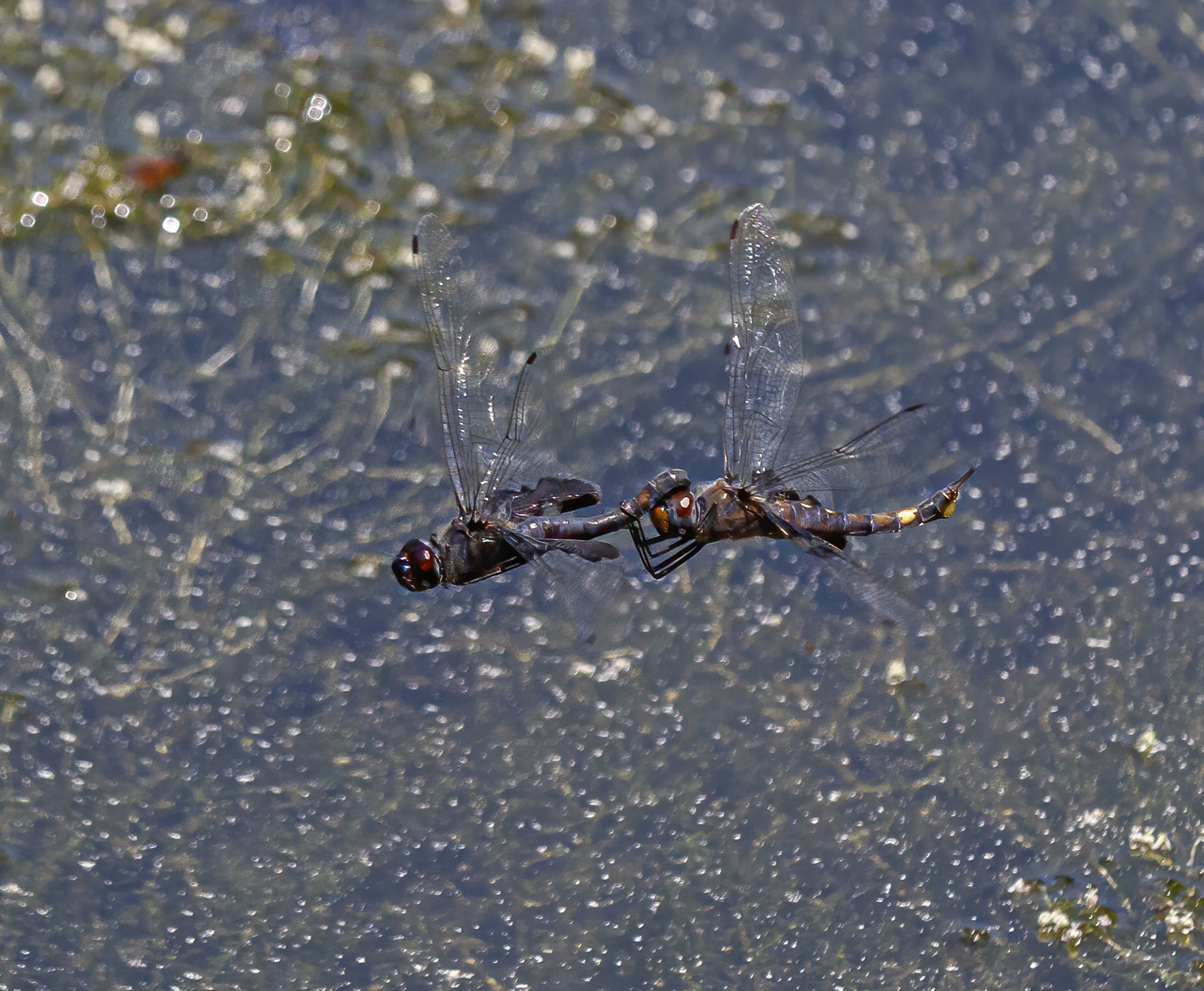
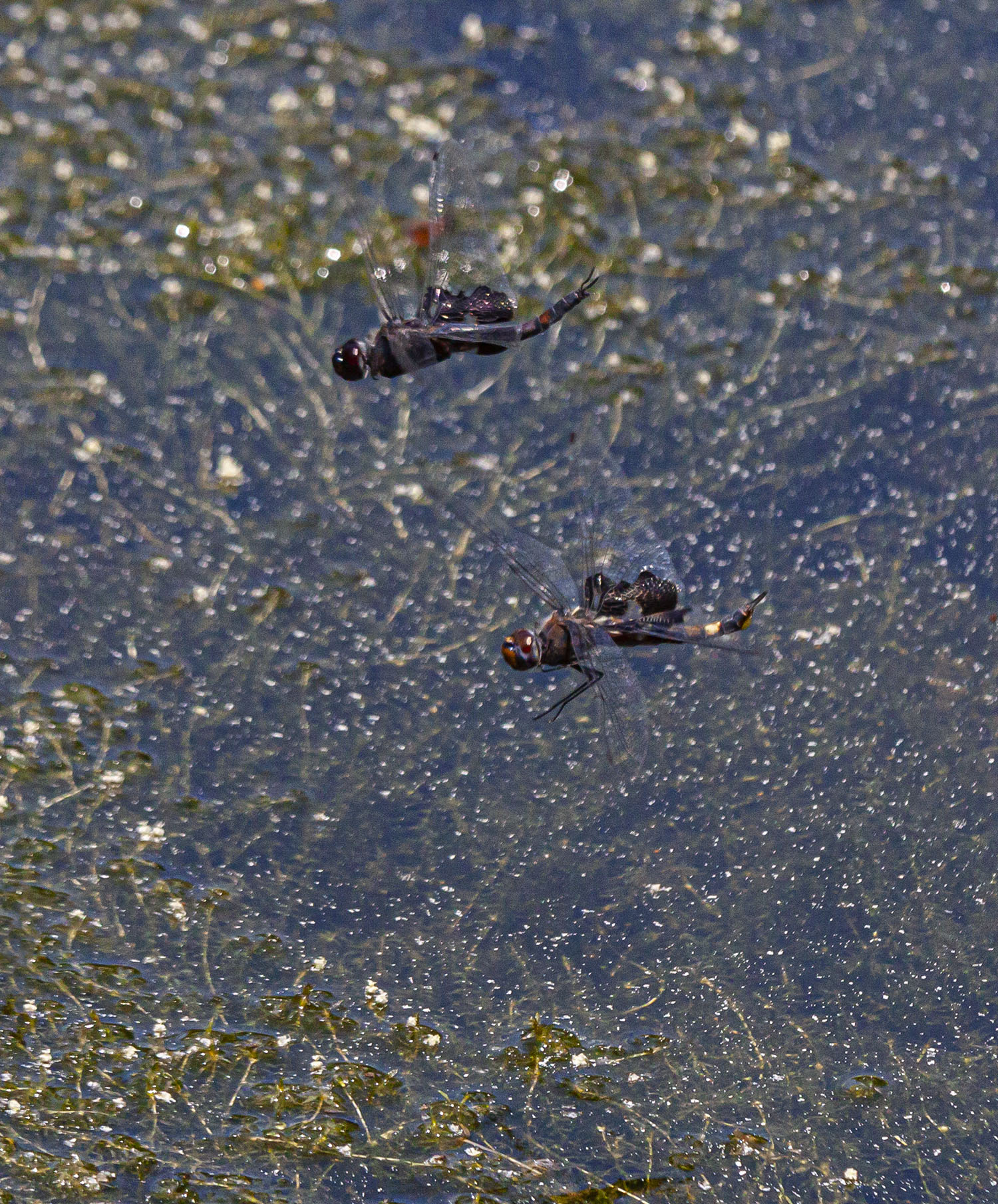
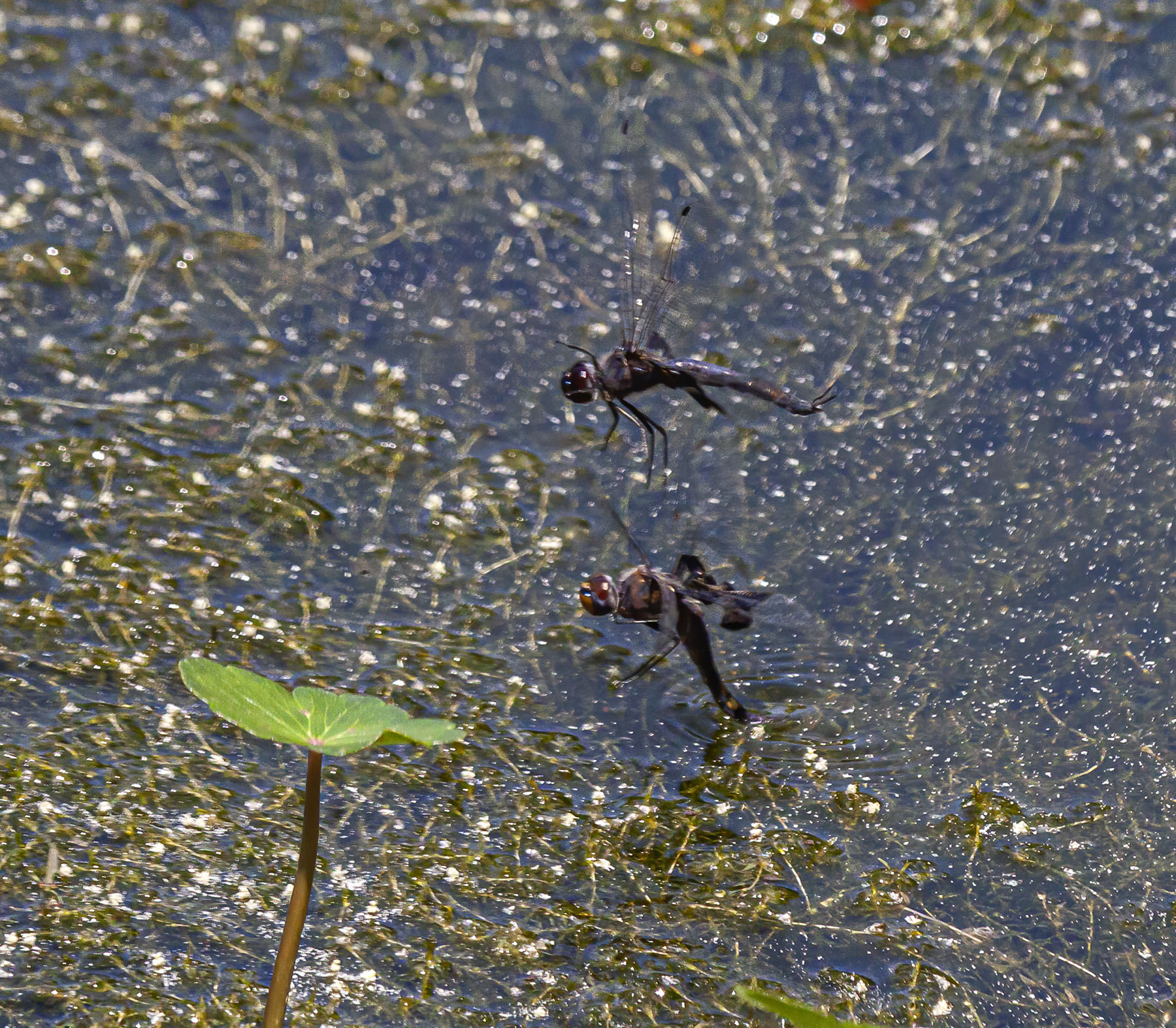
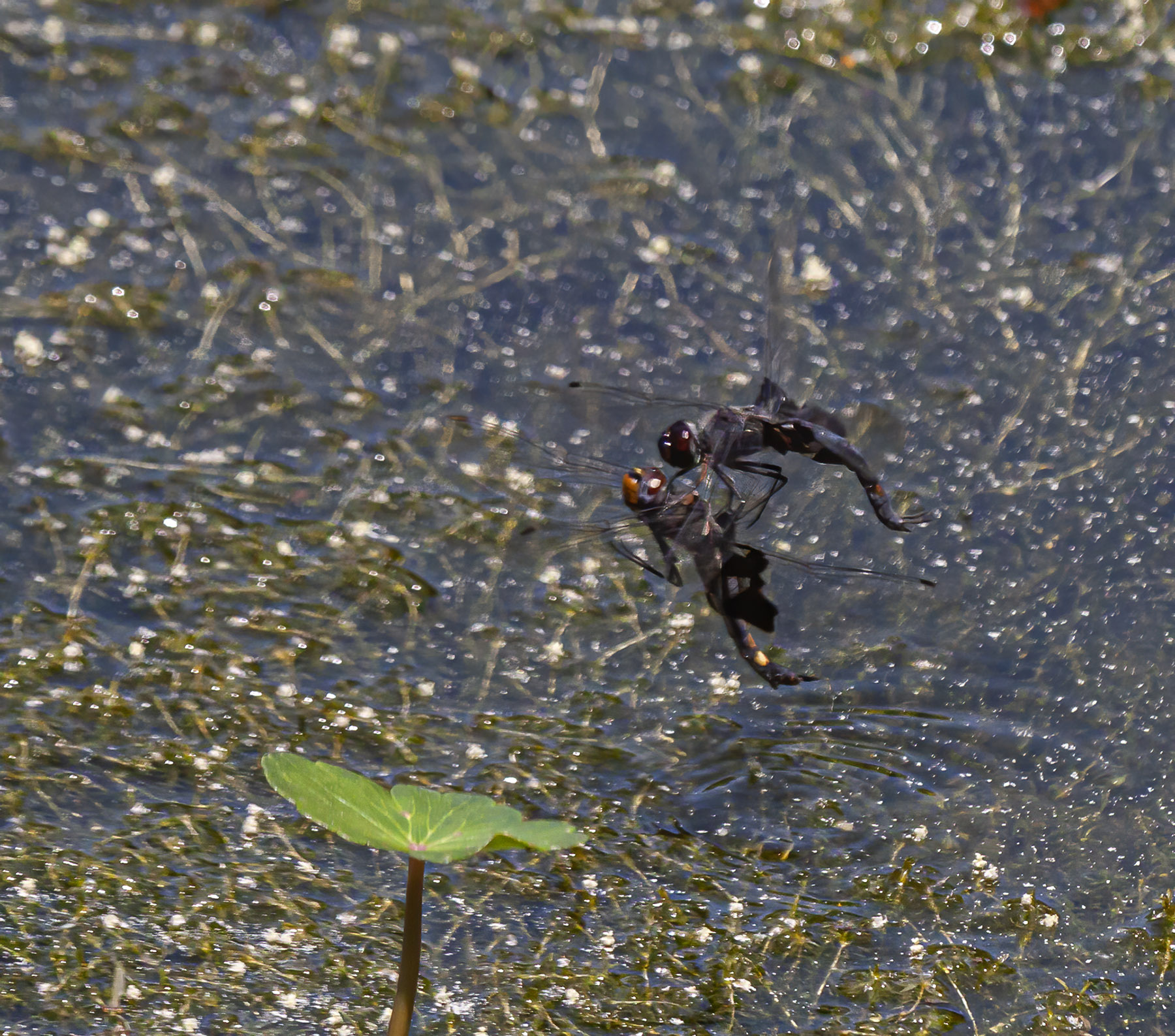
Black Saddlebags dragonflies (Tramea lacerata) use a different technique for guarding that I like to call “release and catch.” After mating is completed, the male and female Black Saddlebags fly together over the water in a tandem position, with the male in the front. At certain moments, for reasons that I cannot determine, the male releases the female and she drops down to the water and taps it to release one or more eggs. As she rises up out of the water, the male catches the female and reattaches the tip of his abdomen to the back of her head. They continue to fly in tandem and repeat this cycle multiple times.

On Saturday I was fortunate to be able to capture this sequence of shots that documents the entire process. Most of the time these dragonflies chose spots that were too far away for me to photograph them, but in this case they flew a bit closer to the edge of the pond where I was standing. As you probably suspect, I had to crop in a good amount to highlight the action for you, given that I was shooting with my trusty 180mm macro lens, which has a more limited reach than the lens that I use when photographing birds.

Black Saddlebags

Black Saddlebags

Black Saddlebags

Black Saddlebags

Black Saddlebags

© Michael Q. Powell. All rights reserved.

Read Full Post »

When you are walking near the edge of the water, it is good to look down from time to time. Sharp-eyed Walter Sanford, a fellow dragonfly fanatic, spotted this Northern Water Snake (Nerodia sipedon) as we were searching for dragonflies in Fairfax County, Virginia last Monday. This is a non-poisonous snake, but I have read that it will bite and the wound may bleed a lot, because its saliva contains a mild anticoagulant.

Three years ago I had an encounter with a similar snake and watched it capture and devour a catfish. If you missed that posting, click on this link and check outSnake captures catfish—if you are like me, you will be fascinated and slightly horrified by the encounter and may avoid wading in the water at the edge of rivers for a time.

Northern Water Snake

© Michael Q. Powell. All rights reserved.

Read Full Post »

What is the most common dragonfly where you live? Over the last few weeks I have noticed more and more dragonflies at the ponds and marshes that I visit, an indication that many of the summer dragonfly species have emerged. Here in Northern Virginia, the most common dragonfly is probably the appropriately named Common Whitetail dragonfly (Plathemis lydia). This species is one of the first to appear in the spring and one of the last to disappear in the fall. They are easy to identify and are such habitat generalists that they can be found almost anywhere.

Many of you know that I will often spend lots of time looking for rare dragonfly species, but I try not to take for granted the more common ones that many people (and photographers) ignore. The first image shows a male Common Whitetail that was hovering for a moment as he kept watch over a female as she deposited eggs in the water.

The second image is a portrait of a male Common Whitetail as he perched on some vegetation overhanging the water. If you look at the angle at which I took the shot, you can probably guess that I was at risk of falling into the water when I took the shot. The final shot is a portrait of a beautiful female Common Whitetail. When they are young, males have a similar coloration on their bodies as the females, but the wing patterns are different. You can also tell the genders apart by looking at the tip of the abdomen (the “tail”) where the terminal appendages are sexually differentiated.

As is often the case for species saddled with the name “common,” Common Whitetail dragonflies are uncommonly beautiful.

Common Whitetail

Common Whitetail

Common Whitetail

© Michael Q. Powell. All rights reserved.

Read Full Post »

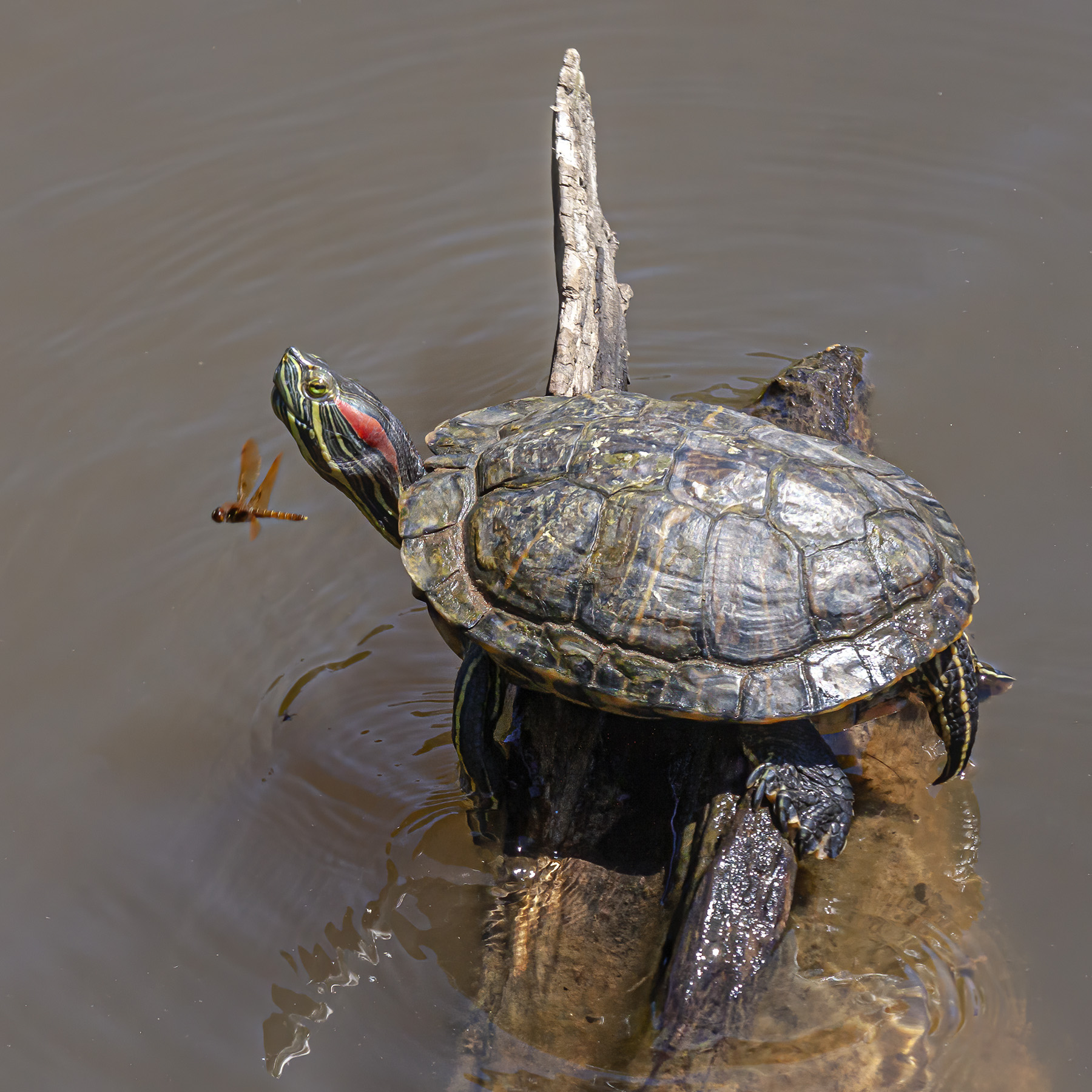
Most of the time Red-eared Slider turtles (Trachemys scripta elegans) slide into the water as soon as they detect my presence. Yesterday, however, this turtle seemed to be in such a deep meditative state that it remained in place when I approached it at Jackson Miles Abbott Wetland Refuge. The turtle was even impassive to repeated buzzings by several Eastern Amberwing dragonflies, some of which flew within inches of its face.

I was hoping to get some a shot of a dragonfly landing on the turtle’s shell, but was content to capture this image with both the turtle and a passing dragonfly.

Red-eared Turtle

© Michael Q. Powell. All rights reserved.

Read Full Post »

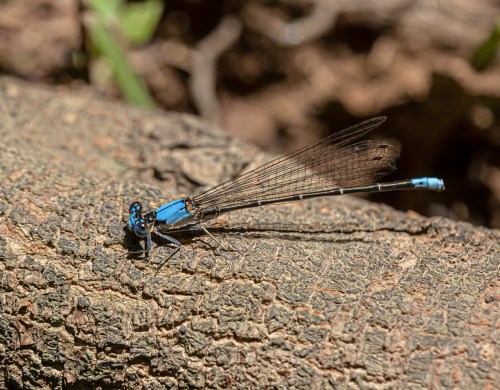
The genus Argia, commonly known as dancers, is a large New World group of damselflies. Although the genus name Argia, αργία in Ancient Greek, is translated as “idleness,” dancers are quite active and alert damselflies, according to Wikipedia. Why are they called “dancers?” They are known as dancers “because of the distinctive jerky form of flight they use which contrasts with the straightforward direct flight of bluets, forktails, and other pond damselflies.” I wonder if I am part damselfly, because “distinctive” and “jerky” are definitely adjectives that could be used to describe my attempts at dancing.

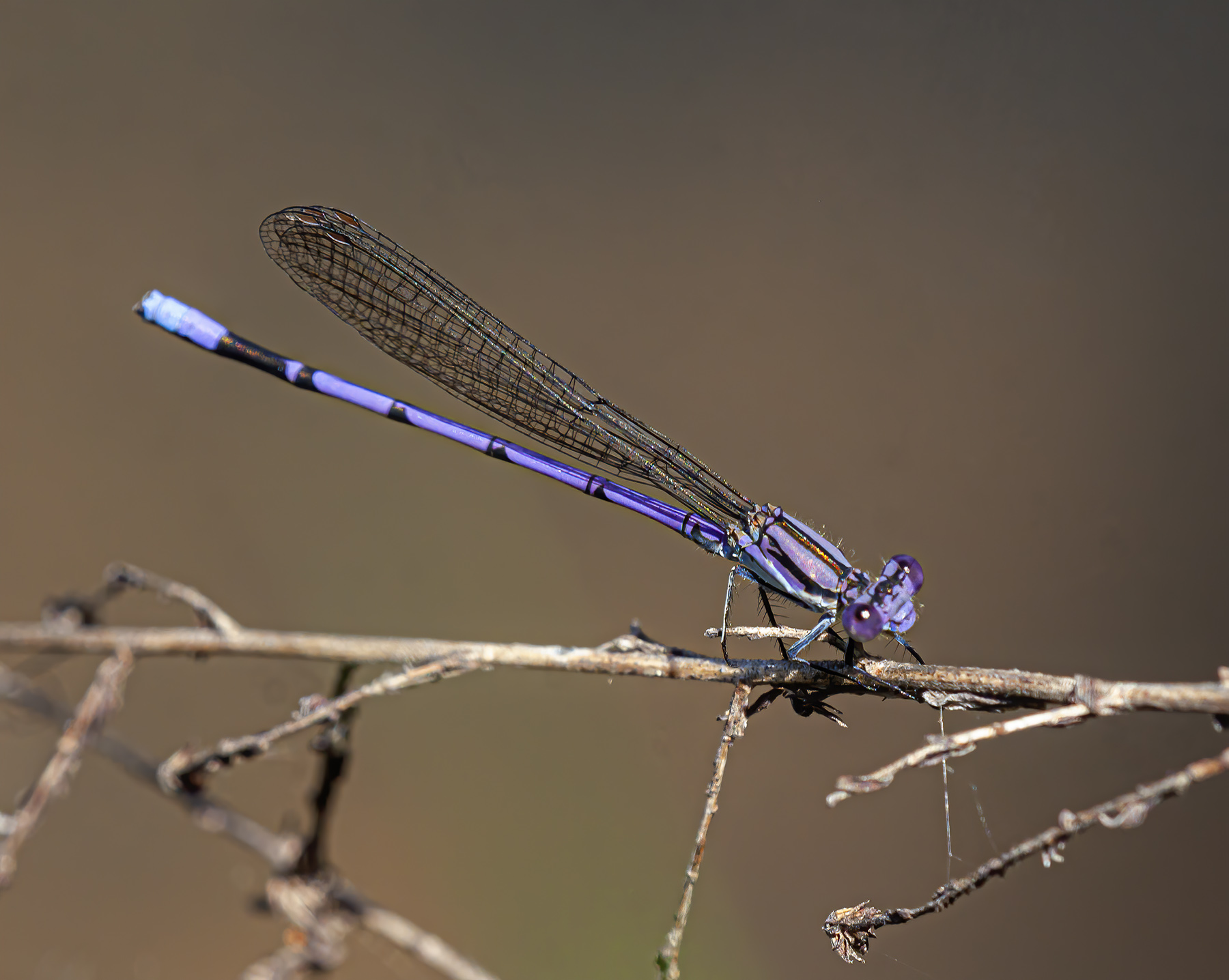
This past week, I have seen three different species of dancers. The first one, the Variable Dancer (Argia fumipennis violacea) has perhaps the most strikingly beautiful color of any of the dragonflies and damselflies that I have seen—I love that shade of violet. Some of my longtime readers may have noted that a photo of a Variable Dancer has been the banner image for this blog for many years.

The damselfly in the second image is a Blue-fronted Dancer (Argia apicalis). The thorax of the males of this species are almost completely blue, with only hairline stripes in the middle of their backs and shoulders.

The final damselfly is a Powdered Dancer (Argia moesta), our only mostly white damselfly. As you can see in the photo, members of this species often like to perch on stones at the edge of the water. I chose to leave this image mostly uncropped, because of the way that it shows the water moving around the stone and the submerged stones on the stream bottom in the background.

All of this talk of dancers brings to mind a country music song that I really like by Lee Ann Womack called “I Hope You Dance.” I am really touched by the basic message of the song—when you get the choice to sit it out or dance, I hope you dance.

Here is the first verse of the song, just in case you have never heard it:

“I hope you never lose your sense of wonder
You get your fill to eat but always keep that hunger
May you never take one single breath for granted
God forbid love ever leave you empty handed
I hope you still feel small when you stand beside the ocean
Whenever one door closes I hope one more opens
Promise me that you’ll give faith a fighting chance
And when you get the choice to sit it out or dance
I hope you dance.”
(I Hope You Dance lyrics © Sony/ATV Music Publishing LLC, Universal Music Publishing Group, Songtrust Ave)

Variable Dancer

Blue-fronted Dancer

Powdered Dancer

© Michael Q. Powell. All rights reserved.


Read Full Post »

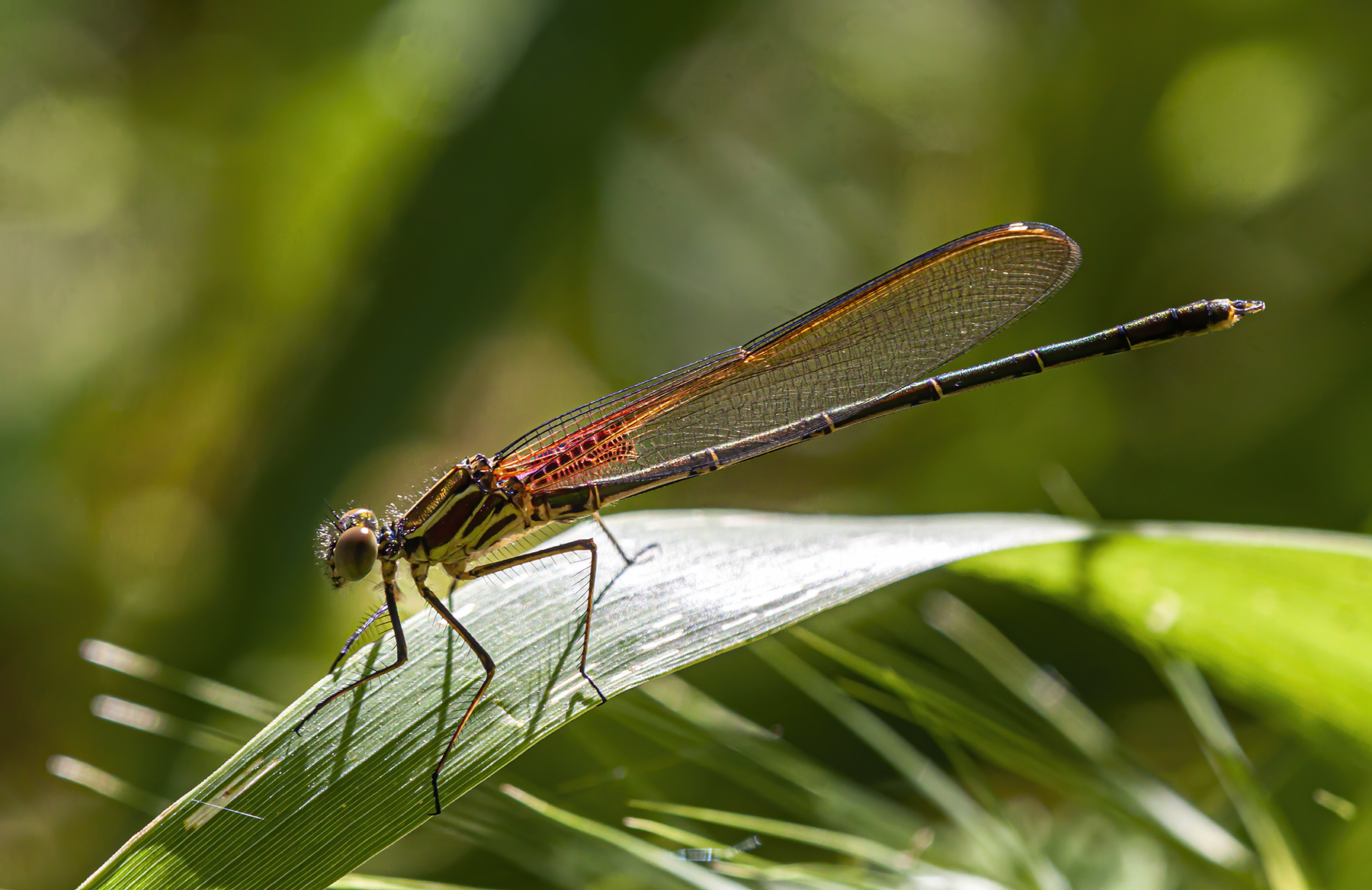
I was really excited to spot this male American Rubyspot damselfly (Hetaerina americana) on Monday while exploring in Fairfax County, Virginia with my good friend and fellow dragonfly enthusiast Walter Sanford. I have seen this species only a few times before, but had no trouble identifying it, thanks to the distinctive “rubyspot” on its wings.

The first image gives you the best view of this gorgeous little damselfly, but the second shot is my favorite. I love to look straight into the eyes of dragonflies and damselflies—they have an almost hypnotic effect on me. Whenever I get the chance, I try to get a close-up shot of the eyes of these acrobatic insects that fascinate and delight me endlessly.

American Rubyspot

American Rubyspot

© Michael Q. Powell. All rights reserved.

Read Full Post »

I usually try to fill the frame as much as possible when I photograph wildlife, but it is equally cool sometimes to take a wider shot that shows the subject’s environment. That was the case with this photo of a Broad-headed Skink (Plestiodon laticeps) that I took last Friday at Occoquan Regional Park. As many of you know, during this time of the year I shoot most often with a macro lens that does not zoom. When I spotted this skink from a distance, I took this shot, suspecting that the skink would scamper away if I got any closer. As soon as I took one more step, the skink disappeared under the tree.

I love the contrast between the bright orange head of the skink and the vibrant green moss on the trunk of the fallen tree. This is probably a male skink, given that the head in males becomes bright orange, as in the photo, during the mating season (spring) but fades and reduces in size in other times of the year.

Broad-headed Skink

© Michael Q. Powell. All rights reserved.


Read Full Post »

It is lily season now in the garden of my neighbor and photography mentor Cindy Dyer. Here are a few photos that I took yesterday morning of some of the lilies blooming in her beautiful garden. It is always reassuring to know that I do not have to travel far to find colorful subjects to photograph—as a photographer and graphic designer, Cindy chooses flowers to plant that she know are photogenic.

lily

lily

lily

© Michael Q. Powell. All rights reserved.

Read Full Post »
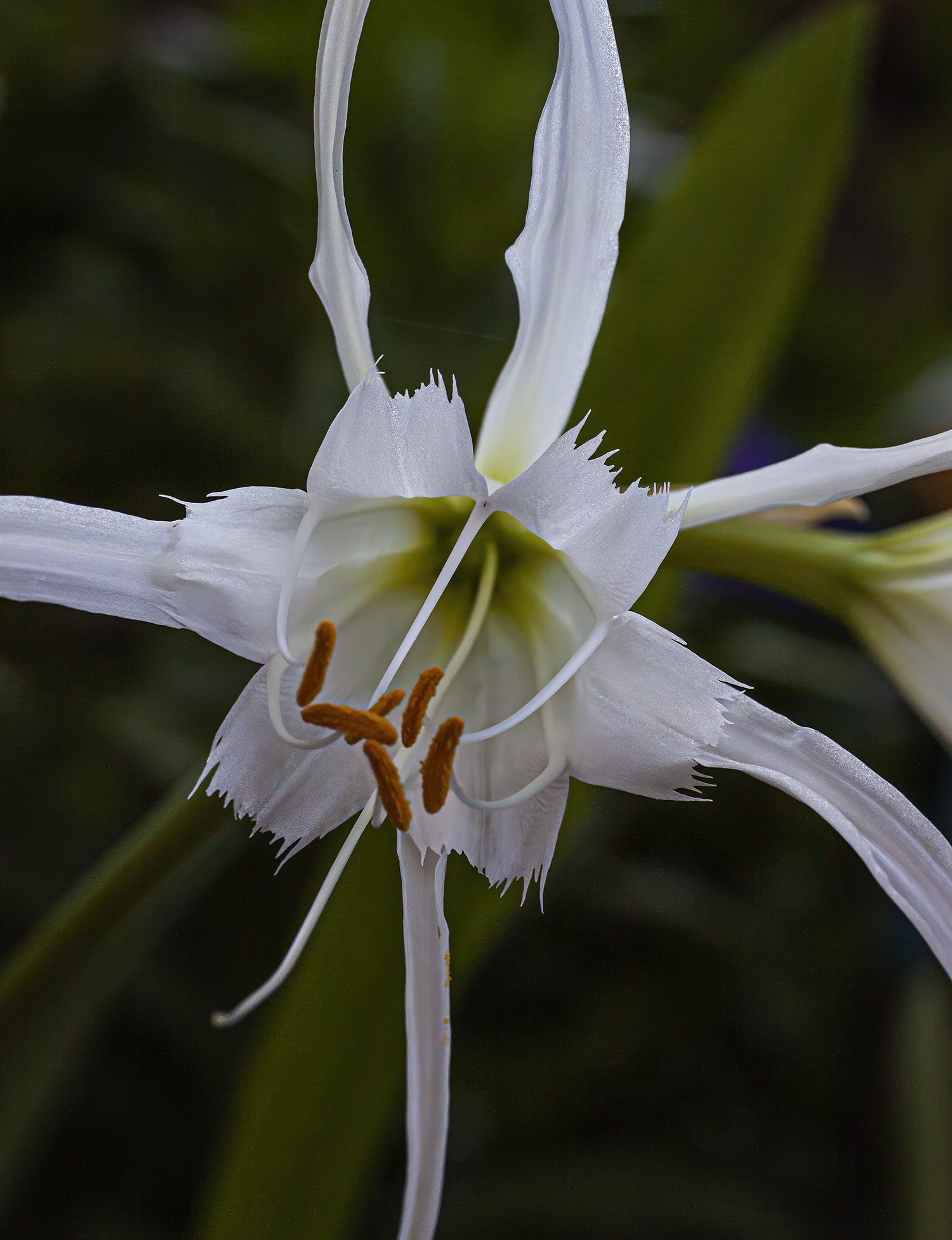
Every year I enjoy taking photos of dragonflies perching on a piece of rusted rebar that sticks a few inches out of the water of a small pond at Jackson Miles Abbott Wetland Refuge. I have seen dragonflies of several species use this particular perch, but photographically speaking my favorite is probably a male Eastern Amberwing dragonfly (Perithemis tenera) like the one in this photo from last Friday—the orange-rust colors of the dragonfly and its perch are complementary and soften what might otherwise be a jarring juxtaposition of the natural and man-made worlds.

You can’t see it really well, but there is a spider, probably a long-jawed spider, visible onthe lower portion of the rebar. I don’t know for sure if that spider could capture the dragonfly, but it is a potentially dangerous situation for the dragonfly and in the past I have photographed several dragonflies that had fallen prey to spiders.

Eastern Amberwing

© Michael Q. Powell. All rights reserved.


Read Full Post »

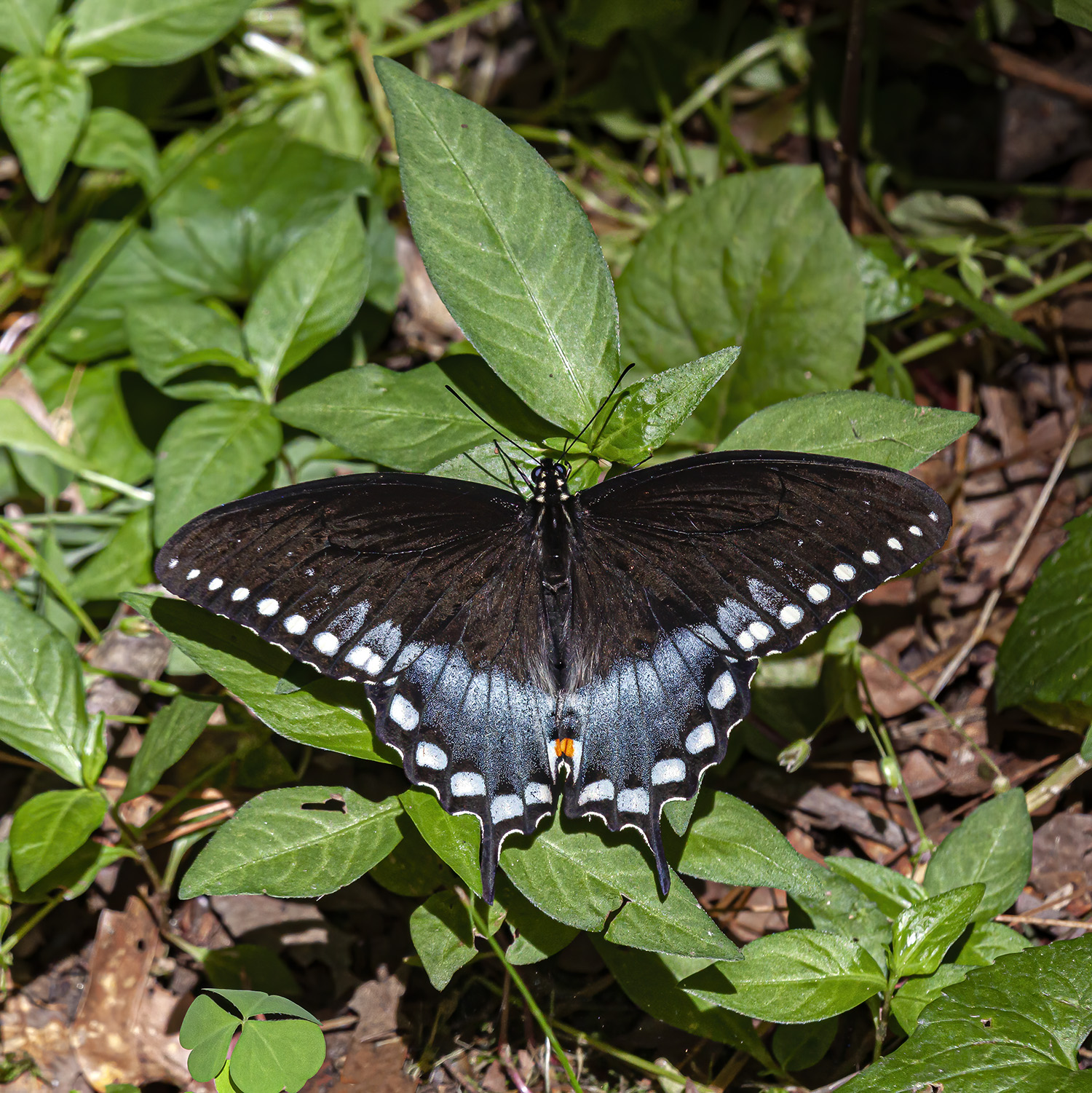
We have a number of different dark swallowtail butterflies in the area in which I live, which can make identification a little tricky. I spotted this beautiful butterfly last Friday at Jackson Miles Abbott Wetland Refuge and believe that it is a Spicebush Swallowtail butterfly (Papilio troilus). The perfect condition of its wings suggest to me that it has emerged quite recently—as we move deeper into summer, I often spot butterflies with tattered wings.

Spicebush Swallowtail

© Michael Q. Powell. All rights reserved.


Read Full Post »

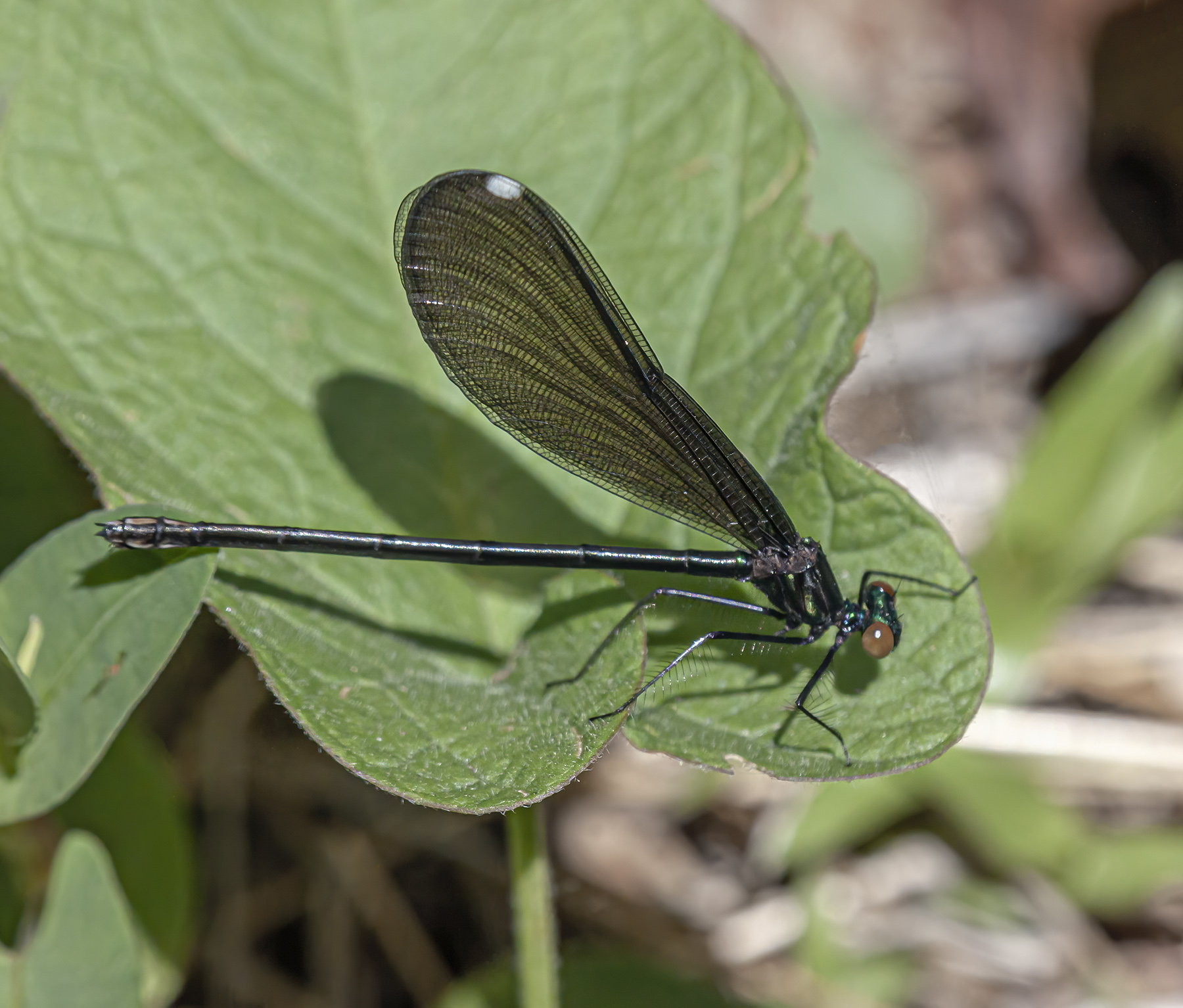
Yesterday I posted images of Eastern Amberwings, one of the most easily identified dragonfly species in my area. Today I am going to continue the mini-trend of going easy on my identification skills by presenting our most easily identified damselfly species, the Ebony Jewelwing damselfly (Calopteryx maculata).

I spotted this beautiful female Ebony Jewelwing last week as I was exploring in Occoquan Regional Park. Ebony Jewelwings are found most often along wooded slow-moving streams and frequently perch on low shrubbery in sun-lit openings in the forest canopy, which pretty well describes the circumstances of my encounter with this little beauty.

How do I know that it is an Ebony Jewelwing? There is no other damselfly in our area that has completely dark wings like the Ebony Jewelwing. How can I be sure that it is a female? Females have a conspicuous little white patch on their wings, technically known as a “pseudostigma,” that is pretty obvious in the photo below.

Some recent postings have noted the difficulties in making a correct identification of the dragonflies and damselflies that I photograph. I enjoy a mystery from time to time, but there is something reassuring about spotting a familiar species and being able to identify it immediately.


Ebony Jewelwing

© Michael Q. Powell. All rights reserved.

Read Full Post »

Last week I spotted my first Eastern Amberwing dragonflies (Perithemis tenera) of the season at Jackson Miles Abbott Wetland Refuge. These distinctively colored dragonflies are a frequent sight throughout the summer as they buzz about over the waters of ponds. Eastern Amberwings are small, even by dragonfly standards, with a total length of less than an inch (25 mm) and are considered to be a wasp mimic. According to Wikipedia, “The Eastern Amberwing dragonfly is one of the only types of dragonfly that actively mimics a wasp. The yellow and brown stripes on its abdomen encourage predators to stay away. When perched, they will wiggle their abdomen and wings in a wasp-like fashion to deter other animals from eating it.”

My second and third shots are portraits of perched male Eastern Amberwing dragonflies that were carefully composed and sharp, but my favorite image of the day is the dynamic shot of two dragonflies in flight. It may not be obvious what is going on in the photo, so let me explain. After mating, the female in the upper left corner is getting ready to deposit her eggs in the water, while the male in the lower right corner hovers in the air, ready to keep any rivals from interfering with the process.

Eastern Amberwing

Eastern Amberwing

Eastern Amberwing

© Michael Q. Powell. All rights reserved.

Read Full Post »
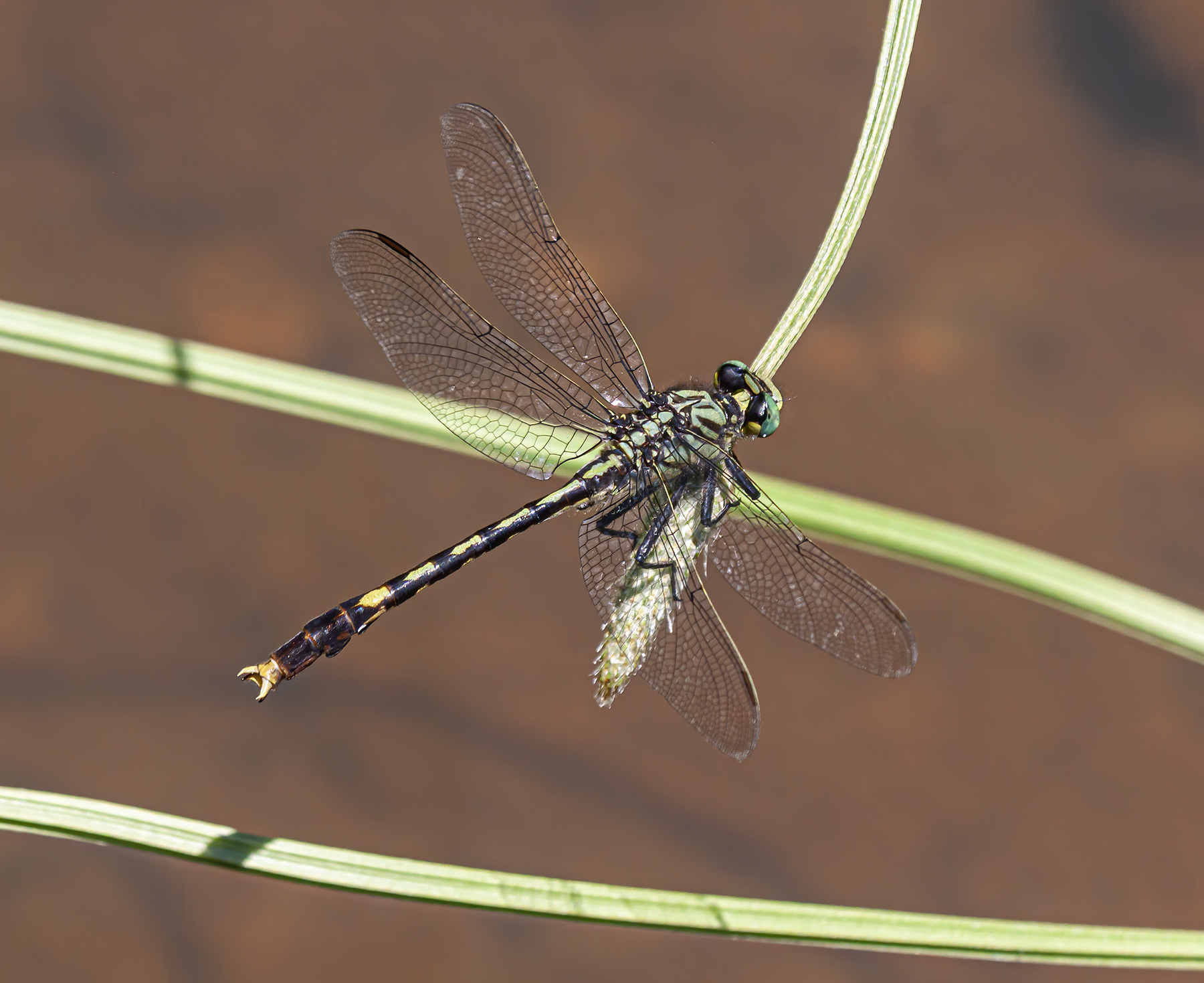
Dragonflies have been around for a long time, with fossils showing dragonfly-like creatures that date back to the Jurassic period, more than 150 million years ago. It is generally believed that dragonflies of the Petaluridae family, including the Gray Petaltail (Tachopteryx thoreyi) most closely resemble those ancient species.

I was thrilled to find several Gray Petaltails this past Monday at Occoquan Regional Park, about 20 miles (32 km) from where I live. Most of the time Gray Petaltails perch vertically, flat against tree trunks at eye level or higher. The first photo is a little deceptive, because it makes it look like it is easy to spot these rather large dragonflies (three inches (76 mm) in length). However, in my experience it is rare to see a Gray Petaltail on a smooth-barked tree. When they perch on trees with coarser bark, these dragonflies almost melt into the trees. You get a hint of how this camouflage works in the second image below.

The final image shows a more typical scenario. From a distance, I saw a Gray Petaltail land on a tree. When I snapped the photo, though, I could not see the dragonfly, even though I knew exactly where it was. Can you see the Gray Petaltail in the final photo? I think that my post processing may have made it a little easier to spot, but the dull color and pattern of the dragonfly help it to blend in with the light and shadows on the tree trunk.

Gray Petaltail

Gray Petaltail

Gray Petaltail

© Michael Q. Powell. All rights reserved.

Read Full Post »

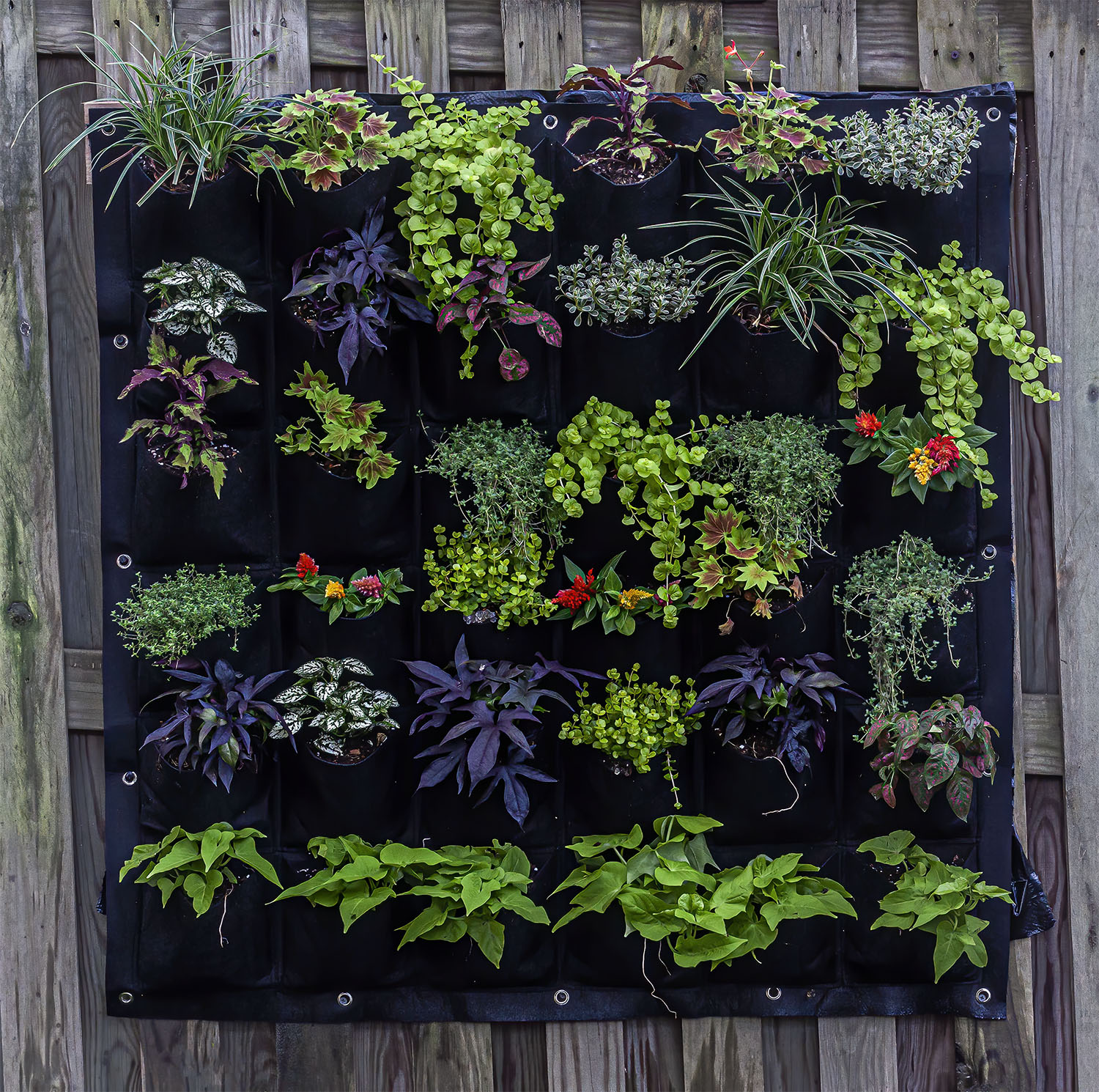
How do you grow a lot of plants in a small space? My amazingly creative friend, neighbor, and photography mentor Cindy Dyer decided to take advantage of vertical space and created this incredible wall of flowers and plants on the interior portion of the fence that encloses her back yard. Wow!

I do not know all of the details about how she set it up, but I think that the material, which Cindy describes as “felt-like,” has sewn-in pouches into which she inserted all of the plants and flowers. She mentioned to me that she had mixed some water-storing crystals in with the potting soil to reduce water stress and plans to water the wall regularly.

flower wall

© Michael Q. Powell. All rights reserved.

Read Full Post »

I was thrilled on Monday to see lots of butterflies as I was exploring Occoquan Regional Park. Many of them were small skippers that skittishly flew away whenever I approached them. Only a few were large and colorful, like the Red-spotted Purple butterfly (Limenitis arthemis) in the first photo. When it first landed on the plant, its wings were closed, but I waited and eventually the butterfly opened its wings. The damage to one of those wings this early in the season really emphasizes the fragility of these beautiful little creatures.

I also saw some brown woodland butterflies and I chased after several of them. I was out of breath but finally managed to catch up to one. Identification of this type of butterfly is always problematic, because there are quite a few similarly-colored species that vary only in the number and placement of the the eyespots. I think that the butterfly in the second shot is a Little Wood Satyr butterfly (Megisto cymela). I contemplated cropping closer, but decided I liked the little plant on the right side of the image and kept it. With this framing, I am able to create the illusion that the butterfly is staring at the plant.

Red-spotted Purple

Little Wood Satyr

© Michael Q. Powell. All rights reserved.

Read Full Post »
Most of you know that I love to photograph dragonflies. In a recent posting, I thought I was featuring photos of a Cobra Clubtail dragonfly, but it turns out that it was a Splendid Clubtail dragonfly. Here is Walter Sanford’s behind the scenes account of the initial misidentification of the dragonfly, with photos showing the differences between the two species, and how experts determined that we had made an error. His posting provides some fascinating insights into the complications sometimes associated with making an identification of a species (and why it is important to photograph subjects from multiple angles, if possible).

Be sure to click on the “View original post link” if you are using the WordPress Reader to read Walter’s complete posting on his blog or go directly to his posting by using this link.

waltersanford's avatarwalter sanford's photoblog

A Splendid Clubtail dragonfly (Gomphurus lineatifrons) was spotted during a photowalk with Michael Powell at an undisclosed location in Fairfax County, Virginia USA. Easy for me to say now. As it turns out, my initial identification was incorrect.

The first photo I took of the dragonfly — the record shot — is shown below. Notice the pattern of yellow lateral marks/spots on its abdomen. Also notice the yellow blotch on the side of abdominal segment eight (S8) extends onto the club flange, as shown in the full-size version of the image. (Thanks to Michael Boatwright, founder and administrator of the Virginia Odonata Facebook group, for sharing these key field marks for Splendid.)

26 MAY 2020 | Fairfax County, VA | Splendid Clubtail (female)

In contrast, the pattern of yellow lateral marks/spots on the abdomen of a female Cobra Clubtail (Gomphurus vastus), shown below, looks…

View original post 449 more words

Read Full Post »

On Tuesday I spotted this handsome male Spangled Skimmer dragonfly (Libellula cyanea) at Occoquan Regional Park. This species is fairly easy to identify because of the “spangles,” the little white patches on the leading edges of the wings, often referred to as stigmata or pterostigmata. Most other species have darker colored stigmata or none at all.

If you use the meteorological calendar, summer started on the first of June. For most of us, though, who use the astronomical calendar, we have a few weeks to wait until the summer begins on the 20th of June. No matter how you calculate summer, I have noticed a lot more of the summer dragonfly species during my most recent outings. If things work out well, June could be a great month for dragonfly hunting, with the possibility of seeing some of the remaining spring species, plus the new summer ones.

spangled skimmer

© Michael Q. Powell. All rights reserved.


Read Full Post »

Last Tuesday I spotted this cute little toad—I think it may be a Fowler’s Toad (Anaxyrus fowleri)—while exploring the wilds of Fairfax County. The toad was just chilling (or more accurately may have been warming itself) on a rock ledge with a bumpy texture and mottled coloration that matched those of the toad pretty well.

It is hard to know what the frog was thinking, but it appeared to be in deep contemplation. “I think, therefore I am.”

Fowler's Toad

© Michael Q. Powell. All rights reserved.


Read Full Post »
We have started a new month and new flowers are blooming in the garden of my friend and photography mentor Cindy Dyer. Iris season has almost ended, but more lilies are opening each day. Today’s featured star is the bold, fragrant oriental hybrid known as the Stargazer Lily (Lilium ‘Stargazer’). Wow—there is nothing subtle about this flower that overwhelms both the eyes and the nose.

The words “star gazer” bring to mind some words from one of my favorite songs, The Rainbow Connection as sung by Kermit the Frog. “What’s so amazing that keeps us stargazing and what do we think we might see? Someday we’ll find it, that rainbow connection, the lover, the dreamer, and me.” Now more than ever, we all need hope.

I want to share with you the concluding portion of a prayer distributed to us by our local Episcopal bishop yesterday, a National Day of Mourning and Lament for those who have died of COVID-19. “God of all hope, God of all goodness, we are a people hurting, lost and divided. Our world seems a strange and foreign land, our days a blur of separation and isolation. Gather us to your very heart as we pray for our nation, receive all who have died into the fulness of your heaven, guide the hands of all who serve others. Bless our efforts to love all people in concrete action and, in your powerful ways and in your perfect time, make us whole for the sake of a world so desperately in need of You. Amen.”

Stargazer Lily

Stargazer Lily

© Michael Q. Powell. All rights reserved.


Read Full Post »

Names can sometimes be misleading. There is a genus of damselflies, consisting of 35 species, called American bluets. As the common name “bluet” suggests, most members of the genus are primarily blue in color. One notable exception is the adult male Orange Bluet (Enallagma signatum) that often does not appear to have even a speck of blue on its body.

I spotted this little guy last Friday at Jackson Miles Abbott Wetland Refuge and was a bit shocked by his bright red eyes when I looked through the viewfinder of the camera. The male Orange Bluet was perched at the extreme end of some vegetation overhanging a pond.

I would have liked to have gotten a shot in which more of its body was in focus, but I did not want to risk falling in the water, which looked to be pretty deep at that spot. As I look at the photo now, I realize that the soft focus of the body may actually be a good thing, because it draws a viewer’s attention even more to the eyes of the handsome little damselfly.

orange bluet

© Michael Q. Powell. All rights reserved.

Read Full Post »

« Newer Posts - Older Posts »