Feeds:
Posts
Comments

Archive for the ‘Macro Photography’ Category

There were quite a few grasshoppers yesterday at Occoquan Bay National Wildlife Refuge and this one cooperated for me by posing momentarily. Initially the grasshopper hung upside down as shown in the first image, but eventually it climbed around on the stalk of vegetation and assumed a more upright pose.

I couldn’t help but notice that the background of the two shots seems really different. I think this was caused by the fact that I shot them from very different angles, even though I remained more or less in the same spot.

grasshopper

grasshopper

© Michael Q. Powell. All rights reserved.

Read Full Post »

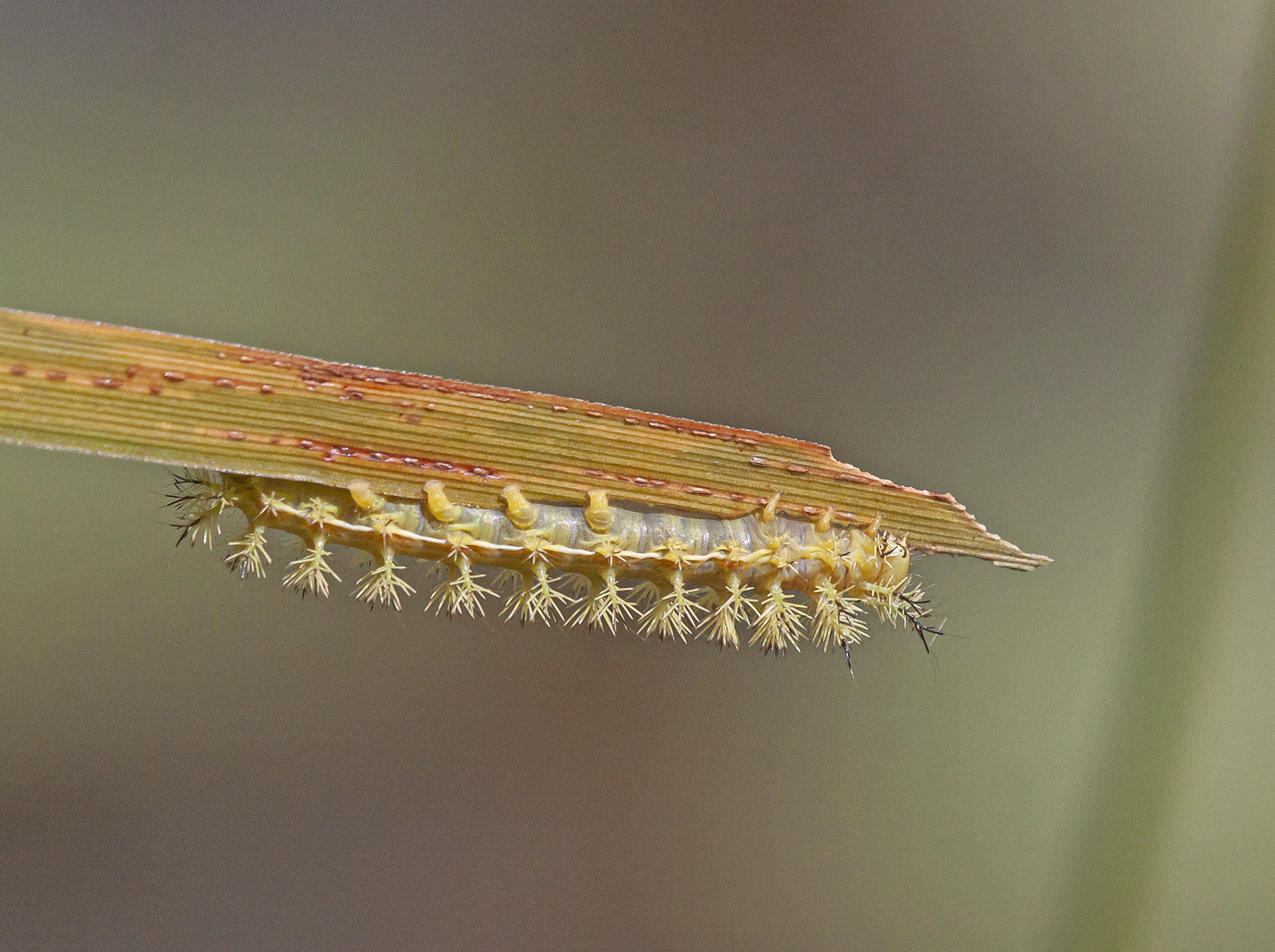
I spotted this strange looking caterpillar recently while exploring Jackson Miles Abbott Wetland Refuge. I was intrigued by all of the tufted spines sticking out of its back—I am pretty sure that it is upside down in this photo. Over the years, I have learned that it is best to avoid spiny caterpillars, because many of them are poisonous.

I sent a copy of a photo of this caterpillar to the helpful folks at bugguide.net and one of the viewers there suggested that this is an Eastern Buck Moth caterpillar (Hemileuca maia). I have not yet been able to get a confirmed identification, but according to Wikipedia, the caterpillars of this species are, “covered in hollow spines that are attached to a poison sac. The poison can cause symptoms ranging from itching and burning sensations to nausea.”

Fortunately I kept my distance when I captured this image with my long macro lens. I have no desire for a close encounter with a spiny caterpillar.

Eastern Buck Moth

© Michael Q. Powell. All rights reserved.

Read Full Post »

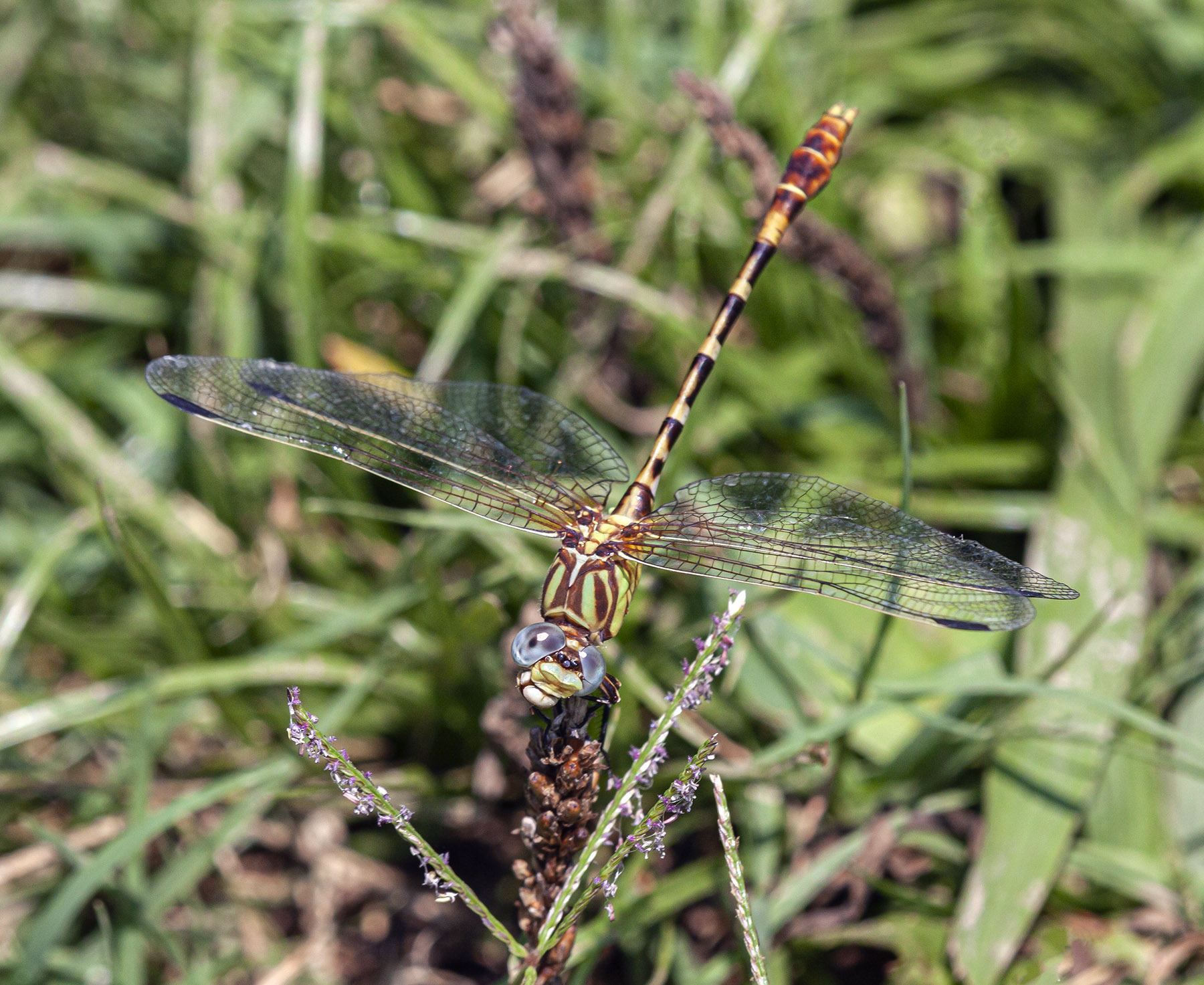
What is the best way to photograph a dragonfly that perches low to the ground? How can you create an image in which the dragonfly is not lost amidst the clutter of the vegetation? That was the challenge that fellow dragonfly enthusiast Walter Sanford and I faced last Monday when we journeyed to Riverbend Park in Great Falls, Virginia  in search of Eastern Ringtail dragonflies (Erpetogomphus designatus).

Walter has a lot of experience with dragonflies and knew where to find Eastern Ringtails in the park. He knew, for example, that they like to perch on a section of concrete aggregate and indeed we spotted one not long after we arrived. Walter likes to maximize the chance of getting the entire dragonfly in focus by shooting downwards, ideally from as close to overhead as possible. For him, the concrete background is uncluttered and allows him to capture all of details of the dragonfly.

Although I prefer to photograph dragonflies on natural vice manmade surfaces, I took some photos, including the third one below, while the dragonfly was on the concrete—you have to shoot when the opportunity arises and I was not confident that I could wait for the dragonfly to choose a better perch. Rather than shooting from above when the dragonfly is on the ground, I usually choose to get down with the dragonfly.

Eventually I was able to get some shots of Eastern Ringtails perched in the grass. The middle image shows the dragonfly tilting its head to look towards me as I photographed it. I like the pose, but I was not fully satisfied. Those of you who have followed my blog for a while know that I like to get as close to a dragonfly as it will let me. The initial photo of this posting was one of my final shots of my session with the Eastern Ringtails and it is probably my favorite.

I began this post with a question and feel like I owe you a response. In reality, there is no “best” way to photograph a dragonfly on the ground, but my preferred option is to get low to the ground and close to the subject so that I am able to focus on part of the dragonfly, hopefully the eyes, and blur out the background because of the shallow depth of field when shooting that close. If you would like to see Walter’s wonderful photos of Eastern Ringtails from the same trip, I encourage you to check out his blog postings Eastern Ringtail reunion, continued and  Reconnecting with Eastern Ringtail. Those postings provide his visual response to the question that I posed.

Eastern Ringtail


Eastern Ringtail

Eastern Ringtail

© Michael Q. Powell. All rights reserved.

Read Full Post »

With all of the hot weather we have been having recently, I have absolutely no desire to be as busy as a bee. I spotted this bee busily at work this past Tuesday morning at Occoquan Bay National Wildlife Refuge.

Temperatures in our area are forecast to rise to 100 degrees (38 degrees C) today and the high humidity will make it feel even more intolerable. I will probably spend most of the days indoors, but fortunately I have plenty of recent photos in reserve that I can process and post.

This image is the kind of simple shot that I really like. I remember my sense of wonder the first time I used a macro lens and I still feel excitement when I immerse myself in the details that a macro lens reveals.

bee

© Michael Q. Powell. All rights reserved.


Read Full Post »

I am not sure if Blue-fronted Dancer damselflies (Argia apicalis) are always happy, but the ones that I spotted yesterday at Jackson Miles Abbott Wetland Refuge seemed to be smiling at me.

The beautiful light blue color on their upper bodies and their striking blue eyes make Blue-fronted Dancers relatively easy to spot and to identify.

Blue-fronted Dancer

Blue-fronted Dancer

Blue-fronted Dancer

© Michael Q. Powell. All rights reserved.

Read Full Post »

This past Saturday I was thrilled to spot this mating pair of Ebony Jewelwing damselflies (Calopteryx maculata). No, I am not a peeping Tom, but I do enjoy being able to see the male and female of a species together, so that I can compare their coloration and markings.

When it comes to damselflies, I just love the sidewards heart that their bodies create when they are in this mating position. I have been told that the process is somewhat brutal, but I like to think of it as romantic, two hearts joined as one.

Ebony Jewelwing

© Michael Q. Powell. All rights reserved.

Read Full Post »

Earlier this week I did a posting that described the Eastern Amberwing dragonfly as “unmistakable.” When it comes to damselflies, that title almost certainly belongs to the very distinctive Ebony Jewelwing damselfly (Calopteryx maculata). There is no other damselfly in our area that has completely dark wings like the Ebony Jewelwing.

I spotted this handsome male Ebony Jewelwing on Monday at Occoquan Regional Park. How do I know it is a male? Well, the female has a conspicuous little white patch on her wings that is technically known as a “pseudostigma,” which this damselfly in lacking. Additionally, the little hoop-like appendage at the end of this damselfly indicates that it is a male.

These little damselflies like to spend a lot of time in the semi-darkness of shaded forest streams, like the location at which I photographed this Ebony Jewelwing.

Ebony Jewelwing

© Michael Q. Powell. All rights reserved.


Read Full Post »

Some of the photos in recent postings have shown that damselflies are incredibly flexible. Normally they demonstrate this flexibility when mating with a partner.

Earlier this week I spotted this damselfly, which I believe is a male Fragile Forktail (Ischnura posita), doing a solo gymnastics exhibition. The acrobatic damselfly repeatedly would swing its body backwards (second photo) and them end up with the tip of his abdomen between his legs (first photo). What was he doing?

According to my local dragonfly/damselfly expert Walter Sanford, damselflies are quite fastidious and will often spend time grooming themselves. That is what appears to be happening in these photos.

Who knew? It is not what I would have guessed—sometimes truth is stranger than fiction. 🙂

Fragile Forktail

© Michael Q. Powell. All rights reserved.


Read Full Post »

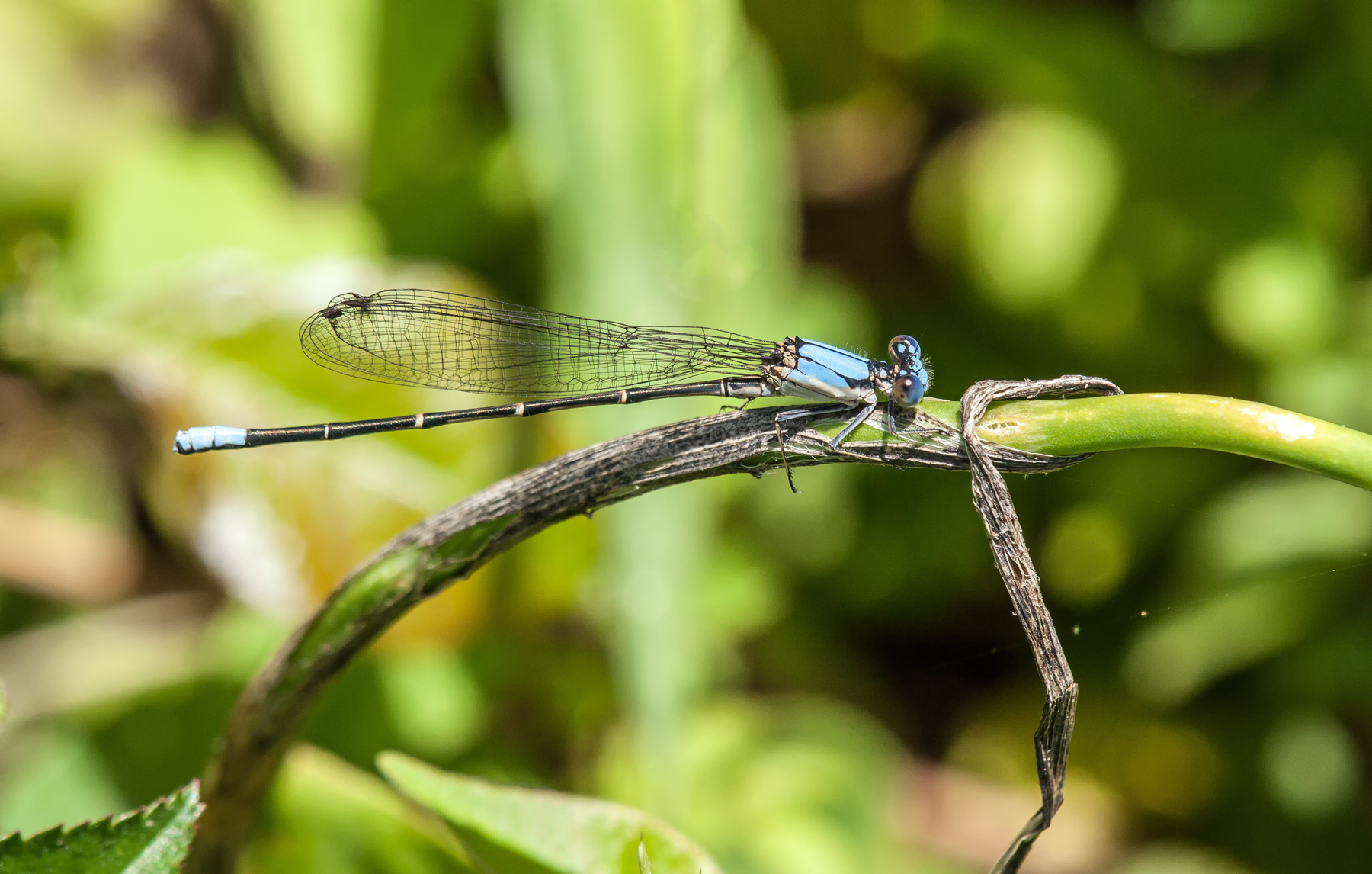
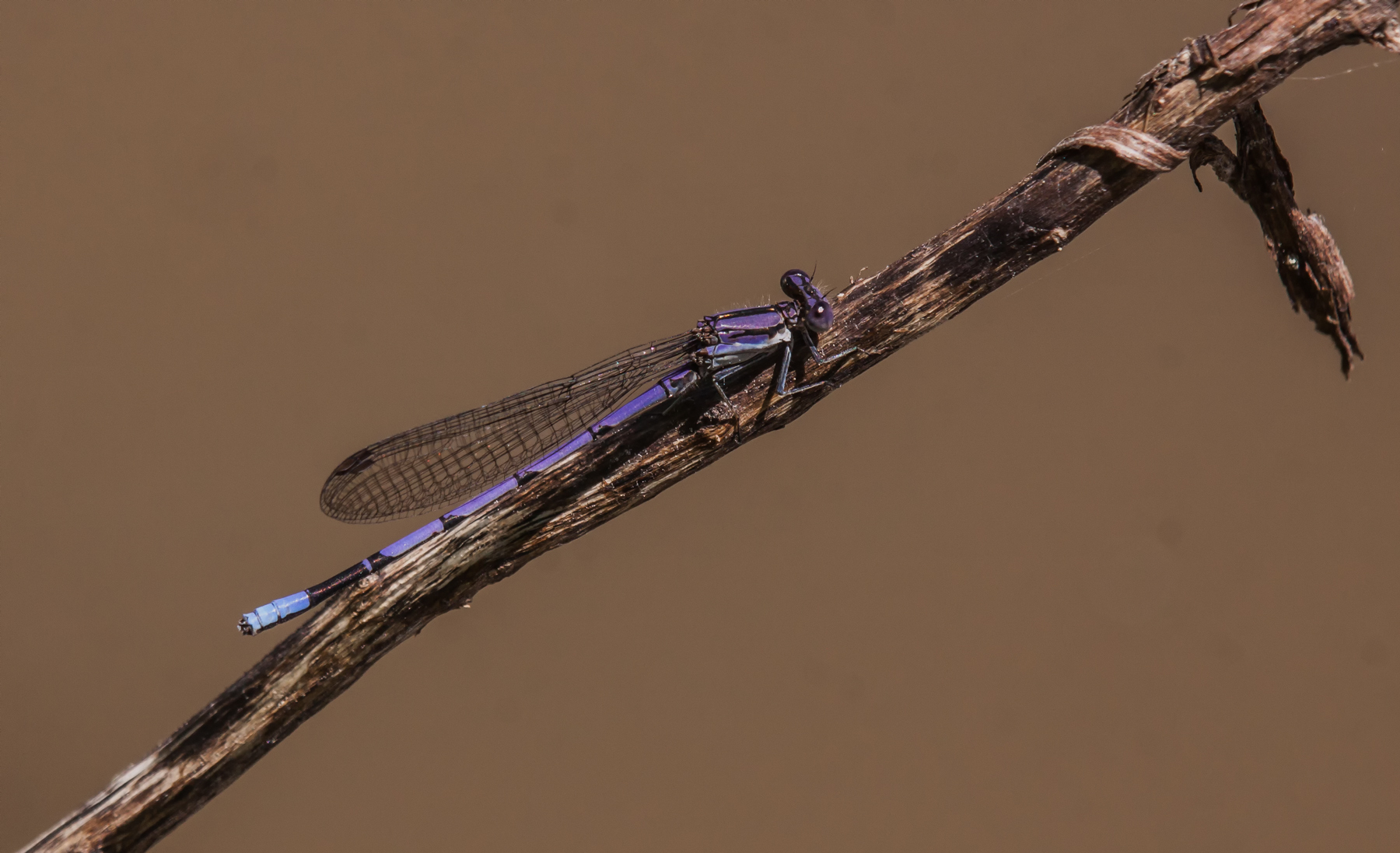
I was thrilled yesterday to see that two of my favorite damselfly species, the Blue-fronted Dancer (Argia apicalis) and the Variable Dancer (Argia fumipennis) have reappeared at Jackson Miles Abbott Wetland Refuge. It is definitely worth clicking on the images below in order to get a better look at the beautiful baby-blue color of the Blue-fronted Dancer and the spectacular purple of the Variable Dancer.

Blue-fronted Dancer

Variable Dancer

© Michael Q. Powell. All rights reserved.

Read Full Post »

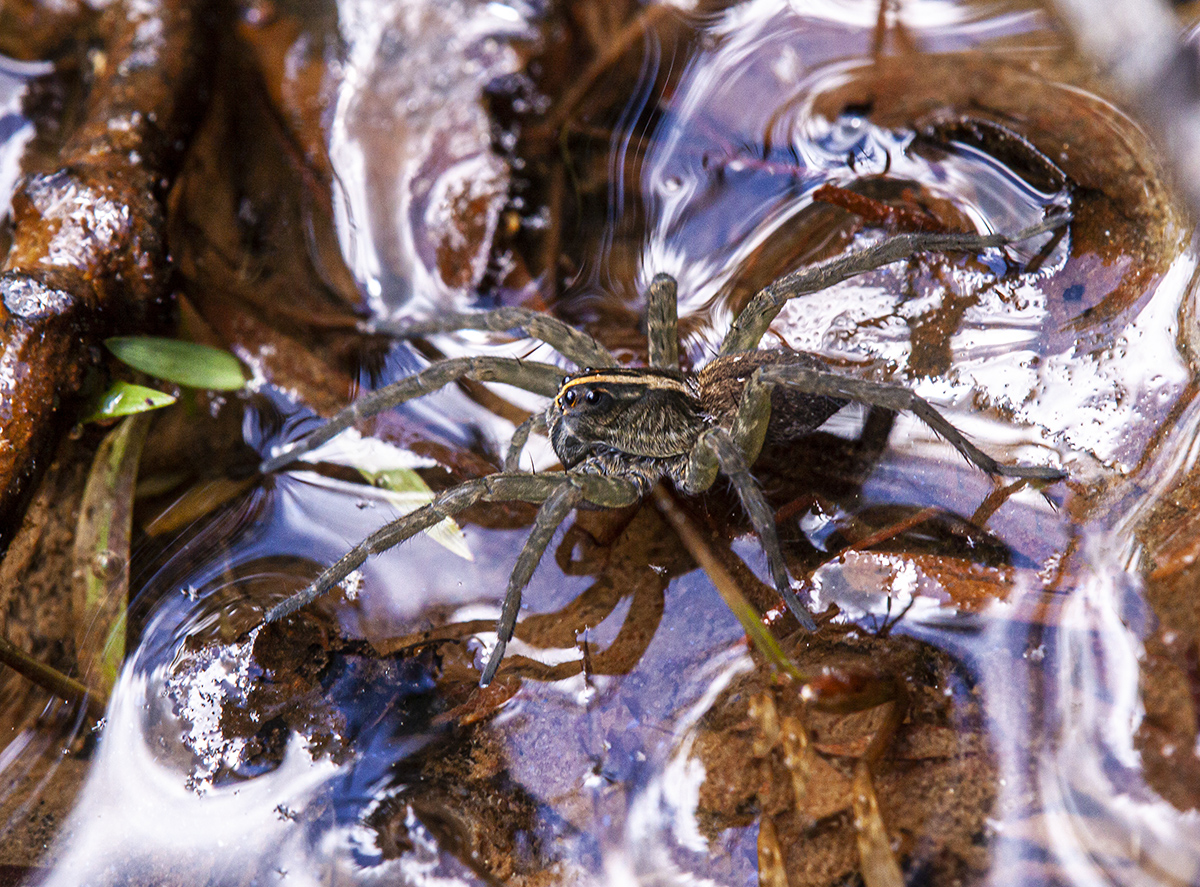
Did you know that not all spiders build webs? Some, like jumping spiders, rely on stealth and speed to capture unsuspecting prey. One of my favorite spiders, the Six-spotted Fishing Spider (Dolomedes triton), sits at the edge of the water with some of its long legs fully extended. When it senses vibrations of a potential prey on the surface of the water, a fishing spider can walk on the water to seize insects, vertebrates, tadpoles and occasionally small fish or even dive underwater up to 7.1 inches (18 cm), according to Wikipedia.

Here are a couple of images of a Six-spotted Fishing Spider that I spotted earlier this week at Prince William Forest Park. I really like the way that you can see most of the spiders eight eyes in these images and the way that the environment looks almost alien and other-worldly.

Past experience has shown me that viewers will be split in their reactions to these images—some will find them to be really cool and fascinating, while others will find them to be completely creepy. As you might suspect, I am in the former group.

Six-spotted Fishing spider

Six-spotted Fishing spider

© Michael Q. Powell. All rights reserved.

Read Full Post »

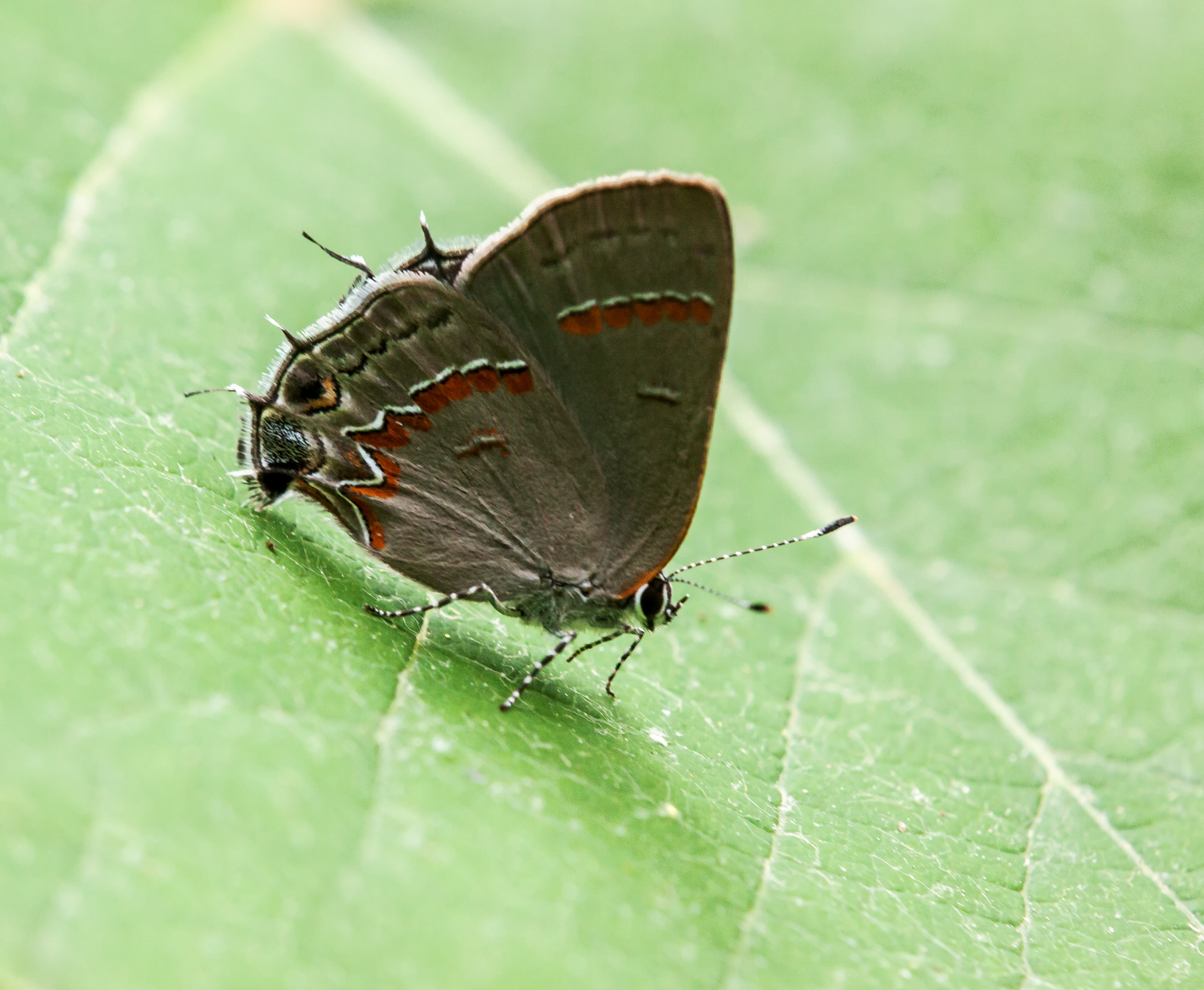
Yesterday I was thrilled to get a shot of this pretty Red-banded Hairstreak butterfly (Calycopis cecrops) at Occoquan Regional Park. These tiny butterflies are only about an inch (25mm) in length, so you really need a macro lens to get a close-enough shot that reveals all of the butterfly’s wonderful colors and patterns. It is also nice to be able to see the little “tails” protruding from the hind wings that I believe are responsible for the name “hairstreak.”


Red-banded Hairstreak

© Michael Q. Powell. All rights reserved.

Read Full Post »

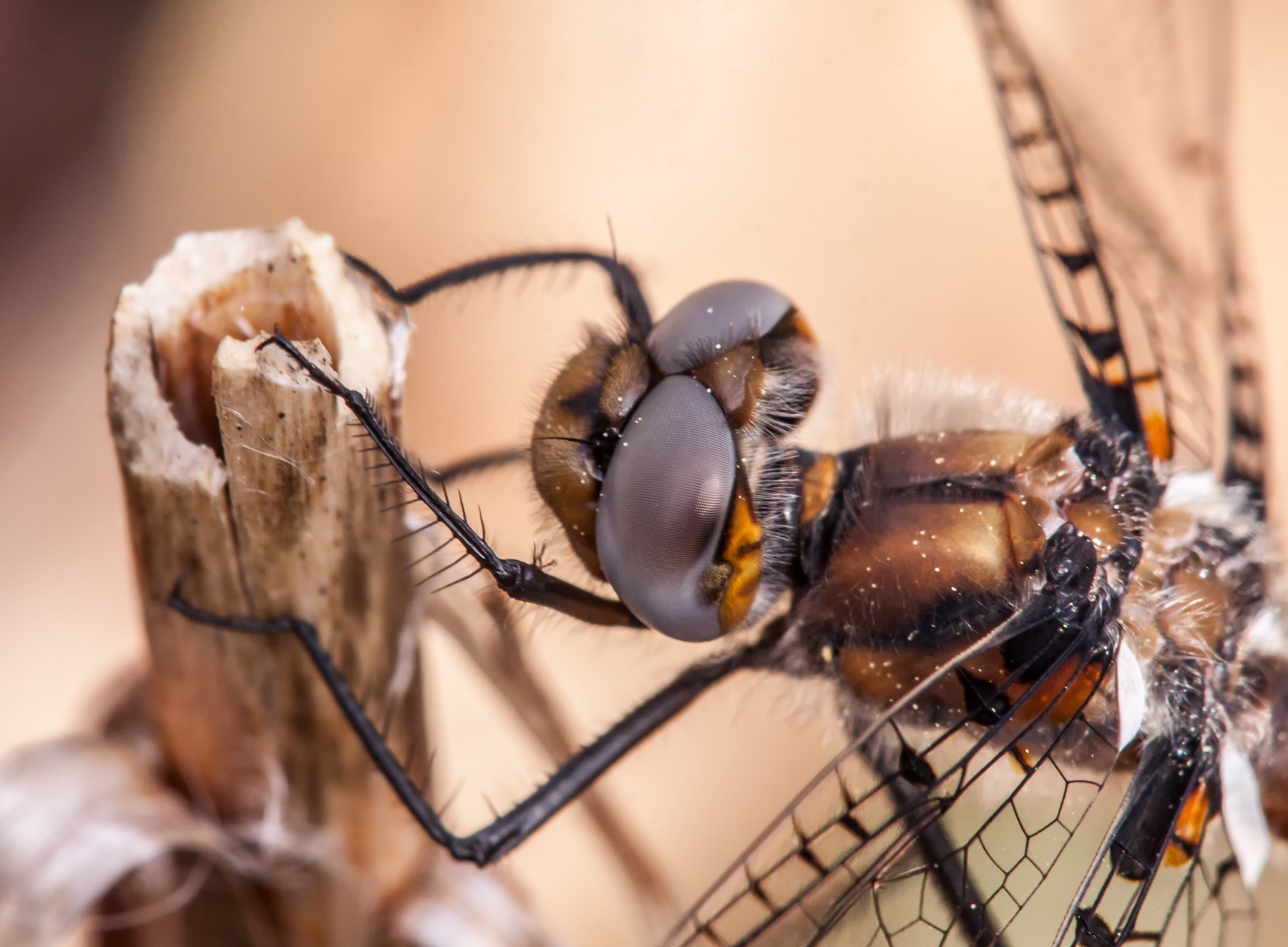
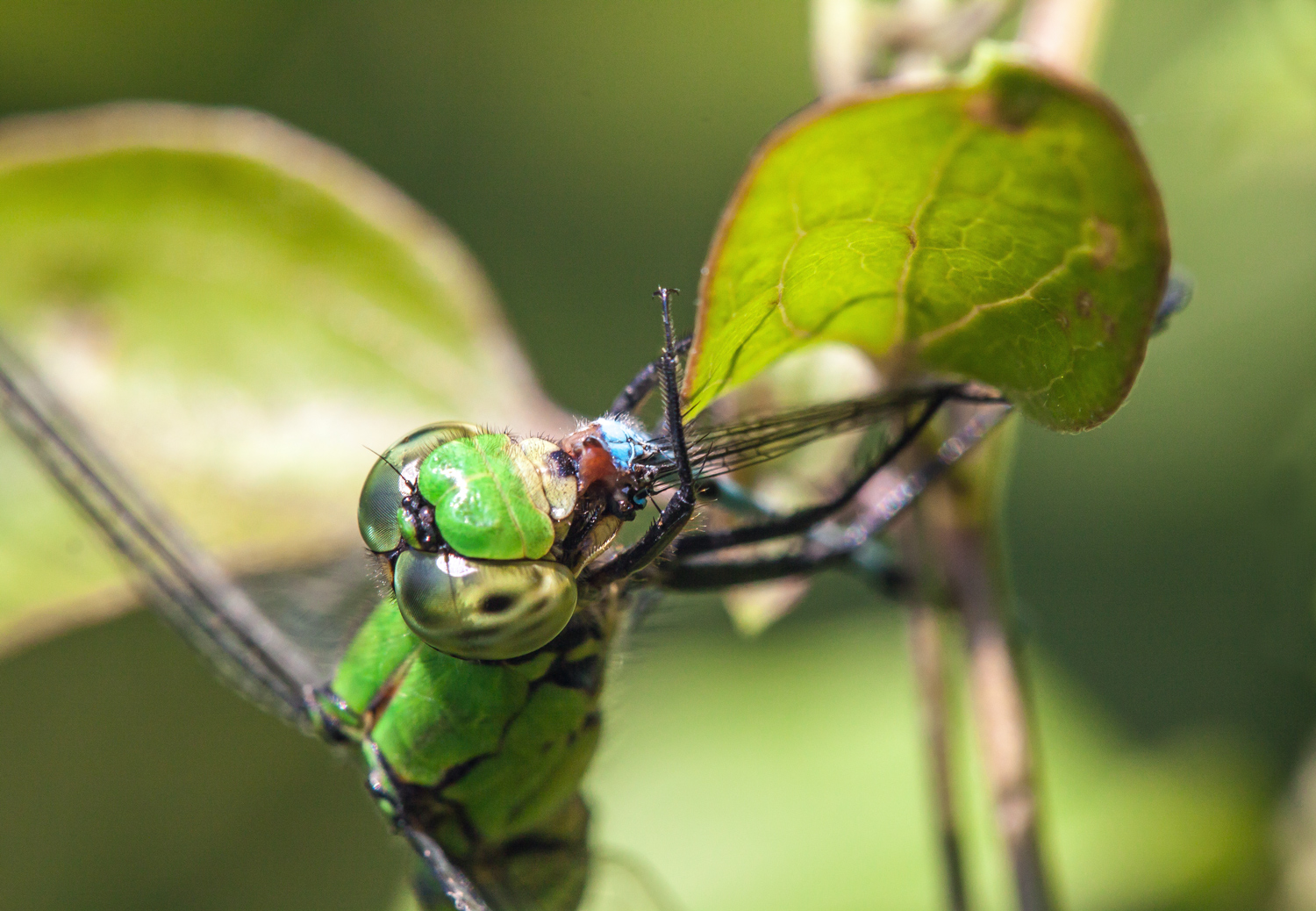
You know you are pretty close to a dragonfly when you can see individual grains of pollen on its head and body. I photographed this Uhler’s Sundragon dragonfly (Helocordulia uhleri) on 12 April alongside a creek in Northern Virginia. Ideally it would be best to stabilize macro shots taken at this close a range by placing the camera on a tripod, but in a field situation with a live subject, that is rarely possible.

If you click on the individual images, you will see some wonderful details, like the ommatidia, the individual optical units that make up the amazing compound eyes of these dragonflies.

Uhler's Sundragon

uhler's sundragon

© Michael Q. Powell. All rights reserved.


Read Full Post »

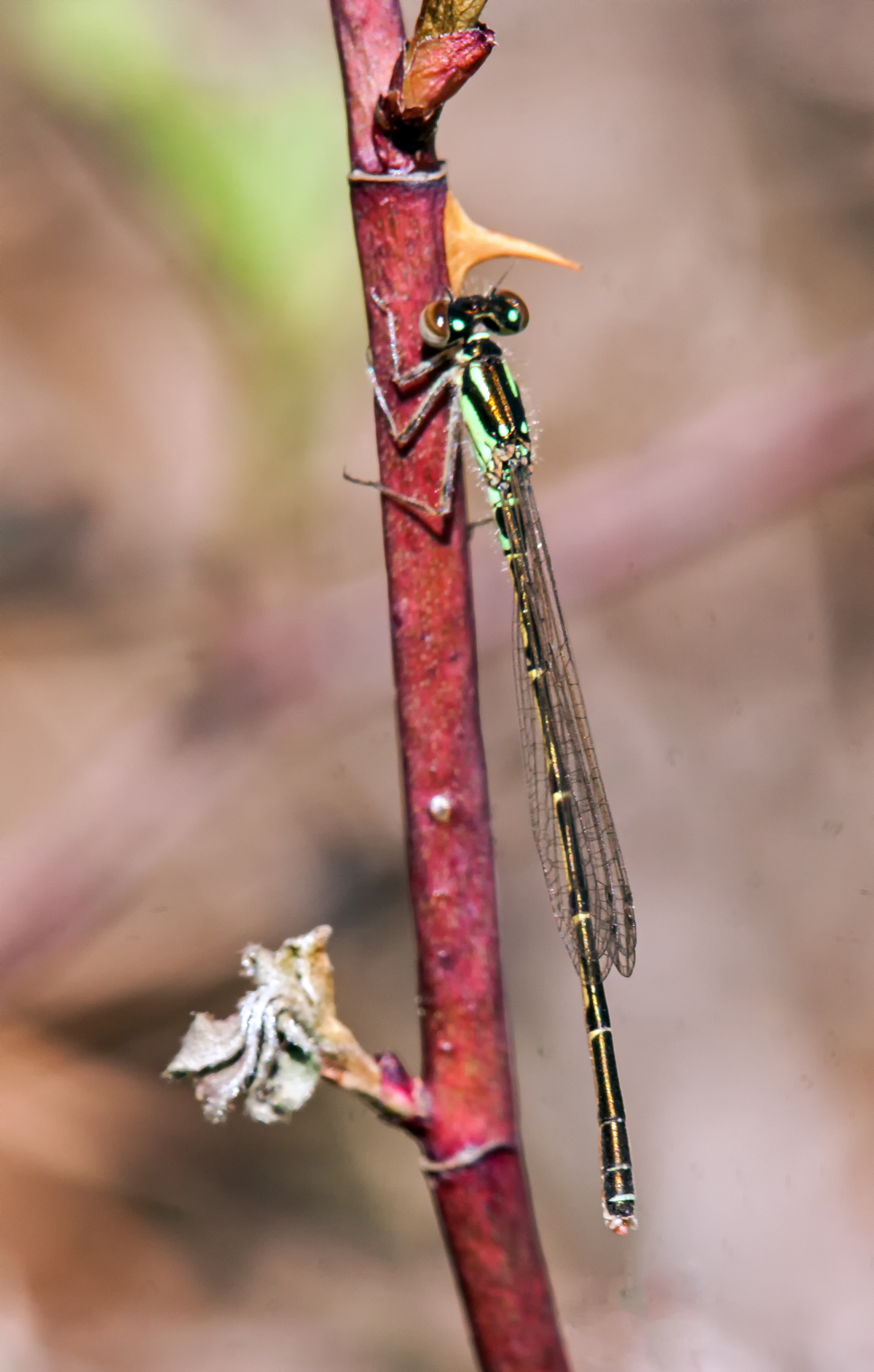
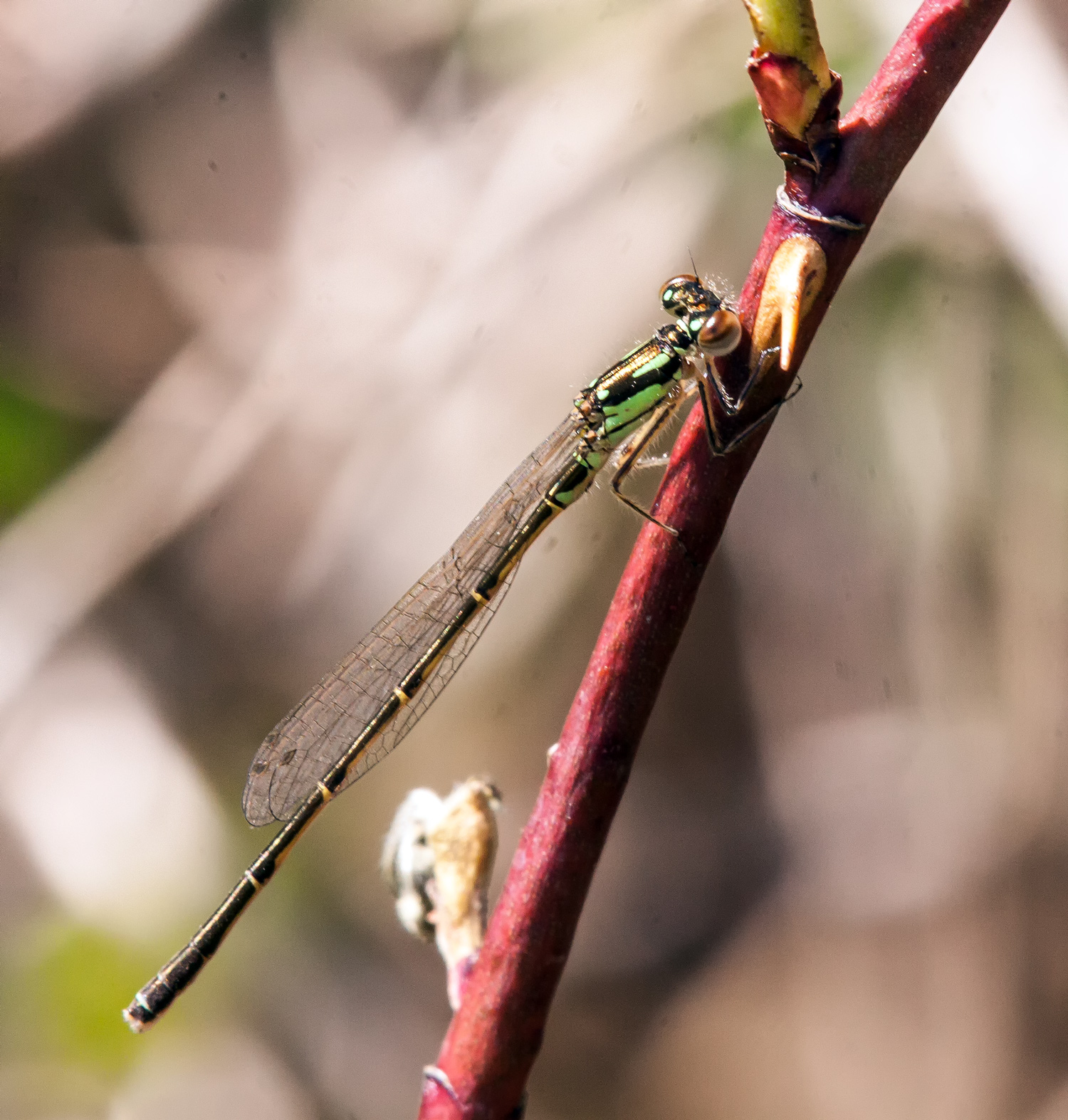
I’m still looking for my first dragonfly of the season, but was thrilled yesterday afternoon when I spotted my first damselfly, a Fragile Forktail (Ischnura posita), at Jackson Miles Abbott Wetland Refuge. In anticipation of seeing one of these small insects, I mounted my Tamron 180mm macro lens on my camera, a lens that has gone largely unused during the long winter months in favor of my telephoto zoom lens.

Yesterday was a nice reminded of how much I enjoy using a macro lens. (To give you a sense of scale, a Fragile Forktail damselfly is about 0.8-1.1 inches in length (21-29mm).)


Fragile Forktail

Fragile Forktail

Fragile Forktail

© Michael Q. Powell. All rights reserved.

Read Full Post »

Thanks to all of you for your overwhelming positive responses to a recent posting Some favorite photos of 2018 that showcased some of last year’s photos that I really like. Check out that posting if you have not seen it yet.

Interesting enough, not a single one of them was from my most-viewed posts of the year. How many views do you regularly get for one of your blog postings? One of my average postings tends to get about 60-80 hits. It is a rare and happy occasion for me to get as many as 100 views for any posting.

Here are links to my five most-viewed postings of 2018 and an indication of how many views they received in 2018 and since they were originally published. You’ll probably notice that four of them were taken in 2013 or earlier. Somehow these postings apparently appear in searches in Google and other search engines and that is how viewers find their way to my blog.

The photos below are ok, but they are certainly not among my favorite or best photos. A review of these statistics reinforces in me the notion that “views” are not a very accurate measuring tool for deciding if a posting or a photo is “good.”

Here is one fun fact about my blog—Red-footed Cannibalfly has been my most-viewed posting for the fourth year in a row. Who knew that so many people were fascinated by this fearsome insect?

Take a look at that posting (or any the others below) by clicking on the highlighted title. Maybe you will be able to discover for me the secret behind their relative popularity.

Red-footed Cannibalfly (31 August 2013) 366 views in 2018 (2457 views since published)

red-footed cannibalfly

Fuzzy white caterpillar (3 August 2013) 341 views in 2018 (1209 views since published)

fuzzy white caterpillar

Blue-eyed garter snake (9 May 2016) 218 views in 2018 (503 views since published)

garter snake

Yellow Garden Orbweaver with a Grasshopper (29 August 2012) 166 views in 2018 (214 views since published)

Insects gone wild (29 May 2013) 125 views in 2018 (901 views since published)

© Michael Q. Powell. All rights reserved.

Read Full Post »

I was really struck  by the contrast in color and texture between this cluster of large milkweed bugs (Oncopeltus fasciatus) and the milkweed on which they were perched at Occoquan Bay National Wildlife Refuge during a visit earlier this week.

The color combination seems appropriate for a Christmas card, though the subject matter would be considered untraditional, to say the least, and might not be met with enthusiasm by all recipients.

milkweed bugs

© Michael Q. Powell. All rights reserved.

Read Full Post »

When this Spotted Orbweaver spider (Neoscona crucifera) spotted me last week at Jackson Miles Abbott Wetland Refuge, it scurried along the silken threads of its web to the relative safety of the plant to which one end of the web was attached.

There is something that really appeals to me about this image. Maybe it’s the way that the colors of the spider match those of the plant or how the shapes of the stems are similar to those of the spider’s legs. Perhaps it is the contrast between the sharpness of a few elements in the image and the dreamy, almost ghost-like background.

Most of the time I strive for super-realistic images and try to draw a viewer’s attention to the details. When I am in an artsy, creative mood, though, I am content to capture an impression of the subject, leaving the details to the imagination of others.

spotted orbweaver spider

© Michael Q. Powell. All rights reserved.


Read Full Post »

Orange is one of the colors that I tend to associate with autumn. Some leaves are already turning orange and pumpkin decorations and displays have started to appear on my neighbors’ doorsteps.

As I was exploring Occoquan Bay National Wildlife Refuge yesterday morning, my eyes detected some motion in the nearby grass. I leaned forward and was delighted to see this tiny damselfly decked out in the colors of Halloween—orange and black. I had no idea what species it was, but fortunately I have a really good guide for damselflies and was able to identify it as an immature female Eastern Forktail damselfly (Ischnura verticalis).

Although there are already lots of symbols for autumn, I think this tiny damselfly could be added to the list.

Eastern Forktail

© Michael Q. Powell. All rights reserved.

Read Full Post »

Sometimes I don’t have to venture far to capture images. I took this shot recently of a flower growing out of one of the hosta plants in my front yard as the rain was falling.

Simple colors and shapes and the sparkle of raindrops—photography doesn’t always have to be complicated. The challenge is to slow down, to really see the world around us, and to recognize its inherent beauty.

hosta in the rain

© Michael Q. Powell. All rights reserved

Read Full Post »

Milkweed plants provide a wonderful habitat for all kinds of creatures, including this Large Milkweed Bug (Oncopeltus fasciatus) that I spotted earlier this week at Green Spring Gardens. These  bugs go through a fascinating series of physical transformations as they move though different nymph phases. A little over six years ago, I studied these bugs  pretty closely and documented their stages of development in a posting that I called Life phases of the large milkweed beetle. Be sure to check it out for more information and fascinating photos of these colorful little bugs.

I really like the combination of colors in this simple shot, colors that remind me a little of Christmas. However, I doubt that anyone would choose to feature this image on their annual Christmas card. 🙂

Large Milkweed Bug

© Michael Q. Powell. All rights reserved

Read Full Post »

When you shoot with a zoom lens, you can change the look of an image without moving from where you are standing. That can be an advantage, but it can also be a disadvantage, because it can discourage you from exploring different angles or different perspectives.

I really enjoy shooting with a lens of a fixed focal length, especially my macro lens, because it forces me to think more about composition. If I decide that I want the subject to be larger in the frame, I have to move physically closer to the subject. If the terrain doesn’t let me get any closer, then I have to consciously consider how else I could frame the shot.

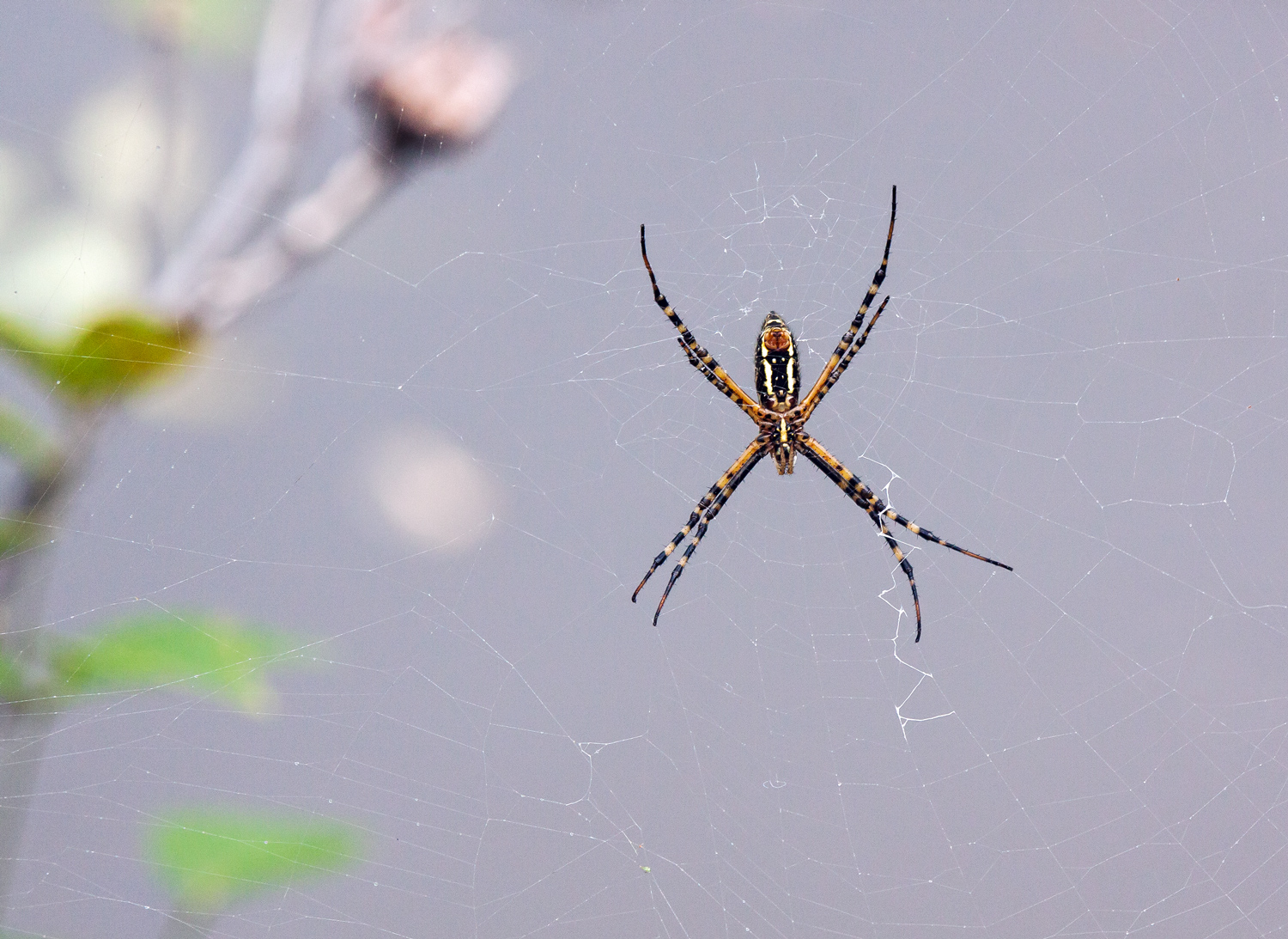
This past weekend I saw a lot of black and yellow garden spiders (Argiope aurantia) when I was exploring Jackson Miles Wetland Refuge, a small park not too far from where I live. Some of the spiders were in bushes and others were overhanging the water of a small pond. It was a fun challenge to figure out how to photograph the spiders in different and interesting ways.

In the first shot, I decided to shoot the spider from the side rather than from the front as I normally do. I was delighted to see the way the the shape of the vegetation in the background almost matched the shape of the spider’s legs.

I also photographed the spider in the second image from the side, but the leafy backdrop and the inclusion of more of the spider’s web gives the image a completely different feel as compared to the first one.

When I saw the spider in the third image overhanging the water, I loved the shape of its body and its extended legs. If I had had a zoom lens, I am pretty sure I would have zoomed in on the spider. When processing the image, I was also tempted to crop in closely. I remember when I was shooting, though, that I deliberately included the vegetation on the left hand side, because I liked the way that it looked. So the image that you see is pretty much the one that I chose when I shot it, having zoomed in as closely as my feet would allow (without getting really wet). Despite my normal desire to fill my frame with my subject, I think it was good that I was not able to do so in this case.

argiope spider

argiope spider

argiope spider

© Michael Q. Powell. All rights reserved


Read Full Post »

I tend to look at my own images in a kind of vacuum, but one of the bloggers that I love to follow, Liz of Exploring Colour, likes to look for themes across different blogs and puts images from them into a single posting. I was honored today when she matched up one of my images with one by Pete Hillman. Pete and I often use a similar approach to shooting subjects even though we are separated by the Atlantic Ocean. Check out Liz’s posting to see the juxtaposition of two beautiful images. The color palettes in the two images are a bit different, with mine having a cooler tone than Pete’s, but the pinkish red in each shot tends to unify the two images, which work amazingly well together.

Ms. Liz's avatarExploring Colour

I dance with these guys, but not literally of course…I “follow” their blogs, I love their photography and from time-to-time I profile their work on my blog. So in this rather fanciful piece of writing I dance with them, its a joy!

This morning I found they’d both posted exceptionally fine photos and I felt moved to profile both in a special post. Pete blogs from Staffordshire in the UK and Mike blogs from Virginia in the US. Both blogs are fantastic!


September dancer by Mike Powell

Damselfly. Variable Dancer (Argia fumipennis). Click on photo to enlarge

variable1_14sep_blog

By Mike Powell. See Mike’s original post for more information.

Mike blogs at:  Mike Powell | My journey through photography


Chequered Hoverfly Melanostoma scalare by Pete Hillman

Female of the species, rear garden, Staffordshire. Click on photo to enlarge

chequered-hoverfly-melanostoma-scalare

By Pete Hillman. See Pete’s original post for more photos of this…

View original post 15 more words

Read Full Post »

On Monday at Occoquan Bay National Wildlife Refuge I watched with fascination as this spider (maybe a Marbled Orbweaver (Araneus marmoreus) spider) worked on her web. She seemed to have started with the spokes coming out of the middle and was adding the ribs when I photographed her.

If you look closely in the first image, you can actually see the web material coming out of one of her spinnerets, the organs in which a spider produces the different kinds of silk that make up a web. I tried to figure our her process as I observed her. It looks like she would produce a length of silk, maneuver it into place on one of the spokes with one or more of her legs, affix it in place, and then start the process over again. For the final image, I moved back a little to give you a somewhat better view of more of the web and a sense of its shape.

I have photographed spiderwebs many times before, but this was the first time that I watched one being built. My admiration for the skills and artistry of spiders continues to grow—they are simply amazing.

spider making web

spider making web

spider making web

© Michael Q. Powell. All rights reserved


Read Full Post »

It was cool and wet on Monday and clouds covered the entire sky, but I felt an irresistible need to return to the wild after a week in the urban confines of Brussels, Belgium. Many of the trails at Occoquan Bay National Wildlife Refuge, my recent favorite shooting location, were blocked by standing water and there was not a great abundance of wildlife to be seen.

Most dragonflies prefer warm, sunny weather, so I was not surprised when I did not see many of them. I was happy, though, to see that damselflies were active and I spent quite a bit of time trying to capture images of them. They seemed more skittish than normal and the poor lighting made it tough to keep my shutter speed high enough to keep my images from being blurry.

This is one of my favorite damselfly shots of the day. I was able to isolate the subject, which I believe is a male Big Bluet (Enallagma durum) damselfly, while still including enough of the vegetation to give you a sense of the environment in which I found him.

Big Bluet

© Michael Q. Powell. All rights reserved

Read Full Post »
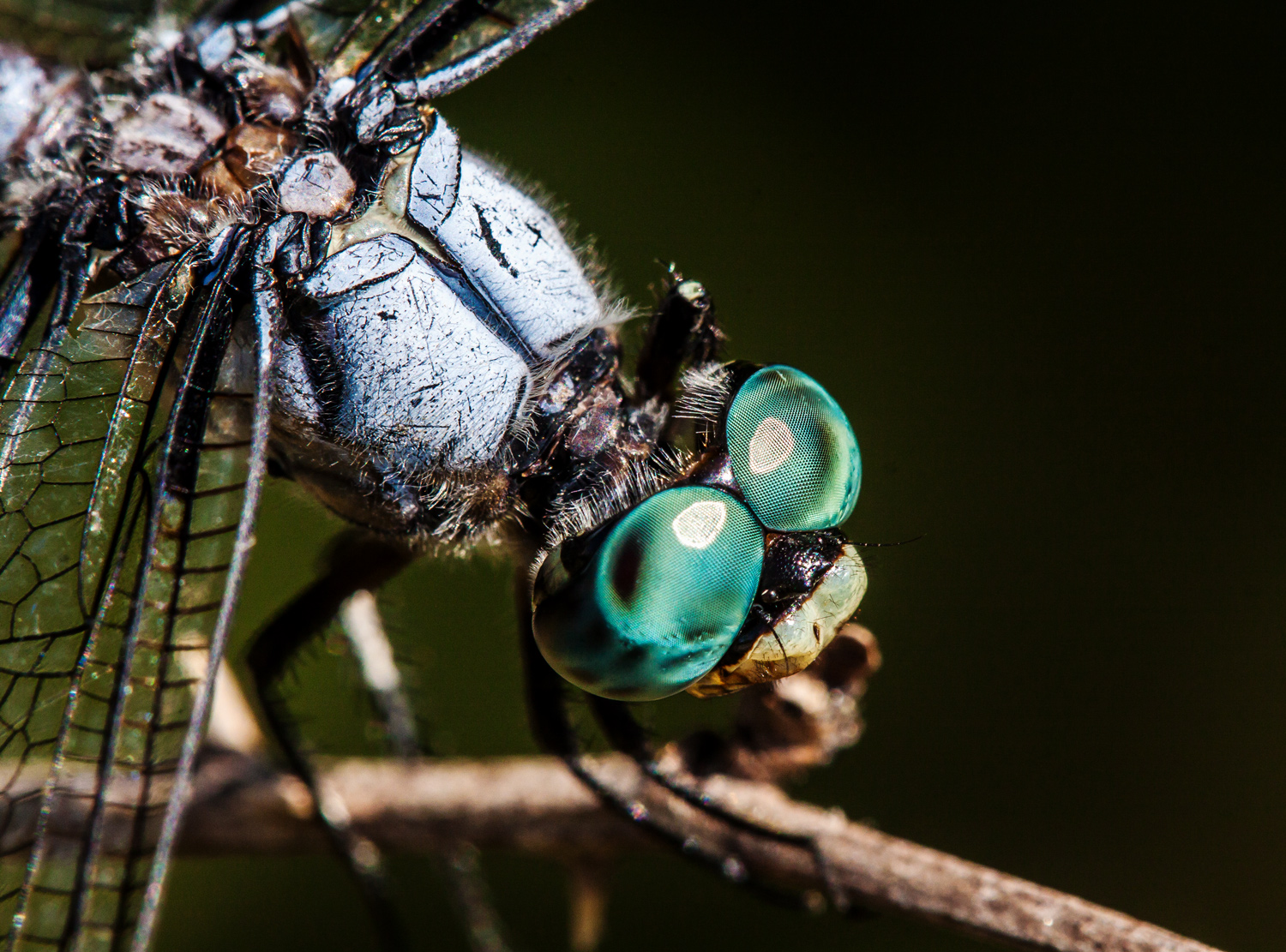
It almost looks like this Great Blue Skimmer dragonfly (Libellula vibrans) was wearing cool wraparound sunglasses this past weekend when I spotted him chilling out at Occoquan Bay National Wildlife Refuge. From a distance, it looks like dragonflies have smooth bodies, but when you get a good look up close, you discover that they have tiny hairs covering various parts of their bodies.

Great Blue Skimmer

© Michael Q. Powell. All rights reserved


Read Full Post »

When recently at Occoquan Bay National Wildlife Refuge I spotted these two damselflies, which an expert identified as probable Big Bluets (Enallagma durum), I initially thought they were mating. Then I realized that the positions were all wrong and the nibbling on the neck was probably indicative of a literal hunger. Yikes.

As Tina Turner once sang, “What’s love got to do with it?”

damselflies

daamselflies

© Michael Q. Powell. All rights reserved

Read Full Post »
When you check out spider webs really carefully, you can often discover really cool-looking tiny spiders, like this Arrowhead Orb Weaver spider (Verrucosa arenata) that I spotted yesterday at Occoquan Bay National Wildlife Refuge. If you look really closely in between its uppermost legs, you can see some of its multiple eyes looking straight at you. Information on BugGuide.net indicates that this spider is unusual because it rests in the web with its head up, not head down like most other Orb Weavers.

It’s hard to get a sense of scale when you look at this image, but I’d estimate that this little spider was less than an inch in length (25 mm). It was hanging in the air in its web at the edge of a trail when I first spotted it. I was able to move in pretty close with my macro lens—unlike many other spiders, it did not scurry away to the edge of the web. Sharpness is always an issue when shooting at at close range, but my monopod helped to steady me enough to get a relatively sharp image.

You may not like spiders, but you have to admit that this is a cool-looking spider.

Arrowhead Orb Weaver

© Michael Q. Powell. All rights reserved

Read Full Post »

Dragonflies have amazing compound eyes that wrap around their heads. With up to 30,000 facets (ommatidia, to be technical), dragonflies have incredible vision and can even see colors beyond human visual capabilities, like UV light. For an easy to read discussion about dragonfly eyes, i.e. not overly scientific, check out this posting by “grrl Scientist” that was posted on scienceblogs.com.

I captured this close-up image of a Great Blue Skimmer dragonfly (Libellula vibrans) yesterday at Occoquan Bay National Wildlife Refuge. At least once a season, I manage to get a shot like this when a cooperative dragonfly lets me get close. I captured the image below with my trusty Tamron 180mm macro lens on my Canon 50D DSLR. This lens, which has a longer focal length than most macro lenses, gives me some stand-off distance so I can get a macro shot like this without actually being on top of the subject. The only downside to the lens is that it has no built-in image stabilization, so I have to pay extra attention to remaining steady when shooting with it—I generally use a monopod to help reduce camera shake and I think it helped for this image.

The image is framed just as I saw it in my viewfinder. Most of the time I end up cropping my images as part of my normal post-processing, but in this case it looked pretty good without any cropping whatsoever.

Great Blue Skimmer

© Michael Q. Powell. All rights reserved

Read Full Post »

Imagine an insect so powerful that it is reportedly able to take down a hummingbird. Then give it the macabre monniker of Red-footed Cannibalfly (Promachus rufipes). If I were an insect, I would be really worried. Actually I don’t think that I would want to allow one to bite me, because a cannibalfly stabs its prey with its proboscis and injects saliva that help to liquify the prey’s insides. Then the cannibalfly sucks out the liquid through its proboscis.

I don’t know why exactly, but the last week or so I have seen a lot of Red-footed Cannibalflies during my trips to Occoquan Bay National Wildlife Refuge. Here are a few of my recent shots. The first one reminded one of my Facebook viewers of The Lorax, a Dr. Seuss character with a big mustache. Maybe this insect needs to overhaul its public image so that it is viewed as being less threatening. One possible first step might be to change its name to the Bee Panther, a nickname that is sometimes used for this species.

On a side note, each of the last four years, including this year, a 2013 posting entitled simply Red-footed Cannibalfly has been my most viewed posting. If I calculated correctly, the posting has been viewed almost 2400 times, including 293 times in 2018.

Why is that posting so popular? Apparently a lot of people do Google searches for “red-footed cannibalfly” and stumble onto my blog posting. I’m proud of a number of my postings and the images that I have captured, but I must confess that I don’t consider that 2013 posting as one of my best.

It’s a little scary to think that I may be inextricably linked in some people’s minds with Red-footed Cannibalflies. Yikes!

Red-footed Cannibalfly

Red-footed Cannibalfly

Red-footed Cannibalfly

© Michael Q. Powell. All rights reserved.

Read Full Post »
This image is a little gruesome, but here is a close-up look at an Eastern Pondhawk dragonfly (Erythemis simplicicollis) as it consumed a damselfly that it had captured this past Monday at Occoquan Bay National Wildlife Refuge in Northern Virginia. The second image shows a different Eastern Pondhawk with a different damselfly—the pondhawks seemed to have a particularly voracious appetite that day.

Eastern Pondhawk

Eastern Pondhawk

© Michael Q. Powell. All rights reserved.


Read Full Post »

When you closely at flowers, you discover all kinds of cool insects, like this Ailanthus Webworm Moth (Atteva aurea) that I spotted yesterday at Occoquan Bay National Wildlife Refuge. My eyes were drawn to the colorful pattern on the body of this insect, which I initially assumed was some kind of beetle. Because of the distinctiveness of the pattern, it was not hard to identify it after a Google search, but I was a bit surprised to learn that it is a moth, not a beetle.

I thought that this was my first time spotting this moth, but a search of my blog shows that I saw one in 2016 and did a posting entitled Not a Beetle. Although my memory may not be perfect, apparently my reaction was almost identical both times.

Ailanthus Webworm moth

© Michael Q. Powell. All rights reserved.

Read Full Post »

Most folks are familiar with the comic book hero the Green Hornet, but have you ever seen a green bee? I don’t see them very often, so I was pretty excited to spot this one in some flowers last weekend at Occoquan Bay National Wildlife Refuge. I think this kind of bee is generally known as a metallic green sweat bee and is of the genus Agapostemon.

green bee

© Michael Q. Powell. All rights reserved.

Read Full Post »

« Newer Posts - Older Posts »