Feeds:
Posts
Comments

Archive for the ‘Macro Photography’ Category

It is pretty cool that a website (cracked.com) chose to use one of my photos in an article entitled “6 Insanely Colored Versions of Normally Boring Animals.” It is this photo that I took during the summer of my favorite insect, the Handsome Meadow Katydid and I featured in a posting called Rainbow Grasshopper.

rainbow1_blog

Check out the article at http://www.cracked.com/article_20811_6-insanely-colored-versions-normally-boring-animals.html .

© Michael Q. Powell. All rights reserved.

Read Full Post »

I don’t know what it was about Autumn Meadowhawk dragonflies, but they really seemed to like to perch on me during several sessions when I was stalking them with fellow photographer and blogger Walter Sanford, who was able to capture shots of them (including mating pairs) on various parts of my clothing and body. His shots are wonderful and provide some great views of these colorful dragonflies, which seem to have disappeared with the arrival of frigid weather in our area.

waltersanford's avatarwalter sanford's photoblog

Autumn Meadowhawk dragonflies (Sympetrum vicinum) like Mike! Mike Powell, that is, a.k.a. “Meadowhawk Mike.” The following photos were taken at Huntley Meadows Park on 15 November 2013. Each set of images, or individual image, features a different dragonfly (or dragonflies) perching on Mike at various times during the day. Disclaimer: No dragonflies were either injured or killed in the making of these photos.

Now you see it; now you don’t! A male dragonfly perching on Mike’s shoulder, that is. Or was.


A time-series of images showing a mating pair in tandem. Mating pairs are usually more skittish than this male and female.


Sometimes the same dragonfly — or more than one dragonfly — perched in different places.


Another male, testing a couple of perching places.


A male on Mike’s arm.


This isn’t an optical illusion — a male dragonfly actually is…

View original post 133 more words

Read Full Post »

Could this be the mascot for a new line of clothing or shoes? Dragonfly photographer extraordinaire Walter Sanford took these shots of a beautiful female Autumn Meadowhawk perched on my hand as I tried to move it closer to the messenger bag in which I carry my camera gear.

waltersanford's avatarwalter sanford's photoblog

The preceding gallery shows a female Autumn Meadowhawk dragonfly (Sympetrum vicinum), spotted at Huntley Meadows Park on 15 November 2013. She is perching on the hand of Mike Powell, fellow wildlife photographer and blogger. This individual is not the female featured in my last post, “Champion dragonfly.”

Copyright © 2013 Walter Sanford. All rights reserved.

View original post

Read Full Post »

Fellow photographer and blogger, Walter Sanford, has an incredible talent for capturing photos of dragonflies, in this case one that was perched on the sleeve of my sweatshirt.

waltersanford's avatarwalter sanford's photoblog

The following gallery features photos of the undisputed champion dragonfly!

This individual is a female Autumn Meadowhawk dragonfly (Sympetrum vicinum), spotted at Huntley Meadows Park on 15 November 2013. She is perching on the sleeve of Mike Powell’sChampion USA sweatshirt.

Hey Champion, how ’bout a little something, you know, for the product placement in my photos?

Copyright © 2013 Walter Sanford. All rights reserved.

View original post

Read Full Post »

When an Autumn Meadowhawk dragonfly (Sympetrum vicinum) landed on my thigh last Friday, my first thought was to get a photograph of him. Fortunately, my 100mm macro lens was already on my camera—in anticipation of a shot like this—and I was able to capture a close-up, eye-to-eye portrait of the dragonfly by contorting my body and attempting to stabilize my shooting position.

My blue jeans were broken in and their texture, color, and pattern made a pretty cool backdrop for this colorful dragonfly. It may be my imagination, but he seemed to be looking up at me with a mixture of curiosity and amusement.

For whatever reason, many of these dragonflies, which I was able to observe as recently as yesterday, do not seem fearful of people. The classic Drifters song from the 1960’s may talk of spending time with your sweetheart under the boardwalk, but these Autumn Meadowhawks seem to spend most of their time warming up on (and not under) the boardwalk, with periodic mating forays into the bushes.

dragonfly1_denim_tight_crop_blog

Click on the photo to see it in higher resolution.

© Michael Q. Powell. All rights reserved.

Read Full Post »

It may be mid-November, but one hardy dragonfly species is still around here in Northern Virginia—the Autumn Meadowhawk (Sympetrum vicinum).

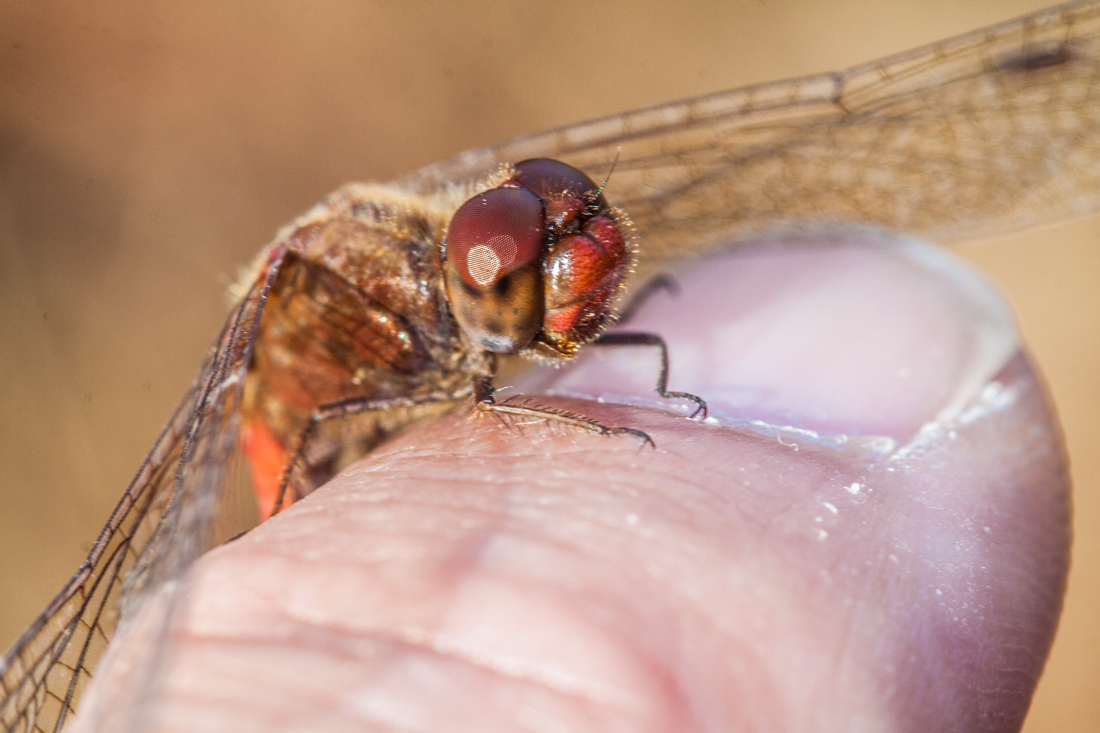
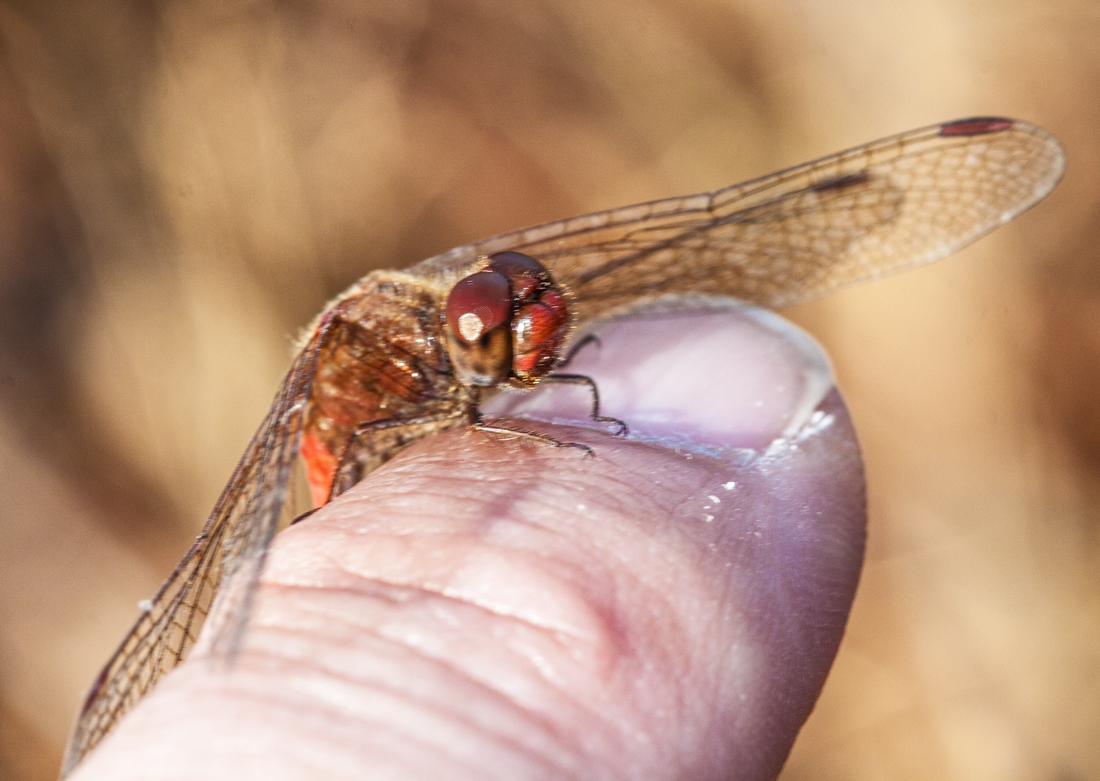
The dragonflies were unusually friendly today, perching on my sweatshirt and jeans numerous times, though they spent most of the time trying to warm themselves in the sun on the boardwalk. Here is a close-up shot of a male Autumn Meadowawk that I coaxed onto my fingertip yesterday at Huntley Meadows Park. All I had to do was slowly move my finger forward and several times a dragonfly accommodated by crawling onto the finger.

Needless to say, it was an interesting challenge trying to hold one finger out as far as I could and then focus and shoot my DSLR with the other hand. Fortunately I had switched to my macro lens—my arms would not have been long enough to get within the minimum focusing distance of the telephoto zoom lens that I had been using earlier in the day. Click on the photos to get a higher-resolution look at the details of the dragonfly’s compound eyes.

dragonfly_finger2_blogdragonfly_finger1_blog

© Michael Q. Powell. All rights reserved.

Read Full Post »

We’re starting to get down to the last insects of the season, and fuzzy brown caterpillars are among the few insects that I still see. Some of these are Banded Wooly Bear caterpillars (Pyrrharctia isabella) that supposedly help tell how severe the winter will be, though I confess that I can never remember how you are supposed to judge, i.e. does a wide middle section mean a short winter or a long one?

When I first took this shot, I thought the subject was a wooly bear caterpillar, but the more I look at it the less certain I feel. There seems to be a black tip on only one end of the caterpillar rather than at both ends. Despite the uncertainty about identification, I really like the shot and the way that I was able to isolate the caterpillar from the background.

fuzzy_brown_final_blog

© Michael Q. Powell. All rights reserved.

Read Full Post »

Some spiders can be creepy, but others are quite beautiful, like this one that I photographed earlier this month at my local marshland park. I am catching up a bit on posting photos from this month that I really liked and thought it might be good to post a spider image on Halloween night. I have not yet been able to identify this spider, but noted that it did not have a web and seemed to be lying in wait for prey on the long leaf of this plant. I’d welcome assistance in identifying the species of spider,

spider_halloween_blog

© Michael Q. Powell. All rights reserved.

Read Full Post »

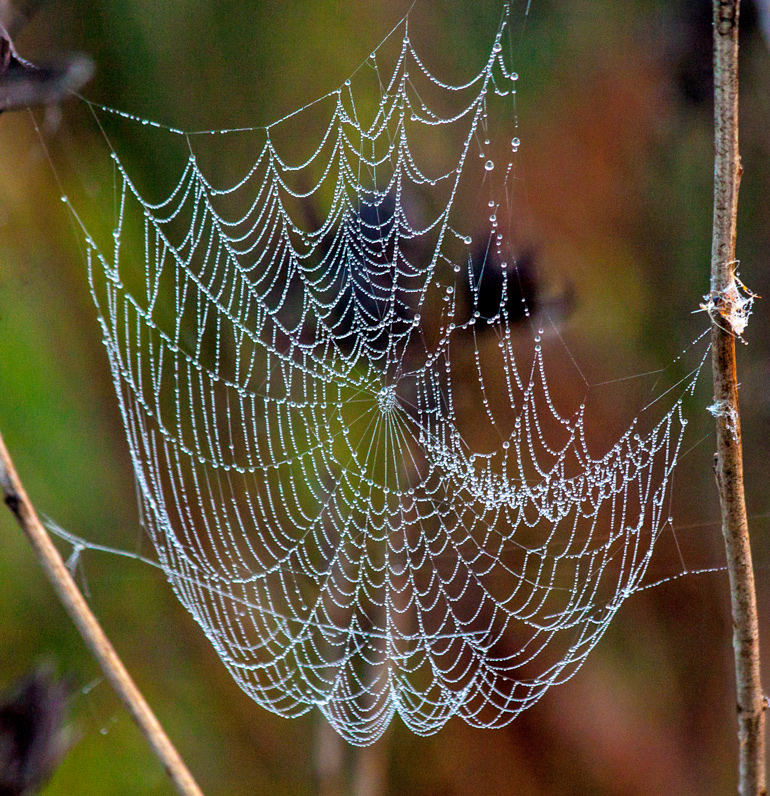
On Halloween night, it somehow feels appropriate to post this photograph of a spider web that I took earlier this month. Some people find spider webs (and spiders) to be creepy, but I find them to be fascinating.  I look at spider webs as a form of beautiful natural art, filled with wonderful geometric shapes and designs and always marvel at the ability of spiders to weave them.

web_halloween_blog

© Michael Q. Powell. All rights reserved.

Read Full Post »

Turnabout is fair play. In one of my earlier posts entitled “Dragonflies mating on a calf” I featured Walter Sanford, a fellow photographer and blogger. Today, in a posting called “The natives are friendly.” he featured my arm and finger as I tried to charm a couple of different dragonflies to perch on my index finger.

waltersanford's avatarwalter sanford's photoblog

Most dragonflies are skittish. Some dragonflies are “friendly,” such as Blue Corporal dragonflies (Ladona deplanata). Autumn Meadowhawk dragonflies (Sympetrum vicinum) are friendly; sometimes very friendly!

Mike Powell and I visited Huntley Meadows Park recently. We stopped to “charm” dragonflies a couple of times during our photowalk. The following gallery shows two different male Autumn Meadowhawk dragonflies perching on Mike: Photos 1-2 show Mike coaxing a dragonfly onto his finger; Photos 3-4 show another dragonfly perching on Mike’s arm.

Tech Tip: Either mouse-over or tap photos to see captions.

Copyright © 2013 Walter Sanford. All rights reserved.

View original post

Read Full Post »

This past weekend I traveled with some friends to photograph a large grove of ginkgo trees at the Blandy Experimental Farm of the State Arboretum of Virginia in Boyce, VA. It was a beautiful day, with bright blue skies, and I took some shots that I will probably include in a more extended post, but I wanted to give you a sneak preview of the really-cooling looking leaves of the ginkgo (Ginkgo biloba) tree, a tree that dates back at least 270 million years, judging from ginkgo leaf fossils that have been uncovered.

GInkgo Vertical blog

© Michael Q. Powell. All rights reserved.

Read Full Post »

Despite the frost that we’ve had the last few mornings, the gorgeous Morning Glory flowers of my neighbors continue to flourish. I photographed one of the flowers yesterday afternoon—does that make it an afternoon glory?

When you look at the photo it looks like I used flash, which caused the background to go black. However, if you look carefully at the way the light falls, with some of it coming from the back, you realize I would have had to use an elaborate multi-light setup to get this kind of lighting. I took this shot in the early afternoon, with the light mostly coming from the side and back of the flower.

My fellow photographer and blogger CIndy Dyer says that the shadow in the bottom area of the white part of the flower looks like a photographer (possibly with a bald head) with a camera and long telephoto lens and she initially thought I had somehow managed to get a reflection of myself onto the flower. We may have spent too many hours yesterday out in the sun with our cameras!

Glory Photographer blog

© Michael Q. Powell. All rights reserved.

Read Full Post »

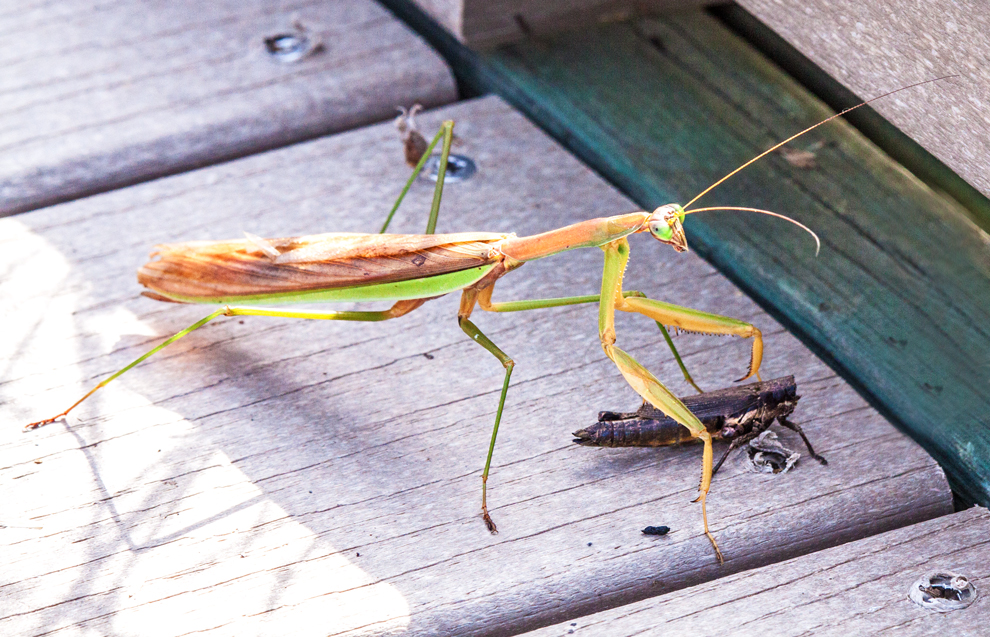
When this praying mantis began to straddle a hapless grasshopper, I wasn’t sure what was going to happen, but suspect that the grasshopper may have been the one that began to pray.

Was the mantis looking at the grasshopper as a potential mate or a potential meal? With praying mantises, the question of mate or meal is a little complicated, because some females reportedly bite off the heads of the males after mating.

As it turned out, the praying mantis ignored the grasshopper and simply climbed over him and the grasshopper’s prayer undoubtedly turned into one of giving thanks.

mantis_grasshopper_blog

© Michael Q. Powell. All rights reserved.

Read Full Post »

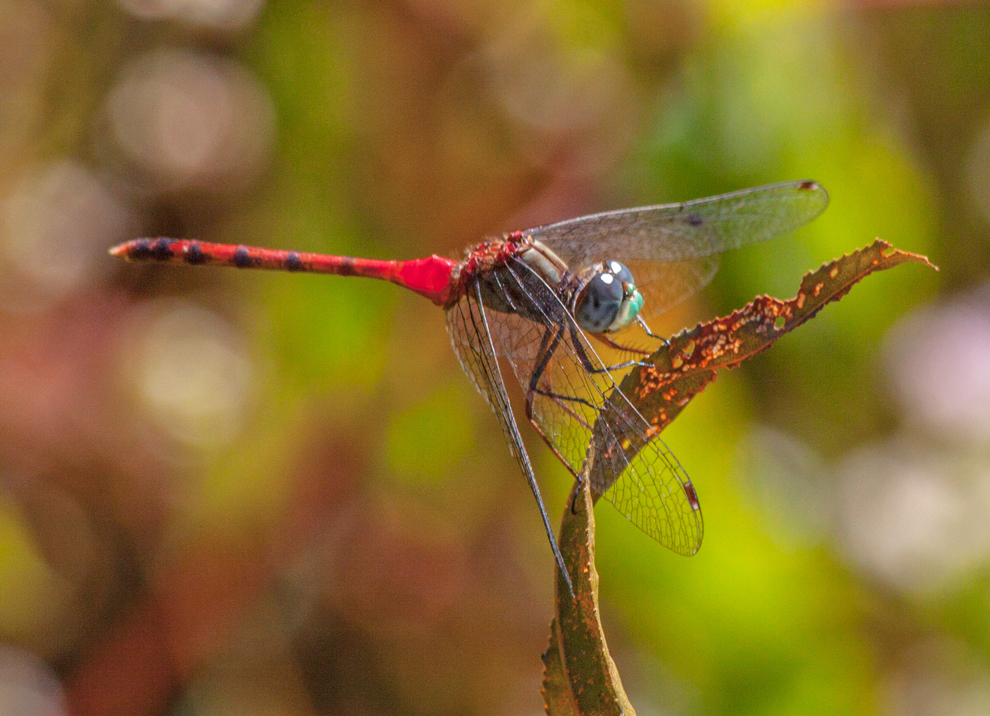
When this bright red male Autumn Meadowhawk dragonfly landed briefly on my fellow photographer’s white sneaker yesterday, it suddenly struck me that we might have hit on a potential fall fashion fad. Why not accessorize plain shoes with colorful dragonflies in seasonal colors? We could start with the Autumn Meadowhawk for fall and perhaps move on to the Common Whitetail as the snow begins to fall. Spring could bring on the Green Darner and summer could feature the Blue Dasher.

Of course, we couldn’t use real dragonflies, but they could serve as models for pin-on or clip-on dragonflies. Size-wise, it looks like this Autumn Meadowhawk is about the right size.

Now that I have a marketing idea, all I need is investors.

dragonfly_sneaker_blog

© Michael Q. Powell. All rights reserved.

Read Full Post »

There is something a little wistful about searching for the last dragonfly of the year. Most of the familiar dragonflies from the summer have disappeared and it looks like the sole remaining dragonfly in our area is the Autumn Meadowhawk dragonfly (Sympetrum vicinum).

Yesterday I spent some time trying to photograph this dragonfly along with fellow photographer and blogger Walter Sanford, who has an amazing collection of photographs of dragonflies on his blog site, including a world-class series on the Blue-faced Meadowhawk. I was willing to try to capture photos of any dragonfly that I could spot, but Walter noted that he had taken enough photos of the male Autumn Meadowhawk and was really interested in photographing females or, even better, mating pairs.

The mating pairs tended to elude him most of the day, until suddenly a pair in the “wheel” position circled around us and landed on his bare calf—talk about unprotected sex. There was no way that he could twist himself around to get a good photo, but I manage to get this shot of the two dragonflies in action.

Temperatures are supposed to continue to drop this week, so there is always a chance that these will be the last dragonflies that I see this year, though I will be out searching for them for weeks to come before I bid my final adieu to them.

wheel_leg_blog

© Michael Q. Powell. All rights reserved.

Read Full Post »

As the outside temperatures continue to drop, I am seeing fewer and fewer spiders. This is one of my favorite recent shots of what I think is a barn spider. I really like the way that the spots in the background mirror the spots on the spider’s abdomen.

I think that this may be a Neoscona crucifera spider, though it may be an Araneus cavaticus spider. Strangely enough, both of them are sometimes known as barn spiders.

orange_spider2_blog

© Michael Q. Powell. All rights reserved.

Read Full Post »

Perhaps the old adage that “opposites attract” applies to grasshoppers too. When I photographed this intimate moment on a leaf, I couldn’t figure out for sure what was going on.

Perhaps the grasshopper was attracted by the bright colors of the Handsome Meadow Katydid and was trying to start a conversation.  Maybe this was a blind date set up by some well-intentioned friends. Is it possible they matched on a lot of points in the insect version of Match.com?

I have photographed grasshoppers and katydids separately, but this is the first time I have them both in a single image. It is fascinating to be able to compare the bodies of the two species and note the differences in the eyes, the legs, and many other parts.

The striking colors of the Handsome Meadow Katydid have always drawn my attention, but I am left with one question to ponder. Do grasshoppers even see in color or only in shades of gray?

grasshopper_encounter_blog

© Michael Q. Powell. All rights reserved.

Read Full Post »

I am not really sure what these spiders were doing, but it looked to me like they were engaged in a game that I played as a child called “King of the Hill.” The objective of the game was to climb to the top first and then to repel the efforts of the others trying to unseat you and take your place.

The two spiders seemed to be racing to the top of this plant’s stalk in the first photo and the second image shows that the one on the left was the winner. Somehow that second image reminds me of the iconic shot of King Kong on the Empire State Building, clutching the spire of the building.

It was a challenge trying to track moving subjects like this with a macro lens and my need for a higher shutter speed caused me to sacrifice some depth of field. I do like the simple, uncluttered composition that I was able to achieve and the fact that I was able to capture these little spiders in action.

spider_games2aspider_games1a© Michael Q. Powell. All rights reserved.

Read Full Post »
Here’s another shot of one of the numerous spiders that I observed yesterday at my local marsh, which I have not yet been able to identify.

This one was pretty big and seemed to be putting out a lot of silk, one strand at a time. If you look closely, you can spot numerous eyes and a cool orange racing stripe down the middle of its face. I took this shot from a low angle so that I could capture the spider with the sky as the partial backdrop.spider_sky_blog

© Michael Q. Powell. All rights reserved.

Read Full Post »
There seemed to be spiders everywhere at the marsh today. When I arrived in the morning, there were webs all over the place, though not the kind that orbweavers make—plants were simply covered with web-like material. Later in the day I saw all kinds of spiders scurrying along the boardwalk and even flying through the air in a process known as ballooning.

I saw a lot of one of my favorite type of spiders, the jumping spider. I am still downloading my images from today, but here is an advance preview, an image of a jumping spider that had crawled onto part of the railing of the boardwalk. I love the details of the spider, especially the eyes, and even the peeling paint of the railing.

spider_jump1_blog

© Michael Q. Powell. All rights reserved.

Read Full Post »

I haven’t seen many big spiders this fall, but I did come across this spiderless web early one morning recently. The morning was damp and foggy and the droplets of water on the web made it easier to spot in the cattails of the marsh. Using manual focusing, which is still a challenge for me with my DSLR, I was able to capture this image of the web. If you click on the image, you can see the beads of water that look like tiny strands of transparent pearls.

web_fall_blog

© Michael Q. Powell. All rights reserved

Read Full Post »

I don’t expect to see new species of dragonflies at this time of the year, but one of my fellow photographers, Walter Sanford, has been stalking the Blue-faced Meadowhawk (Sympetrum ambiguum) almost daily and I joined him for a few hours one late September day and got this shot.

I learned quickly that these dragonflies are hard to spot, despite their conspicuous coloration. They seem to like to remain perched down low in the vegetation and wait for their prey, rather than fly around when they are hunting.

I love the combination of colors on the Blue-faced Meadowhawk and I was happy to get a decent shot that shows its blue face. If you want to see more shots of this beautiful dragonfly, check out Walter’s blog posting from yesterday.

I am now in search of the Autumn Meadowhawk, the last dragonfly that I observed last fall. Normally they should be here already, but none of my fellow dragonfly followers has observed any of them yeat.

blue-faced1_blog

© Michael Q. Powell. All rights reserved

Read Full Post »

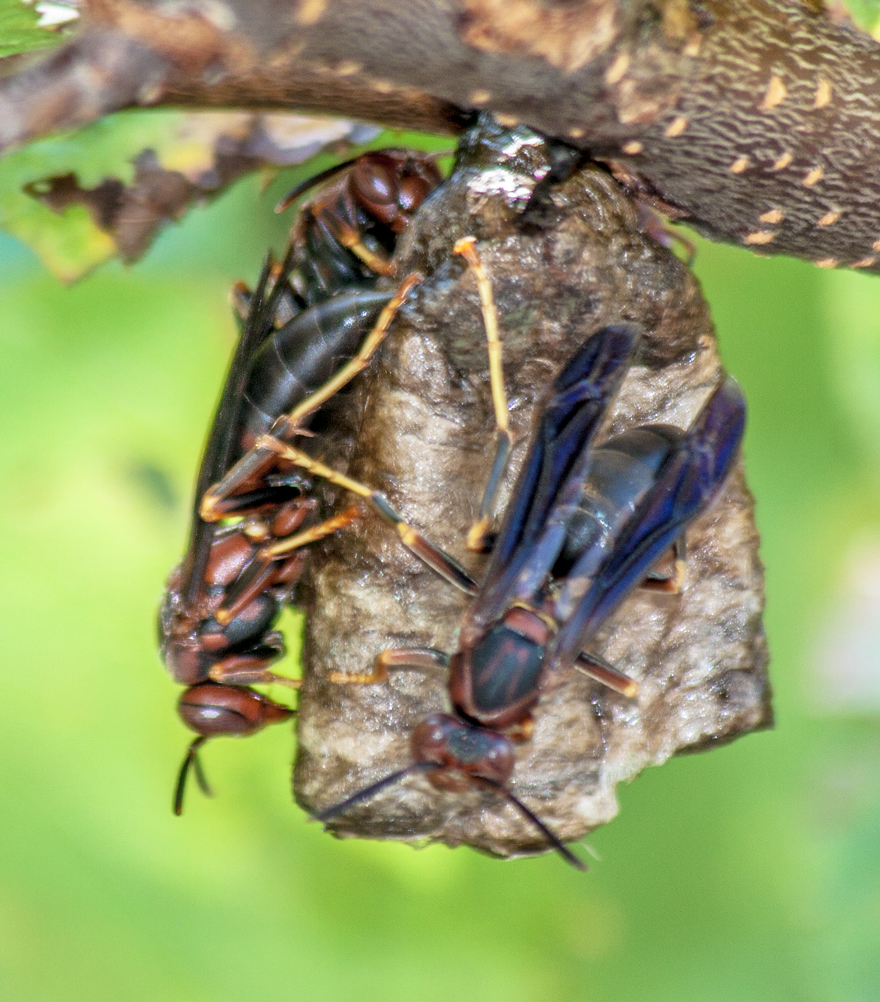
” Do you want to get some shots of a wasp nest?” I was at a loss for words when a fellow photographer excitedly posed that question to me this past weekend. I had visions of an enormous cluster of very large and angry insects and I hesitated for a long moment before finally agreeing.

What had I gotten myself into? It turns out that my fears were greatly exaggerated and the nest was a very modest one, not much bigger than the wasps themselves. My fellow photographer had been told that they are paper wasps and it looks to me like they may be brown paper wasps, judging from some of the photos that I have seen on-line.

I am hoping that the nest doesn’t get too big, because it is near a path that I regularly use. There were not a lot of wasps present yet, but they looked pretty fierce and I kept my distance and used my telephoto zoom at the far end of its range.

wasp_nest_blog

© Michael Q. Powell. All rights reserved

Read Full Post »

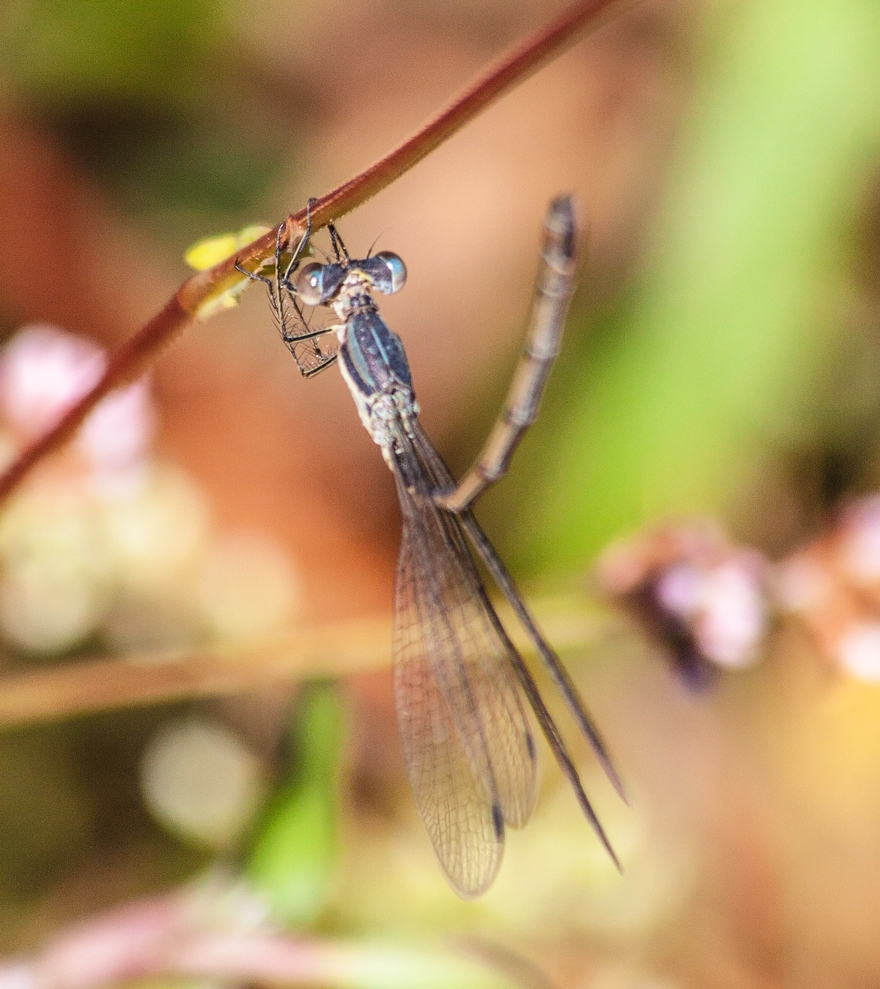
I featured this Slender Spreadwing damselfly (Lestes rectangularis) in an earlier posting in a series of action shots, but thought this more formal portrait deserved a posting of its own.

As I stalked this beautiful little dragonfly, it moved to a number of different perches and it is interesting to see how the background shifted in terms of color palette and clutteredness (I think I may have just created a new word). In the gymnastics shots of this damselfly, the background was bright and colorful and a little busy, whereas the background here is darker and a bit more moody, with just a hint of colors. Be sure to click on the image to see a higher resolution view of this little damselfly that was probably less than 2 inches ( 50 mm) long.

Those of you who like to observe damselflies know that this species is an exception to the general rule that damselflies, unlike dragonflies, hold their wing close into and parallel to their bodies when at rest. My fellow photographer and blogger, Walter Sanford, an expert on dragonflies, was the one who first spotted this damselfly and you should check out his blog for lots of wonderful wildlife photos, including a recent image of a perched Wandering Glider dragonfly, a species that never seems to land.damsel_spread_blog

© Michael Q. Powell. All rights reserved

Read Full Post »

As I was observing this Slender Spreadwing damselfly (Lestes rectangularis) earlier this week, it suddenly launched into a series of acrobatic maneuvers worthy of an Olympic gymnast on the high bar. I captured several action shots of the routine, possibly related to laying eggs, although I managed my clearest shot when the damselfly returned to its starting position and waited for the scores from the judges.

Pointing the toes for maximum extension

Pointing the toes for maximum extension

damsel_spread2_blog

Swinging back to generate greater velocity for the next trick

Finishing up the routine

Finishing up the routine

Waiting for the scores from the judges

Waiting for the scores from the judges

© Michael Q. Powell. All rights reserved

Read Full Post »

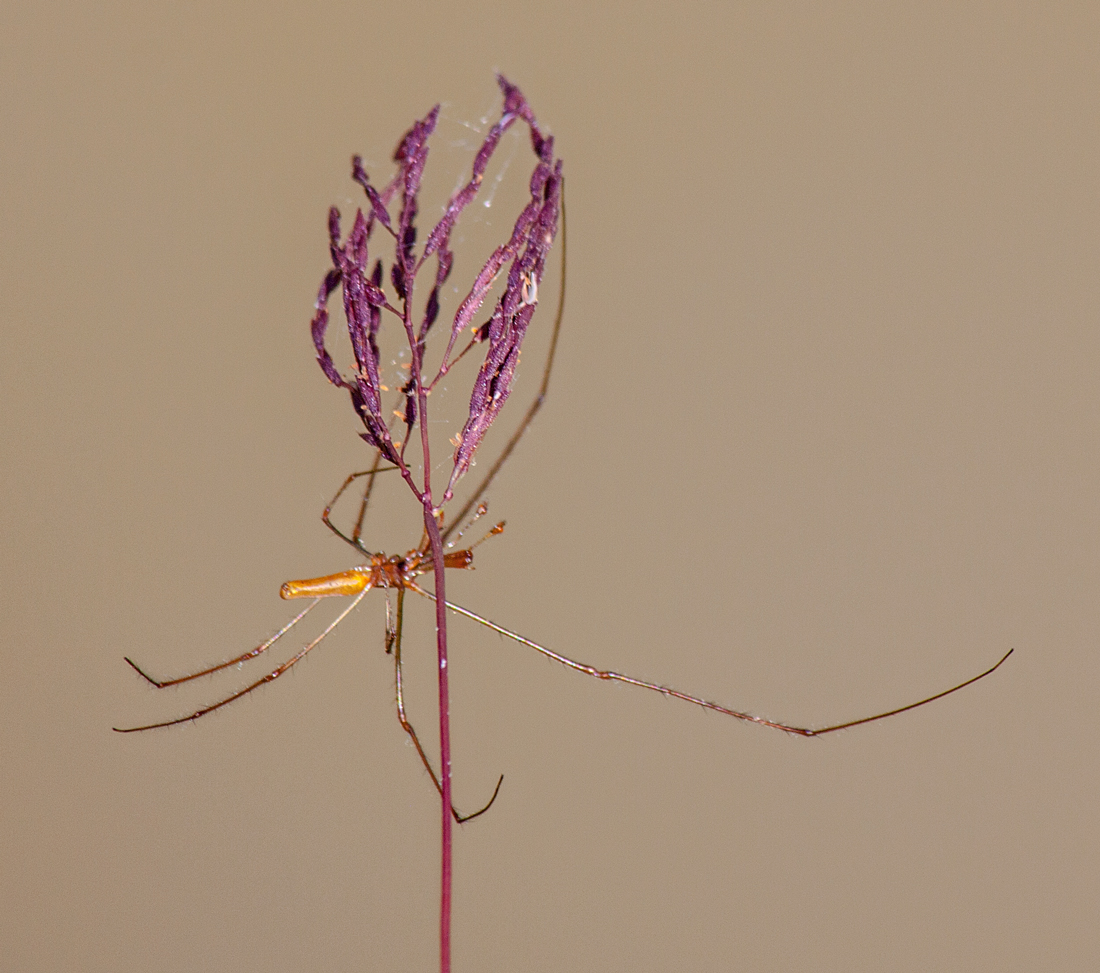
This long-jawed spider is not really camouflaged, of course, but it positioned itself in such an artistic way that its elongated body and legs seem to be an extension of the plant, especially from a distance. The plant was growing at the edge of a small pond at my local marsh and the brown background color is the water of the pond.

spider_purple_blog

Click on the image to get a higher resolution view of it.

© Michael Q. Powell. All rights reserved

Read Full Post »

A familiar subject can look quite different when viewed from an unusual angle. It’s a lesson that every photographer is taught early on, but I need constant reminders to vary my approach.

I took this shot of a Viceroy butterfly (Limenitis archippus) yesterday while lying on the ground and pointing my telephoto lens up toward the sky. The perspective caused the shape of the wings to be different and permitted me to see the butterfly’s legs in a way that was completely new.

Not all such experiments are successful, of course, but I think that this one worked out pretty well.

looking_up_blog

Click on the photo to see a higher resolution view.

© Michael Q. Powell. All rights reserved

Read Full Post »

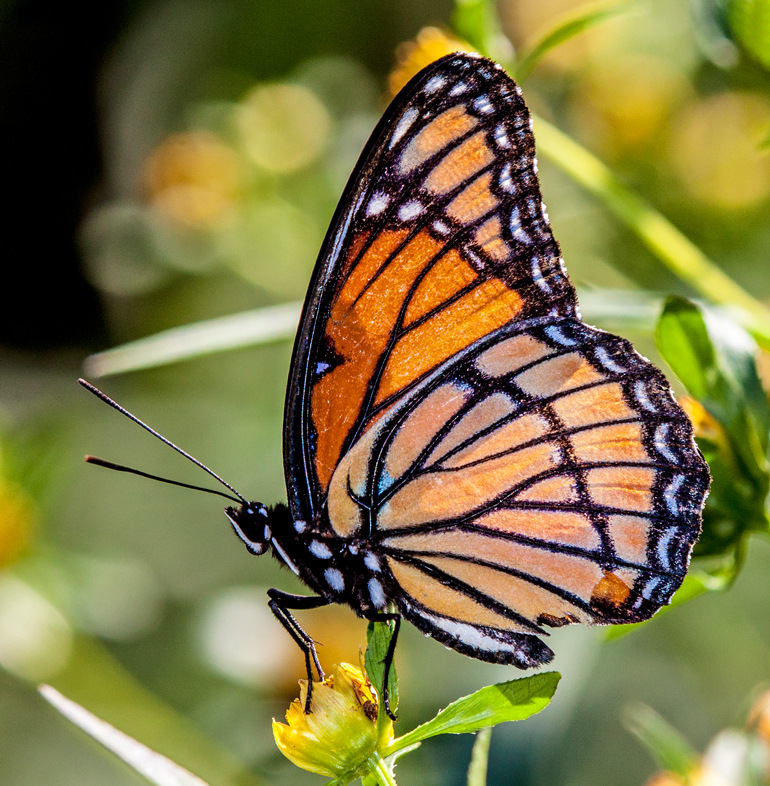
The days are getting cooler and leaves are starting to wither and fall, but there are still signs of the lingering summer, like this beautiful Viceroy butterfly (Limenitis archippus) that I photographed this past weekend. viceroy_bokeh_blog

© Michael Q. Powell. All rights reserved.

Read Full Post »

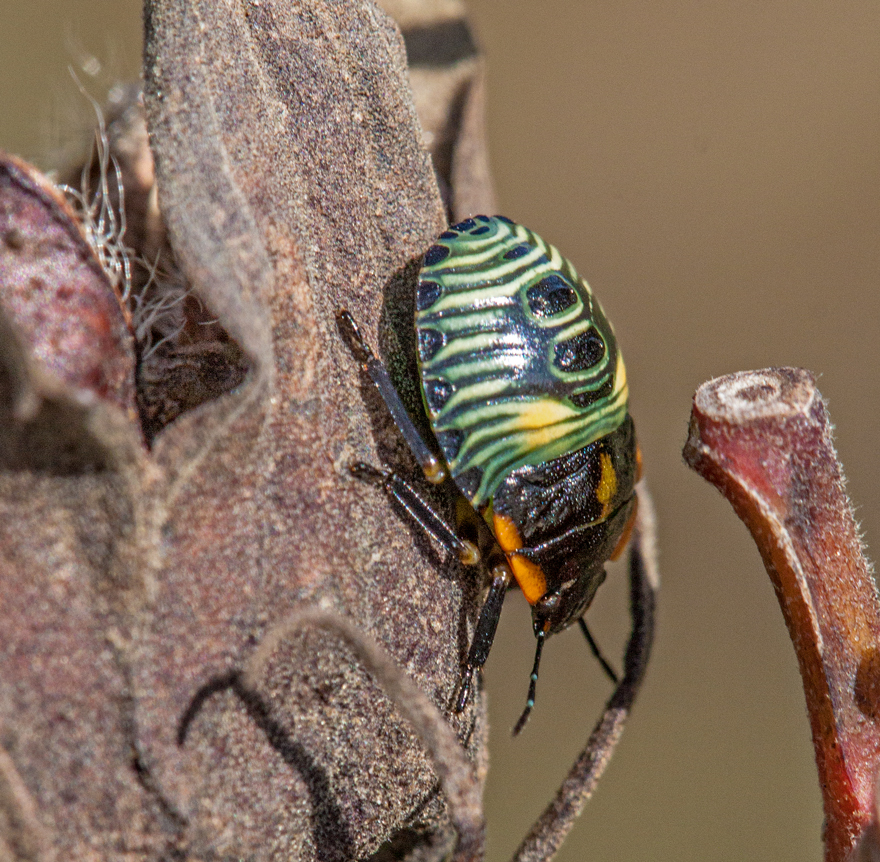
All the leaves are brown and the sky is gray as fall arrives in my local marsh, but there are still occasional spots of bright color, like this beetle that I encountered yesterday, crawling down a withered leaf. I have not been able to identify it, but its bold pattern and colors remind me of the art and fashions of the late 1960’s, when no combination was too wild. I graduated from high school in 1972 and still recall wearing some pretty wild-looking clothes.

Somehow I think the pattern on the beetle’s back would work well on a necktie. I guess it’s a commentary on how my life has progressed that I now think more in terms of neckties than tie-dyed t-shirts.

colorful_bug_blog

© Michael Q. Powell. All rights reserved.

Read Full Post »

Imagine how skinny this fuzzy white caterpillar would appear if its fur were “groomed,” like some of the dogs in my neighborhood. There is one fuzzy white dog, in particular, that looks huge, which I think is a Great Pyrenees. I was shocked one day when I saw that dog with closely cropped fur—it looked to be only half of its normal size.

For some reason, this caterpillar’s hair seems to be more tufted than usual, compared to similar caterpillars that I have seen. Maybe the hair is bunched because of the heavy dew or the way that the caterpillar slept. Clearly the caterpillar is having a bad hair day.

Do you think it could get away with wearing a hat to cover the bad hair?

really_fuzzy2_blogreally_fuzzy1_blog

© Michael Q. Powell. All rights reserved.

Read Full Post »

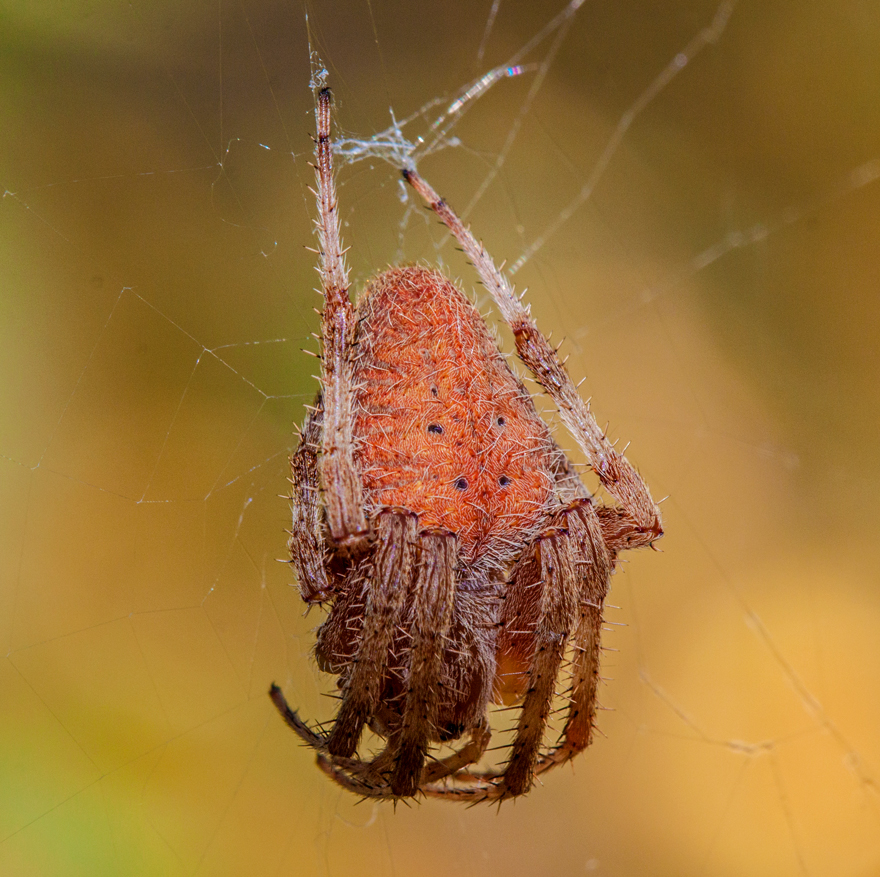
Walking along the boardwalk at my local marsh, I encountered this fairly large, hairy red spider in a web almost at eye level.

It was a little disconcerting to look a spider in the eye (eyes) at such close range, but it did allow me to get a pretty detailed shot at close range against an uncluttered background. I’ve been searching around on the internet, attempting to identify the spider but so far have not had any success. Can anyone identify this cool-looking spider?

orange_spider1_blog

© Michael Q. Powell. All rights reserved.

Read Full Post »

« Newer Posts - Older Posts »