Feeds:
Posts
Comments

Archive for the ‘Macro Photography’ Category

Many of my photographer friends have been posting photos of hummingbirds and I felt a little left out. I didn’t see any yesterday, but did spot several Snowberry Clearwing moths (Hemaris diffinis) at Occoquan Bay National Wildlife Refuge. This species, along with other clearwing moths, is sometimes called a “hummingbird moth” because of its appearance and behavior, which reminds some folks of a hummingbird.

Most of the times in the past that I have seen a hummingbird clearwing moth, it has been a “cousin” of this species, the very similar Hemaris thysbe. That species, however, has more red on its body and has lighter colored legs, according to the butterfliesandmoths.org website.

As you might suspect, these moths are in almost constant motion.  Its is quite a challenge, therefore, to track them and keep them in focus as they dart among the flowering plants.

As I was tracking one, a second one flew in and seemed intent on dislodging the first one. I reflexively I pressed the shutter button and was a little shocked to see that I managed to capture them both in a single frame. It’s cool that they both had their long proboscises curled up at the moment I took the shot.

Snowberry Clearwing Moth

Snowberry Clearwing moth

Snowberry Clearwing moth

© Michael Q. Powell. All rights reserved.

Read Full Post »

When I came upon this little praying mantis during a recent trip to Occoquan Bay National Wildlife Refuge, I couldn’t decide if it was the predator or the prey. Although the mantis seemed to be at least partially trapped in a spider’s web, the spider no longer seemed to be present. In addition, the mantis appeared to be trying to work its way out of the web.

There is definitely a story here, but I can’t figure out for sure what it is. You’ll have to choose an ending to the story on your own.

praying mantis


praying mantis

© Michael Q. Powell. All rights reserved.

Read Full Post »

While they have been out of town, I have been watering the flowers in my neighbors’ garden and watching (and feeding) their three cats. The garden was planted by my photography mentor, Cindy Dyer, who always selects particularly photogenic species. She asked me document some of the flowers as they bloomed in case she does not return in time to see them herself.

Yesterday I was particularly struck by the beauty of the different lilies that are now blooming. Some of them probably qualify as day lilies, but there is another cool variety that has blooms that face downward. The big star of the show, though, is undoubtedly an enormous cream-colored lily that just opened and is the one that is featured in the first photo.

Many of you know that I am generally in ceaseless pursuit of animate subjects, but it is good to periodically stop and take the time to smell the lilies.

lily

lily

lily

© Michael Q. Powell. All rights reserved.


Read Full Post »

Whenever I see a patch of milkweed I will usually stop and and watch and wait. Milkweed attracts such a colorful cast of insect characters that it reminds me a little of the Mos Eisley Cantina in the original Star Wars movie.

My patience was rewarded this past Saturday at Occoquan Bay National Wildlife Refuge when a Monarch Butterfly (Danaus plexippus) stopped by for a visit and I was able to capture this image.

Monarch butterfly

© Michael Q. Powell. All rights reserved.

Read Full Post »

Even if you find spiders a bit creepy (which I don’t), you can’t help but admire the beauty and artistry of their webs. This spider, which I think is a Black and Yellow Garden Spider (Argiope aurantia), went a little crazy with its zigzag pattern this past weekend at Occoquan Bay National Wildlife Refuge.

Most of the time the webs of these spiders have a single zigzag pattern that leads to the center of the web. This spider, which seemed smaller than many of the others of this species that I have seen, for some unknown reason decided to repeat the pattern multiple times, which helped me to spot the web more easily.

© Michael Q. Powell. All rights reserved.


Read Full Post »

Insect identification is really tough for me. When I saw this insect crawling about on the top of what I believe is a Shasta daisy, I was pretty sure that it was a beetle. Beyond that, I really had no idea what it was. A quick search on the internet made me conclude that it was a kind of scarab beetle.

I posted a photo on the website bugguide.net and asked for help. Responders provided a couple of possibilities and it looks most likely that this is an Oriental Beetle (Exomala orientalis) or (Anomala orientalis). In some ways it’s not that important to identify my subject, but it is something that I strive to do as much as I can and I usually end up learning a lot in the process of figuring out what I have shot.

I took quite a few shots of this beetle and especially like this one, because the beetle raised its head momentarily and I was able to get a look at its cool forked antennae. I also like the way I was able to capture some of the drops of water on the petals of the daisy.

In case any viewer is worried that I have given up on dragonflies, I can reassure you that I still have shots of lots of beautiful dragonflies to be posted and am always seeking more. I just figured that I would mix things up a little and provide a little glimpse at the world through my macro lens.

Oriental Beetle

© Michael Q. Powell. All rights reserved.

Read Full Post »

A macro lens helps to open up a whole new tiny world that is often beautiful and occasionally a little scary. I think that a tiny insect that fellow photographer Cindy Dyer pointed out to me in her garden yesterday fits into the latter category. The insect in question was moving about on an orange cone flower and at first we thought it might be a spider. When we counted the legs and looked a little closer, we realized it was probably a bug, a bug with massive spiked front legs and additional spikes on its body. It was a bit chilling to learn that this was the nymph of an assassin bug, a Spiny Assassin bug in the genus Sinea.

As I was taking this photo, I was reminded once again now much I enjoy macro photography. It has its own set of challenges, but it is rewarding to be able to get shots like this. In this image I particularly like the way that the spikes in the center of the cone flower mirror those of the fearsome little insect, which would be a real monster if it were larger.

Spiny Assassin Bug nymph

© Michael Q. Powell. All rights reserved.


Read Full Post »

This shot from Monday is for Cindy Dyer, my photography mentor, who used to refer to me as her “grasshopper” and taught me some important lessons when I was just starting to get serious about my photography six years ago.

Folks of a certain age may recall that “grasshopper” was the nickname used by Master Po for his young student Kwai Chang Caine in the western martial arts television series Kung Fu in the 1970’s. The name is a reference to a wonderful scene in the pilot episode for the series in which the blind teacher helps to teach his new student that “seeing” requires more than the simple use of your eyes.

Here, from Wikipedia, is a snippet of dialogue with some of the wisdom of Master Po:

Master Po: Close your eyes. What do you hear?
Young Caine: I hear the water, I hear the birds.
Po: Do you hear your own heartbeat?
Caine: No.
Po: Do you hear the grasshopper which is at your feet?
Caine: Old man, how is it that you hear these things?
Po: Young man, how is it that you do not?

In case you have never heard of the Kung Fu television series or want to relive a moment from your past, here is a link to a short YouTube video of the above-referenced scene.

As a nature photographer, I think a lot about “seeing” as I seek a closer connection with the natural world and so many of its inhabitants. My observations have caused me to conclude that the pace of the natural world is different from that of my everyday life and that I consequently have to slow down in order to be in synch with it.

grasshopper

© Michael Q. Powell. All rights reserved.

Read Full Post »

At this time of the year I generally exchange my long telephoto zoom lens for my macro lens as my primary lens. Macro photography was my first love when I started getting more serious about my  photography and it still has a special attraction for me. Besides, birds are mostly hidden by the foliage and, as you probably have noticed, dragonflies have resumed their place as my favorite subject.

A macro lens helps me capture the world in a different way, revealing details that we don’t normally see. I think that was the case yesterday when I encountered a small brown butterfly while I was walking alongside a stream. I think that it is a Northern Pearly-eye butterfly (Enodia anthedon), though there is a chance that it is an Appalachian Brown butterfly or some other species. I didn’t get a really good look at the markings of butterfly and instead concentrated on trying to get as parallel as I could to the butterfly so the eyes would be in focus.

I like the low angle shot that I was able to get, which makes the butterfly look a little bit like a bat.

Northern Pearly-eye

© Michael Q. Powell. All rights reserved.


Read Full Post »

I love dragonflies, but it will probably be a month or two before they reappear in my area. I bide my time and photograph birds during the winter, but one of my fellow dragonfly enthusiasts, Walter Sanford, has been spending his time studying exuviae, the exoskeletons that are discarded when nymphs almost magically undergo a metamorphosis and emerge as dragonflies. Check out Walter’s most recent posting in which he determined the species of an exuvia I collected last year and be sure to explore the rest of the fantastic photos and info in his blog.

waltersanford's avatarwalter sanford's photoblog

Michael Powell collected several odonate exuviae during a photowalk along the Potomac River in Fairfax County, Virginia USA, including two damselflies and two dragonflies. The exact date is uncertain, although Mike thinks the exuviae were collected sometime between 19-23 July 2017.

Both dragonfly exuviae are from the Family Gomphidae (Clubtails), as indicated by a flat labium that doesn’t cover the face as well as club-like antennae. Notice that abdominal segment nine (S9) is elongated, strongly suggesting this individual is a member of the genus Stylurus.

The dichotomous key for Stylurus larvae that appears on pp. 310-312 in Dragonflies of North America, Third Edition by Needham et al. was used to identify the species of the exuvia. The ninth couplet [9, 9′] is as follows.

9(7’). Length of abdominal segment 9 at least equal to its basal width; lateral spines of abdominal segment 9 at least…

View original post 670 more words

Read Full Post »

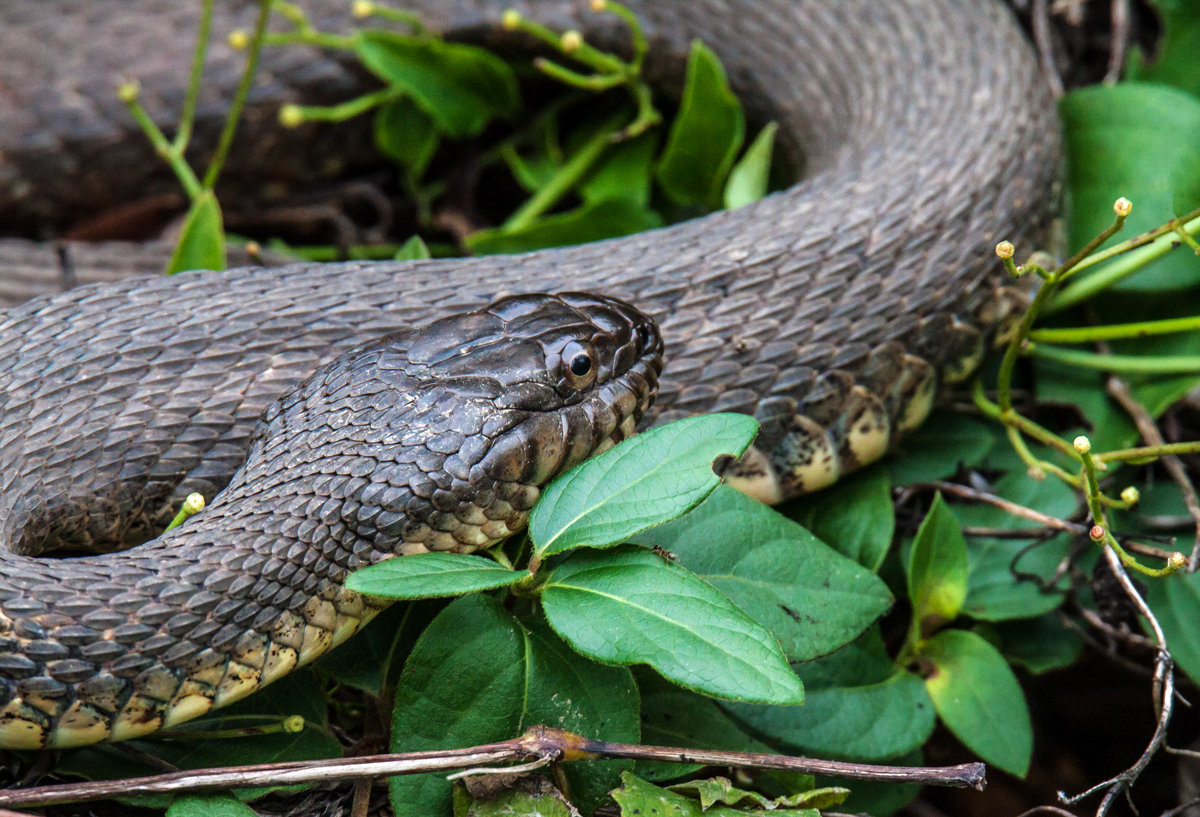
I spent much of my time Friday at Occoquan Bay National Wildlife Refuge scanning the trees for birds. On one of the rare moments when I was looking down, I ended up looking into the eyes of what appears to be a Northern Watersnake (Nerodia sipedon).

Although it may look like I was dangerously close to this snake, I took these shots with my Tamron 150-600mm lens, which has a minimum focusing distance of almost 9 feet (274 cm). Northern Watersnakes are not poisonous, but I have been told that their bites can be very painful and that the snakes inject an anti-coagulant when they bite, so wounds tend to bleed profusely.

I particularly like the way that I was able to capture some of the details of the snake, including its scales and its head. If you look closely, you can even see a miniature landscape in the eyes of the snake.

UPDATE: One of the viewers on my Facebook page commented that this looks more like an Eastern Ratsnake (Pantherophis alleghaniensis) than a Northern Watersnake. I am hoping to get some clarification on the species of this snake and would welcome the views of any readers with expertise in this area.

Northern Watersnake

Northern Watersnake

Northern Watersnake

© Michael Q. Powell. All rights reserved.


Read Full Post »

It is often said that springtime is a time for love, but so apparently is autumn, especially if you are a Blue-faced Meadowhawk dragonfly (Sympetrum ambiguum). This species appears most often during the latter part of the summer and in early autumn, so springtime is not really an option for them.

I spotted this couple in flagrante delicto during a recent trip to Huntley Meadows Park. It is hard to get a real sense of scale from this photo, so you will have to trust me that these brightly-colored dragonflies are really small, about an inch and a half in length (38 mm).

Blue-faced Meadowhawk

© Michael Q. Powell. All rights reserved.

Read Full Post »

As I was loading camera gear into my car on Monday at Occoquan Bay National Wildlife Refuge, I noticed that I had a tiny hitchhiker—a crab spider that looked ready to embrace me with open arms. After photographing the cute little spider, I released it into a grassy area, where it seemed more likely to catch something to eat than on the roof of the car.

I do not have much experience with crab spiders, but think this one might be a Goldenrod Crab Spider (Misumena vatia). As always, I would welcome a correction or confirmation if you are knowledgeable about spiders.

crab spider

© Michael Q. Powell. All rights reserved.

Read Full Post »

Different dragonfly species rest in varying positions. Some of them hang vertically, but most of them perch at somewhat of an acute angle. Last week when I spotted this male Swift Setwing dragonfly (Dythemis velox), I was struck by the degree to which its rigid position reminded me of the diagrams of a right angle in my geometry textbook when I was a schoolboy—the dragonfly and the plant stem seemed to form an almost perfect 90 degree angle. One unusual thing about Swift Setwing dragonfly is the way that it holds its wings forward when perched and not straight out as most dragonflies do. Perhaps it helps to counterbalance the effects of gravity and helps it hold its abdomen so high for so long.

Swift Setwing

© Michael Q. Powell. All rights reserved.

Read Full Post »

Although some folks find spiders to be creepy, I look at them as wonderfully creative architects and artists and I was thrilled to capture this image of one in its web that I spotted early yesterday morning at Occoquan Bay National Wildlife Refuge. I have found that early morning is the best time to get shots of spider webs and they tend to show up best in shots that are backlit, which is to say that light is shining from the front. In this case I tried to frame the shot carefully for maximum effect and did not have to crop the image at all.

web art

© Michael Q. Powell. All rights reserved.

Read Full Post »

At first I thought it was love, but looking closer I realized that Tina Turner was right—what’s love got to do with it. Both the predator and the prey in what appears to be an act of cannibalism look to be Big Bluet damselflies (Enallagma durum), which I spotted this past Sunday at Occoquan Bay National Wildlife Refuge.

The pale coloration of the victim suggests to me that it is newly-emerged, a phase referred to as “teneral.” At this stage of development, dragonflies and damselflies are relatively immobile as their bodies and wings are transforming and are particularly vulnerable.

damselfly cannibalism

© Michael Q. Powell. All rights reserved.

Read Full Post »

As the seasons change, some dragonflies begin to disappear, but happily some new ones appear, like this spectacular female Blue-faced Meadowhawk (Sympetrum ambiguum) that I spotted this past Monday at Huntley Meadows Park.

One of the really cool things about this species is that there are two different color variants of the females. Most of the females (and young males) are brown in color and are sometimes referred to as heteromorphs, while a smaller number of females, like the one in the photo, have a bright red color matching that of mature males and are sometimes referred to as andromorphs. This is roughly parallel to the Eastern Tiger Swallowtail butterfly, which has two different varieties of female, a yellow morph that matches the males and a black morph.

Blue-faced Meadowhawk

© Michael Q. Powell. All rights reserved.
Read Full Post »

When I spotted this praying mantis today at Huntley Meadows Park, I couldn’t help but think that it had chosen an appropriate pose to remember those who died and countless others whose live were forever changed by the tragic events of 9/11.

praying mantis

© Michael Q. Powell. All rights reserved.

Read Full Post »

When a Black and Yellow Garden Spider (Argiope aurantia) traps a prey in its web, it often moves so quickly to wrap it up completely that it is difficult to identify the prey. That was not the case with the damselfly that I spotted yesterday at Occoquan Bay National Wildlife Refuge as it was being encased in a silken shroud.

The damselfly looks to be a bluet damselfly and if pressed, I’d guess that it might be a Familiar Bluet (Enallagma civile) or possibly a Big Bluet (Enallagma durum). The spider seems to be experiencing the same kind of problem that I encounter when I am trying to wrap an awkwardly-shaped present at Christmas time—it is hard to be neat and tidy, the process uses up lots of wrapping material, and the package always end up irregularly shaped and easy to identify.

spider and damselfly

© Michael Q. Powell. All rights reserved


Read Full Post »

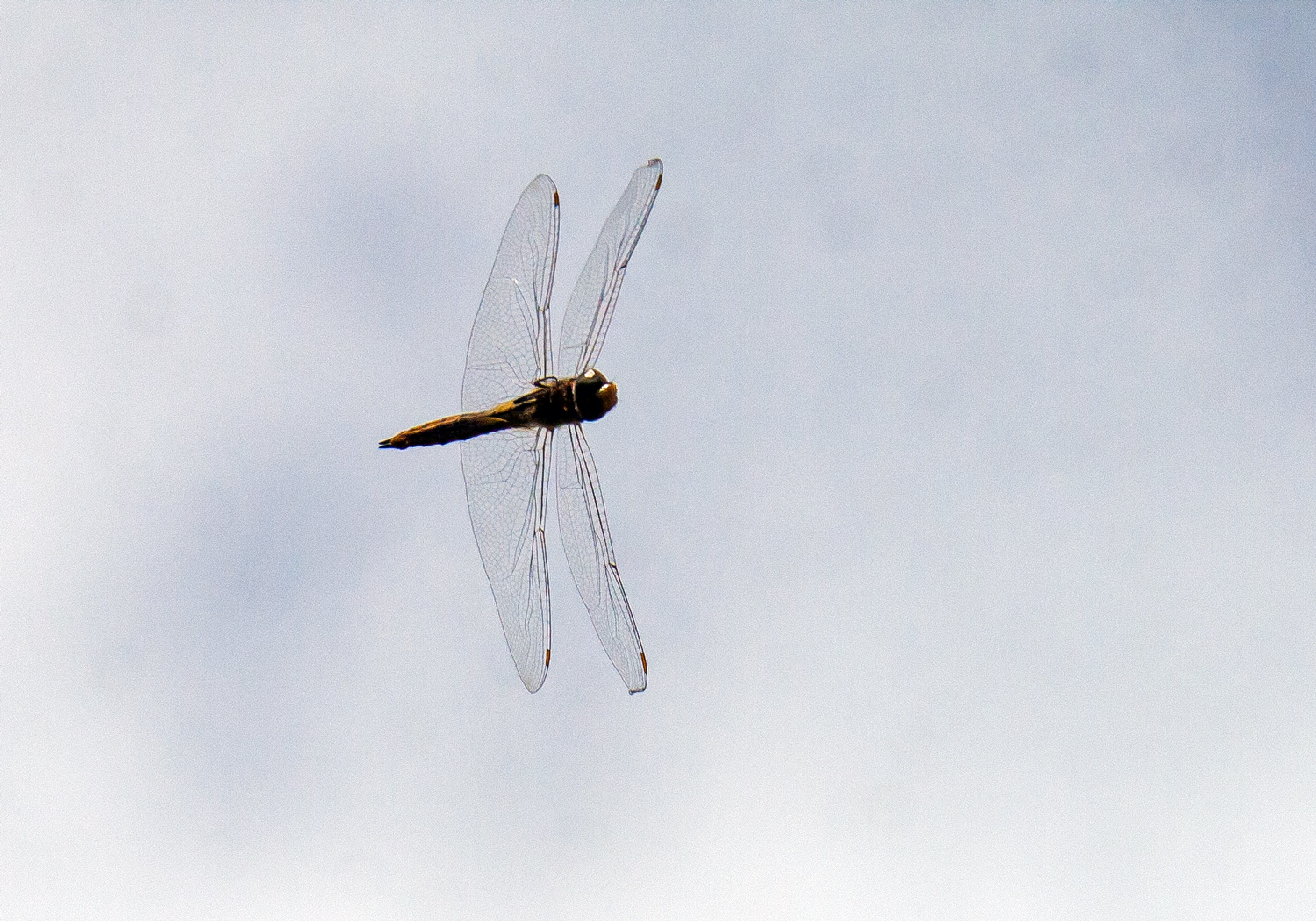
When I first saw this dragonfly land yesterday at Occoquan Bay National Wildlife Refuge, I had no idea what it was. Zooming in, I was shocked to see that it was a Wandering Glider (Pantala flavescens), a migratory species that almost never perches.

The Wandering Glider is considered to be the most widespread dragonfly in the world, found on every continent except Antarctica. According to odonatacentral.com, “It is a strong flier that is regularly encountered by ocean freighters and a well-known migratory species. Because of its ability to drift with the wind, feeding on aerial plankton, until it finally encounters a rain pool in which it breeds, it has been called “…the world’s most evolved dragonfly.” ”

After I got the initial shots of the dragonfly on two different perches, I decided to follow the dragonfly and wait for it to perch again. It wandered about through the air over my head for an extended period of time and never again came down to land. The last photo gives you an idea of my view during that period of waiting—note the long wings that help it to fly such long distances.

Wandering Glider

Wandering Glider

Wandering Glider

© Michael Q. Powell. All rights reserved

Read Full Post »

Over the last few years it has become traditional for me to be in Brussels over Labor Day weekend in early September for meetings. After I arrived today, I had some free time and captured these images of damselflies in the Botanical Gardens. Some of them are quite similar to those that I see at home, while others appear to be a bit different. As is often the case when I am traveling for work, I left my big camera at home and took these shots with my Canon SX50 HS superzoom camera.

damselfly in Brussels

damselfly in Brussels

mating damselflies in Brussels

© Michael Q. Powell. All rights reserved

Read Full Post »

Do you have a favorite insect? This is such a strange question that most folks would not have an immediate answer and would have to stop and think a bit before responding. The quickest responses would undoubtedly come from those who simply do not like insects at all. The most common positive answer, I suspect, might well be a Monarch Butterfly.

Many readers know that I see lots of beautiful dragonflies and butterflies, but my favorite insect is almost certainly the Handsome Meadow Katydid (Orchelimum pulchellum), like this one that I photographed on Monday at Occoquan Bay National Wildlife Refuge. I remember my sense of awe and amazement the first time that I spotted one—I couldn’t believe my own eyes, because the combination of colors seemed so bright and almost unreal. When I initially posted a photo of the Handsome Meadow Katydid, one of my friends thought that I had added the colors in Photoshop.

To this day, I never fail to marvel at a Handsome Meadow Katydid’s spectacular rainbow colors and incredible blue eyes and am always thrilled to discover again their amazing beauty when I am fortunate enough to find one.

Handsome Meadow Katydid

© Michael Q. Powell. All rights reserved

Read Full Post »

“Beautiful Spider”—I know that some people would consider that an oxymoron, a contradiction in terms. I, however, am fascinated with spiders and photographed this Black and Yellow Garden Spider (Argiope aurantia) at Jackson Miles Abbott Wetland Refuge as carefully as if I were doing a beauty shot in a photo studio. The spider had constructed her web on some vegetation overhanging a small pond, which is why  I was able to get such an uncluttered gray background.

Argiope aurantia

Earlier this month I captured an image of a spider of the same species while exploring Occoquan Bay National Wildlife Refuge—this seems to be the prime season for these spiders, which I have seen at multiple locations. This image shows well the amazing reach of the spider’s amazingly long legs and, as was the case in the first image, shows the ziz-zag portion of the web that is associated with this species.

Argiope aurantia

© Michael Q. Powell. All rights reserved

Read Full Post »

The beautiful Monarch Butterfly (Danaus plexippus) is often featured in conservation efforts that focus on its dwindling numbers and shrinking habitat. It was therefore a little disconcerting to stumble upon a Monarch that had been ensnared in the web of a Black and Yellow Garden Spider (Argiope aurantia) during a visit this past weekend to Occoquan Bay National Wildlife Refuge.

I have no idea how long the butterfly had been in the web, but it appeared to be totally immobilized. Spiders like this one, known also as Yellow Garden Spiders or Writing Spiders, kill their prey by injecting venom and often wrap them up in web material for later consumption.
I considered cropping this image to focus more attention on the spider and the butterfly, but ultimately decided that I liked the context provided by the elements of the spider’s web and the murky, out-of-focus background.


spider and Monarch

© Michael Q. Powell. All rights reserved


Read Full Post »

Predator or prey? Dragonflies are fearsome predators, but they can also become prey—it’s the whole circle of life cycle in the natural world.

This past Friday as I was walking around Occoquan Bay National Wildlife Refuge, I spotted the twisted body of a dragonfly suspended in the air against a backdrop of the sky. Instinctively I knew that there must be a spider web there, although it was not initially visible. The wing pattern of the dragonfly made it easy to identify as a Common Whitetail (Plathemis lydia).

As I got closer, I realized that a large spider was holding onto the body of the dragonfly. I am not totally certain of the spider identification, but it looks to me like it is a Spotted Orbweaver (Neoscona crucifera). Often when I approach a spider, it will scurry to the edge of its web, but this spider defiantly stayed in place—it looked like it was determined not to give up its prey.

As many readers know, I really like dragonflies, but spiders have to eat too. Undoubtedly this scenario plays out multiple times each day, but it is still a little unsettling to see it face-to-face.

spider and dragonfly

© Michael Q. Powell. All rights reserved


Read Full Post »

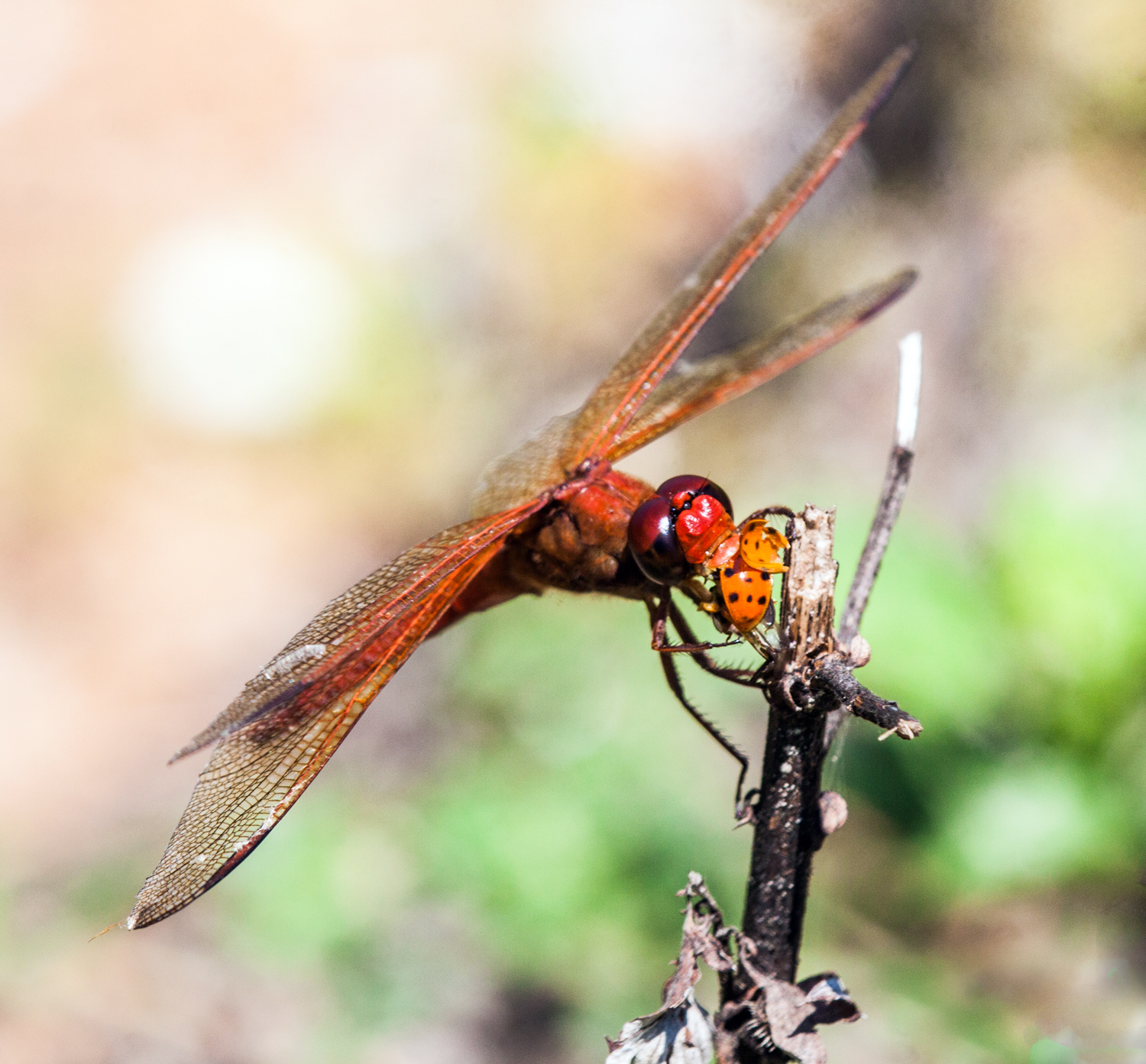
Dragonflies have to eat too, but I was a little shocked when I stumbled upon this Needham’s Skimmer dragonfly (Libellula needhami) munching on a ladybug or two yesterday at Occoquan Bay National Wildlife Refuge in Woodbridge, Virginia. Although I know that dragonflies are fearsome predators, I guess that I am not used to thinking of ladybugs as prey—they are usually depicted as cute, which is why they are seen so often on children’s clothing and furnishings.

dragonfly and ladybug

© Michael Q. Powell. All rights reserved

Read Full Post »

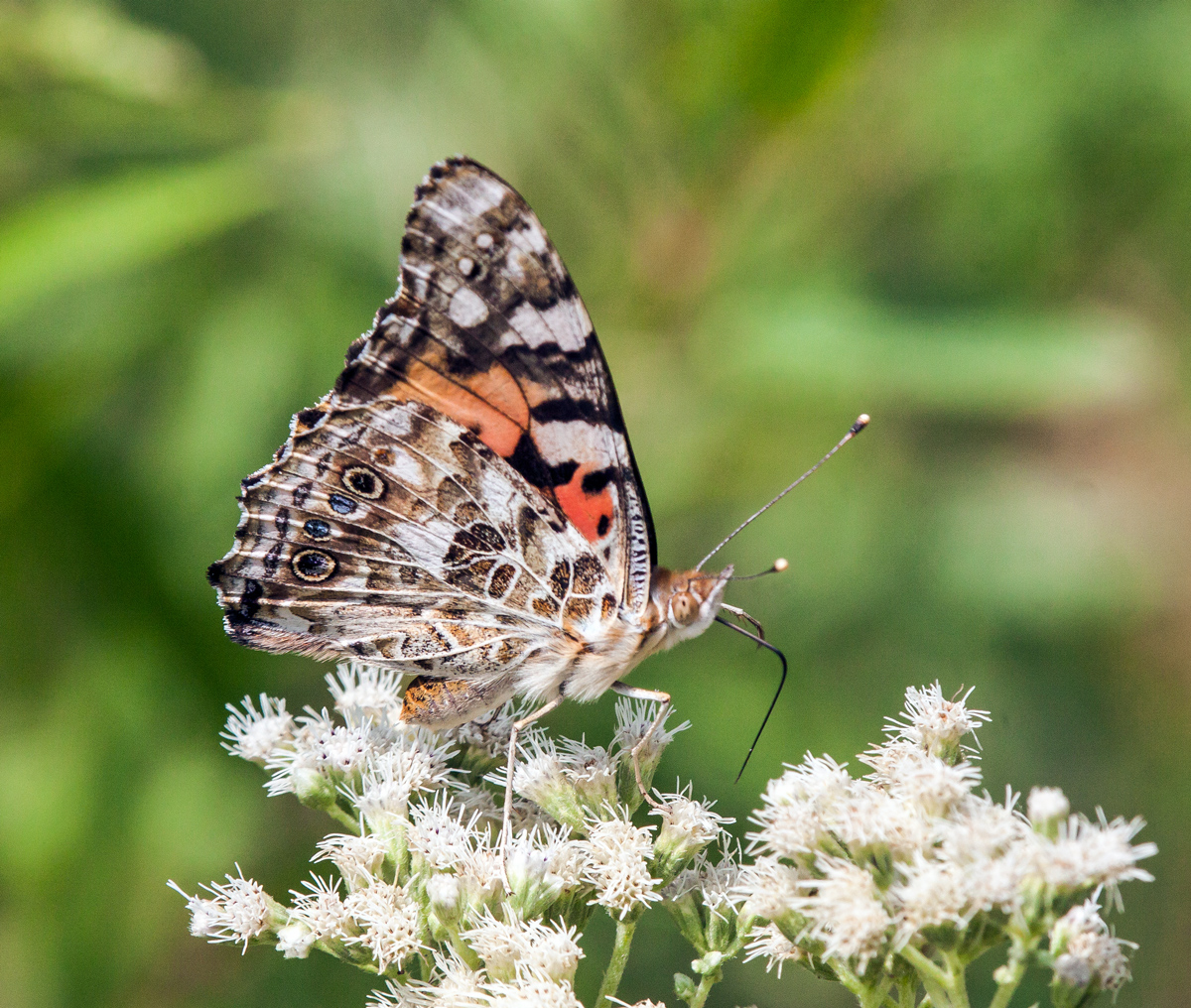
As I was exploring at Huntley Meadows Park this past weekend, I was thrilled to stumble upon this beautiful Painted Lady butterfly (Vanessa cardui), a species that I have not seen in several years. In the field, I couldn’t remember the differences between a Painted Lady and the similar-looking American Lady. Fortunately, there are plenty of resources on-line, including this helpful comparison page on bugguide.net that shows the differences between the two types. On the basis of the pattern of the eye spots, I concluded that this is almost certainly a Painted Lady.

Painted Lady

© Michael Q. Powell. All rights reserved

Read Full Post »

Several years ago, when I first started getting serious about photography, I probably would have called the insect in the photo a bee. My choices back then were simple—a black and yellow insect was either a bee or a yellowjacket. Now that I know a whole lot more about insects, I can readily identify the insect as a hoverfly (also referred to as flower fly) from the Syrphidae family.

When I spotted the hoverfly yesterday, I was struck by the way that its colors matched almost perfect those of the black-eyed Susans (Rudbeckia hirta) that were growing in abundance at Jackson Miles Abbott Wetland Refuge.

hover fly

© Michael Q. Powell. All rights reserved

Read Full Post »

When I first encountered two insects this past weekend at Huntley Meadows Park, I thought they were mating. Looking a little closer, I realized it was a robber fly and its prey, which, after some research, I conclude is probably a Striped Horse Fly (Tabanus lineola). In addition to its unusual eyes, check out the sharp mouth parts of the horse fly that are used, I believe, for biting. Ouch!

There is a whole family of robber flies, known as Asilidae, of varying sizes and shapes, including the Red-footed Cannibalfly that I have featured several times recently. This robber fly was considerably smaller than a Red-footed Cannibalfly, but has many of the same general characteristics. They both grasp their prey with their long legs and inject it with saliva that paralyzes the victim. The saliva eventually liquifies the insides of the prey and the robber fly sucks out the liquified material through its proboscis. I think that the robber fly in the photo was in the middle of that process when I spotted it.

Robber Fly

© Michael Q. Powell. All rights reserved


Read Full Post »

In the insect world, Red-footed Cannibalflies (Promachus rufipes) are fearsome predators. Yesterday I spotted one at Huntley Meadows Park in Alexandria, Virginia that appeared to be subduing a Hummingbird Clearwing Moth (Hemaris thysbe) that it had just captured.

What happens next? Wikipedia describes the tactics of a robber fly, the family to which the Red-footed Cannibalfly belongs, in these words:  “The fly attacks its prey by stabbing it with its short, strong proboscis  injecting the victim with saliva containing neurotoxic and proteolytic enzymes which very rapidly paralyze the victim and soon digest the insides; the fly then sucks the liquefied material through the proboscis.”

Yikes!

red-footed cannibalfly subdues hummingbird moth

© Michael Q. Powell. All rights reserved

Read Full Post »

How much pollen can a bee transport at one time? As it circled the inside of a sunflower, this bee filled the pollen baskets on its hind legs with so much bright yellow pollen that I was afraid it would not be able to lift off and fly away. In addition to the very full pollen baskets, which looked like cotton candy to me, the bee was virtually covered with grains of pollen. My fears proved to be unfounded, and the overladen bee was able to carry away its golden treasure.

I think this bee is a bumblebee, though I am no expert on the subject of bees. According to Wikipedia, certain species of bees, including bumblebees and honeybees, have pollen baskets (also known as corbiculae) that are used to harvest pollen. Other bee species have scopae (Latin for “brooms”), which are usually just a mass of hair on the hind legs that are used to transport pollen.

bee pollen

© Michael Q. Powell. All rights reserved

Read Full Post »

« Newer Posts - Older Posts »