Feeds:
Posts
Comments

Archive for the ‘Humor’ Category

Some birds are stealthy and fly silently through the skies. Canada Geese (Branta canadensis) would not fit into that category. They like to announce their presence for all to hear, like this pair that I spotted on Monday at Occoquan Bay National Wildlife Refuge as they were coming in for a landing.

Unlike at the airport, there was no need for a loudspeaker to announce this landing.

Canada Geese

© Michael Q. Powell. All rights reserved.

Read Full Post »

You have to be really careful scratching an itch if you have big talons like this Bald Eagle (Haliaeetus leucocephalus) that I spotted yesterday at Occoquan Bay National Wildlife Refuge.

At least one of the eagle couples has recently been observed building a nest, so already a number of paths in the wildlife refuge are now blocked. As I wandered around the refuge, I did spot several eagle couples and some possible nests—it is hard for me to tell if a possible nest is an eagle nest or an osprey nest. Unlike the nest in the closed area, these nests are far enough away from the paths that the human presence is less likely to disturb the eagles. It is at times like this that I am thankful that my telephoto zoom lens extends out to 600mm.

Bald Eagle

© Michael Q. Powell. All rights reserved.


Read Full Post »

On Monday, I was having a nice little portrait session with a male Ruby-crowned Kinglet (Regulus calendula) at Occoquan Bay National Wildlife Refuge, but I wanted more than just a glimpse of his “ruby crown.” Amazingly, he bowed in my direction to make my wish come true.

For those of you who may not be familiar with kinglets, they are tiny birds that are even smaller than chickadees. During this past fall, I became aware that they spend their winters in my area and I have been hunting them ever since. Both the Ruby-crowned Kinglet and the Golden-crowned Kinglet are energetic and elusive and rarely sit still long enough for me to get a shot. When it comes to the “ruby crown,” only the male has it and it is only occasionally visible. That is why I was ecstatic to be able to get such a clear shot of the ruby crown of this kinglet.

Wishes do come true—maybe a ruby crown is better than ruby slippers.

Ruby-crowned Kinglet

Ruby-crowned Kinglet

Ruby-crowned Kinglet

© Michael Q. Powell. All rights reserved.

Read Full Post »

Can ducks smile? I realize that a duck’s bill is pretty inflexible, but I couldn’t help but think that this American Black Duck (Anas rubripes) was giving me a coy little smile as it dipped its bill into the water this past Monday at a small suburban pond in Kingstowne, Virginia..

When I first spotted two ducks swimming around together, I thought they were simply two female mallards. When I looked more closely at them, it seemed that their bills were brighter and more yellow than that of a a female mallard. When I got home, I pulled out my birding guide and looked through the section on ducks. I concluded that the two ducks, one of which is shown in the photo, are American Black Ducks.

When I am really uncertain about a bird species, I will post it to a Facebook page on which more experienced birders provide help with identification. In this case, I decided to be bold and make this posting without confirmation of my identification. If I am incorrect, it won’t be the first time, and certainly not the last time—bird identification is not easy, with lots of variation caused by gender, season, age, and location.

American Black Duck

© Michael Q. Powell. All rights reserved.

Read Full Post »

Initially I did a double take when I saw the sign for a restaurant in Brussels called O’Tacos and I figured it was some kind of Irish-Mexican fusion cuisine. I almost burst out laughing, however, when I read the words, “Original French Tacos.” French tacos? Who knew?

I did some further investigation when I returned to my hotel and found out that O’Tacos is a chain that is now worldwide. OK, but what exactly is a French taco? A review on foodrepublic.com described it in these words—”Less like a taco and more like a pressed San Diego-style burrito, the French taco is stuffed with fries, a white creamy cheese sauce, a protein (choices include grilled chicken breast, nuggets, tenders, ground beef or sausage), an additional sauce (mustard, Tabasco, ketchup, mayonnaise, barbecue) and other ingredients (cheese, mushrooms, grilled veggies, an egg, bacon, ham and more) all wrapped up in a flour tortilla.”

original French tacos

© Michael Q. Powell. All rights reserved

Read Full Post »

Great Egrets (Ardea alba) always seem to me to be a little vain and self-centered—maybe if comes from being so beautiful and graceful. This one did not like being ignored, so it decided to photobomb my shot of a deer this past weekend at Huntley Meadows Park .

Great Egret

© Michael Q. Powell. All rights reserved

Read Full Post »

I am not completely certain what these two muskrats (Ondatra zibethicus) were doing on Monday at Huntley Meadows Park. It may have been only grooming, but to me it looks like muskrat love.

muskrat love

© Michael Q. Powell. All rights reserved

Read Full Post »

The simple shape and spare palette of spiderwort plants (g. Tradescantia) really appeal to me and I found myself taking innumerable photos of them during a visit with fellow photographer Cindy Dyer to Meadowlark Botanical Gardens in Vienna, Virginia this past weekend. Be sure to check out Cindy’s blog for some awesome colorful images of many of the other flowers that we observed.

My friends all know that I have a warped sense of humor, so it would come as no surprise to them when I confess that I can’t help but think of an abnormal growth on an arachnid every time that I use the word “spiderwort.” As the weather continues to warm up, I’m pretty confident that I will soon be featuring images of spiders, warts and all.

spiderwort

© Michael Q. Powell. All rights reserved

Read Full Post »

This Double-crested Cormorant (Phalacrocorax auritus) was focusing so intently on the water yesterdy that I thought it was stalking a fish. I was initially shocked at the size of the fish that it pulled out of the water until I realized that it was only a large leaf.

Double-crested Cormorant

The cormorant waved the leaf around proudly until it finally let go of the leaf. Obviously this bird has a policy of “catch and release.”

Double-crested Cormorant

Undeterred, the cormorant went back to fishing—I never did see him land one, but he might have been catching small fish during his dives.

Double-crested Cormorant

© Michael Q. Powell. All rights reserved.


Read Full Post »

Hooded Mergansers (Lophodytes cucullatus) were really active yesterday at Huntley Meadows Park, including this female, who seemed to be contemplating using this nesting box to lay her eggs a little later this spring.

You might call it “thinking outside of the box”—or not.”  🙂

Hooded Merganser

Hooded Merganser

Hooded Merganser

© Michael Q. Powell. All rights reserved.

Read Full Post »

I couldn’t help but do a double take when I saw this sign at Fort Benning, Georgia. I was filled with visions of dogs on automatic conveyor belts being sprayed with soap and slapped with moving towels. Was hot wax an option for dogs?

I did a little checking and learned that the dog wash is a separate facility adjacent to the car wash. It is the first of its kind on a US military installation and includes a coin-operated, do-it-yourself, climate-controlled booth that offers washing, drying and flea and tick bathing options. The booth is then automatically sterilized after each use.

dog wash

© Michael Q. Powell. All rights reserved.


Read Full Post »

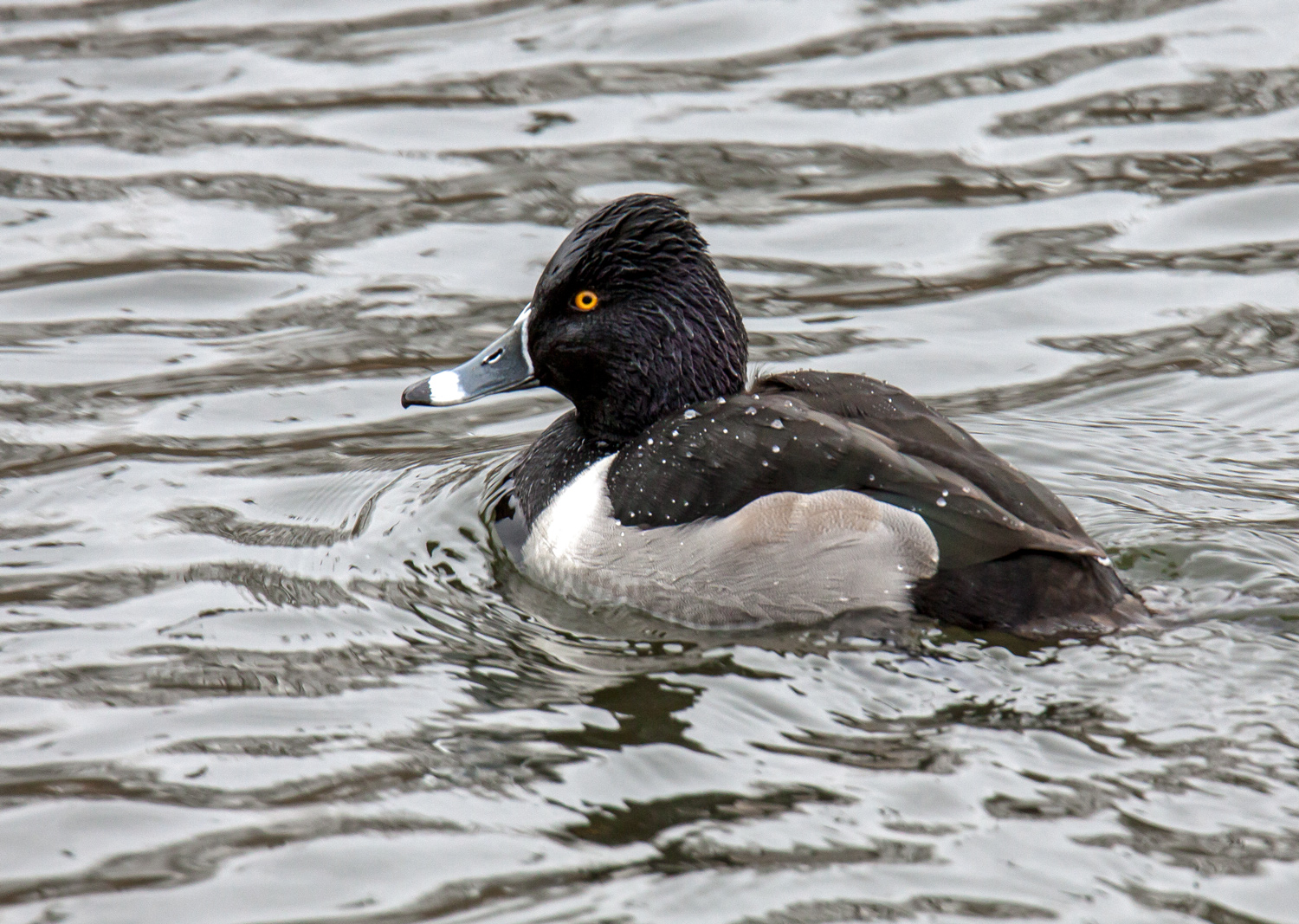
Experienced birders know that this is not an Indigo Cone-headed duck. In fact, there is no such bird—I simply made up the name because I was not really satisfied with calling this bird a Ring-necked duck (Aythya collaris). It is definitely a cool-looking bird, but where is the ring around its neck?

The Cornell Lab of Ornithology explained this conundrum with these words:

“This bird’s common name (and its scientific name “collaris,” too) refer to the Ring-necked Duck’s hard-to-see chestnut collar on its black neck. It’s not a good field mark to use for identifying the bird, but it jumped out to the nineteenth century biologists that described the species using dead specimens.”

I’m in favor of having practical names that are descriptive of live specimens that I might encounter. If Indigo Cone-headed duck doesn’t work for you, how about Ring-billed duck? I’d enjoying hearing any creative ideas you might have about renaming this handsome little duck.

Ring-necked duck

© Michael Q. Powell. All rights reserved.

Read Full Post »

One of the most unusual-looking water birds that I occasionally see is the Pied-billed Grebe (Podilymbus podiceps), like this one that I spotted in a small, man-made pond yesterday in Kingstowne, a suburban community near where I like in Northern Virginia.

According to the Cornell Lab of Ornithology the Latin genus name for “grebe” means “feet at the buttocks.” And I thought “grebe” sounded funny just by itself—imagine having that Latin name as part of your name.

Pied-billed Grebe

Pied-billed Grebe

Pied-billed Grebe

© Michael Q. Powell. All rights reserved.

Read Full Post »

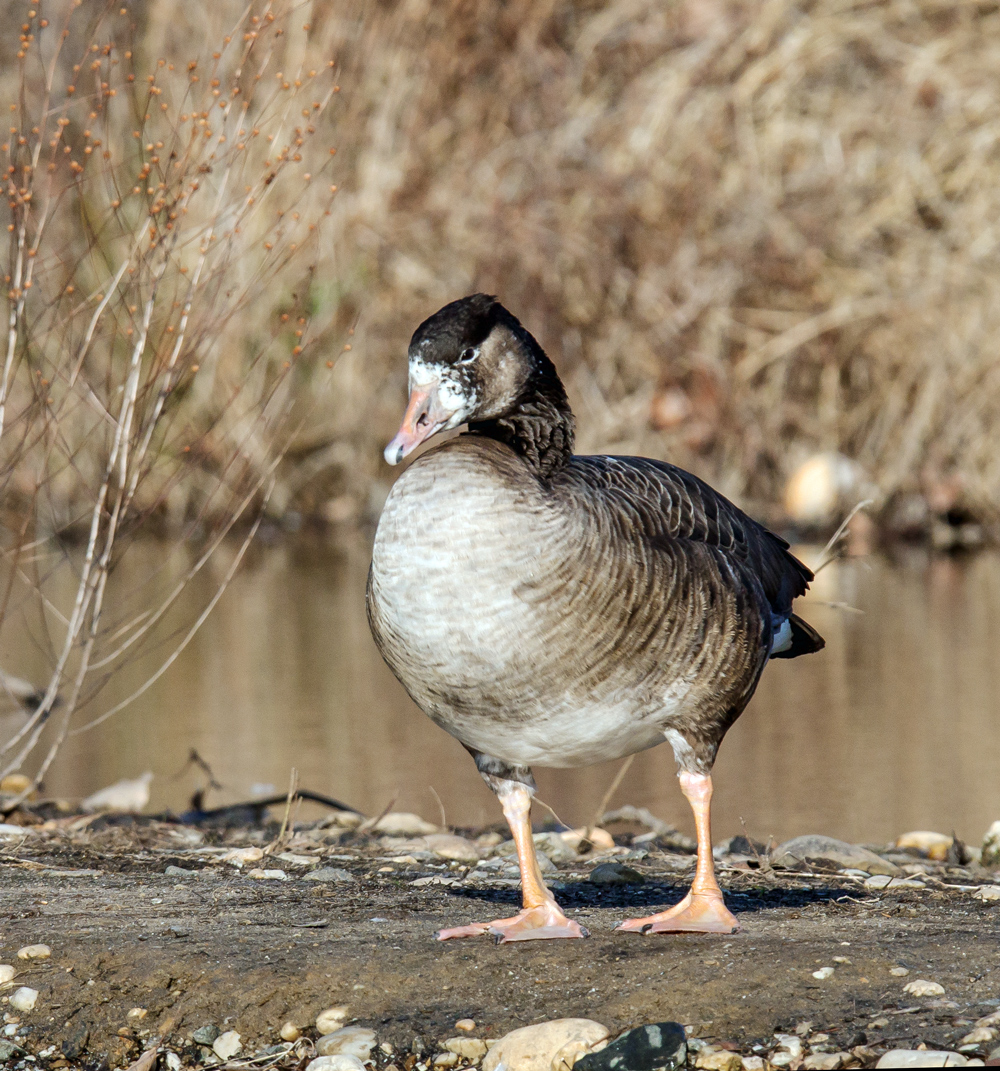
One of the first games that children often learn to play is called “one of these is not like the others” and I felt like I was playing that game this past weekend. As I surveyed the geese that dotted the surface of Lake Cook, a small, pond-sized body of water not far from where I live, it became clear that one of them was different, very different from the others. It had a pinkish bill and a white stripe on its head and pinkish orange legs and feet.

All of the other geese at the lake were Canada Geese (Branta canadensis). Was this possibly a French-speaking separatist Canada Goose? When I looked through my bird identification book, there was no such variant of the Canada Goose.

In fact, there were not very many geese from which to choose. “My” goose sort of looked like the images of the Greater White-fronted Goose (Anser albifrons), but not exactly. In an effort to get some help, I posted some photos to a Facebook birding page and received a range of responses. Most folks seemed to agree that this was a hybrid Canada Goose of some sort, but there was disagreement about the other part of the goose’s genetic makeup. Some thought there might have been a pairing of a Canada Goose with a domesticated goose, while others thought it might have been a Canada Goose and a Greater White-fronted Goose. I tend to be in the latter camp.

When I did a Google search on goose hybrids, I found there are an incredible number of hybrid variations. When it comes to bird identifications, I suppose I am going to have to be content with making my best guess—I refuse to take the next logical step of doing DNA testing of all of my subjects.

hybrid goose

hybrid goose

© Michael Q. Powell. All rights reserved.

Read Full Post »

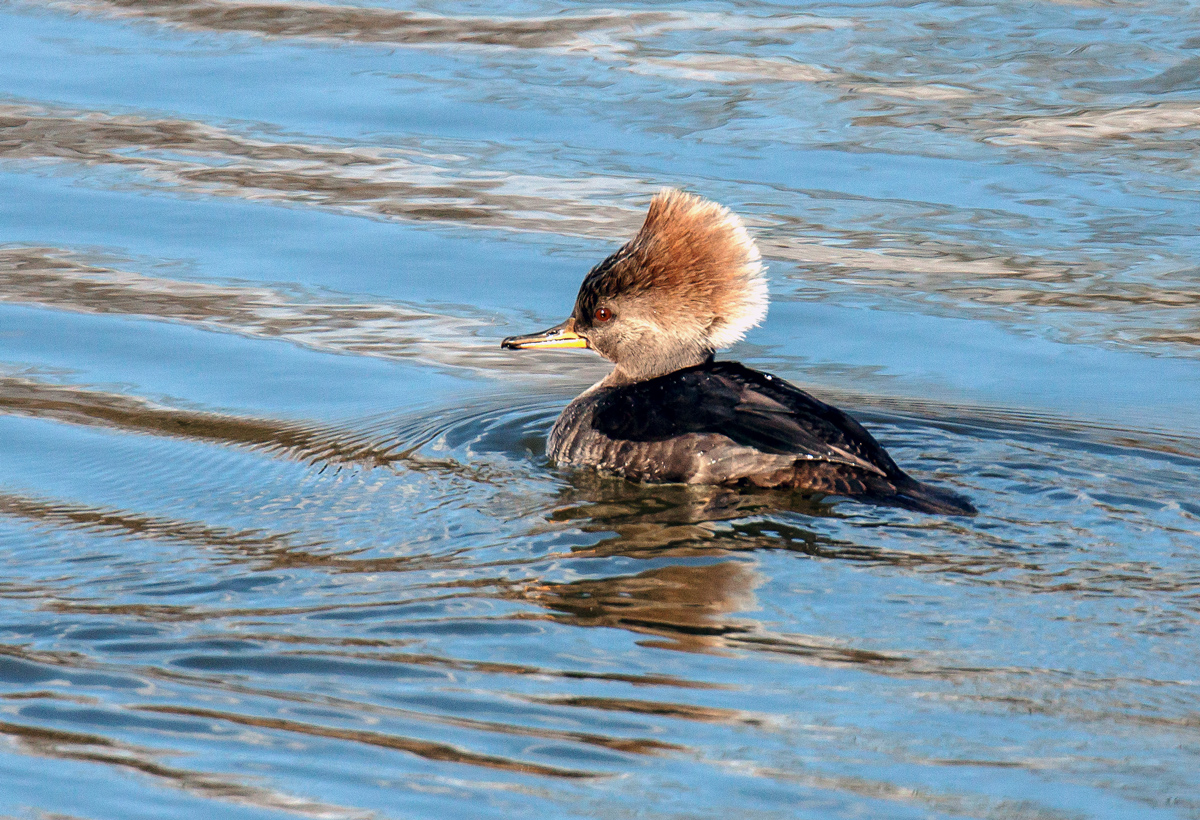
The hairstyle of this female Hooded Merganser duck (Lophodytes cucullatus) and the electric blue of the sky reflected on the water somehow brought back my memories of growing up in the 1960’s.

Hooded Merganser

Imagine my surprise a bit later when I learned that another one of the female Hooded Mergansers was a huge fan of Chubby Checker and she demonstrated for me her own version of The Twist.

Hooded Merganser

© Michael Q. Powell. All rights reserved.

Read Full Post »

Sometimes I have this feeling that the birds and other creatures that I photograph are playing games with me. On Monday this Red-headed Woodpecker (Melanerpes erythrocephalus) seemed to be playing peek-a-boo with me at Huntley Meadows Park. It was hiding at the top of a broken-off tree and at irregular intervals would show its face for just a split second and then immediately pull it back.

As I look at the woodpecker’s head I can see streaks of brown, rather than the solid red of an adult, suggesting that this may be a juvenile redhead—maybe that’s why it likes to play games.

Red-headed Woodpecker

© Michael Q. Powell. All rights reserved.

Read Full Post »

Whenever a vulture is circling overhead, I like to make sure I move about from time to time. This Turkey Vulture (Cathartes aura) at Huntley Meadows Park didn’t seem to be paying too much attention to me, but you can never be too cautious, especially if you have not taken a shower that morning.

Turkey Vulture

Turkey Vulture

© Michael Q. Powell. All rights reserved.

Read Full Post »

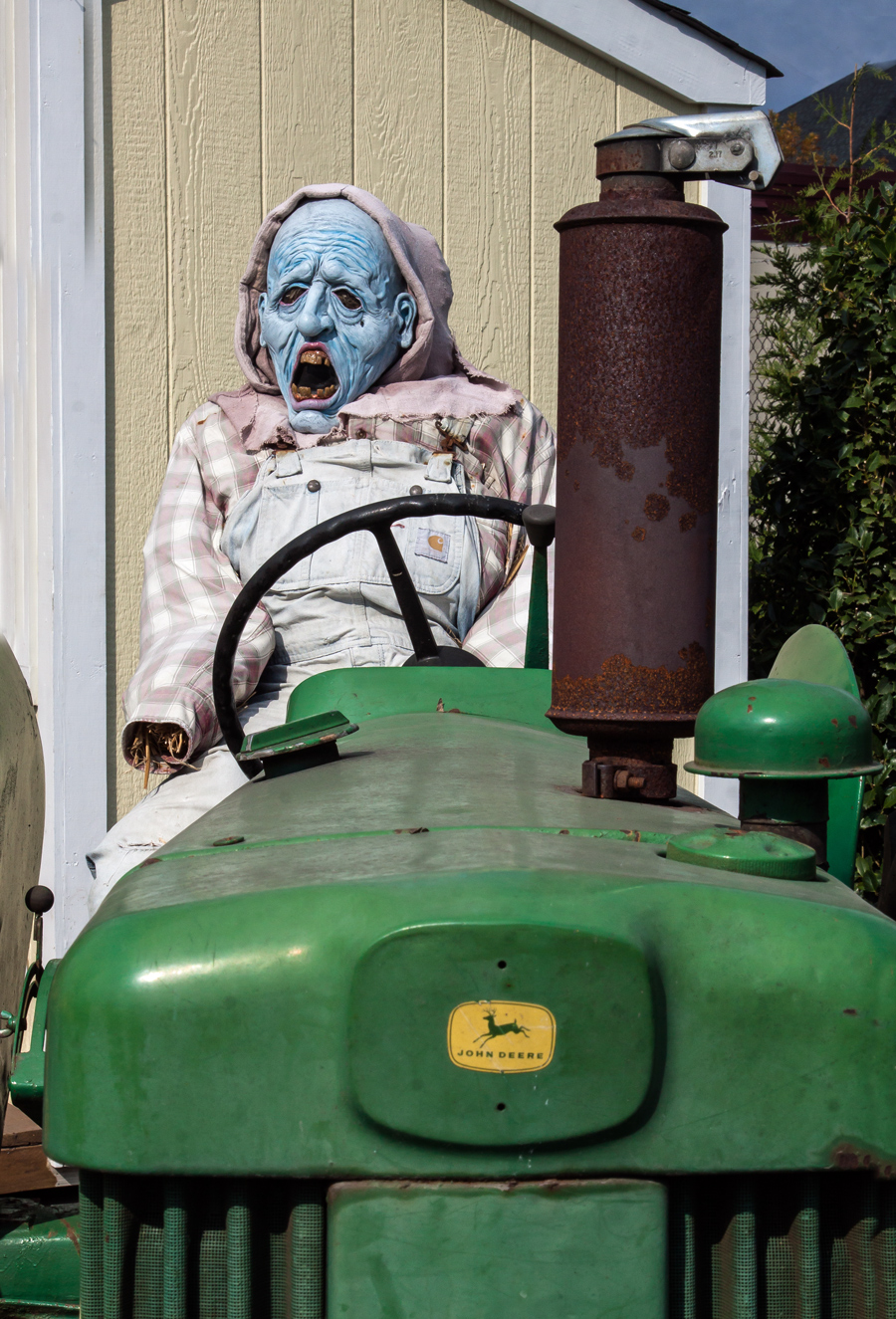
I grew up in the suburbs and have never lived in the country, but somehow I love the beauty of old tractors. During my recent visit to a local produce center that I have featured the last few day, my eyes were inexorably drawn to the a green tractor and its ghoulish driver. Oh, Deere. The scene was staged at the edge of the property, so it was hard to get a shot that did not include barbed wire and chain link fence.  Here are a few shots from different angles to give you an overall view (yes, the driver is wearing overalls)  as well as a wide-angle view.

Happy Halloween!

Halloween tractor


Halloween tractor


Halloween tractor

© Michael Q. Powell. All rights reserved.

Read Full Post »

Some very creative people must work at the local pumpkin patch at Nalls Produce Center in Alexandria, Virginia. As I wandered about, I encountered numerous mini-scenes celebrating farm life and/or Halloween.

One of my favorites featured a crazed–looking cat in overalls conversing with a cow. I also really liked the jack-o-lantern made with all natural materials. I can’t recall ever before seeing a jack-o-lantern with hair.

Halloween

Halloween

© Michael Q. Powell. All rights reserved.

Read Full Post »

I never get tired of watching the Great Blue Herons (Ardea herodias) at Huntley Meadows Park. Quite often they ignore me and focus intently on catching a fish. I marvel at their patience and persistence.

During one recent encounter, though, I had eye-to-eye contact with a heron. The heron looked right at me and seemed to be sending a distinct warning message that it was not going to share the small fish that it had just caught.

I backed off and let the heron enjoy his fish appetizer in peace. It was gone in a quick gulp and the heron went back to work and I moved on in search of more subjects.

Great Blue Heron

© Michael Q. Powell. All rights reserved.

Read Full Post »

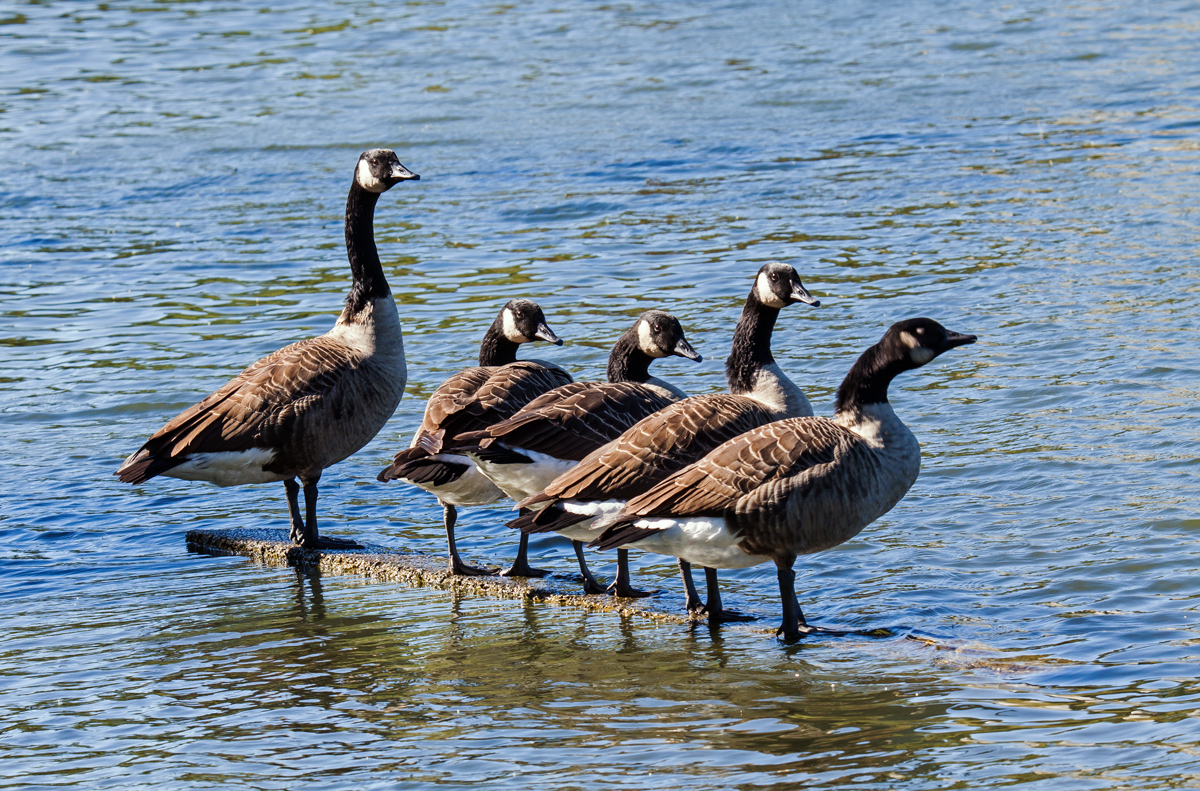
Have you ever tried to shoot a group portrait? You get everyone lined up and facing the camera, but there is always one uncooperative subject. That was certainly the case with these Canada Geese (Branta canadensis) at a little suburban pond on Monday. The gaggle of geese was preening and cleaning themselves all in a row on a on a concrete bar sticking out of the water.

Canada Geese

© Michael Q. Powell. All rights reserved.

Read Full Post »

I am not sure what this Great Blue Heron (Ardea herodias) was doing when I spotted it this past weekend at Huntley Meadows Park, but it looked to be admiring its most recent manicure.

Great Blue Heron

© Michael Q. Powell. All rights reserved.

Read Full Post »

I love to photograph insects with cool or unusual names, like this caterpillar known as the Smeared Dagger moth caterpillar (Acronicta oblinita). Who makes up these crazy names? (Photographed on Monday at Huntley Meadows Park.)

One of my other favorite names is the Twice-stabbed Stink Bug (Cosmopepla lintneriana). Yes, that’s a real insect. You can’t just make this stuff up, or maybe you can.

smeared dagger moth caterpillar

© Michael Q. Powell. All rights reserved.


Read Full Post »

The rays of sunshine illuminated her face and our eyes met and Katy and I shared a moment when time seemed to stand still. Alas, the spell was soon broken and she abandoned me. Yes, Katy did.

I took this shot last weekend at Jackson Miles Abbott Wetlands Refuge at Fort Belvoir, Virginia. I believe that “Katy” is a Handsome Meadow Katydid (Orchelimum pulchellum), although much of the katydid’s body remained in the shadows so I am not one hundred percent sure of the species identification, though the length of the antennae makes me confident that it is a katydid and not a grasshopper.

It was a fun challenge to get this shot, which I decided to post uncropped. I was sprawled on the ground, trying to get at eye level with the katydid and move in as closely as I could without disturbing the stalks of grass. For a shot like this, my 180mm macro lens was perfect, though I really have to focus on technique to make sure that my shooting position is steady, given that the lens does not have any built-in image stabilization (VR for Nikon folks).

Handsome Meadow Katydid

© Michael Q. Powell. All rights reserved

Read Full Post »

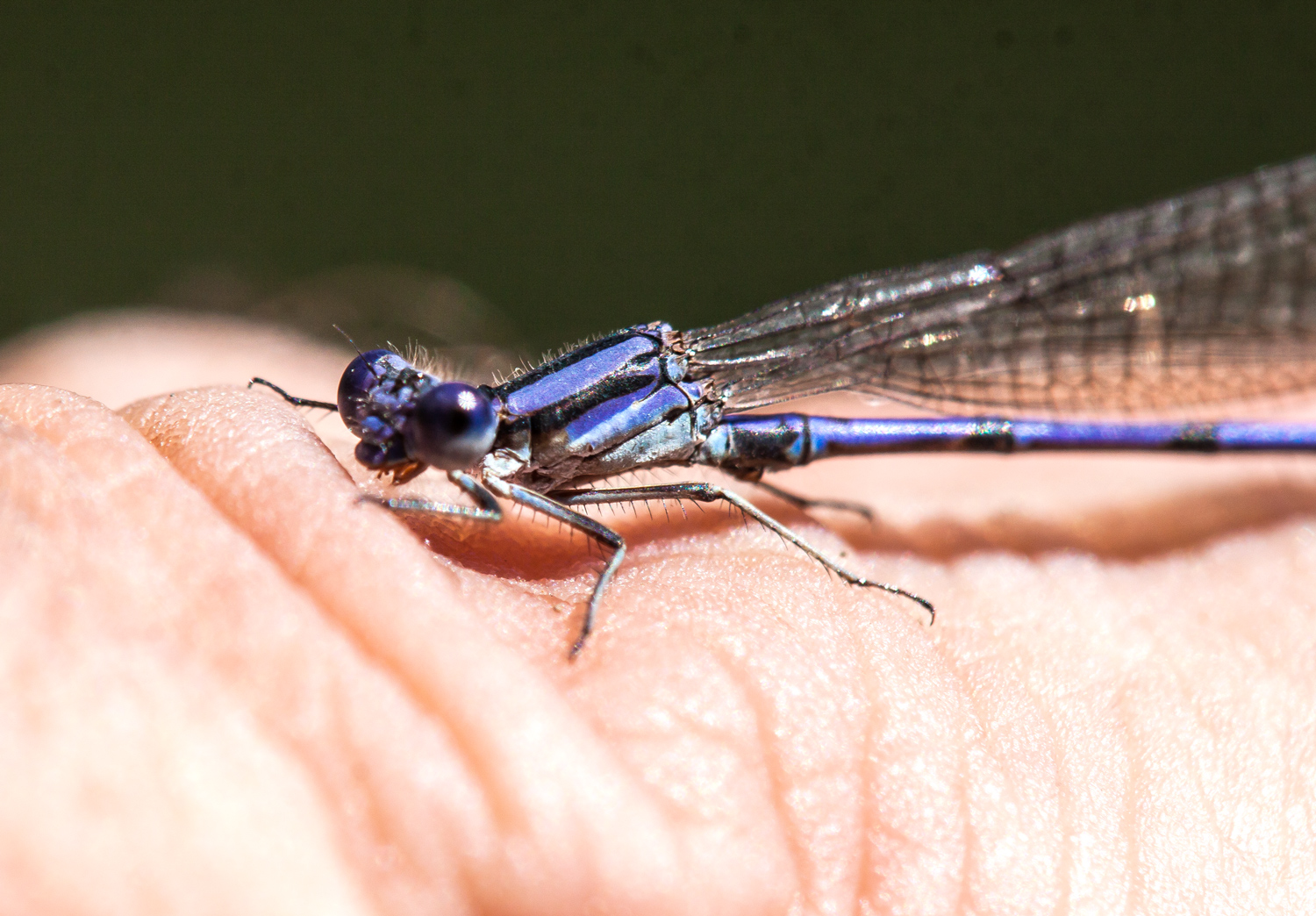
Not all people like to have insects perch on them, but I thought it was pretty cool when an inquisitive Variable Dancer damselfly (Argia fumipennis) landed on my hand Monday at Jackson Miles Abbott Wetlands Refuge. The real challenge was getting a photo of the damselfly shooting one-handed with my DSLR and 180mm macro lens.

Sharp-eyed readers may have recognized that this is the same species of damselfly as the one featured in my blog’s banner. I just love the beautiful purple markings of this damselfly, which is also known as a Violet Dancer (Argia fumipennis violacea), if you use the name of the sub-species.

It was interesting trying to get shots as I tried to hold my left hand still and slowly extended my arm out as far as it would go. The damselfly was relatively cooperative, but moved about a little as it explored my hand. Steadying my shooting hand was an even bigger challenge. Normally I like to try to get as close to parallel with a damselfly’s body as possible, so that most of it will be in focus, but that was not possible in this situation, given the anatomical limitations of the human body.

Looking at these images, I have reached a sad conclusion—I am going to have to give up on my dream of becoming a professional hand model.

Variable Dancer

Variable Dancer

Variable Dancer

© Michael Q. Powell. All rights reserved

Read Full Post »

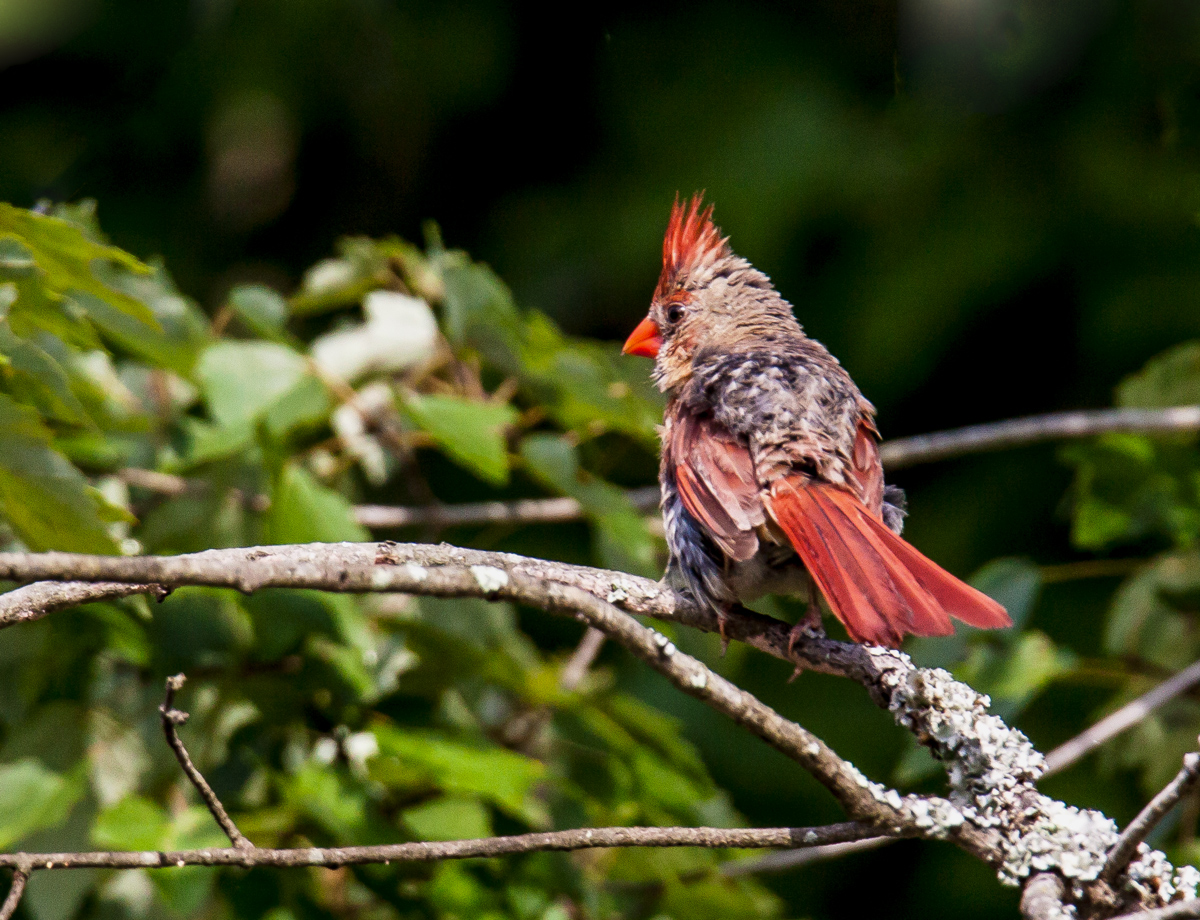
A Northern Cardinal (Cardinalis cardinalis) that I spotted on Saturday at Huntley Meadows Park seemed to be in an awkward feather phase that gave him an almost clown-like appearance.

I suspect that the cardinal feels as self-conscious as the average human male going through puberty.

Northern Cardinal


© Michael Q. Powell. All rights reserved.

Read Full Post »

A Great Egret (Ardea alba) and a Great Blue Heron (Ardea herodias) started goofing around yesterday at Huntley Meadows Park when I was trying to take their photo together—I think they are great friends. They looked like they were posing for a selfie.

I cropped the image to a square to make it easier for them to post to their Instagram pages.

great friends


© Michael Q. Powell. All rights reserved.

Read Full Post »

How do you get your subject to smile when you want to take a picture? This Blue Dasher dragonfly (Pachydiplax longipennis) didn’t need any prompting at all when I went in for an extreme close-up shot yesterday at McKee-Beshers Wildlife Management Area in Maryland.

Start each day with a smile.

Blue Dasher

© Michael Q. Powell. All rights reserved.

Read Full Post »

Do dabbling ducks double date? It sure looked like that was the case earlier this week when I spotted a Mallard (Anas platyrhynchos) couple and a Hooded Merganser (Lophodytes cucullatus) couple swimming away from a larger group of mostly mallards for a few quiet moments together. I grew up in a family with eight siblings, so I can really understand their pursuit of peace and privacy. 

It’s almost springtime and many of the birds are searching for mates. Usually it’s the males that put on elaborate displayes, but I think the female “Hoodie” here was the one that went all out to impress her date with an elaborate hairstyle.

duck dating

© Michael Q. Powell. All rights reserved.

Read Full Post »

I don’t know if this male Northern Cardinal (Cardinalis cardinalis) qualifies as an “angry bird,” but he sure did not seem happy to see me this morning at Huntley Meadows Park.

Maybe he was cold and hungry or got off on the wrong side of the bed this morning. In any case, I couldn’t coax a smile out of him.

Northern Cardinal

Northern Cardinal

© Michael Q. Powell. All rights reserved.

Read Full Post »

Whenever I visit Brussels, I always visit the statue of the Mannekin Pis, the little boy who is one of the best known symbols of the city. On holidays and on some special days, the statue is dressed in various costumes and I am always curious to see if there is a new outfit. On this occasion, there was no costume, only a bouquet of flowers.

Mannekin Pis

© Michael Q. Powell. All rights reserved.

Read Full Post »

« Newer Posts - Older Posts »