Feeds:
Posts
Comments

Archive for the ‘Flowers’ Category

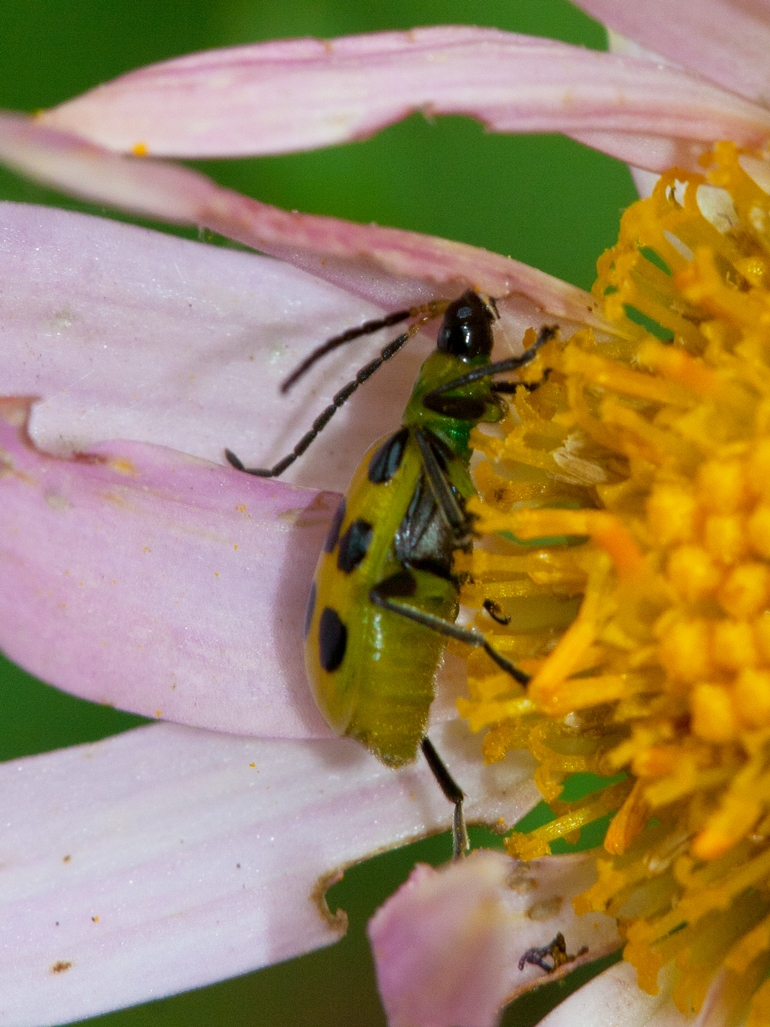
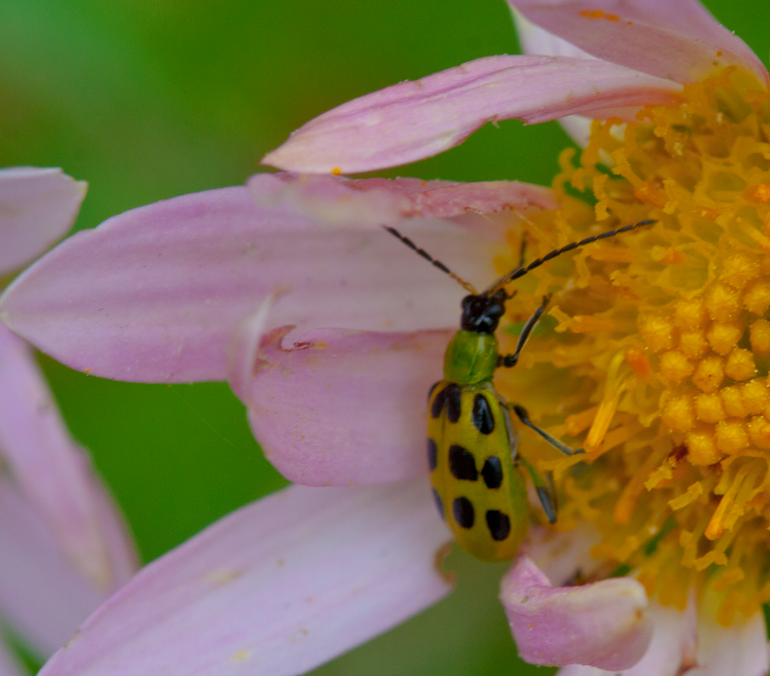
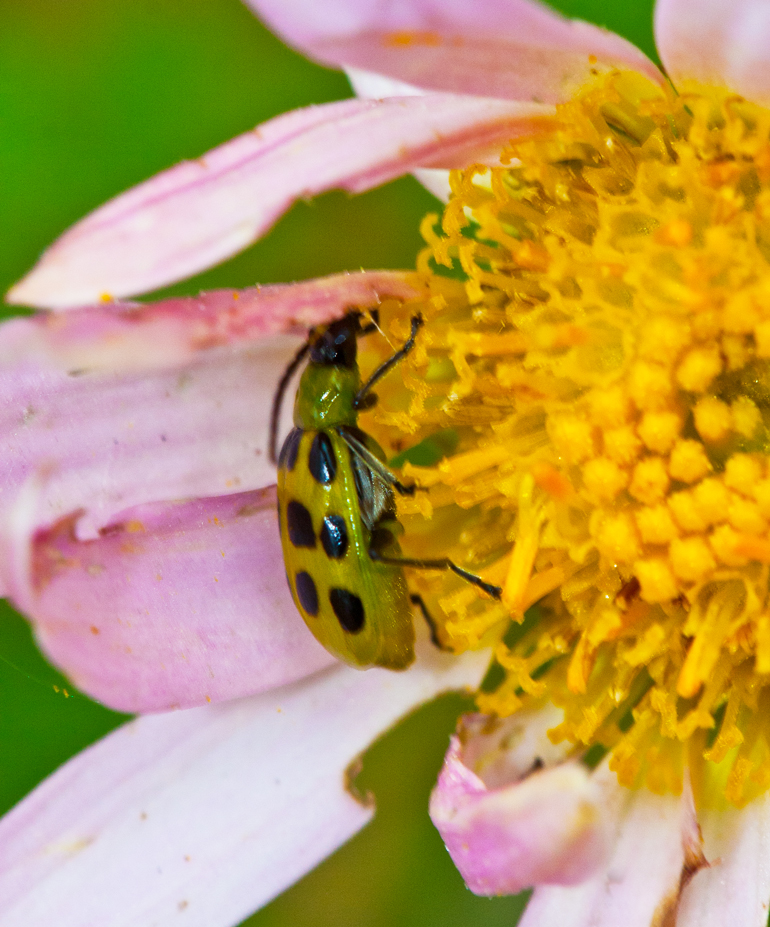
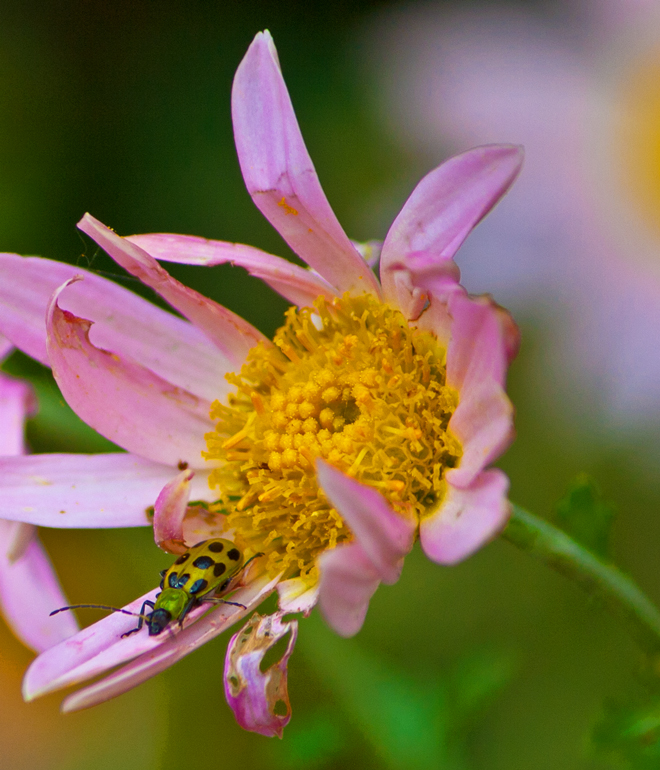
It seems that as long as plants are blooming, some insects, especially those considered to be pests, will continue to be active. This past weekend as I was looking at flowers at a local garden, I spotted a familiar insect, the Spotted Cucumber beetle (Diabrotica undecimpunctata). I consider this beetle to be attractive, with his different shades of green and multiple black spots, but recognize that it causes a lot of destruction (and you can see some of the petals of the flower that it has chewed through).

Several cucumber beetles were on the flowers and I was able to get some pretty good shots with my 100mm macro lens, a lens that has fallen into disuse as I have focused more of my attention on birds. The photos show the beetles in several different “poses”—I especially like the first one that seems to have caught the beetle as he is chewing on the flower. You may want to click on the photos to see higher resolution views.

© Michael Q. Powell. All rights reserved.

Read Full Post »

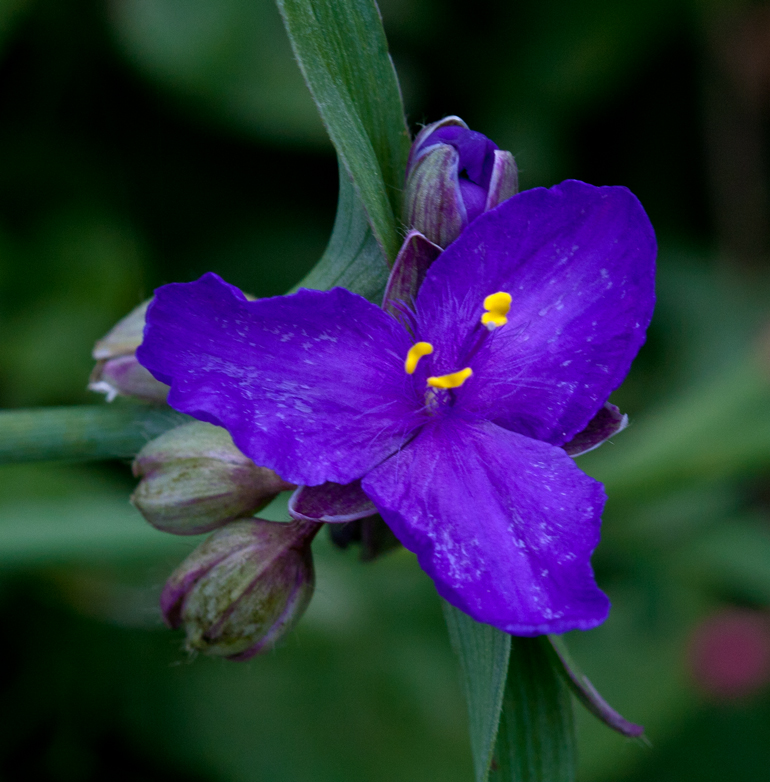
During a walk this past weekend through a local garden, I was surprised at how many flowers were still blooming (or were newly blooming). Here is a somewhat random assortment of photos of those flowers, some of which I can identify such as a zinnia and a pansy, but others are nameless beauties to me.

© Michael Q. Powell. All rights reserved.

Read Full Post »

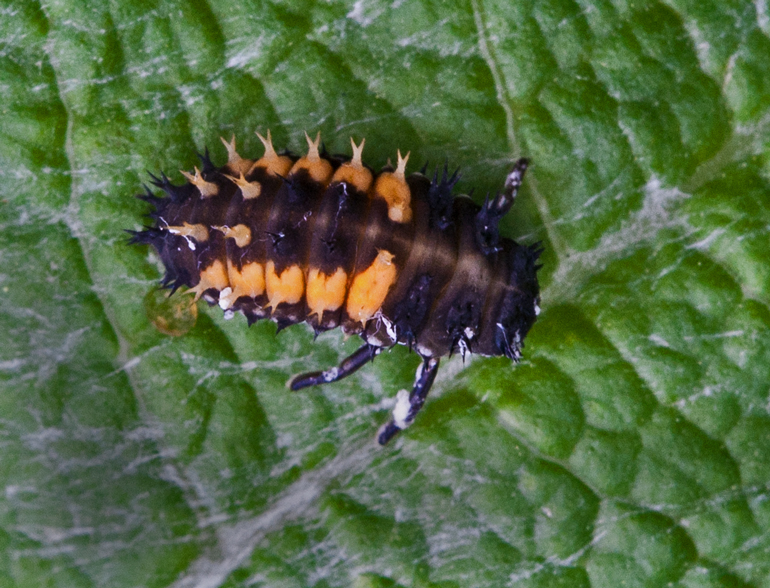
I know that ladybugs don’t really have babies, but, seriously, how many people will read a posting with words like “larva” and “pupa” in the title? A more accurate title would be something like “Larva and Pupa of the Multicolored Asian Lady Beetle (Harmonia axyridis).”

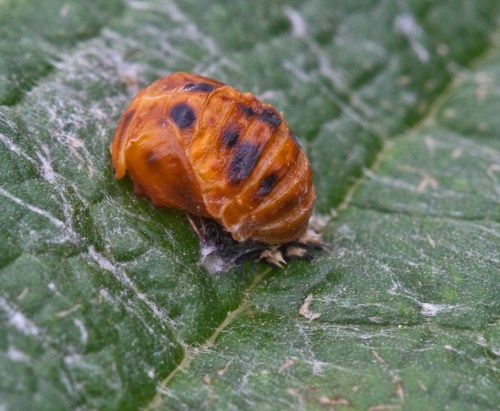
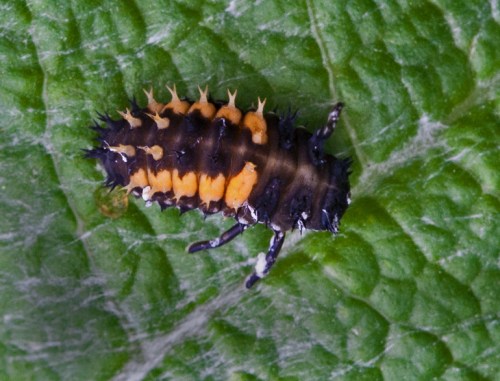
This past weekend I was wandering through a local garden when I spotted a strange-looking little yellow and black insect. Upon closer investigation, I discovered several more of them on the plant, along with some orange and black objects that I thought might be insects too, but they were not moving. This was a good excuse to take out my macro lens and to follow the old adage about shooting first and asking questions later.

After a bit of research, I realized that I had captured two different phases in the life cycles of a ladybug. Lady-bugs.org and ladybug-life-cycle.com offer additional details on the stages of development of a ladybug, but allow me to summarize for folks like me who don’t follow insects for a living. The ladybug’s life cycle is about four to six weeks long, with four stages (egg, larva, pupa, and adult). During the larval stage, the ladybug larvae shed their exoskeletons three times before the pupation stage begins. It is during the pupa stage that the metamorphosis takes place that is almost as magical as it is for butterflies and the insect that I photographed turns into a full grown ladybug.

Thanks to bugguide, I was able to identify my bug as the Multicolored Asian Lady Beetle (Harmonia axyridis). The article notes that the larvae look like tiny alligators and grow to be larger in size than the eventual ladybug. It describes the pupa as “an elongated dome shape, usually found attached to a leaf, with the spiky remains of the last larval skin usually clinging to one end. The branched spines of this skin are usually visible.”

It was fascinating to discover the details of what I had photographed—metamorphosis never ceases to amaze me. Here are a couple of my favorite shots of the ladybug larvae and several of different pupa. Be sure to click on them to see more details.

© Michael Q. Powell. All rights reserved.

Read Full Post »

Yesterday I returned to my photographic roots at Green Spring Gardens, a county-run historic park, to shoot flowers and bugs, the subjects I started with six months ago when Cindy Dyer, my mentor and muse, helped me get serious about my photography. It was cloudy and cool (about 47 degrees F (8.3 degrees C) and I didn’t expect to see many insects active. There was quite a variety of flowers blooming, including many that have been present all summer. Perhaps when we have a hard freeze, some of them will die off, but for now they provide a blast of bright color that contrasts with the now fading fall foliage.

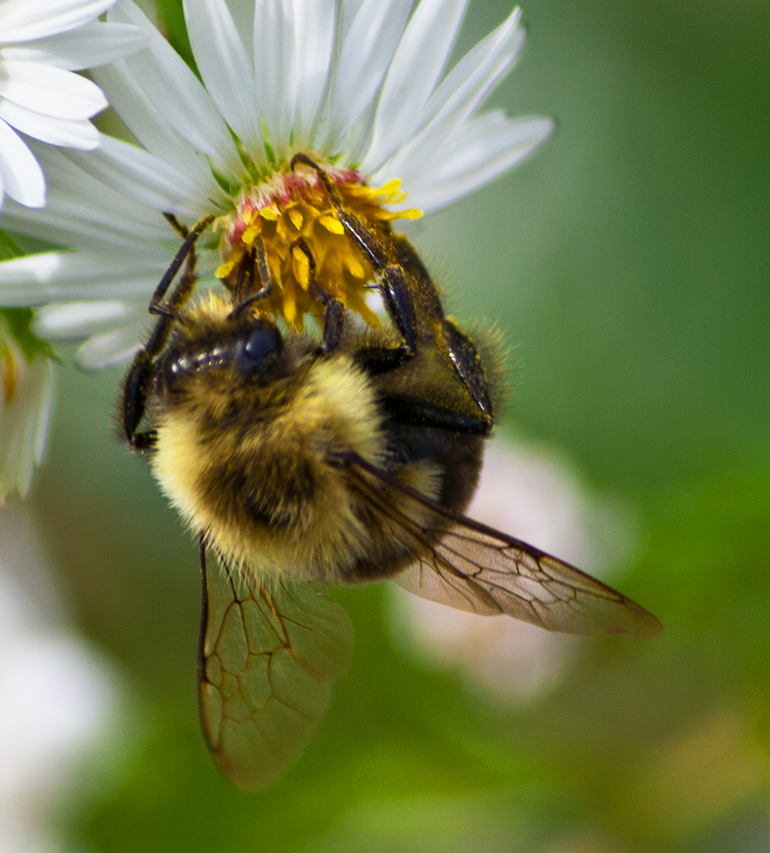
Bee in early November

I was surprised when I encountered this bee, the only one that I saw all day. It seemed to be moving slowly in the colder weather, but was industriously working on this purple flower. Judging from its relatively hairless abdomen, I think that this might be a carpenter bee rather than a bumblebee, though I am not completely sure about the identification.

I have always mentally associated bees with spring, but now, as I look more closely at nature, I realize that I have to question all of my previous assumptions. That’s probably a good thing for me to do regularly, and not just in my photography.

Bee working in the cold

© Michael Q. Powell. All rights reserved.

Read Full Post »

Originally posted on 25 August 2012

I am re-posting this image for three primary reasons.

  • Today’s Halloween and what could be more appropriate for an insect with Halloween in its name?
  • This is one of my absolutely favorite images and many of you may not have seen it yet (and I like the text too).
  • I’m a bit of a contrarian and want to post something beautiful today, rather than the creepy images that others may choose to post.

Happy Halloween!

Text of original post:

I remember my excitement the first time I saw a really cool dragonfly a few months ago that turned out to be a Halloween Pennant dragonfly (Celithemis eponina). He had a very distinctive look with brown spots and stripes on his wings and orange veins. That first time I was happy to get any shot of the dragonfly.

Today I think that I encountered a Halloween Pennant for a second time. I was still very much taken by his looks but I had the presence of mind to circle about a bit, trying to get a good angle for the shot. The shot below is the one that I like the best of those that I took.

As I think about it, I go through this cycle a lot. I’m so in awe and wonder when I encounter something new that photography is not my first priority. Instead I am living the experience. Maybe my photos the first time are not the best, but that’s ok for me, because living my life is more important than merely recording it in my photos. That may be why I like to go back to places a second time and then focus a bit more on getting good shots.

Halloween Pennant dragonfly (Click for higher resolution view)

© Michael Q. Powell. All rights reserved.

Read Full Post »
Bees were one of my initial subjects when I started photographing insects six months ago. Even now,  I can’t resist snapping a few shots whenever I see them. I never expected to encounter them in late October, however, so it was a nice surprise yesterday, when I was able to capture these images of bees at work (and a skipper too).

Bee in the fall with a single flower

Bee in the fall with multiple flowers

Skipper in the fall

© Michael Q. Powell. All rights reserved.

Read Full Post »
I was going over some photos from earlier this month and came across these photos of a Monarch butterfly. I remember how excited I was when I shot them and decided to share a few of them. Early in the summer I took lots of photos of swallowtails, but I longed to photograph a Monarch butterfly. The first few that I saw flew away before I could raise my camera. Eventually, I managed to get some decent shots, but my pulse still quickens whenever I see a Monarch. Other insects may be cool or interesting or unusual, but for me there is nothing that really matches the beauty and elegance of a Monarch butterfly.

© Michael Q. Powell. All rights reserved.

Read Full Post »
It’s the middle of October and grasshoppers are still hopping, though it seems that there are fewer of them than a month ago. This grasshopper was willing to stay still long enough to pose for this informal portrait. The sunlight was coming from the side and the back, helping to illuminate the underside of the grasshopper that is usually in the shadows and there is a nice glow to the grasshopper. I like the effect.

Illuminated fall grasshopper

© Michael Q. Powell. All rights reserved.

Read Full Post »
Have you ever woken up on a fall morning and noticed the dewy grass and bushes littered with spider webs? I don’t mean the beautiful geometric-patterned webs of the orb-weaving spiders, but webs that appear to be nothing more than loosely woven sheets of spider silk. Normally I don’t give them a second glance, but one morning this weekend I stopped and looked at one of them more closely.

Close-up of web in the grass

I discovered a beautiful little world, filled with tiny beads of water, captured by the threads of the web. I think the spider is a grass spider of the genus Agelenopsis. Wikipedia notes that the webs of grass spiders are not sticky, but the spiders makes up for that by being able to run really quickly.

Here is a view of an entire web through a telephoto lens. I was on a walkway several feet above ground-level when I took the shots, so I was not able to get actual close-up shots. The photo is not a very good one, but it gives you an idea of how nondescript the web looked at first glance.

Web in the grass

© Michael Q. Powell. All rights reserved.

Read Full Post »

Early morning sunlight illuminates the cattails (and the webs in between them) in the marsh at Huntley Meadows Park in Alexandria, VA. Low hanging mist/fog that morning added a special beauty and mystery to the quietness of that fall morning.

(click on photo to see a higher resolution view)

© Michael Q. Powell. All rights reserved.

Read Full Post »

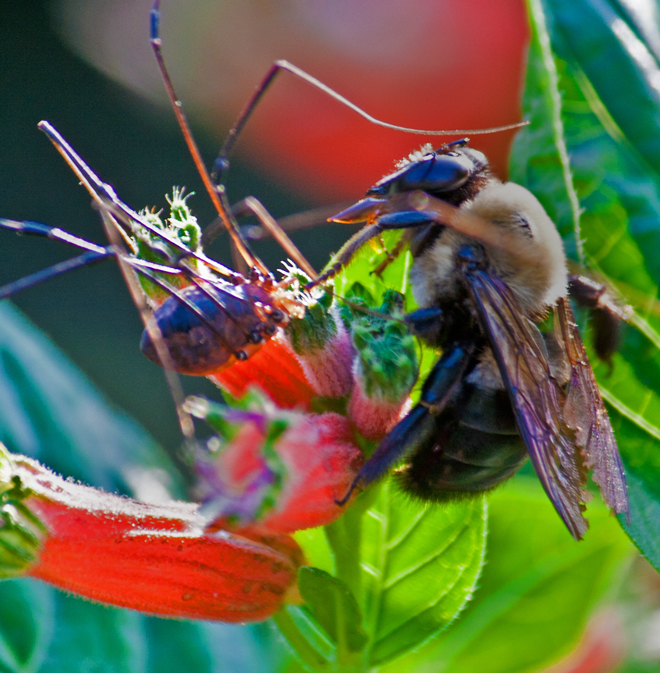
I am always fascinated whenever I happen to capture two different insects in a single image, especially when they appear to be interacting. A bee flew onto a flowering plant and appears to be having a conversation with a daddy longlegs (aka harvestman) that was already there. Does one of them look at the other as a potential prey? Are they sharing information? Is one asking the other out on a date?

Can you hear me now?

Insect interaction

© Michael Q. Powell. All rights reserved.

Read Full Post »

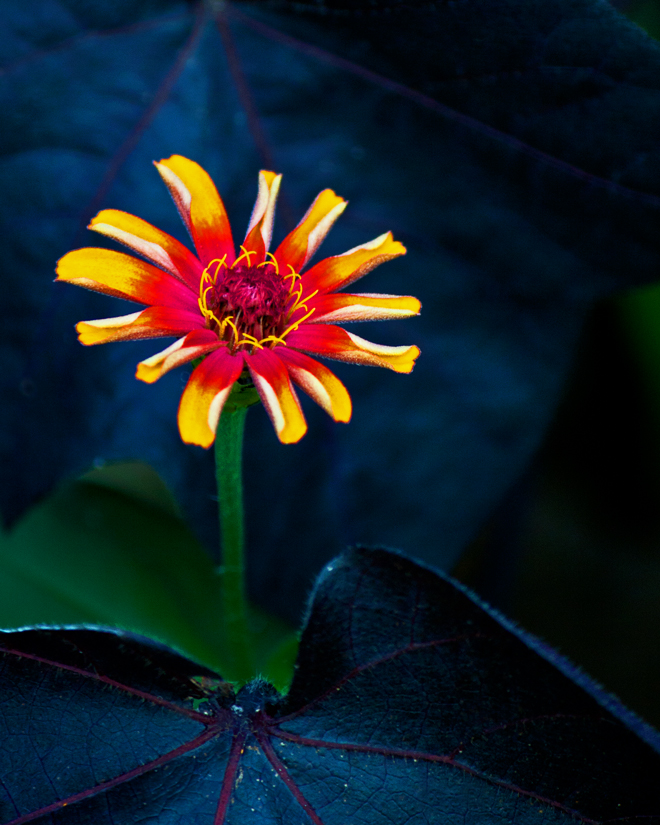
Some words are just fun to say out loud. How can you not smile when you repeat the words “Zowie Zinnia?”

I think that is the correct name for this colorful little flower, which helps to brighten up the gloomy weather that has descended on us the last few days. Zowies usually have much more showy displays, but I like the way that the colors and shape of this young plant are set off against the backdrop of the dark green leaves.

“Zowie!”—it sounds like something Robin would say to Batman (and of course it would need to be punctuated with an exclamation point).

Zowie Zinnia

© Michael Q. Powell. All rights reserved.

Read Full Post »

Some of my friends of Facebook think that I make up the name of some of the insects whose pictures I post. After all, can there really be an insect called the Handsome Meadow Katydid? Normally, the official names are so strange that there is no need to invent new ones.

Today, however, I decided to  make up a name for a caterpillar that my friend Cindy Dyer helped me identify earlier in the summer, when I did a posting entitled Patterned Caterpillar. The caterpillar’s real name is a Cattail caterpillar (Simyra insularis) and I photographed it this weekend at Huntley Meadows Park in Alexandria, VA.

This caterpillar’s black-and-white patterns are such a perfect match for those ubiquitous markings found on all products that I want to rename it as the Barcode caterpillar.  What would register if you scanned this caterpillar at the checkout counter at a store?

Cattail caterpillar (Simyra insularis)

© Michael Q. Powell. All rights reserved.

Read Full Post »
The day was winding down as I retraced my steps back to entrance of Green Spring Gardens, when I caught a glimpse of a Spotted Cucumber beetle (Diabrotica undecimpunctata). My initial instinct was to switch from my 55-250mm telephoto zoom lens  to my 100mm macro lens so that I could fill the frame with this colorful little insect on a single flower.

I was tired and a little impatient, so I decided to photograph the beetle with the “wrong” lens. In retrospect, I am happy that I made that decision, because I ended up with an image that I really like. Yes, the beetle is still there, but the shape and positions of individual buds of the flower are what make this image stand out for me.

What did I learn? I realize that I need to consciously question my initial instincts and consider shooting a usual subject in an unusual way. I can’t always rely on fatigue to be the causative factor for a good result.

Spotted Cucumber beetle on red flower

© Michael Q. Powell. All rights reserved.

Read Full Post »

We continue to fade to brown, with only muted color changes as the leaves begin to fall from the tree. As if to compensate for the lack of spectacular foliage, brightly colored flowers are still blooming. I managed to get some shots of equally colorful insects interacting with yellow flowers. When I see Monarch butterflies (Danaus plexxipus), they are usually in the midst of blooming flowers, but I was surprised to also see a shiny red ladybug near the center of a yellow flower.

Monarch butterfly on yellow flower

Ladybug on yellow flower

© Michael Q. Powell. All rights reserved.

Read Full Post »

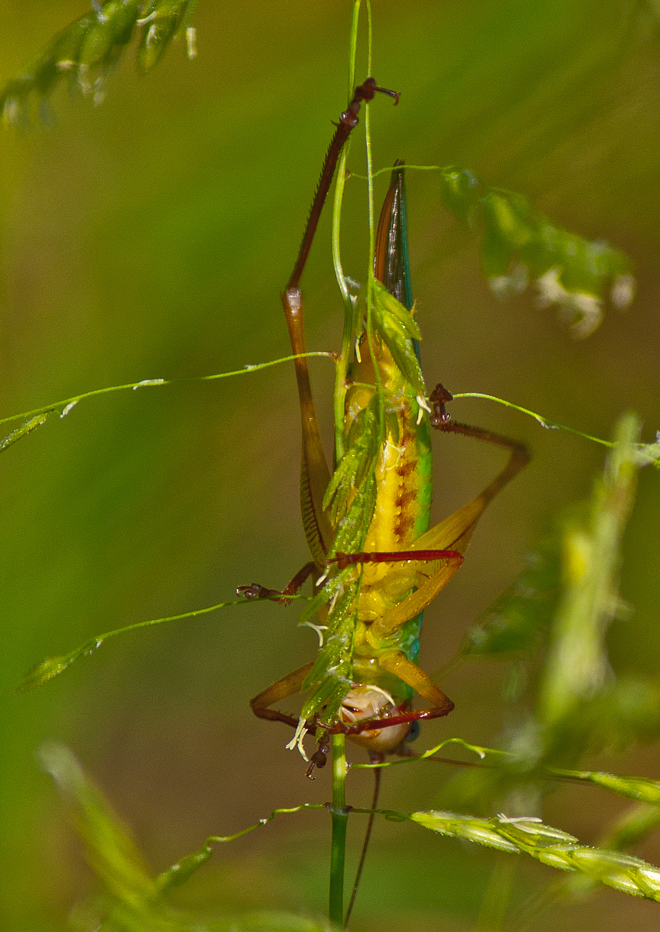
Several years ago I saw one of the Cirque du Soleil productions, an event full of dazzling costumes and amazing acrobatic feats. Memories of that unforgettable experience were triggered when I first viewed this photo of another Handsome Meadow Katydid (Orchelimum pulchellum) at Huntley Meadows Park. I have previously posted a number of different images of this very photogenic insect, but this one shows my beautiful friend in action, rather than in a static pose.

Acrobatic Handsome Meadow Katydid

I recall how the acrobats of the Cirque du Soleil were suspended high in mid-air, holding on (often with what seemed to be a single toe) to a trapeze or to a slender rope. My little katydid is not risking his life in that way, but I do find it amazing how he is clinging to the single stalk of grass. His brilliant colors continue to amaze me and the red blotches on his face accentuate the circus-like effect, as you can see in this close-up view of his face.

Close-up view of a Handsome Meadow Katydid

I will be a little sad when I stop seeing my colorful little friends at Huntley Meadows Park, but the memories will remain. Perhaps  in the future, some brightly colored object or acrobatic pose will trigger memories of these katydids, nature’s own Cirque du Soleil.

© Michael Q. Powell. All rights reserved.

Read Full Post »
It was a dark and cloudy afternoon and the rain was threatening to start at any moment (and eventually did). Even my usual grasshoppers and spiders seemed to have disappeared from sight. I was losing hope that I would find anything interesting to photograph when I stumbled upon a large bee on a bright yellow plant.

It looked like a carpenter bee, but the eyes were unusually light in color. I am pretty sure that it is an Eastern Carpenter bee (Xylocopa virginica) and the white patch on the face indicates that it is a male. There are other photos on-line of carpenter bees with green eyes, but I am not sure how common it is to find one like this. I don’t recall ever seeing one like it before.

Male Eastern Carpenter bee

© Michael Q. Powell. All rights reserved.

Read Full Post »

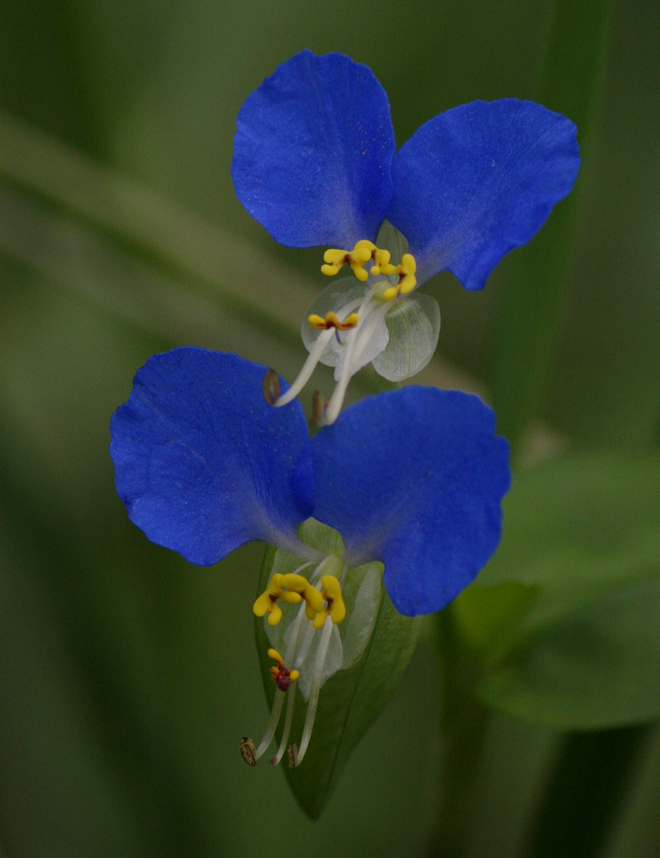
This past weekend some small blue wildflowers caught my eye. They seemed a bit unusual, because they had two large blue petals and what appeared to be smaller white petals. In addition, they had really long stamen.

According to a Wikipedia article, these are Asiatic dayflowers (Commelina communis), a plant native to East and Southeast Asia that has been introduced into the eastern part of the United States. The flowers are used in traditional Chinese medicine and they are used to produce a dye in Japan.

As is frequently the case with wildflowers, there seems to be some debate about whether this is a weed or a flower. Call it what you will, it is a strikingly beautiful plant.

Asiatic dayflower (Commelina communis)

© Michael Q. Powell. All rights reserved.

Read Full Post »

Wandering yesterday through the marshy area of Huntley Meadows Park, I spotted a large bug perched near the top of one of the cattails. I could not really see for sure what it was and it flew away as soon as I took one photo. When I opened the image on my computer, I saw that I had captured an image of a strange-looking bug that seemed to have the blade of a circular saw embedded in its back.

It did not take much of a search on the internet for me to discover that it is a wheel bug (Arilus cristatus). The University of Florida Entomology Department website notes that the wheel bug is an assassin bug that administers a very painful bite, described as worse than the bite of a bee, wasp, or hornet. Wheel bug saliva contains a toxic, paralytic substance that immobilizes and kills its victims (caterpillars, bees, aphids, and other insects) usually within 15 to 30 seconds after injection.

Personally, I think this insect looks like a miniature dinosaur or something out of a low-budget science fiction movie. In any case, it is certainly one of the strangest looking creatures that I have ever encountered.

Wheel bug surveys the situation from a cattail

© Michael Q. Powell. All rights reserved.

Read Full Post »

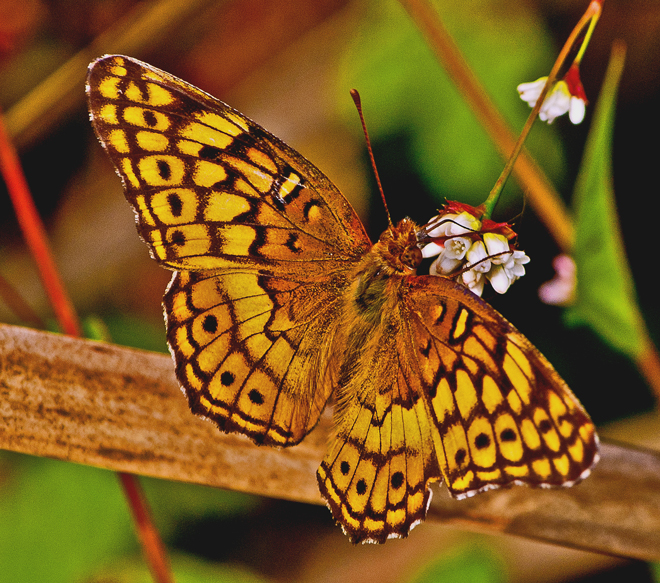
As we move deeper into autumn, I expect to find the colors orange and yellow only in the fall foliage or an occasional sunset. Yesterday, I was surprised to see this orange-and-yellow butterfly flitting from flower to flower, seemingly oblivious to the changing seasons. Doesn’t he know it’s almost October? Is it eternally spring for a butterfly?

Butterfly in late September

© Michael Q. Powell. All rights reserved.

Read Full Post »

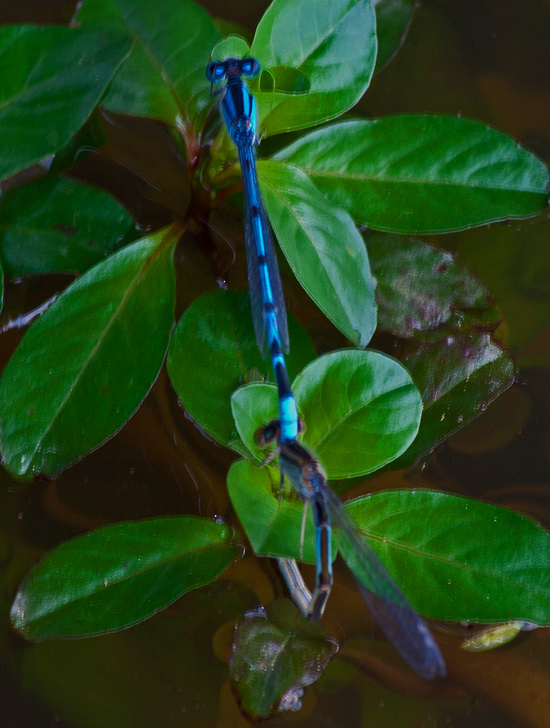
Damseflies are really small and if they were not brightly colored, they would be difficult to see. However, when there are two of them flying together (really together), they are slightly easier to detect. Anatomically speaking, I am having a little trouble figuring how the mating takes place with the damselflies as pictured below, but suffice it to say that damselflies are more flexible and acrobatic than I had previously thought.

I took these shots this afternoon at Huntley Meadows Park in Alexandria, VA.  Getting a decent image was a bit of a challenge because I was shooting from a raised boardwalk almost two feet above the water level and the damselflies keep landing on vegetation that was just in the shadows underneath the boardwalk. As a result, my position sometimes resembled that of the lighter-colored damselfly.

Close-up of mating damselflies

Mating damselflies

Acrobatic mating damselflies

© Michael Q. Powell. All rights reserved.

Read Full Post »

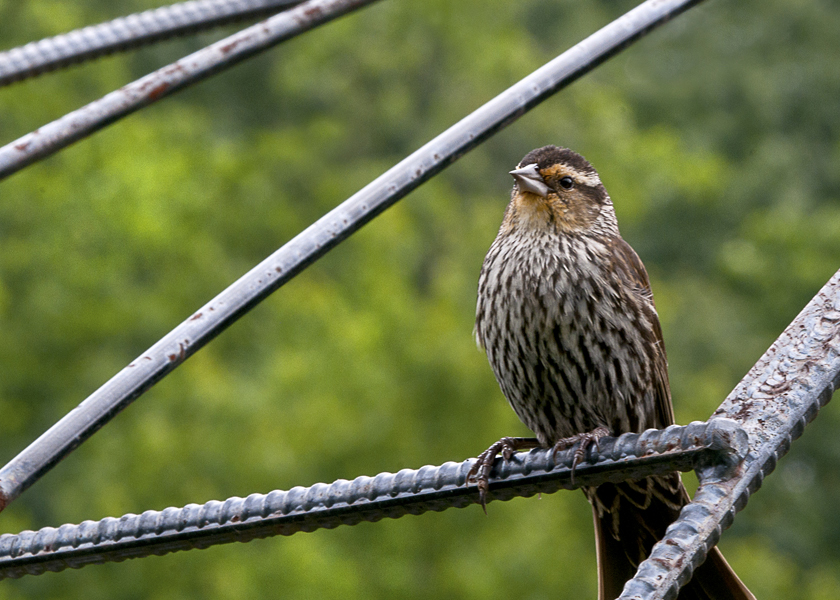
I have recently been making a lot of attempts to photograph birds, but none of the photos comes close to matching the visual impact of this female red-winged blackbird that I photographed in early June at Brookside Gardens in Wheaton, MD.

Normally you are not supposed to photograph a bird from the front, but in this case it seems to heighten the intensity of the bird’s stare. The sky was almost white that day and it disappeared when tweaks were made, but that seemed to fit with the industrial look provided by the rebar that was used to form a trellis.

Intense female red-winged blackbird

Here is another shot of the blackbird on the trellis, with some greenery in the background. You can see some of the details of the trellis, and it looks like the rusted metal is almost a perfect color match for some parts of the bird.

Bird on a wire

My blog is still less than three months old, so I have a number of my pre-blog favorites that you have not yet seen. I will occasionally share some of them when I don’t have any new material or don’t have time to prepare the new photos.

© Michael Q. Powell. All rights reserved.

Read Full Post »

The bright green leaves of the plants in the marsh have faded and most of the colors are more subdued than in early summer. Against that muted backdrop, I was surprised to come across a brightly colored caterpillar this past weekend. It looks a bit like the Cattail Caterpillar (Simyra insularis) that I photographed and described earlier this year, although the spiky red tufts are more extreme on this caterpillar. I think I can detect the prominent black and white pattern that was so visible in the image that I posted previously.

This is the first year that I have paid close attention to the cyclical changes in plants, animals, birds, and insects. I am excited to see what new species will come into my field of vision as we move through the fall.

UPDATE: I did a little more research and now think that this caterpillar is actually a Smeared Dagger Moth caterpillar (Acronicta oblinita).

Colorful caterpillar in late September

© Michael Q. Powell. All rights reserved.

Read Full Post »
Basking in the warmth and light of the fall sun, turtles of all sizes were perched on the logs and other chunks of wood in the muddy waters of a local marsh pond. I was struck by the attitude of this red-eared slider turtle (Trachemys scripta elegans), whose stiff-necked and imperious pose seemed almost aristocratic. He had gained this prime piece of real estate by crawling over one of his fellow turtles and was now standing on that turtle’s back to provide himself better access to the sun.

I have to admit that he is beautiful and I suspect that he would be the first to tell me so if he could speak.

Red-eared slider turtle basking in the sun

© Michael Q. Powell. All rights reserved.

Read Full Post »

I still can’t get over the striking blue eyes of a Handsome Meadow Katydid (Orchelimum pulchellum), so I am posting a shot from yesterday that highlights that feature (and my apologies to Frank Sinatra for borrowing the title of his 1973 album for this post).

The katydid almost seemed to be looking right up at me, perhaps wondering why I am disturbing him. I find the details of his feet to be utterly fascinating and I’ve made sure that you can see some of the many neon-like colors of his body.

Check out some of my other postings if this is your first encounter with this gorgeous katydid. You’re almost certain to fall in love with him too.

Ol’ Blue Eyes (Handsome Meadow Katydid)

© Michael Q. Powell. All rights reserved.

Read Full Post »

As the sun dropped lower and lower in the sky yesterday, I was struck by the way in which the light caused the cattails to glow. Many of the cattails had already burst into masses of cottony fibers and the backlighting showed them in wonderful detail and texture.

I tried to capture this beauty, but it was difficult shooting directly into the sun and I ended up with all kinds of light artifacts. Because I was mostly interested in the effects of the light, I decided to experiment this morning and converted one of the photos into black and white and played around with it (probably too much).

I think I need to read up some more on how to convert images to black and white and how to tweak them, but for now I’ll continue to enjoy the process of experimentation. I might stumble onto something really good.

Backlit cattails in the marsh

© Michael Q. Powell. All rights reserved.

Read Full Post »

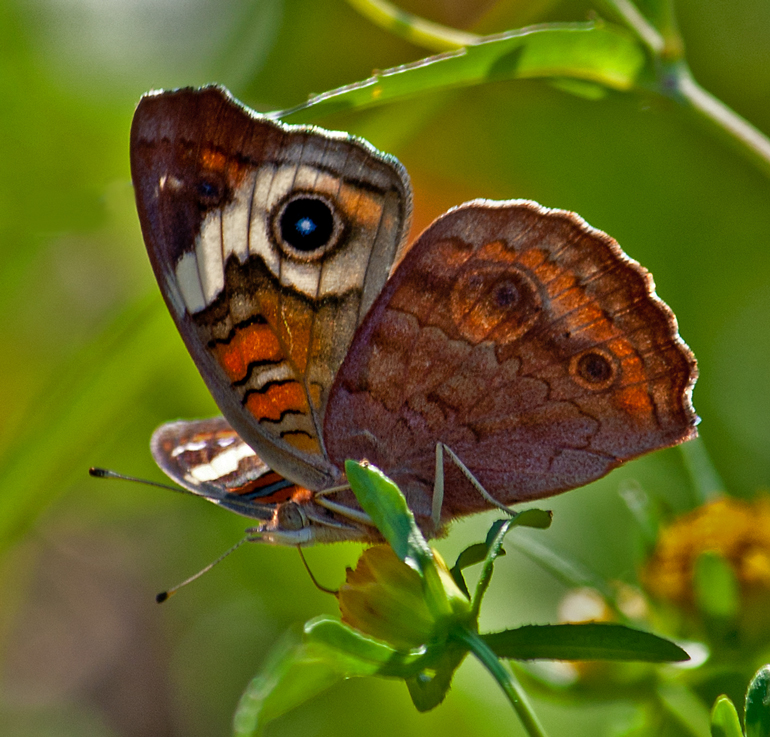
Yesterday was a common day for finding subjects to photograph. I already posted a photo of a Common Whitetail dragonfly. Here’s a photo of the Common Buckeye butterfly (Junonia coenia).

A month ago I featured the Common Buckeye in a posting after my first encounter with this type of butterfly. Yesterday I was shooting in the middle of the day and there was more sunlight that I would have liked when. However, I managed to get a shot of the butterfly in which the sun is shining through one of its wings, highlighting the beauty of those wings. There are still some harsh shadows in the photo and the colors are not as saturated as they would have been with more diffused light, but I find that the colors and patterns of this butterfly make it uncommonly beautiful.

Common Buckeye butterfly in mid-September

© Michael Q. Powell. All rights reserved.

Read Full Post »

I was at a local garden when I happened to hear this bird singing. My bird identification skills are so weak at this point that I won’t even hazard a guess about what kind of bird he is (I seem to be wrong more than I am right, with the exception of really common birds like robins and cardinals). His song was pleasant, however, and his brown eyes were captivating. He was perched up high enough that the sky provided a clear background and the green leaves and bright red berries added some interest and color in the foreground, although they partially hide his body. I like the way the shot turned out and it required only a minimum amount of cropping.

I finally managed to get a decent bird image in relatively good focus. What happened? I’m learning that I need plenty of light with the camera and lenses that I have to get an optimal image and I need to avoid the extreme end of my telephoto zoom and aperture range too.  Most of all, I need to be really lucky.

© Michael Q. Powell. All rights reserved.

Read Full Post »

Growing up in New England, I used to love this time of the year, when the fall foliage featured brilliant displays of red, orange, and yellow. I now live outside of Washington, D.C. and somehow the colors don’t seem as intense (and the colors change a lot later in the fall season). Sometimes, it seems that we simply fade to brown.

I was thrilled earlier this week to find relief from the fading fall colors when a flash of bright orange grabbed my attention. Somehow I thought it was too late in the season and that the weather was too cool for butterflies, but I was wrong. A Monarch butterfly, in all of his brilliant glory, was busily at work, flitting from flower to flower.

This fall I probably will not see the amazing oranges and yellow leaves of my childhood memories. The presence of  those same fall colors in the wings of a butterfly, however, help to trigger those memories. Isn’t it amazing how certain sights, sounds, colors, or smells can transport us back to a different time and a different place?

Monarch butterfly in mid-September

© Michael Q. Powell. All rights reserved.

Read Full Post »

It’s only a grasshopper, not an exotic insect, but I really like the way that his portrait turned out.

The grasshopper’s pose suggests that he is ready for action and his slightly cocked head helps to give him personality. I was able to get sufficient depth of field and sharpness by using an F8 aperture, ISO 200,  and 1/200 sec and by moving in a bit from the far end of my telephoto zoom (I was at 229mm of a 55-250mm lens). Both the foreground and the background are simple and are made up of a minimum of colors, mostly green and brown. The day was mostly cloudy, so the shadows are soft.

All these elements seemed to work in harmony and I was able to produce this nice, open-air portrait of a grasshopper.

Grasshopper portrait (click for a higher-resolution view)

© Michael Q. Powell. All rights reserved.

Read Full Post »

I have repeatedly observed a small spider or two hanging around the periphery of the web of the large Yellow Garden Orbweaver spiders (Argiope aurantia) that I have been photographing recently. Initially I thought it might be the male of the species, which is considerably smaller than the female, but when I finally took a clear enough photo of one of these small spiders, I realized it was a different species.

My research suggests that this is a kleptoparasitic spider. Let me explain. It may sound like I’m trying to sound like a scientist, but “kleptoparasitism” is a single word that captures the idea that this spider steals or feed on the prey captured by another spider. According to Wikipedia, kleptoparasitic spiders occur in five different families and I am pretty sure the little spider below is of the genus Argyrodes, which are also called dewdrop spiders.

Kleptoparastic spider eyes another spider’s catch

Let me set the scene for you. The much larger Yellow Garden Orbweaver spider caught what looks like a bee and returned to the center of the web, leaving the wrapped bee on the periphery. The little spider moved in and appears to be checking out this potential new food source. Compare the relative size of the spider and the bee—the spider is tiny. That made it tougher to get a clear shot of both the spider and the captured bee. My shot is far from perfect, but it does allow you to see some of the details (and you can get a higher resolution view if you click on the image).

It seems to me that the little spider plays a risky game, living with (and maybe stealing food from) a larger, more dangerous spider. Maybe he’s a thrill-seeker, an adrenaline junkie who enjoys living in a state of constant danger.

© Michael Q. Powell. All rights reserved.

Read Full Post »

« Newer Posts - Older Posts »