Feeds:
Posts
Comments

Archive for the ‘Flowers’ Category

Small butterflies have a special, delicate beauty all their own, like this Gray Hairstreak butterfly (Strymon melinus) that I photographed in mid-August at Lewis Ginter Botanical Gardens in Richmond, Virginia.

BugGuide states that this is the most common hairstreak in North American, but this is only the second time that I have seen one. Based on my limited observation of American women, I would assert that the blond hairstreak is the most common one, though, as a bald guy, I realize that hair is not my area of expertise.

hairstreak2_bloghairstreak1_blog

© Michael Q. Powell. All rights reserved

Read Full Post »

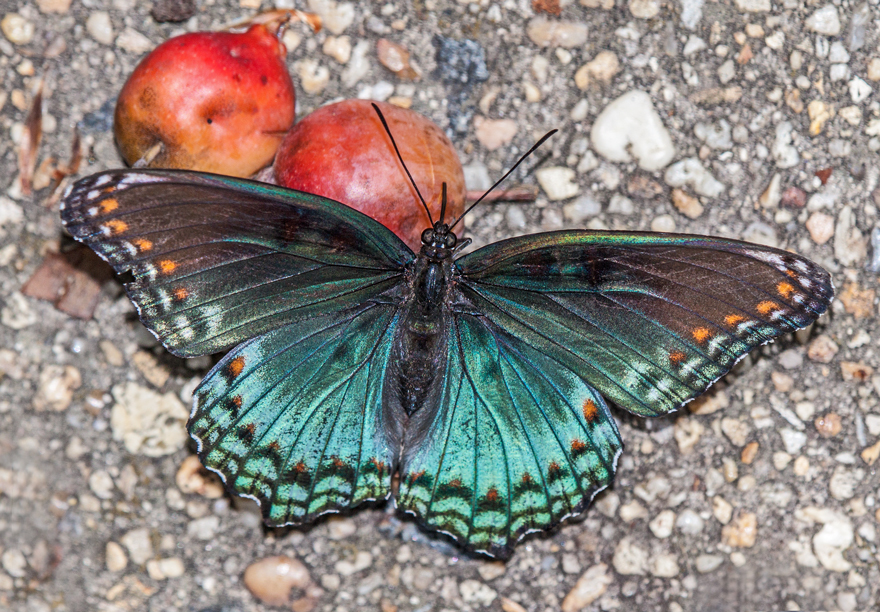
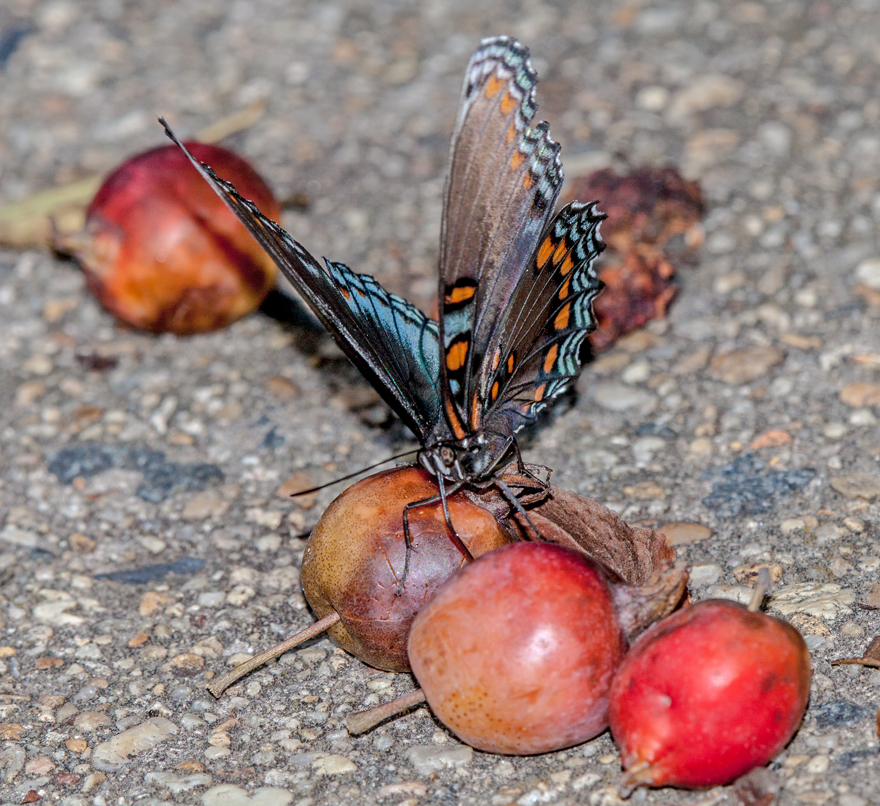
In the townhouse community in which I live in Northern Virginia, many of us have crabapple trees in our front yards, and the fallen crabapples are a nuisance at this time of the year. However, they do provide food for certain butterflies that prefer rotten fruit to flower nectar, like this Red-spotted Purple butterfly (Limenitis arthemis astyanax) that I photographed this morning.

crabapple2_blogcrabapple_blog© Michael Q. Powell. All rights reserved

Read Full Post »

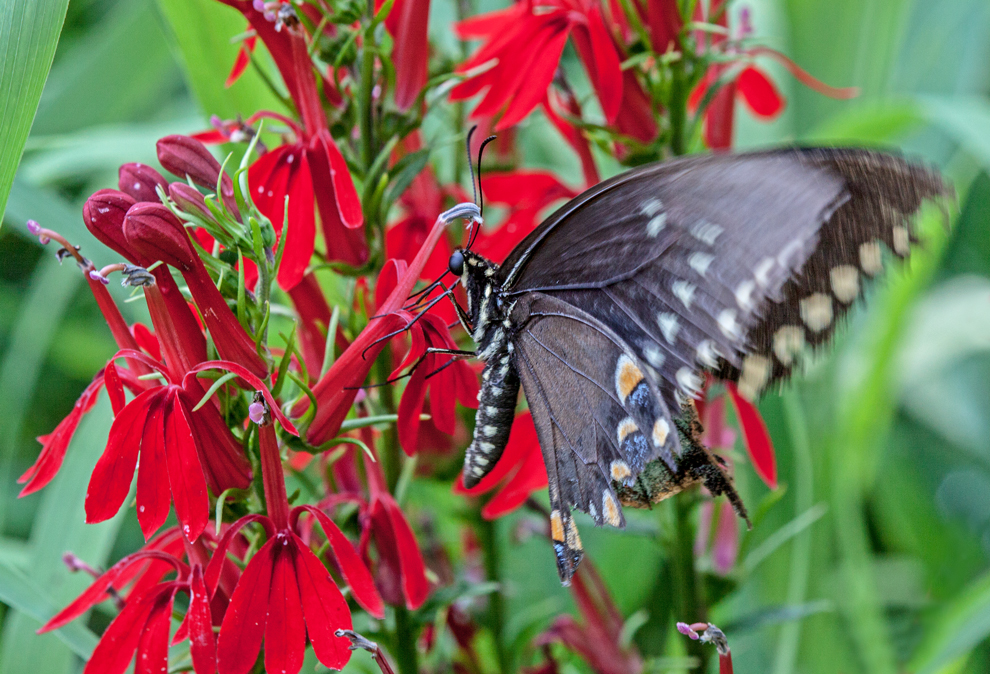
I love the look of this black-colored swallowtail butterfly feeding on a cardinal flower (Lobelia cardinalis) in the marsh—I just wish that I could identify the butterfly with greater certainty.

I used to think that there were only a few varieties of black-colored swallowtails, but as I learn about more species, I get more confused when trying to identify them. Most of the time I think that this is a Pipevine Swallowtail, but at other moments I convince myself that this is a Spicebush Swallowtail or even a Black Swallowtail. Whatever species it is, this butterfly kept its wings flapping pretty quickly as it was feeding, which accounts for the motion blur in the wings.

I really like the color and shape of the cardinal flower and wanted to show some of the buds and petals, so I decided not to crop the shot any tighter. I was a little surprised to find this butterfly on the cardinal flower, because I read in one document on the internet that these flowers are pollinated almost exclusively by hummingbirds.

swallowtail_cardinal_blog

© Michael Q. Powell. All rights reserved

Read Full Post »

Looking into a Swamp Rose Mallow (Hibiscus moscheutos), I immediately noticed the distinctive colors of a Handsome Meadow Katydid (Orchelimum pulchellum), feeding on the center stalk of the flower.

The katydid did not move from its position and merely cocked its head a little to the side and glanced up at me with its striking blue eyes. It seemed to be a little irritated to be disturbed, though I must confess that it’s really hard to gauge the emotions of an insect from its expressions.

The Handsome Meadow Katydid is one of my favorite insects and, in my humble opinion, truly deserves its name. In addition to its rainbow coloration and distinctive eyes, it has the cutest little feet and toes.

katy_mallow1_blog

© Michael Q. Powell. All rights reserved

Read Full Post »

I love backlit subjects, especially when the light shines through from behind and provides a stained glass effect, as was the case with this Viceroy butterfly (Limenitis archippus).

backlit_viceroy_blog

© Michael Q. Powell. All rights reserved

Read Full Post »

I probably should have come up with a more creative title for this posting than the name of the featured insect. I mean, really, how many readers will be enticed to read a posting about a Dusky Stink Bug (Euschistus tristigmus)?  I word “stink” is enough to turn off some people.

Stink bugs are pretty much all shaped the same, but they come in different colors and patterns, many of which are similar, so identification is not always easy. In this case, for example, I had to determine if the shoulders were rounded or pointed to distinguish between two brown stink bugs—they look pointed to me.

The stink bug was hanging upside down, feeding on a plant that I can’t identify, when I encountered him. He seemed to be feeding, although I never did get a look at his face in order to verify my assumption. The upside down perspective is a little odd and I thought about rotating the image, but ultimately decided to leave it with its original orientation.

shield_blog

© Michael Q. Powell. All rights reserved

Read Full Post »

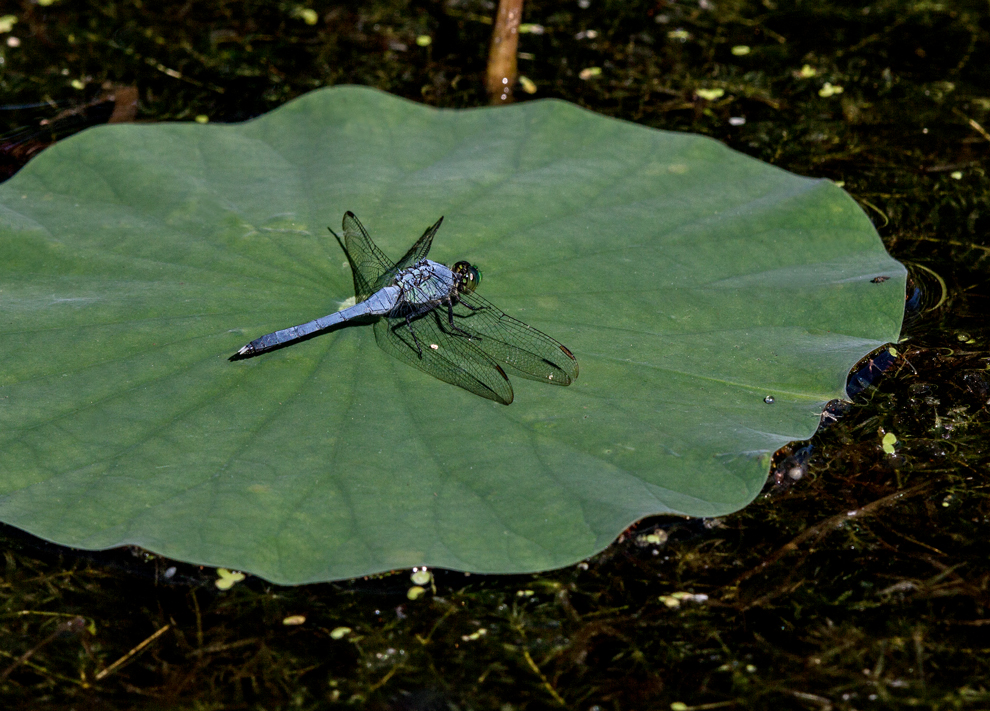
In most of my dragonfly shots the dragonfly is perched on an upright object, so, for variety, I decided to post this shot of a male Eastern Pondhawk dragonfly (Erythemis simplicicollis) in a different position—posing on a lily pad.

The dragonfly made multiple touch-and-go landings on this lily pad, sometimes landing near the edge, as in the first image, and sometimes in the middle, as in the second image. I couldn’t tell if he was using the lily pad as a platform for hunting insects or was merely resting. (It seems to me that it would be more advantageous for hunting to be higher up, unless you are hunting aquatic insects, which didn’t seem to be the case here.)

pad2_blogpad1_blog

© Michael Q. Powell. All rights reserved

Read Full Post »

I usually think of bees as being yellow and black, but I encountered this cool-looking metallic green bee (of the Agapostemon family) yesterday at Lewis Ginter Botanical Garden in Richmond, Virginia.

I remember The Green Hornet on television when I was a child, but I had never seen a green bee before. At first I was not even sure that it was a bee, but as I watched it gather pollen, I concluded that it had to be a bee.

It seems appropriate that I would be suffering from color confusion at that moment, because the bee was perched on a Purple Cone Flower (Echinacea purpurea), a flower that in my experience is rarely purple—they normally appear to be more pink than purple.

Now that I have freed my mind and broken the bonds of my conventional thinking about the color of bees, perhaps I will be able to bee all that I can bee.

green_bee1_blog green_bee2_blog green_bee3_blog

© Michael Q. Powell. All rights reserved

Read Full Post »

This bee might argue that it’s just the camera angle, but my initial impression of this bee was that he looked chubby—I don’t think that I have ever encountered a bee with such a round face. He reminds me of a sumo wrestler at the start of a match.

The bee pretty much ignored me, though, and seemed to really get into his work, literally, gathering pollen from some kind of milkweed plant, perhaps swamp milkweed (Asclepias incarnata).

chubby_blog

© Michael Q. Powell. All rights reserved

Read Full Post »

I was attracted initially by the bright red color of a cardinal flower (Lobelia cardinalis), but then I noticed a small amount of movement. When I looked more closely, I realized there was a tiny bee—the smallest that I have ever seen—busily gathering pollen. Rather than gathering pollen in little sacs, as I had seen other bees do, this bee seemed to be collecting it on his abdomen.

I don’t know much about plant anatomy, but as I searched on the internet, I learned some fascinating things about the cardinal flower, especially from a blog posting by Eye on Nature dealing with the way in which hummingbirds pollinate cardinal flowers. That posting contains some detailed images of the cardinal flower as well as some fantastic shots of a hummingbird.

I shot these images handheld with my 180mm macro lens. Ideally I should have used my tripod to get clearer shots, but the bee was so active that I feared that it would be gone if I had taken the time to set up the tripod.

It’s hard to appreciate the small size of the “bearded” section of the cardinal flower, so I enclosed an overall look at the flower as a final photo.

tiny_bee_blogtiny_bee2_blogtiny_bee-3_blogcardinal_flower_blog

© Michael Q. Powell. All rights reserved

Read Full Post »

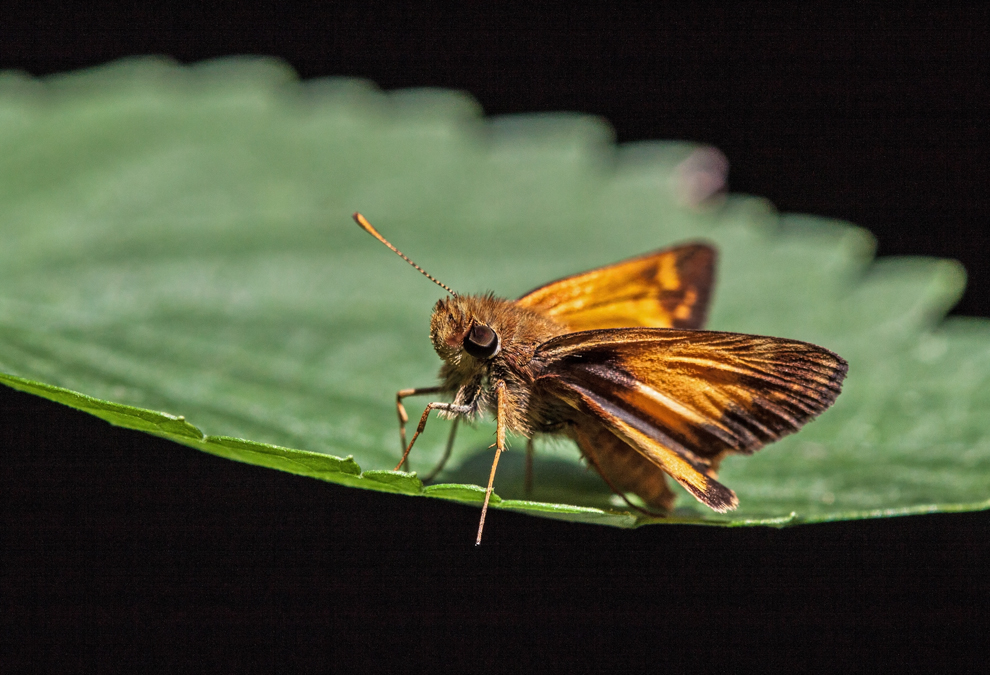
Every now and then I take a photograph and I am not really sure how I achieved the effect in the shot, like this one of a Fiery Skipper butterfly (Hylephila phyleus) on a jagged leaf.

With the exception of a few minor adjustments of the RAW image and a tiny bit of cropping, this looks just like the image I started with. When I first examined the image, I was pretty sure that I had used flash, but the EXIF data indicate that flash was not used. I took the shot handheld at ISO 400, f/6.3, and 1/500 sec. The depth of field was pretty shallow, but I did get the eye pretty much in focus, and I like the way the sharpness falls off so quickly.

I especially like the blurry jagged back edge of the leaf and the sharper near edge. The triangular shape of the wings seems to mirror those jags. Even the butterfly’s pose seems to work well, with the one leg dangling over the edge. If you click on the image, you get a higher resolution view of the photo.

I think that this is a Fiery Skipper, though I confess that I am not very good at identifying these little butterflies. Let me know if you can help in further identifying the butterfly.

skipper_leaf_blog

© Michael Q. Powell. All rights reserved

Read Full Post »

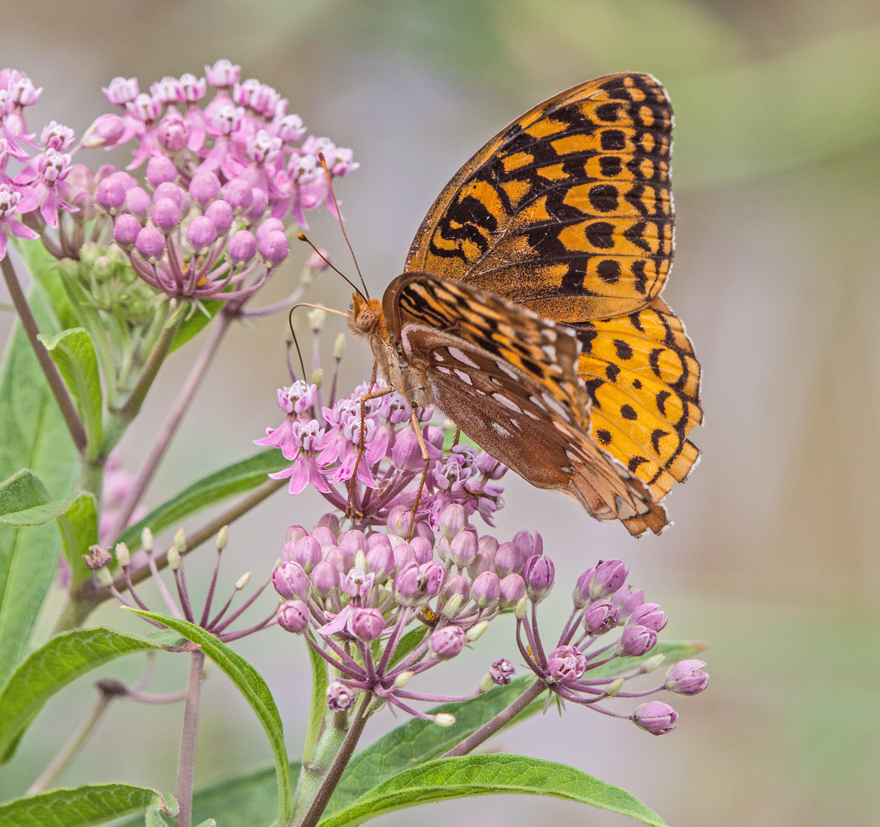
Normally I don’t think of orange and pink as colors that work well together, but I really like the result when I captured a shot of a Great Spangled Fritillary butterfly (Speyeria cybele) feeding on an unidentified pink flower.

spangled_pink_blog© Michael Q. Powell. All rights reserved

Read Full Post »

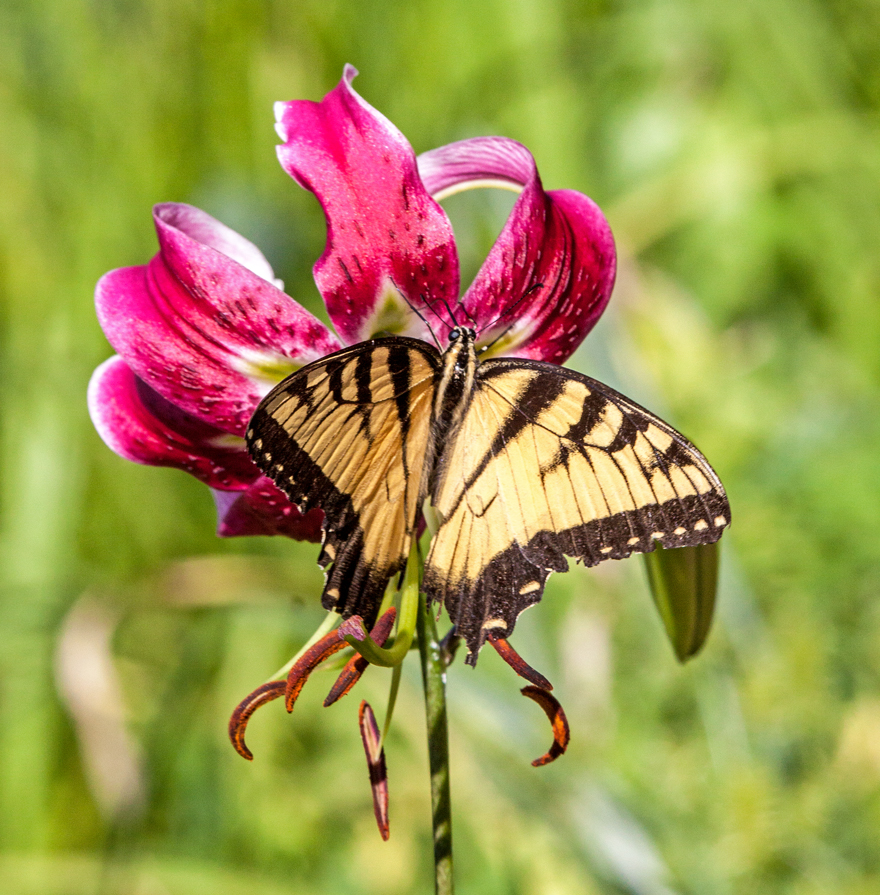
I don’t know my flowers very well, but I think that this Eastern Tiger Swallowtail (Papilio glaucus) is feeding on some kind of tiger lily (Lilium columbianum). Tiger on tiger—I like the way that sounds. Whatever the case, I love the gorgeous colors of the flowers, providing a gorgeous contrast to those of the butterfly.

tiger_blog

© Michael Q. Powell. All rights reserved

Read Full Post »

The weather this week has been mostly gray and dreary and I felt the need for a burst of bright colors, so I am posting this image from last week of a two Eastern Tiger Swallowtail butterflies (Papilio glaucus) feeding on an unidentified flower against the backdrop of a brilliant blue sky. The butterflies were even cooperative enough to place themselves at different angles to add  visual interest to the shot.

swallowtails_blog

© Michael Q. Powell. All rights reserved

Read Full Post »

The wasp looked huge, even from a distance, but I could get a clear shot of it against a beautiful blue sky, so I stepped out of my comfort zone and got close enough to it to get these images.

Fortunately I was shooting with a 180mm macro lens, so I was not exactly on top of the wasp, but even so, it was a little disconcerting to try to get a shot of a moving insect that looked so enormous and a bit threatening in the viewfinder.

After I took these shots, the wasp flew away and I breathed a sigh of relief—another sting avoided.

wasp2_blog

wasp1_blog

© Michael Q. Powell. All rights reserved

Read Full Post »

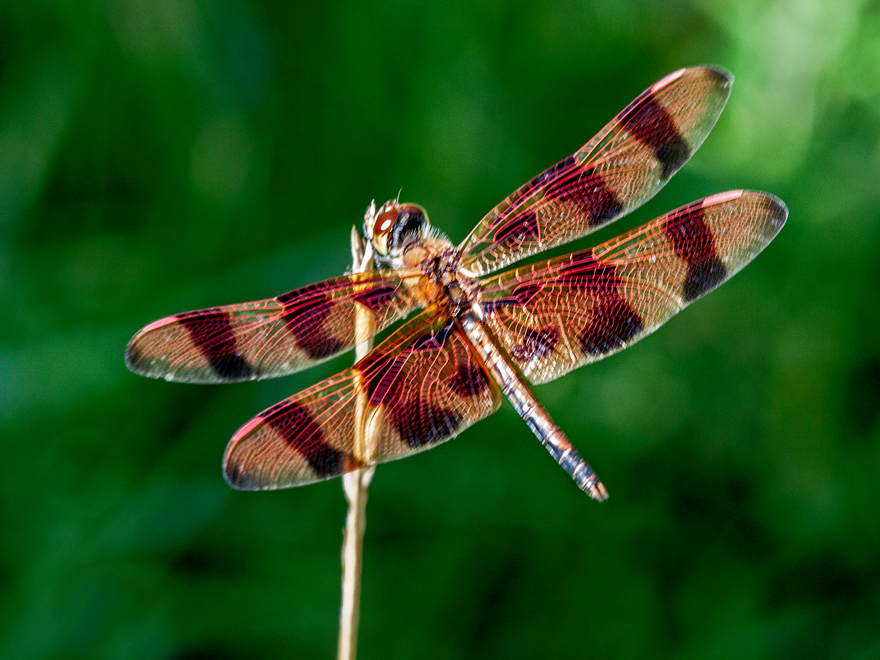
Yesterday I was happy to get some shots of my favorite dragonfly, the Halloween Pennant dragonfly (Celithemis eponina), at Meadowlark Botanical Gardens in Vienna, Virginia.

I don’t see this dragonfly at all at most of the usual places where I take photographs, so I was really excited when I caught sight of a couple of them yesterday. I chased them around for well over an hour and attempted to take a couple of hundred shots using a wide range of camera settings.

Why did I take so many photos? The dragonfly gets the “pennant”  part of its name because it likes to perch on the very tip of a weed stalk and waves in the breeze like a pennant. Yesterday, in fact, was breezy and it was quite an adventure trying to keep the dragonfly in focus, particularly because I was trying to fill the frame with the dragonfly.

The dragonflies that I photographed were reasonably cooperative and I was able to attempt shots from the side, from above, and even from below (fortunately the insects in the grass did not bite very often).

I have not been able to go through the shot to pick the best ones, but thought it would be nice to post one now, especially for those readers who may not be familiar with this beautiful dragonfly. I suspect that I will eventually post at least a couple more images in future postings.

Halloween1_blog

© Michael Q. Powell. All rights reserved

Read Full Post »

Different flowers affect me differently—some attract me with their beauty or their fragrance or their colors. Others produce an emotional response, like sunflowers, which invariably make me feel happy.

The sunflower’s large size, bright colors, and bold graphic design appeal to me. The sunflower virtually shouts its presence to the world—there is nothing soft and delicate and hidden about a sunflower.

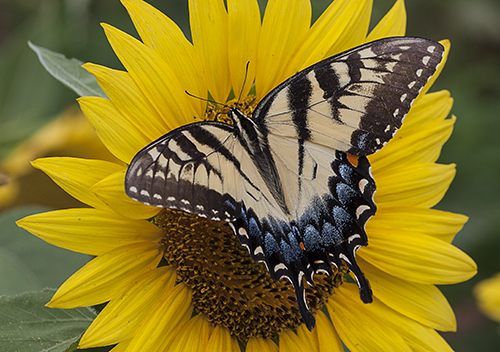
Like this Easter Tiger Swallowtail butterfly (Papilio glaucus), I sometimes enjoy the flowers one at a time. It was really fun, though, to visit a large field of sunflowers last month with some friends and to see row after row of these cheery flowers. I wanted to capture a group shot of the sunflowers, but I struggled to find a way to do so effectively (even though we had even brought along a little stepladder to give us a perspective from above the flowers).

In the end, my favorite shot (the second one below) focuses on a single sunflower, with other flowers a blur in the background. I used a simple 50mm lens (often called the “nifty fifty”) on my camera to make sure that I could control the aperture and throw the background out of focus.

EasternTigerSwallowtail lorez

sunflowers_blog

© Michael Q. Powell. All rights reserved

Read Full Post »

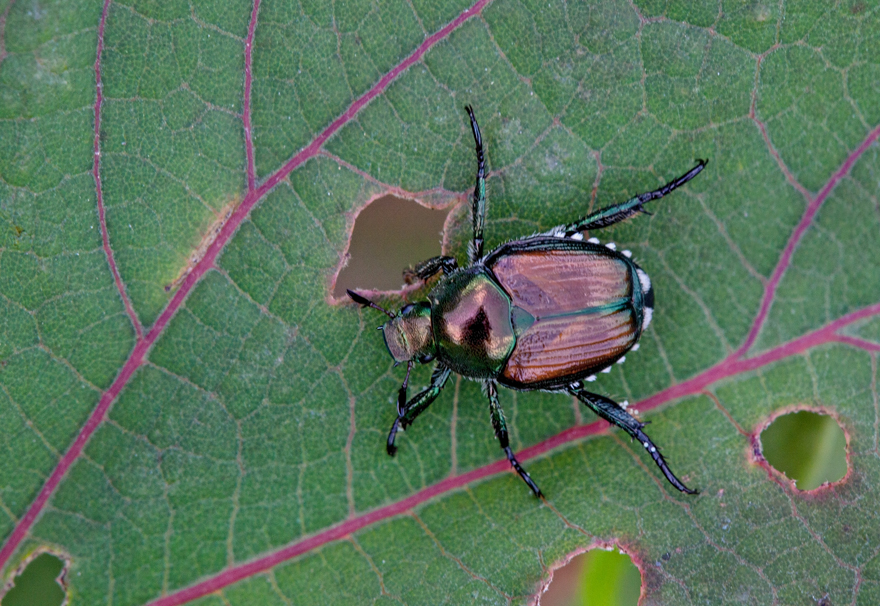
Japanese beetles (Popillia japonica) are very destructive, but also very beautiful and I sought to highlight both of these aspects in this image.

There were quite a few plant with holes chewed in them in one area of the marsh and I suspect that Japanese beetles were the culprits (this one sure looks guilty). I like the coloration and the reflectiveness of the insect’s body.  I’m not completely sure, but  I think that I see my own reflection as well as the sky in the part of the shell near the beetle’s head.

This was a situation in which I really enjoyed having my new 180mm macro lens. It allowed me to frame it the way in which I wanted without scaring away the beetle (and I did not have to do much cropping at all).

beetle_chew_blog© Michael Q. Powell. All rights reserved

Read Full Post »

I don’t often see dragonflies perched on flowers, so I was really happy when this male Blue Dasher dragonfly (Pachydiplax longipennis) decided to take a break on something more attractive than the usual broken swamp reed.

If you look closely at the dragonfly’s face (or click on the photo for higher resolution), you can see some interesting details, like his cute little bucktooth and some sparse sprouting hairs on his chin, like those of a human teenager. I also like the contrast in color between the blues and greens of his body and the pink of the flowers.

Why did the dragonfly choose to land on the flower? It almost looks like he is helping with pollination, but I suspect that is not the case. The answer to the question is probably much more simple—he landed on it, because it was there.

face_blog

© Michael Q. Powell. All rights reserved

Read Full Post »

As I was ending a photo shoot of sunflowers last month with some fellow photographers, one of them noticed a pretty butterfly perched on a leg of one of our tripods.

The butterfly remained on the tripod leg for a long time and appeared to be licking the leg, prompting us to speculate that there might be residual salt from sweaty hands on the leg. Of course, we all gathered around the tripod and tried to snap photos of the butterfly. Eventually the butterfly flew off to some nearby vegetation, where I got this shot of a butterfly that I have not been able to identify.

As we go ready to walk back to our vehicle, the butterfly perched on the pant leg of one of the other photographers and then on my shirt before flying away again. After stowing our gear in the trunk, we figured that we had seen the last of the butterfly.

However, as we were slowly driving away, we noticed that the butterfly was inside the car, eventually moving to the windshield, right in front of the driver. We helped the butterfly out of the car with the aid of a CD cover, but had to admire its persistence—the butterfly really seemed to want to go home with us.

SpottedButterfly lorez

© Michael Q. Powell. All rights reserved

Read Full Post »

Tiny butterflies seem to be constantly in motion and their size and speed normally make them difficult to photograph.

However, this butterfly, which I think may be a Summer Azure butterfly (Celastrina neglecta), stayed perched on a Black-eyed Susan (Rudbeckia hirta) long enough to allow me and my fellow photographer, Cindy Dyer, to take multiple shots, including some with flash. There is a whole family of small Azure butterflies, which have a wingspan of about one inch (25mm) and look pretty similar, so please correct me if I have misidentified this insect.

We encountered this little butterfly on a recent trip to Meadowlark Botanical Gardens in Vienna, Virginia. (You can check out Cindy’s image of this butterfly, along with her amazing photographs of other flowers and insects on her blog.)

I love large, colorful butterflies, like the Eastern Tiger Swallowtails that were virtually omnipresent in the garden that day, but there is something really special too about the delicate beauty and simple colors of this tiny butterfly. In this image, I like the way in which the muted tones of the butterfly provide a nice visual counterbalance to the bold colors of the flower.

azure1_blog

© Michael Q. Powell. All rights reserved

Read Full Post »

I have always thought that Great Blue Herons (Ardea herodias) look a bit awkward on the ground, tall and gangly, but they are exceptionally beautiful in the air.

As I approached this blue heron yesterday at my local marshland park, it decided to take off. I often try to capture photos of birds in flight, though generally I’ve had only limited success.

I was pretty happy with this shot, taken shortly after the heron had taken to the air. The shaded woods make a decent backdrop and I like the blooming mallow flowers in the foreground. The focusing is a little soft, but I was able to capture some of the magnificent details of the visible wing.

heron_flying_blog

© Michael Q. Powell. All rights reserved

Read Full Post »

As the beautiful afternoon light illuminated the wings of this Eastern Tiger Swallowtail butterfly (Papilio glaucus) from behind, I couldn’t help but think of a stained glass window. I love backlighting and these subjects seemed perfect to showcase the effect—I didn’t even have to worry about using fill flash to avoid shadows, because of the translucency of the wings.

I took this image yesterday at Meadowlark Botanical Gardens in Vienna, Virginia, yet another wonderful local spot for photographing flowers and insects.

stained_glass_butterfly_blog

© Michael Q. Powell. All rights reserved

Read Full Post »

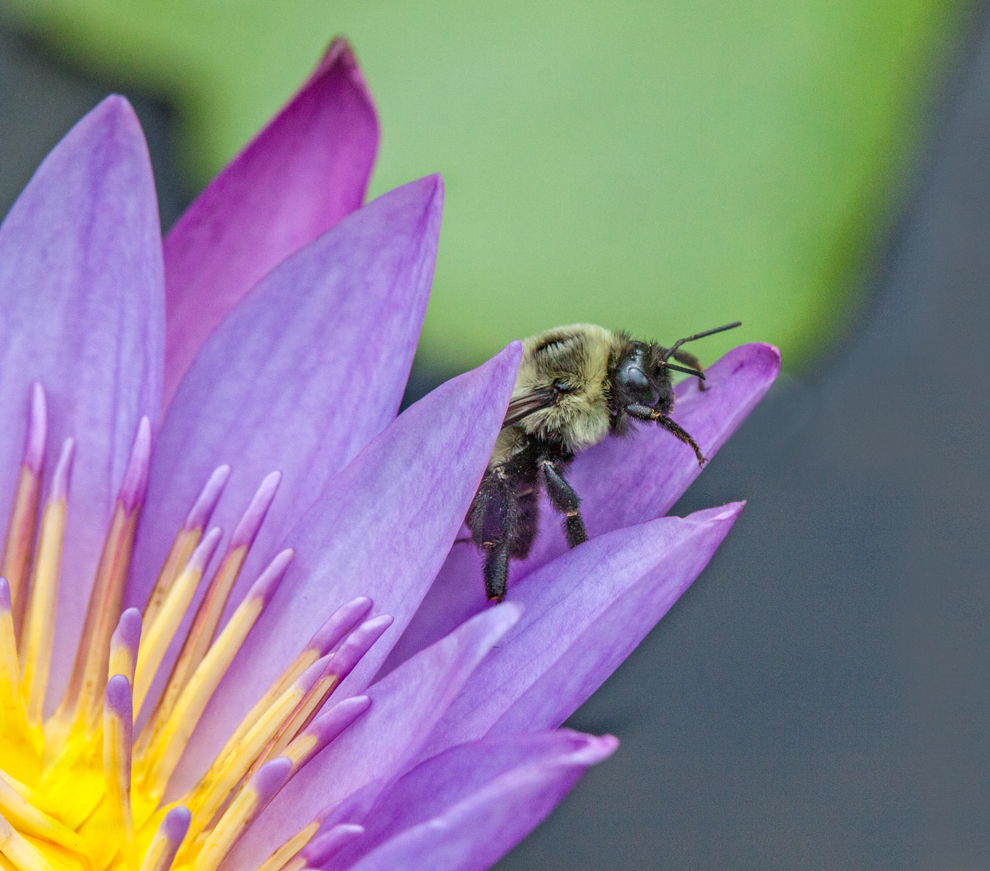
A bee landed on a petal of this purple water lily and, rather than heading for the center of the flower, the obvious source for pollen, decided to crawl down in between the petals.

I followed his movements and, after a short time, those movements ceased—I think he was stuck. Eventually the plant began to move again, this time more violently. Slowly the bee reemerged, crawling slowly up the petal, and I took this shot.

I find the tones of this image to be very soothing and purple is one of my favorite colors. If you too like purple, check out today’s postings called Violetta at Calee Photography, one of my favorite blogs.

crawling_out_blog

© Michael Q. Powell. All rights reserved

Read Full Post »

The sunflower was big enough that an Eastern Tiger Swallowtail butterfly (Papilio glaucus) and a bumblebee could peacefully coexist, though it looks like they had each carved out their individual spheres of influence and kept a respectful distance from each other.

coexistence_blog

© Michael Q. Powell. All rights reserved

Read Full Post »

Is photography an art or a science? One of the reasons why I enjoy photography so much is that it engages me on both levels—it speaks to my inner artist and to my inner geek.

Growing up, I remember watching Olympic figure skating and I was struck by the fact that the skaters received two sets of scores, one for “artistic impression” and one for “technical merit.” In many ways, I use a similar internal scoring system for my photographs.

Some of my photographs rate high on one scale, but fall short on the other. Every now and then, though, one of my images stands out, with high marks all around, like this shot of a Hummingbird Clearwing Moth (Hemaris thysbe).

I posted an earlier photo of this remarkable insect and I thought it was really cool that I was able to get a close-up with the wings open and frozen in action, a somewhat impressive technical feat. This image, shot from a bit farther away, gives a better view of the moth in action and is a more interesting pose. The background, which I recall was evergreen bushes, is uncluttered. Even the flower cooperated by following the “odd rule” of composition, with three clusters of tiny flowers.

It’s hard to be objective when analyzing my own work, but I know that I like this image a lot.

clearwing2_blog

© Michael Q. Powell. All rights reserved

Read Full Post »

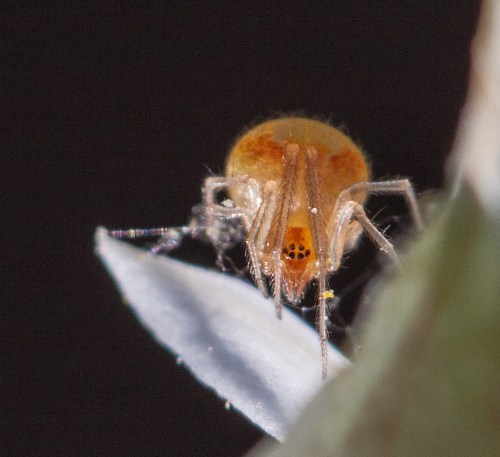
Is it just my imagination or do the eyes of this spider look like a smiley face to you too?

Eager to use my new macro lens, I went searching yesterday in my neighbors’ garden for subjects and came upon a tiny orange spider, which I have not yet been able to identify.

The spider was initially suspended in midair, but climbed up an invisible silken thread as I approached and took refuge in the shadow of white flower.

I boldly (or foolishly) tried photographing the spider handheld, but the images were blurry. Eventually I put the camera on my tripod and did my best to focus manually. For some shots, I used my pop-up flash to add a bit more light. Of course, it turned the background black, but I think that works for this shot.

In the original shot, the spider was upside down, but I decided it looked better when I rotated the image 180 degrees. I am fascinated with the multiple eyes of spiders.  There seem to a lot of different eye patterns in the different species of spider—a macro lens tends to make me look more closely at these kinds of details.

orange_spider_blog

© Michael Q. Powell. All rights reserved

Read Full Post »

Have you noticed that I really like purple water lilies? I was so struck by their beauty the first time that I saw one last year that a purple water lily appears at the top of my blog most of the time.

Earlier this week, as I was visiting Brookside Gardens in Wheaton, Maryland,  I came across an area in which two types of purple, tropical water lilies were growing. My photography mentor, Cindy Dyer, always recommends photographing the little signs that identify flowers and other plants and these water lilies were called “Panama Pacific” and “Blue Beauty.”

As I was photographing one of the waterlilies—I think it was a Panama Pacific—a bee dove headfirst into the center of the flower. Even before the bee arrived, I had noticed that the center of the water lily seemed to be glowing and that was what I was trying to capture by underexposing the shot. If you click on the photo, you can see a higher resolution view of the image, which shows an almost three-dimensional view of the flower’s center.

diving_blog© Michael Q. Powell. All rights reserved

Read Full Post »

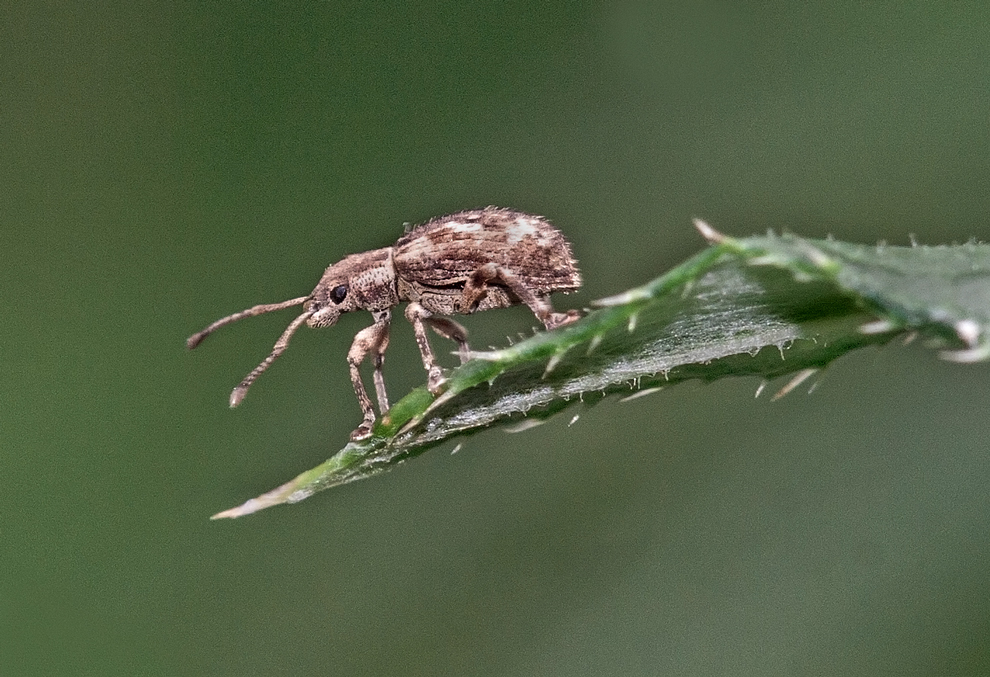
Last week, I stalked this little insect in my neighbors’ garden, trying hard to get a decent image of it with my 100mm macro lens. When it paused at the end of a leaf, I was able to get this shot, capturing some of the details of its body, which looks like a miniature dinosaur to me. Click on the photo to see some more details of the skin/shell of this little creature.

Normally I try to identify an insect before I post its photo, but in this case I am having trouble figuring out what it is. Perhaps one of my readers can help in identifying it.

Life_on_edge_blog

© Michael Q. Powell. All rights reserved

Read Full Post »

I was out yesterday on a trip to photograph sunflowers, but couldn’t resist capturing images of insects that my fellow photographers and I discovered, like this beetle—probably a blister beetle—on a chicory flower.

chicory_bugA_blog

In many ways this image was part of an experiment for me. I was using a camera that is new to me, a used Canon 50D that I recently purchased, and this was my test run with it. The Canon 50D is several years old and is far from the bleeding edge of technology, it’s a considerable step up from my Canon Rebel XT. I also was trying to shoot macro-like photos with a telephoto zoom, because my macro lens has been acting up and is now on its way to Canon for repair. Finally, I jumped a couple of versions of Photoshop Elements and discovered today that the interface has changed considerably between versions 9 and 11, so it was interesting trying to work on this image.

Once I get the hang of my new camera and new software, I’m hoping to improve that you’ll be able to see some improvement in the quality of my images.


© Michael Q. Powell. All rights reserved

Read Full Post »
How do you capture a field of sunflowers in a single image? That was my challenge yesterday, when I visited McKee-Beshers Wildlife Management Area in Montgomery County in Maryland, where there are 48 acres of sunflowers in a total of seven fields.

I am still going through my photos from yesterday, not sure if any single image captured the feeling of the endless rows of sunflowers. I am happy, though, that I was able to capture this iconic (or perhaps cliché) image of a single sunflower isolated against the sky.

BlueSkySunflower lorez

It should have been a simple shot to take, but initially the sky was overcast and white—good for most kinds of photos, except for this kind of image. I was taking photos with some friends and we joked about having to Photoshop in the sky, but eventually the clouds broke up a little and enough blue showed in the sky that I was able to get this shot.

© Michael Q. Powell. All rights reserved

Read Full Post »
« Newer Posts - Older Posts »