Feeds:
Posts
Comments

Archive for the ‘Flowers’ Category

Like tiny bunches of grapes, growing out of the ground on a stalk, grape hyacinths are one of my favorite spring flowers. I moved in really close with my macro lens in the first shot to emphasize the beautiful details and the rich dominant bluish-purple color of the plant and moved back a bit for the other two shots to highlight the varied shapes and colors of the individual “grapes.”

GrapeHyacinth Closeup webHyacinth Umbels webGrape Hyacinth 1 web

© Michael Q. Powell. All rights reserved

Read Full Post »

This final image of my mini-series on unopened tulips is my favorite—I love the simple composition, the almost monochromatic palette (with the slightest touch of pink at the tip), and the  sensual curves of the leaves.

It was almost six o’clock in the evening when I took this shot and the light was still pretty strong, but was starting to fade. I knew that I wanted to shoot some close-up shots of flowers, so I was using my 180mm macro lens. I probably should have been using my tripod for increased steadiness, especially because the lens does not have image stabilization (VR for Nikon folks), but I hadn’t brought a tripod with me.

As is often the case with my macro lens, I ended up focusing manually, trying to get as much of the tulip in focus as I could as I carefully composed the shot. The settings for this shot, for those who might be interested in such technical details, were ISO 400, f/8, and 1/50 second. The shutter speed is a bit slow, I’ll admit, but I was able to brace myself pretty well and I was trying to avoid increasing the ISO and introducing more noise.

If you haven’t seen the other images in this mini-series, Anticipation I and Anticipation II, be sure to check them out. Is there one that you like more than the others?


IMG_0907 web

© Michael Q. Powell. All rights reserved

Read Full Post »

With the cold, gray days of winter receding in my memory and the world exploding with color, I’ve taken a brief break from focusing primarily on wildlife photography and have turned my attention to capturing the beauty of flowers and blossoms.

I’ve never quite figured out how to photograph broad expanses of color, so I tend to focus more on the details of a single flower and try to isolate it from the background.  (One of my favorite bloggers, Camilla, of Calee Photography did an amazing job in capturing the beauty of tulip fields by photographing them from a small airplane. Check out her posting.)

In this case, my eyes were drawn to the not-yet-open tulip, where the color of the flower was beginning to be revealed. The composition is simple and graphic and a little abstract.

I can already sense the beauty that is to come—the anticipation makes it even more sweet.

IMG_0790 web

© Michael Q. Powell. All rights reserved

Read Full Post »

Anticipation, waiting for the moment when a tulip will burst open. For now, all we can see is a little tongue of color, a foretaste of the beauty that is to come.

Anticipation web

© Michael Q. Powell. All rights reserved

Read Full Post »

The flowering trees in my neighborhood are spectacular right now. Here’s a couple of shots of the flowers of one of them, which I think is some kind of magnolia or tulip tree.

magnolia_blogmagnolia2_blog

© Michael Q. Powell. All rights reserved

Read Full Post »

I am always happy to visit the garden of one of my neighbors, Cindy Dyer, a fellow photographer and blogger, at this time of the year, because there is always something new in bloom. Yesterday’s treat was this simple little purple flower. I have no idea what it is, but I love its shape and colors.

flower_tiny_blog

© Michael Q. Powell. All rights reserved

Read Full Post »

This red tulip may have been at its peak a few days ago when it was in full bloom, but it has retained its beauty in its current faded state.

tulip_faded_blog

© Michael Q. Powell. All rights reserved

Read Full Post »

The late afternoon sunlight shining through this crocus from behind illuminated it like a natural stained glass window. I love the beauty of simple things.

crocus2_march_blog

© Michael Q. Powell. All rights reserved

Read Full Post »

Yesterday afternoon, my dear friend and fellow photographer Cindy Dyer called to alert me that there were some crocuses blooming in her garden. The lighting was wonderful and the dirt in the background provides a simple backdrop for the gorgeous colors of this little spring flower.

crocus1_march_blog

© Michael Q. Powell. All rights reserved
Read Full Post »

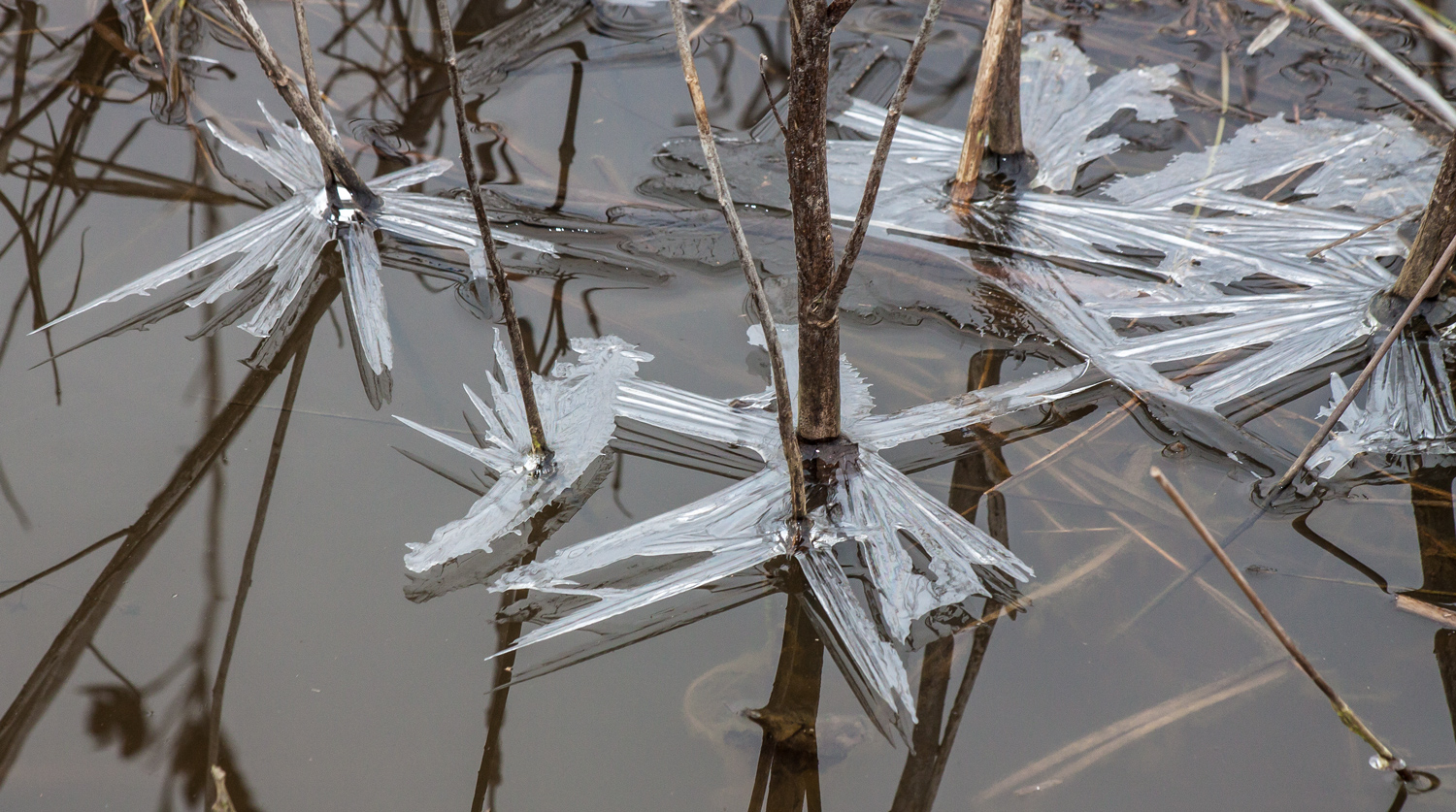
In this transitional time of the year, mornings are often frosty and ice forms in some areas of the marsh in beautiful patterns that look like crystal flowers. Spring is not far off and soon these ice flowers will be replaced by the real thing.

ice_flowers2_blogice_flowers1_blogice_flowers3_blog

© Michael Q. Powell. All rights reserved

Read Full Post »

Although it has started to get a bit warmer, lots of snow remain, snow that has lost its initial pristine beauty and is now flecked with brown road dirt and various chemicals. I feel a need for color, so I am posting some shots I took last month of a tropical plant in the greenhouse at my local county-run garden.

One of the challenges in shooting in this small space was the often cluttered background. I tried to frame these shots in such a way that background is not too distracting. I have no idea what kind of a plant this is, but that doesn’t bother me, for it is the color, texture, and shape of the plant that I find most interesting.

It won’t be long before I’ll see bursts of color like this outdoors—I can hardly wait.

pink_star_blogpink_star2_blog

© Michael Q. Powell. All rights reserved

Read Full Post »

This past weekend, I was filled with an inexplicable urge to take some flower photos. With the exception of some clumps of snowdrops, nothing was blooming outdoors, so I slipped into the small glass-enclosed greenhouse at my local county-run garden to capture images of some of the tropical flowers there.

I was alone with the plants for an extended period of time and was able to set up my tripod and use my macro lens, which has been gathering dust the last few months. My eyes have grown accustomed to looking for birds in the distance and it was an interesting challenge to get them to focus on the smaller details of stationary objects.

I am not sure of the names of the flowers that I photographed (with the exception of the second one, which is a kind of Lady’s Slipper orchid), but my senses were satisfied temporarily with the sight and smells of these beautiful flowers.

I can’t wait for spring, when I’ll have the chance to to see more flowers (and the accompanying insects) outdoors.

pink_blogslipper_blogstars_blog

© Michael Q. Powell. All rights reserved

Read Full Post »

It’s a little too early for most flowers to be blooming, although I did find flowering snowdrops yesterday at Green Spring Gardens, a local county-run historic garden. I like the way that the white of the flower shines in the shadows, a reminder that the brightness of spring will eventually come.

snowdrop_feb_blog

© Michael Q. Powell. All rights reserved
Read Full Post »

What’s the coolest thing that could happen to you as a photographer? All of us would like greater exposure and I was thrilled on Monday when I learned that my dear friend and photography mentor Cindy Dyer had five of her fern photos issued as stamps by the US Postal Service. They are being issued in coils of 3,000 and 10,000 stamps with a total printing of 95 million stamps. Wow! That’s broad exposure.

Check out her blog to see some of her amazing photos. Her teaching, support, and inspiration have played (and continue to play) a huge role in my evolution and development as a photographer.

cindydyer's avatarCindy Dyer's Blog

Yesterday, after more than a year in the making, my series of USPS-licensed fern photographs were released as 49 cent stamps in large coil format for business use. Special thanks to art director Phil Jordan for being so great to work with on the series! I’ll be back with more details on how we can POSSIBLY get a smaller amount than the issued 3,000 and 10,000 quantity rolls!

Read more about the stamps here: http://uspsstamps.com/stamps/ferns

Order a first-day-of-issue set within 60 days here:

http://about.usps.com/postal-bulletin/2014/pb22381/html/info_013.htm

Screen shot 2014-01-28 at 5.58.36 PM

View original post

Read Full Post »

This past weekend I traveled with some friends to photograph a large grove of ginkgo trees at the Blandy Experimental Farm of the State Arboretum of Virginia in Boyce, VA. It was a beautiful day, with bright blue skies, and I took some shots that I will probably include in a more extended post, but I wanted to give you a sneak preview of the really-cooling looking leaves of the ginkgo (Ginkgo biloba) tree, a tree that dates back at least 270 million years, judging from ginkgo leaf fossils that have been uncovered.

GInkgo Vertical blog

© Michael Q. Powell. All rights reserved.

Read Full Post »

Despite the frost that we’ve had the last few mornings, the gorgeous Morning Glory flowers of my neighbors continue to flourish. I photographed one of the flowers yesterday afternoon—does that make it an afternoon glory?

When you look at the photo it looks like I used flash, which caused the background to go black. However, if you look carefully at the way the light falls, with some of it coming from the back, you realize I would have had to use an elaborate multi-light setup to get this kind of lighting. I took this shot in the early afternoon, with the light mostly coming from the side and back of the flower.

My fellow photographer and blogger CIndy Dyer says that the shadow in the bottom area of the white part of the flower looks like a photographer (possibly with a bald head) with a camera and long telephoto lens and she initially thought I had somehow managed to get a reflection of myself onto the flower. We may have spent too many hours yesterday out in the sun with our cameras!

Glory Photographer blog

© Michael Q. Powell. All rights reserved.

Read Full Post »

When I first saw this bird, I knew that it was a sparrow, but couldn’t identify it. I was baffled when I went to my Peterson Field Guide to Birds of North America, because I couldn’t find the sparrow. I went back and forth through the 14 pages covering sparrows, examining carefully the text and illustrations, but none of the species looked like this bird.

I was beginning to doubt my identification skills, so I kept looking through the field guide, desperately hoping to find the bird. On the very last page of the section of the guide with information on bird species, just before all of the range maps, I stumbled across a small section called Old World Sparrows and found the bird—it’s a House Sparrow (Passer domesticus).

Apparently Old World sparrows are non-native (as their name suggests) and are of a different family from all of the other sparrows that I have observed. The Cornell Lab of Ornithology website indicates that House Sparrows were introduced from Europe in 1851 and that they are common in places with houses, because the birds seem to prefer to nest in manmade structures, like the eaves of buildings, more than natural nesting sites. I took these photos at a little manmade lake that is partially surrounded by houses, rather than at the marsh where I do a lot of my shooting, which may explain why I have never noticed this type of sparrow before.

little_bird1_blog

© Michael Q. Powell. All rights reserved.

Read Full Post »

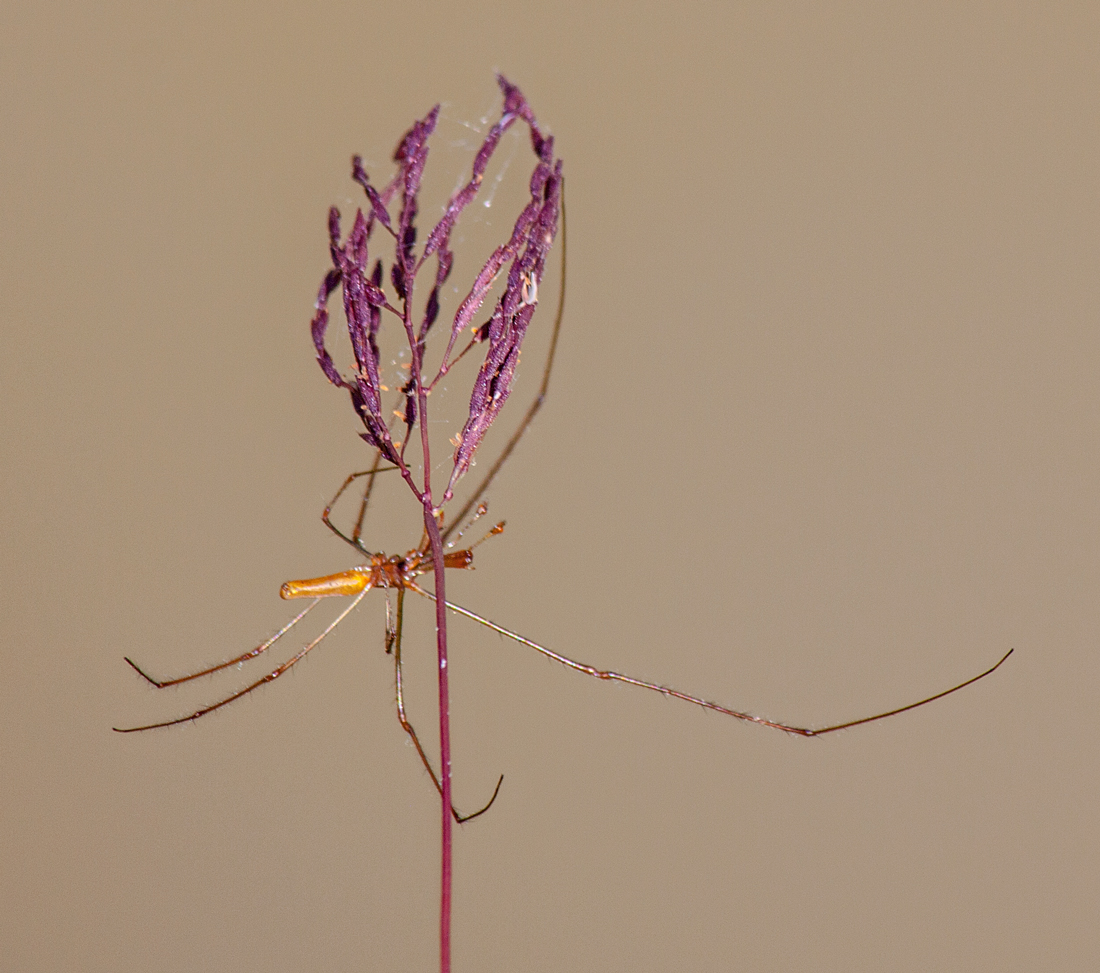
This long-jawed spider is not really camouflaged, of course, but it positioned itself in such an artistic way that its elongated body and legs seem to be an extension of the plant, especially from a distance. The plant was growing at the edge of a small pond at my local marsh and the brown background color is the water of the pond.

spider_purple_blog

Click on the image to get a higher resolution view of it.

© Michael Q. Powell. All rights reserved

Read Full Post »

A familiar subject can look quite different when viewed from an unusual angle. It’s a lesson that every photographer is taught early on, but I need constant reminders to vary my approach.

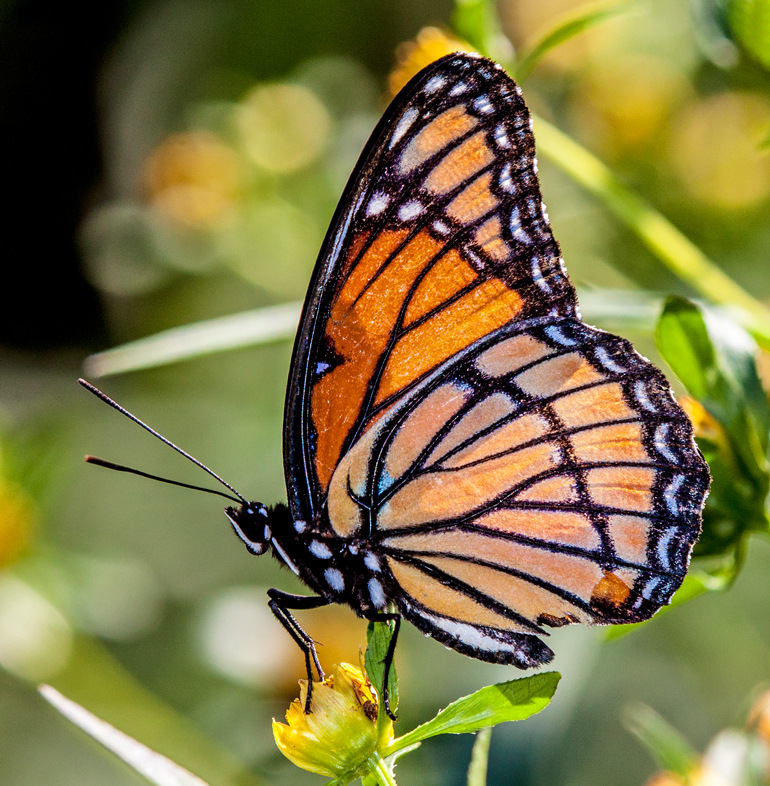
I took this shot of a Viceroy butterfly (Limenitis archippus) yesterday while lying on the ground and pointing my telephoto lens up toward the sky. The perspective caused the shape of the wings to be different and permitted me to see the butterfly’s legs in a way that was completely new.

Not all such experiments are successful, of course, but I think that this one worked out pretty well.

looking_up_blog

Click on the photo to see a higher resolution view.

© Michael Q. Powell. All rights reserved

Read Full Post »

The days are getting cooler and leaves are starting to wither and fall, but there are still signs of the lingering summer, like this beautiful Viceroy butterfly (Limenitis archippus) that I photographed this past weekend. viceroy_bokeh_blog

© Michael Q. Powell. All rights reserved.

Read Full Post »

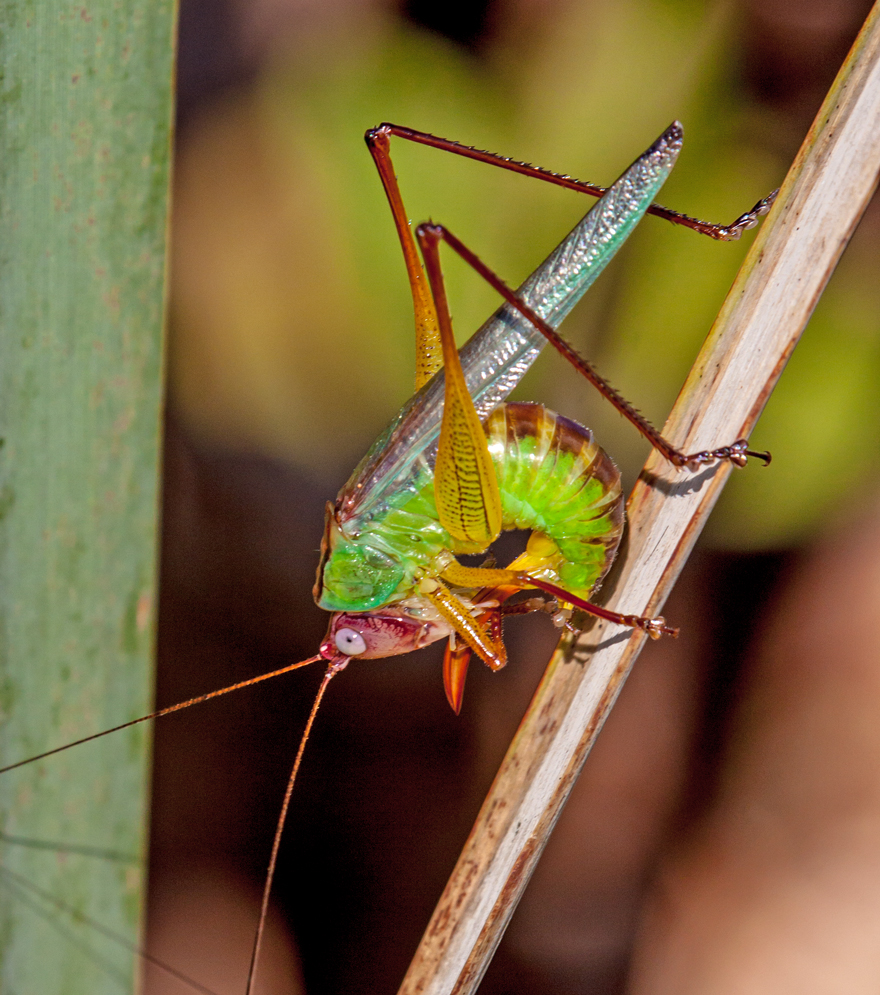
As was watching this Handsome Meadow Katydid (Orchelimum pulchellum) through my viewfinder,  it suddenly arched its body and assumed a position worthy of an world-class gymnast or yoga master. What was it doing?

rainbow_gymnastics_blog

My first thought was that the katydid was merely stretching, getting ready for the day’s activities. When you jump around as much as these insects do, you can’t risk a pulled muscle or other injury by not warming up properly.

Over the past year, this rainbow-colored katydid has become my favorite insect, but I confess that I don’t much about their anatomy. Looking over my photos, I realized that I needed to identify the orange-colored body part, a part that I don’t recall observing before, in order to figure out what was going on. What could it possibly be?

rainbow_gymnastics3_blog

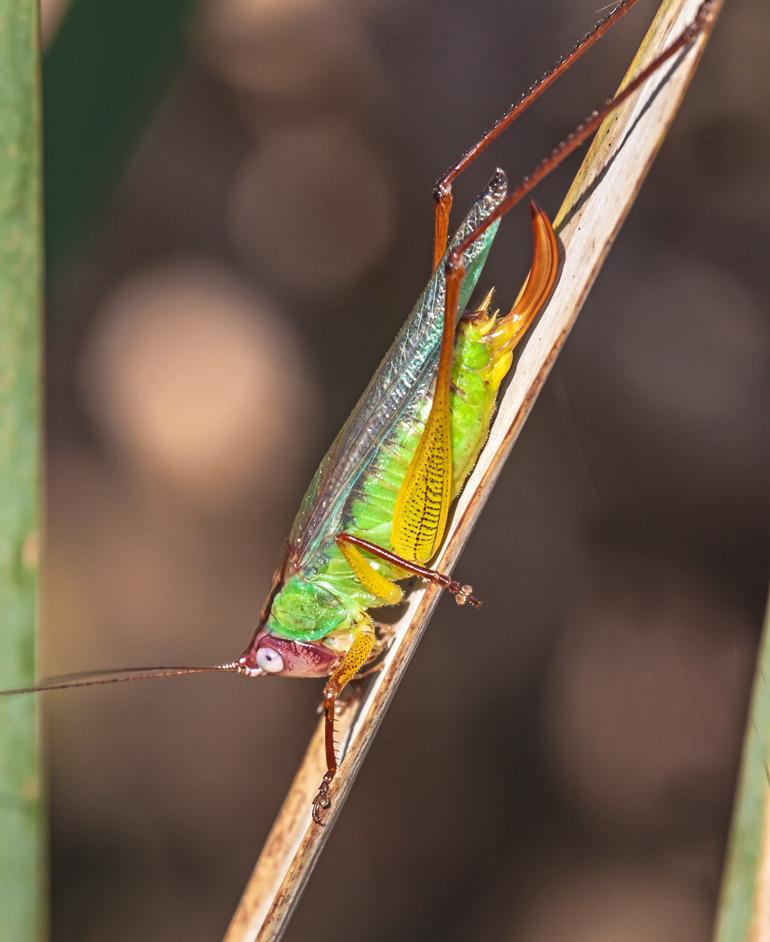
Well, it looks like this katydid probably is a female and the orange-colored thing is her ovipositor, the organ used for depositing eggs. So, is she depositing eggs in the photos? I am not sure.

A University of Arkansas website describes the ovipositing for a similar katydid with these words, “An ovipositing female embraces a plant stem with her prothoracic and mesothoracic legs and brings the curved and sword-like ovipositor far forward so its tip can scrape the substrate.” It’s not really helpful when the explanation contains so many words with which I am unfamiliar. I think that I will leave this kind of science to the scientists.

As a photographer, I continue to be amazed by the multi-colored beauty of this fascinating insect and especially by its alluring blue eyes. I know that it’s an illusion, but those eyes often seem to be looking right at me. I’m not sure if this Handsome Meadow Katydid is depositing eggs in these photos, but I am sure that  I like the images a lot, including the final image, which shows the katydid in a more “normal” position following her brief series of gymnastics.

rainbow_gymnastics2_blog

© Michael Q. Powell. All rights reserved.

Read Full Post »

Autumn is my favorite time of the year, a time when bright spots of spring-like color co-exist with the fading fall colors, a foretaste of the bleak winter landscape to come. Areas of my local marsh are dotted in bright red right now, the berries of a plant that I have been told is Winterberry (Ilex verticillata).

I’ve traipsed through lots of museums in my lifetime and seen innumerable paintings in which artists have arranged fruits and flowers and other objects into paintings that are generally known as “still life paintings.” I had those paintings in mind when I framed this shot in my viewfinder, attempting to capture a pleasing composition of colors and shapes. It’s rare that I don’t crop an image at all, but I decided to show this one composed just as it came out of the camera.

stillife_blog

© Michael Q. Powell. All rights reserved.

Read Full Post »

Summer is fading rapidly, but some flowers continue to bloom, like this beautiful Orange Jewelweed (Impatiens capensis) that I photographed recently at my local marsh.

Wikipedia claims that hummingbirds are the main pollinators of these flowers, which is not surprising, judging from their shape. Every time I pass by a cluster of these plants, I keep my eyes peeled for hummingbirds, but have not seen a single one and suspect that it is too late in the season for them.

jewelweed_blog

© Michael Q. Powell. All rights reserved.

Read Full Post »

When almost everything that you see looks like a bug, you know it may be time to take a break from photographing insects.

Recently I have been getting shots of different kinds of very fuzzy caterpillars and a posting on a fuzzy, white caterpillar has become my most viewed posting by a significant margin. This has whet my appetite to look even more intently for caterpillars and Monday I was pretty sure that I had spotted one with spiky tufts of hair on the thin branch of a plant. It was only when I got really close that I realized that my eyes had deceived me—it was not another fuzzy caterpillar.

Don’t get me wrong, it ‘s a pretty cool collection of seed pods and tendril-like branches, but it’s definitely not the caterpillar that I had in my mind.

not_caterpillar_blog

© Michael Q. Powell. All rights reserved.

Read Full Post »

It’s been gray and rainy almost all this week in Brussels, so many of these shots feature raindrops. When I am away on a trip for business, I generally carry only my point-and-shoot camera, an old Canon A620.

This trip I decided to experiment with the macro mode and see what kind of shots I could get. I was pleasantly surprised with the results and even managed to get some insect shots, despite the fact that I had to get really close to them, compared with the macro lens that I normally use. I never had to worry about harsh sunlight—I never saw any the entire trip—and mostly had to shoot a a high ISO and an almost wide-open aperture.

I did get some shots of the buildings in Brussels, which looked almost monochromatic in the gray light, but will post some of those images when I return home from the trip.

beepink1dropsflyleaf_dropspink2

© Michael Q. Powell. All rights reserved.

Read Full Post »

I love the mix of colors that resulted when a male Blue Dasher dragonfly (Pachydiplax longipennis) that I was observing chose to perch on a plant with red leaves.red_obelisk_blog

© Michael Q. Powell. All rights reserved.

Read Full Post »

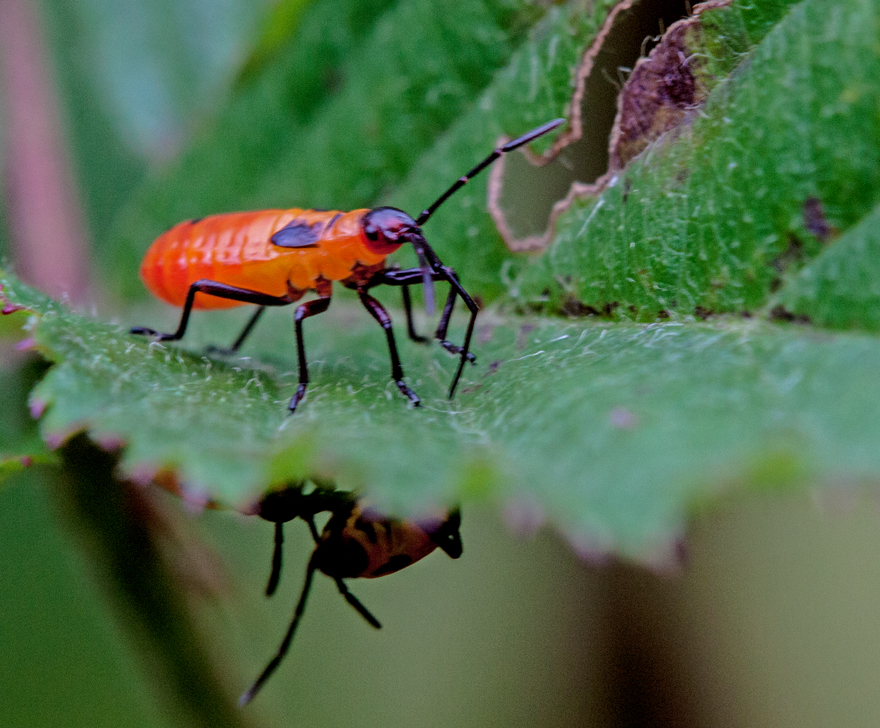
I continue to be fascinated by the metamorphosis of bugs and was happy to spot these familiar bright red milkweed bug nymphs recently at my local marshland.

Last year, I closely followed the development of Large Milkweed Bugs (Oncopeltus fasciatus) and documented my observations in a posting called Life Phases of the Large Milkweed Bug. I was a bit surprised when that posting turned out to be my fourth most visited posting of the year (it was since slipped to number six on the charts), because it was as much an educational posting as one to highlight my photos.

When I spotted these bugs, there were several clusters of them and the individuals seemed to be gradually separating as they sought out food. The bugs go through five phases (instars) as nymphs before they become adults and these look to be in one of the middle phases of development, judging from the size of the “wings.”

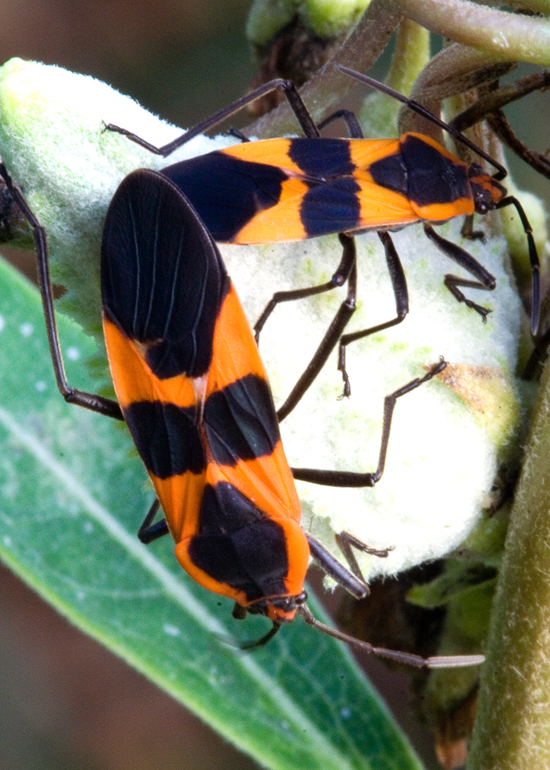
In case someone is not familiar with these bugs, I am attaching a photo from last year of adult milkweed bugs to give an idea of what these nymphs will eventually become.

red_bugs_blogred_bug_blog

bug8_5x7blog

© Michael Q. Powell. All rights reserved.

Read Full Post »

One of the advantages to living in a relatively southern state is that summer lingers on for a bit longer and flowers continue to bloom. As long as there are flowers blooming, bees continue in their efforts to gather pollen,

I am not sure what flower this is, but it was blooming in the garden of one of my neighbors, Cindy Dyer, a fellow photographer and blogger. She plants her garden with an eye toward plants that will photograph well and when I have a few minutes to spare, I enjoy making a quick trip to her garden to see what is blooming.

When I first spotted it, I had this mental picture of the bee working in the center of the flower, surrounded by a protective little fence.  I tried to frame the shot with that picture in mind and chose an angle that emphasized the “fence.”

Sep_bee_blog

© Michael Q. Powell. All rights reserved

Read Full Post »

Earlier this week I came across this little Jumping spider, patiently waiting for a prey to come by.  I never fail to be amazed by those eyes that seemed to be staring right at me.

Transfixed, I can’t take my eyes off of you, tiny spider, and your eyes seem to follow me. I don’t want to seem paranoid, but when I am with you, I always feel like somebody is watching me.

Somehow I thought I heard the spider humming, “I only have eyes for you,” but it was just my imagination, running away with me.

jumping_marsh2_blog

© Michael Q. Powell. All rights reserved

Read Full Post »

Hoverflies normally are as busy as bees, in constant motion as they move from flower to flower. From time to time, though, I guess that they need to rest. Earlier this week, I captured this image of  a hoverfly relaxing on the dried out leaf of a cattail at my local marshland park.

hoverflyA_blog

© Michael Q. Powell. All rights reserved

Read Full Post »

Although it is already September and signs of autumn are starting to appear, bees continue to be as busy as ever. The blooming morning glory flowers in my neighbors’ garden attracted a bee’s attention early yesterday morning and I got these shots as it tried to figure out the optimal strategy for gathering pollen.

glory2_blogglory3_blog

© Michael Q. Powell. All rights reserved

Read Full Post »

« Newer Posts - Older Posts »