Feeds:
Posts
Comments

Archive for the ‘dragonfly’ Category

Do you photograph the same subjects over and over again? I know that I do, hoping that each new opportunity might provide something different—perhaps a new pose, an unusual angle of view, or different lighting conditions.

That is why I was chasing after this male Eastern Amberwing dragonfly (Perithemis tenera) last week at Jackson Miles Abbott Wetland Refuge. Usually I find the males of this common species buzzing around at water’s edge or perched on vegetation overhanging or growing out of the water. This individual, however, was flying over a grassy patch adjacent to the pond, periodically pausing to perch only a few inches above the ground.

I took this shot from almost directly above the little dragonfly—Eastern Amberwings are less than an inch (25 mm) in length—and that angle helped me to capture the entire body in relatively sharp focus. Sharpness, though is only one of the factors that I use in evaluating my photos and often it is not the most important one. In this case, I really like the angled pose of the dragonfly and I the dominant colors in the image. I absolutely love the way that the beautiful warm brown colors of the dragonfly contrast with the cool greens in the background.

Sometimes we grow so comfortable with our familiar surroundings that we take them for granted. I strive to look at the world with optimism and fresh eyes each day, confident that I will discover beauty almost anywhere that I find myself.

Eastern Amberwing

© Michael Q. Powell. All rights reserved.

Read Full Post »

It is not yet the end of summer, but already it seems like the numbers of dragonflies of some species are diminishing. Many of the survivors show signs of wear and tear, with damage to their wings and scratches on their bodies. However, there are some dragonfly species that do not appear on the scene until late in the summer or even in the autumn, so those of us who enthusiastically chase after dragonflies still have plenty to keep us occupied—in my area certain dragonflies are around until December and even occasionally into early January.

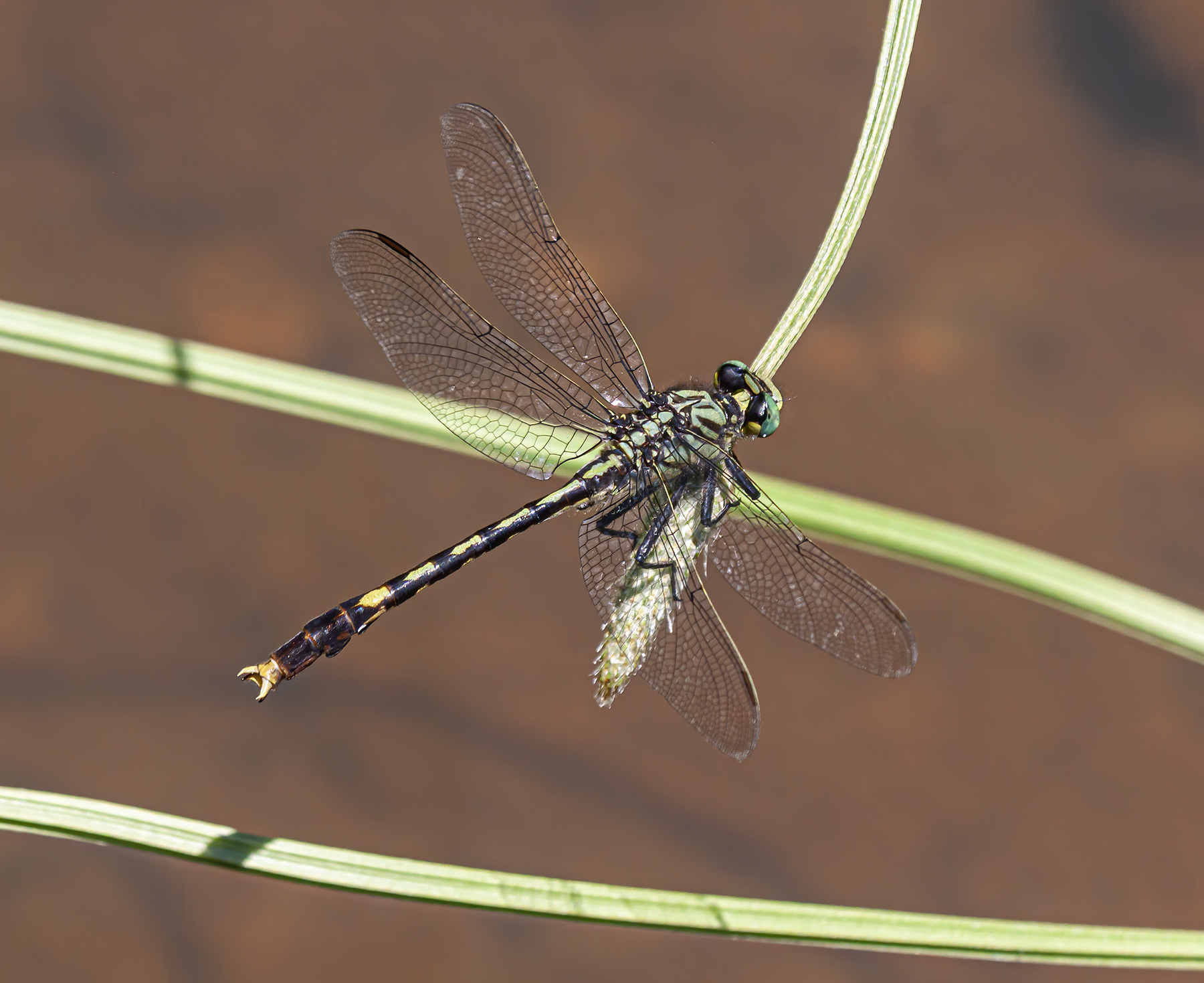
Yesterday I was excited to spot one of those late-summer dragonflies at Jackson Miles Abbott Wetland Refuge, a female Russet-tipped Clubtail dragonfly (Stylurus plagiatus). When I first spotted her, she was clinging to some vegetation, as you can see in the second photo. I was so entranced by her beautiful green eyes, though, that I decided to lead this posting with a close-up shot shot of those spectacular eyes that remind me a little of malachite.

In the final two photos, you can clearly see the distinguishing features of the “tail” that are responsible for the common name of the species. As is often the case with clubtail dragonflies, the “club” is much more prominent with the male Russet-tipped Clubtail than with the female. If you would like to see some cool shots of a male for comparison, check out my blog posting from September 2016 entitled “Russet-tipped Clubtail dragonfly.”

Russet-tipped Clubtail

Russet-tipped Clubtail


Russet-tipped Clubtail

© Michael Q. Powell. All rights reserved.


Read Full Post »

I was really happy yesterday morning when I spotted a female Tiger Spiketail dragonfly (Cordulegaster erronea) while exploring a small stream in Prince William County, Virginia and absolutely thrilled when she started ovipositing, giving me a chance to capture these images. For several years I have been trying to photograph this elusive species. In the past I have gotten a glimpse of a Tiger Spiketail on several occasions, but never managed to get a shot of one.

Why have I had such problems? Kevin Munroe, who developed the wonderfully informative website Dragonflies of Northern Virginia, described the species in these words:

“This secretive and seldom seen forest dweller has an almost elven quality. It lives deep in mature woodlands and spends most of its life around tiny, almost invisible spring-fed seepage streams. When startled, it disappears into the leafy canopy, which is also where pairs fly to mate, often hidden for hours. Their larvae live in such small, food-scarce streams that they take several years to mature. Tigers live in smaller streams than any other Northern Virginia spiketail. Their numbers are relatively low, and it’s unusual to see more than one or two together. There’s a certain thrill to finding a Tiger Spiketail at its stream—you know you’ve stumbled upon a clean, quiet and special corner of whatever park you’re exploring.”

Tiger Spiketails fly patrols low above the water of these tiny forest streams. If you find the right kind of stream, you stand and wait, hoping that a Tiger Spiketail will fly by. If one appears, you might have a second or two to get off a shot of the flying dragonfly before it disappears from sight. You repeat the cycle and if all goes well, the dragonfly may come back again within fifteen to thirty minutes or you may never see it again.

I was really lucky yesterday. Earlier in the morning I had had several sightings of a Tiger Spiketail, but had gotten only a single very blurry shot. When a Tiger Spiketail flew into view, I immediately started tracking the dragonfly visually and I was shocked when she began to dip the tip of her abdomen in the water to deposit an egg, a process known as ovipositing. What this meant was that she would hang around in a spot for several seconds and then move upstream a bit and repeat the process.

Although I had the Tiger Spiketail in sight, getting a decent shot was a challenge. In addition to her lateral movements, she was also moving up and down as she deposited her eggs. Much of the stream was in the shade or the light was heavily filtered, so it was hard to get enough light to capture a moving subject. I managed to get a few reasonably sharp action shots of the Tiger Spiketail. If you double-click on the first image, you can actually see the dragonfly’s “spiketail” and other details including its beautiful markings and striking green eyes. The second shot gives you a better view of the environment in which I found this dragonfly, which is considered rare in the area in which I live.

Whenever I manage to capture of a new species, I am so excited that I do not worry much about the quality of the images. Before long, though, the excitement dies down and I will hit the trails again, determined and hopeful that I will be able to get some better shots. That crazy, quixotic vision is what drives most of us nature and wildlife photographers to go out repeatedly, always in search of the next best photo.

Tiger Spiketail

Tiger Spiketail

© Michael Q. Powell. All rights reserved.

Read Full Post »

What do you do to cope on a hot sunny day? Most of us stay indoors in an air-conditioned space, possibly with a cold beverage. Dragonflies do not have those options, so many of them assume a pose, often known as the obelisk posture, in an attempt to regulate their temperature by reducing exposure to the direct sunlight.

You may seen dragonflies in a handstand-like pose, looking like gymnasts in training—that is the obelisk posture. The dragonfly lifts its abdomen until its tip points to the sun, thereby minimizing the amount of surface area exposed to solar radiation. At noontime, the vertical position of the dragonfly’s body suggest an obelisk, which in my area immediately brings to mind the Washington Monument. According to Wikipedia, scientists have tested this phenomenon in a laboratory by heating Blue Dasher dragonflies with a lamp, which caused them to raise their abdomens and has been shown to be effective in stopping or slowly the rise in their body temperature.

While visiting Green Spring Gardens last week on a hot humid day, I observed obelisking behavior in a male Blue Dasher (Pachydiplax longipennis) and a male Eastern Amberwing (Perithemis tenera). I have always been intrigued by this pose and would love to try it out to see if it works for thermoregulation in humans too. Alas, I lack both the upper-body strength and the lower body flexibility to make a go of it, so I’ll continue to be merely a spectator of these beautiful little acrobats.

Blue Dasher

Eastern Amberwing

© Michael Q. Powell. All rights reserved.


Read Full Post »

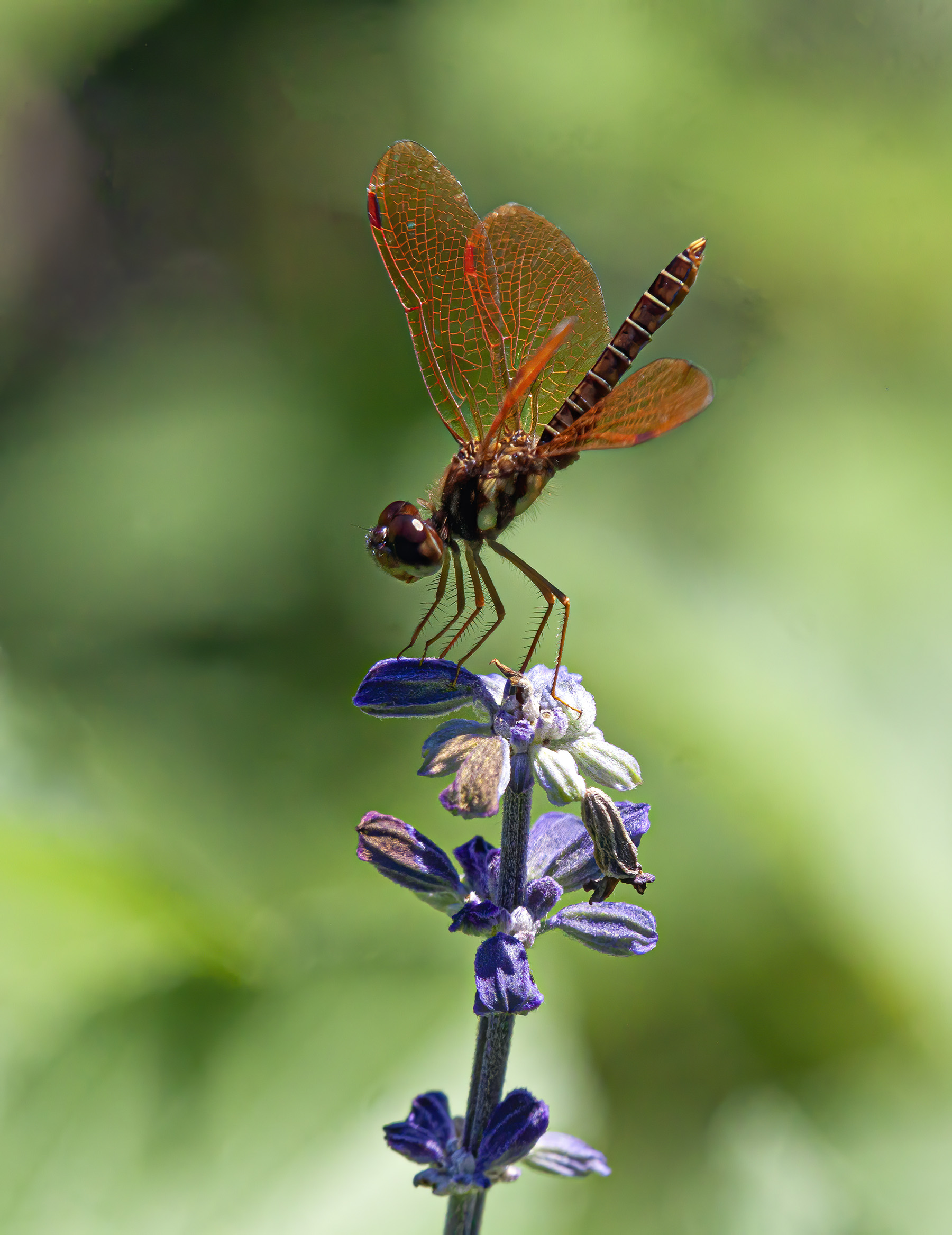
It love it when dragonflies cooperate and choose particularly photogenic perches, as these female Eastern Amberwing dragonflies (Perithemis tenera) did on Tuesday at Green Spring Gardens in Alexandria, Virginia, not far from where I live. The males of this species, whose wings are a solid amber in color, mostly seemed to be hanging out at a pond at the bottom of a hill, while the females were flitting about among the flowers in the gardens at the top—the gender separation reminded me of the awkwardness of junior high dances when I was growing up.

As many of you may recall, dragonflies and damselflies are part of the Odonata order of flying insects. My friend and fellow dragonfly enthusiast Walter Sanford has coined the term “odonart” to refer to artsy-style photos that we manage to capture of our favorite aerial acrobats. I think that both of these images qualify to fit into that self-created category, given the beauty of the dragonflies and their particularly photogenic perches.

Eastern Amberwing

Eastern Amberwing

© Michael Q. Powell. All rights reserved.

Read Full Post »

Dragonflies are carnivorous—they feed on other live insects. Most of their diet consists of gnats, mosquitoes, and other small insects, but they also prey upon bees, butterflies, damselflies, and even on other dragonflies.

When I first spotted this male Eastern Pondhawk dragonfly (Erythemis simplicicollis) on Saturday at Jackson Miles Abbott Wetland Refuge, it had just perched on a stalk of vegetation. As I moved a little closer, the dragonfly changed its position, looking almost like it was trying to hide behind the stalk. What I did not realize at the time was that the dragonfly had just snagged a damselfly and was preparing to eat his lunch. Obviously he did not want to share it with me.

Almost all of the times that I have seen dragonflies with prey, they been Eastern Pondhawks, which seem to be particularly fierce predators. Some dragonflies eat their prey in mid-air and I never see them do so. It may also be the case that some other dragonflies fly up into the trees and consume their prey out of sight, while the Eastern Pondhawk is content to eat in public.

It is often difficult to judge the relative size of dragonflies and damselflies. This images lets you see how much smaller and thinner damselflies are than dragonflies. An Eastern Pondhawk is about 1.7 inches (43 mm) in length and the unidentified damselfly looks to a bit over an inch (25 mm) in length.

Eastern Pondhawk

© Michael Q. Powell. All rights reserved.

Read Full Post »

We are definitely in the summer doldrums, with day after day of oppressive heat and humidity. This week has been a bit different only because we have had some violent thunder storms. In terms of dragonflies, the common skimmer species are flying about in great numbers. In my area, that means that on a trip Tuesday to Occoquan Bay National Wildlife Refuge, I saw lots of Common Whitetails, Eastern Pondhawks, Needham’s Skimmers, Blue Dashers, and Great Blue Skimmers.

Although I have photographed these species many times, I still chase after them, trying to capture new behavior or interesting portraits, perches, or backgrounds. That is why I was able to capture this image of this smiling female Great Blue Skimmer dragonfly (Libellula vibrans) as she perched on some stalks of Eastern Gammagrass (Tripsacum dactyloides). I do not know vegetation very well, but I remember my friend Walter Sanford identifying this type of grass to me a few years ago and somehow the name has stuck with me.

In many ways, this photograph is indicative of my favorite approach to wildlife photography. Although I will sometimes look for rare species to photograph, I especially enjoy photographing common species and highlighting their uncommon beauty. Beauty is everywhere.

Great Blue Skimmer

© Michael Q. Powell. All rights reserved.


Read Full Post »

I ventured out into the heat for a couple of hours yesterday and was rewarded for my efforts by this beautiful female Halloween Pennant dragonfly (Celithemis eponina) that I spotted at Occoquan Bay National Wildlife Refuge.

What makes a portrait perfect? For me, an optimal portrait captures an interesting subject in a dynamic pose with good lighting and a complementary background. I think that this images ticks all of those boxes. Why, then, do I call it “almost” perfect in the title? I guess that there is a part of me that is never completely satisfied, that is steadfastly convinced that I can do better. That is why I was out walking the trails yesterday when temperatures soared above 95 degrees (35 degrees C). Don’t worry, I stayed in the shade, carried lots of water, and took it slowly. The good news was that social distancing was a breeze—I saw only one other crazy person walking about in the midday heat.

Halloween Pennant

© Michael Q. Powell. All rights reserved.


Read Full Post »

Blue Dashers (Pachydiplax longipennis) are one of our most common dragonflies and were an early favorite when I started to get more serious about my photography eight years ago. I still enjoy capturing images of them, especially when the lighting is as interesting as it was last Tuesday during a visit to Green Spring Gardens with my friend and photography mentor Cindy Dyer.

I had a lot of fun trying to track the male Blue Dasher dragonflies as they flew among the lotuses and water lilies at a small pond. Most of the time they would perch on distant plants, out of range of my macro lens, but on a few occasions they came closer. The first image shows one perched on the broken-off stalk of a lotus, partially in the shadow of other lotuses. The second image shows a Blue Dasher perched in the light, atop what I believe is one of the lily pads, though there is a slight chance that it might be a lotus leaf.

Yes, Blue Dashers are still among my favorites, even after all of these years.

Blue Dasher

Blue Dasher

© Michael Q. Powell. All rights reserved.


Read Full Post »

I tend to associate dragonflies primarily with marshes and ponds, but a few dragonflies also like sandy beaches. Most of the times that I have observed Common Sanddragon dragonflies (Progomphus obscurus) they have been perched directly on the sandy edges of forest streams, which makes sense, given their name. On Monday I was thrilled to spot some Common Sanddragons at Wickford Park, a small park adjacent to Huntley Meadows Park, a marshland refuge where I used to do a lot of shooting before it became too popular.

Although the dragonfly in the first image may look like he was perched on the ground, he was actually on the slanted side of a concrete drainage ditch. Normally I try to avoid man-made backgrounds for my subjects, but this shot provided a good overall view of the entire body of the Common Sanddragon. It might be my imagination, but it looks to me like this little guy was glancing up at me and smiling. Double-click on the image and see what you think.

In many ways I prefer the second shot, with the Common Sanddragon dragonfly perched amidst the rocks at the edge of the stream. I love the different colors, shapes, and textures of the rocks and don’t mind that the dragonfly itself is harder to spot. I consider the image to be a kind of environmental portrait.


Common Sanddragon

Common Sanddragon

© Michael Q. Powell. All rights reserved.

Read Full Post »

As I was walking past one of the fields Huntley Meadows Park on Monday, I spotted a large dragonfly patrolling back and forth, flying low over the heavy vegetatation. I tracked the dragonfly’s movements with my camera as it flew tantalizingly close to me, only to abruptly change directions each time. All of the sudden, the dragonfly zoomed past me and disappeared into the foliage of a tree on the other side of the trail on which I was standing,

Fortunately I was able to see where the dragonfly had landed and eventually I found it perched on the underside of a branch. The second shot shows the view that I had after I had approached the dragonfly cautiously. If you look closely at the space between the dragonfly’s head and the branch, you will see that it is in the process of eating what looks to be a black and yellow insect of some kind. In my experience, when dragonflies are eating, they tend to be so focused on their food that I can get closer to them than might otherwise be possible.

From that distance I could already identify it as a Swamp Darner dragonfly (Epiaeschna heros), one of the largest dragonflies in our area, almost 3.5 inches in length (89 mm). I was happy to be able to get the side shot, but wanted a different angle, so I maneuvered my way around and captured the dorsal view shown in the first photo. From this angle you get a really good view of its amazing blue eyes and the wonderful circular ring markings on its abdomen. The angle of view also showed me some body parts that allowed me to determine that this is a male.

I spent only a couple of hours hunting dragonflies on Monday, but had a very successful day, finding the elusive Mocha Emerald that I featured yesterday and this gorgeous Swamp Darner. Folks frequently ask me why I like dragonflies so much and I think that the first photo is a convincing visual response to such a query—no further explanations should be required.

Swamp Darner

Swamp Darner

© Michael Q. Powell. All rights reserved.


Read Full Post »

It has been a few years since I last saw a Mocha Emerald dragonfly (Somatochlora linearis), so I was excited when I spotted one yesterday while exploring at Huntley Meadows Park. The male Mocha Emerald was patrolling along above a small stream in a way that is typical, but infuriating—he would fly a bit and then hover, but before I could focus on him, he would fly some more, each time moving again before I could catch up to him. Fortunately, Mocha Emeralds perch pretty often and I was absolutely thrilled when this one chose a perch within sight of where I was standing.

As you look at the photos, you cannot help but notice that the dragonfly’s body long, dark, and skinny body, although you eyes may well be drawn first to his brilliant emerald eyes. You may also note that he does not really perch, but instead hangs from the branch to relax. The position reminds me of the one what I assume when I am doing pull-ups and definitely would not be my preferred position for resting.

I am often surprised by the amazing diversity in the dragonfly world. When I first started to focus on dragonflies, it was obvious that they came in different colors. As I have learned more about dragonflies and photographed them, I have grown more attuned to body shapes, behavior, and habitats. Yes, I am somewhat obsessed with these beautiful creatures and enjoy searching for hours for little jewels like this Mocha Emerald.


Mocha Emerald

Mocha Emerald


© Michael Q. Powell. All rights reserved.


Read Full Post »

As summer progress, the once pristine wings of dragonflies and butterflies become increasingly tattered and torn. When I spotted this handsome Spangled Skimmer dragonfly (Libellula cyanea) last week at Occoquan Regional Park, I couldn’t help but notice that he has varying degrees of damage on the trailing edge of all of his wings. Comparatively speaking, the damage is minor and did not seem to inhibit his activity in any way—I have seen dragonflies with much more severe damage that were still able to fly.

How did his wings get damaged? Predators such as birds or even other dragonflies could inflict damage as could vegetation with sharp branches and thorns. When I looked closely at this dragonfly’s abdomen, I also noticed scratches there, which made me think of another potential source of some of the damage. It is now the prime season for mating and like most male dragonflies, this dragonfly is vigorously trying to do his part to perpetuate the species.

Dragonfly mating can be rough and could be the source of some of the visible damage. The final photo shows a mating pair of Spangled Skimmer dragonflies and, judging from the locations of the damage to its wings, the male in the first photo appears to be one of the participants.

In case you are curious about identifying this dragonfly species, the white “stigmata” on the trailing edge both male and female Spangled Skimmers, i.e. the “spangles” responsible for its common name, make this species an easy one to identify.

Spangled Skimmer

Mating Spangled Skimmers

© Michael Q. Powell. All rights reserved.

Read Full Post »

Some dragonfly species are special to me because of their beauty; some—because of their rarity; and some—because of the specific circumstance under which I found them. Swift Setwings are in the latter category.

Four years ago I photographed a strange-looking dragonfly at Jackson Miles Abbott Wetland Refuge and could not identify it. I was a little shocked when experts told me it was a male Swift Setwing dragonfly (Dythemis velox), a primarily southern species that had never before been spotted as far north in Virginia as Fairfax County where I live.

Every year since that first encounter, I make a pilgrimage to the spot of my first sighting to check on “my” dragonflies, which now seem to have a well-established breeding population. Alerted by a Facebook posting by a fellow photographer, I visited the refuge this past Tuesday and was thrilled to spot several male Swift Setwing dragonflies.

As you can see from the two photos below, Swift Setwings have a distinctive posture—they typically perch on the tip of branches with their wings angled down and forward and their abdomen slightly raised. Apparently the stance reminded some scientist of a sprinter at a track meet on the blocks in the “ready, set, go” position” and that is supposed to be the source of the somewhat unusual name for the species.

Usually the vegetation on which a Swift Setwing is perched hangs over the water and the dragonfly faces the water. As a result, I too often have to hang over the water to get a decent angle for a shot. So far, I have managed to keep from falling into the pond, though I must admit that I have come close to doing so a few times.

Swift Setwing

Swift Setwing

© Michael Q. Powell. All rights reserved.

Read Full Post »

Where can you find dragonflies? You can find them almost anywhere where there is some kind of water nearby, but different species have preferred habitats. Some dragonflies can be found at lakes or ponds or streams or in sunlit meadows or in the margins of the forest.

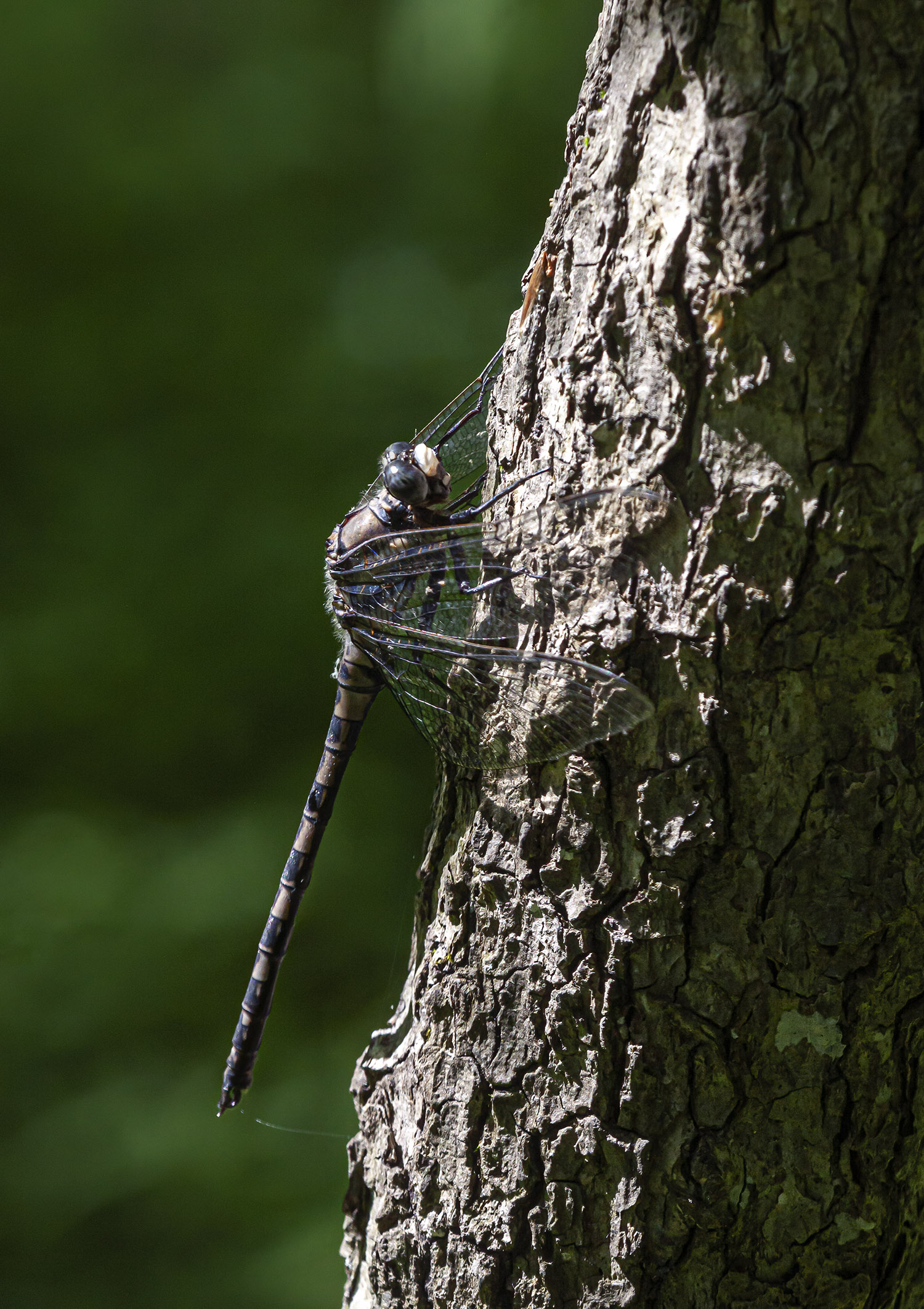
Some of my favorites, including the Gray Petaltail dragonfly (Tachopteryx thoreyi) are creatures of the seeps, those mucky forest areas where skunk cabbages are likely to grow. Most of the photos that I have published of Gray Petaltails have shown them perching vertically on sunlit trees near those seeps. That is where they are found most often, although they will sometimes perch on people with gray shirts, perhaps mistaking them for trees. I have had it happen to me on multiple occasions and, even though I love dragonflies, it is a little disconcerting when one of these large dragonflies flies by your head with an audible whir and lands on you.

As I was exploring a seepy area in Occoquan Regional Park on Wednesday, I was thrilled to be able to capture a shot of a Gray Petaltail perched horizontally on some skunk cabbage. What was he doing there? My first thought was that maybe he had just emerged and was waiting for his wings to harden. Unlike many other dragonfly larvae that live in the water, Gray Petaltail larvae live in the moist leaves in and around the seeps, so that is were they undergo their amazing metamorphosis from larvae into dragonflies.

When the dragonfly flew to a nearby tree, as shown in the second shot, it appeared to be a full-grown adult. I am still at a loss to explain why he was previously perched on skunk cabbage. Who knows? However, I do like the way that way that the background of this image is diagonally broken up into a kind of yin-yang pattern, a wonderful backdrop for this dragonfly’s muted colors.

The final photo is a quick shot to give you a visual impression some of the elements in a sun-lit forest seep, the preferred habitat for a Gray Petaltail dragonfly. This seep is on the side of a hill, so the water is not stagnant, but instead slowly oozes its way into a stream. If you want to find a Gray Petaltail on your own, this is the kind of place where you need to search.

Gray Petaltail

Gray Petaltail

seep

© Michael Q. Powell. All rights reserved.


Read Full Post »

I was happy on Tuesday to spot this male Lancet Clubtail dragonfly (Phanogomphus exilis) perched in the vegetation overhanging the small pond at Jackson Miles Abbott Wetland Refuge. I would like to have gotten a closer shot, but the bank was steep and the water in the pond appears to be deep at that spot. Staying dry, I was content to capture this environmental portrait of the handsome little dragonfly with such striking blue eyes.

lancet clubtail

© Michael Q. Powell. All rights reserved.

Read Full Post »

If you are lucky and persistent, it is not hard to photograph a perched dragonfly. Some of them are amazingly tolerant of the presence of a human and will let you get really close to them. Even when they do fly away, many of them will return to the very same perch.

If you want to really challenge your skills as a photographer and perhaps even your sanity, you attempt to photograph members of dragonfly species that fly almost constantly and rarely perch, like this male Prince Baskettail dragonfly (Epitheca princeps) that I spotted late in June at Jackson Miles Abbott Wetland Refuge. This dragonfly was flying irregular patrols low over the waters of a small pond at the refuge—sometimes he would fly relatively close to the shore, but often his flight path was unpredictable.

So how do I do it? I generally use the same 180mm macro lens that I use for close-up shots of dragonflies. However, I know that the lens tends to focus slowly and autofocus simply can’t acquire the subject, because it fills such a small part of the frame, so I switch to manual focus. I pre-focus on a general area and then as I track the dragonfly, I adjust the focus on the fly as he zooms by and fire away in burst mode. As dragonflies go, a Prince Baskettail is relatively large, almost 3 inches in length (75 mm), but it is really tough to get an in focus shot of one while he is flying.

On a second occasion when I was visiting the same refuge, I got a chance to try a variation of the technique. The dragonflies were patrolling  high overhead as I stood in a grassy area at one end of the pond. The second shot was the best that I could manage—the wing pattern suggests that it is also a Prince Baskettail, but the eye coloration and the terminal appendages at the tip of the abdomen make me wonder if this one is a female. What I discovered is that it is actually a lot harder to focus on a dragonfly when I am looking straight up than when looking down at the water and my arms get tired a lot quicker when holding my camera up hight for an extended period of time.

Prince Baskettail

Prince Baskettail

© Michael Q. Powell. All rights reserved.


Read Full Post »

I spotted this mating pair of Halloween Pennant dragonflies (Celithemis eponina) last Thursday during a brief visit to Meadowlark Botanical Gardens in Vienna, Virginia with my dear friend and photography mentor Cindy Dyer. The wing patterns and coloration of Halloween Pennants have always attracted me, making them one of my favorites. As most of you know, however, I tend to have lots of favorites when it comes to dragonflies.

I was in stealth mode as I slowly moved closer to this couple and attempted to frame the image in a way that was interesting and creative, while trying not to feel too much like a voyeur. Yes, I will boldly assert that this is art, and not insect porn.

Halloween Pennant

© Michael Q. Powell. All rights reserved.


Read Full Post »

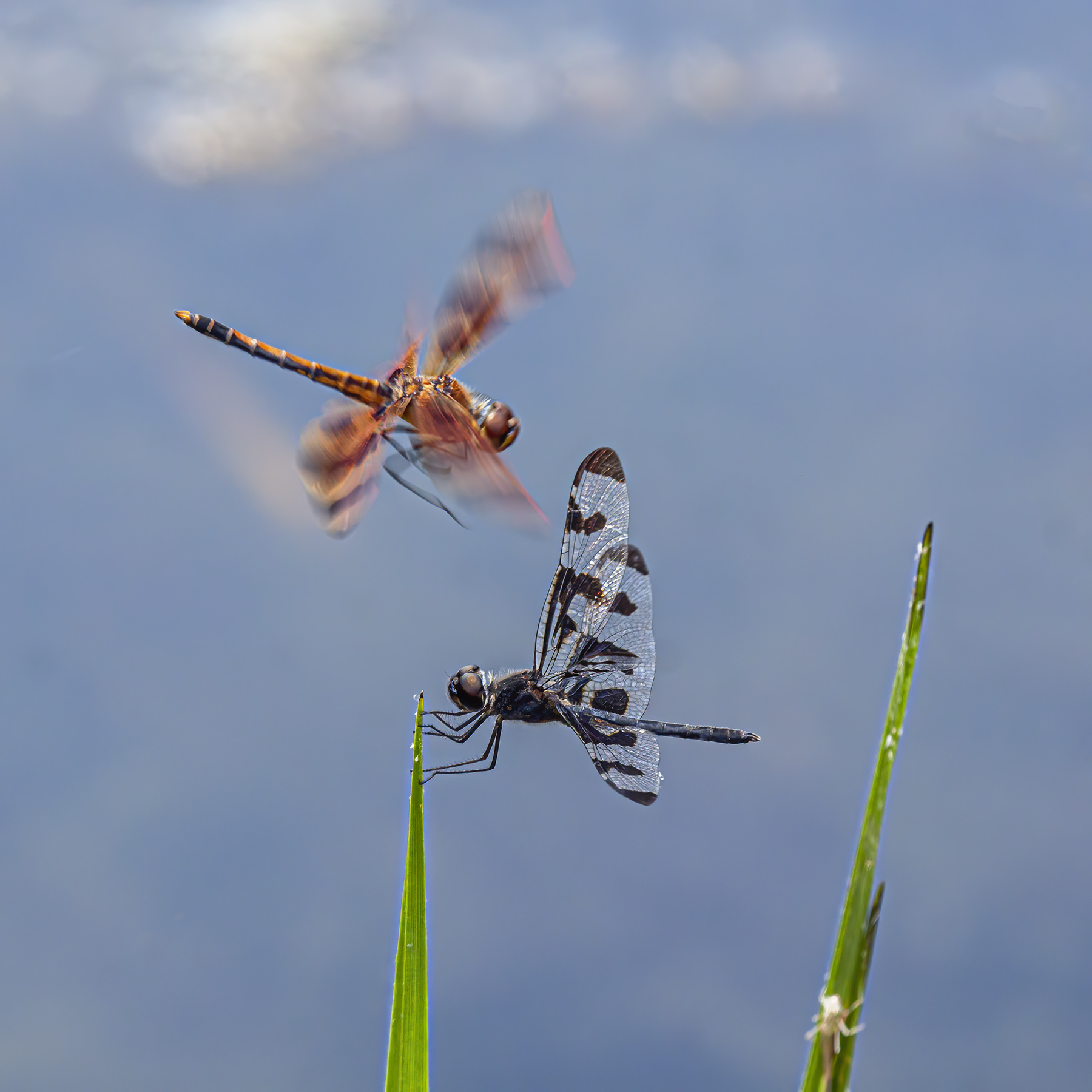
Perhaps it was a territorial dispute, but whatever the reason, a male Halloween Pennant dragonfly (Celithemis eponina) came screaming in determined to dislodge a perched male Banded Pennant dragonfly (Celithemis fasciata) on Thursday at Meadowlark Botanical Gardens and achieved his goal. A few moments earlier I had spotted the two dragonflies perched in a moment of peaceful co-existence (with appropriate social distancing), but that moment of tranquility did not last very long.

Can’t we all just get along and live in harmony with one another?

Halloween Pennant and Banded Pennant

Halloween Pennant and Banded Pennant

© Michael Q. Powell. All rights reserved.


Read Full Post »

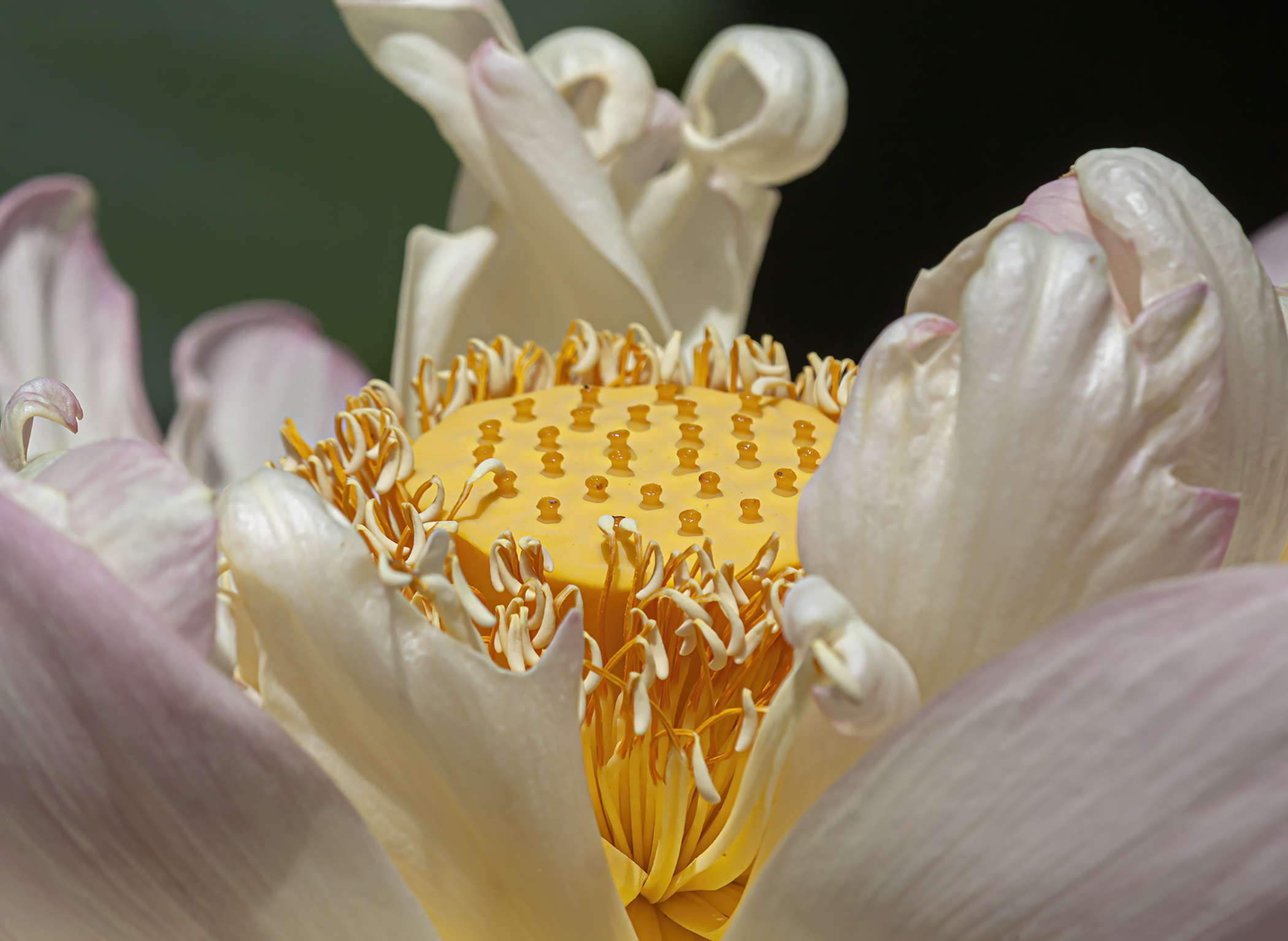
There were only a few lotuses in bloom on Thursday at Meadowlark Botanical Gardens, but they were more than sufficient to sate my senses. How much beauty is “enough?”

Increasingly I am finding that I enjoy beauty in small doses. So many voices in our society try to convince us that we need “more,” when perhaps “less” is even better, especially when we slow down and take the time to explore and appreciate that beauty.

I love the layers of  petals of the lotus flower; the details of the center of the lotus, revealed when the petals open up and begin to shrivel; and the promise of future beauty in the lotus bud on which the Slaty Skimmer dragonfly (Libellula incesta) had chosen to perch.

Sometimes when searching for beauty, it is more beneficial to search deeply, focusing on a few things, than to search widely, always looking for something newer and better.

lotus

lotus

slaty skimmer on lotus bud

© Michael Q. Powell. All rights reserved.


Read Full Post »

Most dragonflies are slender and acrobatic, prompting one of my friends recently to call them “dainty.” There is absolutely nothing dainty, however, about Dragonhunter dragonflies (Hagenius brevistylus)—with their massive upper bodies and powerful legs, they remind me of powerlifters. Dragonhunters, unlike some other large dragonflies, do not fly patrols overhead in their search for food. Instead, they are patient hunters who perch, waiting for passing prey, and then use their powerful back legs to snag their victims, which are often other dragonflies.

One thing that always strikes me when I spot perched Dragonhunters is that they seem uncomfortable. Their back legs are so long and ungainly that Dragonhunters’ poses look awkward, bringing to mind gawky teenage males who have undergone recent growth spurts and have not yet gotten used to their longer limbs.

I was thrilled to spot this Dragonhunter last week while exploring a stream in Fairfax County with my friend and fellow dragonfly enthusiast Walter Sanford. It was a hot, humid day and we did not have any success in finding Eastern Least Clubtails, our main focus for the day. In fact, during the day we did not see many dragonflies at all. Walter had been at this location repeatedly and at the start of the day had commented to me that he had often seen Dragonhunters perched on branches overhanging the stream. In fact, we spotted Dragonhunters several times during the day, but did not manage to get good shots of them.

As the skies began to darken, signaling an approaching rainstorm, I knew our time was drawing to an end. I decided to return to a fallen tree where we had seen a Dragonhunter earlier in the day and was pleasantly surprised to see a Dragonhunter holding on to the very tip of a branch. I waded into the stream and moved a little closer to the dragonfly, slowly making my way across the slick, uneven rocks. I called out loudly to Walter, who was a good distance downstream from me, and eventually I heard his response.

I became the patient hunter now as I stood in the calf-high waters of the stream, trying to minimize my movements as I struggled to get a decent shot without disturbing the dragonfly, waiting for the arrival of my friend and hoping that the dragonfly would stay in place. Well, Walter arrived and we both managed to get some shots. I then felt free to move a bit more and crouched low to get a better angle for a shot. Lost in the moment, I did not initially notice that my backside was getting wetter and wetter as I squatted lower and lower. Fortunately I had moved my wallet and keys to my backpack which remained dry.

Eventually the Dragonhunter flew away from its initial perch, but the flights were short and relatively direct and we were able to track the dragonfly to its subsequent positions. The Dragonhunter looked a bit more comfortable at its new perches, but I was not. The rocks underfoot were getting bigger and more uneven and navigation through the water was increasingly difficult. At one moment I encountered an unexpected small drop (maybe 6 inches or so) and I slipped and momentarily lost my balance, but somehow managed to stay dry.

I was tired and wet when we began the uphill trudge back to the parking area, but I was feeling happy about our encounter with this Dragonhunter, one of the powerful giants of the dragonfly world. If you would like to see Walter’s photos and commentary on our Dragonhunter adventure, be sure to check out his blog posting today entitled “Dragonhunter dragonfly (male).” While you are there, be sure to poke around on his site—he has lots of cool images and fascinating information on all kinds of dragonflies and other creatures too.

Dragonhunter

Dragonhunter

Dragonhunter

© Michael Q. Powell. All rights reserved.

Read Full Post »

Some of the dragonflies that I feature in my postings are uncommon species in my area. They are found in very small numbers, have a short flight period, and require very specific habitats. My good friend and fellow dragonfly enthusiast Walter Sanford did an extensive amount of research two years ago and re-discovered the Sable Clubtail dragonfly (Stenogomphurus rogersi), a species that is considered to be rare in Northern Virginia. Several of us were able to capture numerous images of this beautiful species during the 2018 dragonfly season.

Since that time, however, the habitat at that location has deteriorated significantly. As a result of some imprudent dumping of dirt and the resulting runoff, the stream habitat has been compromised by increased silt and higher levels of vegetation. Last year, as far as we know, there was only a single sighting of Sable Clubtails at this spot.

Had the population of Sable Clubtails been wiped out? During May and June this year, I made repeated trips to this location and on 12 June I captured the second shot below. When I took the shot, I was not sure if it was a Sable Clubtail, so my excitement was somewhat muted while I was in the field.  However, when Walter confirmed that it was in fact a male Sable Clubtail, I was really happy. In many ways, though, my excitement was no match for Walter’s the next day, when we returned to that location and, after much searching, had several encounters with Sable Clubtails, including the one shown in the first image.

For more background on the saga of the Sable Clubtails, be sure to check out Walter’s posting from last Friday entitled “Sable Clubtail dragonfly (Male No. 1).” The posting includes Walter’s photos, range maps for the species, and fascinating details on the backstory. Walter has a background in science and his systematic and analytical approach allows him to view things from a different perspective than I do with my background in languages, literature, and political science. Our approaches are quite different, but are definitely complementary.


Sable Clubtail

Sable Clubtail

© Michael Q. Powell. All rights reserved.

Read Full Post »

How much does the  background matter in a wildlife photograph? Is it merely a potentially distracting element or should it help convey a sense of the environment? Like many photographers, I often obsess over the background when I compose my images, trying to frame the shot and to adjust the camera settings to produce a certain effect. I suspect that my mindset is frequently more like that of a portrait photographer, who wants to draw your attention to the main subject, than that of a landscape photographer, who wants everything in the viewfinder to be in focus.

During the month of June I have been blessed to spot Gray Petaltail dragonflies (Tachopteryx thoreyi) on multiple occasions at several locations. I have taken lots of photos of them and the majority of those photos show the dragonfly perched vertically on the trunk of a tree—that is what petaltails do most of the time. My personal challenge has been to capture some images of Gray Petaltails doing something a bit different.

In the first image, the Gray Petaltail was perched horizontally, a position that I have rarely seen. The background in this shot is completely blurred—you don’t know for sure what is behind the dragonfly, though the colors suggest that it is vegetation. The blurred background forces you to focus on the main subject and to a limited extent on its perch. It is the type of portrait image that I strive to capture most often, though rarely am I this successful in doing so.

The second image uses a different approach. I visually separated the dragonfly from its perch by shooting from the side so that the details of its body are not lost in the shadows of the tree. The background is slightly blurred, but it lets you know that the dragonfly was perched in a sea of interrupted ferns. I like the way that you can see the patterns and color of those ferns. I took the shot from a lot farther away than I did with the first image, so the dragonfly occupies a much smaller part of the frame. As a result, the details of the perch grow in importance and in many ways the tree shares the spotlight with the dragonfly. This is the kind of environmental portrait that I really like, but often forget to take. Too often I am so driven to fill the frame with my subject that I forget to try different approaches.

The final shot is a kind of compromise shot, taken from a medium distance with a background that is more suggestive of the environment than in the first image, but not as detailed as in the second one. The perch has some details, but is intended to play a supporting role, rather than be the co-star as in the the second image. The dragonfly fills less of the frame than in the first image, but more than in the second.

In the story of Goldilocks and the three bears, she repeatedly tried two extremes, before setting on one that was “just right.” Is that the moral of the story here? Au contraire, mes amis. You can come to your own conclusions as you look at these three images, but for me it is clear that there is no single solution to the question of backgrounds. Blurry backgrounds can be good, but not always. Close-up shots are great, but may come with a cost. Showing some details in the background can enhance an image, except when it doesn’t.

What is best? Some folks may be unhappy with the lack of clarity, but the best answer seems to be, “it depends.” With backgrounds, as with so much in photography, we are left in an ambiguous situation in which “rules” are at best general guidelines, intended to be broken as the situation dictates or as the photographer decides. That gives me unlimited possibilities and a maximum amount of freedom to create more cool images.

Gray Petaltail

Gray Petaltail

Gray Petaltail

© Michael Q. Powell. All rights reserved.

Read Full Post »

The shape of the silhouette is familiar and if the lighting is bad, you might be able to convince yourself that a Great Blue Heron (Ardea herodias) is standing in the corner of a small pond at Green Spring Gardens. I have visited the pond dozens of times, so I know that the heron is not real, but it still makes for a fun subject to photograph.

I love the heron’s distorted reflection in the first photo and the touches of green provided by a small tree to the side and the duckweed floating on the surface of the water. I was equally thrilled when a male Blue Dasher dragonfly (Pachydiplax longipennis) perched on the heron’s head after I had moved in closer. I doubt that a real heron would have been quite as accommodating in permitting the dragonfly to perch and seem to recall having seen a Great Blue Heron attempt to snatch a dragonfly out of the air as it flew by.

Great Blue Heron

Blue Dasher

© Michael Q. Powell. All rights reserved.


Read Full Post »

In some of the locations that I visit, Blue Dasher dragonflies (Pachydiplax longipennis) are the most common species that I encounter. They are pretty easy to photograph, because they hunt by perching and waiting for suitable prey to come within range. When it does, they dart from their position to catch it and often return to the same perch.

Over the years, I am sure that I have taken hundreds of photos of Blue Dashers, but I still enjoy trying to capture new and potentially better images of these beautiful little dragonflies. Blue Dashers have a special place in my heart in part because my very first posting on this blog almost eight years ago featured a photo of one. My gear has changed over those eight years, but my approach has remained pretty consistent. If you are curious about the kind of images I was capturing way back then, check out the posting that was entitle simply “Blue Dasher dragonfly.”

One thing that has changed, though, is that I now have a greater appreciation for female dragonflies, which are generally less colorful than their male counterparts. Some might see the females as drab and uninteresting, but I often find a special beauty in them that is more subtle and refined than the garish males.

The images below are shots of female Blue Dashers that I have taken during the month of June. The final photo shows a younger female with brighter colors and a more distinct pattern on her abdomen. The first two images feature a more mature female—both sexes of Blues Dashers develop a waxy, frosted color with age, a phenomenon known as “pruinescence.” One of the coolest features of these females is their two-toned eyes, with a prominent red color on the top half of the large compound eyes.


Blue Dasher

Blue Dasher

Blue Dasher

© Michael Q. Powell. All rights reserved.


Read Full Post »

Can dragonflies smile? It sure looked like this male Great Blue Skimmer dragonfly (Libellula vibrans) was flashing me a toothy grin when I spotted him last Friday at Occoquan Bay National Wildlife Refuge. Perhaps it was just my imagination, running away with me.

smiling dragonfly

© Michael Q. Powell. All rights reserved.


Read Full Post »

Although Calico Pennant dragonflies (Celithemis elisa) are quite small, about 1.3 inches (33 mm) in length, they pack a lot of color into their tiny bodies and wings. Adult females have bright yellow markings, as shown in the first photo, and wonderful designs on their wings that appear to be outlined in gold when the sun hits them from the right angle. Adult males have bright red markings that look almost like little hearts and have similarly detailed patches on their wings, although the pattern and colors are different from those of the females.

What about the dragonfly in the third photo? Its coloration is similar to that of the adult female, but it is in fact a juvenile male that will eventually turn red. How can I tell it is a male? If you look closely at the tips of the abdomen (the “tail”) in all three images, you will note that the terminal appendages are similar in the final two photos and are different from those in the first photo. Normally I will try to rely on those anatomical features when trying to tell the gender of a subject, because in quite a large number of dragonfly species, juvenile males and females have the same coloration.

I spotted all three of these Calico Pennant dragonflies during a visit last Friday to Occoquan Bay National Wildlife Refuge, one of my favorite places to spend time with my camera. This refuge was one of the few facilities in our area to remain open during the stay-home period and got a bit too crowded for my taste. Now that other parks have reopened, the number of visitors has dropped to much lower levels and I am able to enjoy the solitude of nature once again.

Calico Pennant

Calico Pennant

Calico Pennant

© Michael Q. Powell. All rights reserved.

Read Full Post »

Do you believe in unicorns? I am always happy when I manage to spot a Unicorn Clubtail (Arigomphus villosipes), a beautiful dragonfly species in which both sexes have a small hornlike projection between their eyes that gives rise to their common name. I recently spotted the dragonflies in this posting while exploring a small pond in Fairfax County, where I live.

This is the only clubtail species in our area that prefers ponds and marshes over streams and rivers, according to the Dragonflies of Northern Virginia website. It is fairly easy to identify this species, because of the rusty-edged club at the bottom portion of the dragonfly’s abdomen and the very visible bright tip. Male Unicorn Clubtails tend to fly short patrols and perch quite often on low vegetation, so it is not hard for me to spot them if I am in the appropriate environment.  The third photo below shows a male in a typical perching pose.

Female Unicorn Clubtails, on the other hand, are hard to find—I do not know where they hang out, but it seems that they come to the water only when they are ready to mate. The only two times that I have ever seen a female Unicorn Clubtail dragonfly was when when she was ovipositing, like this one in the first two photos that I spotted this past Thursday. I captured these shots as she hovered momentarily in the air, getting ready to tap the water again with the tip of her abdomen to release more eggs.

Chasing unicorns? Yes, that is how I enjoy spending my time in the wild.


Unicorn Clubtail

Unicorn Clubtail

Unicorn Clubtail

© Michael Q. Powell. All rights reserved.

Read Full Post »
I was really happy that I was able to track this Swamp Darner dragonfly (Epiaeschna heros) after it zoomed by me yesterday afternoon at Occoquan Bay National Wildlife Refuge. When I finally caught up to it, the large dragonfly was hanging vertically, high in a tree among the leaves, leisurely munching on its bee lunch in the shade.

Yes, I recognize that bees play an important role as pollinators and highlighted that in yesterday’s posting. Bees, however, also serve as a food source for other creatures higher up on the food chain—they are all part of the circle of life.

Swamp Darners are among the largest dragonflies in our area, about 3.4 inches (86 mm) in length. I really like the description that Kevin Munroe provided of Swamp Darners on the wonderful Dragonflies of Northern Virginia website. “I often tell people on dragonfly walks that if they see a rhino with wings, it’s a swamp darner. Slight exaggeration, perhaps, but they are pretty impressive. June is their month and the best time to see them, as they cruise, slow and purposefully, over shallow, swampy pools, or hunt high over nearby meadows.”


Swamp Darner

© Michael Q. Powell. All rights reserved.


Read Full Post »

Sometimes I take photographs when I am standing upright, but quite often I am crouching, kneeling, bending, or leaning as I try to compose my images. I occasionally  remark that I am happy that nobody is filming me as I contort my body for the sake of my craft—a kind of photography yoga. Sometimes, though, my friends will take photos of me as I am am taking photos.

Several readers wondered how close I was to the Gray Petaltail dragonfly when I captured some macro images of its eyes that I featured in a posting earlier this week. My friend Walter Sanford, with whom I frequently go on photographic forays for dragonflies, captured the first image below of me in action and graciously agreed to let me use it in this posting. You may need to double-click on the photo to see it, but the Gray Petaltail dragonfly is perched on the left fork of the branch just after the split. The dragonfly was so cooperative that I remained in that crouch for an extended period of time, periodically flexing forward to get a tiny bit closer.

My friend and photography mentor Cindy Dyer has also captured me in action. She recently came across the second photo below, which I think dates back to 2013, and posted it in Facebook. I am not sure what I was looking at so intently through my viewfinder, but it seems likely that I had spotted something more interesting than the Canada Geese right in front of me. As I often do, I was crouching in the brush, with all kinds of vegetation threatening to poke me in the ear and eyes.

When a crouch will not get me low enough, I am often willing to sprawl on the ground, as in the third photo below that was also taken by Cindy Dyer. You may notice that I was carrying a tripod with me in a case on my back. Cindy is a big fan of using a tripod whenever possible for macro shots and I remember well when she told me that one of the keys to success was for me to get as low as possible and spread my legs. I blushed initially until I realized that she was referring to my tripod.

It is probably not mandatory for all photographers, but I have found that it helps to be fit and flexible. One of my personal challenges will be to maintain that level of fitness and energy as I get older, so that I can continue my “style” of photography.

Gray Petaltail

kingstowne pond

shooting position

© Michael Q. Powell. All rights reserved.

Read Full Post »

In an ideal world, I would be able to photograph a dragonfly up close and from multiple angles. My close-up shots of a Gray Petaltail dragonfly in yesterday’s posting were the result of almost perfect circumstances. Real life, alas, is rarely that perfect. My entire life, it seems, I have heard the words of the Rolling Stones, reminding me that “You can’t always get what you want, but if you try sometimes, you might find you get what you need.”

Last week I spent almost an entire day with fellow dragonfly enthusiast and blogger Walter Sanford searching for dragonflies in a variety of habitats. It was a long, grueling effort, conducted often in the hot direct sunlight and sometime involving wading through waist-high vegetation. Walter and I have worked together often enough over the years that we have developed some routines. Most of the time we try to stay in sight of each other, so if one of us spooks a dragonfly, the other has a chance of being able to track it to its next perch.

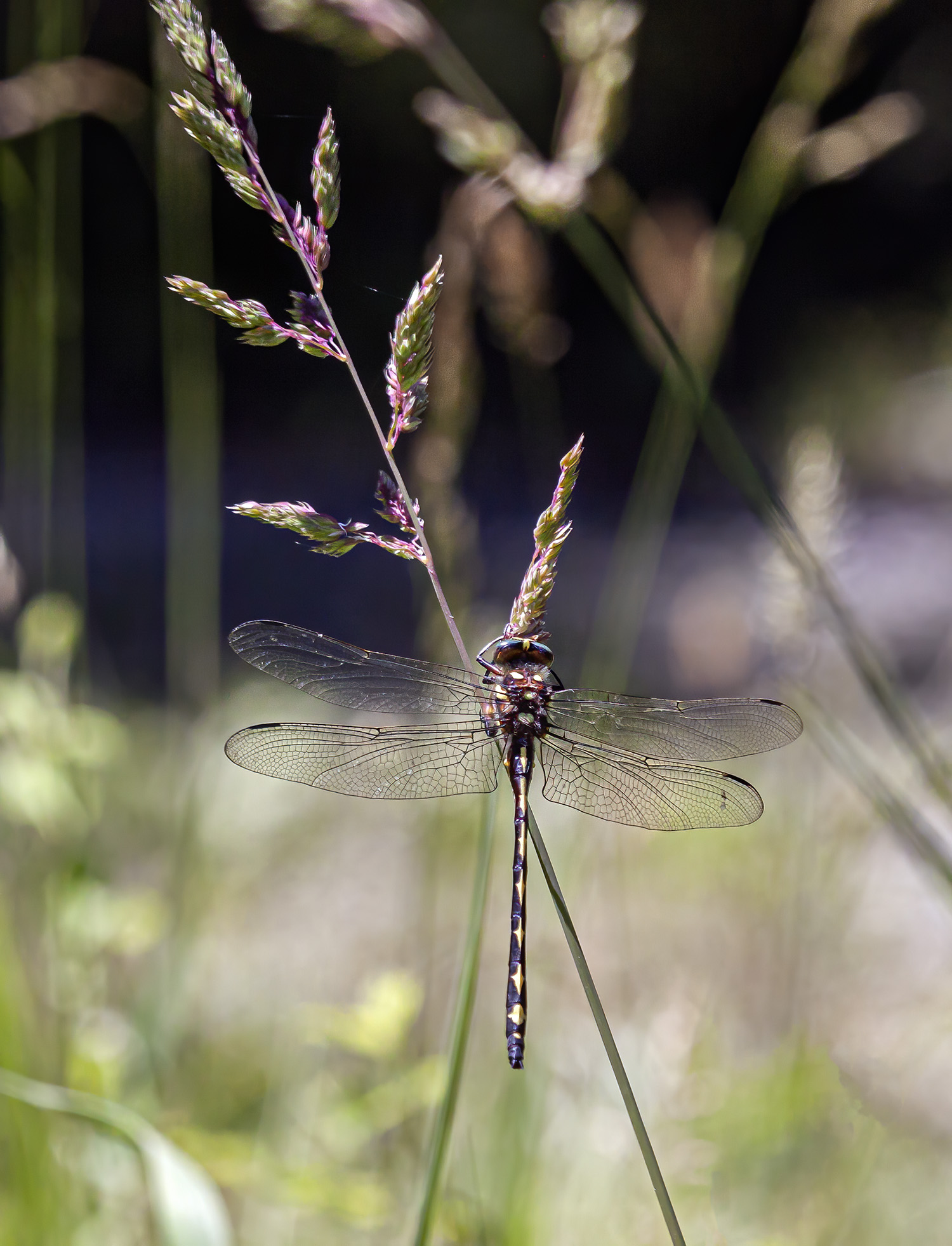
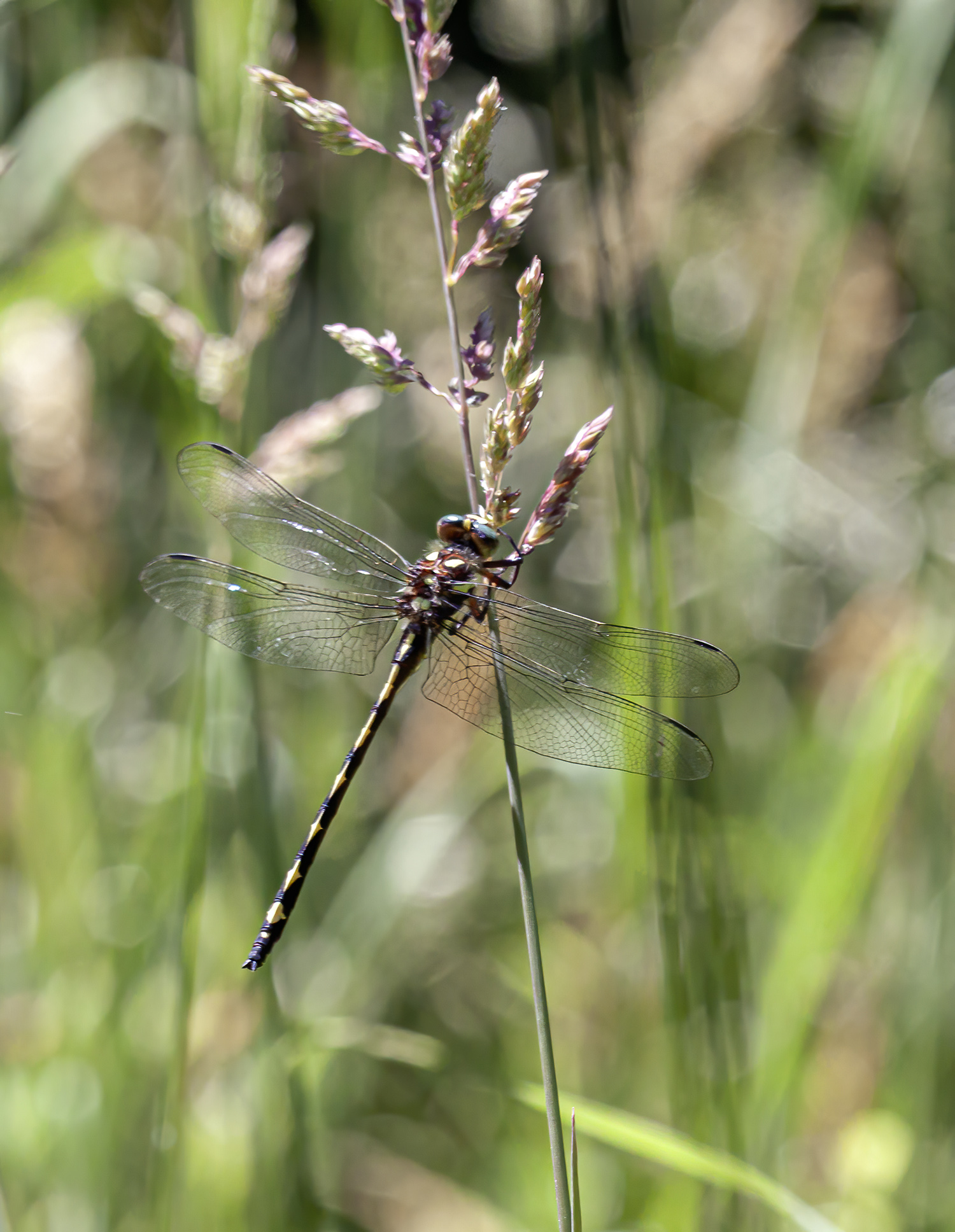
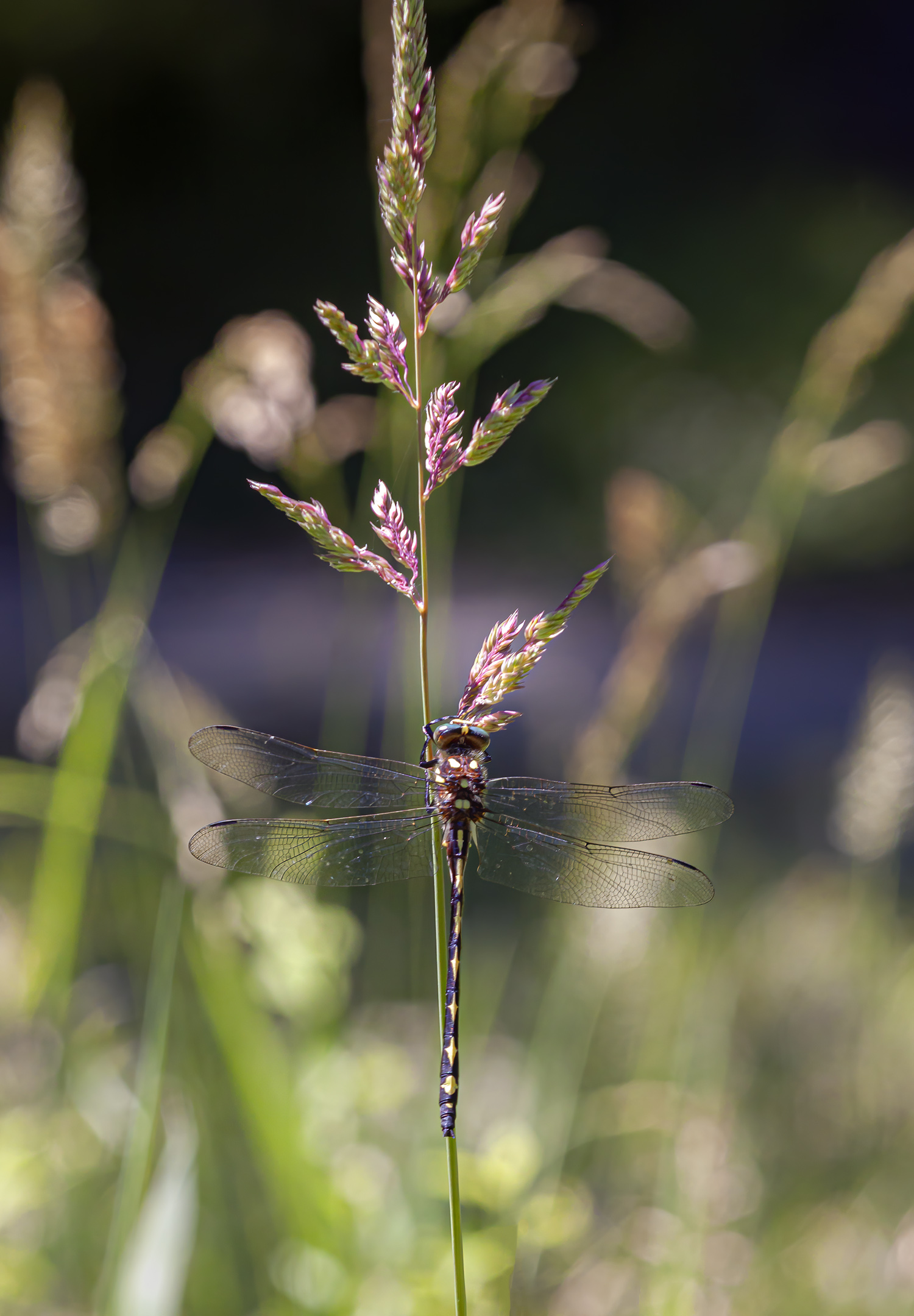
Towards the end of day, we had wandered a little farther apart than usual when I heard Walter tell me emphatically to stop—he had spotted a dragonfly. I was in an awkward position when I stopped and I could barely see the dragonfly through the lens of the camera. It was hanging vertically from a thin stalk of vegetation that was swaying vigorously back and forth in a breeze that had suddenly kicked up. My heart started to beat a bit faster when Walter told me that it looked to be a male Arrowhead Spiketail dragonfly (Cordulegaster obliqua), an uncommon species that I have seen only a few times.

So there I was, frozen in place far from my subject, trying desperately to focus manually on my moving subject that I knew might take off at any moment. I tried to pay attention to the background as I composed my shots, bending my body and flexing my knees to get some minor variations in my angle of view. What you see below are three of those variations. I like the way that they captured the Arrowhead Spiketail in the environment in which we found it—I may not have gotten what I wanted, but perhaps I got what I needed, i.e. I got some decent shots of my subject.

Walter observed this dragonfly from an entirely different angle of view and, as always, approaches things from a different perspective. I encourage you to check out his blog posting today “Arrowhead Spiketail dragonfly (male)” to see his photos and to read about his reactions to seeing this uncommon dragonfly in an environment that was not “according to the book.”

Arrowhead Spiketail

Arrowhead Spiketail

Arrowhead Spiketail

© Michael Q. Powell. All rights reserved.

Read Full Post »

« Newer Posts - Older Posts »