Feeds:
Posts
Comments

Archive for the ‘Dragonflies’ Category

As I noted in an earlier posting today, some of my favorite images are almost minimalist in their approach. This recent image of a male Blue Dasher dragonfly (Pachydiplax longipennis) fits into that category.

Once again, the composition is simple, the color palette is fairly limited, and there is a good amount of negative space. The brown-colored background is the water in one of the areas of my local marshland park.

I like the position of the dragonfly—I think he was trying to cool off on a hot day by raising his abdomen—and the viewer’s eyes are drawn to the dragonfly, because it is the most colorful and the most sharply-focused object in the photo.

This image reminds me a little of a painting in which the artist has arranged the elements to make a pleasing composition. In this case, though, nature did the arranging.

dasher_leaves_blog

© Michael Q. Powell. All rights reserved

Read Full Post »

Some of my favorite images are almost minimalist in their approach, like this shot of a male Common Whitetail dragonfly (Plathemis lydia).

The composition is simple, the color palette is limited, and there is a pretty good amount of negative space. The subject is not unique and unusual—its name even indicates that it is “common.”

I managed to capture some of the details of the dragonfly, though, like the “hairs” on the legs (click on the image to see a higher resolution view), though the image is not super sharp. The shadow of the wings on the green leaf adds an additional touch of visual interest to the image.

The photo is not spectacular and showy, but I find a real beauty in its quiet simplicity.

whitetail_A_blog

© Michael Q. Powell. All rights reserved

Read Full Post »

One of the many reasons why I love dragonflies is their amazing wings, which are so delicate and yet so powerful, like those of this male Blue Dasher dragonfly (Pachydiplax longipennis). In this shot, I tried to capture some of the intricate detail of the structure of the wings of the dragonfly. They remind me a bit of the leaded glass windows that I sometimes see in old homes, with each small piece of glass outlined in black.

dragonfly_wings_blog

© Michael Q. Powell. All rights reserved

Read Full Post »

When I first caught sight of this male Blue Dasher dragonfly (Pachydiplax longipennis) in the air, I thought that he had captured some sort of prey. I was wrong, yet I was also right.

The male dragonfly’s prey was a female dragonfly and they were in a mating position that I later learned is known as the wheel. The sheer flexibility and athleticism involved seems worthy of the Cirque de Soleil. Apparently it starts when the male grabs the female’s head with special claspers at the tip of his abdomen.

I came across a fascinating article by Jennifer Ackerman in National Geographic Magazine entitled Dragonflies Strange Love that provides some amazing insights into the mating habits of dragonflies. One sentence really sums up the process, “Grab, shake, bite, puncture, punch—that’s just the courtship ritual of these dazzling aerobats.”

The male dragonfly seems to be driven by an incredibly strong biological drive. I can almost hear one of them repeating the words of the Tina Turner song, “What’s love got to do with it?”

wheel_blog

© Michael Q. Powell. All rights reserved

Read Full Post »

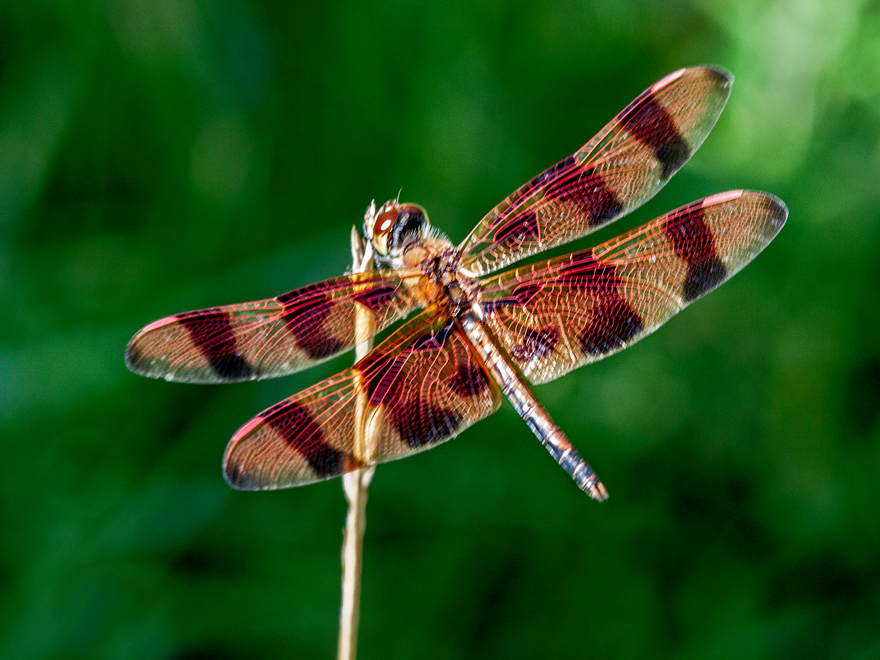
Yesterday I was happy to get some shots of my favorite dragonfly, the Halloween Pennant dragonfly (Celithemis eponina), at Meadowlark Botanical Gardens in Vienna, Virginia.

I don’t see this dragonfly at all at most of the usual places where I take photographs, so I was really excited when I caught sight of a couple of them yesterday. I chased them around for well over an hour and attempted to take a couple of hundred shots using a wide range of camera settings.

Why did I take so many photos? The dragonfly gets the “pennant”  part of its name because it likes to perch on the very tip of a weed stalk and waves in the breeze like a pennant. Yesterday, in fact, was breezy and it was quite an adventure trying to keep the dragonfly in focus, particularly because I was trying to fill the frame with the dragonfly.

The dragonflies that I photographed were reasonably cooperative and I was able to attempt shots from the side, from above, and even from below (fortunately the insects in the grass did not bite very often).

I have not been able to go through the shot to pick the best ones, but thought it would be nice to post one now, especially for those readers who may not be familiar with this beautiful dragonfly. I suspect that I will eventually post at least a couple more images in future postings.

Halloween1_blog

© Michael Q. Powell. All rights reserved

Read Full Post »

I don’t often see dragonflies perched on flowers, so I was really happy when this male Blue Dasher dragonfly (Pachydiplax longipennis) decided to take a break on something more attractive than the usual broken swamp reed.

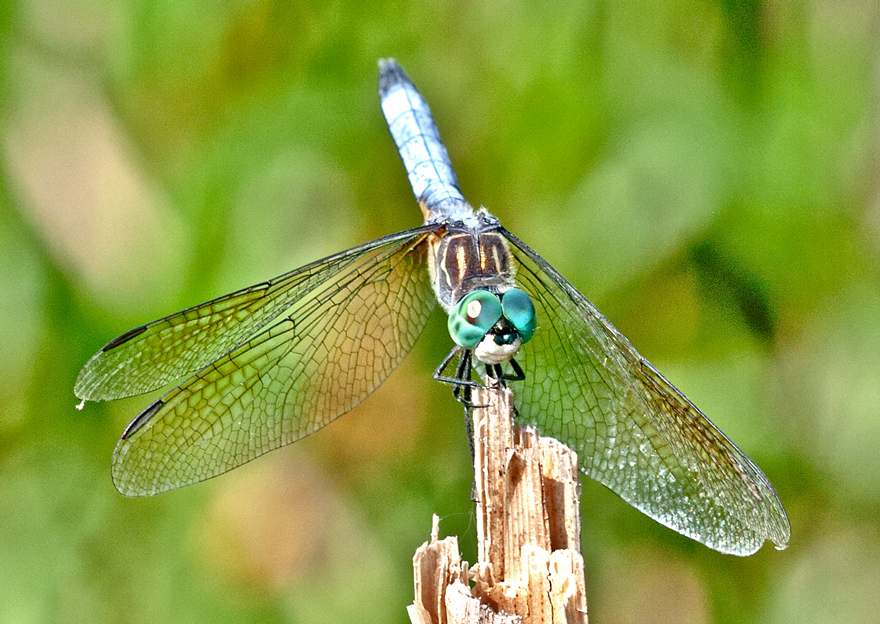
If you look closely at the dragonfly’s face (or click on the photo for higher resolution), you can see some interesting details, like his cute little bucktooth and some sparse sprouting hairs on his chin, like those of a human teenager. I also like the contrast in color between the blues and greens of his body and the pink of the flowers.

Why did the dragonfly choose to land on the flower? It almost looks like he is helping with pollination, but I suspect that is not the case. The answer to the question is probably much more simple—he landed on it, because it was there.

face_blog

© Michael Q. Powell. All rights reserved

Read Full Post »

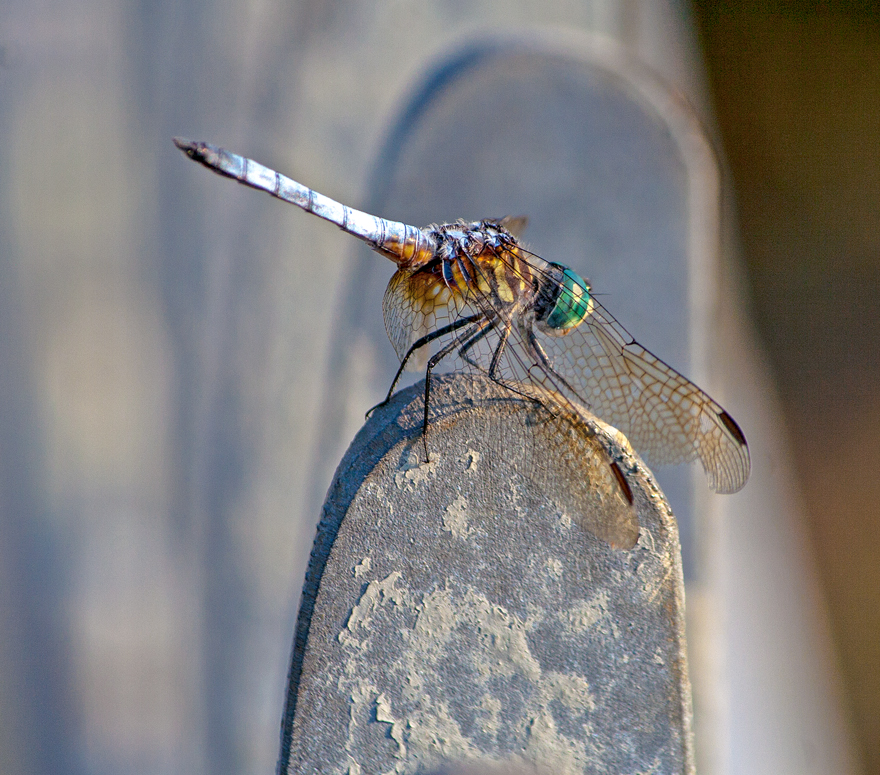
What do you do when the wildlife subject that you are attempting to photograph puts itself in a man-made setting, rather than a more natural environment? That was my dilemma when a Blue Dasher dragonfly (Pachydiplax longipennis) landed on one of the slats of a railing surrounding part of the boardwalk at Huntley Meadows Park, the local marshland where I take a lot of my photographs.

As I looked down the railing at the dragonfly, my eye was attracted to the repeating pattern of the slats, and I decided to try a creative approach to an image using that pattern. I chose camera settings that would give me a relatively shallow depth of field. Then I carefully composed the shot so that some other slats would appear in the background in a blurry form, but the one on which the dragonfly perched would be in sharp focus.

Although I generally prefer a more natural setting for my wildlife subjects, I think I managed to achieve a pretty cool effect that was relatively close to what I had in mind. I especially like the detail that I was able to capture of the weathered metal slat in the foreground (click on the photo to see a higher resolution view).

railing_blog

© Michael Q. Powell. All rights reserved

Read Full Post »

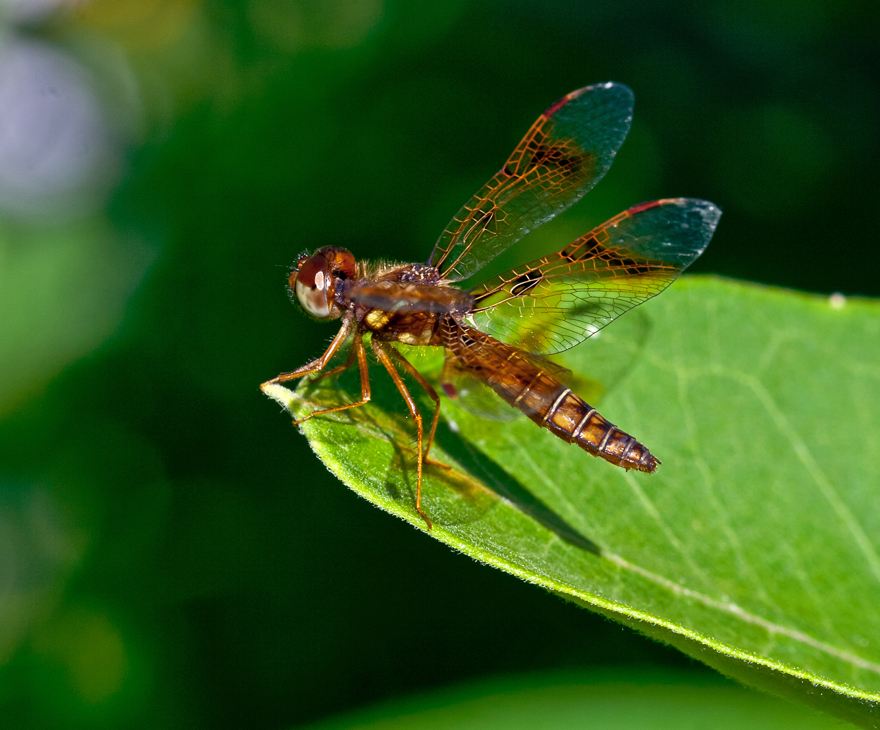
Only a tiny, lightweight dragonfly, like this Eastern Amberwing (Perithemis tenera), could assume this pose and hold it for an extended period of time. I have watched other dragonflies land near the end of a leaf like this, but gravity forced them to quickly give up their perch.

I was able to take a lot of photos of this dragonfly and this is one of my favorites, because its abdomen is raised, its wings are spread, and its head is cocked a little to the side—a near perfect pose.

amber_grass_blog

© Michael Q. Powell. All rights reserved

Read Full Post »

Every time that I look at a dragonfly head-on, I can’t help but think of the biplanes of World War I, like the Sopwith Camel that Snoopy famously imagined piloting in his battles with the Red Baron.

Considering the colors of this Needham’s Skimmer dragonfly (Libellula needhami), I guess that he would have to represent the Red Baron, not Snoopy. Aerial dogfights are not without danger, and it looks like this dragonfly has survived several encounters with the enemy, with all of his wings showing some damage.

red_dragonfly_headon_blog© Michael Q. Powell. All rights reserved

Read Full Post »

All of the photos that I have posted this year of the Eastern Pondhawk dragonfly (Erythemis simplicicollis) have been of females, which are a beautiful emerald green, but I think that you will agree that the male in this photo is equally stunning. I love the mixture of blue and green on its body and was particularly happy to capture this one perched on a colorful flower.

This is a shot from couple of weeks ago, when I was able to borrow my friend’s Nikon D7000 and Tamron 180mm macro lens for a little while while we were shooting at Kenilworth Aquatic Gardens in the District of Columbia. Every time that I look over the images that I shot, I am impressed by the results that I was able to achieve with a “foreign” camera—normally I shoot with a Canon.

Pondhawk lorez

© Michael Q. Powell. All rights reserved

Read Full Post »

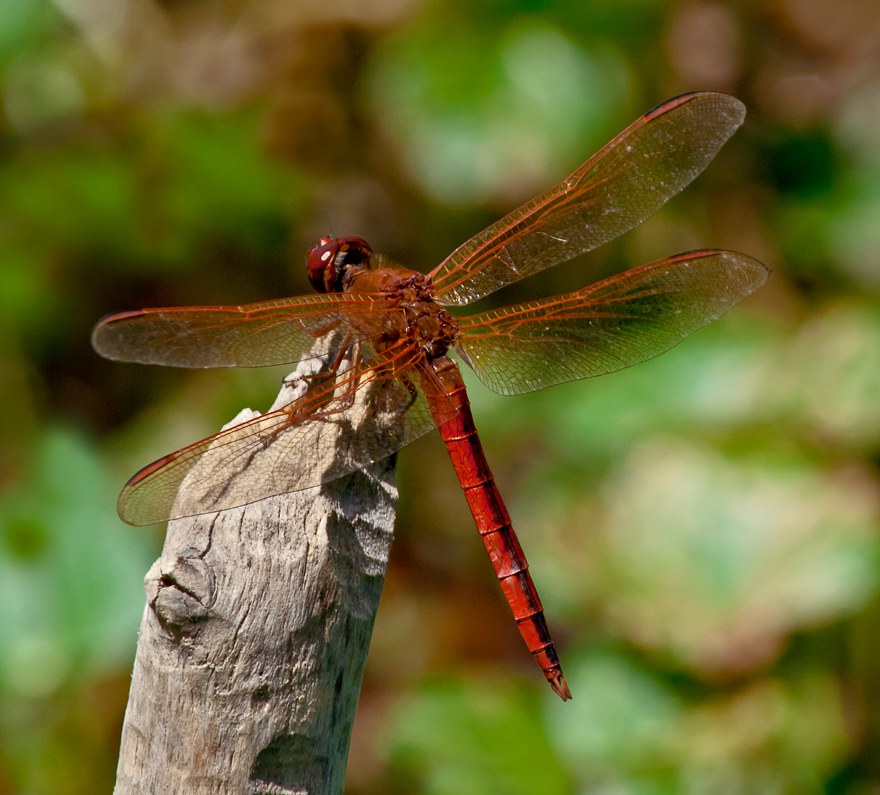
It’s unusual for me to see a red dragonfly, so yesterday I chased around several of them and have concluded that they are probably Needham’s Skimmer dragonflies (Libellula needhami), a species that I have never before encountered.

In addition to the red-orange bodies, these dragonflies have reddish-brown veins in their wings, which make them very striking. There is another species, Golden-winged skimmers (Libellula auripennis), that is supposed to look like the Needham’s Skimmers, so I may be off in my identification—I will leave the final call to experts.

I’m keeping my eyes open and hope that I’ll be able to find a few more species that are new to me before the summer ends, though it’s tough right now to go outdoors with temperatures in the daytime around 95 degrees F (35 degrees C) and very humid.

red_dragonfly2_blog

© Michael Q. Powell. All rights reserved

Read Full Post »

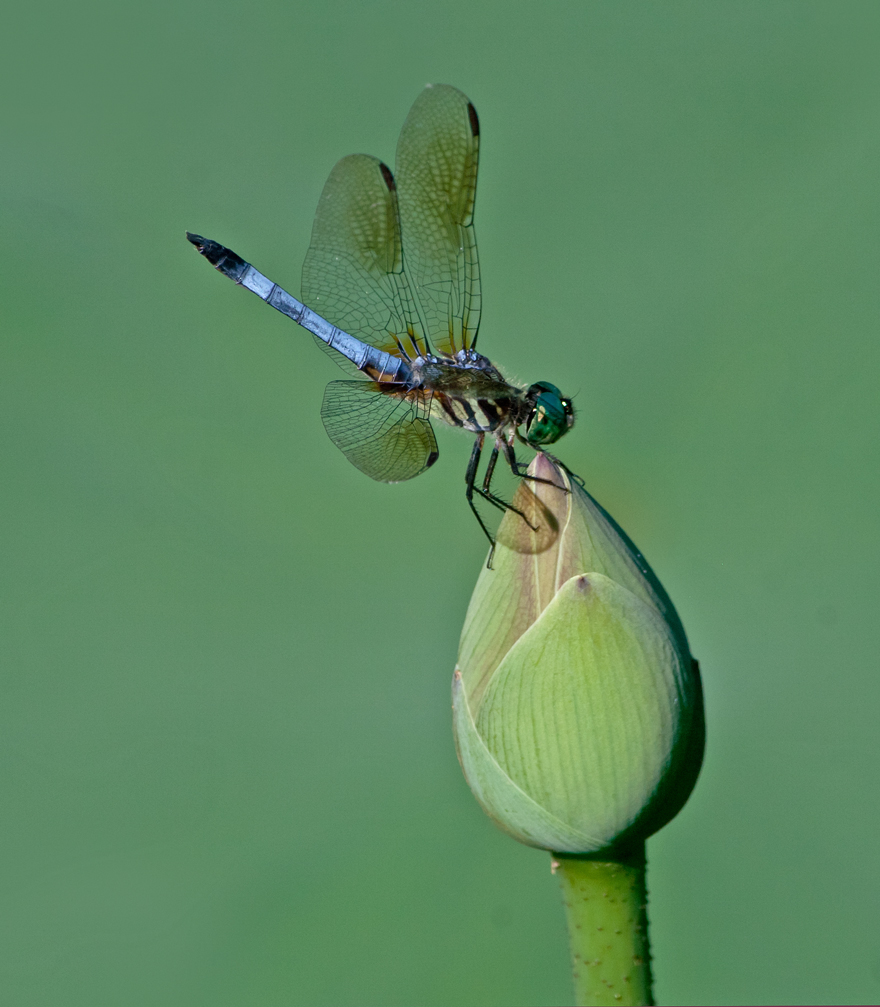
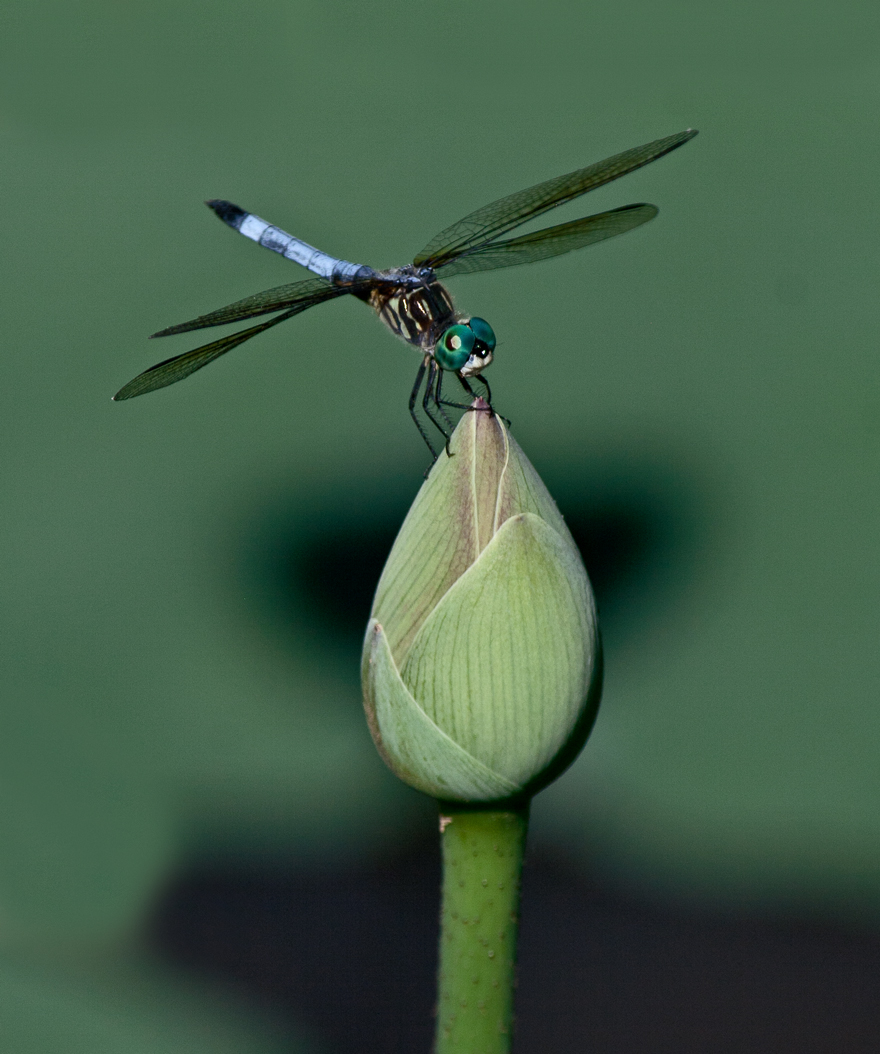
Having spotted some lotus flower buds at the aquatic garden last weekend, I remember thinking how cool it would be to see a dragonfly perching  on a lotus bud and then it happened—a male Blue Dasher dragonfly (Pachydiplax longipennis) landed on the tip of one of the buds.

When stalking dragonflies, I always hope that they will choose a photogenic perch, but most of the time the perches are nondescript, at best, and the background is often cluttered.

I would like to claim that I have special powers as a dragonfly whisper, but I was unusually fortunate and am happy that I was able to get some good photos when the circumstances presented themselves.

lotus_bud2_blog

lotus_bud_blog© Michael Q. Powell. All rights reserved

Read Full Post »

I love the coloration of this male Slaty Skimmer dragonfly (Libellula incesta) that I photographed last weekend at Kenilworth Aquatic Gardens in the District of Columbia.  Somehow I was able to get both an interesting perch and a blurred background—all too often I get one or the other.

Black Dragonfly lorezB

© Michael Q. Powell. All rights reserved

Read Full Post »

When I first spotted this dragonfly, I thought it was a wasp—it was that small. As I continued to observe it, however, I realized that it was a tiny dragonfly.

Its wings reminded me a little of a Halloween Pennant dragonfly (Celithemis eponina), one of the most exotic-looking dragonflies that I have ever photographed, but it was far too small. (Check out this previous posting for a look at the Halloween Pennant.)

This dragonfly seemed even smaller than the Eastern Amberwing dragonfly (Perithemis tenera), the smallest dragonfly that I had encountered, and I figured it couldn’t be an Eastern Amberwing, because it did not have amber wings. I was wrong. Once again I had allowed myself to be misled by the name of a species. It turns out that this is almost certainly a female Eastern Amberwing, and females have clear wings with brown spots, not amber wings.

I continue to be amazed at the dragonfly’s diminutive size. According to the Field Station at the University of Wisconsin at Milwaukee, Eastern Amberwings are considered to be wasp mimics, because of their coloring, their rapid, erratic flight, and the way they twitch their wings and abdomens when at rest. The Latin name tenera means “tender” or “delicate,” a description that seems to fit this little dragonfly quite well. If you want to learn more about the Eastern Amberwing, you should check out the Field Station website.

Large or small, at rest or in motion, dragonflies are one of my favorite photographic subjects at this time of the year. Their beautiful colors and incredible agility never cease to amaze me.

tiny1_blog

© Michael Q. Powell. All rights reserved

Read Full Post »

It was bound to happen. No more than I few days ago I lamented that I had never seen a dragonfly eating, in responding to a wonderful posting by Sue of Backyard Biology about dragonflies as super predators—you should check out her posting, unless you are squeamish about things like headless dragonflies.

Sure enough, this past weekend I was able to get some photos of a female Eastern Pondhawk dragonfly (Erythemis simplicicollis) with a bee that she had captured. Initially, I was just trying to get a photo of the beautiful emerald-colored dragonfly on the plant in the second photo. I didn’t even realize that she was cuddling a bee in her front legs, almost like a little baby.

Eventually she flew down from the plant to the edge of the boardwalk to enjoy her meal and I got the first shot. I had to lean over the edge of the boardwalk to get the photo and just barely avoided falling into the bushes below.

My usual experience is that I am so excited about photographing a subject the first time that I not very concerned about the quality of the images. I will keep my eyes open and hope to capture some more images of dragonflies feeding.

dragonfly_bee1_blogdragon_bee2_blog

© Michael Q. Powell. All rights reserved

Read Full Post »

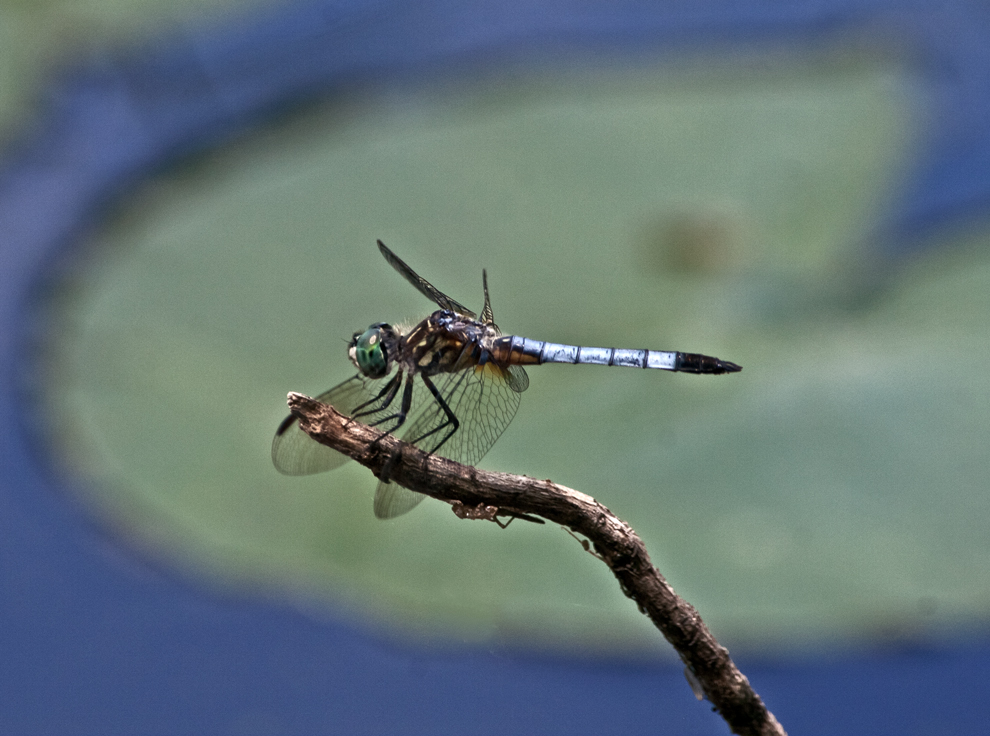
It’s not often that I have the luxury of consciously composing the background when I am photographing a dragonfly, but this Blue Dasher (Pachydiplax longipennis) was cooperative enough that I was able to frame the shot with a lily pad in the background. As a bonus, the colors of the background are a pretty good match for the colors of the dragonfly.

Who knew that dragonflies were so stylish? Maybe the coordinated colors helps the males to attract prospective mates. The less stylish dragonflies probably have to rely on the insect equivalent of eHarmony.com.

dasher_pad_blog

© Michael Q. Powell. All rights reserved

Read Full Post »

Imagine what it would be like to climb out of the secure watery world that you have always known onto an exposed blade of grass to wait for a transformation to take place, a transformation from the inside.

Impatiently waiting for your skin to dry in the sun, you prepare to break out of your former body, unfurl your wings, and fly into the air. You’ve waited all your life for this moment, when you emerge as a dragonfly. How hard it must be to wait for the transformation to be complete. At last you take off, forever changed, leaving behind the empty outer shell as the sole evidence of your former existence.

shell_blog

© Michael Q. Powell. All rights reserved

Read Full Post »

One year ago today I made my first posting on this blog, an image of a Blue Dasher dragonfly in a pose that I later learned was called the obelisk pose, and it seems appropriate on this anniversary to post a similar shot that I took yesterday.
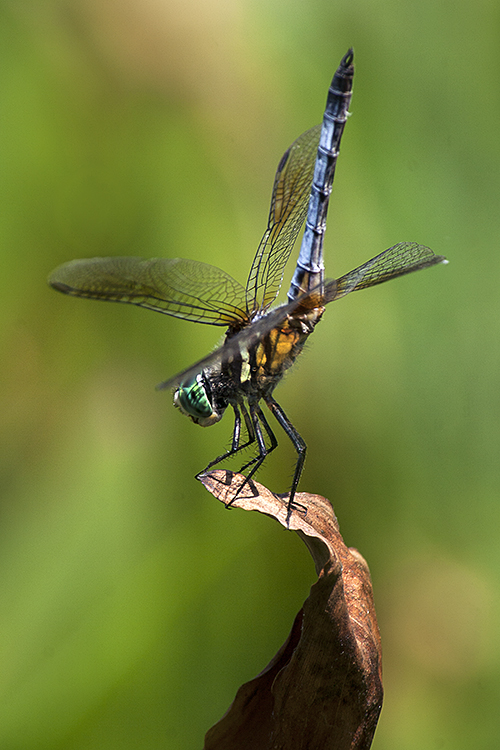
Blue Dasher Undulate

I remember well that first day, when my photography mentor and good friend, Cindy Dyer, sat me down at her computer and helped me set up my account. She was pushing me to get more serious with my photography and she somehow sensed that a blog would be a good creative outlet. Given the fact that this is my 723rd posting on this blog, it turns out that she was amazingly prescient. I could not have done it without here constant support, encouragement, and inspiration. Thanks, Cindy.

I have learned a lot about photography this past year, but more significantly I have learned a lot about myself through all of these postings. I have also had the wonderful experience of being part of an incredibly supportive community of fellow bloggers, who have been extravagantly free in providing encouragement and assistance. I look forward to my daily interaction with so many of my readers.

Statistically speaking, I’ve had over 23,00o views of my previous 722 posts from readers in 85 countries. I am honored that 479 of them have chosen to follow my blog.

My audience is a diverse one—some of you take photos of the same subjects as I do, but many of you express yourselves in words and photos of different themes. I looked over some of the statistical formation that WordPress provides to see if I could determine what type of postings were the most popular, based on the number of views, and realized that there is no magic formula. Some photos with single posts worked well, but sometimes ones with multiple photos and a lot of text were equally popular. Creepy bugs and beautiful flowers—there seems to be an audience for all kinds of images.

I continue to follow the approach that I started with a year ag0, to post photos that I personally find interesting or beautiful and share some of my thoughts about the subject or the situation in which I took the photo.

Some of you may be curious about the posting that had the most hits this past year. I though about reprising the photos themselves, but I decided that it was better to include links instead, so that you could read the text that surrounded the images, in order to understand better the context.

Here are the ten most popular postings this past year on my blog, starting from the one with the most views:

The dominant theme that connects these diverse subjects my insatiable curiosity to know more about the world around me and to capture some of nature’s beauty in my photography. Somehow in the process of this ongoing journey of discovery, I have come to finally consider myself to be a photographer, and not just someone who takes pictures.

© Michael Q. Powell. All rights reserved

Read Full Post »

Earlier this week I posted some images of the Eastern Amberwing dragonfly (Perithemis tenera) in flight, but you can see the details of this tiny dragonfly better in this shot of one perched on a branch. It’s always a treat for me to get shots of these beautiful little dragonflies, because they are so small (less than one inch (25mm) and very active.

amberwing_branch© Michael Q. Powell. All rights reserved

Read Full Post »
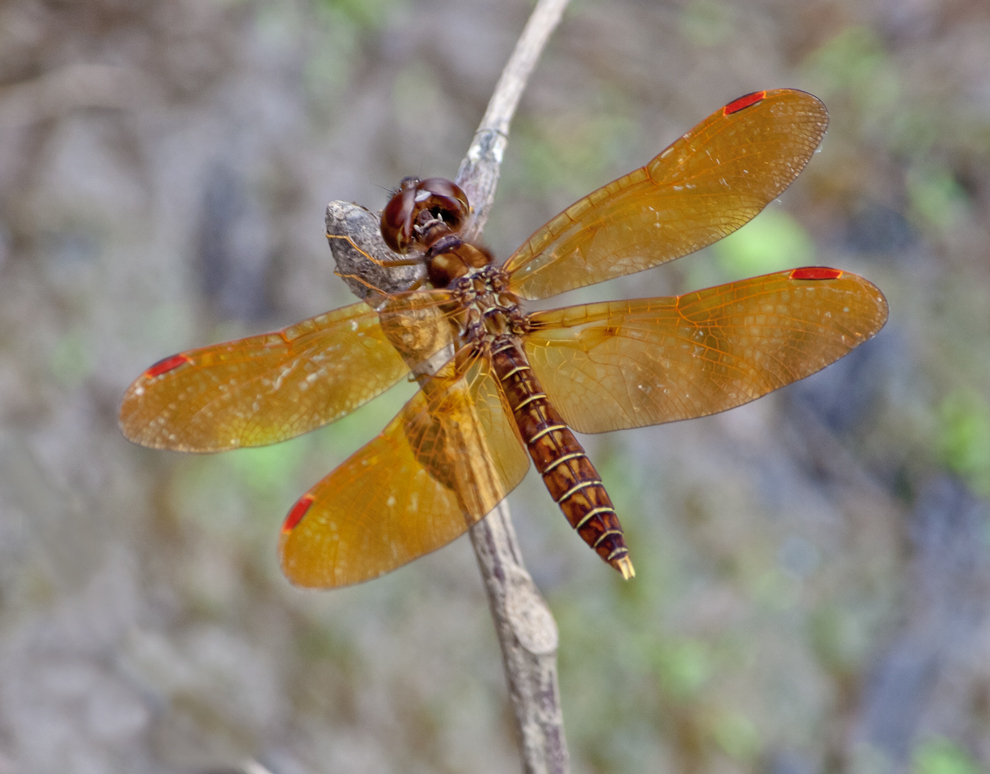
It’s tough enough to try to photograph any dragonfly in flight, but this past weekend I chased after some of the smallest ones, the Eastern Amberwing dragonflies (Perithemis tenera).

According to Bugguide, these dragonflies are typically 21-24mm in length, which is less than one inch. There were lots of Eastern Amberwings buzzing around the edges of a small pond at one of the local gardens that I like to visit. They were within range of the 100mm macro lens that I was using, but focusing was my big problem. Even though they tended to hover a bit, it was tough to get them in focus when focusing manually and impossible to do so with auto-focus.

The amber wings of this dragonfly are distinctive and I was happy to get some images that showcase the wings. The shots are not quite as sharp as they might have been if I had captured the dragonflies perched, but they seemed to be in constant motion and never posed for me. Focusing manually is still an adventure for me when the subject is moving, but it is a fun challenge.

amber1_blog

amber2_blog

© Michael Q. Powell. All rights reserved

Read Full Post »

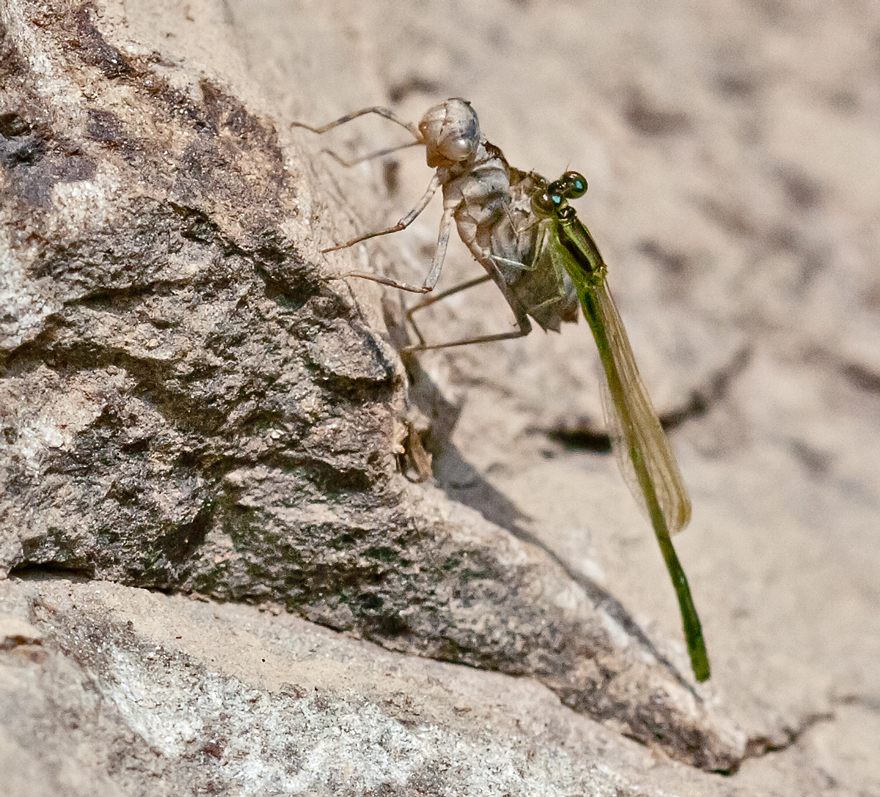
This photo leaves me a little confused, because the larval shell to which this damselfly is clinging seems too big for its body and looks more like it belonged to a dragonfly.

There are plenty of places on the internet where you can read about the life cycle of dragonflies and damselflies, but the short version is that they spend most of their lives in the water as nymphs. There they go through a series of larval stages in which they shed their skin that has grown too tight. Just before they molt for the final time, they climb out of the water and, once the skin dries, the damselflies emerge. They then have to rest for a little while as their wings unfurl and their legs get stronger. Only then can they fly away.

This pretty little damselfly seems to be in the resting phase on a little rock ledge at the edge of a pond at a local garden. I wanted to try to get a bit closer, but the embankment where the ledge was located was steep and muddy and I would have had to be standing in the water to get a better angle.

I like the photo a lot and find it to be weirdly fascinating. The landscape is simple and rugged, with some texture in the foreground. The moulted shell still seems lifelike and seems to be looking at us with a slightly tilted head. The damselfly itself has the only color in the image and attracts the viewers’ eyes. There is a kind of tension in the damselfly’s pose, as it hangs on with all of its strength, waiting until the moment when it can fly away.

Imagine what it would be like waiting, waiting for the moment when you take to the air for the first time, leaving behind forever your old life in the water.

emerging_blog

© Michael Q. Powell. All rights reserved

Read Full Post »

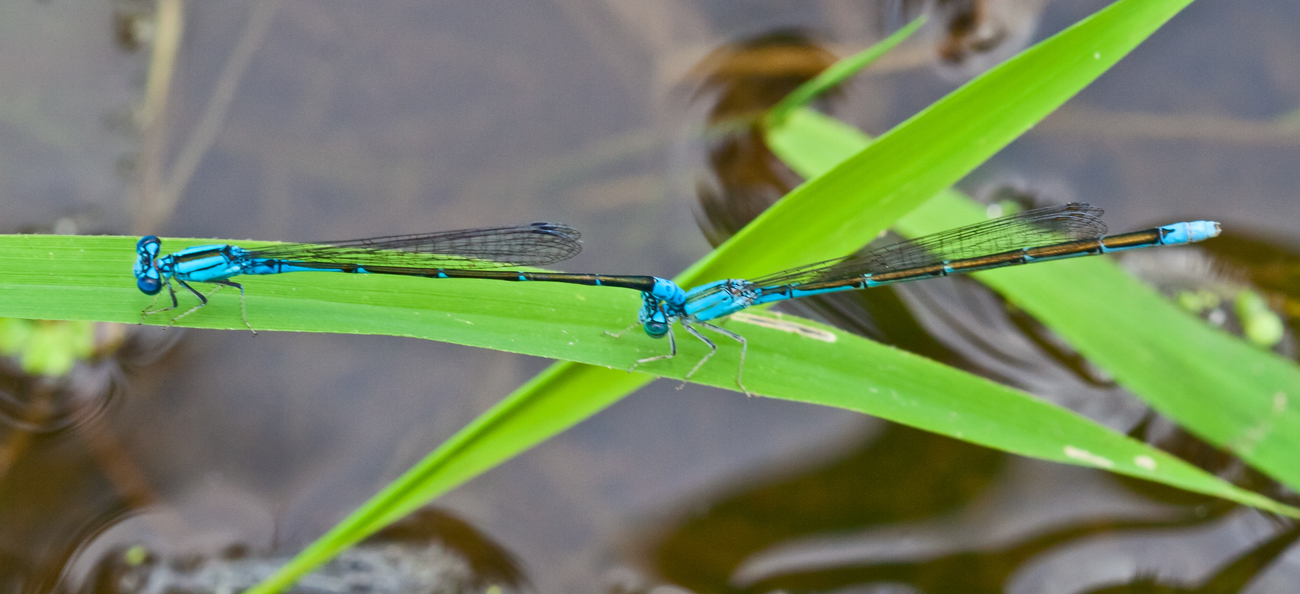
Damselflies have such narrow bodies that it’s often hard for me to get my camera to focus on them, but I love to chase after them, hoping to capture some of their beautiful colors. I was happy that I managed to get this shot of mating damselflies with enough detail to see some of the differences in coloration between the male and the female. I don’t dare try to explain the physiology of the mating process—I don’t really understand it and will leave that to the experts.

mating_blog

Click on the photo to see a higher resolution view of it.

© Michael Q. Powell. All rights reserved

Read Full Post »
The water lilies at one of my local gardens seem to be blooming a little late this year, but two of them finally were in bloom yesterday. Here’s a shot one of them and if you look closely you’ll notice a damselfly perched on the water lily. The image is not in his style, but water lilies always remind me of Monet, one of my favorite painters.

water_lily_blog

© Michael Q. Powell. All rights reserved

Read Full Post »

I just can’t get enough of the Blue Dasher dragonfly. Here’s a shot I like of a male Blue Dasher (Pachydiplax longipennis) on an unidentified green plant that I took at Hidden Pond Nature Center here in Springfield, VA. Often I will try to go for maximum possible sharpness and realism, but I like the composition of this image and it has a kind of an “artsy” look that appeals to me.

plant_dragonfly_edited-1_blog

© Michael Q. Powell. All rights reserved

Read Full Post »
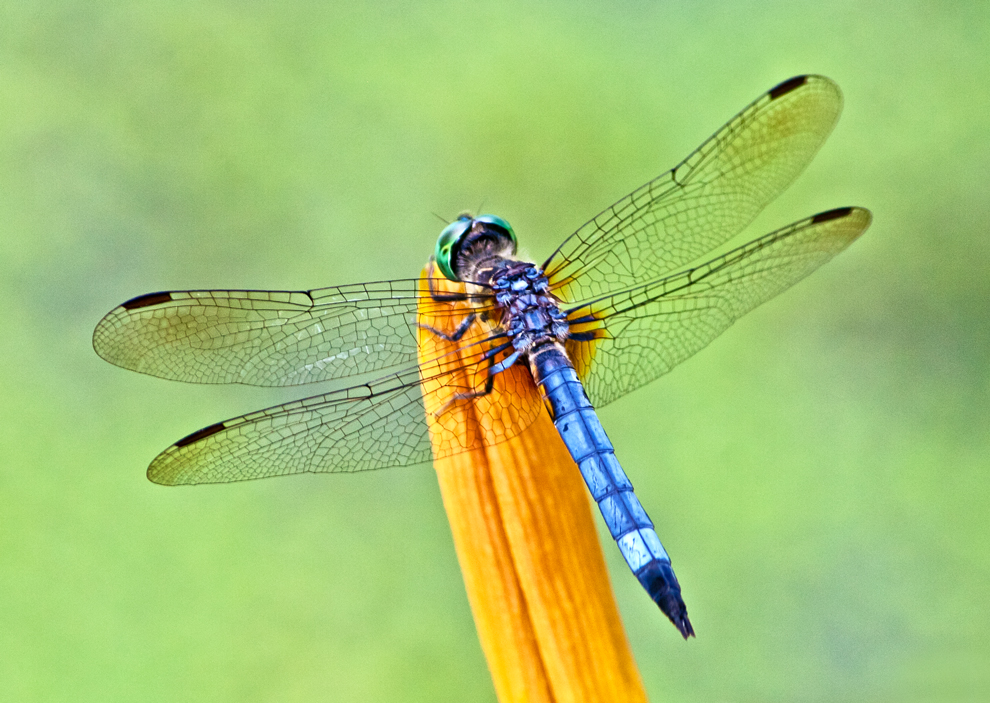
My normal instinct is to move in really close to my subject, whether it is physical movement with my macro lens or virtual movement with my telephoto zoom, but when I saw this dragonfly, I consciously pulled back in order to bring more of the stalk of the lily into the image.

This is a new species of dragonfly for me and I think it is probably a Slaty Skimmer (Libellula incesta). I love the contrast between the dark blue color of the dragonfly’s body and the orange shade of the lily.  This dragonfly’s muted colors give it a somewhat more sophisticated look that the more garishly colored Blue Dasher (Pachydiplax longipennis) that I also photographed that day. (Check out my previous posting to see the contrast between the images of the two dragonflies in similar positions.)

In addition to the colors, I like the composition of the image and the water in the background blurred out pretty nicely too. In the next few weeks, I’ll be off trying to catch some shots of dragonflies on lotus flowers and waterlilies—it’s that time of the year again.

slaty_orange1a_blog

© Michael Q. Powell. All rights reserved

Read Full Post »

I couldn’t believe my luck when this male Blue Dasher dragonfly (Pachydiplax longipennis) perched on one of the orange lilies at the edge of the pond.

The lily had not yet bloomed, making it a perfect place for the dragonfly to land, and I had positioned myself to take this shot, but I was a little doubtful that a dragonfly would cooperate.

The green of the background complements the blues of the dragonfly, but it is the orange that makes this image pop for me.

I am happy with the image.

lily1_blog© Michael Q. Powell. All rights reserved

Read Full Post »

Do you ever have days when you crave solitude, but others just won’t stop bothering you? That may be how this male Blue Dasher dragonfly (Pachydiplax longipennis) felt today, when other dragonflies harassed him from the back and from the front.

behind_blogsuspended_blog© Michael Q. Powell. All rights reserved

Read Full Post »

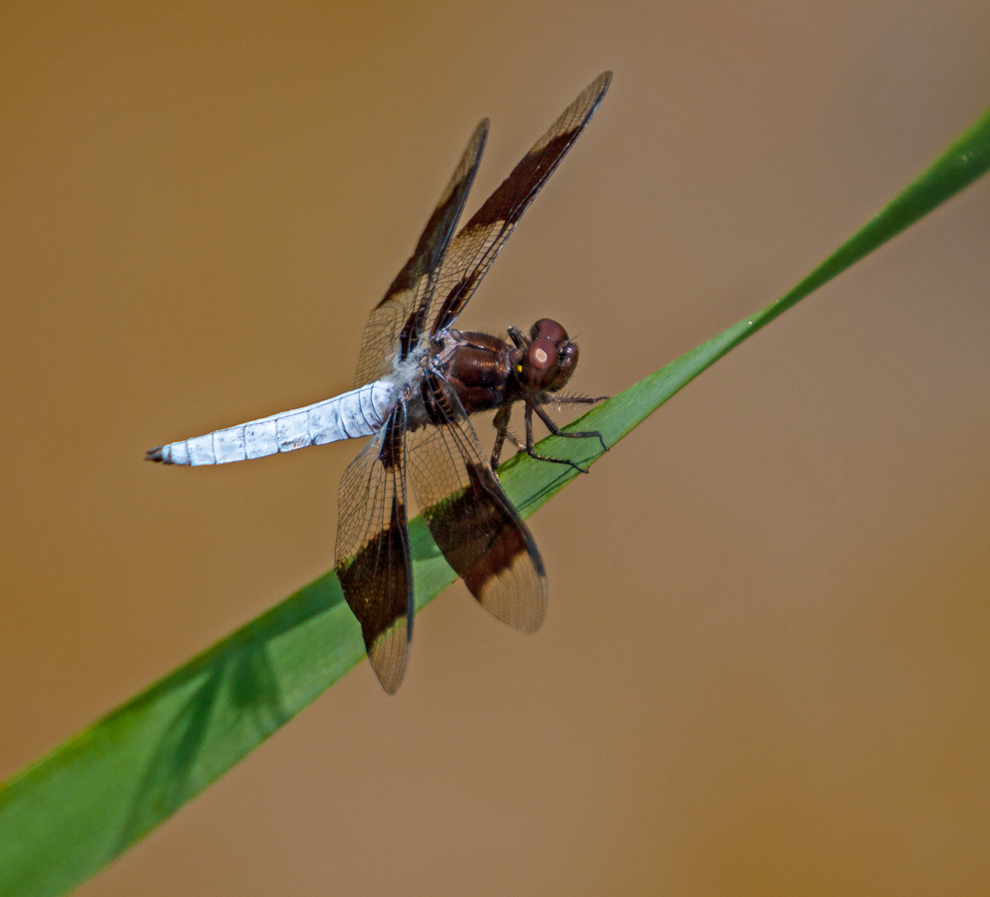
It was exciting for me to spot a new dragonfly this weekend, a male Widow Skimmer dragonfly (Libellula luctuosa).

I really like the brown and white pattern on the wings, which was distinctive enough that it also helped me in identifying it. According to Bugguide, the species name means sorrowful or mournful, perhaps because the wings of both male and female seem to be draped in mourning crepe.

The weather has turned hot and humid, which is typical for the Washington D.C. area, which seems to be great for the dragonflies, so I’ll be out as often as I can tolerate the heat, searching for new dragonflies to photograph.

brown_white1_blogbrown_white2_blog

© Michael Q. Powell. All rights reserved

Read Full Post »
Male Blue Dasher dragonflies (Pachydiplax longipennis) assume this handstand-like position, called the obelisk posture, when they feel threatened or want to minimize exposure to the sun. I was leaning a little closer than normal to this dragonfly, because I had a 100mm lens attached to the camera and not a longer zoom lens, so maybe that caused him to be a little alarmed. As the weather warms up and more dragonflies appear, I am sure that I will be getting a lot more shots of Blue Dashers, which were my favorite dragonflies to photograph last summer.

dasher1a_blog

© Michael Q. Powell. All rights reserved

Read Full Post »
Dragonflies are super-predators, according to a posting today by one of my favorite bloggers, Sue of Back Yard Biology, thanks to their agile flying ability and incredible eyesight, but predators can also become prey. You should check out that posting for a wonderful explanation of dragonflies’ visual acuity and some beautiful dragonfly images.

The Tree Swallow (Tachycineta bicolor) in this photo has captured a male Blue Dasher dragonfly (Pachydiplax longipennis) that appears to be struggling to extricate itself from the grip of the bird. In the second shot, the swallow is offering its prize to its mate, which pokes its head of the nesting box and takes a bite of one of the wings. (If you look carefully at the first shot, you’ll see that it was taken after the second shot and part of one of the dragonfly’s wing seems to have been bitten off.)

Predator or prey? There always seem to be some creature above you on the food chain. It’s no wonder that so many of the birds, animals, and insects are so hyper-vigilant and skittish when we try to take photographs of them—their survival may depend on it.

breakfast1_blogbreakfast2_blog

Michael Q. Powell. All rights reserved

Read Full Post »
I chased around this beautiful female Eastern Pondhawk dragonfly (Erythemis simplicicollis), hoping in vain that she would land on something more natural-looking than the composite boards of the marsh boardwalk. Several times she took off and circled around a bit, but returned each time to the boardwalk.

Shooting from a high angle, I was able to capture some of the details of the dragonfly that I do not usually see, like the little hooks at the end of the hairy legs. I really like her pose as she seemed to lean toward me, without seeming threatening in any way.

As always, I was struck by the strikingly beautiful emerald color of the females of this species. It’s even more impressive in real life.

green_blog

Michael Q. Powell. All rights reserved

Read Full Post »

« Newer Posts - Older Posts »