Feeds:
Posts
Comments

Archive for the ‘Dragonflies’ Category

Nature photographers are a peculiar breed of people. How else could I explain why I headed off to the Donau-Auen National Park within hours of my arrival in Vienna, Austria. I am staying in the center of the city, virtually surrounded by historic buildings and monuments, yet I feel more drawn to explore nature than history.

Saturday was a warm, sunny day and I was hoping to encounter dragonflies as I explored some of the areas of the park that I have visited before. It may be a little early in the season or that I was simply not lucky, but in any case I did not encounter a single dragonfly. I was, however, quite fortunate and saw quite a few damselflies. These beautiful little creatures are tiny and elusive and like to hide perch on vegetation, so it is often challenging to get clear shots of them.

I was shooting with my Canon SX50, a superzoom point-and-shoot, which helped me sometimes to get shots without scaring off the damselflies. In some cases, though, it was really tough to get the camera’s focus to lock onto the target.

The shapes and colors of the damselflies are somewhat familiar and may be related to the species that I see at home, but I am not even going to try to identify them. I hope that you can enjoy the delicate beauty of these damselflies that I encountered during my most recent adventures in the national park here in Vienna.

damselfly in Vienna


damselfly in Vienna


damselfly in Vienna

damselfly in Vienna

© Michael Q. Powell. All rights reserved

Read Full Post »

You have to be awfully lucky to capture in-flight images of damselflies, but it helps a little when they are in tandem. I spotted these Southern Spreadwing damselflies (Lestes australis) last week at Huntley Meadows Park. The pair in the foreground were still hooked up after mating and appeared to be heading for the branch that you can see in order to lay eggs there.

It’s cool how you can see another damselfly in the background flying in from another direction. I noticed that some single damselflies, probably rival males, seemed to be trying to interfere with the couples when they were involved in ovipositing, which is why the male stays with the female until he is sure the job is done.

Southern Spreadwing

© Michael Q. Powell. All rights reserved

Read Full Post »

These Southern Spreadwing damselflies (Lestes australis) were engaging in a little May Day mayhem this past Monday at Huntley Meadows Park. If I have this figured out right, the female, the one on the right in this image, is depositing her eggs in the vegetation after successfully mating with the male, who is still holding on to her.

Southern Spreadwing

 © Michael Q. Powell. All rights reserved

Read Full Post »

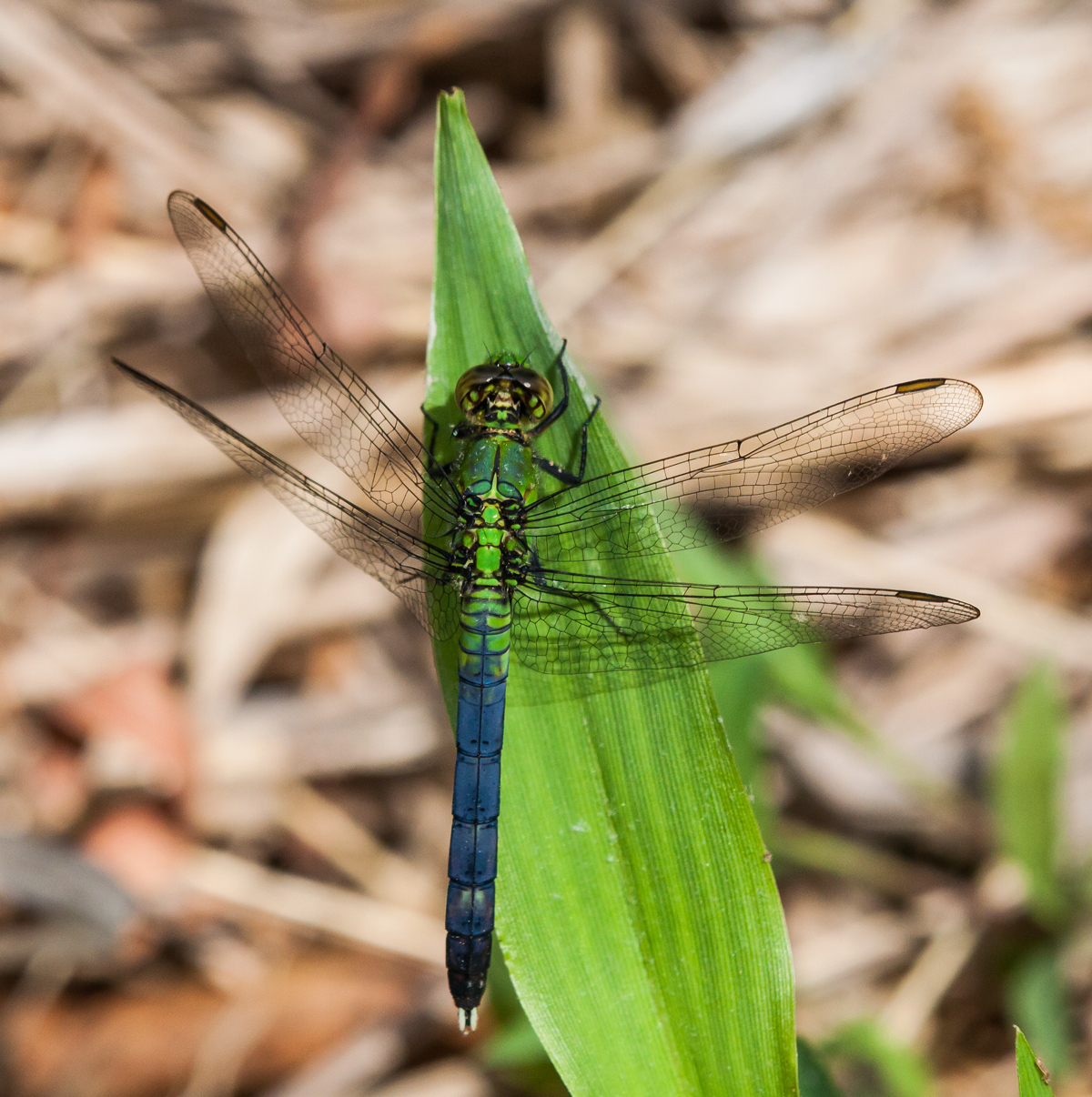
Male Eastern Pondhawk dragonflies (Erythemis simplicicollis) start out with the same bright green coloration and bold black and white stripes as the female that I featured in a posting earlier this week. Over time the males turn a fairly nondescript blue and are outshone by their female counterparts.

On Monday, I was fortunate to capture this image of a male Eastern Pondhawk in a transitional  stage, with beautiful two-toned shades of green and blue. I was thrilled when it perched on a green plant, which helps to draw the viewer’s eye to the dragonfly in a background of dried-up fallen leaves.

Eastern Pondhawk

© Michael Q. Powell. All rights reserved

Read Full Post »

I celebrated May Day yesterday by searching for dragonflies at Huntley Meadows Park and was rewarded by spotting my first Eastern Pondhawk dragonflies (Erythemis simplicicollis) of the season. This bright green female pondhawk was almost hidden in the fresh vegetation, but she really showed her colors when she perched on the brittle fallen leaves on the forest floor. The muted tones of gray and brown created a wonderful (albeit cluttered) backdrop that really let her beautiful colors and patterns stand out.

Eastern Pondhawk

© Michael Q. Powell. All rights reserved

Read Full Post »

The weather yesterday was hot and sunny—perfect for dragonflies, although a little uncomfortable for me. I decided to search in the vicinity of a vernal pool, one of my favorite spots for dragonflies at Huntley Meadows Park. As I was walking along a small water-filled ditch, a large dragonfly flew up from the water and perched in a tree just a short distance away. I suspected it might be a Swamp Darner (Epiaeschna heros) and it turns out that I was right.

About this time each year, a number of female Swamp Darners descend on this small ditch to lay their eggs. Unlike many other dragonflies, which lay their eggs in the water, Swamp Darners lay their eggs in moist, often rotten logs. Essentially they tunnel into the wood before they lay the eggs.

I spotted the most likely target log and sat on the bank of the ditch to see if the dragonflies would come. It didn’t take long for them to arrive. Sometimes it was just one dragonfly, while at other times there were two or even three of them laying eggs in the same log. I was shooting with a 180mm macro lens, so I could not zoom out to include all of them (and I did not want to move for fear of scaring them away). In one of the photos, you can see two of the Swamp Darners in action and part of the abdomen of a third one in the upper left corner.

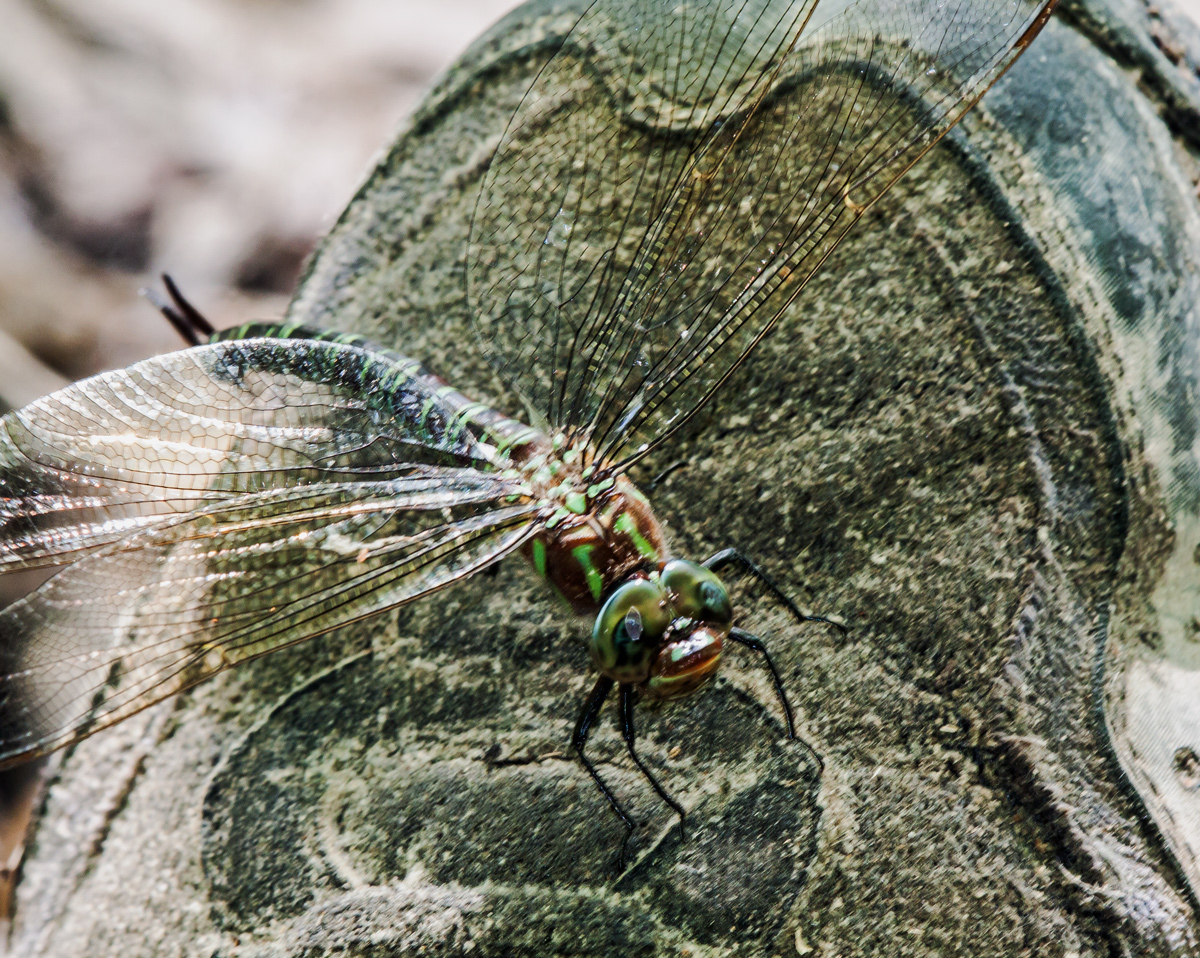
I don’t know if it is some biological imperative for species preservation that compels them to deposit these eggs, but the females were putting them everywhere. I was a little shocked when one of them landed on my mud-covered shoes and began to deposit eggs there.

The dragonflies were so focused on depositing their eggs that I was able to lean forward and get a close-up view of the face of one of them. I love dragonfly faces and especially their amazing giant eyes.

Swamp Darner

Swamp Darner

Swamp Darner

Swamp Darner

Swamp Darner

© Michael Q. Powell. All rights reserved

Read Full Post »

During the summer it seems like dragonflies are everywhere, perching prominently in plain sight, but this early in the season there are a whole lot fewer of them and the ones that are around are hard to find. Fellow dragonfly enthusiast and blogger Walter Sanford recently did a posting about some Ashy Clubtail dragonflies (Phanogomphus lividus) that he had spotted at Jackson Miles Abbott Wetlands Refuge.

I had never seen this species before, so I set off this past Friday to see if I could find one of my own. Walter had alerted me to look for the Ashy Clubtails perched in the grass and in the low vegetation that surrounds the small pond at the wildlife refuge. I circled the pond several times in vain before I suddenly caught sight of some dragonfly wings shining in the sunlight. I was able to track the dragonfly during its short flight and saw where it landed in the grass.

Almost certain that I had found an Ashy, I approached the dragonfly slowly and cautiously, fearful of scaring it away before I could get a shot. I was face-to-face with dragonfly, which is not the greatest position for capturing its details, and was able to confirm that it was an Ashy Clubtail. Its pale coloration and very clear wings indicate that it is newly emerged, what is often called a “teneral,” and it looks to be a female. Having gotten a few shots, I tried to get a better angle and spooked the dragonfly.

Ashy Clubtail

Buoyed by my success, I was motivated to search even harder and eventually spotted two more teneral female Ashy Clubtails. One was in some chest-high thorny bushes and I had to push up against them to get as parallel as possible with its body for a detailed shot. I was able to photograph the third Ashy from almost directly overhead and the final photo gives you the best overall view of this beautiful dragonfly.

These Ashy Clubtails ares not as brightly colored as some of the dragonflies that will appear later in the summer, but they were definitely a welcome sight for me.

Ashy Clubtail

Ashy Clubtail

© Michael Q. Powell. All rights reserved

Read Full Post »

Now that the dragonfly season has started in my area, I am devoting more and more of my available photography time to searching for these beautiful little creatures. Some dragonflies can be found almost anywhere, but many of them require a very specific kind of habitat and may be present for only limited periods of time.

Yesterday afternoon I visited Jackson Miles Abbott Wetland Refuge, which features a small pond surrounded by a pathway. Last year I found several different dragonfly species there, so I knew that I might have a chance of seeing some dragonflies. I looked in the brush and in the vegetation and came up empty-handed until I looked at the water and spotted several dragonflies flying low above the water.

I recognized the dragonflies as Common Baskettail dragonflies (Epitheca cynosura) and knew that I faced a challenge—this species seems to fly continuously and rarely have I seen one perch. I realized that if I wanted to get some shots of the dragonflies I would have to capture the images while they were flying.

I had my Tamron 180mm macro lens on my camera and started to track the flying dragonflies. I have tried a number of focusing techniques in the past and have had the most success when I focus the lens manually (although I hesitate to use the word “success,” given the high rate of failure in getting an in-focus shot). This was my favorite shot of a Common Baskettail flying above the water. There is a bit of motion blur in the wings and I had to crop the image quite a bit, but I managed to keep most of the dragonfly in focus.

Common Baskettail

I walked multiple circuits around the pond, still searching for more dragonflies. I tend to like to keep moving, rather than sticking in one spot. As I reached one end of the pond, I suddenly realized that a dragonfly was hovering in mid-air right in front of me. The dragonfly was moving slowly above a grassy patch adjacent to the pond, but did not seem interested in heading for the water.

I could hardly believe my good fortune and tried to compose myself and focus on the dragonfly. I managed to get some detailed shots that show, for example, how the Common Baskettail folds up its legs when flying. I took the first shot below while on my knees, so that I was almost level with the dragonfly. For the second shot, I was shooting down on the dragonfly and it looks almost like it was taken by a drone, hovering above the hovering dragonfly.

Common Baskettail

Common Baskettail

© Michael Q. Powell. All rights reserved

Read Full Post »

On the same day that I saw the Common Whitetail dragonfly that I featured yesterday in my blog posting, I was thrilled to have the chance to photograph an uncommon dragonfly, a male Stream Cruiser (Didymops transversa). I had never before seen a Stream Cruiser, but local dragonfly expert and fellow photographer Walter Sanford had observed them in the past at Accotink Bay Wildlife Refuge and offered to guide me.

It’s somewhat of an understatement to say that Stream Cruisers are hard to spot. The are not very big (about 2.2 inches (56-60mm) in length), they are skittish, and they often perch on the stems of low vegetation. During the hours that we searched for them, I observed a couple of probable Stream Cruisers in the air, but lost them in the blur of the vegetation and never saw a single one land. Walter saw the first one of the day, a female, and posted an awesome photograph of the beautiful dragonfly in a blog posting yesterday. Unfortunately for me, I was unable to make it to the dragonfly’s location before she flew away. Walter spotted a few more Stream Cruisers during the day, but each time I couldn’t get there quickly enough to see one.

I was beginning to think that I was going to end up empty-handed for the day when Walter called out that he had spotted a male perched in the underbrush. This Stream Cruiser was cooperative enough to stay perched as I rushed to try to get a shot. I had my Tamron 180mm macro lens on my camera at that moment. The dragonfly and the stem on which it was perched were so small in the viewfinder that my camera’s autofocus would not lock on my subject, so I had to resort to focusing manually. Dragonflies have so many fine details that it is really hard to tell when they are in focus. This image was the best I could get after cropping the initial shot quite a bit.

Stream Cruiser

I decided to push my luck and see if I could get a better shot with my Tamron 150-600mm lens that I use primarily to photograph birds. Amazingly the dragonfly stayed put while I changed lenses. Once again I had to focus manually, which is an even bigger problem with this lens, because the focus ring is located really close to the lens mount. It’s hard to hold the camera steady and focus manually at the same time.

Here’s an image that I shot at 600mm. I managed to get the eye pretty sharp and to capture some of the details of the dragonfly’s incredibly long legs, but the depth of field was so shallow that the abdomen is out of focus. Normally I will try to move around the subject to be as parallel as I can be, but in this case I stayed fixed at one spot and remained as immobile as I could.
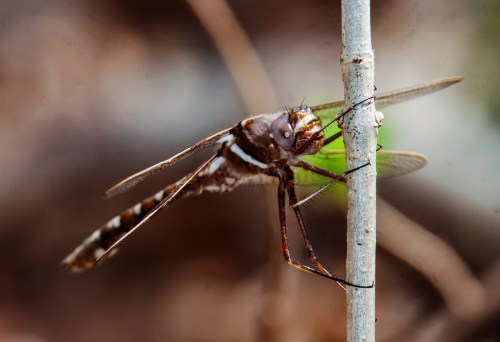
Stream Cruiser

It is really nice to start off this dragonfly season with a new species. If you want to learn more about the Stream Cruiser dragonfly, check out this page from the Dragonflies of Northern Virginia website (and stay tuned for Walter’s shots of this dragonfly that should appear tomorrow morning in his blog).

© Michael Q. Powell. All rights reserved.


Read Full Post »
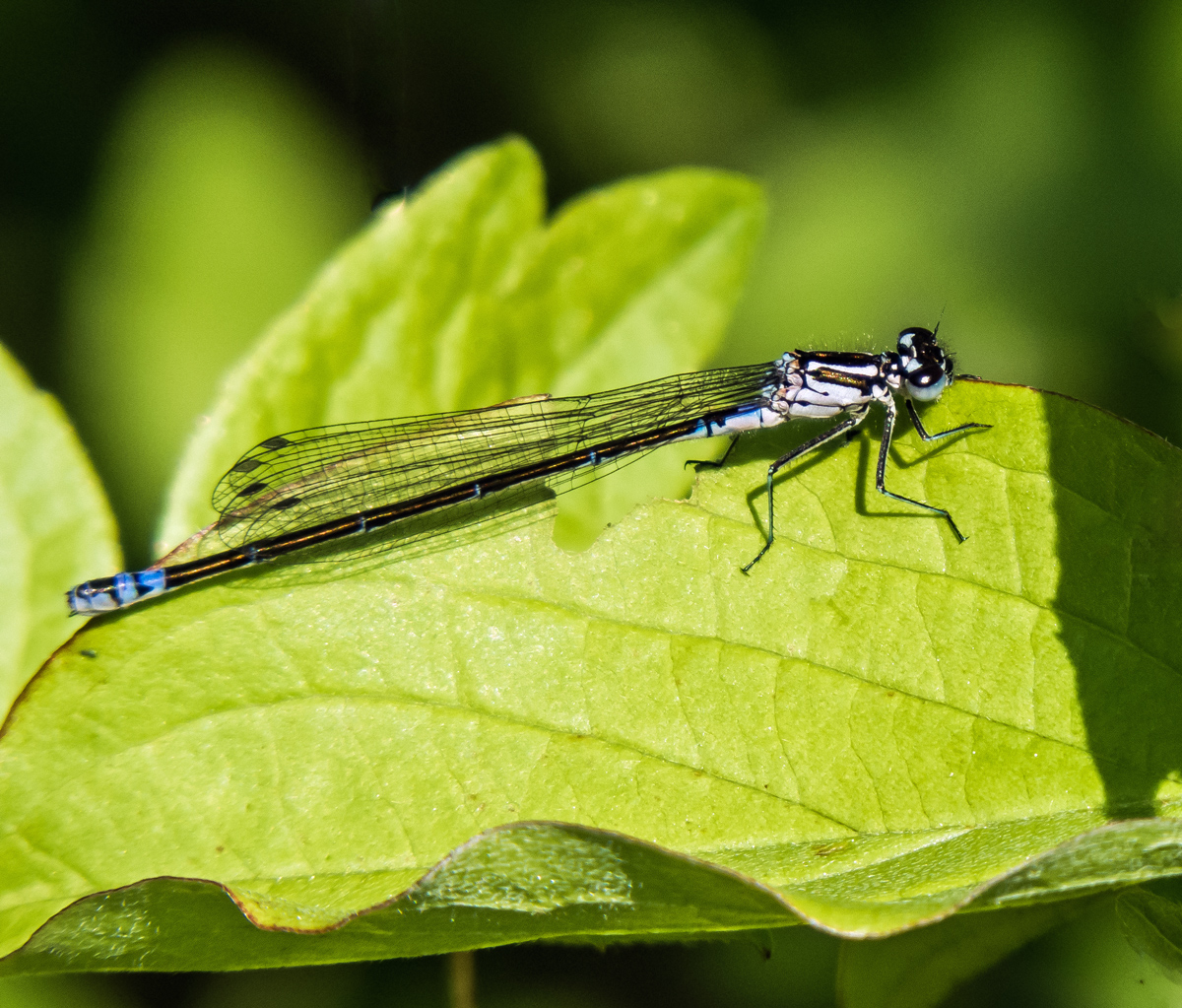
Thanks to recent warmer weather, dragonflies are finally starting to emerge in Northern Virginia. I captured this image of a female Common Whitetail dragonfly (Plathemis lydia) on Monday at Accotink Bay Wildlife Refuge. Unlike many species with the word “common” in their names, Common Whitetail dragonflies are actually pretty common. They are among the first species to emerge in the spring and among the last to depart in the fall. Unlike many of the early spring species, they are habitat generalists—you can find them pretty much anywhere  and do not have the scour the underbrush or walk through streams in remote locations.

Although I spotted a Common Green Darner dragonfly earlier this month, I was not able to get a photo of it and suspect that it had migrated from another location. This is my first photo of the season of a “native” dragonfly, with plenty more sure to follow in the coming months.

Common Whitetail dragonfly

© Michael Q. Powell. All rights reserved.

Read Full Post »

As I drove back yesterday from Georgia to Northern Virginia, an almost 800 mile drive (1287 km),  I stopped at a rest area on I-95 in North Carolina. Noting that there was a small man-made pond, I decided to investigate for odes and spotted this damselfly. One of the experts in the Southeaster Odes Facebook Group helped to identify this beauty as a female Fragile Forktail damselfly (Ischnura posita).

It’s a whole lot cooler in Northern Virginia than it was in Georgia and North Carolina, so I suspect that I will have to wait a month or two for damselflies and dragonflies to emerge here. With this sneak preview, I can hardly wait.

fragile forktail

© Michael Q. Powell. All rights reserved.

Read Full Post »

It was a pleasant surprise to see this colorful Familiar Bluet damselfly (Enallagma civile) last Friday at Huntley Meadows Park. With the arrival of frigid weather, with temperatures at near-freezing levels at night, however, I fear that it will be my last damselfly sighting of the season.

When I first spotted this damselfly, I had my  Tamron 150-600mm zoom lens on my camera. I didn’t want to take my eyes off of the damselfly, for fear of losing sight of it in the underbrush, so I decided to make do with the long zoom lens. I quickly realized that I had a few obstacles to overcome. The minimum focusing distance of the lens is almost nine feet (2.7 meters), so I had to back up. At that distance the damselfly was so small that my autofocus did not want to lock onto it, so I was forced to focus manually, while handholding the lens at 600mm.

I ended up trying to do environmental portraits, rather then the close-ups that I generally prefer to take. I like the way that the seasonal coloration of the background helps the blue of the damselfly’s body really stand out, almost like it is an alien visitor in a foreign land.

Farewell, sweet damsels of the air, until we meet again in the spring.

Familiar Bluet

Familiar Bluet

© Michael Q. Powell. All rights reserved.

Read Full Post »

With all of this cooler weather that we have had recently, including several frosty mornings, you might think that dragonfly season has ended, but it’s not over yet. Autumn Meadowhawk dragonflies (Sympetrum vicinum) are still with us in pretty significant numbers at Huntley Meadows Park in Alexandria, Virginia. In previous years I have continued to see these dragonflies into mid-December and one of my fellow photographers has seen them in early January.

Autumn Meadowhawks are small dragonflies, a little over one inch (25 mm) in length, so you have to look hard to spot them. At any other time of the year, their red bodies would make them really stand out, but they seem to like to perch on fallen leaves, including red ones, so they are often pretty well camouflaged until they move.

Here are a few favorite shots of these red beauties from this past weekend. Enjoy the dragonflies while you may and put off thoughts of the impending winter.

Autumn Meadowhawk

Autumn Meadowhawk

Autumn Meadowhawk

© Michael Q. Powell. All rights reserved.

Read Full Post »

I am not about to make a sign proclaiming that “The End is Near,” but I couldn’t help feeling a slight sense of impending doom when I spotted an Autumn Meadowhawk dragonfly (Sympetrum vicinum) this past weekend. In our area, Autumn Meadowhawks are the ultimate survivors of the dragonfly season and they can usually be found well into December and occasionally into January.

This pretty red and brown dragonfly is a harbinger of doom—inexorably  winter is approaching and dragonflies will eventually cease to fly until the spring.  For now, though, I’ll continue to search for these spectacular aerial acrobats and enjoy their beauty and skill when I am lucky enough to find one.

Autumn Meadowhawk

© Michael Q. Powell. All rights reserved.

Read Full Post »
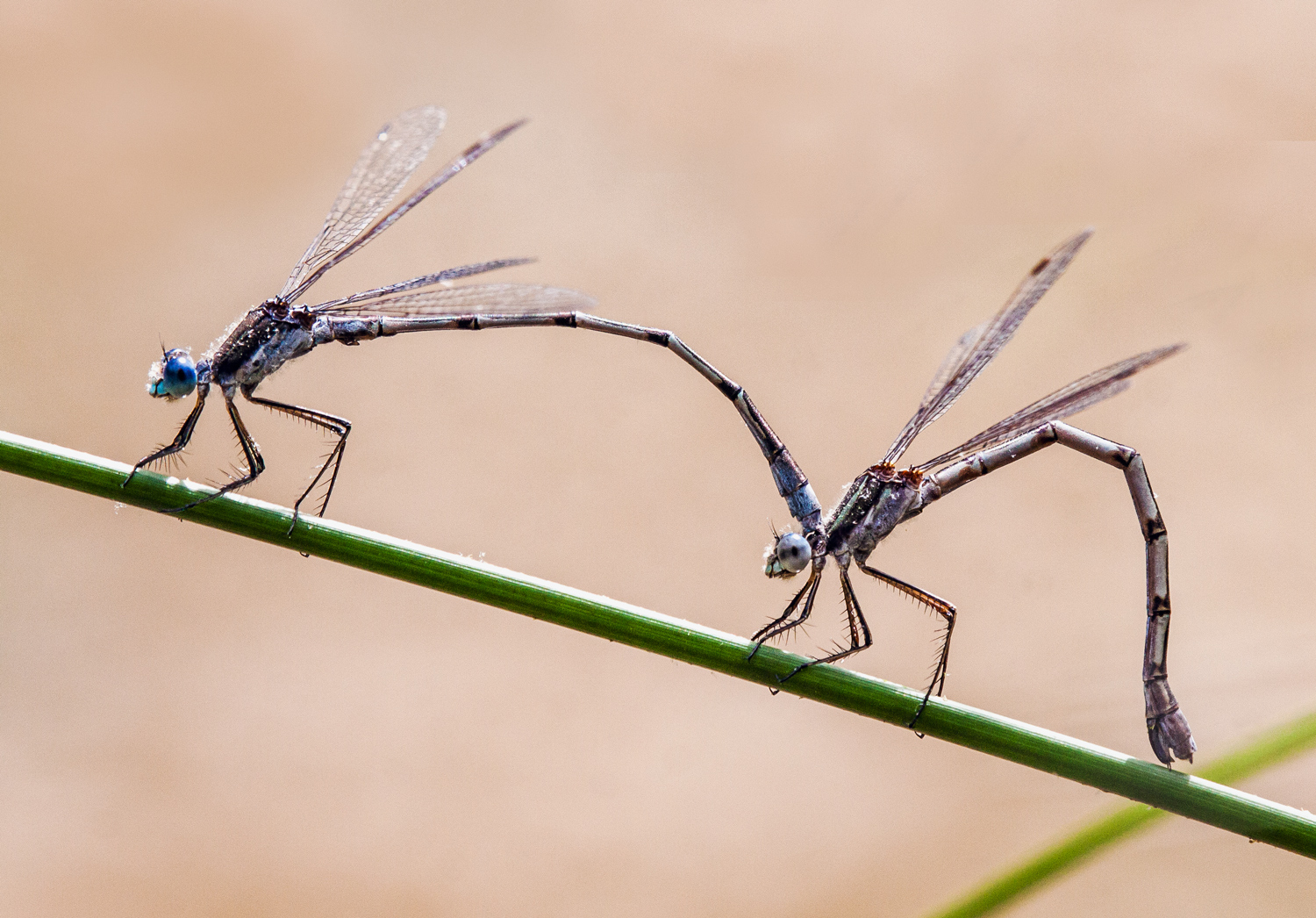
Many dragonflies are very skittish and will fly away as you get close. Blue-faced Meadowhawks (Sympetrum ambiguum), however, appear to be unusually inquisitive, like this one that perched on my knee Monday at Huntley Meadows Park as I was trying to photograph another dragonfly.

He seemed to want to check me out at close range and I returned the favor.

Blue-faced Meadowhawk

© Michael Q. Powell. All rights reserved.

Read Full Post »
On Friday I had a close encounter with one of my favorite dragonflies, a spectacular Blue-faced Meadowhawk (Sympetrum ambiguum). This species is a sign for me each year of the arrival of autumn and I eagerly await its appearance. I find the blue eyes to be mesmerizing and simply love the way that they contrast with the bold red color of its body.

I could go on and on about the beauty of this dragonfly until I too was blue in the face, but I will simply let you enjoy a glimpse of its beauty.

Blue-faced Meadowhawk

© Michael Q. Powell. All rights reserved


Read Full Post »

When fellow photographer and local dragonfly expert Walter Sanford posted a photo of a Russet-tailed Clubtail dragonfly (Stylurus plagiatus) that he had spotted on Thursday at Jackson Miles Abbott Wetlands Refuge, I was filled with an overwhelming urge to see if I could find the dragonfly. At this time of the year, as the dragonfly season winds down, I really don’t think much about finding new species, so this was an exciting challenge.

I knew the general location, but I forgot to ask Walter for more specific information about his find. Was it near the water or in the woods or along the stream or among the wildflowers? It was a kind of crazy quixotic quest, but I am pretty persistent, so I scoured the area, making loop after loop around a small pond.

My hope and my energy were beginning to fade when I suddenly caught sight of a dragonfly’s wings shining in the sunlight. The dragonfly was perched on some vegetation at the edge of the treeline. Moving as stealthily as I could, I approached the dragonfly and realized that I had found the Russet-tipped Clubtail. I often complain about the inappropriateness of the names of insects, but in this case it fit perfectly.

I managed to take a number of shots of the perching dragonfly before it flew off, heading deeper into the woods. After it had flown a short distance, it seemed to stop abruptly in mid-air. What was going on? I switched to manual focus and took a few shots and then began to worry that the dragonfly had gotten caught in a bit of spider web. (All morning long I kept running into spider webs at face level as I walked through the woods.) As I moved my hand closer to the dragonfly in an attempt to free it, the dragonfly flew off and disappeared. I didn’t see any evidence of a spider web, so it was probably only my overly active imagination.

This was one of my most memorable encounters with a dragonfly. I may stop by again this weekend to see if it is still hanging around, but the chances are not good that I will see it again. Still, lightning can strike twice and that kind of optimism helps to fuel my enthusiasm for photography.

Russet-tipped Clubtail

Russet-tipped Clubtail

© Michael Q. Powell. All rights reserved

Read Full Post »

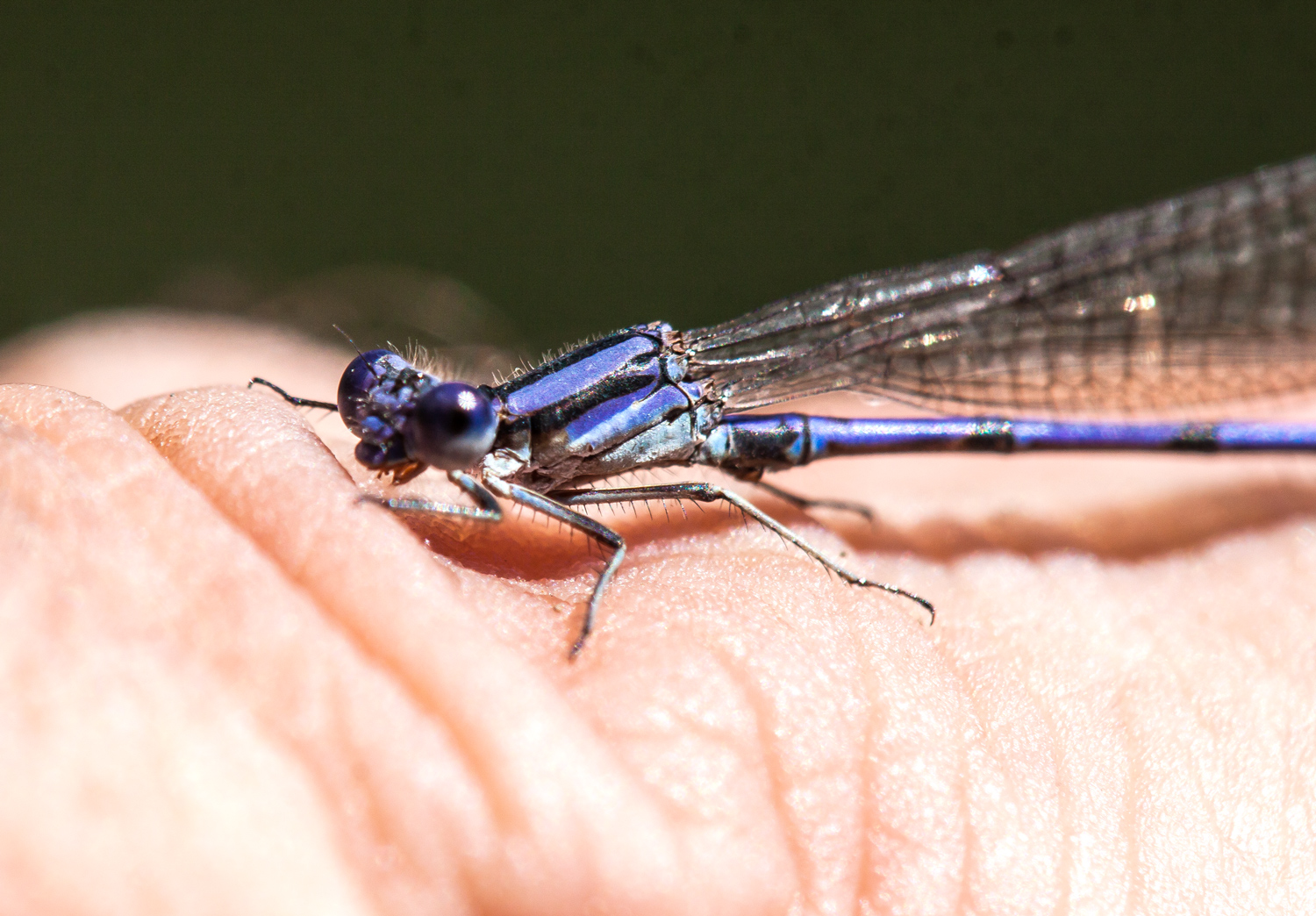
Not all people like to have insects perch on them, but I thought it was pretty cool when an inquisitive Variable Dancer damselfly (Argia fumipennis) landed on my hand Monday at Jackson Miles Abbott Wetlands Refuge. The real challenge was getting a photo of the damselfly shooting one-handed with my DSLR and 180mm macro lens.

Sharp-eyed readers may have recognized that this is the same species of damselfly as the one featured in my blog’s banner. I just love the beautiful purple markings of this damselfly, which is also known as a Violet Dancer (Argia fumipennis violacea), if you use the name of the sub-species.

It was interesting trying to get shots as I tried to hold my left hand still and slowly extended my arm out as far as it would go. The damselfly was relatively cooperative, but moved about a little as it explored my hand. Steadying my shooting hand was an even bigger challenge. Normally I like to try to get as close to parallel with a damselfly’s body as possible, so that most of it will be in focus, but that was not possible in this situation, given the anatomical limitations of the human body.

Looking at these images, I have reached a sad conclusion—I am going to have to give up on my dream of becoming a professional hand model.

Variable Dancer

Variable Dancer

Variable Dancer

© Michael Q. Powell. All rights reserved

Read Full Post »

Most of the Blue-faced Meadowhawk dragonflies (Sympetrum ambiguum) yesterday at Huntley Meadows Park were perched alone in the bright sunlight, but some of them managed to find mates and were “getting busy.” No matter how many times I have seen this behavior, I continue to be amazed by the unusual and acrobatic method that dragonflies use when mating.

I usually start to see the brightly-colored Blue-faced Meadowhawks in early September, at a time when the overall number of dragonflies is declining and they are one of the signs for me of the end of the summer. This species seems to be generally tolerant of my presence, although some individuals are quite skittish, and I have managed to get some close-up shots of them in the past.

Don’t be surprised to see more photos of the Blue-faced Meadowhawks in upcoming weeks—they are one of my favorite species of dragonflies.

Blue-faced Meadowhawk


© Michael Q. Powell. All rights reserved

Read Full Post »

Today was a beautiful sunny day in Brussels, Belgium and I had some free time to explore the city. I have been in Brussels for short business trips a number of times in recent years and have already visited many of the attractions in the center of the city.  Today I decided to look for some of the kinds of wildlife that I love to photograph, so I made my way to a park that leads to the Botanical Garden of Brussels.

I was encouraged a little when I saw some ducks and turtles in the small pond there and my level of excitement really soared when I spotted some dragonflies flying about. The only problem was that the dragonflies refused to land. When I have my normal DSLR and my favorite lenses, I’ll try to capture in-flight shots, but when I am traveling for work, I tend to leave all that gear at home and use a point-and-shoot camera. My current travel camera is a Canon SX50. It has an amazing zoom lens, but really is not responsive enough to photograph moving dragonflies.

A bit later, I made my way to the opposite side of the tiny pond and discovered the staging area for the dragonflies. Every now and then a dragonfly would perch very briefly on the vegetation. It took quite a few tries, but eventually I got a few shots. I don’t know anything about European dragonfly species, so I can’t really identify the ones that I photographed today. They look pretty similar to ones that I have seen at home and certainly they belong to the same families, but I’d sure welcome assistance in identifying the species.

Today was a day full of unexpected treats. I don’t expect to see bright days full of sunshine during trips to Europe and I didn’t really expect to find dragonflies in Brussel’s urban center.

UPDATE: I have done a bit more research on the internet and it looks to me like the dragonflies in the first two photos below may be Migrant Hawkers (Aeshna mixta).

dragonfly in Brussels

dragonfly in Brussels

butterfly in Brussels

© Michael Q. Powell. All rights reserved


Read Full Post »

On Monday I spotted this beautiful Swift Setwing dragonfly (Dythemis velox) at Jackson Miles Abbott Wetlands Refuge at Fort Belvoir, a nearby military base. When I observed one at the same location in June, it was the first time that one had been recorded in Fairfax County, the county in Northern Virginia where I live, so I was a little surprised to see that they are still around.

If you would like to see some photos of my initial sighting, check out my blog posting from June 25. The range of this dragonfly seems to be moving northward and it seems likely that I’ll be seeing this species again next year, since I suspect that mating and egg-laying have been taking place during the past two months.

Swift Setwing

Swift Setwing

Swift Setwing

© Michael Q. Powell. All rights reserved.

Read Full Post »

Many of the dragonflies that I see this late in the summer have wings that are torn and tattered, yet they seem to still fly perfectly well. The dragonflies clearly are survivors—survivors of encounters with predators and thorny vegetation or even of overly energetic mating sessions.

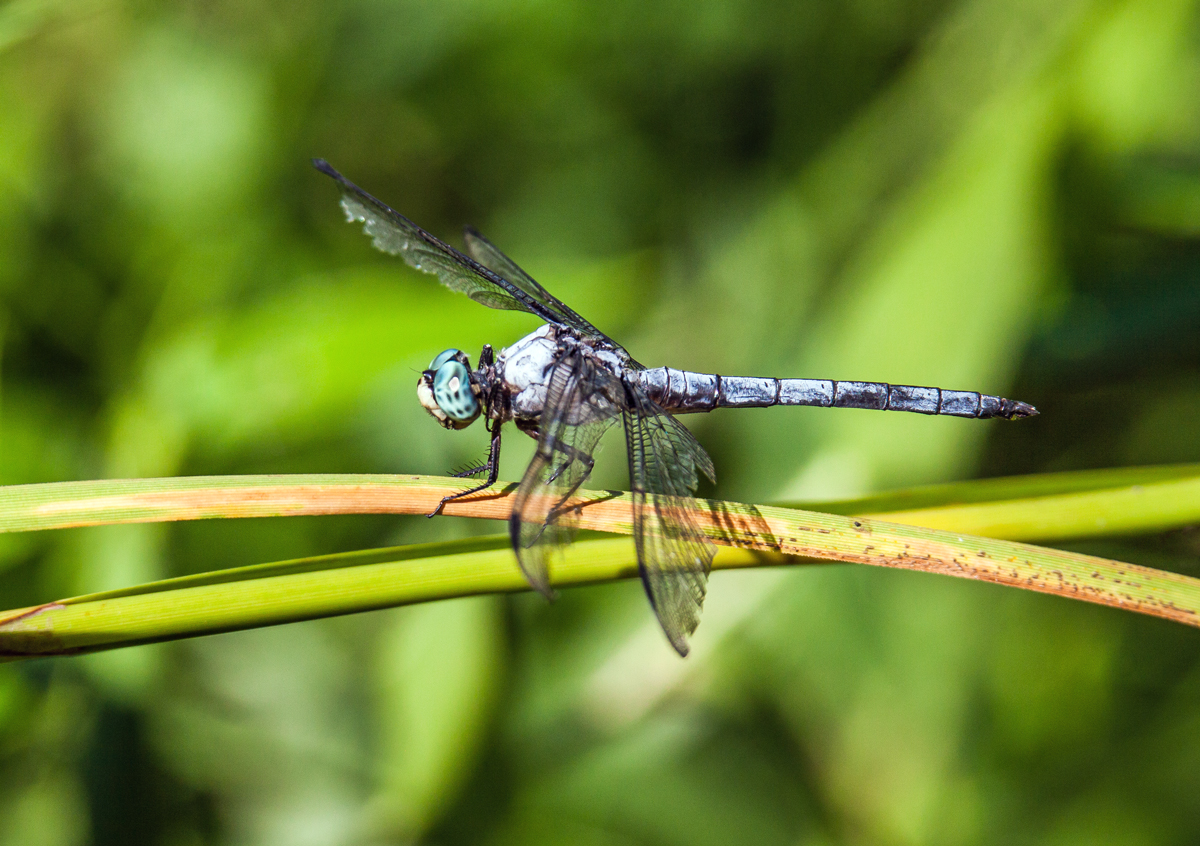
Last Friday I spotted this Great Blue Skimmer (Libellula vibrans) as it perched on some bent stalks of grass. He is not a perfect specimen, but I can’t help but be drawn in by his beautiful speckled blue eyes.

Yes, he still deserves to be called “great.”

Great Blue Skimmer

© Michael Q. Powell. All rights reserved.

Read Full Post »

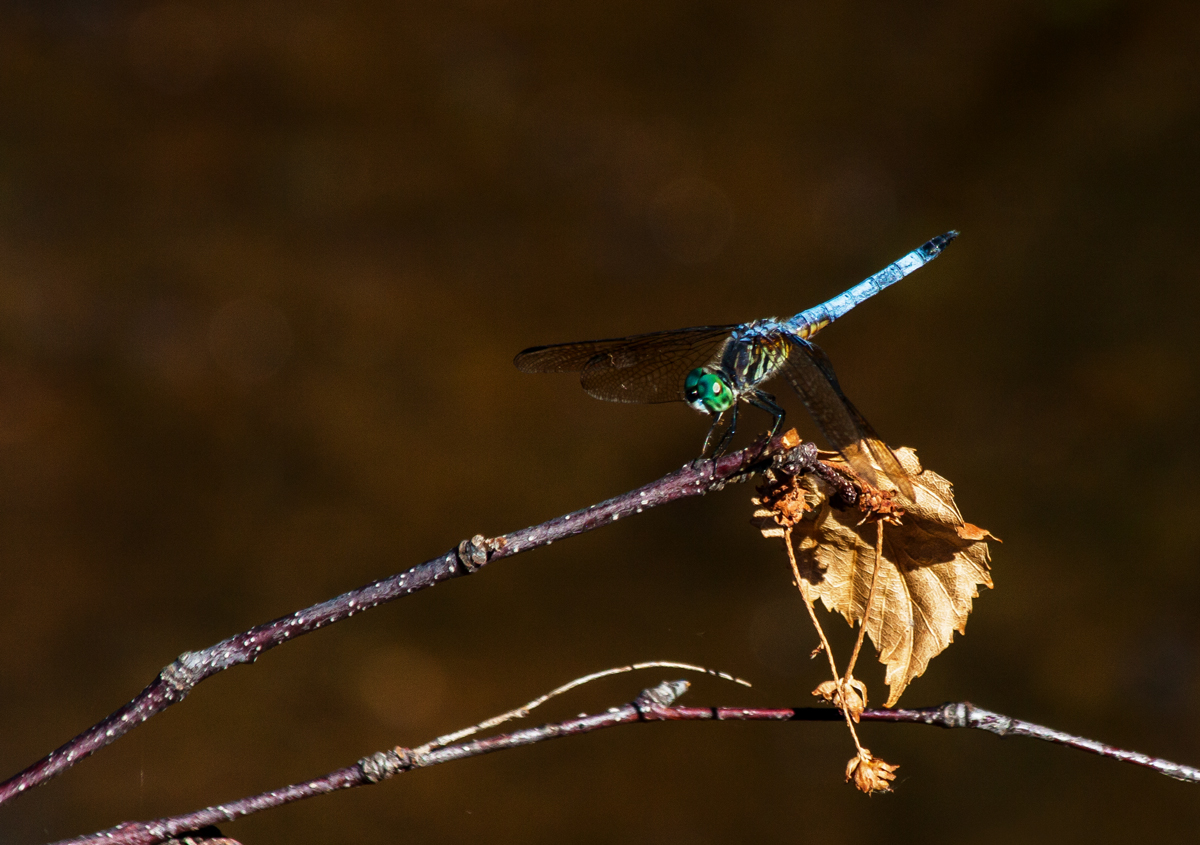
Blue Dashers (Pachydiplax longipennis) are one of my favorite summer dragonflies. I spotted this one recently at Huntley Meadows Park, perched on the railing of an observation deck in the obelisk pose.

The dragonfly was pretty cooperative and I was able to try few different angles and shooting positions. Although I had my camera’s aperture set to f/10, you can see that the depth of field was relatively shallow and I tried to take advantage of that to isolate the subject and the specific rail on which it was perched.

Blue Dasher

Blue Dasher

Blue Dasher

© Michael Q. Powell. All rights reserved.

Read Full Post »

Yesterday afternoon at Huntley Meadows Park I captured this image of a female dragonfly as she hovered over the water, periodically dipping the tip of her abdomen into the water to lay eggs (and generate ripples).

hovering dragonfly

© Michael Q. Powell. All rights reserved.

Read Full Post »

I don’t often see dragonflies in a garden, but spotted this female Eastern Amberwing dragonfly (Perithemis tenera) amidst the flowers earlier this week at Green Spring Gardens. There were lots of male Eastern Amberwings buzzing around the small ponds in another location at the gardens in hopeful expectation of finding a mate.

I have the impression that female dragonflies like to hang out in a different area from the males and then make an appearance at a time of their own choosing.

Eastern Amberwing

© Michael Q. Powell. All rights reserved.

Read Full Post »
It was really easy to find Blue Dasher dragonflies (Pachydiplax longipennis) near the hotel where I stayed in Woburn, Massachusetts this past weekend. The challenge was capturing them in interesting poses, which was a bit more difficult than usual because they were unusually skittish—maybe they are not used to seeing people.

Blue Dasher

Blue Dasher

Blue Dasher

© Michael Q. Powell. All rights reserved.

Read Full Post »

Normally Blue Dasher dragonflies (Pachydiplax longipennis) perch on plants growing upwards, but this one decided to be different by perching on hanging vegetation. I love how the lighting makes it look like the image  was shot in the studio. I think I will call his position the “downward-facing dragonfly.” (I captured the image this morning in Woburn, MA at a small canal just outside of my hotel.)

Blue Dasher

© Michael Q. Powell. All rights reserved.

Read Full Post »

As I was walking through a field of sunflowers at McKee-Beshers Wildlife Management Area in Poolesville, Maryland, I spotted an unusual dragonfly that I couldn’t immediately identify. It turned out to be a Black-shouldered Spinyleg dragonfly (Dromogomphus spinosus)—a cool name for a cool-looking dragonfly.

When I first caught sight of the dragonfly, the dragonfly’s long, skinny abdomen and the enlarged area near the end suggested to me that it was a member of the clubtail family of dragonflies. (You can get a really good sense of the shape of the “clubtail” when you look at the shadows in a couple of the images). The only clubtails that I have seen with any kind of regularity have been Common Sanddragons and Unicorn Clubtails, and this was clearly not one of them. When I am out in the field, I don’t worry too much about identification—I practice what I call the “Law of the West,” i.e. “shoot first and ask questions later.”

Later in the day my shooting partner was able to identify the dragonfly after I pointed her to the website “Dragonflies of Northern Virginia.” This website is my favorite resources for information and photos of dragonflies in my area. I checked my past blog postings because I had a vague recollection that I had seen this species before and found a posting indicating that I saw one almost exactly a year ago on a trip to a different part of Maryland.

Black-shouldered Spinyleg

Black-shouldered Spinyleg

Black-shouldered Spinyleg

© Michael Q. Powell. All rights reserved.


Read Full Post »

During a quick trip to Jackson Miles Abbott Wetlands Refuge at Fort Belvoir, Virginia last weekend, I was thrilled to see that the spectacularly patterned Banded Pennant dragonflies are still around. This is the only location that I visit regularly where I have spotted this dragonfly species and I am never quite sure when an encounter will be the last one of the season.

As I was looking over the two shots that I chose to use with this posting, I realized that they represent two different approaches that I use when photographing dragonflies. Ideally I will try to position myself so that the camera’s sensor is parallel with the dragonfly’s wings and most of the dragonfly will be in focus. That was the case with the second shot and it really highlights the beautiful pattern of the wings. However, the image seems a bit too static for my taste. I prefer the first shot, in part because the pose is more dynamic and the direct eye contact with the dragonfly draws me in.

Banded Pennant

Banded Pennant

© Michael Q. Powell. All rights reserved.

Read Full Post »

Blue Dasher dragonflies (Pachydiplax longipennis) have become for me one of the signs of summer in the area in which I live. When the weather turns hot and humid, they can often be seen flying lazily over the marshes and ponds, perching frequently on vegetation growing out of the water.

On a recent trip to Green Spring Gardens, I captured some images perched male Blue Dasher dragonflies. In the first shot, the dragonfly was perched on the edge of a lotus leaf. I really like the curves and softness of the leaves, which contrast with the details of the dragonfly. I think too that the shadow cast on the lower leaf adds some additional visual interest to the  image.

The second image features a Blue Dasher in the obelisk pose. It is generally believed that some dragonflies assume this pose to dissipate heat by reducing the amount of their bodies that is exposed to direct sunlight. I was shooting partially into the sun, which forced me to overexpose the image a bit and accounts for the lighter background. However, the surface of the water was covered with a lot of duckweed and was not uniform in color. As a result, the background ended ended up with some ugly gray patches that I seemed to be impossible for me to remove.

Blue Dasher

Blue Dasher

© Michael Q. Powell. All rights reserved.

Read Full Post »

Yesterday I spotted this spectacular female Swamp Darner dragonfly (Epiaeschna heros) at Huntley Meadows Park. At almost 3 1/2 inches long (90 mm), Swamp Darners are one of the largest dragonflies in our area.

It was a rare treat for me to capture shots of one perching—usually I see them only in flight. Like most darners, Swamp Darners hand vertically from vegetation, often low to the ground. I was fortunate to see this beautiful dragonfly fly to the perch and it remained there long enough for me to maneuver into position for a clear shot with my long zoom lens. I actually had to pull back from the maximum 600mm focal length of the lens in order to be able to fit the dragonfly’s entire body in the frame.

If you want to get a higher-resolution look at some of the wonderful details of this dragonfly, including the amazing colors of its eyes, be sure to click on the image.

Swamp Darner

© Michael Q. Powell. All rights reserved.

Read Full Post »

« Newer Posts - Older Posts »