Feeds:
Posts
Comments

Archive for the ‘Butterflies’ Category

I was thrilled to capture some shot of a Spicebush Swallowtail butterfly (Papilio troilus) this past weekend at Green Spring Gardens as it fed on a lantana flower. I am so used to more muted colors when I am shooting in the “wild” that the brightness of these flowers seem almost unnatural.

If you look closely at the butterfly’s legs in the first image, you will see that one of them is blurred. Obviously the butterfly was moving about and my camera’s shutter speed was too slow to stop the motion. In many cases I would be disappointed with that lack of sharpness, but I find that it acceptable here, because it doesn’t really distract the viewer’s eyes.

There are a number of dark-colored swallowtails in our area, but the Spicebush Swallowtail is the only one with a blue swoosh on its wings in the middle of a row of orange spots.

Spicebush Swallowtail

Spicebush Swallowtail

© Michael Q. Powell. All rights reserved.

Read Full Post »

There were lots of flowers in bloom yesterday at Green Spring Gardens, a historic county-run garden not far from where I live. One of my favorites was the Zowie Zinnia and a Monarch butterfly (Danaus plexippus) seemed to like it a lot too.

I was at the garden with my dear friend and photography mentor, Cindy Dyer, and her husband. We were all taking a break at one point and I told Cindy that I was going to return to a patch of Zowie Zinnias to see if I could get a shot of a butterfly landing on one. We both recalled a photo that she took in 2010 (check out her blog posting) when an Easter Tiger Swallowtail butterfly appeared out of nowhere and landed on one of the two Zowie Zinnias that she was focusing on with her camera on a tripod.

Imagine her surprise when a couple of minutes later I returned with this photo. She grabbed her camera and went to the patch of zinnia, but, alas, the butterflies were not as cooperative for her as they had been for me.

Monarch butterfly and Zowie Zinnia

© Michael Q. Powell. All rights reserved.

Read Full Post »

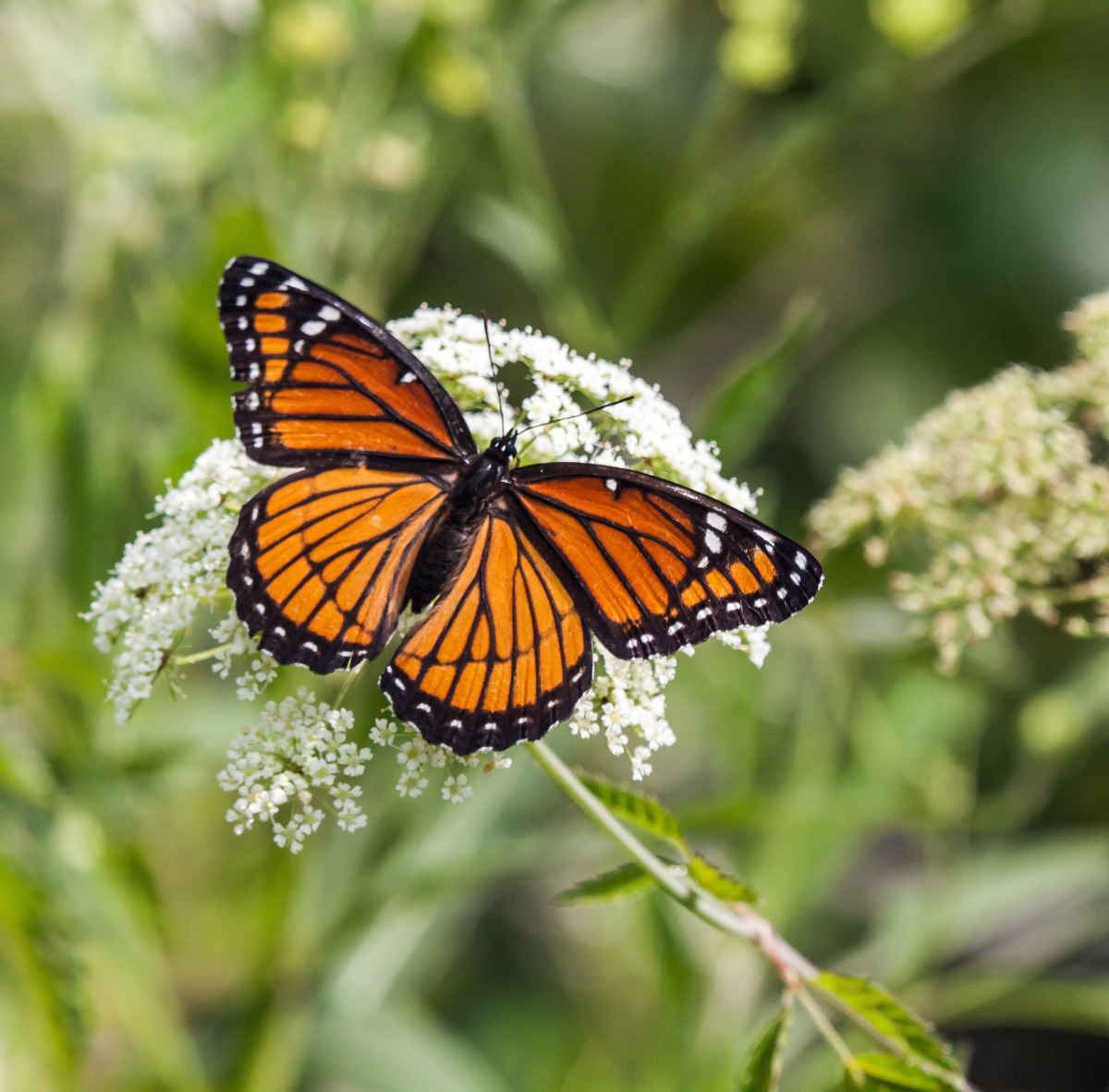
I suppose that I should call this a royal posting for it features both a viceroy and a queen. Of course, here in the USA we don’t have a monarchy, but that doesn’t keep us from having Viceroy butterflies (Limenitis archippus) and Queen Anne’s Lace (Daucus carota). I spotted this royal pair on Monday at Occoquan Bay National Wildlife Refuge where the Viceroy repeated probed the clusters of Queen Anne’s Lace.

You probably have noticed that the coloration of the Viceroy butterfly matches that of the Monarch butterfly. One of the easiest ways to tell them apart is the black line across the hind wings which is present with Viceroys but not with Monarchs.

Viceroy butterfly

Viceroy butterfly

© Michael Q. Powell. All rights reserved.

Read Full Post »

I can’t identify this flower and I am not certain what kind of skipper butterfly this is, but the two of them sure did combine well in this image that I captured this past weekend at Meadowlark Botanical Gardens. (I’m leaning towards this being a Peck’s Skipper (Polites peckius), but there are so many different kinds of skippers that it’s hard to be sure.)

In many ways this is the kind of image that I aspire to capture. The subject is active, engaged in probing the flower with its extended proboscis, rather than in a static pose. Of equal importance, the image has an artistic feel, a kind of beauty in its composition and colors. There are so many uncontrollable elements in nature that there is no way to guarantee results like this, but it is sure is nice when it happens.

UPDATE: Helpful folks on Facebook and readers of this blog have helped to identify the butterfly as a Zabulon Skipper (Poanes zabulon) and the flower as an Obedient Plant (Physostegia virginiana). Thanks, Drew and Molly.

skipper and flower

© Michael Q. Powell. All rights reserved.


Read Full Post »

I am always excited to see Monarch butterflies (Danaus plexippus). Over the years there have been numerous reports of this species becoming endangered, primarily because of the loss of habitat. Some years, I have spotted only a few Monarch during an entire summer. This year I have been fortunate enough to see them at several of the locations that I frequent.

I spotted this spectacular Monarch butterfly yesterday while visiting Meadowlark Botanical Gardens in nearby Vienna, Virginia with some fellow photographers. Each of us has a different style of shooting and preferred subjects and we usually shoot separately. It is always a lot of fun when we reassemble after shooting and share our photos and experiences with each other over dinner at a restaurant.

Monarch butterfly

© Michael Q. Powell. All rights reserved.

Read Full Post »

Recently I spotted this small orange and brown butterfly while I was roaming the trails at Occoquan Bay National Wildlife Refuge. I initially thought it was a Pearl Crescent butterfly, a familiar species, and posted a photo on Facebook. One of my friends there, however, pointed out that my little butterfly was actually a Silvery Checkerspot butterfly (Chlosyne nycteis), a new species for me.

The composition in my image is pretty simple, but I really like the way that it turned out, with the soft contours of the butterfly juxtaposed with the linear veins of the leaf and the sharp contrast between the dominant green and orange tones. The shadows are a real bonus, adding additional interest to the photo.

Silvery Checkerspot

© Michael Q. Powell. All rights reserved.

Read Full Post »

I spotted this beautiful butterfly this past weekend at Jackson Miles Abbott Wetland Refuge. I am pretty sure that it is a Question Mark butterfly (Polygonia interrogationis), judging from the pattern of its wing spots.

While I may not be absolutely certain that it is a Question Mark butterfly, its beauty is unquestionable.

Question Mark butterfly

© Michael Q. Powell. All rights reserved.

Read Full Post »

I love photographing the nondescript butterflies that are so common that they fly by virtually unnoticed, like this beautiful little sulphur butterfly that I spotted last week at Occoquan Bay National Wildlife Refuge. I believe it is an Orange Sulphur butterfly (Colias eurytheme), though it is often hard to distinguish that species from the Clouded Sulphur (Colias philodice), so I am a little uncertain of the identification.

What I am certain of, however, is the delicate beauty of this butterfly and I am happy that I was able to capture some of that beauty in this image. As I gaze at this photo, I am reminded of the moment when I took it, a moment when I was enveloped by a sense of deep tranquility as the gorgeous sunlight illuminated the wings of the butterfly. Quite often when I am pursuing a subject, I can feel my heart racing a little as adrenaline kicks in.  This was one of the rare circumstances when I had the opposite physical reaction.

It is hard to describe in words what I was feeling, though it was definitely cool to experience. I hope that some of you will get a sense of that tranquility from this image. Iam becoming more and more convinced of the value of taking life a little more slowly, of opening myself up to experiencing the beauty that surrounds us every day.

sulphur butterfly

© Michael Q. Powell. All rights reserved.

Read Full Post »

In a moment of calm amidst the storms this past Monday, I captured this shot of a beautiful little Cabbage White butterfly (Pieris rapae) in the garden of my neighbor and fellow photographer Cindy Dyer. The shot is a little grainy, because there was not a great deal of light, but somehow the image fills me with an overwhelming sense of serenity.

Cabbage White

© Michael Q. Powell. All rights reserved.

Read Full Post »

Whenever I see a patch of milkweed I will usually stop and and watch and wait. Milkweed attracts such a colorful cast of insect characters that it reminds me a little of the Mos Eisley Cantina in the original Star Wars movie.

My patience was rewarded this past Saturday at Occoquan Bay National Wildlife Refuge when a Monarch Butterfly (Danaus plexippus) stopped by for a visit and I was able to capture this image.

Monarch butterfly

© Michael Q. Powell. All rights reserved.

Read Full Post »

The combination of springtime rain and summertime heat in our area has caused a real explosion of insects. Some of them, like deer flies and mosquitoes, mercilessly harass me when I go out with my camera, but a lot of them are amazingly beautiful, like this spectacular Common Wood Nymph butterfly (Cercyonis pegala) that I spotted this past weekend at Occoquan Bay National Wildlife Refuge.

Many woodland butterflies are rather drab in appearance and it is hard for me to identify their species. With the Common Wood Nymph, though, the yellow patch on the wings makes them almost instantly recognizable.

Common Wood Nymph

© Michael Q. Powell. All rights reserved.


Read Full Post »

It is easy to be so dazzled by the beauty and the aerial skills of dragonflies that you forget that they are also fearsome predators. I had a stark reminder of this grim reality on Friday when I encountered a Cobra Clubtail dragonfly (Gomphurus vastus) that had captured a Hackberry Emperor butterfly (Asterocampa celtis) at Riverbend Park. The dragonfly was starting to consume the butterfly and in the photo below almost appears to be suspended in mid-air.

In the past I have observed dragonflies with small butterflies, but this was the first time to see one with a larger butterfly. I really like butterflies and so I felt a mixture of horror and fascination when I stumbled upon this scene. Life in the wild can be brutal and today’s predators can become tomorrow’s prey—a fellow photographer posted a photo yesterday of a bird that had captured a dragonfly.

All in all, this moment served as a sober reminder to me of the fragility of life and of beauty. Somehow it brings to mind a country music song that I really like by Tim McGraw, a song that recommends that you live like you were dying. If you have not familiar with the song or simply want to hear it again, check out the official music video here on YouTube.

Cobra Clubtail

© Michael Q. Powell. All rights reserved.


Read Full Post »

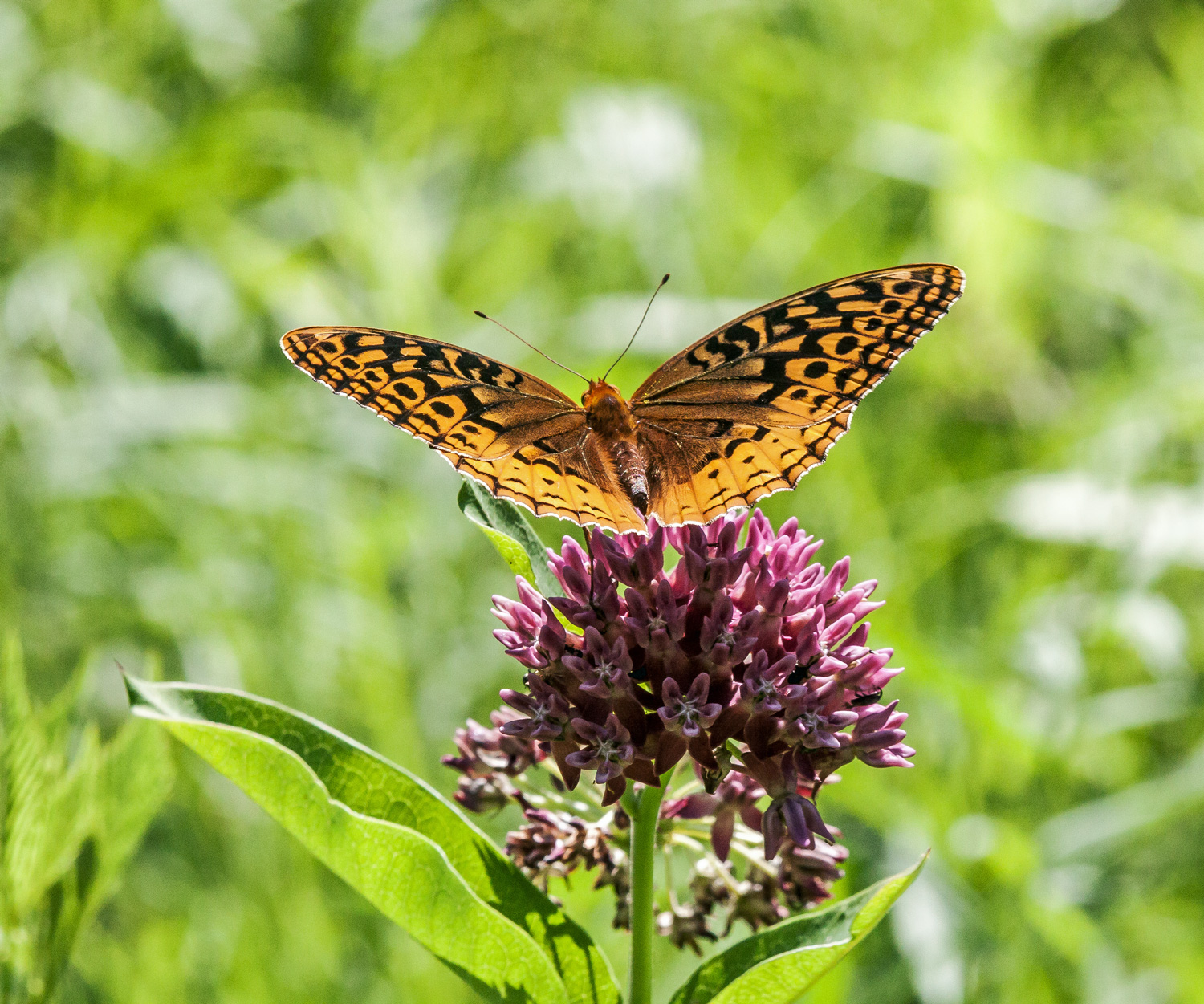
It is a gray and gloomy Friday morning and rain is forecast for most of the day. Somehow I feel the need for a boost of bright colors. So here is a shot of a Great Spangled Fritillary butterfly (Speyeria cybele) on a clump of what I believe is Purple Milkweed (Asclepias purpurascens) from this past weekend at Huntley Meadows Park.

As I worked on this image, there was a real temptation to crank up the saturation level of the colors, which made the shot look unnatural. I tried to show a little restraint and render the colors as I remember them, bright, but not in neon-like tones.

Great Spangled Fritillary

© Michael Q. Powell. All rights reserved.

Read Full Post »

At this time of the year I generally exchange my long telephoto zoom lens for my macro lens as my primary lens. Macro photography was my first love when I started getting more serious about my  photography and it still has a special attraction for me. Besides, birds are mostly hidden by the foliage and, as you probably have noticed, dragonflies have resumed their place as my favorite subject.

A macro lens helps me capture the world in a different way, revealing details that we don’t normally see. I think that was the case yesterday when I encountered a small brown butterfly while I was walking alongside a stream. I think that it is a Northern Pearly-eye butterfly (Enodia anthedon), though there is a chance that it is an Appalachian Brown butterfly or some other species. I didn’t get a really good look at the markings of butterfly and instead concentrated on trying to get as parallel as I could to the butterfly so the eyes would be in focus.

I like the low angle shot that I was able to get, which makes the butterfly look a little bit like a bat.

Northern Pearly-eye

© Michael Q. Powell. All rights reserved.


Read Full Post »

Early Monday morning at Occoquan Bay National Wildlife Refuge I spotted my first Monarch Butterfly (Danaus plexippus) of the spring. It seemed really skittish and flew up into the trees. I was happy to be able to capture this image from an unusual angle—it is not often that I photograph a butterfly while aiming my camera in an upwards direction.

Some years I see only a few Monarchs and I read quite often about their threatened habitats. I am therefore excigted each time that I am blessed to see one of these beautiful butterflies.

Monarch butterfly

© Michael Q. Powell. All rights reserved.


Read Full Post »

Here are a few shots of butterflies that I spotted last weekend during a visit to the Donau-Auen National Park in Vienna, Austria. Unlike the brightly-colored larger butterflies that I sometimes see in gardens, these butterflies were small, rather drab in coloration, and very skittish. They also tended to perch on the ground, which made them a little tougher to photograph. In my experience, woodland butterflies tend to fit this general profile.

I particularly enjoyed chasing one butterfly, which is shown in the first and second images below. The butterfly is a species that I do not see at home and looks quite nondescript when its wings are closed. With the wings open, though, the butterfly reveals its beautiful colors and patterns—it is like a hidden treasure.

The other two butterflies are also quite beautiful, with wonderful muted tones and patterns.


butterfly in Vienna

butterfly in Vienna

butterfly in Vienna

butterfly in Vienna

© Michael Q. Powell. All rights reserved.

Read Full Post »

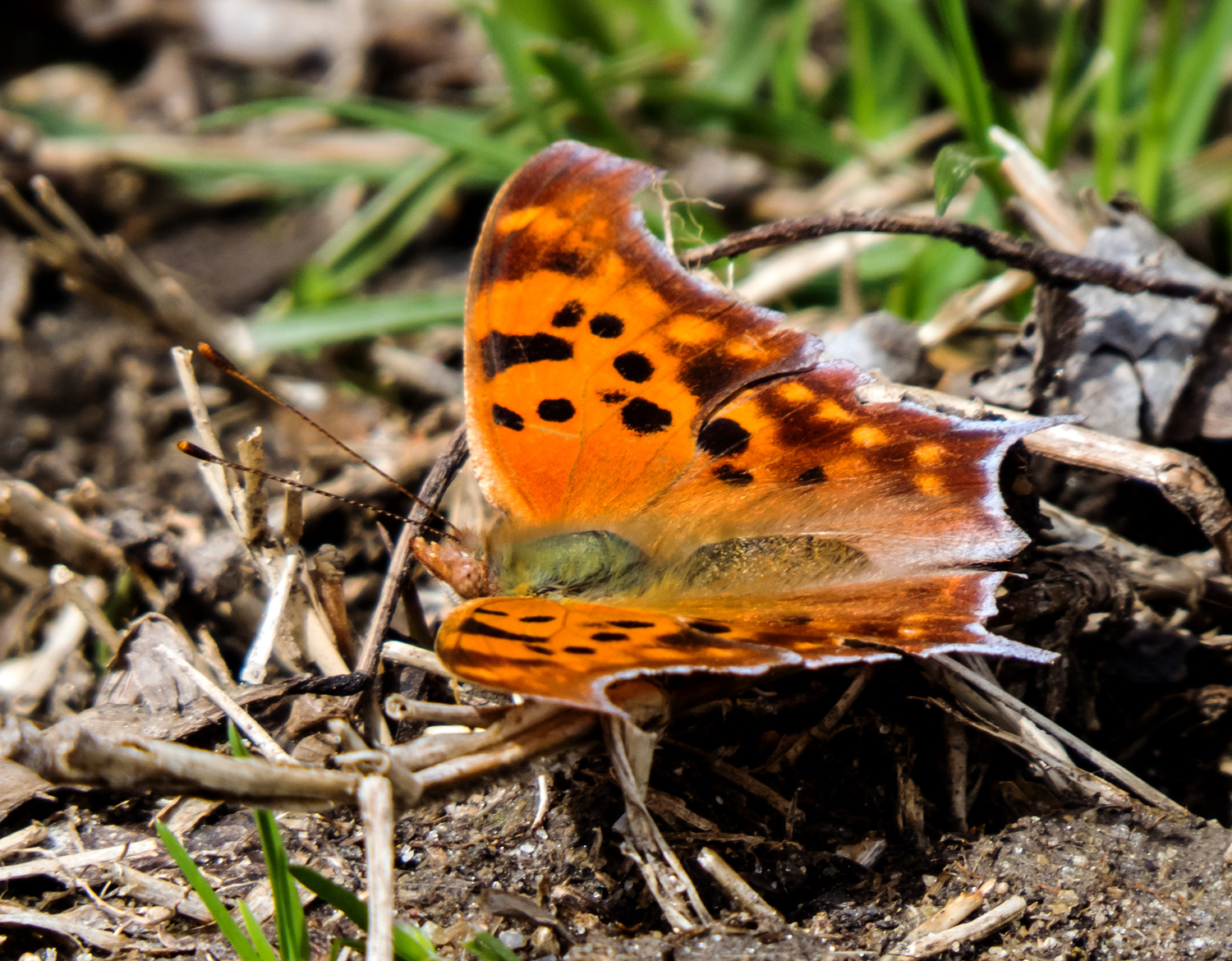
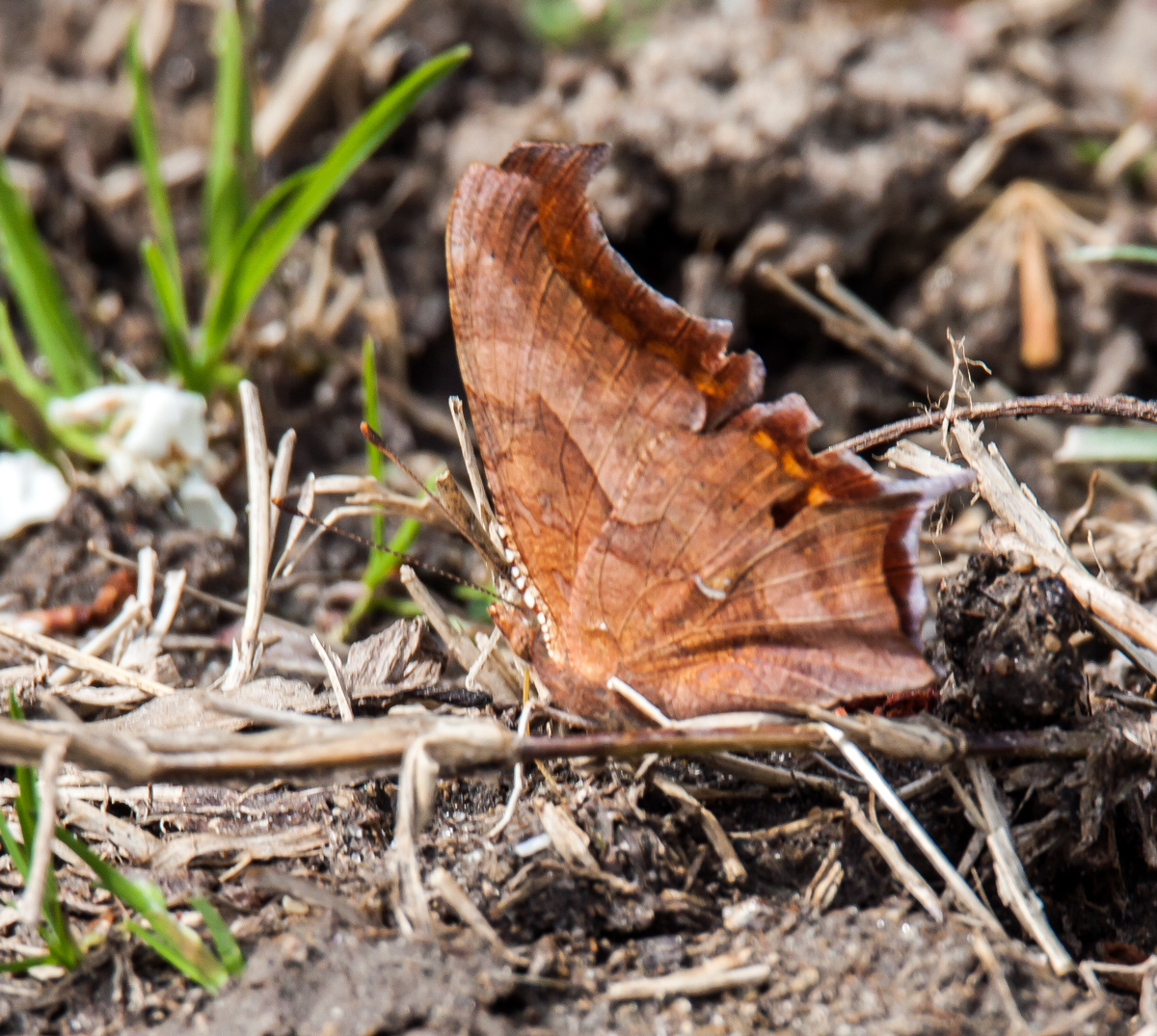
We have had colder than normal weather this past week, so I was quite shocked to see a fairly large orange and black butterfly last Friday fluttering about at Occoquan Bay National Wildlife Refuge. Actually, when the butterfly opened its wings I could see its bright colors, but it kept them closed, the butterfly blended in well with the background and look simply like another fallen leaf.

In our area there are two butterflies that are very similar in appearance and I knew that this one was either and Eastern Comma (Polygonia comma) or a Question Mark (Polygonia interrogationis) butterfly. I am often amused by the names given to species in nature and I wonder what kind of a personality some has that decides to name two butterfly species after punctuation marks—almost certainly it was a scientist and not an artist.

You can tell the two species apart by the markings on both the outer and inner wings and I concluded that this one is probably a Question Mark. If you are curious about the differences, check out a posting by TrekOhio called “Butterflies that Punctuate: The Eastern Comma and the Question Mark” that goes into some detail in explaining how to tell the species apart.

In the next few days, the weather is supposed to warm up and hopefully more colorful insects will appear (and maybe even some more birds). It’ll be fun to see what I can find and photograph.

Question Mark butterfly

Question Mark butterfly

© Michael Q. Powell. All rights reserved.


Read Full Post »

I am delighted to see that butterflies are finally appearing as we move deeper into spring, like this tiny Gray Hairstreak (Strymon melinus) that I spotted this past Friday at Occoquan Bay National Wildlife Refuge. Since I was mostly looking for birds, I had my trusty Tamron 150-600mm lens on my camera. Although this lens is not optimal for such a small subject, it did a pretty good job in capturing the delightful details of this little butterfly, like the little “tails” at the bottom of the wings and the patches of orange on the wings themselves.

The same day I also saw a larger orange butterfly that I think was a Question Mark butterfly. If my photos are clear enough, I’ll probably post them soon. Stay tuned for coming attractions.

Gray Hairstreak

© Michael Q. Powell. All rights reserved.

Read Full Post »

Yesterday at Occoquan Bay National Wildlife Refuge I finally spotted my first full-sized butterfly of the spring, which was, not surprisingly, a Mourning Cloak butterfly (Nymphalis antiopa). Unlike some other species that migrate, Mourning Cloak butterflies overwinter with us as adults in a hibernation-like state and awake to mate in the early spring. Generally, therefore, they are among the first butterflies to appear in the spring.

Mourning Cloak butterfly

© Michael Q. Powell. All rights reserved.


Read Full Post »

I was a bit shocked and absolutely thrilled this past week at Occoquan Bay National Wildlife Refuge to spot my first butterfly of the year, which appears to be the appropriately named Spring Azure butterfly (Celastrina ladon). We have had some slightly warmer and sunny days recently, but the temperatures continue to be below freezing most nights.

When I encountered the tiny butterfly, I had my trusty Tamron 150-600mm lens on my camera, which is not exactly the optimal lens for this kind of subject. Life is often about making do with what you have, so I extended the lens to its full length, steadied myself as well as I could, and focused manually on the butterfly as it perched on some vegetation, a few inches above the ground.

It won’t be long before I see some bigger and more colorful butterflies, but this one is really special to me as the first butterfly of the spring.

Spring Azure

© Michael Q. Powell. All rights reserved

Read Full Post »

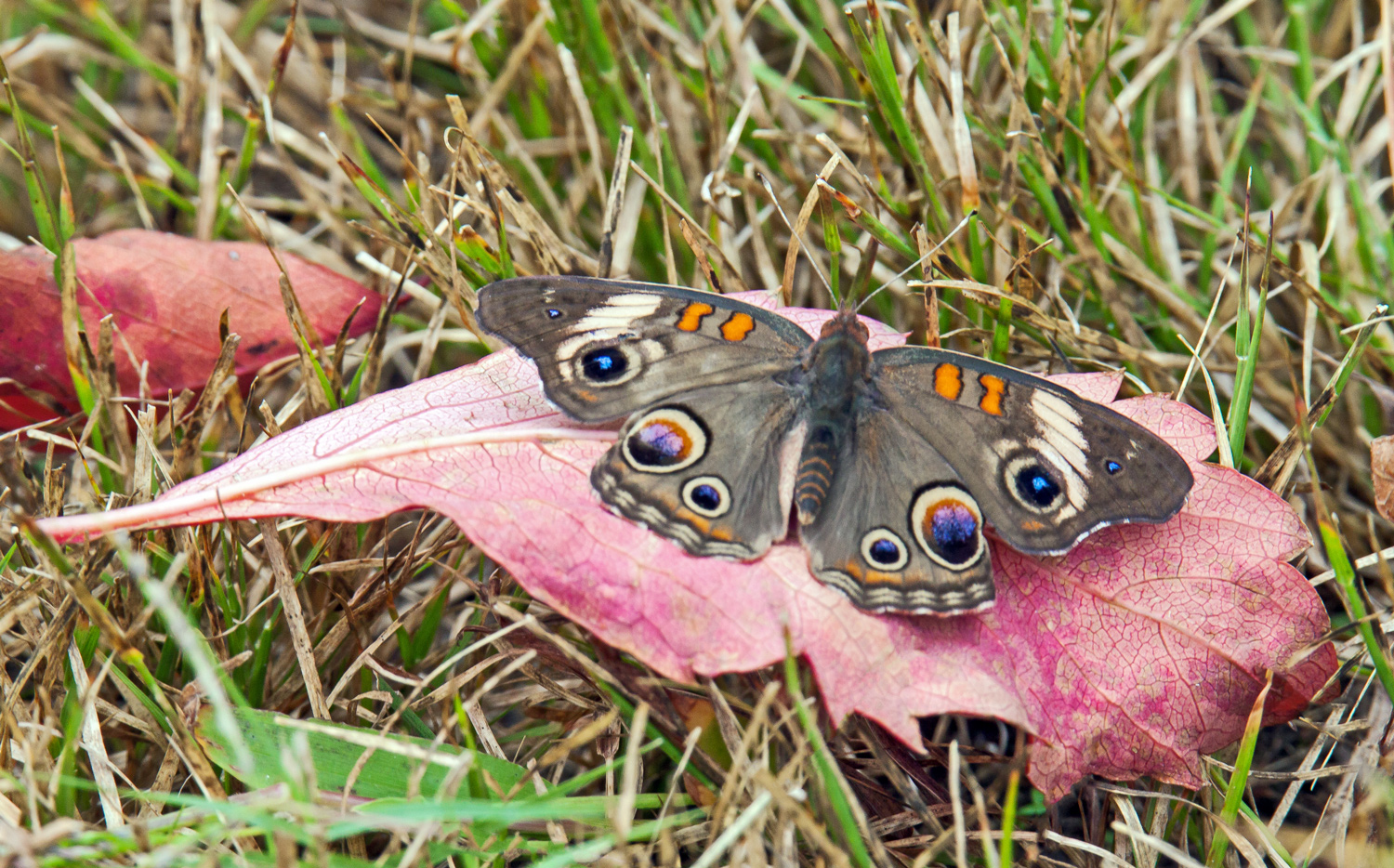
We are deep into autumn now, but some butterflies are still hanging in there, like this beautiful Common Buckeye (Junonia coenia) that I spotted during a recent trip to Occoquan Bay National Wildlife Refuge. I was actually a little shocked to see quite a few of these butterflies flying along the paths of the wildlife refuge and in some of the open areas. The challenge for me was getting one to pose in a way that would convey a sense of autumn. I was therefore thrilled when this one perched on a fallen leaf and and kept its wings wide open long enough for me to capture this shot.

Common Buckeye

© Michael Q. Powell. All rights reserved.

Read Full Post »

I was thrilled this morning at Occoquan Bay National Wildlife Refuge to see that there are still quite a few Monarch butterflies (Danaus plexippus) in our area, including this beauty that I was able to photograph as it was feeding on a thistle plant.

monarch butterfly

© Michael Q. Powell. All rights reserved.

Read Full Post »

This spectacular Black Swallowtail butterfly (Papilio polyxenes) spread its wings wide and seemed to be posing for fellow wildlife enthusiast Walter Sanford and for me as we explored Occoquan Bay National Wildlife Refuge this past weekend. We have a number of different dark-colored swallowtail butterflies in our region, including the black morph of the female Eastern Tiger Swallowtail, the Pipevine Swallowtail, and the Spicebush Swallowtail, but this is the only place that I have encountered the Black Swallowtail.

Whenever I photograph a swallowtail that is black, I will usually refer to a very helpful blog posting by Louisiana Naturalist that compares some of the identification features of the four different dark swallowtails.

Black Swallowtail

© Michael Q. Powell. All rights reserved.

Read Full Post »

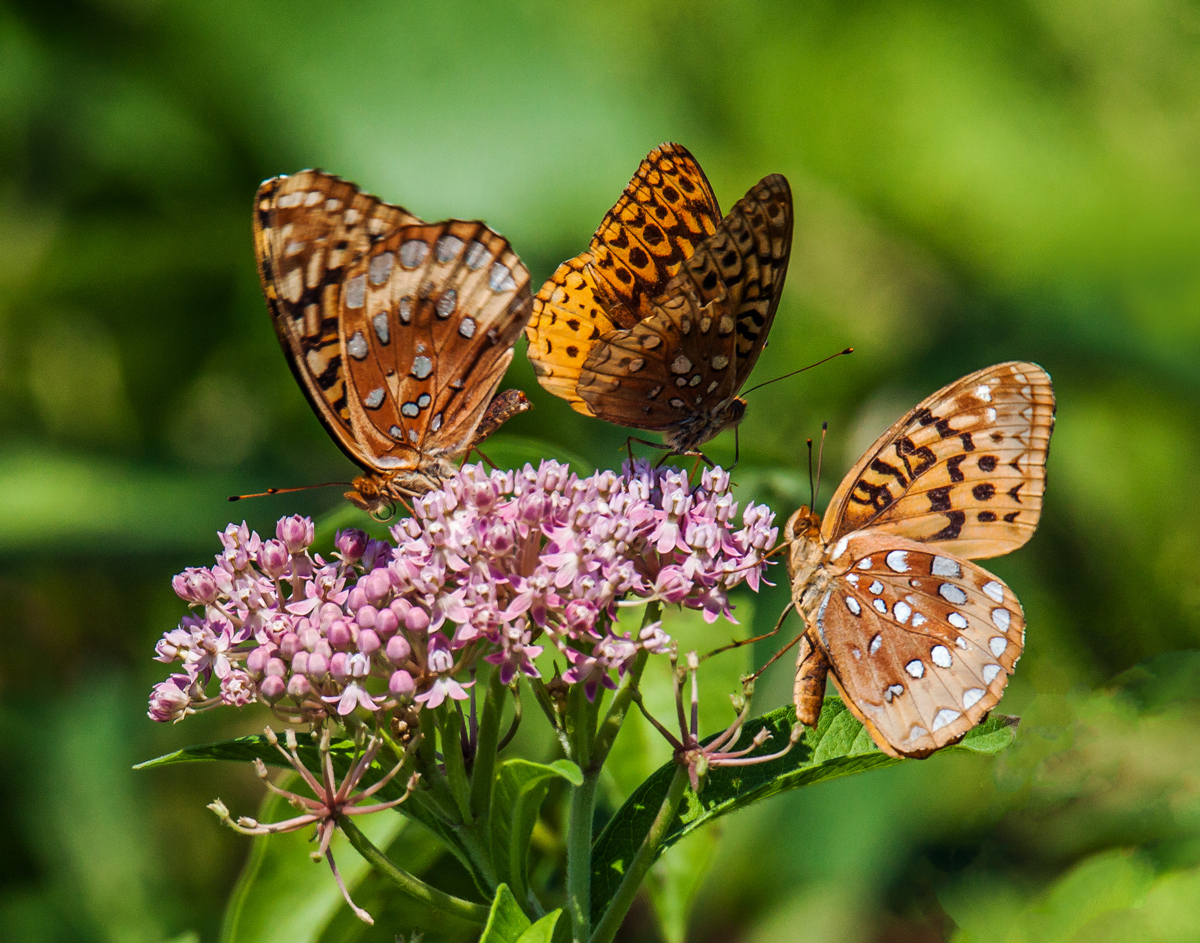
A clump of what I think is Swamp Milkweed (Asclepias incarnataseemed irresistible to a trio of Great Spangled Fritillary butterflies (Speyeria cybele) on Monday at Huntley Meadows Park. For a brief moment they coexisted peacefully, until one of them encroached into the territory of another and they all began to jostle each other for the prime spots.

I quickly snapped off a series of photos before the butterflies flew away. As is the case with almost any group, it was almost impossible to capture an image in which all of the subjects were more or less facing the camera and had interesting poses. It was roughly equivalent to trying to photograph a group of wiggly little children—single subjects seem easy by comparison.

Great Spangled Fritillary

© Michael Q. Powell. All rights reserved

Read Full Post »

The beautiful Monarch Butterfly (Danaus plexippus) is often featured in conservation efforts that focus on its dwindling numbers and shrinking habitat. It was therefore a little disconcerting to stumble upon a Monarch that had been ensnared in the web of a Black and Yellow Garden Spider (Argiope aurantia) during a visit this past weekend to Occoquan Bay National Wildlife Refuge.

I have no idea how long the butterfly had been in the web, but it appeared to be totally immobilized. Spiders like this one, known also as Yellow Garden Spiders or Writing Spiders, kill their prey by injecting venom and often wrap them up in web material for later consumption.

I considered cropping this image to focus more attention on the spider and the butterfly, but ultimately decided that I liked the context provided by the elements of the spider’s web and the murky, out-of-focus background.


spider and Monarch

© Michael Q. Powell. All rights reserved


Read Full Post »

One of the coolest looking butterflies in our area is the Zebra Swallowtail butterfly (Eurytides marcellus). In addition to having beautiful coloration, it has amazingly long “tails” that flutter when it is in flight. It is not a species that I see very often, so I will spend a lot of time chasing after one when I spot it, hoping, often in vain, that it will perch long enough for me to get a shot.

This Zebra Swallowtail, which I chased this past Friday at Occoquan Bay National Wildlife Refuge, was reasonably cooperative, though it refused to open its wings to give me a view of its entire wingspan.

Zebra Swallowtail

© Michael Q. Powell. All rights reserved

Read Full Post »

Although I tend to associate Monarch butterflies (Danaus plexippus) with milkweed, this Monarch was hungrily feeding on Queen Anne’s lace (Daucus carota) this past weekend at Huntley Meadows Park. I am not sure why, but I have seen significantly more Monarch butterflies this summer than in the past few years.

Monarch butterfly

© Michael Q. Powell. All rights reserved

Read Full Post »

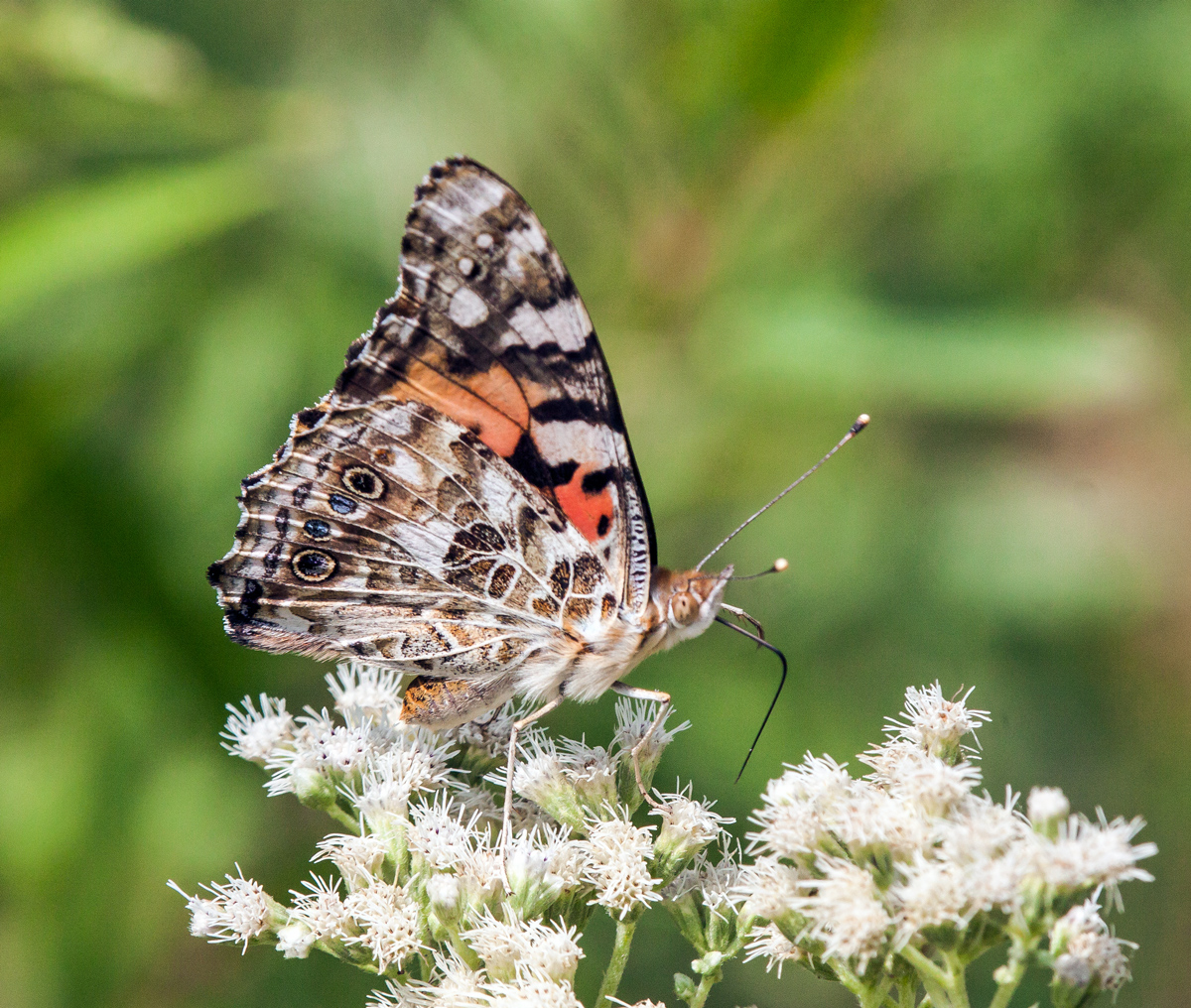
As I was exploring at Huntley Meadows Park this past weekend, I was thrilled to stumble upon this beautiful Painted Lady butterfly (Vanessa cardui), a species that I have not seen in several years. In the field, I couldn’t remember the differences between a Painted Lady and the similar-looking American Lady. Fortunately, there are plenty of resources on-line, including this helpful comparison page on bugguide.net that shows the differences between the two types. On the basis of the pattern of the eye spots, I concluded that this is almost certainly a Painted Lady.

Painted Lady

© Michael Q. Powell. All rights reserved

Read Full Post »

One of the little woodland butterflies that I see only rarely is the Common Wood Nymph (Cercyonis pegala). I was therefore pretty excited when I spotted this beauty on Friday while it was perched on a tree at Huntley Meadows Park. The yellow patch is so distinctive that it was pretty easy for me to identify this one, unlike so many other woodland butterflies that are mostly brown with different patterns and colors of eye spots on their wings.

Common Wood Nymph

© Michael Q. Powell. All rights reserved

Read Full Post »

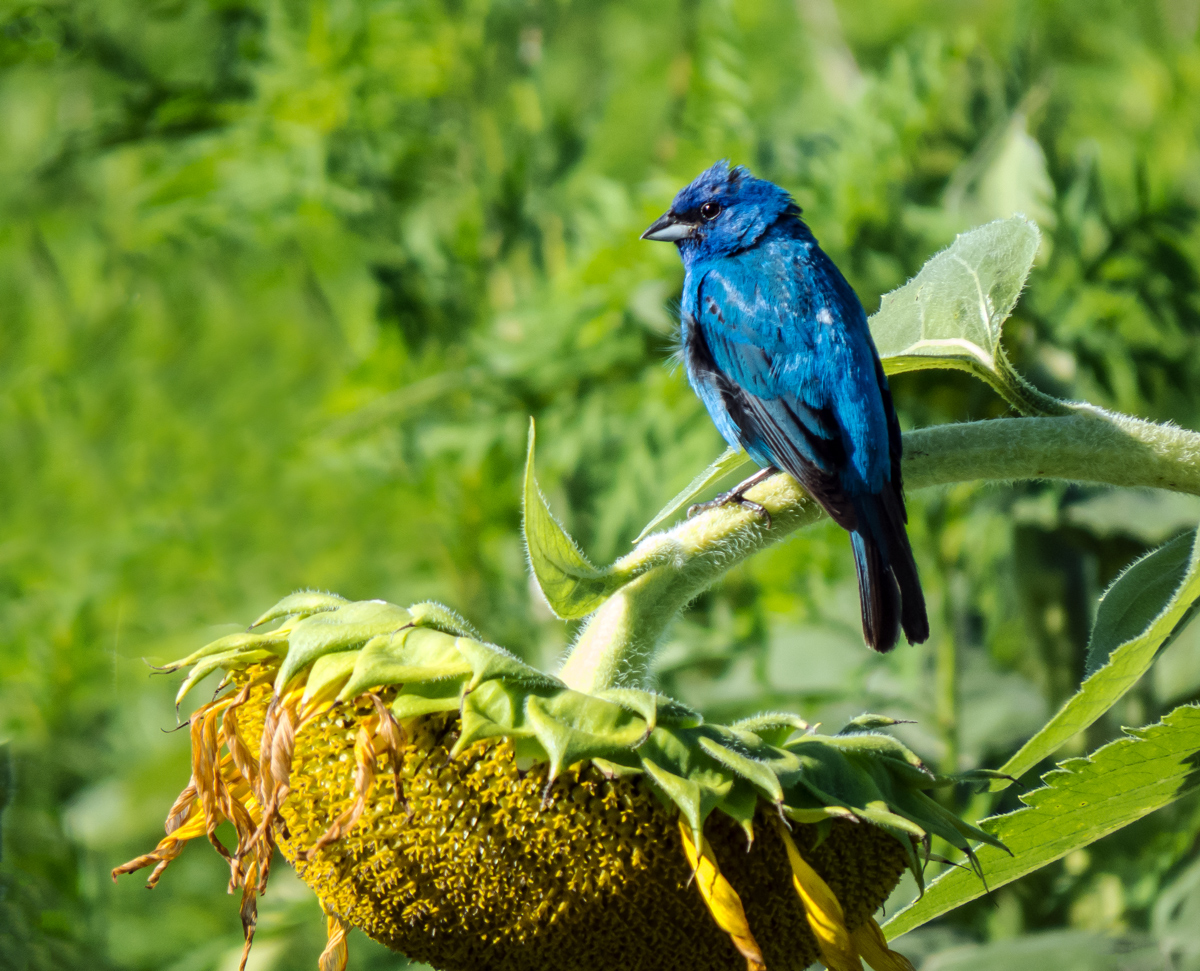
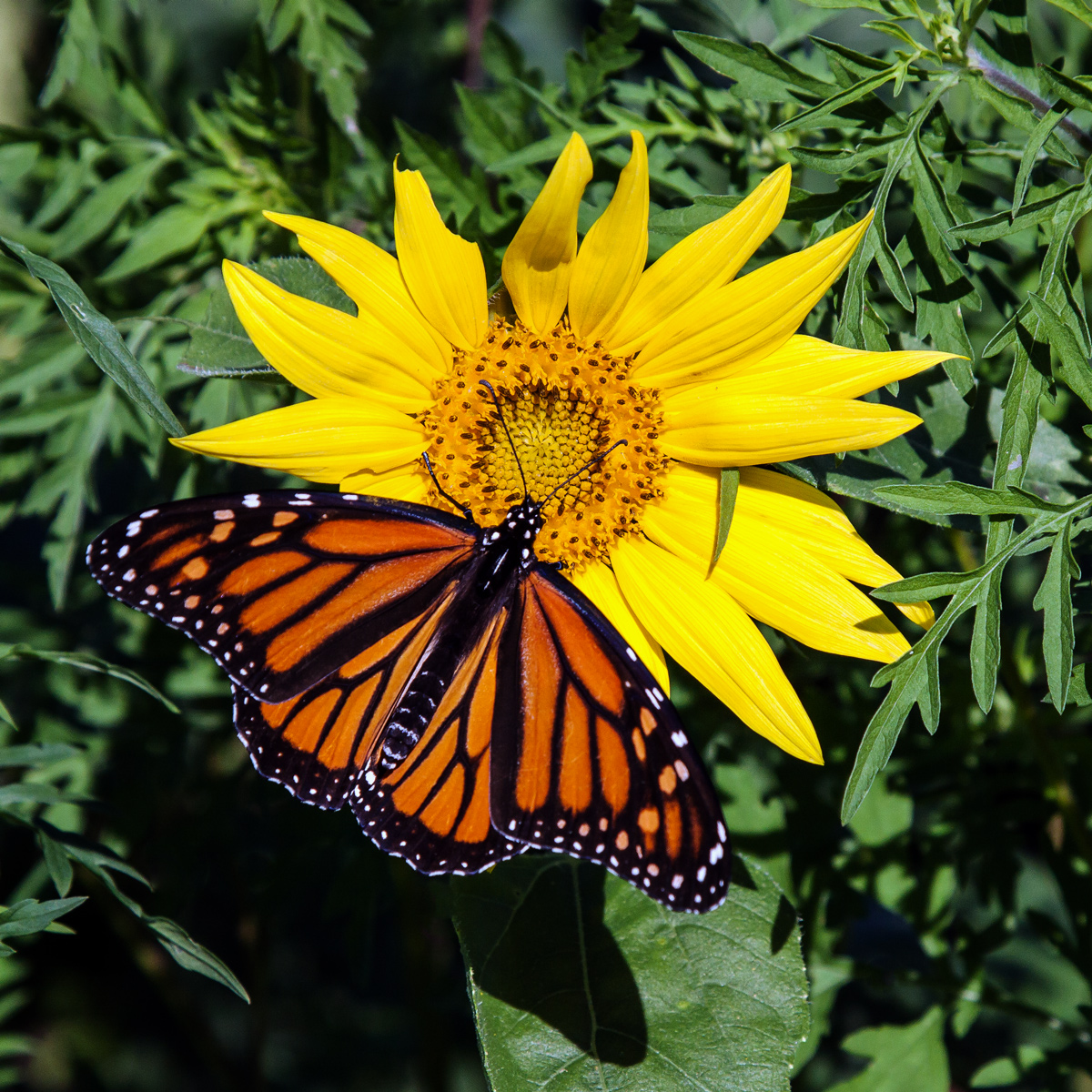
In the first sunflower field that we visited yesterday morning at McKee-Beshers Wildlife Management Area, many of the sunflowers were drooping because of the weight of their seeds. They may not have been very photogenic, but the birds and butterflies seemed to love them, like this Indigo Bunting (Passerina cyanea) and this Monarch butterfly (Danaus plexippus) that I spotted among the sunflowers.

Several photographer friends and I made the trip to the sunflower fields in Poolesville, Maryland, hoping to see endless rows of tall sunflowers. According to its website, McKee-Beshers has 30 acres of sunflowers planted in nine different fields. I think that the sunflowers may have been a little past their prime and appeared to be a little stunted in size, compared to some past years.

It was tricky to figure out what kind of gear to bring on a trek like this. I ended up using my super zoom Canon SX50 to photograph the Indigo Bunting, which was a first sighting for me of this beautiful bird, and my Canon 24-105mm lens on my normal Canon 50D DSLR for the butterfly. I had both of the cameras with me at all times, which gave me a pretty good amount of flexibility. I’ve seen some photographers walk around with two DSLR bodies, but that seems like a lot of weight to carry around, especially when you are moving through vegetation as I was doing as I waded through the rows of sunflowers.

I did take shot shots of the sunflowers  and I’ll post some of them eventually. Folks who know me, though, are probably not surprised that my first instinct was to post images of birds and butterflies, rather than ones of the flowers alone.

Indigo Bunting

Monarch butterfly

© Michael Q. Powell. All rights reserved

Read Full Post »

Cardinal flowers (Lobelia cardinalis) are now in bloom at Huntley Meadows Park. In addition to being beautiful, these vivid red flowers attract butterflies, like this Spicebush Swallowtail butterfly (Papilio troilus) that I spotted this past weekend at the park.

Spicebush Swallowtail

© Michael Q. Powell. All rights reserved

Read Full Post »

« Newer Posts - Older Posts »