Feeds:
Posts
Comments

Archive for the ‘Butterflies’ Category

Chasing after beautiful butterflies on a sunny summer day—it doesn’t get much better than that. I don’t know plants very well, but this appears to be some kind of thistle. I photographed this Eastern Tiger Swallowtail (Papilio glaucus) last Saturday at Huntley Meadows Park in Alexandria, Virginia.

Eastern Tiger Swallowtail

© Michael Q. Powell. All rights reserved.

Read Full Post »

With patches of red, white, and blue, this Red Admiral butterfly (Vanessa atalanta) that I spotted earlier this week seems to be perfectly attired to celebrate Independence Day today here in the United States.

Happy Fourth of July!

Red Admiral

© Michael Q. Powell. All rights reserved.

Read Full Post »

A few years ago I probably would have misidentified this butterfly as a Monarch because of its coloration. Now, however, I can tell immediately that it is a Viceroy butterfly (Limenitis archippus), because there is a black stripe across the hindwings that the Monarch lacks.

I spotted this beautiful little butterfly this past Monday as I was searching for dragonflies and other creatures in a remote area of Huntley Meadows Park, the marshland area where I take many of my photos. A significant number of the areas that I like to visit are at least partially flooded. The month of June that we just ended turned was the second most rainy June on record for the region (and the rain has continued into July).

As I take more and more photos, I keep learning more and more about my subjects as I try to figure out what I have shot. What amazes me is that I manage to retain some of that information and can use it to identify a subject, as I did in this case. It’s not that easy most of the time (at least for me).

Viceroy butterfly

© Michael Q. Powell. All rights reserved.

Read Full Post »

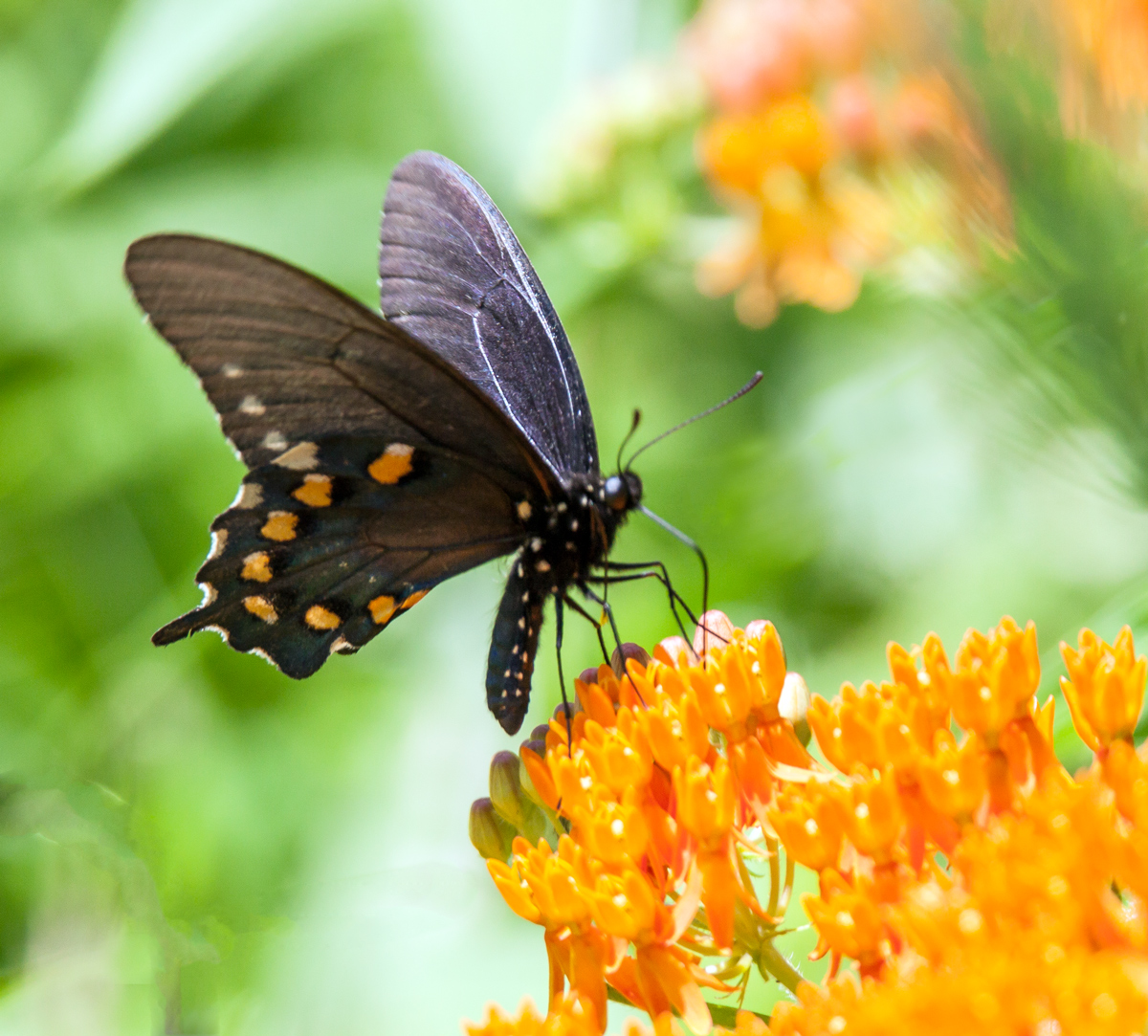
This past weekend I spotted a black swallowtail fluttering about some bright orange flowers, never stopping for more than a split second. Could I get a shot before it flew away?

Well, I managed to get some shots and then came the tough part—figuring out which black-colored swallowtail I had captured. How hard can that be? For a casual observer like me, there were at least three candidates that immediately came to mind—the black version of the Eastern Tiger Swallowtail, the Spicebush Swallowtail, and the Pipevine Swallowtail. I recalled that one of the key indicators is the pattern of the orange spots, but I couldn’t remember which one had which pattern.

After some quick research, I’ve concluded this is probably a Pipevine Swallowtail butterfly (Battus philenor). I was also really taken by the orange plant and think it might be butterfly weed (Asclepias tuberosa), a type of milkweed that, as its name suggests, attracts butterflies.

Pipevine swallowtail

Michael Q. Powell. All rights reserved.

Read Full Post »

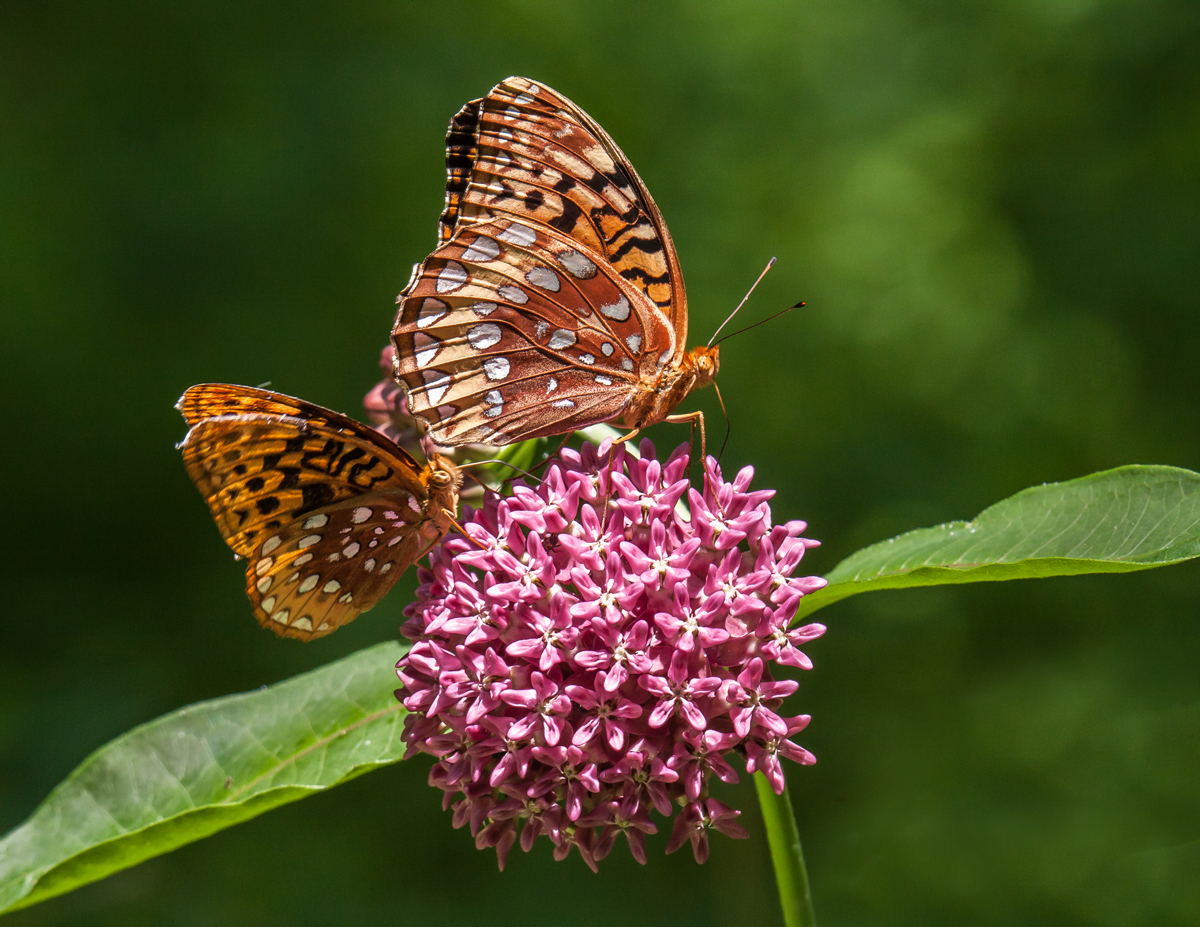
Swamp Milkweed (Asclepias incarnata) is now in bloom at my local marshland park and the Great Spangled Fritillary butterflies (Speyeria cybele) are loving it.

Great Spangled Fritillary

Michael Q. Powell. All rights reserved.

Read Full Post »

A Silver-spotted Skipper butterfly (Epargyreus clarus) kept returning to these purple flowers yesterday at the edge of a small pond at Brookside Gardens in Wheaton, Maryland. I am not sure what kind of flower this is, but the Silver-spotted Skipper, the only skipper that I can reliably identify, really seemed to like it.

Some of my fellow photographers with whom I traveled to the gardens really enjoy photographing flowers—I seem to have reached a point at which I enjoy shooting flowers primarily as a beautiful backdrop for showcasing insects.

There are a lot of gardens in the Washington D.C. area that provide for wonderful photographic opportunities, many of which, like this one, have no admission fee. Although I really enjoy shooting at the marshland park that I feature here so often, it’s nice to venture out a little for a bit of variety.

Silver-spotted Skipper

Michael Q. Powell. All rights reserved.


Read Full Post »

I spotted a beautiful Mourning Cloak butterfly (Nymphalis antiopa) this past weekend at Huntley Meadows Park and suspect that it recently emerged. I always thought of  Mourning Cloaks, which are apparently known as Camberwell Beauties in Great Britain, only as an early spring butterfly, because I knew that they overwinter with us as adults.

After doing a little research, I learned that the hardy winter survivors mate in the early spring and then die. The eggs turn into caterpillars that pupate and the new butterflies emerge in June or July. After briefly feeding, the butterflies will enter into a state of dormancy (called aestivation) for the summer. I must confess that I was not familiar with the word “aestivation” when I first ran across it and had to look it up. As far as I can tell, it’s the summer equivalent of hibernation. Last year I remember learning the word “brumation,” which is a hibernation-like state that helps turtles survive in the mud during the winter. Who knew there were so many hibernation-type states?

In the fall, the Mourning Cloak butterflies will go on a real feeding frenzy to store up energy for the long winter. It’s amazing to realize that these butterflies have a life span of 10 months, which is an eternity in the insect world.

Mourning Cloak

Michael Q. Powell. All rights reserved.


Read Full Post »

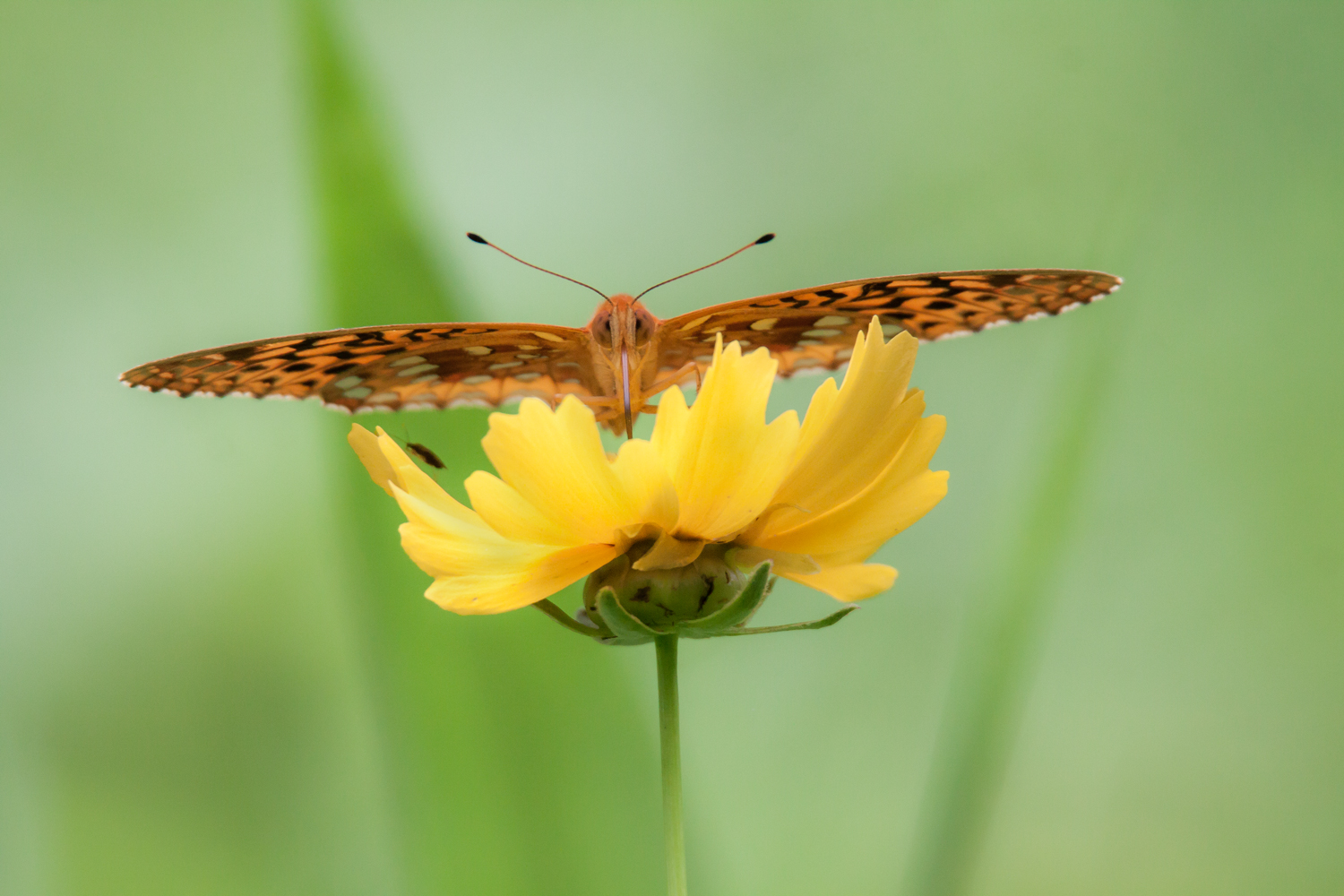
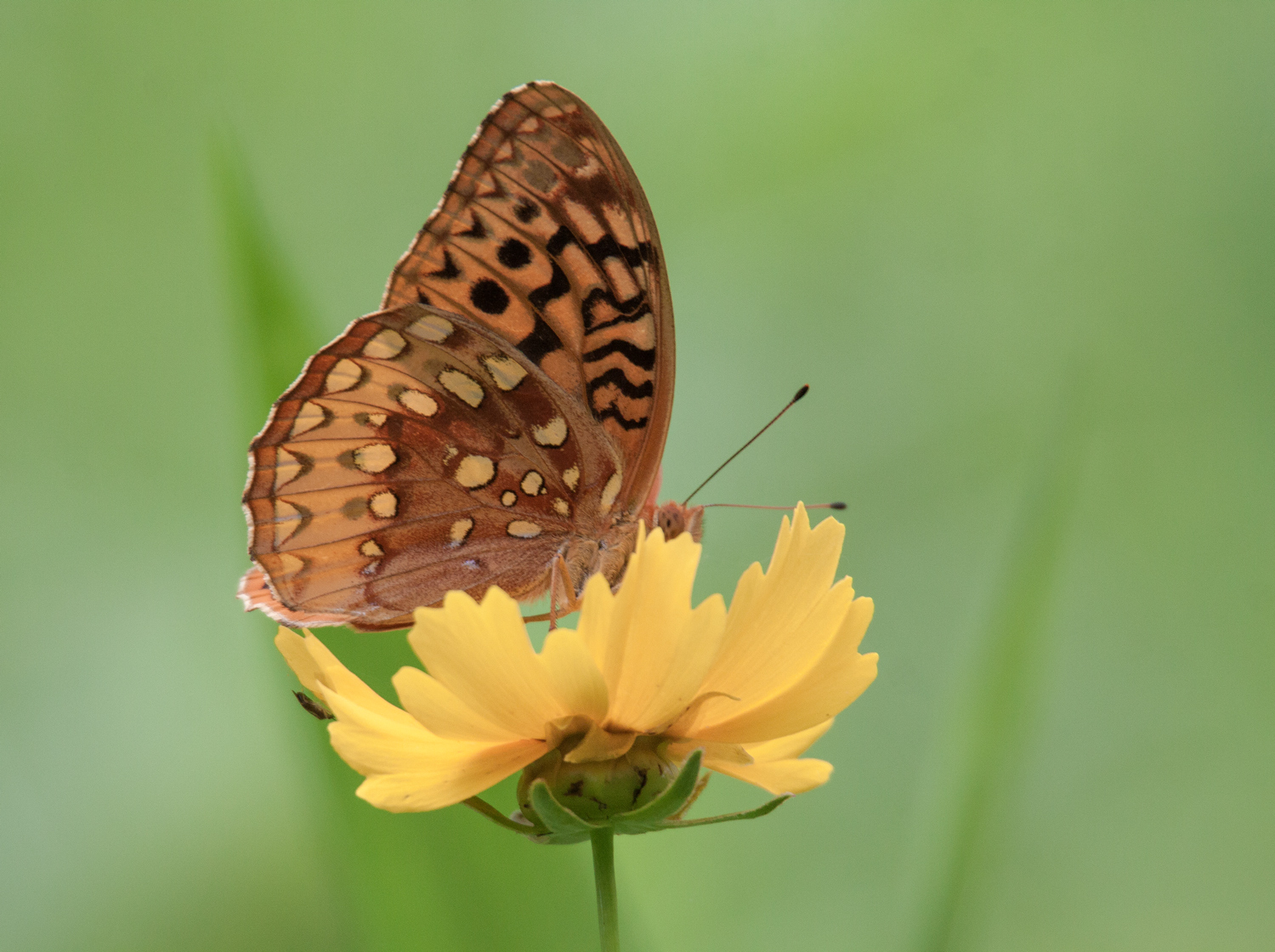
Eye to eye with a butterfly—it’s fun trying to capture subjects from different angles, in this case a Great Spangled Fritillary butterfly (Speyeria cybele) at Huntley Meadows Park in Alexandria, Virginia.

Great Spangled Fritillary

Great Spangled Fritillary

© Michael Q. Powell. All rights reserved.

Read Full Post »

As I was out searching for dragonflies in the heat of the midday sun, a butterfly came fluttering into view. I haven’t seen many large butterflies yet this spring, so I followed after it, trying to identify it. When the butterfly paused for a moment to feed on one plant, I scrambled to get a shot.

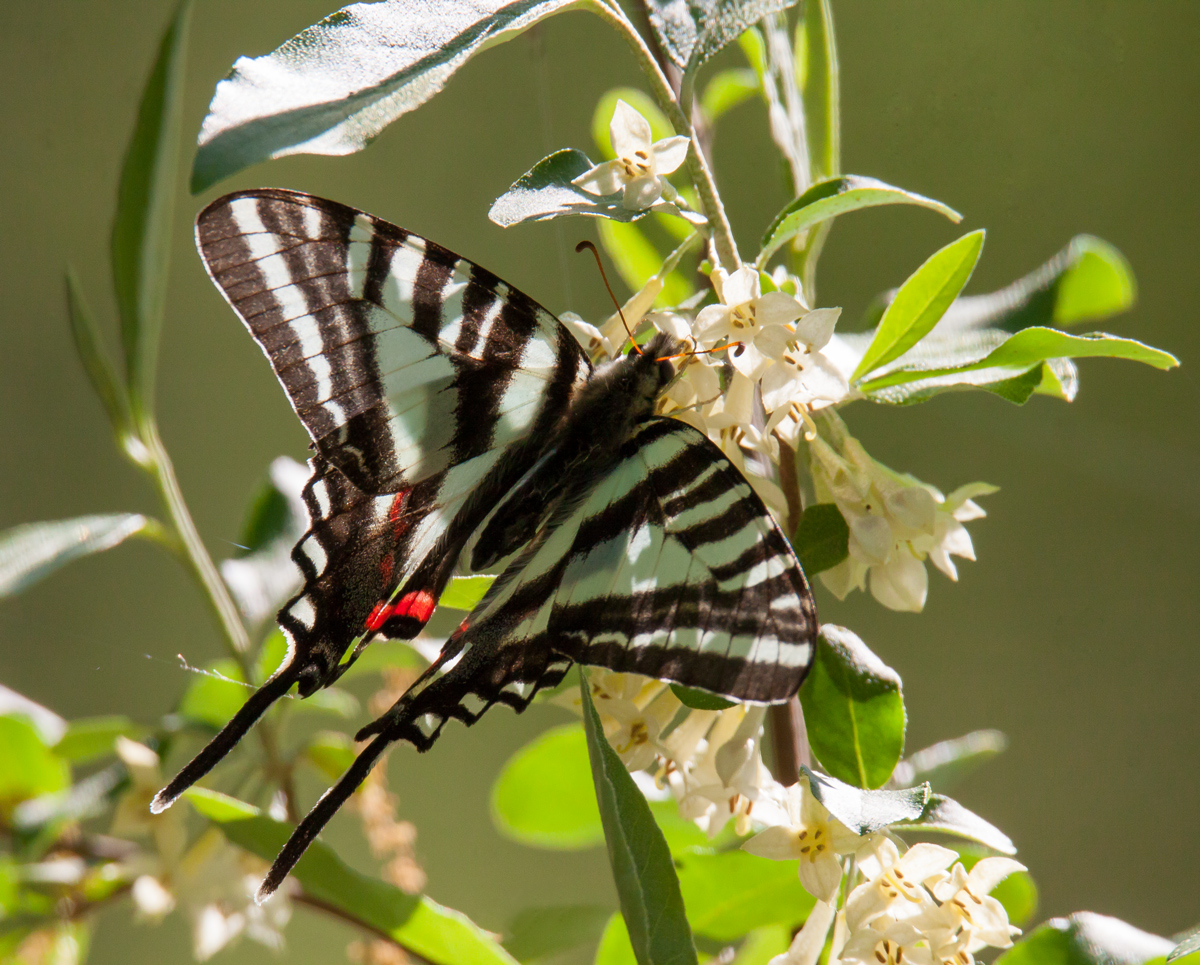
The light was harsh and coming from a bad direction, but my long telephoto showed me clearly that it was a swallowtail butterfly, but definitely not at all colored like the Eastern Tiger Swallowtails that I often see during the summer. The markings were distinctive enough that it was easy to determine later that it is a Zebra Swallowtail butterfly (Eurytides marcellus), a species that I had never before encountered.

Multiple sources indicate that the Zebra Swallowtail is closely associated with the pawpaw tree, though I don’t know enough about trees and blossoms to determine if that is the plant on which this butterfly was feeding.

As I was poking about on the internet, I also learned from ereferencedesk.com that in 1995 the Zebra Swallowtail was designated as the official state butterfly of Tennessee. I must confess that I didn’t know that states have official butterflies.

Zebra Swallowtail

© Michael Q. Powell. All rights reserved.

Read Full Post »

I don’t know if this Monarch butterfly (Danaus plexippus) migrated from the south or was a refugee from the indoor butterfly garden, but I was sure happy to see it this past Saturday at Lewis Ginter Botanical Garden outside of Richmond, Virginia. Monarch butterflies have been pretty scarce in this area the last couple of years.

Monarch butterfly

© Michael Q. Powell. All rights reserved.

Read Full Post »

Do you chase after butterflies? I do. There is a simple, uninhibited joy in running around a meadow in pursuit of a butterfly, waiting for it to perch, hoping to capture its beauty with my camera.

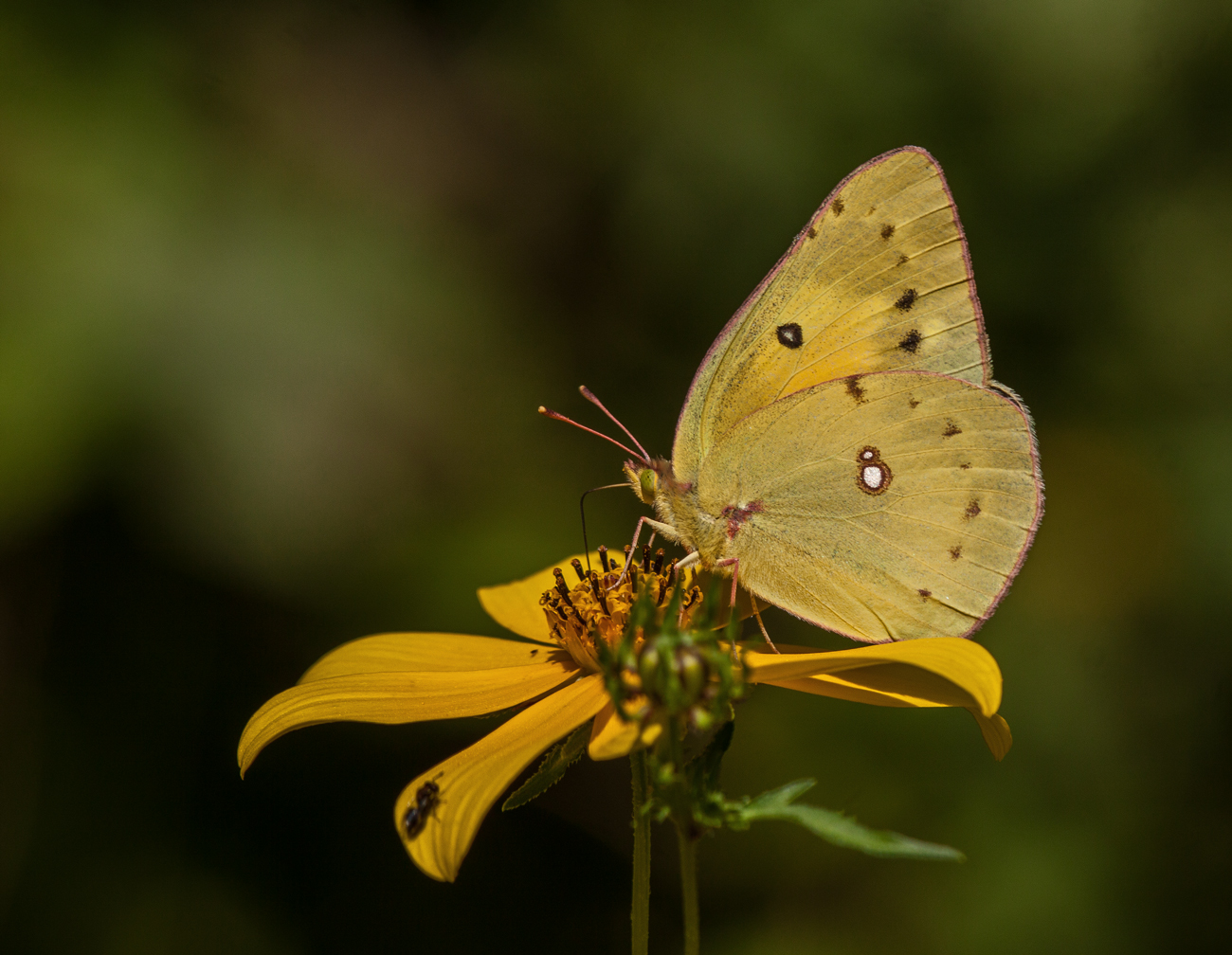
It’s still a little early for some of the larger, more colorful butterflies, but last week I was able to photograph this beautiful little Clouded Sulphur butterfly (Colias philodice).

Clouded Sulphur butterfly

© Michael Q. Powell. All rights reserved.

Read Full Post »

One of the butterflies that I observed this past weekend at the Franklin Park Conservatory and Botanical Gardens in Columbus, Ohio was this spectacular Blue Morpho (Morpho peleides), a species whose normal habitat is the tropical forests of Latin America.

In the past when I have visited butterfly exhibitions, I have found it amazingly difficult to catch this butterfly with its wings open, but this one was surprisingly cooperative and posed for a moment to let me get this shot.

Blue Morpho butterfly

© Michael Q. Powell. All rights reserved.

Read Full Post »

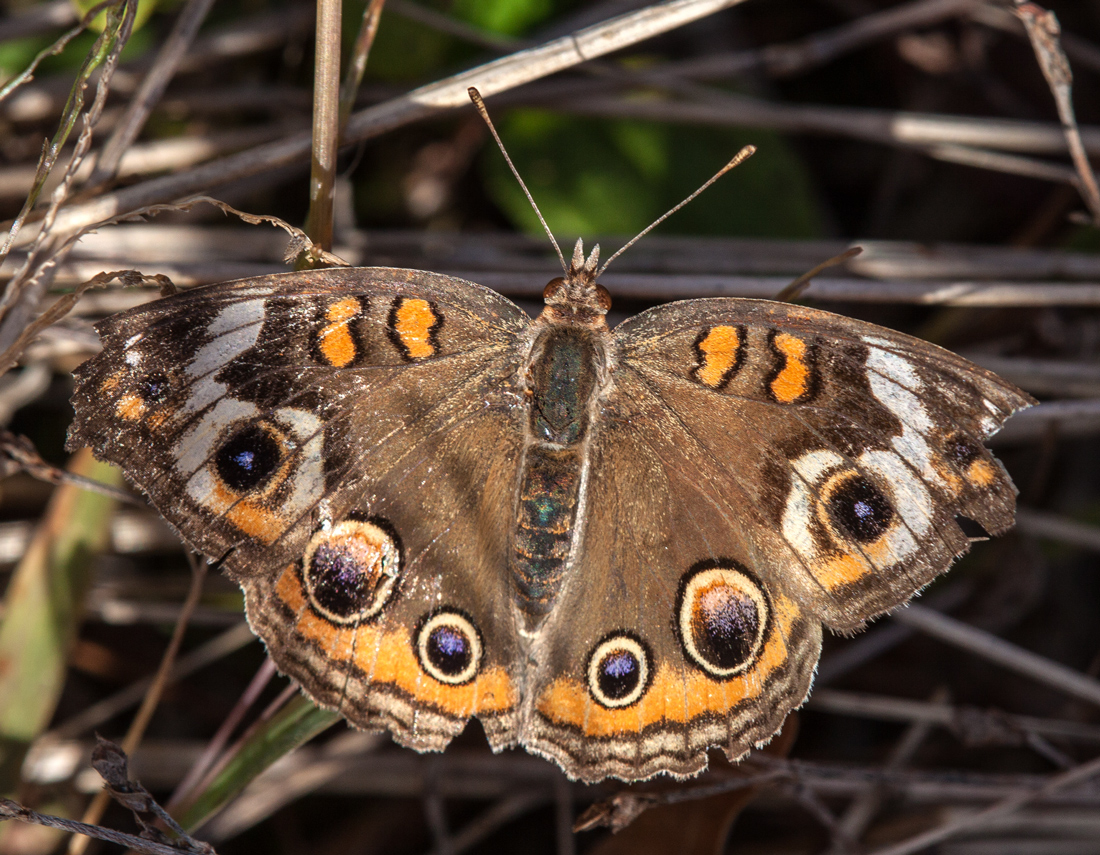
Butterflies in November? I didn’t really expect to see any, so it was a pleasant surprise when I came upon this Common Buckeye (Junonia coenia) on Monday at my local marsh. The butterfly is beat-up and bedraggled, but its beauty beams brightly—uncommon beauty at an unexpected time.

buckeye_nov_blog

© Michael Q. Powell. All rights reserved.

Read Full Post »

This re-posting is a bit of shameless self-promotion, but it is hard to describe how honored and thrilled I feel to be featured by Leanne Cole in a blog posting today. Leanne, who lives and works in Australia, is a wonderful photographer who spends a lot of time as a kind of photographic evangelist, sharing her passion for the art and practice of photography. She is constantly encouraging and teaching others, yet somehow seems to find time to explore new areas of her own photography, ranging from photographing the stars at night to investigating the close-up world of macro photography. Be sure to check out her incredible blog.

Read Full Post »

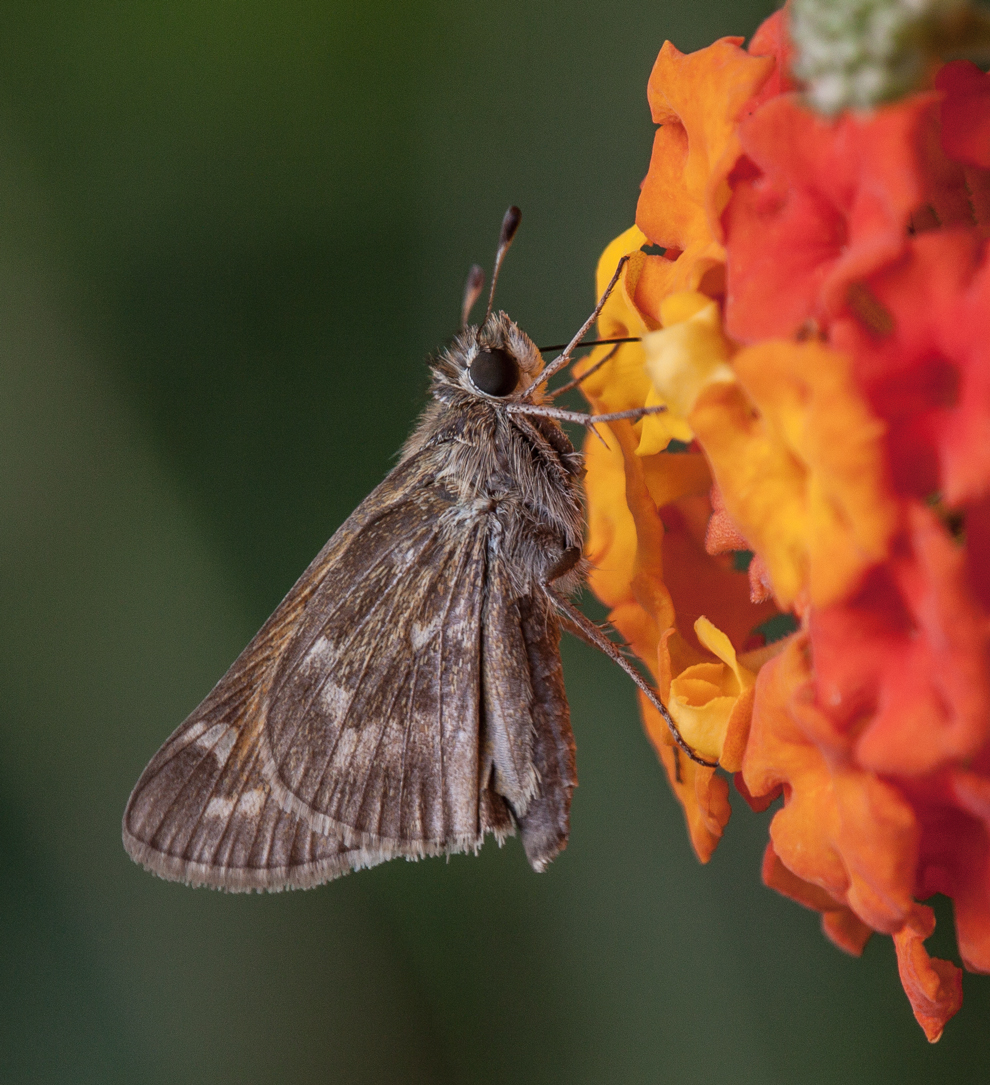
It’s a gray and gloomy day with intermittent rain—I feed the need for some color. This little skipper butterfly was busily at work last week on some very colorful flowers and I was able to catch him in action with his proboscis extended.

I am not sure what kind of skipper this is (there are more than 3500 species of skippers worldwide), but it looks a little like one that a reader identified for me as a Peck’s Skipper (Polites peckius). I must confess, though, that many skippers look very similar to me, so my identification is very tentative.

Capturing the butterfly with my macro lens was not too much of a problem, but I had a real problem in processing these shots because of some super bright highlights coming of the yellow flowers. I ended up darkening the highlights and desaturating the color in order to restore some detail to those flowers. I am not sure if I am happy with the results and might choose to process them differently another time. (The RAW images are still intact.)

skipper2_oct_blogskipper1_oct_blog

© Michael Q. Powell. All rights reserved.

Read Full Post »

There is perhaps nothing more ordinary than this, a simple Cabbage White butterfly (Pieris rapae) on a small white flower (which is possibly a weed), but the ordinary can be extraordinarily beautiful.

Cabbage White butterfly

© Michael Q. Powell. All rights reserved.

Read Full Post »

Strange as it seems, I have been seeing more butterflies in the waning days of summer than I did at its height. I think that this little beauty, which I spotted on Monday at my local marshland park, is a Clouded Sulphur butterfly (Colias philodice).

Clouded Sulphur

© Michael Q. Powell. All rights reserved.

Read Full Post »

I ran into a painted lady yesterday in a meadow at my local marshland park. No, I did not have a secret rendezvous with a tattooed female, but a chance encounter with this beauty, a Painted Lady butterfly (Vanessa cardui).

Painted Lady

The weather is getting cooler and the days are getting shorter, but as long as butterflies are still flying, it feels like summer to me.

© Michael Q. Powell. All rights reserved.

Read Full Post »

As this Great Spangled Fritillary butterfly (Speyeria cybele) moved about on a flower, the light hit it in different ways, beautifully illuminating its colorful wings.


© Michael Q. Powell. All rights reserved.


Read Full Post »

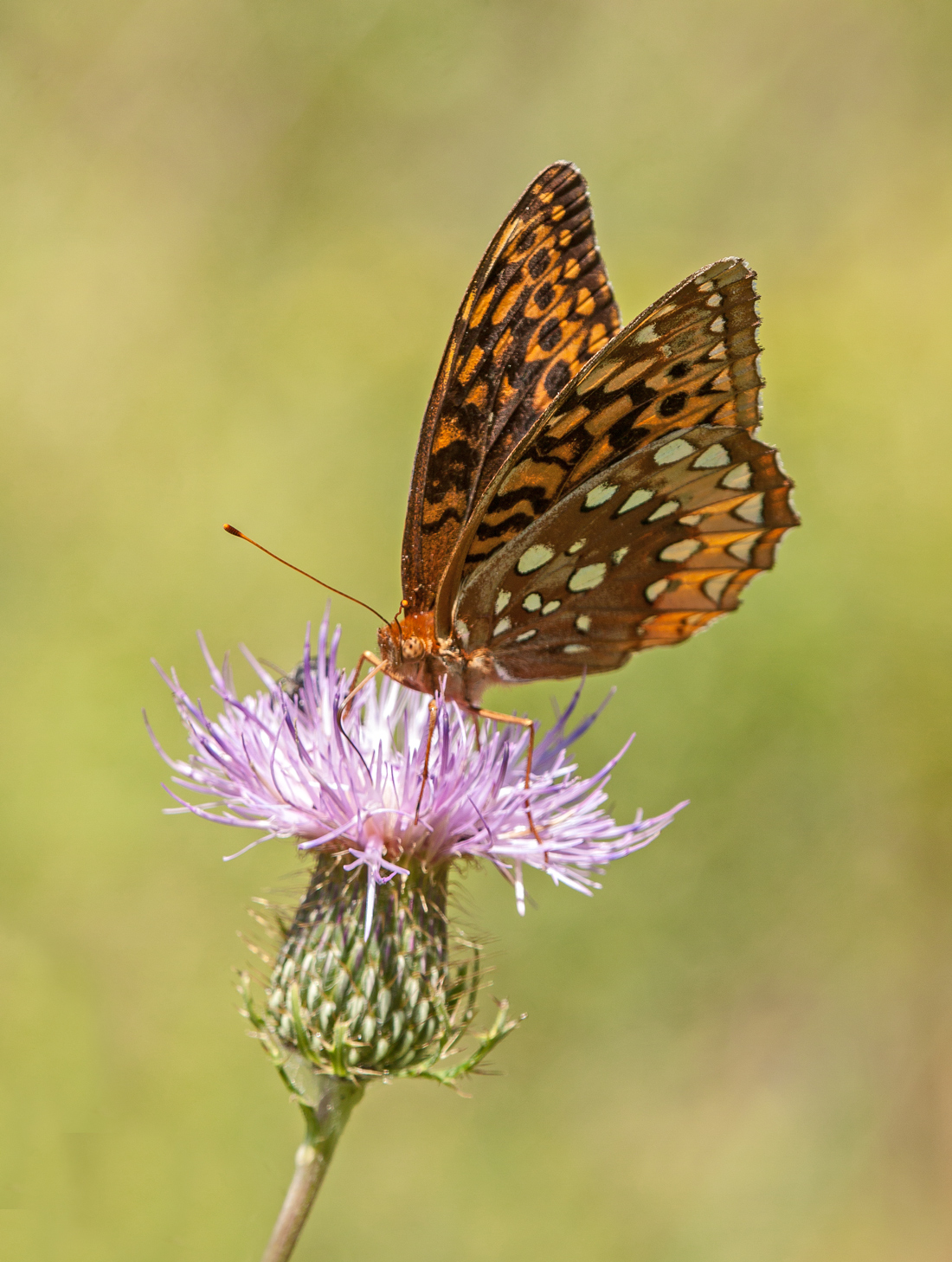
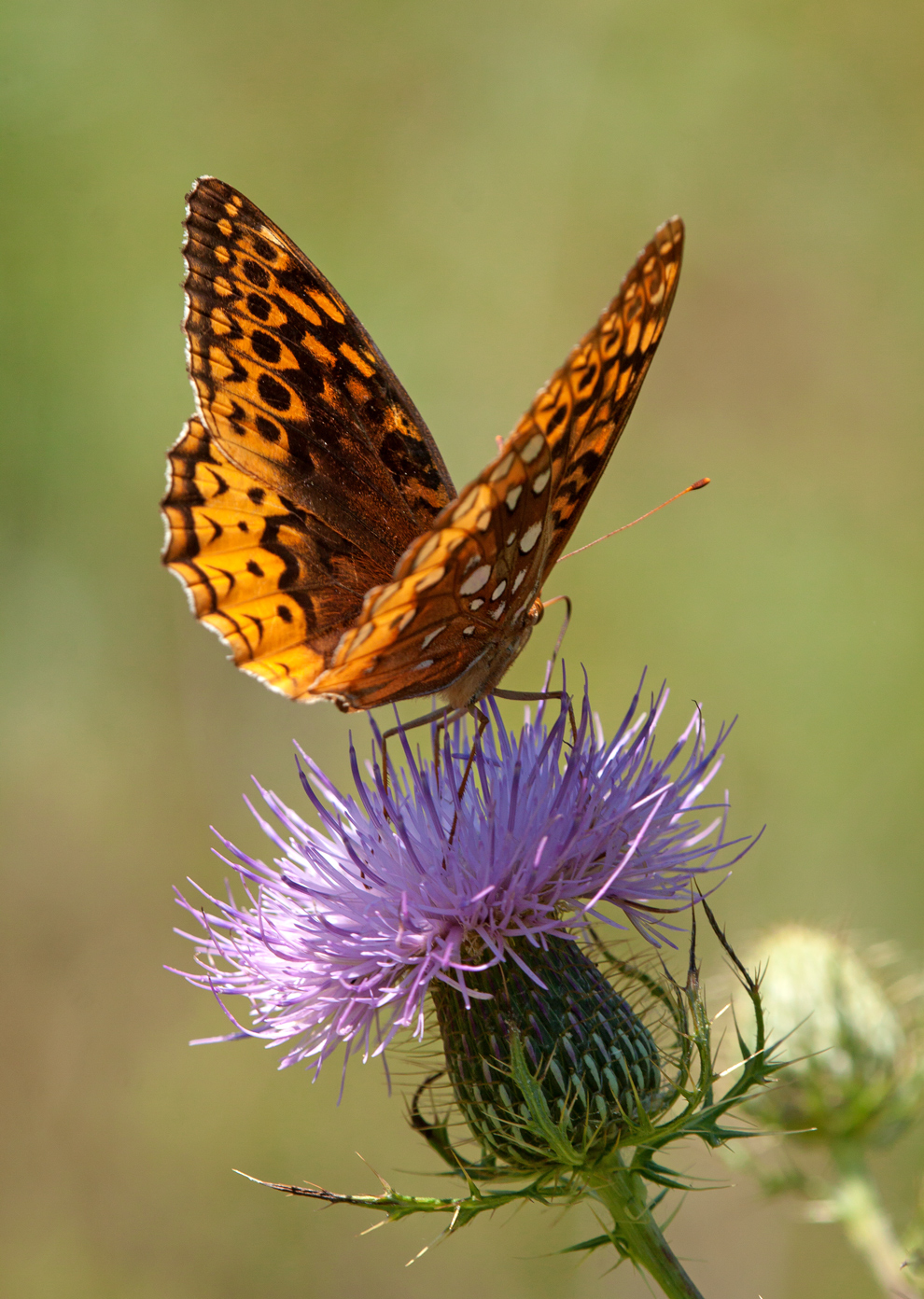
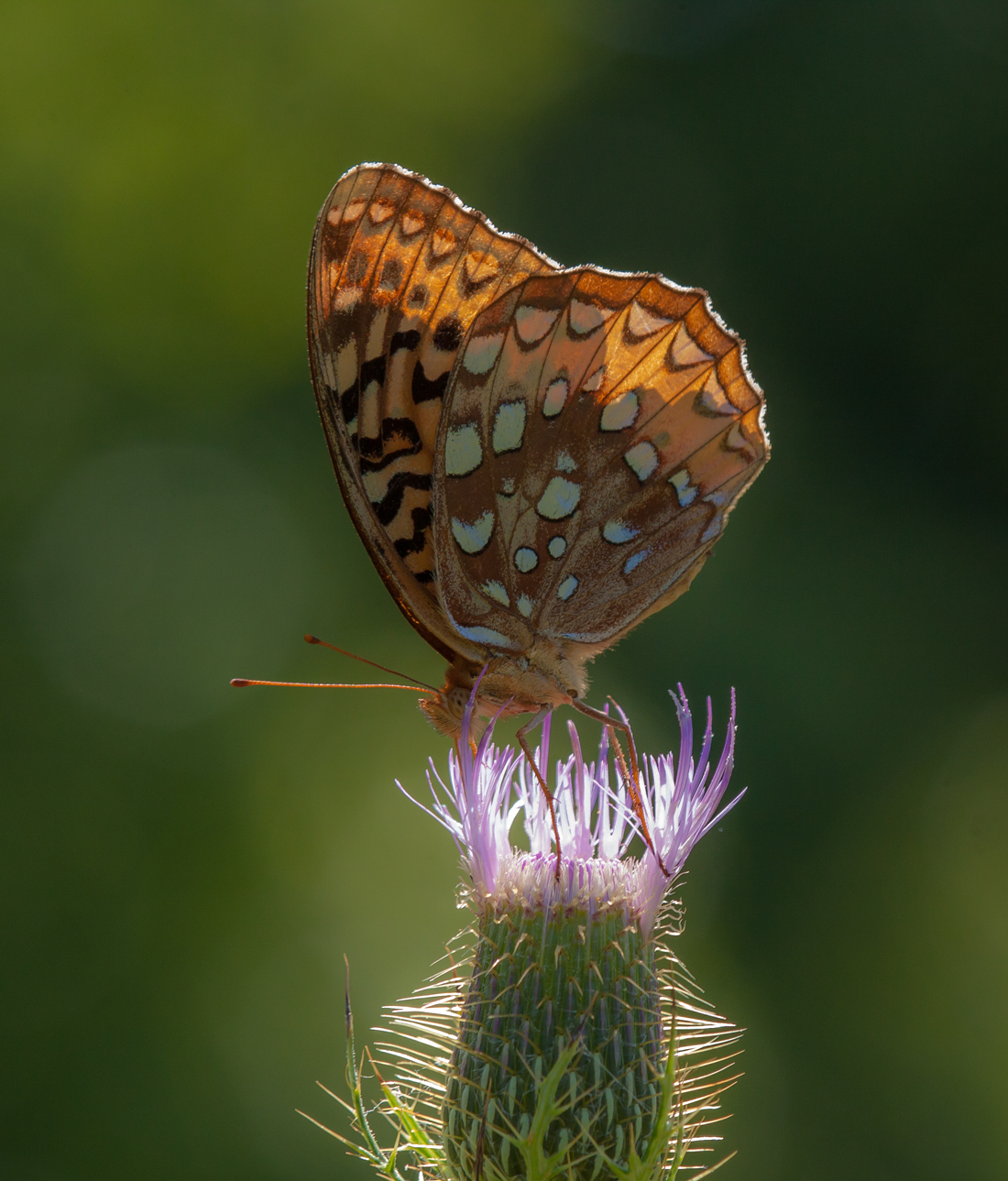
As I came out of the woods into a meadow at my local marshland park, I caught sight of some bright orange butterflies, which I could immediately identify as Great Spangled Fritillary butterflies (Speyeria cybele). The butterflies were concentrating their attention on a small cluster of plants which looked to be some kind of thistle.

I moved closer to get some shots, wading through the vegetation, which by this time of the summer is chest-high. I’ve already learned the hard way about the “joys” of chiggers and ticks, but I tossed my concerns to the side and boldly stepped forward. Fortunately for me, the butterflies were distracted with their feeding activity and did not fly away at my approach.

The sunlight was pretty strong and the look of the photo changed a lot as I circled around the butterflies, as you can see from the images below. I took a lot of shots, some of which I have not yet processed, but I was so happy with the images that I captured that I figured I better post some while it is still summer. Don’t be surprised if you see a few more images like this in the near future.

Great Spangled Fritillary

Great Spangled FritillaryGreat Spangled Fritillary

© Michael Q. Powell. All rights reserved.

Read Full Post »

Summer is not over yet. Sure, Labor Day has come and gone and school buses now clog my morning commute. In the elevator yesterday, I heard two ladies discussing whether they could still wear a white skirt to work. Leaves are starting to fall from the trees and are changing colors.

Despite these signs, I still defiantly proclaim that summer is not finished as long as I continue to see beautiful butterflies, like this Red-spotted Purple butterfly (Limenitis arthemis) that I spotted last Friday at my local marsh. The wooden board on which it is perched is not exactly photogenic, but I can’t complain too much, since these butterflies also have a fondness for rotting fruit and animal dung.

© Michael Q. Powell. All rights reserved.

Read Full Post »

While at Lewis Ginter Botanical Gardens in Richmond,Virginia last weekend, I visited the butterfly house. It was hot and really humid inside of the glassed-in conservatory, but it was worth it to be surrounded by all of the colorful, exotic butterflies. Normally, I try to identify the species that I photograph, but in this case I neglected to photograph the placards inside the butterfly house.  My brain is full enough trying to remember the species indigenous to my area, so perhaps viewers can forgive me and simply enjoy the delicate beauty of these amazing creatures.

Click on any of the tile to see all of the shots in slide show format.

© Michael Q. Powell. All rights reserved.

Read Full Post »

The few Monarch butterflies (Danaus plexippus) that I observed earlier this season were all in gardens, so I was especially happy when I spotted one this past weekend in the wild, feeding on some Swamp Milkweed (Asclepias incarnata) at my local marsh.

The little patch of Swamp Milkweed was a pretty good distance away, so I had to use the long end of my 70-300mm zoom for these shots. It looks like many of the flowers of the milkweed had not yet opened, but the butterfly obviously found it to be attractive enough to stop for a moment.

Monarch Butterfly Huntley MeadowsMonarch Butterfly Swamp Milkweed

© Michael Q. Powell. All rights reserved.

Read Full Post »

I used to think that there were only one or two varieties of black-colored swallowtails, but as I learned there were more such species (some deliberating mimicking each other), I’d sometimes get confused and frustrated when trying to distinguish among them.

For example, I encountered this beautiful black swallowtail butterfly feeding on a Cardinal Flower (Lobelia cardinalis) this past weekend at my local marsh. It is definitely an unusual circumstance when I can identify a flower, but not the insect.

So, I asked myself, is this a female Eastern Tiger Swallowtail or a Pipevine Swallowtail or a Spicebush Swallowtail or a Black Swallowtail? How can you tell them apart, given they are all black and all have swallowtails?

While searching on the internet, I came across a wonderful blog posting on a site called Louisiana Naturalist that compared all four of these swallowtail species and pointed out clearly the distinguishing marks. Once I looked at the posting, it was pretty clear that “my” butterfly is a Spicebush Swallowtail (Papilio troilus). Why am I so confident? One of the identifying marks is the blue comet-like marking that interrupts the inner row of orange spots.

It’s interesting to see this butterfly feeding on the Cardinal Flower. The website of the Lady Bird Johnson Wildflower Center at the University of Texas states that the Cardinal Flower depends on hummingbirds for pollination, because most insects find its long tubular flowers difficult to navigate. I suspect that butterflies play a role in pollinating these plants, even if they are not as efficient as bees would be (or maybe even hummingbirds).

Spicebush Swallowtail

© Michael Q. Powell. All rights reserved.

Read Full Post »

Can you name the most recognized Skipper butterfly in North America?  According to Wikipedia, it’s the Silver-spotted Skipper butterfly (Epargyreus clarus), like this one that I photographed recently at Brookside Gardens in Wheaton, Maryland.

I have been seeing a lot of skippers this month and many of them look so much alike that it is difficult for me to identify them  The Silver-spotted Skipper’s colors may be a little drab, but I am happy that it is easy to identify it, which makes me happy, given that there are over 3500 different species of skippers worldwide, according to a separate article in Wikipedia.

silver_blogsilver3_blog

© Michael Q. Powell. All rights reserved.

Read Full Post »

Last week I turned 60, but I am happy to confess that I still chase butterflies with much of the exuberance (if not quite the energy) of a child. There is something really special about the delicate beauty of butterflies that draws me in and the idea of their metamorphosis inspires me.

During a recent trip to Meadowlark Botanical Gardens in Vienna, Virginia, I was thrilled to spot this female Eastern Tiger Swallowtail butterfly (Papilio glaucus). She was feeding on an identified plant that must have been tasty, because she kept moving from spot to spot on the plant, offering me multiple opportunities to get some shots.

I especially like the fact that I was able to get the sky into some of the images, reinforcing for me the idea of butterflies flying freely and lightly through the open air. Now that’s the way to live a life.

swallowtail1_blogswallowtail2_blogswallowtail3_blogswallowtail4_blog

© Michael Q. Powell. All rights reserved.

Read Full Post »

Within minutes of my arrival at a garden in Maryland, I was able to photograph my first Monarch butterfly of the summer, but was also “treated” to the sight of the fattest, hairiest fly that I have ever seen, a true case of a beauty and a beast.

Brookside Gardens is a beautiful spot for photographing flowers and insects in Wheaton, Maryland in the suburban Washington, D.C. area. In one section of the garden, there is a section specifically planted to attract butterflies and it was in that area that I saw the Monarch butterfly (Danaus plexippus) along with more numerous Eastern Swallowtail butterflies.

I didn’t see a single Monarch butterfly last summer and feared that I might not see one this summer either, because of habitat issues in Mexico and the severe winter we experienced. I was therefore thrilled when I first caught sight of a Monarch and chased after them throughout the day at the garden.

monarch1_blog

My moment of joy was interrupted when I was buzzed by a very large fly. When it landed, I was startled to see that it was really plump and really hairy. Of course, beauty is in the eye of the beholder, but it would be tough to consider this beast to a a beauty. I poked around the internet in an attempt to identify this fly and it appears to belong to the genus Juriniopsis, though I can’t identify a specific species.

fly1_fat_blog

I continue to be fascinated by insects and at this time of the year you can usually find me chasing after them with my trusty macro lens, giving equal time to the beauties and to the beasts.

© Michael Q. Powell. All rights reserved

Read Full Post »

Chasing a nymph through the woods–it may sound like I was living out some fantasy as a character in Shakespeare’s A Midsummer Night’s Dream, but I was only running after a butterfly, a Common Wood Nymph (Cercyonis pegala).

As is usually the case, I had never seen this “Common” butterfly before, but the large, yellow-ringed eyespots on the forewings make it pretty distinctive and I had no trouble finding it in an on-line identification guide.

I chased after the butterfly for quite some time before it finally came to a stop and perched on a tree. I am not sure why, but the butterfly chose to perch upside down. When I processed my images, I couldn’t decided if I should flip the image 180 degrees or not. Ultimately I decided that the flipped image, which is the first one, looked more “normal.”

Which one do you think works better, the flipped image, i.e. the first one, or the one with the original perspective, i.e. the second one?

nymph1A_blognymph1_blog

© Michael Q. Powell. All rights reserved

Read Full Post »

A handsome little skipper feeds on a gorgeous purple flower and the result is simply beautiful.

skipper_purple_blog

© Michael Q. Powell. All rights reserved

Read Full Post »

As I search in vain for larger, colorful butterflies, I continue to be amazed by the beauty of the smaller ones, like this Clouded Sulphur butterfly (Colias philodice) that I observed last week at Green Spring Gardens in Alexandria, Virginia.

Generally I like my closest shots the best when I am shooting with my macro lens, but in this case, I think I prefer the first shot below, that I took from a bit farther back. I like the way in which you can see the shadowy representations in the background of the stalks of the same kind of floweras the one one which the butterfly is feeding.

clouded2_blogclouded1_blog

© Michael Q. Powell. All rights reserved

Read Full Post »

Small skipper butterflies don’t stand out as much as their larger, more colorful brethren, but they have an understated beauty that I find striking. It’s a daunting challenge, however, to identify them.

According to Wikipedia, there are more than 3500 recognized species of skippers worldwide, so I don’t feel too bad that my identification skills are weak in this area. As I looked through images on-line, I came across one identified as a Little Glassywing (Pompeius verna) that looks a bit like the one that I photographed, though my confidence level in this identification is pretty low.

I am confident, however, that I like the image I captured of the little skipper. There is a pretty good amount of detail, the background is blurred, and the leaves on which the butterfly is perched makes for an interesting pose.

UPDATE: A butterfly expert has definitively identified this as a female Sachem (Atalopedes campestris). Thanks to Joe Schelling and Jim Brock for their assistance in identifying this little skipper.

skipper1_blog

© Michael Q. Powell. All rights reserved.


Read Full Post »

« Newer Posts - Older Posts »