Feeds:
Posts
Comments

Archive for the ‘Birds’ Category

It was cold and windy on Friday, but the sun was shining, permitting me to take this portrait of a resting male mallard. The subject is ordinary, but the lighting was wonderful and the bright colors of his head and bill really pop, including in his reflection in the brown waters of the beaver pond. I even managed to capture a little catch light in his eye.

It’s exciting to take photos of extraordinary subjects, but most often I am content to try to reveal some of the beauty in the ordinary things that I encounter every day.

mallard_blog

© Michael Q. Powell. All rights reserved

Read Full Post »

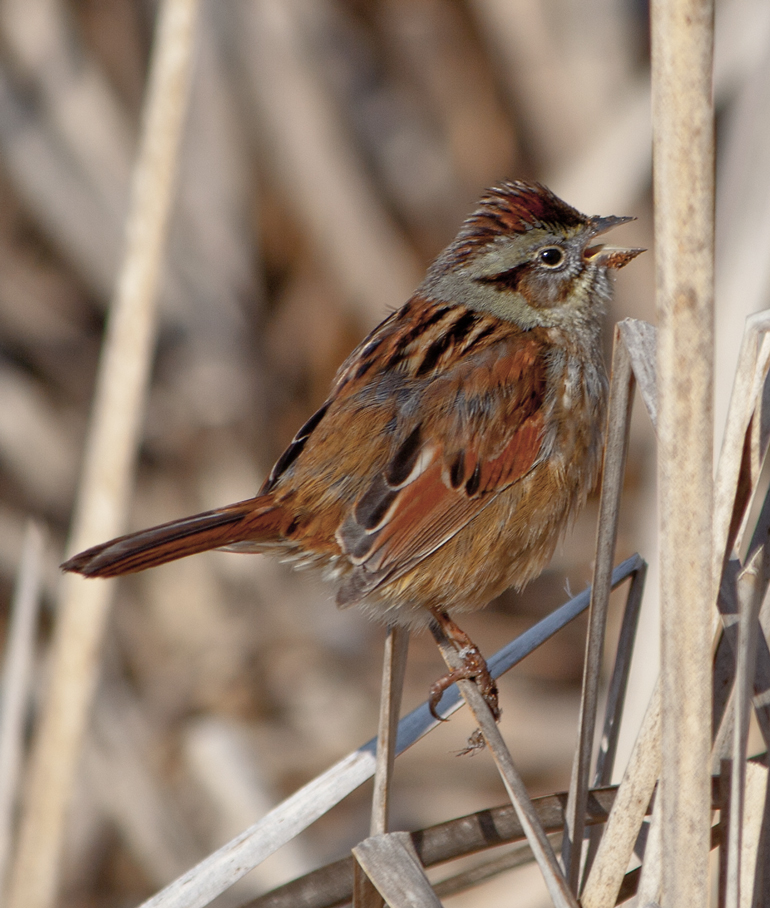
On days when no other birds are visibly active, I can always count on the sparrows to be hard at work, often accompanying their work with a song. As I watched, this sparrow (which seems to be either a Song or Swamp Sparrow) took a break from his activities and burst into song, as though compelled to share his joy and excitement with the rest of the world.

Wouldn’t it be great if we felt that way too and felt free enough to share it with others?

sparrow2_blogsparrow_blog

© Michael Q. Powell. All rights reserved

Read Full Post »

My curiosity turned to discomfort yesterday when I realized that the large bird diving in my direction was a Turkey Vulture (Cathartes aura).

In the past, the only Turkey Vultures that I had seen were soaring high in the sky, but this one got close enough for me to see his red head. As he got a bit closer, I realized that his angle of flight would take him farther away from me than I had initially thought. Just to be sure that he did alter his course and head toward me, however, I moved around vigorously to let him know that I was still alive.

You can never be too cautious when it comes to vultures.

vulture1_blog vulture2_blog© Michael Q. Powell. All rights reserved

Read Full Post »

As the insistent honking got louder, I scanned the horizon for approaching geese and saw none.

Suddenly a pair of Canada Geese swooped over a nearby treeline and headed right at me as I stood on the boardwalk at my local marshland park. They were closing so quickly that it was hard to get my focus to lock on. At the same time I also had to adjust my zoom lens. Normally I photograph birds at the far end of my 55-250mm zoom lens, but the geese were filling up so much of the frame that I had to zoom out.

This is my best shot from the encounter. The goose and I were able to look each other straight in the eye at that moment.  The background has a nice blur, because I was shooting at f5.6, and a fair amount of the goose is in focus. I like the goose’s position too as he strains forward in preparation for the water landing. (Click on the photo to see more details)

Incoming_blog

© Michael Q. Powell. All rights reserved

Read Full Post »

Why do some hawks fan their tails out when they are soaring and others don’t?

On an overcast day earlier this week, I was watching two hawks soaring through the air together, when I happened to notice that one of them kept his tail fanned out all of the time. His tail was so noticeably striped that I am pretty sure that he is a Red-Shouldered Hawk (Buteo lineatus).  The other hawk, however, never fanned out his tail. Looking at the wings of the two hawks, I think they are probably the same kind, although one of them looks to have a somewhat longer body.

So I am left wondering why, under the same  conditions, they each chose to us their tails differently.

doublehawk1_blogdoublehawk2_blog

© Michael Q. Powell. All rights reserved

Read Full Post »

Most of the time I like to focus on individual birds, but in this case I think I prefer this panoramic-style shot of Canada Geese coming in for a landing on a snow-covered field. The expansive white backdrop allows us to see better the different body and wing positions of the geese (and I recommend clicking on the photo to see the details).

The snow is now gone from Northern Virginia, a victim of warmer temperatures and heavy rains. For many readers, snow is much more an everyday reality of the winter, but it’s rare enough here that it has a special beauty (as long as I don’t have to drive to work in it, in which case I tend to forget its beauty and view more as a nuisance).

landing_blog

© Michael Q. Powell. All rights reserved

Read Full Post »

I have seen some rotund cardinals this winter, but this male Northern Cardinal has to be the roundest one yet. He looks a bit to me like an overinflated balloon figure. I saw him fly away, so I know he is airworthy, but I am pretty sure that his current shape produces more aerodynamic drag than usual.

On the other hand, maybe he is merely big-boned.

rounded_blog

© Michael Q. Powell. All rights reserved

Read Full Post »

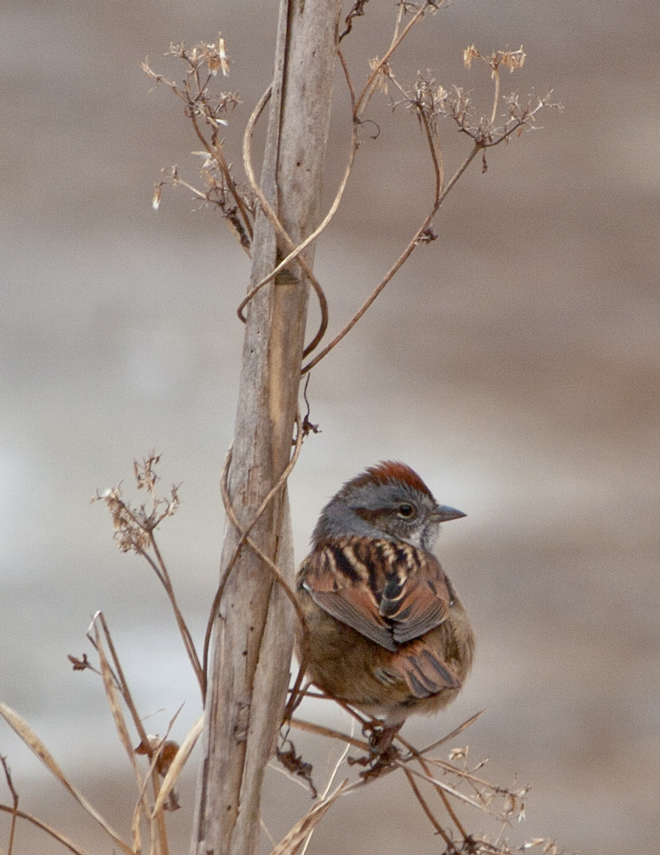
The crisscrossing pattern of the vine and the cooperative pose of the Song Sparrow combine to make this photo one of my recent favorites.

It is always exciting for me when the elements of an image work together in interesting and unexpected ways. I was attempting to photograph this Song Sparrow (Melospiza melodia) when he flew onto this stalk. He was facing away from me, but I kept shooting and them he turned his head. I am not sure that I could have intentionally come up with a more interesting pose—I love the way we are looking down his back and get to see his wings and also get a clear view of his face.

When I first looked at this photo, though, what caught my eyes the most were the crisscrossing vines, an unanticipated bonus. The X-shape of the vine is both linear and curved at the same time and I chose to crop the photo to highlight this feature.

One of the things that keeps me thrilled about photographing nature is the balance between preparation and spontaneity, between technical excellence and creativity. I try to put myself into situations outside in which I know there is a chance that I will see something interesting and then prepare myself (and my camera) to take advantage when something does happen (and it’s usually not what I anticipated).

sparrow_blog

© Michael Q. Powell. All rights reserved

Read Full Post »

When I saw a Wilson’s Snipe (Gallinago delicata) on Friday, I expected that it was a once-in-a-lifetime sighting and was really happy to have gotten some photos. I never imagined that I would see the bird (possibly the same one) the very next day in even better lighting conditions. I may eventually post some other photos, but I wanted to share this one in which he is visible against a snowy background that is mostly blown out. I think it helps to highlight some of the wonderful colors and textures of this long-billed shorebird.

Somehow the word “snipe,” which is used in all kinds of other contexts, doesn’t seem dignified enough for this beautiful bird, so I have taken to calling him the “Pinnochio bird”—for obvious reasons.

wilson_snow_blog

© Michael Q. Powell. All rights reserved

Read Full Post »

Simple in composition and simple in color palette, I find something really appealing about this photo of a male Northern Cardinal (Cardinalis cardinalis).

The backdrop is made up of the gray composite elements of the boardwalk that wends its way through the marshland area of Huntley Meadows Park in Alexandria, VA. The gray “wood,” with its horizontal and diagonal lines helps to give a little structure to the image.

The cardinal cooperated by cocking his head in an interesting way and giving me a sidewards glance. I believe that the red berry-like fruits are rose hips. The cardinals seem to enjoy eating the inside part of the fruit, but seem to discard most of its flesh. Several areas of the board walk are littered with these red remains.

cardinal_blog

© Michael Q. Powell. All rights reserved

Read Full Post »

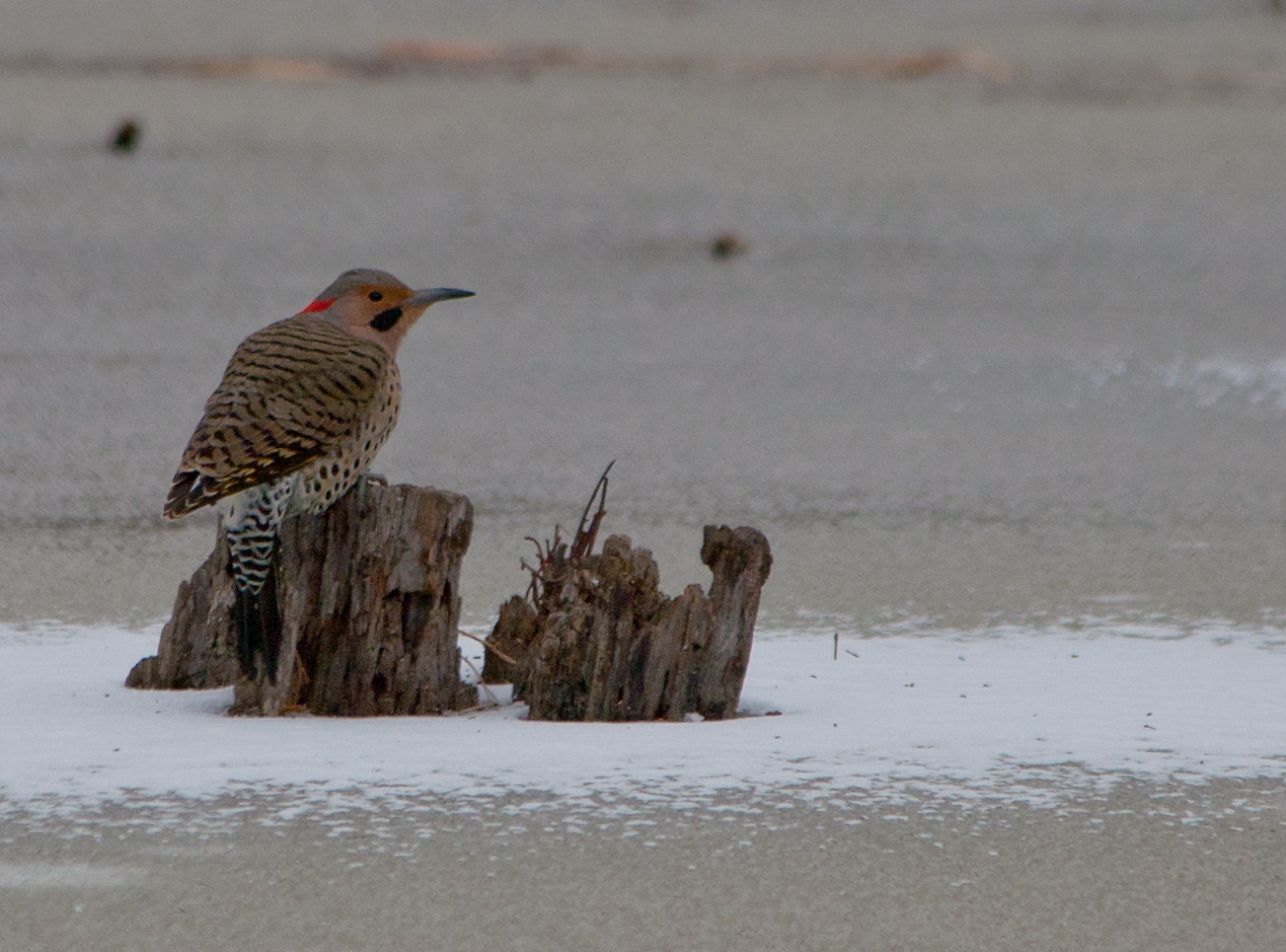
Against the backdrop of a frozen pond with a dusting of snow, the colors of this male Northern Flicker (Colaptes auratus) stood out even more brightly than usual yesterday morning. The flicker is perched on a rotted stump that is poking out of the beaver pond at my local marshland park.

I love the colors and the markings on this beautiful bird, who seems to be making a fashion statement by mixing stripes and polka dots and accenting the ensemble with touches of bright colors.

flicker1_blog

© Michael Q. Powell. All rights reserved

Read Full Post »

Yesterday I encountered the strangest-looking bird I have ever seen in the wild.

As I was marveling at the fact that some of the water surrounding the beaver pond at my local marshland park had not frozen despite multiple days of temperatures in the 20’s (minus 4-6 degrees C), I heard a sound in the water. Most of the birds that I had seen earlier in the day were sparrows, pecking away in the undergrowth, but it was clear that this was no sparrow.

The bird was standing in the shallow water and was bent over. When he withdrew his bill from the water, I was amazed at its length—it looked to be almost freakishly long. When I first looked at my images on the computer screen, I though of a recent posting of fellow blogger Calee in which she comment that an orchid she had photographed looked like a cartoon character. Truly, this bird looked like he could have been playing the role of Pinnochio.

I think that this bird is a Wilson’s Snipe (Gallinago delicata), judging from the information that I was able to find on the internet and in my Peterson’s guide. I really like the way that he blends in with the surroundings in which I found him.  The Cornell Lab of Ornithology lists some fascinating facts about the bird’s extra-long bill, “The long bill of the Wilson’s Snipe is flexible. The tips can be opened and closed with no movement at the base of the bill. Sensory pits at the tip of the bill allow the snipe to feel its prey deep in the mud.”

It’s a bit early for the mating season, but it seems that the family life of the Wilson’s Snipes is as  dysfunctional as that of some humans. According to the Cornell Lab, “The clutch size of the Wilson’s Snipe is almost always four eggs. The male snipe takes the first two chicks to hatch and leaves the nest with them. The female takes the last two and cares for them. Apparently the parents have no contact after that point.”

The range maps for this bird show that I am close to the northern edge of the wintering area for these migratory birds, so I am hoping that I’ll have a chance to see one again.

long_bill2_bloglong_bill1_blog

© Michael Q. Powell. All rights reserved

Read Full Post »

It was cold (about 24 degrees F or minus 4.4 C) this morning and the sky was completely covered with clouds as we awaited the coming snowstorm. Nonetheless, I went out with my camera to my marshland park to see what animals and birds were active.

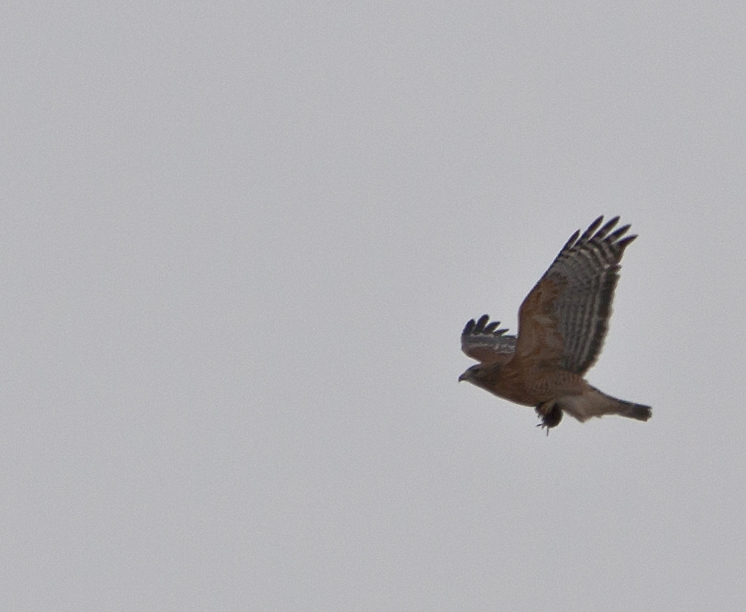
Previously I had identified a tree where a hawk is frequently present and one was there today. The perch is pretty high up and there is a field of cattails between the boardwalk and the tree, so I can’t get very close to the hawk. As I stood watching the hawk, he suddenly flew almost straight down into the field and returned to a different tree after what had obviously been a successful hunt. I attempted to photograph the action, but my camera was not adjusted properly for the reduced light in the field and my photos were blurry and out of focus.

All was not lost, however, because a short time later a hawk came flying from the same area and I was able to get some photos of him. When I looked at the photos on my computer, I discovered that the hawk, which I am pretty sure is a Red-shouldered Hawk (Buteo lineatus), is carrying  a rodent in his talons.

I am not sure why he chose to transport his prey to another location, but it provided me a really cool photo opportunity.

prey5_blog

© Michael Q. Powell. All rights reserved

Read Full Post »

This week I have been posting a lot of photos of soaring birds that I photographed last weekend. This last batch, which includes some of my favorites, features a young hawk soaring in a number of different positions. I was fortunate that he flew almost directly overhead and the light was reasonably good.

The strength and beauty of a bird like this is hard to capture in photos, but it was really impressive to watch him effortlessly soaring on the winds.

flight3_blogflight1_blogflight2_blogflight4_blog

© Michael Q. Powell. All rights reserved

Read Full Post »
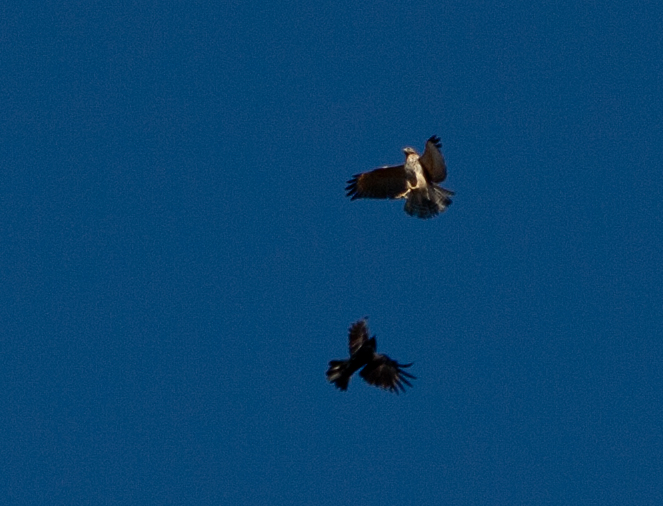
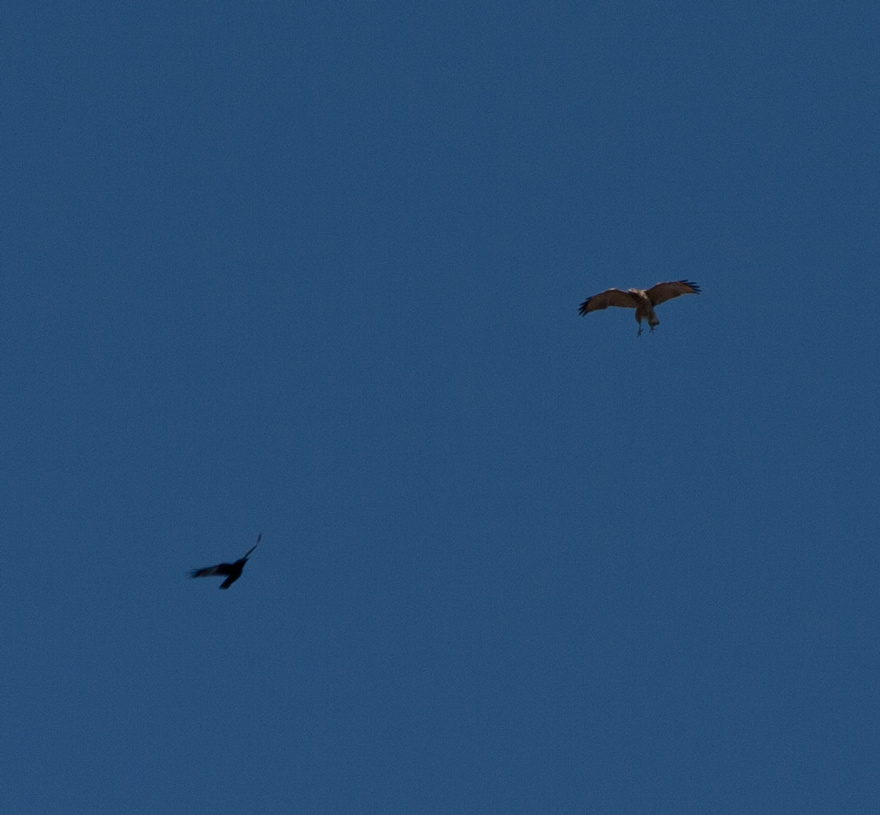
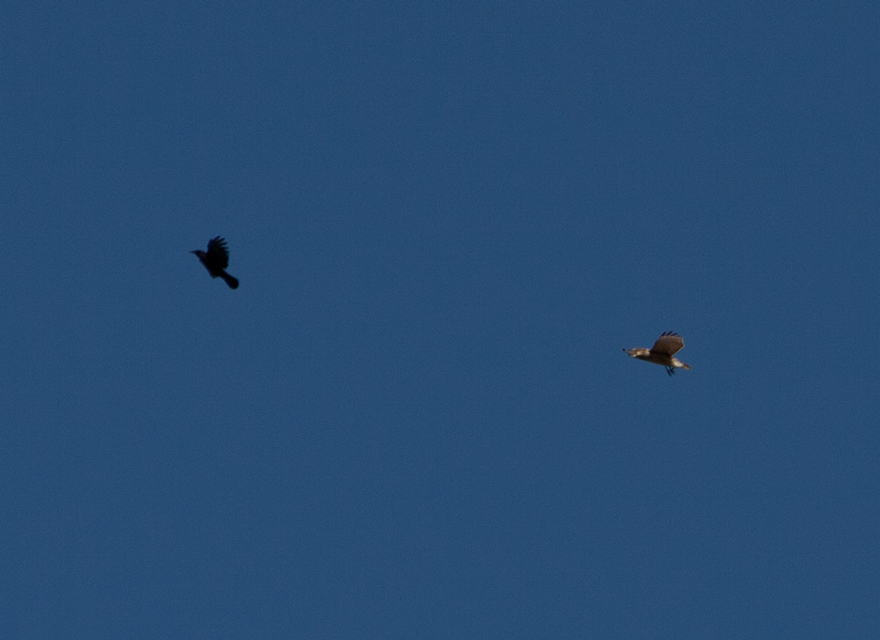
I was looking up in the sky watching a hawk soaring through the air this past weekend when I noticed that there was another bird there too, a black bird that I eventually identified as a crow. The two of them seemed to be soaring on the same updrafts, each virtually mirroring the movements of the other. My first thought was that they must be having a lot of fun, gliding along together. When I looked at my photos, though, I realized that a more serious drama probably had been taking place at high altitude.

chase5_blog

Now, I have never had a hawk come rushing at me with talons flashing, but the crow seems to have decided that it was probably not a good idea to wait around and see what the hawk’s intentions are. The hawk began to chase the crow, it appears, and the crow took immediate evasive action. As far as I can tell, the crow got away. Here are some shots that I took of the chase. They are not very high resolution, but they help illustrate a fascinating encounter.

chase4_blogchase1_blogchase2_blog

chase3_blog

Since last weekend when I took these shots, I’ve done some research on the internet and learned that crows and hawks don’t get along very well and each has been known to pester the other. I’ll keep my eyes open now for any additional encounters between the two species.

© Michael Q. Powell. All rights reserved

Read Full Post »

I was outdoors a lot this past weekend enjoying the beautiful weather and managed to catch a glimpse of a pair of Hooded Merganser ducks (Lophodytes cucullatus). As is usually the case, they headed in the opposite direction as soon as they perceived my presence.

I was able to get a couple of clear shots of the male (the female kept ducking under the water). I especially like the duck’s reflection in the water, which looked almost turquoise. and the ripples on the surface of the water.

merganser1_blogMerganser2_blog

© Michael Q. Powell. All rights reserved

Read Full Post »

This past weekend I saw more hawks than I have ever encountered before. I am not sure if some are migrating through the area or if the ones already here were more active than before.

This hawk, who looks to be immature, was sitting on a tree limb across a small field from me and I was able to get shots of him a few different positions. I need to figure out a way to get closer to him or use a longer lens in order to get clearer images, but I am still at a stage in my photographic journey at which I am excited to take any photos of hawks and eagles in which they are recognizable. As some readers are well aware, I have been trying to take photos of birds in flight and I managed one so-s0 image of this hawk when he flew away.

hawk4_blogHawk3_bloghawk2_bloghawk1_blog

© Michael Q. Powell. All rights reserved

Read Full Post »

The Black Vulture (Coragyps atratus) needs to improve its public image and what could be better in these times of economic difficulty than emphasizing its energy efficiency?  The Cornell Lab of Ornithology states that the Black Vulture “soars on thermals to gain altitude and to cover large distances with little energy expenditure.”

This past weekend we had warm weather and a breeze, which made it perfect for soaring. Normally I see Black Vultures very high in the sky and in groups, but this time I spotted a solitary vulture soaring at a a lower altitude, which permitted me to get some decent photos. The Cornell Lab notes that Black Vultures have a less well-developed sense of smell than Turkey Vultures and rely more on sight than smell to find carrion, which may be why they soar at greater heights than Turkey Vultures.

I propose that the Black Vulture become the new symbol for energy-saving practices. What do you think?

vulture1_blogvulture2_blogvulture3_blog

© Michael Q. Powell. All rights reserved

Read Full Post »

Have you ever tried to will a bird or animal to change its position slightly to enable you to get a better photo? That happened to me this weekend when I came upon this Northern Mockingbird (Mimus polyglottos).

I crept close to him and positioned myself for an unobstructed shot with a beautiful blue sky in the background. The only problem was that the mockingbird was facing the wrong direction and his head was in the shadows.

So I started a mental conversation with the mockingbird, imploring him to turn slightly in my direction so that the light coming from the right would put a catch light in his eye. I didn’t dare to get any closer and continued to repeat the thought, “Please turn your head toward me, but don’t look directly at me.” Without moving his body, the mockingbird slowly turned his head and offered me an almost perfect profile shot and held the pose.

I like the way his tail and his claws turned out, but most of all I like his face. I think the mockingbird would be happy with this portrait.

mockingbird_blog

© Michael Q. Powell. All rights reserved

Read Full Post »

I spent several hours on Sunday and Monday stalking a female Belted Kingfisher (Megaceryle alcyon). Does that make me a bad person?

I first encountered this beautiful bird a couple of weeks ago and was immediately smitten. Like a paparazzi photographer, I started snapping photos frantically when I saw her. I included some of those photos in a previous posting that I creatively entitled “Belted Kingfisher.”

Now I have started to hang out what I think are some of her favorite places, hoping desperately to catch a glimpse of her. She is still quite standoffish and won’t let me get close, but perhaps she will get used to having me around. Maybe she has commitment issues.

Here are a few shots from my recent encounters, including two in which I captured her as she was flying away.

For now, it is a classic case of unrequited love.

kingfisher1_blogkingfisher2_blogkingfisher3_blogkingfisher4_blog

© Michael Q. Powell. All rights reserved

Read Full Post »

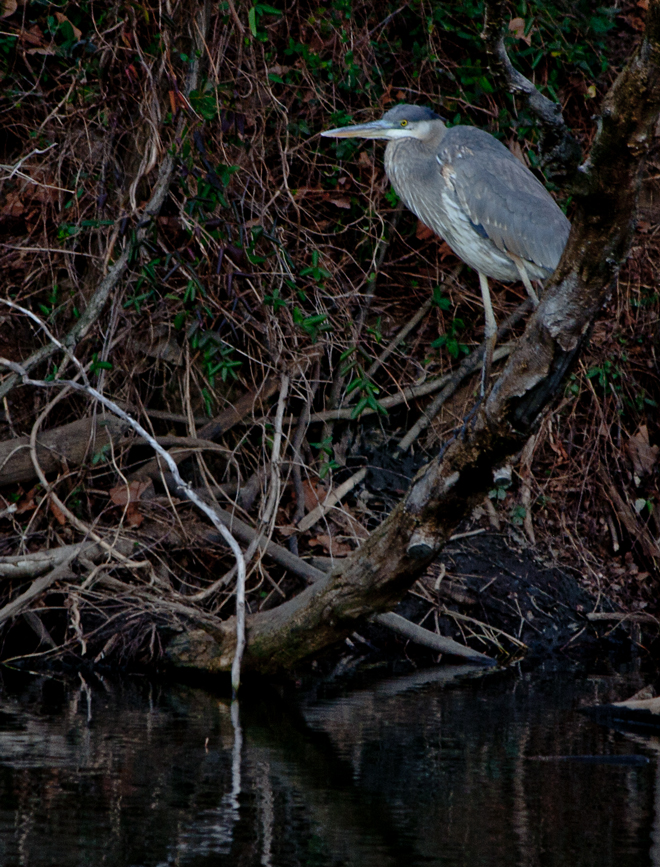
Yesterday I returned to the little lake near where I live in hopes of seeing the Belted Kingfisher again. As I was scanning the trees near the water’s edge, I caught sight of a Great Blue Heron.

Most of the time when I see Great Blue Herons, they are in the water. This one, however, seemed quite content to just stand in the shade of a tree on a slanted bank, surrounded by all kinds of roots and vines.

As I was inching my way down the slope of the opposite bank, he caught sight of me and took off immediately. Acting on instinct, I raised my camera to try to capture him in flight and lost my footing.  Sliding down the bank. I dug in my heels and managed to stop just before I reached the water.

Needless to say, I did not get any good shots of the heron’s departing flight.

GBH1_blog

© Michael Q. Powell. All rights reserved

Read Full Post »

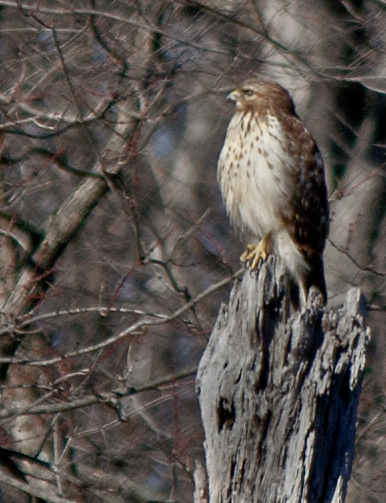
This past weekend I was fortunate enough to see a few hawks. I am still having trouble identifying the different types of hawks, especially when they are immature, as I think this hawk might be.

I spotted this one perched on the top of a old broken-off tree overlooking one of the fields of the marsh and was able to creep close enough to get a clear shot (although nor close enough to get an image that didn’t require significant cropping). For me, there is something regal about the hawk’s position, as though he is a monarch surveying his domain.

I have a few more shots of a hawk in a tree that I probably will post later, but wanted to share this one first.

stump_blog

© Michael Q. Powell. All rights reserved

Read Full Post »
Today when I was observing Canada Geese at Cameron Run, a tributary stream of the Potomac River, I noticed one goose that looked really different. His bill and his legs were pinkish in color, unlike his companions, who had black bills and legs; his cheek patch was brownish in color rather than bright white; and there was a black and white mottled area between his eyes and his beak.

I went searching through identification guides on the internet and it seems likely to me that this is a hybrid goose and not a separate species. One of the problems with hybrids, of course, is that there are lots of different combinations that are possible. I saw one photo that looked a little like this goose that was a probable hybrid of a Canada Goose and a Greylag Goose, but it was from the United Kingdom. Some of the photos of the dark morph of the Snow Goose also look a little like this goose.

If anyone has any ideas, I’d love to have assistance in identifying this goose.

strange_goose1_blogstrange_goose2_blogstrange_goose3_blog

© Michael Q. Powell. All rights reserved

Read Full Post »

After a week away from home in a far-off city, it was great for me to get back to nature. Somehow my senses seemed to be heightened yesterday as I took in the sights, sounds, and smells of the little marshland park that has become a second home for me.

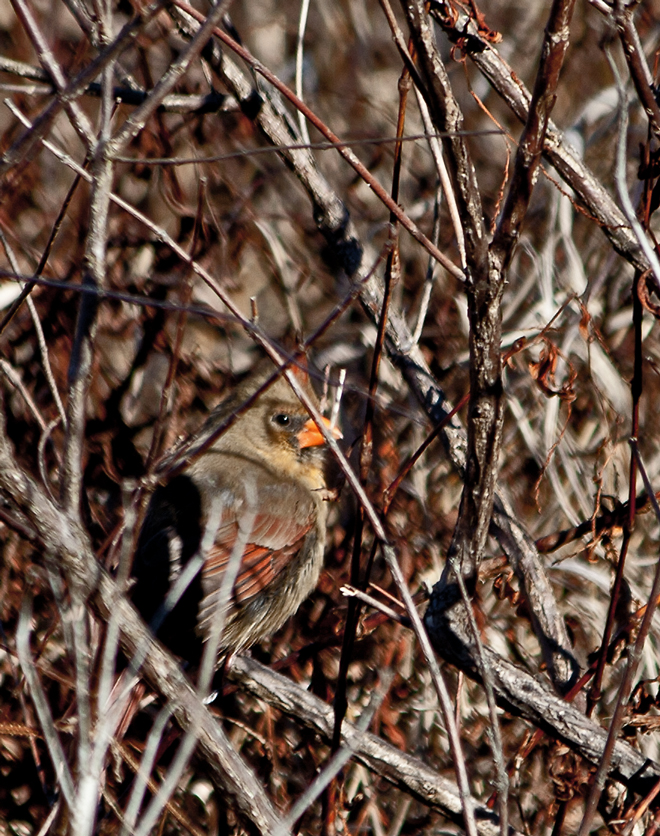
Even so, I almost missed this female Northern Cardinal, whose muted tones provided almost perfect camouflage for her in the vine-filled underbrush. A slight amount of movement and the bright orange color of her bill, however, were enough to permit me to see her despite all of the visual obstructions.

I realize that most people don’t get excited about photographing such ordinary subjects, but there was something comfortable and reassuring about returning to the familiar, like putting on a pair of my favorite jeans.

almost_blog

© Michael Q. Powell. All rights reserved

Read Full Post »

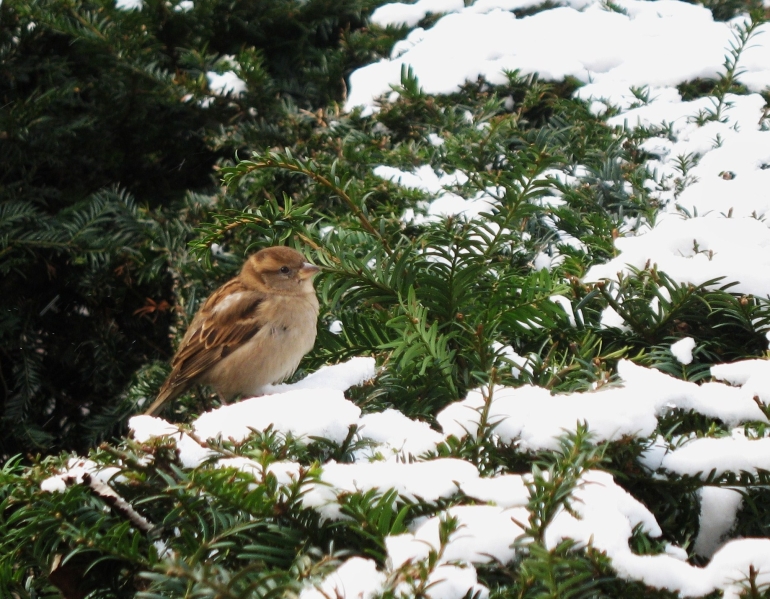
I have been photographing so many birds recently that one of my first thoughts upon arrival in Brussels yesterday was to look for birds. I did manage to get a few shots of some sparrows in a small park near the Central Train Station, the neighborhood in which my hotel is located. However, I quickly realized that the 4X zoom of my little Canon A620 is a limiting factor in getting close enough for a decent shot. I also know that at 7.1 megapixxels, I can’t afford to dramatically crop the photos.

I’m happy with these two images. I captured the first sparrow on a snowy evergreen bush. Snow may not be special to many, but my part of the USA has seen only a very small amount of snow this year. The second sparrow is perched on the railing surrounding the plants and is looking into them. I think he was singing so much that the bottom part of his beak is blurred.

I haven’t yet been able to identify these sparrows, but I wonder if they are different from the ones that I typically see in suburban Virginia.

Sparrow in Brussels

Sparrow in Brussels

Sparrow on a fence

Sparrow on a fence

© Michael Q. Powell. All rights reserved

Read Full Post »
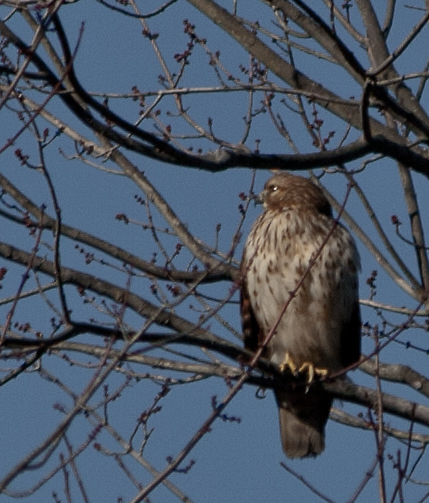
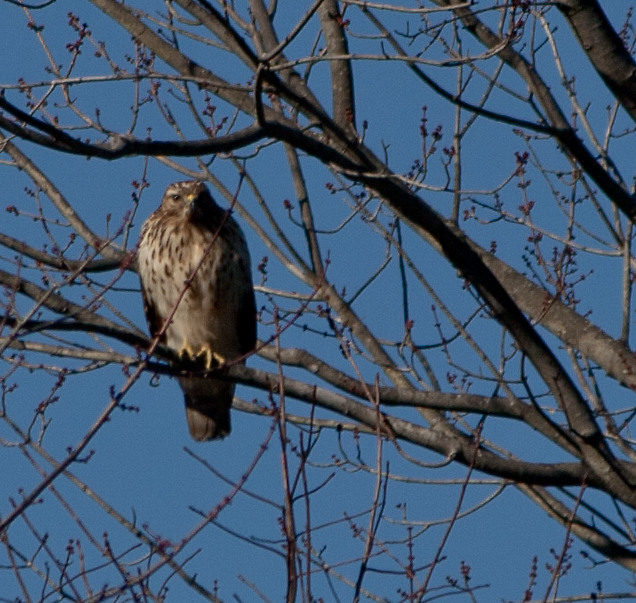
Yesterday I encountered this big bird in a tree and I’m pretty sure that it is a hawk, probably a Red-shouldered Hawk (Buteo lineatus). I was a happy that he was perched relatively low in the tree, so that I could get a relatively normal perspective view of his head and body. His coloration doesn’t match exactly any of the photo identification keys I looked at, so I am not one hundred percent sure of the identification. The photo is a bit soft and grainy, because of the distance and lighting, but I like that fact that I was able to get a relatively unobstructed view of this beautiful bird.

Hawk in a tree

Hawk in a tree

© Michael Q. Powell. All rights reserved

Read Full Post »

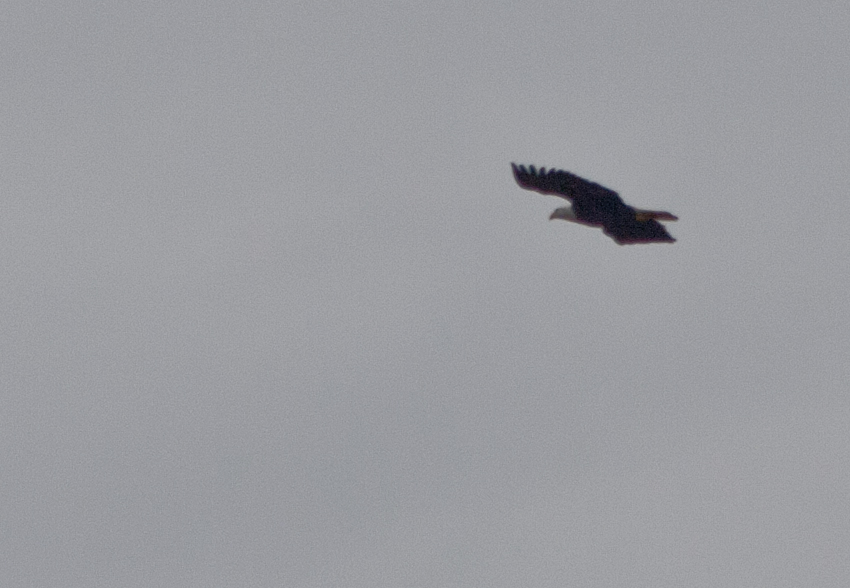
Yesterday I was observing ducks, geese, and gulls in one of the ponds at my local marshland, when suddenly they all took to the air. It seemed to me that something had spooked them and I quickly scanned the ground area and the water and found nothing. When I turned my eyes to the sky, however, I discovered a relatively large bird flying  across my field of vision in the distance

The day was dark and gray and rain clouds covered the sky, so the lighting was not very good. The poor lighting and the fact that the bird was so far away made it tough for me to lock on the focus of the camera, so I was able to snap off only a couple of shots before the bird disappeared completely in the distance.

The flight of the bird did not look like that of the vultures that I have photographed, so I thought that perhaps I had photographed a hawk, though it was hard to know for sure from the image on the little LCD screen of my camera. When I viewed the images on my computer, I was thrilled to discover that I had finally photographed a Bald Eagle (Haliaeetus leucocephalus). Maybe it’s because of the symbolism attached with the bald eagle—all I know is that I felt really happy with my discovery.

These two images are not really that clear and I hope to get better ones in the future. In many ways, I am continuing what I recognize as a pattern in my shooting. The first time I capture a new subject, I am so excited that I will share the image, irrespective of its quality. The second time, the quality of the image normally increases dramatically.

eagle2_blogeagle1_blog

© Michael Q. Powell. All rights reserved

Read Full Post »

Nowadays when I see a little brown bird, my first thought is that it’s probably some kind of sparrow. In this case, however, the beak seemed to be too long to be a sparrow, so I had to so some research. I’m pretty sure this pretty little bird is a Carolina Wren (Thryothorus ludovicianus). In addition to the beak, I was able to use the white eye stripe and uplifted tail as identification features.

In addition to the internet, I now have my first hardcopy identification guide, Peterson Field Guide to Birds of North America, a thank-you gift from friends for catsitting. I suspect that this may turn out to be the first of a series of guides that I’ll end up acquiring.

Carolina Wren

Carolina Wren

© Michael Q. Powell. All rights reserved

Read Full Post »
One thing that I have learned since I started watching birds is that birds seem to enjoy the company of other species of birds. In the past, for example, I might have assumed that a flock of birds was made up of a single species—now I know better. As a result, I’ve started to pay more attention to the individual birds in a group and determine if there are some that look “different.”

That was the case last weekend, when I was looking at a group of mallard ducks from a pretty good distance. One of them had a streak of bright white, which seemed unusual for a mallard. Clueless to what kind he might be, I took some photos, following my usual practice of “shoot first and ask questions later.” Returning home and doing a little research, I discovered that my mystery duck is a male Northern Pintail Duck (Anas acuta), a new species to me.

My first photo permits you to compare him with a mallard and it’s pretty obvious why he stood out. I like the way that he hold his long white neck upright in almost a military posture.

The second shot was my attempt to capture him in flight when he took off. My view was obscured a bit as I shot from a distance and the focus was not great, but I at least managed to catch him in flight. This is the kind of shot I aspire to shoot, so you’re getting to see my practice shots as I try to master the techniques of capturing photos of birds in flight.

pintail_blogpintail2_blog

© Michael Q. Powell. All rights reserved

Read Full Post »

It is not well known that geese are jealous of their water fowl colleagues, the swans, for all of the attention they get in numerous productions of Swan Lake. Geese consider themselves equally adept at dancing and have picked up regional folk dancing during their long migratory travels through numerous territories. In this photo, a goose is practicing a variation of a traditional fan dance (and it turns out that geese, unlike humans, don’t need any props for the fan dance).

dance_blog

© Michael Q. Powell. All rights reserved

Read Full Post »

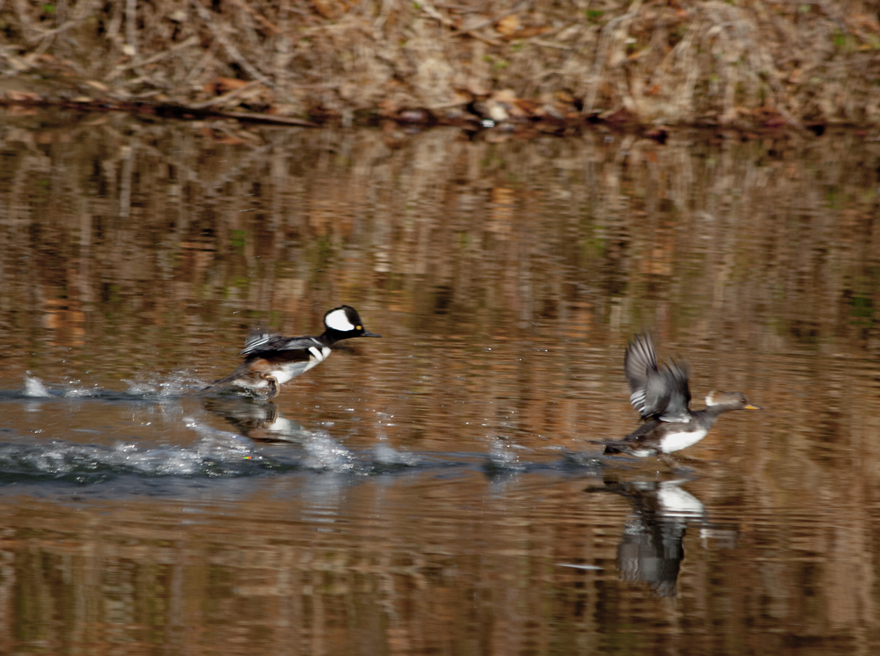
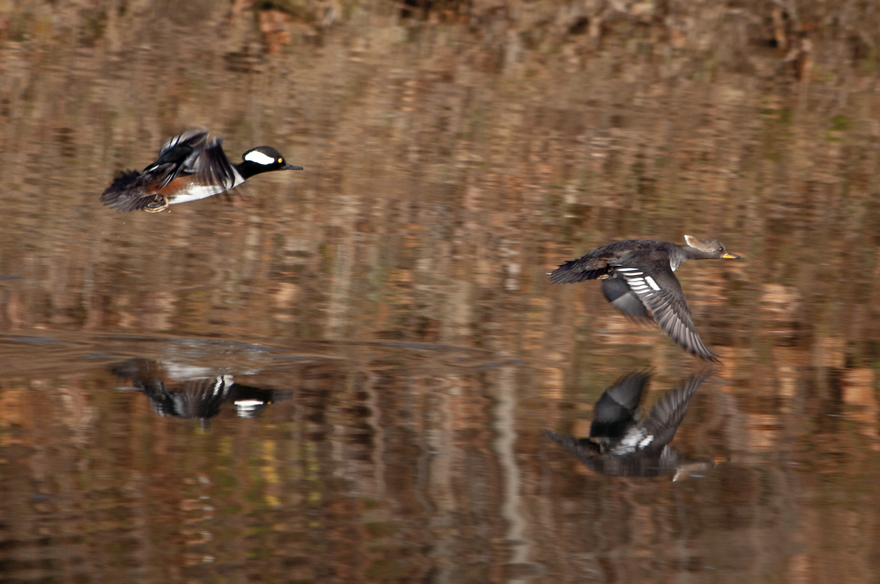
I stumbled upon a pair of Hooded Merganser ducks (Lophodytes cucullatus) at Lake Cook, a tiny urban lake, shortly after I photographed a Belted Kingfisher this past weekend. As soon I spotted them, they also became aware of my presence and immediately took evasive action. In most cases in the past, that has meant that they started swimming away. This time they seemed to have decided that more decisive action was needed and they immediately took off.

Fortunately my camera was already in my hands and the settings were about the right ones for the situation. When I started photographing birds, one of the more experienced birders whom I met recommended keeping the camera set for burst mode and that’s where I keep it most of the time now. Occasionally that means I shoot off a few extra exposures unintentionally when my trigger finger is a little heavy, but sometimes it lets me get an exposure I might not have gotten otherwise. Now, let me be clear that my almost ancient Canon Rebel XT is not a professional DSLR, so burst mode means about three frames a second, which worked out this time.

I fired off a half-dozen frames as the two ducks, a male and a female, took off from the water and I am pretty pleased with the results. It looks like the ducks get a running start on the water before they take to the air. The photo of the male duck that I featured at the start is the second one in the chronological sequence, but I thought it was the most interesting in showing the little water “explosions” as the ducks skipped across the surface. The rest are pretty much self-explanatory. I especially like the way that the heads flatten out into more aerodynamic shapes as the ducks start flying and the reflections are pretty nice. A couple of the shots are cropped to show only the male duck, because his position happened to bemore interesting than that of the female in the image (no discrimination intended).

Takeoff2_blogTakeoff1_blogtakeoff3_blog Takeoff4_blog

© Michael Q. Powell. All rights reserved

Read Full Post »

« Newer Posts - Older Posts »