Feeds:
Posts
Comments

Archive for the ‘Birds’ Category

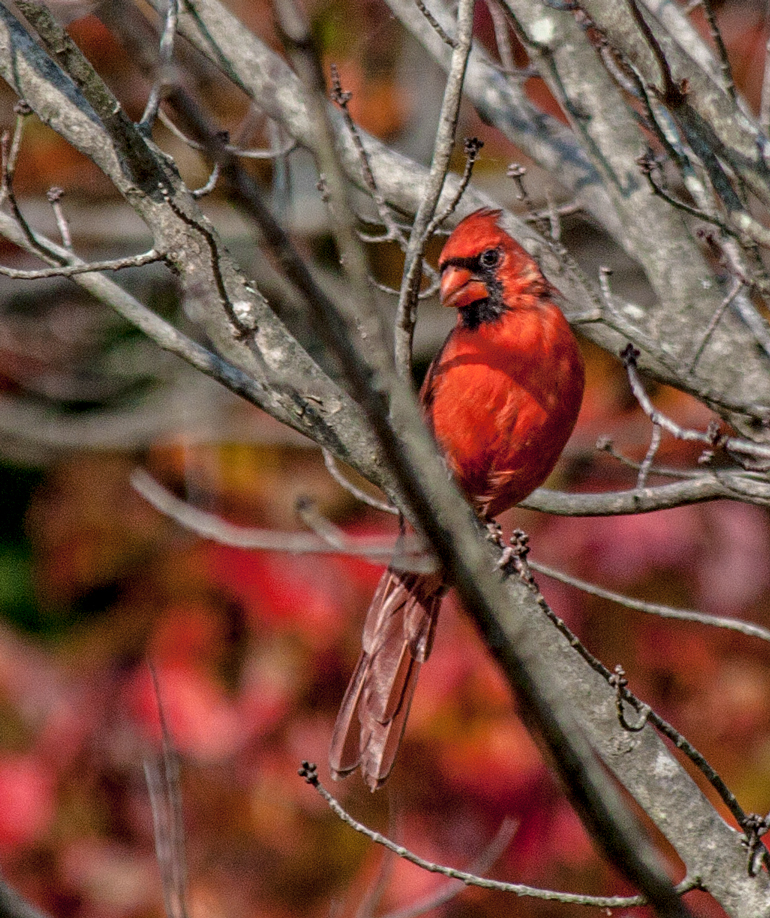
I love to photograph cardinals throughout the year, but I was really excited when I saw this male Northern Cardinal (Cardinalis cardinalis) land on a tree with colorful fall foliage in the background. There were a lot of branches, but I somehow managed to get a facial shot with an interesting expression.

The cardinal seemed to be staring at me, silently criticizing my behavior. It reminded me of the expression that parents sometimes adopt when they want to publicly communicate their displeasure to their offspring without uttering a single word.

cardinal_autumn_blog

© Michael Q. Powell. All rights reserved

Read Full Post »

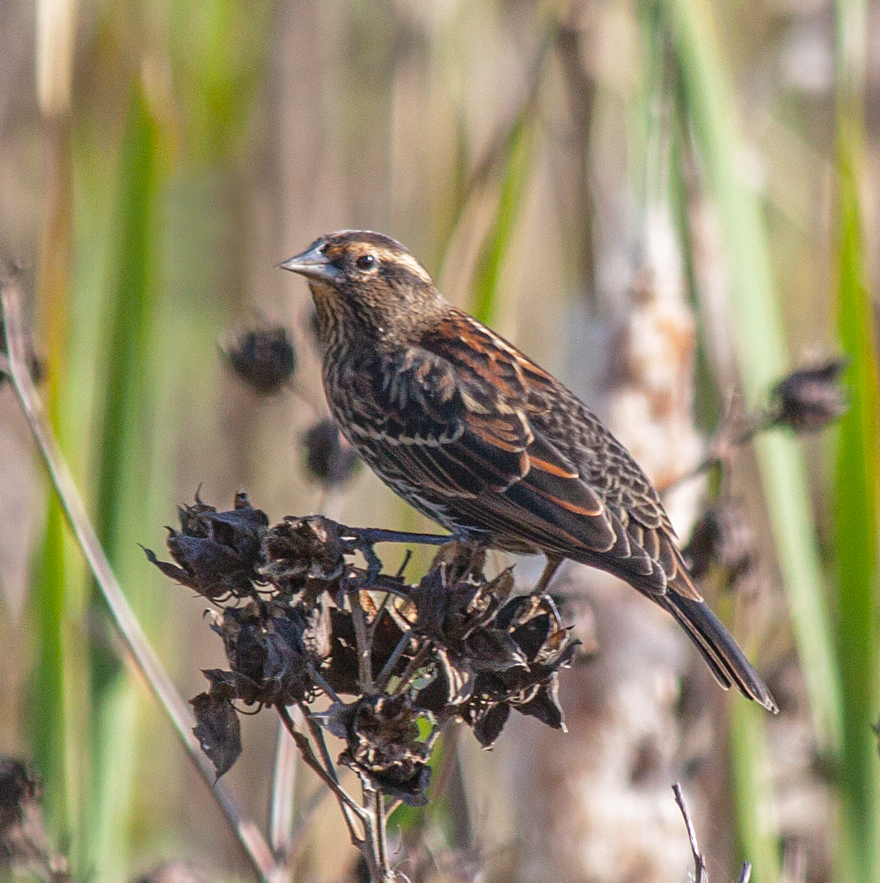
I remember well my confusion the first time that someone identified a bird like this one as a female Red-winged Blackbird (Agelaius phoeniceus). “How can it be a Red-winged Blackbird, when it’s not black and doesn’t have red wings?” I naively asked.

I have learned a lot since that moment and have resigned myself to the reality that the names of birds and insects are often not descriptive (or apply only to one gender of the species).

Female Red-winged Blackbirds seem to forage for food in the underbrush most of the time and I have found it to be harder to get a good shot of females than the males, which seem to like to perch and pose prominently on the cattails. This female lifted her head for a brief moment, permitting me to get this shot, and then quickly returned to work.

blackbird_female_blog

© Michael Q. Powell. All rights reserved

Read Full Post »

Out of the corner of my eye, I detected some movement and, glancing upward, caught sight of this Great White Egret (Ardea alba) flying almost directly overhead. Normally I see egrets in flight only when I spook them and prompt them to fly away from me.

The early morning light helped to illuminate the underside of this gorgeous bird, which is usually in the shadows, revealing some of the details of the feathers. It is always tricky for me to get the proper exposure with these very white birds and I was happy that I managed to avoid blowing out too many of the highlights.

As I recall, I was pointing the camera almost straight up for these shots and that provides an unusual perspective. In the second shot, for example, it almost looks like the egret is imitating a fighter jet and is flight straight up into the air.

egret_overhead1_blog egret_overhead2_blog

© Michael Q. Powell. All rights reserved

Read Full Post »

There seemed to be a lot of small birds in the trees this past weekend, mostly hidden in the foliage. I did manage to get a shot of this pretty little bird, which I think is a Red-eyed Vireo (Vireo olivaceus). The eye does not look as bright red as in some of the images that I see on-line of this bird, but most of the other characteristics seem to match pretty well.

We seem to be moving into the prime season for birds and my bird identification guide (I was given a Peterson Field Guide to Birds of North America by a dear friend) now has a prominent spot on my desk. Unlike some of the birders that I encounter, I don’t carry around a field guide when I am shooting—I don’t like to have my head buried in a book and potentially miss some action shots.

vireo_blog

© Michael Q. Powell. All rights reserved

Read Full Post »

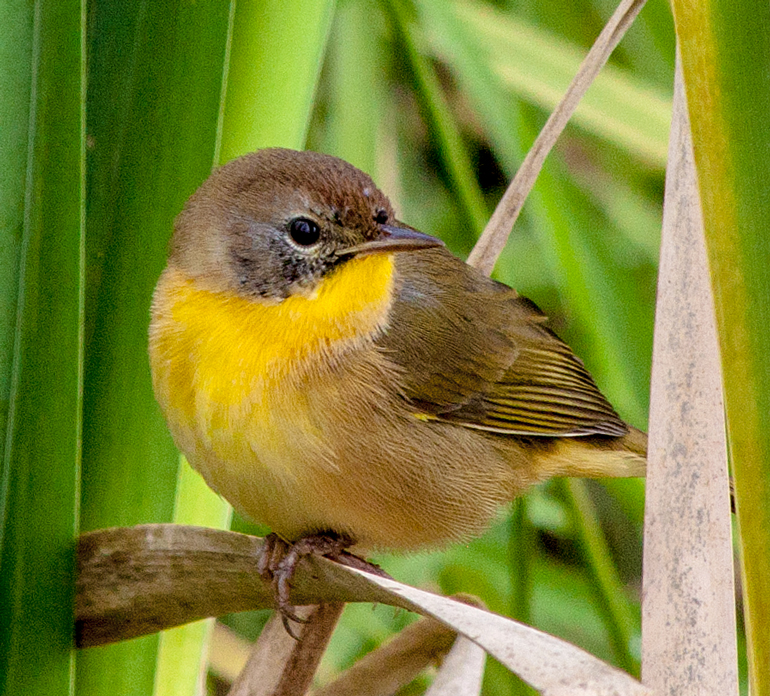
Glancing into the cattails, I caught sight of a flash of color and then gradually a bright yellow bird came into view. The tail was partially concealed by the cattails, accentuating the bird’s circular body shape (and everyone knows that the camera adds pounds to subjects).

I have done some internet searches and concluded that this is probably an immature male Common Yellowthroat (Geothlypis trichas). Adult male Yellowthroats are really easy to identify, because they have a prominent black mask. Like many bird species, however, young male Yellowthroats look a lot like the females, but gradually develop the mask. It looks to me that this bird may have the first traces of such a mask.

The lighting and camera settings combined to produce images that I really like, with colors that are beautifully saturated. I need to figure out how to replicate this look.

yellowbird_blogyellowbird2_blog

© Michael Q. Powell. All rights reserved

Read Full Post »

When a scope-toting birder told me that there was a cuckoo in a tree in the distance, I had not idea what to look for. My parents had a German cuckoo clock when I was growing up and somehow I thought the cuckoo would look like the little bird that popped out of the clock each hour.

I could see the white breast of the bird, so I pointed my telephoto lens at the tree and focused as well as I could. I had to crop quite a bit, but the bird I photographed is definitely identifiable as a Yellow-billed Cuckoo (Coccyzus americanus). What shocked me the most was the length of the bird’s tail. According to my birding guide, this cuckoo is about 12 inches (30 cm) in length.

According to the Cornell Lab of Ornithology, these birds like to eat large quantities of hairy caterpillars. Those readers who follow my blog know well that there have been lots of hairy caterpillars recently at my local marsh, so it makes a lot of sense that these birds would be present.

The background in the image is cluttered, but I like the bright colors of the autumn leaves, so I am not bothered by it, particularly because they do not conceal very much of the cuckoo.

cuckoo_blog

© Michael Q. Powell. All rights reserved

Read Full Post »

Whenever I see large birds soaring in the sky, I will try to get photos of them. Often the birds turn out to be vultures, but this weekend I managed to get this shot of a Bald Eagle (Haliaeetus leucocephalus). Any day when I can get a shot of an eagle is a successful day of photography.

The bald eagle was far away and my zoom lens maxed out at 300mm, but the resulting image is still recognizable, especially if you  look at it in higher resolution. As I get more experienced with birds, I am starting to look at features like the position of the wings, which, in this case, immediately make this bird recognizable as a bald eagle. I am very much in awe of experienced birders who can identify a bird quickly and accurately from the shape of its bill, the markings on its wings, or even its call. I am pretty confident that I will never reach those levels of expertise.

There are lots of signs of the changing season—for me, it’s the switchover from a macro lens to a telephoto as the default lens on my camera when walking around in a natural environment and birds start to replace insects as my primary subjects.

eagle1_blog

© Michael Q. Powell. All rights reserved

Read Full Post »

The early morning light from the side illuminated the bright fall leaves and the equally bright red male Northern Cardinal at my local marsh this past weekend.

cardinal_fall_blog

© Michael Q. Powell. All rights reserved

Read Full Post »

Yesterday I noticed several small flocks of blackbirds swooping in and out of the cattails at my local marsh and suspect that they are migrating birds. The marshland park seems to be favorite stopping-off spot for all kinds of birds as they move south.

I managed to get his shot of one of a male Red-winged Blackbird (Agelaius phoeniceus) in a rather typical pose on a cattail stalk. Unlike in the spring, when males seem to spend a lot of time calling out to potential, the blackbirds yesterday seemed to be much more focused on foraging for food.

blackbird_fall_blog

© Michael Q. Powell. All rights reserved

Read Full Post »

Yesterday I went shooting on Theodore Roosevelt Island, a small nature preserve in the Potomac River, just opposite Washington D.C.  that is accessible by a small bridge from the Virginia side and got this shot of a Great Blue Heron (Ardea herodias). The heron took off when I got a little too close to it.

One of the interesting problems of shooting in an urban environment is that it is hard to control the background. The long shape behind the heron is a one-man crew scull. If I hadn’t cropped the image, you would have been able to see the brightly clothed rower.

heron_potomac1_blog

© Michael Q. Powell. All rights reserved

Read Full Post »

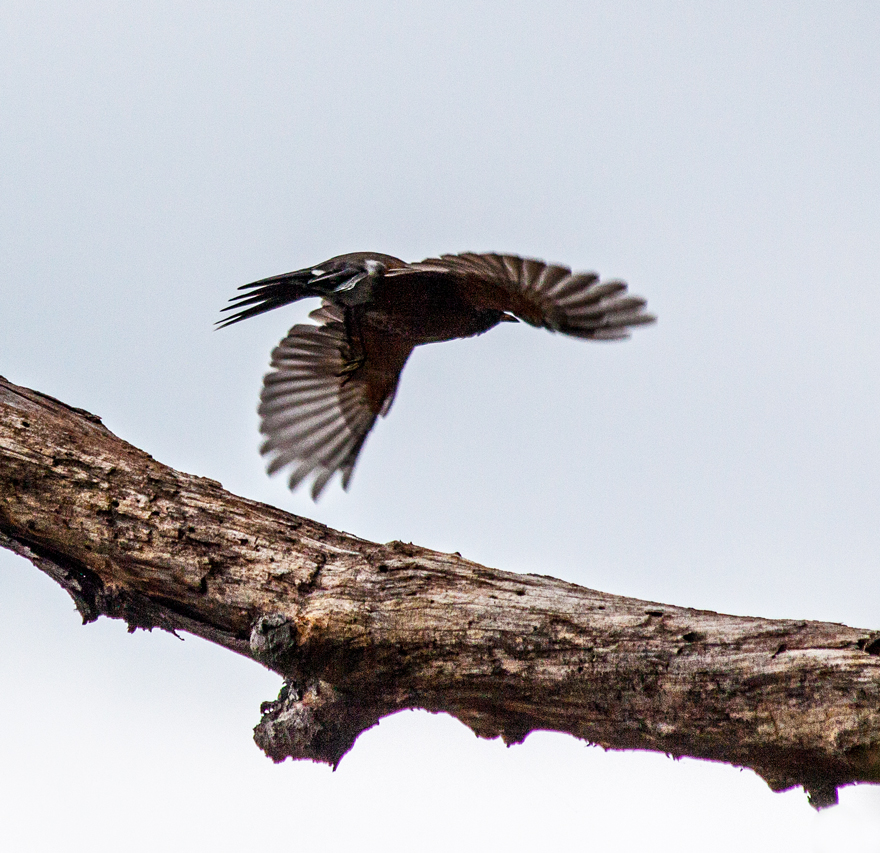
No matter how quickly I try to focus on a bird, they often are quicker than I am. Often I am left with merely an image of an empty branch, but every now and then I’ll get a cool image of the bird taking off.

That was the case yesterday, when I tried to get a shot of this small, dark-colored bird. I really like the position of the tail and the detail of the wings, which help to form an almost abstract portrait of the unidentified bird.

unknown_takeoff_blog

© Michael Q. Powell. All rights reserved

Read Full Post »

Before long, the White Egrets (Ardea alba) will leave this area for more temperate locations, so I was happy to get a few shots this past weekend of one of them at Cameron Run, a tributary of the Potomac River.

The egrets like to roost in trees that overlook this stream and the first shot shows an egret relaxing in a tree after I inadvertently flushed him. I am deliberately underexposing the image in an effort to keep from totally blowing out the highlights of this very white bird, but it is still very hard to capture any details on the body.

The second shot shows the egret out of the water and its pose reminds me of a dancer, with its slim body and long elegant neck.

If things follow last year’s course, the blue herons will remain in my local area for most of the winter, but the egrets and green herons will soon depart. I’ll be looking for more photo opportunities with them before they leave.

egret_tree_blogegret_standing2_blog

© Michael Q. Powell. All rights reserved

Read Full Post »

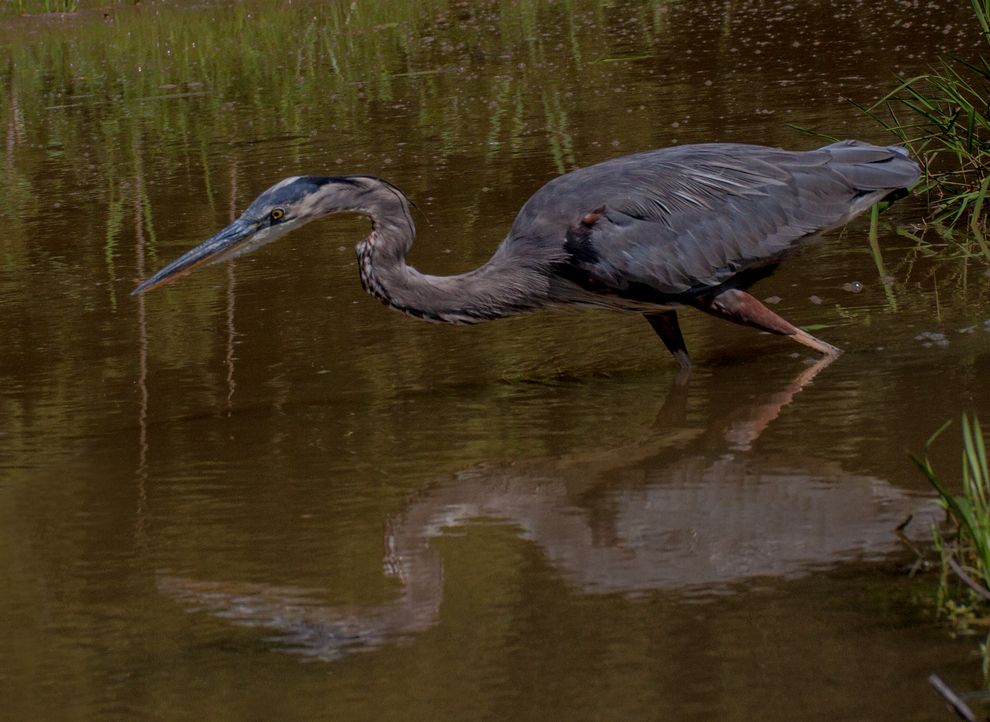
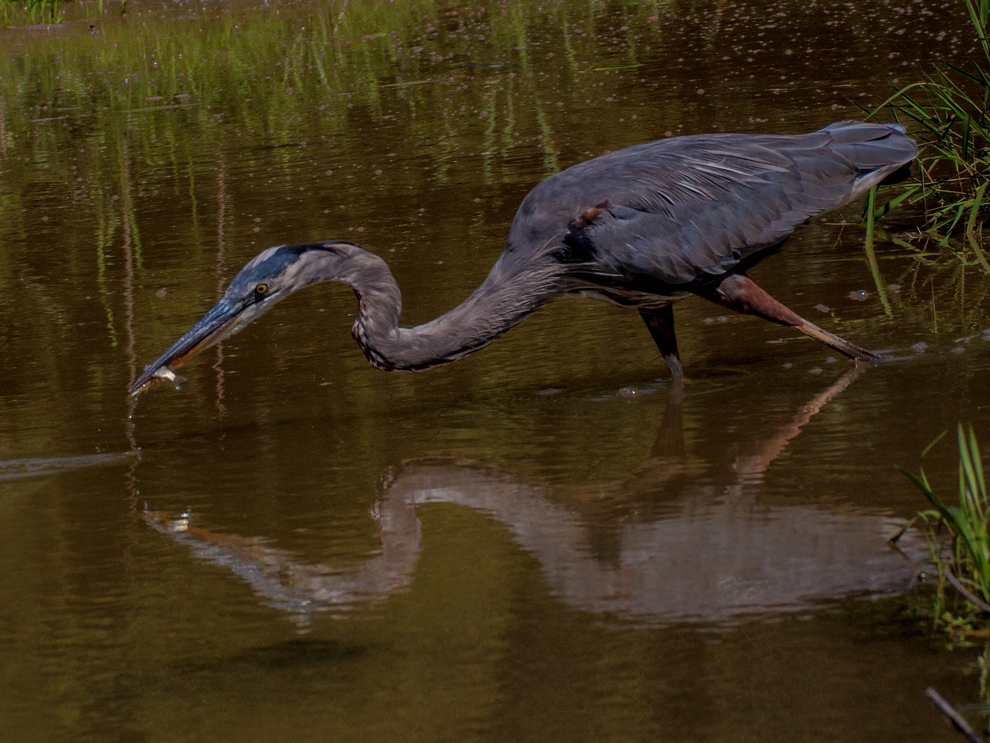
The Great Blue Heron stealthily moved into position and leaned forward, preparing to strike. Would he pull a great big fish out of the water? The second photo provides the answer.

The catch was relatively modest, a tiny fish, dwarfed by the size of the heron’s bill. The heron obviously did not believe in the “catch and release” policy used by most fisherman for such small fish. Turning his head back a little, the heron had no trouble swallowing the little fish. He even seemed to smile a little as he did so, content that he had been successful in his fishing.

Having consumed his appetizer, the heron got back to fishing, hoping to catch a more substantial dinner.

fishing1_blog

fishing2_blogfishing3_blog

© Michael Q. Powell. All rights reserved.

Read Full Post »

Recently I had the chance to observe a Green Heron (Butorides virescens), one of my favorite birds, as it waded into the water at the edge of a small pond and focused its attention on catching a meal.

It was fascinating to watch the heron’s movements—it moved so with such care and stealth that it almost seemed to be moving in slow motion. At times, the heron would lean forward, as in the first photo, perhaps when a potential prey caught its attention.

The water in the pond was very still and I was happy to capture some nice reflections of the heron. They presented a minor dilemma for me in deciding how to crop the shot. Was it better to crop tighter and emphasize the main subject, as I did in the first shot, or to show the entire reflection, as in the third shot, which is the same image cropped differently? What do you think?

In many ways, the second shot is my favorite one. The heron had started to slowly move away and then turned its head back and opened its mouth a little. That little gesture seemed to give the heron more personality and it looks almost like it is smiling.

green_heron_close2a_bloggreen_heron_close1_bloggreen_heron_close2_blog

Read Full Post »

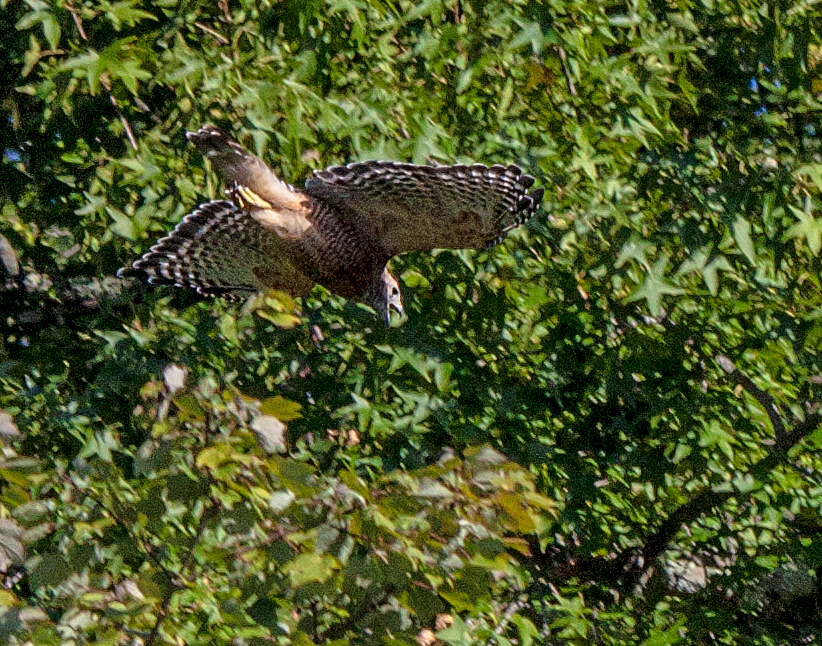
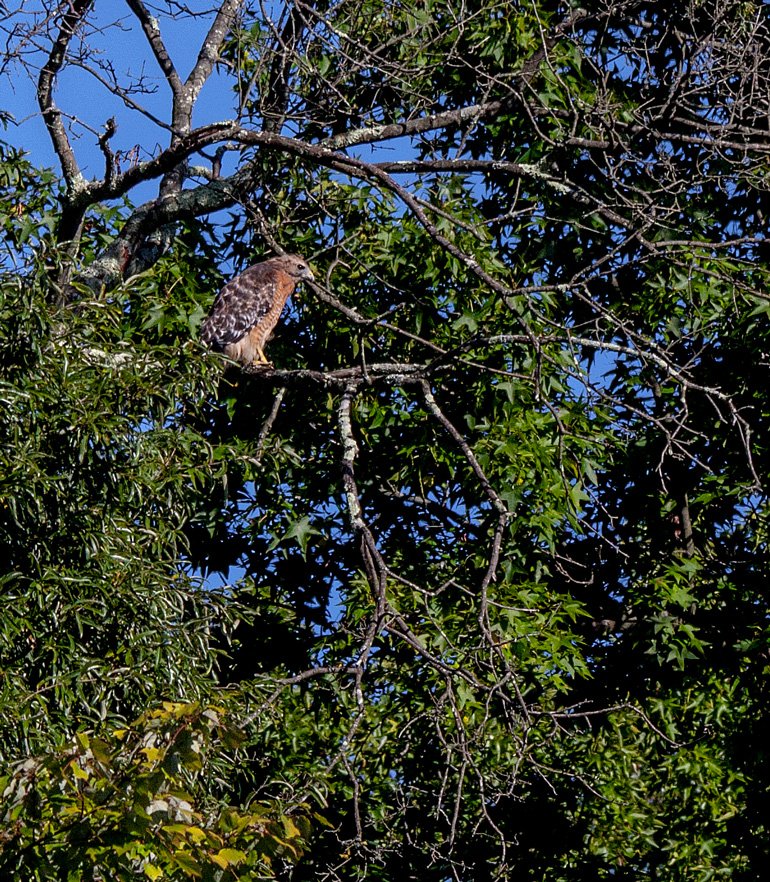
I have not seen any hawks at my local marsh for quite some time, so yesterday I was really happy when I heard the unmistakable sound of screaming Red-shouldered hawks (Buteo lineatus). (Check out the sound file on the Cornell Lab of Ornithology website if you have never heard the cry of these magnificent birds.)

From the sound of the loud screaming, I could tell that the hawks were not far away and eventually I spotted two of them soaring above the trees. After a few minutes, one of them flew silently into view and landed in a tree across the beaver pond from where I was standing. I suspected that he would not remain very long, so I decided to try to get some shots with the lens that I happened to have on my camera at the time, my Tamron 180mm macro lens, rather than take the time to set up my tripod and change to a longer lens.

Before long, I heard the cries of the other hawk and the one that I was watching took to the air and joined in the screaming. I was a little surprise to see that it flew laterally and downward, but I was able to track it pretty well and got the in-flight shot that you see below.

I was pleased to see that the lens was able to capture a pretty good amount of contrast and detail, even in heavily-cropped images like the two that I am posting. I enjoy the challenge of attempting to capture any birds in flight and look forward to more attempts as we move out of insect season, when my macro lens is use most of the time, into bird season, when I switch to a telephoto lens.

screaming3_blogscreaming2_blog

© Michael Q. Powell. All rights reserved

Read Full Post »

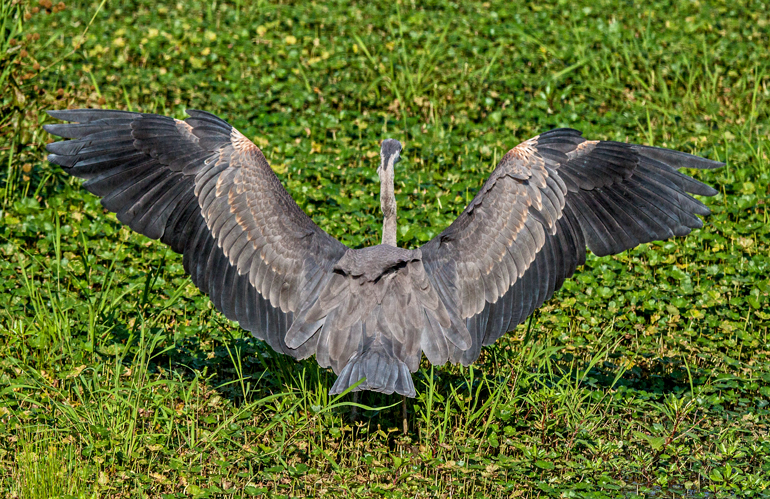
Coming in for a landing, this Great Blue Heron (Ardea herodias) stretched out his wings to their full extent and the sight was mighty impressive. The wings stretched out so wide, in fact, that I couldn’t fit them entirely into the frame. As he reached the ground, the heron gradually pulled in his wings and I was able to get a couple of additional shots of the impressive wingspan.

wingspan1_blog

wingspan2_blog wingspan3_blog

© Michael Q. Powell. All rights reserved

Read Full Post »

Without fill-in light, a backlit subject is often in the shadows and becomes a silhouette, which is what happened in these shots of a Great Blue Heron taking off from a watery area of my local marshland park. The same sunlight in front of me also created beautiful reflections of the heron in the water, and I really like the combination of the silhouettes and reflections in these images.

This heron was getting ready to give chase to another blue heron and was squawking loudly as it took off. I watched the two herons for quite a while and this one went out of his ways several times to harass the other one and force it to search for prey in the vegetation away from the pool of water. As you can see in the second and third photos, a Great Egret was a spectator to the action, lifting up its head to observe what was going on. When things calmed down, the egret returned to its fishing until the next round of activity from the herons.

heron_silhouette1_blog heron_silhouette2_blogheron_silhouette3_blog

© Michael Q. Powell. All rights reserved

Read Full Post »

Do Great Blue Herons (Ardea herodias) have a sense of humor? What would prompt one to burst out in laughter?

Maybe one of the many turtles surrounding the heron’s feet decided to tickle them. (Click on the photo to get a better look at the turtles).

Perhaps he is preparing for an audition for the reality television show America’s Got Talent. What’s his talent? Judging from his appearance, I’d say this heron might have a future as a stand-up comic. I might have captured hims as he was trying out new material on the turtles, which are notoriously tough as judges—you have to be really funny to be able to penetrate those thick shells.

laughing_heron_blog

© Michael Q. Powell. All rights reserved

Read Full Post »

When it started to rain yesterday, I pulled out my umbrella and kept shooting for a while, permitting me to get this close-up shot of a Great Blue Heron (Ardea herodias).

The heron was stoically enduring the rainfall, as drops of water began to bead up on its shoulders. The wind started to kick up a little too, ruffling some of the feathers on the heron’s chest. I was afraid that my white and green umbrella would spook the heron, but I was able to get pretty close to the heron to get this shot at the far end of my 55-250mm zoom lens. If you click on the photo, you can see these (and other) details in a higher resolution image.

There are many flowers blooming in my local marshland park right now and I really like the little splashes of yellow in the background of this image.

heron_closeup1_blog

© Michael Q. Powell. All rights reserved

Read Full Post »

Have you ever seen a Great Blue Heron (Ardea herodias) attempt to do a vertical takeoff from the water? Most of the time, blue herons gain altitude with a few thrusts of their powerful wings as they move forward into the air.

This heron, however, looked like he was initially trying to levitate straight up into the air, like a Harrier jet, a jet that is capable of taking off vertically. It looked like the heron could not perform a normal takeoff because his feet were tangled in the weeds at the bottom of the little pond.  Before he could take off, he had to untangle his feet and his initial upward wing movements were intended to accomplish that task. Only then was he cleared for takeoff.

You’ll probably noted that I posted the images in reverse chronological order, so if you want to follow the takeoff process, you should start at the bottom. The first two images are more impressive as photographs, because I was able to capture the heron in the air, with the wings in interesting positions, despite the fact that I was using “only” a 180mm lens. (Some of the bird photographers that I encounter have 500mm or longer lenses.) The last two images are interesting and a little whimsical, because of the heron’s actions and the angle at which we are viewing the heron. Did you notice how skinny his face and neck look when shot from a head-on position?

flying2_blog

Click on the image for a higher-resolution view.

flying1_blog

flying4_blog

Before you can take off, you have to untangle your feet.

Before you can take off, you have to untangle your feet.

© Michael Q. Powell. All rights reserved

Read Full Post »

I am in awe of photographers who can capture amazing shots of birds in flight and I continue my quest to improve my own skills. So many things have to come together to get such shots including the timing, location, lighting, and focusing.

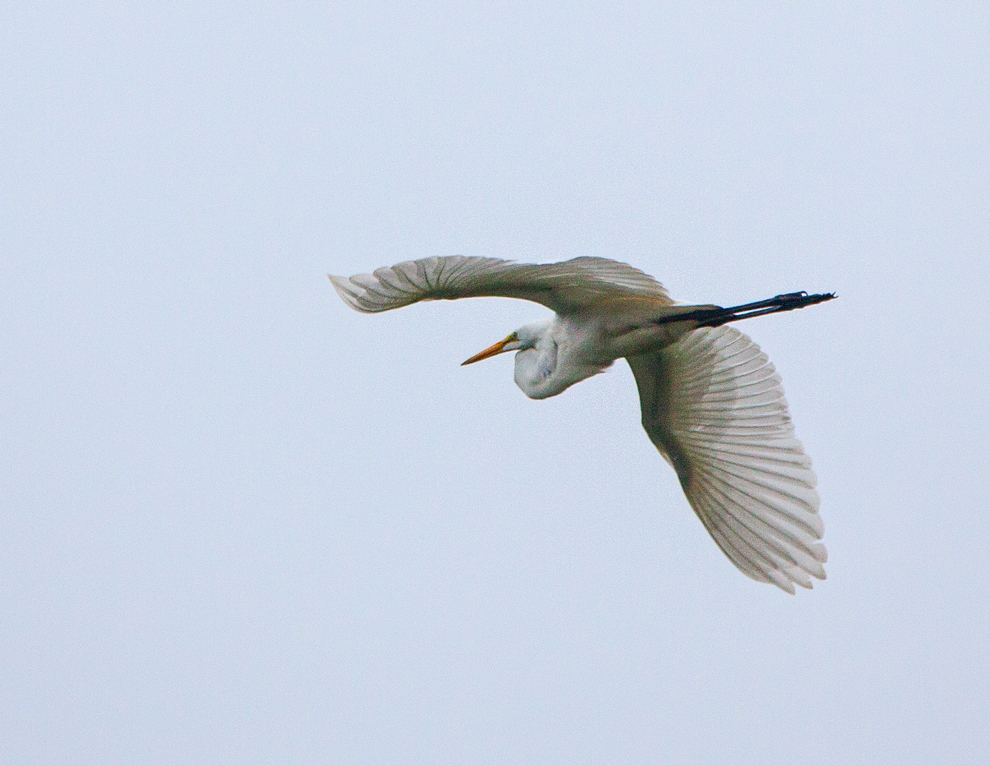
Here is one of my most recent efforts, a shot of a Great Egret (Ardea alba) in flight. The focus is a little soft, but I really like the position of the egret that I managed to capture, with a beautiful sweep of the wings.

flying_egret1_blog

© Michael Q. Powell. All rights reserved

Read Full Post »

The water has gone down in some parts of my local marsh and I encountered this Green Heron (Butorides virescens) in a little tree that overlooked one of the dried out areas.

I am not sure if the heron was hunting or resting, although it looked more like the former than the latter, because he seemed to be looking from side to side. Perhaps he was searching for frogs or some other terrestrial prey.

I did not have my longest telephoto lens on my camera, but I was happy that to get some several decent shot of the little heron in a number of different poses.

limb1_bloglimb3_bloglimb2_blog

© Michael Q. Powell. All rights reserved

Read Full Post »

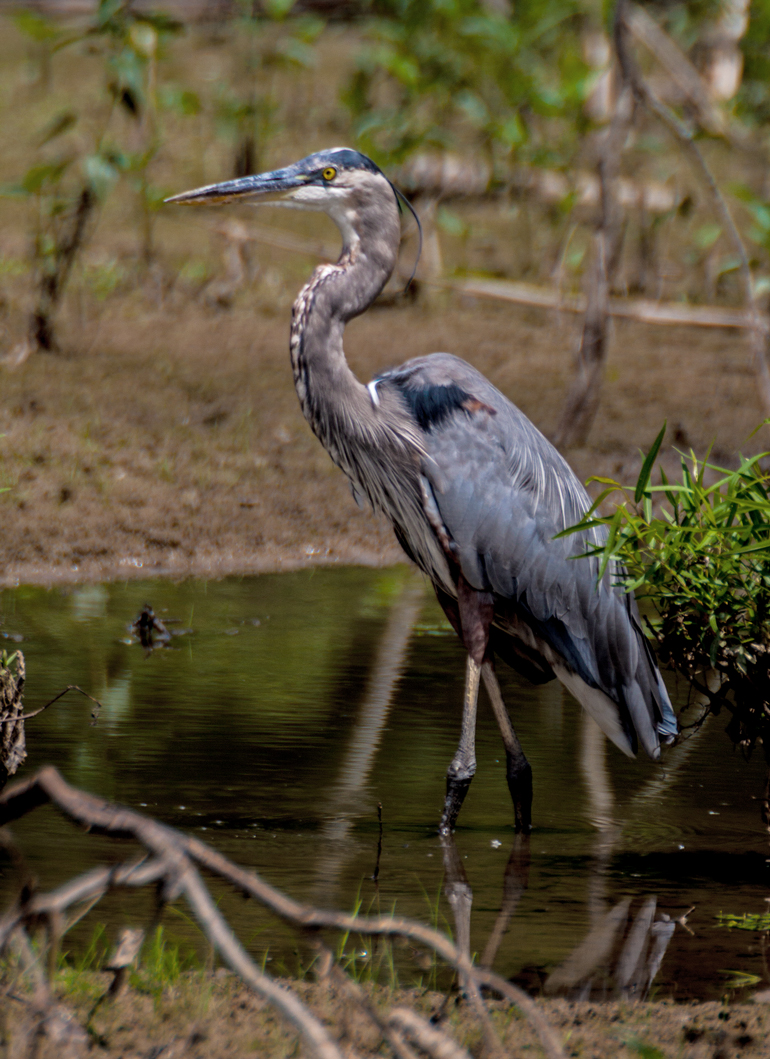
I had zoomed all the way in on this Great Blue Heron (Ardea herodias), when suddenly he took a big stride, a stride that almost took him out of the frame.

Something must have caught his attention, because he started moving quickly after having been still for quite some time. Normally when a blue heron moves, he is striking, reaching down to pull (or spear) some hapless prey out of the water. His lateral movement caught me a little by surprise.

One of the challenges of taking photos of wildlife is to be ready for the unexpected. I’m learning that the more I study subjects like this blue heron, the more I can anticipate some of their action. It’s a whole lot easier to be ready for the expected than for the unexpected.

stride_blog

© Michael Q. Powell. All rights reserved

Read Full Post »

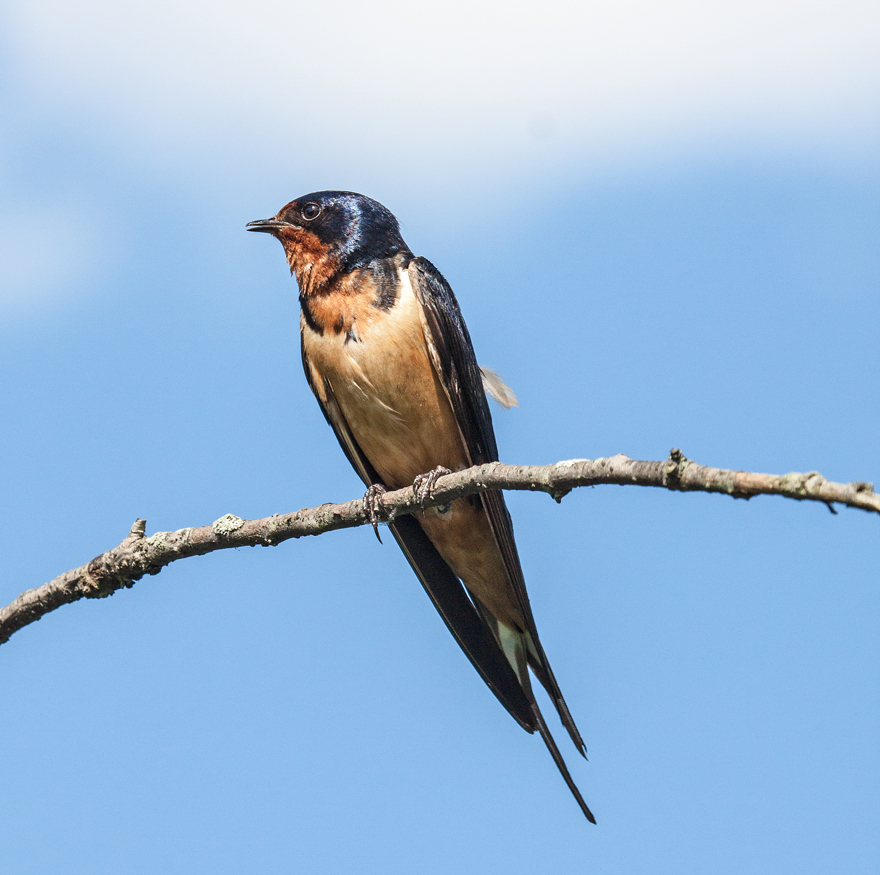
I don’t usually think of photographing birds with a macro lens, but that’s exactly what I did when I encountered this Barn Swallow (Hirundo rustica) perched on a small branch, with a beautiful blue sky in the background.

Of course, I probably should note that the macro lens in question is 180mm in focal length, so it has good telephoto capability—I had just never tried to use it in that way. My experience photographing birds this past winter suggests that this lens does not have enough reach for most birds.  I was really happy, though, with the detail it was able to capture in this situation, when I was standing almost directly below the bird.

Mentally it was an adjustment to be shooting with a prime lens and I had to keep reminding myself that if I wanted to adjust the composition, I had to change my position and move closer or farther away. That’s probably a good thing to remember when I am using a zoom lens, which has a tendency to make me a little lazy.

swallow2_blogswallow1_blog

© Michael Q. Powell. All rights reserved

Read Full Post »

I have always thought that Great Blue Herons (Ardea herodias) look a bit awkward on the ground, tall and gangly, but they are exceptionally beautiful in the air.

As I approached this blue heron yesterday at my local marshland park, it decided to take off. I often try to capture photos of birds in flight, though generally I’ve had only limited success.

I was pretty happy with this shot, taken shortly after the heron had taken to the air. The shaded woods make a decent backdrop and I like the blooming mallow flowers in the foreground. The focusing is a little soft, but I was able to capture some of the magnificent details of the visible wing.

heron_flying_blog

© Michael Q. Powell. All rights reserved

Read Full Post »

Can you spot the heron in this photo?

I think that you probably can pick out the Green Heron (Butorides virescens), which blends in pretty well with the vegetation, a little easier than I was able to do, when I visited my local marshland yesterday. The heron, which I think might be a young one, was foraging about in the marsh plants, unlike other Green Herons that I have seen in the past, which tended to stand near the edge of the water awaiting prey. If the heron had not moved, I might not have seen him, because it was so close to the ground.

I really like the colors of the Green Heron and its distinctive yellow eyes. The Green Heron may not be as big in size as a Great Blue Heron, but it has its own beauty—maybe I should begin a campaign to change its name to Great Green Heron.

heron_grass1_blog

© Michael Q. Powell. All rights reserved

Read Full Post »

I never fail to be excited by the sight of a large, powerful bird soaring through the air.

Earlier this month, as I was walking along Cameron Run, a tributary of the Potomac River, I spotted a bird heading right toward me. It kept getting bigger and bigger as it approached and I suspected it was a hawk or an eagle—it turned out to be an osprey. Fortunately I had my largest telephoto zoom lens, a Sigma 135-400mm, already on my camera and, after a few adjustments, I started snapping away.

I was shooting almost directly into the sun, so much of the detail of the osprey’s body are hidden in the shadows, but I was able to capture some of the details of its amazing wings, with a little backlighting. Click on the images to see a higher resolution view of some of these details.

It may seem that I am photographing insects and spiders these days, judging from my blog postings, but I continue to enjoy photographing birds. In fact, photographing birds in flight is one of the specific areas in which I hope to improve, so these photos may be a preview of coming attractions once summer is over.

osprey1_blogosprey2_blog

© Michael Q. Powell. All rights reserved

Read Full Post »

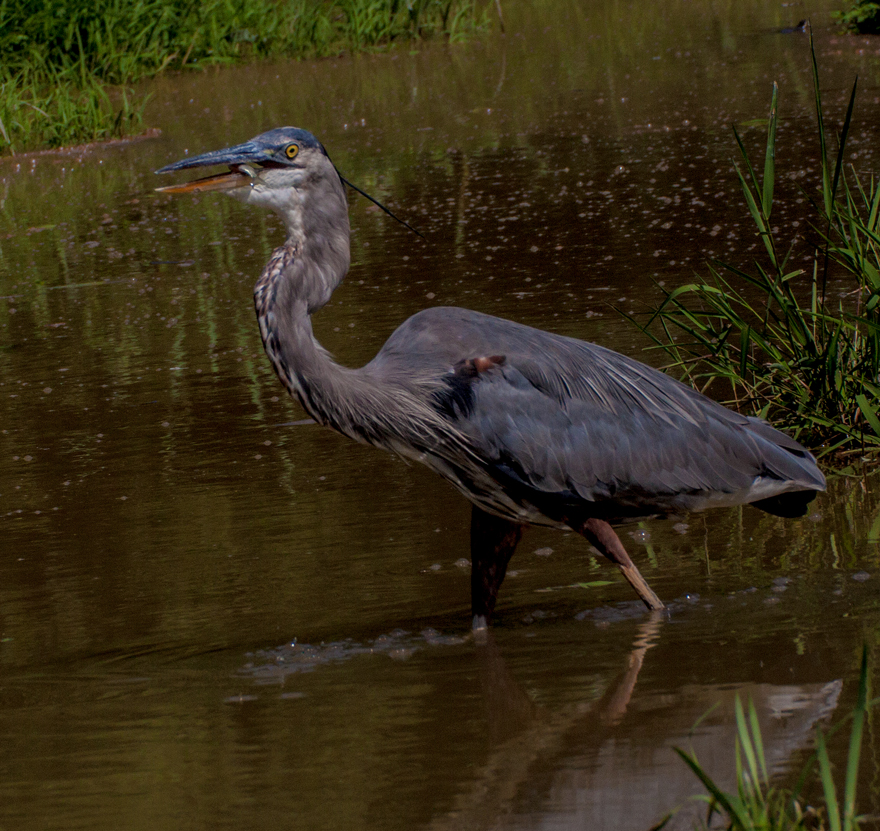
I enjoy watching Great Blue Herons (Ardea herodias) fishing—they seem so patient and so focused—and observed one recently in the beaver pond at my local marsh.

I was a little surprised to see the heron at that location, because the water level in the pond has dropped as the weather has gotten hotter and some areas are even exposed. As the heron plunged his bill into the shallow water, I expected him to pull out a frog or perhaps a small fish. I was too far away to tell for sure what he had caught, but I kept shooting. When I looked at the images, it looks like he may have caught a crayfish, but I am not really sure. Do herons even eat crayfish? I took the photos in the middle of the day, so the colors are washed out a bit, but some more knowledgeable reader may still be able to tell me for sure if it is a crayfish in the heron’s mouth. (You can get a higher resolution view if you click on the image.)

GBH2_blog

The second photo was taken before the heron began fishing and gives you an idea of how shallow the water is in the beaver pond. In post processing, I made a number of tweaks to the image to try to increase the contrast and saturation of the colors and may have gone over the top a little. What do you think?

GBH1_blog

© Michael Q. Powell. All rights reserved

Read Full Post »

Although I tend to use either my macro or my shorter telephoto zoom lens most at this time of the year, yesterday I decided to walk around with my longest zoom (135-400mm) and was happy about that decision when I encountered this juvenile Hooded Merganser duck (Lophodytes cucullatus).

When I first saw it, the duck was sitting on a semi-submerged log  in the beaver pond of my local marshland pond, basking in the sun. I expected for the duck to be part of a group, but it appeared to be alone.

Merganser1_blog

I guess that I got a little too close, because the juvenile duck then slipped quietly off the log into the brown, muddy water of the pond and swam away a short distance. I like the concentric ripples in this shot of the duck slowly paddling away.

Merganser2_blog

I backed off and continued to observe the young duck, which decided to take advantage of being in the water to do a little grooming. After submerging itself, the duck rose up out of the water to dry off. The duck flapped its wings and I clicked my shutter and got this shot.

Merganser3_blog

There is a kind of playful feel to this shot that I really like. Somehow the duck reminds me of a friendly little dragon in this shot, with its feathers looking almost like scales and its wings and tail in an unusual position. I almost expected it to breathe a tiny burst of fire.

Maybe I should name the little duck “Puff.”

© Michael Q. Powell. All rights reserved

Read Full Post »

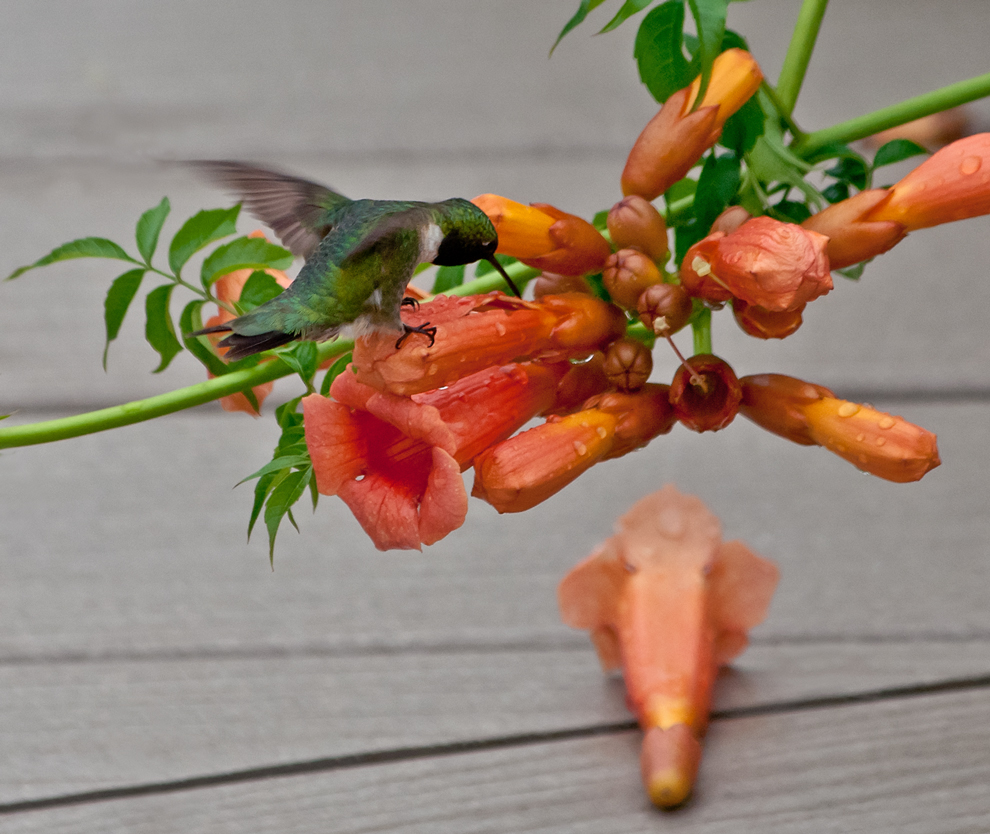
How do you get a sharp photo of a hummingbird’s wings? Apparently, if a hummingbird is hungry enough, it will extract the nectar from a flower before it has bloomed, and the leverage required may force it to perch on the flower, doing away with the necessity to fly its wings rapidly.
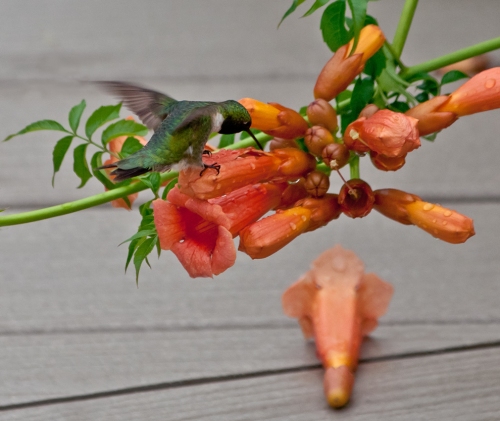
hummingbird1_blog

Walking on the boardwalk at my local marshland park, the last thing on my mind was a hummingbird—I was searching for butterflies and dragonflies.  As I turned a corner, I saw a flash of color and figured it was a butterfly. I took a closer look and realized it was a hummingbird, a Ruby-throated Hummingbird (Archilochus colubris).

hummingbird4_blog

The hummingbird was circling around a plant with red, trumped-shaped flowers that was partially hanging over the boardwalk. Most of the flowers had not yet bloomed, so the bird seems to have decided to use its bill to drill into the side of the unopened flowers to extract the nectar. That decision was largely responsible for me being able to get some shots, because it caused the hummingbird to hang around longer.
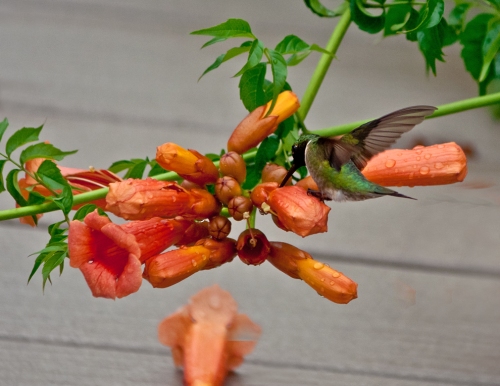
hummingbird2_blog

I realized that I had a limited window of opportunity and made a quick adjustment to my camera to increase the shutter speed of my camera, although that meant I had to narrow my depth of field. I also ended up shooting downward, with the gray composite boards of the boardwalk as the background. It was definitely a challenge to keep the camera focused on the hummingbird.
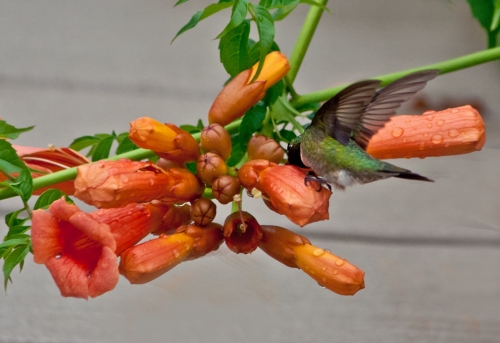
hummingbird3_blog

The photos are not perfect, but I am pretty happy that I was able to get photos at all, given that this is only the second time that I have seen a hummingbird in the wild. Next time, perhaps I’ll manage to get a more traditional shot of a hummingbird hovering in the air.

© Michael Q. Powell. All rights reserved

Read Full Post »
It seems like I have been seeing Green Herons (Butorides virescens) everywhere recently. Of course, that is an exaggeration, but within the last month I have encountered Green Herons in three separate locations.

Out of the three locations, this is the most suburban—a little pond at a local garden, surrounded by grass on most sides. The other locations are in marshy, wooded areas.

I observed this Green Heron this past weekend and think it is a juvenile. Normally I have trouble identifying juvenile birds, but adult Green Herons have yellow legs, while juveniles have greenish legs.

I happened to have my 100mm macro lens on my camera, so I had to try to inch my way toward the heron to get this shot. I like the heron’s pose with its head tilted up. Ideally I would have liked to blur out the background more, but I don’t find the green grass to be too distracting.

juvenile_green1_blog

© Michael Q. Powell. All rights reserved

Read Full Post »
« Newer Posts - Older Posts »