Feeds:
Posts
Comments

Archive for the ‘Birds’ Category

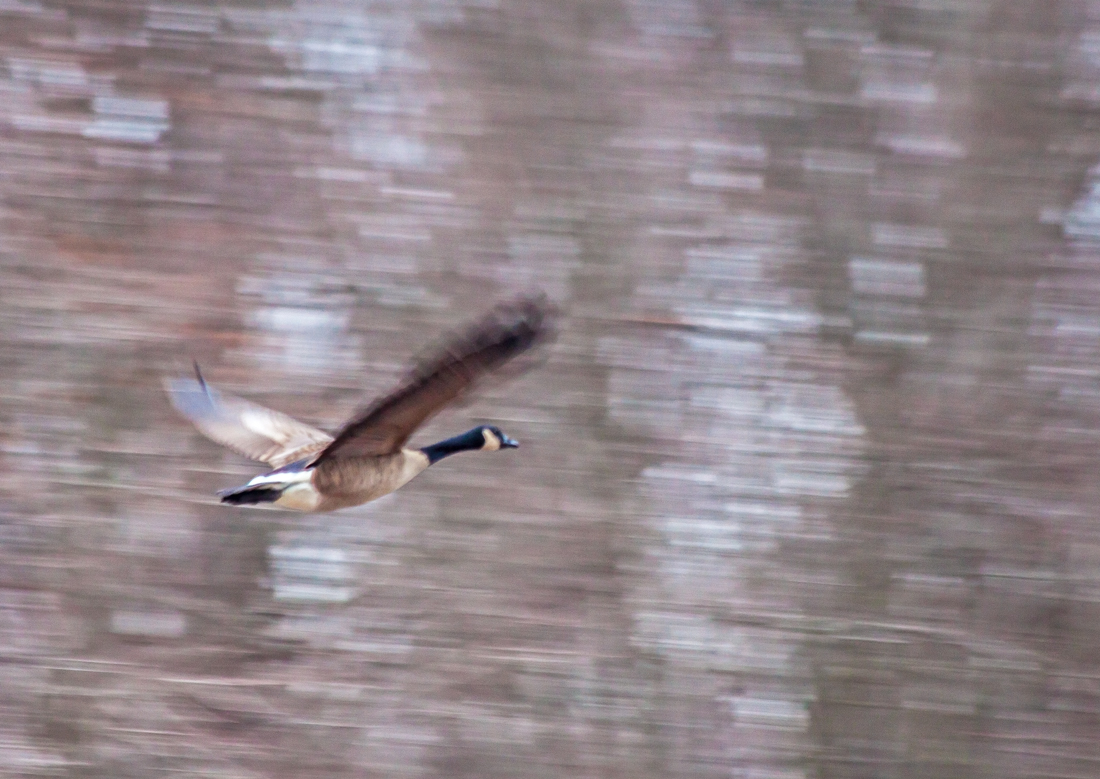
How do you capture speed? Sometimes I will pan the camera and track the moving subject, as I did yesterday with the flying Canada Goose (Branta canadensis). Usually the background is a little blurry, but this time the background became abstract, almost like a painting, an effect that I really like.

What happened? Generally, I shoot in aperture priority mode and I had my camera set on f/5.6, as wide open as I could get at the far end of my telephoto zoom. The weather was cold and gray with the threat of precipitation—it eventually rained for hours—so I set my ISO to 500. It turned out that I would have needed a much higher ISO to stop the motion completely, for my camera provided me with a shutter speed of only 1/60 of a second. That is why there is some motion blur in the wings.
goose_pan_blog

© Michael Q. Powell. All rights reserved.
Read Full Post »

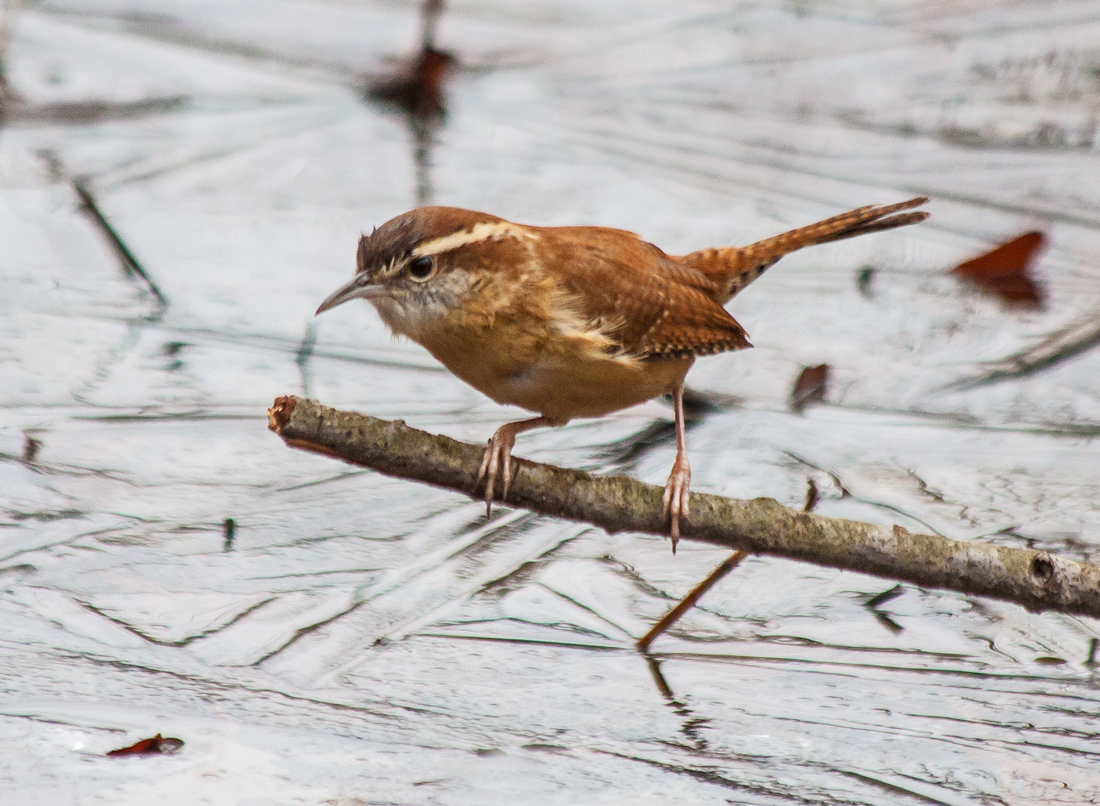
Back home from a week overseas in Vienna, I felt the need to reconnect with nature and headed off to the marsh at Huntley Meadows Park early this morning. The weather was cold and gray, but I was able to get some shots of birds, like this Carolina Wren (Thryothorus ludovicianus), surveying the frozen pond from an overhanging branch.

It’s nice to be home.

wren_dec_blog

© Michael Q. Powell. All rights reserved.

Read Full Post »

This Turkey Vulture (Cathartes aura) was circling around me last week, so I followed the advice given to me by one of my fellow photographers—I made sure that I moved periodically as I captured shots of this large bird with an impressive wingspan.

I will be away from home on a business trip starting tomorrow and I am not sure how often I will be able to update my blog. I wanted to alert readers in case they are concerned if they don’t see any movement for me for a number of days—the vultures probably have not made a meal of me yet. turkey_vulture6_blogturkey_vulture5_blogturkey_vulture4_blogturkey_vulture3_blog

© Michael Q. Powell. All rights reserved.

Read Full Post »

Do you ever sit by a window and daydream as you look out into the world with unfocused eyes? Somehow that was what came to mind when I spotted this Mourning Dove (Zenaida macroura) perched on a branch, framed by the trees. The dove seemed gentle and pensive, unlike so many of the birds (and people) in this area that are so driven, always intense and tense.

There is a real value in slowing down and daydreaming more in order to recharge my creative batteries. Sometimes I need a gentle reminder.

dove_framed_blog

© Michael Q. Powell. All rights reserved.

Read Full Post »

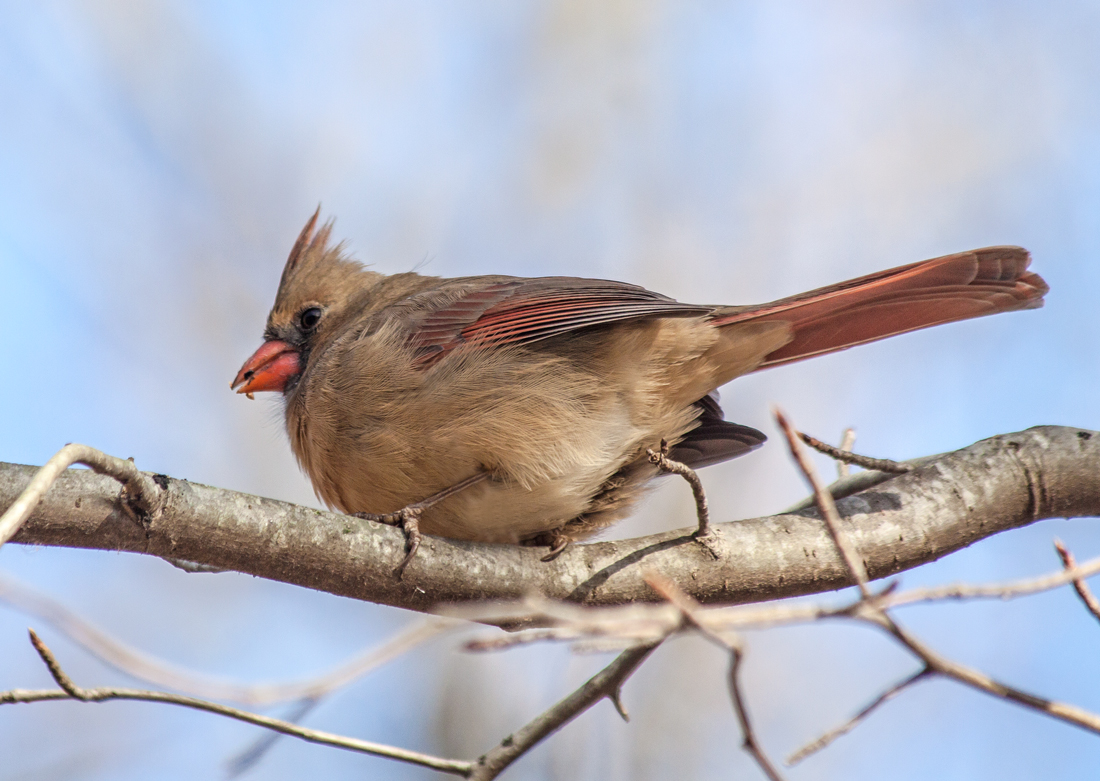
I looked up at her from below and then she cocked her head and looked down at me. Our eyes met and we shared a brief, magical moment together. Then it was over, my all-too-short encounter with a beautiful female Northern Cardinal (Cardinalis cardinalis).

cardinal_looking_down_blog

© Michael Q. Powell. All rights reserved.

Read Full Post »

Although it is exciting to search for new birds or for unusual interactions, I love to return to familiar subjects, like this male Red-winged Blackbird (Agelaius phoeniceus) that I photographed last week.

There is nothing complicated about this image, a blackbird perched on a cattail, but the small details make it special for me. I like the angled body and the turned head. The feathers seem unusually glossy and the eye is shiny too. There are a few wispy feathers that are matched by the “fluff” from the cattail. The background is brown, but there are a wide variety of shapes and shades.

What does it take for you to be satisfied as a photographer? For now at least, I am content to stay relatively close to home and photograph whatever I can find as well as I can. Life doesn’t have to be complicated all of the time.

blackbird_turned_blog

© Michael Q. Powell. All rights reserved.

Read Full Post »

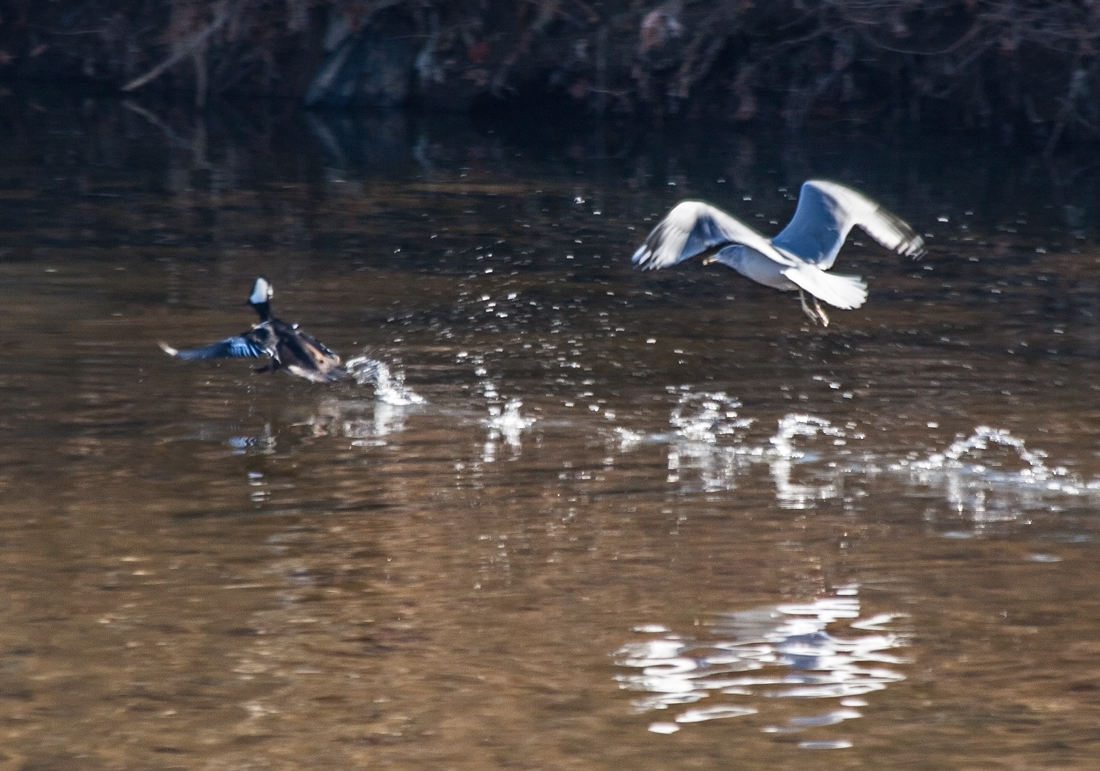
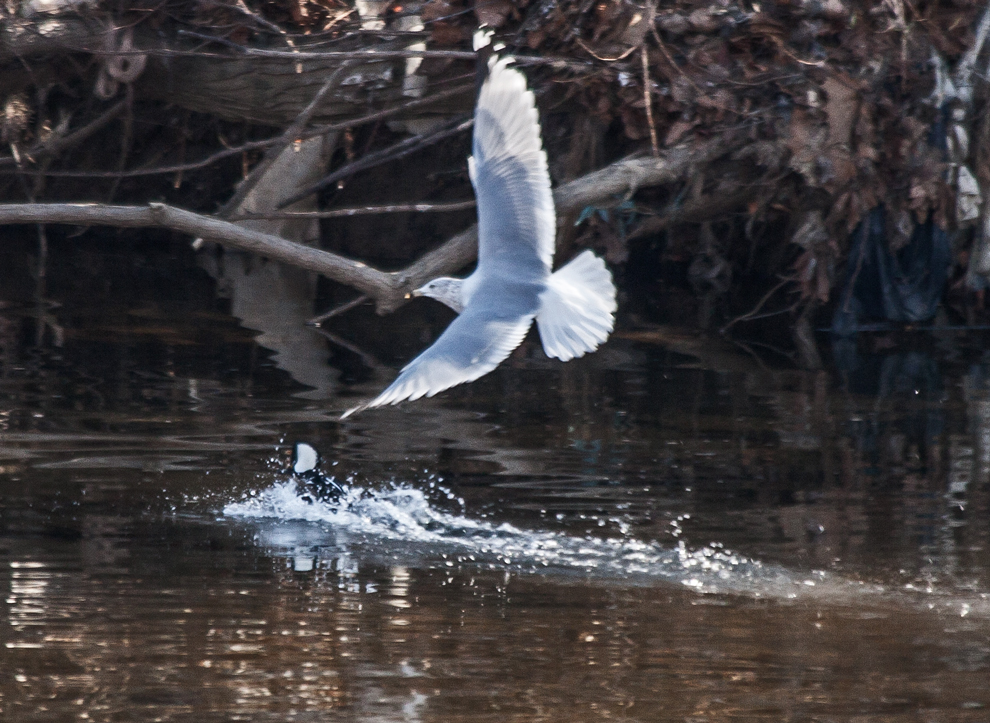
Do seagulls hunt ducks? That’s a crazy question, but that was the first thing that came to mind when a Ring-billed Gull (Larus delawarensis) started aggressively chasing a Hooded Merganser duck (Lophodytes cucullatus) with what appeared to be hostile intent.

I was walking along Cameron Run, a tributary of the Potomac River, when the scene started to unfold in front of me. The gull flew toward the dusk with its legs extended, like it was trying to snatch the duck out of the water. The duck immediately started bounding across the water (as you can see in the third photos) in an effort to escape the gull, but did not take to the air. When the duck got close to the bank of the stream, the gull turned away and left the duck in peace.

Was this merely a cranky gull or maybe a bully? Was it a territoriality thing? All I know is that it provided me a fascinating moment as I treated to a brief interaction between these two very different species of birds.

gull_chasing_duck3_bloggull_chasing_duck1_bloggull_chasing_duck2_bloggull_chasing_duck4_blog

© Michael Q. Powell. All rights reserved.
Read Full Post »

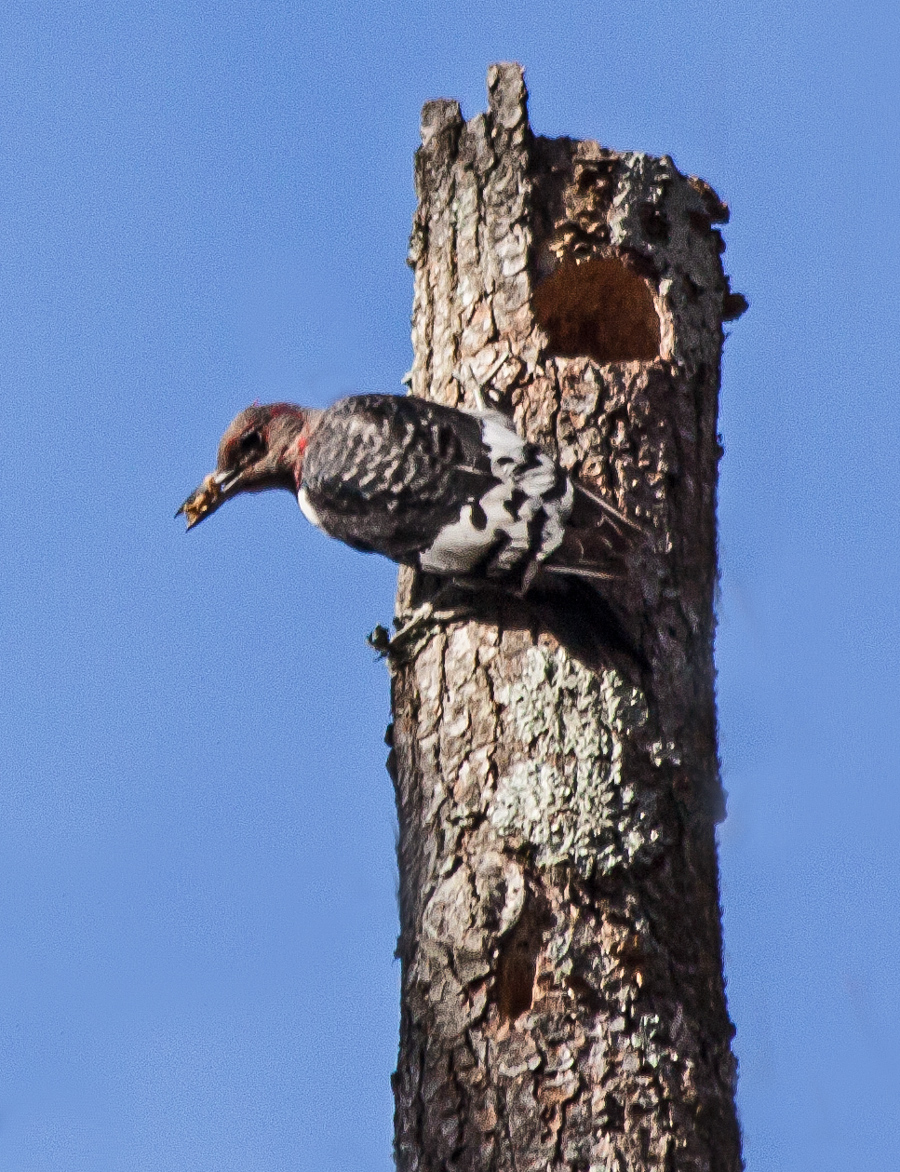
I suspect that I may qualify as a stalker, because I spent over thirty minutes on Friday sitting on a fallen tree, observing every movement of a juvenile Red-headed Woodpecker (Melanerpes erythrocephalus) high in the oak trees.

The small branches and the shadows made it almost impossible to get a clear shot of the little bird, but they did not keep me from trying. I was really fortunate to get this shot of the woodpecker as it took off from one of its perches with an acorn in its mouth and gave me a glimpse of its beautifully-patterned wings. As I understand it, when the Red-Headed Woodpecker becomes an adult, its wings will be pure black and white, so I am glad that I was able to get the shot of the black dots.

After I posted this photo, I noticed that there is a least one acorn jammed into a crack in the bark just above the top edge of the bird’s tail, mostly likely a snack that it has cached for future consumption.

woodpecker_flying_blog

© Michael Q. Powell. All rights reserved.

Read Full Post »

Why was this Red-bellied Woodpecker (Melanerpes carolinus) pecking so feverishly at the top of this broken tree? It certainly did not look like a good spot to find insects.

A few seconds later, I got an answer to my unspoken question, when the woodpecker pulled an acorn out with its beak (at least that’s what I think it is). After a bit of research on the internet, I learned that these woodpeckers eat plant materials, like acorns, as well as insects and that they sometimes use cracks in trees to store food for use at a later time.

red_bellied1-blogred_bellied2_blog

© Michael Q. Powell. All rights reserved.

Read Full Post »

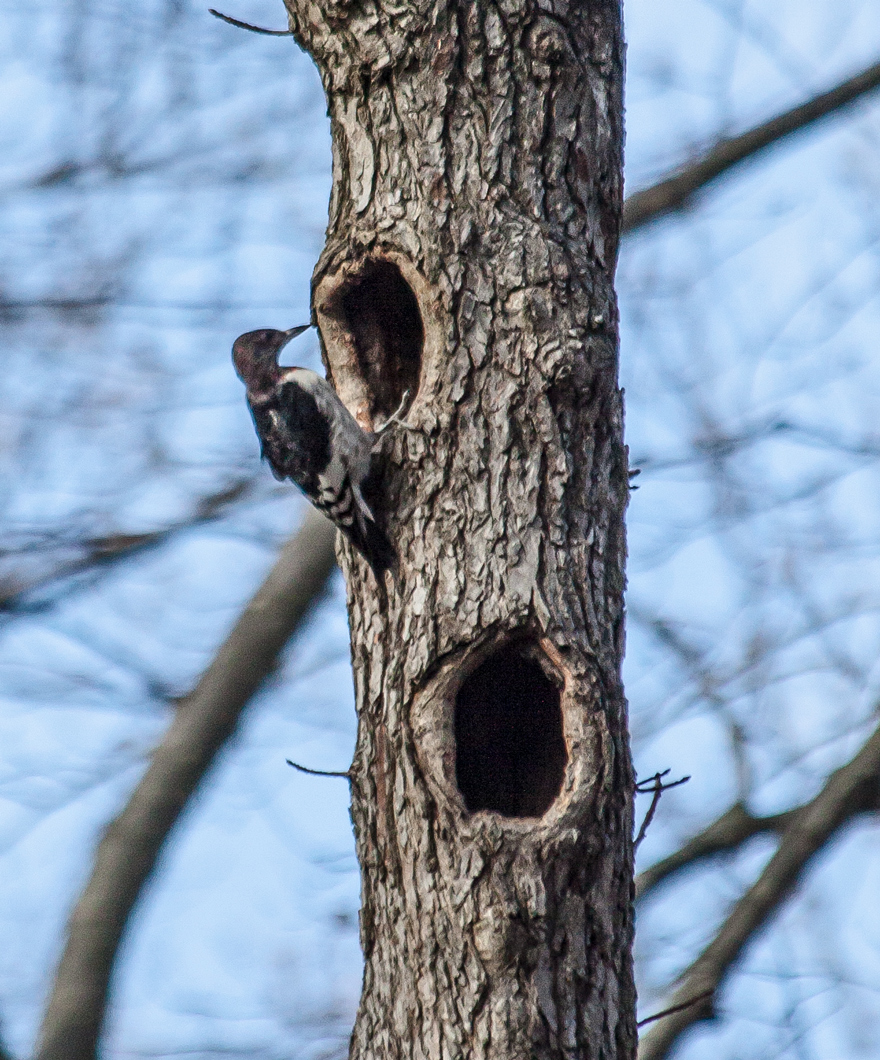
Wouldn’t you know it, I finally see a Red-headed Woodpecker (Melanerpes erythrocephalus) and its head is not red. It’s a juvenile one and if you look closely you can see a few traces of the spectacular red that it will eventually sport on its entire head.

One of the serious birders at my local marshland park identified the area in which two juvenile Red-headed Woodpeckers had been seen regularly and I was fortunate to spot one of them this past Monday. The woodpecker seemed to be carving out a cavity in the tree and actually climbed into the hole as it chiseled away the bits of wood. Earlier, I saw one of them in the distance at a nearby tree with two large cavities (see the third photo). The bird stuck its head inside one of the cavities and I couldn’t tell if it was checking out the hole or was storing food there.

The Cornell Lab of Ornithology notes that the Red-headed Woodpecker is one of only four North American woodpeckers known to store food, and it is the only one known to cover the stored food with wood or bark. These woodpeckers have a varied diet and will eat both insects, which they sometimes catch in the air, and a a number of plant materials, especially acorns.

I don’t know how long it will take for this bird’s head to turn red, but I will certainly be keeping an eye out for it, now that I have an approximate idea of its territory.

redheaded2_blogredheaded1_blogwoodpecker_cavity_blog

© Michael Q. Powell. All rights reserved.

Read Full Post »

I don’t often see deer in the daylight at my local marshland park, so I was a bit surprised last week when a doe came running out of the cattails and began to pick her way thought the ducks that were foraging in the shallow water. She was immediately followed by a smaller doe, who was also running.

What was going on? What had spooked these two deer? I didn’t have to wait long for an answer. A small buck emerged and started chasing the other two deer through the water.

I don’t know if they were just playing or if the buck had amorous intentions, but it gave me the chance to get a few shots of what passes as “big game” for me.

doe_big_blogdoe_little_blogbuck2_blogbuck_blog

© Michael Q. Powell. All rights reserved.
Read Full Post »

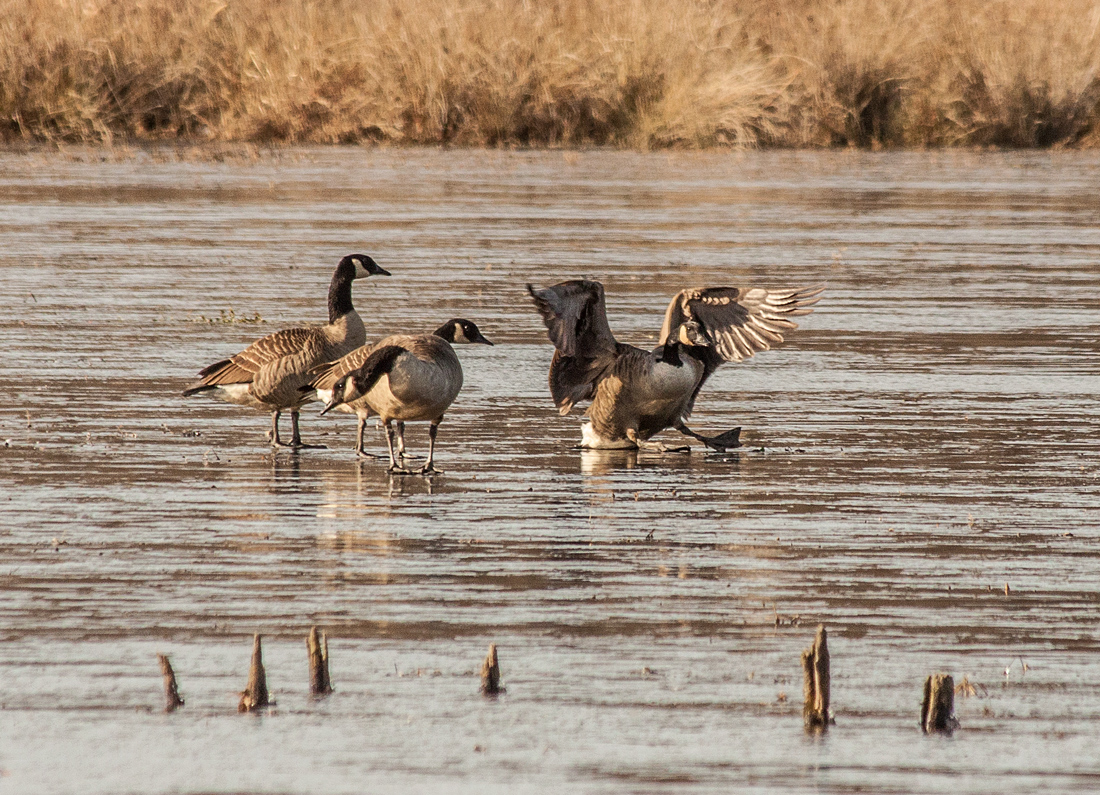
It was cold enough Monday that the pond at my local marsh froze over. The ice may not have been thick, but it complicated landings for migrating Canada Geese (Branta canadensis).

One goose slid to a stop by lowering its tail, as other geese watched with varying degrees of interest. It has warmed up a bit and we’ve had a lot of rain since Monday, so the ice is almost certainly gone by now, but I suspect that I will see this scene repeated as we move into winter.

slippery_landing_blog

© Michael Q. Powell. All rights reserved.
Read Full Post »

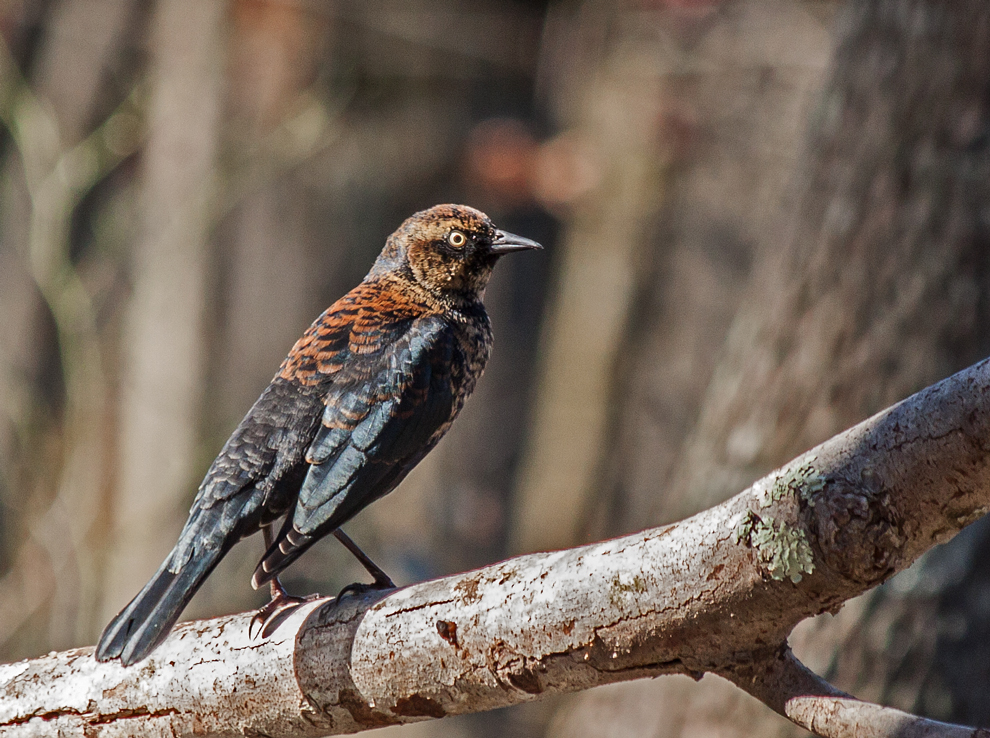
I encountered another small flock of blackbirds this past weekend and this time I managed to get a shot of a female Rusty Blackbird (Euphagus carolinus). If you want to compare the female with the male, check out my earlier posting with an image of a male.

I have now gotten used to the idea that these blackbirds are likely to be be found in the water and the mud, rather than in the cattails, where I usually find the Red-winged Blackbirds. I have also gotten used to the notion that female blackbirds are not black—that used to mess with my head.

What I have not gotten used to, however, is the pale yellow color of the eyes of the Rusty Blackbirds. There is something a little eerie and disconcerting about those eyes and I find them to be a bit creepy.

blackbird_rusty_female_blog

© Michael Q. Powell. All rights reserved.

Read Full Post »

It’s been months since I have seen any Hooded Merganser ducks (Lophodytes cucullatus), so I was thrilled when I spotted several pairs in the distance this past weekend, swimming around as shown in the second photo.

Unfortunately, they sensed my presence before I could get much closer and took to the air. Given the distance and the small size and speed of these ducks, I was surprised that I got a reasonably good shot of one of the males in flight. Hooded Mergansers always look a little cartoonish, but that effect is magnified when they are straining forward in flight. If you click on the first photo, you can get a better look at some of the details of the wings and some of the beautiful colors of this little duck.

The second photo was taken before the first and it gives you a general idea of the differences between the male and female of this colorful species of duck.

merganser_flying_blogmergansers_swimming_blog

© Michael Q. Powell. All rights reserved.

Read Full Post »

Have you ever watched ducks taking off from the water? Some of them seem to rise up almost straight out of the water, while others, like this Ring-necked Duck (Aythya collaris), like to get a running start, bouncing across the surface of the water.

bouncing_takeoff_blog

© Michael Q. Powell. All rights reserved.

Read Full Post »

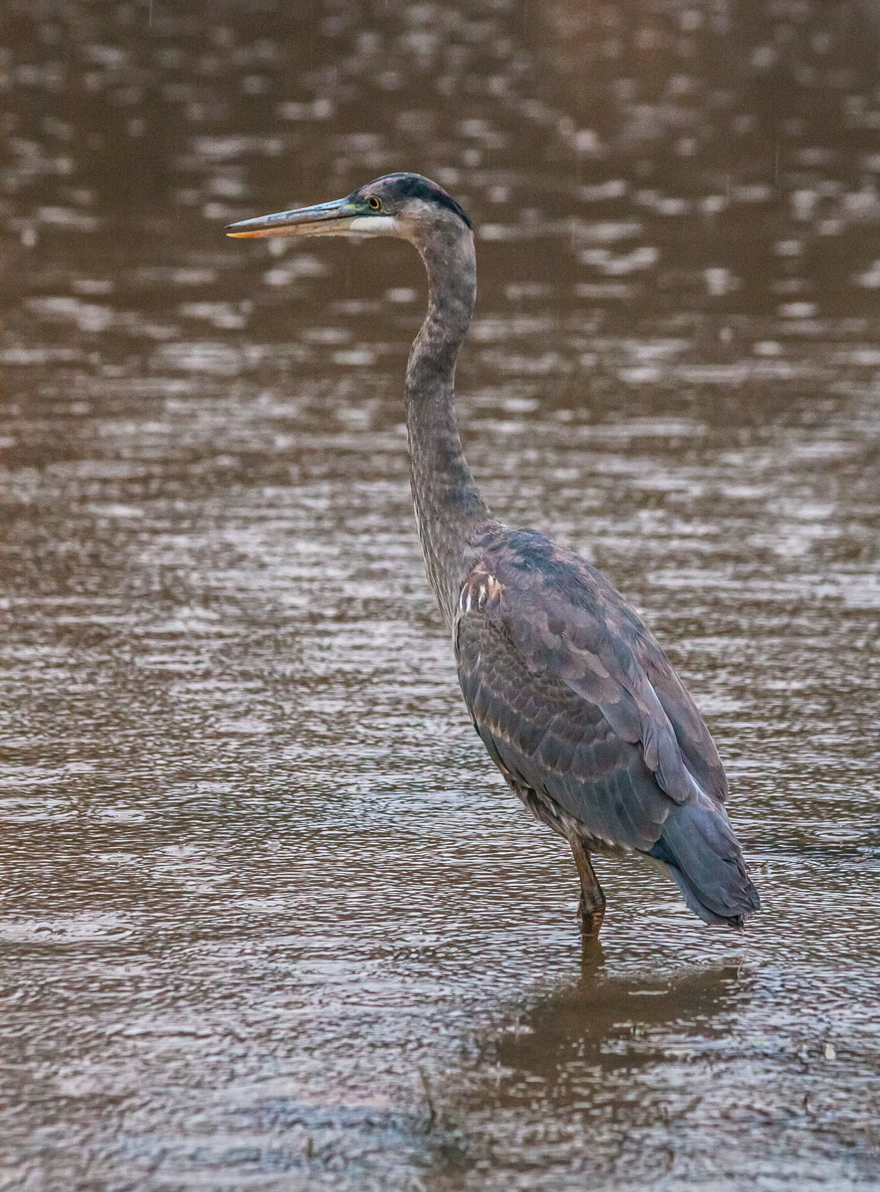
The light was fading in the late afternoon yesterday and it was starting to rain when I came across a Great Blue Heron (Ardea herodias), one of my favorite birds. The conditions were less than ideal, but I was determined to try to get a shot.

I managed to open my umbrella without startling the heron, a minor miracle, given that my umbrella is green and white. Knowing that I was going to have to shoot one-handed (with a small amount of balancing help from the hand holding the umbrella), I decided I was going to have to crank up the ISO of the camera higher than I had ever gone before—to ISO 1600.

I like the image that I got, though unsurprisingly it was a bit grainy. Fortunately, my software was able to reduce thee noise a little.

So now you know of at least two things that you can find out in the open when it is raining—blue herons and crazy photographers.

heron_rain_blog

© Michael Q. Powell. All rights reserved.

Read Full Post »

When I saw a small flock of blackbirds on Monday at my local marsh, I assumed that they were Red-winged Blackbirds, but a closer look showed that I was wrong—they were Rusty Blackbirds (Euphagus carolinus), a species that I had never photographed before.

The shape of the body seems similar to that of the Red-winged Blackbird, but the coloration is different and the pale yellow eyes of the Rusty Blackbird are particularly distinctive. They also seem to prefer a flooded area of the woods and I observed them pecking about in the shallow water, periodically flipping over wet leaves.

The Cornell Lab of Ornithology notes that the Rusty Blackbird is one of North America’s most rapidly declining species, whose population has plunged an estimated 85-99 percent over the past forty years and scientists are not sure why.rusty_blackbird_blog

© Michael Q. Powell. All rights reserved.
Read Full Post »

It won’t be long before my bird photos have the colorless backgrounds characteristic of winter, so I am photographing as many birds as I can find with autumn colors in the background, like this House Sparrow (Passer domesticus) that I observed last Sunday. As I noted in a posting last month, these birds are non-native (introduced from the Old World) and sometimes crowd out native birds. Still, I find them to be beautiful, especially when they pose like this. This pose is one of my favorites, when I get to look down the tail toward the head turned to the side.

house_sparrow_autumn_blog© Michael Q. Powell. All rights reserved.
Read Full Post »

The autumn colors may be fading fast, but the remaining leaves still provided a colorful background for this Northern Mockingbird (Mimus polyglottos) this past weekend.

Normally mockingbirds sing all of the time, but this one was curiously silent the entire time as I moved around at pretty close range, trying to get the best possible background for the shots. From time to time, the mockingbird would turn its head, almost like it was striking new poses for me. This was my favorite pose, a serious portrait in profile in which the mockingbird looks unusually stern.

mockingbird_autumn

© Michael Q. Powell. All rights reserved.

Read Full Post »

When I spotted a fairly large bird soaring in the sky, I stopped talking in mid-sentence and pointed my camera to the sky. My fellow conversationalist might have thought it was rude (she is not a photographer), but I am always trying to capture images of birds in flight and will start shooting long before I have identified a bird.

This bird looks to be a juvenile Red-shouldered Hawk (Buteo lineatus), though I am not certain about the identification and the hawk did not cry out at all, so I have only visual clues to go by. At first I thought it was just soaring for fun, but the intensity of the hawk’s eyes, especially in the second shot, suggest that it was paying attention to what was happening on the ground.

I was pretty fortunate when the hawk turned toward the light with its wings extended, providing a good look at the beautiful feathers of its wings and body. I am hoping that I will be getting better shots of hawks as we progress into winter, though, as with most wildlife subject, there are no guarantees.

hawk1_soaring_bloghawk2_soaring_blog

© Michael Q. Powell. All rights reserved.

Read Full Post »

Blue Jays are usually very loud and obnoxious, but this one flew by me without a sound.  When I looked at the photos, it was pretty clear why I had heard only the sounds of silence—the Blue Jay (Cyanocitta cristata) had apparently discovered an all-you-can-eat buffet and decided to stuff its mouth.  I suspect that the Blue Jay was going to cache the food, which seems to include acorns, and go back for more.

bluejay_mouthful_blogbluejay2_mouthful_blog

© Michael Q. Powell. All rights reserved.

Read Full Post »

How often have you been told (or read) that you need to fill the frame with your primary subject? If you photograph wildlife as I do, you know that it is rare that you have the opportunity to “fill the frame,” especially when your subject is moving.

I was a little shocked when I first looked at this image of a Canada Goose (Branta canadensis)—not only had I filled the frame, but I had managed to compose it pretty well. Yes, this is an uncropped image of a flying goose. I was awfully lucky to get this shot and I know that several of the images in the burst I took featured cutoff bodies or heads.

Now if I could just get a raptor to fly by this closely…

goose_fill_frame_blog

© Michael Q. Powell. All rights reserved.

Read Full Post »

No matter how bad the weather is, sparrows seem to be omnipresent at this time of the year. I can hear them as they move about in search of food, but they often choose to bury themselves deep in the bushes and undergrowth.

This White-throated Sparrow (Zonotrichia albicollis) was snacking on some kind of berries and I managed to catch him mid-bite when he lifted his head slightly. The branches and leaves give you an idea of the challenge involved in getting an unobstructed  shot. I am happy that I was able to get the head (and eye) in focus and the pose is an interesting one, because it caught the sparrow as it was doing something—static portraits are nice, but for me it’s even nicer to capture motion and activity.

berry_blog

© Michael Q. Powell. All rights reserved.
Read Full Post »

Orchestral conductors tend to be flamboyant characters and that is exactly what came to mind when I first say this image  of a female Mallard Duck (Anas platyrhynchos) with fully outstretched wings. She seems to be conducting an unseen duck orchestra creating what some might call music and other would characterize as a quackonophy.

dancing_duck_blog

© Michael Q. Powell. All rights reserved.

Read Full Post »

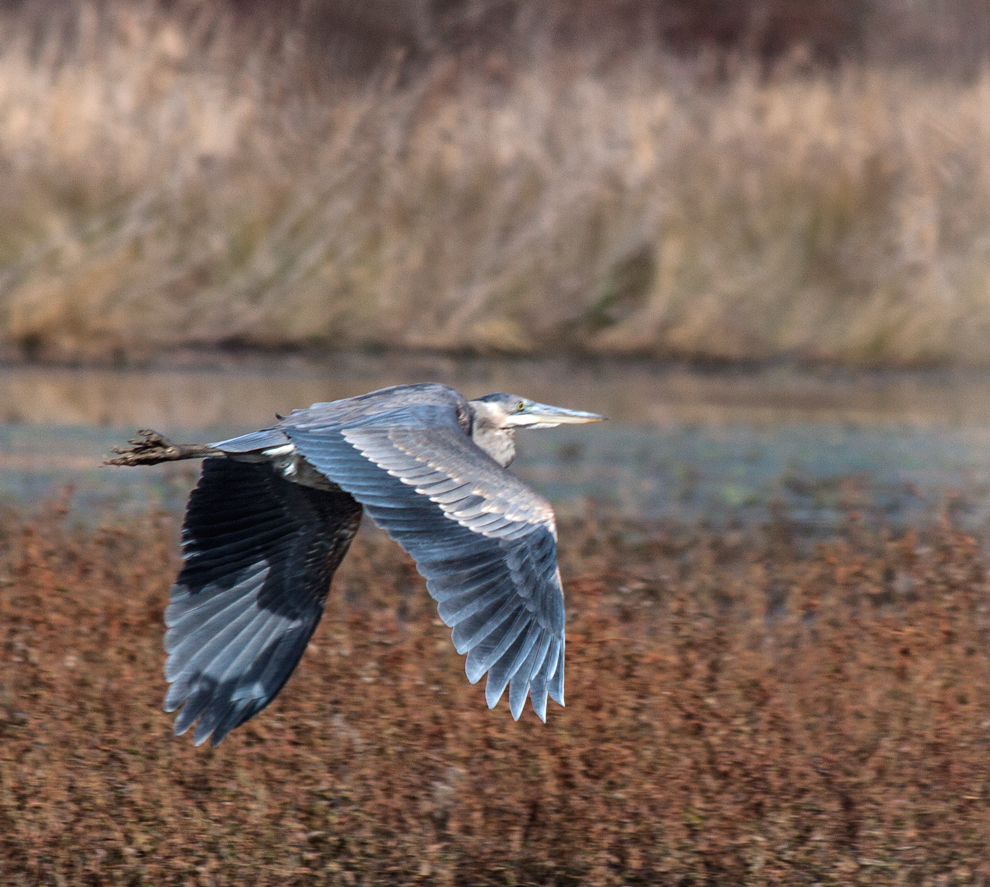
I was moving forward slowly in the underbrush, trying to get closer to some ducks, when out of the corner of my eye I detected some motion. It was a Great Blue Heron (Ardea herodias) flying low over the waters of the marshland pond.

I didn’t have time to check the settings on my camera, but the heron’s slow speed in flight did allow me to get off a few shots. This was one of the few times that I have been able to capture a bird in flying parallel to the ground at eye level and I really like this perspective.

heron_marsh2_blogheron_marsh_blog

© Michael Q. Powell. All rights reserved.

Read Full Post »

Green-winged Teals (Anas crecca) are very small ducks and they are really skittish, but I managed to capture a photo of these three (and a mallard) yesterday shortly after they took off from the water. When they are in the water, you get only the slightest hint of the green on the wings (see my post from last year to see one Green-winged Teals at rest), but when they are flying, it’s easy to see why the got their name.

I went back and forth in my mind about whether or not to crop out the female mallard. Most people are familiar with mallards, so they can see how small the teals are by comparing them in the photo to the mallard. In addition, I like contrast between the green in wings of the teals and the blue in the wings of the mallard. However, the mallard is a bit far away from the three teals and there is nothing of visual interest in the center area of the photo. So I cropped a bit more and created the second image that eliminates the mallard.

Which version of the image works best for you?

green_and_blue_ducks_blog

green_and_blue_ducks_B_blog

© Michael Q. Powell. All rights reserved.

Read Full Post »

Now that most of the leaves are gone from the trees, one of the Red-shouldered Hawks (Buteo lineatus) seems to have returned to a favorite perch at my local marsh. The good news is that I know where the perch is, but the bad news is that there is a large field of cattails in mud and water between my best observation spot and the tall tree in which the hawk is perched.

The branch is parallel to the ground and seems to provide the hawk a comfortable observation post from which to survey the surroundings and look for prey. Apparently it is so comfortable that the hawk can stay in that one spot for a long period of time. I had my camera on a tripod for the first shot and I waited and waited for the hawk to fly.

A fellow Canon photographer came by and we started taking about menu settings and I took the camera off the tripod in order to check the menus. As I was thumbing through the menus, my friend suddenly blurted out that my hawk had taken off. I turned back in the direction of the hawk and was able to snap off a couple of quick shots of the hawk in flight.

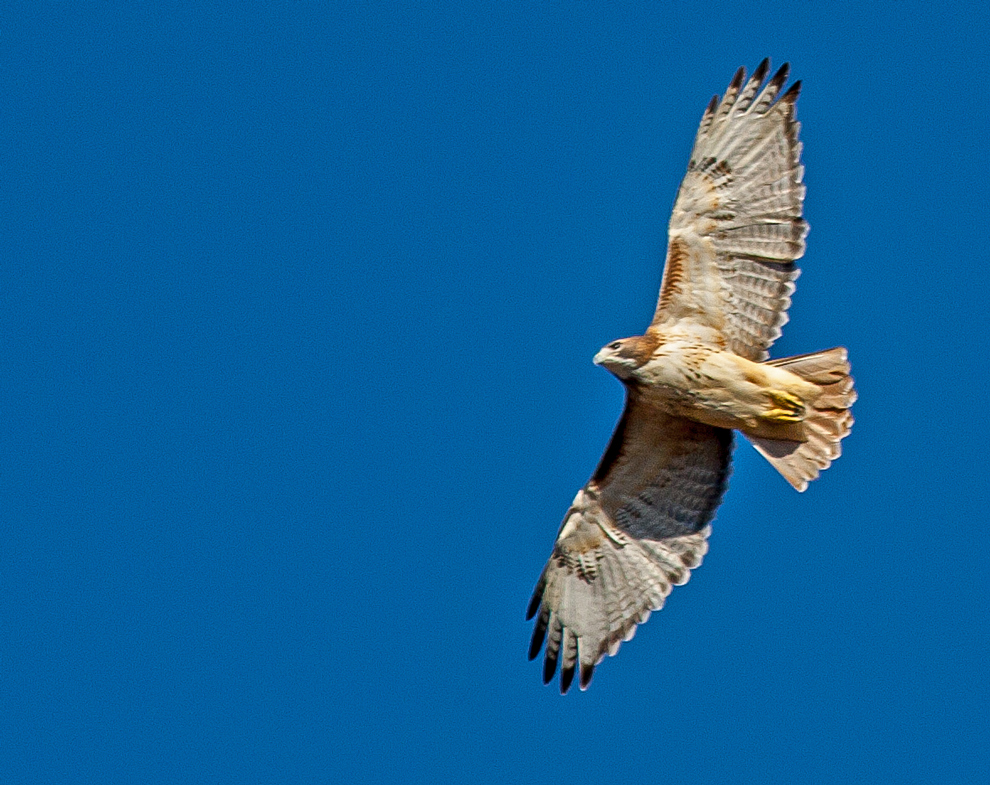
The shots highlight some of the beautiful colors and patterns of the hawk’s wings and so I have chosen to include them in this posting. As one of my fellow bloggers Lyle Krahn has noted, any day that you see a hawk is a good day. Be sure to check out his blog for some awesome shots of hawks (and lots of other wildlife), including this recent posting, in which you are asked to make a difficult choice between two hawk photos for an imaginary calendar.

hawk_flying3_bloghawk_flying_bloghawk_flying2_blog

© Michael Q. Powell. All rights reserved.

Read Full Post »

He was partially hidden by the branches, but I was happy—I had finally gotten a clear view and a recognizable photograph of a Pileated Woodpecker (Dryocopus pileatus).

I have long hoped to spot a Pileated Woodpecker. I have seen evidence of their handiwork (or is it more appropriately “beakwork”) several time and heard the loud sound of these large woodpeckers at work, but I had not been able to find one. This past Monday, while I was attempting to photograph dragonflies, I heard the sound of a woodpecker in a nearby patch of woods and went to investigate. I was surprised to see a Pileated Woodpecker, because the soft tap-tap was not what I expected from this species.

My shot is really just a record shot, but the first time that I see a new bird, insect, or animal, I am invariably content to get any kind of shot. I know I can do a lot better, if I can just find a cooperative Pileated Woodpecker.

pileated_blog

© Michael Q. Powell. All rights reserved.
Read Full Post »

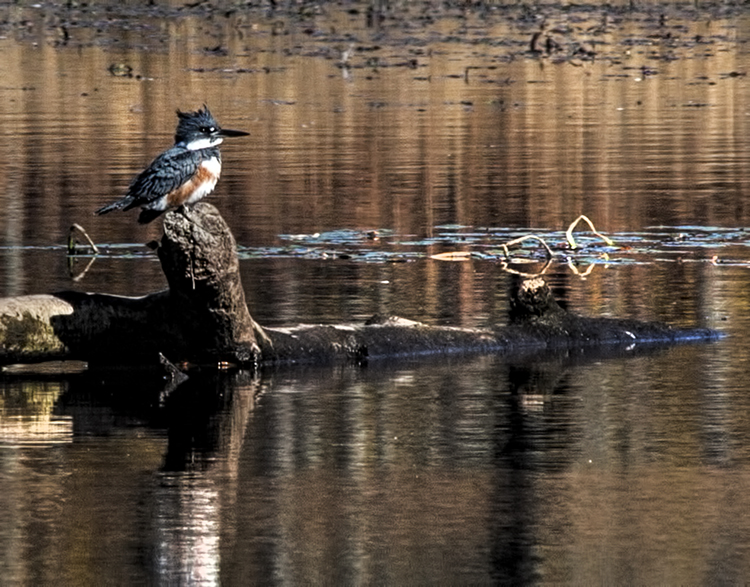
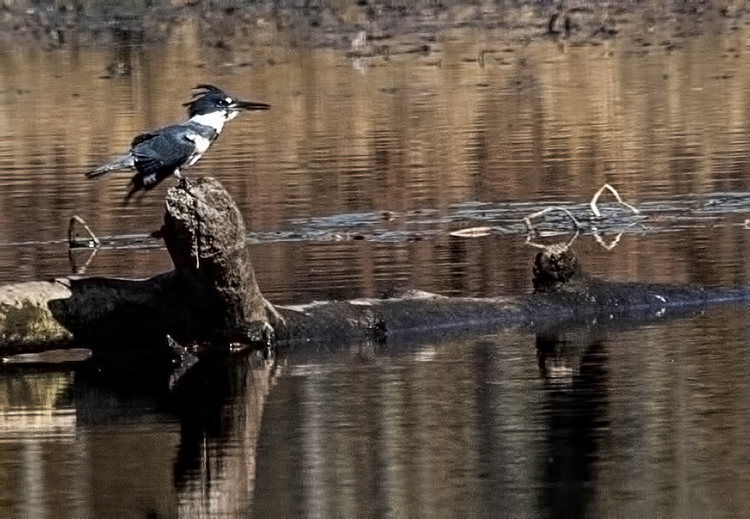
I was looking across the water of a small pond at my local marsh, enjoying the beautiful early morning reflections, when a bright white flash zoomed across my field of view and stopped in the middle of the water.

Initially I had no clue about what it might be, but when I looked through my telephoto lens, I could see that it was a female Belted Kingfisher (Megaceryle alcyon). I had never before seen a kingfisher perched so low to the water and it was pretty obvious that she was not fishing. As I watched from a distance, she went through what I assume is her morning routine, as she twisted and turned and fluffed up her feathers.

Before long, the kingfisher flew off to a higher perch in a more distant tree, where I suspect she busied herself with the task of catching some fish for her breakfast.

IMG_2587 crop webIMG_2519 Cropped web

© Michael Q. Powell. All rights reserved.
Read Full Post »

Sometimes you don’t have to make a choice between two options—you can have them both.

In this morning’s blog posting, I posed the question, “When it comes to images of birds in flight, do you prefer the sky as the background or some element of the earth?” and I received quite a few responses, with a greater number having a preference, in general, for background or contextual elements rather than a plain blue sky.

Sometimes I manage to get an image that incorporates the best of both worlds. This image, for example, has one Canada Goose against a leafy background, one against the sky, and one in between.

Who says you have to choose? (In the interest of full disclosure, I intentionally set up the question as a false dichotomy in order to stimulate thinking. For me, the best answer to the question I posed, which called on you to make a sweeping overgeneralization, was the person who responded quite simply with the words, “It depends.”)

geese_flying_cropped_blog

© Michael Q. Powell. All rights reserved.

Read Full Post »

When it comes to images of birds in flight, do you prefer the sky as the background or some element of the earth? Here are two photographs of Canada Geese (Branta canadensis) that I took this past Monday that illustrate my question.

Canada Geese are some of my favorite subjects as I try to improve my skills in photographing flying birds—they are relatively big, flight slowly (especially when taking off and landing), and, perhaps most importantly, there are a lot of them.

In some ways, it’s a little easier to track a bird in the sky, since there is nothing else to grab the camera’s focus (if you can lock in the focus quickly enough). However, the light is a lot more variable, particularly when a bird is circling, so proper exposure is a challenge and shadows are a sad reality. I was happy that I was able to time the second shot so that the light illuminated most of the underside of the goose. Some photographers, though, seem to look down at photos of birds in the sky and prefer more environmental shots.

I had to act quickly to get the shot of the goose with the trees in the background, when some geese took off and flew by me at almost eye level. The trees were far enough away that they blurred out and the head of the goose is mostly in focus. Depth of field is always an issue for me in shots like this—you can actually see the depth of field in the amount of the extended wings that is in focus.

So there you have it, two different shots of a goose in flight. Does the background play a role in your assessment of which one you prefer?

goose_flying_11Nov_blog

goose_flying2_11Nov_blog

© Michael Q. Powell. All rights reserved.

Read Full Post »

« Newer Posts - Older Posts »