Feeds:
Posts
Comments

Archive for the ‘Autumn’ Category

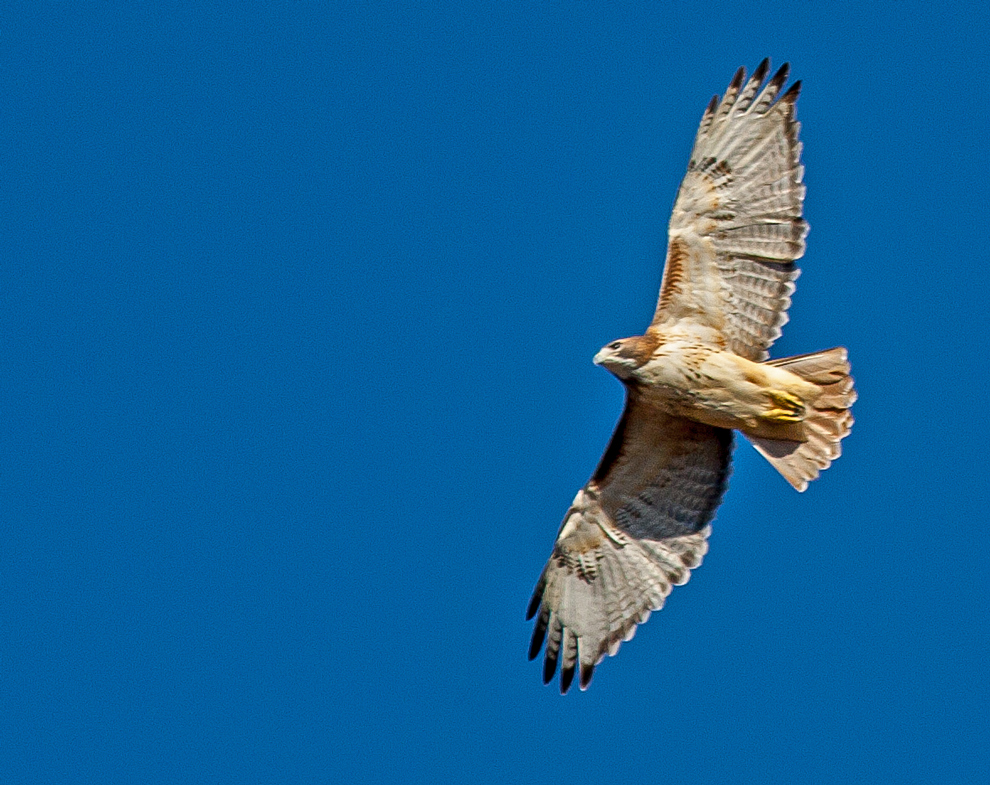
When I spotted a fairly large bird soaring in the sky, I stopped talking in mid-sentence and pointed my camera to the sky. My fellow conversationalist might have thought it was rude (she is not a photographer), but I am always trying to capture images of birds in flight and will start shooting long before I have identified a bird.

This bird looks to be a juvenile Red-shouldered Hawk (Buteo lineatus), though I am not certain about the identification and the hawk did not cry out at all, so I have only visual clues to go by. At first I thought it was just soaring for fun, but the intensity of the hawk’s eyes, especially in the second shot, suggest that it was paying attention to what was happening on the ground.

I was pretty fortunate when the hawk turned toward the light with its wings extended, providing a good look at the beautiful feathers of its wings and body. I am hoping that I will be getting better shots of hawks as we progress into winter, though, as with most wildlife subject, there are no guarantees.
hawk1_soaring_bloghawk2_soaring_blog

© Michael Q. Powell. All rights reserved.

Read Full Post »

When an Autumn Meadowhawk dragonfly (Sympetrum vicinum) landed on my thigh last Friday, my first thought was to get a photograph of him. Fortunately, my 100mm macro lens was already on my camera—in anticipation of a shot like this—and I was able to capture a close-up, eye-to-eye portrait of the dragonfly by contorting my body and attempting to stabilize my shooting position.

My blue jeans were broken in and their texture, color, and pattern made a pretty cool backdrop for this colorful dragonfly. It may be my imagination, but he seemed to be looking up at me with a mixture of curiosity and amusement.

For whatever reason, many of these dragonflies, which I was able to observe as recently as yesterday, do not seem fearful of people. The classic Drifters song from the 1960’s may talk of spending time with your sweetheart under the boardwalk, but these Autumn Meadowhawks seem to spend most of their time warming up on (and not under) the boardwalk, with periodic mating forays into the bushes.

dragonfly1_denim_tight_crop_blog

Click on the photo to see it in higher resolution.

© Michael Q. Powell. All rights reserved.

Read Full Post »

Blue Jays are usually very loud and obnoxious, but this one flew by me without a sound.  When I looked at the photos, it was pretty clear why I had heard only the sounds of silence—the Blue Jay (Cyanocitta cristata) had apparently discovered an all-you-can-eat buffet and decided to stuff its mouth.  I suspect that the Blue Jay was going to cache the food, which seems to include acorns, and go back for more.

bluejay_mouthful_blogbluejay2_mouthful_blog

© Michael Q. Powell. All rights reserved.

Read Full Post »

How often have you been told (or read) that you need to fill the frame with your primary subject? If you photograph wildlife as I do, you know that it is rare that you have the opportunity to “fill the frame,” especially when your subject is moving.

I was a little shocked when I first looked at this image of a Canada Goose (Branta canadensis)—not only had I filled the frame, but I had managed to compose it pretty well. Yes, this is an uncropped image of a flying goose. I was awfully lucky to get this shot and I know that several of the images in the burst I took featured cutoff bodies or heads.

Now if I could just get a raptor to fly by this closely…

goose_fill_frame_blog

© Michael Q. Powell. All rights reserved.

Read Full Post »

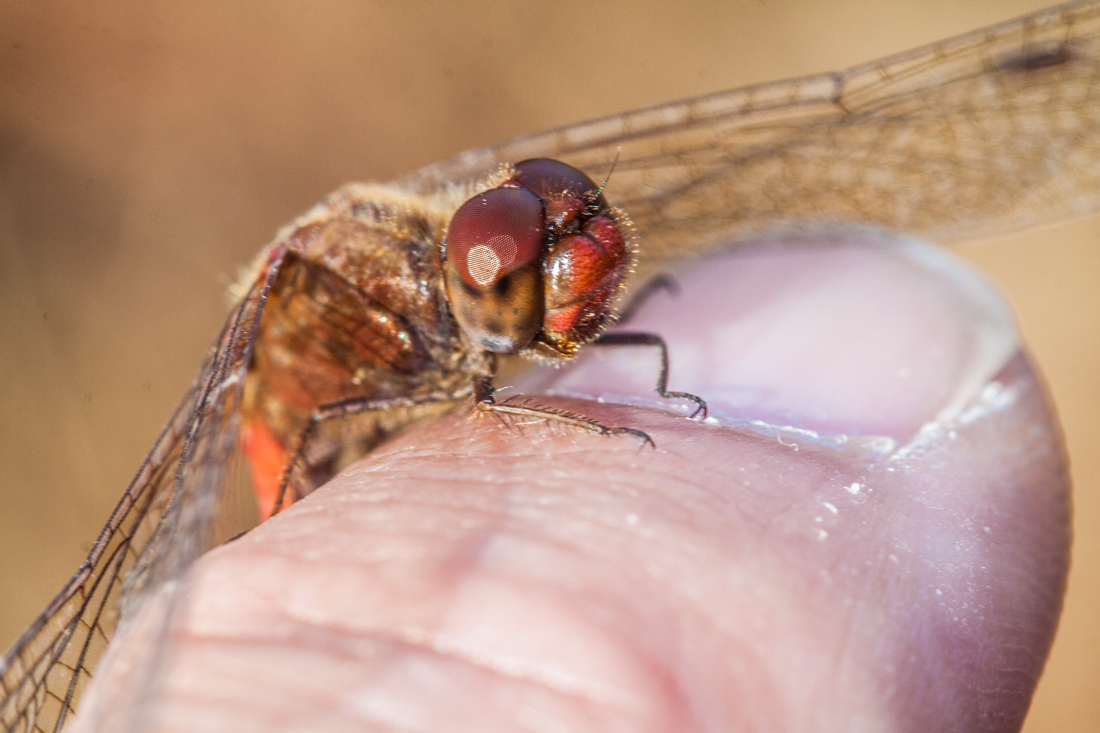
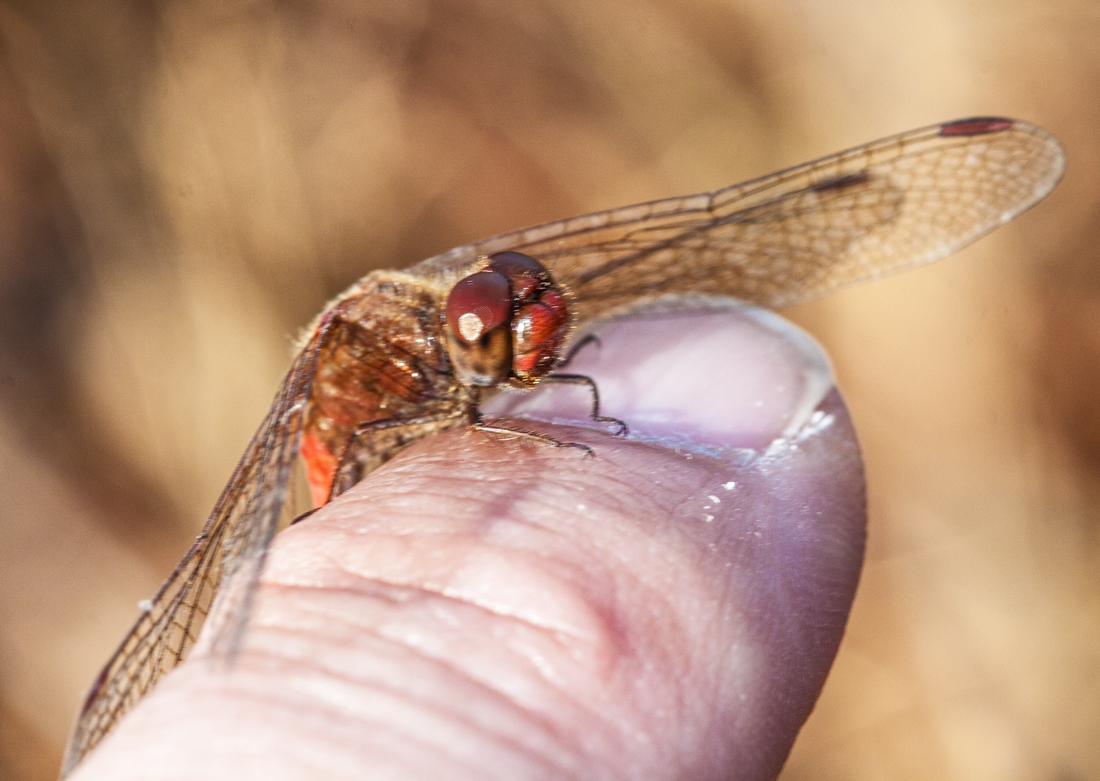
It may be mid-November, but one hardy dragonfly species is still around here in Northern Virginia—the Autumn Meadowhawk (Sympetrum vicinum).

The dragonflies were unusually friendly today, perching on my sweatshirt and jeans numerous times, though they spent most of the time trying to warm themselves in the sun on the boardwalk. Here is a close-up shot of a male Autumn Meadowawk that I coaxed onto my fingertip yesterday at Huntley Meadows Park. All I had to do was slowly move my finger forward and several times a dragonfly accommodated by crawling onto the finger.

Needless to say, it was an interesting challenge trying to hold one finger out as far as I could and then focus and shoot my DSLR with the other hand. Fortunately I had switched to my macro lens—my arms would not have been long enough to get within the minimum focusing distance of the telephoto zoom lens that I had been using earlier in the day. Click on the photos to get a higher-resolution look at the details of the dragonfly’s compound eyes.

dragonfly_finger2_blogdragonfly_finger1_blog

© Michael Q. Powell. All rights reserved.
Read Full Post »

Now that most of the leaves are gone from the trees, one of the Red-shouldered Hawks (Buteo lineatus) seems to have returned to a favorite perch at my local marsh. The good news is that I know where the perch is, but the bad news is that there is a large field of cattails in mud and water between my best observation spot and the tall tree in which the hawk is perched.

The branch is parallel to the ground and seems to provide the hawk a comfortable observation post from which to survey the surroundings and look for prey. Apparently it is so comfortable that the hawk can stay in that one spot for a long period of time. I had my camera on a tripod for the first shot and I waited and waited for the hawk to fly.

A fellow Canon photographer came by and we started taking about menu settings and I took the camera off the tripod in order to check the menus. As I was thumbing through the menus, my friend suddenly blurted out that my hawk had taken off. I turned back in the direction of the hawk and was able to snap off a couple of quick shots of the hawk in flight.

The shots highlight some of the beautiful colors and patterns of the hawk’s wings and so I have chosen to include them in this posting. As one of my fellow bloggers Lyle Krahn has noted, any day that you see a hawk is a good day. Be sure to check out his blog for some awesome shots of hawks (and lots of other wildlife), including this recent posting, in which you are asked to make a difficult choice between two hawk photos for an imaginary calendar.

hawk_flying3_bloghawk_flying_bloghawk_flying2_blog

© Michael Q. Powell. All rights reserved.
Read Full Post »

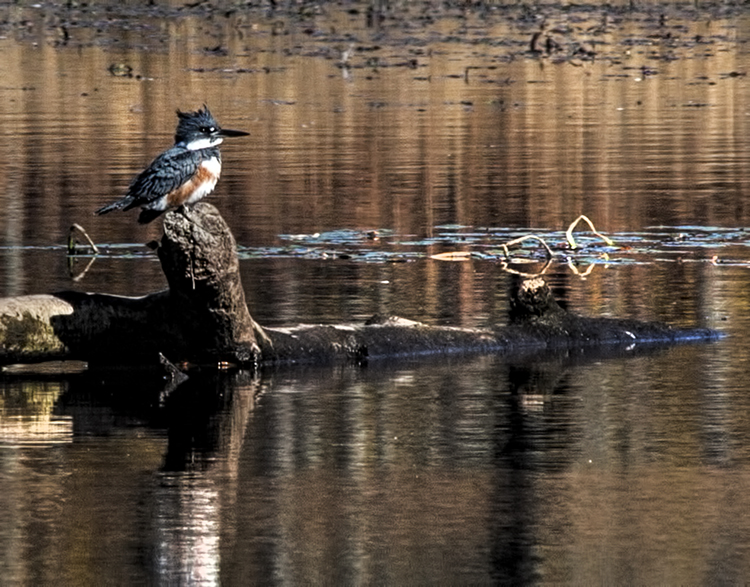
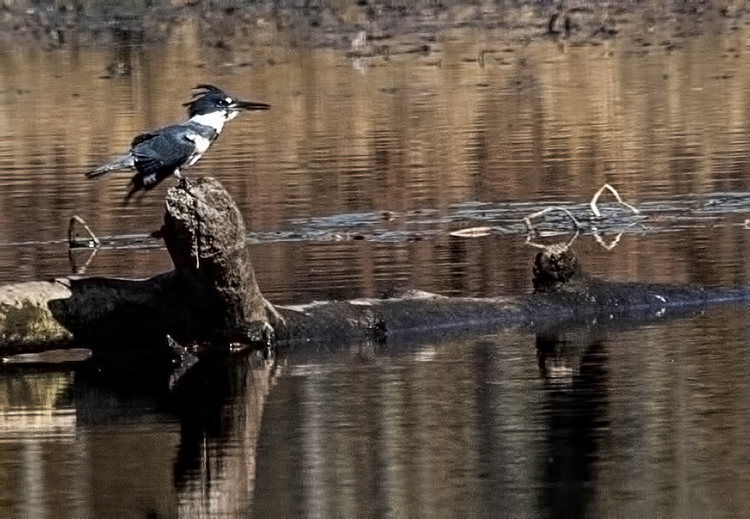
I was looking across the water of a small pond at my local marsh, enjoying the beautiful early morning reflections, when a bright white flash zoomed across my field of view and stopped in the middle of the water.

Initially I had no clue about what it might be, but when I looked through my telephoto lens, I could see that it was a female Belted Kingfisher (Megaceryle alcyon). I had never before seen a kingfisher perched so low to the water and it was pretty obvious that she was not fishing. As I watched from a distance, she went through what I assume is her morning routine, as she twisted and turned and fluffed up her feathers.

Before long, the kingfisher flew off to a higher perch in a more distant tree, where I suspect she busied herself with the task of catching some fish for her breakfast.

IMG_2587 crop webIMG_2519 Cropped web

© Michael Q. Powell. All rights reserved.

Read Full Post »

Sometimes you don’t have to make a choice between two options—you can have them both.

In this morning’s blog posting, I posed the question, “When it comes to images of birds in flight, do you prefer the sky as the background or some element of the earth?” and I received quite a few responses, with a greater number having a preference, in general, for background or contextual elements rather than a plain blue sky.

Sometimes I manage to get an image that incorporates the best of both worlds. This image, for example, has one Canada Goose against a leafy background, one against the sky, and one in between.

Who says you have to choose? (In the interest of full disclosure, I intentionally set up the question as a false dichotomy in order to stimulate thinking. For me, the best answer to the question I posed, which called on you to make a sweeping overgeneralization, was the person who responded quite simply with the words, “It depends.”)

geese_flying_cropped_blog

© Michael Q. Powell. All rights reserved.

Read Full Post »

When it comes to images of birds in flight, do you prefer the sky as the background or some element of the earth? Here are two photographs of Canada Geese (Branta canadensis) that I took this past Monday that illustrate my question.

Canada Geese are some of my favorite subjects as I try to improve my skills in photographing flying birds—they are relatively big, flight slowly (especially when taking off and landing), and, perhaps most importantly, there are a lot of them.

In some ways, it’s a little easier to track a bird in the sky, since there is nothing else to grab the camera’s focus (if you can lock in the focus quickly enough). However, the light is a lot more variable, particularly when a bird is circling, so proper exposure is a challenge and shadows are a sad reality. I was happy that I was able to time the second shot so that the light illuminated most of the underside of the goose. Some photographers, though, seem to look down at photos of birds in the sky and prefer more environmental shots.

I had to act quickly to get the shot of the goose with the trees in the background, when some geese took off and flew by me at almost eye level. The trees were far enough away that they blurred out and the head of the goose is mostly in focus. Depth of field is always an issue for me in shots like this—you can actually see the depth of field in the amount of the extended wings that is in focus.

So there you have it, two different shots of a goose in flight. Does the background play a role in your assessment of which one you prefer?

goose_flying_11Nov_blog

goose_flying2_11Nov_blog

© Michael Q. Powell. All rights reserved.

Read Full Post »

As I was going through some of my bird photos, I realized that a majority of them feature the male of the species. The males tend to be more loud and flashy, so I guess it’s not surprising that they draw my attention much of the time. The female often has a more delicate beauty and coloration, as is the case with this female Ring-necked duck (Aythya collaris) that I photographed recently.

I added an image of a male Ring-necked duck that I photographed the same day to allow you to make your own comparison and judgments. It may be a cliché, but it is nonetheless true that beauty is in the eye of the beholder.

ring-necked_female_blogring-necked_male_blog

© Michael Q. Powell. All rights reserved.
Read Full Post »

The wind was kicking up yesterday on the Potomac River, making it difficult for the ducks there, like this Ruddy Duck (Oxyura jamaicensis). I watched as the small ducks got drenched repeatedly as they sought to ride the waves.

At least it wasn’t raining and the temperatures have not yet dropped below the freezing levels, even at night.

ruddy_waves_blog

© Michael Q. Powell. All rights reserved.
Read Full Post »

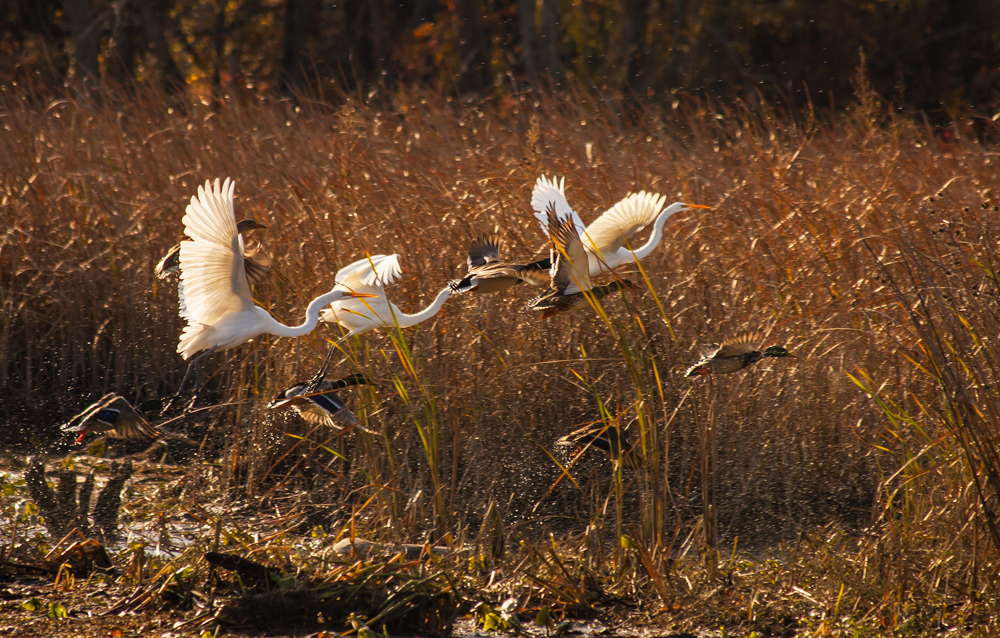
I was watching some Great White Egrets (Ardea alba) yesterday at Dyke Marsh Wildlife Preserve, a freshwater tidal wetland on the Potomac River, when something startled the birds.

The egrets and some mallard ducks took off from the water en masse in a great explosion of water. I captured some of that noise and confusion in the second photo. The photo I chose to feature shows the birds a short after the take off as they start to lift off a little and fly over a meadow-like area with tall golden grass. The light was especially beautiful on the wings of the egrets, which happily I managed to capture without blowing out the highlights as sometimes I do with these very white birds.

Click on the photos to see some of the beautiful details of the birds in greater resolution.

takeoff_group1_blog takeoff_group2_blog

© Michael Q. Powell. All rights reserved.

Read Full Post »

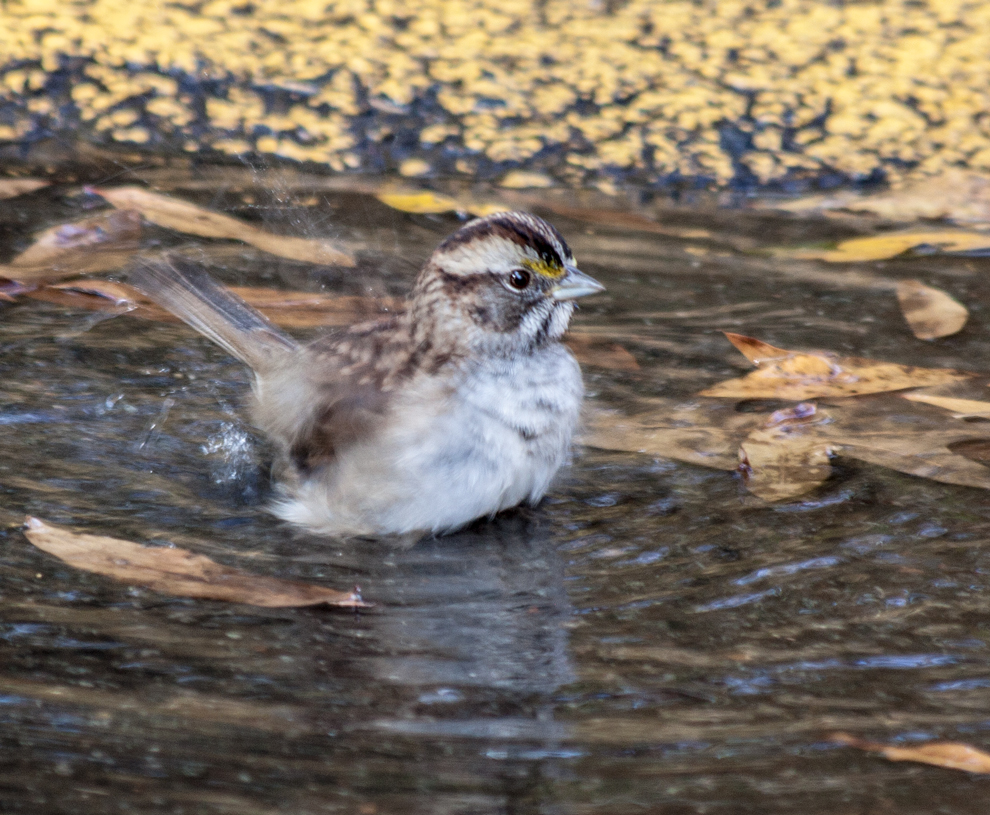
Did you enjoy playing in puddles when you were a child? I remember a childhood of rubber boots and yellow slickers and days when my pant legs would be drenched from walking through puddles. Even now, I’ll occasionally kick my feet through a puddle of water and then glance quickly all around, hoping that nobody has seen me give in to my child-like impulses.

When I spotted this White-throated sparrow (Zonotrichia albicollis) in a shallow puddle, I thought he was merely getting a drink of water. However, he stuck his head in the water, splashed around, and seemed to be having a good time. Perhaps he was taking a bath, or maybe he was simply enjoying himself in the cool waters. (In case you are curious about the background, the puddle had formed in a low area adjacent to a speed bump at the entrance to the parking area of my local marsh park—the yellow you can see is the safety paint of the speed bump itself.)

Initially, I was unsure that this sparrow was a White-throated, because the white patch was not really obvious and the eye stripes were not as well defined as in previous photos that I have posted of this species. The yellow coloration above the lore (the area between the eye and the bill) makes it pretty likely that this is a White-throated sparrow, though it may be the brown and tan striped variant, rather than the black and white one that I featured in a posting earlier this week.

I don’t know about you, but I feel inspired to find a puddle to play in today. Have a wonderful Friday.

Sparrow_puddle_cropped_blog

© Michael Q. Powell. All rights reserved.

Read Full Post »

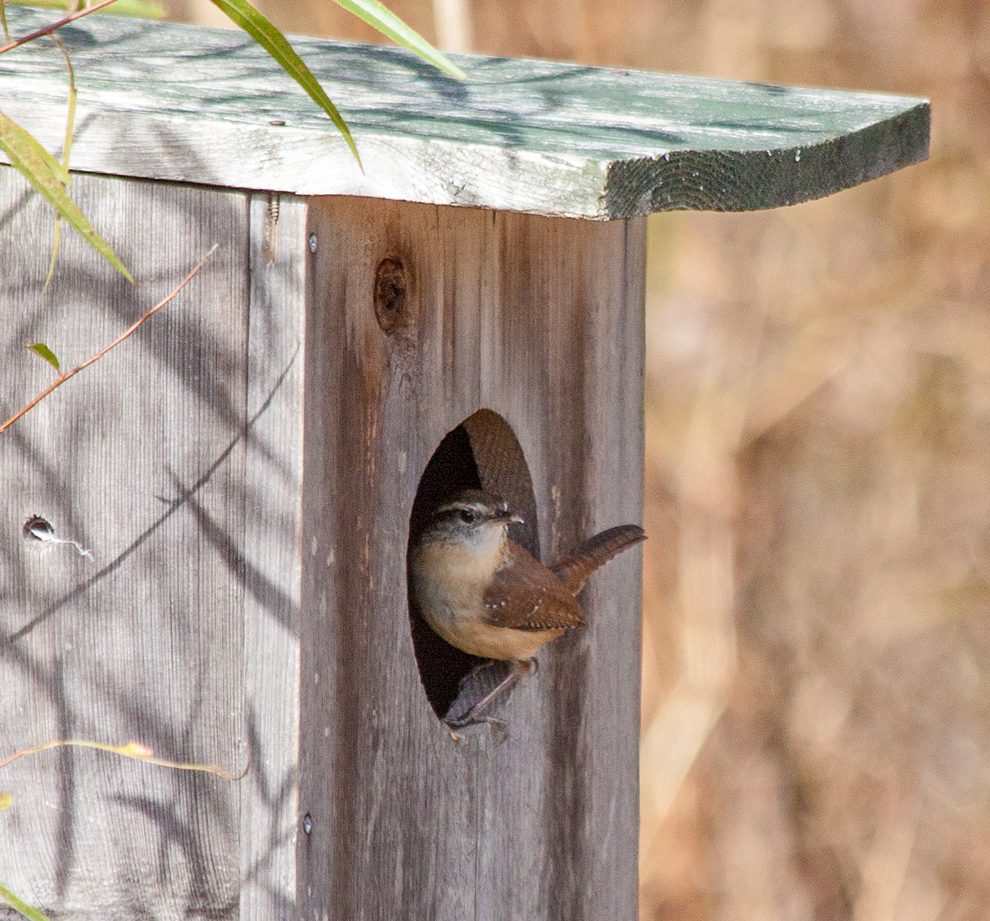
Why was this wren perching on the nesting box just prior to entering it? It’s not nesting season, is it? Was it seeking shelter on a cool, windy day? Were there insects inside to eat?

As I noted yesterday, bird activity was low on Monday—we didn’t even have any Canada geese or ducks passing through. I initially noticed this small bird, which I think is a Carolina Wren (Thryothorus ludovicianus), when it was checking out the underside of this nesting box. The box itself is pretty big and was placed there, I believe, for ducks to use. Eventually the wren perched on the edge of the entrance and peered inside and then looked all around before going inside.

wren_box_blog

© Michael Q. Powell. All rights reserved.

Read Full Post »

It was cold and overcast yesterday and there were not many birds visible, with the notable exception of sparrows. Sparrows were as active as ever, though most of the time I could only hear them and not see them. They seem to like to rot about in the underbrush most of the time.

I was really happy when this White-throated sparrow (Zonotrichia albicollis) popped up for a moment and I was able to get this image. I love the facial pattern and colors of this bird, which seems to have a goatee much like my own. (My goatee started out with salt-and-pepper color, but increasingly has become mostly salt).

When researching this bird, I learned that there is another version (morph) of this bird that has brown and tan head stripes, instead of black and white. I will have to look even more closely at my photos of the White-throated sparrow, which has become more common the past few weeks, and see if I have managed to capture any images of the tan-striped variant.

sparrow_white_throat_crop_blog

© Michael Q. Powell. All rights reserved.

Read Full Post »

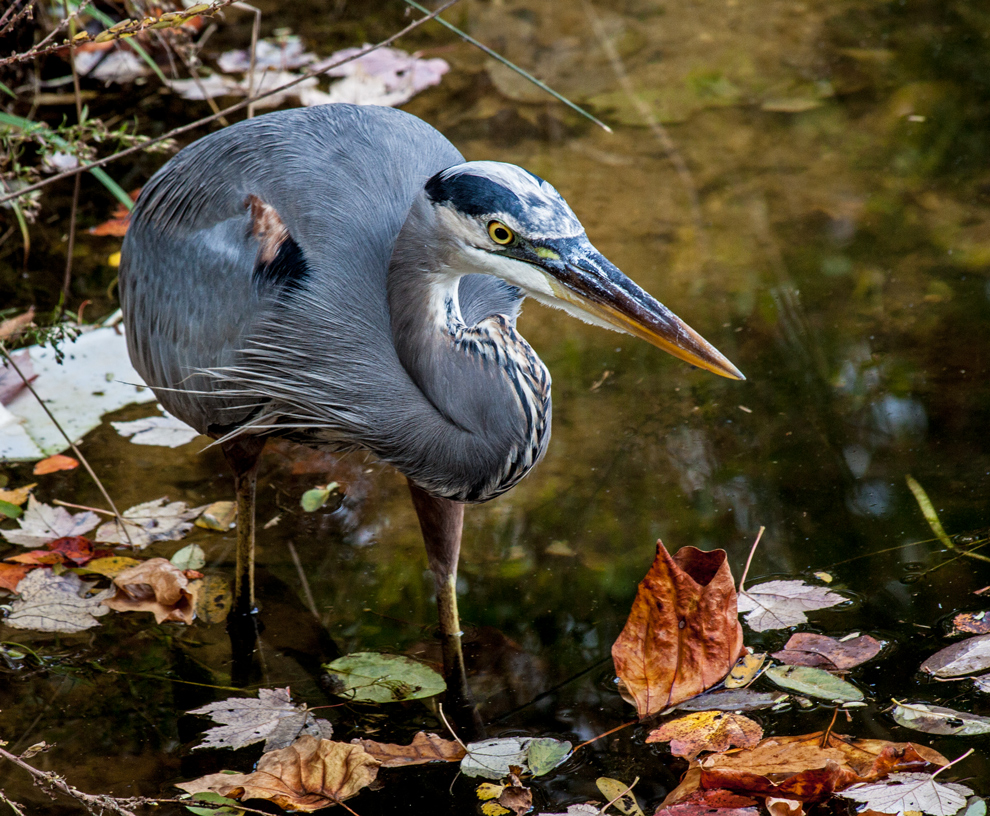
Saturday, I went out with fellow photographer Cindy Dyer to take photographs of the fall foliage and we stopped at a little suburban pond, where I managed to get this close-up shot of a Great Blue Heron (Ardea herodias) crouching at the edge of the water. If you want to see some awesome shots of the fall colors in Northern Virginia, check out Cindy’s blog—she was quicker than I was in posting her shots.

I was able to get this downward-looking angle for the image because I was on a small bridge that is part of a walking path around the pond. The heron was focused on trying to catch prey, though he didn’t seem to be having too much success. Judging from its relatively small size and inexperience fishing, I suspect that this might be a juvenile heron.

I took a number of other shots of the heron that I will probably post, including an encounter with what I think is a juvenile cormorant. Stay tuned.

heron_crouching_blog

© Michael Q. Powell. All rights reserved.

Read Full Post »

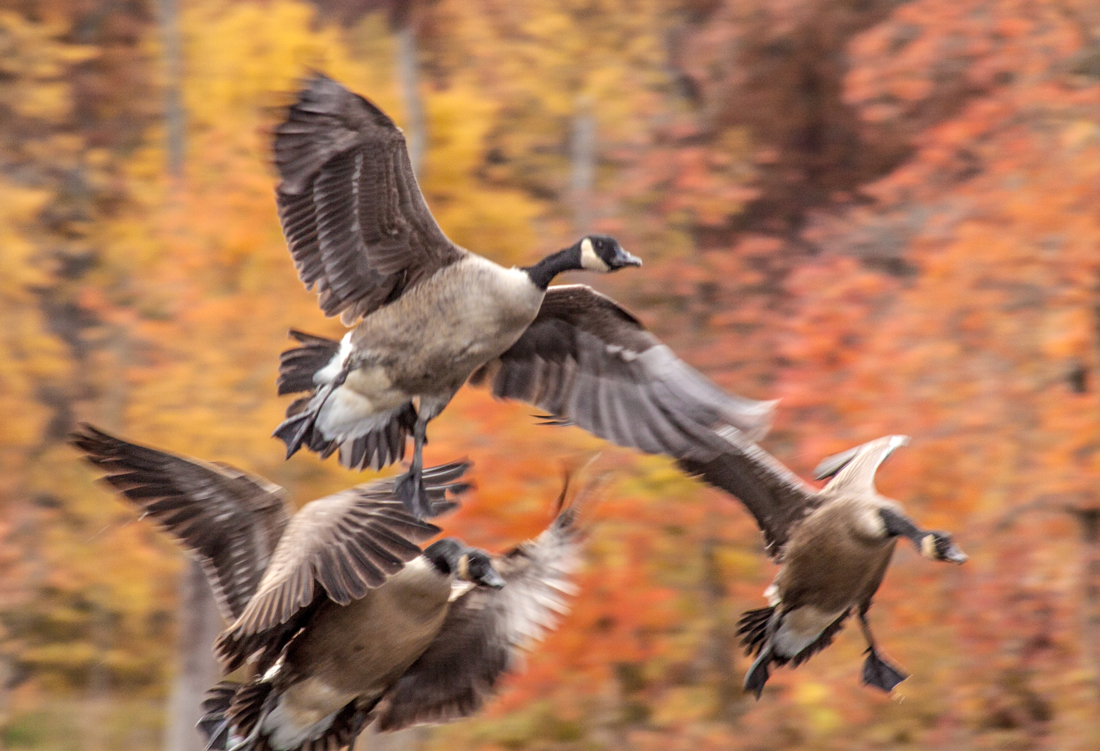
Standing at the end of a small pond, I heard the sounds of an approaching flock of Canada Geese (Branta canadensis). I looked all around as I prepared to track them and couldn’t help noticing areas of beautiful autumn foliage.

Wouldn’t it be cool  if I could capture the geese landing with the colorful leaves as a background? I put that idea in the back of my mind, remembering that it was going to be tough enough to capture decent shots of the geese without worrying about the background.

It’s a noisy crazy couple of moments when the geese come in for a landing—they come in waves and there is so much activity that it’s hard to figure out what to focus on. Usually, as I did here, I will try to concentrate on a single bird as it approaches and to keep it in focus.

I captured this image at the moment when the geese were slowing down just prior to entry into the water. My main subject is in a pretty good focus and the other geese are in interesting positions. I was surprised that I was able to get the orange background—it had been a hope, but certainly not an expectation. The result is an image that I really like, an image that combines two of the iconic elements of the autumn.

geese_landing_fall_blog

© Michael Q. Powell. All rights reserved.

Read Full Post »

Most of the time when I try to photograph ducks in flight, I end up with shadows and muted colors. Last weekend, though, the light was right and I was able to capture a small group of mallards (Anas platyrhynchos) in full color. They were pretty far away, but I like the formation that I was able to capture. There are four males and one female, and one of the males is a straggler who seems to have trouble keeping up with the group.

straggler_blog

Click on the photo to see it in higher resolution.

© Michael Q. Powell. All rights reserved.
Read Full Post »

Last year it seemed like I saw Downy Woodpeckers everywhere, but this year I have sighted only a few of them. I took this shot of a female Downy Woodpecker (Picoides pubescens) in mid-October during a visit to Theodore Roosevelt Island, a nature preserve in the Potomac River opposite the District of Columbia.

woodpecker_downy_blog

© Michael Q. Powell. All rights reserved.

Read Full Post »

My eyes caught a flash of bright blue yesterday as I was walking through Huntley Meadows Park, my local marsh, and I pointed my telephoto lens at the tree in the distance.

As I composed this shot, I was initially a little confused by what I saw. The reddish-brown color of the breast and the fact that there were some blue feathers made me think that it was an Eastern Bluebird (Sialia sialis), but the bird’s body didn’t seem blue enough. After doing a little research when I got home, I realized that most of the bluebirds that I had seen previously must have been adult males—as is the case with many other birds, the female Eastern Bluebird is more subdued in color than the male.

I didn’t have a lot of time to frame this shot, so I was happy that I managed to center the bird on the dark spot in the background and to surround it with some colorful fall foliage. All of the orange color in the image really helps the blue on the wing to pop, which is not too surprising since, if I remember color theory correctly, orange and blue are complementary colors.

bluebird_autumn_blog

© Michael Q. Powell. All rights reserved.
Read Full Post »

« Newer Posts