Feeds:
Posts
Comments

Archive for the ‘Autumn’ Category

Over the last month I have developed an unhealthy obsession with the Great Spreadwing damselfly (Archilestes grandis)—I think that I have turned into a stalker.

Normally I am a walker, not a stalker. I like to keep in motion, opportunistically scanning for new and different subjects to photograph. Increasingly, however, I have been spending endless hours at the same location, waiting and hoping that I will get yet another glimpse of a Great Spreadwing damselfly.

My friend and fellow fanatic Walter Sanford and I have been closely monitoring this one location, documenting in our photos the continued presence of these beautiful creatures and establishing new records for the latest date that they have been spotted in our area. It’s become harder and harder to find one of them and their population has shrunk to the point that there may be only one damselfly remaining.

That certainly seemed to be the case on 11 November (Veterans Day/Armistice Day), when for the first time this season, Walter and I hunted together for a Great Spreadwing. We have a friendly rivalry and push each other, but on this day it was complete cooperation as we searched for hours, uncertain if there were any survivors. Check out Walter’s blog posting today for an engaging narrative and wonderful photos of our adventures that day, which ultimately turned out to be successful in spotting a Great Spreadwing damselfly.

I too managed to get a few photos, although it was tough to frame a shot, because the  damselfly perched in the almost knee-high vegetation and I couldn’t move much from my crouching position for fear of scaring it away. I was shooting with my 180mm macro lens, so zooming from a greater distance was not an option.

Is this the final fall farewell? Are my days as a stalker coming to an end? When is it time to call it quits on a relationship?

The weather has turned cooler again and conditions continue to grow increasingly inhospitable. These may well be the last shots I get of a Great Spreadwing damselfly this season.

However, I’m heading out to the park in a short while and suspect that I will be drawn back inexorably to the damselfly’s habitat.

It’s so hard to say goodbye.

Great Spreadwing

Great Spreadwing

© Michael Q. Powell. All rights reserved.


Read Full Post »

Check out today’s posting by my good friend and fellow photographer Walter Sanford for a compelling narrative and wonderful photos of our newest adventures searching for the Great Spreadwing damselfly.

waltersanford's avatarwalter sanford's photoblog

It was my honor to spend Veterans Day with my good friend and photowalking buddy Major Michael Powell, U.S. Army, Retired. We were men on a mission: Searching for Great Spreadwing damselflies (Archilestes grandis), in the hope of extending the “official” late-date for this species in Virginia. Mission accomplished, but it wasn’t easy — the operation was unsuccessful until we called in an “air strike!”

Since 06 October 2015, Mike and I have been frequently monitoring the Great Spreadwing damselflies that inhabit a small permanent pond and surrounding fields at a remote location in Huntley Meadows Park.

On 11 November, Mike and I spent several hours intensively searching for our quarry; no luck. A little after 1:00 p.m., we were standing near the pond watching a lone Shadow Darner dragonfly (Aeshna umbrosa) aggressively hawking smaller odonates perching around the perimeter of the pond: the darner dipped into…

View original post 199 more words

Read Full Post »

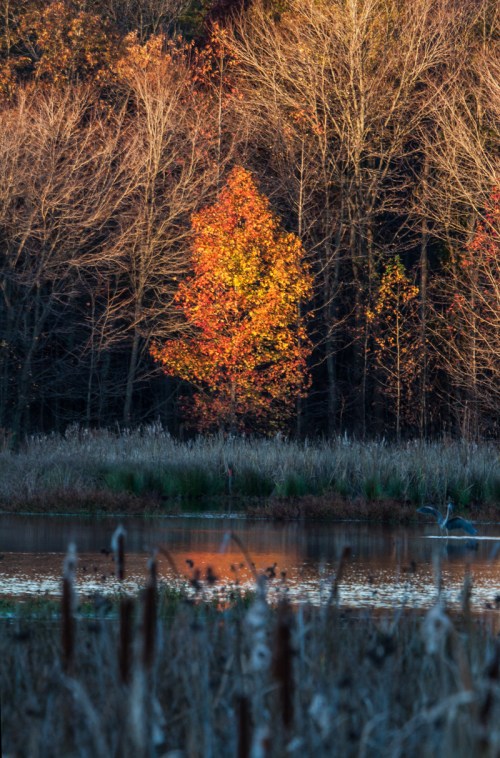
Most of the trees have given up their colorful leaves by now, but one hardy young tree refused to do so and looked almost like it was on fire in the early morning yesterday at Huntley Meadows Park.

The tree really stood out and grabbed my attention and I wanted somehow to capture its beauty. Many of you know that I have very limited experience with landscape photography and I simply wasn’t sure how to approach this atypical subject.

My first instinct was to zoom in closely and fill as much of the frame with the details of the tree as I could. That’s my favored approach with both my macro and zoom lenses.  I was shooting over a field of cattails and across a pond and my first series of images looked like this one.

fiery tree

I moved further down the boardwalk and decided to try to capture more of the surrounding environment by shooting in landscape mode. I also tried to get a clearer view of the beautiful reflections my moving beyond the cattails.

fiery tree

In order to get a different view, I climbed up the observation deck and took some shots like this one with various objects in the foreground and some reflected sky showing at the bottom of the image.

fiery tree

I presented the images with only a slight amount of cropping to give you an idea of what I was going for as I “worked” this subject. How did I do? In my view, the middle image is by far the best and serves as a reminder to me that stepping back and zooming out can be beneficial. More importantly, perhaps, I can see the benefits of trying out different approaches and different subjects as a way of stretching and learning and, hopefully, growing in my skills as a photographer.

© Michael Q. Powell. All rights reserved.
Read Full Post »

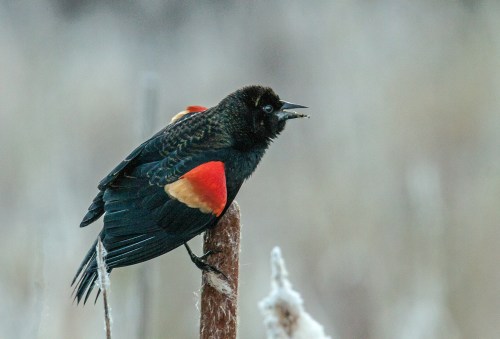
Who needs a rooster when you have a Red-winged Blackbird?

The silence of the early morning yesterday at Huntley Meadows Park was broken by the raucous call of a male Red-winged Blackbird (Agelaius phoeniceus), announcing loudly his presence and the arrival of a new day.

On a frosty November morning, it was time to wake up.

Red-winged Blackbird

© Michael Q. Powell. All rights reserved.

Read Full Post »

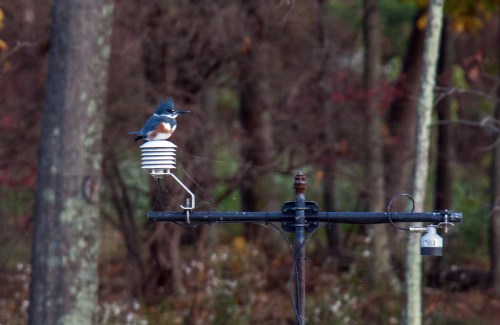
How do birds choose the perches they use? Several times last month I saw a female Belted Kingfisher (Megaceryle alcyon) perched in the early morning on this monitoring equipment sticking out of the water. Somehow I had the impression that the kingfisher was spending the nights on that perch.

Perhaps it’s more comfortable (or maybe safer) than the surrounding trees. Whatever the case, it makes for an interesting juxtaposition of natural and man-made elements in the image.

Belted Kingfisher

© Michael Q. Powell. All rights reserved.

Read Full Post »

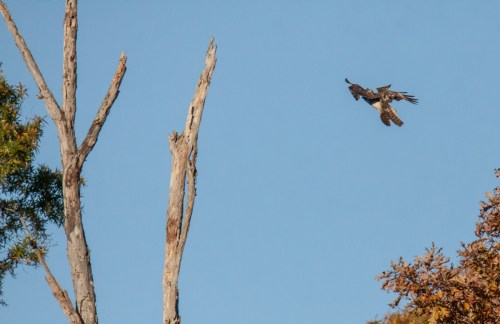
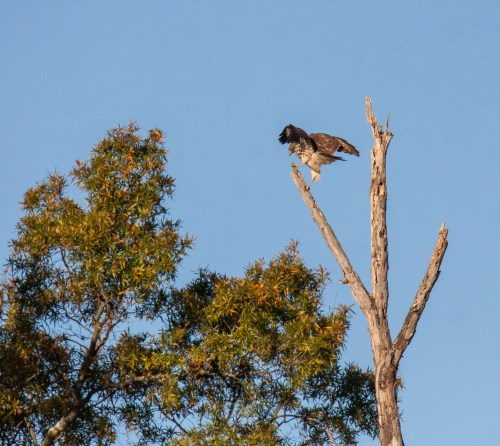
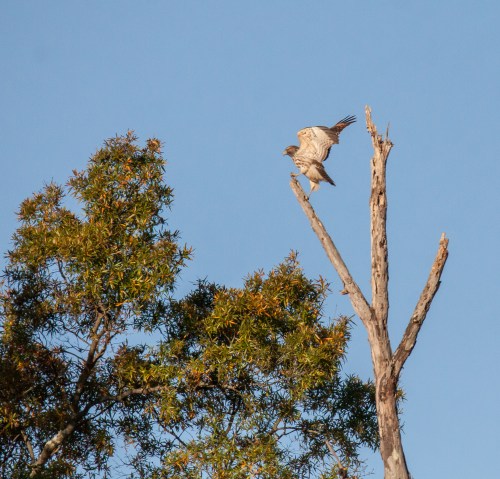
The hawk was moving really fast when it apparently spotted a perch that it liked. In an amazingly short distance, the hawk was able to slow down and really stuck the landing.  If I were a judge, though, I would have to deduct some points for the break in his form as he slowed down—it certainly did not look very elegant.

For most of these shots of the hawk, which I think is a Red-shouldered Hawk (Buteo lineatus), I was shooting at a higher ISO than I prefer in order to keep the shutter speed high. The results are a little grainy, particularly because I had to a fairly substantial crop, given that I was shooting across a small pond and the tree on which the hawk was perched was pretty far away. In the final shot, when the hawk was stationary, I was able to lower the ISO and there is a bit more fine detail.

Red-shouldered Hawk

Full speed ahead

Red-shouldered Hawk

Trying to slow down

Red-shouldered Hawk

Sticking the landing I

Red-shouldered Hawk

Sticking the landing II

Red-shouldered Hawk

Adjusting the position

Red-shouldered Hawk

Surveying the area

© Michael Q. Powell. All rights reserved.
Read Full Post »

Do you keep returning to the same places over and over again to take photos of the same subjects? For the last month or so, I have been going back repeatedly to a small pool of water in a secluded part of my favorite park, hoping to get another glimpse of a spectacular Great Spreadwing damselfly (Archilestis grandis).

Their numbers seem to have dwindled and it is possible that there is only a single damselfly of this species remaining. Yesterday, I watched and waited for quite some time before I was finally able to spot a male Great Spreadwing and it took several mini-encounters before I was able to get a decent photograph of the damselfly.

All of the female damselflies of this species seem to have disappeared several weeks ago, so it seems that any hopes he harbors for mating may be in vain. Indeed, the clock is definitely ticking for him—this species has never before been documented in Virginia this late in November.

I am cheering for this survivor and will try to find him again later this weekend. Despite my hopeful attitude, however, I can’t help but remember that yesterday I observed a large Shadow Darner dragonfly (Aeshna umbrosa) patrolling the pool and periodically chasing the damselfly, hoping to turn him into the main course of his lunch.

I’ve included two very different images of yesterday’s damselfly. The first shot is one that I framed very carefully, trying to get as parallel as I could with the damselfly and focusing manually. I like the way that it shows so many of beautiful details of the damselfly’s body. When I took the second shot, I was facing almost directly into the sun and I hurriedly played with camera settings to try to ensure that I did not get a mere silhouette. I really liked the way the sunlight was coming through the outstretched wings and used my camera’s pop-up flash to add a little light to the damselfly’s underside.

Great Spreadwing

Great Spreadwing

© Michael Q. Powell. All rights reserved.
Read Full Post »

Growing up in the 1960’s, I remember well The Byrds folk-rock version of the song Turn! Turn! Turn! (To Everything There is a Season), a Pete Seeger song with lyrics adapted almost word-for-word from Chapter 3 of the Biblical Book of Ecclesiastes. (If you have never heard The Byrds version of this song, here’s a link to a YouTube video of a performance.)

“To everything there is a season, and a time to every purpose under the heaven…”

According to statistical records, the season of the boldly-patterned Twelve-spotted Skimmer dragonfly (Libellula pulchella) in my area ended in early to mid-October. I was therefore shocked last Friday, 30 October, when I spotted a beautiful male Twelve-spotted Skimmer flying about in a field at Huntley Meadows Park.

I sometimes have trouble identifying species, but the wing patterns of this species are so distinctive that I knew exactly what it was, so I chased it around for a little while until I was able to get some shots of it. When I posted this photo on the Facebook page of Northeast Odonata, several members of the group commented on the “fresh” and undamaged condition of the dragonfly.

Statistics only get you so far, especially when looking at individuals. This dragonfly beat the odds and is a survivor—his personal “season” is off of the charts.

Like this dragonfly, we all have personal “seasons.” The dragonfly’s unexpected appearance brought to mind the words of a pastor at a funeral I attended earlier this year, who poignantly remarked that “we all come with expiration dates.” That reminder continues to challenge me as I think about how I should live my life.

“To everything there is a season, and a time to every purpose under the heaven…”


Twelve-spotted Skimmer

© Michael Q. Powell. All rights reserved.


Read Full Post »

On a sunny day in late October, I was admiring the beautiful fall colors at Huntley Meadows Park and thought that it would be really cool if a Great Blue Heron (Ardea herodias) would pose for me in the colorful foliage.

Then it happened.

Wishes sometime come true.

Great Blue Heron

© Michael Q. Powell. All rights reserved.
Read Full Post »

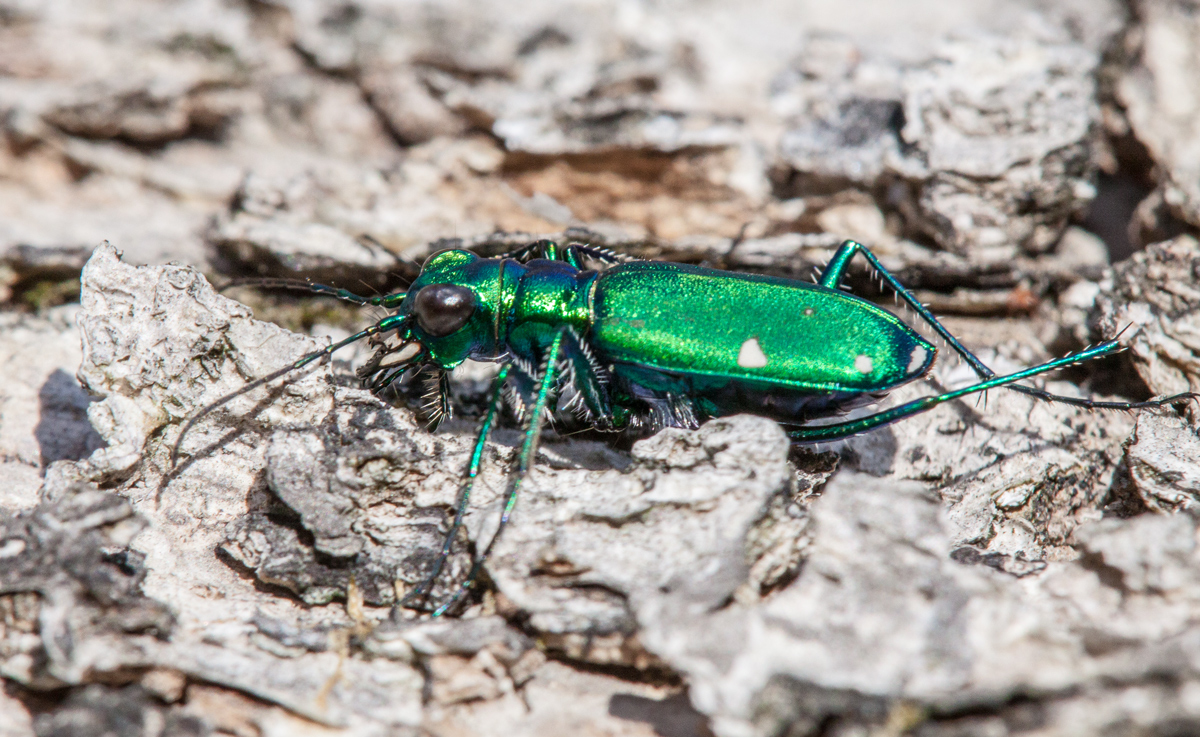
I’m happy to see that some insects are still with us despite the cooling autumn weather. On Friday, I spotted this gorgeous metallic green Six-spotted Tiger Beetle (Cicindela sexguttata) on a fallen log at Huntley Meadows Park in Alexandria, Virginia.

Six-spotted Tiger Beetle

© Michael Q. Powell. All rights reserved.
Read Full Post »

What do you do when a dragonfly lands on you? My first reaction, of course, was to take a photo when this Autumn Meadowhawk (Sympetrum vicinum) landed on my leg on Friday.

The good news was that I had a macro lens on my camera, so I knew that I would be able to focus on the dragonfly. The bad news was that it was a 180mm  macro lens, so I had to go through acrobatic contortions to try to achieve enough distance to fit the entire dragonfly into the frame. I also had to move like a ninja to keep from scaring away my subject.

In the end, I managed to get a decent shot of the dragonfly by standing as tall as I could and shooting straight downward, although my gray sweatshirt billowed out a bit and obscured the view of the dragonfly’s feet. For those of you who are not familiar with Autumn Meadowhawks, they are small dragonflies with bodies about an inch or so in length (25mm).

Autumn Meadowhawk

© Michael Q. Powell. All rights reserved.
 

Read Full Post »

Early morning light and fall foliage make such a great backdrop and I was thrilled when an Eastern Bluebird (Sialia sialis) flew closer to me and allowed me to take advantage of the situation.

I love it when the composition is this basic and the results are simply beautiful.

Eastern Bluebird

© Michael Q. Powell. All rights reserved.

Read Full Post »

The soft morning light reflected off of the colorful autumn foliage early today at Huntley Meadows Park, providing a beautiful backdrop for this male Red-winged Blackbird (Agelaius phoeniceus) as it perched in the cattails.

Red-winged Blackbird

© Michael Q. Powell. All rights reserved.

Read Full Post »

Warblers are so small and hide so well in the trees that I almost never see any. This past week, however, I spotted a flash of yellow in the distance and I was able to capture some shots of what I have been told is a Palm Warbler (Setophaga palmarum), though it is hard for me to confirm the identification, considering how much many warbler species look almost alike.

I took these three shots from the same spot on the boardwalk at my local marshland park as I looked across a field of cattail and other vegetation. It’s interesting to note how much the feel of the photos changed as the warbler moved from perch to perch.

Normally I try to get close-up shots of my subjects, but I decided not to crop in on the first image, which reminds me of a Japanese ink painting with its sparse use of color and emphasis on lines and shapes. The background was so interesting in the second image, that once again I did only a minor crop. In the third image, my favorite element is the warbler’s tail.

Palm Warbler

Palm Warbler

Palm Warbler

© Michael Q. Powell. All rights reserved.

Read Full Post »

This past weekend I inadvertently spooked a small flock of little Wood Ducks (Aix sponsa) while wandering about Huntley Meadows Park, but managed to get some shots of them as they flew away through the trees.

I just love the combination of the colorful birds in flight and the autumn foliage.

Wood Duck

Wood Duck

Wood Duck

Wood Duck

© Michael Q. Powell. All rights reserved.

Read Full Post »

After a gray, rainy day like today, I need a visual pick-me-up and energetic Downy Woodpeckers (Picoides pubescens) never fail to raise my spirits. I spotted this little beauty at Huntley Meadows Park this past weekend.

Downy Woodpecker

© Michael Q. Powell. All rights reserved.

Read Full Post »

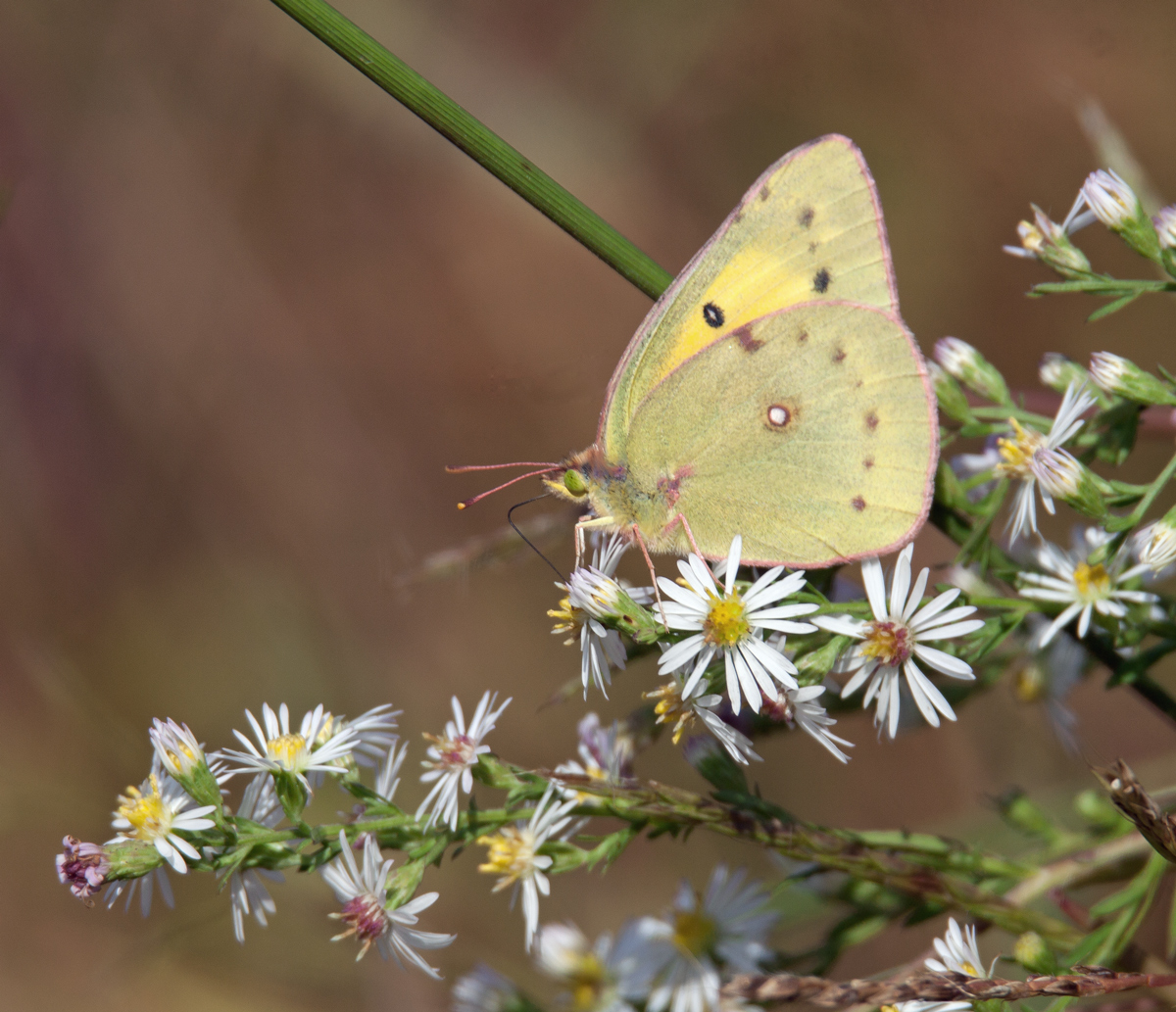
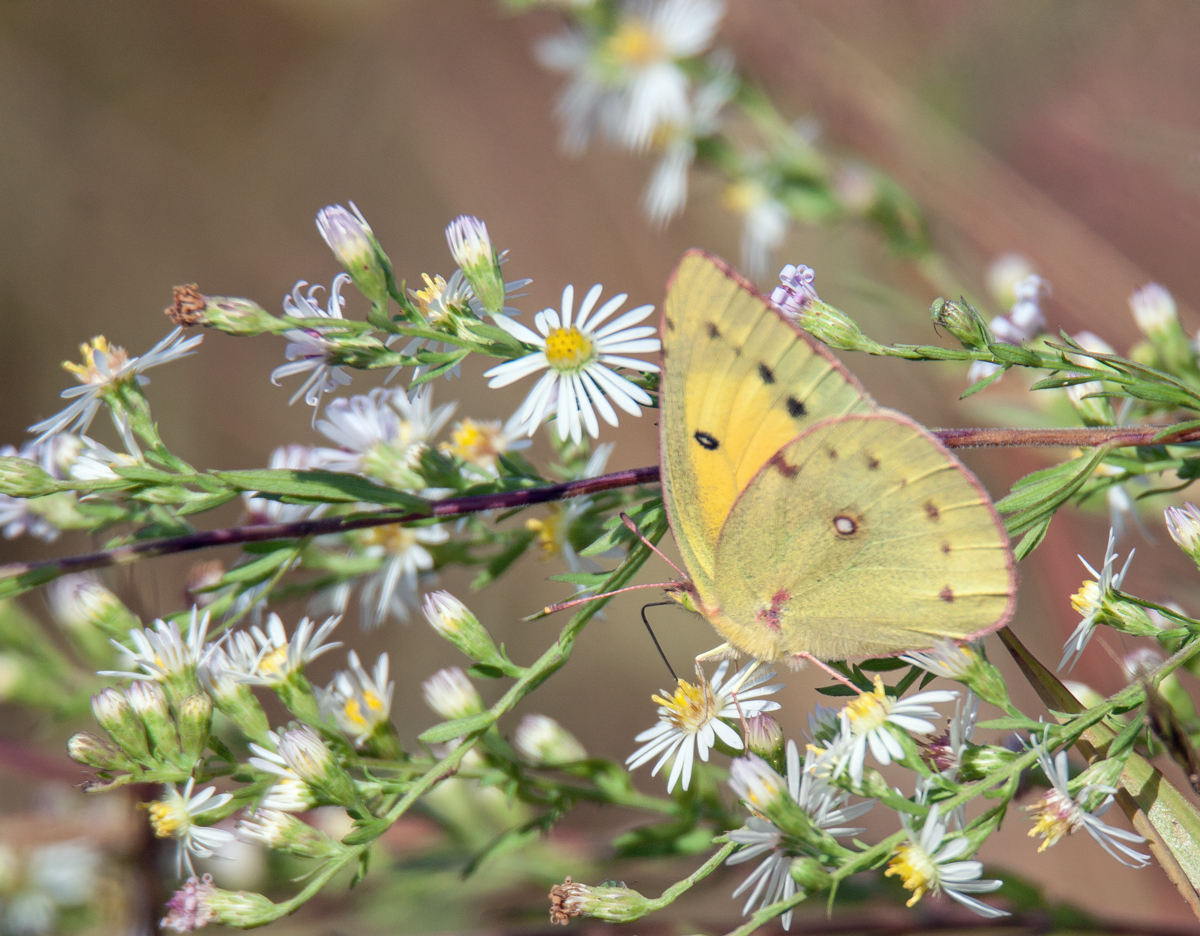
The large butterflies seem to be gone, but I continue to occasionally see smaller sulphur butterflies nectaring on late blooming flowers.

There are several different varieties of sulphur butterflies that look a bit alike, so I am not certain in identifying this butterfly. At first I thought that this might be a Pink-edged Sulphur (Colias interior), but the range maps suggest that we may not be in the correct geographic region for that species.

I think it is more likely that this is a Clouded Sulphur butterfly (Colias philodice). As for the flower, it looks to me to be some variety of aster.

The weather is definitely getting colder—I had to scrape frost off my car’s windshield earlier this week—so I don’t know how much longer I’ll be seeing these little beauties. Beauty so often is transitory; all we can do is enjoy it and appreciate it until it is gone.

Clouded Sulphur

Clouded Sulphur

Clouded Sulphur

© Michael Q. Powell. All rights reserved.

Read Full Post »

When I arrived at the marsh in the early morning hours, it looked like the spiders had been busy all night preparing decorations for Halloween—there were spider webs everywhere.

The webs seemed to have been more hastily constructed than those of the orbweavers that I have observed recently and there did not appear to be any spiders in the center of these webs. What is the purpose of these webs if the spiders are not there to secure any prey that is caught in the web?

I can’t help but admire the amazing artistry of these fascinating little creatures as I examine the interlocking lines and curves of their incredible creations.

I’ve place these images in a mosaic collage—if you want to see larger versions of the images, just click on any one of them and you’ll move into a slide show mode that lets you scroll through them quickly.

© Michael Q. Powell. All rights reserved.
Read Full Post »

After a summer of not seeing many spiders, I was thrilled recently to spot this orbweaver spider as it dealt with an unidentified prey that it had captured.

Most of the large spiders that I observe are Black and Yellow Garden spiders (Argiope aurantia), but this one looks different from the ones that I have previously seen, especially in the first image. It may be that I am used to seeing the spider only in the center of her web, as in the second image, or perhaps this is a different spider species.

This was an unusual case for me, because I spotted the spider as I was walking through a field of waist-high vegetation and I was able to get pretty close to the spider and get these shot with my macro lens. Generally, I am forced to photograph spiders like this from a distance (which most people probably think is a good idea anyways).

There are some subjects, like cute birds, that I photograph that I know will have a broad appeal, but past experience has shown me that spiders tend to divide people into two camps—some people are fascinate and think spiders are totally cool, while others are thoroughly creeped out and find spiders to be repulsive.

What do you think about spiders?

orbweaver spider

orbweaver spider

© Michael Q. Powell. All rights reserved.

Read Full Post »

Although it is October, my good friend and fellow photographer Walter Sanford continues to discover new species of damselflies in my favorite marshland park. Check out his posting (and his site) for some awesome images of his newest find.

waltersanford's avatarwalter sanford's photoblog

I’m fairly certain I discovered a new species of damselfly at Huntley Meadows Park (HMP): Sweetflag Spreadwing damselfly (Lestes forcipatus).

A Sweetflag Spreadwing damselfly (Lestes forcipatus) spotted at Huntley Meadows Park, Fairfax County, Virginia USA. This individual is a male. 15 OCT 2015 | HMP | Sweetflag Spreadwing (male)

This individual is a male, as indicated by its hamules and terminal appendages.

A Sweetflag Spreadwing damselfly (Lestes forcipatus) spotted at Huntley Meadows Park, Fairfax County, Virginia USA. This individual is a male. 15 OCT 2015 | HMP | Sweetflag Spreadwing (male)

(See a full-size version of the preceding photo, without annotation.)

The hamules are key field markers for differentiating some species of similar-looking damselflies, such as Southern Spreadwing (Lestes australis) and Sweetflag Spreadwing (Lestes forcipatus).

All male damselflies have four terminal appendages, collectively called “claspers.” Male damselfly terminal appendages don’t look exactly the same for all species of damselflies, but their function is identical.

A Sweetflag Spreadwing damselfly (Lestes forcipatus) spotted at Huntley Meadows Park, Fairfax County, Virginia USA. This individual is a male. 15 OCT 2015 | HMP | Sweetflag Spreadwing (male)

(See a full-size version of the preceding photo, without annotation.)

Claspers are used to grab and hold female damselflies…

View original post 352 more words

Read Full Post »

In the early light of the dawn, I captured this solitary Great Blue Heron (Ardea herodias) in deep reflection, contemplating the start of a new day.

There is nothing really complex about this image, but I like the way that it conveys the mood of that moment, a moment when the world seemed to be totally tranquil, uncluttered by the hustle and bustle of everyday life.

I love the early morning.

Great Blue Heron

© Michael Q. Powell. All rights reserved.

Read Full Post »

As the sun gradually illuminates the trees and burns off the mist on the water, Huntley Meadows Park is especially beautiful, especially at this time of the year, when the trees are showing off their changing colors. The park was silent when I arrived in the early morning darkness, but gradually I could hear the sounds of birds singing and I couldn’t help but notice the arrival of a small flock of Canada Geese (Branta canadensis).

The colors of the foliage here in Northern Virginia are not as bold and striking as in some other parts of the country, but there is an understated beauty in the muted tones or red and yellow. I am not used to taking landscape-style shots (and a 150-600mm lens is probably not optimal for doing so), but I tried to capture some different scenes to give you a sense of the park where I take so many of my photographs. It’s a wondrous location, particularly when you consider that it is found in a suburban location.

autumn

autumn

autumn

autumn

© Michael Q. Powell. All rights reserved.

Read Full Post »

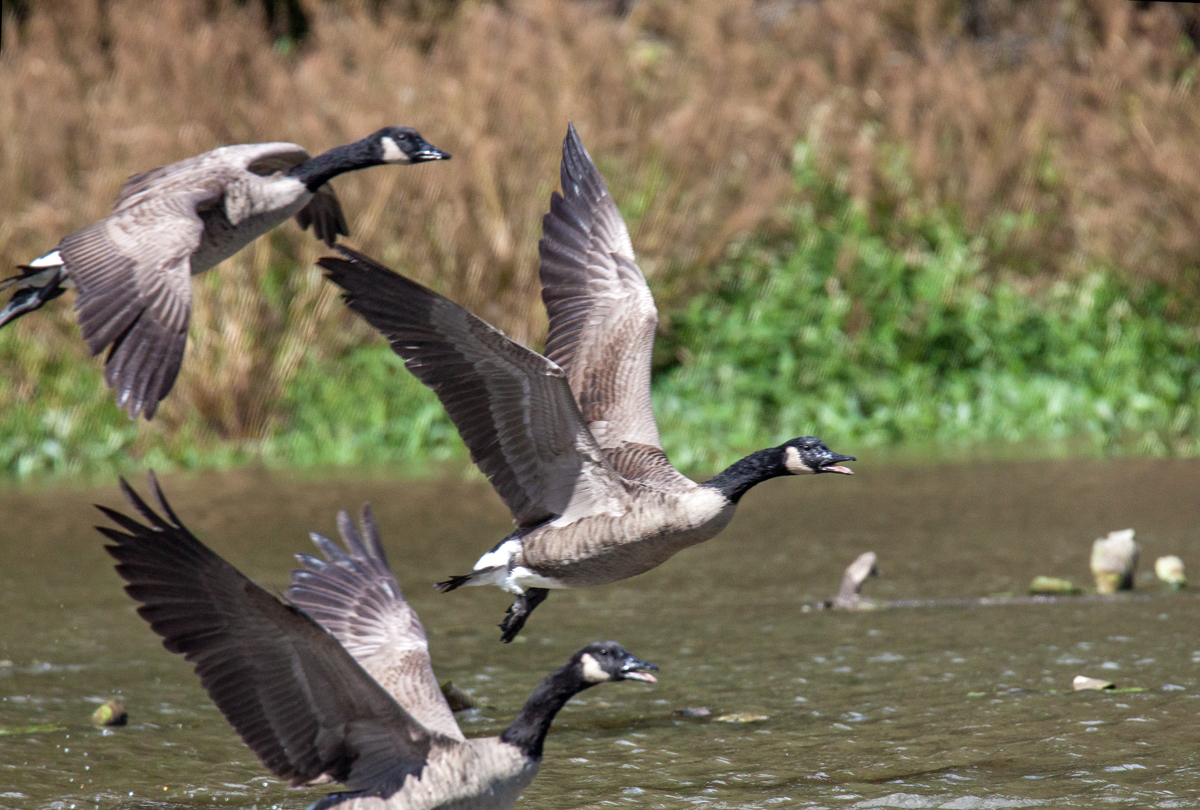
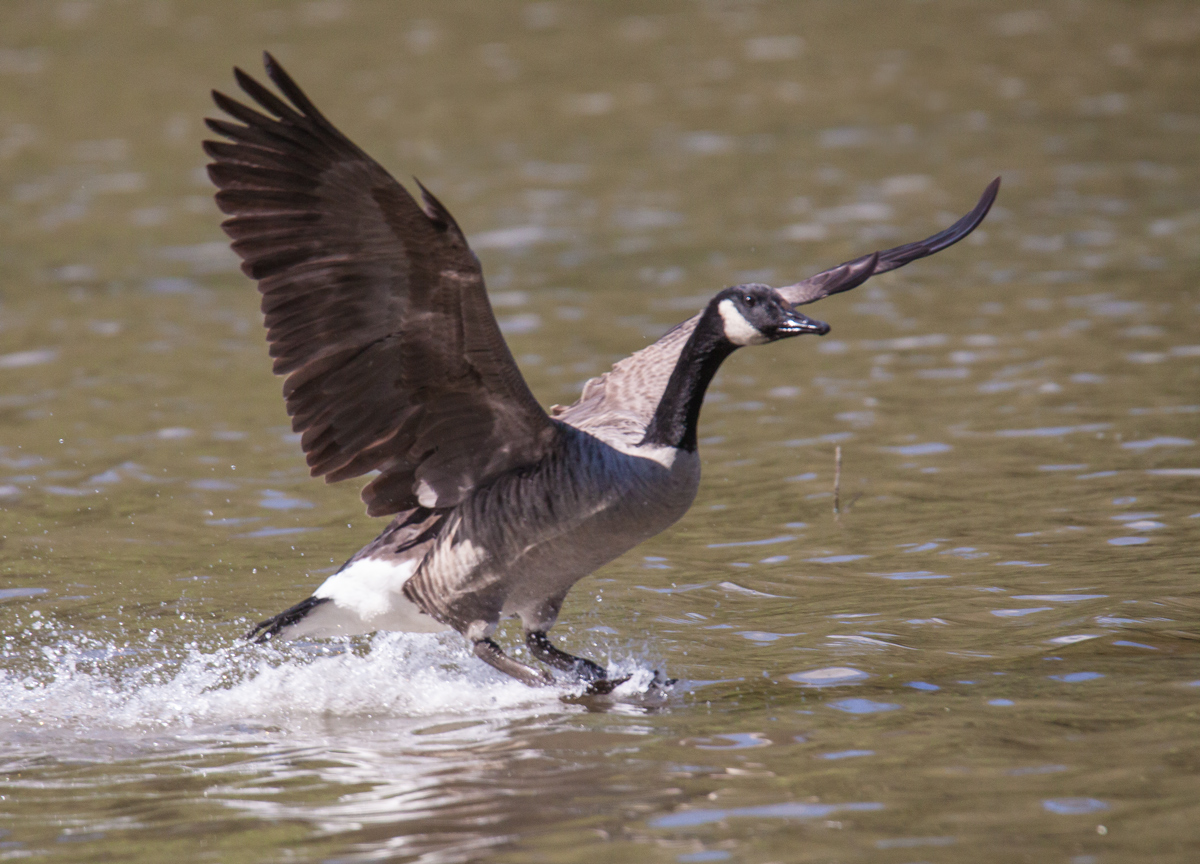
Canada Geese (Branta canadensis) are our constant companions at my favorite marshland park throughout the fall and the winter as the geese migrate south or choose to overwinter at the park. Several small flocks flew in yesterday, accompanied by the usual amount of honking and splashing to announce their arrival.

Folks at the park either love the geese or hate them (because of the mess they make). I enjoy seeing them and they provide me with lots of practice subjects to hone my skills in capturing birds in flight. Their interactions with each other are also fun to watch.

Canada Geese

Canada Geese

Canada Geese

© Michael Q. Powell. All rights reserved.

Read Full Post »

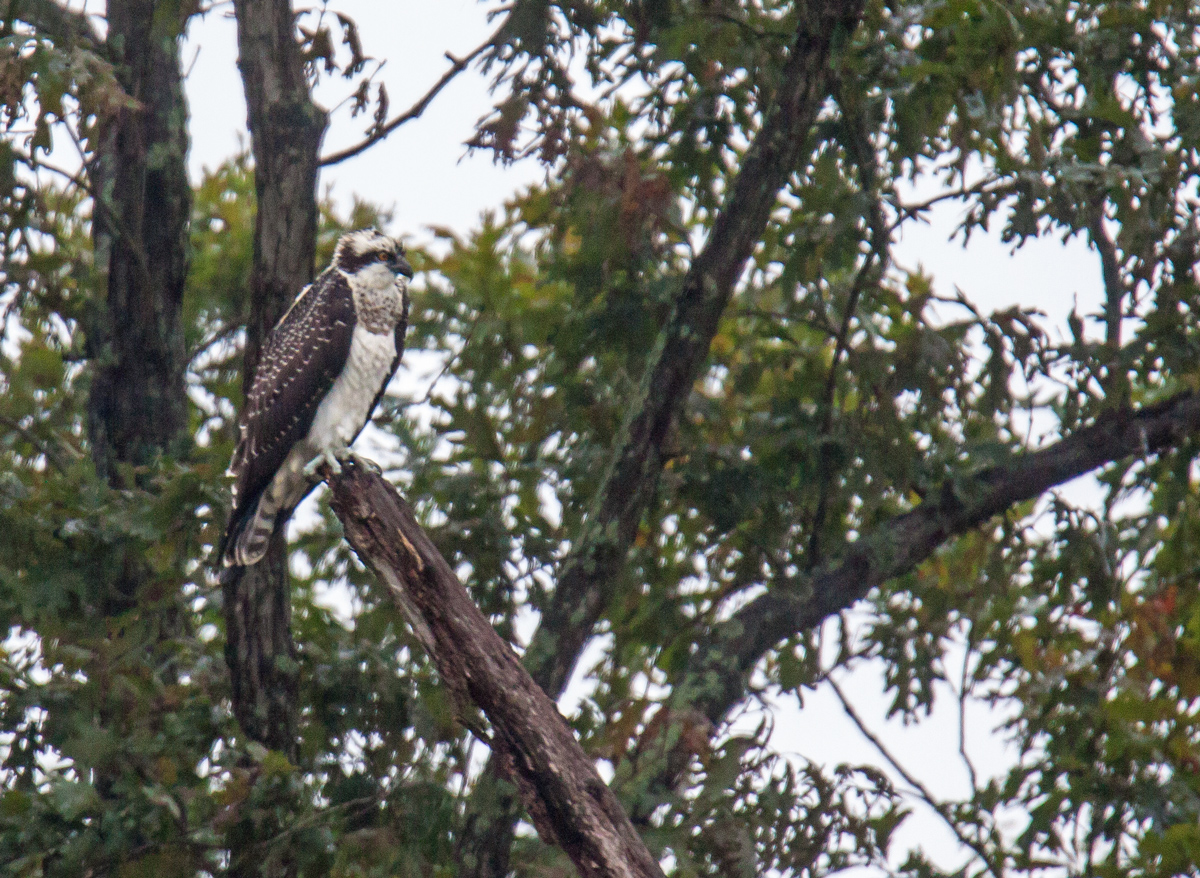
On Saturday morning, this juvenile Osprey (Pandion haliaetus) at Huntley Meadows Park seemed interested in only one thing—seeking shelter from the rain. The osprey was hunched over and seemed to be doing its best to retain body heat on a cold, wet, and windy day. Although it could almost certainly see me across the water of the pond, the young bird showed no inclination to move from its comfortable, sheltered perch.

The scalloped edges of the wing feathers are what cause me to think this is a juvenile osprey—the wings are a solid brown in adults.

osprey

osprey

osprey

© Michael Q. Powell. All rights reserved.

Read Full Post »

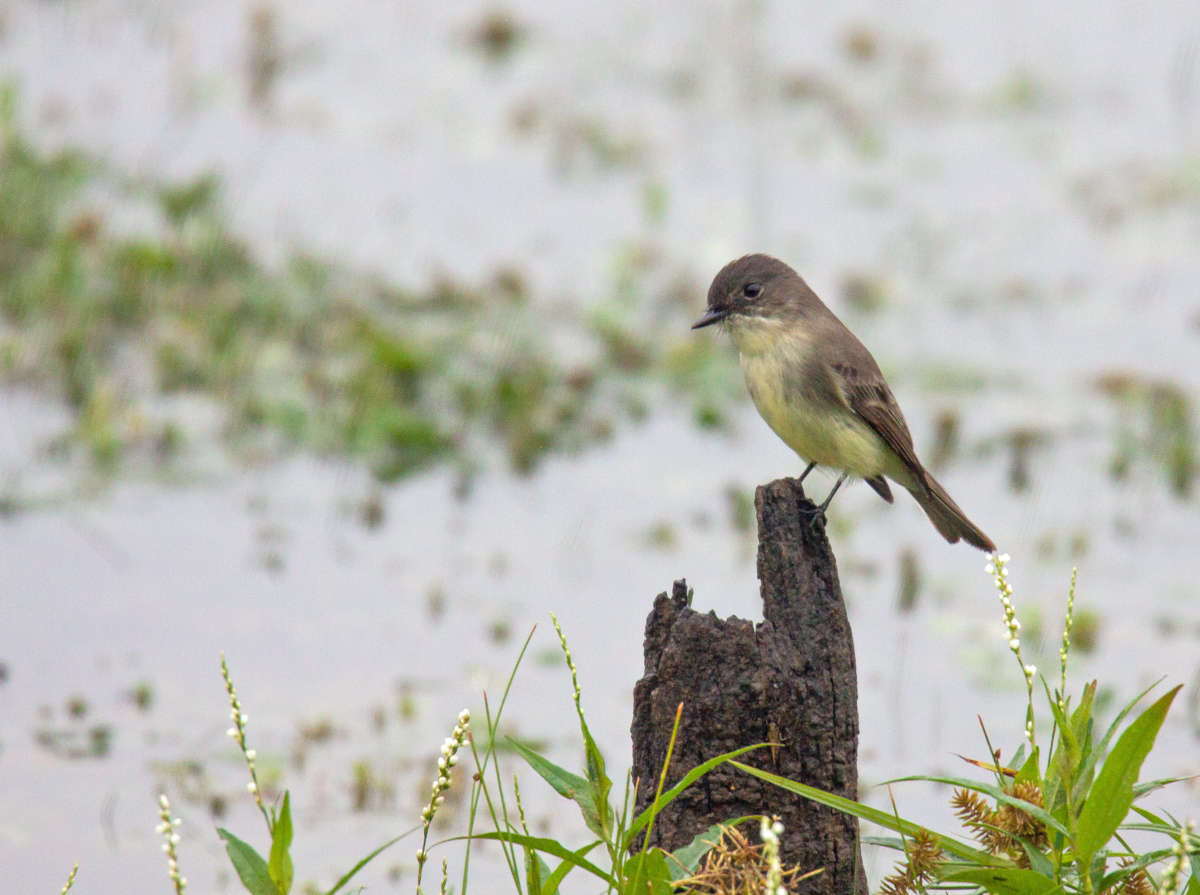
Despite the light rain, a few birds were flying about at Huntley Meadows Park yesterday morning. It was beautiful and peaceful, a feeling that I was able to partially capture in this image of one of my rainy day feathered friends, an Eastern Phoebe (Sayornis phoebe).

Eastern Phoebe

© Michael Q. Powell. All rights reserved.

Read Full Post »

We usually think of springtime as the season of love, but apparently autumn is also a good season if you are a damselfly. I don’t know what was so special about this one plant sticking out of the water, but mating damselfly couples seemed to be competing for a spot to land and deposit their eggs on it this past Monday at Huntley Meadows Park in Alexandria, Virginia.

I’m no expert when it comes to identifying damselflies, in part because so many different species have similar patterns of black and blue, but I think these couples, all in the tandem position, may be Big Bluets (Enallagma durum). I’d welcome any corrections or confirmation of my initial identification.

UPDATE:  My local odonate expert, Walter Sanford, weighed in with a correction to my identification—these damselflies are Familiar Bluets (Enallagma civile), not Great Bluets. When it comes to my initial identification, you might say that I blew it.

For those who might be curious about the technical aspects of the photo, I took this with my Canon 50D at 600mm on my Tamron 150-600mm lens, which is the equivalent of 960mm when you take into account the crop sensor of my camera. I continue to be pleased with the amount of detail that I can capture with the relatively affordable long lens, even when it’s extended to its maximum length. If you click on the image, you can see even more of those wonderful details.

mating damselflies

© Michael Q. Powell. All rights reserved.

Read Full Post »

I love the distinctive look and bright colors of the Belted Kingfisher (Megaceryle alcyon) and was thrilled to spot this female on Monday at Huntley Meadows Park.

She was initially perched on a rotten tree trunk in a meadow, which is actually a dried-up pond—the water levels at the marsh are perilously low at the moment.  Before I could get a close shot, I managed to spook her and she flew to the higher perch that you see in the first image of this posting. The second image shows her in her initial position.

I like the way that the dark leaves provide a backdrop that draws our attention to the kingfisher in the first shot, but also like the softer quality of the second shot, with the grass and the out-of-focus treeline.

Unlike in most bird species, the female Belted Kingfisher is more colorful than the male—she has a rust-colored stripe that is absent in the male.

Belted Kingfisher

Belted Kingfisher

© Michael Q. Powell. All rights reserved.

Read Full Post »

The autumnal equinox arrived yesterday, marking another change of seasons. I love the autumn, but there is something a little wistful about it, as so many of the bright summer colors begin to fade and the leaves dry out and fall off of the trees. Somehow for me it is a reminder of the inexorable passage of time and of the fragility of life.

Earlier this week I saw a faded male Twelve-spotted Skimmer dragonfly (Libellula pulchella) that put me in a pensive mood, remembering how this boldly-patterned species really stood out in the spring. Now he has has almost become a part of the background, less notable, less distinctive, less likely to attract attention.

How many of us are like that? Our society worships youthful beauty and older people are often pushed out of the spotlight in favor of unblemished youths. It’s nice to have memories of the way we were, remembering our youthful beauty and capabilities, but I think it’s important to celebrate who we are and who we are becoming.

So here’s a look at that male Twelve-spotted Skimmer and a female Twelve-Spotted Skimmer that I observed last week. Wouldn’t you agree that they are still beautiful despite (or perhaps because of) their senior citizen status.

Twelve-spotted Skimmer

Twelve-spotted Skimmer

© Michael Q. Powell. All rights reserved.

Read Full Post »

What is the most beautiful bird that you can see in the wild in your area? We have lots of pretty birds here in Northern Virginia, but I could make a really strong case for the male Wood Duck (Aix sponsa) as the most stunning bird.

Alas, wood ducks are also amazingly elusive and it is rare that I get a glimpse of one of them. Toward the end of November, however, I was thrilled when I caught sight of one in Holmes Run, a tributary stream of the Potomac River. I was on a bridge pretty high above the stream and the duck did not seem to sense my presence, so I was able to get some decent shots as he swam in and out of the light.

The water in which the duck was swimming looks amazing, with swirls and colors that complement the Wood Duck’s bright colors and striking patterns.  I am not sure what caused the effect, but I really like it.

This was the only Wood Duck that I spotted all autumn, but it sure was worth waiting for. I’ll be keeping an eye out for these beauties as we move deeper into winter.

Merry Christmas and Happy Holidays to all of you.

Wood Duck

Wood Duck

© Michael Q. Powell. All rights reserved.

Read Full Post »

Fellow photographer and blogger Walter Sanford and I both photographed this female Blue-faced Meadowhawk dragonfly on 17 October and decided to do companion postings again, showing our different approaches to photographing the same subject.

waltersanford's avatarwalter sanford's photoblog

This is the second installment in a three-part series featuring some of my favorite photos of female dragonflies spotted while photowalkingHuntley Meadows Park during Fall 2014.

The following photos show a Blue-faced Meadowhawk dragonfly (Sympetrum ambiguum) spotted on 17 October 2014 near a vernal pool in a relatively remote location in the forest. This individual is a heteromorph female, as indicated by its coloration and terminal appendages.

Blue-faced Meadowhawk dragonfly (heteromorph female)

Female Blue-faced Meadowhawk dragonflies are polymorphic: heteromorphs are duller in color than males; andromorphs are male-like in color.

Blue-faced Meadowhawk dragonfly (heteromorph female)

Both female morphs feature the same distinctive blue eye coloration as males.

Blue-faced Meadowhawk dragonfly (heteromorph female)

Mike Powell, fellow wildlife photographer and blogger, spotted this dragonfly while I was shooting photos of a male Great Spreadwing damselfly (Archilestes grandis) perching on thigh-high grasses a few yards away. I joined Mike after my subject flew away.

I don’t recall seeing Mike’s photos of this dragonfly. Perhaps it’s…

View original post 28 more words

Read Full Post »

This past Saturday, I searched and searched for a straggler dragonfly which might have survived our recent cold spell, but I found none—dragonfly hunting season is officially over for me. That same day, however, fellow photographer and blogger (and local dragonfly expert) Walter Sanford did a blog posting with photos of a female Blue-faced Meadowhawk dragonfly (Sympetrum ambiguum) that both of us photographed on 17 October and suggested that I also post some shots.

Previously this year, Walter and I did companion postings, in which we each posted photos that showed our different photographic approaches to the same subject, which in that case was a pair of mating dragonflies. (If you are interested, check out Walter’s posting Two sides to every story and my posting My view of the mating dragonflies.)

I am fascinated by the way that two photographers shooting together consciously or unconsciously make a series of creative choices that can result in very different images. Some of the differences, of course, are attributable to the choice of photographic equipment, but many of the differences are caused by the “style” in which the photographer prefers to work.

I took these shots with a 180mm macro lens at fairly close range, which meant that I had to be thinking all of the time about depth of field. The three images I selected show how the amount of the dragonfly’s body in focus changed as I circled around the dragonfly and photographed it in various positions as it flew off and returned to the same general area.

I remember going once to an exhibition showing paintings side by side of a scene that had been rendered by two impressionist artists painting together—I think it was Monet and Renoir—and since that time I have periodically considered the question of whether or not there is an objective reality when it comes to taking (or painting) pictures. What is reality?

Be sure to visit Walter’s blog and his images of this dragonfly in his posting To All The Girls I’ve Loved Before (Part 2).

Blue-faced Meadowhawk

Blue-faced Meadowhawk

Blue-faced Meadowhawk

© Michael Q. Powell. All rights reserved.

Read Full Post »

« Newer Posts - Older Posts »