Feeds:
Posts
Comments

Archive for the ‘Autumn’ Category

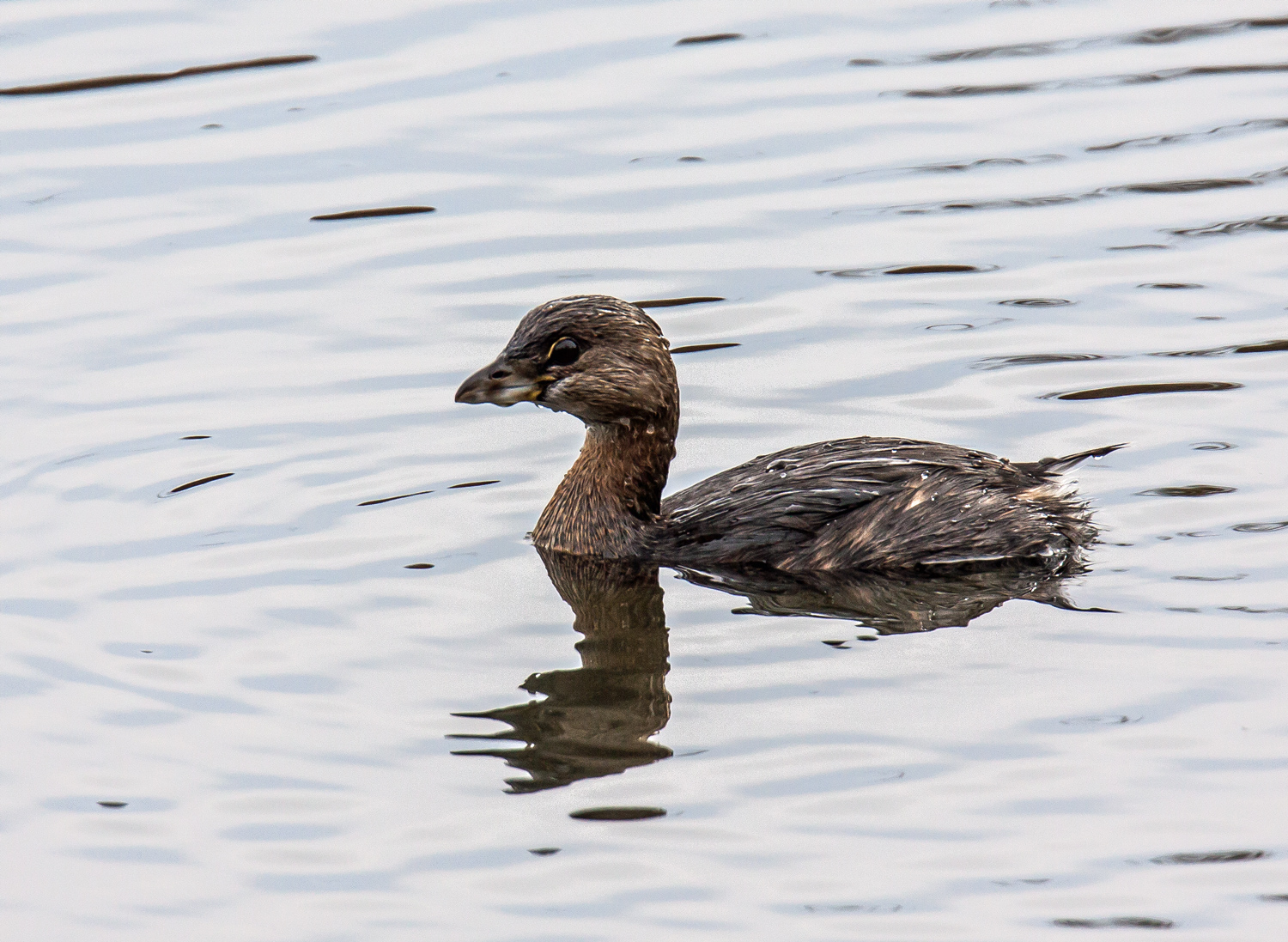
Although Pied-billed Grebes (Podilymbus podiceps) swim like ducks and dive like ducks, it only takes a quick look at one to see that they definitely are not ducks. The shape of the bill and of the body are quite different from those of a duck. I’ve always found the overall look the Pied-billed Grebe to be so unusual that it looks almost cartoonish to me.

I spotted this grebe yesterday in a small suburban pond not far from where I live. This little bird repeatedly was diving underwater. presumably in search of food, though I never saw him catch anything. If you look closely at the photos, you can see droplets of water on the body of the grebe and, in some cases, on his face.

Pied-billed Grebe

Pied-billed Grebe

Pied-billed Grebe

© Michael Q. Powell. All rights reserved.

Read Full Post »

It’s sometimes said that the camera adds pounds to a subject, so maybe these Yellow-rumped Warblers (Setophaga coronata) that I saw last week at Occoquan Bay National Wildlife Refuge are not quite as chubby as they appear at first glance.

I was trying to be funny, but it actually is true that the focal length of a lens can affect the features of a subject. Most of you have probably seen how a fish-eye lens can make a face look bloated in the middle and stretched out on the edges. Other lenses can produce less dramatic effects. Generally it is believed that you get the most flattering portrait of a human subject with a lens of 85mm to 135mm. Here’s a link to an interesting article at businessinsider.com that shows a series of images of a face that were shot with lenses from 20mm to 200mm.

In this case, I think the birds are taking advantage of the abundant food sources while they are still around. Some of these warblers may be continuing their journeys southward, but others may choose to spend part of the winter with us.

Yellow-rumped Warbler

Yellow-rumped warbler

Yellow-rumped Warbler

© Michael Q. Powell. All rights reserved.

Read Full Post »

Downy Woodpeckers (Dryobates pubescens) are the smallest woodpeckers in North America.  They more than make up for their lack of size, however, with their inexhaustible energy. Their constant motion makes them fun to watch, but a challenge to photograph.

I spotted this male Downy Woodpecker earlier this week at Occoquan Bay National Wildlife Refuge. How do I know that it is a male? The males of this species have a little patch of red on the back of their heads and in each of these photos you get a small peek at the red on the head.


Downy Woodpecker

Downy Woodpecker

© Michael Q. Powell. All rights reserved.

Read Full Post »

Nuthatches are curious little birds. Most of the time that I spot one, it is climbing head first down the trunk of a tree.

Earlier this week at Occoquan Bay National Wildlife Refuge, however, I spotted a hyperactive White-breasted Nuthatch (Sitta carolinensis) in the upper branches of a tree. In a series of corkscrewing motions that reminded me of a female gymnast on the uneven parallel bars, the nuthatch made its way up and down and around each of the branches.

If I were an Olympic judge, I would award the acrobatic nuthatch a score of 10 for its brilliant performance.

White-breasted Nuthatch

White-breasted Nuthatch

White-breasted Nuthatch

© Michael Q. Powell. All rights reserved.

Read Full Post »

Some days the birds seem to keep their distance from me, so I do my best to capture modest images of them in their environment, like this Eastern Bluebird (Sialia sialis) that I spotted in a field last week at Occoquan Bay National Wildlife Refuge.

I hesitated a little about posting this image, but I kept coming back to it when I thought about the shots that I wanted to share. I could enumerate technical reasons why this is a somewhat flawed photo, but there is something about the mood of the image that I find appealing. In the end, I decided to follow my basic approach of posting images that I like and letting others decide for themselves how they feel about the shots.

Eastern Bluebird

© Michael Q. Powell. All rights reserved.


Read Full Post »

A small flock of Cedar Waxwings (Bombycilla cedrorum) was active last week at Occoquan Bay National Wildlife Refuge. They stayed high in the trees, but I did manage to get this shot of one of these distinctive and very cool-looking birds as they foraged among the plentiful berries.

Cedar Waxwing

© Michael Q. Powell. All rights reserved.

Read Full Post »

When I entered Occoquan Bay National Wildlife Refuge early one morning last week, a layer of ground fog was hanging over the fields, giving the landscape an eerie feel that somehow seemed appropriate for the Halloween season.

As I made my way to the water’s edge, the skies brightened a bit and the fog seemed to lift a little. I was filled with a peaceful and serene feeling as I enjoyed the early morning moments with a Great Blue Heron in the distance.

morning fog

morning fog

morning fog

© Michael Q. Powell. All rights reserved.

Read Full Post »

As I rounded a curve on a trail at Occoquan Bay National Wildlife Refuge one morning last week, I spotted a fierce looking Bald Eagle (Haliaeetus leucocephalus) almost directly overhead in a tree. I wasn’t sure if the eagle had seen me, but when it looked down and glared at me, I realized it was quite aware of my presence.

In several earlier postings I have mentioned that this is a tough time of the year for spotting birds, because most of the leaves are still on the trees. Often I can hear birds, but I can’t see them. It turns out that the leaves on the trees can also hide me from the birds sometimes. I think that is how I ended up almost directly below this eagle, forced to shot upwards at a somewhat uncomfortable angle.

It wasn’t long before the eagle decided that it had had enough of me and it took off. Alas, I was not able to capture any in-flight shots, but I am definitely happy with the shots I managed to get of the perched bald eagle.

Bald Eagle

Bald Eagle

© Michael Q. Powell. All rights reserved.


Read Full Post »

Several years ago, I received some advice that I continue to follow to this day. I was told that if a vulture is circling overhead, as this one was doing earlier this week at Occoquan Bay National Wildlife Refuge, make sure you move from time to time.

When I first spotted this vulture, I was a little confused. It looked like a Turkey Vulture (Cathartes aura), but the bird lacked the distinctive red head that I am used to seeing on a Turkey Vulture. After doing a little research I learned that juvenile Turkey Vultures have an ashy-gray head that transitions to red as they mature.

juvenile Turkey Vulture

© Michael Q. Powell. All rights reserved.

Read Full Post »

Are you a risk-taker? How often do you go out on a limb?

If you were a Yellow-rumped Warbler (Setophaga coronata) you literally would be doing it all of the time. I love the texture, color, and shape of the branch so much that this image is as much about the branch as it is about the bird—that is the primary reason why I did not crop the image any closer.

Yellow-rumped Warbler

© Michael Q. Powell. All rights reserved.

Read Full Post »

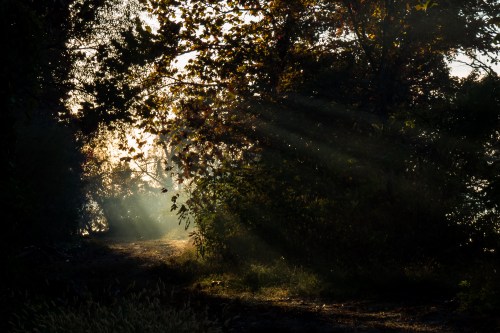
As the early sunlight pierced the foliage at Occoquan Bay National Wildlife Refuge, it created a magical world, filled with visible rays of light in the misty morning air.

The word “breathtaking” is perhaps overused, but it perfectly describes my physical reaction when I came upon this scene as I was walking a path that runs parallel to the water of Occoquan Bay. I knew that the light was coming from in front of me, so I wasn’t really expecting to take any photos until the path curved a bit and the sun was in a better position.

I marveled at the visible rays of sunlight and wondered if there was any way that I would be able to capture the incredible scene in front of me. My 150-600mm lens was affixed to my DSLR and even at 150mm, there was no way I could use it to capture the “big picture.”

Fortunately I have taken to carrying my Canon SX50 camera that has a zoom lens that goes all the way from wide angle to super zoom (an equivalent angle of view of 24-1200mm). I was able to frame the image as you see in the image below and the camera did a decent job in rendering the scene.

It is moments like this that keep me going out in the early morning, traipsing the trails at a time of the day when many folks would prefer to be sleeping.
rays of sunlight

© Michael Q. Powell. All rights reserved.


Read Full Post »

Sometimes it is better to be lucky and to react quickly than it is to be skillful and systematic. As I was tracking a Yellow-rumped Warbler (Setophaga coronata) recently at Occoquan Bay Wildlife Refuge, it suddenly took off.

In and of itself, this was not unusual, because these small birds are in almost constant motion, weaving their way in and out of the vegetation. Instinctively I snapped off a short burst of shots. I thought I had missed the shot and the empty frames at the end of the sequence indeed showed that I was a bit late in reacting.

However, one of the initial shots was this fun image that shows the warbler raising its wings to prepare to provide propulsion while its feet are still attached to the branch. I was shooting in aperture-preferred mode, which meant that the camera chose the shutter speed. There was enough light that the shutter speed of 1/1600 froze most, but not all, of the bird’s motion.

Wouldn’t it be cool to be able to take off into the air like this little warbler, free to fly off to new destinations in search of new adventures?

Yellow-rumped Warbler

© Michael Q. Powell. All rights reserved.

Read Full Post »

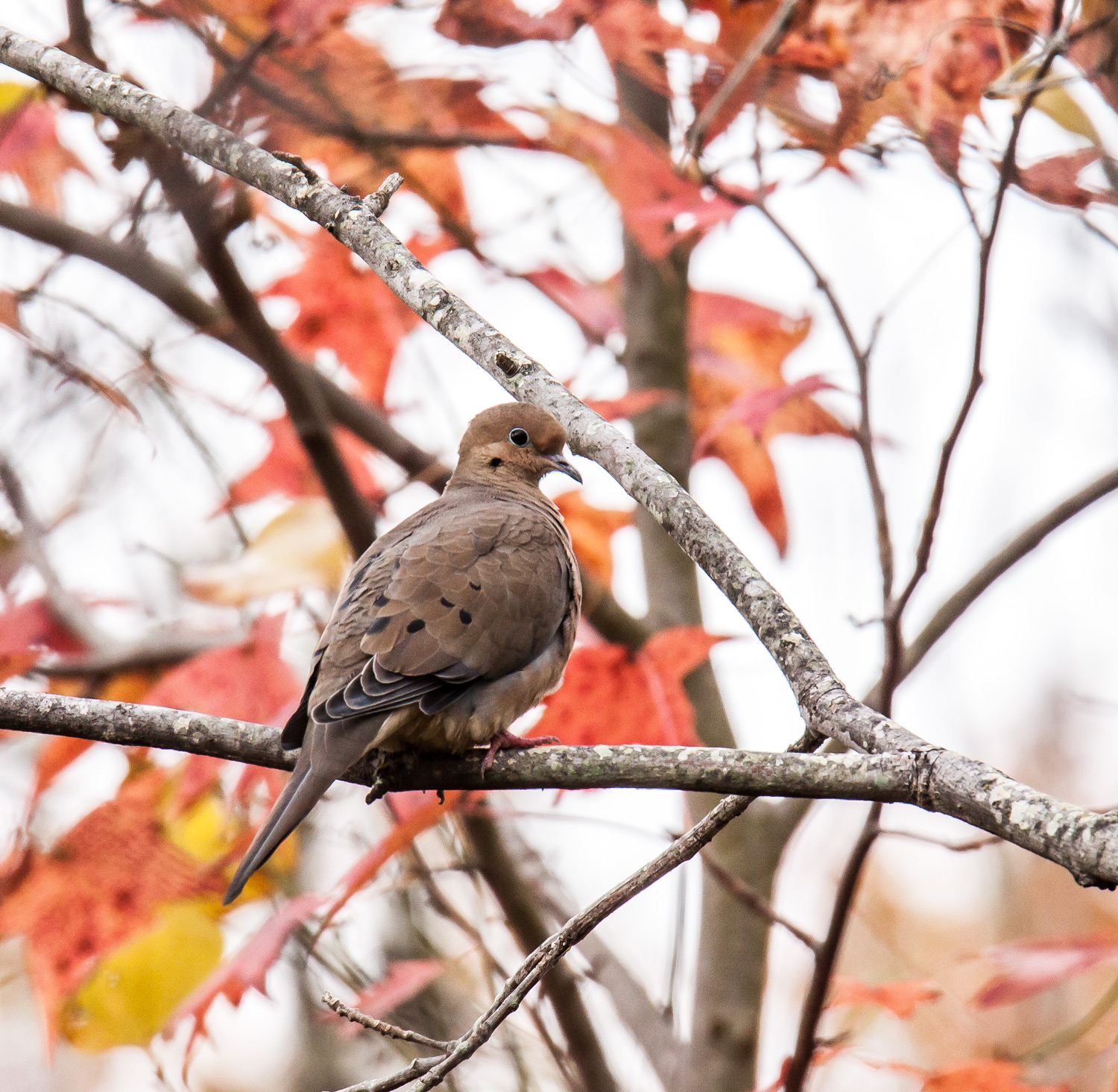
I read the newspaper this morning before I looked at the photos I took yesterday. This image of a Mourning Dove (Zenaida macroura) at Occoquan Bay National Wildlife Refuge seems to reflect my innermost feelings at this moment about the senseless slaughter of innocents in Pittsburgh.

My heart goes out to all of those mourning their losses.

Mourning Dove

© Michael Q. Powell. All rights reserved.

Read Full Post »
There are not a great number of dragonflies still around in my area, and those that are present can sometimes be really hard to spot. That was definitely the case with this beautiful female Autumn Meadowhawk dragonfly (Sympetrum vicinum) that blended in almost perfectly with the fallen leaves and other debris on the ground at Occoquan Bay National Wildlife Refuge this past week.

I initially spotted this dragonfly as she was flying and watched her land, but I couldn’t see her at first. Once I saw where she was, I had to back off, because I was shooting with my 150-600mm zoom lens that has a minimum focusing distance of almost 9 feet (270 cm).

Autumn Meadowhawks are only 1.2 to 1.4 inches in length (30 to 35mm) and spotting the tiny dragonfly from 9 feet away was a challenge to me and to the focusing system on my camera. I think that I was pretty much at the extreme end of the resolving power of the lens when I took this shot, i.e. it is tough to capture a subject with any detail that is much smaller than this.

I have already had to scrape frost from my windshield a couple of times this autumn, so the number of insects will inevitably continue to decrease. Past experience has shown me, however, that Autumn Meadowhawk dragonflies are hardy survivors and I expect to continue to see them for another month or so.

Autumn Meadowhawk

© Michael Q. Powell. All rights reserved.

Read Full Post »

If its head feathers were not so white, I probably would not have spotted this Bald Eagle (Haliaeetus leucocephalus) amidst all of the leaves still on the trees at Occoquan Bay National Wildlife Refuge earlier this week.

Bald Eagle

A short while later, I spotted a second bald eagle, possibly the same one, in a different leafy perch near the top of some trees.

Bald Eagle

It is rare for me to have the chance to photograph a perched bald eagle at what qualifies as close up (though I was shooting at the long end of my 150-600mm lens) and I was incredibly thankful to have two separate opportunities to do so in a single day.


© Michael Q. Powell. All rights reserved.

Read Full Post »

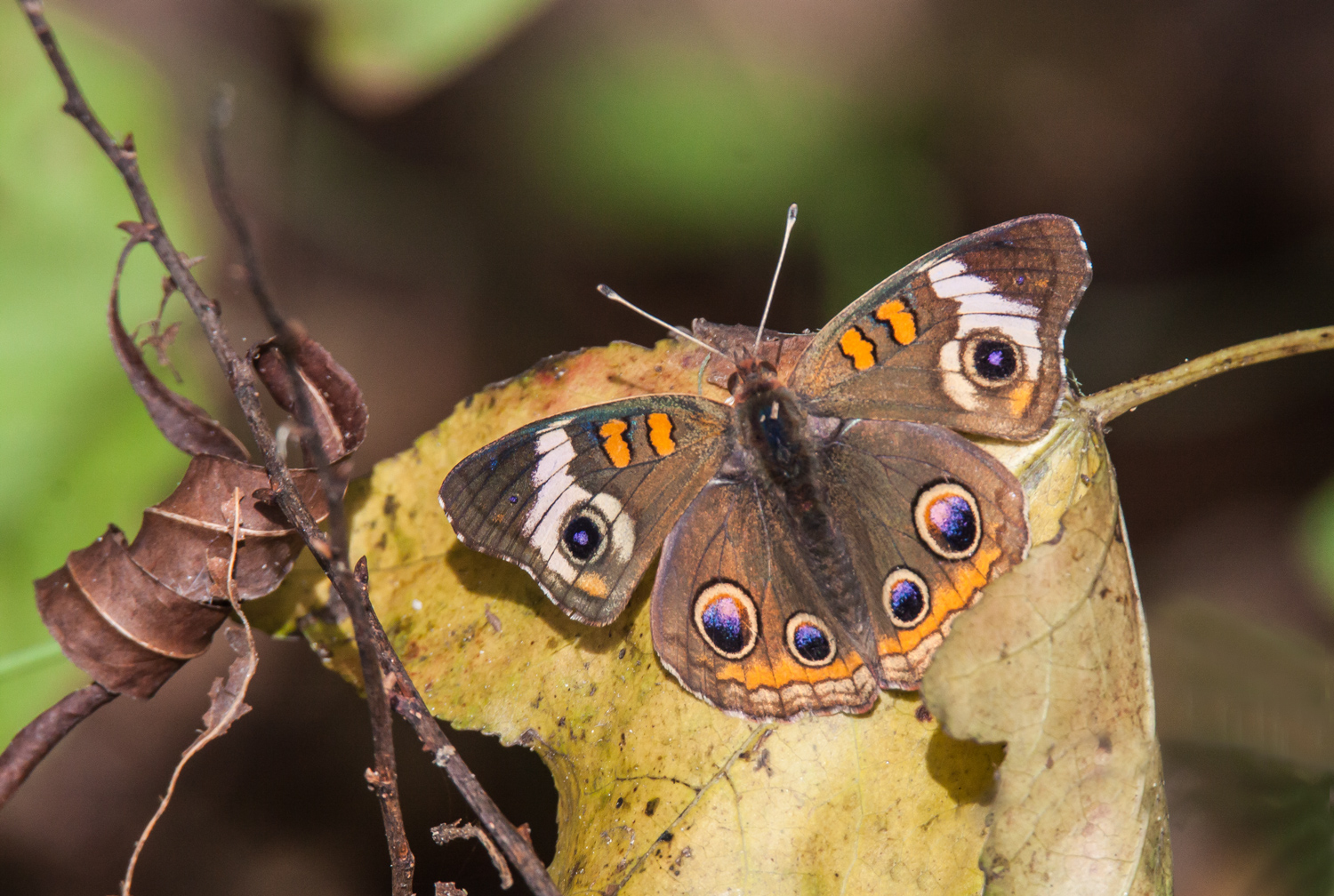
The brightly colored summer butterflies have mostly disappeared, but Common Buckeye butterflies (Junonia coenia) still accompany me in great numbers as I walk the trails of Occoquan Bay National Wildlife Refuge. The subdued, earthy shades of this beautiful butterfly seem a perfect match for the autumn season.

Common Buckeye

© Michael Q. Powell. All rights reserved.

Read Full Post »

It has been quite a while since I last got a shot of a Bald Eagle (Haliaeetus leucocephalus), so I was really happy when I saw this young one in the distance earlier this week at Occoquan Bay National Wildlife Refuge. Experienced birders can tell the age of a Bald Eagle by its coloration. All I know for sure that it is less that five years old, the age at which the head feathers turn white, though I have the impression that it is pretty young.

As is often the case, the eagle spotted me right afterwards and took to the air, but I managed to get a shot as the eagle flew off. When it comes to eagles, it is always a challenge to get a shot, because the eagle’s eyesight is so much better than mine and its reaction time so much quicker.  I therefore have to react almost instantly when I see one and then hope that luck is on my side.

Bald Eagle

Bald Eagle

© Michael Q. Powell. All rights reserved.


Read Full Post »

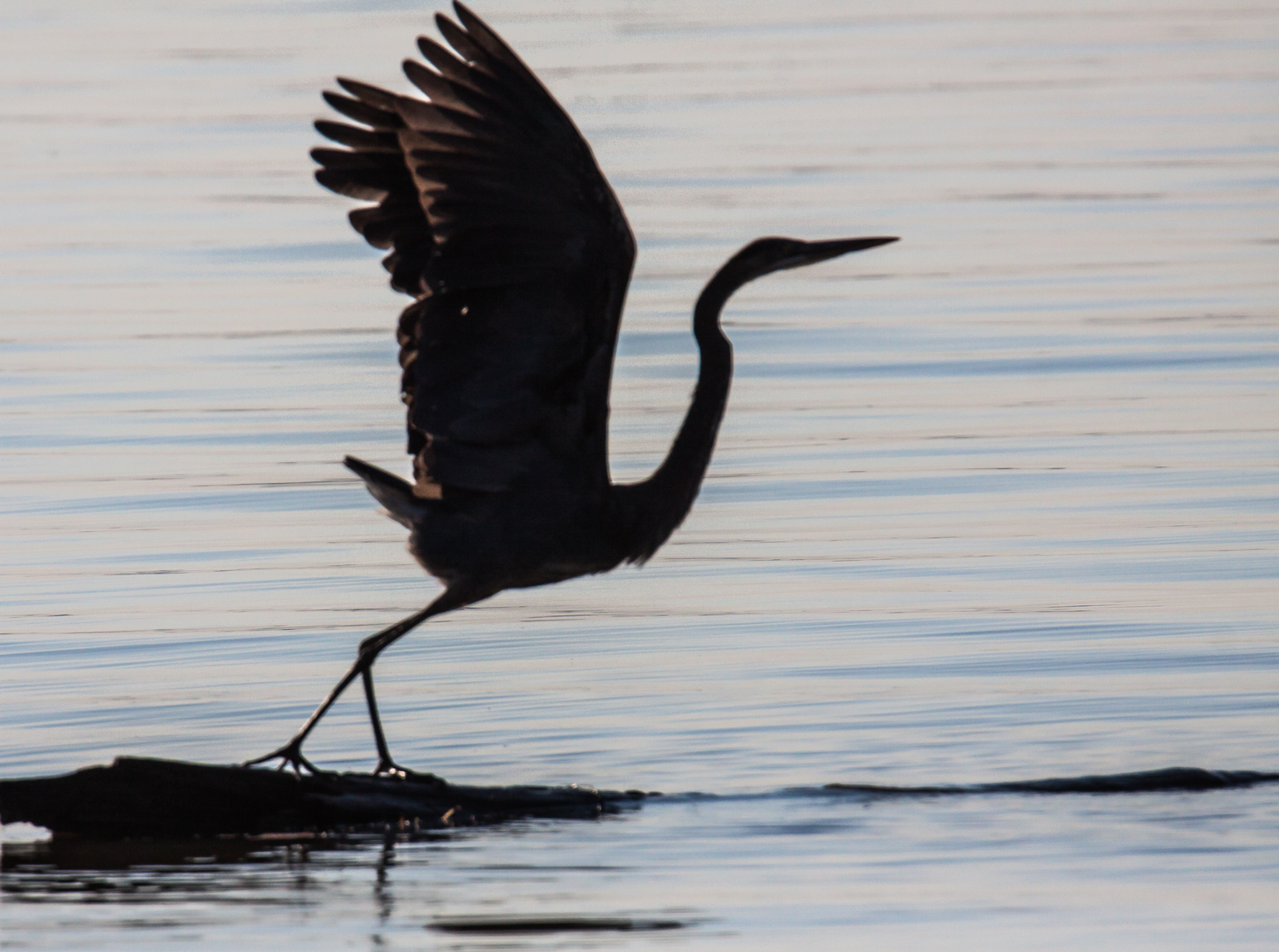
I suspected that this Great Blue Heron (Ardea herodias) at Occoquan Bay National Wildlife Refuge would be silhouetted because I was shooting into the light. I was going to make some adjustments to my camera settings, but it took off before I could do so and I captured a cool series of images.

Great Blue Heron

Great Blue Heron

Great Blue Heron

I liked the way that a few details of the feathers were visible in the images and the pink and blue streaks in the background were a nice touch. I decided, however, to play around with one of the images and opened the second shot in SIlver Efex Pro 2, a black and white conversion software program that is part of the Nik Collection.

One of the filters turned the heron into a completely black silhouette—with some birds, identification would be a problem, but the shape of the heron is unmistakable here. Another filter created the effect of a pinhole camera and you can see the result in the final images. There is something about that final image that really appeals to me.

I tend to strive for realism in my photos and normally do only a minimal amount of post-processing. I had so much fun, though, playing around with the different effects you can achieve with software that I suspect I will consider doing so again in the future.

Great Blue Heron

Great Blue Heron

© Michael Q. Powell. All rights reserved.

Read Full Post »

I spotted this large Wild Turkey (Meleagris gallopavo) strutting about at Occoquan Bay National Wildlife Refuge this past weekend with about a dozen of his close friends. It was hard to get a group shot, so I focused instead on the largest turkey in the group and captured this image.

Wild Turkey

© Michael Q. Powell. All rights reserved.

Read Full Post »

Initially I couldn’t figure out what large insect this Eastern Bluebird (Sialia sialis) had captured on Friday at Occoquan Bay National Wildlife Refuge. When the bluebird turned to the side, however, I realized that it was a Handsome Meadow Katydid (Orchelimum pulchellum), one of my favorite insects. The bluebird beat the insect against the log on which it was perched, presumably to subdue the katydid or to break open its hard shell, before consuming it.

It is hard to truly appreciate the beauty of the multi-colored katydid from a distance, so I am including a close-up photo of a Handsome Meadow Katydid from a posting that I did in August 2013 that was entitled “Rainbow grasshopper.” Check out my thoughts and feelings in that post about one of my initial encounters with such a katydid.

Still, bluebirds have to eat too, so I experienced only a brief moment of sorrow at the demise of this beautiful little creature.

Eastern Bluebird

Handsome Meadow Katydid

© Michael Q. Powell. All rights reserved.

Read Full Post »

Although we are well into October, some of my beloved dragonflies are still hanging on at Occoquan Bay National Wildlife Refuge. Here are some dragonfly shots from the past 10 days of (1) a male Blue-faced Meadowhawk (Sympetrum ambiguum); (2) a female Eastern Pondhawk (Erythemis simplicicollis) with a hoverfly in her mouth; and (3) a female Autumn Meadowhawk (Sympetrum vicinum).

I hadn’t really noticed before I aggregated this shots that all three of the dragonflies were perching on leaves. During the summer months, a significant number of the dragonflies that I photograph are perched higher on stalks of vegetation or on branches. In addition to these smaller dragonflies,

I have also recently spotted Common Green Darners, Wandering Gliders, and Black Saddlebags patrolling over the fields. Unfortunately, none of them paused long enough for me to get shots of them. All three of those species are migratory species and they may have been fueling up for a long journey ahead.

Blue-faced Meadowhawk

Eastern Pondhawk

Autumn Meadowhawk

© Michael Q. Powell. All rights reserved.

Read Full Post »

Every monarch needs a crown and this female Belted Kingfisher (Megaceryle alcyon) seemed to be wearing a leafy one yesterday at Occoquan Bay National Wildlife Refuge.

Maybe I should be calling her a Belted Queenfisher. 🙂

Belted Kingfisher

© Michael Q. Powell. All rights reserved.


Read Full Post »

Yellow-rumped Warblers (Setophaga coronata) eat mostly insects in the summer, but when the weather gets colder they switch to seeds and berries. This past week at Occoquan Bay National Wildlife Refuge I captured a number of shots of Yellow-rumped Warblers as they munched on what I think are poison ivy berries.

In the past, I have seen birds eating these berries only during the coldest days of the winter, leading me to think they were the only available food source. Who knows, maybe poison ivy berries are a real delicacy—though I am not will to try them to see if that is true.


Yellow-rumped Warbler

Yellow-rumped Warbler

Yellow-rumped Warbler

© Michael Q. Powell. All rights reserved.

Read Full Post »

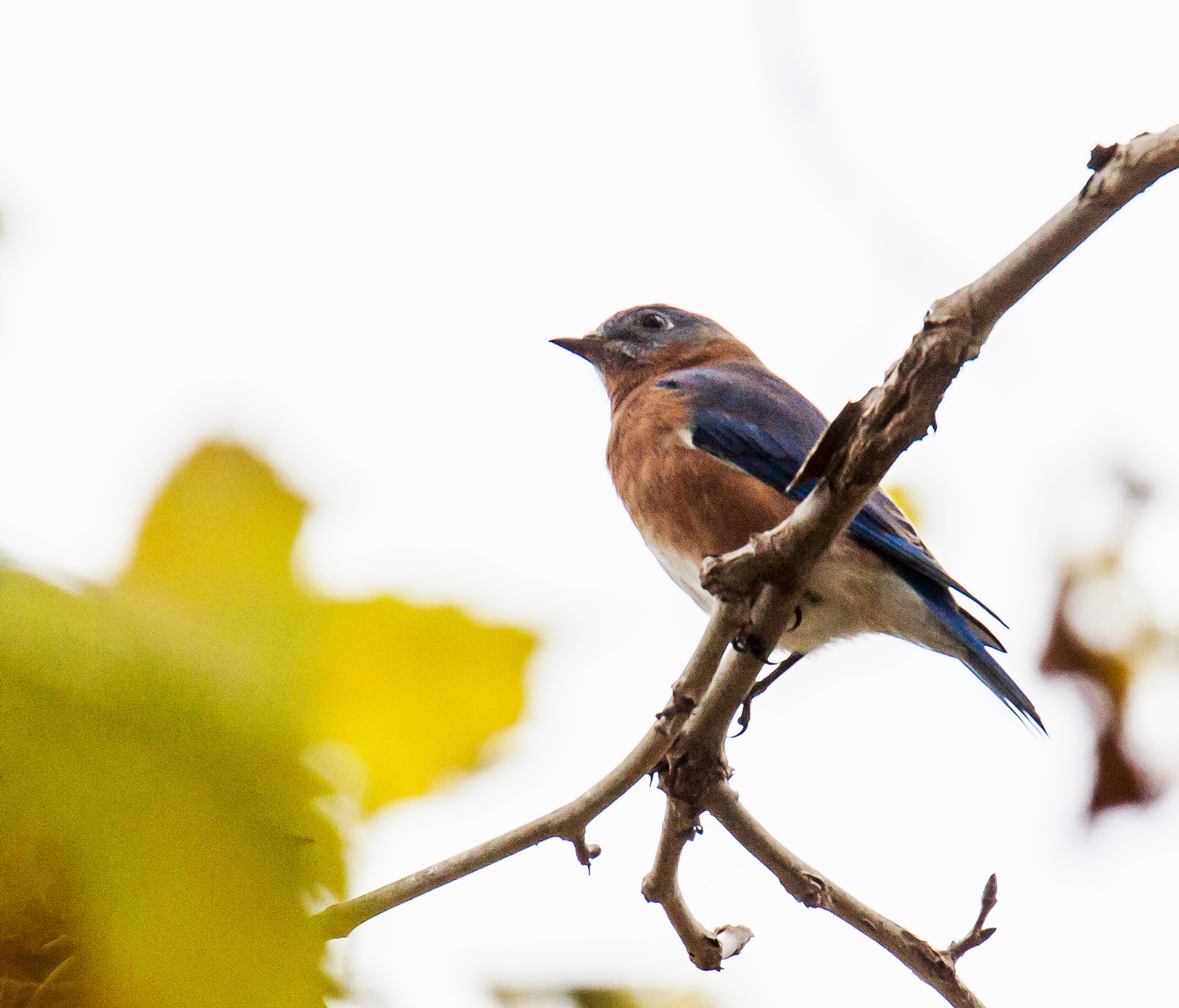
When the lighting is perfect, the blue and orange colors of an Eastern Bluebird (Sialia sialis) are incredibly saturated and beautiful. Alas, lighting conditions were far from ideal when I spotted three bluebirds earlier this week at Occoquan Bay National Wildlife Refuge and the bluebirds were elusive.

I was able to capture some images that give at least a hint of the beauty of the bluebirds, a species that I am always happy to see.

Eastern Bluebird

Eastern Bluebird

Eastern Bluebird

© Michael Q. Powell. All rights reserved.

Read Full Post »

I spotted this little family of Double-crested Cormorants (Phalacrocorax auritus) in the waters off of Occoquan Bay National Wildlife Refuge this past Monday. The adult seemed bothered by something and initIally cried out before finally taking off, leaving the younger cormorants temporarily by themselves.

I am not actually completely certain that this is a family unit, but I think it is a pretty safe assumption when I look at the way that the smaller ones are paying attention to the larger cormorant. It also appears to me that the the adult was potentially reacting to a perceived threat and flew off as a way of protecting the younger ones.

Double-crested Cormorant

Double-crested Cormorant

Double-crested Cormorant

© Michael Q. Powell. All rights reserved.

Read Full Post »

At this time of the year Yellow-rumped Warblers (Setophaga coronata) are probably the most numerous warblers in our area. You can often seem them in constant motion flitting about high in the trees. They rarely stay still for more than a moment and it is unusual to get a clear view of the entire body of one.

I have spent a lot of time this week patiently tracking these little birds at several locations at Occoquan Bay National Wildlife  Refuge and managed to get a few shots that I really like. The first image shows a Yellow-rumped Warbler perched at ground level on the trunk of a tree that had fallen across the road and had been cut up and moved to the side. I particularly like that it shows the tiny feet of this bird that is about 5 inches in length (13 cm). The little yellow streaks just under the wings help to identify this as a Yellow-rumped Warbler.

The second image, possibly my favorite, shows the yellow patch on the bird’s rump that is responsible for its name. The intense focus of the warbler as it looks upward help to give this image a dynamic element that is absent in many images of perched birds.

The final image has a studio-like feel to it, because the sky was completely overcast and turned white as I was processing the image. I had tracked the bird when it entered into the vegetation and managed to get this shot when it finally popped up at the top of the tree and stretched its neck to look around.

Yellow-rumped Warbler

Yellow-rumped Warbler

Yellow-rumped Warbler

© Michael Q. Powell. All rights reserved.

Read Full Post »

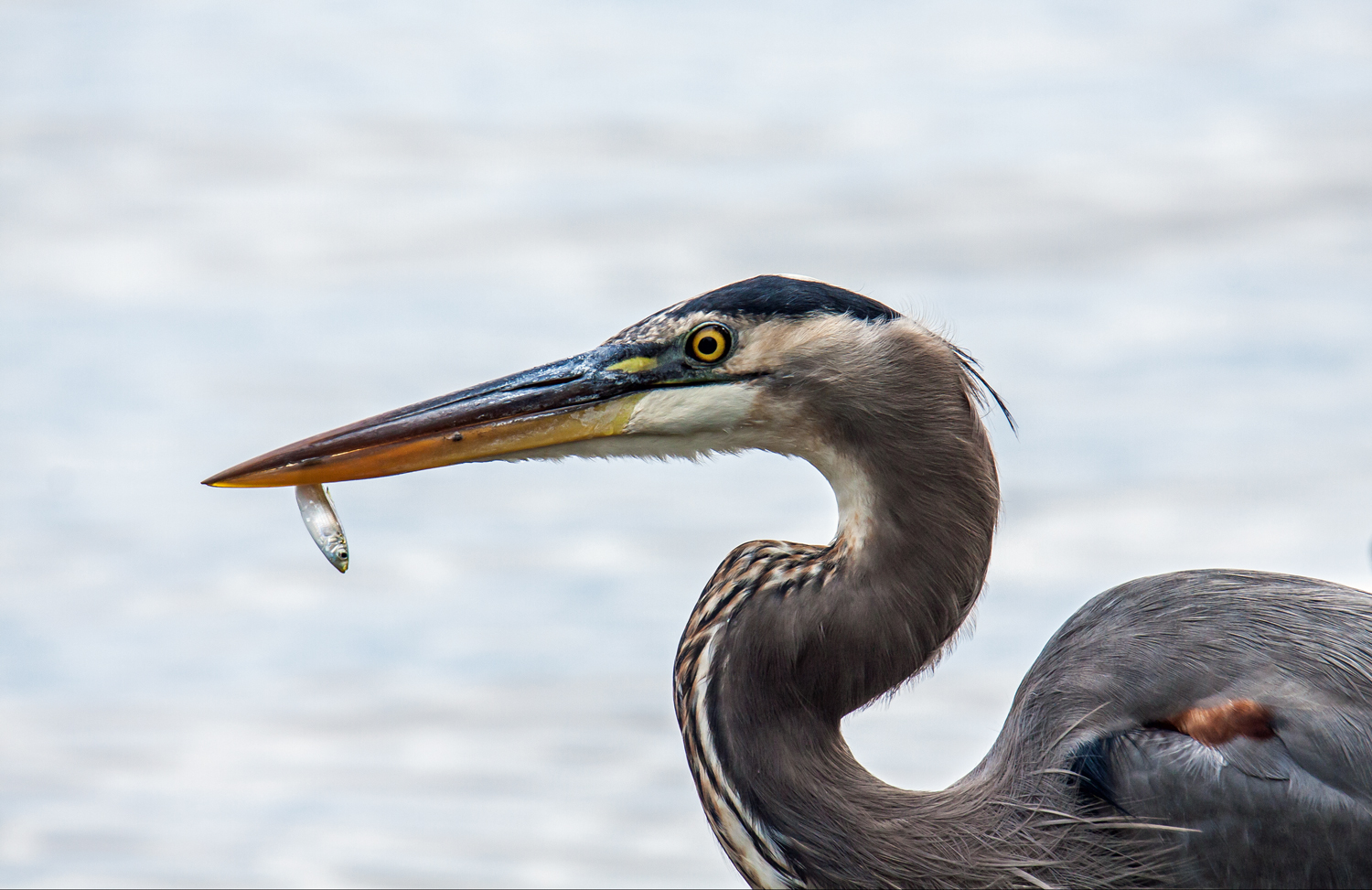
I have seen Great Blue Herons (Ardea herodias) catch fish so big that I was sure that they would not be able to swallow them, but I don’t think I have ever seen one catch fish as small as the ones this heron was pulling out of the water yesterday at Occoquan Bay National Wildlife Refuge.

The Great Blue Heron was standing on the shore rather than in deeper water. As I watched,  the heron periodically would catch and swallow one of these tiny fish and then return to scanning the water. It struck me that it would need to catch a lot of these little fish to make a satisfying meal.

Great Blue Heron

© Michael Q. Powell. All rights reserved.

Read Full Post »

In the autumn, various species of warblers fly through our area as they migrate south and I spent a large amount of time this past Friday trying to get shots of what I believe were mostly Palm Warblers (Setophaga palmarum). Warblers in general are tough for me to identify, even in the spring when the colors and patterns on the birds are bright and distinctive. At this time of the year, however, all of the colors and patterns are muted and many species look really similar to me.

Palm Warblers are a little easier to spot than most warblers to identify, because they often can be found pecking away on the ground rather than in trees, as you can see in the second shot. Although I usually strive to get unobstructed shots of my subject, the first image is my clear favorite of the three in this posting. The branch in the foreground that partially blocks the bird helps in the composition, I think, and reinforces the sense of the elusiveness and caution of this little warbler.

Palm Warbler

Palm Warbler

Palm Warbler

© Michael Q. Powell. All rights reserved.

Read Full Post »

I am always shocked by the length of the tails of Yellow-billed Cuckoos (Coccyzus americanus), like this one that I spotted on Friday morning at Occoquan Bay National Wildlife Refuge. It is pretty rare for me to get an almost unobstructed view of a cuckoo—usually they either fly away as I approach or are hidden in the foliage.

In the second shot, the cuckoo had shifted its body and the the new perspective has the effect of making the tail look a bit shorter and the body a bit chunkier.

Yellow-billed Cuckoo

Yellow-billed Cuckoo

© Michael Q. Powell. All rights reserved.

Read Full Post »

I was startled on Friday when exploring Occoquan Bay National Wildlife Refuge to hear a loud roaring noise overhead. I looked up and saw a large group of vintage aircraft flying in formation. Even though I zoomed out as far as I could with my 150-600mm lens, I could not fit all of the aircraft within the frame until they were flying away.

According to a press release from the Culpeper Air Fest, in an operation known as the Potomac Flight, a group of World War II aircraft on Friday, 12 October did a flyover down the Potomac River from Culpeper Regional Airport over the Pentagon and Arlington National Cemetery to honor Disabled American Veterans as a tribute to the services and sacrifices veterans have made for our freedom. Those of us who live in the Washington DC area know that the airspace over the capital region is tightly controlled and I can only imagine all of the bureaucratic impediments that had to be overcome to make this overflight possible.

I am not very good at identifying vintage aircraft, but the press release cited above indicated the overflight would include T-6 Texans and a C-47 aircraft.

Potomac Flight 2018

Potomac Flight 2018

Potomac Flight 2018

© Michael Q. Powell. All rights reserved.


Read Full Post »

I was really struck  by the contrast in color and texture between this cluster of large milkweed bugs (Oncopeltus fasciatus) and the milkweed on which they were perched at Occoquan Bay National Wildlife Refuge during a visit earlier this week.

The color combination seems appropriate for a Christmas card, though the subject matter would be considered untraditional, to say the least, and might not be met with enthusiasm by all recipients.

milkweed bugs

© Michael Q. Powell. All rights reserved.

Read Full Post »

« Newer Posts - Older Posts »