Feeds:
Posts
Comments

Archive for the ‘Autumn’ Category

I spend a good amount of time looking for unusual subjects to photograph, but I also love to photograph the everyday creatures that inhabit my day-to-day life. I spotted this Eastern Gray Squirrel (Sciurus carolinensis) last Wednesday at Occoquan Bay National Wildlife Refuge. I cannot tell for sure what the squirrel had in its mouth, but he seemed to consider it a treasure.

I love the pose of the squirrel atop the broken-off tree—there is something dynamic about its somewhat precarious position and in fact the squirrel leap jumped to a nearby tree a few seconds after I snapped this photo. I also really like the curve of the squirrel’s tail that adds a kind of whimsical touch to the image.

Eastern Gray Squirrel

© Michael Q. Powell. All rights reserved.

Read Full Post »

When I can’t get near enough to a subject for a close-up shot, I love to try to create an environmental portrait, like this image of a Great Egret (Ardea alba) that I photographed last week in the waters off of Occoquan Bay National Wildlife Refuge. Sometimes it is really cool to focus on capturing the mood of a moment more than worrying about the minute details of the subject.

Great Egret

© Michael Q. Powell. All rights reserved.

Read Full Post »

At this time of the year, a variety of colorful warblers pass through our area as they make their way south to warmer locations. Warblers are quite small and tend to spend most of their time hidden in the leaves at the top of tall trees.  As a result, it is rare for me to see more than just a flash of color. When the leaves fall from the trees, I have a better chance of spotting a small bird, but most of them are gone by that time of the year.

Last week I was fortunate to capture some shots of a bird that I was able to tentatively identify as a Black-throated Green Warbler (Setophaga virens). A lot of warblers look somewhat similar, so I went back and forth in my bird identification guide to try to identify “my” bird. I was a little surprised when some more experienced birders confirmed my identification of the warbler—it was a bit of an educated guess on my part, but a guess nonetheless.

I am in the process of recalibrating my vision now that I have switched to using my long telephoto zoom lens most of the time. Instead of looking down and scanning a close-in area for subjects, I am now trying to look for subjects that are often much higher up and farther away. In this transitional season, though, it becomes a little more complicated, because there are still some insects that I want to photograph.

It requires good camera technique and careful composition to capture images of insects at 600mm, but I have had some success in doing so, thanks in part to the monopod that I use with my long lens for additional stability. For example, my recent shots of Black Saddlebags dragonflies and Monarch Butterflies were all taken with my Tamron 150-600mm zoom lens. As I have noted before, gear does matter, but only to a much more limited extent than most people assume—my basic approach is to get the best photos that I can with whatever I have at hand.


Black-throated Green Warbler

Black-throated Green Warbler

© Michael Q. Powell. All rights reserved.


Read Full Post »

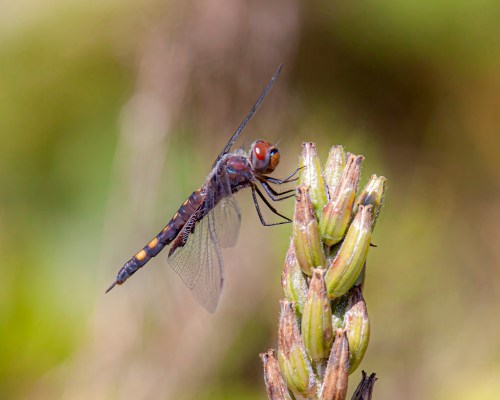
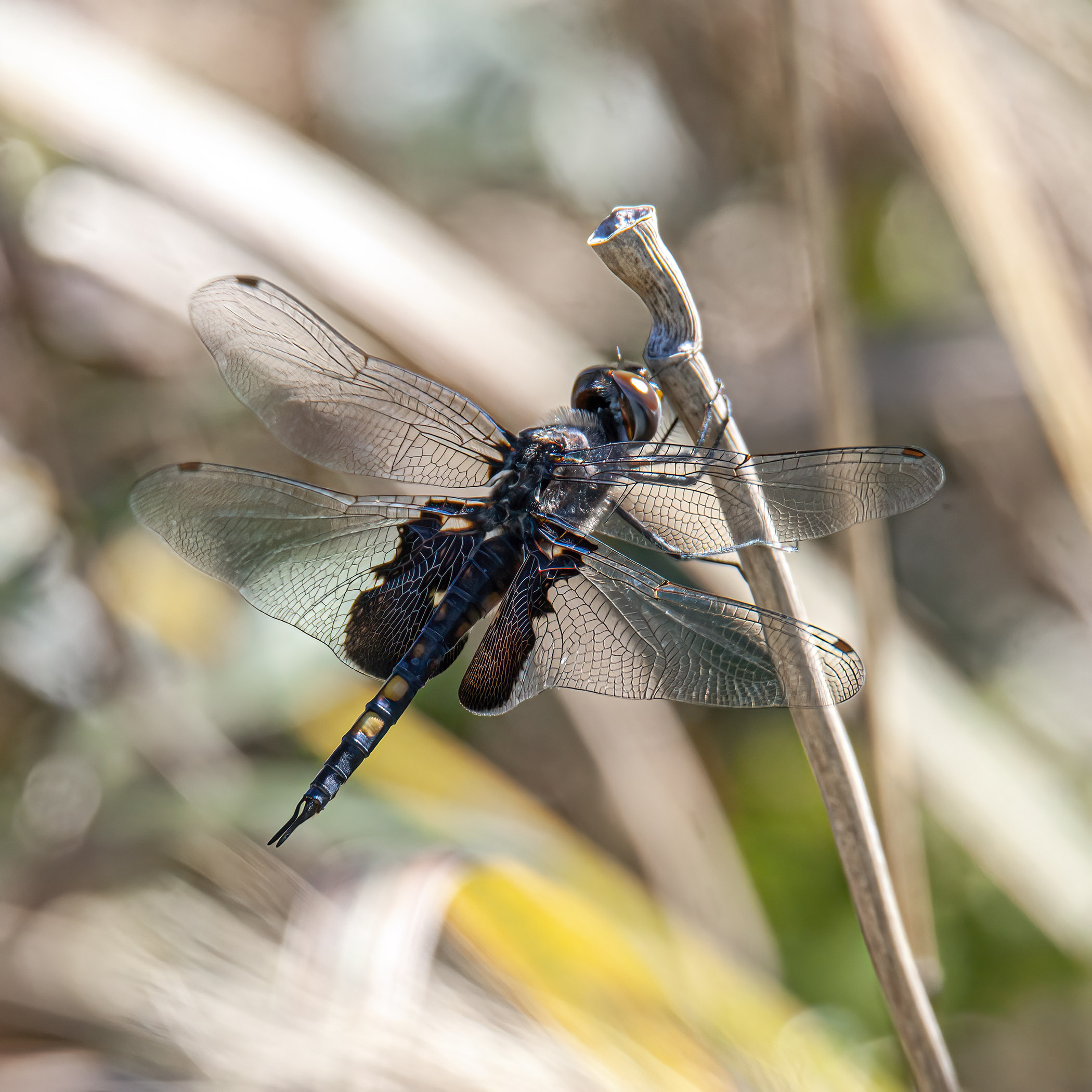
I have been really fortunate recently in getting shots of Black Saddlebags dragonflies (Tramea lacerata). Early last month I spent lots of times trying to photograph Black Saddlebags as they patrolled overhead, convinced that they rarely come down to earth to perch. As the month progressed, I was ecstatic when I managed to capture a couple of images of perched Black Saddlebags.

The last week or so, I have spotted at least one Black Saddlebags on varying types of vegetation during each of three separate visits to Occoquan Bay National Wildlife Refuge. Have these dragonflies changed their behavior? Have I changed my approach by switching from a macro lens to a longer telephoto zoom lens? Am I growing more alert and patient?

Rather than ponder the answer to these questions, I think it is best for me to celebrate the beauty of what I was able to capture in my photos, to live fully in the moment. Most of the time that I go out with my camera, I do have not specific expectations—I take things as they come and try to make the best of the opportunities that I am given.

Recently I watched a vlog by Nathaniel Drew, a  young YouTube creator whose videos I regularly watch, who stated that, “Unhappiness is wishing that things were another way.” The alternative, he continued, is to have a purpose—”Purpose, on the other hand, is about finding meaning, making sense of how things are.”

How do you find happiness? In many ways I am striving to be like the Apostle Paul, who was able to write to the Philipians, “I have learned to be content whatever the circumstances.” True contentment, I believe, can come from treasuring and celebrating what we have in our lives and not complaining or focusing on those things that we do not have.

Have a wonderful weekend.
 

Black Saddlebags

Black Saddlebags


Black Saddlebags

© Michael Q. Powell. All rights reserved.


Read Full Post »

This majestic Bald Eagle (Haliaeetus leucocephalus) was almost hidden in the foliage when I spotted it on Wednesday at Occoquan Bay National Wildlife Refuge. If the eagle’s head had not been so bright white in color, I might not have noticed it at all. At this time of the year, when I often can hear the birds, but cannot see them, it is always a challenge for me to photograph birds.

To mark the change of the seasons, I have switched over to walking around with my Tamron 150-600mm telephoto zoom lens affixed to my camera, a recognition that I am as likely to encounter birds as insects. I am still, however, carrying my 180mm macro lens in my backpack, in case I run into the right kind of shooting situation with an insects or other small creatures.

Initially the eagle had its head almost completely buried in the leaves, as you can see in the first photo. I gradually noticed, though, that the eagle was moving its head around a bit and I was able to capture some images that show a bit more of the eagle’s face. I changed my body position slightly as I watched and waited, but tried to minimize my movements for fear of spooking the eagle.

It has been quite a while since I last featured Bald Eagles in a posting, and I am excited at the prospect of seeing them more regularly. If so, you are sure to see the results here, because, as I have said on multiple occasions, any day in which I see a Bald Eagle is a good day and getting good shots is real bonus.

Bald Eagle

Bald Eagle

Bald Eagle

© Michael Q. Powell. All rights reserved.

Read Full Post »

I had given up on Monarch butterflies (Danaus plexippus) for the season, so I was thrilled when I spotted several of them on Monday at Occoquan Bay National Wildlife Refuge. I do not know if these are local butterflies, but I like to imagine that they are temporary visitors who stopped in to visit during their magical migration journey to warmer locations.

I photographed these two butterflies in different parts of the wildlife refuge. I thought about using only one of the two photos for this posting, but decided that I really like the impact that the images have as a pair, presenting a kind of yin-yang contrast in light and shadows and overall mood. What do you think?

Monarch

Monarch

© Michael Q. Powell. All rights reserved.


Read Full Post »

As we rush towards the end of September, the number of butterflies is continuing to drop and many of the ones that I see are faded and tattered. Yet somehow, despite the obvious signs of age and infirmity, they manage to adapt and survive. I photographed this Black Swallowtail butterfly (Papilio polyxenes) last Friday at Occoquan Bay National Wildlife Refuge.

For folks of my generation, the title of this blog will immediately bring to mind the memorable song by that name as sung by Gloria Gaynor in the late 1970’s.

“Oh no, not I, I will survive
Oh, as long as I know how to love, I know I’ll stay alive
I’ve got all my life to live
And I’ve got all my love to give and I’ll survive
I will survive”

Black Swallowtail

© Michael Q. Powell. All rights reserved.


Read Full Post »

When I spotted this raccoon (Procyon lotor) last Tuesday afternoon at Occoquan Bay National Wildlife Refuge, it was trotting right towards me on one of the trails, seemingly undeterred by my presence. I stepped to the side as far as I could and grabbed a stick for potential protection. The raccoon swerved a little as it passed me, but did turn its head to growl at me.

Folks in a nature forum on Facebook reminded be that there are a number of reasons why raccoons might be out in the daylight like this, including foraging for food for babies, and that I should not assume that the raccoon has a problem, such as rabies. I try to be really careful when I am out in the wild, particularly because I am usually alone, and avoid direct contact with my subjects. It this case, the raccoon seemed to have a really determined look on its face and I was more than happy to move out of its way.

raccoon

© Michael Q. Powell. All rights reserved.

Read Full Post »

Each September I look forward to the reappearance of three dragonfly species: the Blue-faced Meadowhawk (Sympetrum ambiguum); the Autumn Meadowhawk (Sympetrum vicinum); and the Fine-lined Emerald (Somatochlora filosa). At a time when most of the other dragonflies are dying off, these species burst onto the scene.

This season, however, “burst” would not be the appropriate verb to describe their activity. At Occoquan Bay National Wildlife Refuge, where I have photographed all three species in the past, I have seen  Fine-lined Emeralds in flight three times, but have not managed to get a photograph of one. I still have not seen an Autumn Meadowhawk and until last Friday, I have not seen a Blue-faced Meadowhawk.

I was thrilled, therefore, when I spotted this female Blue-faced Meadowhawk on Friday. I had my long telephoto zoom lens on my camera, so trying to focus accurately on my tiny subject was a big challenge, but I am pretty happy with the result. Females of this species have relatively subdued coloration—the males have bright red bodies and blue faces—and they are generally harder to find than the males.

I hope to be able to feature a new photo of a male Blue-faced Meadowhawk soon, but if you are impatient or curious to see what one looks like, check out this posting called Blue-faced Meadowhawk (male) from September 2020.

Blue-faced Meadowhawk

© Michael Q. Powell. All rights reserved.

Read Full Post »
Autumn has officially arrived, but I continue to see damselflies at Occoquan Bay National Wildlife Refuge, albeit in ever-decreasing numbers. The damselfly in the first photo is a female Familiar Bluet (Enallagma civile) and the one in the second image is a male Big Bluet (Enallagma durum).

I like the way that I was able to capture hints of the changing season in the images, with the reddish autumn tones in the first shot and the gnawed leaf in the second one.

Familiar Bluet

Big Bluet

© Michael Q. Powell. All rights reserved.

Read Full Post »

When I first spotted the Great Blue Heron (Ardea herodias) on Tuesday, it was standing in the shallow water of a small pond at Occoquan Bay National Wildlife Refuge.  I could not tell if the heron was actively fishing, but it did seem to be alert and attentive, so I decided to watch and wait. It moved slowly toward a patch of vegetation and bent over slightly, its head disappearing from view.

Suddenly the heron thrust its body forward, striking without warning. When the heron turned its head, I could see a squirming creature in its beak, but I could not tell what it was. At first I assumed that it was a fish, but when the prey started to coil itself around the beak, I began to wonder if it was a snake. When I examined the images on my computer screen, I began to wonder if it could be some kind of eel.

I am presenting the images in reverse chronological order, because I think the shot of the heron struggling with its prey is the most compelling—I usually try to lead with my best shot, because it is the one that shows up as the thumbnail image for those using the WordPress Reader feed. A few seconds after I took that shot, the heron flew a short distance away, out of range of my camera, and I watched heron subdue and swallow what I am assuming was an eel. The second image provides the best view of the eel, and the final shot shot shows the heron before the action began.

UPDATE: A Facebook viewer has indicated that the catch is probably a juvenile American Eel (Anguilla rostrata).

Great Blue Heron

Great Blue Heron

Great Blue Heron


© Michael Q. Powell. All rights reserved.

Read Full Post »

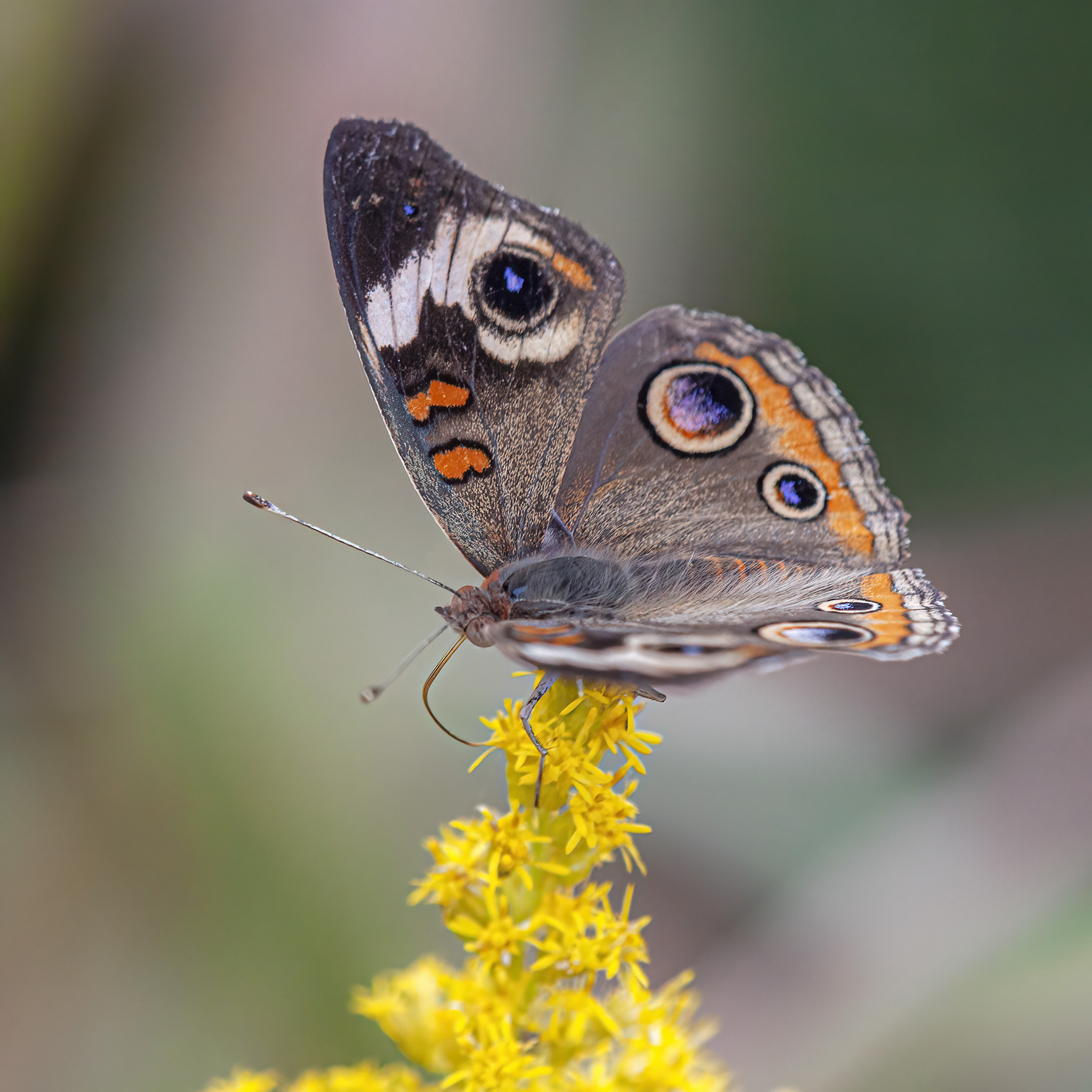
I was delighted to spot this beautiful Common Buckeye butterfly (Junonia coenia) in a patch of goldenrod on Tuesday at Occoquan Bay National Wildlife Refuge. This angle of view over one of the opened wings provides us with a really good look at the butterfly’s distinctive patterns and colors and we can also see its extended proboscis as it sucks nectar from the bright yellow goldenrod.

Common Buckeye

© Michael Q. Powell. All rights reserved.

Read Full Post »

I spotted this really cool-looking turtle on Friday while exploring at Jackson Miles Abbott Wetland Refuge during a light rainstorm. The turtle does not look like any turtle that I have seen before—its speckled face really grabbed my eye. The turtle was nestled into the thick grass and I did not want to disturb it, so I moved on after grabbing a few quick shots.

When I returned home, I rushed to the Virginia Herpetological Society website to see if I could identify “my” turtle. The Commonwealth of Virginia, in which I live, has 25 species and subspecies of turtle, of which five are sea turtles, so I figured that it would not be very difficult to find a match. I could easily eliminate many species from consideration and finally decided that the turtle looks a bit like some of the photos for a Northern Diamond-backed Terrapin (Malaclemys terrapin terrapin).

However, the map and information about the geographic distribution of the turtle within the state does not appear to include my county or any of the surrounding counties. According to the aforementioned website, the Northern Diamond-backed Terrapin is the only truly estuarine reptile in Virginia and it inhabits coastal, brackish marshes and their tributaries, bays, inlets, and tidal portions of coastal rivers—I was at a small pond adjacent to a larger marshland area. I am still seeking confirmation of my identification from more knowledgeable expert.

Where I live, Terrapins—the species seems to be variously referred to as “diamondback” and “diamond-backed”—is most often associated with the nearby state of Maryland, where the terrapin is the official state reptile and mascot for the University of Maryland College Park.


Northern Diamond-backed Terrapin

© Michael Q. Powell. All rights reserved.


Read Full Post »

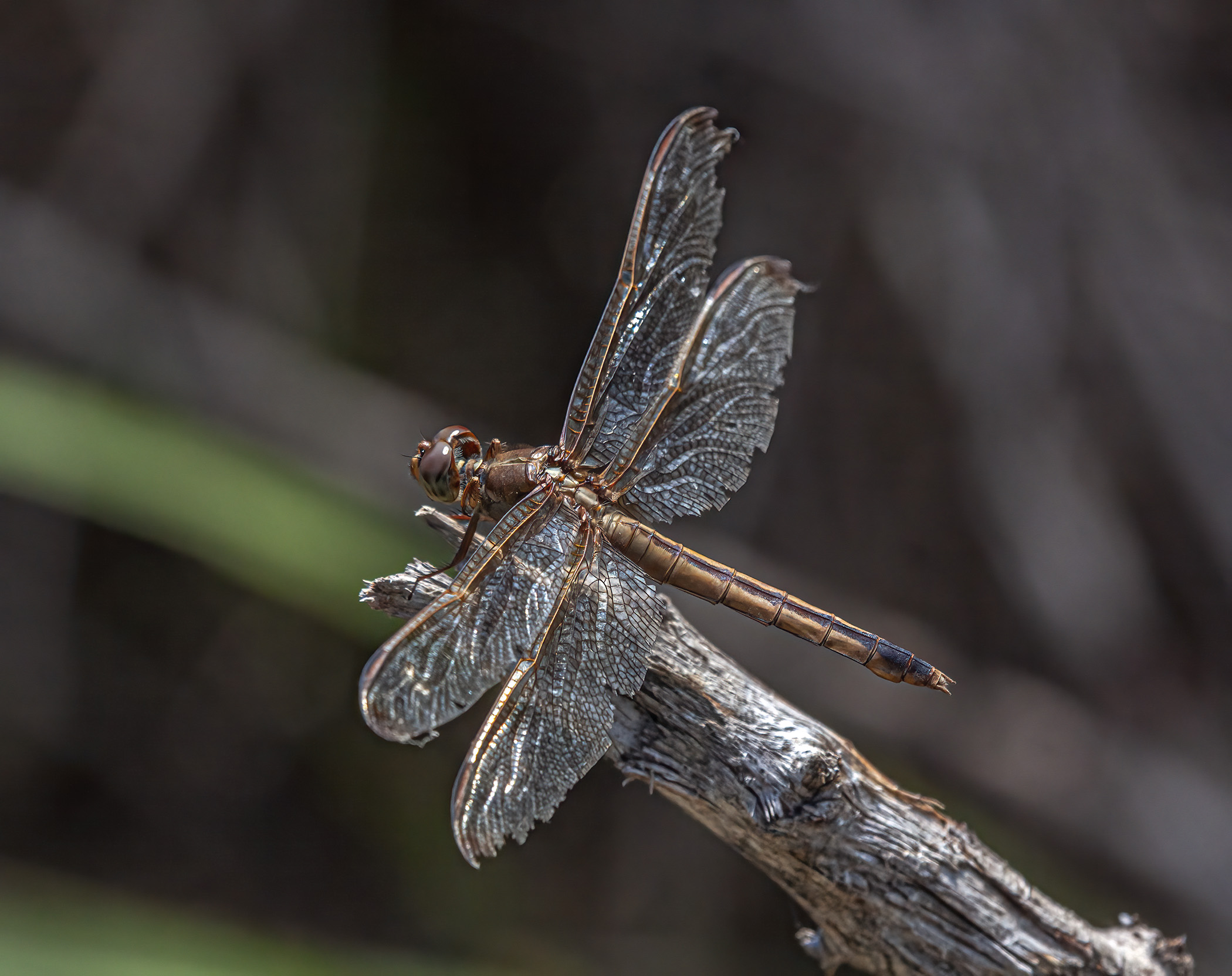
Her colors were faded and her wings were tattered, but the simple beauty and elegance of this mature female Needham’s Skimmer dragonfly (Libellula needhami) were still very much in evidence when I encountered her on Wednesday at Occoquan Bay National Wildlife Refuge. In fact, the coppery-gold veins near the leading edges of her wings seemed to glow from the inside with a radiant light.

So often our society tells us that we should equate beauty with a youthful appearance, but I would argue that beauty can be found at all ages. Beauty for me is not so much about matching up to some standard of perfection—it can be found in the midst of all of our wrinkles, scars, and blemishes. Our uniqueness as individuals in and of itself makes us beautiful if you look closely and deeply enough.

Needham's Skimmer

© Michael Q. Powell. All rights reserved.

Read Full Post »

Although we had only about an inch of snow last week, it has hung around on cars and in shady areas. Despite the continuing cold and overcast weather, I decided yesterday that I needed to get outdoors with my camera. I had several places in mind, but my plans were thwarted when I ran into a traffic jam on the interstate. I took the first exit and decided to visit instead a small suburban pond not far from where I live.

Several species of ducks overwinter at this pond and I spotted Hooded Mergansers and Ring-necked Ducks in the center of the pond, out of range of my telephoto zoom lens. As I continued circling the pond on a walking trail, I was thrilled to spot several Double-crested Cormorants (Phalacrocorax auritus) standing in the shallow water not far from the shore. Some bushes separated me from the cormorants, so I had to bend and twist a bit to get a clear shot, but I managed to capture this image of one of them before they turned their backs to me and swam away.

The bright orange color of the cormorants’ bills always captures my attention, but it is the beauty of their brilliantly blue eyes that keeps me transfixed. Wow! Be sure to double-click on the photo to get a closer look at that amazing blue color.

As it turned out, I did not need to travel far to find beauty—figuratively speaking it was in my back yard. It would be cool to have an actual pond in my back yard, but it would have to be a tiny one and my townhouse homeowners’ association would certainly complain about it.

Double-crested Cormorant

© Michael Q. Powell. All rights reserved.

Read Full Post »

Smaller birds seem to enjoy foraging for Sweet Gum seeds while the seed pods are still hanging on the trees, like this Carolina Chickadee (Poecile carolinensis) that I spotted last week at Occoquan Bay National Wildlife Refuge. Many of you may recall a somewhat similar posting last month featuring goldfinches. If you have not yet seen it, check it out at Goldfinch and Sweetgum.

Although I enjoy photographing raptors, like the Bald Eagle that I showcased yesterday, I derive an equal amount of pleasure observing and attempting to photograph tiny birds like this chickadee. Beauty is everywhere.

Carolina Chickadee

© Michael Q. Powell. All rights reserved.

Read Full Post »

When I first spotted this Bald Eagle (Haliaeetus leucocephalus) last Saturday at Occoquan Bay National Wildlife Refuge, it was mostly hidden from view, perched rather low on a broken-off tree and surrounded by a thick tangle of vegetation. When I finally maneuvered around to a position where I had a relatively clear line of sight to the eagle through the bushes, I realized that I had another problem—the light was shining brightly from the side, causing the white head of the eagle to be overexposed on one side with a resultant loss of details.

I moved a little from side to side to improve the lighting situation and waited for the eagle to move its head too. As I reviewed my shots afterwards, I was delighted to see that the side lighting had helped to reveal the beautiful layers of feathers on the eagle’s body. The eagle seemed to be giving me a disapproving look in the second shot, but amazingly it remained in place. As I was moving away I looked back at the eagle and silently thanked the majestic bird for our shared moments together.

Bald Eagle

Bald Eagle

© Michael Q. Powell. All rights reserved.


Read Full Post »

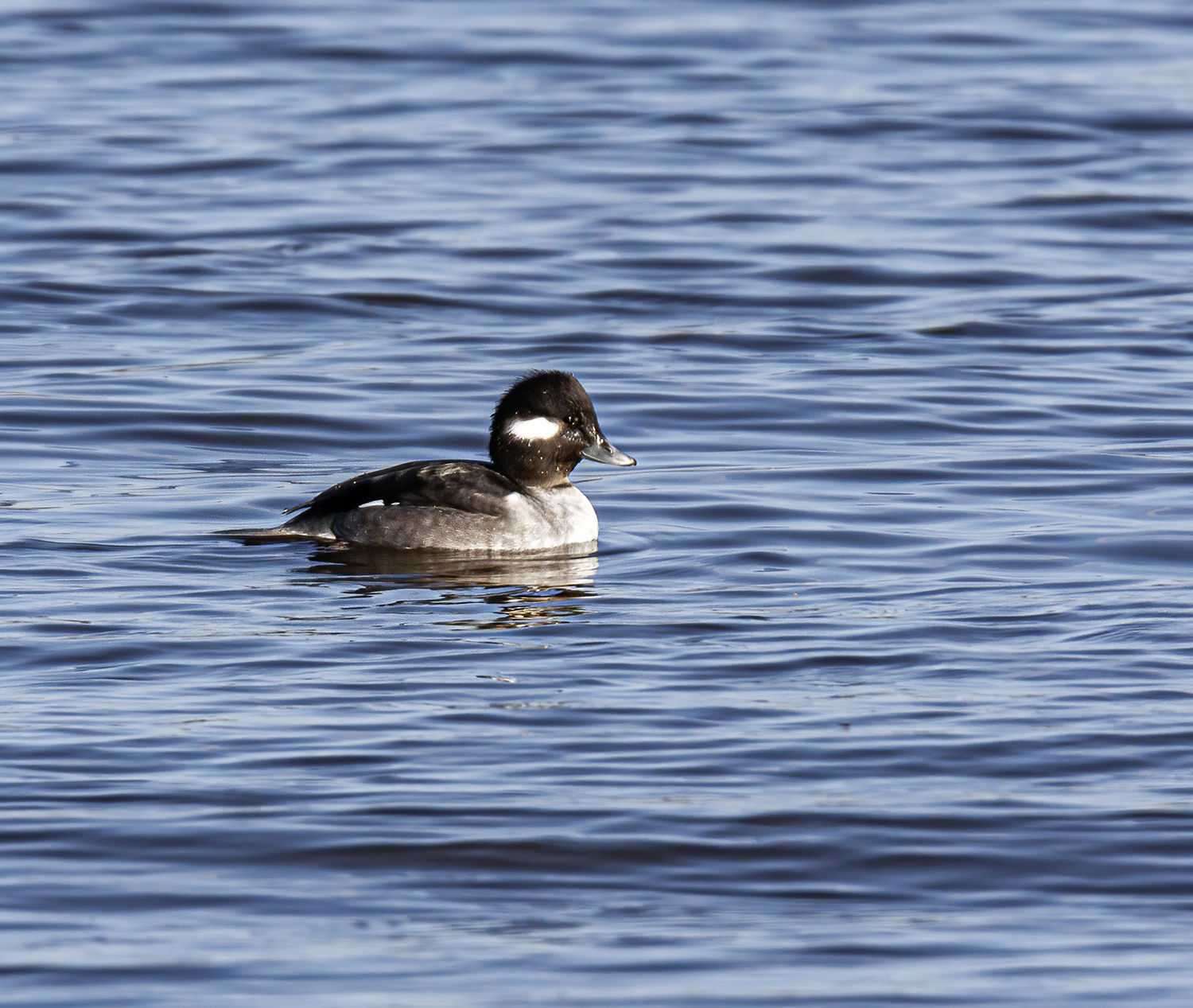
She never approached the shore for the close-up that I was craving, but I was happy to capture this image of a pretty little female Bufflehead (Bucephala albeola) last week at Occoquan Bay National Wildlife Refuge. Later in the winter I am likely to spot small flocks of Buffleheads in the deep waters, but on this day this one was all by itself.

Bufflehead

© Michael Q. Powell. All rights reserved.

Read Full Post »

I am often fooled by Eastern Towhees (Pipilo erythrophthalmus). Whenever I see a flash of rusty brown feathers on a dark bird, I assume that it is an American Robin. If a towhee stays still long enough, it is easy to tell that it is not a robin—the color pattern and the bill shape are completely different from those of a robin. The problem is that towhees are often in constant motion, foraging about in the undergrowth, so it is hard to get a good look at one.

I was fortunate last week when an Eastern Towhee popped out of the brush at Occoquan Bay National Wildlife Refuge and perched for a moment on the branch of a small tree, allowing me to capture a shot of this very colorful sparrow.

Eastern Towhee

© Michael Q. Powell. All rights reserved.

Read Full Post »

During nesting season ospreys build a nest atop this tall platform at Occoquan Bay National Wildlife Refuge, but at other times of the year Bald Eagles (Haliaeetus leucocephalus) like to use it as a resting spot. On a recent day when the weather was cold and windy, I spotted this eagle couple resting together. I suspect that the larger eagle on the lower level is the female and the one keeping watch is the male, although the sharp upward angle at which I was shooting makes it a little difficult to judge their relative sizes.

Bald Eagle

© Michael Q. Powell. All rights reserved.


Read Full Post »

If I wander the trails of Occoquan Bay National Wildlife Refuge for a long enough period of time, I am quite likely to encounter some Wild Turkeys (Meleagris gallopavo). I have seen them in almost all parts of the refuge and suspect that there are several flocks that reside there.

Last Monday I encountered a small flock that appeared to include a half-dozen or so turkeys. They were scratching about at the edge of one of the trails and did not seem to notice me as I slowly made my way forward. All of the sudden, one of the turkeys flapped its wings a little as if to sound an alarm, as you can see in the second image below. All of the turkeys started to move and slowly disappeared into the underbrush. I was thrilled to capture the first image as they were striding away.

Wild Turkey

Wild Turkey

© Michael Q. Powell. All rights reserved.

Read Full Post »

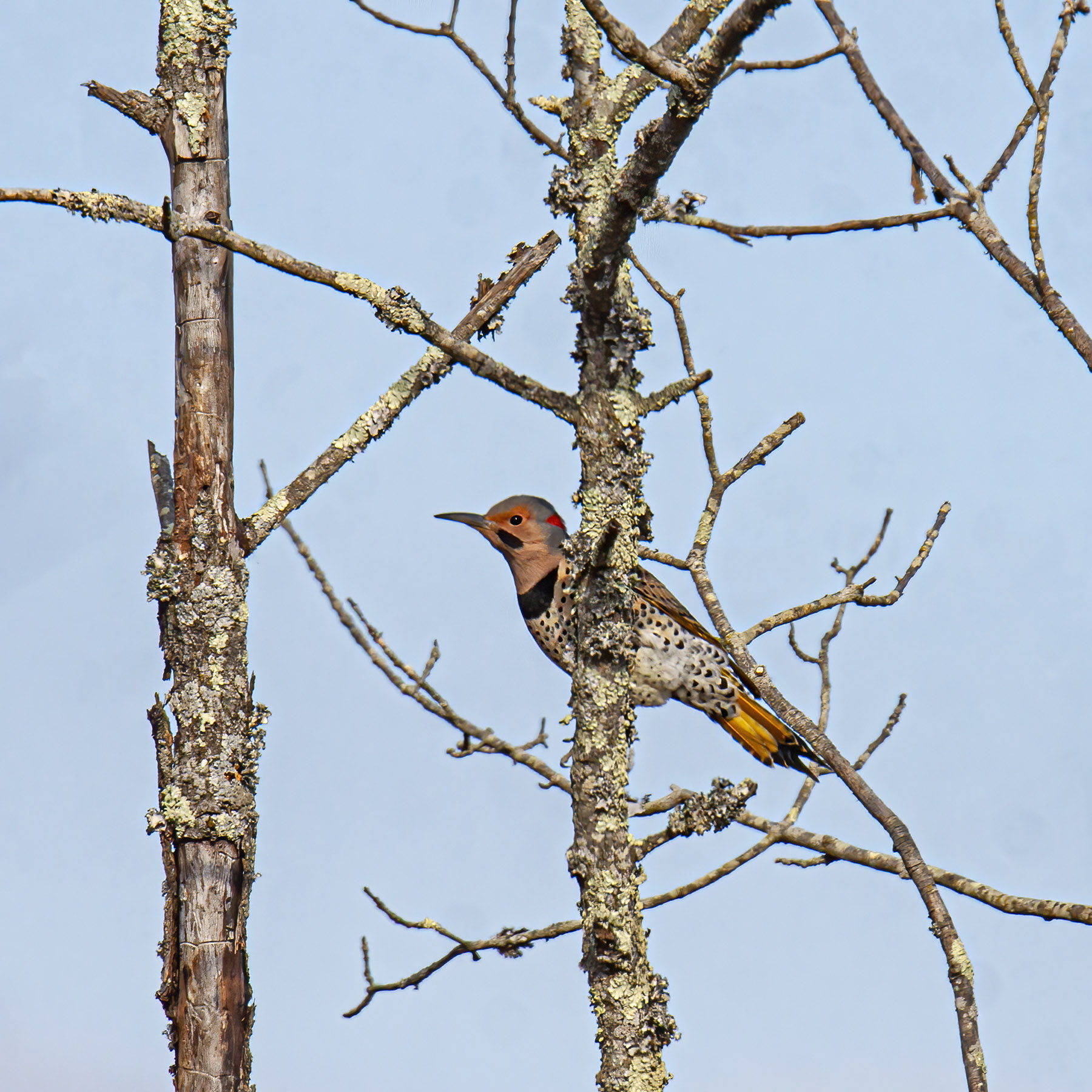
I love the colors and patterns of Northern Flickers (Colaptes auratus), like this one that I spotted on Monday at Occoquan Bay National Wildlife Refuge. In the United States there are two variants of this colorful bird, an Eastern one and a Western one. The Eastern males, like the one in the image below, have a red nape, black “whiskers,” and yellow shafts on their flight and tail feathers. Western males, which I have not yet seen, do not have a nape crescent and have red “whiskers” and red-shafted tail feathers.

Northern Flicker

© Michael Q. Powell. All rights reserved.

Read Full Post »

As the days become colder and the landscape turns monochromatic, I am always happy to spot the bright red plumage of a male Northern Cardinal (Cardinalis cardinalis), like this one that I photographed on Monday at Occoquan Bay National Wildlife Refuge.

Northern Cardinal

© Michael Q. Powell. All rights reserved.

Read Full Post »

Yesterday I featured a Downy Woodpecker, the smallest woodpecker in our area. Today I want to present a Pileated Woodpecker (Dryocopus pileatus), which is by far the largest woodpecker in this region, with a length of 16 to 19 inches (41 to 48 cm) and a weight of 9 to 12 ounces (155 to 340 grams). I doubt that I will ever spot one of these woodpeckers hanging from a seedpod, like yesterday’s Downy.

Quite often I hear the drumming sound of a Pileated Woodpecker long before I see, a sound that sometimes seems as loud as a jackhammer. When I heard that sound on Monday I scanned the trees and finally caught a glimpse of this female Pileated Woodpecker pecking away at a distant tree. I was happy to capture this profile shot that provides a pretty good look at her face and her bright red crest.


Pileated Woodpecker

© Michael Q. Powell. All rights reserved.

Read Full Post »
I was delighted to spot this male Downy Woodpecker (Picoides pubescens) on Monday at Occoquan Bay National Wildlife Refuge as it acrobatically pecked away at some seedpods hanging high in the trees. Fellow dragonfly enthusiast Walter Sanford commented on a Facebook posting that that the seed pods look like trumpet vine (Campsis radicans). Check out his 2011 blog posting entitled Trumpet vine fruit and seeds for more details on this plant.

Downy Woodpeckers are the smallest woodpeckers in our area, about 6 inches long (15 cm), and the lightest, about one ounce (28 g). Still, it was a bit surprising the way that the woodpecker was hanging on the seedpod as it hammered away at it.

During warmer weather Downy Woodpeckers eat mostly insects, but it looked to me like this one was trying to extract seeds from the pods. According to the Cornell Lab of Ornithology, “About a quarter of their diet consists of plant material, particularly berries, acorns, and grains.” Whatever the case, this woodpecker appeared to be determined and focused on his task.

Downy Woodpecker

Downy Woodpecker

© Michael Q. Powell. All rights reserved.

Read Full Post »

It was cold and windy yesterday when I set out for Occoquan Bay National Wildlife Refuge, about 44 degrees (7 degrees C), but I thought that there might be a chance that I could find a dragonfly, because the sun was shining brightly. This late in the season, there is only one dragonfly species still present in my area, the Autumn Meadowhawk dragonfly (Sympetrum vicinum), and its days are almost certainly numbered. I was heartened by the fact that a fellow photographer had spotted an Autumn Meadowhawk this past weekend and the knowledge that fellow dragonfly enthusiast spotted one on 3 January 2016—a new late-date for a dragonfly in Virginia. (Check out his posting for more details.)

I spent most of my time looking for birds, but I would slow down and look closely at the ground whenever I came to a sun-lit patch of ground. Autumn Meadowhawks often perch flat on the ground and love to bask in the sun. I was nearing the end of my normal loop when I finally spotted an Autumn Meadowhawk, the only one that I would see all day.

I had my 150-600mm zoom lens on my camera and it has a minimum focusing distance of almost nine feet (2.7 meters), so I had to back us a bit to get the dragonfly in focus. Autumn Meadowhawks, are pretty small, about 1.3 inches in length (33 mm), so it was a challenge finding the dragonfly in my camera’s viewfinder—fortunately the bright red color of its body helped me to locate the dragonfly. I managed to snap off two shots before the dragonfly flew away.

I am amazed and delighted by the hardiness of these little dragonflies and will search for them again whenever I am out with my camera this month. I decided to include a photo of an Autumn Meadowhawk that I photographed on 16 November, because it really shows off really well the autumn habitat of this species. For the last three weeks, I have put off posting that image, hoping that it would not be my last dragonfly sighting of 2020.

The season for dragonflies is not yet over!

Autumn Meadowhawk

Autumn Meadowhawk

© Michael Q. Powell. All rights reserved.

Read Full Post »
I love watching Great Blue Herons (Ardea herodias) catch fish. Often they will stand still for long periods of time and then strike suddenly and violently. Catching a fish, though, is only half of the battle for the heron. The heron must then maneuver the fish into position so that it can be swallowed head-first.

During a trip last month to Occoquan Bay National Wildlife Refuge, I observed the whole process and was able to capture a series of images, including these three. It looks like the heron speared the fish initially, leaving it either stunned or possibly dead. I admire the boldness and skill of the heron as it flipped the fish into the air, as you can see in the middle photo, as part of the positioning process. Eventually the fish was correctly positioned, as shown in the final photo, and a split second later, the heron tilted back its head and the fish disappeared down its throat.

Great Blue Heron

Great Blue Heron

Great Blue Heron

© Michael Q. Powell. All rights reserved.


Read Full Post »

Often I am mesmerized by light and shadows and reflections. It doesn’t take much to capture and hold my attention, like these pieces of wood that I spotted in the waters off of Occoquan Bay National Wildlife Refuge.

reflection

© Michael Q. Powell. All rights reserved.

Read Full Post »

Sparrows seem so ordinary to most people and I enjoy the challenge of trying to capture images of them in ways that make this drab little birds stand out. On a recent trip to Occoquan Bay National Wildlife Refuge, I observed some Song Sparrows (Melospiza melodia) foraging in the middle of a large, heavily vegetated field. Occasionally one of them would perch on the top of the vegetation and I managed to get some shots.

I like the way that these two images, which are quite different, work together as a pair. In the first one, a viewer’s eyes are immediately drawn to the colorful autumn leaves and only afterwards do they move up to the perched sparrow—there is a sense of energy because of the bright colors. In the second image, the solitary sparrow is the sole subject and the plain background and simple perch create an almost austere feeling—there is a feeling of serenity and simplicity.

Song Sparrow

Song Sparrows

© Michael Q. Powell. All rights reserved.

Read Full Post »

Although they are barely larger than the hummingbirds that migrate south when the weather turns cold, Golden-crowned Kinglets (Regulus satrapa) spend their winters in my home area of Northern Virginia. In addition to being tiny, Golden-crowned Kinglets often forage high in the trees, which makes them really tough to photograph.

I was really happy to capture this image of a Golden-crowned Kinglet on Tuesday at Occoquan Bay National Wildlife Refuge as it was feeding on a cluster of poison ivy berries. Looking through the branches you can see the bird’s lemon-yellow “crown” and the the beautiful pattern on its wings.

Golden-crowned Kinglet

© Michael Q. Powell. All rights reserved.


Read Full Post »

The leaves have mostly fallen from the trees and the weather is now overcast most of the time, it seems. If you use the meteorological calendar, winter has already arrived—if you use the astronomical calendar, you have a few more weeks to wait until the December solstice.

During this somewhat bleak period of the year, I particularly cherish those moments when I stumble upon some bright colors in nature, like those of this male Eastern Bluebird (Sialia sialis) that I spotted on Tuesday at Occoquan Bay National Wildlife Refuge. The brilliant blue and orange colors of this little bird never fail to bring a smile to my face.

My encounter with this little bird was unfortunately brief. The second shot shows my initial view of the bluebird and the background is a bit too cluttered for my taste. The first photo shows how a small change in my shooting position helped me to get a somewhat clearer view of my subject.

Eastern Bluebird

Eastern Bluebird

© Michael Q. Powell. All rights reserved.

Read Full Post »
« Newer Posts - Older Posts »