Feeds:
Posts
Comments

Archive for the ‘Art’ Category

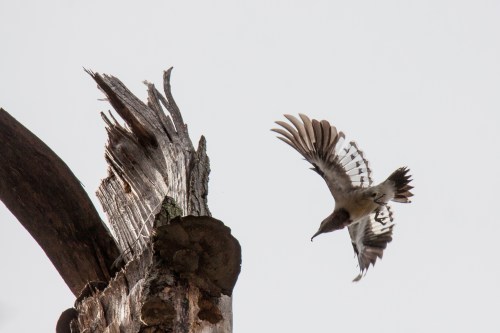
The sky was heavily overcast on Saturday as I focused on a Red-headed Woodpecker (Melanerpes erythrocephalus) high in a broken-off tree at Huntley Meadows Park. The woodpecker was mostly in the shadows and I was having real troubles getting a clear shot of it. Then I got lucky.

The woodpecker flew off and then immediately returned to the same spot and I managed to press the shutter at just the right moment to capture the bird in flight.

I love the way the jagged edges of the tree mirror the shapes of the wings of the woodpecker, giving this image an almost abstract quality. The almost monochromatic color palette and simple composition enhance that abstract feel for me.

Red=headed woodpecker

© Michael Q. Powell. All rights reserved.


Read Full Post »

In the stillness of the early morning hours, the line between reality and reflections is blurred and beauty is simply magnified.

The Great Blue Heron (Ardea herodias) is very recognizable in the first image, but as you progress through the three images, the central focus starts to shift away from the heron. In the final image, the heron has become merely one element of a larger, almost abstract composition.

Great Blue Heron

Great Blue Heron

Great Blue Heron

© Michael Q. Powell. All rights reserved.

Read Full Post »

Early morning light and fall foliage make such a great backdrop and I was thrilled when an Eastern Bluebird (Sialia sialis) flew closer to me and allowed me to take advantage of the situation.

I love it when the composition is this basic and the results are simply beautiful.

Eastern Bluebird

© Michael Q. Powell. All rights reserved.

Read Full Post »

The soft morning light reflected off of the colorful autumn foliage early today at Huntley Meadows Park, providing a beautiful backdrop for this male Red-winged Blackbird (Agelaius phoeniceus) as it perched in the cattails.

Red-winged Blackbird

© Michael Q. Powell. All rights reserved.

Read Full Post »

Warblers are so small and hide so well in the trees that I almost never see any. This past week, however, I spotted a flash of yellow in the distance and I was able to capture some shots of what I have been told is a Palm Warbler (Setophaga palmarum), though it is hard for me to confirm the identification, considering how much many warbler species look almost alike.

I took these three shots from the same spot on the boardwalk at my local marshland park as I looked across a field of cattail and other vegetation. It’s interesting to note how much the feel of the photos changed as the warbler moved from perch to perch.

Normally I try to get close-up shots of my subjects, but I decided not to crop in on the first image, which reminds me of a Japanese ink painting with its sparse use of color and emphasis on lines and shapes. The background was so interesting in the second image, that once again I did only a minor crop. In the third image, my favorite element is the warbler’s tail.

Palm Warbler

Palm Warbler

Palm Warbler

© Michael Q. Powell. All rights reserved.

Read Full Post »

When I arrived at the marsh in the early morning hours, it looked like the spiders had been busy all night preparing decorations for Halloween—there were spider webs everywhere.

The webs seemed to have been more hastily constructed than those of the orbweavers that I have observed recently and there did not appear to be any spiders in the center of these webs. What is the purpose of these webs if the spiders are not there to secure any prey that is caught in the web?

I can’t help but admire the amazing artistry of these fascinating little creatures as I examine the interlocking lines and curves of their incredible creations.

I’ve place these images in a mosaic collage—if you want to see larger versions of the images, just click on any one of them and you’ll move into a slide show mode that lets you scroll through them quickly.

© Michael Q. Powell. All rights reserved.

Read Full Post »

In the early light of the dawn, I captured this solitary Great Blue Heron (Ardea herodias) in deep reflection, contemplating the start of a new day.

There is nothing really complex about this image, but I like the way that it conveys the mood of that moment, a moment when the world seemed to be totally tranquil, uncluttered by the hustle and bustle of everyday life.

I love the early morning.

Great Blue Heron

© Michael Q. Powell. All rights reserved.

Read Full Post »

How do you feel when confronted with a graphic image of mating damselflies? Are you shocked, offended, fascinated, or intrigued? Is it art or is it pornography?

I couldn’t help but feel a little bit like a voyeur as I crept closer and closer on Monday to the mating Great Spreadwing damselflies (Archilestes grandis) with my macro lens. As I prepared the photos for this posting, it seemed like I had extracted a couple of pages from the Damselfly Kama Sutra. What exactly were they doing as they assumed more and more acrobatic positions? It was like watching an R-rated (or maybe X-rated) Cirque du Soleil performance.

Art or pornography? Sometime in the distant past I remember studying a Supreme Court case in which attempts were made to define obscenity. With the help of Wikipedia, I refreshed my memory. It was a 1964 case and Justice Potter Stewart wrote some words that have become a guideline for assessing a given piece of work:

“I shall not today attempt further to define the kinds of material I understand to be embraced within that shorthand description [“hard-core pornography”], and perhaps I could never succeed in intelligibly doing so. But I know it when I see it…”

So that’s it, “I know it when I see it.”

I’ll boldly contend that my photos are art. I am glad, however, that I am not a parent who has to respond to a young child’s curious question about what these damselflies are doing. The birds and the bees are simple to explain by comparison. With damselflies, I think the Facebook expression fits—”it’s complicated.”
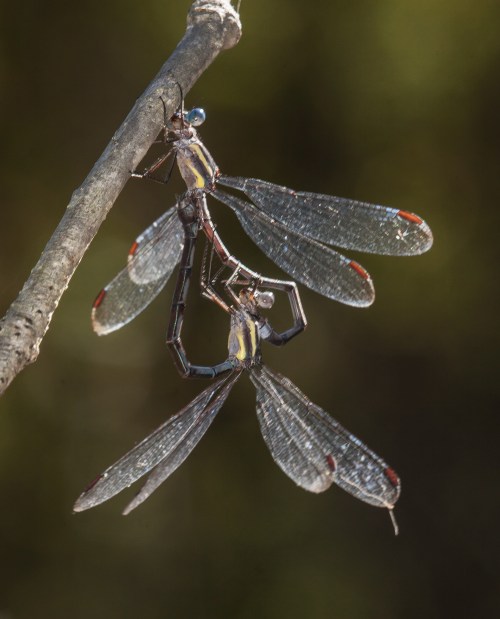
Great Spreadwing damselflies

Great Spreadwing damselflies

© Michael Q. Powell. All rights reserved.

Read Full Post »
I just love the beautiful blue eyes and distinctive markings of the male Great Spreadwing damselfly (Archilestes grandis) and I was thrilled when I spotted one on Saturday at Huntley Meadows Park in Alexandria, Virginia.

I wonder if it damages this little guy’s self-esteem to be called a “damsel?” Perhaps he looks with envy at his odonate brethren with the more macho-sounding “dragon” in their names. Do we need a more gender-neutral name for damselflies?

Great Spreadwing damselfly

© Michael Q. Powell. All rights reserved.

Read Full Post »

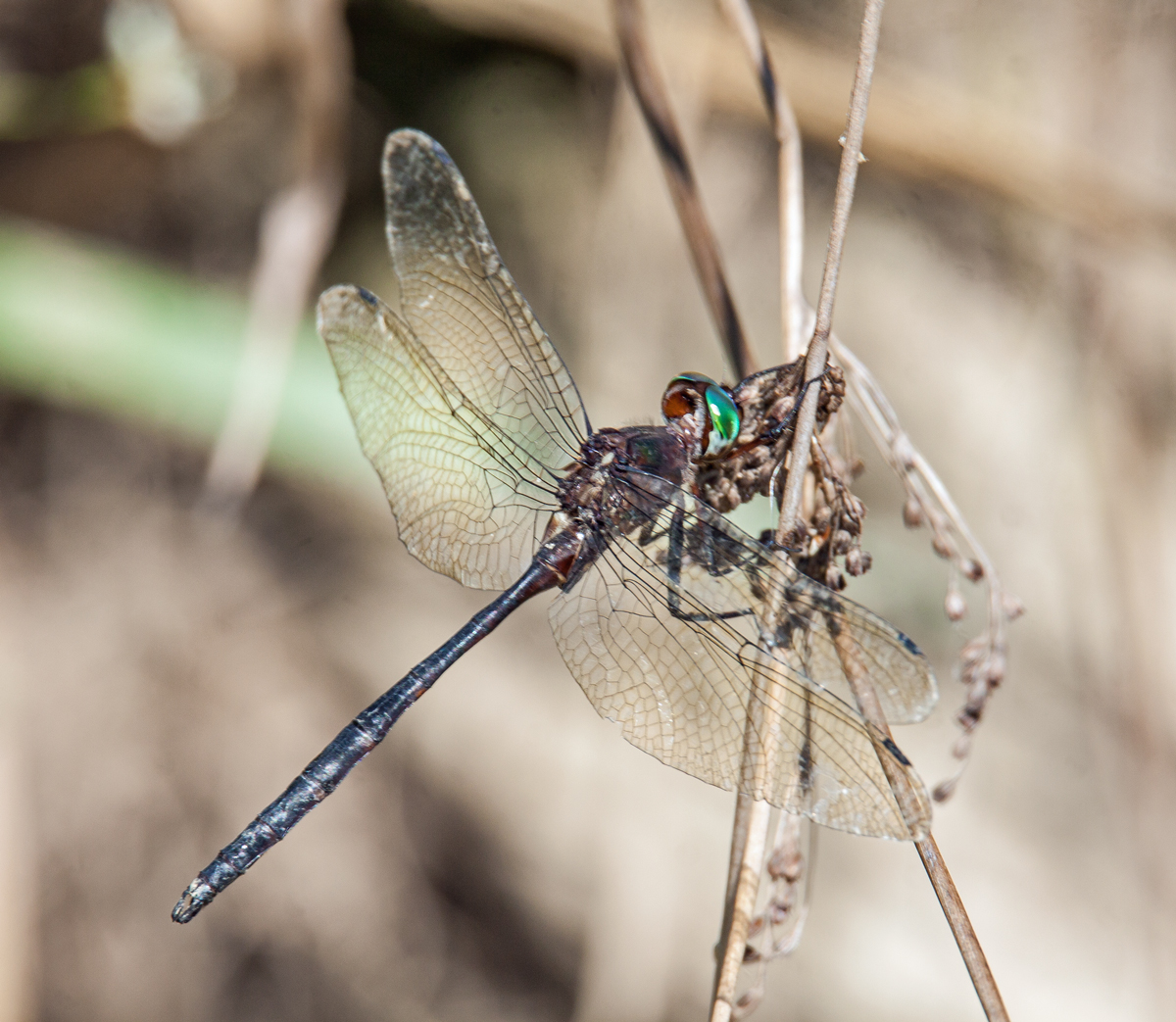
Unlike Pumpkin Spice, Mocha Emerald is not a fall Starbucks flavor—it is a cool-looking dragonfly species that I was excited to spot yesterday at my favorite marshland park.

Mocha Emerald

Every other time that I have observed a Mocha Emerald (Somatochlora linearis), the dragonfly has been perched in the shadows, so I was surprised yesterday to see one in full daylight. This Mocha Emerald, which looks to be a male seemed to be patrolling a stretch of a small stream. Occasionally it would stop to rest and perch vertically on vegetation sticking out low from the bank of the stream.

Getting a decent shot of the Mocha Emerald was quite a challenge. My camera’s auto focus had trouble fixing focus on the dragonfly’s long thin body so I had to focus manually; there was a breeze that was blowing that caused the dragonfly to swing in and out of my field of view as I looked through the viewfinder; and the background tended to be really cluttered.

The first shot is my favorite, because I was able to isolate the dragonfly by hanging over the stream (and almost falling in), although the other shots show some of the details of its body better.

Maybe there should be a Mocha Emerald latte, perhaps for Saint Patrick’s Day—I would be thrilled if it supplanted the green beer that still makes an appearance at some locations.

Mocha Emerald

Mocha Emerald

Mocha Emerald

© Michael Q. Powell. All rights reserved.

Read Full Post »

As I was walking back home last night from the metro station, I was struck by the light that was bouncing all around a highway underpass as cars passed by, creating an abstract world of beautiful shapes and lines.

I really had no idea what kind of settings to use on my camera, but after a few quick tests I settled on ISO 2500 and f/9, which gave me exposures between one and two seconds. I rested my camera on a railing to steady it and pointed my camera in the general direction of the underpass.

Those who follow this blog regularly know that I have recently been experimenting with different approachs and subjects for my photography, which normally focuses primarily on wildlife and nature. Oh, I still enjoy that photography immensely, but it’s been fun and challenging to try some new things too.

I am quite pleased with some the nighttime images that I was able to capture, which are a pretty good reflection of what I was seeing and feeling.

underpass

underpass

underpass

© Michael Q. Powell. All rights reserved.

Read Full Post »

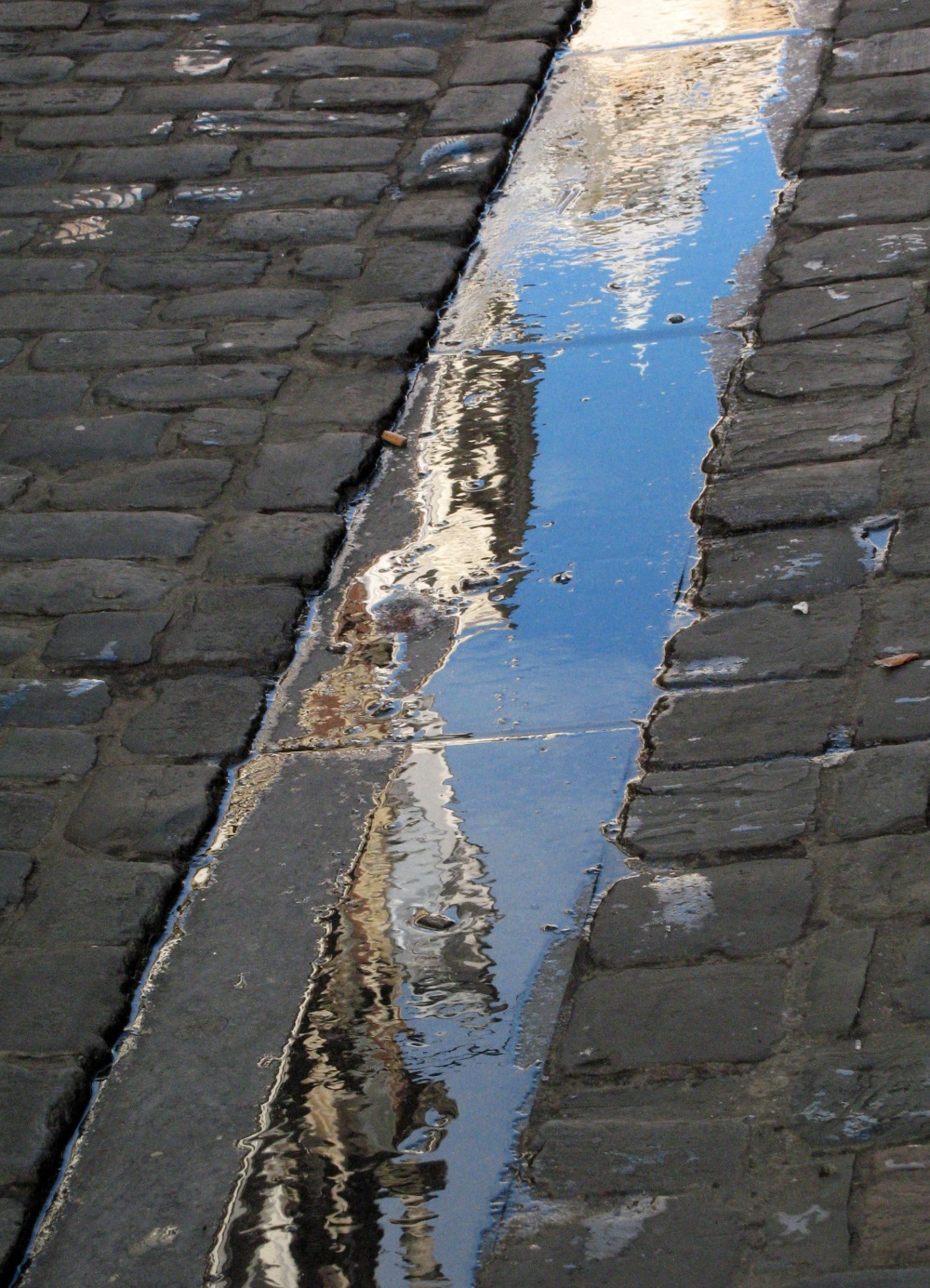
How do you capture the beauty of a city? Do you look up directly at the monuments and impressive buildings or do you look down and perhaps catch an indirect reflection of the unique character of the environment?

I took this shot on one of the cobblestoned side streets that lead to the Grand-Place in Brussels. I like the simple, graphic way in which the  image gives you a sense of the beauty of this ancient city square, while also showing a little of the gritty, littered urban landscape that seems typical in Brussels.

Grand-Place

© Michael Q. Powell. All rights reserved.

Read Full Post »

In its simplest form, photography is about light and darkness, about lines and shapes. That was what I was seeking to capture when I took some shots in a Metro station in Rosslyn, Virginia earlier this week.

I took this week off from work and have spent a considerable amount of time thinking about photography, watching lots of videos, and shooting different subjects in different ways. I have even shot and developed some black and white film—I’ll do a separate posting on that soon.

This first shot highlights the distinctive ceilings that are present in many of the stations in the D.C. Metrorail system. I love the geometric patterns and the interplay of light and shadows in this image. I took this 1/3 second exposure by leaning my camera on a railing.

metro ceiling

The Rosslyn station is at a point in the Metro system where the trains pass under the Potomac River. Consequently, the escalators are extremely long. As I rode the escalator up, I was fascinated by the different lights and captured this image when I was approximately at the mid-point between the level of the tracks and the above-ground station.

It was midday on a weekday, which is why you don’t see more people in this shot. Things get really crowded during rush hour and woe to those who do not follow the Metro etiquette of staying to the right on the escalator steps unless passing.

metro escalator

© Michael Q. Powell. All rights reserved.

Read Full Post »

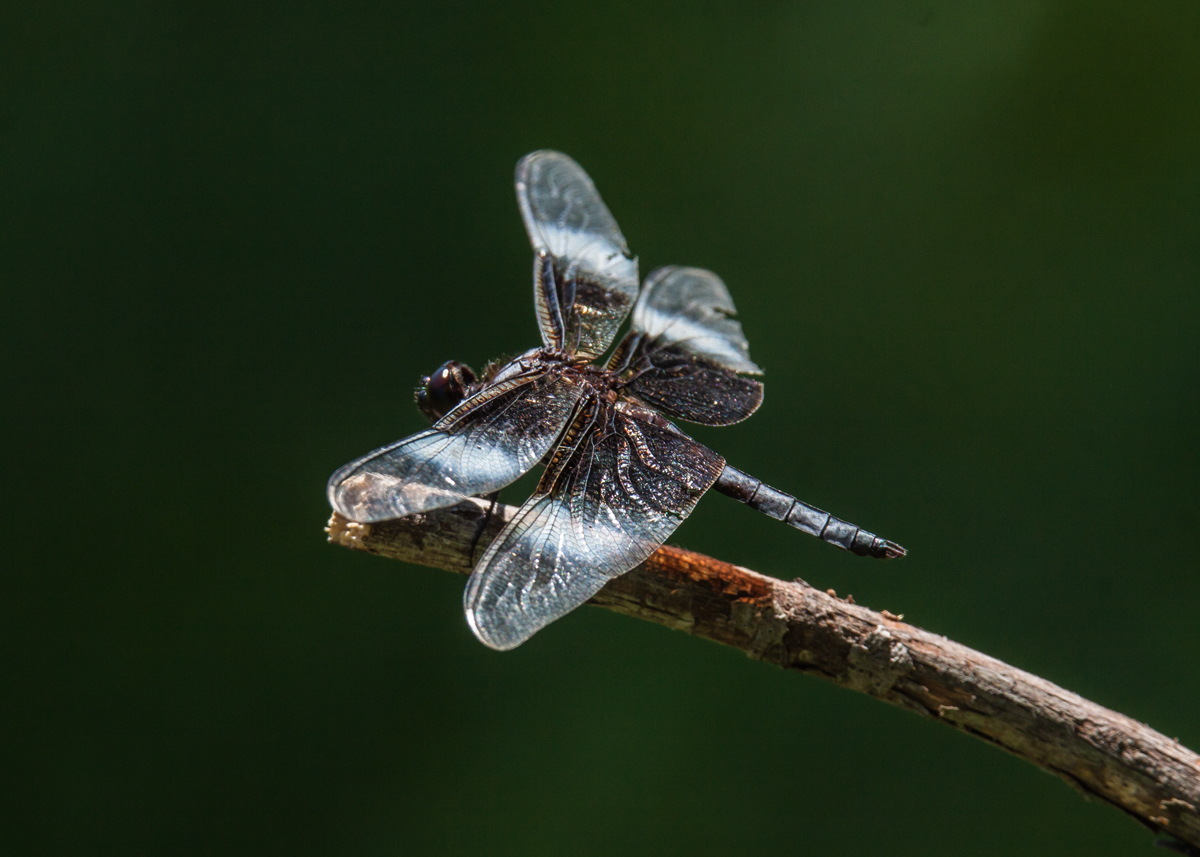
I love the dramatic lighting, the graphic quality, and the simple composition of this shot of a male Widow Skimmer dragonfly (Libellula luctuosa) that I took earlier this month at Jackson Miles Abbot Wetlands at Fort Belvoir, a nearby military installation here in Virginia.

There is a real beauty in simplicity.

Widow Skimmer

© Michael Q. Powell. All rights reserved.

Read Full Post »

A group of small birds was foraging in the shallow waters of a stream and I approached them quietly, hoping to get close enough to isolate one of them with my camera. They seemed to be in constant motion and I followed them, waiting and hoping. Finally they stopped for a moment and I crouched low and took this shot of what I believe to be a Least Sandpiper (Calidris minutilla).

I thought about cropping the image a little so that the bird would not be quite as centered, but I decided that I like the ripples in the left corner too much to cut them off. What you see in this posting, therefore, is the framing as the image came out of the camera.

Least Sandpiper

© Michael Q. Powell. All rights reserved.

Read Full Post »

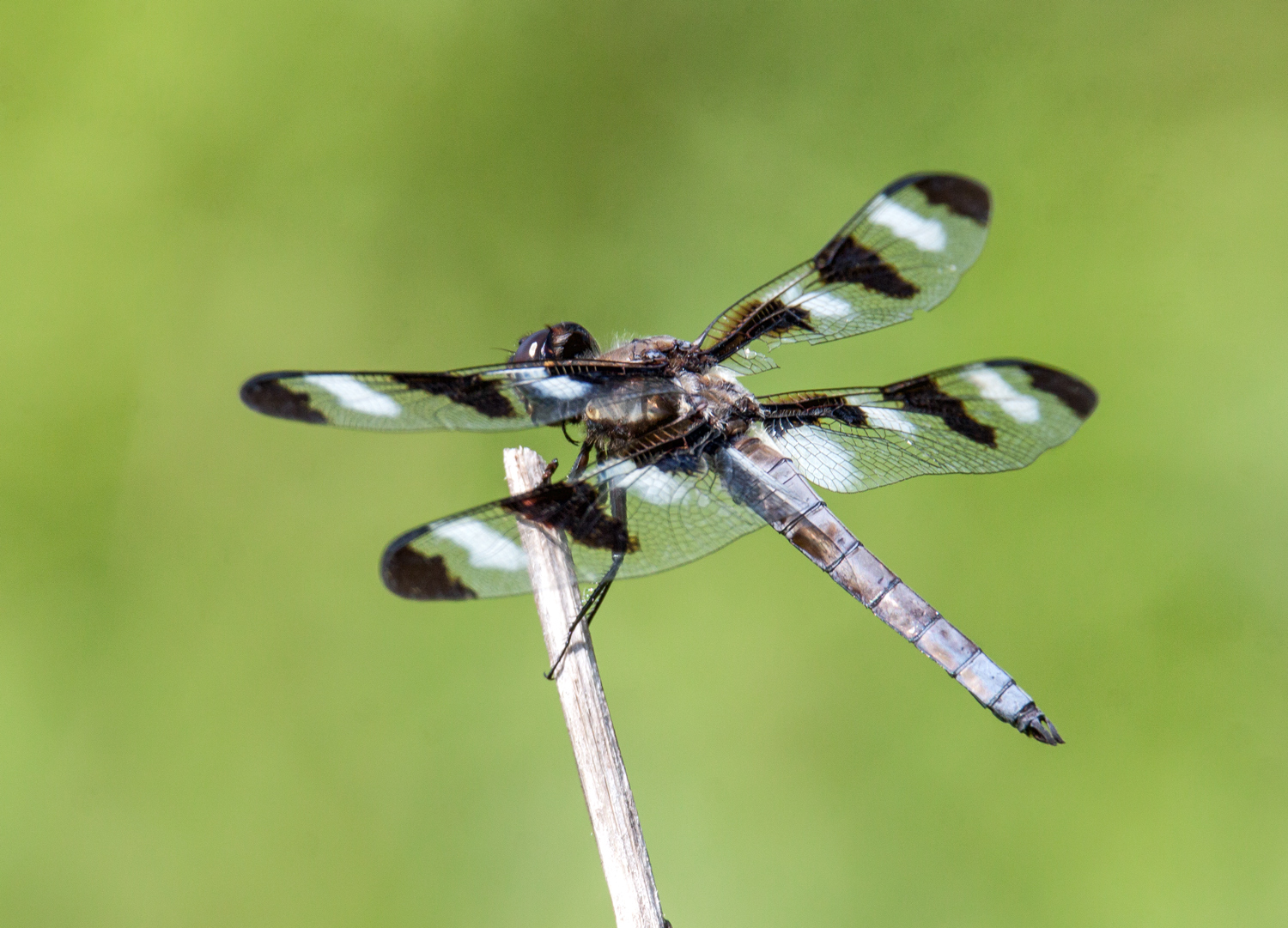
I tend to focus on the realism of close-up details in most of my dragonfly shots, but sometimes the dragonfly seems almost abstract, a mix of colors, shapes, and patterns, like this male Twelve-spotted Skimmer (Libellula pulchella) that I encountered the past Friday.

For those readers who may not be familiar with this boldly-patterned dragonfly species, I am also including a more “traditional” shot of the same Twelve-spotted Skimmer.

Twelve-spotted Skimmer

Twelve-spotted Skimmer

© Michael Q. Powell. All rights reserved.

Read Full Post »

How do you capture the details of a pure white bird as it flies in an out of the light? That was my challenge this past weekend when I tried to photograph Great Egrets (Ardea alba) at my local marshland park.

Many of my past shots of egrets have been unsuccessful, usually because they are overexposed and the highlights and details are blown out. I’ve tried using exposure compensation with only minimum success.

This time, I remembered to switch to spot metering and had greater success. Sure, the backgrounds are a bit underexposed, but I think that the darkness helps the highlight the beauty of the egret.

Great Egrets seem a little awkward when in the water, but when they take to the air, it’s like watching a ballet.

Great Egret

Great Egret

Great Egret

© Michael Q. Powell. All rights reserved.

Read Full Post »

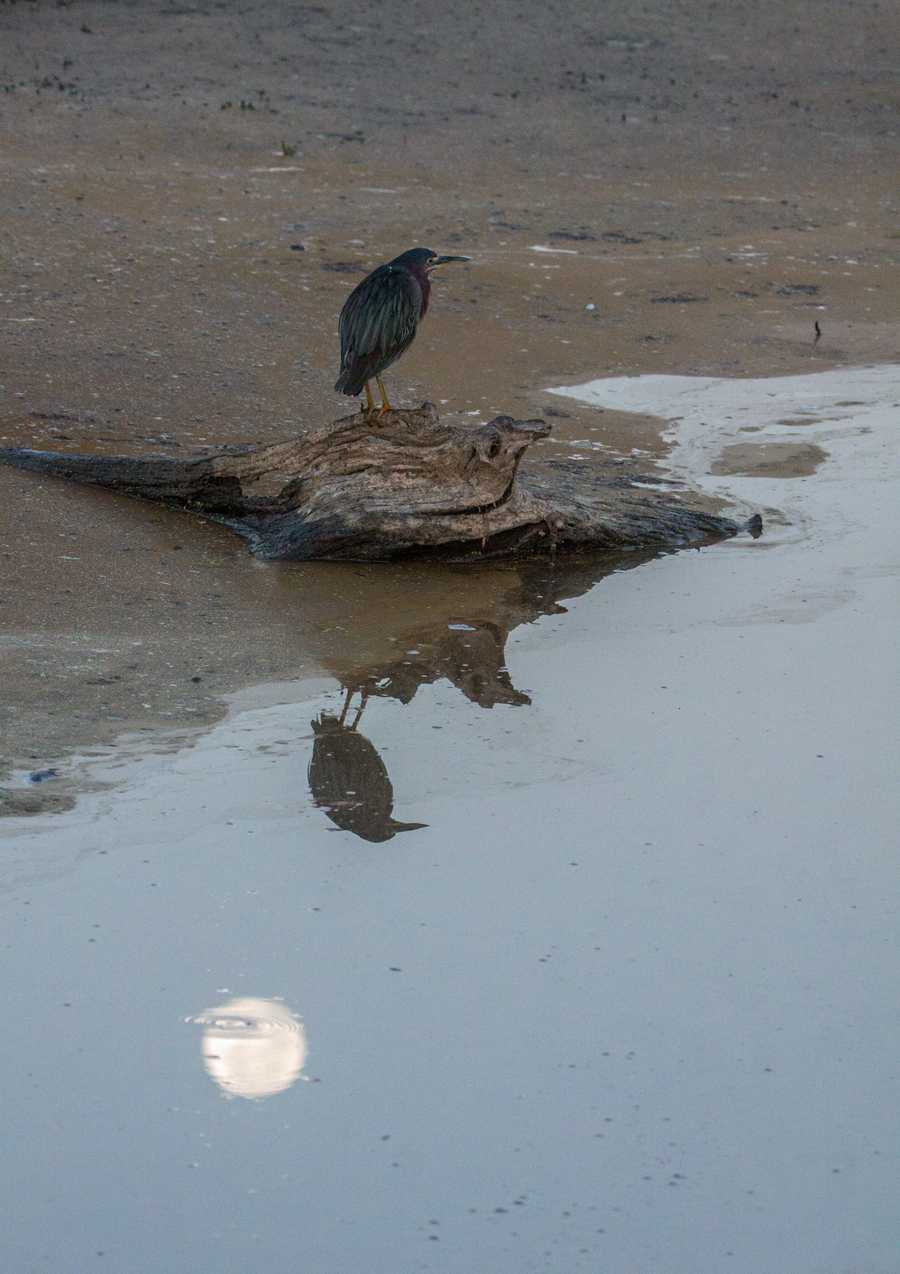
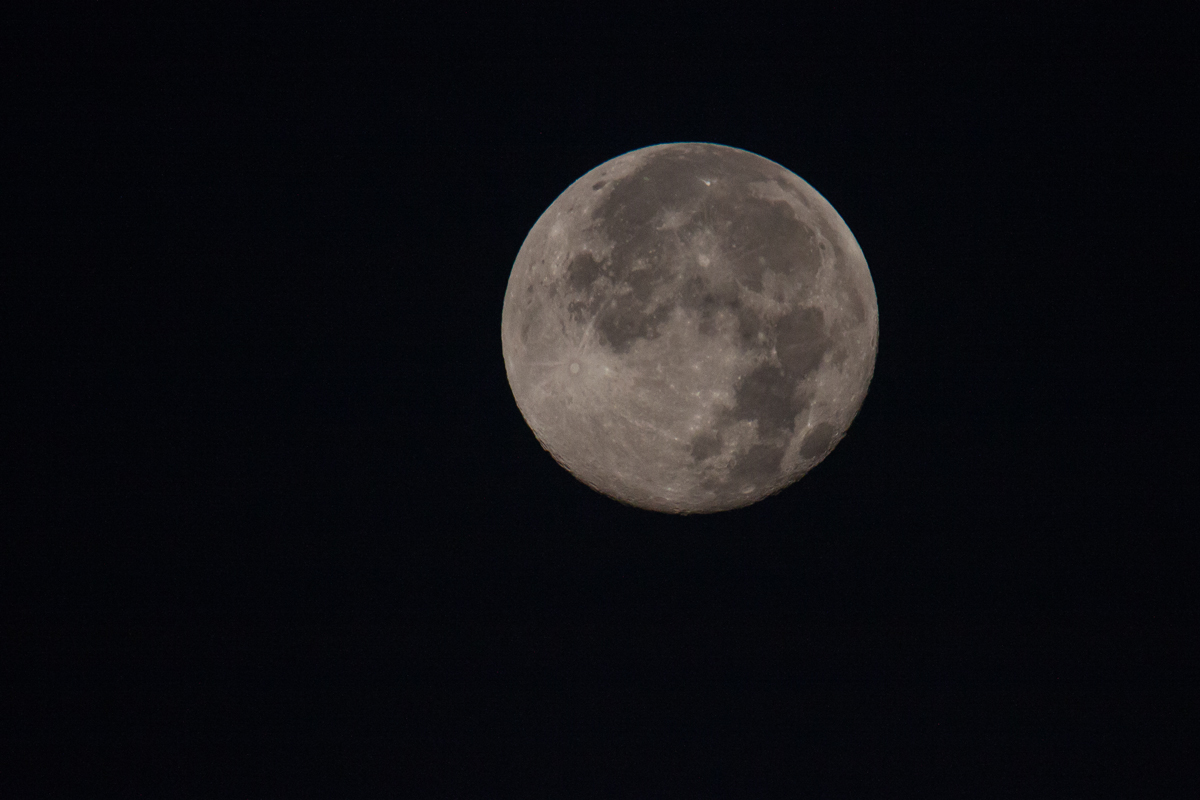
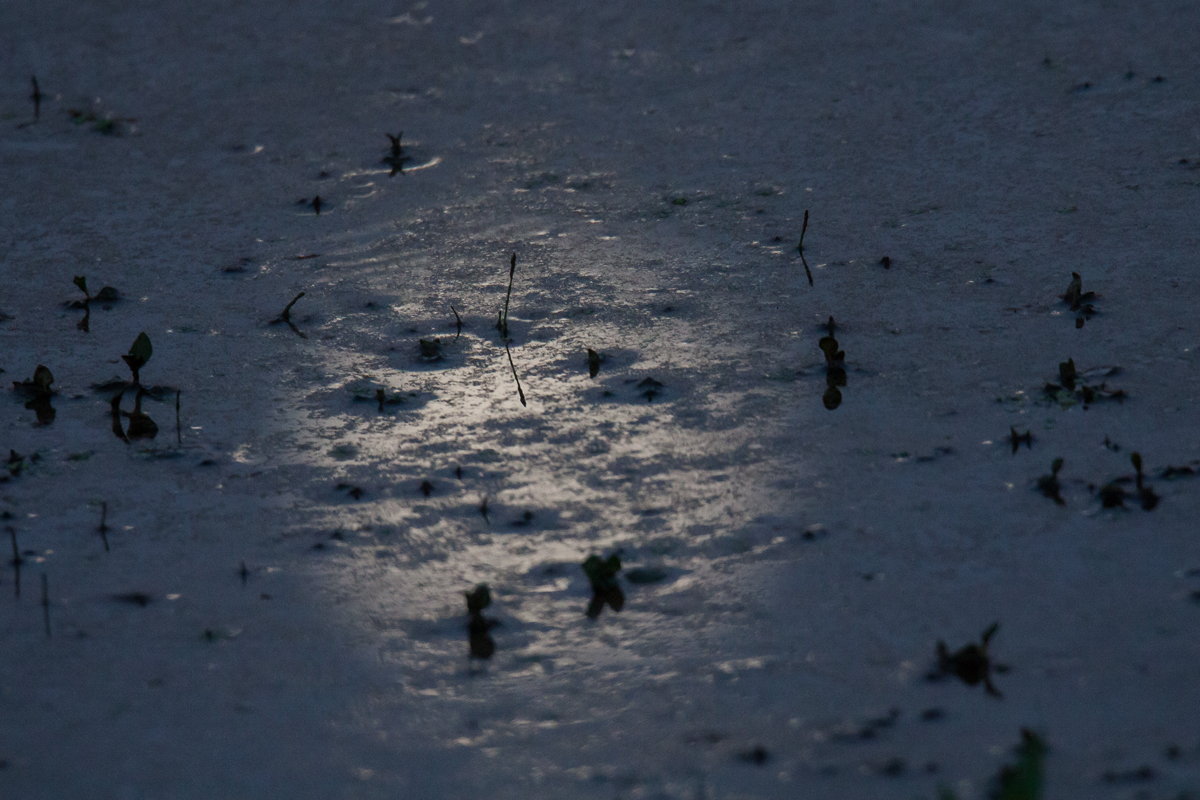
The full moon was bright and beautiful early yesterday morning, when I arrived at Huntley Meadows Park as the sun was just beginning to rise.

I struggled a little, trying to figure out the best way to capture the moon. Should I show the moon against the black night sky? Should I show merely its reflection? Should I show it as an element of a larger composition?

Here are some of my attempts to show the full moon in the predawn light at my local marsh.

Green Heron

Green Heron in the moonlight

Full moon in the night sky

Full moon in the night sky

reflections of a full moon

Reflections of a full moon

full moon

Moon over the marsh


© Michael Q. Powell. All rights reserved.

Read Full Post »

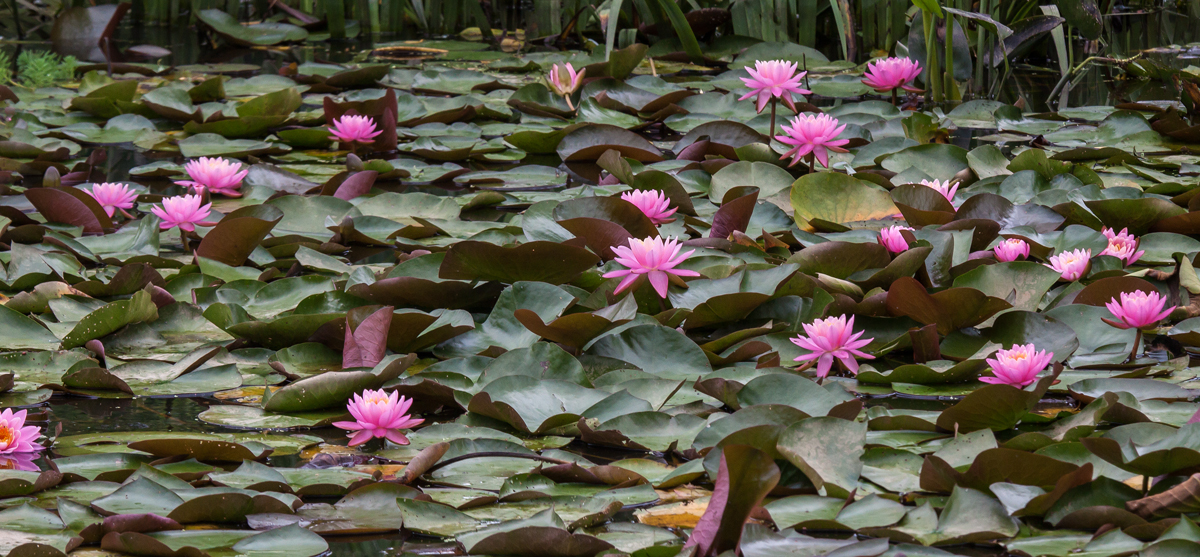
While I was at Kenilworth Park and Aquatic Gardens in Washington D.C. on Monday, it was easy to understand Monet’s endless fascination with water lilies. My opening image of a small wooden bridge brings to mind several of Monet’s paintings of the Japanese Bridge in his water garden at Giverny.

bridge at Kenilworth

Water lilies seem to draw me in and surround me with an overwhelming sense of beauty and tranquility. How can I possibly capture that feeling in a photo? Here are a few images to show you some of the different approaches that I used in attempting to show the irresistible attraction of water lilies.

water lily at Kenilworth

water lilies at Kenilworth

pink water lilies at Kenilworth

© Michael Q. Powell. All rights reserved

Read Full Post »

Globe Thistles (Echinops ritro) are among the coolest plants in my neighbors’ garden. They have a wonderful texture and stand tall, topped with fantastic balls of tiny flowers tinged with blue, purple, and pink.

It’s Friday and I figured for fun that I’d take a short break from insects and feature a few photos of fantastic flowers.

Globe Thistle

Globe Thistle

Michael Q. Powell. All rights reserved.

Read Full Post »

When it is really hot and the sun is directly overhead, Blue Dasher dragonflies (Pachydiplax longipennis) will often perch in a handstand-like pose that is generally referred to as the “obelisk posture.” By doing this, they minimize the direct exposure of the abdomen’s surface to the sun and stay cooler. Some other dragonflies will also engage in this kind of postural thermoregulation, but I see it most commonly in Blue Dashers.

Blue Dashers, one of our most common dragonflies,  were largely responsible for my initial fascination with dragonflies. In fact, almost three years ago my very first posting on this blog featured a Blue Dasher in an obelisk posture.

Since that time, I have grown in experience and knowledge and have cranked out over 1600 posts. My fascination with dragonflies has broadened and grown into a quasi-obsession, but I am always drawn back to the little Blue Dasher dragonfly, whose acrobatic poses never cease to amaze and entertain me.

dasher1_june_obelisk_blog

Michael Q. Powell. All rights reserved.

Read Full Post »

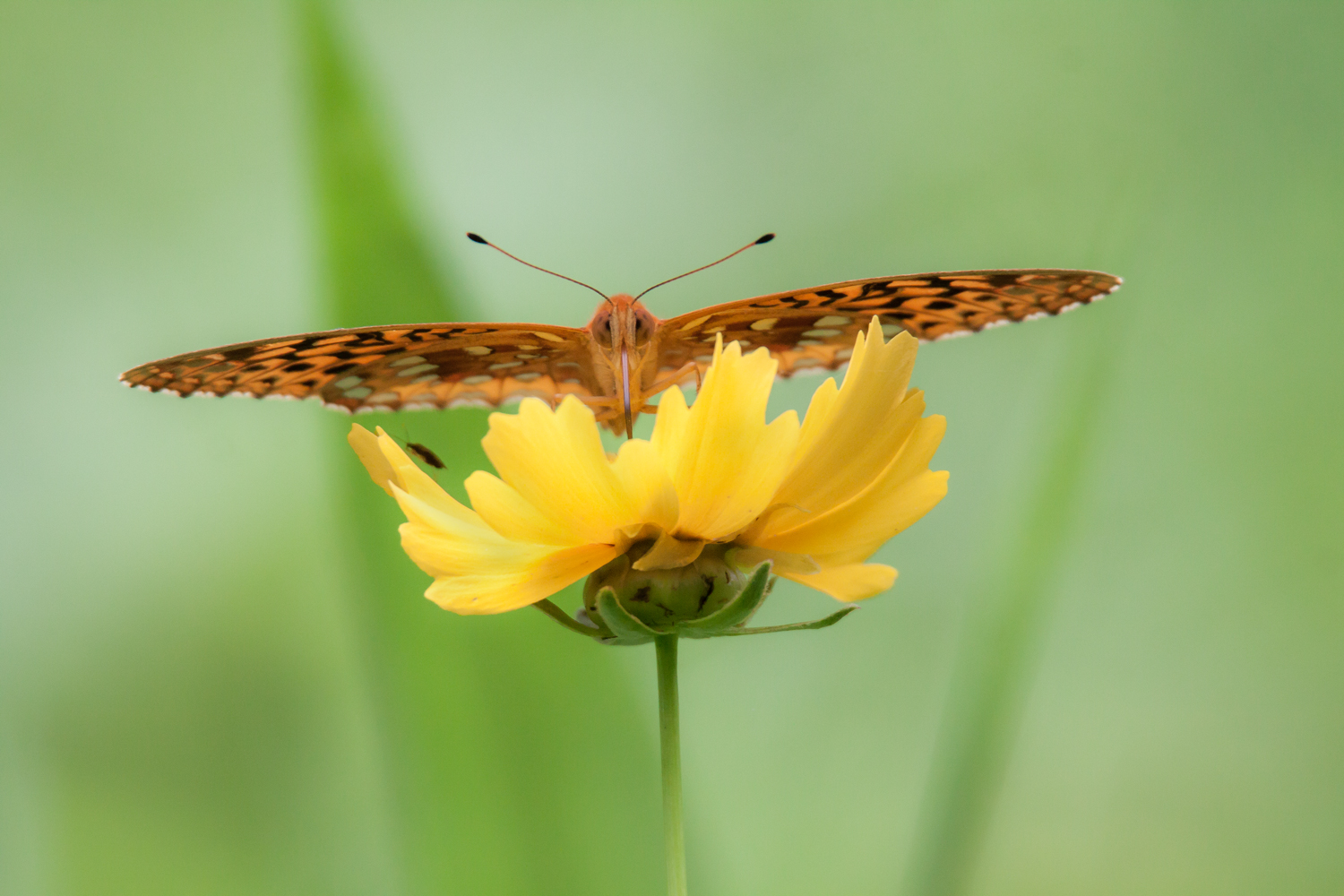
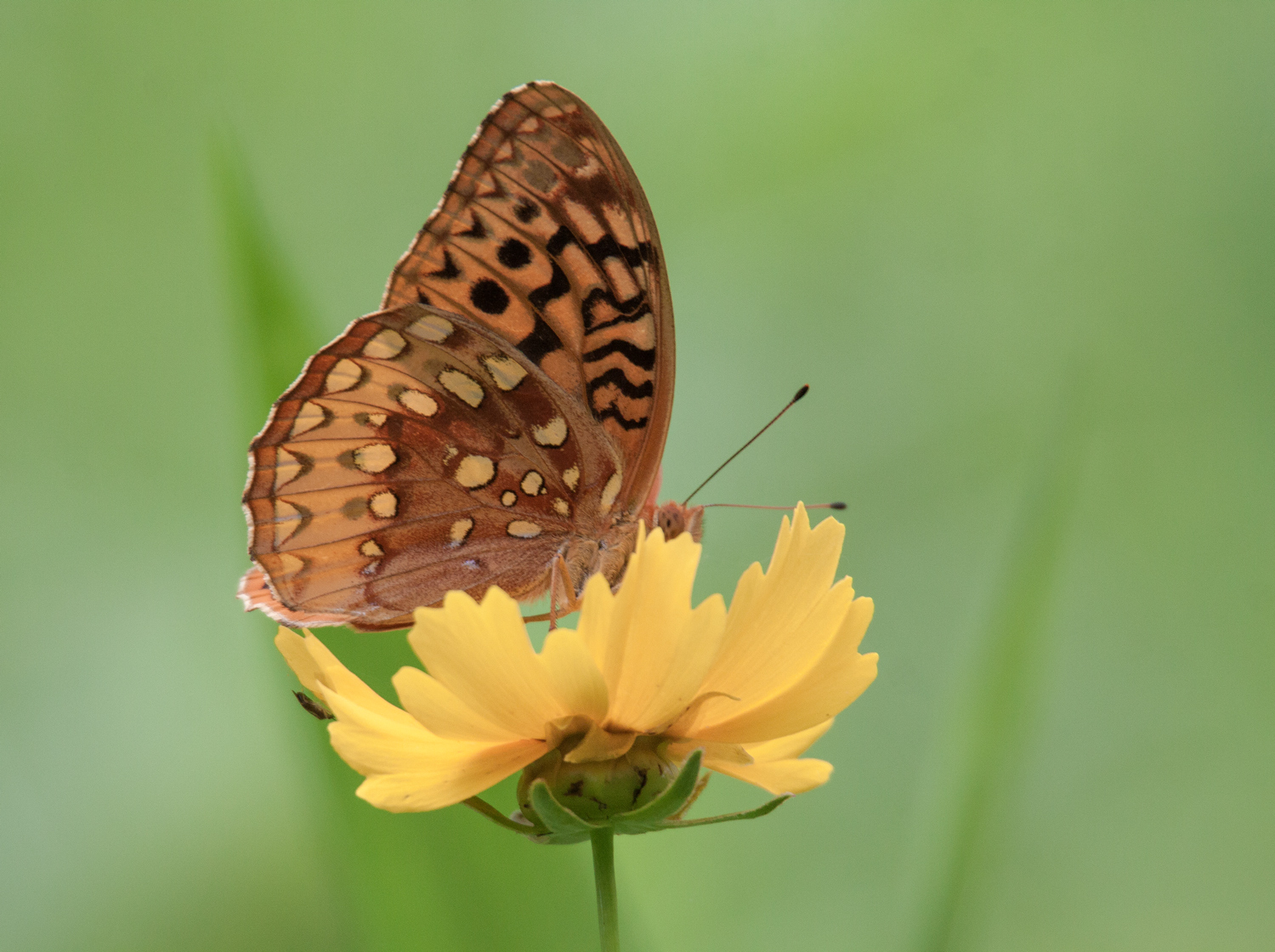
Eye to eye with a butterfly—it’s fun trying to capture subjects from different angles, in this case a Great Spangled Fritillary butterfly (Speyeria cybele) at Huntley Meadows Park in Alexandria, Virginia.

Great Spangled Fritillary

Great Spangled Fritillary

© Michael Q. Powell. All rights reserved.

Read Full Post »

Dragonflies sometimes look like aliens to me, with their giant eyes and other worldly flying skills. My initial impression of this photo was that it looked like an alien landscape from a science fiction movie—the terrain perfectly matched the subject.

Common Whitetail

So what’s the reality? It’s a female Common Whitetail dragonfly (Plathemis lydia) in the process of depositing eggs in the shallow water at the edge of a pond. She is hovering over the water and then will drop down and dip the tip of her abdomen in the water, causing the concentric ripples you see in the image. A short while later, she repeats the process. What you don’t see in the photo is her mate, who is hovering nearby, keeping watch over her as she ensures the continuity of his genetic line.

There will be more aliens.

© Michael Q. Powell. All rights reserved.

Read Full Post »

Ebony Jewelwings (Calopteryx maculata) are one of the most distinctive and easily recognizable damselflies because of their dark wings and metallic bluish-green bodies. So why is the female damselfly in the first shot so pale and colorless?

Ebony Jewelwing damselfly

When damselflies (and dragonflies) shed their exoskeletons and move  from being water-dwelling nymphs to acrobatic flyers, they are initially pale in color, a stage known as “teneral.” In a short time, the wings harden and gradually the newly emerged damselflies, like this one, become more colorful and look more like the one in the second image.

Ebony Jewelwing

As I was photographing this damselfly, it took off and I captured a somewhat blurry image of it in the air that I really like—it reminds me of a water color painting.

Ebony Jewelwing

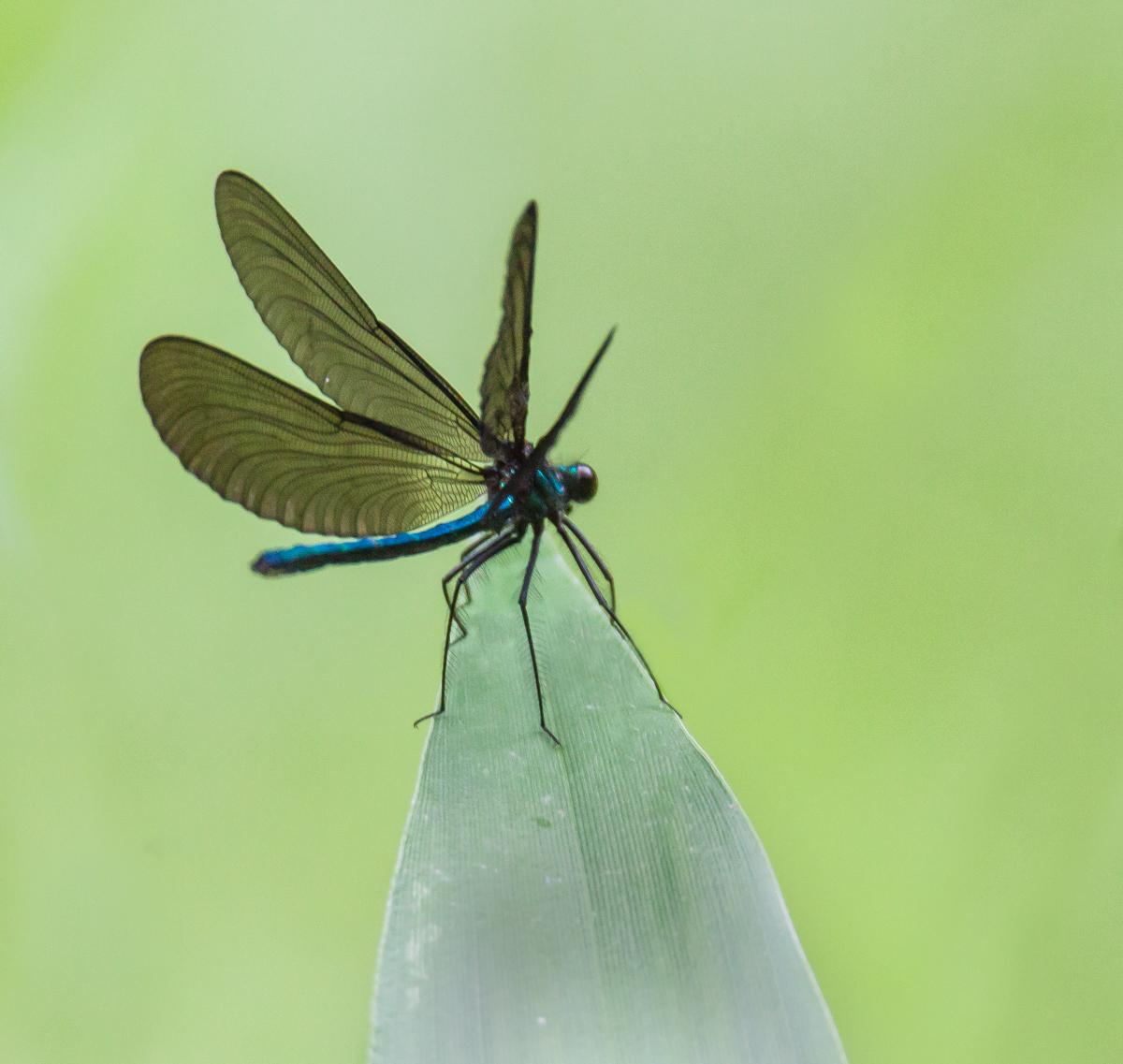
I must be in an “artsy” mood this morning, because one of the other images that I really like of the Ebony Jewelwing is this final one, in which the damselfly was perched at the end of a leaf with wings spread wide, displaying the intricate details of those delicate wings.

Ebony Jewelwing

© Michael Q. Powell. All rights reserved.


Read Full Post »

I can’t get over the beauty of the dragonflies, especially this early in the season. On Monday, I spotted this beautiful male Painted Skimmer dragonfly (Libellula semifasciata) at a tiny pool (which was really more like a puddle) at my local marshland park.

The colors and pattern of the wings make this species quite distinctive and pretty easy to identify. The striking beauty of the Painted Skimmer has also attracted the attention of several other photographers in this area.

I personally love to see how others choose to photograph similar subjects. If you want to see more beautiful images of Painted Skimmers, check out recent postings by Walter Sanford and Joel Eagle. Each of us was presented with a similar dragonfly in different circumstances and made a series of creative choices to produce our individual portraits of this almost magical creature.

Painted Skimmer

© Michael Q. Powell. All rights reserved.

Read Full Post »

The intricate shape and delicate colors of this beautiful little flower simply captivated me yesterday at Meadowlark Botanical Gardens in Vienna, Virginia. (I think it is a kind of columbine flower.)

columbine

© Michael Q. Powell. All rights reserved.

Read Full Post »

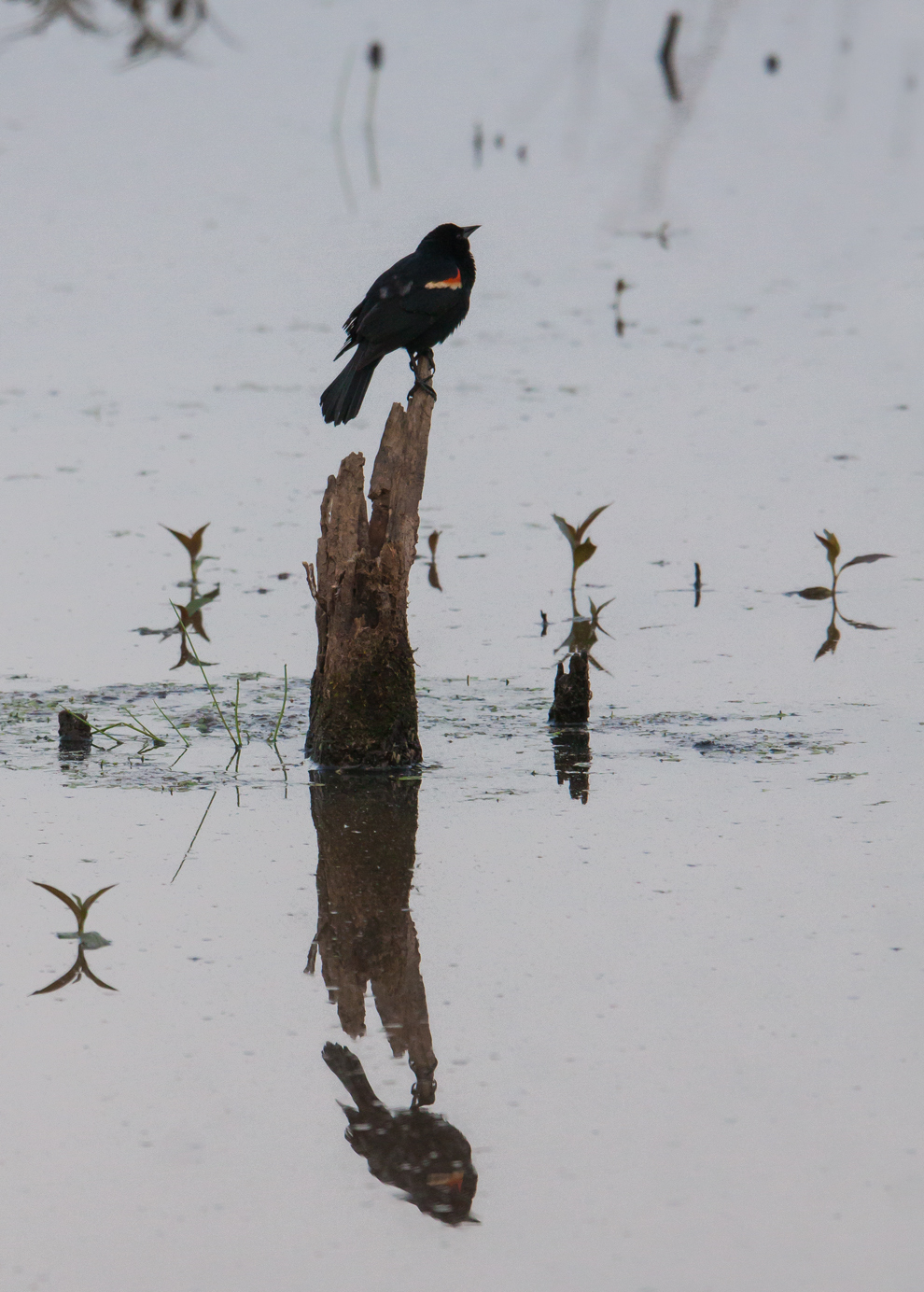
The marsh is especially beautiful early in the morning, as birds like this Red-winged Blackbird (Agelaius phoeniceus) welcome the first rays of the rising sun. The water is still, reflecting the glory of the new day, and a sense of peace overwhelms me.

Red-winged Blackbird

© Michael Q. Powell. All rights reserved.

Read Full Post »

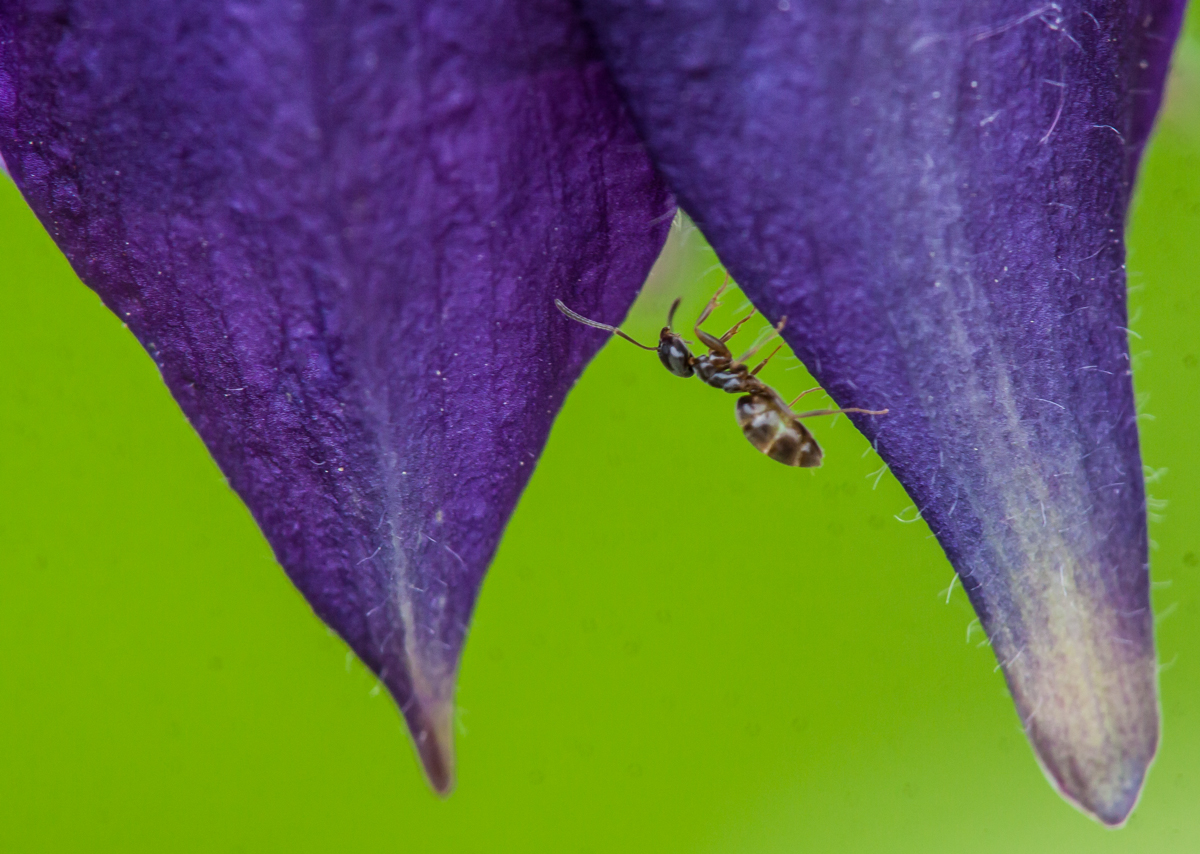
There were lots of flowers in bloom during a trip this past Friday to Green Spring Gardens, but not many insects. However, I did manage to find this intrepid ant testing his mountaineering skills as he climbed up and down the edges of a purple Columbine flower.

alpine ant

© Michael Q. Powell. All rights reserved.

Read Full Post »

One of my favorite spring flowers is the Columbine (genus Aquilegia), whose name comes from the Latin for “dove,” because the inverted flower is said to resemble five doves clustered together. Columbines come in many colors and color combinations and I am always fascinated by the shapes and colors of this unusual-looking flower.

I photographed this beautiful little Columbine on the first day of May at Green Spring Gardens in Alexandria, Virginia, a county-run historical garden that is one of my favorite places for photographing flowers.

Columbine

© Michael Q. Powell. All rights reserved.

Read Full Post »
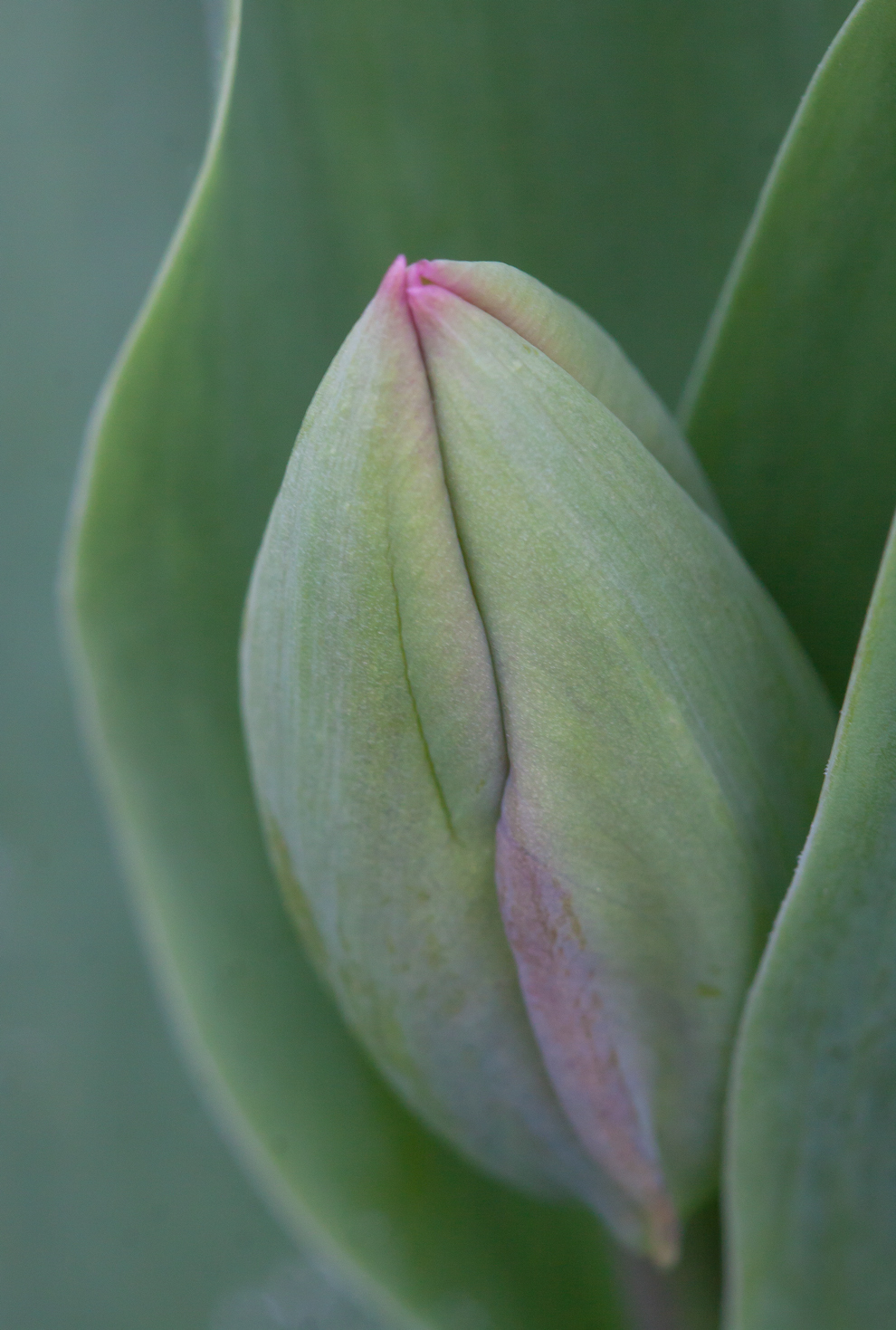
When you think of a gorgeous tulip, do you have to see it flowering to recall its beauty, or does a mere hint of its future shape and color suffice?

This image is different from my “normal” style of images, which tend to emphasize a kind of detailed realism. It is an almost abstract look at this flower, emphasizing shapes and colors and lines, with a minimum of details. There is an “artsy” side of me that I consider to be underdeveloped. Every now and then that tendency comes to the surface and I’ll step out of my comfortable box and try something a bit different.

tulip

© Michael Q. Powell. All rights reserved.

Read Full Post »
It’s showtime in the Washington D.C. area—the cherry blossoms are in full bloom. There is no denying their beauty, but somehow I am drawn even more to the simple beauty of modest flowers like this snowdrop (genus Galanthus) that I observed this past Friday. There was a light drizzle most of the day, which coated the unopened petals with beautiful crystal-like globes.

Simple beauty—I find it to be irresistible.

snowdrop

© Michael Q. Powell. All rights reserved.

Read Full Post »
« Newer Posts - Older Posts »