Feeds:
Posts
Comments

Archive for the ‘Art’ Category

Little kids get pretty excited about snow, but it’s hard to match the enthusiasm of a puppy as she propels herself face-first into the freshly fallen snow.

These shots show Freckles, a year-old Cocker Spaniel, a few seconds after she dove into the snow in my backyard. The yard had areas of sunshine and shadows and the snow appears white when Freckles was in the sun, as in the first image. The snow took on a bluish cast  however, when the snow in the background was in the shadows. I liked the effect and cropped the second image to make the background more uniform, causing it to look a bit like a formal studio shot.

freckles_snow1_blogfreckles_snow2

© Michael Q. Powell. All rights reserved

Read Full Post »

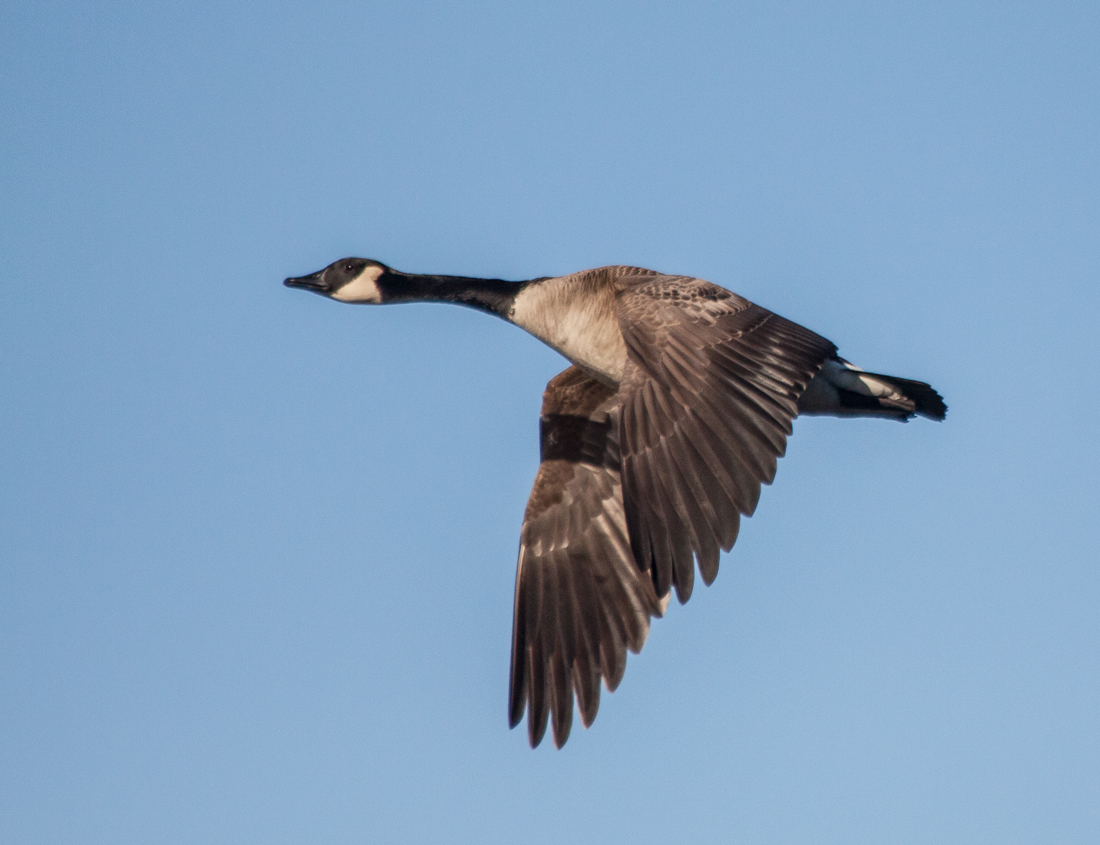
So many factors have to work together perfectly to get good shots of a bird in flight—the lighting has to be right, the exposure needs to be correct, the shutter speed needs to be fast enough to stop the motion, and, most critically perhaps, the camera has to focus properly on the moving subject. Of course, it helps also to be able to capture the wings in an interesting position and to have a background that is not distracting.

I have been working on taking photos of birds in flight, especially Canada Geese, but it has been rare for me to get all (or even most) of the variables to fall into place at the same time. However, in late December I took a series of shots of a Canada Goose (Branta canadensis) that turned out really well. The background was the sky, which some folks don’t find to be very interesting, but at least the goose was not obscured by branches. Click on the photos to see them in higher resolution—I was thrilled that I even managed to get a catchlight in the visible eye.

The challenge for me will be to repeat this success with smaller birds that fly faster and less predictably.

goose_flight1_blog goose_flight2_blog goose_flight3_blog

© Michael Q. Powell. All rights reserved

Read Full Post »

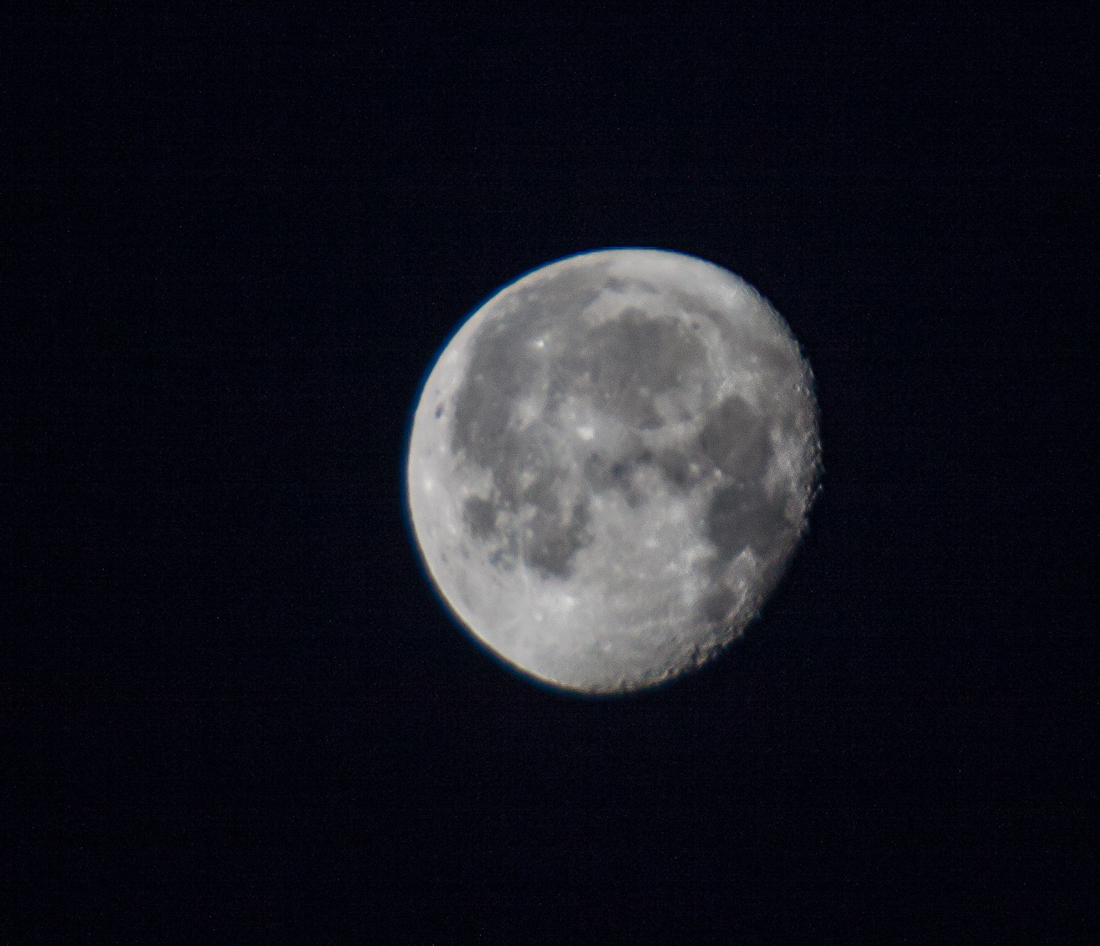
The moon looked amazing at 7:00 this morning when I went out to get my newspaper from my front steps. It was still dark and in the opposite direction, the sun was just beginning to rise. I rushed back into the house, put some socks on my sandaled feet, and ran outside with my camera to get some shots.

I used the longest lens that I have, a Sigma 135-400mm lens, and leaned it against the roof of a parked car to stabilize it.  I was surprised at the detail that I managed to capture of the craters near the dark side of the moon. (I think the full moon was a few nights ago.) Click on the photo to see it in higher resolution.

moon_19Jan_blog

© Michael Q. Powell. All rights reserved

Read Full Post »

Most birds seem to seek shelter when it is raining (and most people too), but this male Red-winged Blackbird (and this photographer) were an exception to that rule in late December.

blackbird_rain_blog

© Michael Q. Powell. All rights reserved

Read Full Post »

It rained most of the day in Brussels, but finally the skies cleared a little in the evening and the moon was visible from time to time, peeking through the clouds. I enjoy walking through this old city at night and observing the interplay of the light and shadows.

It’s a fun challenge to try and capture the effects of light at night with an older point-and-shoot digital camera and I am always looking for solid objects against which to lean to steady myself.

This was my most “artistic” shot of the evening, an attempt to balance the effect of the weak light of the moon with the artificial lights that illuminated this statue.

statue_blog

© Michael Q. Powell. All rights reserved


Read Full Post »

I am drawn to the colors and shapes and patterns in this image of the roof of the Brussels City Hall, one of the iconic buildings of the central square of this beautiful city.

I am back in Brussels for a brief business trip and have not yet had a chance to shoot any new photos. I took this shot last year in mid-January, when the city was covered with a light coating of snow. This year, it looks like it’s a bit warmed and I was shocked to see some sunshine yesterday, the day of our arrival. In my experience, the skies are usually gray and cloud-covered and it is unusual to see the sun at this time of the year.

I hope to have some new photos of Brussels soon, work permitting, which you should be seeing for the next few days.

roof_blog

© Michael Q. Powell. All rights reserved

Read Full Post »

Yesterday’s cloudy, rainy, foggy day made it a little tough to take photos, but I like the effect it had on the landscape, creating almost monochromatic scenes of different shades of gray. This is an unfamiliar style of shooting for me, so I played around a bit, trying to capture both a wide view of the marsh, and some close-views of isolated areas.

The snow here is gone now, but the ice is still hanging on.

harsh3_blogharsh1_blogharsh2_blog

© Michael Q. Powell. All rights reserved

Read Full Post »

On New Year’s Day, as I was hiking with a fellow photographer to one of my favorite spots at the local marsh, she spotted this skull, flipped upside down on a mossy log. Had it been placed on the log by a fellow hiker or had it been abandoned there by another animal?

Judging from the length of the one remaining tooth, it looks like this is a skull of a North American Beaver (Castor canadensis). There is no way for me to tell how this animal died, but the tooth marks around the eye socket suggest that something has been gnawing on the skull.

We both took some photographs of the skull and then hurried along, hoping to see a live beaver at its lodge. We  saw the lodge, but, alas, did not see a living beaver that day.

skull1_blogskull2_blog

© Michael Q. Powell. All rights reserved

Read Full Post »

Like most Downy Woodpeckers, this little male woodpecker started spiraling his way up the tree as soon as he landed on it. Then to my surprise, he worked his way back down the tree and stopped at eye level, where he stayed long enough for me to take a number of shots and even make a few adjustments in between the shots.

I really like Downy Woodpeckers (Picoides pubescens). Their high energy and acrobatic activities are a constant source of interest for me as I watch them at work in the trees and in the cattails. I’ve usually had a tough time, though,  getting an uncluttered shot of a Downy Woodpecker.

I took this shot in an area where there were mostly young trees, which made it easier for me to isolate the woodpecker as he moved about and to slowly move closer and fill the frame with the little bird. The area was shaded, so I ended up using my pop-up flash to add a little fill light. I opened up the aperture as wide as I could, which had the effect of blurring out the background.

I ended up with a portrait-like shot of the Downy Woodpecker that I really like. Click on the image to see it in higher resolution.

downy_Jan1_blog

© Michael Q. Powell. All rights reserved

Read Full Post »

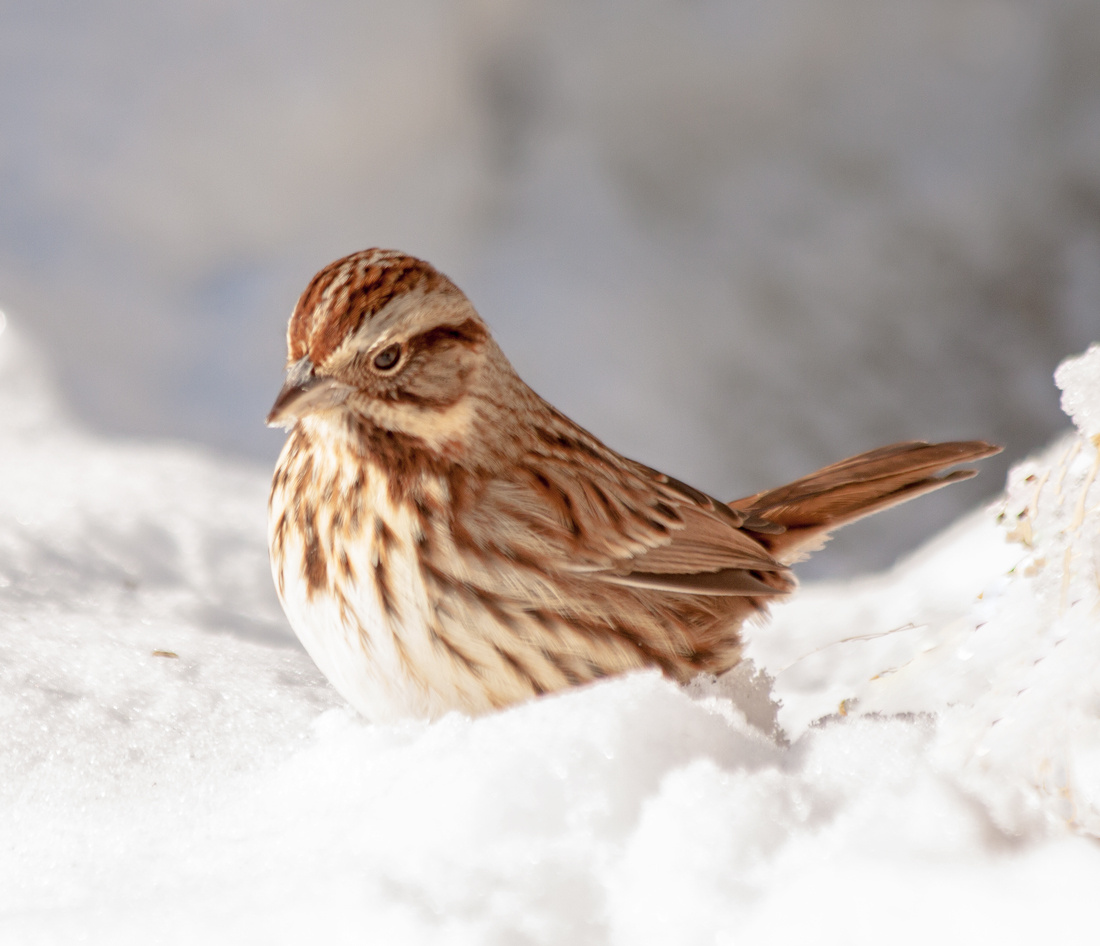
Although I already posted a photo earlier today of a Song Sparrow (Melospiza melodia) in the snow, I came across one I liked even more as I was going through yesterday’s images. This sparrow (and I am never certain of my sparrow identifications) seemed to be posing for me. Somehow I was able to capture details in its eyes that I have never seen before.

After our brief portrait session, the sparrow hurried back to work.

sparrow_snow2_blog

© Michael Q. Powell. All rights reserved

Read Full Post »

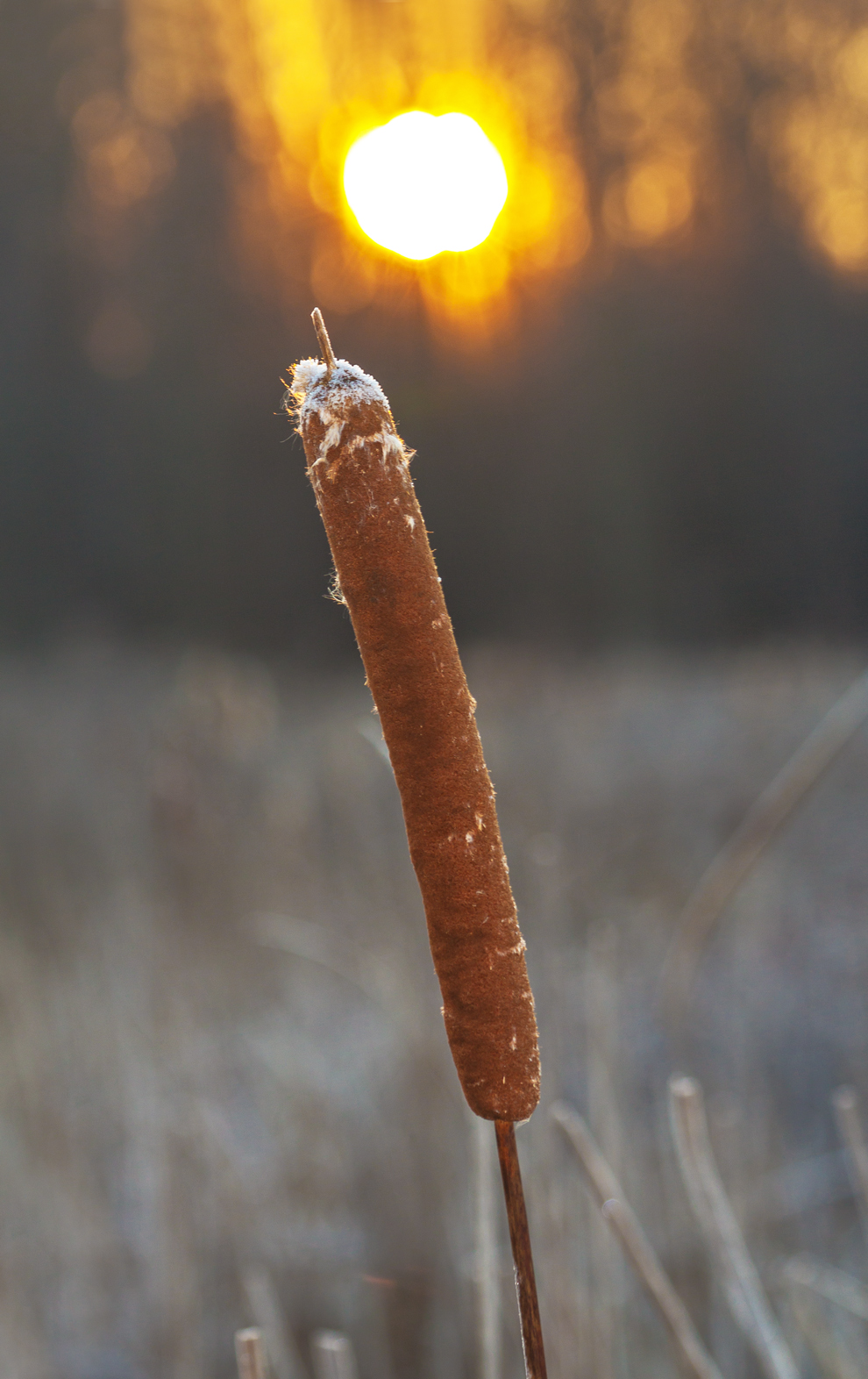
As the new year dawns, it seems appropriate to post this photo I took last weekend at my local marsh, as the early morning sun peeked through the trees and cast its first rays of light onto the cattails.

Best wishes to all for a happy, safe, and blessed 2014.

cattail_dawn_blog

© Michael Q. Powell. All rights reserved

Read Full Post »

Have you ever seen a bird that looked like it was wearing a costume? When I caught sight of  this female Red-winged Blackbird (Agelaius phoeniceus) in the cattails last week, it looked to me like she had donned a large head scarf and an additional coat of feathers as protection from the cold.

blackbird_feathers_blog

© Michael Q. Powell. All rights reserved

Read Full Post »

Do you like long walks in the rain? Although this sounds like a question for an on-line dating service, it’s really about your style of photography.

I enjoy taking wildlife photos in the rain, if the rain is not coming down too hard and if it is not too windy. Of course, I can’t control the intensity of the rain, so I have various levels of protection. Generally, I’ll try to hold an umbrella in one hand and shoot one-handed, steadying my shot by leaning against the umbrella handle, if possible. If the rain starts to fall harder I’ll cover up my camera inside my raincoat or sometimes will pull out a plastic trash bag for additional protection until the rain slows down.

Last week, I was walking in the rain at Huntley Meadows Park, my local marshland park, when I came upon a Great Blue Heron (Ardea herodias), standing on the boardwalk. I approached the heron quietly and stopped. The heron was looking right at me and somehow I knew that it was going to take off.

I dropped to one knee, turned the camera sideways, and pulled way back on the zoom lens, hoping to fit the heron into the frame. This image was shot at 75mm on a 70-300mm lens, so you can tell that I was relatively close to the heron. The other settings were f5, 1/400 sec., and ISO 500 for those who might be interested in the technical aspects of the shot.

It’s always interesting to see which birds are active in the rain and I did get some shots of other birds that day, but I will save them for another blog posting.

heron_liftoff_rain_blog

© Michael Q. Powell. All rights reserved

Read Full Post »

It’s a bit of a cliché, but I really want to capture an image of geese in flight against the backdrop of a beautiful sunset.

There is certainly no shortage of Canada Geese (Branta canadensis) around here and they seem to take off and land so often at my local marsh that it sometimes seem as busy as a regional airport. Beautiful sunsets, though, are harder to come by and many of our days seem to simply fade into darkness. Getting the geese to fly in a proper formation is an additional complication.

This is my most recent attempt at my aspirational image of geese at sunset. There are a few streaks of color and the formation is a little ragged. It’s not quite what I envisioned in my mind—I’ll keep working on bringing that image to life.

geese_at_sunset_blog

© Michael Q. Powell. All rights reserved

Read Full Post »

It is pretty cool that a website (cracked.com) chose to use one of my photos in an article entitled “6 Insanely Colored Versions of Normally Boring Animals.” It is this photo that I took during the summer of my favorite insect, the Handsome Meadow Katydid and I featured in a posting called Rainbow Grasshopper.

rainbow1_blog

Check out the article at http://www.cracked.com/article_20811_6-insanely-colored-versions-normally-boring-animals.html .

© Michael Q. Powell. All rights reserved.

Read Full Post »

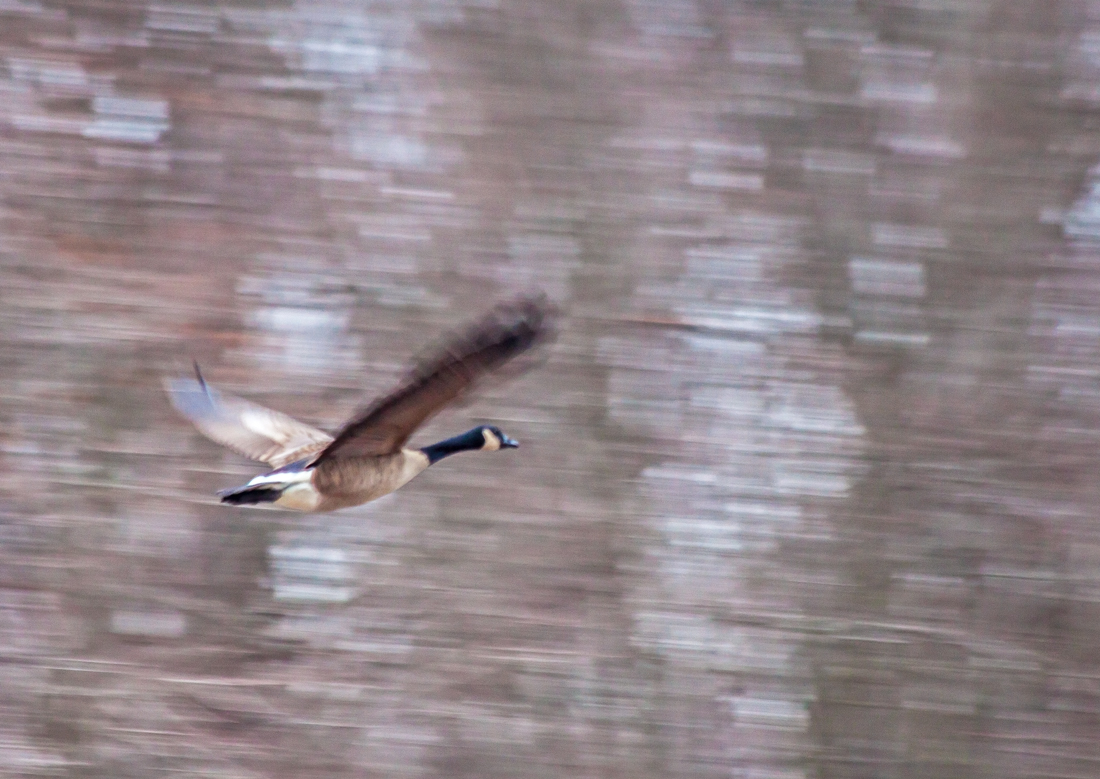
How do you capture speed? Sometimes I will pan the camera and track the moving subject, as I did yesterday with the flying Canada Goose (Branta canadensis). Usually the background is a little blurry, but this time the background became abstract, almost like a painting, an effect that I really like.

What happened? Generally, I shoot in aperture priority mode and I had my camera set on f/5.6, as wide open as I could get at the far end of my telephoto zoom. The weather was cold and gray with the threat of precipitation—it eventually rained for hours—so I set my ISO to 500. It turned out that I would have needed a much higher ISO to stop the motion completely, for my camera provided me with a shutter speed of only 1/60 of a second. That is why there is some motion blur in the wings.

goose_pan_blog

© Michael Q. Powell. All rights reserved.

Read Full Post »

I was a little jetlagged, but managed to take a short walk through part of the city this afternoon, the day of my arrival, and got these photos of some of the notable buildings in Vienna, Austria.

There are so many beautiful and interesting buildings in Vienna that you could easily spend weeks photographing them. I have been in this wonderful city quite a number of times, so many of these buildings are familiar to me. I realize, however, that is not the case for most of my readers, so I thought I would share some of that beauty in a few photos from the point-and-shoot Canon that I have with me during this business trip.

Burgtheater, Vienna

Burgtheater, Vienna

Detail of Austrian Parliament Building, Vienna

Detail of Austrian Parliament Building, Vienna

Rathaus2_blog

Detail of Rathaus (City Hall), Vienna

© Michael Q. Powell. All rights reserved.

Read Full Post »

Do you ever sit by a window and daydream as you look out into the world with unfocused eyes? Somehow that was what came to mind when I spotted this Mourning Dove (Zenaida macroura) perched on a branch, framed by the trees. The dove seemed gentle and pensive, unlike so many of the birds (and people) in this area that are so driven, always intense and tense.

There is a real value in slowing down and daydreaming more in order to recharge my creative batteries. Sometimes I need a gentle reminder.

dove_framed_blog

© Michael Q. Powell. All rights reserved.

Read Full Post »

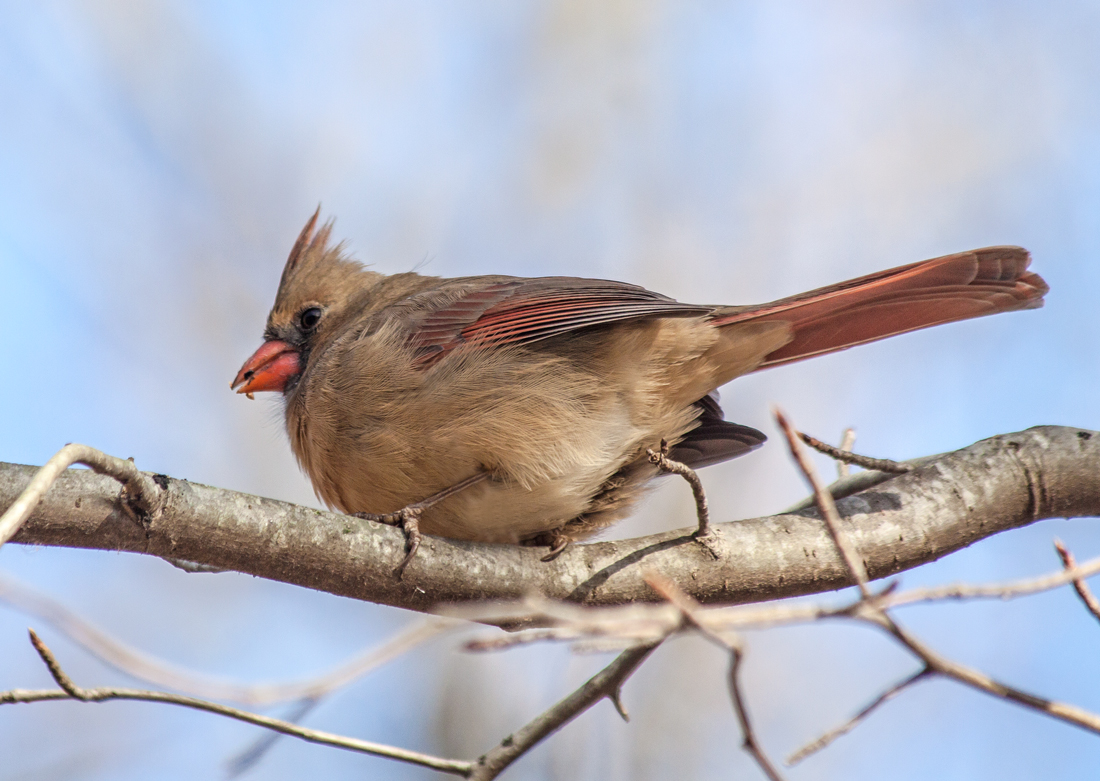
I looked up at her from below and then she cocked her head and looked down at me. Our eyes met and we shared a brief, magical moment together. Then it was over, my all-too-short encounter with a beautiful female Northern Cardinal (Cardinalis cardinalis).

cardinal_looking_down_blog

© Michael Q. Powell. All rights reserved.

Read Full Post »
Although it is exciting to search for new birds or for unusual interactions, I love to return to familiar subjects, like this male Red-winged Blackbird (Agelaius phoeniceus) that I photographed last week.

There is nothing complicated about this image, a blackbird perched on a cattail, but the small details make it special for me. I like the angled body and the turned head. The feathers seem unusually glossy and the eye is shiny too. There are a few wispy feathers that are matched by the “fluff” from the cattail. The background is brown, but there are a wide variety of shapes and shades.

What does it take for you to be satisfied as a photographer? For now at least, I am content to stay relatively close to home and photograph whatever I can find as well as I can. Life doesn’t have to be complicated all of the time.

blackbird_turned_blog

© Michael Q. Powell. All rights reserved.

Read Full Post »

I suspect that I may qualify as a stalker, because I spent over thirty minutes on Friday sitting on a fallen tree, observing every movement of a juvenile Red-headed Woodpecker (Melanerpes erythrocephalus) high in the oak trees.

The small branches and the shadows made it almost impossible to get a clear shot of the little bird, but they did not keep me from trying. I was really fortunate to get this shot of the woodpecker as it took off from one of its perches with an acorn in its mouth and gave me a glimpse of its beautifully-patterned wings. As I understand it, when the Red-Headed Woodpecker becomes an adult, its wings will be pure black and white, so I am glad that I was able to get the shot of the black dots.

After I posted this photo, I noticed that there is a least one acorn jammed into a crack in the bark just above the top edge of the bird’s tail, mostly likely a snack that it has cached for future consumption.

woodpecker_flying_blog

© Michael Q. Powell. All rights reserved.

Read Full Post »

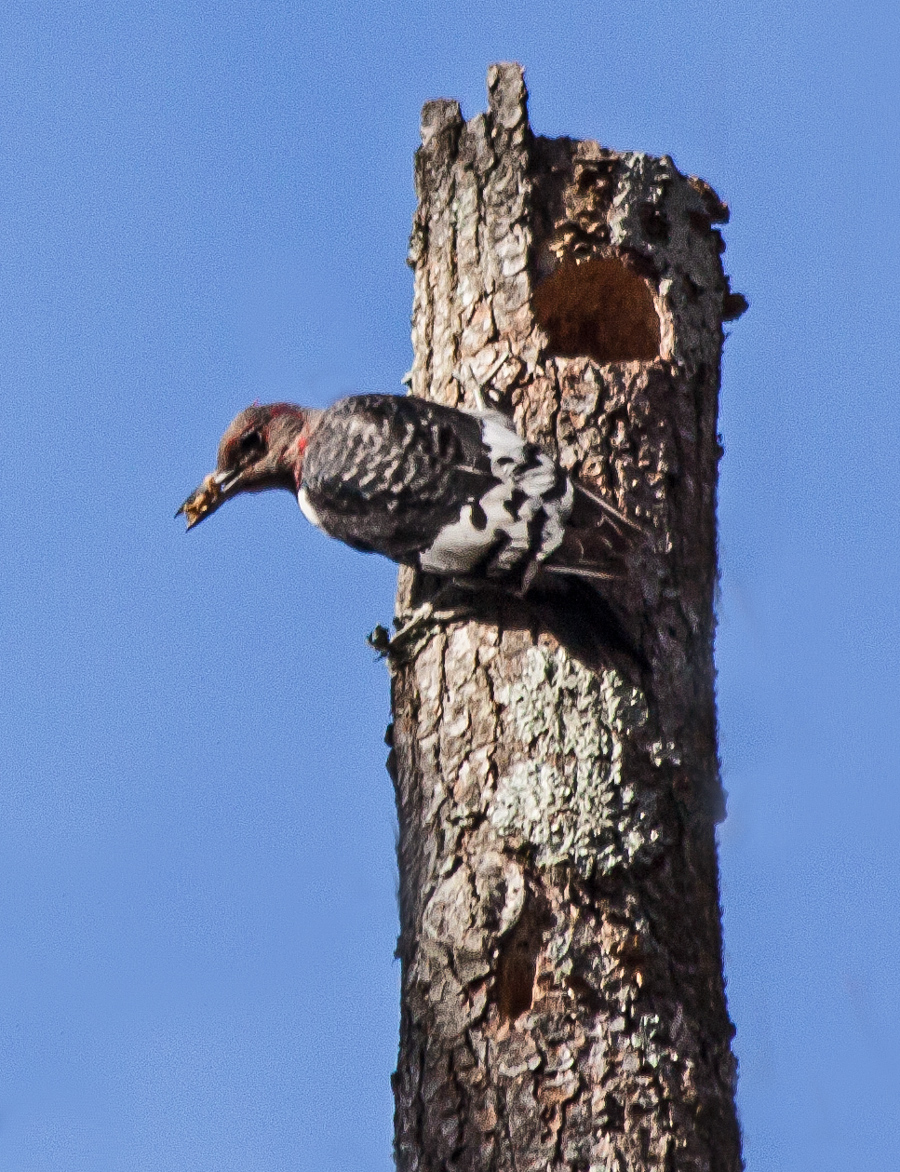
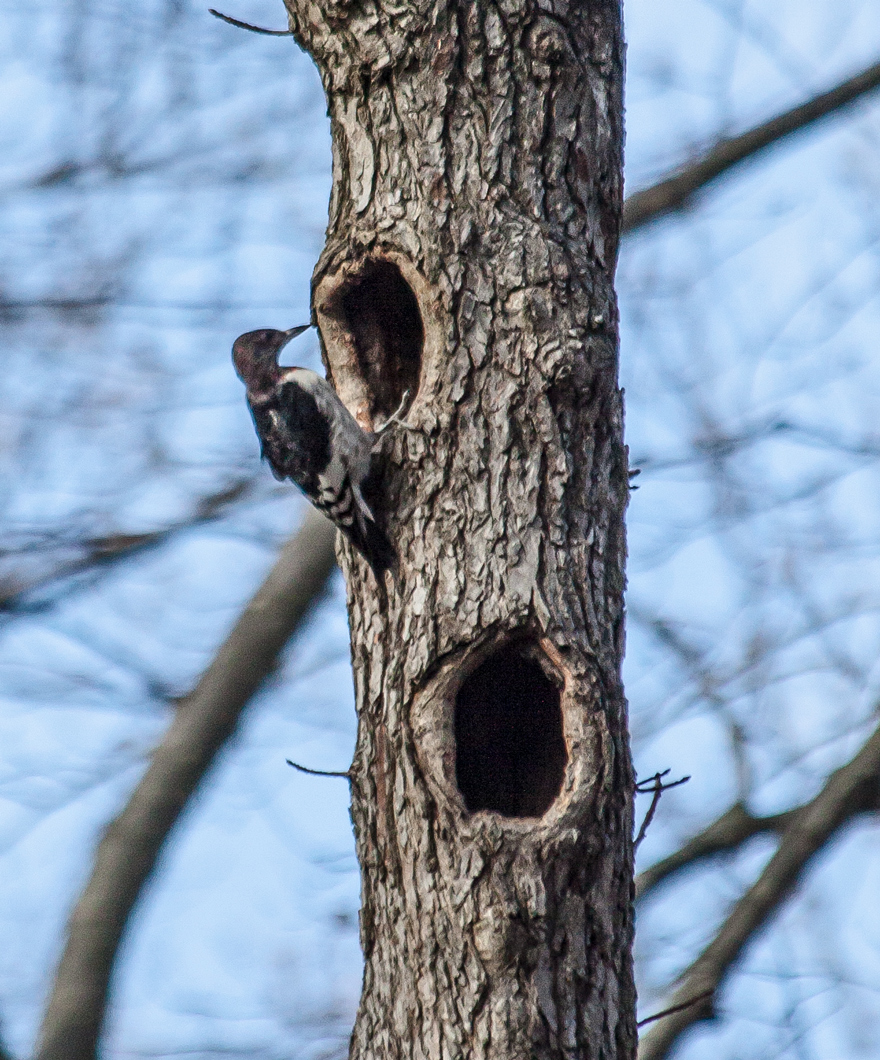
Wouldn’t you know it, I finally see a Red-headed Woodpecker (Melanerpes erythrocephalus) and its head is not red. It’s a juvenile one and if you look closely you can see a few traces of the spectacular red that it will eventually sport on its entire head.

One of the serious birders at my local marshland park identified the area in which two juvenile Red-headed Woodpeckers had been seen regularly and I was fortunate to spot one of them this past Monday. The woodpecker seemed to be carving out a cavity in the tree and actually climbed into the hole as it chiseled away the bits of wood. Earlier, I saw one of them in the distance at a nearby tree with two large cavities (see the third photo). The bird stuck its head inside one of the cavities and I couldn’t tell if it was checking out the hole or was storing food there.

The Cornell Lab of Ornithology notes that the Red-headed Woodpecker is one of only four North American woodpeckers known to store food, and it is the only one known to cover the stored food with wood or bark. These woodpeckers have a varied diet and will eat both insects, which they sometimes catch in the air, and a a number of plant materials, especially acorns.

I don’t know how long it will take for this bird’s head to turn red, but I will certainly be keeping an eye out for it, now that I have an approximate idea of its territory.

redheaded2_blogredheaded1_blogwoodpecker_cavity_blog

© Michael Q. Powell. All rights reserved.

Read Full Post »

“Do you want to go photograph some produce?” How was I supposed to respond to this question posed to me early in November by my photography mentor and fellow blogger Cindy Dyer? How exciting can produce be?

I have grown up in a world in which I buy my produce in a supermarket. That produce has been scrubbed and processed and transported from far away. I was pleasantly surprised when Cindy took me to Nalls Produce Center, a local produce market that has a wide variety of items that I have never seen in a supermarket. Who knew, for example, that pumpkins were not always orange with smooth skins?

I was pretty uncertain about how to photograph the produce, so I just concentrated on shapes and colors and textures.  It somehow seems appropriate to post this selection of photo on Thanksgiving Day, a day when Americans traditionally celebrate the bounty of the autumn harvest.

pumpkin_gray_blog

© Michael Q. Powell. All rights reserved.

Read Full Post »
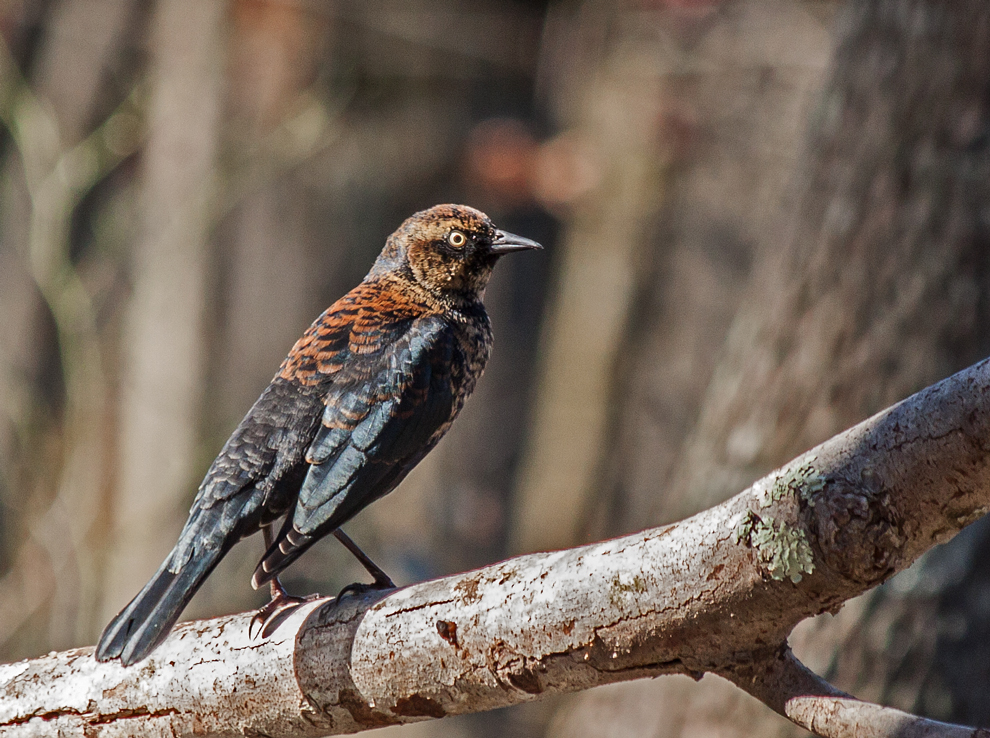
I encountered another small flock of blackbirds this past weekend and this time I managed to get a shot of a female Rusty Blackbird (Euphagus carolinus). If you want to compare the female with the male, check out my earlier posting with an image of a male.

I have now gotten used to the idea that these blackbirds are likely to be be found in the water and the mud, rather than in the cattails, where I usually find the Red-winged Blackbirds. I have also gotten used to the notion that female blackbirds are not black—that used to mess with my head.

What I have not gotten used to, however, is the pale yellow color of the eyes of the Rusty Blackbirds. There is something a little eerie and disconcerting about those eyes and I find them to be a bit creepy.

blackbird_rusty_female_blog

© Michael Q. Powell. All rights reserved.

Read Full Post »
When I saw a small flock of blackbirds on Monday at my local marsh, I assumed that they were Red-winged Blackbirds, but a closer look showed that I was wrong—they were Rusty Blackbirds (Euphagus carolinus), a species that I had never photographed before.

The shape of the body seems similar to that of the Red-winged Blackbird, but the coloration is different and the pale yellow eyes of the Rusty Blackbird are particularly distinctive. They also seem to prefer a flooded area of the woods and I observed them pecking about in the shallow water, periodically flipping over wet leaves.

The Cornell Lab of Ornithology notes that the Rusty Blackbird is one of North America’s most rapidly declining species, whose population has plunged an estimated 85-99 percent over the past forty years and scientists are not sure why.rusty_blackbird_blog

© Michael Q. Powell. All rights reserved.

Read Full Post »

It won’t be long before my bird photos have the colorless backgrounds characteristic of winter, so I am photographing as many birds as I can find with autumn colors in the background, like this House Sparrow (Passer domesticus) that I observed last Sunday. As I noted in a posting last month, these birds are non-native (introduced from the Old World) and sometimes crowd out native birds. Still, I find them to be beautiful, especially when they pose like this. This pose is one of my favorites, when I get to look down the tail toward the head turned to the side.

house_sparrow_autumn_blog© Michael Q. Powell. All rights reserved.

Read Full Post »

Could this be the mascot for a new line of clothing or shoes? Dragonfly photographer extraordinaire Walter Sanford took these shots of a beautiful female Autumn Meadowhawk perched on my hand as I tried to move it closer to the messenger bag in which I carry my camera gear.

waltersanford's avatarwalter sanford's photoblog

The preceding gallery shows a female Autumn Meadowhawk dragonfly (Sympetrum vicinum), spotted at Huntley Meadows Park on 15 November 2013. She is perching on the hand of Mike Powell, fellow wildlife photographer and blogger. This individual is not the female featured in my last post, “Champion dragonfly.”

Copyright © 2013 Walter Sanford. All rights reserved.

View original post

Read Full Post »

The autumn colors may be fading fast, but the remaining leaves still provided a colorful background for this Northern Mockingbird (Mimus polyglottos) this past weekend.

Normally mockingbirds sing all of the time, but this one was curiously silent the entire time as I moved around at pretty close range, trying to get the best possible background for the shots. From time to time, the mockingbird would turn its head, almost like it was striking new poses for me. This was my favorite pose, a serious portrait in profile in which the mockingbird looks unusually stern.

mockingbird_autumn

© Michael Q. Powell. All rights reserved.

Read Full Post »

When an Autumn Meadowhawk dragonfly (Sympetrum vicinum) landed on my thigh last Friday, my first thought was to get a photograph of him. Fortunately, my 100mm macro lens was already on my camera—in anticipation of a shot like this—and I was able to capture a close-up, eye-to-eye portrait of the dragonfly by contorting my body and attempting to stabilize my shooting position.

My blue jeans were broken in and their texture, color, and pattern made a pretty cool backdrop for this colorful dragonfly. It may be my imagination, but he seemed to be looking up at me with a mixture of curiosity and amusement.

For whatever reason, many of these dragonflies, which I was able to observe as recently as yesterday, do not seem fearful of people. The classic Drifters song from the 1960’s may talk of spending time with your sweetheart under the boardwalk, but these Autumn Meadowhawks seem to spend most of their time warming up on (and not under) the boardwalk, with periodic mating forays into the bushes.

dragonfly1_denim_tight_crop_blog

Click on the photo to see it in higher resolution.

© Michael Q. Powell. All rights reserved.

Read Full Post »

How often have you been told (or read) that you need to fill the frame with your primary subject? If you photograph wildlife as I do, you know that it is rare that you have the opportunity to “fill the frame,” especially when your subject is moving.

I was a little shocked when I first looked at this image of a Canada Goose (Branta canadensis)—not only had I filled the frame, but I had managed to compose it pretty well. Yes, this is an uncropped image of a flying goose. I was awfully lucky to get this shot and I know that several of the images in the burst I took featured cutoff bodies or heads.

Now if I could just get a raptor to fly by this closely…

goose_fill_frame_blog

© Michael Q. Powell. All rights reserved.

Read Full Post »

Green-winged Teals (Anas crecca) are very small ducks and they are really skittish, but I managed to capture a photo of these three (and a mallard) yesterday shortly after they took off from the water. When they are in the water, you get only the slightest hint of the green on the wings (see my post from last year to see one Green-winged Teals at rest), but when they are flying, it’s easy to see why the got their name.

I went back and forth in my mind about whether or not to crop out the female mallard. Most people are familiar with mallards, so they can see how small the teals are by comparing them in the photo to the mallard. In addition, I like contrast between the green in wings of the teals and the blue in the wings of the mallard. However, the mallard is a bit far away from the three teals and there is nothing of visual interest in the center area of the photo. So I cropped a bit more and created the second image that eliminates the mallard.

Which version of the image works best for you?

green_and_blue_ducks_blog

green_and_blue_ducks_B_blog

© Michael Q. Powell. All rights reserved.

Read Full Post »

« Newer Posts - Older Posts »