Feeds:
Posts
Comments

Archive for the ‘Arachnids’ Category

Dragonflies seem to love to perch on this piece of rusted rebar that sticks out of the water at Jackson Miles Abbott Wetland Refuge. I really like the juxtaposition of the man-made and natural elements in this shot of a male Eastern Amberwing dragonfly (Perithemis tenera) that I spotted on Monday.

You can’t see it really well in the first shot, but there is a spider on the rebar in addition to the dragonfly.  I got a better shot of the spider later in the day. I don’t know for sure that it could capture the dragonfly, but it’s a potentially dangerous situation for the dragonfly (and I have photographed several dragonflies that had fallen prey to spiders in the past).

Eastern Amberwing


spider

© Michael Q. Powell. All rights reserved.

Read Full Post »

I know that some folks find spiders to be creepy, but I think they are beautiful, particularly when presented creatively in an image. I spotted this little spider earlier this week in a wooded area at Huntley Meadows Park.

The area in which the spider was located was pretty dark, so I decided to use  the pop-up flash on my camera. The light was a bit too powerful at such close range, so I  improvised a diffuser by slipping a plastic sleeve over the flash—when it is raining out, my Washington Post is delivered in plastic sleeves. All three of these shots were taken using the flash, but they look so different because of the direction of the ambient light. In the one that has a light background,for example, I was shooting almost directly into the light, so the flash was need to avoid getting nothing but a silhouette.


dramatic spider


dramatic spiderdramatic spider

© Michael Q. Powell. All rights reserved

Read Full Post »

If you go out early in the morning, you have undoubtedly seen flat dew-covered squares of web material scattered all over the ground. Yesterday morning at Huntley Meadows Park, I decided to explore several of them, hoping to find one of the spider-architects. Eventually I was able to find and photograph one of these spiders, which are commonly known as American Grass Spiders (g. Agelenopsis) or funnel weaver spiders.

According to an article on BugGuide.net, “For this family of spiders, the web is a horizontal, sheet-like web with a small funnel-like tube off to a side (or for some species, the middle of the web). This funnel is what the family is named for, and is used by the spider for hunting and protection. The spider will lay in wait in the funnel, and when an insect flies into, or lands on the web, the spider will rush out, very quickly check to see if it is prey, and if it is prey, bite it. The venom is fast-acting on the prey, so once the prey is subdued (within a second or two), the spider will drag the prey back into the funnel (for safety while eating, and to prevent other insects from recognizing the danger that lurks on the web).”

It’s fascinating to think about all the different ways that spiders are able to capture their prey, including all kinds of webs or even without webs, as is the case with jumping spiders and fishing spiders. It makes me happy that spiders are not larger, except perhaps in some Japanese science fiction movies, or we all might be in danger.

funnel weaver spider

© Michael Q. Powell. All rights reserved


Read Full Post »

Most of us know what it is like to change a lens on a DSLR, but what is it like when you change a lens in one of your eyes? About 48 hours ago, I had surgery to replace the lens in one of my eyes with a plastic intraocular lens (IOL). Cataracts in both of my eyes had advanced to a point where they were interfering with activities such as night driving and both my optometrist and my ophthalmologist recommended cataract surgery.

I am in an interesting situation right now, because one of my eyes has been “fixed” and one of them has not. As a result I can’t help but do a series of before-and-after comparisons by looking at the world one eye at a time.

It’s hard to describe the changes, but it may be a little easier with photographers. Do you remember the first time that you looked at a RAW image? RAW images often look dull and flat. That’s kind of the way that things look in my right (uncorrected) eye. The view is darker, dingier, and has a slight yellow cast. The colors appear desaturated and there is not much contrast.

When I look through my corrected eye, it feels like a RAW image that has been adjusted by a skilled photographer. The whites are pure white, the colors are vibrant, and sharpness and contrast have been tweaked. Interestingly, the colors are a little on the cool side, with a slight blue color cast. One thing I didn’t expect is that objects in my corrected eye are slightly bigger than in my uncorrected eye. I asked my ophthalmologist if the lens he implanted has a magnifying effect and he noted that it did not—the phenomenon I had described was caused by my myopia, which causes objects to look smaller.

Previously I was significantly near-sighted and have needed glasses since I was in the fifth grade. The corrected eye is far-sighted now and my distance vision is amazing—for the first time in my life I was able to drive a car yesterday without glasses. My near vision now is essentially non-existent. I am hoping that it will improve a little bit as my eyes continue the adjustment process, but I fully expect that I will need the kind of reading glasses that I am using at this very moment.

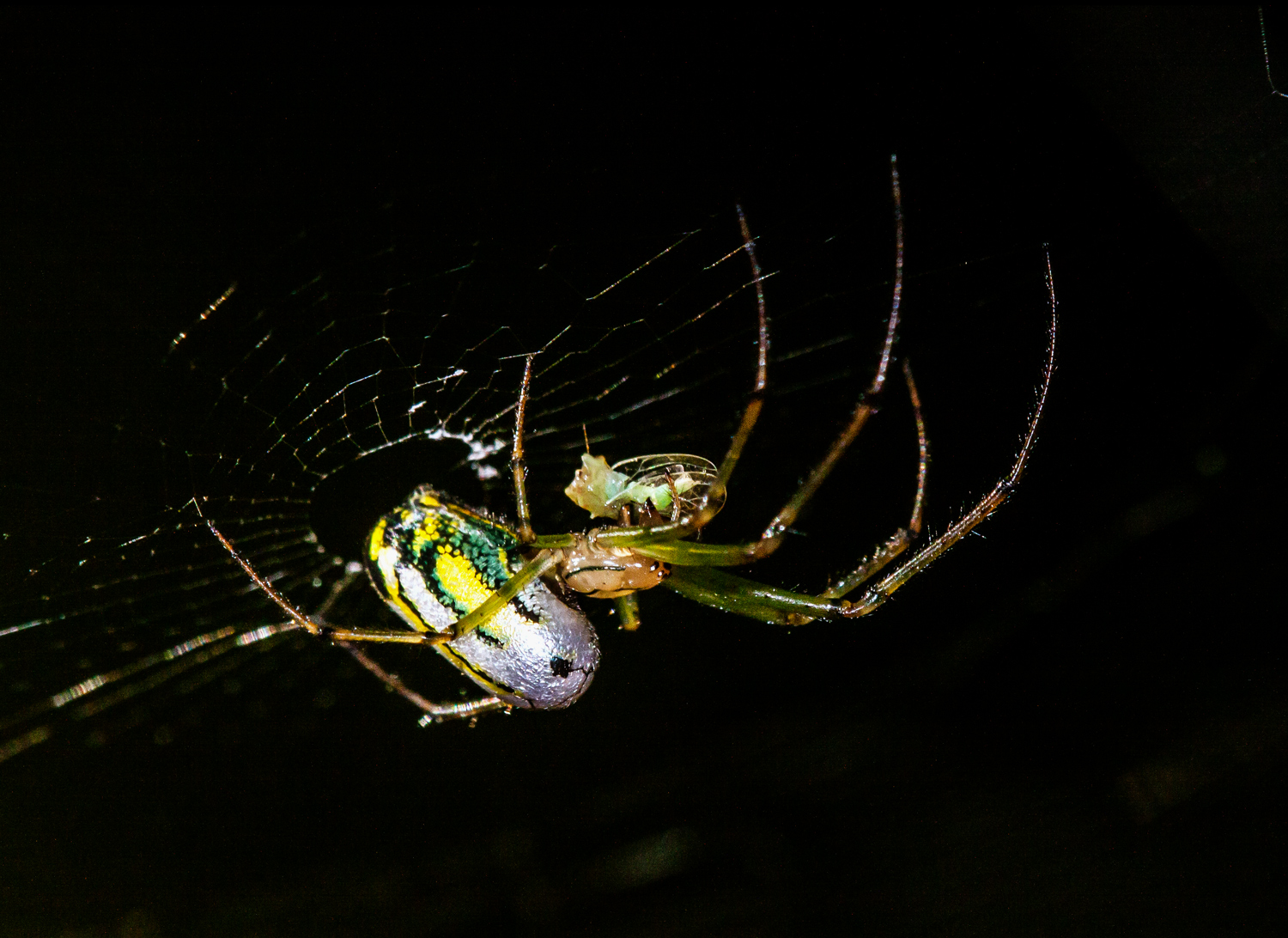
Here is a photo of an Orchard Orbweaver spider (Leucauge venusta) that I took recently. The woods were pretty dark and I was trying to shoot from a relatively short distance away, so I decided to use my pop-up flash. It produced too much glare off of the spider’s shiny body, so I ended up throwing a gray bandana over the flash as a makeshift diffuser. The spider had just captured a prey (I think) and I am pretty happy that I was able to capture as much detail as I did. (Normally I like to be more nuanced when using a flash on close-up subjects, but I think the dark background works well with a spider;)

When I look at the spider with my uncorrected eye, the green and yellow on the spider’s body are pale and dull and the section of the body between the yellow areas appears to be gray. Looking though the corrected eye, however, I see a bright white area in between the bright yellow markings and even the green seems brighter and more intense.

In another two weeks the lens in the right eye is scheduled to be replaced and I’ll probably start to take my newer, brighter world for granted. For now, though, all I have to do is close one eye at a time to see what a difference a change in lens can produce.

Orchard Orbweaver

© Michael Q. Powell. All rights reserved


Read Full Post »

The simple shape and spare palette of spiderwort plants (g. Tradescantia) really appeal to me and I found myself taking innumerable photos of them during a visit with fellow photographer Cindy Dyer to Meadowlark Botanical Gardens in Vienna, Virginia this past weekend. Be sure to check out Cindy’s blog for some awesome colorful images of many of the other flowers that we observed.

My friends all know that I have a warped sense of humor, so it would come as no surprise to them when I confess that I can’t help but think of an abnormal growth on an arachnid every time that I use the word “spiderwort.” As the weather continues to warm up, I’m pretty confident that I will soon be featuring images of spiders, warts and all.

spiderwort

© Michael Q. Powell. All rights reserved

Read Full Post »

This spooky spider image that I took late Friday afternoon while hiking along part the Potomac Heritage Trail is probably more suitable for later in the month, but I just couldn’t wait until Halloween to share it.

Normally when I use fill flash I try to be subtle, attempting to add a little pop without making it obvious that I used flash. In this case, you can’t help but notice my use of the popup flash. Normally I would take a shot of a spider like this with my macro lens, but I was travelling light with just my superzoom Canon SX50. The 50x zoom of this camera has helped to bring distant subjects closer, but I had never tried to use the camera’s macro mode. I quickly learned that you have to be really close to your subject, literally only a few inches away. I was pretty happy when I was able to get the second shot below, but wanted to add to the drama of the shot.

I dropped the exposure compensation in the camera down to a minus three stops and got my favorite shot. The darkened sky and the way that the flash illuminates the spider give the image a kind of creepy look that feels appropriate for a spider that was just about at eye level.

spooky spider

spooky spider

© Michael Q. Powell. All rights reserved.

Read Full Post »

I’m always happy to see a black and yellow garden spider (Argiope aurantia). I love its colorful patterns and its intricate web (and apologies to readers who are totally creeped out by spiders). I spotted this beauty this past weekend in a patch of goldenrod at Jackson Miles Abbott Wetlands Refuge.

Argiope aurantia

© Michael Q. Powell. All rights reserved.

Read Full Post »

This past weekend I spotted an unusual-looking spider at Huntley Meadows Park. I took this shot from a distance, so I didn’t capture all of its wonderful details, but it looks to me like a Triangulate Orb Weaver spider (Verrucosa arenata), also known as an Arrowhead Spider.

The spider was hanging in mid-air, which helped a slight bit with focusing, but Arrowhead Spiders are less than a half inch in size (about one cm), so it was a bit of a challenge getting any kind of shot with my telephoto zoom lens extended to 600mm.

Arrowhead Spider

© Michael Q. Powell. All rights reserved

Read Full Post »
I know that spring has truly arrived when I start to walk around with a macro lens on my camera. I captured this shot of a Bold Jumping Spider (Phidippus audax) on the boardwalk yesterday at Huntley Meadows Park.

As I was walking into the park, a departing fellow photographer alerted me to the presence of the spiders, so I changed lenses in the hope that I would see one. Most of the winter months I have been using my Tamron 150-600mm lens to shoot birds and other wildlife, but I had my Tamron 180mm macro lens with me. It’s amazing how my field of vision changes with the shift in lenses. With the long lens, I am used to looking up and out, in part because it has a minimum focus distance of 8.9 feet (1.7 meters). With the macro lens, I am am scanning a much smaller area, primarily near my feet and just beyond.

Eventually I located a jumping spider. It seemed to be spending most of its time in the cracks between the synthetic boards of the boardwalk, but occasionally would venture out. Despite its name, the Bold Jumping Spider seemed to be pretty timid. In fact, I never did see it jump—it seemed content to crawl slowly.

The coolest thing about jumping spiders, of course, is their eyes. I am absolutely mesmerized by their multiple eyes and I was really happy that I was able to capture some reflections in the eyes. The reflections are most noticeable in the head-on shot, but they are also visible in the action shot. It’s a fun challenge to try to capture action when this close to a subject, but somehow I managed, though the higher shutter speed needed when shooting handheld meant that that my depth of field was pretty limited.

Bold Jumping Spider

Bold Jumping Spider

© Michael Q. Powell. All rights reserved.

Read Full Post »

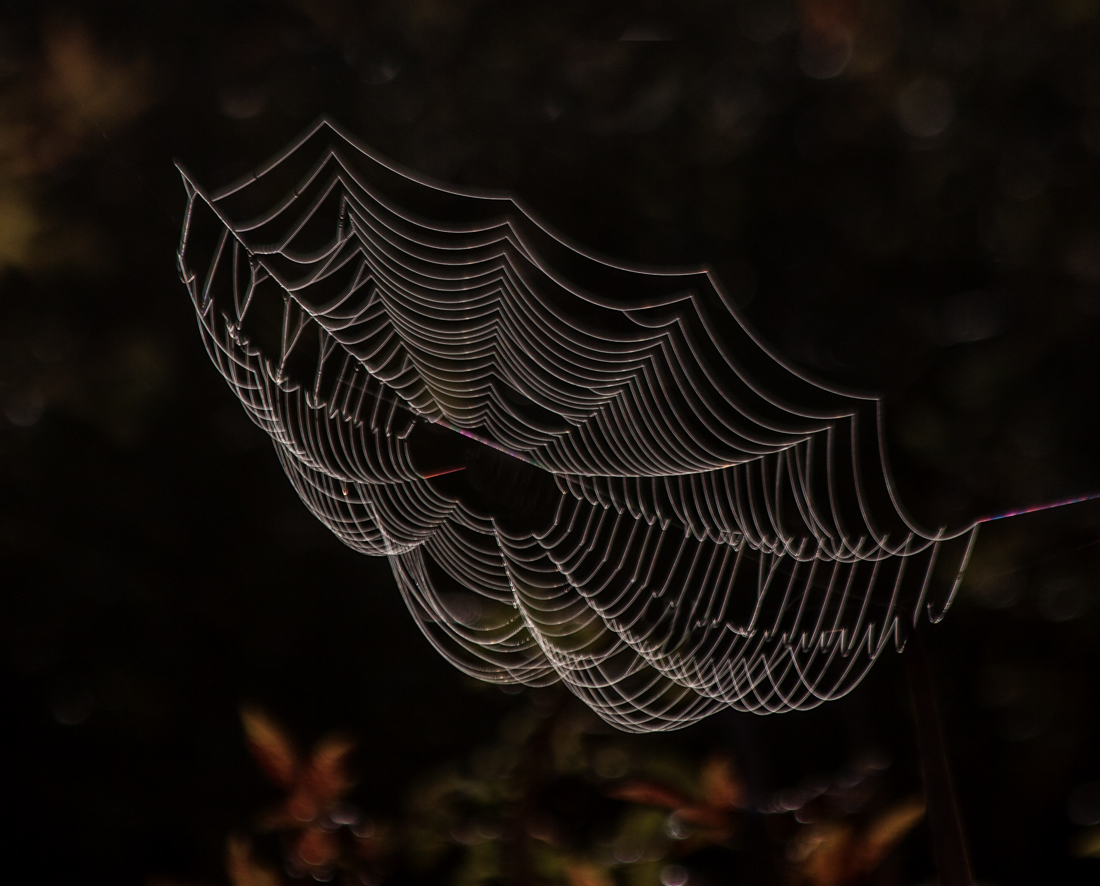
When I arrived at the marsh in the early morning hours, it looked like the spiders had been busy all night preparing decorations for Halloween—there were spider webs everywhere.

The webs seemed to have been more hastily constructed than those of the orbweavers that I have observed recently and there did not appear to be any spiders in the center of these webs. What is the purpose of these webs if the spiders are not there to secure any prey that is caught in the web?

I can’t help but admire the amazing artistry of these fascinating little creatures as I examine the interlocking lines and curves of their incredible creations.

I’ve place these images in a mosaic collage—if you want to see larger versions of the images, just click on any one of them and you’ll move into a slide show mode that lets you scroll through them quickly.

© Michael Q. Powell. All rights reserved.

Read Full Post »

After a summer of not seeing many spiders, I was thrilled recently to spot this orbweaver spider as it dealt with an unidentified prey that it had captured.

Most of the large spiders that I observe are Black and Yellow Garden spiders (Argiope aurantia), but this one looks different from the ones that I have previously seen, especially in the first image. It may be that I am used to seeing the spider only in the center of her web, as in the second image, or perhaps this is a different spider species.

This was an unusual case for me, because I spotted the spider as I was walking through a field of waist-high vegetation and I was able to get pretty close to the spider and get these shot with my macro lens. Generally, I am forced to photograph spiders like this from a distance (which most people probably think is a good idea anyways).

There are some subjects, like cute birds, that I photograph that I know will have a broad appeal, but past experience has shown me that spiders tend to divide people into two camps—some people are fascinate and think spiders are totally cool, while others are thoroughly creeped out and find spiders to be repulsive.

What do you think about spiders?

orbweaver spider

orbweaver spider

© Michael Q. Powell. All rights reserved.

Read Full Post »

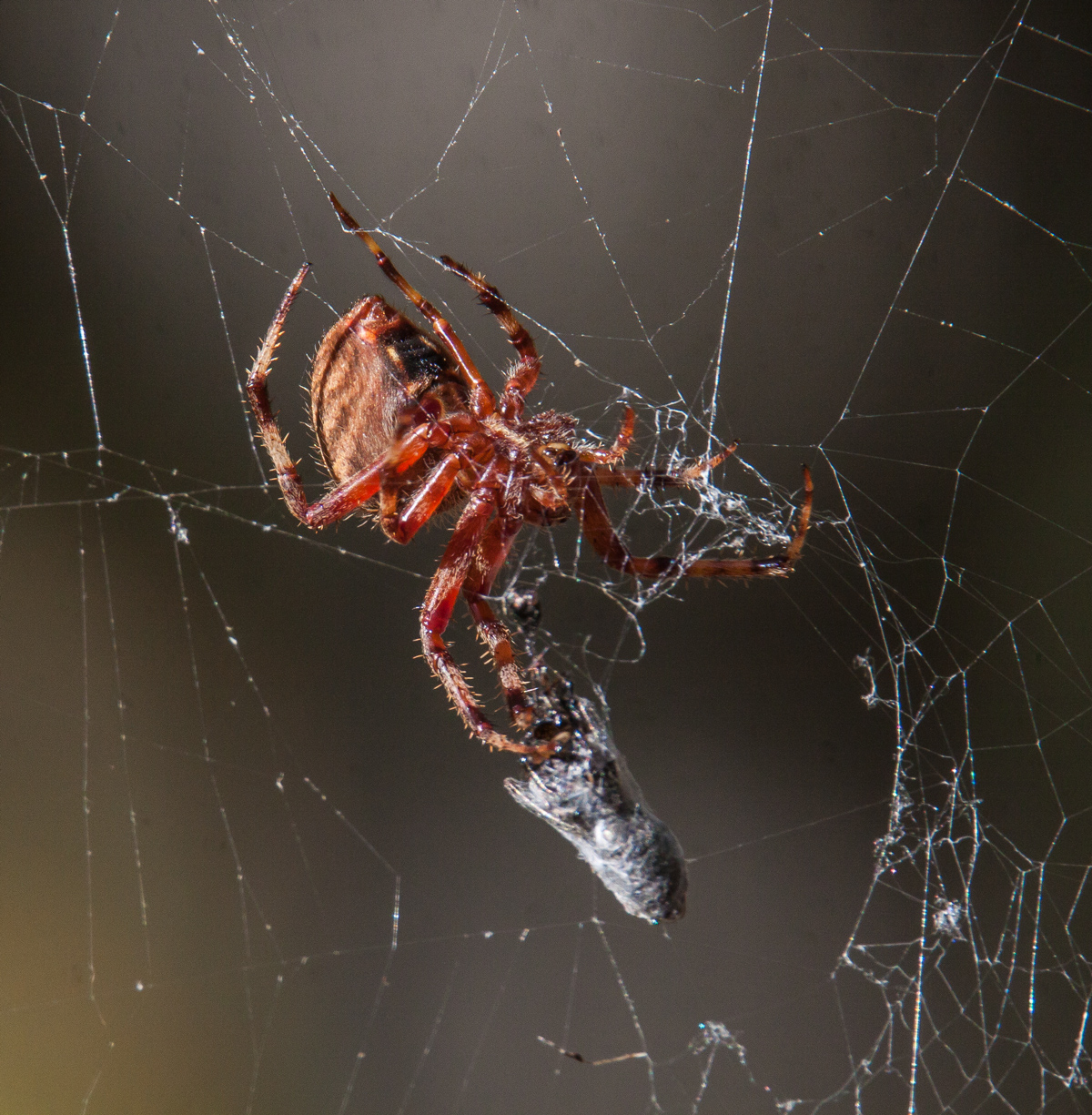
I spotted this barn spider (Neoscona crucifera) hanging in the air about the same time she sensed my presence. She scampered up her web as I moved in a little closer. Eventually she climbed back down and I managed to get these shots of her in motion.

Initially I couldn’t figure out why she was hurrying down the strands of her web. When she stopped, however, I could see that she was anxious to finish off the snack that she had wrapped up earlier.

Although these shots may look like they were taken with a macro lens, they were actually taken at 600mm on my Tamron 150-600mm zoom lens. I ended up focusing manually on the spider, because my camera kept wanting to focus on the background, which was a good distance away. Additionally, I used my pop-up flash on at least some of these images to bring out some of the details of the spider.

barn spider

barn spider

barn spider

barn spider

© Michael Q. Powell. All rights reserved.

Read Full Post »

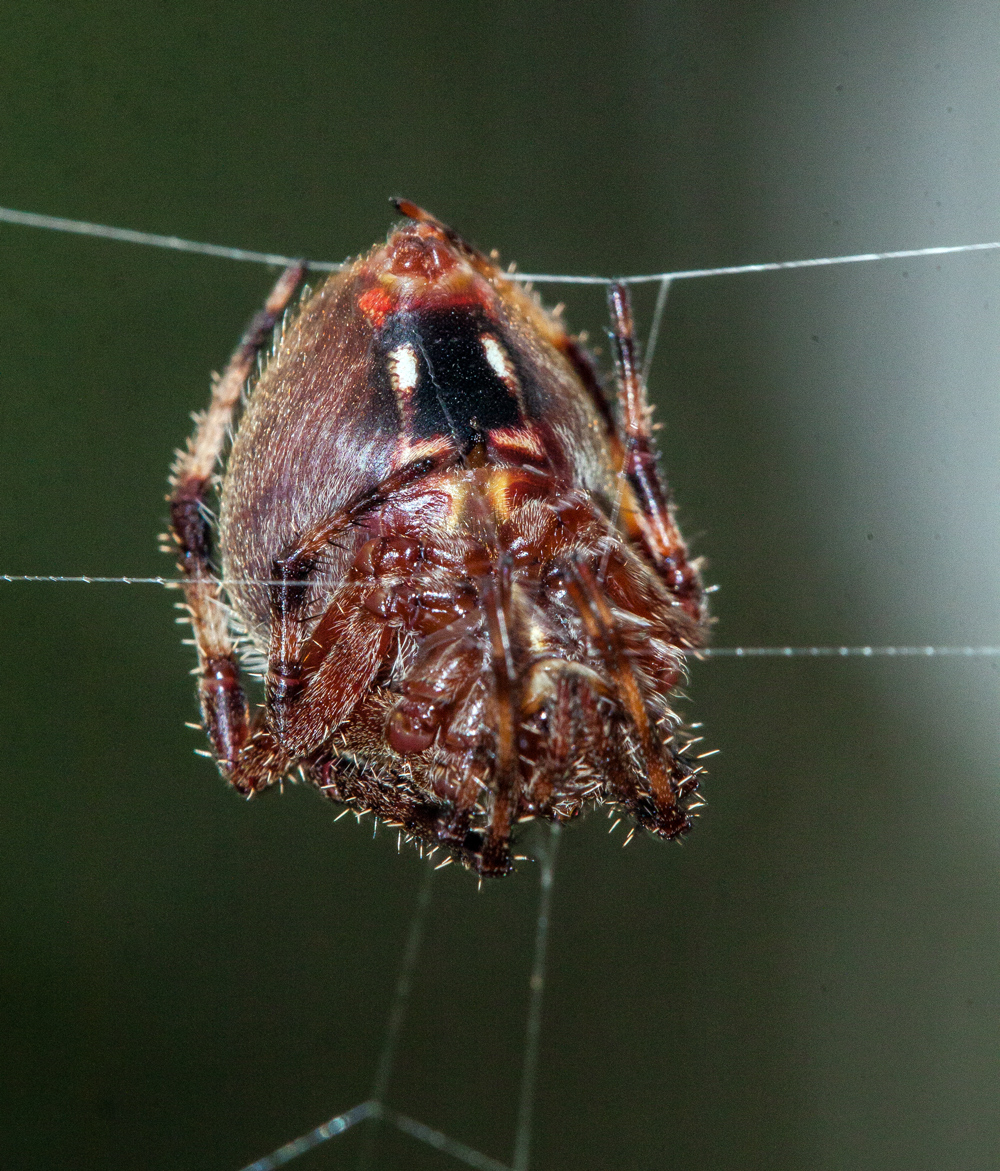
I first caught sight of this spider yesterday when I almost walked into it—it was hanging in mid-air at eye level across a path and we were less than a foot apart when I encountered it.

Initially the spider scampered up a bit and then seemed to run out of web and came to a stop, giving me some time to change to my macro lens. The spider, which I think is a kind of orb weaver (Neoscona crucifera) that is sometimes called a barn spider, was about seven feet off the ground by this time, so it was quite a challenge getting a stable shooting position. I raised the ISO and used the pop-up flash and managed to get some reasonably sharp images.

These are my favorite two images. I really like the detail in the first shot, but like the background and angle of view more in the second shot. Which one is better? I vacillate in trying to decide, so included them both.

orbweaver spider

orbweaver spider

© Michael Q. Powell. All rights reserved.

Read Full Post »

It had been quite a while since I had last seen a Yellow Garden Spider (Argiope aurantia), so I was pretty excited to see one during a visit this past weekend to Dyke Marsh Wildlife Preserve, a tidal wetlands park along the Potomac River in Virginia.

The spider must have sensed my presence too, because she began to oscillate the entire web vigorously. I had to wait for her to settle down before attempting to get some shots. I was on an elevated boardwalk and the spider was considerably below the level of my feet. As a result, I had somewhat limited options for framing my shots, though I was able to photograph the spider from a couple of different angles, and was not able to get really close to the spider.

I was happy that I managed to capture the really cool zigzag portion of the spider’s web, a distinctive characteristic of this particular species.

Argiope spider

Argiope spider

© Michael Q. Powell. All rights reserved.

Read Full Post »

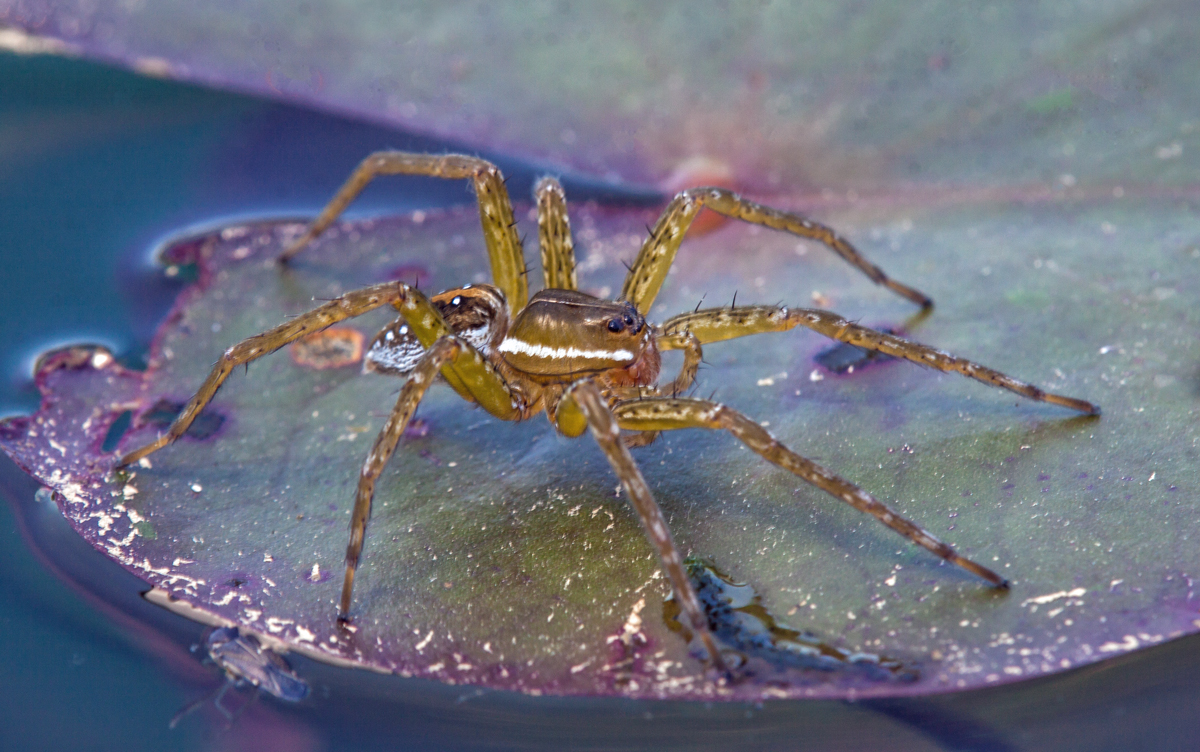
When shot from a relatively low angle, this Six-spotted Fishing spider (Dolomedes triton) looks especially fearsome, although it was actually pretty small, only about an inch (25 mm) or so in length. The spider was perched on a lily pad at Lilypons Water Gardens in Adamstown, Maryland.

Six-spotted Fishing spider

© Michael Q. Powell. All rights reserved.

Read Full Post »

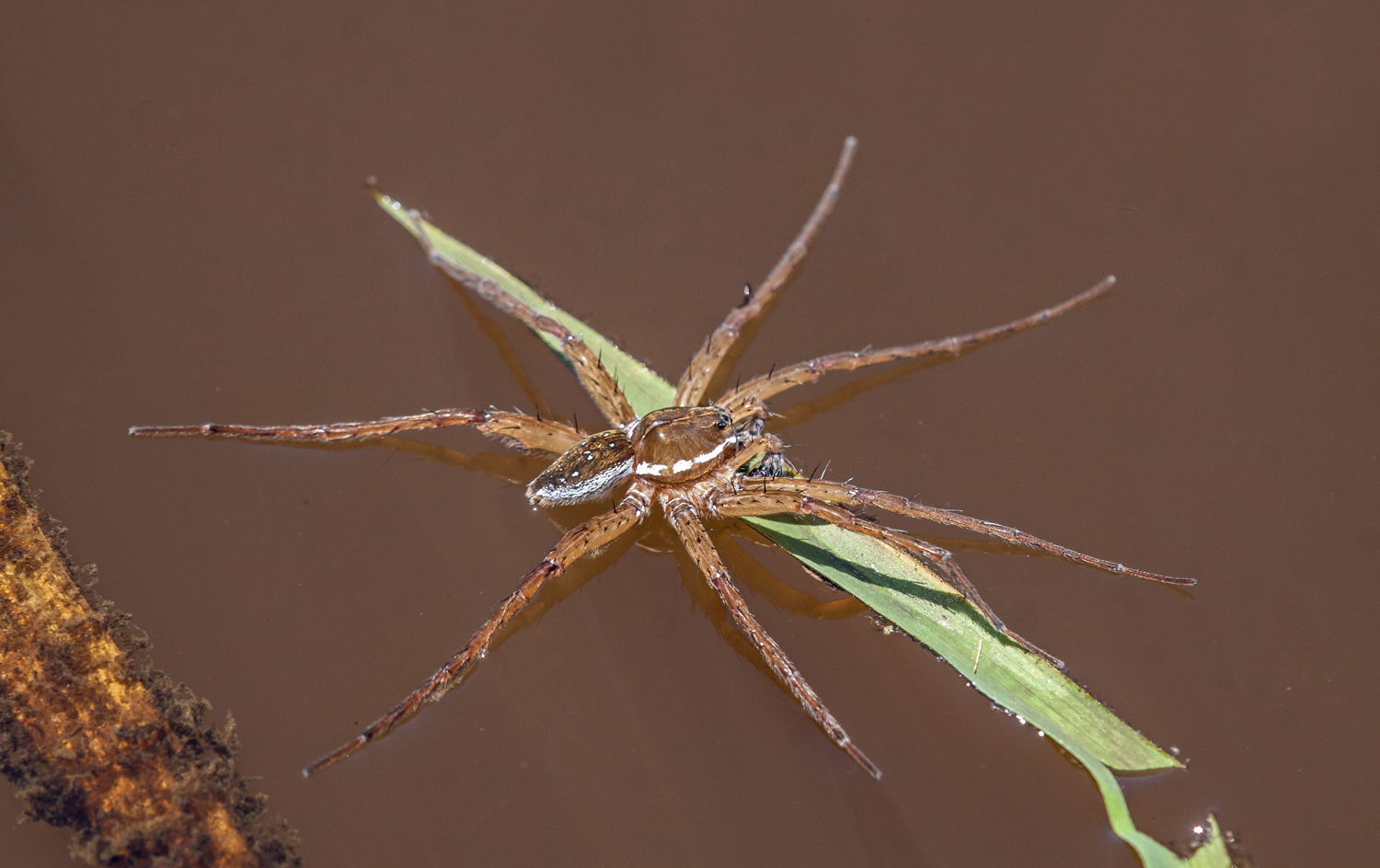
Some movement in the muddy water right below my feet caught my attention yesterday as I was standing at the edge of a small stream at Huntley Meadows Park observing a dragonfly. A Six-spotted Fishing spider (Dolomedes triton) was walking on the water with its legs fully extended.

The other times that I seen one of these fishing spiders, they always had a few legs hanging onto the shore, but this one was moving across the surface of the water pretty quickly, perhaps chasing a potential prey. Unfortunately, overhanging vegetation prevented me from tracking the spider’s movement, so I don’t know if the hunt was successful.

Six-spotted Fishing spider

© Michael Q. Powell. All rights reserved


Read Full Post »

The calendar says that it is not quite spring, but after the cold weather we have had recently, it sure feels like spring when the temperature reaches 60 degrees F (15.5 degrees C) on consecutive days. As I walked about in my marshland park this past Monday I noticed some small flying insects, giving me hope that dragonflies and damselflies will be on the scene soon.

As I was climbing down the stairs of the observation deck, I noticed something hanging in the air. When I bent toward it, it seemed to move farther away from me and eventually came to rest on the surface of the boardwalk. I was a little shocked to see that it was a tiny spider.

There was no way that I was going to be able to get a shot of the spider with the 150-600mm zoom lens that was on my camera, but fortunately I had my 100mm macro lens in my bag. With one eye on the spider, I rapidly changed lens. As I tried to figure out a way to get a shot, the spider started moving, which, of course, increases the challenge of getting a macro shot.

I managed to get a few shots of this early-appearing spider, which I have not yet been able to identify, before it crawled into a crack in the boards and disappeared from view. I’m pretty confident that I will get some better images of spiders as the weather continues to warm up, but this one is special, because it is the first one of the season for me, so I am more than happy with my record shots of it.

spring spiderspring spider

© Michael Q. Powell. All rights reserved.

Read Full Post »

Continuing my quest to find and photograph the dwindling number of insects before winter sets in, I came upon this tiny green spider this past Monday as I was searching for dragonflies. It was almost hidden in the leaf litter, but made a slight motion as I happened to be looking at its direction.

It looks to be some kind of crab spider, though that is more a guess than an informed opinion. One thing that I do know, though, is that I am fascinated by its eyes, which you can see more closely if you click on the image.

I took this photo just about at the minimum focusing distance for my lens, which the manufacture says is 18.5 inches (47cm). I tried to get just a bit closer, but had to back off to keep the spider in focus. As you can probably tell, I was really low to the ground when I took this photo and was using my camera bag to stabilize the lens for the shot.

The weather has turned cooler and rainy, which does not bode well for the insect population. I’ll probably be out tomorrow looking for the survivors (and have a few more to post from Monday if I am unable to find new subjects).

spider1_nov_blog

© Michael Q. Powell. All rights reserved.

Read Full Post »

I’m not big on ghosts and goblins, so to celebrate Halloween I though I’d include a few recent images of spiders that I have not posted previously. Some of my readers may find certain spiders to be creepy and utterly appropriate for Halloween, though I tend to view as beautiful creatures, many of which are capable of creating beautiful web art.

Happy Halloween to all.

NOTE: If you click on any one of the images in the mosaic, you will be taken into slide show mode, where you will see larger versions of the images (when you are viewing the original posting).

© Michael Q. Powell. All rights reserved.

Read Full Post »

This past Friday I spotted one of my favorite spiders, the Bold Jumping Spider (Phidippus audax), in the reeds adjacent to the boardwalk at Huntley Meadows Park. The spider was pretty active and jumped a couple of times, but I managed to get a shot that highlights its multiple eyes and colorful “fangs.”

“Here’s looking at you, kid.”


Bold Jumping Spider

© Michael Q. Powell. All rights reserved.

Read Full Post »

After I have set my camera bag down to take some wildlife shots, I’ve learned from experience that I need to check it carefully for “hitchhikers,” like this little spider that climbed aboard last week while I was focusing on dragonflies.

spider1_bag_blog

© Michael Q. Powell. All rights reserved.

Read Full Post »

The more I watch spiders, the more I am fascinated by them. I used to think that spiders extruded only a single kind of silk, but I have learned that many spiders have multiple spinneret glands that are used for producing different kinds of silk.

One of the most amazing kinds of silk is known as aciniform silk, according to Wikipedia, which is used to wrap up and immobilize prey. This silk looks like a long gauze bandage as it is extruded by the spider.

Last month, I watched as a large Black and Yellow Garden Orbweaver spider(Argiope aurantia) wrapped up a recently captured bee. I was amazed at how quickly it accomplished the mission, spinning the prey as it wound multiple layers of silk around it. Here are a couple of shot I took that show the spinnerets in action.

I loved the reaction of one of my friend to the first photo. He imagined the bee protesting being wrapped in bandages saying, “Hey, you’re not my doctor!”

Argiope aurantiaArgiope aurantia

© Michael Q. Powell. All rights reserved.

Read Full Post »

One of the joys of arriving early at the marsh at this time of the year is having the chance to see spiders’ handiwork, backlit by the rising sun.

web2_blog web3_blog

© Michael Q. Powell. All rights reserved.

Read Full Post »

One of my fellow photographers, Walter Sanford, pointed at the water and exclaimed, “Spider!” A spider in the water? Yes, fishing spiders don’t make a web and instead hunt by sensing the vibrations on the surface of the water.

There are numerous species of fishing spiders, but I think this may be a Six-spotted Fishing Spider (Dolomedes triton). Yes, I realize there are more than six white spots on its back—apparently the name refers to six dark spots on the underside of the spider, a part of the spider that I have never seen.

Six-spotted Fishing Spider

© Michael Q. Powell. All rights reserved.


Read Full Post »

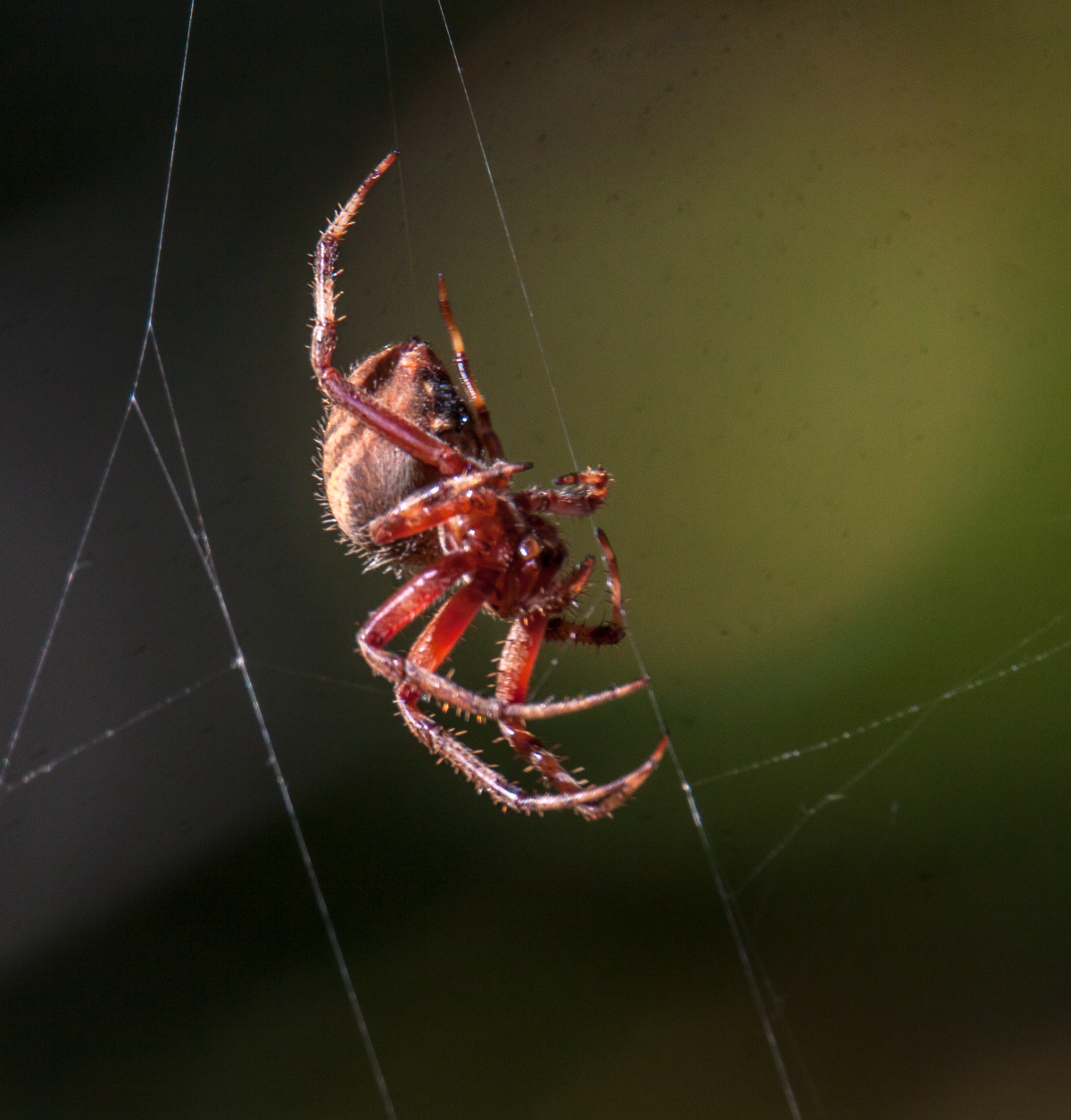
As I gazed across the little creek that I was following, I spotted a spider hanging in midair. The spider scrambled up one of its silken threads as I approached and stopped just short of the branch from which it had been hanging. It was pretty dark in the shade, so I cranked up the ISO to 1250, popped up the built-in flash, and propped the camera against another tree for stability.

Of the images that I attempted, this is the best one I managed of what I believe is a Spotted Orbweaver spider (Neoscona crucifera).

Neoscona crucifera

© Michael Q. Powell. All rights reserved.

Read Full Post »

When I encountered this spider hanging on a branch just above eye-level, I knew I was going to have a problem getting a stable shooting position, so I decided to use my popup flash. It added some additional light and a little drama, though it is pretty obvious that I used it. Like the spider image that I posted earlier today, the image has a really narrow depth of field, a consequence of having to shoot hand held, and only a few of the spider’s legs are in focus.

spider2_small_blog

© Michael Q. Powell. All rights reserved.

Read Full Post »

This summer I haven’t been seeing any of the large orb-weaver spiders at my local marsh that I observed in previous years, but the small spiders can be equally beautiful.

I spotted this little spider when I was hiking through the woods. There wasn’t really enough room to set up my tripod, so I ended up taking the shot handheld with the available light, which meant my depth of field was pretty limited. Although my normal instinct is to move in really close, I decided to take some shots from a slight distance and I like one of the resulting images so much that I am presenting it with almost no cropping (which is unusual for my insect shots). I especially like the interplay of light and shadows on the different elements in the scene, which together produce a sense of drama.

spider1_small_blog

© Michael Q. Powell. All rights reserved.

Read Full Post »

One of my fellow photographers pointed out this cool little crab spider on some Queen Anne’s Lace (Daucus carota) during a photo jaunt to Meadowlark Botanical Gardens in nearby Vienna, Virginia this past Saturday.

In this first shot, my favorite, the spider seemed to be expressing frustration that his prey had escaped his grasp (or simply wanted to show me his awesome biceps pose). Who knew that spiders have biceps?

crab spider

Initially I tried to photograph the spider looking down at it, but I had trouble maintaining a steady pose and my shots were blurry. I decided to kneel down and get at eye level with the spider, looking across the plane of the flower, and that seemed to work a bit better. These shots look like they were done with flash, but the EXIF data shows a shutter speed of 1/320, which is higher than the synch speed of my flash, so these were actually done with natural light, with some exposure compensation dialed in.

The second shot, which preceded the first one in time, shows the spider trying to capture a small insect (I think).

crab2_blog

The little insect starts to run away.

crab3_web

In vain, the spider crawled after the small insect, but it was too late. When I left the spider, it was at the edge of the flower, looking off into the distance, pondering perhaps what might have been, thinking about the one that got away.

crab4_blog

© Michael Q. Powell. All rights reserved

Read Full Post »

One of my fellow photographers excitedly pointed out a small spiderweb to me as I was preparing to leave my local marsh and I moved closer to investigate. At the center of the web was a small colorful spider of a type which I had seen before, but had never identified. I realized that I must have a peculiar reputation when others start to get excited about spiders on my behalf.

I felt obliged to take some photos, given that my friend had gone to the trouble of spotting the spider for me, but I didn’t have any great expectations that they would turn out well. The spider was small and the angle of the web made it a little tough to keep everything on a single plane (and I was handholding the shot at close range).

I really admire the artistry of spiders and their webs, however, and have not seen many this spring, so I took quite a few images and was pleasantly surprised with the result. The spider probably is an Orchard Orbweaver spider (Leucauge venusta) or possibly the similar Leucauge argyra. As you may note, this is a kind of long-jawed spider with legs of differing lengths. It is an ongoing mystery to me how the spider is able to weave an intricate, symmetrical web with such asymmetrical appendages.

Out of all of the subjects that I photograph, spiders tend to be the most polarizing—readers tend to find spider images to be either creepy or beautiful. I hope that the majority of readers will view this colorful little spider as beautiful.


spider_color_blog

© Michael Q. Powell. All rights reserved.

Read Full Post »

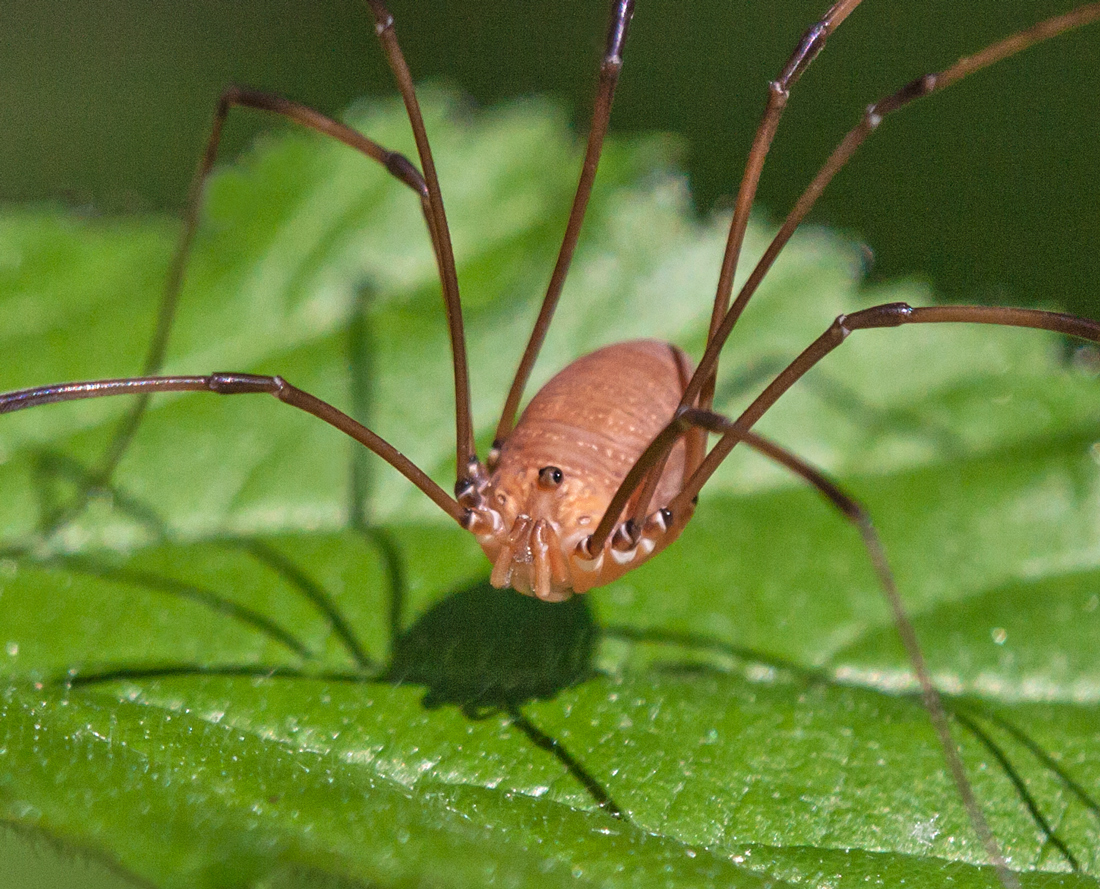
Daddy longlegs have a single pair of eyes, oriented sideways, in the middle of their heads and it’s a little disconcerting to peer through a macro lens and see one of these eyes looking toward you. Daddy longlegs (also known as harvestmen) belong to the arachnid family, but are not spiders. Harvestmen make up the order Opiliones and, according to Wikipedia, there may be as many as ten thousand species of harvestmen worldwide, with over 6500 already discovered.

I cropped the first shot of the harvestman to allow you to see the eyes better, but it doesn’t really give you a sense of the length of the legs. The second shot, which is actually a less-cropped version of the first one, shows you more of the legs. I did crop out the ends of the outermost legs, though, to keep the body from looking too small.


daddy1A_june_blogdaddy1_june_blog

© Michael Q. Powell. All rights reserved.

Read Full Post »
As a follow-up to last week’s preview, here is the complete story of my recent encounter with a Bold Jumping Spider (Phidippus audax) and a female Eastern Pondhawk dragonfly (Erythemis simplicicollis). The photos are a bit graphic, particularly for those of us who like dragonflies, but they illustrate the reality of nature that even super predators like dragonflies can easily become prey.

dragon1A_spider_blogAs I was walking at my local marshland park, I spotted a bright green dragonfly perched on the boardwalk and suspected immediately that it was a female Eastern Pondhawk. I moved in slowly to get a shot and was a bit surprised when the dragonfly did not take off when I got close. This is the initial view I had of the dragonfly.

dragon3_spider_blogI looked closely at the dragonfly and noticed that it was lying on its side and appeared to be dead. Wondering what might have caused its demise, I picked up the dragonfly’s body to do some amateur forensic analysis. (I obviously watched to many televisions shows about crime scene investigations.) As I lifted the body toward my eyes, I was shocked to find that a fuzzy black spider was still attached to it. Apparently the spider had been hiding in the gap between the boards as it feasted on the dragonfly.

Somewhat in shock, I dropped the dragonfly back onto the boardwalk and the fall caused the spider to be separated from its prey. Undeterred, it quickly set off to recapture the dragonfly.

dragon4_spider_blogThe spider grabbed the dragonfly in a headlock and began to drag it back toward the gap between the synthetic boards of the boardwalk. It seemed totally oblivious to my presence.dragon6_spider_blog

When it reached the gap, the spider paused for a few seconds, as though considering possibility of dragging the body through the gap.

dragon7_spider_blog

The spider decided to give it a try and did its best to pull the body in, starting with the head.

dragon9_spider_blog

Despite the spider’s best efforts, however, the dragonfly’s body was simply too big.

dragon12_spider_blog

As I left the scene, the spider had again settled down out of sight below the surface of the boardwalk, happily enjoying its meal and presumably hoping that it would not be disturbed again.

dragon10_spider_blog

© Michael Q. Powell. All rights reserved.


Read Full Post »

« Newer Posts - Older Posts »